Most of my elementary education was pretty amazing, I think.
I don’t have very many clear memories, but most of it is just this fuzzy sense that it was pretty awesome and I loved it, especially when we were living in Iceland. I had a huge group of friends, I could learn whatever I wanted– in fact, I think the years we spent in Iceland were the happiest of my childhood. Part of that was we were going to an overseas military church, and that is a unique experience. The lines between church and family blurred.
When we got back to the States, though, everything was different.
One of the first unfortunate things that happened, I think, was the church we attended in New Mexico ostracized my mother in many ways because she decided to continue homeschooling us instead of enrolling us in the church school. She faced some pretty intense push back for that, for reasons I didn’t understand. How it affected my life was that I didn’t make friends with anyone at church, which deeply disappointed me. They were all friends with each other at school, so breaking into the 10-year-old’s clique proved too difficult for me to manage.
I didn’t do myself any favors with that, though. I think part of it was that I was hurt and angry over being unconsciously rejected by the kids at church, so the “well, I don’t need you anyway!” attitude became part of the equation. At one point I got a scorpion shoved down the back of my dress and I was done. I sat by myself after church ended and refused to speak to any of them.
That was really my first taste of the “us against them” mentality I would accept as the incontrovertible order of things once I was older.
I was different because I was homeschooled. That was what made us separate.
When we transferred to Florida, one of the requirements my mother had for finding a church was other homeschool families. It wasn’t the only requirement, but I remember it being one of the biggest. We visited two churches, and I think one of the biggest reasons why we ultimately chose the church-cult was that a higher percentage of the families homeschooled. This also ended up being how we were cemented into the conservative Christian culture of homeschooling.
Let me make it clear: the conservative Christian/fundamentalist homeschooling culture was always present. In Iceland, many of the homeschooling families were extremely conservative. While the church was a far cry from fundamentalist, many of the people who attended it were. My mother began wearing skirts and destroyed all her Amy Grant and Steve Green CDs because the other homeschooling mothers she hung out with did. There was enormous pressure to conform, and we did. We were introduced to Michael and Debi Pearl in New Mexico, and the homeschooling families there helped inculcate in me many of the homeschooling stereotypes– especially a love for all things Pioneer and a Little House on the Prairie.
However, the church-cult was where I would spend more time than I have anywhere else, and it was where we got sucked even further into homeschooling culture. It was there that we started hearing the message homeschooling or bust, but messages like these weren’t being preached from the pulpit. It was in pamphlets and magazines that were being passed around by all the homeschooling moms. When I was in high school, I read a book called None Dare Call it Education, a book which spends a ridiculous amount of time wailing about how liberal Massachusetts is, and how public school is wrecking our great nation.
Almost all of the homeschooling material we received focused an awful lot of time on telling us how terrible every other kind of education is and how awesome we were for doing the “right thing.”
It seems like most of the messages we got were all about building public education straw men than they were about helping homeschoolers do a good job educating their children.
It didn’t help that just like I had been ostracized by the kids at church in New Mexico we started ostracizing all the kids who weren’t homeschooled. There were three families where the children went to public school, and all of them left– some more quickly than others. I have vivid memories of hanging out at one of the girl’s house and being curious about her math textbook. She was confused when I asked if I could look at her textbooks, but I remember being blown away when I saw what they looked like. I had somehow believed that public schools “dumb down” the material, but what I found in those textbooks was far more advanced than what I was learning even though we were in the same grade. I remember struggling to come up with something to say– and then being deeply troubled by how much looking at those books had wrecked my perceptions.
It didn’t take me very long to come up with plenty of plausible explanations to explain the difference away. That experience was the first time I deliberately denied evidence that public school might– just maybe– be totally fine in favor of believing that being a homeschooler meant that I was superior.
I was twelve.
*****
Middle school is where we first ran into problems with my education. Up until that point I remember being a pretty easy kid to homeschool. But when we hit middle school, all I can remember is either being incredibly bored or hating school. Eventually it got so bad that my mom decided that going through grade 5 was pointless since it was really just a re-cycle of grade 4, so I skipped from 4th grade to 6th grade.
That was the year my mom tried to mix things up. We tried Writing Strands and Saxon Math and I started studying Greek and Latin roots and logic. In some ways, it got me excited about school again, but that interest quickly faded. Me and my mother started struggling, and my frustration started increasing again, but this time it was because I couldn’t learn concepts as quickly as I’d become used to. Things like long division took me weeks to understand, and it made me an incredibly difficult student to deal with. There were days when my mother would throw up her hands and disappear into her bedroom, shouting “call me when you graduate from college!” I became resistant and stubborn, and both 6th and 7th grade were a struggle. I hated Saxon math so much I just refused to keep doing it.
At this point we fell into what I think is a pretty common homeschool trap. I don’t have a term for it, but it happens close to the end of the year. You spend the few months leading up to May or June barely doing any schoolwork at all because you’re sick of it and you don’t want to do it anymore, but you have to do something to finish so you throw together a quick compromise: if you do xyz, complete a few papers, and finish the last quarter of tests and quizzes you can be done for the year. So you spend the last few weeks cramming in all those tests and quizzes you forgot to take (grading many of them yourself and let’s be honest we usually cheated) and then hoo-ray it’s summertime.
Some homeschooling families are more disciplined than this, I know. But, from all the conversations I’ve had in the last eight years, disciplined homeschooling environments where projects were completed in a timely fashion and tests and quizzes were taken when they were supposed to, and you completed enough actual days? That is the exception, not the rule. The rule is much more haphazard and flexible– too flexible, really. And while the flexibility of homeschooling is one of the advantages, it’s also one of its drawbacks, too.
Positive and negatives in homeschooling are usually two sides of the same coin.
My first experience with school was HeadStart at a Department of Defense school, since my father was in the Air Force. I don’t have very many clear memories of this, although they’re mostly positive. I remember coloring a large squirrel, playing with blocks, and listening to stories. However, there were a few drawbacks.
One incident is actually my earliest memory of sexism.
I was playing with wooden blocks–not a toy we had at home, so the only one I was really interested in at school– and I was building towers with another little boy. My parents had shown me concepts like having a wide base in order to build a tall tower, but the boy was stacking one block on top of another– not that I cared or was paying much attention, until he became angry that my tower was taller than his. I remember the teacher coming over and reprimanding me for “showing off” and how I shouldn’t do “boy things.”
I got reprimanded for “showing off” quite a bit, actually. I have always been a perfectionist and I’ve always been incredibly proud of my work. When I colored, I did it excruciatingly slowly and carefully– and turned out what I felt were “realistic” results with my childish attempts at shading and blending. Teachers would encourage me to “have more fun” and not to take things so seriously, which I remember being very confusing. I’ve also always been talkative, and I remember struggling to make friends and feeling that I was disliked, although I had a few good friends and playmates, although I don’t remember my closest friends being from school, but my neighborhood.
What my mother’s main concern about this time period was that I went to HeadStart being able to read, and then my reading skills not only did not progress, but instead regressed. I actually lost some of my ability to read, and my mother spent the summer catching me up to where I’d been before.
We were transferred to Iceland, and I think my first day at kindergarten was in the middle of the school year. Again, my memories of this are mostly positive. There was finger painting, which actually frustrated me because I felt that I wasn’t very “good” at it, and we did science experiments, and I think there was a school performance with singing. An interesting factor about attending a DOD school in Iceland was the cultural enrichment– every so often an Icelandic teacher would come in and teach us something about the country. Most of the time this was fairly simple– teaching us to count to 10 in Icelandic, some basic Icelandic history, some of what Iceland is known for (like their horses and fishing, the geizers and waterfalls).
However, one of the lessons was really confusing to me. The visiting teacher had us sit cross-legged on our reading mats, close our eyes, and to imagine a light coming to speak to us. She explained that the light we could see was an angel and he would allow us to talk to someone we’d known who had died. When I got home from school that day and tried to explain to my mother what I’d “learned,” her reaction was, of course, rather horrified.
We’d practically held a séance in class.
I didn’t go back to school, and that was when my mother officially began homeschooling me.
The first few years I don’t honestly remember much of my schooling. I have vague memories of the curriculum we used (something with a white cover and a blue shield), but I do remember the “school room” my mother set up. She converted a closet, putting in a desk, some shelves, and a large map on the wall. Sometimes we used the room, but I remember spending most of my school days in makeshift blanket forts (how awesome, right?). When I got a little bit older and started playing with the other kids in our apartment building, my mom made a little cross-stitch to hang on the door to let them know that I was doing schoolwork and couldn’t come out to play.
We had an incredibly active homeschool group in Iceland, and I remember it being very diverse. There were kids from a bunch of different churches, kids who didn’t go to church at all, and parents who were homeschooling in a bunch of different ways. Being at an overseas military base meant that your resources were limited, so you took advantage of what you had. I also continued playing with kids who were still enrolled in the DOD school– kids in my building, the children of my father’s co-workers, and because it was the military, the people I knew were Philippino, and Japanese, and African-American, and German.
This time was spent eating baklava and fried seaweed, and I loved it.
Homeschooling in these early years was extremely good for me. I remember being frustrated at school because I wanted to advance further, ask more questions, and I could become incredibly– almost myopically–focused. Once I was curious about a topic– like how a bean grows in a plastic bag taped to a window– it was very difficult to keep me from dominating the next half hour, and I remember teachers being very frustrated with me because they just didn’t have that kind of time. A classroom setting, for me as a six-year-old, was not a good fit. Once I was liberated to do as much schoolwork as I wanted when I wanted and free to read anything I wanted to when I wanted to was incredible.
That actually created some interesting moments– there were days when I would whip through whole sections of my textbooks, and other days when I didn’t want to do schoolwork at all. My mother tried to get me to take it one lesson at a time, but I remember fighting with her about this and sneaking off to do more schoolwork. When I progressed to the point in my math where I was adding more than one column, my mother became incredibly confused at my answers– and then figured out that I was adding up each column separately and then answering 12+48 with 510 (carrying the one, apparently, was a confusing concept for a while).
When we moved back to the States and my mother had the opportunity to put me in public school, another DOD school, or the local church school, she decided to continue homeschooling me– and eventually my sister– because it had worked so well for me and I was obviously doing well. However, State-side homeschooling turned out to be a little different, and that’s where we started running into problems.
What I’ve found that’s a common pattern for most of the homeschoolers I’ve interacted with was that our parents had excellent reasons for starting to homeschool us. While part of why my mother started to homeschool me was religious, it turned out that the primary reason was that the typical classroom experience seemed to be holding me back, so we continued homeschooling because it seemed to be better for me.
However, what I’ve encountered is that once you start homeschooling and become entrenched in homeschooling culture, parents seem to be actively and preemptively discouraged from reevaluating that decision.
Children’s educational needs change over time, and while it was obvious that homeschooling me was the best decision for me when I was young, we never really took a step back and asked if it was the best method for my later education. When I was old enough to perhaps ask the question if being homeschooled was what I wanted, I was already absolutely convinced that going to public or private school would be horribly disastrous.
I’ve been avoiding writing about this. Even once I started planning out the series, I debated with myself for weeks over whether or not I wanted to write it out– and then post it. I’ve talked a lot about some of the other aspects of growing up in fundamentalism, but I’ve avoided talking about my experience with homeschooling for a few reasons. I’ve touched on it a few times, and I’ve even written posts for Homeschoolers Anonymous and for Leaving Fundamentalism. Even as I wrote those posts, I was hesitant about sharing them here, although I did eventually.
I would describe my homeschooling experience as fairly average.
One of the beauties of homeschooling is that no one experience could be called truly average or representative, but in the past nine years since I’ve graduated I’ve been able to interact with hundreds of homeschoolers from all over the country. There are different sub-sets in homeschooling, with the conservative Christian/fundamentalist sub-set probably being the largest, even today (although other movements, like secular and unschooling, are gaining ground).
Since conservative homeschooling environments are probably the largest and the most dominant (see: every single state-level homeschooling conference ever), I’m comfortable with viewing my experience as pretty middle-of-the-road. There are a few patterns – in how homeschooling is experienced, in how it is talked about by its advocates – and some of those are what this series is going to focus on.
My “average” experience is actually why I’ve decided to write this series, though.
HA has hundreds of stories now of educational neglect, of spiritual and physical abuse, and one of the very common arguments that people like R.L. Stollar and Heather Doney are running into all over the place is that yes these experiences are awful but it’s not really homeschooling you’re talking about you’re really just talking about abuse and that’s present anywhere.
So while my church experience was definitely abusive, and while some of the things that were taught at church caused my parents to do some harmful things, my homeschooling experience was slightly detached from all of that. Up until this year, I would have described it in glowing terms. I believed my education was… well, superior. And while I haven’t completely changed my mind about that, I’ve come to realize that my “average” experience was lacking in some pretty big ways that do seem to be common among homeschoolers– religious and conservative homeschoolers, especially.
The second– and biggest– reason why I’ve hesitated writing about this was that talking about homeschooling inevitably means talking about my parents. If there were problems with my education, my educators were responsible. And while many of those problems can be shifted onto the myths and lies my parents were being fed by the homeschooling culture (which I’m going to talk about at length), I don’t have multiple teachers, principles, school boards, or lack of money to blame. I do my best not to drag my parents or my family into my blog, because this blog is about my journey, but I can’t talk about homeschooling in the same way that I can talk about my church-cult.
I love and respect my parents. They were doing what they honestly believed– thanks to the HSLDA, Vision Forum, and the endless homeschooling catalogs and flyers and books and magazines– to be the best thing for their children, and they did their research. They rejected a lot of the more damaging concepts you can find in Homeschooling Today. We rejected the form of homeschooling we laughingly referred to as “the goat-raisers” (incredibly large families, “homesteader” approach). They bought the highly-recommended curriculum, and they sacrificed a great deal of money to get it. They celebrated my successes and encouraged my dreams.
I value everything my parents gave up in order to get me a good education, and this series in no way is meant to criticize them.
There were some very good things about my education that you can hear from a lot of other homeschoolers– a love of reading, unbridled curiosity, and plenty of time to explore. However, even those incredibly positive, valuable things have their downsides.
I’m going to be brutally honest, and sharing my experiences is going to be complicated, and messy, but as nuanced and balanced as I can make it. Hopefully, talking about my “average” experience will help open the door to a conversation about homeschooling that hasn’t really happened yet.
“No true Scotsman is an informal fallacy, an ad hoc attempt to retain an unreasoned assertion. When faced with a counterexample to a universal claim (“no Scotsman would do such a thing”), rather than denying the counterexample or rejecting the original universal claim, this fallacy modifies the subject of the assertion to exclude the specific case or others like it by rhetoric, without reference to any specific objective rule (“no true Scotsman would do such a thing”).”
When my mother decided to homeschool us, we became homeschoolers.
We joined the local homeschool support group, my mother bought our textbooks at the state homeschooling convention, and we paid dues to the Homeschool Legal Defense Association. We joined a homeschool choir, homeschool art classes, and homeschool sports team. We went to homeschool park days and joined in on ‘homeschool day’ at Raging Waters.
To the other homeschoolers it was clear: we were homeschoolers.
The people my parents interacted with in a personal or professional capacity knew that we were homeschooled and asked us the normal homeschooler questions: “But what about socialization?”, “How can a parent teach their children subjects they don’t know?”, etc., and we answered them with the same responses homeschool parents and children publish on the internet today.
We joined the homeschool debate league, for which being legitimately homeschooled (by their definition, legitimate meant: not attending any school) was an enforced requirement. When my mother hosted homeschooler debate conferences, it was unquestionable that we were homeschooled.
When we hosted homeschool game nights, homeschool dances, homeschool ‘Reformation Day’ parties, we were a celebrated part of the homeschool community. When a family friend’s daughter was struggling with school, her parents asked my mother to homeschool her for the rest of the year to get her caught up with her grade.
When my mother was frequently complimented on how ‘good’ her teenagers were, ‘not like teenagers at all but like little adults’, our homeschooling was the accepted cause. When I was admitted to community college and college, my homeschooling was clearly understood as my background. When I ‘graduated’ high school, we rented out a church with four other homeschool graduates, packing out the building and holding an elegant outdoor buffet for the homeschool community on the neighboring school’s lawn after.
For years after, I was accepted as a part of the homeschool graduate community.
I participated in the exclusive ‘Homeschool Alumni’ network. I connected with other adult homeschoolers and compared notes about our childhoods. Nobody questioned the fact that I had been homeschooled. Instead, it was celebrated as the reason for my intelligence, creativity, work ethic, and academic success. Due to my father’s unique position in our local community, there were – and there are – (and this is not an exaggeration) easily more than a thousand people who knew that I was homeschooled, that I played the harp, and that I went to Santa Clara University, followed by Oxford. Many of them knew my face, and possibly even name, as well. I was the homeschooling success story of Saratoga, California, and my family was a model family, one strangers regularly told me I was ‘so lucky’ to be a part of.
But the moment I say that homeschooling enabled my parents to hide abuse and neglect, all of these facts melt away.
I’m no longer a homeschooling poster child.
After all, no true homeschooler would abuse or neglect their child.
I was an aberration. My family was a one-off, virtually non-occurring instance. The families we knew in which the entire community softly murmured about how the children were sexually abused, or neglected, but did not report because ‘it would give a bad reputation to homeschooling’ or ‘the children would be taken away’ also become aberrations the moment I mention them publicly. The number of homeschoolers I personally knew via activities such as homeschool support groups or homeschool debate who were also mistreated, several of which have written for HA, has no reflection on the percentage of homeschool homes where mistreatment occurs. After all, they weren’t true homeschoolers either.
The true homeschoolers were the ones who gave their kids great educations and a great upbringing.
Every account of homeschool experiences should, we all know, contain a disclaimer: ‘not all homeschooling families are like this. Most homeschool families are loving homes that provide their children with an excellent education’. Except, we don’t have any evidence or statistics that this is true. So why is this a required disclaimer? How can we even make this statement at all?
It’s also appropriate to ask: what do the phrases “loving home” and “excellent education” mean to the homeschool leaders and parents who use them? They tell us that true homeschoolers spank their kids, sure, but not to an abusive extent. It’s just to teach them to respect authority. True homeschoolers don’t isolate their kids; they just keep them inside during school hours to avoid calls to CPS, and they protect them from worldly influences. True homeschoolers aren’t educationally neglected; instead, many homeschool girls are raised to succeed at the high calling of being wives and mothers, learning home arts such as cooking, sewing, and cleaning, and taught applied academics as well – for example, how to multiply and divide via cooking lessons, and geometry through sewing.
Start asking specific questions about the ‘happy’ home and ‘good’ education they describe, and an unexpected picture often emerges.
After I had been working with my therapist for three years, she said to me, “You had a truly horrible experience, but I don’t think it is a reflection on homeschooling as a whole. All the other homeschoolers I’ve talked to have had great experiences.” I responded, “Yes, but how many of them were graduated homeschool kids?” Her eyes visibly widened as she replied, “Actually, they were all homeschool parents. That’s a good point. I never thought of that before.”
Homeschool parents: stop crying ‘no true homeschooler.’ If you can’t, an echo of Shakespeare comes to mind: “Methinks thou dost protest too much.”
The holidays are usually a time of great joy, spending extra time together as a family, laughing, sharing precious moments and building memories. The holidays seem perfectly designed for family togetherness, and yet, we, your adult children sit here in the midst of the most dreaded season of them all. Because at every turn we are told that holidays mean having this perfect Christmas card worthy family scene, and that is so very far from our reality.
We, your children, your brothers, your sisters, face a Thanksgiving where we’re not sure how to be thankful because of the huge amounts of anger and hurt being thrown our way. Your words wound us until we are unsure how we’re even supposed to keep from crying into our turkey and cranberry sauce. We face a Christmas sitting alone at home, because that was the only option that didn’t involve being hurt over and over again by your cutting words and judgments. We can’t afford to go somewhere nice on our own because we have to fend for ourselves in a world we were woefully unprepared for. Trying to pay for our own education while working to the bone to create a decent life for ourselves is no easy task, yet it is one you seem completely content to have handed to us.
Most days we are able to bury the hurt we have experienced at your hand just below the surface, simply so that we can continue surviving.
We have to be the strong ones, because we are on our own.
There’s no time to let your words sink deep enough to break us down. However as the holidays come, it seems that every year it is just too hard to ignore that pain. Perhaps it is because for those of us that are still in our families’ lives, the hurts continue year after year. And for those of us who are gone from your life, the absence and quiet becomes just too loud to shut out today.
So today, and perhaps just for today, let’s talk about how much it hurts to be a broken family.
We are your sons, your daughters, your brothers, your sisters. We are part of that great idea called family. Friends you are born into life with, people you share DNA with, all part of the same group that is supposed to stick together through thick or thin. And yet somehow, somewhere, our perfectly preserved little family fell apart.
Some of us have experienced the complete and utter rejection from our families outright. Too many children have been turned out on the streets by the very people who gave life to them. There is hardly anything worse you could ever do to your own child. Some of us have moved forward with our own hopes and dreams only to hear in the midst of our own joy and freedom that the doors have been slammed shut behind us. Yet others have met the one that fills their soul, and you, our family; say “we want you to be happy, but only by the happiness we define for you.” Sadly, our dreams, goals, lovers, and futures do not line up with the harsh lines you have drawn in the sand.
We are told in no uncertain terms that we are not a welcome member of your family any longer.
While resolute rejection is a heartbreaking thing to experience, there are also those of you that call yourselves our family and project this pretty little family togetherness image to those around you, yet when it’s only us around the dinner table the gloves come off. We are expected to act as if everything is perfect and wonderful, yet all the time hearing words that tear us down to our core. You say we are unworthy of your deep love and affection because we don’t share the same view on all issues. We are only to be tolerated and condescended to spend time with.
This kind of “love” is, to put it nicely, a lie.
There’s not much we know to be true from our childhood teachings, but the one main message we heard loud and clear is that God is Love. You may put a pretty spin on it, call it tough love, but when your words are poisonous to the soul, this is not the love of Jesus. When we cry ourselves to sleep because of this deep separation from our former closest confidantes, this, dear family, is not the unconditional, agape love you preached. Whether you like to admit it or not, we may have actually absorbed that lesson better than you did. Perhaps in the midst of the Greek and Hebrew studies you lost sight of the hearts of those you were supposed to be teaching about this simple love. Whatever the reason, we know better. Love is not love when it changes or has qualifiers. This “love” you tell us about as you hurl your dagger words is not love, but rather you trying to comfort your conscience with excuses.
And finally we come to the third kind of broken adult child. Those of us who have had to walk away from you, rather than the other way around. To be fair, all of us have had to do this to some extent to pursue our own dreams and move forward in life, but there are those of us that have had to put the walls all the way up, for our own safety and sanity. When the messages of attack and hurt come wave after wave, it takes its toll. You know that saying “death by a thousand paper cuts?” Well the same could be said about your words, family. There is only so much pain and heartbreak we can endure before we are simply done.
As much as it breaks our heart, it also saves our heart.
In our community, the stories of suicide, depression, self harm etc, are far too common. Sometimes, for our own safety, we have to shut you out, because there are only so many toxic things one can handle until the pain becomes too much.
Please family; take us seriously when we tell you how badly your words hurt. You would not believe how much your preaching, lying, manipulating, guilting, attacking, and judging tear us down. If you are still in our lives, do not take that for granted. It is by our choice, and our choice alone. Heed this warning, because you never know which word will be the thousandth painful word that causes us to walk away forever. If you have shut us out, please think about the relationships you are missing. Grandchildren, cousins, nieces, brothers, nephews, sisters, and daughters.
We are your children.
You raised and cared for us. We trusted you the most. We trusted you first, before anyone else. Please, take a moment this holiday season to think about us, your adult children, and consider changing your attitude toward us. We aren’t asking you to change your convictions. We wouldn’t want you to ask us to change ours (even though you have). We don’t seek to convert you to our “side.” We don’t want to debate, discuss, or disagree. We just want to be a family.
We just want to be purely, unconditionally, forever loved.
Adria Murphy blogs at The Still Point. The following post was originally published on her blog on December 7, 2013 and is reprinted with her permission.
I don’t usually write in reaction to or dialogue with other bloggers. Writing about my own life is emotionally vulnerable, but non-controversial. I don’t blog frequently. When I do write, I do so because I need to say something. But I need to say something right now that is both personal, and possibly controversial.
There has recently been a growing awareness of the devastating problems of abuse and oppression in the conservative Christian homeschooling community, thanks to brave people like my friend R.L. Stollar, a Community Coordinator for Homeschoolers Anonymous. The stories on H.A. are blood-chilling to me, because they sound so familiar. I knew these people, or people like them.
As I’ve read these stories, I’ve been thinking about my own upbringing in a conservative Christian home. I am not the perfect picture of mental health. I’ve struggled with depression and self-destructive behaviors. I’ve had (have?) my share of identity and image complexes.
Complexes notwithstanding, however, I launched into college and adult life with a strong education, an intact faith, and an overall positive and grateful outlook on my own homeschooling education. So as I read these articles and think about the people I know personally who had horrible homeschooling experiences, I am trying to figure out what made my story different. I have a few ideas.
I do not imagine this to be a definitive or even generalizable list. I am so aware that I grew up in very, very privileged circumstances. I want to write this gently. I want to write in a spirit of gratitude, not out of pride, authority, or judgment.
I want to lend my voice in support of those who have experienced abuse and hardship from the homeschool community.
But the thing I do best with my voice is to tell my own honest story. So that’s what I’m doing. If you are a homeschool parent or considering homeschooling, let me share a beautiful example of wisdom and responsibility with you. If you are someone who has experienced the unhealthy side of homeschooling, I am sorry. I am so sorry. And my prayers are with you. I hope we can make things better.
Before I begin my list, let me describe my background. I was homeschooled from sixth grade through high school graduation, and attended a private Christian school before that. I wouldn’t go so far as to call my parents hyper-conservative, as I am all too familiar with startling extremes more deserving of that title. My parents weren’t trying to marry off my sisters or me as child brides. However, my upbringing was sheltered enough to shock even many of my friends at my conservative Christian university.
I wasn’t allowed to watch Lion King or Pocahontas as a kid, because of the “New Age stuff.” Until I left for college, the only R-rated film I’d seen was Passion of the Christ. I wasn’t allowed to date in high school, and in fact had to ask for permission to date after I was already 18 and in college. I wasn’t allowed to wear spaghetti strap shirts, and sometimes even my tank tops were considered too revealing. I read “I Kissed Dating Goodbye” repeatedly, not only because I was convinced that dating was evil and that courtship was Jesus’ perfect plan for my love life, but because I thought the cute anecdotes about happily courting couples were romantic and even a bit racy. As in, oh my goodness, this is the part where Joshua Harris talks about kissing. Gasp. Giggle.
That’s where I came from. Yet, somehow, I emerged thankful for my upbringing. Given the choice, I’d do it again.
So here is my list. Here are the ways my mother homeschooled me without screwing up my life.
1) She treated homeschooling like a tool, not an agenda.
My mother decided to homeschool my brother, who has Asperger’s Syndrome, when the school system failed to offer a supportive solution for his high IQ and low social skills. She started homeschooling me when I, socially misfit and academically bored, came home from my private Christian school in tears too many times. My two sisters followed suit a year later. However, when my youngest sister showed signs of wanting more social opportunities, my mother put her back in private school. When my brother needed more classroom experience and study skills, my mom drove him to a charter school a few days a week, homeschooling him the rest of the time so he could continue to thrive academically in the most comfortable environment. In high school, one of my sisters butted heads with my mother on academic decisions. Rather than demand compliance, my mother enrolled her in a public high school. Halfway into her second year in public high school, my sister wrote my parents a letter asking if she could try homeschooling again. And they did.
My mom has told me, “It’s very difficult to homeschool a child—especially a teenager—who doesn’t want to be. High school students want and need more autonomy over their education. Some people think that’s a battle you have to win. But I don’t think it’s worth fighting at the detriment of the relationship.”
Because of this continual reevaluation and adjusting of our educational options, at one point my three siblings and I were being educated in four different ways: one in private school, one in public school, one part time at a charter school and part time homeschooled, and one (me) fully homeschooled. My mother homeschooled us, not because she was interested in pushing homeschooling as the only or best option, but only when she believed that it truly was the best option in practice.
2) She made academics a priority.
Not only is my mother a pediatrician, highly educated in mathematics and science, but she is also very knowledgeable about literature and writing. Because of her educational background, my mother not only provided us with a rigorous and fascinating science and math education, she graciously welcomed other homeschooling families to join our academic endeavors. On a weekly and sometimes daily basis, we had “classmates” from other homeschooling families in our dining room dissecting cow eyes and puzzling over trigonometry problems.
However, in areas where my mother felt she could not provide us with a comparable or better education than the private and public schools, she found help. Since she is not fluent in a second language, she hired Spanish tutors for us (and once again invited other homeschooling families over to our house to join our Spanish class). She purchased computer software and videos to supplement—though not replace—her instruction. We utilized distance and online learning programs. She sought out the best.
My mother also made it clear that we would never use the flexible schedule afforded by homeschooling to make academics secondary to our extra-curricular activities. Like many of our homeschooled friends, my sisters and I competed in a national speech and debate league for homeschooled highschoolers. However, we were never allowed to research until our school work on core subjects was completed for the day (the most we could hope for was to work ahead or bargain away our weekends in order to schedule a full day of uninterrupted research). My mother also cautioned against an overly rigorous tournament schedule when she found we were falling behind in our core subject work as a result of too many long, exhausting debate tourney weekends.
We all were involved in athletics and arts, but never to the detriment of our school work. We were all taught domestic skills and were responsible for household chores, but we weren’t expected to be miniature parents. I’ve sewn a few skirts. I’m a reasonably competent cook. That’s about it. Academics came first.
3) She raised her daughters and son with disabilities to have careers.
My mother kind of vetoed my first desired career of International Singing Sensation. In the same breath, however, she warned against hoping to become a stay-at-home mom without a backup plan. “Everyone woman should have a marketable skill,” was her mantra. “You can’t control when you’ll get married. What if you stay single? What if your husband loses his job? Or dies? What if you can’t support your family on one income? You have to have a marketable skill.”
As a physician who gave up a brilliant and beloved medical career in order to homeschool four children, my mother was certainly a fan of stay-at-home moms. I will be eternally grateful for her sacrifice. However, she was also a fan of being realistic. Just because she, by God’s grace, had the financial means and circumstances to homeschool us never meant we should expect the same privilege. She pointed out examples of women in our lives, married and single, who had chosen wise career paths and were capable of supporting themselves and, if need (or desire) be, their families.
At the age of 26, I have never been in a relationship. I could be single forever. But I have a fulfilling career that I love. I shudder to think how my self-esteem would be currently suffering were I waiting on a husband to give me my purpose in life. I shudder to think how I would be affording an apartment of my own right now, had I pursued International Singing Sensation or Rich Husband as my primary provision in adult life.
My brother, meanwhile, just got his first job wrapping silverware at Red Robin. We are so proud of him.
4) She lived like a whole person.
One of the best things my mother has done for her children has been to live like her children are not her whole life. We certainly take up most of her time, and I like to think that we’re the most awesome part of her life. But we aren’t all of it.
Once I came home from college to discover my mother beating on our kitchen barstools with drumsticks. “I’m taking a Taiko drumming class,” she explained. While still homeschooling my youngest sister, my mother has been taking classes on health and medicine in third world countries to prepare her for medical missions trips. She participates in runs and bike races. She takes dance lessons and cooking classes. She calls me to tell me what she’s learning in her Bible studies. She speaks like her world is still getting bigger and brighter.
I believe she loves me unconditionally and deeply. I believe my mother finds joy and fulfillment in parenting. Her dedication and sacrifices attest to this. My mother, however, is also a doctor, friend, chicken enthusiast, poodle lover, thrift store ninja, gardener, health and fitness nut, dedicated church volunteer, and Bananagrams champion. And I am so glad she is all of these things. She sacrificed much—more than most moms, I think, if such comparison be possible or moral. She homeschooled us. She didn’t lose herself in us. Just when I thought she’d poured all of herself into us, she somehow proved that her soul was still individual and exquisite, working out her own salvation with fear and trembling, defining herself by herself and God and not by us. She has never stopped becoming more awesome.
In addition to her insistence on a viable career, my mother’s dedication to lifelong learning and growth and fun have done wonders for my own self-esteem. By behaving like a whole person while unconditionally loving her children, she taught me by example that there is life beyond being a wife and mother, however sacrosanct those roles may be. They are not the entire definition of womanhood—even Biblical womanhood.
My mother has three daughters. We are all conservative Christian women. But we are all fierce.
5) She picked her battles.
This might seem contradictory to the earlier description of my sheltered upbringing, but the truth is that my mom did not micromanage our preferences or choices in many areas. It’s true that my mother “sheltered” us as kids. However, our dialogues—even when I was young—led me to see that her end goal in doing so was to train our hearts, minds, and habits before entering autonomous adulthood. She didn’t want to control us or turn us into perpetual children. Even when I disagreed with her practices (I remember hours of argument over certain movies or certain boys), her open communication and clear purpose kept me sane. And, true to her word, she recognized and responded to our growing need and merit for more freedom. We not only eventually saw the movie “Lion King,” we saw the live musical as a family.
When discussing my choices, or my siblings’ choices, my mother often said, “If it’s not immoral, dangerous, or illegal, I let it go.” And she did. She has never been the kind of parent who faked superficial approval or “support” when she disagreed with our choices. She’d give advice and make her opinions clear. We’d have long conversations. But she also let go.
When I did end up in a mess because of my choices, she couldn’t be shocked. I could tell her anything, and she never got mad. She never tried to make me feel ashamed. At most, she’d sigh and say to give thanks because things could’ve been worse. And we’d work through it.
Probably the greatest example of my mother’s battle-picking wisdom was when she gave my sister and me the freedom to attend a church of our choice. At one point when I was in high school, my immediate family was spread out over three different churches. Although I knew this was not my mother’s ideal—not only did she dislike the separation in our family, but she had theological and practical issues with the church I was attending—she didn’t insist. She let it go.
Looking back, I realize how untenable her choice might’ve seemed to other conservative families. My mother chose to let us attend a church she didn’t like, recognizing my responsibility for my own soul and placing trust in both God and me to work it out. Far from damaging my spiritual life, her trust—combined with her fervent example of faith and continued encouragement to seek God—prevented me from becoming resentful towards my upbringing and motivated me to earnestly search for truth.
6) She learned, grew, and was willing to change her parenting and teaching practices.
My mother gets excited about learning new things. I cannot count the number of times I’ve heard her say, “I used to think… but I just learned…!!!”
My mother constantly reevaluated our education and family routines, and tried new things. If we complained about a particular curriculum, my mother found something we enjoyed more. If we struggled with a subject, she changed her teaching method. When I was in high school, I wasn’t allowed to have a boyfriend. My youngest sister, currently in high school, has had two boyfriends. She dates with parent approval and supervision (she cleverly jokes about wanting to write a book called “A Homeschooler’s Guide to Dating: Table for Three, Please!”).
A few years ago, my mother called me and asked, “Your sister says you think that not letting you date in high school causes problems with your dating life, now. Do you really think that’s true?” I explained, no, I didn’t think that—well, not exactly… and we talked about the positive and negative outcomes of being allowed to date at a young age.
I will always remember that phone call, because she was willing to initiate a conversation about her parenting choices, and to hear my answers. As she raises my youngest sister and faces many of the same educational challenges she faced with me, she occasionally will ask what I remember of a particular program or educational experience. While her fundamental values have changed very little, my mother is honest with herself and reflective with us about her parenting and teaching.
7) She balanced doctrine with charity.
When my sister and I participated in homeschool debate, we became very analytic about theology and doctrine. The elevated place of knowledge, competition, and piety in the homeschool community was sometimes a deadly combination. My mother recognized the danger in this and did her best to temper it. Although she did support and encourage us in pursuit of Biblical knowledge—ever valuing education and truth—she also cautioned us.
I find it ironic that, in some ways, I was the grumpy fundamentalist in high school, while my mother was the soft voice of moderation. She did her best to check our bent towards theological correctness with love, Christian practice, and relational devotion to God. When I would come home from church with judgmental comments on the sermon, she would remind me to be a charitable listener and learner. “How can you worship when you’re constantly criticizing?” I remember her asking. She was also very quick to remind us not to criticize people in our eagerness to criticize doctrines. She encouraged us to question the motivation of our critical attitudes. She pointed to holy and loving people with limited theological educations.
The older I got, the more I saw, as she had, how theological correctness was used as a pretext for competition and unnecessary division amongst believers. After high school, it was years before I could stomach another conversation about predestination and freewill. Not only was my mother’s attitude godly and loving, but it kept the peace in our sometimes theologically divided household. I can’t imagine the theological brawls that would have occurred in our home, had my mother demanded agreement on every doctrinal point, or not attempted to reign in our zealous debates.
I’ve seen some of my most doctrinally correct and rigid friends—and their hyper-conservative parents—break when their preconceptions about God and reality smashed against tragedy, better arguments, or simply the wear of time. I’ve been there too—nearly. When I ran out of good arguments, though, I still knew God, still knew love, and so I held on. I’ve believed in predestination. I’ve decried it. I’ve attended many churches trying to figure out what this Christianity thing should look like. But I’ve always believed. If not for my mother’s guidance towards love and relationship with Christ, this might not have been true.
But I’ve always believed.
…
By the way, I let my mom proof-read this post. Her response? She thinks I gave her too much credit. What was she doing when I emailed her? Trying to catch up on sleep in her car between rounds at a homeschool debate tournament, because she woke up at 4:30am. Typical homeschool mom.
This post began life as a pensive reflection on my life as a homeschool apostate. I’ll be blunt: I’m too angry to write that post. I spend so much time trying to separate myself from extremism and militancy that’s personally frustrating to be so stymied by anger now. But that is where I find myself.
I am furious with homeschool parents who, for days, have been telling me that I’m just bitter: a barely competent child whose rage can be invalidated and debased as ‘lashing out.’
I am weary of Christian patriarchs like Chris Jeub who feel obligated to repeatedly insert themselves into the narrative emerging from our stories of homeschool abuse. This week, Jeub hastened to assure his fellow homeschoolers that we “apostates” haven’t really abandoned the faith; that we’re just asking questions. In doing so, he reduced our entire movement to a monolith more palatable to his fundamentalist audience. It didn’t matter that many of us, like myself, have abandoned the faith and are happy for it. But we’re here, patriarchs, and we’re not going anywhere, so you might as well admit we exist.
Jeub’s post is so distressing to me because I see it as a ploy to retain some control of the narrative we’ve tried to produce. Let me be very clear: this story is not about Chris Jeub. It’s not about any patriarch, for that matter. It is about us. Don’t you dare re-center this around yourselves.
It is time for you to sit down and pass the mike. The guinea pigs are talking.
You had your chance to run your social experiment. Now the results are in and patriarchs, it doesn’t look good for you. You deliberately created a cultural hierarchy that enshrined your place of privilege as divine right. The people you’ve oppressed for decades are trying to speak, and every time we make a sound you drown us out.
I am not looking for a conversation. I think the time for conversation has passed, if it ever existed at all. If you’re not willing to discard Christian patriarchy completely, to acknowledge the horrifying damage it has wreaked on those rendered powerless by it, then you are not my conversation partner: you are the enemy in my fight for liberation. If you are not willing to stop viewing your children as property to be controlled, there is no discussion to be had.
Moreover: I think it actually endangers the fight against Christian patriarchy to view its proponents as conversation partners. They actively perpetuate oppression, and I don’t see it as my responsibility to train them in the ways of allyship. Their voices have been so dominant for so long that I believe it will be impossible to make ourselves heard as long as they’re still speaking. There have been calls for conversation. But conversation is only really possible if both partners are operating as equals; those of us who left Christian patriarchy aren’t yet equal to those who perpetuate it.
Some day, yes, that might change. But in order for that change to occur, Christian patriarchs are going to have to recognize that it’s not their turn to speak.
Recently Kathryn Joyce wrote a story for The American Prospect on the rise of the responsible homeschooling movement. I have never seen a piece on this movement spread as quickly as Joyce’s. It lit up Facebook and Twitter like a forest fire starving for oxygen.
If you haven’t read it, you should do so. (You should also check out responses it inspired from Hännah Ettinger, Chris Jeub, and Kate Schell.) Don’t let the length scare you away. The piece is amazingly detailed, giving voice to a diversity of individuals previously not amplified in this conversation. And don’t let the name, “Homeschool Apostates,” cause you to hesitate. The name is an inversion of Kevin Swanson’s radio broadcast where he himself used the phrase to marginalize and dismiss us.
I shy away from Facebook wall debates when stories like this are shared by my friends. I watch them unfold, silently and from a distance. At the very least, I want to understand how our rhetoric is received and interpreted; I may not comment, but I am listening. I want to know what is being said — both positive and negative — so I can continue to improve my own communication and our shared messages.
One individual’s comment on a friend’s wall stuck with me.
I have heard this sort of comment before. In fact, I considered it ironic that this individual said it in such a way that indicated he thought himself clever. Fact is, it’s dreadfully unoriginal. Everyone in this movement has heard it a million times before. But this time it provoked new thoughts for me. The comment is as follows:
As long as millions of families homeschool, it will always be possible to find some who are outliers and thereby call into question the practice. Tis a common practice of the statistically challenged.
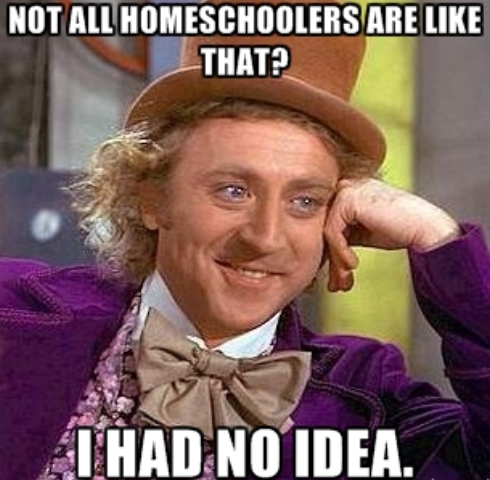
Ah, yes. A jazz riff on the “not all homeschoolers are like that” argument. “Not all homeschoolers are like that” is the broken record of homeschool abuse denialism. My inner sarcastic debater wants to respond like this:
However, my shared humanity understands that sarcasm isn’t always the best rhetorical strategy. There are better strategies:
Reiterating time and time again that we do not think all homeschoolers are “like that”;
Reminding the skeptical voices in the conversation that, in the absence of required registration (or at least notification) of homeschoolers (which the mainstream homeschool lobby opposes), we will all remain statistically challenged because we will have no reliable statistics;
Pointing out that nearly all homeschool research has involved self-selective surveys that describe the participants but prove nothing about homeschooling in general.
Providing counter-self-selective surveys, like the 2013 HA Basic Survey which pretty much “proves” as much as most of Brian Ray’s research — namely, still nothing about homeschooling in general.
If you think the statistical side is lacking, you’re welcome to get in line. We’re right there with you. Those of us speaking up aren’t to blame for a lack of statistics.
That’s the fault of irresponsible homeschool advocates.
(What sort of statistics do you want anyways? Statistics of dead kids? Exactly how many dead kids will it take before we’re taken seriously? While we’re busy trying to make homeschooling better, you get busy figuring out how much abuse you can tolerate before you act, too. Deal?)
For today, however, we are all in the same position: we are feeling around in the dark with anecdotes and stories. You might tell different anecdotes and stories than I might. I choose to respect your storytelling. Whether you choose to respect mine is not in my control.
But at least remember that I have stories. In fact, I probably have more than most homeschool students and parents. I spent a decade of my life traveling around the United States because of homeschool speech and debate — meeting new people, making friends, competing in tournaments, and teaching thousands of homeschool teenagers. I have taught the children of national homeschool leaders.
All this while I was a teenager myself.
As a homeschooled teenager, I saw things that you parents have not seen in your own communities. I have lived a life that you parents have never lived. It is like an alternate universe. My first taste of hard alcohol was provided by the son of one of the most prominent national homeschool leaders. I have lived this life. So while I don’t have statistics for you, and while we in this movement are trying to fix that inherited problem, keep in mind that my “anecdotes” — and our stories — carry the enormous weight of experience.
Have you seen the underside of this world? Because I have. The rabbit hole goes down deep, and I have yet to reach the bottom. There are so many hurting kids, now as there was back when I was a kid. There are secrets and sorrows and fears. We have shared those secrets as friends, we have carried each other’s sorrows, we have whispered our fears like prayers.
But maybe you’re right. Maybe at the end of the day, we’re in the minority.
Maybe we are statistically challenged.
The possibility doesn’t faze me one bit.
Because I don’t look to you for a stamp of statistical approval. I don’t take my cues from your homeschool orthodoxies or your convention speakers.
I take my cues from my conscience. And my conscience says go to where the shadows lurk, to create safe places even where the wild things are.
See, a long time ago, I heard a story. It was about a shepherd who had a flock of 100 sheep. One day, one of those sheep got lost. Instead of remaining with the 99, the shepherd did not sleep, did not stop, until he found that the lost one.
I learned social justice from that story. I learned the meaning of activism. I found the meaning of revolution — that you can “change the world” all you want, you can “redeem the times” ad nauseum. But if you neglect the little ones, it’s all for naught.
See, I learned that Jesus of Nazareth was not content with 99 sheep when 99 sheep means that one gets left behind to suffer in silence and solitude.
And I saw how the Pharisees did not understand. I saw how they looked at each in bemusement, clicked their tongues at Jesus for fretting so much about that one fringe sheep, saying, “Tis a common practice of the statistically challenged.”
But Jesus dealt with human beings, not statistics.
Human beings are what I want to deal with, too.
So go ahead. Keep surveying your 99 award-winning sheep. Us “bitter apostates” will be out in the wilderness, searching for the one you abandoned.
HA note: The following is reprinted with permission from Libby Anne’s blog Love Joy Feminism. It was originally published on Patheos on November 21, 2013
“Libby, you could be an engineer. You have the mind for it.”
My dad made this comment while we were in the car, driving by a factory of some sort. I was probably around sixteen. My dad’s comment was completely offhand, and I didn’t bother to respond. Inside, though, I was baffled.
Why would my dad suggest such a thing?
Didn’t he realize that my lot in life, the lot God had designed for me, was to be a homemaker, raising children, caring for my husband, and tending the home? Couldn’t he see that engineering was not even remotely related to homemaking, and that if I were going to learn a trade it should be something feminine like teaching or nursing?
Why would he even suggest that I could be an engineer? It made no sense!
I wrote recently about something similar regarding my mother. I grew up seeing that Above Rubies magazine on the counter, in mom’s bedroom, or on the stool in the bathroom, and I myself read it voraciously. It was clearly approved reading material, and I never heard my parents contradict it or disagree with it, so I assumed that my parents believed everything in it. I adopted its beliefs myself, and it shaped my conception of myself as a woman and my dreams for my future. And yet, my mother told me several months ago that she had never believed everything in that magazine.
I had had no idea.
Every so often I am reminded of my father’s offhand comment and I am bothered. When I was growing up, I was immersed in the literature of the Christian homeschooling movement and was surrounded by the patriarchal ideas I found there. These ideas shaped my understanding of the world and the trajectory of my life. But did I miss something? Did my father not actually hold all of these beliefs?
Did he honestly think that being an engineer would have been a perfectly legitimate life choice for me?
The mothers and fathers of my parents generation of homeschooling had no idea what it was like to grow up homeschooled in the Christian homeschooling communities they saw as so safe and godly. They may not have realized how deeply we children were imbibing and embracing ideas the that flowed through the Christian homeschooling movement—ideas they may not always have agreed with. Perhaps our parents took many of these things with a grain of salt—but if they did, unless they were vocal about this we had no way of knowing it. And so we believed.
As for my father, I honestly cannot say for sure. When I was in college and things started going haywire, he very clearly expected me to obey him, and very clearly believed that he was my male authority and that I was bound by God to submit to him. But was this perhaps simply the way he responded in his fear of losing me? How deeply did he actually hold those ideas? At the time, I took his reaction as confirmation that he bought into the entire slate of patriarchal beliefs that so characterized the Christian homeschooling world of my childhood and youth.
I have trouble making basic decisions. Big decisions are paralyzing.
I’m nearing the end of my first semester back to school. My one class was a pretty fun, fairly easy fiction writing workshop. It was an elective. I took it more for the chance to be around other adults than anything else.
And now here I am, facing a new semester with two classes, one for my minor and one for my major. More serious classes, requiring more serious brain engagement. I don’t know whether to take them or quit college again.
I am majoring in Media Communications, but other majors have begun to appeal to me. So what should I do? Do I even want to major in MC? I don’t know.
Do I even want to go to school at all? Do I want a job afterwards or should I skip it all and stick to trying to write and get published?
I’m not used to making decisions like this.
My future was all planned out. After finishing homeschooling, I was going to go to college. Then in college, I got married and was going to quit school if I got pregnant (I ended up quitting earlier), and then I was going to be a stay at home mom, and have ‘as many children as God gives us’ (no decision necessary). Then I was going to homeschool those children, then in 30 or forty some years when all the kids were grown up and graduated, I would have time to write.
It was all decided.
But we’ve decided not to have any more kids, at least for now. We’re not planning to homeschool, and in fact are going to send the kids to part time preschool next semester. And with those decisions, my future is no longer all planned out.
I have options for the future. I might get the first real job of my life in the next few years.
And I am terrified.
As stifling as a scripted life can be, it’s safe; it’s comfortable in a cramped sort of way. I didn’t have to take responsibility for many decisions.
I no longer have my mom scheduling my homeschool day, or my dad telling me what major he thinks would be helpful to my husband. I no longer have God insisting I be a submissive, stay at home wife and mom.
I decide where to go and when (mostly nowhere), and I decide what to major in, if anything.
And sometimes I miss the days when i didn’t have to make and own my decisions. It’s terrifying to hold your life in your own hands.
Does anyone want to boss me around?
But no. Because even if I hand the decision making to someone else, I still have to live my life and live with the choices I make (even if that choice is to follow other’s prescriptions for life).
There is no perfect decision maker, there is no formula for a perfect life. There’s just me, trying to do the best I can do, and owning my decisions.






 Homeschoolers Anonymous