How Many More Dead Kids?

tumblr_inline_nhfxcndgRE1r8dw9z

HA note: The following is reprinted with permission from Kathryn Brightbill’s blog The Life and Opinions of Kathryn Elizabeth, Person. It was originally published on December 31, 2014.

Leelah Alcorn was 17 years old when she concluded that life was never going to get better for her.

Before she reached the point that she ended her life, Leelah endured years of spiritual abuse from her parents and from Christian counselors. Her parents eventually pulled her out of school to homeschool, keeping her isolated from her friends and support system by taking away her phone and laptop for months on end.

Here are some of her own words describing what she endured:

“When I was 14, I learned what transgender meant and cried of happiness. After 10 years of confusion I finally understood who I was. I immediately told my mom, and she reacted extremely negatively, telling me that it was a phase, that I would never truly be a girl, that God doesn’t make mistakes, that I am wrong. If you are reading this, parents, please don’t tell this to your kids. Even if you are Christian or are against transgender people don’t ever say that to someone, especially your kid. That won’t do anything but make them hate them self. That’s exactly what it did to me.

My mom started taking me to a therapist, but would only take me to christian therapists, (who were all very biased) so I never actually got the therapy I needed to cure me of my depression. I only got more christians telling me that I was selfish and wrong and that I should look to God for help.

When I was 16 I realized that my parents would never come around, and that I would have to wait until I was 18 to start any sort of transitioning treatment, which absolutely broke my heart. The longer you wait, the harder it is to transition. I felt hopeless, that I was just going to look like a man in drag for the rest of my life. On my 16th birthday, when I didn’t receive consent from my parents to start transitioning, I cried myself to sleep.

I formed a sort of a “fuck you” attitude towards my parents and came out as gay at school, thinking that maybe if I eased into coming out as trans it would be less of a shock. Although the reaction from my friends was positive, my parents were pissed. They felt like I was attacking their image, and that I was an embarrassment to them. They wanted me to be their perfect little straight christian boy, and that’s obviously not what I wanted.

So they took me out of public school, took away my laptop and phone, and forbid me of getting on any sort of social media, completely isolating me from my friends. This was probably the part of my life when I was the most depressed, and I’m surprised I didn’t kill myself. I was completely alone for 5 months. No friends, no support, no love. Just my parent’s disappointment and the cruelty of loneliness.”

Leelah’s death hits me hard, she wasn’t just an LGBT kid, she was an LGBT homeschool kid, and her parents used homeschooling as a tool to isolate her, to try to turn her into the “perfect little straight Christian boy” they thought she should be. As a one-time homeschool kid, I have a feeling of affinity for other homeschool kids. Leelah was one of us, and now she’s gone.

tumblr_inline_nhfxdzilMq1r8dw9z

Just as surely as the homeschool kids who were beaten or starved by their parents, Leelah Alcorn is one of Homeschooling’s Invisible Children. Leelah’s parents are just as responsible for her death as the parents who beat and starved their kids to death, but even though they drove their child to suicide, they’ll never see the inside of a jail cell. They’ll get sympathy, some will probably pat them on the back and tell them how they were good Christian parents doing all they could for a troubled child. Make no mistake though, Leelah’s death was entirely preventable, and if they had given her love and support instead of disappointment and loneliness, this story would have a different ending.

And to the pastor who told me recently that he was going to continue preaching anti-LGBT sermons because to do otherwise would be to disregard the unchanging Word of God, this is what happens. You have kids who are tormented by their church, by Christian counselors, by their parents, all because theology is more important than people.

Christians, if your theology results in a child stepping in front of a truck because she can’t imagine a world where her life will get anything but worse, then it’s time to reevaluate your theology.

A theology that leads to dead kids is wrong and immoral. Jesus said to let the little children come to Him, that whoever harms one of them should have a millstone put around his neck and be thrown into the sea. You’ve got it backwards, you’re tying the millstone around the child’s neck and calling it “love.”

I’m tired. Tired of the dead homeschool kids. Tired of the dead queer kids. Tired of the fact that the Evangelical world doesn’t care about the lives of either group.

Please, don’t let Leelah’s death be meaningless. Change the world and change yourselves so that there aren’t any more Leelahs. No kid should have to endure what she did.

RIP, Leelah.

*Both images taken from Leelah’s tumblr

We’re Here, We’re Queer (and patriarchy had nothing to do with it)

Screen Shot 2014-06-04 at 11.08.04 PM

HA note: The following is reprinted with permission from Kathryn Brightbill’s blog The Life and Opinions of Kathryn Elizabeth, Person. It was originally published on June 4, 2014.

I’m not sure if two examples counts as a trend, but over the last few weeks both HSLDA founder and Patrick Henry College chancellor Michael Farris and well-known homeschool mommy blogger Karen “that mom” Campbell have both suggested that the blame, as it were, for LGBT homeschoolers lies at the feet of patriarchy.

Under this narrative, patriarchy has so harmed and broken us that we have not only rejected patriarchy itself, but have fallen off into a morass of sin and depravity.

Farris’ version of the story, as given in his May 2014 keynote address at the Florida Parent-Educators Association (FPEA) Leaders Forum, is that homeschool alumni critics of homeschooling are almost all victims of patriarchy, and in rejecting that we’ve also rejected God and some of us have become “open homosexuals.” It’s all very Romans 1 of him.

Transcript:

“But the majority, I think, are walking with God. A significant minority, however, have rejected God entirely. A significant number are way, way out there. And the— and the critics that we’re seeing arise from— in the homeschooling movement from young people who are in their twenties and— twenty— mid-twenties, mostly, is kind of the oldest group— that are loudly criticizing homeschooling on the internet and so on and in other venues— were almost all raised in these kinds of homes. And there is no pretense of Christianity in most of their lives. There are openly homosexuals involved, there are atheists involved, there are people that utterly reject everything that we believe in and make no pretense about it, that are— but they came. And so the idea that people are going to create generational, patriarchal family legacies, and we’re counting for them very well, you’re not seeing that. You erect a false view of God for your children, don’t be surprised if they reject God entirely. That’s what’s going to happen.

So what do we do as a movement? First, I would suggest we run as fast and as far away from patriarchy and legalism as we possibly can.”

Full audio can be found here.

Now, aside from the fact that Farris has painted all former homeschoolers who are critical of the homeschool movement as gaytheists who reject everything they’ve been taught, completely ignoring the significant number of critiques from committed Christians (myself included—”gay” and “Christian” are not mutually exclusive), and ignoring that gaytheists deserve a say too, this is balderdash.

While I will grant him the assertion that creating a hateful, vengeful image of God isn’t exactly conducive to producing children who believe in God, blaming our queerness on patriarchy, or at least the fact that we’re open about it, isn’t going to fly.

For one, patriarchy can’t turn anybody LGBT, sexual orientation and gender identity have zilch to do with the kind of environment you grew up in. What is particularly silly though, is the idea that being raised in an environment of fear, isolation, and repression where the odds are good that you heard at least one person suggesting that people like you should be stoned, somehow makes it more likely that Christian homeschool kids will become, “openly homosexuals.”

Although my own coming out experience was uneventful, at least in part because the days of my family’s dabbling in patriarchy by way of the courtship movement were long since passed, the kids raised in the kind of hardcore patriarchy that Farris condemns go through hell to come out. If only it were so easy as to just rage quit patriarchy and become “openly homosexual” in the process.

And well, I feel for the queer kid whose parents heard that talk and assume that by ditching patriarchy they’ll produce good little heterosexual children. Patriarchy doesn’t make a kid queer, and not following patriarchy doesn’t make a kid straight. The only relation that patriarchy has to sexual orientation or gender identity is to make the life of kids growing up queer a living hell. That’s not going to change in Farris’ ideal world since, as I have already documented, he advocates the same ideas that make life miserable for LGBT kids growing up in patriarchy.

My second data point for this whole patriarchy-turns-kids-gay trend is Karen Campbell’s post last week, “Patriarchy on Trial, part 4.”

I don’t particularly feel like getting into the bit in her post where she conflates Homeschoolers Anonymous/HARO with the organization that I’m part of, the Coalition for Responsible Home Education (CRHE), suggests that we’re some sort of gay rights advocacy organization (we’re not, and we have a grand total of zero mentions of anything LGBT-related anywhere in our policy positions), and then in the comments implies that our end game is to define being anti-gay as abuse (it’s not, and the idea literally never crossed my mind until she wrote it).

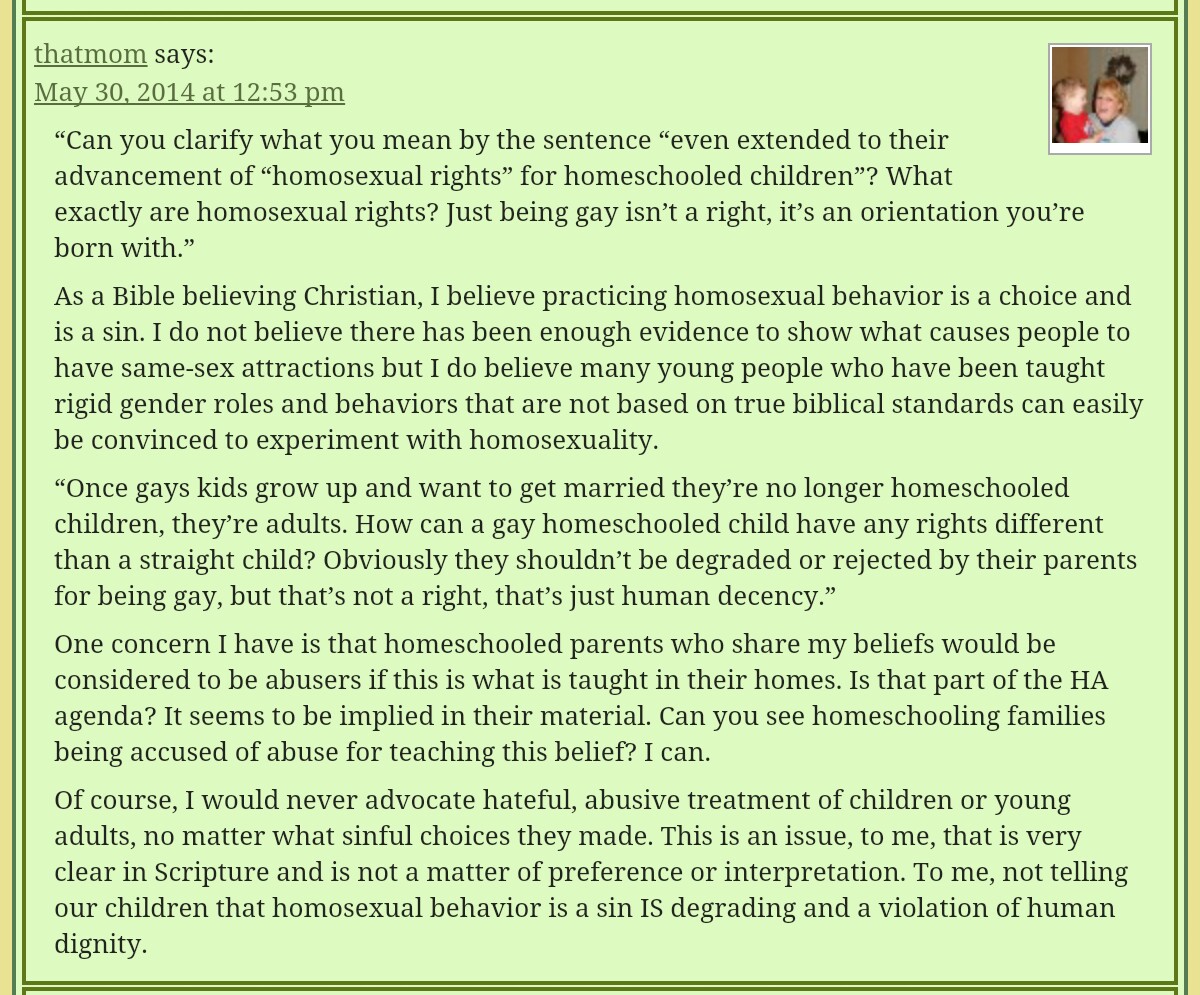
What I would rather talk about is the comment she left on her post, where Campbell suggests that young people raised in patriarchy, “can easily be convinced to experiment with homosexuality.”

karen

Ms. Campbell really doesn’t understand how this whole gay thing works if she thinks that being taught rigid gender roles is going to confuse someone into homosexuality. Also, while we’re at it, bisexuality is a thing too, though I doubt Campbell thinks it exists.

Rigid gender roles are bad, and should be rejected outright, but forcing a kid into a rigid gender role has nothing to do with who they’re attracted to. For that matter, there are kids who fit quite happily into rigidly defined gender roles but are still attracted to the same sex, and kids who don’t fit at all but who are entirely straight.

Homosexuality is about who you’re attracted to, and whether or not a kid fits into a rigid gender role is about gender identity and expression, another issue entirely. For a kid who is gender non-conforming, being forced into a rigid box isn’t going to confuse them into gayness, it’s just going to make their life unpleasant.

Besides, I didn’t grow up forced into rigid gender roles and I’m still queer. In fact, I’d wager that my parents’ version of homeschooling is one that would get the Karen Campbell seal of approval, but hey, here I am and no one convinced me into anything.

Are we so weak that she thinks we can easily be misled into gayness? I graduated from high school at 17, got a degree in computer science as the only female student in all but one class, moved overseas by myself to teach in Asia, and have my JD. That I could “easily be convinced” of anything, much less of something that makes my life harder, is insulting.

There are many things that I will lay at the feet of patriarchy, but nope, you’re not going to be able to write off LGBT homeschoolers this easily. Patriarchy did not make us, this is who we are, and there is nothing wrong with that.

We’re here, we’re queer, patriarchy had nothing to do with it, and it’s high time you get used to it.

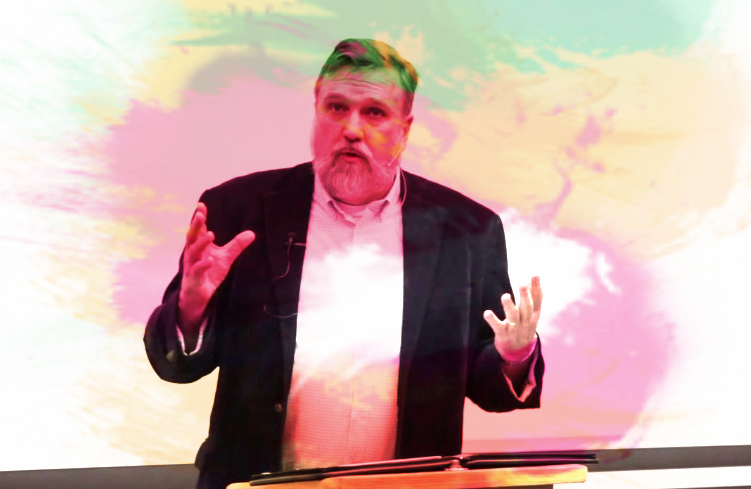
Doug Wilson and the “Gaylag Archipelago”

Doug Wilson

HA note: The following is reprinted with permission from Libby Anne’s blog Love Joy Feminism. It was originally published on Patheos on May 19, 2014.

When a federal judge struck down Idaho’s gay marriage ban last week, fellow blogger Kathryn Elizabeth tweeted the news at Christian pastor and author Douglas Wilson. Wilson is well known for his anti-gay views, and he and Kathryn Elizabeth have sparred over the issue before. Wilson’s response won’t be a surprise to anyone familiar with his work, but it illustrates a problem among religious opponents of LGBTQ rights.

Tweet-Doug-Wilson

Yes, you read that right—Wilson is worried about being sent off to “Gaylag Archipelago.” But don’t let the obvious hyperbole lead you to miss the point—it is mainstream within evangelicalism today to speak of being “persecuted” or “hated” for being anti-gay. A WORLD magazine article titled “‘Haters’ and the Hated” made this point last year:

The word has come down a lot. Once it applied to Adolf Hitler; now to Chick-fil-A. The “haters” of today, as defined by popular rhetoric, are those who argue with current wisdom. . . . It’s easy to attach the hate label to opponents of the issue du jour, and only a slight stretch of the imagination to picture today’s haters stringing up the issue du jour to lampposts in the devilish light of bonfires. This is convenient: If all your opponents are haters, righteous indignation is a valid response. Haters barely deserve to live, much less shape public policy. They must be defeated, by any means necessary.

But let’s talk about the real thing. “If the world hates you, know that it has hated me before it hated you” (John 15:18). . . . To the extent that you abide in Christ, the world will hate you. It will even project its hatred on you.

Bryan Fischer of the American Family Association was even more clear:

We’re hearing a lot about the reinstatement of segregationist Jim Crow laws these days, as homosexual activists fling this accusation at the state of Arizona. They argue that SB1062, a bill which simply protects religious liberty in the Copper State, is tantamount to the reinstatement of discriminatory laws.

As so often is the case, the situation is actually the reverse. It is in fact the bullies and bigots of Big Gay who are reinstating Jim Crow laws, only this time the marginalized and segregated Americans are Christian businessmen. Faith-driven vendors are being told that unless they submit to the owners of the liberal plantation, they will be punished by their homosexualized overlords and sent to the margins of society.

Hence the “Gaylag Archipelago.” I was a child in the 1990s, before marriage equality took the center stage it has today, but even I remember hearing that with the direction the country was heading Christians would eventually be put in jail for believing that homosexuality is a sin. The “Gaylag Archipelago” fits this mentality perfectly—it imagines a world where gay people are the oppressors and evangelical Christians are being robbed of their rights and will ultimately be rounded up and put in internment camps.

Wilson has put it like this:

The same sex marriage crusade has nothing whatever to do with what people can do sexually in private, and it has everything to do with what you will be allowed to say about it in public. We are not talking about whether private homosexual behavior will be penalized, but whether public opposition to homosexual behavior will be penalized.

But you know what? I’ve been involved in the movement for marriage equality for some time now, and I have yet to hear a single person call for those who believe homosexuality is sin to be jailed or sent to work camps. I also haven’t heard anyone calling for banning people from stating that they believe homosexuality is a sin. In actuality, the belief that homosexuality is sinful will go the way of the belief that black people and other minorities are lesser than white people. No one is put in jail for being racist, or even for publicly airing their racist sentiments (unless those sentiments involve threatening physical harm). There are no gulags where racists are rounded up and imprisoned.

But let’s take a look at what these self-prescribed “victims” have in store for their “oppressors,” the LGBTQ community. This from the same Bryan Fischer I quoted above:

We do not believe that homosexual behavior out to be normalized. We don’t think—I don’t think it ought to be legalized. It should not be promoted, it should not be endorsed, it should not be sanctioned, it should not be subsidized. And, in fact, this is the way it was in America for the first 342 years of our existence, well the first 357 years of our existence, from Jamestown in 1607 until Illinois in 1962, the first state in the union to lift sanctions, criminal sanctions, against homosexual behavior. It was still sanctioned in 49 states until 1972, it was even sanctioned according to Antonin Scalia in about 24 states in 2003 when the Lawrence v. Texas ruling came down I counted up about 12 or 14 but somewhere in that neighborhood still had public policies that prohibited homosexual behavior, did not give it legal sanction, it was prohibited, it was against the law under their state code. And so, we believe, I believe, I’ll just speak for myself here, I believe that homosexual behavior should again be contrary to public policy, to put it bluntly it ought to be against the law.

So then the question comes in, what sort of sanctions are you prepared to impose? If it’s going to be against the law, and the law is going to be applied, somebody is apprehended in a way that calls into play this law, this public policy against homosexual behavior, what should be done? What should be done with those defenders? And that’s a legitimate question. Do you put them to death, like they did under the Mosaic law, do you lock them up, do you fine them, what do you do?

Well I want to suggest something, and this just absolutely ticks off homosexual activists, but it makes perfect sense to me. Remember, we’ve talked about this before, but according to the CDC . . . 91% of all of the males in the history of the [AIDS] epidemic either contracted HIV aids through having sex with other men or through injection with drug abuse. Now we have policies in our culture to deal with injection with drug abuse. . . . So here’s my suggestion, very simple, very straightforward, that our sanctions for homosexual conduct should be the same as they are for drug abuse. In other words, whatever we decide are appropriate public policies to deal with drug abuse, those ought to be the same policies that we use for dealing with homosexual behavior because the risks are the same. If we’re concerned about the health of people involved in injection drug abuse, we want to protect them, we want to liberate them from this, and we’re going to have certain policies in place to deal with that, it could involve fines, it could involve incarceration.

We’re seeing a real trend for people who deal in the drug issue to move away from incarceration for nonviolent drug offenders toward rehabilitation. Let’s put these people in therapy, let’s get them in a drug treatment center, rather than lock them up let’s get them help. Now frankly, I am sympathetic to that. . . . Here’s what I’m getting at. . . . What I’m talking about is taking the same policies that we use for drug offenders, because we know it destroys people, it hurts them, it damages them, and since the same health risks exist with homosexual behavior, then it seems to me that we ought to take the same policies and apply them to homosexual conduct, that we ought to direct people toward rehabilitation as an alternative to incarceration. Let’s not lock them up, let’s get them therapy, let’s get them help. I mentioned Nicolas Cummings, former president of the American Psychological Association, he says look, it works, conversion therapy, reparative theory, whatever you want to call it, if people are motivated, they can change, they can redirect their sexual energy. . . . This approach fits with conservative principles.

Sometimes I wonder if the reason people like Bryan Fischer are convinced that LGBTQ activists want them stripped of their rights and imprisoned is that they are projecting what they in fact want on their opponents. In other words, Bryan Fischer wants to make “homosexual behavior” against the law, and wants to give “offenders” a choice between prison and reparative therapy, so he assumes that his opponents want to make “true” Christianity against the law, and to imprison or “reeducate” offenders.

And what about Doug Wilson, of “Gaylag Archipelago”? Wilson has increasingly refused to fully nail down his position on what should be done with gay and lesbian individuals, among other. This may be in part because some of his earlier forays on the subject resulted in widespread outcry. For example, Wilson had this to say in a 2003 interview:

The Bible indicates the punishment for homosexuality is death. The Bible also indicates the punishment for homosexuality is exile. So death is not the minimal punishment for a homosexual. There are other alternatives.

Then in 2009 he put his position like this:

Wilson says he rejects the Reconstructionists’ political tactics and distances himself from the label, claiming that his view of Old Testament law is more subtle than theirs. But when I asked what he thought of the death penalty for homosexual acts suggested in Leviticus 20:13, he did not shy away from the theonomic hard line that disturbs many Christians. “You can’t apply Scripture woodenly,” he says. “You might exile some homosexuals, depending on the circumstances and the age of the victim. There are circumstances where I’d be in favor of execution for adultery.…I’m not proposing legislation. All I’m doing is refusing to apologize for certain parts of the Bible.”

There’s also the matter of Wilson’s magazine, Credenda/Agenda. Wilson is both founder and editor of the publication, and some years back he published an article titled Your Eye Shall Not Pity, by Greg Dickinson. This article is less ambiguous.

The civil magistrate is the minister of God to execute wrath on the wrongdoer (Rom. 13:4). God has not left his civil minister without guidance on how to exercise his office. The Scriptures set forth clear standards of judgment for many offenses. Capital crimes, for example, include premeditated killing (murder), kidnapping, sorcery, bestiality, adultery, homosexuality, and cursing one’s parents (Ex. 21:14; 21:16; 22:18; 22:19; Lev. 20:10; 20:13; Ex. 21:17).

In contemporary American jurisprudence, none of these offenses is punishable by death, with the occasional exception of murder. The magistrates have dispensed with God’s standards of justice. Some Christians believe this is an improvement. They would be horrified to think that the “harsh” penalties of the law should still be applied. Sometimes this is the result of the mistaken belief that the Old Testament has no further application after the advent of Christ. This is an exegetical problem. Too often, it is the result of a sinful view of the criminal. This sin is called pity.

. . .

Thus, the Bible teaches that pity is not an option where God has decided the matter.The magistrate, God’s minister, is to faithfully execute justice according to God’s standard, not man’s.

What the Bible does not teach is that the preaching of the gospel and repentance have no place on death row. Indeed, it is hard to imagine a place where there is a more immediate need of grace, and a presentation of the gospel should be the first response of Christians to those who are condemned. But condemnation still must come if we are to be obedient to God’s Word.

We must respond to the wrongdoer biblically in both judgment and grace. This means that we must return to an obedience which confines pity within the bounds which God has established for us.

It’s worth noting that no one has put either Doug Wilson or Greg Dickinson in jail for what they have said. Indeed, neither has been arrested for their comments, or fined. Just as there are no laws against racist comments, there are no laws against calling homosexuality sin—nor are there likely to be. Contrary to Wilson’s reference to a “Gaylag Archipelago,” Wilson and his friends are free to go on saying these things if they so choose. But while they are legally free to call down all the divine judgement they please, they do not get a free pass from popular outrage.

I suspect that Wilson’s references to a “Gaylag Archipelago” may stem from some of his recent experiences when speaking on college campuses. In 2012, Wilson was heckled and shouted over during a speaking engagement at Indiana University. I suspect Wilson blurs the line between popular anger over his views on homosexuality and legal oppression. Of course, that problem goes beyond Wilson. The WORLD magazine article I quoted above claimed that “The ‘haters’ of today, as defined by popular rhetoric, are those who argue with current wisdom.” In other words, the author is under the impression that evangelicals are “hated” simply because they disagree with the popular consensus. It’s as though she cannot see the very real pain and damage evangelicals cause by their opposition to LGBTQ rights and their belief that same-sex attraction is sinful, and the anger that pain might inspire.

I don’t want to give the impression that every evangelical Christian wants gay people to be executed, rounded up, exiled, or sentenced to reparative therapy. In 2013, 59% of white evangelicals said that homosexuality should be “discouraged” but 30% said it should be “accepted.”  Also in 2013, 49% of white evangelicals supported some form of civil union. But there seems to be a fairly high correlation between evangelicals who claim to be persecuted by the push for LGBTQ rights and evangelicals who believe homosexual behavior, as they term it, should come with legal sanction. And that correlation makes Wilson’s reference to the possibility of being sent to a “Gaylag Archipelago” incredibly disingenuous.

The Invisible B: Faith Beauchemin’s Story

Screen Shot 2014-02-12 at 7.48.57 PM

Series disclaimer: HA’s “Let’s Talk About Sex (Ed)” series contains frank, honest, and uncensored conversations about sexuality and sex education. It is intended for mature audiences.

HA note: The following is reprinted with permission from Faith Beauchemin’s blog Roses and Revolutionaries. It was originally published on February 2, 2014.

*****

Being bisexual is freedom, and it is invisibility.

I flip-flop between calling myself bisexual and pansexual.  Bi is the word everyone knows. Pansexual doesn’t leave anyone out.  And you see, I don’t care what your gender or lack thereof is.  I’m attracted to people, not genders or genitals.

That doesn’t mean I’m attracted to every single person.  It doesn’t mean I have crushes on everyone I hang out with.  It doesn’t mean I’ll go home with just anyone.  All it means is that I could potentially be with a person who lies anywhere on or off the gender spectrum.

To be quite honest, I didn’t know pansexuality even existed up until very recently.  When I was a fundamentalist, the “being gay is a choice” narrative sort of made sense to me.  I mean, everyone had the ability to be attracted to everyone, right?  I read a Christian modesty book which claimed that everyone is “drawn to the female form” because it is just objectively beautiful.  So I figured I must be straight because I knew I was in fact attracted to men, and any pleasure I found in female beauty was artistic, it had nothing at all to do with sexuality.  Besides, all the Christian dating books had a tiny appendix tucked in the back that warned of the dangers of predatory college lesbians.  So, I knew lesbianism existed but all of my associations were totally negative.

Even when I was less naïve, even when I started thinking people were born homosexual and that most gays and lesbians (like most straight people) were not predators, I still didn’t realize that bisexuality actually existed.  “Bicurious” was a term I was aware of, but I thought it was a descriptor of an in-between phase, a transition between heterosexuality and homosexuality.  So therefore, since I was definitely attracted to men, I couldn’t possibly be a lesbian.  Simple as that.  There was no other option.  Monosexism was all I knew.

And that is what I mean when I say bisexuality is invisibility.

We get erased a lot.  The biggest problem is what I term “Schrodinger’s bisexual” which is that a person is perceived as either straight or gay depending on who they’re in a relationship with.  I’m dating a man right now, therefore everybody assumes I’m straight.  You can’t typically determine bisexuality by just one interaction with a person, by one specific point in time.  It doesn’t help that a lot of people talk about bisexuals as though they are “switching” between heterosexuality and homosexuality.

Of course as a woman especially I am sometimes permitted the total opposite of erasure, and that is performance.  Men like the idea of a bisexual woman because their first thought is often of having a threeway.  One night in a bar, a girl kissed me, and immediately a man walked up from across the room and said, “Mind if I join in?”  Visions of a porn-worthy fuckfest dancing in his head, no doubt.  Later, I tried to say something to a friend about how frustrating it is that no one thinks you’re bi unless you’ve actually had a homosexual experience, and he just jokingly spun a scenario where I and another woman would have sex and he would film it.

This goes back to the overarching issue of female sexuality being owned by men.  If we are not having sex with them, we must at least be performing for their gaze.  That’s why most threesome porn is FFM.  That’s why a lot of men think that bisexual women exist to have threesomes with them, and that lesbian women could be “cured” by their magical dicks. And that is all such bullshit.  My sexuality, whatever it is, is mine.

But the seemingly fluid pansexual approach is in fact deemed everybody’s property.  More than anyone else’s, my sort of sexuality is approached with doubt.  Everyone makes assumptions and gets to speculate about the causes and motivations behind my sexuality (no, I am not just “greedy” and I am not going to try to fuck you. No I am not disease-ridden or commitment-phobic. No I’m not going to cheat on my partner).

It’s a reminder to everyone of how truly queer-phobic our society still is. 

We’ll (grudgingly, gradually) accept gay people as long as they want to be just like straight people.  We might potentially on a good day accept one or two trans people, as long as they have had whatever surgery we deem “necessary” for them to pass as cis.  But anyone who is genderqueer, agender, or pansexual is met with flat-out denial of their self-identification.  “You’re lying.” “You’re confused.” “You just want attention.”

Do I though? No more than anyone else.  I hate the fact that being honest about myself means I’ll get extra attention.  But we haven’t reached a truly all-point-on-the-spectrum accepting utopia yet. In fact we’re pretty far from it.

So what’s it like being pansexual?

I’m not exactly sure.  I’ve never been anything else.  What’s sexuality like for all of you out there who are monosexual?

It was truly liberating, though, admitting it to myself.  It was truly liberating learning that pansexuality exists.  I used to fight my attraction to women, not so much because I thought it was “sinful” (because yes the story of my sexuality is also concurrent, though not especially related, to my deconversion) as because I thought if I gave in to it I would have to get rid of my attraction to men.

When I understood that it is possible, acceptable, and even (for me) normal to be attracted to all types of people, it came as a great relief.

For the first time, I was no longer trying to fit my sexuality into any mold that society had built for it.  I could like what and who I liked, without feeling guilty or needing to repress anything.

Due to circumstances and the timing of me finally coming out to myself, I have never had sex with anyone but men.  It’s not really a point of bitterness for me, I don’t have to experience sex with all types of people to know my orientation (much like virgins often know their own orientations before ever having sex of any kind).  Right now I’m happily in a relationship and I don’t see that changing any time soon.  If I die never having had sex with anyone but men, I won’t feel like I was robbed, and I will still be pansexual.

Of course there is a lot of work to be done, to make this world a better and more accepting place for those who are not heterosexual or cisgender.  But “they” are right: coming out is the first step.  Coming out to yourself, to embrace freedom, and coming out to everyone else, to combat invisibility.

This is me taking that first step.

*****

Faith has an open call for stories on Roses and Revolutionaries for individuals that do not fit in the gay/straight binary. If you are interested in participating in that series, read more here. 

None Dare Call It Education: Anna’s Story

Screen Shot 2014-02-12 at 7.48.57 PM

Series disclaimer: HA’s “Let’s Talk About Sex (Ed)” series contains frank, honest, and uncensored conversations about sexuality and sex education. It is intended for mature audiences.

*****

Hello, my name is Anna.

Like many who write stories for Homeschoolers Anonymous I grew up in a legalistic, controlling, and abusive homeschooling Christian household. When I saw that Homeschoolers Anonymous would be posting a series on sex education I knew I had to write something. My story may be appalling to some, but to others I know it will sound all too familiar. I hope that my story will give you insight and encouragement, and I thank you for taking the time to read it.

My sexual education was completely nonexistent.

I remember that there was a book on one of the living-room bookshelves entitled “Preparing For Adolescence.” I don’t know if the book was intended to prepare parents or children, but neither my parents nor I ever read that book. At 11 and 12 years of age I had long since learned to be ashamed and scared of my body; the lectures on modesty and roles of women had made sure of that.

When my body started changing I didn’t know what was going on, but I stayed silent. My parents were not people I could go to with my fears and questions. My period started without me ever having heard the word before. I had no clue what was happening, and it was probably the most horrifying experience of my life. Again, freaked out as I was, I didn’t tell a soul. My mom noticed the blood when doing laundry weeks later, and she had the only “talk” she ever had with me. Her little discourse included only what do about the “problem” and nothing else.

I got the message: another female attribute to be hidden and feared.

Because my mom seemed oblivious to my needs, my older sister gave me her old bra and bought me my first razor and deodorant, and even these items I felt the need to hide. I was always too scared and shy to ask my mom to buy me anything of an intimate nature. I would use the same razor and wear the same bra for years at a time. My fears were somewhat justified; I remember the time that my mom found a receipt for tampons in my purse and asked me severely if I had bought some. I panicked, lied, and said that I had accidentally picked up someone else’s receipt.

Mom let me know that tampons were strictly off limits.

Throughout my teenage years I gained knowledge about sex years by various covert means. I looked up words in dictionaries and read the books about pregnancy that I found on our bookshelves. I found some answers on the internet when I was able to use it without my mom monitoring me, but I always felt like I was doing something wrong. It wasn’t until I was 18 years old that I went on a research binge and learned the complete picture, including things I should have known much earlier, like the names for my own anatomy.

Though my parents never talked about sex directly, I picked up on their attitudes and beliefs, and sexual thoughts and questions were always accompanied by fear and shame. We were told to save our first our first kiss for our wedding day, that women should never make men “stumble” (I never even knew what that meant, hell, I still don’t know what it means), that dating was giving your heart away to strangers, that to Your Future Husband the most valuable thing about you was your virginity and your pure heart. A fear that consumed my life for years was how I would explain to My Future Husband that I masturbated (at the time I didn’t know the word). I knew he wouldn’t want me, and that it would always be my biggest secret.

I felt I wasn’t a virgin, I was sullied.

I was strange, surely no one else did this. Above all, I was letting God down. I began to lose my faith, because I knew I couldn’t think these thoughts and feel these feelings and still be a Christian. Almost the entirety of my teenage years was spent severely depressed and suicidal, and the overwhelming shame attached to my sexuality certainly contributed.

My mom once told me that when a woman looks at a person, she first looks at their face, but when a man looks at a person, he first looks at their crotch.

Hence, the need for women to wear skirts, (can’t let those men “stumble”). This lovely piece of wisdom made me feel even dirtier, because I began to realize how much I was noticing other people’s bodies. When I saw a person, my eyes would travel up and down their body and linger on their butt and (if a girl) her boobs.

I was clearly some sort of freak, only men were supposed to be this way.

Good grief, was I “stumbling?” I hated the girls I saw walking down the sidewalk in tight jeans. How could they flaunt themselves this way? And how could I help but stare? Deep down though, I envied them. When I was around 15 or 16 I was noticing women’s bodies more and more, and women began to enter my fantasies. In a year or two I was thinking about women in a sexual context just as much as I was thinking about men.

I now had another secret to keep, and this one was absolutely damning.

I heard the sermons and speeches; I read the blogs and articles; I listened to the conversations happening around me. Christians hated gay people. God hated gay people. I knew I could never admit my attraction to women and still be accepted by literally anyone I knew. It hurt me every time someone would talk about gay people as if they were evil beings bent on destroying everything good in America. They were a problem that needed to be fixed, and they were certainly not welcome in a church. I felt better because I knew I wasn’t completely gay; I was still attracted to boys. But then what was I? Where did I fit? Would I always be an outcast?

Today as I have left homeschooling physically as well as mentally, I finally have the freedom to discover and embrace the person that I am.

For the first time I am perfectly happy and confident in my sexuality. I am attracted to the entire range of sexes and gender expressions; masculine men and feminine men, femme women and butch women, androgynous and genderqueer men and women, and everything in between. Would I take a magic pill that could make me be attracted to only masculine men, one color in a whole rainbow? Fuck no! I love my orientation.

I don’t know if I believe in God, but if there is a God who made me, he made me the way I am and he doesn’t have a problem with it.

I have yet to tell my parents or anyone in my old homeschool circles about my more fluid sexuality. It’s really none of their business. But I feel the desire to throw it in their faces. I want to say, “Look at me! A real live non-straight person. Tell me to my face that I’m going to hell. Tell me that I am destroying the moral fabric of America. Fight to keep me from having the right to marry a woman if I wish. Shove a Bible in my face and lecture me about the morality of who I am. Give me pat answers and tell me to pray more. I’m a person, right in front of you, not an ideology or an obscure Bible verse. Do you want to cut all ties to me and keep me away from your children? Am I any different now than you always thought I was?”

But I know I can’t look back; I have to look forward. I can’t worry about how my old acquaintances might view me; I have to focus on making new friends. Vibrant, fun-loving, intelligent, creative, accepting and open people, like me.

As for what I wish to say to my mother, the cause of my thoroughly shitty childhood, “You told me what it meant to be a woman. You were dead wrong. You told me what my future would be. You were wrong. You told me what was right and how to please God. You were wrong. You told me who I had to be. You were wrong. You were wrong to deny me an education; never giving me basic information about my body and sex caused me a lot of pain for many years. You created an absolute hell and kept me prisoner there, but I have come out beautiful and strong. I am now one of those “femi-nazis’ that you spoke about with such derision. I will forever be exactly who I want to be and love who I want to love.

“I no longer follow any of your rules or subscribe to any of your ideologies, and I have never been happier.”

My sister has also written about her sexual education experience; the link to her story is here

The Difficulty with Admitting Trauma: Kandice’s Story

Screen Shot 2015-04-25 at 1.02.37 PM

HA note: The author’s name has been changed to a pseudonym at the request of the author.

My name is Kandice, and I grew up being homeschooled.

My parents were and are members of HSLDA (Home School Legal Defense Association) but in our part of Massachusetts, there weren’t too many other homeschoolers.

My seven siblings and I were all home-schooled together; initially started using a mix of curriculum including Christian Liberty, but my parents quickly switched over to Pensacola Christian College’s (PCC) ABeka Book program. I was homeschooled from 2nd grade through 12th.

My siblings and I were raised with very clearly defined social, political, and religious ideology. Strict Calvinism, coupled with the dogma of Independent Fundamental Reformed Baptist theology was the religious perspective; politically, my father is rabidly conservative – huge fan of the NRA, Newt Gingrich, and Rush Limbaugh etc. Socially, we were taught children to follow Biblical principles as my parents saw them.

We were taught the world is full of sin, and you can’t trust anyone other than fellow Christians as all others are under Satan’s sway.

Curiously enough, unlike many in Fundamental circles, my parents are not racist at all. In fact, they harbor great frustration and confusion over racism – we were taught all people are created in the image of god and therefore physical differences don’t matter; my parents explained differences in appearance and language are stemming from the tower of Babel (Genesis Ch. 11).

I have a B.A., which I got from Bob Jones University, which is private and religious.

I was raised by educated parents who valued learning highly – my mother has a B.A. in English and my father has both a B.A., and his M.Div. My father was a minister at an Independent Fundamental Reformed Baptist church – although his religious views didn’t start out there, they progressed to that point. In my early childhood we were traditional ABC Baptists, but after my father got his own church, things began to change.

My political beliefs changed before high school, largely because I knew I was gay, and then continued transforming.

My dad is an extremely conservative Republican and we were raised with that ideology. My biggest passion in life has been reading, I can’t remember not loving words, and this drove change for me. I started reading literature that changed how I saw things – several authors were powerful in this for me: John Steinbeck, Upton Sinclair, Sinclair Lewis, Pearl S. Buck, Thomas Hardy, and Fyodor Dostoevsky.

By the time I entered high school I already disagreed with my family/father on social justice and equality matters – reading literature made me explore history and social science which really helped to broaden my view.

I knew I was gay from a young age, and in college, in my Ethics class, we were taught “facts” about homosexuality that didn’t connect at all with my experience. Such things as, people become gay through being recruited, usually at a bar (I’d never been to a bar and as far as I knew, I’d never met a gay person); or that Jesus and the Bible condemned homosexuality – well, I read everything Jesus said and he did not ever speak out against the LGBT community; the OT references to Sodom and Gomorrah are referencing the sin of lack of hospitality, not being gay. So in college, my political beliefs opened up still further to be able to fully accept myself as gay, and to be able to say that all people, regardless of religion/gender/orientation etc. should have the same rights and freedoms.

My religious beliefs went through transition as I grew older.

I stopped believing in any way that Jesus was more than a man – he existed, but he is not god or any deity. My view of god changed – I don’t have a definition for the power that some of us use the word god to describe. That power exists, and that power is more than me, but beyond that, I don’t have definitions or rules about religion. I learned to see people in light of who they were and what they do, rather than what the claim to believe – beliefs are only as significant as we let them be, and they’re so tied in to our perceptions of reality that they are often wildly flawed. And contrary to what I was raised with, I don’t think it’s my job or duty to try to “convert” anyone. I think my responsibility today is to live the most spiritual life I can, following the path I’m on, and do my utmost to not cause harm but to be of service to others.

These changes occurred because I was reading, and learning. I took what I read and compared it to what I experienced and saw in the world around me and it didn’t align. Teaching I had been taught in the Bible didn’t match up to my experience, or what I experienced from people who were deemed “sinners” or “apostate” or “lost”. And in fact, what some Christians did to me, and others, was distinctly un-Christlike; there was no logic in saying that their behavior was acceptable because they called themselves Christians, while the person who doesn’t believe in god but does amazing good is going to hell.

I would have to say homeschooling was a traumatic experience for me.

I don’t like admitting that. Because admitting trauma means addressing it beyond the bleak recitation of the facts of what occurred. Diving into how it makes me feel, or affects me, is challenging.  I think that unless homeschooling is done in conjunction with an outside schooling process, it leads to isolation, control issues, lack of contact with reality, social discomfort, low self-esteem and self-confidence, poor communication skills, and significant challenges building healthy relationships.

Homeschooling did have some lasting psychological effects on me. While this is not as powerful as it has been in the past, the scars still remain. My journey involved alcohol use that became alcoholism… that was one of the ways I coped with what I was experiencing/had experienced. I also suffered from severe depression and anxiety, leading to suicidal ideation, and this started around age 11. In college I actually attempted suicide because I just had no coping mechanism, and I didn’t know enough to know there were supports available.

Additionally as an adult, I learned that a lot of the behaviors I had as a kid that my parents labelled as “sin” and tried to punish/discipline out of me, were actually tied in to having Asperger’s and having an IQ/mind that naturally asks questions, and that needs to be challenged. It was actually hard to learn that because it hit me really hard to realize that I had spent so many years and so much time trying to change something that was neurobiologically programmed and that couldn’t be changed. Also, it didn’t need to change – it wasn’t wrong.

But the concept of Autistic persons as being sinful is very prevalent in the community I come from.

My father has repeatedly told me he would do the same thing over again, and that it’s [the way I process things] sin, not the way my brain functions.

Guilt over leaving my younger siblings behind to go to college and then leaving them again when I came out as LGBT is something I’m working through. It’s not as bad as it was, by far, because my siblings hold no animosity towards me. I just felt very responsible for them because as their older sister, I always had been responsible for them. And in big families in these environments, you sometimes feel more like a protector or caretaker than a sibling and that changes things.

Had I been in a public school setting, these experiences would have been very different.

I know this for sure since I was in public school for kindergarten and 1st grade – and in 1st grade, when teachers and administrators began to have concerns over what they saw in me, as well as my siblings, my parents shut the door on the world and began homeschooling. Getting diagnosed at a younger age, having supports in place, learning healthy coping mechanisms – yes I definitely believe this would have made a difference. I can truly say I like myself today, though, so I don’t know that I would want to not experience what I experienced because I don’t know who I would be if I hadn’t gone through that.

In conclusion, homeschooling was a mixed bag for me, very much so.

I enjoyed not being held back or slowed down by anyone else, I enjoyed having no homework, and I felt comfortable (translate – safe/understood) being around my siblings. I’ve been told, as an adult by a psychologist who had done a series of IQ tests on me, that homeschooling was actually a very good thing for me in terms of my intellectual development. So I’m grateful for being homeschooled in the sense that it allowed me to really develop my mind.

Emotionally, socially, psychologically, spiritually – homeschooling was extraordinarily damaging. Not knowing how to interact with anyone comfortably that wasn’t from my family, being raised to not trust other people, not having healthy psychological supports in place or anyone in place who could say, “Wait. This is not ok” – that wasn’t good at all. Being able to learn to reach out to people for help has taken years.  And it’s also taken a lot of work. It’s still not easy. Knowing that’s it is ok to feel something other than gratitude for being one of god’s elect was another learning process; the reality that feelings of sorrow, anger, depression, grief, loneliness – these are ok, also they’re normal and they are not sin was definitely not something I was raised with. Most emotions and thoughts were deemed sinful; learning how to first say “sin is man-made, in fact it’s not real” and then say “feelings are feelings, not good or bad unless I want to assign them so”, that also took many years.

If I were a parent, I would not home school my child.

I think we exist as part of a community, a whole, and that community is so much more than a family or small homogenous group.

I think removing the opportunity for children to learn, from a young age, about differences is unacceptable. It stunts growth emotionally, mentally, and socially. I think raising children in rigid, rule-oriented, controlling and judgmental environments is harmful. Not knowing who you are, not being able to develop your own views through experiences and feelings, is not healthy and it leads to damaging behavior and unhealthy practices in adulthood.

I’m not angry or resentful that I was homeschooled; as I mentioned above I like myself and this is a part of who I am. But I can’t in good conscience recommend or advocate for homeschooling.

When Did Homeschooling and Parental Rights Mean Anti-Gay?

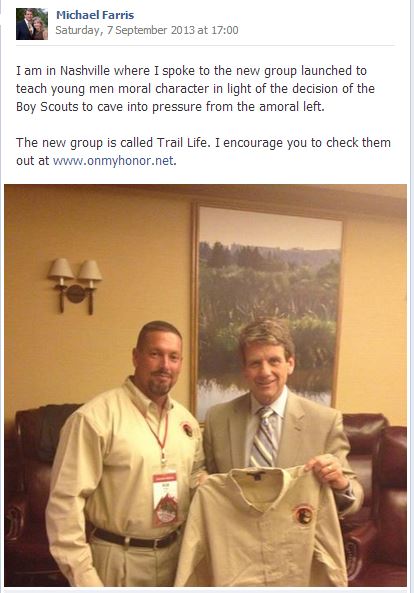
Original photo posted on Michael Farris' Facebook page here: https://www.facebook.com/photo.php?fbid=468390293258668&set=a.351585204939178.76024.351012244996474&type=1
Original photo posted on Michael Farris’ Facebook page here: https://www.facebook.com/photo.php?fbid=468390293258668&set=a.351585204939178.76024.351012244996474&type=1

HA note: The following is reprinted with permission from Kathryn Brightbill’s blog The Life and Opinions of Kathryn Elizabeth, Person. It was originally published on October 2, 2013.

Well, I guess it was too much to hope for that Farris et al. would speak out against the egregious threat to the rights of gay parents in Russia. When a concerned former homeschooler asked him about it on his Facebook page, he pretty much blew her off by saying that because it wasn’t a homeschooling issue he wouldn’t do anything.

Funny though, how he doesn’t have the time and isn’t willing to take the effort to speak out against the proposed legislation in Russia to take children away from gay parents, but he did find time to be at the launch of Trail Life. Trail Life, for the uninitiated, is the organization that just formed as an alternative to the Boy Scouts. To be precise, it was founded as an alternative by those who do not like it that the Boy Scouts is no longer kicking children out of the Scouts for being gay. Note, the Boy Scouts still does not allow anyone over 18 to be involved with scouting if they’re gay, but that’s not enough for the Trail Life folks.

If you’re not kicking kids to the curb if they come out, you’re caving into the pressures of the amoral left.

Source: https://www.facebook.com/photo.php?fbid=468390293258668&set=a.351585204939178.76024.351012244996474&type=1

Again, let me remind you, no time to speak out against Russia wanting to take gay parents’ children away since it’s not homeschooling related, but plenty of time to go help launch a group that differentiates itself from the Boy Scouts by targeting children in the culture war. Yes, that’s what they’re doing.

They’re putting kids in the cross hairs of the culture wars. It’s kids who are going to get booted out of Trail Life, it’s kids who they want to get booted out of the Boy Scouts. Kids.

Not surprisingly, Farris has a bit of a persecution complex about all of this. Here’s the relevant conversation from the comments on his post.

farris2

Two things here. The first is that as a K-12 homeschooler and homeschool graduate, I’m tired of the media treating Michael Farris as if he speaks for all homeschoolers. He doesn’t. He certainly does not speak for me.

The second is this. When Michael Farris talks about “the homosexual community and their elitist friends and the courts,” he’s painting this as an us versus them battle between his band of conservative Christians on one hand and the aforementioned homosexual community and their elitist friends and the court on the other. He is mistaken. There is no us versus them. There is only “we.”

Not just “we” in the abstract, “We the People,” sense either. “We” as in, the people his movement is fighting against aren’t some “other.”

Mr. Farris, we are you—

—your family members, the kids who sang in the church choir and went to AWANA every week, who were trusted to babysit for other homeschoolers because we were part of the community, the homeschool kids who listened when you said that we were the generation who would change America.

You’re fighting so hard, but you aren’t fighting for liberty, you are fighting to deny liberty to people who are not so different from you.

Mr. Farris, it was your con law book for homeschoolers that inspired me as a teenager to want to go to law school.

I listened to you when you said that homeschoolers were going to change the country and I believed it. If I’m some activist elite, Mr. Farris, it’s because you and the homeschool movement created me. When I worked on an amicus brief in Perry and Windsor, it was because of the seeds you planted in me to go to law school.

We are not others, this is not us versus them, and it never has been, no matter how much you try to make it that way.

The Reason I Despise Fundamentalist Christianity, As Revealed to Me In a Dream

misogyny

HA note: The following is reprinted with permission from Sean-Allen Parfitt’s blog Of Pen and Heart. It was originally published on August 26, 2013.

Recently there has been a series over at the Homeschoolers Anonymous blog, called “Voices of Sister-Moms”. I began reading the introductory post, but could not finish. My entire body was having a negative reaction. I mentioned this to some of my fellow LGBT Homeschooled friends, and they wisely suggested that I step away from the article till I could calm down. I was seriously angry, and had beginning symptoms of a minor panic/anxiety attack.

I was surprised at my reaction to the article.

After all, I am a male, the eldest in my family, who, in the patriarchal/quiverfull system, is in a position of privilege. It’s true that I was expected to do a lot of housework and helped homeschool the kids (see last Friday’s post), but I went to college, got a job, and was allowed to live my own life. (And by “my own life” I mean going to work and coming back home and going to church with the family and sometimes hanging out with friends.)

Well, in the last two years, I’ve come out of the closet, left the fundamentalism my family calls Christianity, meet many new kinds of people, and discovered that what I was taught isn’t necessarily the truth. I am in a relationship with another man, which is for me a clear illustration that the traditionally taught family dynamics are not the one true way. I have even begun to question Christianity itself.

But I couldn’t put my finger on either my anxiety when reading about the mistreatment of Christian girls or my strange negative reactions to other generic mentions of Christianity.

Why did I cringe when I saw a post on Twitter recommending a book about God’s love? Why do I skim past the tweets with Bible verses and references to good times at church?

I believe I got my answer in a dream I had Saturday night.

In my dream, I was visiting my father’s childhood church, which my family had begun re-attending. Mom was in a small-group discussion, and brother T was in the main sanctuary. I walked up to T, but he distinctly turned away without acknowledging me. Once Small Groups was over, Mom came back into the sanctuary. I began following her as she straightened the pews, talking to her. She was upset with me for living openly gay, and I was getting more and more angry with her as the conversation continued.

Then I exploded at her. This is very much out of character of me, as I have only raised my voice at her on a few occasions. I almost tremble is reverent fear of my mother, who has power to unleash unheard-of retribution. Or at least, that’s how I feel. So for me to yell at her actually took me by surprise in retrospect. But what I said to her showed me exactly what I had been feeling but had been unable to express before.

It was the very innermost turmoil that I had not been able to understand.

Do you know what I hate about Christianity?” I shouted at my mother, standing in the very sanctum of the religion I was at that very moment criticizing. “Do you know what it is that makes you unable to accept the fact that ‘I’m gay, and it’s OK’?” My mother just stood there, not replying. And then I said the word. Just one word, a simple 8 letters that encompass the root of my dissatisfaction with the religion in which I was raised, and which has caused irreparable pain to so many people. I opened my mouth, and with conviction, the word thundered through the church:

“Misogyny.”

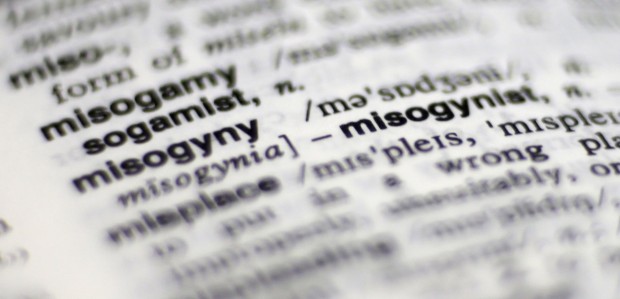
According to Wikipedia, “Misogyny /mɪˈsɒɪni/ is the hatred or dislike of women or girls.” When used in a religious context, it usually refers to the belief that women are the “weaker sex” (see I Peter 3:7) and are under the authority of men (see I Corintians 11:3and I Timothy 2:12). In practice, this means that women and girls are to be humble servants to men. Girls are groomed to become wives and mothers, and should not aspire to be successful on their own. They are to submit, never questioning their fathers, husbands, or pastors.

When I awoke form my dream, I was surprised at what my mind had expressed while I slept. However, upon reflection, I realized how so very true it is. Misogyny is at the heart of much of the pain I have experienced in my life.

It is the root of the pain that countless other women and gay men have felt.

Wait, sure, you can see how misogyny has caused incredible pain and discrimination for women, but how dare I include myself and other gay men in that category? This is the question I asked myself. But even though I did not express it verbally in my dream, I knew what the answer was.

One major argument used against unions between two men is the call to remember God’s biblical definition of marriage. Thus, marriage is commonly interpreted as a union between one man and one woman. Traditionalists maintain that the proper balance of power places the man in the position of leader and the woman in a submissive position. Women are expected to take care of the home, cleaning, cooking, shopping, teaching, raising children, making life easier for men, and providing sex on demand. Men are expected to go to work, provide money and housing, spiritually lead the family, and lead the family into ministry work.

With this in mind, it’s not hard to extrapolate the effects of misogyny onto gay men. If two men are in a relationship, who has what duty? Men aren’t supposed to do the women’s work. Who leads the family and makes the decision? Which one goes to work and which one cleans the house? In short, which one is the man and which one is the woman?

So many straight fundamentalists can’t grasp the idea that gay men are still men.

A flamboyant gay man is called effeminate and looked down on. When I came out to my mother over the phone, she prayed for me. In that prayer, she cried, saying that she didn’t want me to be her daughter; she wanted me to be her son. I have had several people ask me who is the man in Paul’s and my relationship.

Besides being entirely misguided, such notions and comments are very hurtful. I have been completely cut off form my family. My old friends have told me that we cannot fellowship anymore. They see me as a deviant from the natural order and desires. Because I don’t want to be with a woman. Because I don’t want to exercise headship over my partner. Because I like to engage in “feminine” pursuits such as sewing. Because I care what I look like and plan my outfits to coordinate. Because I wear earrings. Because I am “acting like a woman”, when I am really a man.

I admit I am not sure where I stand on the issue of Christianity. The pain and hurt I have received from the church has made me very wary of the religion of the Bible. When I see others facing the same discrimination I have, I become enraged. It is hard not to be bitter against the very religion that brought me up.

It’s a world of pain, hurt, and rejection, all because of one word: misogyny.

I Was Born With A Severe Immune Disease: Attackfish

positives

I Was Born With A Severe Immune Disease: Attackfish

HA note: The following is reprinted with permission from Libby Anne’s blog Love Joy Feminism. It was a guest post by Attackfish and was originally published on Patheos on February 3, 2013.

I was “homeschooled” (and I’m not sure I am comfortable calling it that) for absolutely non-ideological reasons, and in fact, there was only ever a brief time during my schooling in which I was not enrolled in public school, at the very end, a few weeks before I took my GED.

I was born with a severe immune disease, and along with making me extremely prone to infection, it also causes me to have seizures, narcolepsy, fainting spells, asthma, and circulatory problems, all of which grow worse when my body is run down. This made just getting to school, a building with two thousand people and all of their pathogens, a real challenge for me, and in my freshman year of high school, my family and I convinced the school district to send a teacher home to teach me, as part of a program usually used for students with less chronic illnesses, like pneumonia. I was enrolled in six periods of classes, and the teachers from those classes would send me assignments through the home hospital teacher, so the academics of my schooling were identical to the ones at the local high school, aside from the fact that I was allowed to pace myself.

Every year, I did attempt to go back to attending school, and every year I lasted a couple of months before admitting that no, I wasn’t magically better this year.

We knew that the home hospital program existed, because my elementary school had begged us to take advantage of a similar system when I was in kindergarten, because they were unable to handle my “strange behavior” which would much later be diagnosed as seizures. My seizures aren’t what most people think of as seizures. During them, I lose all awareness of myself, and run around, glaze-eyed and utterly non responsive for up to several hours, looking for a place to hide, attacking anyone who physically tries to stop me.

They happened at least once a week before I was diagnosed and received treatment, and sometimes, they happened several times a day, almost always at school. Before I was diagnosed, the school and my teachers assumed it was some kind of emotional problem, and the other students were terrified of me. Even once I had a diagnosis, the teacher and principal I had at the time both refused to believe they were anything other than a brat’s tantrums.

As I stopped having them, they encouraged the other students to bully me mercilessly as punishment, and I eventually had to change schools because of the abuse.

Although we moved to another state when I was in middle school, the social anxiety, low self esteem, and poor grasp of social cues the earlier bullying, and falling prey to my first of two stalkers, had left me with, marked me out as easy prey for more bullies and another stalker, right up until I withdrew from high school.

My bisexuality having somehow become common knowledge to the student body didn’t help matters.

For years, my family and I had battled bullies and an administration dead set against helping me end the torment I was enduring. I had switched schools, moved, and done everything I could to blend in and keep my head down.

I was out of options and out of hope.

I remember this tremendous sense of relief at the idea of leaving school, and once I had, I felt truly safe for the first time in years.

For the first time, my illness presented the solution. I really was too sick to go to school. The bullies and my stalkers hadn’t driven me out, I could leave school guilt free. Learning at home for me was an overwhelmingly positive experience, giving me space to breathe, heal, and gather my strength. I had become so used to living in fear that I didn’t realize how afraid I had been until I wasn’t any longer. Later I would be diagnosed with PTSD, most likely from the two stalkers, and it took me years to be able to admit to myself that I wasn’t just weak, or a wimp, or an overdramatic teenage girl, that school for me was bad.

It was ugly, and it was bad

Escaping it was a Good Thing.

And it was medically necessary. Given how vital the chance to lick my wounds and put myself back together was, it’s sometimes hard to remember the real reason I left high school was that I kept ending up in the hospital.

I don’t fit in well in the pro-homeschooling camp, because I don’t think it’s the best thing ever and everybody should do it. In my case, it was a last resort, but most students aren’t as horrifically unlucky as I was. It’s more that I believe in everyone’s right to protect themselves and to leave abuse.

For me, that meant learning at home. I’m grateful for it.

When Mennonite Stories Are Your Only Literature: Sean-Allen Parfitt’s Story

Screen Shot 2013-08-23 at 2.22.40 PM

Sean-Allen Parfitt is a a gay software engineer, who dabbles in creative writing, music composition, and fashion design. He lives with his boyfriend Paul in Schenectady, NY. Follow Sean-Allen’s blog at Of Pen and Heart, or on Twitter: @AlDoug. The following post was originally published on Of Pen and Heart on August 9, 2013 and is reprinted with the author’s permission.

*****

HA note: The following is the first of a three-part series by Sean-Allen that we will be posting. This post explores the negative aspects of his homeschooling experiences; the other two posts will explore the positive aspects and will be included in next week’s positives series.

*****

Recently I wrote about how the church keeps us in, because we don’t know any better. This is a concept I call Control Through Ignorance (CTI). Today I’m going to approach it with more detail from a different perspective: homeschooling.

I am the eldest of 8 children, all who have been or are still being taught at home by my mother.

Our parents decided to teach me at home before I was in first grade, so I never went to public school. Everything I came in contact with was carefully selected for my growth and benefit. There are several areas I would like to address. These are places in my life where my access to outside influence was restricted or completely cut off.

The first area was social interaction. Just about the only friends I had were from our church, and that’s the only time I saw them. I never made any friends who had a radically different upbringing that I did.  I never met Muslims, Jews, Hindus, or atheists. I never went over to my friends’ houses for sleepovers. We were often reminded why certain things my friends did were wrong. We were very much kept in the shelter of our own home and my parent’s rules.

Because of this, we actually learned to believe that almost everyone in the world was wrong about something. We were the only ones who had it all right.

Why would we spend time with people who might influence us to back-slide into some sort of sin?

Another way in which we were tightly controlled was through the prohibition of any kind of entertainment except that which my parents approved. Basically, this meant that we were allowed to read Mennonite stories.

Period.

The end.

Here is a list of story elements which were particularly banned, with examples.

  • Animals that talk/wear clothes
    • Winnie the Pooh
    • The Little Red Hen
  • Any sort of magic
    • Narnia
    • Lord of the Rings
    • Harry Potter
    • Any Fairy Tails
  • Anything violent
    • Oliver Twist
  • Anything non-Christian
    • The Bobbsey Twins
    • Sherlock Holmes
    • Good Night Moon
"the only reading material we had were story books published or sold by the conservative Mennonite publishing house Rod and Staff."
“the only reading material we had were story books published or sold by the conservative Mennonite publishing house Rod and Staff.”

There were a very few exceptions to the last rule, such as Children of the New Forest. Generally, though, the only reading material we had were story books published or sold by the conservative Mennonite publishing house Rod and Staff. I generally enjoyed them, but there was a very religious/indoctrinating theme in many of them.

In the last few years I lived at home, I saw the Mennonite teachings from these books make a serious impact on my mother and brothers.

When we lived in England,we studied British history as part of our home school curriculum. However, the books we used were all published before 1980, because our parents didn’t want us to be influenced by modern thinking and interpretation of the facts of history. Thus, we learned very little about the last few decades of history.

We were not allowed to watch TV or movies, either. We watched a few Christian movies till about 2003, when our TV/VCR broke. If we were at a friend’s house, or at a party with the cousins, we were forbidden to stay in a room with the TV or a movie playing. We were not allowed to play video games, because they supposedly teach violence, besides wasting time. Any time on the computer was closely monitored. When I was 24 and still living at home, I had to have my computer set up on a table in the living area, so that I could not visit any site that was not appropriate for school, work, or little children.

As you can see, we were very much isolated from everything around us. I did occasionally wish I went to school, but mostly because I wanted to play video games. We thought we were right and nobody else, so we even judged other conservative families at church.

Ours was one of the most conservative and uptight families.

I am so glad that I’m out of that now, but I ache for my siblings. They are still stuck in that environment, in which they have no opportunity to learn about who I am, that I’m not an evil person! That’s the hardest thing about this. I didn’t know that I was OK. What if one of my siblings is gay or lesbian? What if one is transgender? What about my siblings who want to go to college, but can’t because Mom won’t let them?

And I can’t go back and show them these things.

Why?

Because I no longer fit into the category of acceptance. Thus I am excluded from my family.

And that really hurts.

*****

Part Two: Not Well-Rounded, But Excellent >