Visualizing “The Myth of the Unsocialized Homeschooler”

HA note: The following is reprinted with permission from Heather Doney’s blog Becoming Worldly. It was originally published on July 7, 2013.

I googled “homeschool” to see what pictures came up. Many of them had to do with socialization and the messages that homeschool parents get and give about it. So I figured I’d talk about homeschooling and the issue of socialization today and use some of the cartoons I found in the process. Some of them are a little disconcerting in the way they point out issues I see, just maybe not quite in the ways the cartoonists intended.

What is This “Socialization Problem” You Speak Of?

So first a bit about what socialization is and how it relates to homeschooling. This diagram explains socialization pretty simply and it comes from a site that talks abut stopping cycles of discrimination that are often passed on intergenerationally.

soc1

I think the site the diagram comes from – Parenting for Social Change – makes an excellent point – that this is generally how socialization is done but socialization can sometimes be bad. You can absolutely be taught harmful things as well as positive things in the course of your socialization and most people are taught a mix. What homeschooling parents often become inclined to do though is try to eliminate or greatly reduce these “bad” things by winnowing their child’s socialization opportunities down to only parentally vetted and approved sources and quite often those approved sources are fellow homeschoolers, religious leaders, highly edited texts and media, other “likeminded families,” and sometimes, when the parent is particularly controlling or inept at socialization themselves, nobody at all except for the immediate family.

Yes, this last one is a real big problem because terrible things can happen when families get isolated like that and it is a big risk factor for all kinds of abuse, neglect, and poor mental and physical health. Thing is, this social isolation problem happens in homeschooling much more frequently than it should. In fact, even in Brian Ray’s wacky (and so methodologically unsound that I am stopping myself from going on a rant about how many problems it has) “Strengths of Their Own” study included something I found interesting about it. See if you can catch it.

soc2

That’s right. The third bar from the bottom. The yellow one. If 87% of the children in Brian Ray’s highly self-selective study play with “people outside the family” (and I will leave you to ponder right along with me as to why this wording is not “other children outside the family”) then that means that 13% of children in Brian Ray’s study do not play with others outside of their own family, which I would most definitely define as a socialization problem. If Brian Ray, excellent fudger, misconstruer, self-quoter, and ideological spit-shiner of homeschool data extraordinaire, has almost 15% of the kids in his rather cherry-picked study having this issue, how common must it actually be in real life and how do people in homeschooling react to this issue? Well, let’s see…

Socialization Sarcasm

This cartoon makes fun of the concept that socialization problems exist in homeschooling. To me it implies that socialization happens so naturally that it simply isn’t something a homeschool Mom could forget. Why? Well, I’m honestly not exactly sure. Socialization is a component that definitely can be ignored or accidentally left out and it has openly (and wrongly) been discounted as being unimportant by many prominent homeschool leaders. Because it has been ignored and dismissed as a necessary part of many homeschool curriculums is the main reason why homeschoolers have gotten the reputation for being unsocialized in the first place.

soc3

Most homeschool kids don’t like being stereotyped as unsocialized or feeling like they are unsocialized (I mean really, who would?). So there’s also some memes and jokes that have been spread by teenage homeschoolers implying how inherently dumb or inappropriate they think it is when people make socialization an issue. Most of these involve poking fun at the “myth” that socialization is a problem in homeschooling. There is this YouTube video by a homeschooled girl who is trying to do this by distinguishing “the homeschooled” from “the homeschoolers” and while I find it funny, I’m quite sure that her pie chart is wrong and she perpetuates elitist stereotypes she has likely heard throughout her homeschooling experience.

This blog had a post by a homeschool graduate complaining about people asking what’s become known as the “socialization question” and in her post she uses a picture I’ve seen fairly often. There’s even t-shirts with this printed on them that you can buy.

soc4

Socialization is Fishy

So what do homeschooling parents think about the socialization issue when theydo actually address it? Let’s start out with this cartoon, as it’s used a lot. It claims that a lack of socialization in homeschooling isn’t just a rare problem, but an outright myth. It implies that homeschool kids are not only actually in diverse environments as part of a natural ecosystem but are thrilled about it. It also implies that children who are socialized in public school are like half-dead sardines in a can rather than the school of likeminded fish they are expected to be.

soc5

This cartoon is a direct dismissal of there being any merit to the “socialization problem” and it is compounded with a public school counter-stereotype. This is unsurprising to me as the argument that homeschool socialization problems are an outright myth is quite often included with something disparaging about public school or insulting to teachers (and this cartoon is no exception). Notwithstanding how insulting it is to imply that most people who go through public school are like dead fish, is this depiction of homeschool versus public school in any way accurate? Well, I imagine for the occasional situation it is, but in general, certainly not.

Oddly this cartoon was actually almost the exact opposite of my experience. In the CHEF homeschoolers group I was in it was all white Christian families and our parents had to sign a statement of faith to join. It was absolutely a school of fish all swimming the same way and because we got together infrequently, I generally felt like that fish in the fishbowl. Also, when I went to public school in 9th grade I was certainly no canned sardine, even if I wasn’t exactly the manic fish thrilled at the ecosystem in the upper righthand corner. The teachers often tried to corral us into all doing things the same way but we didn’t make it altogether easy for them and generally I expect it was a bit like herding cats. We were all individuals, as were the teachers. I had favorite teachers and subjects and ones I didn’t like and I made friends of different races and beliefs and political persuasions, many of whom who are still my friends and acquaintances to this day.

The Dark Knowledge of Teen Degenerates

Here’s another cartoon about homeschool kid socialization from a slightly different angle, and this one does address the idea that kids don’t always do what you want them to do and by invoking the dreaded “peer pressure,” implies that its all bad. Which one is it – are they lobotomized sardines in a can or are they violent and rebellious ingrates? Make up your mind! Also, how realistic is this, do homeschool moms actually think public school kids are like this? Where are the public school kids who are not “at-risk” of being part of the school to prison pipeline? Why aren’t there any of those at the bus stop?

soc6

Also, in this little dystopian cartoon, gang members with knives read books on values (morally relativistic ones, no doubt), evolution, meditation, and “new age” religion (if that isn’t a culture wars, fearmongering buzzword, I don’t know what is) and pregnant girls read about sex ed and still don’t know what made them pregnant. This cartoon is crazy stuff. People don’t drink beer and shoot up heroin (yeah, there’s a needle on the ground in the cartoon) while waiting for the school bus (although some do smoke cigarettes). People who read a lot don’t typically join gangs. People who know about comprehensive sex ed aren’t any more likely to have sex than kids who don’t and they are much less likely to accidentally get knocked up. Honestly, if this is what anyone actually thinks the world is like then they are not fit to educate other human beings and they probably need some mental help themselves.

Sweet Homeschool Girl in the Ghetto

This cartoon is similar to the previous one in that it also indicates that public school socialization is all bad, but it depicts the expected reaction of the homeschool girl in the public school and implies that if your daughter goes to public high school (obviously radiating her feminine purity with a big hair bow and below-the-knee church skirt) that she will soon be shocked and horrified to encounter people dressed immodestly, young people openly dating, tattoos and piercings everywhere, vandalism and crime, blatant teenage rebellion, and big scary black boys that look more like grown men. So obviously the answer is to just have her at home not knowing that people who are different from her exist, and make most of the people her age out to be disgusting, immoral, and scary, right?
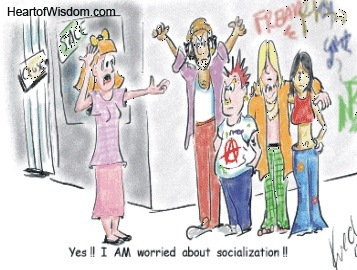
soc7

I followed this cartoon to its site, a blog called Heart of Wisdom, trying to get a higher resolution picture. The blog talked about how homeschool kids should only selectively socialize with other Christians and claims this is biblical. Yep, this is just the type of homeschooling “socialization” I am familiar with. It’s a form of social isolation and indoctrination called “sheltering.” This stuff is all about parental fear and desire for control and helicopter parenting to this extreme is very unhealthy for your child. It will mean that in adulthood that they won’t know how to function at an optimal level. You cannot shield your kid from all “bad influences” and indeed there is nothing in the bible that says your kids cannot play with the kids of people who have different beliefs. That is quite a stretch and it is insular, cultish thinking.

My Homeschool Kid is Smarter than Your Honors Student

That same Heart of Wisdom blog had this other cartoon about homeschooling, so I followed that link and it was to a page dedicated specifically to homeschool cartoons. When I see stuff like this cartoon I have to once again ask – is this supposed to be funny? Do these people actually think this is accurate? My main question, though, is why the elitism and negativity? Even if your kid is getting a much better education in homeschooling, why talk trash about children who through no fault of their own don’t have as good of an education? Why make it into a competition, act like homeschool kids in general are “better” than other kids? It shows me some immature and defensive parenting, really. If you revel in it when someone else isn’t doing as good as you it shows you are 1) being a jerk and 2) secretly worried that you’re no good at what you’re doing. Nobody should ever be excited about other kids having a sub-par education, thinking it makes them and their kids look better. That’s just gross.
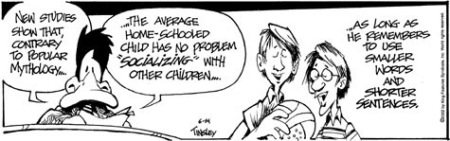
soc8

As it is, I find that there is a grain of truth in this cartoon but perhaps not quite in the way the cartoonist intended. I’ve known a lot of homeschool kids who do use big words in conversations and they soon realize that it comes across as awkward when they socialize with other non-homeschool kids. Admission: I was that kid myself. I read a lot of classic literature and became familiar with words that simply aren’t used in everyday speech anymore. Trying to use them in peer-to-peer conversations didn’t reflect on me being smarter. It reflected on me not having a modern day frame of reference as to what is appropriate. It reflected on me being socially backwards. Lots of public school kids who are bookworms like I was know many big words. They also know the right words to use for their audience. Context is everything. An unsocialized homeschool kid doesn’t have that context and very well might find that using 18th century literary terms in a conversation about basketball will indeed get people looking at them sideways. If homeschool parents want to be proud of that, think it makes their kid (and by extension them) “better,” it shows they truly don’t understand the issue at hand.

Parental Fear & Social Anxiety

That’s where I think we hit the crux of this whole thing. I think the main issue is parental angst and fearfulness. Too many homeschooling parents socially struggled in school themselves and/or got into drugs or unhealthy sexual relationships. Instead of taking a broader view today, they expect that they need to hide their kid away from these settings or the exact same thing will happen to their kid even though their kid is in a different school district in a different generation and *gasp* a different person. These parents become scared of or hurt by the society we live in, withdraw, and then use homeschooling as an excuse to be separatist, snooty, and helicopter over their kids. These are not positive reasons for homeschooling and these are the exact kind of fearful and overbearing attitudes that lead to socialization problems for homeschool kids.

soc9

Because people with strong views often find themselves in positions of leadership, those with exclusionary, separatist, and elitist attitudes often end up running things and then set this negative and divisive tone for the homeschooling group and the community it serves. It’s so pervasive that even some “second choicers” who start homeschooling simply because the other educational options in the area aren’t up to meeting their child’s particular needs (which is an excellent reason to homeschool, in my opinion), can get sucked into this culture, an “us versus them” mindset where homeschooling represents everything that is pure and good and healthy for children and public school and the people and structures that support it represents everything bad. This creates a parallel society of sorts and then you see people start calling public schools “government schools” in a pejorative sense. All this “us versus them” talk fans the fear that homeschooling parents are vulnerable (although still superior) outsiders who are or soon will be discriminated against and this in turn leads to easy exploitation of these scared people.

Why does widespread homeschool participation in things like the fundamentalist-led HSLDA, which capitalizes on these fears and requires dues money (that then goes into their cultish culture wars arsenal) for unnecessary “legal protection” exist? Because many these people are too freaked out to do anything more than cling onto a protector, ignoring all evidence that their “protector” just wants to use them – financially and for furthering a disturbingly anti-democratic agenda. This fear grows and leads to the kind of mindset that spawns ridiculous cartoons like the one below.
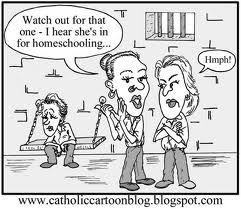
soc10

Put in prison for homeschooling – really? Of course in this cartoon there’s that same (expected) depiction of scary people with piercings, this time instead of a shocked daughter (projecting much?) it’s got a dejected homeschool Mom being shunned by hardened criminals who sarcastically note that her “crime” was homeschooling.

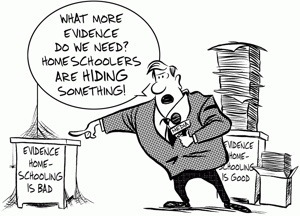
Homeschooling parents who follow these “leaders” (often starting because their local homeschool support group requires or recommends HSLDA membership) hear these divisive messages and become scared to death of being framed, exposed, persecuted, worrying that they will land in jail just for homeschooling. It may be a wacky and unrealistic fear given what’s actually going on, but if people hear it often enough they often come to believe it, along with the bogus stats and stories claiming that homeschooling is as close to perfect an educational option one can get in such a messed up society, and the myth that there is no evidence to the contrary because homeschooling is just so awesome.
soc11

Because homeschoolers test scores aren’t made public and often not even expected, registration isn’t even required in many states, and most people don’t pay much attention to homeschooling unless their kids are being homeschooled. Homeschool movement leaders have been able to get away with exhibiting the cream of the homeschooling crop as representative of all homeschoolers. This has painted an inaccurate picture and hurt the vulnerable kids by leaving them ignored as they fall through the cracks.

Saying “our homeschool kids are socialized but socialization doesn’t matter and in fact it generally sucks if it isn’t coming directly from parents” is a very unhealthy attitude to go into educating with. Responsible homeschooling parents really need to do a bit of soul-searching as to why they tolerate these inaccurate depictions of what socialization is and isn’t, why there is this the across-the-board maligning of all public schools within many homeschool communities, and why so many participate in this ugly (and frankly in my opinion undeserved) elitism, and contribute to such extreme (and inaccurate) stereotyping and putting down of children who have had to attend lower quality inner-city schools, all in order to inflate the merits of homeschooling.

Two big question:

(1) Does this kind of attitude help do anything beyond artificially boosting homeschool egos?

(2) Is there any need for this behavior if homeschooling is really so awesome?

Also, if there is no good data on the problems of homeschooling then instead of celebrating the cobwebs we need to be collecting more data. Every single education method in this world has problems and the places where the problems are denied is where child maltreatment can and does flourish.

The Truth Between “Stereotype” and “Myth”

I get the message that not all homeschoolers are cloistered and don’t know how to talk to people their own age, but the fact is that too many are and we need to recognize that it is a real problem affecting a sizable percentage of homeschool kids. Also, homeschoolers are simply not the most brilliant people in the world or inherently “smarter” than other kids, and as such they shouldn’t need to feel pressured to achieve perfection, perform as child prodigies, or that there’s a black mark on them if they mix up “asocial” and “anti-social” in a conversation.

soc12

This “myth of the unsocialized homeschooler” is an issue in homeschooling but the prevalent idea that the socialization problem is a myth is the real problem, not the legitimate questions and concerns about socialization that homeschool parents keep being asked. Those questions actually need to keep happening because social isolation and ostracism in any setting (including homeschooling) often follows a person into adulthood, and can leave people struggling with social anxiety, a small social network, low levels of social capital, mental health issues, and an unnecessary amount of sad and lonely memories.

The least we can do is stop making fun of people, stop being in denial, stop pointing fingers elsewhere, and acknowledge that it is real, it happens too often and it should be assessed and addressed as the serious problem that it is.

Confessions of a Homeschooler: Iris Rosenthal’s Story

Confessions of a Homeschooler: Iris Rosenthal’s Story, Part One

Iris Rosenthal blogs at The Spiritual Llama. This story is reprinted with her permission.

"I learned at a young age to keep my different opinions to myself and to let her have her say no matter what."
“I learned at a young age to keep my different opinions to myself and to let her have her say no matter what.”

I recently came across a blog called Homeschoolers Anonymous, it caught my eye since I was homeschooled for several years and never set foot in a public school.

As I started reading the blog, I found myself relating to things that were being said there more and more. And when I read the “About” section on their website, that is when I knew I had finally found a place that understood me and the struggles I have gone through to get where I am today, and wouldn’t just dismiss my misgivings about homeschooling telling me “Oh, not all homeschoolers are like that! You just weren’t homeschooled the right way!”

My mother homeschooled my brother, sister and I from K-12 grades. I’m not sure on her exact reasoning for homeschooling us since she was never homeschooled herself and also was a private school teacher for several years. I suspect she would have preferred to have us in a private school, however, living in a very, very very rural area of the state that wasn’t possible nor cost effective. So that left her with homeschooling or having her kids attend *dramatic gasp* public school.

The subject of our education was something that my mom and dad never could seem to agree on. My mom wanted to continue homeschooling us, while my dad wanted us to attend public school once we were older. This topic continued to be something that they both strongly disagreed on even after they divorced. My mom got custody of the three of us kids and we would see our dad every other weekend.

She continued to homeschool us and our curricula consisted of books she would find for us at yard sales and at the library, she also enrolled all of us in 4-H and told us that it was part of our schooling. Once I was in my 3rd or 4th year of high school she bought a computer program called Switched On Schoolhouse.

Once a week we would go to a homeschool co-op, once I was in high school it lost it’s appeal for me because everything was geared towards the younger kids and I was the only one in high school. It was very lonely and also frustrating at times because there were classes in the co-op that I wanted to take (such as the one where you were taught how to change the oil and other basic things on your car) but was told that those were only available for the boys. They had something called Contenders of the Faith (for the boys) and Keepers of the Home (for the girls), I don’t have much experience with either of those programs since they were (as I’ve said before) geared towards the younger kids.

There are times that I have huge doubts as to how intelligent I really am. At home my mother primarily focused on my brother and his education, while my sister and I got the leftovers. It was very tiresome to always hear all the time about how “smart” and “brilliant” my brother was, how well he always did on his schoolwork and how creative he was.

I suppose you must be wondering if my mother ever tried to pass a specific social, political and religious ideology on to us kids. Short answer, yes. She only ever had either conservative talk show, or the Christian music station playing on the radio. I grew up listening to Rush Limbaugh. She also made sure that we were very involved with the church we went to (even though it was a 45 minute drive one way) and was always volunteering us for things, while at the same time not letting us choose what we really wanted to do if it didn’t match her high ideals for us.

Being the oldest I was the first one to graduate of the three of us (even though my brother had skipped a grade or two). Two weeks after graduation I was taking college classes online, even though I had informed my mother that I didn’t want to start college right after high school. I wanted to take a year off and get a job (still hadn’t had a real job at that point, nor was I even driving on my own), work in an inner city church as a volunteer. I wanted to experience the world like I never had before being confined either to the secluded farm, homeschool group, 4-H or church. I didn’t even know what I wanted to go to college for, so it made sense in my 18 year old mind to not go to college until I knew what it was that I wanted to do. And I knew that when I did go to college I would want to stay in a dorm and not take classes online.

Of course that wasn’t good enough for my mom, who took it upon herself to enroll me in an online university to take classes to get an associates degree in business administration. It was her plan for me to eventually turn the farm into a “ranch for disadvantaged youth” and that’s why I had to take these courses.

After trying my very best in the first semester I came to her in tears wanting to drop out. I had toughed it out for a semester and that was enough to reinforce my belief that business administration wasn’t for me. I tried to tell her all of this, but instead got to hear a lecture about how she didn’t raise any quitters. I told her that I would rather have a job, and she told me that in order to have a job that didn’t involve “flipping burgers” that I would have to go to college. Disagreeing with my mother is near impossible if you want to be vocal about your differing opinion, she is very dead set on being right all the time so I learned at a young age to keep my different opinions to myself and to let her have her say no matter what.

I took online classes for eight more months before the university kicked me out because my grades had plummeted so low. It was a great relief for me even though my mother was constantly chewing me out about being a failure because now I could finally get a job.

Overall I would describe my homeschooling experience as negative. Now that I am close to 30 years old and about to have a child of my own, I know that I would not want my daughter to go through what I went through. I don’t want her to be as ill-prepared when it comes to functioning in the real world as I was. I understand parents wanting to protect their kids from all the bad stuff that goes on in the world…however, you have to have balance and know that eventually you will need to teach and equip them how to handle different situations that they will face once they get out on their own.

After all, doesn’t every parent (no matter what their religious or political standings) want their child to be an independent and self-reliant adult in the real world?

Part Two >

Homeschooling and Sibling Relationships

HA note: The following is reprinted with permission from Libby Anne’s blog Love Joy Feminism. It was originally published on Patheos on June 5, 2013.

The homeschool literature that my parents read promised them that homeschooling would create perfect sibling relationships among us children, and make us all especially close and really good friends with each other—unlike those public school kids’ distant relationships with their siblings, and rivalries rather than friendships, of course. I want to take a moment, then, to talk about sibling to sibling relationships in my family. This is kind of embarrassing, to be honest—I’m not going to come off so well here.

It’s true that we kids played together all the time growing up. We sort of had to—there wasn’t usually any other option. I mean sure, we had people over, but most of the time it was just us, and so we were each other’s playmates. I have so many memories of exploring creeks, building lego cities, and chasing each other across the pond. I could go on and on—we really did have great times. But here is my first caveat—I’ve found that most of my friends today who were public schooled also had great adventures with their siblings. Sure, they weren’t around each other for quite as many hours of the day, but it’s wrong to think that they didn’t also explore creeks together, build lego cities together, and chase each other across a pond or pool. In fact, come to think of it, I had cousins growing up who went to public school (and lived far away so we very rarely saw them), and I know for a fact that they did all of those things regularly.

Now, anyone who thinks that homeschooling magically eliminates sibling rivalry is sorely, sorely confused. I’m having troubles thinking of how to easily describe it, but we had sibling rivalries, and lots of them. There were literally three years when one of my brothers and I fought every time we had to spend more than half an hour together (which meant it happened multiple times a day, of course). We just set each other off, somehow. One of my sisters and I just had such completely different outlooks that we ended up permanently at odds—she resented me for being a goody-goody, and I resented her for not being the picture perfect Christian homeschool kid. There were several sisters in a row at one point, and this didn’t always work out that well—there were plenty of times when some of them tore down the others, continually, and with no real explanation. But beyond all this, as I’m going to explain, I actually think that in our case homeschooling served to exacerbate sibling rivalry.

For one thing, we kids fought over friends. See, rather than having individual friends our family generally got together with other like-minded homeschool families as families. So, say, the Smiths and their five kids would come over, or the Joneses and their nine kids, and we’d just play with whoever was somewhere around our age. In this process, I stole friends from my close-in-age-sister. Twice. And once I took a friend who by age probably should have been hers, but I got to her first and monopolized her. And no, this didn’t make for much happy-making between my sister and I. But, well, there were a limited number of friends available to us, so we fought with each other over them, and I usually won. If we’d been in school, we would have been in separate classes and had our own individual pools of friends.

In addition, because we were homeschooled we siblings had to spend 24 hours a day together. Sometimes this worked out great, but sometimes we got on each other’s nerves. A lot. A very, very lot. I suspect that if we had had more time apart from each other we might have grated on each other less. It would have given us a break. It would have meant that we could each have our own space and our own things—something we didn’t really have, and something we often sorely needed.

Next, bullying. Talking about bullying is rather difficult because, well, I was the bully. My parents followed the Pearls’ child training methods, which they came to after another homeschool family recommended them. Based on these methods, they gave us older kids the authority to spank the younger ones. I was never sadistic or anything, but I sure wasn’t very nice about it, and I learned after coming of age and leaving home that many of the younger ones saw me as a bully and had come to hate me. Only, in this case I had been a bully they couldn’t get away from. Normally, kids who are bullied at school have a respite at home. Not so my siblings. Sadly, I’ve seen this same pattern copied by others of my siblings, and even today, among those of my siblings still living at home, the older ones are authorized to spank the younger ones. In some ways, it’s rather like parent-approved bullying. As I’ve written before, I deeply regret my involvement in this. Sure, this pattern can exist without homeschooling, but in our case it was a pattern my parents implemented based on the literature and teachings of the homeschool movement, and not something I think they would have adopted had they not homeschooled.

There’s another issue I should probably discuss as well—as junior mom, I had my favorite among the younger kids. I favored her, and the other kids knew it. In fact, more than once when I was presiding as judge over an altercation the other children accused me of taking my favorite’s side just because she was my favorite. And it was probably true. What’s saddest to me about this is actually what happened after I left home—that special relationship didn’t last. My favorite felt I’d abandoned her when all I’d done was left for college—but she was too young at the time to understand. And then things blew up between myself and my parents and there was a long gap when I didn’t visit home at all, and was afraid to have too much contact with my siblings for fear of risking my parents’ disapproval. I wish I still had a special closeness to the girl I mothered as a teen, but it’s gone now and rebuilding it is hindered by a lack of trust. Perhaps this is something specific to me, but I think it suggests that the junior mother-favored little sibling dynamic common in so many homeschool families I knew growing up wasn’t really so healthy as we thought it was.

And now we come to today.

Today, I’m extremely close to several of my adult siblings—but I’m close to them not because of being with them 24/7 growing up but rather because we were bound together by adversity as young adults. These specific siblings also went through problems with my parents when they became adults and started making their own choices, and during this time we cried on each other’s shoulders, blew off steam in long phone conversations, talked about out our backgrounds have affected us, and just generally were there for each other—and we still do this today. The interesting thing is that these aren’t even necessarily the siblings I was closest to as a kid. As for the kids still at home, my relationships with each of them are weird because if I actively try to undermine what my parents are teaching them, my parents will likely limit my contact with them, and avoiding things that will undermine what my parents are teaching them means avoiding talking about basically everything I’m interested in.

I don’t think homeschooling enhanced sibling to sibling relationships in our family. I’m not saying there weren’t some good things—I did spend more time playing with my siblings than public schooled children do, and I have lots of positive memories from these times—but rather that I think the downsides outweighed what we gained. So when I read the following quote by homeschool pioneer Mary Pride, I just had to laugh. With this background, let me offer the quote and some thoughts I had on reading it.

However, in one respect these books do get it right. In school, kids learn to segregate themselves by age. Older kids learn to be embarrassed about spending time with younger kids. Schoolkids also quickly learn the art of the putdown, and all about “ganging up” on the victim of the day. When all these social fighting skills – which clueless folks refer to as “socialization” – are brought home, it can take sibling rivalry to a new level of meanness.

Does she seriously think sibling rivalry only turns mean when kids attend public school and thus learn bullying techniques and bringing those techniques home? Or, conversely, that public school kids naturally have troubled sibling-sibling relationships? Or, to ask a third question, that homeschooling can’t in certain ways serve to increase sibling rivalry? Because my experience and the experiences of friends I now have who were public schooled very much suggests otherwise.

Does she seriously think that homeschooled kids don’t learn how to put each other down or gang up on each other? Goodness, don’t get me started on the ganging up on each other bit—for a long time, my siblings and I were split into two groups and automatically took opposite sides when there was a fight. Sometimes one faction would gang up on one kid in the other faction, and the rest of that child’s action would rush to her rescue. Each faction viewed the other with some degree of suspicion.

Does she seriously think that homeschooled kids never get annoyed by kid siblings and, yes, even at times come to resent them? Let me tell you right now—they do! I wouldn’t say I ever felt actual resentment—though the same cannot be said of all of my siblings—but I did find some of the younger ones quite annoying at times. And sometimes we older ones—some more than others—wished we could get the little kids out of our hair so we could have some space, but when the little kids share a room with you, it’s rather hard to do that.

When it comes to sibling to sibling relationships, my parents would have done better here if they had sought to read about and learn techniques for fostering positive sibling relationships rather than simply assuming that the act of homeschooling would turn us all into singing cherubs. But then, they bought what Mary Pride was selling hook line and sinker.

I want to be clear that I’m not trying to generalize from my experience—while there may be some similar patterns, I think the dynamics of sibling relationships will vary greatly from homeschool family to homeschool family (just as they vary greatly from public school family to public school family). I’m simply saying that the promise my parents were given that homeschooling would create close and blissful sibling relationships—and also would mean that none of us would face bullying—turned out to be false and grossly misleading. And yet, homeschool speakers and organizations are still out there making this same promise to unsuspecting homeschool parents today. Perhaps, in some small way, my story can help.

If you were homeschooled, I’d like to invite you to use this space to talk about how sibling relationships went in your family. And if you weren’t homeschooled, feel free to talk about your own experiences with sibling relationships and how they compare and contrast with the things I talk about here. 

A Childhood Inside: Richard’s Story

A Childhood Inside: Richard’s Story

This is the story I’ve been trying to write for twelve years.

For the nine years before that — when most expected me to attend elementary school and learn to read and write, find my adolescence in middle school and stumble towards adulthood in high school — I stayed at home. The most logical name for this would be homeschool. However, I’m a little disturbed by the ease of that word – as if a situation so complex and incomprehensible could be so effortlessly labeled, a simple hybrid of the home and the school; a natural consequence, like homeoffice or schoolroom. It wasn’t just that the school was brought into the home; it was much more.

The specifics are easy to relate, I’ve had to explain them many times when the subject is brought up. However, the actual feelings are more difficult to write about. It was as if the nervousness the night before my first day at Kindergarten was extended infinitely and awkwardly. My entrance to school was delayed, forever. I had secret expectations of eventually going to a brick and mortar institution, the schools I read about in Judy Blume novels and saw momentarily on television. Looking back, I thought all schools were indoor hallways of lockers shut down on snow days, neither of which actually happen in West Coast schools. When I made a distinction between what I saw and what I was — my life at home and how I thought everyone else lived — I posed philosophical questions about my situation. My dad was always working, so they were directed at my mother/teacher. I questioned reality and my disconnection from it: “Why don’t I go to real school?” I tried to explore the paradox of our history: “Why did you two go to public school and I can’t?” My mother could only defend our unique separation from everything outside, rather than explain it.

Homeschooling is illegal, or exists in perilous legal terrain, in most developed countries. In Germany, families are not allowed to legally withdraw their children from school and train them within the family unit – this law is intended to “to prevent the emergence of parallel societies based on separate philosophical convictions.” Here they were able to carefully capture the essence of the homeschool: not only does it prescribe a separate education, but encourages a removed existence – separate lives running along parallel to the lives of others, distinct and never touching.

My parents both had advanced degrees. My father was a librarian, my mother a teacher. Their own education, rather than making them cosmopolitan, led them to construct a strict hierarchy along the lines of religion, culture, and race. Rather than seeing themselves on the top, they adopted the Protestant ethic: they were low beings scratching their way up to the top under the vengeful eyes of God. Both attended public schools and grew up in fairly secular households. The roots of how I was raised came not from their upbringings, but rather how they made themselves as adults. My mother attended a private Christian college and, after obtaining her teaching credential, only taught at small Christian schools. My father came from a family Catholic by default, but converted to Protestantism as an adolescent. He tells a story where he was bedridden from sickness and studied the Bible until he found his answer: a religion separate from others, distinct in its purity and historicity. His move from one aspect of Christianity to another, if one could call it a conversion, probably created a need to constantly entrench his position, to lay ideals and notions to ground. My parents, of course, met each other in church.

From what I understand, they came to homeschooling on their own; or perhaps there was some inspiration from others. This was before the echo box of the Internet. We were involved in a loose homeschooling network, but then stopped. We opened our doors to other families in our church for a year or two. Pictures show us: three original children in desks in a wing of the house we called our schoolroom. In a way, we were pioneers, doing something radically different, that had only been done many times before in equal isolation. Just like the picture book “The Little House”, we were an old-fashioned red schoolhouse, the world growing and developing around us as we remained undisturbed and alone, frozen in time.

In fact, the past is a big feature of religious fundamentalism, as I see it. It’s a refuge, a inspiration, a sourcebook. We used old textbooks in our school – they were cheaper, after all, and we didn’t have to rip out contradictory scientific notions. My friends, attending other schools also in their homes, watched Shirley Temple movies and listened to Nat King Cole alone in their rooms, as if stuck in a previous time. We prayed before food, consecrating it with our thoughts and guilt. We spoke in our parents’ dialect, adopting every manner of speech and idiom along with their beliefs, hopes, and dreams. We didn’t know any better than what was given us, and no one told us any different until much later.

I received a robust schooling. There was no “un” attached to what I had, no exploration of my inner motivations or allusions to natural learning. My mother knew how to teach. Our learning was structured, undemocratic, and curricular. But, as our numbers grew and waned, the three of us learned how to be independent. Many who had this type of “structured homeschooling” transition fairly well to future schools and colleges — academics isn’t a problem. When it comes to talking to other people and not pissing your pants in public, it’s a separate question.

I lived between a high school and middle school. The exteriors were familiar, while what was inside was a mystery. On some weekends, I would climb over the locked gates and wander onto the empty playgrounds and fields — empty fragments of something I didn’t quite understand.

I would run around the track or sit on the swings.

Alone.

I Hate That There Is A Name For This: Heather Doney

I Hate That There Is A Name For This: Heather Doney

Heather Doney blogs at Becoming Worldly.

Trigger warning: self-injury.

First off, let me say that I can’t write about this topic without tears of shame coming to my eyes.  Still, I figure the best thing to do with shame is to shed sunlight on it.  So here goes…

I pull my hair out when I’m stressed.  I grab a single hair and yank it out by the root, and then grab another one and do the same thing.  Pulling out the coarser hairs hurts more and those are the ones that I want to pull out.  Wanting to do it isn’t the right word, actually.  It is a compulsion.  If I am absentmindedly messing with my hair (and I generally don’t notice I’m doing it when I am) and find a coarse hair, it is very very hard to not pull it out.  It is an exercise in willpower to just leave it alone, smooth my hair back the way it was, and do something else.  Sometimes I have to put my hair up in a ponytail or a bun because otherwise I can’t help but pull that hair out and then look for another one just like it and then another one after that.

This may seem like an odd problem to have.  Maybe it strikes you as kind of nutty.  I guess I think it’s kind of nutty, and I imagine that if I didn’t have it, I’d probably be pretty judgmental towards someone who did.  Heck, I’m pretty judgmental about it and I do have this problem.

You probably wouldn’t ever know I had this problem if I didn’t tell you I did, or at least I hope you wouldn’t.  I have lived in fear of people discovering it and thinking I am ugly or crazy.  Instead lots of people tell me I have great hair, beautiful hair, compliment me on the cut and color, but I secretly know the truth.

There have been many times when I’ve had a patch or two of short hairs growing back in after I’ve pulled a number of them out and I will use hairspray, clips, ponytail holders, and lots of other things in the arsenal of hairstyling products and tools to hide it.  When in doubt I’ve sometimes gone months without ever wearing my hair down in public.  It makes me so mad.  I prefer having a simple beauty routine as well as wash-and-go haircuts, so the idea that I have this annoying problem and need to spend time and mental space on covering it up, all the while knowing I caused it myself, drives me nuts.  The frustration of being your own worst enemy with something this weird is as maddening as it is hard to explain.

There is a name for this problem.  It’s called trichotillomania.  I still can’t stand that word.  Just writing it down I feel intense loathing for it.  It makes me want to puke or punch a wall.  I hate that there is a name for this.  I hate that it exists.  I hate that I still have it and I hope that sometime, somehow, it will go away.

There are apparently other problems connected or somehow related to trichotillomania and I used to have some of them too.  I still have one of them, although it’s minor.  Nail biting is a similar sort of compulsion, as is skin-picking, and chewing on the corners of your mouth.  I still chew on the corners of my mouth, particularly while reading or writing.  (Yep, just caught myself doing it right now.)

I used to bite my nails and the skin around my nails down to the point where they’d bleed.  I quit at age 14 and have nice healthy nails today. I accomplished this by carrying a nail clipper in my pocket for immediate use on any hangnails (biting them just makes them worse), keeping my nails neatly trimmed and painted with clear nail polish that had a hint of glitter (a forbidden rebellious thing that made me happy), and I would literally sit on my hands when I really wanted to bite my nails until the urge had passed.

I used to pick at my skin daily, making my teenage acne considerably worse, and I stopped because I got a better skin care routine (I use Lush facial scrub followed by a little dab of organic coconut oil as moisturizer every day).  I also limited the time I allotted myself to inspect my skin, and I stopped using a magnifying mirror.  Today I have good and well cared for skin and thankfully the tiny scars I accidentally gave myself aren’t all that visible since I have freckles.

I had trichotillomania for years before I knew what it was.  One day when I was around 11 or 12 years old I was reading a book and noticed I had a small pile of my own hair on the couch next to me.  I threw it in the garbage.  Pulling my hair out inexplicably felt like a relief from stress, which, as the eldest daughter in a large, impoverished, and dysfunctional Quiverfull homeschooling family, I had a lot of.  A few months later I was shocked out of my hair-pulling denial when my parents noticed I had two visible bald spots on my head, each about the size of a quarter.

“Are you stupid or something?” My Dad said,  “You’re quite an idiot to be pulling your hair out by the root.  It might not even grow back now.  You’d better hope it does.  Nobody’ll want anything to do with some baldheaded girl who’s yanking out her own hair, that’s for sure.  Do it again, stupid, and you’re gonna get a spanking.”

My Dad and my siblings mocked me and laughed at me in the months afterwards as the tiny little baby hairs started sticking up when they grew back in.  I was filled with shame and embarrassment. I started wearing my hair in a ponytail all the time.  It’s the only way I was able to stop pulling it out so much and stop having people notice what I’d done.

My Dad’s solution to my problem had been (predictably) to make me feel powerless, ashamed, fearful, insecure, and scared of being hit.  As it is, I think I developed trichotillomania in the first place because I already felt all of those things very strongly.  My life was out of control, I was pointed down the future submissive wife track, and as a sensitive girl who enjoyed books and ideas a hundred times more than babies and domestic duties, I felt I would rather die than have that be my lot.  I felt stuck inside of a skin, an existence, a body, all of which I desperately wanted to shed.  Those were some of the darkest times in my life and I loathed myself as much as I felt my parents did.

I’d like to say that it was sheer willpower that got me to quit these destructive behaviors, but the truth is that over time, as my life trajectory changed for the better and I could see the light at the end of the tunnel, these compulsions naturally weakened to the point that quitting them was possible.  The most noticeable improvement was when I started public school.  Still, I never did quit the hair pulling entirely.  I just hid it better and I tried my best to put my hair up and out of my own reach when I noticed I was doing it.  Thankfully today I don’t do it nearly as often as I did as a girl and at times I have thought the problem was gone entirely.  In recent years it has still returned during periods of extreme stress though.

Finals week.

Flooding out in Hurricane Katrina.

The death of my grandfather.

A breakup.

For years I believed that this problem was because I was somehow defective, screwed up, pathetic, damaged goods, and just couldn’t hack it.  When I think of trichotillomania today I view it through a different lens though.  The image that comes to mind is a bird in a cage.  This connection hit me when I learned that certain kinds of parrots, when they do not get proper socialization and care, will pull their own feathers out.  I can identify with being that bird, wings clipped, kept behind bars, not even knowing what goes on outside of the little space it’s allowed to live in, but feeling bored, unloved, and loathing it’s immediate surroundings.

I think that for girls (and probably guys) who grew up like this and have struggled with various forms of self-harm, it was a perfect storm where the expectation that “God-given natural beauty,” obedient behavior, rigid levels of self-control and self-denial, and perfection in your assigned duties were seen as giving you all of your worth, while any real independent thinking, personality, and human desire were ignored or stamped out, that self-harm became a rebellion of sorts.  It’s natural to want to be valued for who you are, not what you are, so I think that although it is certainly counter-productive, harming your appearance or health, behaving in a manner that is not allowed (towards a body that is your own but you’re told doesn’t really belong to you), and developing compulsions (the very definition of a loss of self-control) is on some level reactionary against that mindset, a twisted affirmation that you are more than those things.  After all, we all are more than those things.

I don’t think I would have ever developed trichotillomania if it hadn’t been for how I was treated as a girl, day in and day out.  Being made to live in a way that is not compatible with human nature really does strange things to people and this is what happened to me and apparently to so many other former homeschoolers (and mistreated kids in general) who developed self-harming behaviors.  The toxic environment messed with our heads so much to where we hurt ourselves, it felt natural to do so, and we didn’t even know why.

Here’s To My Fellow Homeschool Alumni: Ruth’s Story

Here’s To My Fellow Homeschool Alumni: Ruth’s Story

HA note: The author’s name has been changed to ensure anonymity. “Ruth” is a pseudonym.

"Here's to my peers, you fellow homeschool alumni (and wow, does it ever feel good to be connected)."
“Here’s to my peers, you fellow homeschool alumni (and wow, does it ever feel good to be connected).”

This is my own consumer review of homeschooling. I want to share my story simply and directly, so you can understand the results, both the intended results and the side-effects (as someone put it). I was homeschooled all my life until I graduated from high school. So was my older sister and four of my ten younger siblings. The youngest six are still being home schooled.

So first the intended results: I was raised to get A’s. An A practically stood for Acceptable and anything less was handed back for corrections. Because of this rigorous focus on excellence, I am very strong academically. I graduated college with a 3.87 GPA, was inducted into two honor societies and received several other awards.

I’m smart. OK. I’m smart, and I’ve proved it.

Now let me tell you about the side-effects.

At age ten, I moved with my family to a rural area in a new state. From age ten to age twenty, I had no friends. I went to church on Sunday and to piano lessons every other week. My mom was so busy having and caring for my younger siblings that my high school courses consisted of me by myself plowing through one textbook after another. My mom was frequently unhappy with the amount of time I spent on my school work because she needed me to help with my siblings. I was free childcare, and while I loved my family (they were all the life I had), I completely missed out on any experiences that would have allowed me to develop my own identity as an individual or develop any independence from my parents.

When my older sister left for college, I was devastated. I didn’t know how to live without a big sister. We had hardly ever been separated, and I didn’t know anything about how to maintain a relationship with someone long distance or during times of separation.

When I graduated from high school two years later, I was completely at a loss. Since losing my older sister had been such a blow, I was sure I would die if I left the rest of my family, and I was terribly confused as to why my parents suddenly expected me to go to school after sheltering me so carefully all my life. I had never thought seriously about a job or a career because home and family life had always been so glorified, and besides, it was all I knew. I had often been told that I was going to be just like my mother when I grew up (twelve kids and all). So there I was, clueless, clutching very hard at whatever was left of the life I had known.

The years I was eighteen and nineteen are very dim in my memory. I helped my mother care for my younger siblings. I practiced organ three days a week at a local church. I went on homeschooling myself rather secretively.

When I was twenty, my dad told me I needed to get a job. I got a job in a fast food restaurant and was very blessed because my boss was a young woman three years older than me, and I immediately adopted her as my new big sister. She patiently, patiently, patiently loved and supported me as I adjusted to the big, wide world of a hole-in-the-wall restaurant. It was her love, care, courage, ambition and confidence in me that made it possible for me to finally leave home at age twenty-five and attend college several states away. I graduated four years later, and while my college years were incredibly healing (I got to go to counseling regularly for two years and dealt with a lot of anxiety issues, and I was able to cut ties with my parents and become fully self-supporting with my own independent life), there were many, many times when I would have traded some of my academic success for some social skills.

In my life today, I honestly have to say that I am extremely lonely because I still don’t know very much about making friends. I still feel very confused about my age because I am a blend of the neglected child whose needs were set aside for her family or crowded out by the needs of her many siblings and the old (almost grandmotherly) me who knows way too much about childcare and has changed more diapers than many parents. I still feel less than other people because I still hardly know who I am as an individual, and I still find it difficult to realize that I am an adult now with a job, a career to tend to and money to earn and manage. I’m still in shock at my big, wide world, and I’ve been quite depressed for the last few months because I find myself so paralyzed, overwhelmed and confused as I confront it.

So here’s to my peers, you fellow homeschool alumni (and wow, does it ever feel good to be connected). If hearing my story can make even one of you feel less alone, less frustrated, or less like a freak than I’m glad that I shared it.

And to those who want to know how homeschooling can be improved:

1. Parents, please take into account a child’s age and level of development and don’t put more responsibility on her than is appropriate (either too much responsibility for her own education or too much responsibility for contributing to her home and family). And please, please don’t push parenting responsibilities off onto older siblings. They aren’t ready to be parents and being forced into that role deprives them of energy they desperately need to do their own growing up with, and it deprives younger children of the quality parenting that only adults can give.

2. Parents, please remember that each child is an individual person and a future adult, not just a member of your family. Too much isolation is not healthy, and a lack of friends and peers to share and compare experiences with deprives a child of validation, identity-building experiences and knowledge of social roles which are all extremely important to a satisfying adult life. Too little independence is not healthy. The process of becoming independent takes time  (in reality, it starts at birth and is what all the growing-up years are about) and while you can certainly hinder this process and make your child’s normal development one hundred times more difficult than it has to be, you cannot stop her from growing up, so let go. Support her need for independence, and let go some more.

Torching All That Is Sacred: Alexander Anon’s Story, Part Two

Torching All That Is Sacred — One Child’s Emergence From a Totalitarian Environment: Alexander Anon’s Story, Part Two

HA note: The author’s name has been changed to ensure anonymity. “Alexander Anon” is a pseudonym.

*****

In this series: Part One | Part Two

*****

Something people should know about me: I am a fighter. Now, I am not an obvious fighter, and if I was put into the ring, I guarantee nobody would put money on me; but that does not change what I am by nature. See, I am a quirky fighter.  I am weird.  I am unpredictable, though not always intentionally so.  For a while, I simply took what my parents dished out and did not question it.  I do not mean what they intentionally dished out; I mean that I adopted a victim mentality and pitied myself for being in the situations I found myself in.

As I grew older though, I started wanting to change things.  I would still take things timidly, but if they pushed too hard, a fire would flare up in me and I would push back.  Harder.  Through this, I learned that I am much stronger than I had ever previously thought.  I am not a victim; I am the one in control.  If my parents would chide me for engaging in foolishness, I would keep it coming and even ramp up my efforts.  What could they do?  I was invincible.  My foolishness knew no bounds; there were no depths which could be plumbed, no dregs that could be drained.  I could out resource them, outlast them, and outsmart them at virtually every corner until they admitted the futility of their efforts to make me into the cookie-cutter Christian homeschool child.  I had another advantage: the sibling just under me was much more openly defiant (although he used vastly different tactics), thereby allowing me to get by being just slightly less troublesome.

Since being in college, my mom has several times equated my academic success (completed undergraduate honors program with a GPA of 3.92) to having been homeschooled.  This is quite possibly true, but I have never quite had the heart to tell her the truth: her perceptions of my homeschooling experience are much different than my perceptions of that same experience.  If I was to be completely honest, what I enjoyed most was the freedom of homeschooling.  I could do what I wanted, when I wanted, and pursue whatever caught and kept my attention for as long as I wanted without interruption.  For me, at that point in my life, it meant creating Redwall cards that played similar to the Decipher Lord of the Ring’s trading card game.  I would spend hours reading the books, creating workable game mechanics and themes for each culture, and then drawing and coloring the cards.  I was an artist, and a not-too-bad one at that.  I was also an avid reader, but only if the book was of interest.  Many history books and other required readings were simply not to my tastes, and since there was no way to prove if I had actually read the book, I occasionally lied about how much of the book I had read in a particular day (or, at my worst, simply did not read the book while claiming I did).  I did this so that I could spend time doing what I wanted to do: Redwall cards.

I was also notoriously bad at science.  For a while, I thought I simply sucked at science.  Since then, I have realized I did not understand how to study at that point in time.  I would shove a bunch of scientific definitions in, then output them for the test.  On tests where there was more information to memorize, I would earn lower grades.  This measured nothing about my ability to actually understand science; it measured how well I could replicate 15+ definitions word-for-word, with each definition containing several sentences and sometimes looking more like paragraphs.  My junior year, she threatened to kick me into public school for my senior year if I failed a particular science test (since I wouldn’t then be able to pass that grade of science).  Needless to say, I took the ethical high ground and cheated my ass off.  I did not (and still don’t) think it is fair to both at once tell your child that public school is essentially hell and then threaten to send your child to that hell if they do not perform to your liking.

I mention these two aspects of my homeschooling life because they would later get me in trouble just when I thought I was home free in college.  After attending college a few years, I casually joked about how I sometimes wasn’t the best homeschool student as a kid.  To me, it was funny.  Look how well I’m doing in college despite goofing off the last few years I was homeschooled (11th & 12th grade).  My mom, on the other hand, broke out crying at even the hint that I had cheated or lied.  To her, my not taking some aspects of school seriously somehow reflected on her.  It told her she hadn’t done well enough homeschooling to make me care, even though not caring about school is typical for teenagers at that age and I had proven I could excel in college.  She had not failed in any sense of the word, since I was prepared for college and doing well.  But she did not see it that way; only saw that I was admitting homeschool had not been the perfect picture of happiness she thought it had been.

Secretly, deep down, I suspect the true reason she cried is because my goofing off the last 2 years I was homeschooled sent a clear message that I did not need her and homeschooling as much as she thought I did.  Did not need her as a teacher, that is.

This gets to the crux of the matter; it ties together this up-until-now rather bizarre and random story of my childhood.  I think that despite whatever reasons my mom thought she was homeschooling us for, her true motivation was to never have to be alone again after living her entire childhood virtually alone.  Homeschooling, while it may have been about us not getting hurt by others in public school, was also about her not getting hurt by nobody needing her.  It was about making us dependent on her, so that she felt wanted.  Needed.  Ironically, she sometimes lashed out when we expressed the very dependence on her that she had fostered in us.  More than a true need for us to be homeschooled was the need for her to have an identity outside of her children.  An identity that should have come from her relationship with my dad, and with friends her own age.  She needed to escape the burden of parenting for a time instead of embracing it even more fully and homeschooling us all.

I am not saying we should not have been homeschooled; but rather, homeschooling us should not have been the top priority.  She often screamed, “What about me? When do I get to do what I want to do?!?” when she got mad at us for needing her.  But the truth of the matter is this; she was too scared of nobody needing her to ever wander off and do something she wanted to do.  She was afraid that if she did wander off, she might return and find everyone had forgotten her, or worse: never even noticed she left in the first place.

This, then, is what I want to communicate: my entire childhood was shaped by events driven just as much by my mom’s need to be emotionally fulfilled as it was trying to give me what I needed in an education.

Possibly more.

The worst part is knowing she did not do this consciously, she simply failed to recognize what was going on and intervene.  This is not a ‘Fuck you, mom! Fuck you, dad!’ letter.  This is not an article to be used for arguing homeschooling is psychologically harmful and should therefore be overseen, controlled, or prevented by the government.  There is no political message here, no hint of animosity towards anyone; no purpose for saying any of this other than that it is the truth.

The truth.

Truth is never something I was good at hiding, or even wanted to hide.  I tell everyone who will listen that I would rather have a ‘fuck you!’ screamed in my face and punctuated with physical blows than have someone pretend to be my friend.  I do not care if I am physically assaulted; I care if I am told the truth.  Asshats are a dime a dozen; but honest people are virtually impossible to find.  Bluntness, that is.  People who throw social politeness under the bus in favor of calling it like it is.  The ‘ain’t no bullshit here, captain!’ kind of people.  There many honest people in the world, but few who will be blunt with you.

That is what I mean.

In order to avoid ending on a downer note, I will fully self-disclose that things have gotten so much better over the past few years I have been attending college.  Only my youngest brother and sister are still homeschooled, with my oldest sister having attended public school since 9th grade.  I do see my youngest brother struggle with many of the same things I did, but I know I am here to guide him through the confusion and pain that accompanies his upbringing.

More importantly, I know what helped me cope and have given him access to these means at a much younger age.  When I was growing up, I did not have anyone to reach out to about this.  My youngest brother can talk with me about this all; about how sometimes although our parents love us both very much, they do not act rationally and instead resort to violating their own rules and taking their emotional issues out on the children and use us to meet deep needs that we can never fullfill.  He can question me about why most people think the earth is billions of years old but he learns it is only several thousand.  I do not provide him with ‘the answers’, but ask questions to help him think through the issues on his own.

That is what true homeschooling should be: parents providing their children with an outlet to escape the biases and politics of public school without imposing their own biases and politics.  Because ultimately, that’s what homeschooling is: freedom.  Freedom to question authority, to question rules, to question the ‘no tolerance’ policies that are a virtual shitstorm in public schools.  My story is one of that freedom being unconsciously abused, but that same freedom can be used to free others from the abuses they may receive elsewhere.

As hinted at in my opening paragraph, eventually my parents figured a lot of their issues out and loosened the stranglehold conservative Christians had on their throats.  This legalism went to hell when our family became the black sheep of the congregation and the pastor and elders treated our family like shit.  We were accused of much, and treated like enemies instead of brothers and sisters in Christ like they claim to treat all believers.  What they failed to mention when you sign up is that their interpretation of the Bible only tells you to treat people as human if they think as you do and do not question what you demand of them.  Anyone who threatens their reputation, who is similar enough to them and then suddenly appears less than perfect, is quickly either intimidated to fall back into line or else cast out into the cold world to die a lonely and painful death.  Fortunately, our family pulled together and told them that while we appreciate their willingness to spend their entire lives with their heads on vacation in the wonderful world of Up-Your-Ass, our family preferred to admit we are living, breathing, feeling, fallible individuals who must address our shortcomings and forgive each other.

So yes, our family is no longer the perfect Christian, homeschooling family we once were. Thank God. And I mean that; I am both relieved to leave the bullshit and small-mindedness, and thankful to God for rescuing us from the bullshit.

As you can tell, I still believe in God. But not the Orthodox Presbyterian Church God that requires men to dominate women, for children to obey their parents without questioning what they are told to do, and for His followers to spend their time prior to dying and enjoying their life in blissful paradise feeling like shit because they believe happiness is automatically indicative of falling into sin.  Focusing on how fucked up you are, or others are, does nothing to solve the problem.  Even their own book tells them that much, but they still do not see despite claiming you do not see.  Slowly, their God died to me (not for me), and I can personally attest that this death did not occur on a cross.  It took place in my mind, after years of watching my family suffer the consequences of sucking it up when things got hard and pretending everything was alright.  However; this god did die at a cross.  Crossroad that is. The death of the OPC God was a crossroad where I switched paths.  Where our whole family switched paths.

I have never been more proud of our parents than when they essentially told our old OPC church to go fuck themselves. (This message was not communicated quite as bluntly, but the effect was the same).

In closing, I am not mad at my parents. I hold no bitterness for them, or anyone else, including the OPC church and their members.  I am still friends with many of them, and see the pleading looks in their eyes to come back when I occasionally visit.  But I see more than this.

Underneath the pleading for me to return to them I see another kind of pleading; a pleading for someone to rescue them from themselves.  As for me, I am never going back. Not permanently, although I do visit every once in a blue mooon. Having now experienced life in the open — in the sunlit world having emerged from Plato’s cave with the totalitarian forces striving to keep individuals locked away in the cave — I know what it is I will spend the rest of my life doing:

Fighting to free others from the blindness, from being emotionally used and feeling helpless to escape, whether it occurs while being homeschooled, public-schooled, or not schooled. Because using others, even unconsciously, to meet your needs is not right; and having gone through this myself, I find that I cannot wish it upon anyone else either.

We are Anonymous.

We are Legion.

We are Homeschooled.

*****

End of series.

Torching All That Is Sacred: Alexander Anon’s Story

Torching All That Is Sacred — One Child’s Emergence From a Totalitarian Environment: Alexander Anon’s Story

HA note: The author’s name has been changed to ensure anonymity. “Alexander Anon” is a pseudonym.

*****

In this series: Part One | Part Two

*****

As I start, I wish to be clear that this story is intended to convey my experience of the complex phenomenon that was my homeschooling experience, not make broad claims about homeschooling in general; and that within this narrative I perceive not villains but instead numerous individuals that were products of factors they either did not understand or were helpless to change.  What follows is a tale of how homeschooling efforts collided with conservative Christian values to create the perfect maelstrom of do’s and don’ts, and the resulting insecurities I was left with in the wake of destruction caused by the brain-washing and intimidation tactics utilized by the primarily homeschooling congregation of the local Orthodox Presbyterian Church our family attended.

I guess the best place to begin this story is to discuss the dynamics of my parents’ relationships with each other, their seven children, and their parents growing up.  My mother had a hard life growing up, with her parents fighting constantly and physical violence prevalent.  Her experiences in public school were not much better, as she has mentioned on various occasions that she felt isolated, unwanted, and ignored.  The three main things she learned growing up were: (1) you keep fighting even when nothing is alright; (2) if nothing is alright, you shut up and pretend everything is alright; and (3) people will never give you what you want unless you trick them into giving you what you want.  My father, on the other hand, appears to have had a much healthier childhood, although certainly no childhood is ever without its scarring moments.

Although they are virtually mum on the circumstances surrounding their dating and eventual marriage, as best I can surmise my mom wanted to escape her emotionally damaging life at home and my dad possessed the perfect combination of charm and wit necessary to distract her from her emotional wounds.  Underneath his charm and wit; however, was an anger that would flare up from time to time and remind my mom of the dad she was forced to accept ‘loved her in his own way’, but certainly never expressed it in a manner that made her feel loved or accepted by him.

It was into this environment, sometimes wonderfully loving, other times frighteningly turbulent, that our parents brought seven children, of which I am the second oldest.  For the most part, we grew up in a stable, loving place and had the typical American childhood everyone longs for.

We were also homeschooled.

Much of the driving force behind my mom’s decision to homeschool us, I believe, was wanting to shield us from the horrible experience she had with public school.  Although our family never really talked about it, there was an unspoken understanding that people in general are mean, morally bankrupt, and frightening.  While never outwardly communicated, I tuned in to this message that people do not care about you and will ridicule you, and internalized it so that my self-confidence was (and still is, in many areas) virtually non-existent.

To this day I struggle to believe people in my college classes, on the street, in church, and everywhere else I go could find something to like about me.  Because people just don’t like or accept others.  People were monsters.  They were the unknown, and the unknown was frightening.

Our parents were overprotective of us.  Out of love, of course; but still overprotective to the point of being constrictive.  Even as teenagers, we were prohibited from riding our bikes further than a block away from our house.  This severely limited the number of friends we could have.

I can only remember a handful of times our parents had non-family members over to our house, and we certainly were not allowed to go to others’ houses to play unless they lived only a few houses away.  From this all, the message was clear: people are scary.  Something to be avoided.  I still have high social anxiety to this day because of our mom’s fear of being hurt by others.

One particular incident stands out to me.  My older brother was watching over a couple kids at a summer camp as a counselor for several weeks, and had made several friends (he was always more outgoing than I).  After the first week, one of the female friends he had made at camp returned to her home and sent a friendly email to my brother, who was still at camp.  I remember our mom flipping out to our dad because she thought my brother had a girlfriend.  I read the email myself; it was harmless.  The girl was just being friendly.  Even worse; why was the idea of my older brother (at that time in his teens) having a girlfriend something to freak out over?  Why did this idea deserve such a harsh, negative reaction?  I still do not understand to this day, and yet the message could not have been clearer: people are something we avoid.

To be clear, I am not trying to suggest that all homeschooling families are like this; this is certainly not the case, as I personally know family after family that encouraged their children to have as many friends as possible.  However; in our family, having friends almost always seemed bad.  There were a few exceptions.  A homeschooling family moved in down the street from us when I was a young teenager, and our families became as close as possible without being related by blood.  To this day, the two oldest boys in their family are my best guy friends.  Their family moved away after less than a year in our neighborhood.  A few years later, I met another homeschool family at our church and eventually became good friends with the two oldest girls.  Being friends with girls was new to me, since the only previous female friend I had made attended a homeschool co-op that our family left just a few weeks after I finally started feeling comfortable interacting with her.

Besides unintentionally (I truly believe my parents did nothing out of bad intent) restricting my access to friends for the greater portion of my childhood, several other areas of my life were censored out of a need to please God.  This was most noticeable in the music I was allowed to listen to.

I had no interest in music until our local church offered to pay for one cd for every 20 Westminster Shorter Catechism questions I memorized.  Being a homeschooler with little else to do, I beasted this mental feat.  Every time I recited 20 catechism responses, our mom would drive us to the local bookstore, listen to music samples from the cd’s we wanted, and read printouts of the lyrics.  Almost nothing was Christian enough for her tastes.  Newsboys’ Thrive, with its song ‘It Is You’ and lyrics “holy, holy is our God Almighty/ holy, holy is his name alone” was not good enough.  Relient K’s Anatomy of Tongue and Cheek, with lyrics such as “Never underestimate my Jesus/ You’re telling me that there’s no hope/ I’m telling you you’re wrong” (For the Moments I Feel Faint) was not good enough.

You get the picture.

I used to cry every time we returned from the bookstore with my 10th choice cd; or worse, empty-handed after killing an entire afternoon in the store reviewing lyrics.  The point of mentioning this isn’t to generate pity, or talk bad about my mom who I love very much; I bring this up because I learned several very important lessons through this experience:

1. Persistence

If a cd was shot down, my mom would agree to listen to it the next time we went.  Several times she would cave on the third or fourth listen simply because I kept making her listen to it again.  This was not always the case, as Skillet’s Collide album was shot down no matter how hard I tried to get her to accept it as Christian rock.

2. Self-Motivation

No one was going to get me the album I wanted to listen to unless I put in the hard work, constructed arguments my mom was willing to accept for why I should be allowed to have it (usually revolving around why the lyrics were “Christian” lyrics), and didn’t stop the barrage of arguments until I had won or was shut down completely.  Even when a particular album was shot down, I would pick a similar sounding album and push for that, because I suspected that while she claimed to be judging albums based on lyrical content, her genre preferences were also a significant deciding factor.  In other words, I became a social scientist formulating and testing hypotheses because of this process.  I am currently a first year Master’s student studying forensic psychology, and intend to pursue a Ph.D. in criminology.  The skills I learned as a result of these unpleasant music-judging trips have been invaluable to me throughout my academic journey.

3. There Is Always A Way

After trying for several years to get specific albums and failing despite all my best hypothesis testing and revising, I finally stumbled onto the perfect solution without even intending to.  My parents gave us the opportunity to play music, and after a few failed years of learning piano (I did not appreciate the teacher’s mechanical playing style and wanted to play a specific genre of music she did not let me learn), I took up guitar.  The guitar teacher was amazing in so many ways, the most important of which was he alternated between learning how to play and teaching me how to play the songs I wanted to learn.  For this, it was necessary to bring in a recording of the song for him to play along with and figure out the notes.  At first, I would bring in Christian music my mom had let me get.  Then, because I was embarrassed that the guitar teacher did not know any of these songs, I started bringing in more “secular” songs I had recorded on a cassette tape from the radio.  One day, I got the bright idea to search online to see if I could listen to the songs.  Quite accidentally, I discovered a place to illegally download mp3’s of the any song I ever wanted.  Needless to say, I secretly binged and downloaded hundreds of albums this way.  After years of secret listening to music this way and fearing being found out, I finally broke the silence and reported that I had access to any music I wanted and desired to pay the artists money to actually legally own the cd’s.  After the shock wore off, my mom reasonably agreed that the Christian thing to do was to pay money to own them legally since she couldn’t stop me from listening to them anyway, as long as I didn’t buy any “Eminem.”

One of my pet peeves growing up, and that will still get me fired up when I hear my dad tell my youngest brother this, is the phrase “just stop the foolishness.”  This phrase was the buzzword for enjoying yourself, reveling in the absurd nature of something, or presenting something logically impossible.  In other words, it was the response used to prevent a child from being a child and utilizing their imagination.

Foolishness was a concept derived from the Bible (particularly Proverbs), and foolishness was to be avoided at all costs.  Six year olds laughing at farts was “foolishness”; but it was not “foolishness” when my dad wanted to crack a joke about farts.  It was only foolishness if a child tried to add something on to our father’s joke that our dad did not find amusing.  Then, magically, what was not foolish only a moment ago became foolish.  I know my parents did not intend to link enjoying yourself or being happy with punishment, but they did.  One minute I was laughing and having a good time, the next I was being rebuked for foolishness because I had tried to add something of value to the conversation.

Not only did this make me fearful of being happy; it discouraged me from speaking up, because speaking up can inexplicably lead to being punished.

To be continued.

Homeschooled Girls and Trash Cans: Latebloomer’s Story, Part Two

Homeschooled Girls and Trash Cans: Latebloomer’s Story, Part Two

HA note: The author’s name has been changed to ensure anonymity. “Latebloomer” is a pseudonym. Latebloomer’s story was originally published on her blog Past Tense, Present Progressive. It is reprinted with her permission.

*****

In this series: Part One | Part Two | Part Three | Part Four | Part Five | Part Six | Part Seven

*****

Part Two: The Social Isolation of Homeschooling

What do homeschooled girls and trash cans have in common?

They both only leave the house once a week.

"What do homeschooled girls and trash cans have in common?"
“What do homeschooled girls and trash cans have in common?”

This joke was well-received among homeschooled youth because it rang true for so many of us.  For almost all of my teen years, church was the only social activity that I engaged in, the only time during the whole week that I might have a chance to interact with people who were not my immediate family.  Making friends in that context, especially as a shy teen girl, seems daunting.  However, I had an even greater obstacle to deal with: I was not allowed to participate in youth group.

My parents were absolutely terrified of teenage rebellion.  Thanks to various books and speakers popular in the homeschooling community, my parents believed teen rebellion to be a recent American trend due to indulgent parenting and peer pressure.  A rebellious teen was more than just an annoyance in the homeschooling community: that teen was turning his/her back not only on the parents, but also on God.  What a tragic waste of years of sacrifice and careful training by the parents!  This type of thinking motivated my parents to maintain careful discipline and to shelter us from almost all contact with our peers, even at church.

I distinctly remember the conversation between the youth pastor and my mom.  I was probably 14 or 15, and so shy that I would start shaking if anyone tried to talk to me at church.  Although social interaction was painful, I desperately needed it, and I think the youth pastor noticed that.  He approached my parents after church one day to invite us to Sunday school.  My mom asked for the materials that were being used in Sunday school, and took them home to peruse them with my dad.  I heard the decision the next week at the same time as the youth pastor: “Our kids will not be attending Sunday school.”  The reason?  Apparently the material mentioned a teen who was frustrated with his parents, and it was dangerous for me to think that frustration was a valid or normal feeling for a teen to have toward parents.

The tough thing about social phobia is that it is often self-reinforcing.  In my case, my severe social anxiety displayed itself in uncontrollable muscle spasms, and anticipating the shaking made me even more anxious about interacting with people.  What if someone noticed me shaking?  I used to cry myself to sleep at night quite often, occasionally trying to get my mom to notice my tears by sniffing juuuust loud enough for her to hear as she walked by my door.  When she came in to ask why I was crying, I would say something like, “I don’t have any friends” or “I don’t know how to talk to people.”  The answer to these was always the same: “You have us” or “You’re talking to me right now.”  In the morning, life would proceed as usual.

Unfortunately, the “usual” for my life at home was very empty and quiet.  My dad was working long hours and was permanently in a bad mood when at home, and my mom was always sapped of energy for various reasons.  She left us kids to do our schoolwork independently much of the time; we even corrected our own errors from the answer key.  Later, due to mysterious and debilitating health problems, her energy was so low that just going to the grocery store was often too much for her to handle.  It was simply understood in the family that we shouldn’t harass her about wanting to leave the house.  Since I wasn’t able to get my driver’s license until I was 18, I was stuck for hours, days, weeks, months, years with little-to-no mental or social stimulation.

Little-to-no stimulation is not an exaggeration; obviously, a teen girl who can’t even go to Sunday school due to “bad influences” is going to find many other things forbidden to her as well.  Our home did not have a TV; we watched few movies; we only read pre-approved Christian or classical books; we did not have internet access; and we certainly did not listen to most music.  My one musical joy was listening to Steve Green and going to his concert with another homeschooling mom.  When I tried to add Rebecca St. James to my CD collection, my mom almost had a meltdown because of the beat and the heavy breathing; it didn’t matter that almost every song was a verbatim quote from the Bible.  I knew my role–honor your parents–so that CD went straight into the trash and I tried to feel happy that I was obeying God.

What did I do with my time at home?  I dragged my school work out to take up most of the day; I spent large amounts of time spaced out, lying on my bed; I wrote in my journals; and I made my own clothes.  My homemade clothes were the outward sign of my feelings of isolation.  Starting at about age 13, I was responsible for furnishing my own wardrobe (within the boundaries of modesty my parents provided, of course).  I had $25 a month to work with, and my mom could tolerate shopping at fabric stores much more than at clothing stores, where everything was “immodest.”  (And that was in the women’s clothing sections–I didn’t even know that clothing came in junior sizes until after I had graduated from high school!)  Out on various errands or on family vacations, wearing my very odd, ill-fitting clothing, I felt the stares and desperately wished that human contact was unnecessary.  “I wish I could just be a hermit!” — this sentence occurs a little too frequently in my teen journals.

My first friend of my teenage years came from Hope Chapel, when I was about 17.  Pastor Reb Bradley, with the support of the homeschooling families of HC, would not allow a youth group in the church.  Finally, I was not so odd!  It was easier to strike up a conversation with someone, knowing they might be just as desperate and nervous as me.  It was easier to not feel judged when the other person’s clothes were just as odd as my own.  I could more easily feel successful at conversation because it was not full of cultural references that I had no idea about.  I became a little more confident socially, strengthened my atrophied conversational muscles, and got a little more hopeful about life.  I was even able to add a second friend by the time I was 19.

Now I’m 30 years old, with four years of college and eight years of work between me and my teen self, yet I still feel the effects of the isolation I experienced growing up.

First, I still feel significant social anxiety in even the most non-threatening situations.  I am particularly at a loss in group settings full of new people.  What do I say? When do I say it? Whom do I say it to?  How/when do I end a conversation?  Even in a circle setting, when it’s my turn to say my name, my blood pressure skyrockets.

Second, in the whole world, there is no place and no group of people where I feel like I belong.  It’s like I was raised in a different culture, with the distinct difference that I can never go “home” to it.  I’m permanently a foreigner; interacting in this foreign culture takes a lot of attention and effort.  I’ve tried to catch up on the culture I missed…to watch the movies, to listen to the music, to see pictures of the clothing styles…..but it will never mean to me what it means to you.  People always use cultural references and nostalgia as a way to build community and connections between people; for me, they create distance and remind me how different I am inside.

My profile photo is of the 80s star Molly Ringwald.  The first time I ever heard her name mentioned was at my first real job, when I was 22 years old.  God bless my dear gay boss, who saw through my awkwardness and gave me a chance at the job because I looked like his favorite childhood actress!  When he learned that I had no idea who she was, his jaw hit the floor.

These days, I manage to avoid shocking people too much, unless I decide to tell them about my past.  To me, the biggest compliment I can receive today is, “You were homeschooled? Wow, I can’t even tell!”

*****

To be continued.

Generational Observations: Jeri Lofland’s Story, Part One

Generational Observations: Jeri Lofland’s Story, Part One

Jeri’s story was originally published on her blog Heresy in the Heartland. It is reprinted with her permission. The second part of Jeri’s contribution to HA is “Of Isolation and Community.”

Someone asked me about the long-term effects of homeschooling vs. public education, and it got me thinking. I won’t consider secular private education in this article, mostly because I don’t have firsthand experience.  I have enjoyed teaching my young children at home, but we have decided to send them to public school while they are still in the elementary grades because of our observations over a generation of homeschooling.

Effects on Society

Certainly homeschooling promotes elitism. Even without religious motivation, announcing that you can get a better education from your mother than from certified degreed professionals has an air of snobbery. Socially, the kids can hardly escape the inference that they are too good (or smart, or rich) to rub shoulders with the inferior proletariat, especially when they are repeatedly told their home experience is superior. Latin for kindergarteners, anyone?

Public school introduces children to others who are like, yet unlike, them at the same time. It broadens their understanding by allow them to work and play alongside real people of other races, other religions, other languages and backgrounds. When conflicts arise, involved parents have an opportunity to encourage cooperation, sensitivity, and compassion, as well as personal boundaries. My children are learning to respect diversity in a way that would be impossible if they only played with kids from their own neighborhood. And they see that excellence is a personal choice independent of circumstances.

Our public school welcomes parental involvement. Teachers are thrilled to have parents volunteer in the classroom and the principal has always had an open door when I stopped in with a question or concern. When I spend an hour helping my daughter’s classmates practice multiplication, I multiply the teacher’s efforts and support the cause of education far beyond my own children. Our school truly belongs to the community and it is what the community makes it.

Government policies and education budgets now affect my children directly, so I have heightened interest in the issues. I better understand what educators do, helping me relate to a much larger group of society. When teachers and professors in my book club begin to discuss particular stresses on public education, I can participate. Rather than supporting divisions based on class and ideology, I can connect differing perspectives to broaden people’s view of the big picture.

Effects on Students

I maintain that it is neither normal nor traditional for boys to spend their days under the tutelage of their mother after they reach double digits. In the days of the pioneer, a boy might grow up isolated and self-taught. He was prepared to explore the frontier, self-reliant and independent. Those are hardly the skills needed by adults today.

It would be interesting to hear from men how they think homeschooling affected them emotionally. My hunch is that all that time at home with Mom often stunted their decision-making and negotiating skills and either increased their susceptibility to manipulation or their ability to manipulate, or both.

Boys–and girls in contemporary society–need to learn goal-setting and negotiating skills. School exposes them to a range of leadership styles and personalities and varied levels of accountability. It helps them build a portfolio of social skills (and coping mechanisms) that can serve them in the work force when they have to deal with cranky managers, lazy teammates, and charting their own professional course.

Even in modern homeschooling, with its drama groups, advanced math co-op classes, and sports teams, families tend to be overly flexible, to lack commitment to schedules, and to make sacrifices for one child at the expense of the others. In spite of its flaws, the school system does allow for a more level playing field that offers individual choice and rewards accordingly.

Effects on Family Dynamics

Family dynamics are the primary reason I decided against long-term homeschooling. Put simply, my daughter appreciates me much more when she doesn’t have to spend all day with me! Though we spend less time together, we use that time more efficiently, deepening our relationship and helping her develop emotionally and socially. Homeschooling strains the parent-child relationship unnecessarily. It is unfair to a teenager for one or two adults to hold the keys to his education and grades as well as his: social life, access to transportation, food choices, access to employment, daily schedule, recreation, healthcare, and moral guidance. This absolute power tends to corrupt parents, or simply exhaust them.

How many moms have “burned out” on homeschooling, devoting themselves to their children’s needs or success while ignoring their own? If she has her own dreams, the teaching parent may resent the inefficiency of spending so many years as a caregiver and educator for a handful of children, when she could be pursuing a satisfying career while sharing the educational responsibility with professionals who chose the job. The early homeschool movement seems to have coincided with an era when technology and a stronger economy had recently reduced the load on stay-at-home moms. Homeschooling may be a healthy alternative to watching soap operas, but it can be a real financial hardship for some parents–contributing to marriage and family stress.

Adolescence is a time for widened horizons, a time to experiment with choices and learn specific cause-and-effect sequences, with the home as a physical and emotional safety net. When teachers reinforce what parents have been telling their kids, the whole family benefits. Feedback at regular intervals gives kids a chance to test different approaches to learning and meeting goals. When they struggle in one area (academics, social relationships, or family issues, for example), they can lean on other networks for support and hopefully build confidence by succeeding in something else.

As the product of homeschooling, and a homeschooling parent myself, I think the benefits of homeschooling are usually overstated. Certainly religious motivations have driven the movement’s growth, but weighing the social and educational results does not convince me that homeschooling prepares people to better thrive in their society.