To My Sister and the Vision Forum Victim No One’s Talking About

Doug Phillips and his family.

Jenny Wells blogs at Jewellspring. She is a teacher and a writer. She educated her own three children full-time and others’ children some of the time for 17 years until 2012, she stopped and placed her three children into public school. The following was originally published on her blog on November 4, 2013 and is reprinted with her permission.

For ten years, I homeschooled my three children full-time.

And during that decade, I came across all kinds of families, systems, philosophies, and curriculum. I went to the conventions, read the books, did my research. And during that decade, I learned who the big-wigs were, the poster families, the ones “we” the homeschooling community most wanted to emulate. I wanted it at certain points, too…the family-centric lifestyle. The clean-cut gender lines. Perfectly behaved and courted children, mainly for my sake. But in my heart of hearts, I knew I could never be like “them”. I just received their shiny catalogs in the mail and wondered how they pulled it off.

I knew we couldn’t be like them; I wasn’t sure I even wanted to be, but the temptation was there. Why? Because a faith and lifestyle that gives answers feels so much safer than a life of mystery and questions and any mother gets afraid, whether they can admit it or not.

Give me a formula to keep my children “safe” and I’ll follow it.

My views and life have changed so much since the days of being handed books like, “Beautiful Girlhood“. So when Doug Phillips (the patriarch pictured above) resigned last week because of an “inappropriate relationship”, my first reaction was, “A-HA! No one is immune, not even you Mr. Father of Many in Shiny Catalogs.”

But here’s the real reason for my post.

This story has stuck with me and I wake up thinking about it. I read his apology found everywhere (just Google it) and spent some time online last night trying to research the story. I am now even more grieved.

No one. No one, not one supporter or stick-it-to-him writer wrote about her.

Her.

Who was the girl he was involved with?

I don’t need a name. But I need an identity, an acknowledgement. Because I know her heart is broken.

She hides in obscurity.

Doug Phillips apologizes as I have heard so many apologize before, as virtuously as he can sound, but not to her.

He goes home to restore with his wife and family. But I would guess the chances are more likely that she has none. How will she be restored? How will she recover?

I am so sick and tired of these stories being about Him. The man of power.

If you have never experienced it, you can’t know what is like to be given attention from someone of power in a system that encourages it. Oh, but I do. It’s heady, confusing, and so very scary, to be given the attention of a man in a position of power, especially in a system like Vision Forum and many, many circles I came across in my home-schooling and church-attending days where men have been given the greater authority from God.

Dear Sister, whoever you are, I don’t care if you started it. I don’t care if you were his peer or a young woman. I don’t even care all that much that his family was hurt. They still have each other and families have survived worse. But you have to go away. You can have no contact with a man you felt deeply connected to. You have to stay in obscurity. You don’t get to heal with the man who broke your heart. And no one is talking about you and this pain that I imagine is greater than you can imagine surviving. I’m so sorry.

And I care.

If you know of anyone else writing about the real victim, please let me know in the comments below. Thanks.

Ready for Real Life: Part Three, Are Your Children Ready?

Screen Shot 2013-11-02 at 1.15.43 AM

Ready for Real Life: Part Three, Are Your Children Ready?

HA note: This series is reprinted with permission from Ahab’s blog, Republic of Gilead. Part Three of this series was originally published on October 6, 2013.

*****

Also in this series: Part One, Botkins Launch Webinar | Part Two, Ready for What? | Part Three, Are Your Children Ready? | Part Four, Ready to Lead Culture | Part Five, Science and Medicine | Part Six, History and Law | Part Seven, Vocations | Part Eight, Q&A Session | Part Nine, Concluding Thoughts

*****

I am reviewing the “Ready for Real Life” talks, a webinar series on Christian homeschooling hosted by Geoffrey Botkins of the Western Conservatory of the Arts and Sciences. In the previous part, the Botkin family celebrated religious homeschooling as a means of exercising Christian dominion and resisting a supposedly sinful culture. In this part, “Are Your Children Ready for Real Life?”, Geoffrey Botkin and family laid out how Christian homeschoolers should approach the surrounding culture and establish Christianity as their foundation.

Botkins began the webinar with a prayer, thanking God for children and for the way God has designed their lives. He prayed for wisdom and joy in raising children, reminding listeners that they were raising offspring in a supposedly perilous time. “They’re being launched into a very difficult, trying, uncertain century, and we’re living in a country that’s no longer as steady and solid and righteous as it once was,” he said at the 1:17 mark.

Botkins stressed that the best way parents can teach their children to think is to begin with the science of the mind. All science is theological, he insisted, because all things are theological.

“True” scientists in past eras knew that they had to look to theology for a true understanding of reality, he claimed.

God created the mind and personally develops the minds of children, Botkin said. However, the same God can also inhibit the minds of people with poor attitudes and render them mentally slow. “God sharpens the ability to think … or he deliberately deranges the ability to think depending on the attitude of the child or the adult,” he told listeners at the 2:50 mark. At the 4:28 mark, he admonished parents to teach their children well, lest their children behave unrighteously and bring down the wrath of God on themselves.

“Parents, you need to realize that your children and all those children who suppress the truth in unrighteousness personally receive the wrath of God … You cannot let your children suppress the truth that you’re teaching them. You can’t suppress any part of it.”

God’s inflicts his wrath on unrighteous people by instilling them with “moral stupidity”, he claimed. In other words, God causes “moral rebels” to lose their minds, resulting in people who are both intellectually and morally stunted. “All sin makes people intellectually as well as morally stupid,” Botkin asserted, correlating moral clarity with mental clarity.

Botkin’s comment about God “deranging” people’s minds stunned me. Was his statement meant to instill fear in listeners? Believe and have a good attitude or God will scramble your brain! Or was he blaming learning impediments on impiety? If the latter, Botkin’s words essentially blame people for any learning challenges they might face. The idea that learning impediments or problems focusing could have emotional roots (depression, anxiety, trauma) or physiological roots (ADHD, dyslexia, nutritional deficiencies) seems to have escaped Botkin, who prefers to blame the sufferer.

In addition to being fanatical and brazen, Botkin’s comments were incorrect.

If Christian fundamentalism brings moral clarity, which in turn yields mental clarity, one would expect fundamentalist Christians to be brilliant and everyone else to be malfunctioning. However, intelligent people and slow people are to be found among Christians and non-Christians alike. How could Botkin ignore this simple, self-evident fact?

Botkin redefined the word “superstition” to refer to critical approaches to fundamentalism. He reminded parents that they need to correctly interpret the world for their children while in the midst of a “superstitious” culture. One of the most destructive “superstitions” in modern society is the belief that smart people have abandoned God’s covenantal ethics, Botkin claimed.

Parents must teach their children how to decipher our “broken, immoral culture” by using scripture as the standard for all thinking, Botkin insisted. A child’s moral foundation must rest on the ethical system of the Bible, he stressed. Botkin spent several minutes speaking warmly of raising children with God’s law.

At this point, Geoffrey Botkin’s son David chimed in. David Botkin emphasized to listeners that parents must teach children the word of God with great sincerity, and that the word of God must dominate children’s lives.

David spoke approvingly of his father’s influence in his life, such as his father’s emphasis on scripture as a tool for interpreting the world and his love of R.J. Rushdoony’s Institutes of Biblical Law. 

David stressed that the law of God applies to everyone, including the President, and to all matters. He claimed that while in Washington D.C., his father was included in a conference call regarding military action after Saddam Hussein’s forces invaded Kuwait. According to David’s account, Geoffrey Botkin advised the conference call participants to give a warning to Saddam Hussein before initiating military action, in keeping with Biblical teachings, and later felt ashamed when he could not recall the exact Biblical verses supporting this approach.

Geoffrey Botkin’s daughters, Anna Sophia and Elizabeth, chimed into the discussion as well. Anna Sophia Botkin discussed daily scripture reading in the Botkin family, sharing a quote from Cotton Mather on drawing lessons out of Bible verses. Elizabeth Botkin explored the question of whether it is beneficial to make children read the Bible if they don’t want to. She admitted that as a child, she did not always enjoy reading the Bible, but she was eventually saved over time by reading scripture. Only scripture can reform an “unregenerate heart”, she said, quoting a passage in Romans 10 that associated faith with hearing the word of God.

Geoffrey Botkin emphasized that parents must teach their children critical thinking, given the importance of discernment in navigating a world steeped in “superstition and falsehood”. Christians cannot be carried away by every “wind of doctrine”, and thus Christian parents must teach their children to have strong convictions in their faith. Otherwise, a child’s faith can be “stolen” by another child who dares them to change their mind. When teaching his children discernment, Geoffrey Botkin instructed them to ask two questions about any issue: what is lawful, and under whose jurisdiction does the matter fall?

The Botkins talked at length about how parents must be gatekeepers over what information their children absorb.

Geoffrey’s son Isaac Botkin noted that his father taught him to look for “useful work by the ungodly”, that is, positive cultural contributions by non-Christians. Geoffrey Botkin expanded on this point at the 44:03 mark, arguing that Christians can learn from non-Christian writers while rejecting their supposedly fallacious conclusions. 

“We go to the ungodly sometimes to learn from them in matters of detail, while we differ wholly on matters of principle, and that’s what we teach. We teach our children principle. We say, ‘Look at this poor writer. He’s seeing everything that’s going on. He makes phenomenal observations, but conclusions are mixed up.’ Why? Because he does not understand Biblical principle.”

I found Botkin’s comments to be contradictory. Earlier in the webinar, Geoffrey Botkin argued that people with impious attitudes can be afflicted with both moral and intellectual stupidity. Later, however, Botkin admitted that non-Christians can make intelligent observations and offer cultural contributions of substance.

I remain puzzled on how Geoffrey Botkin reconciles these two assertions.

Geoffrey Botkin addressed a listener’s question on how soon to expose children to the internet and to writers that one disagrees with. In response, he argued that a child’s spiritual character, rather than their chronological age, determines when they are ready for such influences. At the 45:55 mark, he argued against giving internet access to a child who is “pining away” for “fellowship or companionship with the bad guys”, framing the outside world as a potentially corrupting enemy.

“If you’re a friend of the world, you’re at war with God, and because we’re training our children to be on the right side of the battle, the great antithesis of time, the battlefield that I spoke of earlier, they must stay on the right side … If I have a child who’s really pining away for the grass greener on the other side of the fence, on the other part of the battlefield where all the enemies are because he wants to have fellowship or companionship with the bad guys, I would not let him be on the internet or to be reading somebody’s book. He’s not ready, he’s not willing, he’s not able to absorb the truth and process it and then apply it to the battle in the right way. We could train some of our children to be skilled in many different things and turn them loose to fight for the wrong side if we’re not careful about what we give them and when we give them.”

Geoffrey Botkin’s words on the outside world were revealing. In Botkin’s worldview, the larger world is an ominous enemy “battlefield”, where Christians must fight for dominion. Non-fundamentalist ideas from “bad guys” serve as potentially corrupting influences that can contaminate unsuspecting minds.

Such an attitude is not conducive to critical thinking, open-mindedness, or a robust learning experience.

Victoria Botkin and several of the Botkin children spoke at length about effective writing and the importance of writing in a homeschool curriculum. The Botkin children spent the rest of the webinar discussing various topics around communication, such as effective speaking, the flaws of excessive reliance on “humanistic” rational argument, and struggles with social awkwardness.

Even this seemingly mundane subject drew revealing commentary from the Botkins. For instance, David Botkin argued that good writing must reflect unwavering dedication to some absolute truth. At the 1:06:10 mark, David claimed that “ideological heavyweights” among Christianity’s “enemies” were effective communicators because they tenaciously clung to their standpoints. 

“The word of God needs to be your standard for absolute truth in everything that you write … When we think about the ideological heavyweights of the last couple centuries, our enemies, people like Marx and Mao Zedong, these have all been people that resolutely clung to something as a source of absolute truth, and that’s what made them effective. If you don’t resolutely cling to something as a source of absolute truth, and I say it needs to be scripture, then what you write, your output, will be weak and affective.”

First, when I think of intellectual “heavyweights” from the past two centuries, ideologues such as Mao Zedong do not come to mind.

David Botkin could have chosen from hundreds of groundbreaking men and women whose ideas changed the world, but he chose Marx (a boogeyman of fundamentalists) and Mao Zedong (a communist dictator) instead. Second, effective writing rests on sound reasoning and solid evidence for one’s claims, not necessarily stubbornness. Many good thinkers are willing to evolve, adjusting their ideas as new evidence or new arguments become available. Confidence and sound arguments, not inflexibility, are the marks of a mature thinker.

At the end of the webinar, Geoffrey Botkin encouraged listeners to take in the next part of the webinar series, “Ready to Lead Culture”. At the 1:20:03 mark, he emphasized the importance of teaching children to carry out Christian dominion in the arts and media, which will be discussed in depth in the next webinar. 

“You must be getting your children ready not just to follow along and conform themselves to the culture that they’re in, but literally to analyze it and then lead it and realize what needs to be done, realize their place in the world. They have the authority to lead it. How to take dominion of the arts without the arts taking dominion of you. So, your children are exposed to all kinds of media and the arts every day. Is it taking control of them and taking dominion over them, or do they have wisdom to know how to take dominion over that, to either get rid of it, to change it, to jump in there and lead the way in music and in the visual arts, in media, in filmaking?”

In conclusion, this part of the “Ready for Real Life” webinar series featured the following themes:

  • Fundamentalist Christianity as the foundation of children’s lives. The Botkins argued for the centrality of the Bible — or rather, an inerrant interpretation of the Bible — in the moral and intellectual lives of children.
  • The outside world as an enemy and a corrupting influence. The Botkins repeatedly spoke of the outside world as “bad guys” and an “enemy”, describing Christian interaction with the larger world in terms of battle. The webinar repeatedly framed Christian interaction with society as a zero sum game; Christians could either exert dominion over the surrounding culture, or succumb to its contaminating influence. The idea that Christians could be part of an open marketplace of ideas, rather than exercise dominion or be dominated, was not considered.
  • Parental control over what children absorb. The Botkins stressed the importance of keeping children away from non-Christian cultural influences until their adherence to Christianity was solid. Non-Christian materials could be introduced to children’s curricula later, but the Botkins encouraged parents to point out ideas that did not reflect fundamentalism. (“Look at this poor writer. He’s seeing everything that’s going on. He makes phenomenal observations, but conclusions are mixed up. Why? Because he does not understand Biblical principle.”)
  • Christian faith equated with intelligence. Geoffrey Botkin made the profoundly flawed argument that Christian faith produces both moral and intellectual sharpness, and likewise, that impiety produces moral and intellectual “stupidity”.  However, in a seeming contradiction of this claim, the Botkins later assert that non-Christians could make sophisticated cultural contributions. While the Botkins acknowledged that non-Christian thinkers could offer useful information, they still viewed such thinkers as imperfect at best.

Stay tuned for commentary on the next part of the Botkin’s “Ready for Real Life” webinar!

*****

To be continued.

Ready for Real Life: Part Two, Ready for What?

Screen Shot 2013-11-02 at 1.15.43 AM

Ready for Real Life: Part Two, Ready for What?

HA note: This series is reprinted with permission from Ahab’s blog, Republic of Gilead. Part Two of this series was originally published on September 30, 2013.

*****

Also in this series: Part One, Botkins Launch Webinar | Part Two, Ready for What? | Part Three, Are Your Children Ready? | Part Four, Ready to Lead Culture | Part Five, Science and Medicine | Part Six, History and Law | Part Seven, Vocations | Part Eight, Q&A Session | Part Nine, Concluding Thoughts

*****

As discussed in a prior post, Geoffrey Botkin of the Western Conservatory of the Arts and Sciences is hosting the “Ready for Real Life” webinar series. “Ready for Real Life” is a seven-part audio series on how Christian homeschooling families should educate their children. Alongside his wife Victoria, his son Isaac, and his daughters Elizabeth and Anna Sophia, Geoffrey Botkin praises Christian homeschooling as a means of resisting a supposedly overbearing government and striving toward Christ. I purchased access to “Ready for Real Life”, and over the next few weeks, I will post content and commentary from the webinar series.

In webinar #1, “Ready for What?”, Geoffrey Botkin argues that Christian homeschooling is more than just education inside the house. Rather, home education is Biblical education. He acknowledge that homeschooling is demanding on parents, especially mothers, requiring a great deal of time and emotional investment. However, such hardships are worthwhile for the sake of one’s children and country, Geoffrey Botkin claimed.

At the 3:50 mark, he assured homeschooling mothers that their efforts were a declaration of defiance against “political enemies” who despise Christ.

“Did you mommies know that simply keeping your children at home and teaching them that B says ‘buh’ and G says ‘guh’ is such a powerful declaration of freedom and academic integrity that your political enemies — and yes, you have political enemies that hate what you’re doing and and all the powers who hate Jesus Christ are losing sleep over your act of defiance and heroic political will. You mothers really are heroes. We want you to know that!”

Christian homeschooling constitutes some of the most important work for the kingdom of God taking place in the 21st century, he told listeners. Homeschooling families are changing the world by teaching math, language arts, and “real” history, he said (an asserting that made me cackle in light of Botkin’s participation in a revisionist history conference this summer).

At the 5:25 mark, Botkin celebrated Christian homeschooling as a challenge to “all controlling” governments, demonizing the American government alongside Russia and China. 

“Home education is the most effective challenge to every runaway, all-controlling government from Germany to Russia to China — every nation that has surrendered liberty to a national curriculum, and that’s what our country has done.”

Homeschooling is more than a “lifestyle option”, he insisted, but rather serves as a way for parents to lead their children through a “very treacherous battleground”. Christians do not want their children to be pushovers for government or culture, he said, so they must find ways to raise their offspring with wisdom, no matter how “confused” the church becomes on real-life issues.

Geoffrey Botkin told listeners that he wanted his children to face the 21st century with “boldness” and stand tall when “enemies scream at them”.

A Biblical foundation for children’s education, he explained, is a correct attitude toward children. Citing Luke 1:17, he invoked John the Baptist turning the hearts of the fathers back to their children to prepare for the Lord’s arrival as a metaphor for the right parental attitude. Geoffrey Botkin used himself as an example of a father whose heart was turned toward his offspring. Initially, he described himself as a former “bad guy” who was once a “disobedient Marxist” before he embraced Christianity. Now, he has rejected the Marxist vision of social transformation in favor of the fundamentalist Christianity vision of changing cultures through families. When his wife Victoria was pregnancy with their first child, Isaac, God turned his heart to his child, he told listeners.

Next, Victoria Botkin spoke at length about motherhood and homeschooling. At the 15:00 mark, she claimed that our “culture of egotism” has encouraged women to see their children as annoyances and assume that their lives are their own (!).

She casts feminism not as a movement that liberates and values women, but as a negative force alongside materialism.

“We have been raised in a culture of feminism and materialism, and of course, those things have been around a very long time. But our generation, I think, may be unique in that we have been raised in such a culture of egotism. Women have been encouraged to think that the only thing that’s really important is self-fulfillment. We’ve been strongly encouraged to think of our lives as our own. We’ve been encouraged to think of our children as a nuisance.”

Victoria spoke of her life as a mother of young children, when she found it difficult to balance child rearing with other activities. For instance, she loved sewing, but quickly grew annoyed when her children would interrupt her sewing time. After reflecting on Matthew 18:9 (“If your eye causes you to stumble, gouge it out”), she gave up sewing completely so that she could devote more attention to her children. In another example, she heard another woman holding up Maria from The Sound of Music as a role model because she loved being with children. Victoria liked this idea and wanted to have such a relationship with her own children, but struggled to balance time with her children with household duties such as cleaning and cooking. If she incorporated children into household tasks, he realized, she would not need to take time out away from them.

As Victoria continued, she continued to depict Christian homeschooling and child rearing as a task without rest for mothers. At the 18:29 mark, she explained that full-time motherhood and homeschooling meant no opportunities for recreation or socializing.

“We had a relative visiting, a woman about my age who asked me, ‘Well, do you ever get to do anything YOU want to do?’ Her question stopped me cold, and I knew what she meant. She meant going out shopping with a friend, or going out to lunch and an art exhibit like she did. And for a minute I was tempted to go down the road of self-pity because no, I never did do any of those things. But then, it was like a little voice inside me pointed out that this was a trick question, and all of you who’ve been to public school know what a trick question is. And I realized in reality, I got to do what I wanted to do all the time, and not just once a month or once a week or whatever like she did. I got to do what I wanted to do all the time because I loved being with my children. I loved taking care of them and living with them and learning with them, and it was just exactly what I wanted to do, and I got to do it all the time.”

Quoting Psalm 37:4 (“Take delight in the Lord, and he will give you the desires of your heart”), Victoria claimed that when she chose to find delight in her offspring, God made that the desire of her heart.

Victoria Botkin’s commentary troubled me, and not just because of the cognitive dissonance.

There’s nothing wrong with enjoying the life of a stay-at-home mother, but neglecting all other activities is unhealthy. I love my job, but if I worked in the office from sun-up to sundown seven days a week, I’d be a basketcase. I take great pleasure in gardening, but if I spent every waking moment cultivating my garden without any time set aside for hobbies, volunteering, or a social life, I’d be miserable. Victoria Botkin’s advice is a recipe for burnout, as she fails to recognize the need for balance and rest in mother’s lives.

Victoria elaborated on the content of homeschooling, citing Deuteronomy 6 as a foundational text. Parents not only need to teach children to love God, make disciples, and take dominion of the earth, but also need to teach reading, writing, geography, science, and current events so that they can operate in the world. For instance, homeschooling parents should teach children history so they can see “God’s workings in the affairs of men”, civics so children know how government works versus how it’s “supposed” to work, and media literacy so children recognize how the media “twists” coverage of current events to manipulate viewers.

At the 22:40 mark, she rejected the idea of teaching academic subjects apart from God, insisting that it would render subjects “meaningless”.

“The public schools pretend to teach all these things, but there’s one big difference, and it is a colossal difference. If we are obedient to God’s sacred command to parents in Deuteronomy 6, we will be teaching all these things in light of the sovereign God who made all things and who rules all things by his might forever. And we simply cannot pretend that math, science, or history are secular subjects and they’re neutral. Being taught as kids are in public school that science, math and history were and are random happenings makes them meaningless, and that’s why these are the subjects that were especially boring in public school. Meaningless, random facts aren’t interesting or relevant. As Christians, I believe we need to teach our children to love learning about God’s ways and God’s deeds, and that includes loving to study science, math and so on.”

Children will love what their parents love, Victoria claimed, and thus parents should model a love of learning to their children. If Christians love God, they will long to understand God’s workings in all things, including science and history.

But what if science and history show your children facts that don’t agree with fundamentalist Christianity? What will you do if knowledge leads them to question your fundamentalism? I thought.

Geoffrey Botkin stressed that parents must cultivate correct knowledge about their children. Children are “godly seed”, not pupils or accessories, he argued. The Bible teaches that children are weapons of war, he added, asking listeners if they were truly acting like warriors.

Like other fundamentalist voices, Geoffrey Botkin described children as torchbearers for a fundamentalist agenda.

On the subject of discipline, Geoffrey Botkin insisted on absolute obedience from children. He spoke approvingly of spanking and “the rod”, and discouraged parents from countenancing any form of disobedience from their offspring.

“Discipline is not an option in your home. You have to bring discipline and order to your home. Disobedience is not an option in your home. Children cannot disobey parents, ever, either outwardly or passively. They can’t roll their eyes … We have to be very quick to rebuke them and reprove them in a way that we want. The rod and reprove give wisdom … Did we spank our children? Yes, we did spank our children. And there were times that there were children who were easy to spank, and children that were literally impossible and difficult to spank. And did we want to give up on that? Sure we did. And there were many times when I would come home and I would need to encourage Victoria and say, ‘Honey, were you faithful in obeying the Lord in this? Because when you discipline your children, they will delight your soul, and they haven’t delighted your soul today.'”

Throughout the webinar, the Botkins addressed listener comments. One commenter asked the Botkins how he and his wife could “detox” from the “garbage” they learned in public school. Geoffrey Botkin replied that they must replace their old public school teachings with “Biblical truth”. Public school teachings are part of a larger flawed culture, Geoffrey Botkin claimed. We live in a “dirty toxic nation” that is “pagan”, he insisted, lamenting that many Protestant churches have embraced dubious ideas steeped in Greco-Roman thought.

WHICH Greco-Roman ideas? I thought. Greek and Roman thought was not monolithic. Why are you lumping it all together and discarding it?

Geoffrey Botkin’s disdain for Greek and Roman cultural contributions ran deep. Another listener asked about the role of Latin and classical texts in home education, to which Geoffrey Botkin gave a polemical response. At the 56:11 mark, he associated Latin with “pagan” indoctrination, caricaturing classical thought as anthropocentric and monolithic. 

“Latin was basic to the initiation process of pagan or deeply compromised academics to gain control over the training of each generation of Christian leaders in England and America. And it was the kind of thing that we must be careful about because the classics are pagan. Greek and Roman literature and philosophy is pagan. They were based on the premise that man is the total measure of everything, than man’s reason is ultimate. It’s such a toxic thing if our children begin to pick this up and become arrogant.”

In conclusion, the Botkins’ first installment of the “Ready for Real Life” series urged parents to homeschool their children with fundamentalist principles at the forefront. Their webinar placed great importance on parental involvement, the Bible, and studying subjects through a fundamentalist Christian filter.

Several recurring themes became apparent.

  • Children as Torchbearers — Christian homeschooling, for the Botkins, is a deeply political act. Geoffrey and Victoria Botkins saw their Christian homeschooling efforts as a means of raising children for future Christian dominion. Children were compared to weapons and arrows in a quiver, and their home education was intended to produce future Christians who would resist messages from society and the state. 
  • Dominionism — The Botkins repeatedly presented Christian homeschooling as a means by which Christians were to exercise dominion and train the next generation for dominion. Geoffrey Botkin spoke warmly of spoke of the Christian reconstructionist author R. J. Rushdoony, whose books were required reading in the Botkin household. He even celebrated Rushdoony’s Institutes in Biblical Law as a “dinner table reference book” in the family’s conversations about current events. 
  • Christian Patriarchy — The roles that Geoffrey and Victoria Botkin prescribed for parents and children were heavily gendered. Women were expected to be stay-at-home mothers and devote themselves entirely to the education and upbringing of their offspring. Geoffrey Botkin also encouraged mothers to treat their sons like men, not boys, so as to prepare them to be future leaders. Revealingly, he did not say the same about daughters.  
  • Obedience — The Botkins called for children’s absolute obedience to their parents, as well as parents’ absolute obedience to God and the Bible.
  • Disdain with the Outside World — The webinar was riddled with condemnation of the state, public schools, humanism, feminism, alleged “political enemies”, and society in general. Christian homeschooling was presented as a form of resistance to “runaway, all-controlling government”, in keeping with Geoffrey Botkin’s fears of statism. Public schools were denigrated as ungodly learning environments that stuffed students’ minds with “garbage”. “Anyone who went through the American public education system in the last thirty years is not totally ignorant, but mostly ignorant,” Geoffrey Botkin insisted at the 58:25 mark. Society at large was demonized as “dirty” and “pagan”, with Christian dominion as the only true antidote to its ills. In short, the outside world, with its diversity and secularism, was framed as a malevolent force that Christian homeschool families must resist.

Stay tuned for commentary on the rest of the Botkin’s “Ready for Real Life” webinar series!

*****

To be continued.

Ready for Real Life: An Investigative Series

Screen Shot 2013-11-02 at 1.15.43 AM

Ready for Real Life: Part One, Botkins Launch Webinar

HA note: This series is reprinted with permission from Ahab’s blog, Republic of Gilead. Part One of this series was originally published on September 15, 2013.

*****

Also in this series: Part One, Botkins Launch Webinar | Part Two, Ready for What? | Part Three, Are Your Children Ready? | Part Four, Ready to Lead Culture | Part Five, Science and Medicine | Part Six, History and Law | Part Seven, Vocations | Part Eight, Q&A Session | Part Nine, Concluding Thoughts

*****

One of my readers alerted me to a webinar series hosted by the Western Conservatory of the Arts and Sciences, led by Geoffrey Botkin. The Ready for Real Life webinar series, hosted by the Botkin family, is a seven-part audio series on how Christian homeschooling families should teach children.

“Starting this September, the Botkin family will be hosting a 7-week webinar series on educating children for leadership in the real world. Featuring all seven Botkin children, as well as Geoffrey and Victoria, they’ll be taking on the tough questions: What do you do if your child has a special gifting? How should we teach our sons and daughters marketable skills? How do we teach them to navigate the real world without becoming like the world? How do we find the best resources without breaking the bank? How do we prevent homeschool dropouts? What constitutes “success,” and how do we help our children achieve it? What should we do about higher education? And how do we teach our children well about things we don’t know ourselves?”

I have purchased access to the webinar series, and I will be posting a series of blog posts on its content. 

What I’ve listened to thus far has depicted the state as an antagonistic entity and Christian homeschooling as a positive force for freedom, children, and the future of faith. As the series progresses, I am eager to hear how the Botkin’s views on gender roles, “statism”, and children as torchbearers color their views on children’s education.

For readers unfamiliar with the family, the Botkins are a fundamentalist Christian family with strong ties to Vision Forum. The Botkins are not only supporters of fundamentalist Christian homeschooling, but vocal proponents of Christian patriarchy. For instance, books by the Botkins at the Western Conservatory of the Arts and Sciences are supportive of Christian patriarchy tenets such as courtship and traditional gender roles. Geoffrey Botkin took part in an interview for the anti-contraception film The Birth Control Movie. Also, So Much More by Anna Sofia and Elizabeth Botkin encourages young women to be helpmeets to their fathers and promotes a “stay-at-home-daughters” vision for girls. Websites such as Overcoming Botkin SyndromeTime to Live FriendNo Longer Quivering, and Love, Joy, Feminism have criticized the Botkins for promoting sexism and unhealthy family relationships.

To boot, Geoffrey Botkins is vehemently opposed to so-called “statism”, painting the modern state as a bloated, intrusive entity at odds with the Christian community.

For instance, at this summer’s History of America Mega-Conference, Geoffrey Botkin devoted a talk to the alleged harms of the “Messiah state” and social safety nets. In a 2009 commentary piece, he attacked the state’s alleged “Marxist social engineering”, accusing it of seeking to kill Christendom, emasculate boys, exploit women through the workforce, and confiscate wealth. Geoffrey Botkin’s caricature of the modern state must be understood in order to understand his enthusiasm for fundamentalist homeschooling and Christian patriarchy.

With this in mind, the Botkins’ webinar series should offer a revealing glimpse into their ideology. Stay tuned for commentary on the “Ready for Real Life” webinar series!

*****

To be continued.

He Does Not Represent God to Me: The Resignation of Doug Phillips, by Kristi-Joy Matovich

hope

HA note: Kristi-Joy Matovich is a writer by trade, a theologian by training, a philosopher by interest, and a musician by family inheritance. She will graduate from Moody Bible Institute in 2014 with a B.A. in Philosophic Theology. She blogs at Constellation Hope. The following was originally published on her blog on October 31, 2013.

*****

I struggled with whether to comment on this event. However, it brings me hope, and it will to certain others, so I’m posting about a horrible situation for Doug Phillips’ wife and children. I apologize to them in advance, and pray that God will heal them somehow.

*****

Vision Forum is responsible for quite a few things in my life.

One is a fantastic three-man slingshot which my siblings and I have put to very good use over the years. Others include a revolutionary war-styled play rifle, a circular cipher, a book called “Endurance” about Sir Ernest Shackleton, and a “wrist rocket.”

My first in-person encounter with the founder and president of this organization, Doug Phillips, was around age 12 or 13 at a homeschool convention where he was one of the main speakers. I don’t remember the topics I heard him speak on, but he doesn’t have that many — modesty, male leadership, femininity, family structure, boys being men, and men being MEN.

With the purchases and the speeches came one very large item that they didn’t ask payment for: GUILT. And lots of it. You see, I was supposed to be buying the pink frilly dressed dolls and doing nothing but learning to cook and sew and being a lovely little lady. As it happened, I was learning to cook and sew, but I preferred watching my dad fix our cars and talking politics and arguing theology with my guy friends IRL and on forums. And playing with the play rifle and slingshot and reading about adventures at the South Pole.

But that pink, wilting femininity?

That was what God made women to be. And I wasn’t it.

Two years ago I attended a homeschool convention with my family. I went on the condition that I did not have to go to any sessions by Doug Phillips. He somehow came to represent all that had told me I was being sinful for not being that kind of girl, for being ambitious toward other things: college, music, and later theology, philosophy, and writing. A guilt I have yet to eradicate as I wrestle with post-college options.

I could not stand being in the room as he spoke.

All that to say, when I found out that Doug Phillips resigned from Vision Forum, and from the speaking circuit, I can only say that I let out a sigh of relief. He is resigning for a very nebulously defined “affair,” which I can only imagine has done great harm to many people directly. For them I am very sorry. Many others have commented about Phillips’ actual announcement and its continuance of a pattern which has been traced by some for a long time. That has many, likely negative, implications.

But for me personally, this is a hopeful moment. It is the removal of someone from my extended sphere of influence. It gives me an opportunity to express my difficulty with someone who has long been held up as a god in the homeschooling community. It gives me hope that perhaps things can change for the better.

It especially reminds me that this particular man does not represent God to me — and I never have to think that he does.

I hope that this event provides a catalyst for some serious rethinking of the ultra-conservative homeschool culture.

May it rock the homeschool world for the better.

Doug Phillips Resigns from Vision Forum, Cancels Speaking Events, Due to “Inappropriate” Relationship

Screen Shot 2013-10-31 at 11.32.58 AM

By R.L. Stollar, HA Community Coordinator

Yesterday, Doug Phillips resigned as president of Vision Forum Ministries*** and discontinued future speaking engagements.

Doug Phillips is a former attorney for the Home School Legal Defense Assocation (HSLDA). As an HSLDA attorney, he was the architect behind what is probably HSLDA’s most significant legal event: rallying opposition to H.R. 6. Phillips was “the person who received the phone call from the office of Congressman Dick Armey alerting the Home School Legal Defense Association of a threat posed by bill H.R.6.” He then “launched a national e-mail alert and physically gathered a brigade of valiant home educators to descend upon the Capitol en masse.” (Phillips’s and HSLDA’s handling of H.R. 6 sharply divided the homeschooling community.)

After serving as an attorney and Director of the National Center for Home Education at HSLDA for six years, Phillips founded Vision Forum in 1998. He also founded a number of other groups and projects, including the National Center for Family-Integrated Churches and the Beautiful Girlhood Collection catalog. He is an advocate of homeschooling, the family-integrated church movement, as well as Quiverfull and Patriarchy ideologies.

Phillips is an extraordinarily popular speaker in the Christian homeschool movement. He has been a featured or keynote speaker at homeschool conventions across the United States. Just in the last two years he has spoken at: 2012 FPEA Florida Homeschool Convention (2012, FL), 2012 CHEF of Missouri 28th Annual Convention (CHEF-MO) (2012, MO), Christian Family Schools (CFS) 28th Annual Expo Homeschool Convention (2012, CA), 1st Annual 2012 Teach Them Diligently Homeschool Convention in Spartanburg (2012, SC), 2013 29th Annual Home School Book Fair (2013, TX), 2013 Christian Heritage Homeschool Conference (2013, WA), 2013 CHEF of Missouri 29th Annual Convention (CHEF-MO) (2013, MO), and 30th Annual CHEA Homeschool Convention (2013, CA).

Phillips was one of the main speakers at the 2009 Men’s Leadership Summit, where Phillips spoke alongside Kevin Swanson, Voddie Baucham, Brian Ray, and Chris Klicka and declared that, “We understand that the core problem with Child Protective Services is its existence” and called for “eliminating it altogether.” It was also at this conference that Phillips declared that, “It is on your watch, it is on my watch that the sodomites are redefining marriage in our land,” and that “We will lose this movement and this work of God, men, if we do not govern our households. And that means lovingly shepherding our wives.” Which to him meant keeping one’s wife from “the female sin of the internet” — namely, blogging.

But in a statement released yesterday by Vision Forum, Doug Phillips resigned as president of his organization and discontinued future speaking events not because of “the sodomites” or because he did not “govern [his] household.” He resigned not because of female blogging. Rather, he resigned because he himself “engaged in a lengthy, inappropriate relationship with a woman.” This relationship was apparently not physical but was instead some form of — “emotional fornication”? He is not clear: “While we did not ‘know’ each other in a Biblical sense, it was nevertheless inappropriately romantic and affectionate.”

Phillips is therefore no longer the president of Vision Forum Ministries for the time being, choosing instead to focus on “nurturing [his] wife and children and preparing my older sons and daughters for life.”

The full text of Doug Phillips’s resignation from Vision Forum follows. You can read it on their website here or view an archived version of it on HA here.

Statement of Resignation

by Douglas Phillips, Esq., October 30, 2013

With thanksgiving to God for His mercy and love, I have stepped down from the office of president at Vision Forum Ministries and have discontinued my speaking responsibilities.

There has been serious sin in my life for which God has graciously brought me to repentance. I have confessed my sin to my wife and family, my local church, and the board of Vision Forum Ministries.  I engaged in a lengthy, inappropriate relationship with a woman. While we did not “know” each other in a Biblical sense, it was nevertheless inappropriately romantic and affectionate.

There are no words to describe the magnitude of shame I feel, or grief from the injury I caused my beloved bride and children, both of whom have responded to my repentance with what seems a supernatural love and forgiveness. I thought too highly of myself and behaved without proper accountability. I have acted grievously before the Lord, in a destructive manner hypocritical of life messages I hold dear, inappropriate for a leader, abusive of the trust that I was given, and hurtful to family and friends. My church leadership came alongside me with love and admonition, providing counsel, strong direction and accountability. Where I have directly wronged others, I confessed and repented. I am still in the process of trying to seek reconciliation privately with people I have injured, and to be aware of ways in which my own selfishness has hurt family and friends. I am most sensitive to the fact that my actions have dishonored the living God and been shameful to the name of Jesus Christ, my only hope and Savior.

This is a time when my repentance needs to be proven, and I need to lead a quiet life focusing on my family and serving as a foot soldier, not a ministry leader. Though I am broken over my failures, I am grateful to be able to spend more time with my family, nurturing my wife and children and preparing my older sons and daughters for life. So, for these reasons I want to let my friends know that I have stepped down as a board member and as president of Vision Forum Ministries. The Board will be making provision for the management of the ministry during this time. To the friends of this ministry, I ask for your forgiveness, and hope that you will pray for the Phillips family at this time, and for the men who will be responsible for shepherding the work of Vision Forum Ministries in the future.

Doug Phillips

Update, November 1: As Kathryn Brightbill has pointed out, “What is not clear is whether Phillips’ resignation is solely from Vision Forum Ministries, the non-profit arm of Vision Forum, or if it is from the for-profit Vision Forum, Inc. as well” (emphasis added). In fact, “Business is usual at the for-profit VisionForum.com site, with no indication of Phillips’ resignation.”

*** Update, November 6: While Phillips resigned from the non-profit Vision Forum Ministries because he “engaged in a lengthy, inappropriate relationship with a woman,” he announced today that he “retains ownership” of the for-profit Vision Forum, Inc., which sells all of his books, teachings, and products and will continue to do so. Here is the text of his blog post today on the for-profit Vision Forum, Inc.:

Last week, I announced my resignation from the presidency of Vision Forum Ministries, a 501(c)3 organization. I retain ownership of Vision Forum, Inc., a distinct and private company, but consistent with my desires to lead a quiet life focusing on my family and serving as a foot soldier, I will not be giving speeches or running conferences at this time of my life under the banner of VFI or VFM. In addition, Doug’s Blog will become the Vision Forum Blog and will be focused on publishing reports and articles by others, along with news and information from Vision Forum, Inc.

View an archived version of today’s announcement here.

When Your Daughters are The #1 Threat to Your Agenda

Screen Shot 2013-10-23 at 9.29.13 PM

HA note: The following is reprinted with permission from Julie Anne Smith’s blog Spiritual Sounding Board. It was originally published on October 15, 2013 with the title “Are Daughters the Biggest Threat to the Christian Patriarchy Movement and Reconstructionism?”

Whether they say it publicly or not, I believe that Christian leaders in the Reconstructionist and Homeschool Movements view adult daughters to be the biggest threat to their agenda in furthering their ideologies.

In this video trailer of The Return of the Daughters, you can hear the urgency of this movement, the fear-mongering blaming the feminists as the primary cause of the destruction of the idolized godly family image.

Stay-at-home daughters — it’s a matter of choice

I want to be clear what my beef is with this movement.

It is not the idea of daughters staying at home if they choose to stay at home.  It’s about an adult daughter not being allowed to make choices for herself.  It’s the idea that if daughters don’t stay at home under their father’s “protection,” they are not being biblical – that the only right way is if a daughter has her father’s blessing on all of her choices, including marriage – and that marriage is very selective as the father wants to make sure that his future son-in-law holds to the same Patriarchal beliefs as he.

I am sick and tired of the implication that young ladies who go to college are trying to perpetuate the feminist agenda and destroy families, simply for making the adult choice to further their education.

In studying the patterns of abuse in churches, the control tactics the proponents of this movement use are similar.  

Why does this issue have to be so black and white?  Because it’s about control.  We see love-bombing of daughters, building her up in her femininity, her homemaking skills, but there is no allowance for an adult daughter to question of authority, to have differing viewpoints, to have a mind of her own.

If adult daughters are not sold on the concept of first being comfortable at being stay-at-home daughters, and then stay-at-home moms, the authoritarian position of the Patriarch, and thus, the entire Movement, is diminished. Any diminishing of their role as Patriarch by a daughter challenging or questioning them would be looked at as disobedience and sin and divisive, just as in spiritual abuse patterns, any questioning of a pastor’s authority would be labeled as divisive.  Do you see the parallels?

Their ideology is that husbands will be spiritual heads of the home, will rule over their wives and families and wives will humbly submit without question to everything they say.  They will be reproducing babies and raising them with the same ideologies:  boys will grow up to be men and heads of households and will rule their families spiritually.  Daughters will grow up and embrace their “biblical role” as submissive wives/mothers.

But ask these folks what happens when abuse enters the picture?  

Does the wife and children get support?  Or what about a death of a husband or disability or unemployment?   Does the church assist these families in real and practical ways?  Or is the family abandoned and the wife accused of sin when she attempts to earn income for her impoverished and broken family?

…O, treason of the blood!
Fathers, from hence trust not your daughters’ minds
By what you see them act.  ~ Othello

Daughters who are allowed to think for themselves, make their own choices, are viewed as a threat

It is my belief that daughters who go against this system, who go to college, learn how to think for themselves, are viewed as a threat. It is wrong to challenge, to question, undermine, speak out against this destructive movement.

I’m certain that Patriarchs know this real threat and that is why we are seeing so much building up daughters positively by glorifying the godly wife role and encouraging the relationships with fathers and daughters.

Patriarchal fathers must win their daughter’s heart at a very young age, win her approval and trust, in order to successfully perpetuate this cycle.

I am now convinced that for many Patriarchs, the agenda is not to honestly build the relationship between the father and daughter. Rather, fathers are using their daughters to instill in them what they believe to be the godly ideology and sell the daughters on their role in continuing and supporting this ideology. This is accomplished through purity ballspurity covenants, books, videos, conferences or retreats like this:

God’s Word speaks volumes to the relationship between fathers and daughters: His most sacred duty is her protection and preservation from childhood to virtuous womanhood. He leads her, woos her, and wins her with a tenderness and affection unique to the bonds of father and daughter. Success in his life mission is directly related to the seriousness and compassion with which he seeks to raise her as an industrious, family-affirming, children-loving woman of God.

She, in turn, looks to her father as a loving picture of leadership, of devotion, and of care. Her relationship with her father will help to define her view of the worth of a woman, the meaning of fulfillment and contentment, and her vision for virtue. When these relationships are realized and cultivated, the generational mission of the Christian family is secure.

Is it any wonder that Satan is on the prowl seeking to tear the hearts of daughters from their fathers, and driving wedges of indifference between them — fathers with no time for their little girls, and young ladies who have replaced the love of their fathers with the acceptance of peers and inappropriate romantic relationships? The Vision Forum Ministries Father & Daughter Retreat is one step on the journey of recovering the preciousness of this relationship so crucial to the kingdom-building work of the Church. (from Father & Daughter Retreated Sponsored by Vision Forum)

Sadly, I also think that some fathers are unknowingly climbing aboard this fast train of destruction.

They don’t understand the system in which they are caught.  

They believe what they are doing is good for their families and daughters and don’t understand the price it will have on their family. It really is not about a relationship for many.  It is about an agenda.

As I have been following trends in the Homeschool Movement, what I am seeing is that those fathers who tightly control their daughters and their lives — do not allow them to have educational and work choices, do not allow them to make important life decisions,  do not allow them to think for themselves spiritually or own their own faith — will likely lose their daughters in adulthood.

They may in fact lose a relationship with their daughters forever.

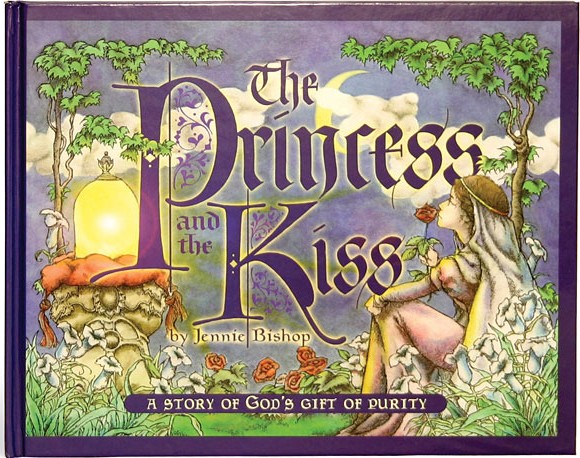
Crosspost: Sally’s First Kiss and The Princess and the Kiss

The-Princess-and-the-Kiss1-e1373847077493

HA note: The following is reprinted with permission from Libby Anne’s blog Love Joy Feminism. It was originally published on Patheos on July 24, 2013.

When I was a teen, I did a lot of babysitting for other homeschool families. One day I babysat two families worth of children while their moms went out for lunch—I think there were about ten kids total that I was watching. I was in the kitchen cleaning up from lunch and the kids were in the living room putting on a play wedding as kids sometimes do. The nine year old was presiding over the wedding of the two five year olds, a girl from the one family and a boy from the other.

All of a sudden I heard the older child say “now you’re supposed to kiss each other” and I freaked out and ran into the living room to break it up.

I wasn’t about to let those two five year olds kiss, thus forever depriving each of the chance to save that first kiss for the altar.

In the conservative Christian homeschooling community in which I grew up, a person’s first kiss was incredibly important. Even today, the products of this culture debate this question with great energy, arguing about whether forbidding the first kiss until the altar is a form of legalism or the preservation of a precious gift.

Now, I was taught that part of the reason that the first kiss should be saved for the alter was that it was a gateway into other things. First comes kissing, and then, who knows? Making out, humping, sex—once you open the door, it’s hard to close it. It would seem, then, that five year olds kissing at a play wedding wouldn’t fit this category, given that we’re not talking about a kiss that comes as a result of sexual tension and mutual attraction.

And yet.

The literature I read didn’t make a distinction between preschoolers kissing and teens kissing.

Instead, it simply talked about the importance of saving “your first kiss” for your wedding day. And of course, we were regaled with stories of virtuous couples who had done just that—didn’t we want to be like them? And then there is The Princess and the Kiss, a book marketed to children as young as four.

The book is about a king and queen who help their daughter save her most precious gift, her first kiss, for the prince she will marry. The princess’s first kiss lives in a glass orb, something like the rose in the Disney version of Beauty and the Beast (you can see it on the cover). This book has become very popular in Christian homeschooling circles and beyond, and there are hundreds of thousands in print. This is the sort of thing I was raised on (though this particular book wasn’t around when I was little, lots of kids are growing up on it now).

All of this came rushing back to mind recently when [my daughter] Sally kissed a little boy at her preschool—or, as I would have seen it in the past, when Sally “gave away her first kiss.”

We had gotten together with the family for a play date, and Sally and her little friend did the whole pretend wedding ceremony thing that little kids spontaneously do (I presided over a few in my day myself). At the end Sally grabbed the little boy and planted a kiss on his face. Surprised and bemused, I couldn’t help but recall my reaction to the pretend wedding staged by the five year olds I was babysitting so many years ago. This time, of course, my perception and reaction was different.

Sally didn’t lose anything when she kissed her little friend. Instead, she simply gained a common life experience—something she will look back at and laugh about when she’s grown.

It’s the people who impute a cute childish action with so much meaning who are creating the problem, not my preschooler.

Rewriting History — History of America Mega-Conference: Part Eight, Closing Thoughts

Rewriting History — History of America Mega-Conference: Part Eight, Closing Thoughts

HA note: This series is reprinted with permission from Ahab’s blog, Republic of Gilead. For more information about Ahab, see his blog’s About page. Part Eight of this series was originally published on July 18, 2013.

*****

Also in this series: Part One: First Impressions | Part Two: Doug Phillips on God in History | Part Three: “Religious Liberalism” And Those Magnificent Mathers | Part Four: Kevin Swanson Is Tired Of Losing | Part Five: Messiah States and Mega-Houses | Part Six: Doug Phillips Rages Against the 20th Century | Part Seven: Christian Vikings, Godly Explorers, and Strange Bacon | Part Eight: Closing Thoughts

*****

I’ve infiltrated several Religious Right events for Republic of Gilead over the years, but none left me as drained as the History of America Mega-Conference. The fundamentalism and revisionist history pervading the conference was difficult to digest, but it offered me a glimpse into an disquieting homeschooling subculture. Woven through the conference presentations were several common themes:

Dominionism / Christian Reconstructionism — Dominion theology and Christian Reconstructionist thought were everywhere at the History of America Mega-Conference. From presenters who quoted from Gary North and R.J. Rushdoony, to merchants who sold Rushdoony’s books, to the banner in the dealer room that read “READ RUSHDOONY”, it was difficult to ignore the affection that organizers held for Christian Reconstructionist writers. To boot, speakers such as Doug Phillips and Marshall Foster attributed Christian principles to America’s foundations, ignoring evidence to the contrary.

Patriarchy — A heavy musk of Christian Patriarchy ideology hung over the conference. All speakers were white men, several spoke harshly of feminism, and some romanticized stereotypical gender roles and family arrangements. Glaringly, most of the historical figures they spoke of were men. The idea that women have played dynamic roles in history, or that female presenters could have brought meaningful content to the conference, was ignored. When the speakers spoke of “men” in history, I don’t think they meant humankind, but rather people with Y chromosomes.

Christianity as Monolithic — It soon became clear that when presenters spoke of Christians, they meant fundamentalist Protestants. In more than one talk, America was celebrated as a “beachhead” for evangelical Christianity throughout history. Anti-Catholic sentiments reared their heads in several talks, suggesting that some speakers did not recognize Catholics as Christians. Moreover, Doug Phillips claimed that the church was silent on political and social issues in the first half of the 20th century, ignoring the rich contributions of Catholic and progressive Protestant Christians during that time.

Sanitization of Christianity in History — Speakers trumpeted real or imagined boons from the spread of Christianity while ignoring violence and oppression committed in Christianity’s name. Whether speakers were ignoring the violence of Iceland’s Christianization, the bloodshed of King Sigurd I’s Crusade, or the ethnocide of the Native Americans, the conference painted a very sanitized picture of Christianity’s role in history.

Distrust of Secular Government — Several speakers, including Doug Phillips and Geoffrey Botkin, condemned the U.S. government for its alleged “statism”. Government programs and social services intended to help the vulnerable were caricatured as the tentacles of a “Messianic” state.

Distrust of the Present and of Mainstream Culture — Speakers repeatedly slammed the modern era and its imagined boogeymen — “statism”, secularism, abortion, feminism, evolution, and same-sex marriage — as fallen and evil. Mainstream culture was caricatured as a corrupting influence from which homeschooling must shield children. At times, Vision Forum’s history conferences hints at a longing to return to the past, a past imagined as more virtuous and Christian.

Children as Torchbearers — Presenters understood children to be transmitters of fundamentalist Christianity unto future generations, and thus concepts such as “generational thinking” often came up. The History of America Mega-Conference was a homeschooling conference, after all, and its revisionist ideas were intended for the curricula of homeschooled children. To boot, children are to be steeped in fundamentalist Christian thought and shielded from mainstream culture, according to Kevin Swanson. Presenters refused to consider how such revisionist education might leave children ill-prepared to integrate into American society, and failed to grasp that some children might reject their fundamentalist upbringing altogether.

At the History of America Mega-Conference, I was exposed to a subculture whose worldview is at odds with modern society. As American society slowly embraces religious pluralism, gender equity, LGBTQ equality, and the paradoxes within its own history, fundamentalist subcultures find themselves out of place in their own country. Since these social upheavals show no signs of abating, will fundamentalists subcultures such as this one retreat even further into their own bubbles? Or will they desperately try to reshape society in their own image by molding the minds of the next generation?

As I listened to workshop after workshop on revisionist history, my heart broke for the children being raised in fundamentalist homeschooling households. The vision of the world they were receiving was incomplete and inaccurate, and I worried about how they would integrate into the larger society as young adults. Would they have the curiosity and will to seek out fresh perspectives and new information, or would they be weighed down by the propaganda of their youth?

As people who recognize the problems with fundamentalism, how do we counter the messages of groups such as Vision Forum? By challenging historical revisionism. By remembering that history encompasses many narratives, not just one. By demanding accuracy in homeschool curricula. By reaching out to current and former homeschoolers and making accurate information available to them. And finally, by educating ourselves on the past and recognizing its impact on the present.

To end on a lighter note, after days of listening to History of America Mega-Conference workshops, I think I’ve earned a beer. Let’s toast to a world free of fundamentalism someday!

Photo courtesy of Ahab at Republic of Gilead.

*****

End of series.

Rewriting History — History of America Mega-Conference: Part 7, Christian Vikings, Godly Explorers, and Strange Bacon

Rewriting History — History of America Mega-Conference: Part 7, Christian Vikings, Godly Explorers, and Strange Bacon

HA note: This series is reprinted with permission from Ahab’s blog, Republic of Gilead. For more information about Ahab, see his blog’s About page. Part Seven of this series was originally published on July 18, 2013.

*****

Also in this series: Part One: First Impressions | Part Two: Doug Phillips on God in History | Part Three: “Religious Liberalism” And Those Magnificent Mathers | Part Four: Kevin Swanson Is Tired Of Losing | Part Five: Messiah States and Mega-Houses | Part Six: Doug Phillips Rages Against the 20th Century | Part Seven: Christian Vikings, Godly Explorers, and Strange Bacon | Part Eight: Closing Thoughts

*****

The History of America Mega-Conference schedule was packed with workshops that sounded interesting (or disturbing), but I could not observe them all, sadly. Fortunately, a kiosk in the Radisson grand ballroom was selling audio recordings of of keynote speeches and workshops, so I purchased CDs of “The Early Explorers: Sea Kings and Vikings” and “The Providence of God in the Age of Exploration”. The former painted Norse voyagers as Christians carrying out a Biblical dominion mandate, while the latter imagined the European “discovery” and colonization of the New World as willed by God.

“The Early Explorers: Sea Kings and Vikings” was presented by Col. John Eidsmoe, the same presenter who delivered “The Rise of Religious Liberalism” workshop. Eidsmoe asked aloud “why men climb mountains” — that is, why they explore. He explained human exploration as a product of two forces: the dominion mandate of Genesis 1:28, and the great commission to convert the world of Matthew 28:19-20.

Earth has likely been explored many times over through human history. One example of ancient explorers was the Phoenicians, who were genetically and linguistically related to the Hebrews. However, he quickly reminded listeners that the Phoenicians lived under a “totalitarian” god-king and followed a “religion of paganism and fertility and human sacrifice”.

The Phoenicians, Eidsmoe explained, carried out sea expeditions along Africa’s eastern coast, Britain, and possibly North America. To lend plausibility to the latter, Eidsmoe cited the “Mechanicsburg stones” (also known as the Phoenician Stones or Susquehanna Stones) found in Pennsylvania’s Susquehanna Valley, allegedly with Phoenician writing upon it.

Eidsmoe shared stories of northern Europeans who set sail, reminding listeners that such stories might be fanciful concoctions or actual historical events that were later embellished. He spoke of the legend of St. Brendan the Navigator (St. Bréanainn), an Irish monastic who embarked on an sea journey with fourteen monks in the 6th century. According to Irish legends, he recounted, St. Brendan and his traveling companions found the island of Paradise, discovered an island of monks with magic loaves that prevented aging, faced a volcanic island with demons, and came face to face with Judas Iscariot.

Another northern European traveler that Eidsmoe discussed was Prince Madog, a Welsh “sea king” who allegedly came to the New World. During the Elizabethan era, when England and Spain competed for the New World, English writers used the Madog legend to justify England’s claim to the Americas, Eidsmoe added. Legends also claims that Scottish nobleman Henry Sinclair explored North America in the late 14th century, nearly one hundred years before Christopher Columbus’ arrival.

Many of these examples were fanciful legends — something Eidsmoe admitted — rather than solid historical fact supported by evidence. I wondered why Eidsmoe was citing legends about men who may or may not have come to the Americas, rather than exploring known history.

Eidsmoe noted that Chinese and Muslim civilizations may have also visited the Americas centuries ago. Eidsmoe claimed that Nihad Awad, founder of the Council on American-Islamic Relations (CAIR), alleged that Muslim expeditions from Morocco and Iberia may have visited North America centuries ago. However, Eidsmoe quickly dismissed this claim as being based in “political correctness” rather than historical evidence.

The Vikings, Eidsmoe explained, were the first pre-Colombian explorers whose visits to North America had “solid” basis in fact. Before delving into Norse expeditions to the New World, Eidsmoe briefly discussed the Christian conversion efforts of King Olafr and Thangbrandr, neglecting to mention the violence and threats that reportedly accompanied the Christianization of the Norse. (Doug Phillips sanitized Norse Christianization in a similar manner in his July 2nd opening speech.) He quoted Shane Leslie’s writings, which spoke glowingly of Christianity overcoming traditional Norse and Celtic religions.

Eidsmoe celebrated other Christian Norse leaders, including Norweigan King Sigurd I the Jorsalafari (“Jerusalem-farer”), who vowed to lead an army of 10,000 warriors on a Crusade. After sailing around Europe’s coast and battling Moors, King Sigurd I received hospitality from King Baldwin I of Jerusalem upon reaching the Holy Land. During his stay with Baldwin, Sigurd I reportedly vowed to take any Muslim city. After Baldwin encouraged him to conquer Sidon, Sigurd I’s forces took control of the city. Siggurd I’s greatest regret, Eidsmoe claimed, was that he never had the opportunity to directly engage the Turkish fleet in a sea battle.

Eidsmoe depicted the Norweigan Crusade as a swashbuckling adventure, failing to mention the looting and massacres of non-Christians that it entailed. The fig leaf of faith cannot hide the realities of war, slaughter, and looting.

Eidsmoe delved into accounts of Erik the Red and his son, Lief Erikson, who converted to Christianity during a visit with King Olaf. After sharing stories of Norse expeditions to Greenland and New England, as well as violent encounters between Norse voyagers and skraelings (indigenous North Americans), Eidsmoe offered speculation as to why no permanent Norse colonies succeeded.

“Why were these Viking colonies unsuccessful? I’m going to suggest to you why. Because even though they were Christian, they showed no interest in sharing Christ with the natives. They spoke derogatorily about them with a term of derision, skraelings. Sometimes when they came upon Eskimos in Greenland, they simply called them ‘trolls’. In other words, they followed the dominion mandate, but they ignored the great commission.”

I found this theory darkly amusing. First, it ignores the fact that the Norse were intruders on Native American soil, which might explain the lack of interfaith dialogue. Second, it disregards other possible roots of Norse colony failures — disease, difficulties adapting to a new land and climate, lack of critical mass, ongoing hostilities between Norse colonists and Native Americans — in favor of a dominionist Christian narrative. Finally, Eidsmoe’s comment could be interpreted to mean that later European colonists succeeded because they proselytized to the Native Americans, regardless of the conquest and ethnocide it entailed.

Toward the end of his talk, Eidsmoe spoke of the Kensington stone in Minnesota and the Newport Tower in Rhode Island, arguing that these could be remnants of Norse visits to North America. While he did mention that evidence is not fully conclusive, he argued as to why these could plausibly be Norse artifacts from pre-Columbian Nordic visits to North America. He dismissed claims that the Kensington stone is a hoax, apparently eager to show that Norse explorers had an extensive presence in North America.

Eidsmoe’s history of early European travelers wove together history and legends into a decidedly Christian narrative about ancient voyagers and evangelists. In doing so, I feel that he downplayed the violence inherent in that narrative, sugar-coating conquests and crusades as Christian “dominion”. Eidsmoe’s talk, like many others at the History of America Mega-Conference, serves as a reminder of the problems inherent in a narrow view of history.

*****

“The Providence of God in the Age of Exploration” was presented by Marshall Foster, founder of the World History Institute (formerly the Mayflower Institute). Foster began the workshop with a statement about God’s intent for human exploration.

“God, from the beginning of time, has made us adventurers. He has made us explorers, and there really is no age of exploration, there is simply unbelief and belief in the power of God to explore. Depending on the time, depending on the age, there has been an ebb and flow of an understanding of God;s purpose for mankind, and during specific times — that’s why we call it the age of exploration — there was an explosion of exploration and settlement of places around the world. and it took place in the 15th and 16th century, coming out of Europe.”

Exploration and settlement by whom? I thought. Plenty of those places were already explored and settled before Europeans came along. These were stories of European conquest.

A series of events over the centuries brought forth America as we know it, Foster explained. To understand this history, we must go to the root of history, he said. Everything must be seen in context of who God is, who we are, and what our purpose is in relationship to God. Everything one needs to know about God and oneself is written in the Bible, he argued, and to the extent that people understand their purpose, they will become “mighty warriors for God” who transform nations.

God created man in his image, and created man and woman together so as to subdue the Earth, Foster said. He assigned Adam the task of naming the plants and animals in the Garden of Eden, thereby structuring the garden with the expectation that Adam would take the “wilderness” and transform it into a “city on the hill”. God designated humans as his “sub-regent of the universe”, making the dominion mandate a godly task. This command was established through families in the Old Testament, he argued, citing Adam and Eve, Noah and his descendants, and Abraham and his descendants. Foster stressed that the Biblical God devised a predestined plan for humanity, not the “god of the Muslims” or the “11,000 gods of the Hindus”. Foster seemed to have ignored the fact that the Quran clearly establishes Allah as the god of Abraham, Moses, and Jesus.

When we understand this mandate, Foster argued, we can understand the great explorers. He lamented that humans quickly took the dominion mandate too far, with conquerors exercising dominion over other men. Ancient civilizations were plagued by five grave sins: tyranny, human sacrifice, enslavement of both one’s own people and foreigners (empire), the establishment of laws independent of God (autonomy), and persecution of believers.

“Mankind went out and took dominion. The only problem is that men took dominion and they went over what God said. God did not say take dominion over other men, he said take dominion over the plants and the animals. What men figured out through Cain and Abel, and then through the great tyrannies of the ancient world, from the Egyptians to the Babylonians to the Greeks to the Romans, was that you just simply needed to take dominion over other men and then you could make them your slaves. Come up with a false religion, guilt them into obedience to you, and have them build your pyramids, have them build your great tombs called the Seven Wonders of the World. And what you’ve got now is civilization structured on a perverted view of the cultural mandate.”

In making this argument, Foster ignored divinely-sanctioned slavery, patriarchy, conquest, and genocide in the Old Testament, reluctant to admit that the Israelites exercised a “perverted view of the cultural mandate” too.

Foster argued for the supremacy of the Christian faith in history. Rome was an unjust empire, but it now lies in ruins, whereas Christianity has risen from the catacombs to become a major world religion. As proof of its supremacy, Foster claimed that Christianity is the only truly world religion, having spread to multiple continents.

Um, Marshall? Islam and Buddhism would like to have a word with you, I thought.

Christianity allegedly exerted a “civilizing influence” over the ancient world, persuading people to give up their “pagan ways”. He likened ancient Christian evangelists to explorers, spreading Christianity far and wide. In the 15th and 16th centuries, “God put all the pieces together” following the Christianization of Europe, he claimed. Europe had lost its missionary zeal, much like modern America, he argued, and “God was going to shake up the troops”. This alleged shake-up took the form of the “Muslim hordes”, first unleashed in the 7th century, then later surging as the Ottoman Turks. After the Byzantine empire, the “greatest culture of the world”, fell to the Ottomans, many Europeans thought they were facing a “countdown to Armageddon”, he claimed. By frightening Christian Europe and forcing it out of its comfort zone, God was allegedly disciplining Europe and setting the stage for later exploration.

Foster cited Psalm 107, calling it a psalm of exploration that inspired Christopher Columbus. “God is in control of the wave of history,” Foster proclaimed, assuring listeners that God had supremacy over Satan in the world. If one walks with God, God will bless one’s culture, as history demonstrates, Foster asserted.

The travels of Christopher Columbus and other explorers led to the creation of America, Foster reminded the audience. He narrated a history of Columbus’ early life that included a vision to take Christianity abroad.

“[Columbus] goes on to have a vision of what God wants him to do, begins to read the scripture, and his vision is to go to the west and find the Indies, not only to find treasure, but to find a way to reach Jerusalem and take the gospel to the nations.”

Foster shared the story of Columbus’ commission, 1492 voyage, and eventual arrival in the Caribbean. Foster called Columbus a “good man” and a “godly man” while briefly acknowledging that he was a poor governor and witnessed evil take place under his management.

That’s an understatement, I thought. Kidnapping, exploitation, and colonization aren’t exactly the legacy of a “good” man.

However, Foster was quick to demonize the indigenous people that Columbus ruled over as cannibals, likening their alleged cannibalism to modern-day abortion. I wondered if this was intended to soften Columbus’ sins in the eyes of the audience by depicting the colonized Native Americans as monsters.

“The natives were not exactly super-friendly. In their second and third voyage they found the Carib Indians, who created children so that they could string them up, abort them, and eat them for bacon, and so … they were cannibals … This is not unnatural, and I’m not looking down on those Native Americans, because this was a way of life for the Romans, for the Greeks, for most civilizations throughout the world, for the Aztecs, for the Incas, and so when people are found in pagan cultures, they almost always are involved in human sacrifice, and then as Christian cultures become more pagan, what do they do? They go back to that human sacrifice, and there are 58 million babies dead today in America because we have forgotten our vision as a Christian nation.”

Baby bacon? Has Hannibal Lecter heard about this? I thought.

Foster briefly recounted the travels of explorers such as Amerigo Vespucci, Balboa, Vasco de Gama, Magellan, and Ponce de Leon. Foster wove these voyages and their subsequent cultural upheavals into a Christian narrative, arguing that God arranged these events to create a Christian nation.

“Now, those who had a vision for the world, the great commission, the cultural commission had a whole other continent, a wilderness to turn from a wilderness to a city on a hill. And isn’t it interesting that it took five thousand years for the civilized world to discover these continents? You think that maybe providence has set aside for such a time as this for the past four hundred years, the development of the world’s first [inaudible] republic since ancient Israel? Do you think it might be providence that set aside America to be the fountainhead of evangelical Christianity, that creates even to this day 80% of the money that goes for missions in the world? Do you think that even to this day that America is set aside as a land that still can and has represented Christian law to the nations by the fact that our constitution still rises from its base every morning and can be seen and should be understood? Could it be that God has us, at this very moment, as explorers for our day? It’s quite obvious.”

Foster left out many disquieting historical facts from the European colonization of the Americas. First, the Native Americans were erased in Foster’s narrative. The New World was discovered and “civilized” by Europeans, in Foster’s narrative, instead of having been already discovered and settled by the ancestors of the Native Americans. Even more egregiously, Foster ignored the ugly realities of European conquest, colonization, genocide, and ethnocide in favor of a glorious Eurocentric, Christocentric vision. Finally, he shoehorned divine providence into the European colonization of the New World and misrepresented America as a Protestant Christian nation with a “Biblical structure of government”. In doing so, Foster refused to acknowledge that the United States was founded as a secular democratic nation, informed by Enlightenment ideas, and shaped by a religiously diverse populace past and present.

In Foster’s eyes, the European colonization of the New World proved that an “army of compassion” could conquer a land by faith instead of by the sword, ignoring the use of both faith and sword to subjugate indigenous populations. Furthermore, he argued that the history of the Americas showed that a nation could be built on Biblical principles and sola scriptura, ignoring the absence of both concepts in the United States’ founding documents. The fingerprints of God, he argued, are all over the history of the New World.

“God planned the location of the continents, the direction of the sea breezes, the theology of the explorers, all in such a way that America, the America we know, the United States of America, could be developed a few hundred years later.”

In conclusion, Marshall Foster’s account of history was one in which Christian proselytization, exploration, and colonization were all part of a divine plan. By holding up a Eurocentric, Christocentric narrative as the only valid one, Foster effectively erased Native Americans, non-Christians, and non-Protestants from the history of the New World. Foster’s version of history does not force us to wrestle with atrocities of the past, or face the effects of colonization and ethnocide that still linger today. In short, Foster’s history is a shame-free history that absolves us from having to learn from the mistakes of our predecessors.

Stay tuned for closing thoughts on the History of America Mega-Conference.

*****

To be continued.