I Can’t Tell My Story Without A Trigger Warning: Elizabeth’s Story

I Can’t Tell My Story Without A Trigger Warning: Elizabeth’s Story

HA note: The author’s name has been changed to ensure anonymity. “Elizabeth” is a pseudonym.

*****

Trigger warnings: this story contains graphic and detailed descriptions of rape, physical abuse, the physical results of abuse, and religious apologisms for both physical and sexual abuse of children.

*****

I can’t tell my story without a trigger warning. I try writing it without describing physical and sexual abuse and it just doesn’t work. It could get graphic.

I just spent the last half an hour sitting in the corner, hugging my knees, and bashing my head into my wall because I dared to post a link to the HSLDA petition. I’m nearly 40, but I’m terrified of getting into trouble.

I can’t use my name–call me Elizabeth. This name I write with isn’t mine. I picked a name that I think is the sort of name that a typical white, protestant American would have. I hope that some homeschooled kid with that name and a similar story won’t be tortured or shunned on account of my speaking out. I just hope that anyone who reads this and sees someone they know knows that it wasn’t really them. It’s just an eerie similarity. Please don’t punish them for speaking out, because I’m someone else.

I can’t tell my story exactly. I’m afraid my family will recognize that it’s me writing. I only feel safe writing anything at all, even vagueing up the details, after reading the lawsuit filed by survivors of abuse covered up by sovereign grace ministries. It’s sad when the text of a lawsuit reads like your biography, but there you have it. It made me realize that this culture of abuse is sufficiently widespread that my parents could just read my personal story of our nightmare family and assume it comes from any anyone anywhere.

It at least gives me some plausible deniability. Not that I need plausible deniability–I have no contact with my family or anyone from my childhood. I won’t even be setting foot in a church again. But I’m so terrified of repercussions that I need a crutch. The brainwashing runs deep. I know I’m safe intellectually, but the rest of me doesn’t believe that safety is possible.

What lets me comment on the differences between homeschooling and other kinds of schooling? I’ve done it all. We started in a religious homeschooling coop–we did PACES first, later A Beka. Then my parents homeschooled us by themselves in a Northern European country–the rest of my education was in the United States. When we homeschooled in Europe there was no curriculum: it was closer to unschooling. Then they sent us to a private fundamentalist Christian school. Then they sent us to public school.

My parents’  reason for homeschooling us was ostensibly religious. We never heard that we’d get a better education than in public school. That wasn’t the issue. The issue was that public school would corrupt us. There’d be peer pressure. We’d risk getting caught up in a bad crowd and imperiling our immortal souls.

This seemed plausible at the time. After all, our church was very isolationist. You know that Emo Philips joke about the Baptists on a bridge? That was us. Everyone else was wrong. We spent hours learning about other denominations and how they got it wrong. Maybe some other Christians would still get into heaven, if God was extra merciful, but we were the only ones who actually had it right!

Did I mention that I basically had zero friends?

We were taught that children had to obey all adults unconditionally and instantly. We were taught that good Christian children who don’t want to burn in hell submit to their parents. They submit to discipline from their parents, other adults, or older children. They submit to spankings. They do not talk back. And so on. If you are wrongly accused you should still accept your punishment because you are a worthless sinful being and the punishment is probably good for you anyway. If you don’t accept punishment when you’re wrongly accused, that’s a sin, so you need to be punished for that now. Catch 22.

And we were taught that good, Christian children do not ever let anyone find out that they aren’t completely thrilled with their lives. We should never complain to secular authorities (or anyone, for that matter, but especially secular authorities) about anything. It makes us bad witnesses. It makes us bad Christians. And we might also be selfishly risking the destruction of our families because CPS will come and take us away. And there isn’t anything better, so after CPS destroys our families, we’ll still be disciplined so destroying our families and our parents’ good names will have been for nothing. If your bottom is sore from a spanking, you’d better not wince as you sit down. If you’re in pain down there, you’d better not let it keep you from walking normally. Don’t talk about your punishment. Don’t let anyone see you cry.

And we weren’t taught about sex, or wrong touching, or children’s rights. Most kids would get this in public school. At a young age, they’d learn that there are things adults aren’t allowed to do to them. They’d learn that they have the right to say ‘no.’ They’d learn that if something is wrong they can tell their teacher or call the police or something. Later, they’d have sex education and learn what sex is.

Here’s what I thought the word “spanking” meant when I was a kid: if your dad is home, usually it happens right away in your bedroom or his. If your dad isn’t home, you get sent to the guest room, where there’s nothing to do in the meantime, to wait for him to get home. Then the spanking commences. Maybe he’ll go for the big wooden paddle. Maybe he’ll pull off his belt. Sometimes he gets them both out and makes you chose. If he makes you choose, he’s feeling particularly sadistic.

Just the paddle is better. Then he sticks to your unclothed bottom and thighs. The pain is excruciating, but it’s a good sign if he doesn’t take his belt off at all. He’ll probably just finger you a bit when he’s done. Ditto if he bends you over his lap instead of over the edge of the bed. If he just breaks out the belt, he’s lost his temper. You’ll get hit everywhere that can be covered by clothes. The individual strikes aren’t as hard as with a stick, but the beating goes on forever. Sometimes your body just shuts down. Maybe that’s better; if you wet yourself the spanking might stop there because you’re now too gross and dirty to rape. But usually he’s going to finish the “spanking.” The whacks stop coming and then he’s inside you, crushing you with all his weight and ramming into you over and over until he’s done with his business.

I was told that all kids got spanked. I didn’t understand that ‘spank’ meant a bit of a beating for most people and not an extreme beating followed by rape. I didn’t even know what rape was, as I knew nothing about sex. I had no idea what was going on.

Spanking was how my dad got access during the day. If he wanted it and I hadn’t done anything wrong, he would make up something wrong. Notably, he’d wait for me to look at the telephone. Mind you, I was too short to actually reach the telephone up on the wall, but he needed to make sure the message was ingrained. He’d wait for me to look at the phone then punish me for thinking about making a phone call. For thinking about lying to people that I was being abused. It was part of his way to drill into my mind that there was no way out. That this way of life was all there was or ever could be.

I only remember a few instances of explicit training. I remember a gruesome rape when I was too young. I can see my baby fat hands in my memory. I can taste blood. I wonder if that was the first time. I think the ripping might have caused some nerve damage. I can’t actually feel much on the surface, which might have made me the perfect victim in the future. He could do whatever they wanted and I wouldn’t react much. I remember one day when I was older–maybe 3ish–getting taught to relax properly, to stretch out, to be able to take in something larger. Being told that this is what big girls are supposed to do. This is what good girls are supposed to do.

Compared to a spanking, simple molestation didn’t mean much. There was a ‘monster’ that came at night and did his thing. I was told that I had nightmares. And I had to comply instantly with any demand made by an adult. I had to do whatever they wanted, whenever they wanted. So if I was running around at church and an adult said I had to come give him a hug, I had to. And if his hand slipped up under my skirt, I was supposed to relax like a good girl and ignore the uncomfortable pressure filling me up. I guess it got out to anyone who was interested that I was groomed for complete submission and wouldn’t make a scene. I don’t know if he shared me on purpose or if all the perverts attracted to the good cover of a patriarchal church found me independently.

The violence was most extreme when we were at the cooperative homeschool. The school and the church reinforced the message. We only came into contact with other kids in the same situation. The probably weren’t all being seriously abused, but some of them sported regular bruises–new dark blues and purples in a new pattern over the fading browns and yellows from last week. Even the ones who weren’t abused weren’t told that they had rights. None of us was going to compare notes and discover that rapes weren’t a standard part of spanking. It was Orwellian. We didn’t have the words or concepts to address any of it.

No one at church would question my dad’s authority. He was a well respected member of the community. He was all godly and stuff. The benefit of the doubt extended to someone in his position was endless. By homeschooling us through this crucial period, my dad normalized abuse and kept me from finding out that I had rights. I literally had no idea until I was an adult that there was anything else out there, that this was not the natural order of things, that everyone wasn’t raised with this sort of abuse. Insofar as I ever heard about child abuse, I was taught that abuse was something that happened to other people.

When we homeschooled in another country, the abuse stopped almost completely. My dad was away from the comfort and safety of being an established pillar of the community. The monster still came at night, but the daytime abuse was drastically curtailed. I spent huge amounts of time being free and happy. The only punishment I recall was being yelled at.

I was only punished for one thing: speaking the other language. Somehow I’d picked it up, although my parents and other siblings hadn’t. My dad could use English at work and didn’t need to know it. Everyone spoke English in the shops anyway. My mom didn’t have a problem with it, but my use of the other language outraged my dad. If I uttered a word in front of him, his face would turn red and he would explode with anger.

How dare I speak another language. I couldn’t know what I was saying if it wasn’t English. I could be insulting someone and not know it! Because I couldn’t possibly know what I was saying if he didn’t know what I was saying. I couldn’t guarantee to him that I wasn’t saying something inappropriate because he couldn’t speak the language. So the act of speaking the other language was deceptive: I was hiding things from my parents by not speaking English. I never knew that I wouldn’t be spanked after these outbursts; I only connect the dots with the illegality of spanking in the other country now, as an adult. Looking back, I realize that he was afraid of getting caught in a country that cared about its children. He needed to make sure that I didn’t trigger any alarm bells there and get rescued by their child protection agencies.

When we returned to the US, we went to a fundamentalist Christian school. The ‘spanking’ resumed but it was much less frequent. Partly the training had kicked in and I was a good little robot. It was very difficult to find a reason to spank me. Partly we now lived in a bigger house. I had my own room and was far enough away from my parents room that it was unlikely for it to wake anyone up when he came in at night. Partly he couldn’t assume that he’d get a free pass at the new school. Teachers were from other denominations who might be just as distrustful of us as we were of them. Some students were just there because their parents thought they’d get a better education at a private school. Some students were even there because they’d been expelled from every other school and their parents couldn’t find anywhere else to take them. While I was guaranteed to not get any sex education or get told I had rights by the school, it was less clear that I wouldn’t exchange information with peers who knew stuff.

The fundamentalist Christian school went bust over doctrinal differences (surprise, surprise) and I was allowed to finish out high school at the local public school. It was the most supportive and loving environment I’d experienced in my life. No one made fun of me, as they had at the Christian school, for having zero social skills. People, not just teachers but students as well, put up with horrific ideas from my upbringing and gently taught me tolerance. Even people who didn’t like me were still patient and cordial with me. And my dad had to stop the ‘spankings’ altogether.

He still came in at night. He suffocated me so I wouldn’t wake up. I only woke up to absolute terror a few times. Rape is a thousand times more terrified when you fade in and out of consciousness from lack of oxygen. When I asked the youth pastor at church he said it was a demonic attack. I tend to trust my gut; I don’t know if that’s good or bad. But he wasn’t the brightest bulb in the box. I think he was just gullible and never got any sex education himself either. He was a relatively young adult who had never dated. I don’t think he had any idea that he was passing on a lie used to conceal abuse.

Unfortunately, I got to public school too late to get sex education. It would have been covered in junior high. I’d learned about periods the day my first one started (I was at the Christian school at the time). A neighborhood girl who went to public school found out how little I knew about it and tried explaining the facts of life to me, but she was several years younger than me and hadn’t learned all the details herself yet. I am grateful that she noticed something was wrong with my complete lack of education and did her best to step in and fill in my educational gaps. But there was so much she couldn’t tell me.

So I didn’t know that periods were supposed to happen regularly, about once a month. I didn’t understand that it wasn’t normal to go months between periods. I didn’t understand that that much pain and that much blood was abnormal. I didn’t understand that something was very wrong if you had to spend several hours bleeding into the toilet and passing chunks. I didn’t put two and two together until I had my first miscarriage as an adult. Then it hit me that my period got regular after I got married. I wasn’t in so much pain. The flow was lighter – a pad was enough instead of having to spend time on the toilet because it was too much. And it hit me that while I’d had a few odd periods in high school, I’d mostly just had a succession of miscarriages. I still can’t have kids. I wonder if it’s from too much violence to my reproductive organs at such a young age. It’s not something I can face having a conversation with my doctor about.

I didn’t understand that I was experiencing rape until we had to read a short story in 12th grade advanced English about a girl being raped. That’s when I learned that that’s what rape was and, by extension, that’s what sex was. But I was too afraid to tell anyone. The programming to pretend everything was fine persisted. Teachers and counselors noticed and asked if something was wrong and I instinctually lied every time. I didn’t know how to do anything else. I didn’t believe anyone could help me, just that it would get back to my parents that I’d told someone. And then I’d be in for another spanking; I’d rather have died than risk another spanking.

I tried reporting my abuse to the authorities once as an adult but the law wasn’t on my side. If I’d been a minor, they could have gotten CPS involved. But as an adult, the law is written for specific instances. You can’t charge someone with years of violence and rape where there are so many memories jumbled together. You need a report of a specific instance. And remembering a specific instance with all its details when it happened all the time is like remembering what you had for dinner on March 12, 1986. What time was dinner? What did you eat? Did you have company? How was the food arranged on your plate? Who sat where at the table? Good luck with that.

Having been rebuffed, I tried getting out but it didn’t take. The economy was in shambles and I couldn’t find steady employment. The U.S. has a patchy safety net. One of the things that we as a society assume is that people’s parents don’t suck. If you’ve very lucky and your abuse is caught and you end up in the system, there are programs for young adults who have aged out of foster care. These programs aren’t perfect, but it beats the hell out of choosing between starvation and going back to an abusive family. After you’re an old enough adult (I think it varies by state), you are eligible for things on your own. But there’s an awkward gap between 18 and 20 something where your eligibility is determined by your parents income. Long story short, I ended up homeless. I had to go crawling back to my parents, tail between my legs, and enduring several more years of abuse before I married my husband and escaped.

I firmly believe that if public school teachers had gotten to me before the brainwashing set in that I might have told them the truth. I think the brainwashing would have been harder if I’d been getting a counterbalancing affirmation from public school that I was a human being with rights of my own. And you know what? Maybe my dad still would have found a way to abuse me, but he either would’ve had to pull me out of public school to keep the abuse hidden or he would’ve had to abuse me a heck of a lot less.

That’s what bugs me the most when homeschool parents bring up the fact that kids in public school get abused too. They act like that’s evidence that regulating homeschool is pointless. From where I’m sitting, that’s hogwash. I’d take rare beatings over frequent beatings. I’d take beatings severe enough to leave obvious marks during just summer vacation over getting those beatings several times a week around the year. I’d take just being raped over having the crap beaten out of me then being raped. I’d take being brutalized for the first 7 years of my life over being brutalized for the first 20 years of my life. I could go on down the line.

It’s clear to me how the abuse I received changed with the amount of control my parents had over the other adults in my life. When it was just them and church, the abuse was horrific. When it was public school teachers who weren’t going to give them a pass just for being Good Christians, the abuse was relatively minimal. I guess it reads as pretty extreme still, but that level of abuse required that they already have the prior controlled environment in which to make sure I never found out about my rights. And it’s way less than the baseline level of abuse they established when they had complete control of my environment.

But the more I think about my upbringing, the more I think the church and homeschooling were just convenient. In the wake of the ohio kidnap victims’ escape, an article in the guardian addressed the issue of girls and women being trapped in long-term situations where they were kept as prisoners and raped repeatedly. It quotes Prof. Sherry Hamby of Sewanee and journal editor of Psychology of Violence as saying “I don’t think there is any question there are other victims in similar situations. We are only catching the dumb ones.” It’s the first time in, well, ever, that I’ve felt like I wasn’t invisible. Usually situations like mine are invisible to mainstream media that is usually so desperate to maintain our societal illusion that abuse is a rare thing that is done to and by people we don’t know.

There are victims in similar situations. And we do only catch the dumb ones. My dad is extremely intelligent. It doesn’t matter what his personal beliefs might be: the perfect place to isolate his prey was in a patriarchal religious sect. The perfect way to avoid letting his kids encounter mandated reporters is through homeschooling. The perfect way to keep me from going to authorities was to lie to me about my rights and to surround me by other kids who didn’t know their rights. I don’t think I’m special. I don’t think I’m unique. I think odds are high that there are plenty of other people who grew up just like me.
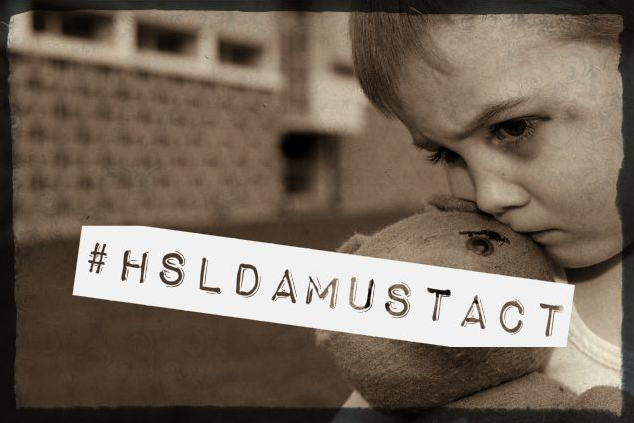
#HSLDAMustAct: History and Related Media

Screen Shot 2014-06-26 at 1.20.57 PM

April 17, 2013

On April 17, Love Joy Feminism’s Libby Anne — a former homeschool student, former attendee of Patrick Henry College’s summer camp on Constitutional Law taught by Michael Farris, and now-parent of two children; also, one of HA’s blog partners — began a five-part series looking at the relationship between HSLDA and child abuse. Of particular concern to many people who have read this series is that HSLDA has slowly but surely moved from homeschool advocacy to — by their own admission — reform of child welfare laws, including opposing anonymous tips, mandatory reporting, and mainstream definitions of child abuse. The five parts to this series are: (1) HSLDA and Child Abuse: An Introduction; (2) HSLDA’s Fight against Child Abuse Reporting; (3) HSLDA’s Stonewalling of Child Abuse Investigations; (4) HSLDA’s Defense of Child Abuse; and (5) HSLDA and the Deregulation of Homeschooling. Part five of the series was published on April 24.

April 20, 2013

The blogger from the Eighth and Final Square, inspired by Libby Anne’s series on HSLDA and child abuse, writes a post about her own homeschooling experience. It is entitled, “we were taught to fear the people who could help.” The author says she, too, was “instilled with a fear of CPS.” As a survivor of abuse herself, she says, “I wonder what would have happened if HSLDA wasn’t around, and the kids had been allowed to talk to CPS workers alone.”

April 22, 2013

Homeschoolers Anonymous started crossposting Libby Anne’s series on HSLDA in conjunction with a week of personal stories that explored the relationships between homeschooling, HSLDA, and the CPS: fears of the CPS, failures of the CPS, and how the CPS could have actually helped those who suffered abuse in homeschooling.

April 23 – May 2, 2013

After finishing her series on HSLDA and child abuse, Libby Anne continues to focus on issues of homeschooling, abuse, and HSLDA. She creates a legislative alert about one of HSLDA’s legislative alerts, urging people to counteract HSLDA’s efforts to stop SB 32, a bill “designed as a way to monitor and protect the well-being of children who are known to be at risk for child abuse or neglect based on prior incidences.” She argues that it is “simply false to suggest that there is nothing about homeschooling that might be attractive to neglectful or abusive parents.” She cites a plethora of horrific stories to explore the idea that, while “most homeschool parents are dedicated, responsible and loving,” “when abusive parents homeschool, the consequences for their children can be absolutely disastrous.”

May 6, 2013

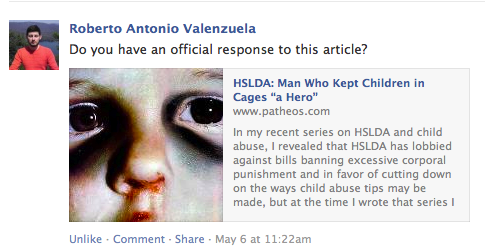
On May 6, Libby Anne writes a post entitled, “HSLDA: Man Who Kept Children in Cages ‘a Hero.'” In this post, she points out that Scott Somerville, an HSLDA attorney, called Michael Gravelle, a man charged with molesting his biological daughter, putting his adopted kids in cages, and later punching and shaking his own wife, a “hero.”

Later that day, someone posts Libby Anne’s article on HSLDA’s wall:

Picture 12 May 7, 2013

The very next day after someone posts Libby Anne’s article on Somerville’s hero comment on HSLDA’s Facebook page, HSLDA chooses to respond via a Facebook status:

Picture 13

The full text of their response is as follows:

It has come to our attention that HSLDA has recently been accused of condoning child abuse. HSLDA does not and will not ever condone nor defend child abuse. 

HSLDA receives hundreds of calls each year from parents who are under investigation by CPS, often based on false, anonymous, trivial, or malicious reports. The vast majority of these are determined by CPS or a court to be unfounded and are dismissed. Because of this, we do not immediately assume that everyone who is the subject of an investigation is guilty of child abuse or neglect. 

As a service to our members, we help homeschool families navigate the legal landscape in the early stages of an investigation before all the facts come to light. This could include helping families know their constitutional rights, helping them understand the legal process, or referring them to a local attorney. If the allegations include homeschooling, we generally will either assist their local attorney to defend homeschooling or represent the family on homeschool matters.

Of the three examples mentioned in a recent article, we did not represent two of the families and in the third we were involved on the question of homeschooling alone after the other issues were resolved by the court. 

We believe that every child deserves a healthy upbringing and that parents have the high honor and duty to meet that child’s needs. For 30 years we have been zealously advocating for the right of thousands of parents to responsibly homeschool their children. To the extent that any statements we may have made could be misunderstood to suggest that we condone the abusive actions of some we repudiate them wholeheartedly and unequivocally.

Libby Anne promptly responded to HSLDA’s response: “I’ve Had Enough: My Reply to HSLDA’s Response”.

Also in response to HSLDA’s response, R.L. Stollar, co-creator of Homeschoolers Anonymous, issued a challenge to HSLDA on their Facebook page: “HSLDA, will your leaders take a public and universal stand against child abuse and launch a public awareness campaign for your members on how to recognize and report child abuse in homeschooling?”

Stollar’s challenge to HSLDA was quickly mirrored by others. Heather Doney, one of HA’s blog partners, wrote, “Demanding an Answer from HSLDA,” where she says, “We deserve to know where the HSLDA stands. We deserve to know that they are thinking about this issue and that they are doing something about it. I, for one, am requesting an answer. Don’t make us wait too long, HSLDA.”

May 7 – 11, 2013

Homeschoolers Anonymous officially launches the #HSLDAMustAct campaign on May 8.

Rebecca Gorman, a former homeschooler, creates the official Change.org petition for the #HSLDAMustAct campaign.

A new website, Homeschooling’s Invisible Children, was launched by former homeschoolers to “to raise awareness of the horrific abuse and neglect that can take place when unfit caregivers use homeschooling as a cover for criminal child maltreatment.”

On May 9, HA announces the official petition in the post, “25 Reasons To Sign The #HSLDAMustAct Petition.”

Here is a full list of posts from bloggers covering the whole Libby Anne/HSLDA issue and the #HSLDAMustAct campaign since May 7:

Wide Open Ground: “Dear HSLDA and Homeschool Parents, What About My Friend Who Died?” and “HSLDA: Discourse Problem Between Fundamentalist and Outsiders”

Anthony B. Susan: “The HSLDA and Abuse: More Denial and Deflection”

Becoming Worldly: “S***t HSLDA’s Homeschool Parents Say”

Ramblings of Sheldon: “HSLDA: We Would Rather Stand Behind Abusers Than Their Victims”

The Home Spun Life: “Homeschoolers, Christians, HSLDA: We Must Do Better, Kids Are Being Abused”

No Longer Quivering: “Petition: HSLDA Address the Problem”

ThatMom: “HSLDA accused of turning blind eye to child abuse: you decide”

Kathryn Brighbill: “HSLDA and Child Abuse” and “Of Fundamental Rights, HSLDA, and Homeschooling”

Anonymous Wonderings: “On Homeschooling”

On May 10, the Christian Post took on the issue but framed it only as a Libby Anne vs. HSLDA issue: “Home School Legal Defense Association Accused of Protecting Child Abusers.” The Christian Post did not attempt to contact Libby Anne; they tried to contact HSLDA, but HSLDA did not respond. They also did not mention the petition.

May 12, 2013

As of Sunday, May 12, the #HSLDAMustAct petition has over 300 signatures from around the world. The signees are almost entirely from the homeschooling community itself. Former homeschool students, former and current members of HSLDA, and former and current homeschooling parents have all signed it. Signees are from everywhere from California to Louisiana to Pennsylvania, from the U.S. and Canada to Germany and Spain.

Also as of Sunday, May 12, HSLDA has still not responded to the #HSLDAMustAct campaign.

Conclusion

We will leave you with these thoughts from Lisa from The Home Spun Life:

“I have been a financial supporter of HSLDA for many years now and I am asking that they become more transparent with how they practice law, how they defend homeschooling, AND how they protect children in a homeschool that is abusive.

I know children are abused in a variety of types of homes. From poor to wealthy, from Christian to atheist, from public school to homeschools. Abuse happens. It’s tragic! We can’t only speak up about abuse when it happens in a public school. We have to speak up no matter where it happens. And we have to learn how NOT to respond to abuse allegations in the homeschool community.

Defending our freedom to choose our children’s education should never trump their freedom to live in a healthy and safe environment.

To the HSLDA,

As a supporter of yours, I am asking for you to clarify your mission to defend homeschool freedom. I am asking that you inform us and SHOW US how you are defending this freedom WHILE defending children in an abusive homeschool environment. HOW do you separate the defense to protect homeschool freedom WHILE NOT enabling abusive parents to further their abuse under your “protection”? HOW are YOU holding abusive parents accountable? HOW are YOU cooperating with local authorities to HELP victims?

We must do better. We must speak up.”

This Isn’t Just A Few Disgruntled People

HA note: The following is reprinted with permission from Kathryn Brightbill’s blog The Life and Opinions of Kathryn Elizabeth, Person. It was originally published on May 9, 2013 with the title “HSLDA and Child Abuse.”

"HSLDA needs to see that this isn’t just a few disgruntled people but that the homeschool community as a whole believes that it’s time for them to do something about this."
“HSLDA needs to see that this isn’t just a few disgruntled people but that the homeschool community as a whole believes that it’s time for them to do something about this.”

I’ve made no secret that I don’t exactly have the most positive opinion about the Homeschool Legal Defense Association’s brand of religious fundamentalism but I never thought that HSLDA was covering for and protecting child abuse. For all of their scare tactics, and for as much as I think that a legal defense organization is unnecessary in a post-Tim Tebow world, I always assumed that the training-up-the-next-generation-of-culture-warriors aside, it really was just about keeping homeschooling legal. That if they were representing a family, it was because the family was wrongly accused.

I found out recently that I was completely wrong.

HSLDA is pursuing a course of action that is helping to protect child abusers while doing nothing to protect kids.

Blogger Libby Anne at Love, Joy, Feminism, herself a K-12 homeschool graduate, has a series of posts exploring HSLDA and child abuse. It’s a long read but I encourage you to take your time to go read it all, it’s an informative series and it opened my eyes as to just how out there HSLDA really is on this.

Seriously, go read it, I’ll wait until you get back.

Have you read everything?

Good, let’s continue.

On Tuesday, HSLDA posted an indirect response to Libby Anne’s series by way of a message posted on their Facebook page. Their response is basically a bunch of buzzwords and denials that doesn’t address any of the actual allegations. Libby Anne responds here.

I had no idea about what HSLDA was really up to and my memories are filtered through the eyes of a homeschool kid reading the Court Report. I rather suspect that this is news to some of the people reading this as well. It makes me mad because this organization that I thought was there to protect homeschooling has ended up protecting abusers. They’d trot out the “success stories,” but they only ever care about the kids if the kids are making them look good. They don’t actually care about the safety and well-being of homeschooled kids, or if they do, their actions are an awfully funny way of showing it.

And here’s the thing.

The advice that HSLDA gives about not letting people into your home without a warrant, not talking without an attorney present, the whole nine yards, is absolutely the right legal advice that attorneys should be giving their clients. The question though, is why is HSLDA even getting involved in child abuse cases? Unless they think that parental rights and homeschooling include the right to lock your kid in a cage or beat, oh sorry, they call it spanking, your kid until you leave bruises and welts, just because a family homeschools shouldn’t mean that a child abuse investigation is automatically a homeschooling issue. HSLDA shouldn’t even be getting involved until the abuse investigation is resolved. And yet, when a friend sent me the link a few days ago to the story of a parents that beat their children until they broke bones and told me to, “prepare to raeg,” I wasn’t the least bit surprised to find out that HSLDA had represented the parents and claimed to World Net Daily that it was social workers persecuting a good Christian homeschool family.

Defending homeschooling should not mean defending abusers. That should be obvious, but apparently it’s not.

I would argue that if you really want to protect the ability to homeschool, making it clear that the homeschool community has a zero tolerance stance towards child abuse is the best way to do it. If HSLDA’s behavior in abuse cases ends up becoming synonymous in people’s minds with homeschooling, then any parent who decides to homeschool is going to be considered suspect. The best way to protect homeschooling is to stop covering for abuse and to make it clear that it will not be tolerated. Covering it up, denying, and stonewalling protects no one but abusers.

Because of this, I am joining with Homeschoolers Anonymous in saying that #HSLDAMustAct. HSLDA needs to stop covering for abusers, they need to acknowledge the problem, and they need to implement an education program to teach their members how to recognize abuse. Instead of instilling so much fear in families about child protective services that people are afraid to call, they need to educate families that abuse can happen in even “good Christian homeschool families” and that child protective services is there to protect kids in those circumstances.

It is high time for HSLDA to take proactive steps to combat abuse.

If you agree that HSLDA must act, add your name to the petition. HSLDA needs to see that this isn’t just a few disgruntled people but that the homeschool community as a whole believes that it’s time for them to do something about this. If you’re a homeschool parent, we especially need you to add your name to the list of people calling them to act. And while you’re at it, I’d strongly suggest considering cancelling your membership. If their complicity in abuse starts hitting them where it hurts—their pockets—they’re going to be more willing to act.

Home Is Where The Hurt Is: Mary’s Story, Conclusion

Home Is Where The Hurt Is: Mary’s Story, Conclusion

HA notes: The author’s name has been changed to ensure anonymity. “Mary” is a pseudonym. The following series is an original non-fiction story that spans 33 pages of single-spaced sentences. It will be divided into 10 parts. The story begins during the author’s early childhood and goes up to the present. At each stage the author writes according to the age she is at.

Trigger warnings: various parts of this story contain descriptions of graphic, often sadistic, physical abuse of children, apologisms for religious abuse, deprivation of food, as well as references to rape.

*****

In this series: Part One | Part Two | Part Three | Part Four | Part Five | Part Six | Part Seven | Part Eight | Part Nine | Conclusion

*****

Conclusion: My Parents Were Not The “Fringe”

I am “Mary” and I would like to follow up my story with this.

Reading so many things and other peoples’ stories, I feel that there are some things I should make very clear for any homeschoolers or homeschool supporters as well as any skeptics who would otherwise want to discredit my story or claim that my parents were the “fringe lunatics.”

If you didn’t figure it out reading my story, I am the 2nd oldest of eight children and the oldest girl.  I was 12 and 15 when my two youngest brothers were born and as a result, we have more of a mother/son relationship than a sister/brother relationship. They are the two still with my parents and have yet to be involved with the rest of us in the exposing of and healing from our past. All the rest of my siblings however, have all read my story and confirmed it with their memories and their own stories. That is six of us that all agree on what happened. It makes me angry that I even feel like I have to defend the accuracy of my story and that people would think that I would actually make this stuff up.

As for my parents, I can assure you that they were not the “fringe” in homeschooling. My dad has an amazing job and they are very well off financially. Dad served as the president of the home schooling organization in our state for quite a few years. They have volunteered at church since I was little, helped out in AWANA, taught Sunday school, kept the nursery, volunteered at other church events, helped organize and plan the homeschool conference in our state every year, volunteered in debate, teach Good News Clubs, host homeschool events in their home and generally keep their reputation about as squeaky clean as is possible.

Mom rarely took us out to the store or anywhere other then the random homeschool field trip during school hours, for fear that someone might notice something. If she did end up having too, we were required to stay in the van (which had heavily tinted windows) while she went inside alone. There were many times we were stuck in our brown van (I specify color to say that it soaked up heat like crazy) during the middle of the summer and we lived in a state that got well into the upper 90’s and lower 100’s. We were not allowed to open the windows because she didn’t want anyone in the parking lot to hear us.

At church we were the model family. My siblings and I lived in utter terror of what would happen to us if we dared misbehave or say anything that they deemed inappropriate while at church or anywhere else out. Nearly a weekly lecture that we received on the way to church was that anything that happened in our household was not to be talked about and was not anyone else’s business. On Sundays, when we had been made to stay up the entire night before, they would force us to drink coffee so that no one would notice how tired we were.  Grandparents lived a state away and we only saw them a couple of times a year so they didn’t see us enough to really have to ability to notice anything. Also, we were all so ashamed of our punishments and what happened that it totally mortified us to think about admitting to our grandparents how “bad” we were and how we were punished.

As far as friends go, most of us didn’t have any. My sister “Abby” and I were really the only ones that did and one of them moved away when we were young and any interaction with the other one was very heavily monitored.  She was welcome to come to our house some of the time but anytime we made plans to go to her house, mom would always figure out a way to cancel it without it looking too suspicious.

My parents did a masterful job of covering up and to this day are revered and treated as role models by church members that I grew up around. There have been a few people that have believed me and my siblings, but the vast majority of them are convinced that my siblings and I are making everything up to purposely ruin our parents’ lives and are convinced that all of us older ones are living in rebellion and have rejected God and everything else we have been taught. When I did report my parents to DSS last year, they did a masterful job of dragging my name through the mud and making the general reaction from others to be pitying my parents for having such an evil daughter. When two of my sisters and I met with the social worker about my parents, I gave them my story that you just read and “Abby” gave hers (which is just as horrible, only I think maybe a little worse because she tried to kill herself a few times and has fought two eating disorders).

I will never understand why they did not remove my brothers from the home.

In my opinion the system is very broken.

So here I sit. I have been blamed for our families’ problems, pretty much cut off from contact with my very beloved brothers because they are still with my parents. I am trying desperately to figure out how in the world to be a good mother to my own two precious treasures. I am dealing with major medical and emotional problems that are a direct result of the abuse I endured. And I am financially struggling because my husband has had major difficulty finding work and we have to pay for all the medical issues. And I am struggling with the constant fear that something might happen to my husband — making him unable to provide for our family and knowing that I could never do it as I have no degree (this is not a groundless fear as my husband has already had a ruptured disk in his back and still has major back issues and heart disease runs in his family).

This is why I shared my story with HA.

I want to support them and I want my voice heard.

I am so very tired of being the bad guy in my family’s sphere of influence. I know that may never change but at least others may believe me.

End of series.

HSLDA and Child Abuse: The Deregulation of Homeschooling

Picture 1

HA note: The following series will run each weekday this week. It is reprinted with permission from Libby Anne’s blog Love Joy Feminism. Part five of the series was originally published on Patheos on April 24, 2013.

*****

Also in this series: Part One, Introduction | Part Two, HSLDA’s Fight Against Child Abuse Reporting | Part Three, HSLDA’s Stonewalling of Child Abuse Investigations | Part Four, HSLDA’s Defense of Child Abuse | Part Five, HSLDA and the Deregulation of Homeschooling

*****

5. The Deregulation of Homeschooling

In this series examining the actions of the Home School Legal Defense Association (HSLDA), we’ve discussed HSLDA’s efforts to minimize child abuse reportingstonewall child abuse investigations, and keep excessive corporal punishment legal. In this post we’re going to change gears and look at HSLDA’s efforts against homeschool regulations, efforts that, in effect, remove compulsory education and legalize educational neglect.

Let me put it like this: HSLDA is against any oversight of homeschooling whatsoever. Without regulation of homeschooling—including even registration with the state education authorities—there is nothing to ensure that parents who remove their children from the public schools (or never send them to begin with) are actually educating their children. But from HSLDA’s perspective, that reality is unimportant. Here is HSLDA’s Christopher Klicka in 2008, explaining the organization’s position:

Mr. Klicka added that the only regulation he found “reasonable” was that families notify authorities of their plans to home school. Other requirements, including record-keeping on childrens’ progress and either standardized testing or year-end portfolios to demonstrate competence, all required in New York State, were currently being challenged in eight active court cases nationally.

In other words, the only regulation HSLDA’s Christopher Klicka—and the organization itself, as we will see—views as acceptable is requiring homeschooled students to give their local schools notice of their intent to homeschool when removing their children.

HSLDA’s basic line is that it is the parents’ responsibility and right to direct the education of their offspring, and that they should therefore not be interfered with. HSLDA does not appear to believe that children have any sort of right to be educated, because the organization opposes any way of ensuring that homeschooling families actually educate their children. In HSLDA’s perfect world, parents would not be required to ensure that their children receive an education—instead, it would be up to their own discretion.

The problem here is very similar to HSLDA’s problem when it comes to child abuse. Both educational neglect and child abuse do take place in HSLDA member families, and they also take place in families that merely use homeschooling as an excuse to educationally neglect and physically abuse their children. (And yes, this does happen.) But the organization appears to be both oblivious to the fact that any of its member families might be guilty of educational neglect or child abuse (because they’re good Christian families!) and not at all bothered by the fact that homeschooling is being used as a tool to enable other families to abuse or neglect their children. If all homeschooling families were like the one I grew up in—if all homeschool parents put the same emphasis and importance on academics that my parents did—HSLDA’s absolutist deregulation stance could perhaps be defended (though not necessarily by me). But not every family is like mine.

Homeschool regulations very drastically from state to state. Ten U.S. states don’t even require that parents register their homeschools with the state education authority, let alone any testing, curriculum, or portfolio requirements. In these states, compulsory education has in practice been repealed. Other states, though, do have oversight of homeschooling. Pennsylvania, for example, has the highest level of regulation of homeschooling, requiring parents to turn in curricular plans at the beginning of the school year (for approval) and submit portfolios of students’ work and written reports of their progress composed by certified teachers at the end of each school year f0r evaluation, along with standardized test scores every third year. This high level of regulation, however, is a bit of an abnormality.

In order to explore HSLDA’s stance on homeschooling regulations, as well as its lobbying power, I am going to use Texas as a case study. Texas is probably the most unregulated state in the country when it comes to homeschooling, and HSLDA has worked hard over the years to keep it this way. As I look over this history, I will quote from HSLDA’s e-alerts, messages it sends out to its member families, often with requests for lobbying action.

A Texas Tale

In Texas, homeschools are counted as individual private schools—and there are no regulations on private schools in Texas. None. While private schools—and thus homeschools—are technically required to teach “reading, spelling, grammar, mathematics, and good citizenship,” there is nothing checking up on them to ensure that they do this, no mechanism to catch ones that aren’t, no evaluation requirements, no curriculum requirements, and even no registration requirement. There is, then, absolutely no oversight whatsoever of homeschooling in Texas.

Homeschools didn’t always count as private schools—that particular quirk of Texas law was the result of a 1994 Texas Supreme Court decision: LeeperThe question before the court was whether the private school exemption to the compulsory education law included homeschooled children. Let me quote from the decision’s introduction:

The dispute in this class action centers on whether the private school exemption includes children who are taught at home, in a bona fide manner, a curriculum designed to meet certain basic education goals, including a study of good citizenship.

The court concluded in its decision, then, that the private school exemption did indeed apply to homeschooled children—or at least to homeschooled children who were “taught at home, in a bona fide manner, a curriculum designed to meet certain basic education goals.” There is nothing in the Leeper decision that bars the state educational commission from creating oversight of homeschooling—and in fact, the decision explicitly states that.

Specifically, the TEA [Texas Education Agency] is not precluded from requesting evidence of achievement test results in determining whether children are being taught in a bona fide manner.

Technically, this decision required that those who were given an exemption from the state’s compulsory education law to be educated at home be taught “in a bona fide manner” using “a curriculum designed to meet certain basic educational goals.” However, the Texas legislature never passed laws providing oversight of homeschooling after the decision was handed down, leaving homeschools to be overseen in the same way that private schools are—which means not at all. As a result, these nominal requirements have never been worth more than the paper it’s written on.

Truancy and Registration, 2003

This lack of oversight of homeschooling has created a bit of a problem for Texas over the years. Namely, how are educational officials to know who is homeschooled and who is, well, just a dropout? From the perspective of local superintendents, the two look very much the same: children who have stopped attending school. How is a local school district to deal with truancy when it isn’t sure who is truant and who was homeschooled? In 2003, a state senator attempted to fix this problem with a bill requiring homeschoolers to register with the state’s commissioner of education. HSLDA responded with an e-alert to its members:

February 28, 2003

Dear HSLDA Members and Friends,

A bill has been introduced in the Texas Legislature that will require all homeschoolers to be registered with the state commissioner of education. HSLDA is completely opposed to any registration or controls on homeschoolers in Texas.

Senator Barrientos introduced the bill, S.B. 586, on February 24. It was referred to the Senate Committee on Education.

We need your calls to Senator Barrientos to urge him to withdraw his bill. There can be no compromise.

ACTION REQUESTED

Please call Senator Barrientos and give him this message:

“Thank you for your concern for public school dropouts. However, registering law-abiding homeschoolers is not the solution. More serious enforcement of the existing truancy laws is all that is necessary. We ask you to withdraw S.B. 586 and keep homeschooling free.”

Senator Barrientos capitol number is 512-463-0114. His fax is 512-463-5949. His e-mail is gonzalo.barrientos@senate.state.tx.us.

Be polite, yet firm that there is no room for compromise.

In this e-alert, HSLDA makes it clear that it opposes any oversight of homeschooling, even something as simple requiring homeschoolers to register with the state educational authority. But what really struck me is that whoever wrote up this e-alert comes across as completely missing the point—the bill requiring homeschoolers to register was proposed so that local school districts could enforce the existing truancy laws, so simply suggesting that these laws need more enforcing makes no sense. Further, asking that homeschoolers register—merely put their names on a list—posed no threat whatsoever to parents’ freedom to homeschool, regardless of what HSLDA implies in this alert.

There’s a little bit left to the e-alert, though, so let me add that:

BACKGROUND

I contacted Senator Barrientos’ office and talked to his aide in charge of the S.B. 586. She explained that their intent is only to help solve the school drop-out problem. They simply “want to protect the sanctity of homeschoolers.”

When informed that that we wanted the immediate withdrawal of the bill, she asked if we would “compromise.”

I explained the history of home schooling Texas and that there was no room for compromise. Homeschoolers are content with the present legal climate and enjoy the freedom they have fought so hard to obtain.

A second call was placed to determine if they would withdraw. The aide said she would recommend that they not withdraw the bill. Officially their position is that they will not withdraw the bill at this time.

We informed her that we inform our membership.

Let Senator Barrientos know homeschoolers want him to withdraw his bill.

Thanks for standing with us for freedom!

Sincerely,

Chris Klicka

HSLDA Senior Counsel

This is how HSLDA operates. No compromise. We will inform our membership. We are standing for freedom. No compromise.

This “we want to protect the sanctity of homeschoolers” bit—which HSLDA quoted the state senator’s aide as saying—is interesting, because I think there is a strong case to be made there. Do homeschoolers really want homeschooling to serve as a shelter for abuse or as a cover for a school dropout problem? Senator Barrientos clearly hoped that requiring homeschoolers to register would ensure that legitimate homeschoolers would be protected while dropouts could more easily be taken to task for their truancy. But HSLDA would have none of that—and no compromise.

Just over a week later, on March 6th, HSLDA sent out another e-alert:

March 6, 2003

Dear HSLDA Members and Friends,

Thank you for your time and effort spent protecting homeschool freedom! Many of you have responded to our elert of Feb. 28 notifying you of  Senate Bill 586. This bill would require all homeschoolers to be registered with the state commissioner of education and would open the door for further regulations.

The bill states: “A home-schooled child is exempt under Subsection (a)(1) only if the child’s parent or guardian provides to the commissioner written acknowledgment on a form adopted by the commissioner that the parent or guardian accepts complete responsibility for adequately teaching the child based on a curriculum designed to meet basic education goals.”

Texas homeschoolers enjoy the greatest liberty to homeschool of virtually all the states. Senator Gonzalo Barrientos (the sponsor of S.B. 586) is offering to amend the bill, but no amendment would be satisfactory since it would involve some limit on the freedom of homeschoolers. Unlike many other states, homeschoolers in Texas have the clear blessing and protection of a landmark Texas Supreme Court case. There is no need to compromise.

HSLDA’s Texas Legislative Counsel Tom Sanders visited Senator Barrientos’ office and he learned that the senator has received over 1,000 calls and 1,000 emails from homeschoolers expressing their opposition to the bill. We encourage you to continue to contact Senator Barrientos.

While no action has been taken on the bill so far, we want to make sure to send the message that Texas homeschoolers are opposed to any change in the law.

For Christ and liberty,

Chris Klicka

HSLDA Senior Counsel

This e-alert notes that the registration form homeschoolers would have to fill out would include a commitment that “the parent or guardian accepts complete responsibility for adequately teaching the child based on a curriculum designed to meet basic education goals.” One would think that’s the sort of commitment HSLDA would support, as it places no stipulations and creates no enforcement mechanism, but merely states that the responsibility for educating the child now lays with the parent, and that the parent is willing to take on that responsibility. But no. No amendment. No compromise. Nothing that will place any limit whatsoever on the “freedom of homeschoolers.”

It’s also worth noting that the Leeper decision already stated that homeschool parents must do those things, essentially word for word. So why was HSLDA so worried about having homeschool parents sign a piece of paper saying that they would do so? HSLDA expounded on its opposition as follows:

HSLDA opposes the bill as it requires parents to send written confirmation to the commissioner that the parent will “adequately teach the child based on curriculum designed to meet basic education goals.” This opens the door for further regulation to determine what is adequate instruction and who determines adequacy. It would require additional legislation to determine the “basic education goals” for homeschoolers.

This is a pattern I’ve noticed—HSLDA inevitably interprets any law that effects homeschooling in any way as a potential Trojan Horse, opening the floodgates that will (somehow) result in a de facto ban on homeschooling. Still, in this case it makes especially little sense, because Leeper itself, which HSLDA cites here as its freedom charter for Texas homeschoolers, already opened the door to regulation when it used words like “in a bona fide manner” and “curriculum designed to meet certain basic education goals,” wording almost identical to that that this bill would require homeschool parents to affirm. But then, if the HSLDA didn’t react in this way to every little law, it wouldn’t have material to frighten homeschoolers into buying their legal insurance.

Several months after this update, HSLDA offered its members a final update:

June 10, 2003

Dear Texas Members and Friends,

Thank you for all of your hard work this legislative season! Because of your calls, letters, and email, we have been able to accomplish several major victories for homeschoolers in Texas. Tom Sanders, HSLDA’s Legislative Counsel, was in Austin nearly every week during the legislative session, lobbying on your behalf to make these
successes a reality.

Homeschoolers killed S.B. 586, the homeschool registration bill. Our consistent message was “no compromise,” and the sponsor got that message from your calls (over a thousand as estimated by a staffer).

Those thousands of phone calls and thousands of emails? This is how HSLDA gets its work done. And time and again, time and time and again, HSLDA succeeds. In fact, it succeeds in getting its way on essentially every homeschool bill it touches.

Truancy and Notification, 2010-2011

Texas schools’ problems with confusing homeschooling and truancy continued for the remainder of the decade, until someone finally blew the whistle in 2010. As reported in the Chronicle:

In an attempt to ensure that public school districts aren’t disguising high school dropouts, the Texas Education Agency is conducting an audit of students who withdrew under the auspice of home schooling.

TEA officials wouldn’t reveal details of the audit — other than to say that the state is contacting a random sampling of families to validate that they intended to home-school when they left middle or high school.

More than 22,620 Texas secondary students were listed as withdrawing to home-school in 2008 — raising a red flag among some experts and educators who worry that Texas’ lax regulations are encouraging abuse in the hands-off home-schooling category. The 2008 figures reflect a 24 percent jump from the prior year and roughly triple the number of high school home-schooling withdrawals from a decade ago.

“They looked at the numbers and data a little more closely and decided to go a little more in-depth,” TEA spokeswoman DeEtta Culbertson said.

If parents who withdrew their children to homeschool were required to register with the state, we wouldn’t have a problem with public schools recording dropouts as students leaving to homeschool in an effort to cook their books, and if there were at least some educational oversight we wouldn’t have a problem with dropouts claiming they’re homeschooling in an effort to avoid truancy laws. But don’t bother mentioning any of that to HSLDA!

Here is an update on the situation a year later in the Chronicle:

A new documentation requirement will make it harder for students to leave the public school system under the guise of home schooling, closing a loophole in Texas’ dropout statistics.

Starting this school year, a parent must submit a signed statement saying that a withdrawing student intends to study at home, regardless of the child’s age. Documentation requirements also are being stiffened for students who say they’re leaving to enroll in a private school in Texas or a school outside Texas. In either of these circumstances, a student is not counted as a dropout.

This change in policy took place without need for a law—it was a change in the school system’s paperwork. In fact, this change didn’t actually require homeschoolers to notify school districts of their intent to homeschool when withdrawing their children—something that still isn’t required in Texas even today. Instead, the change meant that if the schools wanted to list a student as having left to be homeschooled in official school documents counting the number and flow of children, the administration would have to get a signed statement of intent to homeschool. And if the parent didn’t want to give that—and they didn’t have to—the administration would be out of luck.

HSLDA sent an e-alert to its members in response to this change:

Dear HSLDA Members and Friends:

According to the Houston Chronicle, the Texas Education Agency has now implemented its new policy to combat public school attendance fraud by requiring public schools to more fully document whether a withdrawing student intends to homeschool.

Last year, HSLDA alerted Texas homeschoolers that the TEA conducted an audit of public schools and found that some schools in Texas had been classifying dropouts as homeschoolers in order to keep drop-out numbers low. To combat this problem, the TEA is now requiring that when a student is withdrawing from public school, the school must have a signed statement from the parent saying that the student intends to study at home before it can classify them as “withdrawing to homeschool.”

Texas law does not require parents who choose to teach their children at home to file any sort of notice of intent. Thus, the TEA cannot mandate parents to file any such form. However, HSLDA always recommends that parents who withdraw their children from public school inform the school of their intention, lest the sudden absence of the child create grounds for concern. Members can find a sample withdrawal letter on the members-only section of our website. This letter should serve as the parent’s signed statement required by the TEA’s new policy.

Should you encounter any school district that tries to force  homeschooling parents to sign any statements regarding the enrollment  of their children, please contact HSLDA immediately for assistance.

Sincerely,

Darren Jones, Esq.

HSLDA Staff Attorney

It is absolutely true that HSLDA encourages new homeschoolers to notify their intent to homeschool when removing their children from a public school (notify, notregister) and it appears from the quote with which I began this post that HSLDA would be okay with requiring parents to give this notification. But that’s it. Nothing more than bare, basic notification.

Conclusion

HSLDA is opposed to any oversight of homeschooling whatsoever, and if you read the organization’s literature, it’s as though they don’t realize the practical results of their deregulation efforts. In a state like Texas, a parent may remove her children from the public school and, whether or not she notifies the school district of her decision to homeschool, keep her children at home and teach them absolutely nothing. After all, how is anyone to know? How is anyone to ensure that education is taking place?

In effect, it appears that HSLDA’s goal is to—in practice if not in name—make compulsory education a thing of the past, allowing parents to opt their children out of formal schooling for any reason and without any requirement that they actually educate their children. I understand where they are coming from—they believe in the supremacy of parents’ rights and parents’ total control over their children’s upbringing—I just strongly disagree with it. Their policies also, in effect, legalizes educational neglect. And indeed, in an article on compulsory education laws HSLDA stops short of openly coming out against them but nevertheless takes a very critical view of their very existence.

And again, this isn’t hypothetical—it impacts real people and real lives. In 2011, Stephen L. Endress conducted a survey of public school administrators in Iowa and Illinois as part of his dissertation project. While his response rate was low, he found that his several hundred respondents reported that they believed that, on average, 25% of those who left their schools stating intent to homeschool were actually doing so specifically to avoid truancy laws. And when homeschooling regulations are low or nonexistent, there’s nothing to stop people from doing that. This, quite simply, is the result of HSLDA’s advocacy.

And yes, I would definitely say policies HSLDA’s policies — and the state of deregulation it has contributed to — damages “the sanctity of homeschooling.”

End of series.

HSLDA and Child Abuse: HSLDA’s Defense of Child Abuse

Picture 1

HA note: The following series will run each weekday this week. It is reprinted with permission from Libby Anne’s blog Love Joy Feminism. Part four of the series was originally published on Patheos on April 22 2013.

*****

Also in this series: Part One, Introduction | Part Two, HSLDA’s Fight Against Child Abuse Reporting | Part Three, HSLDA’s Stonewalling of Child Abuse Investigations | Part Four, HSLDA’s Defense of Child Abuse | Part Five, HSLDA and the Deregulation of Homeschooling

*****

4. HSLDA’s Defense of Child Abuse

This post is part of a series examining the role of the Home School Legal Defense Association (HSLDA) in aiding and abetting child abuse. I have previously looked at HSLDA’s efforts to prevent the reporting of child abuse and their efforts to stonewall child abuse investigations. In this post I will turn to HSLDA’s defense of child abuse.

HSLDA has made a name for itself defending parents’ right to spank their children and spends a good bit of its time and energy monitoring and opposing new child abuse legislation—an odd activity for an organization nominally devoted to protecting the legality of homeschooling. While HSLDA literature continually talks about the importance of defending parents’ use of “reasonable” corporal punishment, the organization has never taken the time to define just what constitutes“reasonable” corporal punishment. Similarly, while HSLDA occasionally makes statements condemning child abuse, I’ve noticed a bit of a pattern—these statements are always followed with the word “however.”

Hiding and Ignoring Child Abuse

In its literature, HSLDA (to my knowledge) never defines “reasonable” corporal punishment, never warns its member families not to abuse their children, and never tells its member families how to handle child abuse they might see in other families in their homeschooling communities. HSLDA’s attorneys are not pioneers in stopping child abuse in homeschooling families; they are pioneers in disabling child abuse protections. Never once does HSLDA touch on how to solve the child abuse problem, perhaps because they don’t see it as a significant problem or perhaps simply because they see it as something “other” people do, not problem some of their own member families might have. While you could argue that HSLDA sees child abuse detection and prevent as important but not as a homeschooling issue, this makes no sense when you consider the amount of time HSLDA spends working to disarm protections for abused children.

Let me give an example of the sort of advice HSLDA gives regarding child abuse and child protective services—In a document titled “The Social Worker at Your Door: 10 Helpful Hints,” HSLDA attorney Christopher Klicka advised parents as follows:

a. Avoid potential situations that could lead to a child welfare investigation.

b. Do not spank children in public.

c. Do not spank someone else’s child unless they are close Christian friends.

In other words, Klicka is aware that HSLDA member families physically discipline their children in ways many people would consider abusive, and even find concerning enough to actually call Child Protective Services. But instead of addressing where the line between “reasonable” corporal punishment and child abuse is located, he merely advises HSLDA member families to avoid the use of corporal punishment in public. This displays a remarkable lack of care about the very real problem of child abuse, as well as an inability to consider that any of its member families might actually discipline their children in ways that are abusive and should be stopped.

Further, Klicka advises HSLDA member families to restrict their use of corporal punishment on children outside their families to the children of “close Christian friends.” This statement seems to imply that without this suggestion, HSLDA member parents might spank children outside of their families without their parents’ permission and be reported to Child Protective Services for doing so—and also that close Christian friends will de facto be okay with them spanking their children without asking first. After all, why not say “Do not spank someone else’s child unless you have their permission“? Or even, why not say “Do not spank someone else’s child” and leave it there?

There is also the problem of omission—for all of the advice HSLDA gives on how its member families can recognize, avoid, or stonewall child abuse investigation, the organization never takes two seconds to inform its member families how to recognize and avoid child abuse or even how to handle or deal with child abuse in their homeschooling families or communities. One wonders if there are any circumstances at all in which HSLDA would ever recommend that its member families involve CPS.

What Is Child Abuse?

HSLDA’s member manual states that “HSLDA believes that child abuse is a terrible crime and that true abusers should be prosecuted to the fullest extent of the law.” Note the use of the word “true.” The more I read, the more convinced I become that HSLDA does not define child abuse in the same way as most Americans. For example, HSLDA is on record defending foster parents’ rights to use corporal punishment on their foster children, something most Americans would find disturbing. Further, it’s worth noting that the sentence above is one of the many times HSLDA briefly condemns child abuse and then starts the next sentence with the word “However” (see page 3, column 2 of the link).

The only time anyone at HSLDA comes close to discussing what actually counts as child abuse is in discussing a 2008 California law that would have added to the penal code a list of actions for jurors to consider when determining if a form of discipline is “unjustifiable.” In a Washington Times op ed, HSLDA president J. Michael Smith explained that HSLDA had no problem with most of the items on the list—stating that these things were indeed child abuse—and that the organization only opposed the law because it took exemption to the listing of hitting children with objects. Here are his words:

This bill amends Penal Code section 273(a), which makes it a crime to cause unjustifiable pain, harm or injury to any minor child. If the bill passes, spanking with an object such as a stick, rod or switch would be lumped in with throwing, kicking, burning, or cutting a child.

Striking a child with a fist. Striking a child under 3 years of age on the face or head. Vigorously shaking of a child under 3 years of age. Interfering with a child’s breathing. Brandishing a deadly weapon upon a child. These are all factors that a jury could use to conclude that a defendant in a criminal case has inflicted unjustifiable physical pain or mental suffering.

What the bill would do is to equate discipline administered via an implement with the above conduct, which obviously is abusive behavior toward a child.

Now of course, this is no actual laying out of a comprehensive definition of child abuse—Smith merely goes down the items listed in the bill. Further, I’m less than willing to trust what HSLDA spokespeople say in public forums given that Farris claimed in an article for popular readership that requiring social workers to have either parental consent or a warrant to enter a home was be no biggie because the vast, vast majority of people voluntarily let social workers in, even as the organization advises its members to never never never let a social worker into their homes without a warrant, ever. Still, it does appear that HSLDA does view some actions—such as violently shaking a small child or striking a child with a fist—to be child abuse. Whether it warns its member families against these actions or ever takes the time to define “reasonable” corporal punishment, however, is another story.

For the record, I am personally against any form of physical punishment of children, and am raising my two young children without laying a hand to them. In contrast, many conservative Christians, including those who founded and run HSLDA, believe strongly that the Bible demands that parents use corporal punishment on their children (they take “spare the rod, spoil the child” stuff literally). Most Americans fall somewhere in between these two positions: they believe that some form of corporal punishment can be employed without crossing the line into child abuse, but also that spanking should consist merely of swatting a child’s buttocks with an open hand and that this form of punishment is usually unnecessary. The question I want to ask here is not whether or not corporal punishment is acceptable but rather where HSLDA draws the line between “reasonable corporal punishment” on the one hand and child abuse on the other. The reason I titled this post as I have is that HSLDA appears to define child abuse differently from the average American.

Given that HSLDA never defines “reasonable corporal punishment” or gives any sort of comprehensive definition of child abuse, I want to take a look at the organization’s positions regarding three different proposed state child abuse statute changes over the past five years. Their positions and advocacy on these bills represent a small fraction of HSLDA’s monitoring of child abuse statute changes across the nation—something the organization watches very closely and doesn’t hesitate to use its e-alert system to mobilize its members in lobbying—but should give us a sample of how HSLDA talks about and defines “reasonable” corporal punishment and what it does or does not include as child abuse.

HSLDA in California: Don’t Restrict Disciplining with Objects!

We’ll start with the HSLDA’s opposition to the proposed 2008 revision of California’s child abuse statute referenced above. At the time, the state’s statutebanned causing children “unjustifiable physical pain or mental suffering.” The new bill kept this same language but added the following:

In a prosecution under this Section in determining whether or not a defendant willfully caused any child to suffer, or inflicted unjustifiable physical pain, or mental suffering, a jury may consider any of the following:

a) The use of an implement, including, but not limited to, a stick, a rod, a switch, an electrical cord, an extension cord, a belt, a broom, or a shoe.

b) Throwing, kicking, burning, or cutting a child.

c) Striking a child with a closed fist.

d) Striking a child under the age of three on the face or head.

e) Vigorous shaking of a child under the age of three.

f) Interference with a child’s breathing.

g) Brandishing a deadly weapon upon a child. However, the above conduct is not sufficient by itself to prove guilt, and its weight and significance, if any, is for the jury to decide.

HSLDA explained its opposition to this change as follows:

The instructions to a jury which are mandated by the current version of A.B. 2943 would state that a jury may consider that physical pain or mental suffering inflicted upon a child is unjustifiable if it is caused by any of the seven kinds of actions…. The first of the seven actions listed is “the use of an implement, including, but not limited to, a stick, a rod, a switch, an electrical cord, an extension cord, a belt, a broom, or a shoe.” This first action includes the act of spanking with an object other than using one’s hand.Because these items would be listed in the Penal Code, the police and district attorney would likely consider all spanking with an implement grounds for bringing charges against the parents. Then a court trial would determine if the parents are guilty of criminal child abuse. Parents would have the difficult task of proving that the spanking was justifiable to the satisfaction of the court in order to avoid being sent to jail for up to one year or receiving other penalties. The case also could be referred to Child Protective Services (CPS) and Juvenile Court, which could result in the possible temporary or permanent loss of custody of their children.

In other words, HSLDA opposed this bill because it listed beating child with a stick, rod, or electrical cord as a factor the jury should take into account when determining whether or not the actions of a parent accused of child abuse were justifiable. Indeed, HSLDA has a pattern of opposing laws that would ban hitting children with objects, even without banning spanking itself. We can safely conclude that HSLDA does not consider hitting children with objects to be child abuse.

But there’s another reason I started with this example, and that’s because of the way HSLDA uses this sort of case in an attempt to induce fear in its member families, distorting the facts and engaging in hyperbole in order to do so. I mean just look at the title of HSLDA president J. Michael Smith’s Washington Times op ed’s title: “California May Ban Spanking.” This bill absolutely would not have banned spanking, and it would not have even banned the use of a paddle—it would instead have merely stated that when determining whether the pain a parent inflicted on a child was unjustifiable, the jury should consider whether an implement should be used. But none of that mattered to HSLDA, which saw a chance to hold the specter of a complete ban on spanking over the head of its member followers.

HSLDA in Mississippi: “Reasonable Discipline” Exemption Not Enough

Next we move to the Deep South. In January of 2012 HSLDA opposed a change to Mississippi’s child abuse statute. Let’s start by looking at the original text of this section of Mississippi’s code:

(2) (a) Any person who shall intentionally (i) burn any child, (ii) torture any child or, (iii) except in self-defense or in order to prevent bodily harm to a third party, whip, strike or otherwise abuse or mutilate any child in such a manner as to cause serious bodily harm, shall be guilty of felonious abuse of a child and, upon conviction, shall be sentenced to imprisonment in the custody of the Department of Corrections for life or such lesser term of imprisonment as the court may determine, but not less than ten (10) years. For any second or subsequent conviction under this subsection, the person shall be sentenced to imprisonment for life.

In other words, if you burn or torture a child, or whip or strike a child so as to cause that child serious bodily harm, you can be prosecuted for child abuse. Brice Wiggins, a Republican state senator, became convinced that the statute did not do enough to penalize child abuse, and introduced a bill to entirely rewrite this section of the code. So let’s look at how his 2012 bill would have amended the code:

(2) (a) (i) A person shall be guilty of felonious abuse of a child if the person intentionally and in a manner causing bodily harm shall:

1. Burn any child;

2. Torture any child;

3. Strangle or choke any child;

4. Disfigure, scar or mutilate any child; or

5. Whip, strike or otherwise abuse any child except as a result of reasonable discipline, in self-defense or in order to prevent bodily harm to a third party.

(ii) A person who is convicted of felonious abuse of a child shall be sentenced to imprisonment in the custody of the Department of Corrections for life or such lesser term of imprisonment as the court may determine, but not less than ten (10) years. For any second or subsequent conviction under this subsection, the person shall be sentenced to imprisonment for life.

(iii) Reasonable discipline shall be a defense to any criminal charge brought under this subsection.

The new statute would prohibit striking or whipping a child so as to cause “bodily harm,” rather than “serious bodily harm” as in the previous statute, but would also insert an exception to this prohibition for “reasonable discipline.” Or to put it another way, while parents before could legally strike or whip their children so as to cause bodily harm whether or not it was done as part of “reasonable discipline” (just so long as they didn’t cause serious bodily harm), under the new revisions parents could only strike or whip their children so as to cause bodily harm as part of “reasonable discipline.”

HSLDA opposed this revision, explaining as follows:

Summary: This bill would make it a felony to “whip, strike or otherwise abuse any child,” thereby causing bodily harm to the child. The maximum penalty would be life in prison. “Reasonable discipline” would be an exception to this offense, but what is reasonable would be left up to judges to decide.

HSLDA’s Position: This bill has the potential to send a parent to prison for life for spanking a child. This bill should be opposed.

First note the fear mongering: “This bill has the potential to send a parent to prison for life for spanking a child.” This makes absolutely no sense—listing a “reasonable discipline” exemption to a law that banned striking a child so as to cause bodily harm clearly indicates that striking your child so as to cause harm can be reasonable discipline. Else why the exemption? In other words, contrary to what HSLDA told its member families, the bill would actually have codified spanking as “reasonable discipline.” HSLDA’s actions here were nothing short of lying and conniving fear mongering—and HSLDA did kick up a good bit of fear as conservative media outletspicked up the story, quoting HSLDA spokespeople and running alarmed headlines like “Miss. Bill Could Mean Life Imprisonment for Parents.” Given that HSLDA makes its money off of selling legal insurance, scare mongering is where it’s at its best. In fact, some have suggested that the organization may intentionally beef up the legal alerts it sends out right around the time it does its membership drive.

HSLDA claimed to oppose the bill because “reasonable discipline” was not defined and would be left up to judges to interpret. What this indicates to me is that HSLDA is aware that its member families define “reasonable discipline” appreciably differently from most Americans—or at least differently from Mississippi judges. What HSLDA wanted was for the law to allow its members to strike or whip their children so as to cause bodily harm without having to prove to judges that their actions constituted “reasonable discipline,” or at the very least an expansive and detailed definition of what constituted “reasonable discipline.” And HSLDA got its way when a new version of the bill was introduced early this year—a bill HSLDA did not oppose. Here is how this bill amended the statute to read:

(2) Any person shall be guilty of felonious child abuse in the following circumstances:

(a) Whether bodily harm results or not, if the person shall intentionally, knowingly or recklessly:

(i) Burn any child;

(ii) Physically torture any child;

(iii) Strangle, choke, smother, or in any way interfere with any child’s breathing;

(iv) Poison a child;

(v) Starve a child of nourishments needed to sustain life or growth;

(vi) Use any type of deadly weapon upon any child;

(b) If some bodily harm to any child actually occurs, and if the person shall intentionally, knowingly, or recklessly:

(i) Throw, kick, bite, or cut any child;

(ii) Strike a child under the age of fourteen (14) about the face or head with a closed fist;

(iii) Strike a child under the age of five (5) in the face or head;

(iv) Kick, bite, cut or strike a child’s genitals; circumcision of a male child is not a violation under this subpagragraph;

(c) If serious bodily harm to any child actually occurs, and if the person shall intentionally, knowingly or recklessly:

(i) Strike any child on the face or head;

(ii) Disfigure or scar any child;

(iii) Whip, strike, or otherwise abuse any child;

The new bill banned striking or whipping a child so as to cause them “serious bodily harm” but made a broad allowance for causing a child bodily harm, excepting only bodily harm caused by throwing, kicking, biting, or cutting, striking a child under 14 in the face or head with a closed fist, striking a child under 5 in the face or head, and kicking, biting, cutting, or striking a child’s genitals. Or to put it another way, under the new bill it would be legal to cause your child bodily harm without having to prove that doing so constituted “reasonable discipline,” so long as that bodily harm was not caused by things like biting, kicking, punching in the face, or trauma to the genitals. With this change, HSLDA no longer saw this law as a threat to its members’ “right” to discipline their children using “reasonable” corporal punishment.

Just how did the law define “bodily harm” and “serious bodily harm”?

(e) For the purposes of this subsection (2), “bodily harm” means any bodily injury to a child that includes, but is not limited to, bruising, bleeding, lacerations, soft tissue swelling, and external or internal swelling of any body organ.

(f) For the purposes of this subsection (2), “serious bodily harm” means any serious bodily injury to a child and includes, but is not limited to, the fracture of a bone, permanent disfigurement, permanent scarring, or any internal bleeding or internal trauma to any organ, any brain damage, any injury to the eye or ear of a child or other vital organ, and impairment of any bodily function.

With these definitions, then, the new bill left it legal for parents to beat their children so as to cause “bruising, bleeding, lacerations, soft tissue swelling, and external or internal swelling of any body organ” without even having to pass any sort of “reasonable discipline” standard. The reason HSLDA had opposed the 2012 version of the bill—but not this one—was that the former version only allowed parents to strike or whip their children so as to cause bodily harm if it was done as part of “reasonable discipline,” a standard they did not want their member families burdened to meet. HSLDA was successful in opposing the original bill and this travesty of a child abuse statute is the result.

HSLDA in Florida: Significant Bruising and Welts are A-Okay

Finally we turn to Florida. In 2010, HSLDA sent out a legislative alert about Florida’s Senate Bill 1360, urging its members to oppose the measure. Here is the text:

Summary: Includes inappropriate or excessively harsh corporal discipline in the definition of “criminal conduct” for purposes of protective investigations. Prohibits parents, legal custodians, or caregivers from inflicting such corporal discipline. Provides penalties and applicability. Includes offenses involving inappropriate or excessively harsh corporal discipline within the offense severity ranking chart of the Criminal Punishment Code, etc.

HSLDA’s Position: Oppose.

This one had me scratching my head. Why would HSLDA oppose a bill outlawing “excessively harsh corporal discipline”? Isn’t their typical line that they defend “reasonable” corporal punishment (which they never define)? Doesn’t that make them de facto against excessively harsh corporal punishment? Just what “inappropriate or excessively harsh” corporal punishment did SB 130 add to the criminal code? Let’s have a look at the text of the actual bill. The bill begins as follows:

Section 1. Paragraph (b) of subsection (2) of section 39.301, Florida Statutes, is amended to read:

(2) (b) As used in this subsection, the term “criminal conduct” means:

1. A child is known or suspected to be the victim of child abuse, as defined in s. 827.03; or of neglect of a child, as defined in s. 827.03; or of inappropriate or excessively harsh corporal discipline, as defined in s. 827.032.

In other words, the statute originally listed “child abuse” and “neglect” as “criminal conduct” and this bill would have amended it to also include “excessively harsh corporal discipline” alongside “child abuse” and “neglect.” How does the bill define “excessively harsh corporal discipline”?

Section 2. Section 827.032, Florida Statutes, is created to read:

827.032 Inappropriate or excessively harsh corporal discipline; penalties.—

(1) As used in this section, the term “inappropriate or excessively harsh corporal discipline” means an act of discipline that results or could reasonably be expected to result in any of the following or other similar injuries:

(a) Sprains, dislocations, or cartilage damage.

(b) Bone or skull fractures.

(c) Brain or spinal cord damage.

(d) Intracranial hemorrhage or injury to other internal organs.

(e) Asphyxiation, suffocation, or drowning.

(f) Injury resulting from the use of a deadly weapon.

(g) Burns or scalding.

(h) Cuts, lacerations, punctures, or bites.

(i) Disfigurement.

(j) Loss or impairment of a body part or function.

(k) Significant bruises or welts.

(l) Mental injury, as defined in s. 39.01.

The bill defines excessively harsh corporal discipline, then, as that which results in bone fractures, suffocation, burns, cuts, disfigurements significant bruises and welts, etc. HSLDA did not explain its opposition to this bill. The only thing that makes any sense to me is that HSLDA opposed it because it listed “significant bruises or welts” as “excessive corporal discipline.” HSLDA’s concern must have been that banning discipline that resulted in significant bruises and welts infringed on parents’ rights to use “reasonable corporal punishment” on their children. It seems, then, that disciplinary actions that leave “significant bruises or welts” fit within HSLDA’s definition of “reasonable corporal punishment.”

Concluding Thoughts

Given the lack of any word from HSLDA on what constitutes “reasonable” corporal punishment, we have to piece together HSLDA’s definition of that term by examining its positions on bills revising state child abuse statutes, which HSLDA monitors closely. What we find when we do this is that HSLDA opposes laws that would ban hitting children with physical objects, striking or whipping children so as to cause bodily harm in a manner that judges would not consider “reasonable discipline,” and disciplining children in a manner that leaves significant bruises or welts. It would seem that all of these things fit within HSLDA’s definition of “reasonable corporal punishment.” And, beyond that, it appears that HSLDA is aware that its members use corporal punishment that many if not most Americans would consider child abuse.

If HSLDA’s view of child abuse reporting and child abuse investigations as bad things that need to be cut down on or obstructed was disturbing, HSLDA’s actions and views regarding child abuse itself are more so.

HSLDA seems to see child abuse as something that happens “out there” and to “other people,” not something that happens within its own member families and needs to be treated seriously. Further, HSLDA appears to view child abuse as something that always exists in extremes, in children with broken bones and starved bodies—and if its member families aren’t engaging in those sorts of activities, then they can’t be abusers, right? But what the organization refuses to admit is that it is a continuum, and that much of what it considers “reasonable” corporal punishment is considered by most Americans to be child abuse. And through all of this, HSLDA makes no attempt to draw a line between reasonable corporal punishment and child abuse or advise its member families on anything other than how to hide abuse—and by not speaking, they are complicit.

Finally, HSLDA seems oblivious to the fact that its opposition to bills criminalizing child abuse might actually aid and abet abusers to continue their abuse. After all, thanks to HSLDA it is now perfectly legal in Mississippi for a parent to whip a child bloody, or beat a child with a rod until he is covered with welts, all without even having to justify this activity as “reasonable discipline.” This sort of thing affects real people, real children, real lives.

To be continued.

Home Is Where The Hurt Is: Mary’s Story, Part Nine

Home Is Where The Hurt Is: Mary’s Story, Part Nine

HA notes: The author’s name has been changed to ensure anonymity. “Mary” is a pseudonym. The following series is an original non-fiction story that spans 33 pages of single-spaced sentences. It will be divided into 10 parts. The story begins during the author’s early childhood and goes up to the present. At each stage the author writes according to the age she is at.

Trigger warnings: various parts of this story contain descriptions of graphic, often sadistic, physical abuse of children, apologisms for religious abuse, deprivation of food, as well as references to rape.

*****

In this series: Part One | Part Two | Part Three | Part Four | Part Five | Part Six | Part Seven | Part Eight | Part Nine | Conclusion

*****

Part Nine: The “Rest” of the Story

I finally graduated and got a job.

"it was like Jesus came down and was holding me, whispering to me that how my parents and our homeschool organization portrayed Him to me was very, very wrong."
“it was like Jesus came down and was holding me, whispering to me that how my parents and our homeschool organization portrayed Him to me was very, very wrong.”

I wanted to go to college but I didn’t have a transcript. Mom never made one for me and told me when I told her that I needed one that I would have to make it myself. This was after she and Dad had spent my entire senior year telling me how stupid I was, how I would fail in college, and that there was no point in me even trying to apply for scholarships because I was too lazy and stupid to qualify. This was their backhanded way of trying to enforce the thought process from our homeschool organization that women were supposed to stay home and make babies, nothing more.

After a year of working, I was old enough to enroll at Tech school without having a transcript and I loved it. I loved having real teachers and classes and I didn’t fail. Not only did I not fail, but I had a 3.6 GPA! After a year at Tech, I transferred to Pensacola Christian College and spent 3 semesters there. I dropped out after the third semester because I could not handle the legalism and lack of privacy — and because they treated their students like untrustable children, not like adults. It was way too much like the homeschool organization I had just been able to escape. I came home to try to figure out where I would transfer to when I was hit with the shocking reality that nothing I took at PCC would transfer anywhere because they were not accredited.

I was already almost 22 and the thought of having to pretty much start over to get a degree was overwhelming. At this point, God saw fit to bring an amazing young man across my path. Through 6 months of talking and interacting with this man in church and other functions with our mutual friends and Sunday school class mates, I learned how amazing, Godly, sensitive and wonderful this man really was. So, when he finally asked me out on a date 6 months after we met, I most certainly agreed.

I was still living at home during this time, but was doing my best to never actually be there. After our first date, my parents went nuclear because I had left them out of this. According to the organization that I was raised in, I was never supposed to be alone with a man until my wedding night, and I most certainly was not supposed to be the one that picked the man I was going to marry. From that first date to our wedding date 2 years later, my parents made it clear that they disapproved, didn’t like my boyfriend/fiancé/husband in that order of course. They told me again that I was setting a terrible example for my siblings and told me that I had better behave myself because the “eyes of our church were on me” to make sure I didn’t screw up.

Needless to say, I was very angry and frustrated about this. Between our first and second dates, I pretty much dumped everything into my boyfriend’s lap. I will have to say that I was pretty surprised that he didn’t run for the hills when he saw what he was getting himself into. No, he stayed, he encouraged, he prayed, he pointed to Scripture and God — and he loved. Oh how sweet that love was and is.

Nearly to the day 2 years after our first date, I walked down the isle and became Mrs. Richard Smith.

Never have I and never will I ever regret that step like my parents told me I would.

Growing up they told me all the time that I would end up with a no good husband that would beat me and that he would be in prison and do drugs, all because I was such a “rebellious” child. Oh how happy I am in proving them so very wrong! Two months after our wedding we were joyfully surprised at finding out we were expecting our first child, our sweet son Carl.

Amidst all that joy however, there was deep pain of which I was still unaware of. During the pregnancy I was constantly freaking out because I was sure I would ruin my child. I somewhat believed what my parents had told me many times that I was going to have an evil child because of the laws of reaping and sowing. The hardest time during the pregnancy was when Richard and I partook in the Lord’s supper at church one morning. That seems like a small thing from the viewpoint of a believer, but my parents had always portrayed it to us like God was sitting up there watching us — just waiting for us to partake unworthily so that He could strike us down.

Well almost as soon as the service was over I went into a panic attack and felt like for sure I had failed to confess something and God was going to punish me. Carl moved a lot during the pregnancy but this particular Sunday morning he wasn’t moving much and I freaked out. I was sobbing by the time we got in the car and just kept saying over and over to Richard that God was going to take my baby as punishment. Richard tried to reason with me, but nothing he said could convince me otherwise. For the next hour and a half Carl kept on sleeping and I kept on begging him to turn, move, kick, just do something that would prove to me that he was still alive. I pleaded with God in tears and told Him I was sorry if I had forgotten about anything that I needed to confess. Poor Richard had to just sit there and watch me and hold me through it until finally Carl woke up and started moving. The intense joy that I felt in that moment is beyond description but I will never forget it. Afterwards it was like Jesus came down and was holding me, whispering to me that how my parents and our homeschool organization portrayed Him to me was very, very wrong.

About a month before my due date, Abby, Richard and I sat down with Mom and Dad in a meeting. Abby’s pastor and 3 of her church elders were there just so that we were not facing Mom and Dad alone. The point of that meeting was because Abby and I desperately wanted to actually communicate with our parents but we didn’t feel like it was safe to do it alone. The pastor opened us up in prayer but then he and the other church elders went silent for us to try to start talking. Then, in front of everyone one there, Dad verbally attacked Abby telling her that everything was our fault again. I couldn’t handle listening to him do that so I started to defend myself and Abby. This of course caused Dad to turn and verbally attack me.

At that point, Richard intercepted, respectfully stating that Dad was not allowed to talk to me that way (shout out for my amazing husband for standing up for his wife!). Dad stood up, motioned for Mom to follow, said, “I did not come to be lectured,” and stomped out with Mom following at his heels. To this day, Dad claims that that was a tainted meeting in which everyone was lining up to accuse him and Mom. As far as I know, this was the last time I will ever sit down and talk with them about this again. The only exception will be if I see that they are truly devastated by their behavior and truly repentant before us as their children and before God. I refuse to put myself through that emotional trauma again.

After that meeting, Mom and Dad went back to pretending that nothing was wrong and that everything was fine. I let it go simply because I was afraid that they would cut off my contact with my dearly loved younger siblings of which there were 4 still at home. I didn’t know of any physical abuse still happening, so although I knew they were still being verbally, emotionally, mentally, and spiritually abusive, I knew of no way that they would actually be able to get in trouble. I knew Dad was still dealing with his addiction to pornography (he told us about it, I still have yet to figure out why). But I still let him and Mom see Carl for fear that they wouldn’t let me see my brothers and sisters.

Hope finally graduated and got a job and started at Tech and Grace was getting very close to graduating when it happened again.

Hope came home from work to find Paul and Joshua sleeping outside in the winter cold with no coats on. Through questioning them and Grace I learned that Mom was making the boys, Joshua especially, go without food for days at a time again. I started having conference calls with my grandmother and my aunt and uncle (all who support me). We had still not come to the conclusion of what to do when I had a meeting with my counselor.

After she heard the facts that I knew, she told me that it was my legal obligation to report my parents. The biggest reason that I had been hesitant to do so was because I was really afraid that I would be making that call out of revenge, not necessity. So I called, and was so upset about having to do so that I had a migraine before it was over. Right after I got off the phone with CPS, Hope called me in hysterics saying that she had just walked in on Mom and Dad beating Joshua who was half stripped and is almost 13. They were beating him with a belt and  the belt was hitting everywhere. I called CPS right back and they went out the next day.

Hope moved in with us and Grace moved to Seattle to live with John and his wife. I am thankful to be able to say that Grace is finishing her senior year at a high school there and will graduate when she was supposed to.

Paul and Joshua are still with Mom and Dad and I haven’t been aloud to see them since.

Mom and Dad are telling everyone that it is John’s fault and my fault that the boys are being rebellious and have turned their backs on God. They are telling everyone that we have encouraged their disobedience and are actually still being rebellious ourselves.

CPS told me a month after they went to my parent’s house that they had enough information to remove the boys that day. They did not, however, because they said that Mom and Dad had isolated them so well that they didn’t think it was the best idea to throw them into the public school setting in middle and high school. I disagree, but they didn’t live there. Now I am worried about my brothers, concerned for their safety and pleading for their salvation. I know how Mom and Dad are presenting God to them and, right now, they want nothing to do with Him.

From another sibling I have learned that they are angry with me for reporting our parents. I just pray that 15 years from now, they will be able to look back and realize that I did it out of my love for them and that I was trying to rescue them, not harm them. I don’t want them to have the same regret that I have — that I once convinced my grandmother that she didn’t need to call.

To be continued.

HSLDA and Child Abuse: HSLDA’s Stonewalling of Child Abuse Investigations

Picture 1

HA note: The following series will run each weekday this week. It is reprinted with permission from Libby Anne’s blog Love Joy Feminism. Part three of the series was originally published on Patheos on April 20 2013.

*****

Also in this series: Part One, Introduction | Part Two, HSLDA’s Fight Against Child Abuse Reporting | Part Three, HSLDA’s Stonewalling of Child Abuse Investigations | Part Four, HSLDA’s Defense of Child Abuse | Part Five, HSLDA and the Deregulation of Homeschooling

*****

3. HSLDA’s Stonewalling of Child Abuse Investigations

This is the third post in a series on the role the Home School Legal Defense Association (HSLDA) plays in aiding and abetting child abuse. In the last post I wrote about HSLDA’s efforts to decrease the reporting of child abuse; in this post I will write about the role HSLDA has played in encouraging the obstructing of child abuse investigations. In a nutshell, HSLDA encourages its member families to do whatever they have to to prevent social workers from talking to their children alone, has pioneered legal strategies aimed at enabling parents to stonewall child abuse investigations, encourages children and parents alike to regard social workers with fear and suspicion, and portrays child abuse investigations themselves as abusive.

Standard Bearers of the Fourth Amendment

The fourth amendment protects citizens against unreasonable search and seizure; it is because of this amendment that law enforcement must have a warrant to enter your house. HSLDA is adamant in its insistence that the fourth amendment gives parents the right to deny Child Protective Services workers access to their homes and children without a warrant. In fact, HSLDA has been so dogged in pursuing litigation to extend parents’ fourth amendment rights that a legal comment published in UMKC Law Review in 2004 was titled “Standard Bearers of the Fourth Amendment: The Curious Involvement of Home School Advocates in Constitutional Challenges to Child Abuse Investigations.”

Just what is HSLDA’s line on the fourth amendment? Well, in his 2001 testimony urging that the Child Abuse Prevention and Treatment Act (CAPTA) be amended, HSLDA’s Christopher Klicka made the following suggestion:

Specific Declaration of the 4th Amendment Probable Cause Standard: Social workers must be held accountable to the same 4th Amendment standards as the police and other law enforcement authorities. As a condition of receiving federal funds, states should be mandated to declare in their state code that a warrant, supported by probable cause, must be obtained before a social worker can enter the home without consent of the parents.

HSLDA was actually partially successful in its attempt to amend CAPTA: As a result of their efforts, a provision requiring that social workers be trained regarding the requirements of the fourth amendment was added to the bill. Now while HSLDA’s laser focus on the fourth amendment as a way to protect homeschooling families against child abuse investigations may seem fishy, it is true that the fourth amendment does protect families against intrusions of law enforcement without a warrant, so applying this same standard to CPS workers, who serve as government agents, is not really that out there (whether or not I agree with it, of course, is another matter). Where it gets strange is what comes next.

Don’t Let the Social Worker In!

HSLDA insists that requiring social workers to get either the parents’ consent or a warrant before entering a home and interviewing children won’t actually get in the way of child abuse investigations, explaining as follows:

Obviously, nothing in the Constitution prevents a social worker from going to a home and simply asking to come in. If the parent or guardian says “yes”, there is no constitutional violation whatsoever provided that there was no coercion.

This covers the vast majority of investigations. The overwhelming response of people being investigated is to allow the social worker to enter the home and conduct whatever investigation is reasonably necessary.

This is very odd given what HSLDA advises its members:

Never let the social worker in your house without a warrant or court order. All the cases that you have heard about where children are snatched from the home usually involve families waiving their Fourth Amendment right to be free from such searches and seizures by agreeing to allow the social worker to come inside the home. A warrant requires “probable cause” which does not include an anonymous tip or a mere suspicion

In the Stumbo case, when a social worker came to the door to investigate suspected child abuse after a tipster made a report about an unattended naked two year old in the family’s driveway, HSLDA advised the family not to let the social worker in. The Stumbos followed HSLDA’s advice, denying social workers access to their children, and as a result what might have been a simple investigation revealing no suggestions of child abuse and leading to the tip being unsubstantiated and the case dismissed instead turned into a drawn-out court battle that lasted for years.

Growing up in an HSLDA member family, I remember what I was taught was the number one most important thing to remember in case of a social worker coming to the door: Never, never, never let a social worker into the home, and never let the social worker talk to any of the children alone. The reason for this, I was told, was that social workers would fake evidence and plant false memories in children, meaning that if even the most innocent homeschooling family let a social worker into the house they would end up losing custody of their children. I never thought about the reality that, in practice, urging parents against allowing CPS workers into their homes or access to their children might both make the families appear extremely suspicious and serve to impede the investigation and discovery of real and devastating child abuse.

Just What Is Probable Cause?

If HSLDA member families follow HSLDA’s advice, social workers will always have to get warrants to investigate child abuse complaints against homeschooling families. To get a warrant the social worker will have to establish probable cause, and HSLDA is adamant in wanting the strictest standards used in determining just what constitutes probable cause—and that means anonymous tips or “mere suspicion” of child abuse, however earnest or dire, are out.

In the Stumbo case the social worker responded to the parents’ refusal to allow access to their home or children by going to a judge and getting a warrant. HSLDA responded by taking legal action to challenge this warrant—and ultimately won.

In one article, HSLDA offers an example of probable cause: A grandmother calls CPS, providing her name and personal information, and reports that her grandson has been locked in his room for days without food and that she has seen him and he looks pale and weak. HSLDA states that in this case, if the CPS worker can verify the identity and relationship of the caller, he would then have probable cause and could get a warrant. Later, the article states that “It is not enough to have information that the children are in some form of serious danger. The evidence must also pass a test of reliability that our justice system calls probable cause. … Anonymous tips are never probable cause.”

Let’s take a look at how things would work if HSLDA has its way: When a tipster calls CPS to expresses concerns about a homeschooling family, a social worker will be dispatched to the family’s home in an attempt to ascertain whether there is any justification for these concerns. On HSLDA’s advice, the family will turn the social worker away without allowing her access to their home or children in order to investigate the allegations. The social worker can then go to a judge, and must present some form of information that will pass the “test of reliability” and serve as “probable cause”—and this information must all be obtained and presented without any access to the family’s home or children. If the tip is anonymous or the repost rests on “mere suspicions” or the allegations are not deemed to pass the “test of reliability,” regardless of the severity of the accusations, the judge will deny the warrant and the case will be dismissed, all without the social worker ever having any contact with the family’s children. Seen in this way, it’s not hard to see that HSLDA is intent on throwing up any possible roadblock in the path of child abuse investigation.

Don’t Let Them Talk to the Kids!

Perhaps this is the most disturbing part: HSLDA does whatever it has to to keep CPS workers from contact with homeschooling children, rejoicing every time they successfully keep children from private interviews with the social workers sent to investigate child abuse tips a family. In one article in its Home School Court Report, an article that is extremely representative of the stories recorded there, HSLDA exults over a successful case against child abuse investigations as follows:

A Home School Legal Defense Association member family in Jackson County recently contacted us for assistance in a Department of Social Services investigation alleging physical abuse.

The investigation was prompted by a report to DSS alleging inappropriate discipline of their child approximately two years ago. Although the report just covered one child, the social worker insisted that she be allowed to interview all of the children in the home.

HSLDA contacted the social worker, explaining that our members were eager to address the allegations made against them and were prepared to meet with the social worker to respond to questions about the report. However, we clarified that the parents would not discuss any matters beyond the specific allegations, and that they would strenuously oppose subjecting their children to the trauma of any interrogation by social workers.

The family recently received a letter stating that the investigation was terminated as “unfounded.”

In case after case after case after case after case after case, HSLDA makes it clear that allowing social workers to speak with children alone is the absolute worst thing a parent can do, and is something to be avoided at all costs. This is the thing a parent must never do. HSLDA seems completely unaware that sometimes a private interview with a social worker is the only chance an abused child has to speak out about her abuse, and that having a parent or other relative present often impedes abused children’s ability to speak openly of their abuse. But then, HSLDA also seems unaware that any of its member families could possibly abuse their children.

In fact, here is a statement by HSLDA directly addressing the importance of opposing private interviews between children and social workers:

Private interviews with a social worker can be extremely traumatic for a child. Social workers sometimes ask inappropriate, personal, and offensive questions which can destroy a child’s innocence or security. HSLDA works hard to avoid such traumatic interviews wherever possible.

HSLDA isn’t shy, then, about its opposition to letting social workers speak privately with children. In case after case listed in their Court Report and on their website, they crow over how they cowed social workers out of being able to meet one-on-one with homeschooling children. HSLDA may insist that social workers plant stories of abuse and traumatize children during these private interviews, but the simple reality is that HSLDA is working its hardest to cut off any chance abused children might have of actually speaking to social workers about their abuse.

For more on how HSLDA teaches parents to deal with CPS workers—and more on the fear and suspicion with which HSLDA encourages parents to view CPS workers—take a minute to read this play in two acts involving “Mr. Innocent,” “Mr. Wise,” “Little Eager,” and “Orwell,” the social worker. This play is an excellent peek into exactly how I was taught growing up to view social workers and deal with CPS investigations. And you may have guessed it already—the goal is to avoid allowing CPS to speak privately with the children.

Child Abuse Investigations as Abusive to Children

HSLDA also has a track record of arguing that children must be protected from child abuse investigations. For example, in explaining opposition to mandatory reporting laws HSLDA has said the following:

HSLDA has seen firsthand how malicious or ignorant child abuse and neglect allegations have destroyed innocent families. A family has few protections against the power of CPS agencies. And even if a CPS investigation is closed as unfounded, the trauma to a young child, to an innocent family as a stranger (albeit maybe a well-intentioned stranger) enters the home and threatens to remove the children, is lasting and profound.

And, after winning one case, HSLDA reported as follows:

Elated by this sudden victory after months of worry, the Willittses returned to normal life. Their refusal to back down – even in the face of relentless intimidation – had protected their children from a traumatic interview and their family from any further invasion of privacy. We thank God for the positive resolution of this case.

HSLDA often describes CPS investigations as abusive toward families, thus co-opting the rhetoric of abuse. I’m unsure of whether HSLDA is aware of how insensitive this makes them look—or if they’re aware that even HSLDA member families can be abusive. Either way, the idea that child abuse investigations are this horribly abusive thing that families and children must be protected against at all costs serves in practice to aid abusive parents seeking to hide the evidence of their abuse and minimizes the abuse that many children suffer every day at the hands of their parents.

Teaching Children (and Parents) to Fear Social Workers

I would suggest that whatever “trauma” is in fact suffered by homeschooled children interviewed by CPS workers is the result of HSLDA literature urging children to be afraid of social workers. When I was a child, I was terrified of CPS workers, viewing them as an evil boogeyman out to take me away from my parents at the drop of a hat. Where did I get this fear? From HSLDA. In spades. HSLDA sows fear among homeschooling parents and children because that fear is what keeps its coffers full—after all, if homeschooling parents are not afraid, they will not buy HSLDA’s legal insurance.

In fact, HSLDA founder Michael Farris even wrote a horror novel called Anonymous Tip, which detailed the story of a woman whose daughter was removed from her custody by a conniving social worker who faked evidence after a child abuse tip called in by the woman’s deadbeat ex. I’m sure I’m not the only homeschooler who read Farris’s novel and took it very, very seriously—and the play I referenced earlier was likely taken similarly seriously.

Through its books, email alerts, and magazine, HSLDA plants a fear of social workers and CPS investigations deep in the heart of both parents and children—even leading them to believe that CPS workers commonly remove children from their parents without justification, and that this could happen to them too—and then crows to the rooftops about the trauma that results from child abuse investigations. If HSLDA wasn’t sowing this fear in the first place, parents and children wouldn’t be frightened to death when social workers show up at the door to investigate a complaint and make sure everything is alright.

But there’s more to this, too. When HSLDA teaches children to be afraid of social workers, it is teaching them to see their helpline as the enemy. CPS workers ought to be seen as friends and supporters of children, there to listen to kids and help protect them from abuse. Sure, there may be the random bad social worker, but by and large social workers are dedicated individuals who believe deeply in helping children. Social work isn’t something you go into for the money. And yet, HSLDA is busy teaching children to view social workers as objects of terror, which of course means that homeschooled children won’t see social workers as people they can trust and go to when they need help.

This Isn’t Hypothetical

I think it’s important to realize that this isn’t some abstract hypothetical we’re talking about. In early 2012 a fifteen year old homeschooled Wisconsin girl was found starving, walking alone along the side of the road, having escaped the prison cell her basement room had become.

The girl, now 15, was found by a passerby earlier this month as she walked in her pajamas and barefoot along a McFarland road. Authorities said the girl weighed 70 pounds.

The complaint states the girl’s face appeared sunken with her collarbones sticking out, and that she was”gorging” on food after authorities got her to care. The complaint states the girl gained 17 pounds in a matter of days.

According to the complaint, the girl told authorities Drabek-Chritton often denied her food, while Chritton claimed food would trigger diabetic reactions and render the girl prone to violence. Court documents state Drabek, two small children in the household, and Chritton and Drabek-Chritton would eat normally, while the girl would scavenge for food from garbage and go days at a time without eating. Her stepmother, Drabek-Chritton, was listed in court records as 370 pounds. Authorities said there was no evidence to support family claims of the girl’s alleged medical conditions, including eating disorders.

It seems there had been child abuse tips lodged against this family in the past:

“It also appears that the family in the past was not cooperative with the department of human services or the city of Madison police department,” Moeser said. Court documents state Chritton and Drabek-Chritton refused social workers access to their home during at least one investigation, and refused staff access to Drabek and the girl at times when both were minors. State and county officials were unavailable to comment on whether court actions were considered or attempted to overcome parental objections during investigations, with officials citing confidentiality rules.

I don’t know whether this homeschooling family was an HSLDA member family, but I do know that they step by step followed the course of action HSLDA recommends families follow in dealing with child abuse investigations, and that following HSLDA’s advice enabled them to hide their abuse of their daughter, abuse that only came to light when the girl physically escaped the hell her home had become. HSLDA’s policies for the handling of child abuse investigations aren’t just hypothetical—they have real world implications and affect real children’s lives in profoundly negative ways.

Conclusion

HSLDA may not see itself as doing everything in its power to obstruct child abuse investigations, but that is in practice what it is indeed doing. HSLDA urges its members against allowing social workers to investigate allegations of child abuse without a warrant and at the same time is working to increase the standards of what counts as “probable cause,” thus making it harder for social workers to get warrants to investigate abuse. At the same time, HSLDA does everything in its power to avoid letting social workers personally interview children, thus cutting off any possibility children who are being abused by their parents have of speaking out about that abuse. Meanwhile, HSLDA keeps homeschooled children so scared silly of social workers that it is more than likely that many abused homeschooled children wouldn’t report their own abuse if they had the chance. Meanwhile, HSLDA paintsthe child abuse investigations themselves as the problem, and as a dire threat to children.

Instead of doing its utmost to obstruct child abuse investigations, why doesn’t HSLDA instead urge its members to comply with investigations in order to dispel allegations of abuse? Why not focus on ensuring that CPS follows their own best practices and rules, thus minimizing false positives in child abuse investigations, rather than viewing CPS as the enemy to be opposed and obstructed? Or for that matter, why deal with child abuse allegations in the first place? Why not stick with the accusations that deal directly with homeschooling, such as ensuring that local officials know state law and that member families comply with those laws?

There are many possible responses to these questions, of course. Perhaps protecting parental rights against any limitations whatsoever is HSLDA’s primary goal, with homeschooling merely a tool to this end, and perhaps this has led to HSLDA defending parents against investigations of child abuse. Perhaps HSLDA’s definition of child abuse does not elide with the CPS’s definition of child abuse. Perhaps many HSLDA member families do have something to hide, and HSLDA knows it. Perhaps HSLDA’s focus on the primacy of parental rights means that the organization is not actually interested in doing things to protect children against abuse at the hands of their parents.

As one last example of how HSLDA views child abuse accusations and investigations, let me quote from an HSLDA article on Japanese homeschoolers:

Recent revisions to the Juvenile Law have strengthened child abuse reporting laws. There is now the possibility for neighbors of homeschool families to give notice to the Child Consultation Center (Zidoh-Sohdan-shyo in Japanese) that homeschooled children are abused by their parents. Regrettably, the Child Consultation Centers in each district are now required to investigate each and every abuse notice. Unsubstantiated abuse claims are expected to increase and to affect homeschool families adversely.

“Regrettably.”

In case it is not already clear, HSLDA considers Child Protective Services investigations simply annoyances homeschoolers should not have to deal with rather than seeing them as important means of locating and helping abused children. Once again, it’s like HSLDA is completely unaware that some homeschooling families might actually physically abuse their children, or that some homeschooled children might be in need of help. HSLDA would probably deny these allegations, of course, and would point to statements deploring child abuse, calling for “true” child abusers to be prosecuted, and arguing that the corporal punishment parents employ should be “reasonable.” In the next segment of this series we will examine HSLDA’s ideas about just what actually constitutes child abuse.

To be continued.

What I Should Have Said 13 Years Ago: Sharon Autenrieth’s Thoughts

HA note: The following piece was originally published by Sharon Autenrieth on her blog Strange Figures. It is reprinted with her permission. Sharon describes herself as a “wife, mom to 5, homeschooler, Christian Education Director, idealist, malcontent, [and] follower of Jesus.”

It was one of my first homeschool meetings, an evening devoted to people like myself:  the rookies. Three veteran couples were there to encourage us, answer our questions, and give us the benefit of their experience.

I don’t recall much from that evening, but I remember one of the veteran dads counseling us, raw recruits that we were, on the importance of discipline in the home. And by “discipline” he meant something very specific. He went on at great length on the virtues of “beating” (his word, not mine) children regularly, abundantly, at the first sign of rebellion. His weapon of choice was the yardstick and he told us that he’d broken many over the years in an effort to drive wickedness and rebellion from the hearts of his children. Teenagers taken in as foster children had also received frequent beatings, something I suspect their caseworkers did not know.

I listened, trying to hide my shock and disgust. I was new to homeschooling, but I’d been parenting for almost a decade and there was no way I would be taking this father’s advice. I pitied his children; wondered about his quiet wife who nodded and smiled as he shared his “wisdom”; marveled that he could seem so jolly while describing the physical abuse of children entrusted to his care.

But here’s what I didn’t do: I didn’t speak. I didn’t say, ”Excuse me, but what you are describing doesn’t sound like discipline. It sounds like abuse.” I didn’t say, “I’ve been licensed for foster care myself and what you’ve done to your foster children is illegal. I’m going to report you.” I didn’t even meekly suggest that perhaps “biblical” parenting needn’t be so violent. I was silent because he was a veteran and I was a newbie. I was silent because he was a man and I was a woman. I was silent because I didn’t want to make a scene or alienate others in the group. I was silent because I was a coward.

Now, many years later, I know that I sinned that night. I had an opportunity to speak up on behalf of mistreated children and I didn’t take it. Perhaps no one would have listened to me or taken me seriously, but I still should have spoken. I knew that what I was hearing was not just wrong but evil, and I let it go unchecked, unquestioned. I listened as evil was called good – and I did nothing.

This week I fell down the internet rabbit hole into a world of what might be called “homeschool survivor” blogs. The stories are awfulangrypainful to read. I love homeschooling and my immediate response to criticism of the homeschool movement is defensive. I want to shout, “We’re not like that! We’re not like that! We’re not like that!”

But the truth is, some of us are like that. And it’s time that we confessed it, and started holding each other accountable.

The problem is rarely motive. Homeschoolers, as a category, take parenting very seriously. We don’t set out to damage our children, but to do the very best for them that we possibly can. That very seriousness can be a trap, I think. We are prone to particular temptations, many of which are expressed in this article by a homeschool veteran, Reb Bradley. You’d think that doing something so nonconformist (homeschooling) would mean that homeschoolers would be nonconformists generally, but that hasn’t really been the case. There is tremendous pressure to get it right – to turn out ideal children, raised in ideal families – and we are easy targets for experts who promise to deliver results. So we listen to the loudest voices and quiet our consciences and treat our children like objects to be manipulated and molded into polished, shiny finished products rather than as the complicated, untidy, beautiful persons they were born to be.

The problem is not homeschooling as an educational option. And further muddying the waters, the problem is that there’s more than one problem. Here are a few of them:

We confuse external control with internal transformation.

We crave the approval of other homeschoolers so much that we ignore the warning bells going off in our own homes.

We emphasize parental rights and parental authority to such a degree that we dehumanize our children.

We swallow poison as long as it’s coated in Bible verses.

I don’t want to be party to that anymore. It’s not enough to say, “Well, I don’t do that to my children, and other people’s children aren’t my responsibility.” Homeschool friends: do we accept that argument when we’re talking about abortion, or child pornography, or child sexual abuse? Do we feel off-the-hook as long as it’s only other people’s children who suffer, and not our own? I’m as stubborn about parental rights as the next homeschooler. I do not want someone from the government telling me how to raise my children. But perhaps that means we take responsibility for speaking truth to each other, for being honest even about our failures, and for listening to the children our community has raised.

I repeat: the problem is not homeschooling. There is so much potential for good in homeschooling, and every year that potential is realized in thousands of lives. But I’m convinced we can do even better, and it begins with recognizing where we’ve gone wrong. As I read through some of the stories at Homeschoolers Anonymous my heart ached to see how many included abusive doses of “biblical chastisement” or parenting by the “rod”.

So even if I’m 13 years late, I’ll say this now:

That father was wrong. The “biblical model” he was presenting was dangerous and destructive. What he was describing was abusive parenting.  Brutalizing foster children who have already been traumatized and almost certainly have difficulty trusting adults is a special kind of heinous.

You cannot beat sin out of your child; that’s not how spiritual transformation works. What you can do, perhaps, is silence your child out of fear. They may learn to hide their anger, resentment, bitterness, rage, depression and hopelessness from you.

Or perhaps you will discipline your child to death.

“Breaking the will” of a child is a terrible goal, and does not correspond to the way that our kind and merciful Father God deals with us. “A bruised reed He will not break.” Homeschoolers have unwittingly broken many bruised reeds and it’s time to stop.

(Note:  For more stories from former homeschoolers, I suggest Recovering Grace (specifically addresses ATI/Gothardism), Becoming WorldlyDefeating the DragonsElizabeth Esther – and of course, Homeschoolers Anonymous. When it comes to “chastisement,” Elizabeth Esther has done a great job over the years of covering Michael and Debi Pearl, whose To Train Up a Child has been especially influential – and deadly.)

HSLDA and Child Abuse: A Series

HA note: The following series will run each weekday this week. It is reprinted with permission from Libby Anne’s blog Love Joy Feminism. Part one of the series was originally published on Patheos on April 17, 2013.

*****

Also in this series: Part One, Introduction | Part Two, HSLDA’s Fight Against Child Abuse Reporting | Part Three, HSLDA’s Stonewalling of Child Abuse Investigations | Part Four, HSLDA’s Defense of Child Abuse | Part Five, HSLDA and the Deregulation of Homeschooling

*****

1. Introduction

As a homeschooled child, Michael Farris, the founder of the Home School Legal Defense Association (HSLDA), was my hero. It was HSLDA, I believed, that had given my parents the right to homeschool, and that continued to protect our rights against government encroachment. This made what I have learned about the organization upon adulthood that much harder to absorb and fully comprehend. Put simply, HSLDA is doing everything it can to keep people from reporting child abuse and to inhibit child abuse investigations, has opposed laws against child abuse, and is working to undo compulsory education laws altogether, effectively decriminalizing educational neglect.

HSLDA was in 1983, ostensibly to protect families’ right to homeschool. In practice, however many of its cases today deal not with homeschooling but with child abuse allegations. If you read through HSLDA’s Court Report, you will find story after story of HSLDA defending homeschooling parents against child abuse allegations. Homeschooling is today legal in every U.S. state, and HSLDA has gone far, far beyond its original mandate. In fact, it appears that HSLDA is today more preoccupied with sheltering child abuse than it is with protecting the legality of homeschooling.

Let me offer the Stumbo case as an example. In September of 1999, a neighbor saw the Stumbo’s two-year-old naked and unattended in the family’s driveway and registered an anonymous tip with Child Protective Services. After receiving the tip, a CPS worker appeared on the Stumbo’s porch and asked to interview the children to ensure that there was no abuse taking place. On HSLDA’s advice, the Stumbos refused to grant the CPS worker any access whatsoever to their children. The CPS worker then went to a judge and got a court order to interview the children. In spite of the fact that the case had nothing to do with homeschooling, HSLDA appealed the order and eventually won; the court found that there was too little evidence of abuse to justify a court order. HSLDA had hoped the court would find that interviewing a family’s children would count as seizure under the fourth amendment, but was disappointed as the case was decided more narrowly.

I remember reading about the Stumbo case in Home School Court Report when I was kid. It was played up as this grand scary thing, as though the kids were about to be removed from their parents for no reason whatsoever. At the time I wasn’t aware of the legal background surrounding the case—including the reality that there was never an attempt to remove the children from their parents and that the case primarily involved not homeschooling but rather the proper procedures for child abuse investigations. Whether or not the CPS took the proper actions in the Stumbo case isn’t the issue. The issue is that HSLDA has moved beyond defending the legality of homeschooling and into the world of litigating against child abuse investigations—sometimes with rather disastrous implications for abused children.

And HSLDA isn’t shy about this shift, either. For example, this statement was included in a paper from the 2000s on how to deal with CPS investigations:

HSLDA is beginning to work with states to reform the child welfare laws to guarantee more freedom for parents and better protection for their parental rights. HSLDA will be sending out Alerts to its members in various states where such legislation is drafted and submitted as a bill.

“Child welfare laws” means laws dealing with child abuse and Child Protective Services investigations. “Better protection for … parental rights” means protection against accusations of child abuse and CPS investigations. This has nothing to do with homeschooling and everything to do with protecting parents’ absolute control over their children, and absolute freedom from state interference, no matter what that means for the well-being of the children themselves.

From what I have learned in the time since my teenage years spent pouring over each month’s Home School Court Report, it appears that there are four primary ways that HSLDA is complicit in aiding and abetting child abuse and educational neglect: (1) They work to minimize the reporting of child abuse; (2) They seek to stall the investigation of child abuse; (3) They defend the legality of excessive corporal punishment; and (4) They oppose any homeschooling regulation whatsoever, even when it is merely intended to ensure that learning is actually taking place. This post introduces a series addressing these issues and revealing HSLDA’s troubling relationship with child abuse and educational neglect.

To be continued.