Wisdom Homeschooling and Child Abuse: Mahlah’s Story

Screen Shot 2015-05-04 at 5.13.26 PM

Pseudonym note: The author’s name has been changed to ensure anonymity. “Mahlah” is a pseudonym.

I grew up in Alberta, Canada with a single mom and three siblings. We were low-income and we moved around a lot, from rural Alberta to cities like Calgary.

In highschool, my oldest sister experienced some bullying and so my mom decided to homeschool her. Since my mom worked full time, often two jobs, my sister was expected to keep on top of her studies by herself. In elementary school, my brother and I experienced some minor bullying as well. So my mother pulled us out and homeschooled us as well.

I was only in the first grade.

We were homeschooled through the group Wisdom Homeschooling, a faith-based group whose credentials are not recognized by Canadian Universities and whose credits are not convertible to standard provincial diplomas. Essentially, it sets you up to fail because you are not a holder of any recognized high school diploma when you are 18.

The majority of our school books came from US publishers such as Apologia Educational Ministries, which taught everything from how evolution is a lie to how great manifest destiny is. Often my mother had not ordered all the books we needed, so when I should have started grade 4 math, I started grade 6 instead.

Every year we would have a program facilitator from Wisdom Homeschooling come and do a review to see how we were making progress. It should have been clear that we did not have appropriate school books, that our mother was too absent to properly administer any supervision, and that on any given year myself or my siblings were not doing sufficient work that children in public education would be completing.

By the time I was a teenager I began realizing how dire the situation was.

My two older siblings technically did not graduate, even by Wisdom Homeschooling’s standards. I was very worried. I knew I wanted to go to university, but nothing I had done up until that point would be accepted by any university, except private Christian schools.

Except, I didn’t know that.

My program facilitator told me I could compile a “portfolio” of my work, essentially self-testing that I had completed and kept a record of, some of my art work, a list of books I’d read. Clearly that was a lie. Universities would not accept that.

I wanted to go to public school and finish highschool. I begged to go to public school. But my mother said no.

By 14 I was working full time. I spent more time working than completing my totally useless fundamental Christian studies. I used my money to help pay for groceries and save for university.

Again my facilitator was willfully ignorant of the fact that I was not doing nearly enough work on my school books.

At 16 I called him to ask more questions about university. The conversation took a turn when he asked me about my mother. He asked me if she had been drinking the last time that he had come for his scheduled visit. I said yes.

During that visit, my mother had an outburst at me. She yelled in front of the facilitator and it was extremely awkward. She always yelled at me when she had been drinking.

She had a problem. I wanted to get out so badly.

On the phone with the facilitator, I broke down crying. I told him everything. I told him about the drinking, I told him about the emotional abuse I had been enduring. And my fears for my education. I didn’t want to end up like her. Poor with 4 kids.

I basically asked him for his help. The facilitator told me he can’t confront her, because she will feel attacked and may feel that she should pull us out of homeschooling and put us into public school.

That was his biggest concern. 

That we stayed in homeschooling. 

That we didn’t tarnish the name of Wisdom Homeschooling. 

A year later I moved out. I took American SATs to use as entry into Mount Royal University in Calgary and the process was complicated and daunting.

Homeschooling ruined my life. Even today I am struggling to overcome social anxieties and awkwardness due to lack of socialization.

I have no math skills and I struggle to understand basic science.

When I wanted to join the military, they denied me because I didn’t have a high school diploma, even though I am a university student.

Somehow, I have managed to get control of my life. Today I am working for the government and I am about to graduate from university. I have not spoken to my mother in years.

I did not receive a real education. In the face of flagrant child abuse, I was ignored.

6 Things You Should Know About Voddie Baucham

By R.L. Stollar, HA Community Coordinator

Due to the controversy over the lack of indictment of Darren Wilson in the Michael Brown shooting in Ferguson, Missouri, American Christians are having heated conversations about racism in the United States. One of these conversations was provoked by an article written by Voddie Baucham for The Gospel Coalition. Baucham’s article, entitled “Thoughts on Ferguson”, was immediately criticized by fellow conservative Christian Thabiti Anyabwile. Today four Christian leaders of color — Austin Channing Brown, Christena Cleveland, Drew Hart and Efrem Smith — condemned Baucham for an “assault on black people” that was “dishonoring the image of God in black people, especially at a time when so many black Americans are in pain.”

As all these conversations are happening, it seems a lot of people who didn’t grow up in the conservative Christian homeschooling world are wondering: who is Voddie Baucham? Well, as people who did grow up in the conservative Christian homeschooling world, let us assure you: oh we can tell you. For those unfamiliar with Baucham’s extremism, here are 6 things you should know (and share with anyone who’s sharing Baucham’s article):

1. Voddie Baucham was a featured speaker at a male supremacist homeschool conference that called for dismantling child protection systems.

Voddie Baucham is one of the most outspoken proponents of “Christian Patriarchy,” an extreme movement within conservative Christian homeschooling that advocates for male supremacy and men ruling over their wives and children, especially female children. Two of Baucham’s fellow Christian Patriarchy advocates, Doug Phillips and Bill Gothard, now stand accused of sexual abuse and harassment.

In 2009, an exclusively male group of such homeschool leaders descended upon Indianapolis, Indiana for a “Men’s Leadership Summit.” Voddie Baucham was one of the featured speakers at the summit. This summit included calls for girls needing to have an entirely home-focused education, the need to defeat “feminism” in homeschooling, the concern that “the female sin of the internet” (framed as equal to “the male sin of pornography”) was blogging, and the necessity of men taking back their rightful place as head of their own households. The summit also featured Doug Phillips declaring the entire child protection system should be dismantled. During his speech, Baucham himself complained that, “The homeschool movement is now rife with parents who do not know their roles” — a reference to the strict roles demanded by Christian Patriarchy.

2. This creepy quotation from Voddie Baucham:

“A lot of men are leaving their wives for younger women because they yearn for attention from younger women. And God gave them a daughter who can give them that. And instead they go find a substitute daughter….you’ve seen it, we’ve all seen it. These old guys going and finding these substitute daughters.”

As Libby Anne said last year when this quotation was going around,

“There is nothing wrong with arguing that a strong father/daughter relationship is important—if, that is, you’re also arguing that strong parent/child relationships in general are important. But there’s something weird when you elevate the father/daughter relationship above these others and start arguing that fathers and daughters should find in each other what they would otherwise go looking for in sexual and romantic relationships. Voddie Baucham says that middle aged men should turn to their teenage daughters to get the attention and fulfillment they would otherwise look for through an affair with a young secretary.”

3. Voddie Baucham is a proponent of the “stay-at-home daughter” movement.

The “stay-at-home-daughter” (SAHD) movement, promoted by the disgraced Vision Forum president Doug Phillips as well as the cult-like Botkin family, is best encapsulated in the documentary movie Return of the Daughters. Here is a trailer of that movie, in which you can see Voddie Baucham featured:

The Wartburg Watch explains the SAHD movement in the following way:

“Young girls and single women are encouraged (perhaps coerced?) to be “keepers at home” until they marry. They are forbidden to attend college or seek employment outside the home (that is, their parents’ home). These maidens spend all of their time honing their “advanced homemaking skills”, which include cooking, sewing, cleaning, knitting, etc. A stay-at-home daughter is under her father’s “covering” until he transfers control to her husband.”

True to form, Baucham has not allowed his daughter Jasmine to leave their home. She has to “live under the discipleship of my parents until marriage.” While she has completed higher education, it was only through an online, conservative Christian homeschool college program.

4. Voddie Baucham wants you to hold an “all-day session” of spanking your toddlers to “wear them out.”

From Baucham’s November 4, 2007 speech on corporal punishment:

Spank your kids, okay? (laughter from audience)

And, they desperately need to be spanked and they need to be spanked often, they do. I meet people all the time ya’ know and they say, oh yeah, “There have only been maybe 4 or 5 times I’ve ever had to spank Junior.” “Really?” ‘That’s unfortunate, because unless you raised Jesus II, there were days when Junior needed to be spanked 5 times before breakfast.” If you only spanked your child 5 times, then that means almost every time they disobeyed you, you let it go.

Why do your toddlers throw fits? Because you’ve taught them that’s the way that they can control you. When instead you just need to have an all-day session where you just wear them out and they finally decide “you know what, things get worse when I do that.”

5. Voddie Baucham wants you to punish your children for being shy.

Also from Baucham’s November 4, 2007 speech on corporal punishment, on what Baucham calls “the selfish sin of shyness”:

The so-called shy kid, who doesn’t shake hands at church, okay? Usually what happens is you come up, ya’ know and here I am, I’m the guest and I walk up and I’m saying hi to somebody and they say to their kid “Hey, ya’ know, say Good-morning to Dr. Baucham,” and the kid hides and runs behind the leg and here’s what’s supposed to happen. This is what we have agreed upon, silently in our culture. What’s supposed to happen is that, I’m supposed to look at their child and say, “Hey, that’s okay.” But I can’t do that. Because if I do that, then what has happened is that number one, the child has sinned by not doing what they were told to do, it’s in direct disobedience. Secondly, the parent is in sin for not correcting it, and thirdly, I am in sin because I have just told a child it’s okay to disobey and dishonor their parent in direct violation of scripture. I can’t do that, I won’t do that.

I’m gonna stand there until you make ‘em do what you said.

6. Voddie Baucham wants you to punish infants if they’re not immediately obedient.

Baucham is an advocate of “first-time obedience,”  a staple of Christian discipline books advocating the physical abuse of children, such as Gary and Anne Marie Ezzos’ Growing Kids God’s Way and Michael and Debi Pearl’s To Train Up A Child. First-time obedience has been criticized by many Christian parents because it “neglects the child’s basic well being”, cripples “the development of critical thinking”, and is based on “works-based salvation” and a “gross lack of grace.” According to Cindy Kunsman at Under Much Grace, Baucham “defines any ‘delayed obedience’ in black and white terms as intolerable, an unqualified disobedience to parent and God, something he requires of a two year old.”

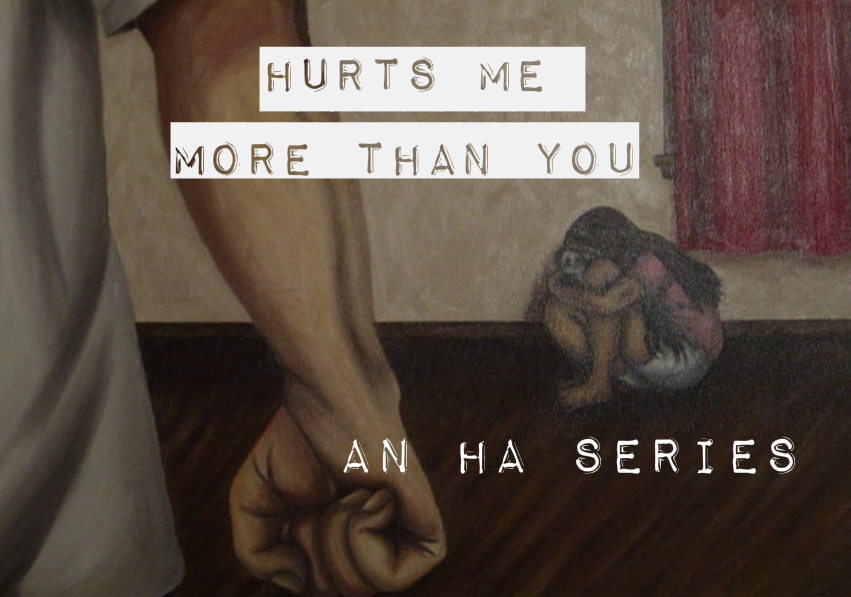
Hurts Me More Than You: A Poem by Jessica

Screen Shot 2014-09-23 at 10.15.16 AM

*****

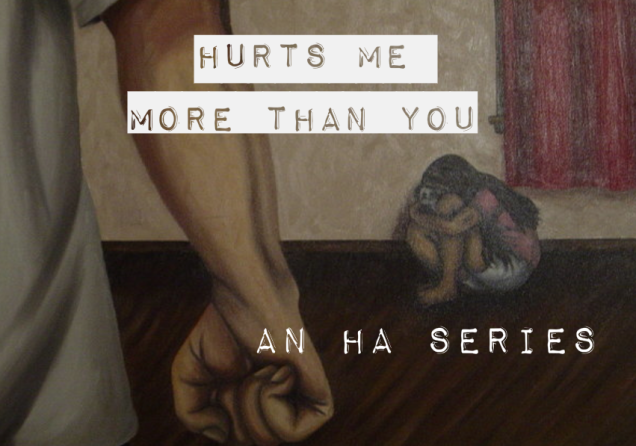
Trigger warning for Hurts Me More Than You series: posts in this series may include detailed descriptions of corporal punishment and physical abuse and violence towards children.

Additional content warning for Jessica’s poem: intense descriptions of emotional and verbal abuse towards a child.

*****

“Daddy Loves You,” a poem by Jessica

“Bless us, Oh Lord…” we all sit to pray,
But you neglected to do it well.
She scratched her nose and you opened your eyes.
Children like you two are going to hell.

Now you may eat, but just as I say.
Don’t take a bite so big!
If you stuff your face you’ll end up like mommy,
A nasty, big, fat pig.

Don’t clack your fork. Don’t smack your lips.
Don’t finish your dinner too fast.
But don’t still be eating by the time I am through!
You’re a fat, ugly cow if you’re last.

You are mean. You are nasty. And so full of hate.
You are retarded and dumb.
None of your friends actually wants to be near you.
Nope. Not a single one.

You make stupid choices, and I know you’ll end up,
Marrying a loser who will bail.
Oh, you’re going to be a horrible mother,
And your children will end up in jail.

You are rude. You are mean, and a horrible person.
So full of anger and hate.
You should be ashamed of all that you are.
I don’t care that you’re only just eight.

You’re retarded.
You’re lazy.
You’re going to hell.
You’re a liar.
You’re a loser.
You’re going to fail.

You just disappoint me and make me recoil.
I don’t even want you in sight.
Now come here and give me a kiss on the cheek.
Remember, Daddy loves you.
Goodnight.

Hurts Me More Than You: Charis’s Story

Screen Shot 2014-09-23 at 10.15.16 AM

*****

Trigger warning for Hurts Me More Than You series: posts in this series may include detailed descriptions of corporal punishment and physical abuse and violence towards children.

*****

Charis’s Story

Our physical abuse was defined as love.

I used to think that there was only one thing that was not ideal during my childhood. What I remember as isolated incidents, the times that my mom was not ok with my dad’s behavior. I’m now seeing with different eyes the methods of ‘discipline’ and ‘training’ that my parents used. Realizing that what was abusive, I considered normal.

When it came to “training” or “discipline” there was no doubt my parents believed it was for our ultimate good. That it was an expression of their love for us. They “chastised” us because they wanted to keep our souls out of an “eternal lake of fire.” We were told many things about how this abuse was actually love, and demanded by God:

“I do this because I love you.” “This hurts me more than it hurts you.” “God disciplines those he loves.” “Parents who don’t discipline their children hate them.”

When I was younger, spankings and time alone were the main methods of “discipline” that I remember. It didn’t really matter how old you were. A first time for one of us, I remember my sibling being around maybe eighteen months. My mom and I came home from the grocery store and my younger sibling was very… subdued? Dad said they had had their first training session, or something like that. No idea what, if anything, had been done wrong.

I know there was some statement by dad on how he had done it while my mom was gone because she would have been too soft.

I don’t even know how to describe what they used to strike us with. It was made of something like leather, very thick and smooth, too big to be from a belt.

There was always a pronouncement of how many times we would be hit. “That’s eight!” or the like. My mom had a penchant for counting, like some parents do when they want you to do something “one, two, three…” In our case each count represented another “spanking”. Before you could be punished, or “chastised”, you had to express absolute submission. This meant not crying, removing your pants and underwear, and bending over the bed.

Afterwards you had to hug them, and usually there was a drawn out discussion about what you had done wrong.

I remember being maybe five years old. It was after my dad had spanked me, and I was crying. I didn’t want to touch him, so I was backed up towards the wall away from him, and really didn’t want to hug. He was explaining to me that just like I was backing away from him, my sin separates me from him, and hurts our relationship.

Conditional affection, love defined as chastisement, and the blame laid to me for problems in our relationship.

I distinctly remember a “training” moment when I was a small person, at whatever potty training age was. I remember being given specific instruction to go in the toilet and not my underwear, or else. It seems like mom and dad left me alone to play for awhile, because I remember the moment when they came to my door and discovered I had gone in my pants. It seems like the reasoning was that I was rebellious or lazy, but I couldn’t say.  “Sins of omission” and all that. I was in big trouble, was given a lecture and spanked. I also remember that I was wearing orange.

I have a memory of playing in my room with a doll that cried if you turned it over. I was spanking the doll with the leather instrument my parents used on me and making my doll cry. My parents discovered me and I was in big trouble. To this day I have no idea what was so wrong, I was a child emulating my parents.

*****

There is one term my dad uses to this day that concisely defines the picture of God I was painted.

“God’ll help you with that.”

Seemingly sanguine, it was used as a threat or condemnation. It meant something along the lines of: “If you don’t get your act together God will make your life living hell until you shape up.”

Similarly, if dad said “I can help you with that” it was meant as a threat. Figure out how to obey on your own, or the consequences would be severe.

Around eight I have fewer and fewer memories. The bottom dropped out of life and everything was hard, for all of us. Never got easier after that. From age eight until I moved out life was a constant stress. You never knew when something was going to happen, when someone was going to get hurt. Sundays were the worst because dad was home all day. There was plenty of ‘discipline’. I have no idea what was deserved and what wasn’t.

Something must have happened to the leather thing, because my mom adopted a sturdy wooden spoon. She broke a few of those with use. Dad, I think, used his hand for a bit because I remember his graduation to a board due to the strain on his hand.

I was around ten or eleven years old when dad made a board with a handle and put work into sanding and finishing it. I remember it being 2+ feet long and five or six inches wide. I only have the memory, nothing exact, and of course everything is bigger when you’re a child.

There was a big to-do about the whole thing. Dad talked about a board from his childhood that had holes in it and two separate layers along with a handle. One of those -you’re so lucky I had to walk to school uphill both ways- kind of things. I don’t even know if the story was true.

The existence of this new form of punishment was a big threat. I had no doubt dad would use it on us. At this point I was already afraid of hearing his truck in the driveway. I remember cleaning my section of the room immaculately. The hangers in our closet were so straight that looking at then made me dizzy.

The very first time dad pronounced punishment with the new board it was for me. We were getting groceries as a family. My younger sibling started to walk away to go be with dad. We got in trouble for being between parents alone in the store, so I grabbed my sibling’s sweatshirt and told him to stay. He went to dad and told him what I had done. Dad got in my face and said he was going to punish me with the board. I fell apart right there in the grocery store, absolutely hysterical. My parents herded us out of the store, I was screaming and crying the whole way home. My dad told me to shut up, no more noise on the way home. I couldn’t stop crying. Mom suggested to my sibling that we take the punishment together, split it or something. He would have been around five ears old. To this day I don’t understand why she said that. I don’t remember any more of what happened. It seems like mom and dad started dickering (maybe about her suggestion that I get less) and then dad left angry, for a long time. I don’t know for sure.

I figured out that if something mattered to you, they’d use it to punish you. If you did something wrong, they’d take it away. If you didn’t do something right, they’d tell you that you might have gotten what you wanted back, but now you wouldn’t.

I made it my mission in life to care about absolutely nothing.

If I didn’t want it they couldn’t use it against me. I didn’t care about eating. I didn’t care about spending time with them. I didn’t care about being alone. I had no friends after eleven, so they couldn’t keep me from seeing anyone. One sibling was particularly hard to use the method of removing “privileges” on. I remember my mom saying in exasperation that there was nothing that mattered to him, how was she going to take it away? Removing meals or no food for a day was an oft used punishment.

I remember distinctly the moment when I realized I could never be good enough. It was never going to stop.

I had made dinner for the entire family, cleared up and was just finishing washing every dish. My dad came into the kitchen and screamed at me. I remember dad saying that if I thought that was good enough I was crazy. I don’t remember anything after that.

I figured out there was nothing I could do to protect myself or my siblings. All I wanted was to find a way to prove that we didn’t deserve it. That we had done the right thing. We had obeyed even if dad didn’t think so. I became increasingly depressed and suicidal as I faced the reality that there wasn’t a standard of perfect that christians agreed to. Even if I were capable of perfection, we couldn’t even decide what it was.

The years from early grade school and all through my teens are a blur. I have very few isolated incidents that I remember. Screaming and cursing, unpredictable enough to completely catch you off guard.

My brothers definitely got the worst of the punishments. I don’t know why this is. Maybe they thought boys were sturdier or more rebellious and needed more force to make an impression. Maybe my parents had a harder time breaking their spirit. Maybe because they were younger than me and got the worst of my dad’s anger as his stability waned.

My dad beat my brothers. I have no difficulty calling it a beating. If you hit your child with a board using all your force countless times on a regular basis, that is a beating.

I know there was punishment that I never knew of, and sometimes there were things I heard about later. Dad would go into a room with one of us and I had no idea what happened. Most of the time I would intentionally go outside in the yard so I didn’t have to hear the screaming of my sibling.

Every day it shatters my heart to know that I was there, and there was nothing I could do about any of this. I wanted to do something, I wanted to protect my siblings. But I was helpless. I wished I could take it all for them, find a way to teach them how to avoid all of it, to be good enough. In hindsight I know it was fruitless.

This ‘training’ is not what love is, but I was raised to believe that it was.

HSLDA Members Put Naked Child in a “Cage With Feces and Urine”

hslda

By R.L. Stollar, HA Community Coordinator

5 years ago, in 2009, the Home School Legal Defense Association (HSLDA) claimed Karen S. Tolin and Timothy E. Tolin as a victory for their organization. According to an HSLDA press release on January 12, 2009 (archived as a PDF here),

“When Tim and Karen Sue Tolin received notice that officials with Ubly Community Schools in Michigan had called a due process hearing for their son Sean, they turned to HSLDA for help… They currently have nine adopted children, seven of whom they homeschool. Sean, their 8-year-old, has been diagnosed with multiple challenges… The Tolins withdrew Sean from public school to homeschool him… School officials insisted that the Tolins have Sean undergo the evaluations they recommended and that he be given an Individual Education Plan… Mr. and Mrs. Tolin refused.”

The Tolins were members of HSLDA and contacted the organization for help. HSLDA attorney Darren Jones put pressure on the school district and “Ubly Community Schools dropped the proceedings.”

Fast forward 5 years. Last month, this headline appeared:

Two arraigned on charges after teen found in cage in Michigan’s Thumb

That headline eerily resembles the case of Michael Gravelle, the abusive father and husband that HSLDA attorney Scott Sommerville once called a “hero” and who was later indicated to be a child abuser and wife-beater. Gravelle had similarly placed his adopted children in cages. As it turns out, the two arraigned on charges last month were — you guessed it — Karen S. Tolin and Timothy E. Tolin, the parents HSLDA defended in 2009.

Here are the conditions the Tolins forced their developmentally disabled child into:

Police responded to investigate a civil dispute about 4 p.m. Monday, Oct. 20, to a home at 3700 Minden Road south of Priemer, when they discovered the mentally challenged male teen in a caged bed with the door chained shut, the Huron County Sheriff’s Department said in a prepared statement. 

“The odor was very noticeable as the deputy began to climb the stairs,” Hanson said.

Huron County Prosecutor Timothy Rutkowski said the teen was found naked in the cage with feces and urine around him, based on his review of the police report. The 19-year-old has a developmental disability called Angelman syndrome

Libby Anne at Love Joy Feminism first discovered this story, and made the following observation:

“This is another verifiable case where HSLDA defended the rights of people who turned out to be abusers. In this case, it was actual legal assistance. (I know several individuals whose abusive parents were also defended by HSLDA, but these are stories where social services never became involved and the abuse was never discovered.) Now yes, abusers should have legal defense. It’s how the system works. But HSLDA doesn’t position itself as an organization that defends all comers and sometimes has to do dirty work, it positions itself as the family-friendly smiling face of homeschooling and actively works to shape policy. That HSLDA doesn’t vet those it defends, and does in fact defend abusive and neglectful families, needs to be more widely understood.”

Hurts Me More Than You: Jennifer’s Story

Screen Shot 2014-09-23 at 10.15.16 AM

*****

Trigger warning for Hurts Me More Than You series: posts in this series may include detailed descriptions of corporal punishment and physical abuse and violence towards children.

Extra trigger warning for Jennifer’s story: descriptions of blood in relation to physical abuse during menstruation

*****

Jennifer’s Story

I am 17.

Funny how the majority of my life is a blur; I have very few clear memories of my childhood. I believe this is because my mind is suppressing the worst of the abuse.

But I do know that every day my oldest brother was beaten for mocking  and hitting me and that at least once a week I and my other siblings were beaten.

Rather than talk to my brother about why he felt the need to bully me, my parents used belts which only exacerbated the issue. And of course, I and my two other siblings were  ambiguously “disrespectful” and deserved beatings, no matter that everyone we ever had contact with thought us perfect.

I remember the times we hid from my father when he came  home and read the list my mother kept of infractions the children committed and deserved being beaten for. The four of us were always  found out and told to “line up.” Listening to my older siblings’ screams and being a helpless bystander knowing it would be my turn next was so much worse than the beating itself. Listening was much more psychologically damaging. Thanks to that damage, I was incredibly introspective.

It was a habit of mine in middle school  to sneak out and wander the streets by night, fascinated by the stars, doubting God. One day I was caught by a police officer, who called my mother at 3 a.m. I was  menstruating, but my father beat me anyway, until I had lost about a quart of blood, my legs coated in it. The combinations of cramps and blunt force created the most excruciating pain I have ever experienced.

That was four years ago.

Today, I still recoil when people reach out to me. I still cringe at the sound of a belt. I am still not free from them; indeed, today my sister has healing scabs on her arm from our mother clawing her.

And the worst, most depressing, soul draining thing is not the scars, but how I have no recourse but to watch her cry.

In my childhood, my parents mocked people who used the term “spanking,” saying they don’t call it what it is and they are right. Any form of physical punishment is violence and damaging. Not only to the one being hit, but to everyone hearing the screams.

Hurts Me More Than You: Robert’s Story

Screen Shot 2014-09-23 at 10.15.16 AM

*****

Trigger warning for Hurts Me More Than You series: posts in this series may include detailed descriptions of corporal punishment and physical abuse and violence towards children.

*****

Robert’s Story

I don’t remember anything about my young life before I was 5. They always told me I was a happy, quiet child.

The first memories I have of my childhood are extreme bouts of corporal punishment. As to whether the corporal punishment or the home education came first is as fine of a question as the chicken and the egg.

When I misbehaved as a young child my mother had the belief that “If you spare the rod, you spoil the child” in regards to punishment. In fact that’s what she told me before the belt came out.

The belt.

For the uninitiated a real leather belt taken off of a shelf can be a colossal terror for a small child. I suspect it was a 36″ model, the same size I wear now and that my father would have worn in his 30s.

My mother had a philosophy, that I assume was if I didn’t scream the neighbors would be less likely to intervene. Her exact words “Take it like a man”. Usually the beatings would be 10 at a time unless I cried or screamed, if a murmur came from my tiny mouth the count would be reset.

I cried a lot.

The beatings would continue until I was 13 and larger than her, at which point I took the belt from her by force and never allowed her to strike me again.

The “Education”.

As my young life continued I did not proceed to go to school with my friends across the street (we played their Atari and I found shelter in their house). Instead I found myself at home 24/7 with an abusive mother who decided that school wasn’t for her son. In my later years I found out that this was for religious reasons and to keep me from worldly things.

My childhood coursework consisted of whatever books she chose for me. I excelled in subjects I had interest in which led to much bragging among friends and family by mother about my proper education. Reading, biblical courses, basic math, American history (redux in a christian slant, obviously) and spelling were my highlights.

The Fallacy.

When I was in my teens I hit a glass ceiling in my education. The coursework – Algebra, Trig, advanced courses were all above my aptitude levels at that time. What’s the problem? a person might ask. You have a teacher right? Unfortunately this is where my truth and many of others comes out.

I was alone, in my room, studying without a teacher.

This was my home education. I was taught core basics in my early years, in my teenage years I taught myself as I had the basic skills needed to learn from a book. For me – it was a personal shelter and I was able to avoid most verbal abuse by keeping my head inside of a book and not admitting that I didn’t know what I was doing. This continued until I was 18 years old, I failed multiple courses of advanced subject matter and at the end my mother simply stated that I wasn’t good enough.

My mother attempted to kill my father and myself when I was 16 years old because “God told her to do it”. Somehow she avoided jail time, instead going for mental evaluation. My education did not advance past that point. PTSD took over my teenage brain and I lived my next two years in fear.

Growing up.

I removed myself from my parents home at 18 years of age after acquiring a GED (this was my way to graduation according to my mother and her home school group). My father filed for divorce from my mother less than a week after I left. He is a good man. He stuck around to make sure I was able to get out.

I didn’t know anything about the world and I didn’t have any experiences to fall back on. I immediately joined the wrong crowd, drinking and smoking at 18, smuggling large quantities of weed when I was 19 until I was ripped off, drunken driving in my 20s. I never went to jail and I deserved to so many times. The thing about homeschooling is that you just don’t fucking know what to do because you have no experiences and no peers. My family lived in the country for almost all of my childhood and had contact with others at church and small home school gatherings only.

I never grew to learn what not to do or the consequences of my actions.

Getting lucky.

Today I’m in my mid 30s. I am married to a beautiful woman who showed me true love. I have alcoholic, abusive tendencies that have gained me some trouble in my 30s along with depression and PTSD. Fortunately I am stable and with the help of my loved ones I am conquering my past.

If anyone is reading this story feeling alone in their struggle I encourage them to find peers that have been down the same road. We need each other.

One last thing — regarding “spoiling the child.” I am a strong atheist who has had no need for any gods and have been since my 20s. The rod will always fail you.

~ Robert, class of 1996

Hurts Me More Than You: Jaime and Susanna’s Stories

Screen Shot 2014-09-23 at 10.15.16 AM

*****

Trigger warning for Hurts Me More Than You series: posts in this series may include detailed descriptions of corporal punishment and physical abuse and violence towards children.

*****

Jaime’s Story

Two things I hate hearing the most are:  “Why are you getting spanked?” and of course “I got spanked as a kid and I turned out fine!”

We four siblings rode our bikes to a park, and we were supposed to be home by 5pm.  I was 11 and didn’t look at my watch.  When it was 5:30pm and we were still on the swings, terror gripped me.  I didn’t want to go home, then. We had to, and every delaying moment would make it worse.

We returned home eventually.  Mom lined us up.  My little sister, the youngest, got the paddle first, sprawled on a bed.  The correct technique is bare-bottom paddling until the child is gasping with sobs.  She was too little for it, and I tensed with rage.  She kicked and screamed and fell off the bed.

Mom moved on to my brothers.  You spank boys harder.  They need to be responsible.  Soon she grabbed my arm and yanked me across the bed.  She pulled my shorts and underwear off and put her elbow into my back to keep me from escaping.

The paddle was thick but slightly smaller than average—she could swing it quickly.  No set number of licks.  Just bruised and deeply red bottom and thighs.  The thighs hurt the worst.  I thought:  I’m going to run away.  Call the police.  No, wait, the HSLDA radio show said they will take my siblings away from each other.

“Why are you getting spanked?”  You must answer correctly.  You have to have “real repentance.”  It sometimes takes multiple paddlings to get it.  You sit funny that day.

“Are you sorry?”  I am whatever it takes, Mom.

I am required to hug her and can’t withdraw too fast.  Real repentance.

I want to kill her.  Or myself.  A few years later, I try to kill myself, but I can’t get anything right.

How this kind of thing happens, I understand.  She was a frustrated woman, angry with how her life was turning out at age 34.  Her husband was distant.  She did not feel she could control much.  It was past 5pm, where were her children?  They need to learn better to obey—obey the first time always, no questions ever.

She and her friends subconsciously (at times openly) judged each other based on their kids’ behavior.  And believe me, I know kids can be deeply frustrating—my coworkers today complain about their kids all the time.  It all makes sense.

Today’s culture tells me that we never hit women, we can hit children as punishment (“I turned out fine!”), and we can hit men whenever.

How about just not hitting anyone?

*****

Susanna’s Story

I have 10 siblings, so anytime an infraction had been committed that warranted spanking, but the exact perpetrator was unclear (“who tracked mud on the carpet?”), my mother would grab a belt or wooden spoon and have us all line up at her bedroom door for sometimes hours at a time as we all received the punishment one by one.

This means I have been spanked for literally nothing countless times. But trying to beg off and sobbing out “I didn’t do it!” only resulted in more spanks and a cold “I’m sure you’ve done Something that I missed.”

Occasionally, my siblings and I would be able to convince one of our own to take the blame for the ambiguous crime so that only one of us had to be punished. We had a system where we took turns volunteering if the option was given. But even when it wasn’t my turn, hearing the belt thwacks on my brothers’ legs would make me violently ill, and just thinking about it today is upsetting my stomach.

From as early as I can remember, a spanking has never made me feel “sorry”. Only angry, sick, and determined to never again let this happen to me (even though I was just as helpless to stop it the next time). I have never ever felt as angry as I did after getting spanked.

As an adult, I avoid speaking to my mother, as just seeing her upsets my stomach, and I struggle with any situation that could lead to confrontation. I used to work under an aggressive boss that I disagreed with frequently, but any time I even thought of confronting him on the smallest issue, my knees would get weak, my stomach would flip, and my hands would begin to sweat and shake uncontrollably. That same reaction can happen to me anytime I consider any confrontation; once it happened when my room mate ate my yogurt and the thought crossed my mind that I might speak to her about it.

It’s exactly the reaction my body would have through my childhood when I knew with certainty that I had a spanking coming my way.

You’re not a victim because…

Screen Shot 2014-10-21 at 12.25.01 AM

HA note: The following is reprinted with permission from Eleanor Skelton’s blog. It was originally published on October 20, 2014.

Trigger warning: victim-blaming.

Observing the backlash against my friend Cynthia Jeub’s blog series on family abuse has been quite informative for my journalistic aspirations.

Cynthia and I worked at the campus newspaper as editors for two years, and we share a passion for investigative reporting.

Together, we advocated for disabled students on campus, plotted together to conduct social experiment videos, followed the conflict over sermons about homosexuality at Bob Jones University last year, and cheered on the BJU students leaking bootleg recordings.

But two weeks ago, it got real.

Cynthia wasn’t just supporting Homeschoolers Anonymous and the spiritual abuse survivors blog network anymore, we weren’t just swapping links back and forth on chat. She shared her own story.

People told us to be quiet, to not make God or Jesus or Christianity look bad.

And all I could think of was a verse from memorizing the book of Ephesians with my youth group nearly 10 years ago: “Take no part in the unfruitful works of darkness, but instead expose them.” (ESV)

There is no need for silence any longer. I noticed several types of attempts to stop Cynthia:

“You’re mentally ill.”

Cynthia’s parents and siblings keep using “mental illness” in attempting to discredit her, posting comments like: “Hey I’m Cynthias lil brother Micah Jeub and she is making this stuff up. she is just lying. Cynthia is dealing with mental illness and needs prayer.”

In the Jeub family’s responses, the fact Cynthia is even seeing a therapist at all is grounds to claim she is “mentally ill” and that her memories should not be considered credible.

I’ve noticed that American culture often misunderstands mental illness, as illustrated by the Matt Walsh post on Robin Williams’ suicide.

But legally, the state only interferes when the patient states or acts to threaten their lives or others.  When their issues keep them from functioning in society.

So I don’t believe the Jeub family can label Cynthia “mentally ill” because she goes to counseling. She holds a full-time job and attends classes. If Cynthia’s crazy, well then so am I.

“But you forgave me.”

Another phrase abusers use to cover up the past. Especially in the church, because forgiveness is a Christian virtue, and Jesus forgave so much more than you ever could.

This brand of “forgiveness” just enables abusers, as illustrated in power and control cycles.  Read the “minimizing, denying, and blaming” section.

Last week, a friend of mine received a message from her former boyfriend’s phone, sent by his controlling, manipulative girlfriend who assaulted him back in 2012.

“Anyway, it’s all in the past now. The only thing we can do now is move forward. You seem to be doing good things in your life. And we are doing good things in ours. Lets just all be happy and forgiving and let the negativity finally subside.”

If we cannot tolerate this behavior in romantic relationships, we shouldn’t in child rearing, either. Even forgiveness does not heal the hurt.

“You’re exaggerating.”

Chris Jeub’s podcast was loaded with this excuse, mostly from Cynthia’s siblings.

“That’s not abuse, that’s what every mom does when her kids don’t do the dishes, she throws silverware at you.”

“A lot of moms would have popped before mom did.”

The Jeub children still living at home assume explosive outbursts and physical attack is normal and happens in every household.

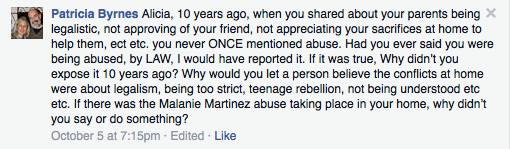
A more aggressive attempt to discredit Cynthia’s story, in the form of libel accusations, came from Patricia Byrnes, former counselor to Cynthia and the other older Jeub sisters.

She and her husband Kurt Byrnes founded Anchor of Hope Ministries in Monument, Colorado, and provide services to the homeschool community.

I received the following Facebook message from her on October 7:

p1

Also, notice her comment on Chris Jeub’s Facebook status two days before, discussing a therapy session:

p2

And her comment on Cynthia’s Melting Memory Masks post:

p3

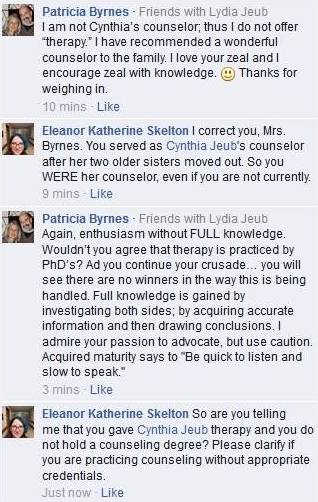
So I screen-captured Patricia’s message and posted it publicly to my Facebook account. She dialogued with us on the thread:

p4

In these online encounters, Patricia Byrnes violated her own confidentiality agreement in revealing details from prior therapy sessions. Anchor of Hope’s policy states: “Interactions between client and counselor are confidential. Unless I have permission from you, what we talk about will be private; I will not discuss it with anyone else. Our discussion will be private and confidential.”

And she actively discouraged Cynthia from sharing her story, although a counselor’s role should be to enable and empower.

Patricia Byrnes also avoided questions about her credentials, while still telling us to “use caution” and “be quick to listen and slow to speak.”

The homeschool community becomes abusive and toxic when authority figures mislabel and deny our voices and then advocate a false forgiveness above all else.

These scenarios are what perpetuated our harm for so many years.

Silence only enables abusers. Our scars have stories. And the stories matter.

HSLDA’s Michael Farris to Heidi St. John: “We Are Standing With You”

farris

By R.L. Stollar, HA Community Coordinator

Several days ago, the Home School Legal Defense Association (HSLDA) issued a statement on their involvement (or lack thereof) in allegations about a widespread cover-up of physical and sexual child abuse in the Christian homeschooling community. The child abuse is alleged to have involved the children and a relative of Paul and Gena Suarez, owners of the popular homeschool magazine The Old Schoolhouse.

HSLDA’s statement, which you can view in entirety here, was that “HSLDA does not get involved in conflicts between families or individuals” and their mission is “not to be the police force of the homeschooling movement.” In response, I pointed out that not only does The Old Schoolhouse remain an HSLDA-suggested resource promoted to HSLDA members at a special discounted rate, but HSLDA is currently sponsoring The Old Schoolhouse. In terms of finances, therefore, it’s not difficult to see why some people would believe HSLDA is taking sides.

Today, however, HSLDA founder Michael Farris made explicit at least one side he’s taking: Heidi St. John’s.

St. John has been accused of ignoring a request for help from Jenefer Igarashi — the mother of one of the alleged abuse victims — as well as playing a role in getting Igarashi blocked from a homeschool convention. St. John issued a statement regarding the allegations, which she publicly posted on her Facebook page yesterday. St. John alleges that she is “being slandered in such a way that it has become very obvious that the devil is mad” and has “been betrayed by people who claimed to be our friends.” (You can view an archived image of St. John’s Facebook post here.) Various homeschool leaders have shown or declared solidarity with St. John, including Chris Jeub (who has recently been accused of emotional and physical abuse by several of his children) and Tracy Klicka MacKillop (widow of the late Chris Klicka of HSLDA).

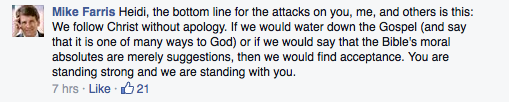
One of these leaders includes Michael Farris. Farris left the following comment on St. John’s post:

Screen Shot 2014-10-18 at 1.51.09 PM

Text is:

Heidi, the bottom line for the attacks on you, me, and others is this: We follow Christ without apology. If we would water down the Gospel (and say that it is one of many ways to God) or if we would say that the Bible’s moral absolutes are merely suggestions, then we would find acceptance. You are standing strong and we are standing with you.

Considering that all of the individuals who have brought abuse allegations against Paul and Gena Suarez of the Old Schoolhouse (and associated individuals like St. John) are outspoken Christians, it’s unclear why Farris suggests the attacks involve “watering down the Gospel.”

What is clear, however, is that HSLDA’s Michael Farris has made explicit that he’s taking St. John’s side in this situation.