Hurts Me More Than You: Jace and Jocelyn’s Stories

Screen Shot 2014-09-23 at 10.15.16 AM

*****

Trigger warning for Hurts Me More Than You series: posts in this series may include detailed descriptions of corporal punishment and physical abuse and violence towards children.

Extra trigger warning for Jace’s story: reference to family sexual abuse.

*****

Jace’s Story

I believed my parents when they said this hurts me more then it hurts you. At least when I was young I did. I knew I was bad and needed the rod to drive the evil from me. The things my cousin did to me made me bad. I knew that. I was bad because I let him do those things to me. He always gave me the option, do as he said or he would just go get my little sister. So I done as he said. I was so bad.

When my father asked if I understand that I deserved the beating. I always said yes even if the reason he gave was false I still knew I was bad and deserved the spanking. My father loved me. God was using him to drive the bad from me. Foolishness is bound in the heart of a child.

Then the day came when someone in the family had committed a crime in my mother’s eyes. She was going to get to the bottom of it but no one would confess. So she put me in one room, my sister in another. Then she went back and forth spanking us and asking for a confession. I remember wishing she would just ask if I knew I deserved the spankings. I could say yes but to confess would be a lie.

I did not know what to do. I sat and listened to my sister’s screams when it was her turn to be spanked. I heard mom say this hurts me more then it hurts you. I knew that was a lie! I had suffered for years at the hands of my cousin so my sister could be safe. I loved my sister and I knew I could never beat her and hear her scream in pain even if God commanded it.

How could my mother do that? The spanking did not hurt mom more then my sister. I got up went in to the other room and confessed to a crime I had not done.

Mom beat me and for the first time I did not believe her when she said this hurts me more then it hurts you.

*****

Jocelyn’s Story

“Spanking isn’t abusive in and of itself.”

I used to say this when I heard someone say they would never spank a child. In my mind, you would have a bratty child if you didn’t spank them. Because that’s what I was told. Every time the wooden paddle came out, it was accompanied with a reminder that this was for my good, that it was because I was loved, and that God said it was the best way to discipline.

“My parents spanked in the right way”, I argued. 

I was never spanked to the point of bruising. It was always with clothing on. It was not a daily occurrence.  But recently, I have been becoming more in touch with my childhood, seeing it for what it was. I see fear. And anger. And confusion. I see a disturbing fascination with violence, even sexual violence, before I was ever exposed to much of the outside world or knew what sex was. Where did those feelings and thoughts come from? I am beginning to think that they came from being spanked. Spanked “in the right way”.

Which urges me to reconsider that there is a “right way” to hurt your child.

The violent and disturbing fantasies I had as a child have not gone away yet. I’m thinking of having my own kids soon. I won’t be spanking.

Not even in “the right way”.

I Was Once Considered A Success Story In The ACE World: Aaron K Collett’s Story, Part One

Screen Shot 2014-11-01 at 12.47.05 PM

Aaron K Collett is currently a Communication major, with an emphasis in Digital Film making. Aaron blogs at Bringing Thought to Life.

Part One: I Was Once Considered A Success Story In The ACE World

My homeschooling story is a bit different than a lot of people’s.

I wasn’t beaten, I wasn’t isolated (technically), in fact, I was only technically home-schooled for one school year. But oh, how I wished I were homeschooled while I was actually in school.

From the fifth grade through high school, excepting my freshman year in home-school, I attended Rocky Mountain Christian School. RMCS was a “private Christian school” – in all respects, though, it was really just a church-school. We used a fairly well-known home-school curriculum (Accelerated Christian Education), so it really was like being homeschooled at a different building.

Well, almost.

Before I came out as an godless apostate heathen atheist, I was considered a success story in the ACE world.

ACE is a self-paced program, which means students sit at a desk and do their work independently, only getting help when and if they need it. While I don’t have a problem with that idea necessarily, it has the same problem lecture-style teaching does: it pigeonholes students into one way of learning. It worked fantastically for me; I “graduated” a year early. Other students were not able to self-learn like I can, and suffered under the non-guided learning style. But the self-paced style was not the largest problem with the curriculum.

I “graduated” in 2004. “Graduated” because while I have a diploma, I learned very little actual things from ACE. As I’ve said before, I was fantastically lucky. My mother had a background in education, and she really was my teacher. She taught me how to write, she taught me how to read, and she taught me how to math and science. And when I got to college, I could do those things fairly well.

Unfortunately, other subjects were…less well-taught.

ACE history books start with Genesis. So do their science books. We learned that evil scientists who hated God were hiding the evidence for a six-day creation 7000 years ago. Ken Ham and Kent Hovind were our heroes. They were standing up to the evil scientist conspiracy.

History was a joke. We were spoon-fed the stories of Genesis as if they were fact. As if Mid-Eastern origin myths were at the same level as modern professional historians and archaeologists. We learned….well, nothing, actually. Pretty much all of my history and all of my science education has happened in college. I can fake it – I’ve taken it upon myself to learn on my own – but I didn’t get the opportunity until I was in my 20s.

But the lackluster schooling was not the worst part of Rocky Mountain Christian School.

To be continued.

Hurts Me More Than You: Warbler and Laralyn’s Stories

Screen Shot 2014-09-23 at 10.15.16 AM

*****

Trigger warning for Hurts Me More Than You series: posts in this series may include detailed descriptions of corporal punishment and physical abuse and violence towards children.

*****

Warbler’s Story

I was a “liar and a thief” growing up. AKA: I would take saltine crackers out of the cabinet and eat them between allowed meals and then I would lie when I was inevitably caught and told to fess up. I got spanked at least once per day for a couple years.

I don’t know were exactly my parents first learned about spanking, but they read and promoted the Pearls out the wazoo.

Over the years they spanked us with hands, paint stirrers, and lastly with 2-by-4s. My mom had a 2×4 custom made with a handle. If we tensed out butts, or put on extra layers we were spanked for avoiding the pain and made to take the layers off and be spanked over underwear. We were usually taken to another (private) room, but our walls were thin and every *thwack* echoed through the house, along with the eventual crying and the “I love you and this hurts me too.” Afterwards we were expected to say in explicit language exactly what we had done wrong, that we were sorry, and that we loved the parent who had just beaten us.

My mother was usually the one to do it, but she would spank us so often that her hands started hurting (blood vessels breaking, etc) that she had the 2×4 made, or she left us to wait in dread for daddy. His hands were tough and he hit hard. The paddle sometimes hit the tail bone as well, and that was the worst.

I usually cried.

As much as I tried I was “weak.” Sometimes if the boys didn’t cry they were spanked till they showed “proper” repentance. If we were stubborn, refused to say we loved them, or did not properly state our transgressions we were spanked again. 5 spanks was the bottom line, then ascending in number by units of 5.

As for me, I never got more than 40 in one sitting (that I remember) because I was (as stated) weak and timid and disliked getting spanked. My older brother was rebellious and would often get spanked for hours. I can still him yelling defiantly over the strikes, refusing to back down even when being punished.

As we got older (teens), our parents decided that spanking was not working and we were given leaf-raking jobs, cleaning jobs, or extra writing assignments. They thought that we were either so bad, or so old that spanking still hadn’t done well, and it was time to try something else. I once heard my mom say something about “decency” having something to do with it, but I have my personal doubts.

Our younger siblings were spanked much less because the “other” punishments on us older ones seemed to be working (or as we got older we didn’t take so much food and hid things better) so they got some similar punishments and spanking was reserved for serious, extra bad transgressions. With the sidelining of the spanking it got worse, though. They were reserved for daddy and he often beat far longer than needed because the younger siblings were not used to being contrite, crying enough to get out of it, and say the right things. I remember the 8th child had a problem at dinner and shouted at my mom or something. My dad had just gotten home from working and it seemed like the height of sin to be making noise and disturbing his dinner. My baby was taken to his room and hit for about 5 minutes long, screaming up until the last minute or so. He was either 4 or 5.

My mom also got more into slapping or hitting as we got older and talked back to her as older teenagers. It was like the ultimate shame because you could never hit back. Those were some of the times that I “saw red…” Brilliant shades of red color everything as you focus in on one person with all the hatred and anger in your tortured soul. Your body shakes and you blink, but still see the color. Nothing else is, or ever was. The only two things in the world are you and the face screaming at you in red waves…. and you wish you had a knife in your hand…. Sometime later you awake from your dissociation, you can’t remember the past 30 minutes, but you feel guilt for your feelings.

After all, you were the one in the wrong. You deserved punishment for your sins…

I don’t know how common spankings are now, as I “ran away” from home 4 years ago. I do know that if my mom had access to plumbing line or glue sticks one or more of us might have fared worse. The wood was solid and “just” bruised.

And we learned how to hide our transgressions in order to avoid it.

*****

Laralyn’s Story

Spanking. Even now I don’t know what to make of the term.

It feels so wrong to apply it to how our parents punished us. I initially assumed I would always spank my own children. After all, it was Biblical and right according to so many Christian parenting books. I didn’t want to have horrible children, so of course I would spank. As my first baby became a toddler, I found I couldn’t stomach the idea. I tried to spank her once and the attempt was half-hearted and I cried because I knew deep down it was horribly wrong. The moments I was tempted to spank were when I was angry or I didn’t know what else to do and that to me said more than any Christian parenting book ever could. I decided then and there that I would never physically punish her or future children in such a way.

I wish I couldn’t feel my stomach turn when I remember my parents disciplining us. The angrier they were, the worse it was. A belt was the most frequent tool and almost all spankings accompanied the remove of clothing below the waist. I still feel humiliation and shame when I remember it. We were spanked for nearly every infraction – my parents knew no other mode of discipline.

However, the moment I remember most vividly is when I was spanked for being afraid of the dark.

I had horrible fears as a child (of hell, of the house burning, of dying) and refused to sleep alone. One night, after repeated attempts to settle me, I was still crying uncontrollably. My parents, frustrated to the point of losing control, marched into the room. My dad ordered me to turn over and with my head buried in the pillow to muffle my crying, he hit me several times across my bottom. He yelled at me to shut up and then they left.

I was still crying. I was still afraid.

I started injuring myself when I was five in response to anger and overwhelming emotions. This behavior continued and worsened into my teens and young adulthood. My parents shamed me and blamed bad influences.

I blame their shaming and willful crushing of spirit.

How a Logical Girl Talked Herself into Fundamentalism, Part 3

screen-shot-2014-10-26-at-12-39-25-pm

HA note: The following is reprinted with permission from Cynthia Jeub’s blog CynthiaJeub.com. It was originally published on October 17, 2014. 

< Part Two

Trigger warning: child abuse

“Icy roads beneath my feet,
Lead me through wastelands of deceit,
Rest your head now, don’t you cry,
Don’t ever ask the reason why.” –Opeth

When Tangled hit theaters in 2010, my sister Lydia and I saw it within the first couple of weeks. We were late for the movie, missing the narrator introducing Mother Gothel as the villain. We found our seats just in time to see the song “Mother Knows Best.”

Both of us thought, after watching that song, that perhaps in this movie the witch in the tower was a good person. After all, it was a retold fairy tale. You never know what they’re going to swap around.

For the uninformed, “Mother Knows Best” features textbook emotional abuse with manipulation and control, using guilt trips, threats, and fear tactics. I watched the song again recently, and realized most people knew that when they first saw it. When I was eighteen, I did not see any problems with the song.

Gothel looked like a good mother to me.

So after reading an article about girls in the homeschool movement who live with self-deception, I did the most natural thing I could think to do. I emailed it to my mom, and said I felt like my life had been that way.

Her reply: “We left all that behind in ’06.”

For context, my family filmed for reality TV in 2006. After that, my parents re-branded themselves, championing the word “love” as the ultimate trump card. They wrote a book called “Love in the House,” and emphasized that the greatest commandment is love.

To this day I get shamed for talking about the multi-faceted manipulation in my family, because it’s not in accordance with our brand, “love.” I got a text message a couple of months ago from my dad, after I walked out the front door because he started yelling at me for, well, ignoring his text messages. The text read, “Love is the answer. This is not love.”

Because I was accustomed to believing my parents every time they reinvented stories, I believed my mom. Maybe I wasn’t under pressure after I was 14. But I wrote letters about brightening the house until I was 18.

I visited my parents’ house sometime in May this year, and my sister Hannah, age 11, was standing at the stove. I asked where mom was, and was told that mom had been shopping for the past four hours. My brothers were working, and my eleven-year-old sister was left to feed and supervise her six younger siblings, and clean the entire house. Hannah beamed proudly as she told me about her work: she’d cooked, cleaned, watched the kids.

It was the first time in my life that this situation seemed like too high an expectation for an 11-year-old girl. It was what I was raised with. It had been normal.

The only thing Hannah didn’t have time for was the dishes. We don’t have a dishwasher because, with 14 people living in the house, it’s inefficient. We use too many large serving and cooking items, and there are more plates and cups at each meal than a regular dishwasher can hold. My parents have always verbalized dreams about an industrial dishwasher, but we could never afford one. As a result, we wash everything by hand, which takes hours, but it’s better than putting up with a tiny dishwasher.

Mom got home an hour later. Hannah beamed with pride, waiting for a compliment on how well she’d done. Mom’s eyes went straight for the dishes, piled all around the sink. Hannah had cooked, babysat, swept all the floors, and the other counters and tabletops were clean. The dishes were her one oversight.

My mom started yelling, and I watched my little sister crumple. I felt a twinge of familiarity. I had received the same treatment at her age, and taken it with the guilt I was supposed to feel, and tried to perform better. I became a master of homemaking over the next several years.

We listened to mom rant about how dishes are an important chore, and why didn’t Hannah get them done, and now it would be hard to move ahead with the day, and I-was-gone-shopping-aren’t-you-grateful-for-my-hard-work-enough-to-do-what-I-asked.

Hannah defended herself, listing all she had completed. My mom would hear none of it, so I stepped in. “Mom, the house is never this clean when you’re in charge. It’s always in better shape when you leave one of the girls here.”

This was insult. I was informed that my mom did her best, and now was no time for criticism. I tried to help her see that she was holding her young daughter to a hypocritical standard. It was no use. Hannah deserved a tongue lashing, but my mom could not be expected to keep the house in order.

I brought up the email. “You said you left all this behind, and here we are,” I said. She insisted that there was nothing unreasonable about her expectations.

Another time I visited, Hannah and mom were having the same argument: mom had left the little girl in charge, and Hannah had failed on one chore, and mom was yelling at her. I walked in on the middle of the conversation, and Hannah had evidently just cried.

My sister turned to me. “Happy Fairy, cheer me up.”

Something twisted in my gut. This was what I’d been coping with when I pretended to be happy. This was what I convinced myself was a good thing. This was what I was burying away, and this was why I’d dropped out of college and started mental health therapy – because I couldn’t live in denial of my depression anymore.

I looked at Hannah, who was hopeful and ready for my “magic” power to cheer her, and said, “The Happy Fairy was a lie. I forced myself to be happy. Just in the past few months, I’ve learned to start sentences with ‘I feel…’ because I was never taught to express my feelings. I spent my teenage years pretending to be happy. I thought I could fake it until I made it.”

My mom was standing in the kitchen with us. She was quick to announce, “You didn’t learn that from me.”

But I did learn that from her. One of my mom’s favorite lines was, “It’s scientifically proven that if you smile when you don’t feel like smiling, it sends messages to your brain that you’re happy, and pretty soon, you feel better.”

I turned back to my little sister. “I also distrusted myself when I felt angry or sad. You’re angry for good reason: you tried to keep the house in order and you didn’t please mom, and she yelled at you. It’s okay to be frustrated about that. You don’t have to pretend to be happy, and I’m sorry I made you think it would work. It didn’t work for me. It just helped me bury all my emotions for years.”

In the weeks that followed, my mom used all kinds of emotional abuse to get me to stop criticizing her. She said she could yell at my siblings if she wanted to, that’s just the way she is. She could never see the hypocrisy of having higher expectations for her kids than she had for herself. She threatened to commit suicide. She appealed to my emotional vulnerabilities, and she knew them all: I’d just been through a breakup, I couldn’t trust myself because I was mentally ill, and I should feel guilty and ashamed for not being forgiving and loving enough.

One evening, when I was exhausted from arguing with her, I collapsed on the couch. She sat next to me and stroked my head, and told me I could trust her, and that she loved me, and that she hoped I’d get better, and said how she thinks I’m an awesome person.

It was like being cuddled after a nonconsensual BDSM session, as I told a friend a few days later. Had I not read a post on tumblr criticizing the lack of consent in Fifty Shades of Grey, I would not have recognized what my mom was doing that night.

Then I realized she’d done this all my life: attack, threaten, comfort. Hurt, and then flatter.

And in that one moment, with my mother gently caressing my hair and murmuring soothing words, I lost every ounce of trust I’d ever had for her.

End of series.
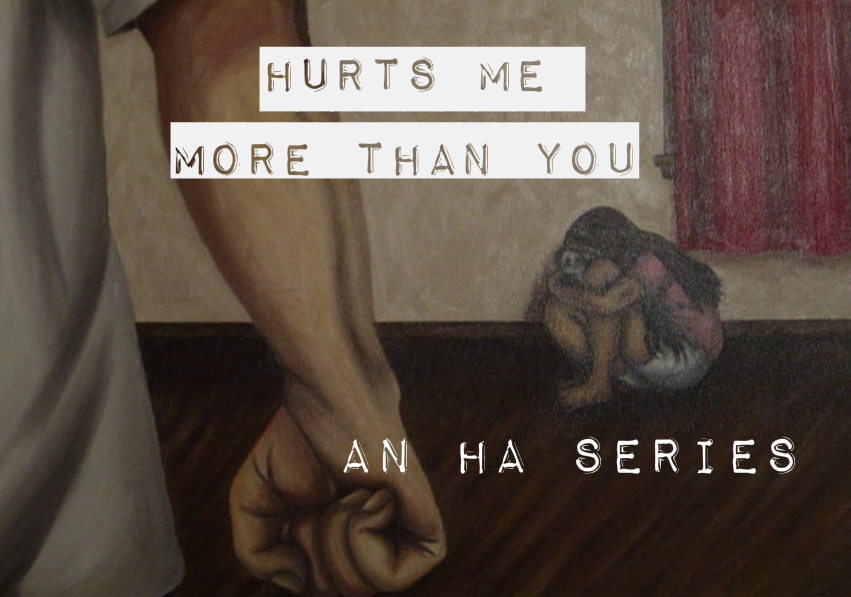
Hurts Me More Than You: A Poem by Sam

Screen Shot 2014-09-23 at 10.15.16 AM

*****

Trigger warning for Hurts Me More Than You series: posts in this series may include detailed descriptions of corporal punishment and physical abuse and violence towards children.

*****

“Love?”: A Poem by Sam


A child naked, helpless, letting himself be hit.

If he resists he will be hit more, if he doesn’t stop crying on command it is the same.

Every time he doesn’t obey unquestioningly,

Even if he just doesn’t want to finish his lima beans.

“We only do this because we love you.”

But is it love, or something very different?


Parents talk of all day spanking sessions till “they” are black and blue

After work a father continues what his wife did all day.

They talk to their pastors who tell them to continue to achieve the desired outcome.

Unquestioned obedience the only apparent goal.

“We only do this because we love you.”

But is it love, or something very different?


“You can only have friends over if the house is clean.”

But the house is never clean enough.

Friends do things differently, to dangerous to remain friends.

Xanga blocked. E-mail monitored. Mail read. Checkmate trapped.

“We only do this because we love you.”

But is it love, or something very different?


Behind in logic when it is reviewed the first time all semester

Upset mother. Tension palpable. She grabs coat to leave.

Son begs her not to go. “Tell your father I’m leaving.”

He comes home, begs forgiveness, and searches.

“We only do this because we love you.”

But is it love, or something very different?


I awake.  I can smell dinner in the kitchen.

We’re all there, we smile and eat. No one explains, no one questions.

Three months later I burst into tears at what was swept under the rug.

“Why do you bring things up that happened so long ago?”

“We only do this because we love you.”

But is it love, or something very different?


Of course since you are a Christian, you believe this.

What that means in practice varies by the day.

Questions are dismissed. Opinions can change,

But only if it is a parents thought.

“We only do this because we love you.”

But is it love, or something very different?


Son fails out of school, a perfect trophy no more.

Explosions from minor things. Parents are impossible to please.

He works hard and returns to finish what he started.

Professors see a success. Parents still only see a failure.

“We only do this because we love you.”

But is it love, or something very different?


Gorgeous woman. Incredible friend. Determined to treat her right.

Hugs and dancing leads to consternation.

Forced home. Cut off. Will Broken.

Why do I feel forced to agree to every demand?

“We only do this because we love you.”

But is it love, or something very different?


They try to sabotage and marry smile as we say “I do.”

We leave and cleave and start an incredible life.

Married children are not to be respected as adults.

If they think differently, they can not interact with younger siblings.

“We only do this because we love you.”

But is it love, or something very different?


I awake.  This is not right.

“You may not keep treating me this way.”

“Son, stop being bitter, get past the hurt.

“Why do you bring things up that happened so long ago?”

“We only do this because we love you.”


But this is not love, this is very different.

Hurts Me More Than You: The Stories of Five Sisters

Screen Shot 2014-09-23 at 10.15.16 AM

*****

Trigger warning for Hurts Me More Than You series: posts in this series may include detailed descriptions of corporal punishment and physical abuse and violence towards children.

*****

HA note: These five stories are the perspectives of five sisters, with psuedonyms taken from the seven sisters from greek mythology. They have previously guest-blogged at Becoming Worldly.

Maia’s Story

My parents were very zealous about raising us right.

They read the Bible, joined the groups, read the books. When I was very young, I was punished in a way that I think was very typical of the late 80’s (and still common now): a slap on the hand, a swat on the bottom. But after the books and the groups, it became more violent, and included hitting us on a handy body part, pinching and squeezing handy body parts, and formal spanking.

My father accumulated spanking implements, and he enjoyed hearing about new materials that could be used to spank his children.

He insisted that it be called the rod, as a matter of respect to him. His favourite stick was a think branch from our woods. He cut it off the tree himself, trimmed off the little branches with a knife, and sanded the nubs down.

It still had most of the brown bark on it, and over time, the sanded nubs started to look shiny and polished from use. It seemed to me that my parents thought that spanking had magical properties. They thought it could be used for anything from attitude adjustments to ensuring instant obedience to helping the memory when we had a hard time reciting the Bible verses we were supposed to memorize.

When my father thought we had a rebellious attitude, he would spank us, and then talk to us about having a better attitude, which was difficult to process, especially on those occasions when we weren’t having rebellious thoughts to begin with. If we failed to respond to a command immediately, or did it with the wrong attitude, or not thoroughly enough, we were spanked. We were spanked until we cried, because they felt that resisting tears was a rebellion of its own (it was). But we became disconnected from our own reaction of crying, so sometimes we would start crying right away, trying to do what was expected, and we were spanked until we stopped the rebellion of crying.

They told us that they didn’t want to hit us, but they had no choice because the Bible made it clear that they would be punished if they didn’t spank us.

Being spanked and hit and pinched made me flinch around sudden movements from my parents, but, you guessed it, I was punished for flinching. I became very fearful, and tried to completely control my behaviour and reactions to avoid being punished. I became a very silent and somber child, trying to show respect and obedience all the time, even though inside I was extremely angry. I learned to try to avoid punishment, not to do things well from any internal motivation, and this was something I have had to learn to overcome as an adult.

I do not support spanking as a discipline method.

Electra’s Story

I was spanked when I was a kid.

The spankings went on from when I was about 2 to when I was 12. Sometimes the sessions would go on for hours, and they usually took place at least once a day. Even the slightest offense, such as taking an extra piece of fruit, or “having a bad attitude”.

I remember one event, when I was about 8, when my parents decided I was possessed.

This was at bedtime and the beating and praying went on till the early morning hours. Usually I would get a forced hug after a spanking session, along with a prayer and a guilt trip for “causing them this pain”.

I feel that a lot of my social skills were hindered by this abuse, and I think that spanking is an unnecessary and brutal use of force that should never be used.

Alcyone’s Story

As a child, I was spanked by my dad and my mom. Most of the time it was for pointless and unimportant things. My dad would spank me until I cried. I don’t mean whimper; he would spank me till I cried loud and in pain. He would spank me with a rod that had the diameter of a quarter.

My dad justified his spanking methods by saying that God showed him that it was time to spank. He once spanked all of my siblings and myself, with the reason that he had to test out his new spanking implements. I got spanked because I baked cookies for my dad as a surprise, but I burned them. I got spanked for climbing out my bedroom window. I got spanked for dropping a watermelon because it smashed on the ground.

The actual spanking didn’t hurt me psychologically. It was the reason and the criticism that the spankings were served under. I was scarred by my dad’s spanking physically; more emotionally though. My dad once beat my sister with a broomstick in front of me because she missed a spot on the floor. That scarred me.

Spanking is wrong in many circumstances. When a spanking is meaningless for no reason, then it is wrong. I don’t know if it’s wrong all the time, so in my children’s lives, I have chosen not to. I can’t justify hitting child, no matter what they did.

Taygete’s Story

I was spanked when I was growing up. And it definitely affected me permanently. I was spanked for everything; it was extremely inconsistent and never for the same things. I  was spanked and it hurt. I was spanked anytime my father wanted too. He spanked me so often that I thought it was just the normal way of life.

My parents instilled fear in me at a young age. As a child the one thing I feared the most was my parents; no matter what I was doing ( playing the piano, playing lego, or even playing in the yard ) because anything could set my dad off.

This not only hurt me as a child but followed me into adulthood as I went on to parent my own child.

I developed bipolar as a result of this and multiple other mental issues. It made it hard in relationships because I couldn’t even tell I was being abused for the longest time.

This is only a very brief description of how child abuse affected me forever.

Celaeno’s Story

I was spanked by my parents when I was younger. Each spanking wasn’t very long (as I can remember), but it is hard to remember how often I was spanked. I was often spanked with grey patterned tent rods, and I was never spanked for a reason (as far as I know). Each Sunday, we were taught at “church” that spanking was normal and a fine way of discipline so I didn’t realize that the living situation I was in was a horrible one.

Later on in life I got counselling which I probably had needed much earlier but from counseling, I learned so much more about spanking, how wrong it was, and how illegal and inexcusable it was. There are many wrong things about spanking especially when you aren’t given a reason for it. It hurt me physically and psychologically. I will never spank my kids when I have them, hurting them physically won’t be the answer. Kids don’t realize when they’re doing something wrong unless you tell them.

There are alternatives to hurting them.

How a Logical Girl Talked Herself into Fundamentalism, Part 2

screen-shot-2014-10-26-at-12-39-29-pm

HA note: The following is reprinted with permission from Cynthia Jeub’s blog CynthiaJeub.com. It was originally published on October 15, 2014. 

< Part One

Trigger warnings: child abuse

“I could fight this, but I may die.
And all I want is be the apple in your eye
Well I could stay here, strap on my face
Listen to the words that put me in my place.” –Pendulum

I was a curious child. I wanted to know how everything worked and why we did certain tasks, and if the explanation wasn’t satisfactory, I refused to participate.

One day when I was nine, I questioned the reasoning behind sweeping the floor. It was always dirty again within hours. Why not just leave it, or find something more efficient? In a fit of frustration, my mom pulled my ear and yelled in my face, then threw me into the pile I’d partially swept. My head rang from hitting the wood floor and my mom kept yelling about how I needed to finish my chores and stop asking questions, and do it as she said to do it. I finally obliged.

The next day, I felt weak. I struggled with low energy and being underweight, so this happened pretty often. I didn’t have the strength for my chores, and fell asleep again soon after breakfast. My mom brought me a snack and gently offered comfort and care, and she said that I could always trust her. When I felt safe, she asked about why I had such a strong aversion to chores. I remember this phrase from her: “Jesus wouldn’t be happy that you won’t listen.”

I didn’t recognize my own use of humor as a defense mechanism. “I don’t want to follow Jesus, mom.” I laughed at her alarm and joked, “I want to be a follower of Garfield. He’s okay with himself how he is, and he lays around, and he’s not skinny as a rail like me.”

The next day my mom told me, “Your dad and I have talked it over, and we decided you can’t read comics for a year.”

I wanted to cry. I already knew what it felt like to lose something I loved for a whole year, because they grounded me off of watching Star Wars when I was seven and eight. I loved reading, and I loved comics. I loved reading Garfield, Spider-man, Calvin and Hobbes, Foxtrot, and always got the newspaper and read the comics before reading some of the news. It was wit and humor and information and philosophical thought and character development.

My favorite movies, and now comics, took precedence over my parents’ religion and expectations, and that made them an idol. My crime for losing what I loved was that I loved it too much.

But like I’ve said before, I knew to suppress my feelings. I took pride in the fact that I did not cry.

For years afterward, I checked myself: never let your obsessions with fantasy and science fiction and stories get in the way of God. Better yet, convince yourself that you want to love God more than anything else.

I started to enjoy housework after my last spanking, at age eleven. I was fighting with my mom about chores again, and she called my dad’s office. He was a web designer for Focus on the Family. I was afraid of talking to him on the phone, so I hid. I was told I’d be spanked with a belt, and I was terrified.

Now, again, I didn’t make these connections at the time – but now I know that the threat of a belt was a trigger for me because my older sister was beaten with a belt years earlier. It was the first and only time the belt was used on me. I cried, and what I hated about spankings was that I always had trouble catching my breath after I started crying. That moment of fighting to breathe was agony, worse than the initial pain of the spanking itself.

Within a week, I decided I loved housework. I took pride in doing it well. I did my chores on time, then I was allowed to disappear and read. I couldn’t read comic books anymore, so I read more chapter books. As I grew into my teen years, I learned to bury my emotions and put on a smile. By the time I was an adult, I had mastered the art of self-deception.

I could either resent what I was expected to do and be, or I could embrace it. I chose to embrace it, and spent countless hours cooking, cleaning, babysitting children, and encouraging other girls like myself, so they could enjoy my lifestyle as much as I did.

As a teenager, I remember thanking my parents for spanking me. I thought it had been effective, and I thought I’d spank my own kids. Now that I’ve researched emotional and physical abuse, I see my memories in a new light:

My parents broke me into embracing the identity they demanded of me.

Part Three >

Hurts Me More Than You: Lynn’s Story

Screen Shot 2014-09-23 at 10.15.16 AM

*****

Trigger warning for Hurts Me More Than You series: posts in this series may include detailed descriptions of corporal punishment and physical abuse and violence towards children.

Additional trigger warning for Lynn’s story: descriptions of sexual arousal due to corporal punishment.

*****

Lynn’s Story

“Whoever spares the rod hates his son” Proverbs 13:24

 “For those whom the Lord loves he disciplines, and he scourges every son whom he receives.” Hebrews 12:6

From my earliest memories, love and pain have been inter-mingled.  Hugs, kisses, painful blows, and stinging words blur one into the other.  As a child I was taught both explicitly and implicitly that love and pain are opposite sides of a single coin.

One cannot exist without the other, because, children are so very, very bad.

In our Christian, homeschool family, multiple spankings a day were a normal part of life for me and my four siblings.  Dowels, wooden spoons, belts and those slender, flexible, rods used to open and close mini blinds were all instruments of punishment.  Our pastor taught a lot about “biblical discipline”: the spanking should hurt (a lot); you should never hit your child in anger; you should not hit them anywhere but the buttocks; your child should feel loved and reconciled afterward.

He also taught that “biblical discipline” sometimes leaves “little marks” even hours after the punishment is inflicted.  He assured his congregation that this does not amount to abuse.

However, even these harsh teachings failed to line up with what I experienced at home.

My dad almost always spanked us in anger, often smacked us in the face (giving me a bloody lip on a few occasions) and occasionally used his large carpenter’s fingers to flick us repeatedly on the head until we screamed.  Sometimes the spankings would go on for what seemed like forever.  The one time my mom tried to intervene, my dad screamed at her to leave.  She later apologized to the whole family for being an unsubmissive wife.

The worst part of the abuse was not the physical pain, but the constant anxiety.  I couldn’t protect my siblings, and I couldn’t be perfect enough to avoid deserving punishment, so I lived in fear of the next mistake.  My dad loved the fact that he could produce such fear.  He would sometimes stomp up the stairs shouting, “Let the beatings begin!” carrying a heavy wooden mallet from my great grandfather’s farm.  He never hit us with it, but he enjoyed seeing the terror in our eyes. He delighted in telling stories of how he had hurt or scared other children. I believe my father is a sadist.[i]  Perhaps it shouldn’t be at all surprising that he raised a masochist.

It’s hard for me to remember a time when I wasn’t aroused by images, descriptions or fantasies of being spanked, hit, or beaten.  However, it wasn’t until I was an adult that I realized that the physical sensations I had been experiencing since I was a small child had anything to do with sex.

I was very young when the fantasies began—no older than six or seven.  I lived in a world full of pain (but not pain worthy of anyone’s attention), so I dreamed of the only different worlds I could imagine.  In one, I was in an orphanage, or had been kidnapped, or was a slave.  I was terribly mistreated.  Unlike what I experienced at home, the abuse in my fantasies was obviously bad enough to justifying running away or someone else coming to my rescue.  I wanted desperately to be rescued.

In the other fantasies, there was finally someone who punished me out of love, the way my pastor said they should—someone who genuinely hated causing me pain, but did it because they loved me so very deeply.  This was always a man whom I admired, trusted, and desired to please (unlike my father).  I always felt deeply ashamed of my need to be punished, but willingly subjected myself to his loving blows.  In these fantasies I felt safer, happier, and more loved than I ever did in real life.  This was the closest thing to emotional intimacy that fit into my worldview.

I thought I was imagining the way my father was supposed to treat me.

When I entertained these fantasies, my body always reacted to the images of being beaten or shamed.  I thought this is how everyone’s body responded to fear and shame.  Both of my fantasy worlds seemed so much better than my reality that I loved them.  But I also felt guilty for experiencing pleasure from scenarios that were so similar to what I hated most about my own life.  Real life spankings were terrifying, painful and humiliating.  Why did I willingly relive them over and over and over again? Still, it never entered my mind to think that my physical reaction was not a normal response to fear, guilt and shame.  My family never talked about sex.  My mom gave me the barest of details when I was 14, but I had never even heard of sexual arousal, much less had any idea of what it might feel like.

My first clue that my reaction was abnormal came when I was a sophomore in college.  The first time my boyfriend put his arm around my shoulders, I felt the same physical sensation I had always experienced when thinking about being punished.  I was surprised, but I chalked it up to being slightly afraid and feeling incredibly guilty for letting him “go too far.”

Later, I experienced my first orgasm while having a nightmare about being spanked.  I wasn’t entirely sure that what I had felt was sexual, since I was still almost completely clueless about sex, and there was nothing overtly sexual about my dream as far as I understood at the time. However, I began to suspect that something was wrong.

After I got married and became sexually active, my suspicions were confirmed.  I became incredibly conflicted about sex.  I loved the physical sensations and feeling so close to my husband, but the only way to climax was to allow the images of abuse to flood through my mind whenever I started to feel aroused.  I could fight them off, but doing so took so much mental energy that it distracted me.  When I did allow them to come, the enjoyment was always mixed with revulsion at the imagines in my head.  By this time, I had come to believe that my parents’ “discipline” was actually abusive and that the idea that someone must hurt me to truly love me was a lie.

I hated feeling aroused by those images.  I had no idea how to maintain a healthy sex life. 

Today, six years into marriage, I still struggle.  I already deal with nightmares about not being able to protect myself and my siblings from my dad.  I don’t want to have daydreams of the same.  However, I have been in therapy for the past nine months, and I hold on to hope that perhaps one day I will be free of the chains.

I strongly believe that frequent spankings and the message that love requires causing pain to the object of one’s love—both of which are so prevalent in conservative homeschooling circles—played a significant role in the development of this disorder.[ii]  After all, who could ever think that repeatedly hitting a child on an erogenous zone of the body would not have a sexual impact?

I cannot be sure that I would have had the same reaction if the spanking in my family had not been as abusive as it was, or if I had not tried to imagine the “loving spanking” that my pastor promised.  Personally, I don’t think any of the supposed benefits of are worth the risk.[iii]  However, even if it isn’t interpreted sexually, the message that “someone who doesn’t hurt me doesn’t love me” is an extremely toxic.

It prepares young victims who already believe the lies that every abuser is waiting to tell them.

Notes:

[i] I am using the term “sadist” loosely.  I know that my dad enjoys causing fear and pain to children, but I don’t know the nature of that pleasure.  While I suspect that it is sexual, I have no direct proof of this.

[ii] When arousal from physical pain or humiliation, or fantasies of such things, causes significant distress to the individual, it is considered a paraphilic disorder.

[iii] I personally think that hitting any person of any age on any part of their body is wrong unless it is in self-defense or the defense of someone else.

How a Logical Girl Talked Herself into Fundamentalism, Part 1

Screen Shot 2014-10-26 at 12.39.29 PM

HA note: The following is reprinted with permission from Cynthia Jeub’s blog CynthiaJeub.com. It was originally published on October 13, 2014. 

“Do not look down
Or the abysmal beast of non-conformity
Might stare some unpleasant truth
Into your desensitized mind.” –Meshuggah

It was in April 2014 that I read an article on Homeschoolers Anonymous by Sarah Henderson entitled, “Oh daughters of fundamentalism, take upon yourselves the cloak of self-deception.”

I read it, and for the first time, I recognized how I’d survived my teenage years.

There’s a huge myth I run into on a regular basis – that people raised in fundamentalism are stupid.

It’s too simple an explanation for the many types of people involved in it. There are the stupid ones, of course. There are also those who love power, and they control those less intelligent than themselves. Some are willfully ignorant, checking their brains at the door, as it’s been so eloquently said elsewhere. Then there are those who are both smart and ignorant, and, having been presented with no alternative, survive with self-deception.

I was in the last category. I prided myself in logical thinking, and had quite a few radical ideas of my own. I read all the time, and I wasn’t afraid to reject what I thought seemed unreasonable. Predestination, for instance, was something I enjoyed arguing against.

To give you some idea of what it was like to do what Sarah Henderson describes, here’s a segment of a letter I wrote to my best friend when I was eighteen:

“About setting the tone in the house…I know exactly what you mean. It’s in the difference between the bright ‘Oh, I’ll clean up the cinnamon all over the floor’ vs. the blame-leaden ‘It’s Noah’s job to clean the kitchen in the afternoon’. I think the problem with attempting to brighten our family’s faces is that, at least for me, I feel like nobody cares if I’m really trying to be an encourager. So one thing I do is to remind myself what I hear from people who work in minor departments on films: ‘The best compliment is no comment at all.’ Especially for animated films, there are people who work as hard as the rest in order to get the lighting just right to make the scene vibrant, but the audience doesn’t notice. The only thing the audience sees are the characters talking, the clever dialogue and movement. That’s rather how it is at home: the goal is not to make my siblings and parents realize how hard it is for me, but to do my best, and the results will brighten the mood of the house, not necessarily the task itself. I guess what I’m trying to say is that others don’t think of my actions in terms of isolated incidents, they look at my attitude’s consistency as a whole. What goes on inside my head is not what my family sees, hopefully. What they see is a cheerful servant.”

See, I was informed and could command words. I gave good examples. I was not unreasonable. Looking at that letter now, I see denial and buried emotions. I had no idea that I was in survival mode. It would take three more years for me to realize that I was depressed, and that my depression was perpetuated by forced smiles and taking pride in the fact that I never cried.

I was great at it. In my final years of living with my family, my parents and siblings nicknamed me “The Happy Fairy.” I was known for my skill in lifting spirits. I could make everyone laugh away any frustration. I could lighten any mood. I embraced my Happy Fairy nickname. After all, I love fairies, and my ever-bettering skill as the one who could keep the house happy was a sign of accomplishment. When I started college and spent more time away from home, my family complained that they missed the sound of my cheerful singing.

This took years to develop. My adult self was the product, but I didn’t stop fighting until I was eleven.

Part Two >

Why I Cannot Support Frontline Family Ministries’ Abuse Prevention Week: Part Seven, Conclusion

Screen Shot 2014-10-26 at 12.50.47 AM

By R.L. Stollar, HA Community Coordinator

*****

In this series: Part One, Introduction | Part Two, Kalyn’s Secret | Part Three, Kalyn’s Secret (Continued) | Part Four, Not Open | Part Five, Unmask the Predators | Part Six, Recommended Resources | Part Seven, Conclusion

*****

Part Seven, Conclusion

When it comes to educating people about issues like child abuse and mental health, I truly do not care if you are Christian, atheist, Muslim, conservative, liberal, moderate, gay, straight, bi, or whatever you may be. What I care about is that you actually understand child abuse and mental health. If you’re going to set yourself as an educator and leader about a topic, I expect you to do your homework.

That’s what I care about.

I understand that we live in a diverse world. And I understand that many Christian homeschool communities and organizations are politically and religiously conservative. That’s life. I haven’t even found someone in the HA community that I agree with on everything. I am willing to support and work with people I disagree with on many issues provided that on the issues we all care about — like child abuse and mental health — we are moving forward in productive and helpful ways.

Honestly, I was looking forward to supporting Frontline Family Ministries’s National Sexual Abuse Prevention Week. A national ministry creating a week of awareness for an issue I have cared deeply about for over a decade? What is not to like?

Turns out, a lot.

But I didn’t start from a place of antagonism. In fact, it has made me sick to my stomach over the last few months as I realized just how counter-productive and damaging this ministry’s teachings are. This isn’t what I hoped for. It’s the exact opposite.

Throughout this last week I have explained in great detail why I ended up deciding I couldn’t support Frontline Family Ministries. Some of you may thought it was overkill. But I went into that much detail because I take seriously the decision that I cannot support a National Sexual Abuse Prevention Week for Homeschoolers. And I needed to make as clear as possible why I made that decision. It wasn’t made because Lisa Cherry is a Christian, or conservative, or charismatic, or because she’s a homeschool mom, or any personal reasons. As I said in the very beginning of this series, my heart goes out to her and her family and I wish them nothing but continued hope and healing.

I made the decision because I believe homeschooling communities desperately need to educate themselves about child abuse and mental health — and I believe that education must be done correctly. Not perfectly. But at least correctly. All my life energy, nearly every waking hour, has been invested for over a year and a half to homeschooling issues because I care about homeschooling. I want to see it flourish. I want to see it be a safe and nurturing movement for children everywhere. But until we come to our senses and start taking seriously the tears and cries of the alumni and children of homeschooling, the movement is going to suffer.

The question I wrestled most with, after doing all this research, was this: Can I declare a lack of support for Frontline Family Ministries but still declare support for the National Sexual Abuse Prevention Week?

Ultimately, I decided no. I decided this for two reasons:

First, Frontline Family Ministries is not simply presenting insufficient information. The information they are promoting is actively damaging. It encourages victim-blaming, it sanctions fear-based authoritarian parenting, it sets up abusers’ most vulnerable targets as abusers themselves, it distracts people from who abusers usually are, and it teaches people to guilt and shame those who suffer from abuse and mental illness.

It’s one thing if I simply disagreed with the ministry on political and religious doctrines.

It’s a whole different situation when I know from firsthand experience that the “awareness” they promote are the exact same messages that got the Christian Homeschool Movement into the mess we are in today.

Second, I simply cannot separate supporting the week itself from supporting the ministry. Frontline Family Ministries has been steadily positioning themselves as the new authority on sexual abuse prevention within homeschooling — and some of the most important gatekeepers in Christian homeschooling have fallen for it — hook, line, and sinker. You see the Great Homeschool Conventions, the National Center for Life and Liberty, HEDUA, even an anti-Bill Gothard person like Karen Campbell, all rushing to heap praise upon them.

Yet apparently none of these people or organizations either (1) bothered to read the ministry’s books or (2) find such damaging teachings to be a problem.

This is flagrantly irresponsible. This is, again, exactly the sort of attitude that got the Christian Homeschool Movement into the mess we are in today.

To support this week would be a stamp of approval on the ministry’s positioning as educators and leaders in homeschool sexual abuse prevention. I cannot give that stamp of approval with a good conscience, and it saddens me that others have so quickly decided to give that stamp themselves.

We’re at a moment in the history of the Christian Homeschool Movement where we need to wake up and treat these issues with urgency and sobriety. We do not need any more snake oil. We need to start listening to children and alumni and centering their voices in these conversations.

Until we do that, we’ll just be traveling in circles.

It’s for all these reasons that I cannot support Frontline Family Ministries’ Abuse Prevention Week.