David Barton: Homespun History

Screen Shot 2014-09-20 at 1.30.24 PM

Jeri Lofland blogs at Heresy in the Heartland. The following was originally published by Jeri on September 10, 2013, and is reprinted with permission. All photos are courtesy of Jeri.

History was my favorite subject as a kid.

I devoured the Little House on the Prairie series, was enchanted by Ben and Me, and giggled through Jean Fritz’s junior biographies of King George III, Samuel Adams, and Patrick Henry. I would slip away into “the study” to read and re-read the fourth grade A Beka textbook on the American colonists, the lives of the presidents in our 1968 World Book, or tales of Marco Polo and Christopher Columbus.

Later, our bookshelves bulged with biographies of Lincoln, Anabaptist stories of the Reformation, and thick volumes from Bob Jones University Press skimming across the centuries from ancient Greece to World War II. Once, Dad brought me home a copy of Kennedy’s Profiles in Courage. And I could recite most of the dialogue from “A More Perfect Union“, Brigham Young University’s dramatic film about the Constitutional Convention.

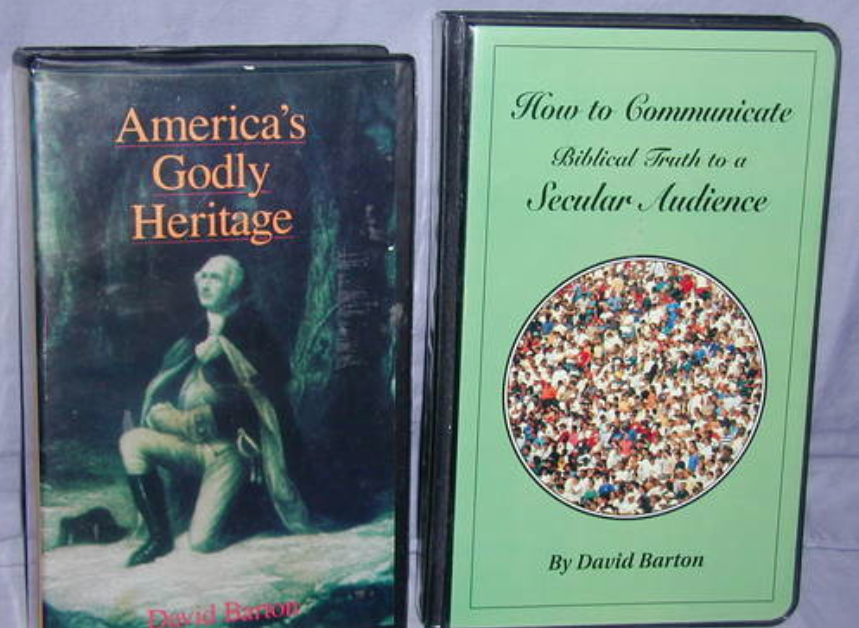
When Bill Gothard first distributed David Barton‘s “America’s Godly Heritage” to homeschooling families in his Advanced Training Institute, I was entranced. We listened to that first cassette together and marveled at Barton’s rapid-fire diction. After that, I would follow along with the tapes with my notebook and pencil and try desperately to copy out the quotations from the Founders as Barton galloped from one to the next at rodeo speed. Protected as I was from secular influences and celebrity worship, Barton was the equivalent of a rock star in my world. I collected Barton’s numerous books and a stack of cassettes. I copied out and memorized my favorite lines. When he addressed the national ATI conferences in Tennessee, I was giddy with excitement. I wished the audience would quit applauding so he could fit in more of his speech!

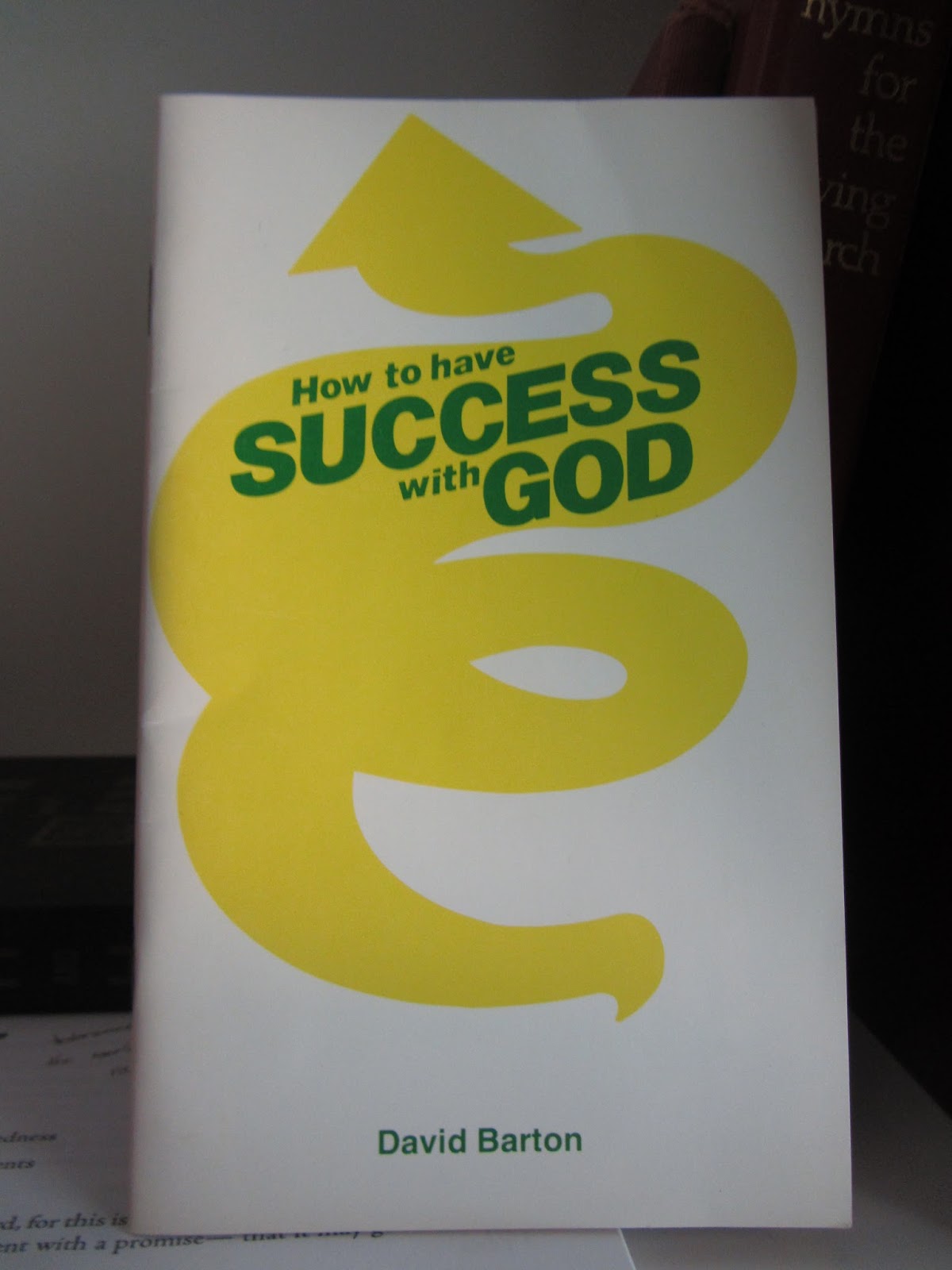
Besides Barton’s books on American history, I even purchased his obscure 31-page booklet How to Have Success With God, published in 1984:

“To God, obedience is better than anything.”
“The more you do of what you hear from God, the more you will hear from God what to do!”
“Be a Christian who enjoys obeying God and you will enjoy being a Christian!”
IMG_3694
Besides Barton’s books on American history, I even purchased his obscure 31-page booklet How to Have Success With God.

Today, “David Barton is a former Vice Chairman of the Republican Party of Texas and a political consultant for the Republican National Committee. He is also a bestselling author and political activist who has worked diligently to arouse true patriotism and restore America to her Biblical foundation.”

But back then, Barton and his organization Wallbuilders had not yet gained notoriety outside Texas. In time he would get chummy with Sen. Sam Brownback of Kansas, U.S. Rep. Todd Akin of Missouri, and the chairman of Gothard’s Board of Directors, Congressman Sam Johnson of Texas. Brownback would say of Barton, “His research provides the philosophical underpinning for a lot of the Republican effort in the country today — bringing God back into the public square.” And that was a mission I supported wholeheartedly.

When my worldview began to unravel, however, I revisited the Wallbuilders’ website, curious for answers that would settle some of my doubts. For the first time I realized that David Barton has no credentials as an historian or an archivist. He holds a B.A. in religious education from Oral Roberts University and has been both a [math and science] teacher and a principal at a private Christian school in his hometown of Aledo, Texas.

As a homeschooled student myself with limited exposure to the ways of academia, I could sympathize with Barton’s ignorance of correct protocol for citing sources. But I was flummoxed to learn that he lacks primary sources for some of his quotations. Including some of my favorite quotations–lines I used to recite glibly at candidates who brought up the spurious “separation of church and state”. Now this was unsettling.

I hadn’t heard David Barton for well over a decade when he appeared as a guest on “The Daily Show with Jon Stewart”. Well, here was a blast from my past! I settled in to listen to the Texan’s familiar too-rapid drawl and was surprised. Before, I had only heard Barton lecture to sponge-like crowds. His material seemed much less concrete in an interview before a skeptical audience. (And this incredible exchange with Glenn Beck puts Barton much closer to “unintentional comedian” than “educator.”)

Disillusioned with Barton, and with those who unquestioningly accept his version of the past, I discarded the remaining Wallbuilders publications on my bookshelf and set out to round out my re-education on American history and the variegated experiences and ideals of the brilliant yet flawed men who penned our founding documents. Thus did they launch these United States on her voyage into their future, hoping that we would prove equal to the task of sailing her, of maintaining her trim and keeping her prow pointed forward.

Even if we were to concede that America was intended to be a “Christian” nation (in spite of plain evidence to the contrary), even if we acknowledge that weather patterns were divine intervention on behalf of the Continental Army and that the Holy Spirit inspired the writing of the Constitution, even if we were to accept Barton’s version of the past, how would that enlighten our present conversation? It does not therefore follow that George Washington would now use his influence in favor of creationism in science textbooks. It would be presumptive to assume that John Adams would cast his vote today for pointless transvaginal ultrasounds or that James Madison would oppose national healthcare. We could not even conclude that Thomas Jefferson would want his children reciting a pledge to a flag, much less to a nation “under God”.

Mike Huckabee thinks our country would be improved we the people were all forced “at gunpoint, no less” to listen to David Barton’s spin on our history. But I cannot help wondering how our Founding Fathers would respond today if they could hear Barton’s appeal to an unrecognizable tradition. These men jettisoned the heavy time-worn design in favor of a revolutionary new ship of state they believed capable of carrying “we the people” through the vicissitudes of history. They were open-minded scientists, philosophers, and inventors, eagerly seeking and adopting new information and technological advances. Certainly, our nations’ founders looked to the past for guidance as they plotted a new course. But to David Barton, history and tradition are anchors with which to slow progress and avoid forward-thinking.

When my daughter was very young, she used to protest when we explained disagreeable facts. “I don’t want that to be true!”, she would cry. Perhaps Barton is ignorant of the way he misleads and misinterprets evidence in order to achieve his political agenda.

Or perhaps he just doesn’t want history to be true.

The Legend of the Bitter Alum: Hope’s Story, Part Three

Homeschoolers U

HA note: The author’s name has been changed to ensure anonymity. “Hope” is a pseudonym specifically chosen by the author. All other names herein have been changed as well.

< Part Two

Part Three

“Moving on,” in my case, meant a complete restructuring of my world at PHC. I changed rooms and churches, stopped hanging out with other students from Distance Learning, and started asking a lot of questions about the Tragic Meltdown.

It was still fresh in the minds of the students, which meant that some of them wouldn’t shut up, some of them wouldn’t open up, and some of them were okay with talking so long as it was in private. Everyone responds to grief differently.

From the ones who would talk privately, I learned a great deal.

I learned that the quickest way to annoy any student was to suggest that someone “won” the fight – everyone was eager to assure me that there were no winners. “Everyone got hurt,” the students said emphatically. It was the most common refrain. Even Dr. Farris had not gone unscathed. People didn’t easily forgive him for airing his disagreements with the professors at the student’s graduation. “That day was about the graduates! Many of them were close with those professors! Why should they have had to hear their mentors abused in public on what should have been their day of celebration?”

I learned also that the fight had been building for years, but mitigated through the efforts of the former Dean of Academic Affairs, who was able to keep the peace. It was only when the dean had enough and left the school that the whole Meltdown happened – which made me suspect that he’d probably left to avoid burn out.

I also learned that no one really could explain why it happened. I heard a lot of theories. Dr. Farris’ temper figured prominently in most versions. Others might reference a flaw of this professor or that. One of the professors was prickly about his honor, couldn’t shrug off an insult. Another professor was egging things on, demanded that the students in his class take sides – the one girl who’d walked out told me she’d done so because she figured if she had to take a side, she’d prefer to at least pick which side it was.

I asked about the writings, said that they didn’t look like they were in conflict, and was told that it was a fight more of personalities, than doctrines. As I said, however, these were the things I learned from those who would only talk in private.

Of the ones who wouldn’t shut up, there were three students in particular that I soon learned I didn’t like. They were very angry and condescending in public. Any ASE or article written by them was sure to offend. The college announced it had received accreditation, the threesome looked sour. They frequently argued that people should get out now while they had a chance, which was especially insulting to the freshmen and Distance Learners, none of whom appreciated being treated like brainless infants.

The newcomers, far from helpless, lashed back indiscriminately with their own equally insulting conviction that the seniors were mighty poor losers who should just drop the subject.

It was as if someone planned a birthday party and a wake in the same location at the same time and didn’t bother to warn the guests.

So there’s people with party hats and noise makers wandering around, bumping into black-armbanded mourners with tissue boxes. And both groups are convinced it was the other group who read the invite wrong.

I got into an email exchange with one of the three when she sent out an All Student Email that I thought was unnecessarily antagonistic. I asked why she was even on campus if she was so determined to be displeased by everything. She told me she was trapped, her credits wouldn’t transfer, and so she had to stay if she wanted her degree. She only had to tough it out one more year.

That, I completely understood.

Still, the year of the toxic party-wake created the unshakable image of the “bitter alum.” These few students, with their alumni counterparts, had long since given up any hope of fixing things. They weren’t talking out of a desire for reform. They were there only because they were trapped, and so they only communicated anger and despair.

In time, of course, those voices fell silent as they found areas in which they were accepted and welcomed and encouraged to invest.

But other voices arose, belonging to people who were angry but not in despair, and they were not heard.

The Administration went through a complete turn-over after the Tragic Meltdown. So did the student body.

The Legend of the Bitter Alum was known, but not the context, not the motives, and not the identity.

As the legend was neither forgiven nor forgotten, there were many who were eager to hunt the Bitter Alum and only the people who had been there could know that the Alum of Legend had moved to greener pastures.

The Board had been too far removed from the action, those in the Administration who could be expected to know were removed from power, and the Student Body and most of the alumni were just too young.

When the New Republic Article came out, the Alumni President went to the Board and told them they had better listen this time. He warned them that the voices behind the article were not the same voices they had assumed. This time, there had better be reform, because the costs of doing otherwise were far too great.

For the most part, there’s been progress. The school did create an Independent Review Board, they encouraged discussion of the IRB’s findings, and they seem willing to support the suggestions. We’re still waiting to see how far they are willing to go, but all gains are incremental.

In the meantime, just gotta keep talking. Increment by increment, I’m confident we’ll get there if we’re just persistent enough.

End of series.

The Legend of the Bitter Alum: Hope’s Story, Part Two

Homeschoolers U

HA note: The author’s name has been changed to ensure anonymity. “Hope” is a pseudonym specifically chosen by the author. All other names herein have been changed as well.

< Part One

Part Two

I can still remember his glare, the way his lips clenched and eyes narrowed, and then he took his red pen and scrawled his judgment across my paper. The look and the words combined to tell me all I would ever need to know about myself. That I was a failure. That I would never measure up. That my best efforts were utterly worthless.

It was December of 2006, the last week of class before finals, and twenty-four hours before, my roommates, Alice and Amy, had come back from a meeting with the dean of student life as two utterly broken girls.

A few weeks earlier, over Thanksgiving break, Alice had been sexually assaulted by Ryan, a man I had once considered a close friend. She didn’t have to say much for me to know she was telling the truth and I didn’t press for details. I didn’t want to know and I thought it would be insensitive to make her tell.

When she told me what happened, I tried to be supportive. I told her that he’d pay for it – I was fully convinced he would be expelled from the school. I told her I believed her, didn’t blame her, and that Ryan had always been weak in that area.

After all, who’d know that better than me? Sign after sign I’d seen all that semester . . . he wasn’t a gentleman, wasn’t pure in thought. He was a stalker, who lived to see the prey’s fear. How many times had I seen him sneak up on a friend, just to terrify them? Not startle – terrify. He had cruel eyes and he licked his lips.

I even felt a sense of relief when she told me, because finally things were out in the open. The problem had finally been defined.

All three of us skipped Biology lab that morning, to let the news sink in and to avoid taking class with him. Alice and Amy decided to take a nap, as they’d been up late talking. Once they were asleep, I left the room, walked down to the basement door of Red Hill, and waited for Ryan to arrive.

I didn’t have to wait long. Lab was just ending and he soon came out. He smiled, but I didn’t wait for his greeting.

“I know what you did,” I told him, loudly but with finality. “Alice told me. You were very wrong, and you will pay for it. People will find out about it. A lot of people are going to find out.” He tried to defend himself, but I didn’t listen. I’d said what I needed to say, so I turned and left.

I expected that to be very nearly the last word on the subject, or at least the last word that I would ever need to make on the subject. Things didn’t turn out that way. Alice and Amy did come back from the first meeting with the dean hopeful, reporting that she – the dean – had been very upset by what she’d heard and that she’d promised (if it was true) to expel him.

Well, the catch was in the qualifier, I guess, although I’ve never really been sure. My interactions with the dean were almost all indirect and the ones that I did have was so cold, so professional, and so distant, that I can’t begin to speculate on her motives.

In any case, things began to go all wrong shortly thereafter. Ryan was angry. Very angry. What’s the phrase, “high dudgeon?” That was it . . . the absolute, iron-clad, self-righteous assurance that what he had done was perfectly right, or if not perfectly right, that at least it was something that no one had any right to challenge him on.

It might not have been so bad, except that I was expecting things to be quick and simple. Oh, probably not court conviction, it’s not like we had any proof that the police could take to trial, but obviously this was going to be public. Obviously he was going to be disgraced. Obviously he would go away and leave us alone. I mean, seriously, this was sexual assault we’re talking about. People get expelled for that.

But it didn’t happen.

Lunch happened, he was there. Night fell, he was on the sidewalks or in the bushes. I remember coming around the building once and jumping out of my skin to see him so close. Heart in my mouth and breathing heavily, I caught up to some other walkers as quick as I could.

He did jump Alice once. Didn’t do anything, just scared her. I was furious.

The college asked us to keep quiet while the investigation was ongoing. I could understand that. Don’t want to crucify a person before you know he’s guilty . . . this silence did align with my own convictions against gossip. But the longer the thing went on, the more I realized this silence was isolating me. I had only my roommates and my all-too-distant mother for support.

Both of my roommates left campus that weekend, leaving me alone with this madman. I didn’t expect, when I said good bye to them, that it was going to be much of a problem, but I had severely underestimated how much Ryan scared me. The moment night fell, I began to remember so much that had not meant anything to me before . . .

. . . that blow to the face he’d given me in a pillow fight, so hard that my glasses were driven deep into my nose and I’d blacked out for a split second . . .

. . . him telling me about how he’d climbed D2 to plaster nightmarish posters over the girls’ second story windows to “celebrate” Halloween, and how disappointed he was that the security guards had removed them so soon . . .

. . . all our trash talk about martial arts and how he could take me in a fight, which somehow didn’t feel much like trash talk now . . .

. . . each time I’d tried to pull back and he’d ignored my hints and every time I’d given way because I didn’t want to be a prude . . .

Once upon a time, I’d been excited to think that he was a little bit dangerous. Now? Now, it was night, I didn’t have a roommate with me, and he was angry. If he wanted to retaliate, I was the only available target. And he knew I was alone. And he could climb. And he could beat me. And he never did take ‘no’ from me, not even on little things.

I was horribly terrified and far more alone than I’d ever been in my life.

I slept in the RD’s room that weekend, but that was only at night. The RD and my own RA were both incredibly busy people. I felt guilty for taking up their time, and wanted to talk to Amelia, the RA I had adopted as my own. Stupid me, I asked permission first.

It was denied.

For most of the semester, I had been in the habit of walking up to Founder’s several times a night just “to get a drink of water” and also to scope out the events – always did hate to miss a party. I didn’t dare do that alone now, but I also was fully convinced that it was not right to spill the details. I asked a friend to accompany me “because there is someone on campus that I’m scared of.”

Word made it back to the dean, who sent me an order through the RA to shut up. “Don’t be scaring people,” they said. “It isn’t true anyway. Don’t be seeking attention.” I shut up.

Then came the day when we realized none of this was ever going to go away. The day we realized they weren’t going to expel Ryan. Twenty-four hours of hopeless uncertainty, then the meeting where they’d make it official.

And that was the night my paper was due.

Actually, I had two papers due. One was an Economics paper that I had planned to write on the financial considerations of making vs. buying a dress for the Liberty Ball. Ryan, my roommates, two other guys, and I had planned that we would all go together dressed in LOTR costumes – I was going to be Rosie. I didn’t have time to change topics.

Each word I wrote was sheer agony, a blow to an open wound, and I couldn’t allow myself to cry. I had to finish that bloody paper, so I could do the next one.

I could have done them on the weekend before, yes, but I had never had problems writing in high school. Writing was, for me, a pleasure and a privilege, always accompanied by high praise from my teachers and often in front of the class. I could write easily and in minutes what others never could even if they’d struggled for days. I wanted it to stay a pleasure. I wanted to write without the burden of uncertainty and fear on my shoulders.

And now things were nightmaric. All I wanted to do was cry and try to sleep. Instead, I wrote about dreams that could never happen as I worked the night into oblivion.

The first paper finished barely on time. The second was harder, as I had no ready-made plan for it. I had no mental power left to spare, but I came up with a topic. Somehow. I found quotes . . . somehow. I wrote . . . somehow.

And then I walked into the end of class, with my paper hot from the printing. I smiled at the professor, proud to have accomplished something despite the madness of my world. I had done it. No sleep, no tears, no heart left to call my own . . . but at least I could still write. He glared back and, taking his pen, scrawled those four unforgettable red words across my clean white sheet.

Late. End of Class.

My smile vanished, but I didn’t cry. I nodded polite acceptance of his judgment, and left without a word.

And that was my first semester.

For me, it meant a major restructuring of my world. I went home for Christmas feeling like a total failure and scared to death of the dark. Each night of Christmas break, I turned off the lights and just lay in bed, staring at the ceiling, letting the fear wash over me as the tension built and built. Then, I’d reach up, hit the closet light switch, and roll over to go to sleep. Then came the joyful day when I realized I could see enough by the green light of the digital alarm clock that I didn’t have to turn on the closet light. The worst of the fear had finally been broken.

Everyone at home knew something had gone wrong, but not what it was. I told my parents, but acted distant and quiet around anyone else. People told me they were praying for me.

For my own part, I spent my days thinking things through. Did I really want to go back to PHC? I had two years and all my savings sunk into that college and it’s not like I could expect all of my credits to transfer. If I went back to school somewhere else, I would be starting all over again. But maybe that would be worthwhile, just to get away from Ryan.

There are bad apples at every school, I thought. At least at PHC I know who it is. Not, perhaps, the most cheering sort of progress one could make, but still progress of a kind.

If I leave PHC, where will I go? It had taken me two years to scrape together enough hope and will power to apply to PHC. I had no guarantee the next time would be quicker and plenty of reason to believe that it wouldn’t. I have always hated giving up and I believed that the shock of quitting would probably kill me. I felt like a failure right now; but if I got that diploma, wouldn’t I be proving that I wasn’t a failure at all?

It never occurred to me to wonder if other administrations did things differently than PHC’s had. I guess I just assumed that was industry standard. Not the best assumption perhaps, but it did give me a way to distance myself from the event.

It happened, it was done, I’ll move on.

Part Three >

How Not to Address Marriage or Child Abuse

Screen Shot 2014-09-20 at 2.13.08 PM

HA note: The following is reprinted with permission from Libby Anne’s blog Love Joy Feminism. It was originally published on Patheos on September 3, 2014.

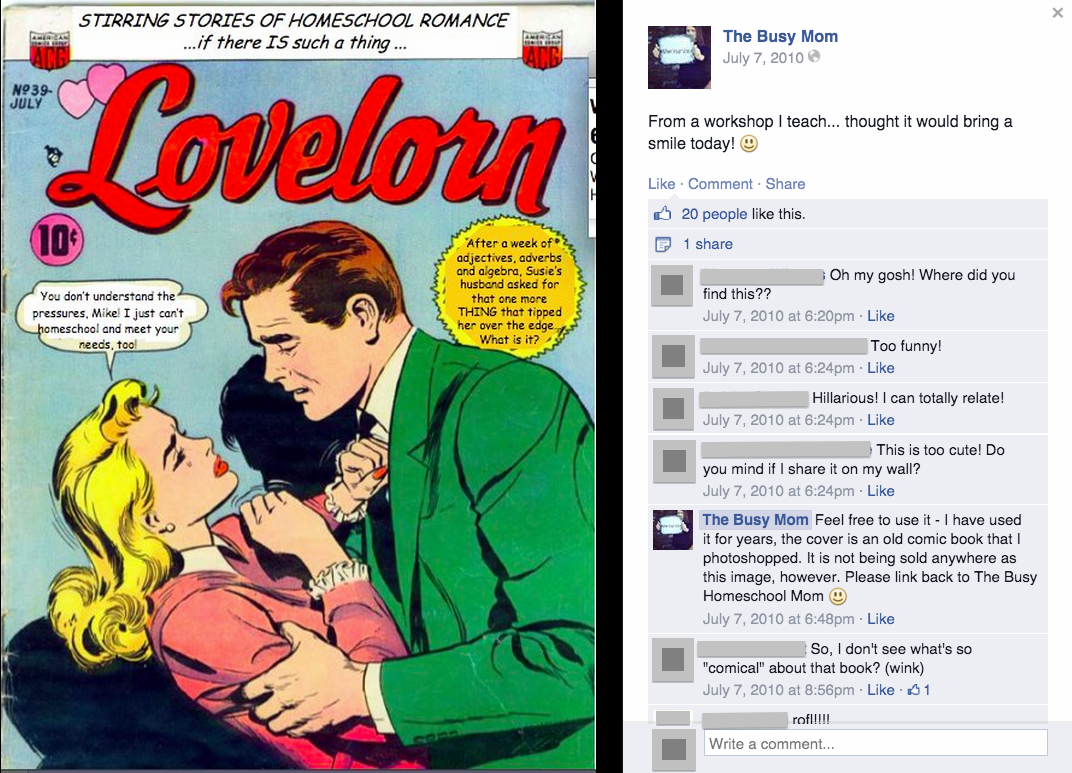
I recently came upon an image posted on Facebook by homeschool mom, speaker, and writer Heidi St. John.

I’m not sure what’s more disturbing—this image, or that none of the moms commenting on it saw this image as disturbing.

Rape-Culture-FB

The image is photoshopped from an old comic that depicts an employee sexually assaulting his “frigid” boss (see here and here or view the full comic here). Sure, one could try to argue that the image has been removed from that context, what with the new words in the bubbles and all, but that fails given the tear on the woman’s cheek and the fact that she is clearly trying to fight the man off (notice her pounding fists). Whatever the words, the image clearly depicts a woman futilely trying to fight off a stronger man’s advances. In fact, in the context St. John provides the image, it appears to be depicting attempted marital rape.

Heidi St. John runs The Busy Mom blog and holds retreats for homeschooling moms. She and her husband run several ministries, including Firmly Planted Family and Firmly Planted Co-ops, which has member co-ops across the country and offers a workbook on how to make sure your homeschool co-op is “firmly planted”. St. John is also the author of The Busy Homeschool Mom’s Guide to Romance, among other books. The author’s blurb is as follows:

busymomHomeschooling offers parents the best opportunity to shepherd their children both academically and spiritually. Yes. It’s worth it. But do you ever feel as if your life is all homeschool all the time? Do you ever wonder where the girl your husband married went? This book is for every mom who has collapsed into bed at the end of the day, looked into the eyes of her husband and promised tomorrow, she’d have time for him. Trouble is, tomorrow finds her more exhausted than the day before. If you have ever felt caught between the demands of homeschooling your children and meeting the needs of your husband, you’re not alone. Read and discover how even a busy homeschool mom can make time to nurture her marriage. It s not as hard as you think and more important than you may realize. Pre-order your copy today!

I am sure St. John has some genuinely good advice. The Amazon reviews of her book (which I have not read) speak of chapters on things like household organization and “me time.”

My concern with St. John centers on two things: first, her use of the comic book image makes me concerned about what she teaches regarding sex and consent, and second, her treatment of HA and HARO on her facebook wall makes me concerned about how her homeschool co-op ministry addresses (or does not address) things like abuse or neglect.

First, the comic book image.

The trouble is that an image like this, in the Christian homeschooling community St. John is very much a part of, arrives in a context already influenced by writers like Debi Pearl and the teachings of Bill Gothard and others. These leaders explicitly teach that a wife should never say “no” to her husband’s sexual advances. These leaders do not recognize the existence of marital rape, because they see sex within marriage as the husband’s right.

Coming in this cultural context, St. John’s image is not “funny.” It’s a problem.

It normalizes coercion and marital rape.

Second, St. John’s treatment of HARO and HA.

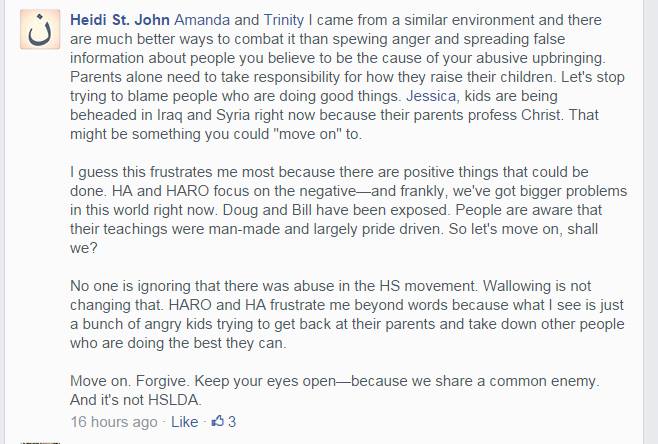
Last week St. John posted a defense of HSLDA on her facebook wall, and several homeschool alumni who had mutual friends with her left comments sharing their stories and trying to explain their concerns with an organization that defends child abusers and elevates parental rights while denying that children have rights. St. John’s responds was this:

HARO-and-HA

St. John’s response to abuse in the homeschooling environment is “we’ve got bigger problems in this world right now” and “move on.” She calls homeschool-alumni-turned-reformers “a bunch of angry kids trying to get back at their parents.”

This should not be acceptable.

I’d like to see St. John reach out to member co-ops with information on recognizing and reporting abuse and neglect, perhaps using resources developed by HARO or CRHE, but her response here suggests that she doesn’t see this as a priority. Instead, she’d rather stick with praising HSLDA and condemning homeschool alumni who point out that HSLDA’s policies protect abusers (which they do). My concerns here are much, much bigger than Phillips and Gothard. Those two leaders have gone down in scandal, but they were never the center of my concerns. The valuing of belief over people, the glossing over things like consent, the minimizing of the need to protect children—these are things that concern me.

And St. John reminds us, once again, that these things haven’t disappeared with Phillips and Gothard.

The Legend of the Bitter Alum: Hope’s Story, Part One

Homeschoolers U

HA note: The author’s name has been changed to ensure anonymity. “Hope” is a pseudonym specifically chosen by the author. All other names herein have been changed as well.

Part One

The story of my admission into PHC is an odd one, starting from the first moment I heard of the college and culminating in interviews between the admission counselor and both of my parents. I’m convinced the admissions counselor only let me in because it was easier to do that than it was to answer my dad’s questions.

It was my mom who wanted me to go to PHC. When she first made the suggestion, in my junior year of high school, I told her, as diplomatically as possible, that it was a perfectly horrid idea. A college full of would-be politicians out to change the world sounded like something straight out of Dante. Why would anyone ever volunteer as a tribute (I mean, student) for a school filled with ego-maniacs and egg-heads? I was pretty sure the students were all going to be arrogant jerks, not at all worth knowing.

Unfortunately, I soon learned that one didn’t have to be a would-be politician-in-training to be an arrogant jerk.

I don’t even know how to explain what happened that next year, because it was so unexpected and so devastating. Nobody ever saw it coming.

“Joseph” was such a close friend to me that I called him my brother and people believed me, even though we didn’t look anything alike. His mother, Jackie, was a second mother to me. She was a bit… intense and somewhat tempermental, but I never thought much of it. I mostly just laughed off her oddities and moved on with my life. She had this thing where she loved to mock people who had y-chromosomes. Joseph was her favorite target.

Anyway, Joseph started dating this girl, Emily Schmidt, and, when things started getting serious, Jackie started getting even more demeaning and bullying than was normal for her. She didn’t like the girl or the girl’s family because they weren’t about to let Jackie dominate them the way she dominated Joseph. Or at least, that’s what I heard after the fact. I hadn’t been paying attention.

Then came the point Joseph had enough. He decided he was moving out of the house that very day and he called his future in-laws over to help him. Jackie flipped out. She called the police and my parents and then, when neither group proved able to stop things, she called everybody else. Everyone in the county heard all about how Joseph had been duped and stolen away from her by a sinister cult family who were out to steal brides and grooms for all their freaky cult kids from the good homeschool families of our tight-knit community. The Schmidts had been well-respected and liked up until that point and I’d enjoyed their company as often as I had opportunity. But now, friendship and openness was replaced with suspicion and confusion.

After ten years of reflection, I can be flippant and matter-of-fact when telling the story, but, at the time, I fell into a depression so dark that I had no idea I was even sad. I thought I was merely bored as I flopped on my bed and imagined how it would be if I fell asleep and never woke up. I looked at the vitamins on my shelf and wondered if it was possible to overdose on them and whether it would be obvious and whether it would be like falling asleep. My SAT results came back and they were good (even though I’d refused to study for it). A torrent of college flyers followed in their wake, but I didn’t care. They bored me to pieces. I threw most of them away without looking at them.

The only thing I was good at, the only thing I enjoyed, was writing. But even at that, there was nothing to write about except for school. I had no life apart from my homeschool group and simply couldn’t think of the future enough to contrive a plan.

The summer after high school graduation, I reconnected with Dave, a childhood friend I hadn’t seen since his family moved away ten years earlier. I remembered him as the happy-go-lucky person with whom I’d reconnected, but his other friends and his senior picture testified to a very recent bout of deep depression. Like myself, he was a homeschooler, but, by this point, he’d spent a year at PHC. To hear him tell it, PHC was all that was good and worthwhile in the world – hard work, lots of study, prank wars, and good friends.

Between PHC and self-reflection, there was no better cure for depression. For me, it was worth a shot.

There was no way I could attempt to live away from home at that time, but, fortunately, PHC had a distance learning program and the enrollment process was less arduous than the one for on-campus enrollment. I spent two years in the program, recovering my good spirits as I built up my friendships. Finally beginning to feel optimistic again, I tackled the “real” application, which included numerous essays, including one on cultural engagement.

I still thought “lead the nation and shape the culture” was a silly, egotistical motto. There was no way I had any intention of running for office. And while I could probably have gotten in by writing about how being a wife and mother is “shaping the culture,” the thought never occurred to me. Instead, I wrote about the need for respect in public dialogue and how we needed to try to understand people even when we think they sound ridiculous. I used the examples of Christians who hate Harry Potter and atheists who search for extraterrestrials because I figured that way I couldn’t accidentally insult the unknown reader. I sent it in, feeling that this at least was an important issue and one that I did care about passionately, even if it wasn’t one of the big issues like pro-life.

I managed to score an interview, but the admissions counselor had a hard time believing I was ready for higher academics. She asked to talk to one of my parents, so I had my mom call. My mom felt that she did a horrible job of representing me, so she had my dad call. According to my dad, the conversation went something like this:

Counselor: do you feel that your daughter is ready for the challenge of higher academics?

Dad: what criteria are you using to judge that?

Counselor: what do you mean?

Dad: if you’re asking that question, you must have some criteria in mind, some standard that makes you think my daughter isn’t ready. If I’m going to answer your question, I have to know what you mean by asking it.

I think my dad was actually disappointed that her only answer to the question was to accept my application.

In hindsight, my timing was hilarious. I sent in an essay about the need for respectful dialogue during what would later be called “the Great Schism.” This was the horrific breakdown in communications and tempers that led to a high turn-over among the professors, the replacing of the school president and most of the deans, and a mass exodus of students. The aftershocks were felt for years – in fact, I am convinced that they are still being felt in ways that are not always obvious.

Although it is often called the Great Schism, I prefer the term “the Tragic Meltdown,” which I picked up from one of the professors who left the next year. As a nuclear physicist’s daughter, I find the comparison to Chernobyl and Three Mile Island to be satisfyingly exact.

Of course, I didn’t know about any of that at the time of my application. The campus-quake didn’t hit the online forums of the Distance Learning community until late in the semester. I read everything I could find about it. There were two items in particular; I think it was the Faith and Reason lecture by one of the professors, and an article for the Herald (the school newspaper) by someone from the Administration.

If I was hoping those would explain the commotion, I was disappointed. From a conflict standpoint, these made zero sense.

The lecture was completely orthodox Christianity. The article was completely orthodox Christianity. The school is supposed to be a completely orthodox Christian institution, so how in the world two orthodox Christians even managed to be in conflict on a point of complete orthodoxy was a mystery to me.

The only cause of conflict that I could scrape out between them was that the article interpreted the lecture in what I considered to be one of the most unlikely ways possible. The lecturer said that the Bible isn’t a how-to manual for building a house. The writer of the article said that the Bible isn’t a how-to manual, but it does require that a house-builder build his houses in an ethical and moral fashion. Perhaps if I’d been the lecturer, I’d have been insulted that something so basic wasn’t inferred from the text.

Maybe the whole problem was just a stupid insult war?

Dave told me to be very careful and to seek to be informed. He liked the professors and distrusted the official line. Said this was the worst time to start at PHC. I agreed, but I wasn’t going to delay any longer. Anyway, it couldn’t really affect me, could it?

It probably wouldn’t have either, but my first semester didn’t go as planned.

Part Two >

I Am a Homeschool Alumna. I Care.

Screen Shot 2014-09-16 at 12.12.16 PM

HA note: The following is reprinted with permission from Libby Anne’s blog Love Joy Feminism. It was originally published on Patheos on September 8, 2014.

You know what I’m growing really tired of? Comments like this:

There are vastly more kids in public school than are homeschooled, and abuse and educational failure are widespread in those institutions. More kids are affected by the incompetence of the public schools, yet you have devoted quite a bit of time and space here to homeschooling failures. Your interest in homeschoolers seems disproportionate to the problem.

I’m sorry, what? It reminds me of Heidi St. John’s comment:


HARO-and-HA

The relevant excerpt being:

Kids are being beheaded in Iraq and Syria right now because their parents profess Christ. That might be something you could “move on” to . . . . frankly, we’ve got bigger problems in this world right now.

What I’m hearing in these comments from homeschool parents is that the only possible reason homeschool alumni could possibly want to protect homeschooled children from abuse and neglect is to “get back at” their parents.

That sounds ridiculous, doesn’t it? Of course, these homeschool parents claim—with absolutely zero evidence—that homeschool alumni like myself are not interested in protecting homeschooled children but rather in taking down homeschooling. I’m having troubles finding words for how angry this complete unwillingness to actually listen makes me.

What I also see, though, is a lack of interest in the needs of current homeschooled children, which is odd given that most of this is coming from homeschool parents. Those who say that it is illegitimate to worry about homeschooled children until the problems in public schools are fixed are suggesting that the interests and safety of homeschooled children are secondary to those of public schooled children. As a homeschool alumna, this is really insulting. Yes, public school children matter. And so do homeschooled children. All children (and all people) matter. All children have an interest in a safe upbringing and a basic education—including homeschooled children.

I am asked why I should care so much about the wellbeing if homeschooled children, as opposed to some other cause. The answer to that is very simple. I was homeschooled. Aren’t alumni expected to care about their alma mater? For me, that’s what homeschooling is. I have sympathy for homeschooled children because I was one. I am a homeschool alumna.

Homeschool alumni have created a variety of organizations in the past year and a half. There is Homeschoolers Anonymous (HA), where homeschooled alumni who had negative experiences share their stories. There is Homeschool Alumni Reaching Out (HARO), which focuses on awareness raising and support for alumni. There is Homeschooling’s Invisible Children (HIC), a database of documented cases of child abuse or fatality in homeschooling settings. There is the Coalition for Responsible Home Education (CRHE), which focuses on research, resources, and policy.

Homeschool parents can say what they want, but they can’t make us go away.

I Am a Survivor: Elizabeth W.’s Story, Part Two

Screen Shot 2014-09-16 at 11.30.22 AM

< Part One

Trigger warning: graphic descriptions of physical and verbal abuse.

Part Two

Looking back, I can see that after we moved and no longer had immediate neighbors to hear the screaming when she beat me or my brother, she felt much less restrained and the violence increased in frequency and intensity.

If I was quiet and withdrawn (which was pretty much always) and mom decided my quietness was “rebellious” or “disrespectful”, or if I forgot to say “ma’am” after addressing or answering her she would begin screaming at me, calling me a disrespectful whore/slut/tramp/bitch, while simultaneously slapping me across the face hard enough to knock me down. She began to use bigger and better weapons than her hands and the bristle side of a hairbrush. I was beaten with length of copper pipe, pieces of two by four, a thick wooden yardstick (which broke on me eventually), thrown down stairs, had my wrists twisted until she forced me to my knees, screaming in agony, was dragged around the house by my hair and my head bounced off any and all hard objects. She tried to suffocate me several times, held me down and forced a pillow onto my face with all her weight, while screaming she was going to kill me and she wished I would die. I had my head and face forced under a pouring tub faucet and held there until I thrashed my way out of her grasp.

These things happened at least several times a week, sometimes more than once a day, interspersed with the verbal abuse, and her refusal to address me by name, but rather as “bitch” or “slut’. I was regularly told I was “ugly”, “fat”, “disgusting”, “crazy”, and “stupid”.

For those who think I may have been a “difficult” teenager from 11-16 or so when this pattern really took off – I never raised my voice to my mother, never cursed at her, never had friends over or snuck out, never wore anything other than black, baggy clothes (which is hardly slutty), never disobeyed a direct order, never did an illegal drug, smoked or drank, and only ever argued by politely stating I didn’t want to do something, or I thought she was mistaken. The latter two always resulting in a beating or several, so rarely did I dare say no to anything.

In public, my siblings and I were always perfectly behaved, rarely speaking, never making noise of stepping out of line. Mom only had to give us that angry glare that promised later retribution for us to think twice about doing anything at all. There was no one around who knew us beyond the brief homeschooling afternoons with the LEAH group who could have possibly known that anything was terribly wrong in our house. We were so isolated, there was no one I could have spoken to, even had I found the courage to do so.

We’d been trained to fear the authorities and Child Protective Services and had no friends or family to speak of.

Mom “volunteered” me to go work at St. Vincent de Paul soup kitchen once a week to win points with the local Catholic church she dragged us to once in a while. At first I was furious that she had volunteered me without even asking me, but after a while I realized it was a few hours a week out from under her thumb and grew to enjoy it. Mom also signed me up for confirmation classes at the local Catholic church, after she had begun attending workshops run by a fundamentalist Catholic homesteading family who also homeschooled their twelve children.

Mom decided it was time for all of us to get more “spiritual”, and began three times a day “prayer circles” where we would all be forced to sit and read aloud from the Bible and sing hymns that the “Fahey’s” (the Catholic family she was imitating) sang. She instituted a clothing change, head-coverings for the girls (I refused), she began making ankle length dresses for herself and us (I also refused), and only long sleeved button down shirts for the boys. She threw out our shorts and t-shirts, started getting rid of her college feminist lit, and any and all of our books she found too “worldly”. Mom sold the computer my grandparents had bought for us, got rid of our tiny video and cd collection, and began instituting even stricter rules for us to follow. So during these changes I attended confirmation classes at the local church, which I despised and between the forced Bible study there and the forced Bible study at home quickly grew to despise Christianity and the confining, narrow-minded tenets the Bible espouses. I never spoke my thoughts aloud, but my mother could tell from my face when I wasn’t agreeing or complaisant enough and my face invariably led to new beatings and verbal abuse.

Mom began to use the Bible as an additional weapon, quoting the “Thy shall honor thy father and mother”, and telling me that God said I must be obedient and respectful to her. (Even though I was always obedient and never voiced any disrespect.) This just furthered my disgust for the Bible, although I now see that, like homeschooling it was simply being used by my mother to her ends, not necessarily bad unto itself.

I was falling deeper and deeper into a depression that seemed like it was swallowing me whole. I started sleeping really late every day, shuffling through my duties with my head down and my mouth shut. I began snapping at my siblings when mom wasn’t looking, I had no patience for their demands for my attention or their quarrels. My brothers began fighting viciously with each other, first when mom was out, later even when she was home, resulting in beatings for them as well as me. I knew my mother hated me, I didn’t know why.

I tried so hard, for so long, to be what she wanted me to be, obedient, respectful, responsible, but never seemed to find her approval or even a respite from her rage.

I am, at my core, fundamentally an honest person, having no talent for acting, for pretending to be happy when I am not. This was my downfall. If I had only been a better actress, perhaps I could have fooled her into thinking I was, in fact, what she wanted me to be, rather than merely doing whatever I was told with my face betraying my misery and despair.

I tried to kill myself twice.

Once, at summer camp, I stepped in front of an oncoming semi truck with a feeling of exultant freedom and calm. A boy who liked me happened to be standing nearby and turned around and yanked me out of the road as the truck went by. The second time, my brother Alexander and I were coming home from the paper route and I decided the easiest way to end my misery would be to poison myself. I picked a handful of deadly nightshade berries and was about to throw them down my throat when my brother jumped up and slapped them out of my hands and started screaming and crying hysterically.

I felt sad, resigned, and guilty for terrifying him so, and didn’t try to kill myself again.

1997, was the last year of my paper route as mom decided it was allowing me too much freedom and she wasn’t making enough money off of it/me to be worth the trouble, so she called my boss and “quit” for me. I was devastated by this, as it was among my last outlets for momentary respite from the hell that was my home.

The following year I got my first real job, washing dishes at a local pizzeria for minimum wage. I was ecstatic at being able to get out of the house a few evenings a week and being allowed to save a little money to buy a puppy for my sixteenth birthday. After about six months, my mother called and told my employer that I could no longer work there because I was sleeping with a married 30 year old man who was a coworker there. All this because I had spoken to him on the phone (about a dog) while she was listening in, and she said she could tell we were having sex by the tone of his voice. Really. There was no other evidence for her accusation, that was it. Mom convinced herself that this was true even though both he and I told her she was mistaken and crazy. She then beat me, off and on, for the next two days for this delusional belief until I could stand it no longer.

I packed my things and lived on the streets of Buffalo for next three weeks.

I camped out in the basement of an abandoned apartment building, slept in a refrigerator box when I could, and mostly just tried to process what on earth to do next. Going home was not an option, if I stayed another minute I knew I would kill myself, I felt as if I was being slowly crushed by my life and there was only a spark of life and spirit left. After a few weeks, I found a runaway shelter who helped me track down my biological father who came and got me.

My mother’s insults and degradations became ever more creative and hateful, designed to wound. They did. To this day, simply recalling these things makes me shake uncontrollably and I do not believe that my littlest sisters should have to wait until things get as bad as they were when I was driven to the streets before someone should step in. I have only waited this long because I had hoped that mom had changed her behavior as she claims, and because she is still my mother and I was, (and still am) hesitant to speak the truth and have her never speak to me again.

Contrary to what I’ve been told by DCS when I made a statement regarding my two sisters still trapped there, physical abuse is not the only threat to a child at home. Emotional and verbal abuse leave damage far deeper, with myriad consequences to a child. Emotionally fragile, sensitive teenage girls do not need to have what little self confidence and self respect they have destroyed by the one person in the world who is supposed to support them, believe in them, and give them strength to take on the struggles of life. My mother does not, and never has provided any of those things.

On the contrary, her words tore me down to the ground and I have spent half my adult life rebuilding my self image and confidence solely because of the things she said every day of my childhood.

End of series.

We Are Not The Threat

Screen Shot 2014-09-16 at 11.54.57 AM

HA note: The following is reprinted with permission from Darcy’s blog Darcy’s Heart-Stirrings. It was originally published on August 28, 2014.

There’s a new threat to homeschooling, folks! That’s right, and it isn’t the evil government or liberal feminists or Satan. The homeschooling apocalypse will be ushered in because of….*drum roll*…..

The Homeschool Alumni.

Yup. Those pesky people who just won’t keep silent about their upbringing. Who dare to tell their not-so-happy stories, the good, bad, and ugly. Who dare to paint big, bold, dark colors on the beautiful Thomas-Kincaid-like portraits of homeschooling. Who dare to stop pretending that everything in their world was beauty and light and are exposing the ugly darkness.

Their stories of abuse and neglect and confusion are apparently a threat to a way of life that is upheld as God’s Ideal Plan for all mankind. (Looks like “God’s Plan” had a few unexpected loose ends.)

What I’d like to know is this: what, exactly, are we a “threat” to?

If people telling their stories is a “threat” to your way of life, you should really re-evaluate your way of life. It says a lot about who you are and what exactly you’re trying to protect and preserve when the very people that lived as you do are merely telling their own stories and you’re quaking in your boots because of it.

If our stories of real-life experiences as homeschooled children, and the real-life effects of those experiences on us as adults, are a threat to you, then perhaps instead of trying to silence us, and instead of trying to discredit us, there should be some extreme makeover-type remodeling being considered within the homeschooling community.

Do you know who the real threat is here?

Because it isn’t me or my friends. It isn’t those of us brave enough to speak out and fight for the rights of people who have no voice. It isn’t my friends who were beaten, raped, neglected, deprived, and put down; it isn’t the victims. To point fingers at us and call us the “threat” is either extremely ignorant or extremely cruel.

The real threat is the abusers.

The self-proclaimed leaders who steal, kill, anddestroy the lives of the vulnerable. The men and women who cry “Parental rights!!” then turn around and trample on the rights of their children. Who fight tooth and nail to keep their victims powerless.

And the second greatest threat are the people that defend them, support them, and fail to call them out on their abuses. 

The folks who stick their heads in the sand and deny, deny, deny. They seem to no longer care about the very real faces behind those stories, but only that the image of Almightly Homeschooling is preserved intact. Their institution has become more important than the people that comprise it. THEY are their own worse threat. THEY are doing more to cause the implosion of the homeschooling movement than anything my friends or I could say.

If you point at victims and call them “threats”, you are telling them that protecting their abusers and the environment that facilitated their abuse is more important to you than truth and healing. 

Victims are only threats to the prospering and perpetuating of abuse.

Homeschooling parents, we are not your enemy. How could we be? We were once your children. We are the products of your movement. We are just no longer voiceless and if that is a threat to you, then maybe you should rethink what and who it is you’re protecting. 

“An entire generation of homeschoolers have grow up and they are telling their stories, the good, bad, and ugly. Most of us have lived our whole lives under crushing standards, expectations, and facades, and we are done. So done pretending. There a lot of successes and a shitload of failures that came from the conservative homeschooling movement and we will talk about all of them. Because information is power, empowering the next generation to help avoid the awful parts of ours. They NEED to know what went wrong, from the perspective of the guinea pigs. We alone can tell that part of the story, paint that part of the picture, speak from the very darkest places in our hearts about the parts that went so desperately, terribly wrong. What do people think? That we share the worst parts of our stories to billions of strangers on the internet for the heck of it? We share because WE FREAKIN’ CARE. We care that others not go through what we did. We care and desperately want to save others from needless pain. This isn’t some joyride we all decided to take part of. This shit hurts, and the derision we experience from family and friends is daunting, but staying silent while others suffer is a far worse pain than honestly exposing our own wounds. “

~On Homeschooling, Stories, and Dismissal 

I Am a Survivor: Elizabeth W.’s Story, Part One

Screen Shot 2014-09-16 at 11.24.07 AM

Trigger warning: graphic descriptions of physical and verbal abuse.

Part One

My name is Elizabeth and I am a survivor.

I am the oldest of seven children, two of whom are still trapped in the isolated, abusive world created by our mother. My mother began “homeschooling” in the fall of 1993, immediately after three of her four children were returned to her by the state of New York. I had been placed with my biological father for the previous nine months, while my siblings were in a foster home as both their biological father and our mother were in jail.

Our mother had been charged with child endangerment and was mandated to attend counseling.

I am unsure whether she did or not, however, her abusive and violent behavior continued only to escalate after this time. I had been miserable being placed with a father who was virtually a stranger to me, and over a thousand miles away from my brothers and sisters. In October of 1994, I finally convinced my dad that I wanted to be with mom and my siblings, so he took me back. A decision I would live to regret in many ways, but looking back, would not have chosen differently at the time.

My mother informed me that from now on we were all going to be “homeschooled” so that no more nosy teachers would be interfering in “our” (her) lives. One of my youngest step-siblings had made some mention to a teacher of the rampant domestic violence that routinely rampaged through our home. (Thus the subsequent investigation and arrest of both our parents.)

Homeschooling was the first step my mom took to make sure no one could get involved through children’s loose tongues ever again.

While mom had always been explosively violent with me I didn’t remember quite so many constant beatings and verbal abuse before this all happened. After my return from my dad’s house, mom began to turn on me with sudden and unpredictable rage. She slapped me across the face multiple times, knocked me down and dragged me around by my hair, repeatedly slamming my head off the floor or walls. All the while screaming that I was lazy, stupid, ungrateful, “just like your father”, “you’re a traitor, you’ve betrayed me”. Often the attacks seemed to be triggered by her simply looking at me, and not liking my facial expressions, she would look at me and say that I was looking “rebellious” if I happened to be unhappy and withdrawn that day. I often heard that I looked just like my father, which also seemed to set her off. We stayed in the new apartment for another month or two before mom and my stepdad got back together and moved into a new place in Buffalo, New York in December 1993.

Mom and my stepdad together were a volatile mix, two different kinds of mentally unwell and two different kinds of violence. My stepdad beat her and she in turn beat us, mostly me. She often told us that if we ever spoke to anyone about what was going on that we would be separated and sent to foster homes and juvenile detention centers for bad children where we would be beaten every day.

She also taught us to fear the police and whenever she saw one or they were called to the house to investigate all the screaming, she would freak out and tell us to hide and keep our mouths shut.

Once in the new apartment, mom continued to “homeschool” us, which consisted of buying a few textbooks (sometimes grade appropriate, sometimes not) and telling us to go to our desks and “do school”, for a few hours a day. Many, many days I was interrupted by mom telling me I needed to “watch” the newest baby for several hours while she talked on the phone or went and did errands. I spent so much time caring for my newborn sisters that two of them actually called me “ma”, until mom heard. This was one of many things that set off her punching, kicking, pulling me by the hair and trying to break my face routine. I can honestly say that was the extent of my “schooling” for the next six years until I left. Mom did the New York State required “quarterly reports” on our progress, usually late and always false. We also took the mandatory annual CAT tests and usually scored fine on some subjects and poorly on others. Mom officially enrolled us in the Clonlara Homeschool Association that year, which meant she bought “curriculums” from them (which we never used) and we went to their annual conferences a few times.

Spring of 1994, my mother arranged for me to work a large paper route that covered 12 city blocks on our street. I worked that route for the next four years, eventually adding another 12 blocks. I was robbed twice in two years, first when I was thirteen and a guy in a football helmet jumped out of the bushes and held a gun to my back and demanded I hand over the money (paper route money). My mother took all of the money I earned except for what I needed to buy dog food for my dog. She also pushed me to take other jobs. I mowed people’s yards, did landscaping, house cleaning and babysitting. I was never allowed to keep any of the money – this was how she was supplementing the family budget, as she never worked.

Soon after we moved to Buffalo, Mom joined a local homeschooling chapter of born again Christian homeschoolers, LEAH (living education at home). Aside from the one or two weeks a year I was allowed to go to a local YMCA camp, and the occasional summer soccer games with the kids on our street, LEAH was the first regular social interaction I’d been allowed since I left public school in 1993. None of us kids were thrilled with the group, being very religious and preachy and we were not (yet). However it was a few hours a week that we got to leave the house and be out from under mom’s constant supervision and iron rule, so we made the best of it.

The winter I turned 14 our car was repossessed and mom began sending my little brother and I to do all the errands during “school” time.

We walked miles through the Buffalo snow to get groceries and the mail (at the post office) every few days. I was also expected to do nearly all of the housecleaning, mopping every room, sweeping, dishes, folding laundry (for seven people) as well as most of the babysitting. There was very little time I could have done “school” even had I been brilliant enough to teach myself a sixth thru tenth grade school education. As it was I spent my free hours immersing myself in books I borrowed from the library, ranging from fiction to history, anthropology, classic literature to feminist studies. I credit the natural inclination of my curious and inquiring mind combined with my access to a library with my ability to survive any and all later academic pursuits.

Before long the constant screaming of our mom and my stepdad echoing through our apartment drove our neighbors crazy and they asked the landlord to evict us. Winter of 1996, we moved a mile down the road into a HUD (low income fixer upper) house, the first my parents had ever owned. Outwardly, things continued much the same, I had my myriad jobs, housecleaning and babysitting duties and mom sat at home and talked on the phone or did “bills” all day. We still attended the LEAH group, though not regularly, and often escaped for a week or two of summer camp.

After the move, we didn’t make new friends, so spent even more time in the house, and grew gradually ever more isolated. Mom slowly alienated her family although her parents and sisters made a valiant attempt to stay in touch long distance. Mom had an unparalleled ability to say cruel and hurtful things and make people recoil and stay away. My stepdad’s family was not accepting of the biracial aspect of our family and with the exception of one uncle, made no attempt to be part of our lives. Neither mom nor James had a single friend that I knew of, no one ever came to our house. We weren’t allowed to have friends over, talk on the phone, use the computer, listen to music, or even have uncensored mail.

This quickly put a stop to any attempt on our parts to have even casual friends.

Part Two >

Fault and Educational Neglect

Screen Shot 2014-09-15 at 10.46.44 PM

HA note: The following is reprinted with permission from Kierstyn King’s blog Bridging the Gap.  It was originally published on August 28, 2014.

I don’t usually post about things Kevin Swanson says, and I usually try not to pay attention to it, but a recent week’s broadcast…hurt more than usual. For a synopsis/highlights that will keep most of your eyeballs intact, you can read this post from HA.

One of the highlights, and…what’s sort of turned me into an odd little puddle, is this bit (emphasis mine):

Kevin: when someone says, I could have had a better education than that provided by my mother or by my father, that’s really, really, really hard to prove. How, how, how do you know that? Maybe it was a character problem on YOUR part. Maybe you didn’t obey your parents! Maybe you didn’t study your books like you were told to! And to think that you could have had a better education if you had done it this way versus that way is extremely hard to prove.

Steve: Right!

(laughter)

Kevin: Extremely hard to prove!

Steve: Because you can’t go back and do it that way!

Kevin: You can’t! (laughter) You can’t… and even if you could have, you would have dragged your same old person, with your same old character flaws, with your same old slothfulness issue, into the public school or private school setting or other setting ‚ and you could have done worse…

Steve: Yeah.

Kevin: …than you did with your parents — trying to do whatever they could have done with you, even with all of your character issues that you’re dealing with. It’s fun to blame your parents for your OWN lack of character!

And then there’s this charm (emphasis mine):

Kevin: I’m talking about Christian homeschool families. Their values are primarily first and foremost not to get their kid into Harvard or get them a good job.

Steve: Right.

Kevin: That’s not primary. It’s not being sure that the kid can read Plato before he’s 12 years of age…

Steve: Yeah.

Kevin: …and get really messed up with the wrong worldview. (laughter) That’s not the goal. See, homeschoolers bring in other values: like relationship building, character building, work, worship. These are important.

What struck me is my parents have said essentially the exact same thing that Kevin did in the second quote. Multiple times. I remember in no uncertain terms hearing that the most important thing educationally was that we were able to read and understand the bible, write just enough to communicate, and do basic math. NOTHING ELSE MATTERED. This is what Kevin Swanson advocates, this is what my parents believe, and importantly:

This is not a full, well-rounded education.

He talks about how fake educational neglect is, makes fun of the people who have pushed through it, pretends the people living in it don’t exist, and blames the (current and former) students with little to no power over their own education, for their own neglect.

He talks about how children should be learning “work, relationships, character, and worship”….

Well sir, that was my entire childhood, and you know what, I was educationally neglected! I taught myself and my parents bragged about it from the age of 10, I did everything I could possibly do, everything I knew to do, and it doesn’t change the fact that my education was neglected. It was not my fault. I’m not lazy, and wasn’t a lazy student – I was  an over-worked student who’s parents cared more about being served and looking good than their children and the quality of their education.

Swanson is advocating for educational neglect, and then turning a blind eye to the people who say, no, my parents did do what you said and that’s the problem, and instead labeling them whiners, traitors, and Benedict Arnold’s.

Well if talking about my lack of education and working to put regulations in place so my siblings and other kids have a chance means I’m a traitor, so be it.

But don’t you tell me that my lack of education was my fault as a child.

That was out of my control, it’s not blaming my parents for my flaws, it’s abuse.

P.S. I would have done amazing in a traditional school setting, before my parents took me out of pre-k, it was amazing and I loved it. No one asked me if I wanted to be homeschooled, they just said “we’re gonna homeschool you from now on” and being the ripe age of 3 or 4, I just wanted to make sure I could be picked for Show-and-Tell still. I don’t remember doing show-and-tell after leaving school though.