I’ve had really vivid dreams lately, probably due to getting over the lingering effects of a cold (it was a horrible cold, and I’m mostly better but still dealing with minor sinus issues). My dreams have been weirdly stressful and tend to feature my family and I wake up feeling like I haven’t slept, but last night…last night I dreamt that my dad was shooting at me. A lot, constantly, I was trying to leave and he was just shooting and shooting and following me and shooting, and that’s the first time that’s happened. The last time I had a similar dream, my dad was a bear trying to eat Alex and me…
…This is the first time there were guns.
Which makes sense, my family has at least 3.
A few weeks ago I sent my family an open letter, addressing the things I knew they were upset about (my hair, my sexuality, my lack of pregnancy, telling them once and for all that I’m an agnostic), and telling them things about me that they probably didn’t care to know, and ending it by telling them to stop using me as a bat on my siblings, and to leave me alone (with the caveat of, if they ever get over themselves and decide to accept me as a human and get to know me and not just spy for creating-drama purposes, to talk to me instead of going through other people). Considering all my family really cares about is using me to create drama, I think that my letter shut everyone up about me like I thought it would.
My theory was that by giving everyone the same information about me they wouldn’t have anything to gossip or speculate about or reason to use whatever means necessary to spy – since I answered all their questions/issues and took the interestingness out of it.
It’s been radio silence and I hope it keeps. It’s weird, you know…my parents said they wanted nothing to do with me until I apologized to them in 2010, but then conveniently forgot that when it suited their purposes (I’m assuming, to make them look good in front of church people – it’s what they do). I unfriended everyone on my mom’s side in November and the family freaked out when they realized it, but I’ve never once been asked, genuinely, how I am, no one has tried to get to know me in five years, they’ve only been intent on spying and using me as a tool to inflict guilt on my siblings and that’s just wrong. Every contact I’ve had with them has been silently self-serving, done of obligation, or not-so-subtly implied that they wished I was who they wanted me to be and approved of and not who I am. I don’t have time for that.
I put up a strong face – I throw up brick walls the way Elsa made her Ice Castle, bury the pain inside the mortar.
It’s easier to be callous and cold and numb, than angry, and vulnerable, and hurt. So I act like it doesn’t bother me, Fuck them all is my mantra, but it does bother me and I wish that it wouldn’t.
I wish that I didn’t feel as though the most abusive people in my life mean something. Because I feel like they shouldn’t. I wish I didn’t feel sad because I know that by merely existing I’m letting down the people who spent my entire childhood neglecting me and usingme.
Sometimes I feel like the Hulk and my secret is that I’m always angry.
Because I am angry.I’m angry at how they get off scot-free, I’m angry at how the world thinks we need to revere parents even when our parents are the bullies we couldn’t escape. I’m angry that they can keep on manipulating people and lying and living with no guilt or remorse, with aid from family, and keep people on their side and looking up to them – as people with Narcissism and Borderline are really good at doing.
My family is looked up to in churches, cited as examples, people seek out my parents to ask them advice about homeschooling and child-rearing (and other things), they think the fact that my mom has destroyed her body having kids is awesome and noble.
No one sees the dark underbelly of what it looks like to grow up with them and their life choices, no one registers the fake smiles, no one sees past the masks.
And I get to pick up the pieces.
I can’t look at an infant or pregnant person without feeling ill and stressed out. I panic every time I see a stroller, or an entitled parent at a restaurant. I get to be condemned for not having or wanting kids, for not doing anything for mother’s day, for doing what I need to do for my sanity and quality of life that involves cutting out the toxicity that is my family. I can’t leave my apartment without being bombarded by triggers, I can’t talk to any nosey old person without being patronized about my existence, the general consensus of the world does everything in it’s power to tell me that everything about me is wrong and flies in the face of what is approved of and wouldn’t it just be easier if I killed everything-that-is-me and conformed?
I’m planning out how to help my siblings after they reach adulthood because my parents thought it was unnecessary for half of my sisters to have identification, and everyone born after 1999 is unvaccinated.
This is the aftermath of growing up with abusive and neglectful parents and extended family who enable them. You bet your ass I’m angry.
When my siblings and I were children, my parents deliberately misinformed us about the world.
I am still not sure what the overall goal was. Some of it makes sense. The ideological nonsense that contributed to psychological control makes sense, such as the misinformation about lust, reproduction, and consequences, but some of it really doesn’t make sense.
Why were we misinformed about the healthiness of foods? Why were we misinformed about women’s periods? Why were we misinformed about the lactose content of butter? My parents also gave us this information in a way that made us afraid to double check, and there was certainly no ability to find out correct information and take it back to our parents. As isolated as we already were, there was always the fear that we could be isolated further if our lifestyle allowed for too much knowledge seeking.
My parents taught us some strange theories about food, which I believe contributed to a lot of food and weight issues in our family. They told us that calories were a lie, and that potatoes and rice were vegetables. They didn’t teach us to have a treat or two and then healthy food, to make choices. They didn’t teach us that you could have a certain amount and maintain, lose or gain weight. They taught us that when food was available to eat it. There was always food, but sometimes it was just rice, for breakfast lunch and supper. So when there was tasty food available, we really wanted it. We weren’t taught moderation and we were taught that there was only ever starvation or overindulgence.
For the purpose of this writing I finally did some quick googling about lactose in milk. It doesn’t matter now and it didn’t matter then, no one in my family is lactose intolerant. But my parents told us that butter didn’t have any lactose but margarine does. This, as I learned today, is very outdated (50 years or more), because margarine is now normally prepared to be lactose free, and butter is often ‘enhanced’ with other dairy products. Pure butterfat is lactose free, but that is very difficult to achieve.
My mother had the female reproductive talk with me when I was younger than nine years old. I think I was eight, but she denies this, but I remember the house. I then promptly forgot until I thought I was bleeding to death when I was 11. She then reminded me what it was but didn’t give any more information so I thought I would bleed forever. Miraculously it stopped, so I thought I was gone forever. Then it came back and I had to ask again, and she was annoyed and made fun of me. I decided then not to ask any more questions. I learned about human anatomy from a health textbook, which my parents provided on the grounds that I wouldn’t look at that section. I did.
My parents taught us that everyone outside our circle wanted to harm us.
They taught us that foster parents are bad people and that social workers want to hurt children. They taught us that non-religious children are mean and selfish and would steal our stuff. It was only after going to high school that I learned that non-fundamentalist teens are great people. Sure they aren’t perfect, but they really don’t judge other non-perfect teens either.
My parents taught us that strangers are dangerous. Not like most parents do, but to the extent that I have to catch myself to not view all other drivers on the road as evil people who will hit me if they want to, for example. They taught us that if there is a way for other people to hurt us, they will.
They taught us that we were a lower tier of person than others. This is a complex issue, because they also taught that we were better than others because of the fundamental beliefs. I think this was more about guiding us to have low self-esteems. They taught us to let others walk first and butt ahead of us and choose last and give in, in all areas of life. It was hard to change this mindset and take my right of way and walk boldly through a grocery store.
They taught us that spending money on something that you do not need to the point of failing health or death is wrong. This extended from food to shoes to glasses. I was given a pair of glasses when I was nine, at which point I learned that stars are real (I thought people were lying about seeing stars in the sky) and stores in the mall have signs above them so you know which store it is – I thought people guessed and I couldn’t see in, and I never had the courage to ask what I was missing. My next pair of glasses came when I was 15. After there were about six of us I don’t think my parents ever bought shoes or clothes, not even from second hand, instead depending on other families to give us their cast off underwear and shoes and other items.
These are just some of the ways we were misled about daily life, not to mention the religion-based untruths. Further to the idea of not buying items that weren’t life preserving, we were taught that desiring things was wrong, and that god would judge us for jealousy if we wished for more of anything or asked for what we saw other children receive.
My parents taught us that girls were able to evoke some kind of sinful feeling in men, and so we needed to be very careful about how we dressed, stood, walked, and sat, or we would answer before god one day about what thoughts went through the minds of men in our lives.
My parents taught us that girls weren’t as valuable to parents as boys were, because boys could grow up to be powerful successful people one day, unlike girls. They taught us that the women’s role was to support the men in whatever the men wanted to do, and we weren’t supposed to have any dreams of our own because it would hinder the goals of our future husbands.
I know that at this point I have been able to gather knowledge and counteract the misinformation I received, but I still have siblings in that home that are receiving a similar level of false information.
I took it upon myself to give some information to my siblings, especially regarding female health, because there was a real worry that misinformation could cause harm. And I thought my sisters should know that tampons didn’t take your virginity. Lying to your children like this should be criminal.
Conflating demon possession with ‘madness’ hurts people.
That may sound harsh, but this is a real problem. I have been hurt by this in the past, and in the present, and others have too. When people talk about an (apparently) mentally ill person and say ‘He was definitely demon possessed’ that hurts me as a person with a mental illness. When people tell the Bible story about the ‘madman’ with demons, when they use that word ‘mad’, they are saying that the mentally ill person has demons. I have never heard this Bible story told with a caveat that mental illness often has a biological cause. I have, however, heard it told to prove that mental illness is caused by demons.
Here are five reasons you shouldn’t use the word ‘madness’ when talking about demon possession, or imply or say that mental illness is caused by demon possession.
Reason 1) It keeps people from getting help.
Who, especially a Christian, would seek help for mental issues if they know it will be attributed to demons? I was in denial about my depression for years because of the teaching that mental illness is caused by demons. Further, I didn’t get help for my panic attacks because I believed they were caused by demonic presence and would go away if I prayed enough.
Reason 2) It ‘others’ and dehumanizes mentally ill people.
It makes them out to be possessed by absolute evil, instead of treating them as regular humans who happen to have a sickness.
Reason 3) It ignores the physical reasons for mental illness, and the social reasons, such as past trauma or abuse.
Reason 4) It takes stigma to a whole new level.
Again, we’re confusing a chemical imbalance in the brain, or a misfiring of neural pathways, with the person being possessed by entirely evil beings. Anything bad you can say about stigmatizing mental illness, you can say about this concept.
Reason 5) It prevents us from trying to understand the person.
It’s a conversation ender that keeps us from looking further into the person and why they think and act the way they do.
I want people to stop using words that mean mental illness to mean demon possession.
I want people to stop assuming demon possession when the far likelier explanation is mental illness. I want people to be more careful how they talk about mental illness. I want people to be aware that 1/5 americans suffer from mental illness, and 1 in 20 of americans suffer so much that it adversely affects their lives at work, at school, and at home. I want people to realize that they need to be careful how they talk about it, because chances are good that a mentally ill person is listening. In a room with 100 people, it is statistically likely that 20 of those are dealing with some form of mental illness, and that 5 people have a severe case of it. Those people need to feel safe and like they will be treated as humans, they need to be listened to, they need to be loved, they need to feel safe enough to seek treatment.
They do not need to be made to feel as though they are infected with utter evil.
HA note: The following is reprinted with permission from Libby Anne’s blog Love Joy Feminism. It was originally published on Patheos on May 2, 2014.
I really didn’t expect to see Christian homeschool leaders out-and-out reveal that, in the wake of the Doug Phillips scandal, they’re dumping the word patriarchy but keeping the ideas behind it. I mean it’s pretty clear that a lot of them are doing that, but they’re generally doing it in a shell game sort of way as though no one will notice. But not all are taking that approach.
Stacy McDonald is right when she says “the term is not as important as the principle.” But she gets it exactly backwards. She is willing to drop the term but wants to keep the principle. Newsflash here—the principle is what I and so many others have a problem here.
So with all of those ties to the patriarchy movement within Christian homeschooling that Stacy McDonald writes of dropping the word patriarchy while keeping the principle because “we don’t have to use a word that provokes people or causes them to misunderstand us.” But what exactly is being misunderstood, here? If Stacy McDonald preaches patriarchy, as she very openly does does, we’re not “misunderstanding” anything at all when we call it out. As for “provoking” people, I’m pretty sure it’s the ideas that are doing the provoking, not the term. That is apparently lost on Stacy.
But I suppose I’m just glad someone is being honest.
As someone who strives to take Jesus of Nazareth seriously, yet daily fights depression and suicide, I know full well the crushing weight that these ideas can have one’s life.
I know the immense guilt and shame they heap on people. I also know they have no basis in reality, are contrary to the history of Christianity’s relationship with mental health, and thus deserve to be called out for what they are: a twisting of the gospel and a careless rejection of science — in other words, of the nature that Baucham’s God so carefully made. To reject nature, as revealed by the science and reason so graciously gifted to us, is to reject God and exchange the gospel for fear and supernaturalistic dogma.
There is much in Baucham’s sermon I could critique. But I want, for the sake of length, to focus on three specific problems: (1) a misunderstanding of the basic nature of mental illness, (2) a misunderstanding of basic medical-scientific definitions, and (3) a misunderstanding of why people don’t talk to their pastors about their very real mental health struggles.
A misunderstanding of mental illness
I’d like to start at the beginning of Voddie Baucham’s sermon, where he reveals at the outset that he has no idea what he’s talking about. Baucham introduces the topic of mental illness by claiming that Nebuchadnezzar’s curse in Daniel 4 was a curse of schizophrenia:
You can act like Daniel, Chapter 4 is not here and we can not deal with the question of schizophrenia. But then you gotta read Job and you gotta deal with clinical depression. “Oh we’ll just act like Job is not there.” That’s fine. We’ll deal with the Apostle Paul and the murders he oversaw and then we can talk about post-traumatic stress disorder. “Well, I don’t really want to talk about that.” Ok, fine, if you don’t want to talk about that, let’s talk about Jesus, shall we? In the Garden of Gethsemane, where he experiences a classic instance of anxiety. Or better yet, when he comes to the tomb of Lazarus, weeping, there in depression, but then resuscitates Lazarus, and they celebrate — now he’s bipolar. Let’s not even talk about the Psalms, where you find every manner of what we would define as “mental illness” expressed by the psalmist himself.
Right here, at the beginning, Baucham disqualifies himself from discussing these issues in any accurate, sensitive, or thoughtful manner. In fact, his introduction to this topic trots out some of the most ridiculous myths and stereotypes about mental illnesses with which people daily suffer. For example: Job went through horrible times, was sad, and therefore was clinically depressed. In other words, “sadness” is “depression.” Or Jesus weeping? That’s “depression.”
No. No, it’s not. When you’re sad, you’re sad. When you’re depressed, you’re depressed. Those are two completely different categories. Sadness is an emotion. Depressionis a disorder marked by clearly defined symptoms. You see this marginalization of depressed individuals all the time in our society. Did you miss the opportunity to buy tickets to your favorite band and thus described yourself as “depressed”? You’re doing exactly what Baucham is doing: using a word that means something medically to describe nothing more than emotional state. When Jesus wept, he was being emotional. Being emotional is not the same as being mentally ill, though people — like Baucham — who marginalize and stigmatize the mentally ill love to make this equivocation. They love to do so because it allows them to collapse emotions with mental illness and thereby prove the latter amounts to nothing more than the unnatural (or “sinful”) rejection of the former.
When Jesus experienced sadness and wept, and then experienced happiness and rejoiced — those were normal human emotions, not bipolar disorder. And I don’t know a single psychiatrist or psychologist or emergency care physician or general practitioner who would confuse the two. He’s flogging nothing but straw men here. In other words, Baucham is the one confusing the two, not mental health professionals — which is why it’s a good thing that Baucham is not such a professional nor is qualified to treat those who suffer from mental illness.
A misunderstanding of definitions
One sees the continuation of Baucham’s ignorance of mental health when he goes on the attack about mental health terminology such as “symptom,” “syndrome,” and “disorder.” He tries to parse these terms to prove that mental illnesses, unlike physical illnesses, lack scientific basis. He even imputes some species of conspiracy to the professions of psychology and psychiatry (two entirely different professions, which he constantly equivocates between). Here’s an example:
Most Christians don’t know that there is no such thing as chemical imbalance. There’s no test for it. There never has been a test for it… That’s why we use the term “syndrome” or “disorder.”… Psychiatry and psychology have never cured anyone of anything nor do they claim to be able to. Let me say that one more time slowly. Psychology and psychiatry — and they’re not the same thing, one’s a medical doctor who goes to medical school, a psychiatrist, gets a medical degree, k? And they can dispense drugs, and, and that’s pretty much all they do, just dispense drugs and [unintelligible] drugs — and the other one, a psychologist, you don’t go to medical school, that’s a complete different degree, k? But in both instances, psychology and psychiatry have never cured anyone of anything. By the way, in order to cure somebody, you need to be able to diagnose them accurately, right? If you can’t diagnose someone accurately, and there’s no test to demonstrate what a person has, how could you know if you cured them? You can’t…. I’m not telling you my opinion, by the way. Everything I’ve stated for you up to this point is just pure fact… The reason they said “disorder” or “syndrome” is because it is not a disease….You do not have a medical diagnosis. It’s not a disease. And, and it’s time to, to, to expose the man behind the curtain on this one. Because he’s been parading as the great and powerful Oz for far too long.
Honestly, I don’t even know where to begin here. Much of what Baucham is saying is based on an outdated model of anti-psychiatry championed by a man named Thomas Szasz in the 1950’s. Had Baucham bothered to do a simple internet search — or even a lazy perusal of Szasz’s Wikipedia page, at the very least — he might have known this. As it stands, Baucham is merely repeating discredited science from decades ago.
Or there’s the asinine stereotype of psychiatrists being nothing more than psychotrophic Pez dispensers. While I am sure there must be psychiatrists out there who do that (since it’s a common stereotype), every psychiatrist I know is careful in handing out medication and also highly emphasizes exercise, meditation, positive thinking, spirituality, community programs, therapy, and so forth. Baucham’s picture of the average psychiatrist sounds more like an old stereotype of evil, lab-coated psychiatrists than actual, real psychiatrists in the 21st century.
But probably the most problematic part of these statements is Baucham’s understanding of the alleged inferiority of “disorders” and “syndromes.” So let’s look at 4 basic definitions to clear this up:
1) “Symptom”: A symptom refers to an observable behavior or state.
2) “Syndrome”: A syndrome indicates a cluster or combination of symptoms that occur together over time. It does not directly imply an underlying cause. The symptoms that occur together may or may not actually be related. Some syndromes, such as Parkinsonian syndrome, have multiple possible causes.
3) “Disorder”: Disorder means a functional abnormality or disturbance. Like a syndrome, a disorder is indicated by a combination of symptoms and does not necessarily have proven underlying cause.
4) “Disease”: A disease is a disorder where the underlying cause is known.
Baucham plays fast and loose with all these definitions to throw mental illness into a negative light, frequently referring to the illnesses as “syndromes” and “disorders” (rhetorically emphasizing the quotation marks as if they are figments of sufferers’ imaginations). He stresses that, as syndromes and disorders, mental illnesses have no set methods of diagnosis or cure.
The problem here is that Baucham ignores the fact that syndromes and disorders exist outside of the realm of mental illness as well. Take carpal tunnel syndrome, for example. It is highly unlikely (though I could be wrong) that Baucham would take people to task who claim they have carpal tunnel syndrome — the real, physical feelings of sharp pain that most people believe are caused by repetitive motions. Like mental illnesses, carpal tunnel syndrome has symptoms. However, also like mental illnesses, most cases of carpal tunnel syndrome (1) are idiopathic, or have no proven, known, or “scientific” cause, (2) are nonetheless diagnosed because many people report similar experiences, yet (3) there is no objective, all-mighty standard for the diagnosis of carpal tunnel syndrome.
In other words, Baucham might as well have dedicated his entire sermon to “disproving” the seriousness of carpal tunnel syndrome and attacking and belittling medical professionals who attempt to help those who suffer from it. But he did not. He instead chose to apply these arguments selectively to mental illness.
That’s not a coincidence. Rather, it’s nothing less than proof that Baucham is wrong in claiming that, “far from there being a stigma anymore with mental illness,” “we’re proud of our mental illnesses. We wear them like a badge. We won’t tell people our phone number but we’ll tell them our diagnoses.”
That’s not actually the case. In fact, we can directly disprove it by thinking about the differences — in the work place — when it comes to something like carpal tunnel syndrome versus something like a mental illness. If you are a cashier at a grocery store, the workplace would be supportive — in fact, would demand you to inform your superiors — of your getting proper care and treatment for carpal tunnel syndrome. This syndrome would be considered “real” — despite the fact that, as I just said, most cases of carpal tunnel syndrome (1) are idiopathic, or have no proven, known, or “scientific” cause, (2) are nonetheless diagnosed because many people report similar experiences, yet (3) there is no objective, all-mighty standard for the diagnosis of carpal tunnel syndrome. Despite all 3 of these facts, your workplace would never question your pain. You would also never turn up at a church — even Voddie Baucham’s church — and be subjected to an hour-plus sermon about how your carpal tunnel syndrome had a “direct link” to your “sin.”
But now imagine if you are a cashier at a grocery store and you suffer from bipolar disorder. Like carpal tunnel syndrome, bipolar disorder (1) is idiopathic, (2) is nonetheless diagnosed because many people report similar experiences, yet (3) there is no objective, all-mighty standard for its diagnosis. Yet not only would you feel less comfortable telling your manager about your bipolar disorder, your manager would also feel less comfortable supporting you in managing your disorder. Indeed, in a recent survey of 2,000 individuals from a cross-section of industries, it was found that over 50% “thought that if they were open about a mental health issue it would damage their career prospects.” If over 50% of employees who suffered from carpal tunnel syndrome felt their jobs were threatened from speaking up, OSHA would be all over that. But even if this was not the case: it is far easier to receive government acknowledgment that your workplace caused carpal tunnel syndrome (and thus receive worker’s compensation) than to receive government acknowledgment that your workplace caused a mental illness. Whether you believe it should exist or not, there is an inherent bias against the latter that is built within the worker’s compensation system.
That is the reality of mental health stigma. And Baucham has indirectly proven that it is still alive and well, just by the way he framed this discussion.
A misunderstanding of why people don’t talk to their pastors
Baucham attempts to challenge (or probably, in terms of results, shame) his listeners into revealing their private medical histories to their church leaders. Baucham says,
If you’re here today and you’re being treated by someone for a mental illness, and you have not informed your elders — first, I want to ask you a question. Why on God’s green earth would you do that? Why? By the way, I can tell you the answer: Because you’ve bought the lie.
Now I’m going to get a bit personal here and go out on a limb: If people aren’t telling their pastors about their mental health struggles, it’s probably because their pastors’ perspectives on mental illness are just as horrible as Voddie Baucham’s.
I don’t mean that as an ad hominem. I’m deadly serious: people die every day because of the stigma and public shaming of the mentally ill. A significant amount of that stigma and public shaming comes from Christian communities, churches, and leaders. And a significant amount of that stigma and public shaming looks just like Voddie Baucham’s sermon. The fact that he does not see how crippling and destructive the ideas he has communicated here are only goes to show how far certain Christians need to come to better support the mentally ill.
That is why many people don’t reveal their mental health struggles with their churches. Because when they do so, they often hear exactly what Baucham said.
In a 2008 Baylor University study, Matthew Stanford found the following among church attendees with professionally diagnosed mental illness(es):
41% were told by someone at their church that they did not really have mental illness.
28% were told by someone at their church to stop taking psychiatric medication.
37% were told by someone at their church that their mental illness was the result of personal sin.
34% were told by someone at their church that their mental illness was the result of demonic involvement.
A recent 2014 study by LifeWay Research also revealed that, “Only a quarter of churches (27 percent) have a plan to assist families affected by mental illness according to pastors.”
Instead of pushing people who suffer from mental illness to publicly disclose diagnoses that often lead to further shaming and stigmatization (like the shaming and stigmatization in Baucham’s own sermon), Baucham should be working to end stigma. He should be urging his church leadership — and other churches — to transform their communities to be places where the mentally ill feel safe and welcome: where they won’t be told their illnesses are caused by sin, where they aren’t treated as though their illnesses were second-rate illnesses or figments of their imagination, and where their pastors are actually equipped to assist them (or know when to stop pontificating unscientifically about mental illness and instead encourage to seek actual professionals).
Until Voddie Baucham can understand something as simple as the difference between Nebuchadnezzar’s curse and schizophrenia, he needs to sit down and pass the microphone to those who do.
“As for the patriarchy movement, Farris said the teachings are not widely accepted in the broader homeschool community… ‘We have tried, by example, to keep this stuff outside the mainstream of the homeschooling movement.’”
Today we wanted to honor, remember, and reflect on those moments that truly encapsulate HSLDA’s attempts to keep this Vision Forum “stuff” outside the mainstream of the homeschooling movement. Here are 6 such moments:
.
*****
.
1. When HSLDA’s official blog refused to promote Vision Forum material…
.
*****
.
2. When HSLDA’s official blog was like, “No, we will never recommend Vision Forum or G.A. Henty to our members, especially not as recently as October 2012″…
(G.A. Henty being that guy that, you know, wrote things like, “The intelligence of an average negro is about equal to that of a European child of ten years old” and praised “strong white power.”)
.
*****
.
3. When one of HSLDA’s Court Report writers, on HSLDA’s official blog, spoke up against a Vision Forum poetry book because of its oppressive view of “womanhood”…
.
*****
.
4. When HSLDA’s Early Years Coordinator — only 4 months ago, so 2 months after Doug Phillips resigned — made sure HSLDA’s opposition to Vision Forum was clear in their official curriculum suggestions…
(The last available screen capture of the above was December 19, 2013. HSLDA has since quietly scrubbed this — and only this — particular reference to Vision Forum.)
.
*****
.
5. When, on October 22, 2013, HSLDA told Vision Forum, “We want to keep you out of the mainstream, so — no, we will not accept your advertising money, and we definitely will not display your catalog right next to Michael Farris’s face in Farris’s official HSLDA email newsletter”…
.
*****
.
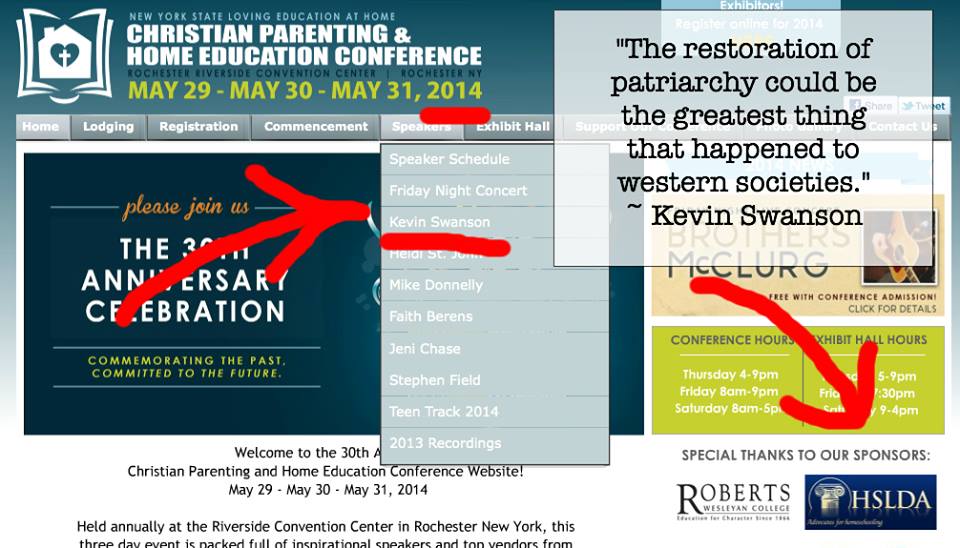
6. When HSLDA took a brave stand against sponsoring conventions headlined by patriarchy advocates…
HA note: Sheldon blogs at Ramblings of Sheldon. This is an original piece that Sheldon wrote for Homeschoolers Anonymous.
In December 2013, I cut my abusive parents out of my life once and for all.
It took quite a bit of emotional strength to do it, but when I finally did, I felt worn out, but I realized that all feelings for my parents that once had were no longer there, they felt dead to me, they were living human beings of course, but I no longer felt any love or affection for them anymore, still don’t.
What led to this point? Well, that’s a lot of details to that, and hopefully I can explain it without writing a book. There was plenty of abuse in my childhood, but besides the effects of the isolation from homeschooling which still cause issues for me to this day at 25 years old, what really got me was how I was treated as a young adult by them.
It started when I tried to attend Southwest Baptist University as a Political Science major. I just couldn’t adjust to being 250 miles from home, going from isolation as a homeschooler to an actual classroom experience, dealing with people on a regular basis, and actually being able to make decisions for myself on a regular basis, from the mundane to the major.
I didn’t realize at the time that I was dealing with depression, and panic attacks started with a vengeance, I lost count after a while of how many I had, but in a 10 month period, I probably had around 15-20 major attacks, with many smaller ones, and that combined with extreme fatigue and hopelessness from the depression, I could no longer function.
Everything came crashing down around me, all my hopes and dreams that led me to become a political science major. I ended up having to face the reality that I could no longer continue attending Southwest Baptist, and was brought home after the end of the freshman year.
Most parents would would do their best to help out their child at a time like this, console them, help them to put their life back together, and emotionally support them. Not mine. My father understood what had happened, but he wasn’t the one who ran our household, my mother was, and to her, the depression was the result of “sin” and “not having a right relationship with god”. Her idea was to punish me for what she saw as recklessness and misbehavior.
I was forced off of medication for depression that I had started upon coming back home (after realizing what the depression actually was), and was treated like a rebellious teen.
I was controlled and emotionally abused to the point that when I tried in desperation to leave with enough of what I owned to fit in my vehicle and a few hundred dollars in my bank accounts, I was convinced that I had to leave, or it would end up leading me to end my life. She personally barricaded the doorway to stop me from leaving, threatening violence, and telling me that if she did attack me, I would deserve it.
I kept fighting, and just saw this as a temporary setback, I worked, saved up money, and finally a bought a house. She did help me rebuild the house, along with my father, but her dark side was showing up again, her controlling and hostile ways. I finally had enough, and told her no longer wanted any help on the house if she was going to act that way. She called me an “ungrateful brat”, I didn’t care anymore, her guilt trips did nothing to me by this point, I told her never to show up at the house again, and I would bring back dad’s tools to them.
I knew, based on the past, that something drastic could happen, so I went out, and bought new locks, and was in the process of installing them that night, when she showed up, I knew it couldn’t go well, I shoved the door shut quickly, with the lock in it half done, it was a fortunate occurrence that the lock jammed because it wouldn’t been properly installed yet, because when closed, it wouldn’t allow the door to open.
I could hear screaming, and her pushing and shoving the door, and futilely trying to open it, she was trying to force her way into the house.
I had enough, I called my town’s police department, and when the officer finally showed up, I went out the back door to talk with the officer, and my mother started the victim act, lying to the officer, claiming that this was all because I didn’t “want to help them work on the house”. My own father, who used to run interference to protect me and my sister as children tried to punch me in front of a cop.
His betrayal that day (along with his increasing habit of trying to cover for her and make excuses for her in the year leading up to that time), is really what got to me the worst, my mother is who she is, and I doubt she will ever change in her lifetime, but for him to turn into a carbon copy of her was shocking.
It’s been severals months now since that day, and it’s been hard, I’ve had to give up the social circles that I had, since most involved the church I was in, along with my parents (it was bound to happen eventually anyway, I couldn’t keep my change in beliefs a secret much longer), and I had to stand my ground with the manipulative pastor of that church who tried to guilt me into accepting my parents back in my life, despite me personally telling him what they had done, both then and in my past.
Enough of that, I’m tired of being forced to be someone I’m not, to please people who won’t accept me anyway. I’ve had a lot of new experiences, I’ve learned what’s it’s like to have the simple freedom of walking around in public with a Pink Floyd or Sons of Anarchy shirt, and not give a care in the world.
I’ve learned how to work on my house myself, I’ve started coming to terms with the fact that I don’t really feel masculine or feminine emotionally on the inside (I recently changed the gender status on Facebook to “non binary”). I’ve found a great Unitarian Universalist congregation where I can be me, and be accepted as one of the group anyway.
Life now can be challenging, but it’s worth it, there’s no going back.
Franklin Graham wants you to think he cares about child exploitation.
He doesn’t.
Franklin Graham is busy pretending he cares about child exploitation and that’s why he doesn’t want to let gay people adopt. He thinks gay people recruit children. Aside from pointing out the utter absurdity of this idea, I have one thing to say to Franklin Graham.
Speak out against the abuse in the church.
If you really care about children being harmed, then use your voice and your famous name to do something about the abuse and exploitation of children in evangelical and fundamentalist churches and institutions.
Speak out against the way churches protect child molesters while shaming their victims. Speak up for the children. Condemn the Bill Gothards, the Doug Phillipses, the Sovereign Grace Ministries, the Christian colleges that refuse to do anything about sexual harassment and assault and punish the victims. Speak against the system that enables the abuse and looks the other way when it happens.
Speak out.
Speak against the child abuse. Against the Pearls, the Ezzos, the parenting “experts” who tell parents that the way to create godly children is to beat them into submission. Speak out against the forces in the homeschool world who are fighting tooth and nail against any efforts to protect children from abuse and neglect.
Franklin Graham, you need to get your house in order. Instead of cozying up to the human rights-abusing quasi-dictator that is Vladimir Putin, just because he hates gay people as much as you do, take some of that effort and do something about the very serious and very real abuse problem in the church.
And as for me?
I’m too busy trying to do what you won’t do, working hard to keep any more children from being beaten or starved to death by “good Christian” parents to “recruit” anybody.
I want to share a very simple little story about something that was a precious moment for me.
When I was a child, we didn’t really have birthday parties, although my mother did make an effort most years to cook a favourite meal for the birthday child. When I was really young, we did have a party or two with a few friends invited and a special meal, but eventually as we became more isolated by the homeschooling, there weren’t really friends to invite, and there was no money for extras like birthday meals when my father was just not working. So in my last few years before I left home, all our birthdays were barely noticed, much less celebrated, except by my mom quietly making a preferred meal from pre-set options and often no cake, or a very plain one with no icing. Birthdays could be a cause for concern for us, since we also were fair game to be confronted about whether we had matured into more godly children in the past year or not, and there was no safe way to answer that question. We were also sometimes taunted by the chance of a birthday party or a coveted gift if we behaved well enough. This was never really a possibility, and we would always lose that privilege no matter how good we were, since the money literally did not exist for it.
I became a little resentful about birthdays and birthday parties as I became an adult, because not only were birthdays not special, they represented a loss. I had been to a few normal birthday parties as a child and just couldn’t be happy for those kids when I would never get that myself. Seeing someone have a nice birthday party became a difficult thing for me. I explained this my non-fundamentalist husband, who along with millions of North American children, apparently had birthday parties. He was a little surprised by this, and decided to do something about it.
My husband threw me a kid’s party for my 24th birthday, because I never got one. He invited friends over, and ordered a very pink cake that said happy birthday on it. He stuck a ton of candles in it and lit them all. He set up our kitchen and living room with pink and white streamers all over, and blew up balloons and hung them from ribbons all over the downstairs area of our house. He made some kind of supper, I can’t even remember what it was, the party was so exciting. And the best part of my party was the cupcake piñata. It was huge, at least two feet in diameter. It had a colourful “wrapper” base, and “icing” on top covered in sprinkles. He filled it with candy rockets and jolly ranchers and suckers and Hershey’s chocolates and little plastic dinosaurs. We hung it in the doorway between the dining room and the living room and he videotaped us hitting it until it cracked open, and then we had little goodie bags and gathered up all the loot.
I didn’t really eat a lot of the smashed piñata candy, but being given that experience at 24 years old was such a healing day for me. I still don’t like it that I missed that part of childhood, but I am not hurt by that any more because the thing that I had lost was given to me. He gave me a piñata for my birthday last year too, I am coming up on my 26th birthday this year.
This week, embattled IBLP founder Bill Gothard received aid from an unexpected quarter–homeschool mom and popular author Debi Pearl.
In the past, self-confessed “old hillbilly” Michael Pearl has sometimes himself been critical of Bill Gothard for helping create the excesses of the homeschooling patriarchy movement–a highly ironic observation coming from the father of patriarchs! But this week, Debi came out swinging against IBLP victims who have gone public with their stories on “Recovering Grace” and other websites.
Beginning her post with the question, “Whose side are you on?” Debi attacks those who have dared to publish accounts of how Gothard lied to, molested, or otherwise mistreated them. According to Debi, these “critics” are “bitter” (that’s the ultimate pejorative in IBLP circles, remember?), they are “foolish”, and they have joined a “Satanic attack on God’s people”.
On the one hand, Debi describes Gothard as a “man who put his whole life into doing a work for God”. On the other, she denies having any connection to IBLP’s beleaguered “ministry” which, she claims, helped “set thousands of people free from bitterness”.
Gothard and the Pearls have, in fact, had a symbiotic relationship for years.
They attended a Basic Seminar in the late 1970’s. IBLP promoted and distributed the Pearls’ parenting book To Train Up a Child. The website for IBLP Australia still offers at least two of the Pearls’ numerous books. At least one of the Pearl girls worked at Gothard’s orphanage and training center (South Campus) in Indianapolis and the Pearls kept several Russian orphans at their home over the summer. Michael solicited donations for IBLP from his followers. Several of the Pearl children’s spouses were raised in Gothard’s ATI program. (I say “spouses”, but Michael Pearl made it clear years ago that his children do not need any such thing as marriage licenses. A ceremony and their parents’ blessing is apparently good enough.*)
Besides being given to racist and homophobic remarks, the Pearls are somewhat obsessed with sex. It gives Michael hope to envision homeschoolers “outbreeding” progressives. He counsels the wife of an angry man to “make love” to improve her husband’s mood. Debi often suggests that being sexually available is a wife’s primary responsibility. Michael even wrote a book on erotic pleasure for fundamentalist Christian couples.
And then there are the Pearls’ highly controversial child training methods, which have now been linked to three child deaths. There is currently a petition circulating to ask Amazon.com to remove To Train Up a Child from its website in the interest of protecting children from parental abuse. According to a BBC report last year, To Train Up a Child has sold over 800,000 copies and boxes of the Pearls’ books have been shipped for free to U.S. troops overseas. “No Greater Joy” pulls in over $1 million a year, with Debi functioning as “the financial brain of the company”, according to her son Gabriel.
Last year, Rachel Held Evans wrote a blunt piece about Michael and Debi Pearl and their abusive “ministry”. First, she quoted Pearl himself describing how to handle a rebellious child:
“If you have to sit on him to spank him then do not hesitate. And hold him there until he is surrendered. Prove that you are bigger, tougher, more patiently enduring and are unmoved by his wailing. Defeat him totally.” -Michael Pearl
And Evans added her own warning:
But it’s not just children who suffer from No Greater Joy‘s ministries.When I was conducting research for A Year of Biblical Womanhood, I read Debi Pearl’s popular book, Created to Be His Helpmeet…which I threw across the room a total of seven times.
The writing is awful, the biblical exegesis deplorable, but what troubles me the most is that the book reads like a manual for developing abused wife syndrome.
In their story “The Real Michael Pearl” a few years ago, Religious Child Maltreatment pointed out the peculiar rush Pearl appears to derive from seeing small children spanked into silence, and his sense that he has “come upon the holy grail of childrearing”.
To Pearl, and many parents who follow his teachings, the primary goal of parenting is not to support children by fulfilling their needs to feel safe and experience appropriate autonomy, but to control children.
In April 2011, Cindy Kunsman, a nurse explained the physical dangers of Pearl’s teachings in a post on the No Longer Quivering blog. Homeschoolers Anonymous reposted the piece in September of last year:
Due to the severity of the spankings with [Michael Pearl’s recommended] plumbing line, both Zariah and Lydia Schatz suffered renal failure because of rhabdomyolysis.
…[W]e may never learn the details about new cases of Pearl-related kidney disease unless it is reported by the families of the survivors.
Kunsman went into much more detail about rhabdomyolysis in another post at Under Much Grace. This article convinced me that the Pearls are not just cranks, they are dangerous.
If the children are aggressively spanked on a chronic basis, …it is possible that chronic damage could occur in children that is not bad enough to cause kidney failure but bad enough to cause damage.Unless a child undergoes blood tests at some point, “renal insufficiency” (inefficient kidney function that is lower than a normal, healthy level) could be present and no one would be the wiser. It is conceivable that at least some children have experienced some damage, but not enough to produce symptoms of kidney failure.
In October 2011 Rachel Stone wrote about Pearl in for Christianity Today. Her article included sadistic passages from To Train Up a Child and described the Pearls’ methods as “a program of calculated cruelty”:
One child suffering under this training is too many; it’s my hope that the Pearls will be widely discredited, and soon.
In a November 2011 post, a Chicago blogger pointed out that the popular Duggar family, who are still members of Gothard’s homeschooling cult, not only endorse but actively promote the Pearls’ materials on their own website:
www.NoGreaterJoy.org Features some of the finest in family-friendly, value-based books, audios, videos, and articles on parenting, husband and wife relationships, ministry and more! Materials include, To Train Up A Child, Jumping Ship, Created To Be His Help Meet, Preparing To Be A Help Meet, Only Men, the Good and Evil graphic novel in over 20 languages and a FREE bi-monthly magazine.
Samantha at Defeating the Dragonsand Libby Anne at Love, Joy, Feminism have both written boldly about the dangerous and abusive teachings of Michael and Debi Pearl. Author and mother of five Elizabeth Esther, whom Anderson Cooperinterviewed alongside Michael Pearl late in 2011, has been both outspoken and tearful about the horrors perpetrated against children when parents follow Pearl’s advice. You can watch the interview for yourself here.
A 2011 New York Times article quotes Michael likening childrearing to training “stubborn mules” and explores links between child deaths and the teachings in Pearl’s book.
Dr. Frances Chalmers, a pediatrician who examined Hana’s death for the Washington State Department of Social and Health Services, said of the Pearl methods: “My fear is that this book, while perhaps well intended, could easily be misinterpreted and could lead to what I consider significant abuse.”
This video shows Michael and Debi Pearl in action at a child training seminar, apparently at the Cane Creek church that meets on Pearl’s property in a Tennessee hollow. Michael would much prefer to be known through his books than through these clips, but there he is on his own turf:
With his wife smiling and nodding beside him, Michael Pearl laughingly advocates cruelty against children. He encourages hitting children, even infants, with implements. He recommends luring young children with tempting objects and then swatting them to teach them obedience and self-denial. He teaches parents to instill fear in their children on purpose. Michael Pearl seems to get off on asserting his domination of a much younger, smaller human being:
” A proper spanking leaves children without breath to complain. If he should tell you that the spanking makes him madder, spank him again.”
The Pearls have long pointed to the supposed happiness of their own trained and obedient children as evidence of the efficacy of their methods. However, Michael and Debi have not taken well to being called out by adults whose parents followed this couple’s advice. Earlier this month, Michael became defensive against vocal homeschool graduates such as those of us who post at “Homeschoolers Anonymous” and posted his response at “No Greater Joy”. But even as he blasts those who speak the truth about their experiences, Michael must admit that homeschooling is no panacea:
“Not every homeschool experience will be a great success. Some will be total failures; others will be good but not altogether good. In some cases, out of six children a family may lose one or two to the world, but they will have two or three that are exceptional human beings.”
Alas for a child who turns out to be a less-than-exceptional human being! Pearl chalks such failures up to satan at work and recommends people buy more of his books, just to be safe.
I really should not be surprised to see Debi Pearl defending Bill Gothard and his ministry against what she considers defamation. But I look at her daughters, their body language, and I wonder what stories they could tell and what they would say about their famous parents if they felt completely safe.
It speaks volumes that the Pearls feel compelled to hitch their ministry to Gothard’s falling star.
“None of my daughters or their husbands asked the state of Tennessee for permission to marry. They did not yoke themselves to government. It was a personal, private covenant, binding them together forever—until death. So when the sodomites have come to share in the state marriage licenses, which will eventually be the law, James and Shoshanna will not be in league with those perverts. And, while I am on the subject, there will come a time when faithful Christians will either revoke their state marriage licenses and establish an exclusively one man-one woman covenant of marriage, or, they will forfeit the sanctity of their covenant by being unequally yoked together with perverts.”















 Homeschoolers Anonymous
