Matt Walsh: “Let’s talk about everything as hyperbolically as possible”

Source: http://www.wlap.com/pages/MattWalsh.html
Matt Walsh. Source: http://www.wlap.com/pages/MattWalsh.html

By R.L. Stollar, HA Community Coordinator

As Matt Walsh once said, “Let’s talk about everything as hyperbolically as possible.”

Except Matt Walsh never said that.

Then again, no politician ever said, “Let’s treat all homeschool parents like felony child abusers,” which was the title of Walsh’s December 18, 2013 post on homeschooling.

I read Walsh’s homeschooling post the same way I read many of his other posts: with a mixture of bemusement, facepalms, and sadness. Sometimes he has interesting observations; but all the times, whatever potential insights he could be making are lost in his predilection for hyperbole and grandstanding.

Matt Walsh is Rush Limbaugh 2.0: Same Hyperbole, New Tattoos!

In his homescholing post, Walsh stands on a soapbox of “parental rights” and speaks dramatically about how if parents do not have “the unquestioned and absolute right to teach and raise our own children,” then — no exaggeration — “we don’t have any rights at all.” That is really the crux of his argument, which deserves analysis. But the specific context for the argument, from which he gets the title of his post, is the recent and tragic death of a 14 year old homeschooled boy, Teddy Foltz-Tedesco.

I would like to look at Teddy’s death first.

Teddy’s death, caused by horrific child abuse, should bring all conversation about homeschooling and parental rights — really, any and every political conversation — to a halt. The kid, only 14 years old, was beaten until he was unconscious by his mom’s boyfriend. He was not taken to a hospital until hours after the fact. Five days later, after suffering internal bleeding and brain contusions, he died.

But that was the end of the story, not the beginning. I will let Homeschooling’s Invisible Children explain what happened prior:

The abuse started three year prior, when Bush started dating Widdersheim. The family became increasingly isolated, and Teddy’s father did not see him after his tenth birthday. Two years before Teddy’s death a grandmother tried to intervene in the family, but Widdersheim refused to believe her children. Friends and neighbors contacted social services, but after teachers at Teddy’s school started an inquiry with the Ohio children’s services agency, Widdersheim withdrew her children from public school to homeschool them.

Too many people failed this kid. His own mother, his siblings, friends and neighbors, social services. People who could have acted, should have acted, did not. People who tried to act should have tried harder. Policies in place to protect kids like Teddy failed. Services we pay for to keep this from happening did nothing to stop it. It makes me nauseous. I’m not a libertarian and I’m not an authoritarian, but moments like these make me want to be both: I want to punch the walls of the entire child protective system in a blind rage because they had laws and money but they did not save this boy! and I want to ban everyone from ever being parents because if we can’t stop kids from dying let’s just take all the kids away from parents!

But neither the complete absence of laws nor passing every law ever will make each and every kid safe.

That’s the maddening factuality of politics’ limitations.

But that does not mean we should stop trying to make better policies. That does not mean we burn homeschooling to the ground or give parents free rein to do whatever the hell they want to their kids.

And most of all, that does not mean it is compassionate or right to encourage others to harass people trying to make the world a better place, even when those people are misguided. Yet that’s exactly what HSLDA and Matt Walsh did.

See, after Teddy’s death, his birth father and other family members began pressing for legal reform in an attempt to spare other kids from Teddy’s fate. His birth father and other family members approached Ohio state senator Capri Cafaro, the result of which was the proposed S.B. 248. The bill (which was later withdrawn) would have required all homeschooling parents to undergo an annual interview with social services before homeschooling.

This proposal was, in my opinion, doomed to fail at the start, not to mention misguided. (Ironically, it was also the first piece of legislation that the newly-launched Coalition for Responsible Home Education took a position on, and even CRHE opposed it.) But HSLDA quickly spun it as — and I quote — the “Worst-Ever Homeschool Law.”

Yes, the “Worst-Ever Homeschool Law.”

HSLDA knows their followers. They know how they respond to such rhetoric. They know their followers will flood social media and rant and rave and bully Facebook pages to no end, just like they did the German Embassy’s Facebook page for over a month, calling people Nazis and tyrants and other colorful phrases.

And then along comes Matt Walsh, saying Senator Cafaro was — and I quote — “repulsively exploiting the child abuse death of a 14 year old kid,” despite the fact that the Senator only proposed that bill because of the prompting of that kid’s father.

But, you know, facts get in the way of hyperbole, don’t they? 

Walsh wouldn’t get nearly as many blog hits if he didn’t exaggerate. HSLDA wouldn’t get nearly as much dedicated fervor from their audience if they didn’t say the bill was basically the Second Coming of Hitler. (Which makes one wonder, who is really exploiting Teddy’s death here?)

So of course inspired by both HSLDA and Walsh, angry homeschool parents flooded the Facebook page dedicated to Teddy’s death and run by his father. Teddy’s remaining family were berated and harassed for days. It was, in my opinion, a real low for the homeschool movement: a mob of people verbally abusing a grieving parent who lost his son, all in the name of “parental rights.”

But it wasn’t just sad. It was aggravating. Because there are real issues here. There are issues that demand a serious, sober debate — between legislators, child protective services, and homeschool advocates. There are heartbreaking failings that demand self-reflection within homeschooling communities about how to protect the communities’ kids from parents who misuse homeschooling.

But we don’t get any of that.

We get Walsh’s hyperbole and HSLDA’s spin.

Which means we don’t get better laws. We don’t get self-reflection. And we don’t get safer kids. 

But Walsh gets more blog hits and HSLDA gets more members.

Wash, rinse, repeat.

Homeschooling leaders and advocates can do better than this. We can do better than this.

No kids are saved while homeschooling leaders are off tilting after windmills of persecution. No progress is made — towards either safety of kids or freedom of education — when we cast our movement in Manichaean colors.

Matt Walsh: no one wants to treat all homeschool parents like felony child abusers. No one. No one thinks all homeschool parents are “dangerous terrorists.” No one. Not even us here at Homeschoolers Anonymous, who are apparently now “whistleblowers documenting the horrific secrets of the fundamentalist homeschooling movement.” Yes, not even us whistleblowers of horrific secrets, who blog daily about homeschool abuse, think all homeschool parents are or should be treated like terrorists or child abusers. You are vainly slapping the face of straw men. You have an entire field full of straw men. You are running around with a pitchfork and screaming at figments of your imagination.

Let’s look at the facts calmly, please?

The facts are, parents do not have “the unquestioned and absolute right to teach and raise our own children.” No. Never. This is good. This is how it should be. In refutation of this sentence of Matt Walsh’s from his post’s second paragraph, I would simply present this later sentence from — you guessed it — Matt Walsh:

You should be able to lose your claim over your child if you are truly abusive, or if you commit any felony crime that would put you in prison and require your kids to be cared for by someone else.

This is pretty simple, really: if you should lose your claim over your child if you are abusive (or for any other reason), then your right to teach or raise your own children is not “unquestioned and absolute.” So Walsh really does not mean half of what he says, or he simply ignores how he contradicts himself. There should be limits on parental rights. The state should have power over your children that supersedes your own.

To some extent.

We are ultimately arguing what the extent to which we should apply the principle; we are not actually arguing about the principle. Walsh confuses these two things. You cannot say “this right should be absolute unless.” If there is even one “unless,” then the right is — by definition — questioned and conditional, not unquestioned and absolute.

Walsh might want fewer restrictions on parents than Teddy’s dad might want, or the NEA might want, or members of the responsible homeschooling movement — myself included — might want. But all of us, Walsh included, believe we need to protect kids. We need to question parents’ right to teach and raise their own children when those parents teach and raise their children to believe God wants them raped and impregnated due to an impending Armageddon. We need to make conditional parents’ right to teach and raise their own children when those parents beat their kids to death in the name of righteousness.

People who believe “parental rights” should not be an excuse to rape and murder your kids are not “lunatics,” as Walsh might have you believe. They are not people who — again, a bizarre tangent on Walsh’s part — think “a person’s only fundamental parental right is to butcher their children.” The desire to protect children from abuse is a highly ecumenical one, transcending people’s beliefs about abortion.

So how about we not talk about everything as hyperbolically as possible?

We could sit down in person over a cup of coffee, or write reasonable blog posts with intelligent rhetoric, where we sift through the issues at hand. Issues that could literally mean the life or death of other homeschooled kids — or public school kids, even. We can have big conversations: about how to improve child protective services, how to help out parents trying to educate their children in safe and nurturing environments, how to assist public school teachers raise achievement for all groups of kids, and how to counter child abuse in any and every context.

By all means, let’s indict sexually abusive teachers in public schools. Let’s indict abusive teachers in public schools, private schools, home schools — even colleges. Let’s join with people like Boz Tchividjian and fight abuse in churches; let’s call out and bring to justice the Jerry Sanduskys in secular institutions, too.

But we’re not going to do that with hyperbole. We’re going to do that with well-vetted policies, dedicated parents, outspoken child advocates, and an endless supply of compassion for survivors and support for those fighting for them.

Let me put it another way:

The time for hyperbole in the homeschooling movement is over. It is time for productive discourse and action.

On being a broom (and why I can’t just relax and enjoy shit)

Screen Shot 2014-01-07 at 10.18.46 PM

HA note: The following is reprinted with permission from Kierstyn King’s blog Bridging the Gap.  It was originally published on December 31, 2013.

I realized why I have a hard time relaxing and taking actual vacations and even enjoying the holidays. 

As a child all of the times that most children have “off” to play and relax and do their own thing, I never had. We never had summer break.

We took Nov-Jan off every year instead, and during those two months we never rested. During those two months, my mom made lists, my mom kept us running ragged either baking or crafting or “ministering” to other people, or doing deep seasonal cleaning. I remember, vividly, begging, all of us, begging to keep one day in two months free so we could just watch a movie and relax and not make cookies (or make cookies that we actually got to eat instead of for everyone and their aunt).

We had “parties” that I don’t ever remember being fun, because the entire time leading up we spent deep cleaning, and cooking, and setting up, and then when it was party time I had to help mom keep the party and the guests organized and on-schedule, and I had to make sure the dessert came out of the oven at the right time, and often was interrupted with some kind of care-taking need in the middle of a group activity.

My mom hated it when I planned my own (graduation) party and I told her she couldn’t do anything and that I had no plans, and we were just going to hangout, maybe watch a movie and order pizza. Even then she still tried to dictate what happened when. I was still pulled aside. It was still stressful.

All I remember my mom doing during breaks, and actually for the majority of my childhood, was sitting in her recliner: writing us lists of things to do, and getting upset when we didn’t do them all fast enough for her.

Her version of helping and “being productive” was sitting there, after giving us our lists, watching us do the things on the list and telling us what we were doing wrong or should do differently, or coming up with more things to do simultaneously.

There is no pleasing my mother.

We had “breaks” solely so we could do chores and things we couldn’t have done while we were “schooling”. Forget that we didn’t school on Fridays, because Fridays were intense cleaning days, you know, on top of normal cleaning all week.

Even my dad, my mom would write huge “honey-do” lists for on his one week off (you know, when we kids just wanted to play and have him rescue our toys from the packaging). My mom was a slave-driver who bred her own slaves.

And yes, I do feel like I and all my siblings are just slaves in my mothers eyes. She wouldn’t say it that way, but that’s exactly how they live(d) and practice(d), and people wonder why I have horrible self esteem issues.

I mean, I was told, outright, for years, that my purpose and job in life (while I was home) was to serve my “family” (i.e. mom). I felt, literally (I cannot emphasize this enough) like I was just a broom with arms, legs, and a heartbeat. I remember standing in the kitchen one day, fighting back tears, devastated as I was doing two things at once, that I didn’t have 8 arms, because I could. not. keep. my. mother. happy. I could not physically clean, and cook, and hold the baby, and do the laundry all at the same time. I was human, I ONLY HAD TWO ARMS, and yet, there was my mom, in her chair in the next room, berating and harassing me because while I was cleaning the dishes and cooking and had a toddler draped around my leg, I hadn’t yet started the laundry, or brought her snack.

If I was “caught” doing anything that loosely resembled “relaxing ” that was immediately rectified with other tasks (unless it was bedtime, or the like 90 minutes of “free time” I had that rapidly shrank). I feel horribly guilty if I am not doing some kind of mundane work when I could be, because I was never allowed to breathe.

I wasn’t a person until I ran away.

Before that, I was nothing more than a breathing, walking, broom.

An Average Homeschooler: Part One, Introduction

Samantha Field, first year of homeschooling.

HA note: This series is reprinted with permission from Samantha Field’s blog, Defeating the Dragons. Part One of this series was originally published on December 5, 2013. Also by Samantha on HA: “We Had To Be So Much More Amazing”“The Supposed Myth of Teenaged Adolescence”“(Not) An Open Letter To The Pearls”,  “The Bikini and the Chocolate Cake”, and “Courting a Stranger.”

*****

Also in this series: Part One, Introduction | Part Two, The Beginning | Part Three, Middle School | Part Four, Junior High | Part Five, High School Textbooks | Part Six, College

*****

I’ve been avoiding writing about this. Even once I started planning out the series, I debated with myself for weeks over whether or not I wanted to write it out– and then post it. I’ve talked a lot about some of the other aspects of growing up in fundamentalism, but I’ve avoided talking about my experience with homeschooling for a few reasons. I’ve touched on it a few times, and I’ve even written posts for Homeschoolers Anonymous and for Leaving Fundamentalism. Even as I wrote those posts, I was hesitant about sharing them here, although I did eventually.

First of all, one of the reasons why I haven’t written about homeschooling is that my experience was nothing like what you can read about at HA. My life was complicated, and the cult-church I grew up in made many things worse, but it was certainly not even approaching the nightmare of parents who could have refused to teach me to read or those who pull their kids out of school so that they can hide their abuse.

I would describe my homeschooling experience as fairly average.

One of the beauties of homeschooling is that no one experience could be called truly average or representative, but in the past nine years since I’ve graduated I’ve been able to interact with hundreds of homeschoolers from all over the country. There are different sub-sets in homeschooling, with the conservative Christian/fundamentalist sub-set probably being the largest, even today (although other movements, like secular and unschooling, are gaining ground).

Since conservative homeschooling environments are probably the largest and the most dominant (see: every single state-level homeschooling conference ever), I’m comfortable with viewing my experience as pretty middle-of-the-road. There are a few patterns – in how homeschooling is experienced, in how it is talked about by its advocates – and some of those are what this series is going to focus on.

My “average” experience is actually why I’ve decided to write this series, though.

HA has hundreds of stories now of educational neglect, of spiritual and physical abuse, and one of the very common arguments that people like R.L. Stollar and Heather Doney are running into all over the place is that yes these experiences are awful but it’s not really homeschooling you’re talking about you’re really just talking about abuse and that’s present anywhere.

So while my church experience was definitely abusive, and while some of the things that were taught at church caused my parents to do some harmful things, my homeschooling experience was slightly detached from all of that. Up until this year, I would have described it in glowing terms. I believed my education was… well, superior. And while I haven’t completely changed my mind about that, I’ve come to realize that my “average” experience was lacking in some pretty big ways that do seem to be common among homeschoolers– religious and conservative homeschoolers, especially.

The second– and biggest– reason why I’ve hesitated writing about this was that talking about homeschooling inevitably means talking about my parents. If there were problems with my education, my educators were responsible. And while many of those problems can be shifted onto the myths and lies my parents were being fed by the homeschooling culture (which I’m going to talk about at length), I don’t have multiple teachers, principles, school boards, or lack of money to blame. I do my best not to drag my parents or my family into my blog, because this blog is about my journey, but I can’t talk about homeschooling in the same way that I can talk about my church-cult.

I love and respect my parents. They were doing what they honestly believed– thanks to the HSLDA, Vision Forum, and the endless homeschooling catalogs and flyers and books and magazines– to be the best thing for their children, and they did their research. They rejected a lot of the more damaging concepts you can find in Homeschooling Today. We rejected the form of homeschooling we laughingly referred to as “the goat-raisers” (incredibly large families, “homesteader” approach). They bought the highly-recommended curriculum, and they sacrificed a great deal of money to get it. They celebrated my successes and encouraged my dreams.

I value everything my parents gave up in order to get me a good education, and this series in no way is meant to criticize them.

There were some very good things about my education that you can hear from a lot of other homeschoolers– a love of reading, unbridled curiosity, and plenty of time to explore. However, even those incredibly positive, valuable things have their downsides.

I’m going to be brutally honest, and sharing my experiences is going to be complicated, and messy, but as nuanced and balanced as I can make it. Hopefully, talking about my “average” experience will help open the door to a conversation about homeschooling that hasn’t really happened yet.

To be continued.

Reaching the Other Side: Deanna Stollar’s Thoughts

mother-child-crossing-road

Deanna Stollar lives in Springfield, Oregon and is a former homeschooling mother of four children (including HA’s R.L. Stollar) and grandmother of two grandchildren. In the 1990’s she co-founded the San Jose, California homeschool support group SELAH (Students Educated Lovingly At Home) as well as San Jose homeschool debate club, CLASH. Deanna has written two debate textbooks for homeschool debate families, It Takes a Parent and Coaching Policy Debate. Along with her husband Terry, Deanna has spoken at numerous homeschool conventions, on topics ranging from “Creating Good Writers” to “Raising False Expectations.” In her spare time she loves to write; her work has been featured in a number of publications, most recently in A Cup of Comfort for Horse Lovers and A Cup of Comfort for New Mothers.

*****

Today at the library I watched as a mother told her kids that they needed to leave.

“Time to go home,” the Mom said. “That computer is gross. Someone else’s eyelash is on it – ugh. We don’t want to use a computer that has something like that on it.”

Her son looked dismayed, “But mom, I was in the middle of my report.”

“It doesn’t matter,” she said, a military determination in her eyes.

His brown hair, shoulder length in a blunt cut, he looked about twelve years old. His younger sister stood next to him. She didn’t argue with her mother, seemingly resigned to the fact they must leave — not willing to question her.

*****

We all know how ridiculous we homeschooling parents can be at times, but I shudder when realizing how dark and cruel some homes can be where instead safety and love should exist.  It sometimes overwhelms me to think of the kind of education taking place in such homes, and often I don’t want to even read about them.

As a now retired homeschooling mom of twenty-six years, I certainly made my fair share of mistakes both as a parent and educator.

Seeing this mom, however, struck a chord in me I have not felt in a while. It sat with me for days. I kept seeing the young boy’s disappointed face and his sister’s disengaged one. From their body language, it was clear this scene of irrationality was an often occurrence for them — a mother who changed her mind on a whim, over the perceived health danger in something as simple as an eyelash imbedded in computer keys; why not use that eyelash as a springboard for an imaginary story? Did a fairy leave it there or a unicorn? Why run away in fear from it?

This scene in the library, their words, their faces, haunted me for nearly a week until it rose to the surface what was really bothering me about it: what was this woman teaching her kids everyday?

She was teaching them to be afraid: afraid of a stranger, of someone who had dirty eyelashes, of equipment shared by others. How was she equipping and preparing them for the future? She was teaching them to fear something that was not real.

She was teaching them to be afraid of the library, of others, of society, and perhaps even of learning itself.

This made me very sad. What made me even sadder was that the librarian, who also witnessed this scenario, along with me, did nothing to remedy the situation either. Maybe she concluded, as I had, why bother.  What could we have realistically accomplished by stepping into this mom’s life in that one moment? Maybe nothing, but maybe our interjections could have helped her children. They perhaps for the first time would have heard something different — a taste of freedom — and longed for it more. Our words might have stayed with them over time and been beneficial.

I will never know now what difference we might have made.

About twenty years ago, I watched on a street corner as another mother screamed at her young blue-eyed, curly blond girl of three. The mother’s tone was both abusive and her reasoning completely unrealistic. Her three-year old was expressing valid fears at crossing the street and the mother refused to console her. She only berated her child. I watched for a moment then went up to the mother. I asked her if there was anything I could do to help. At first her voice was curt, annoyed with my interference, but eventually both she and her daughter calmed down and crossed the street together. As they held hands, the three-year-old girl added a skip in her gait. As they reached the other side, the little girl turned around and waved at me.

Reflecting back on that moment I wish now that I had tried to help the mother in the library. I wished I had tried to help get them to the other side, instead of being stuck in ignorance and fear, but I was too afraid to try that day — bound up in fear myself — the fear that I could not help her.

This is part of why I am glad that Homeschoolers Anonymous exists and that passionate people work hard on a regular basis to help others reach the other side of difficult and often horrifying situations.

They are making a difference, and that is a good thing indeed.

Happy 2014 HA! May it be a blessed year for you.

When “Respect” Involves “Disgust”

HA note: The following is reprinted with permission from Libby Anne’s blog Love Joy Feminism. It was originally published on Patheos on December 5, 2013.

Growing up in a conservative evangelical home, I believed that we were the ones who truly respected women. I believed that our young men—the young men in my homeschooling community—were being raised to treat the women around them, of whatever age, with respect.

I was wrong, very, very wrong.

A reader recently pointed me to an article on World Net Daily that presents a fictional scenario where an “normal” girl, Jane, is ordered by a judge to leave her public school and be educated in a homeschooling family*. While the entire article is a fascinating portrayal of conservative Christian homeschoolers’ perception of the average public school student, I was struck in particular by one short paragraph, three simple sentences—sentences that say so much.

When Jane tries to slut it up with the boys in the class [i.e. the homeschool boys she’s now being taught alongside], they look at her in disgust. Yes, she might be sexy, and yes they have hormones, but that doesn’t mean they’re going to act upon primal urges. They’ve been raised with manners and to respect girls.

It does not work this way.

You cannot follow “they look at her in disgust” with “they’ve been raised with manners and to respect girls.” If they were raised to respect girls, why are they looking at Jane in disgust? Because that’s not respect. Perhaps the author’s definition of “respect” is something very different from that found in the dictionary or what the word is usually understood to mean. Perhaps the author actually means that these boys were being raised to respect girls who were worthy of respect—girls who were properly demure and modest and chaste, as evangelical sexual standards require.

Several years back, the Harris brothers, homeschool graduates who founded The Rebelution, conducted a “Modesty Survey,” asking teen and twenty-something evangelical males what they thought was modest and, well, not modest. If you scroll through the results, one thing that becomes clear is that these young men, most of them products of the same evangelical homeschool culture as myself, have a great lack of respect for women who do not dress “modestly,” and in some cases even openly disdain them. Here are a few examples:

You have less respect for an immodest girl than for a modest one.

There are many Godly men out there, as I’m sure this survey will prove, that are dying to give you their utmost respect when you choose to follow God’s leading in this area of modesty in your life.

Please don’t take modesty lightly. As your brother in Christ I value the relationship that I will have with my wife someday. When I am tempted because of you I lose a part of myself that I am trying to save for her.

Guys really do respect and honor girls who have the willpower to keep themselves pure and looking pure.

God made you a thing of beauty. A thing to be admired and respected. When you dress or act in a way that draws attention to your body, you make it easy for the guys around you to reduce you to the level of a disgusting toy—using you to mentally satisfy their fantasies. . . . Would you rather be the tool by which guys satisfy themselves or the beautiful thing God created you to be, pure for your husband?

I respect and love girls that are modest so much more than those who do not.

And then I start remembering other things about growing up.

I remember the disgust that always suffused any conversation about pop stars like Brittany Spears, or any woman who dressed immodestly.

And that disgust? It was taught. It was something we could read in the reactions of our parents and our friends’ parents. We watched it, we mirrored it, and we learned it. It was something taught from the pulpit. Beware those sinful immodest wayward women!

Of course, the Modesty Survey is full of comments by young evangelical men urging young women to understand that what mattered about them was not their outward appearances but their hearts. They said this to assure young women that they didn’t need to dress sexy to impress. But the irony here is that these same young men, in urging women to dress just so and telling them of the dire consequences for not doing so, were actively reducing women to their clothing and telling them that outward appearances actually do matter—a lot. After all, if what matters is what is inside and not what is outside, why so much emphasis on what is on the outside?

Why tell women in one breath that it is what is inside that matters, not what is on the outside, and in the next breath that if they show cleavage they will as a natural consequence be objectified and robbed of humanity?

The irony is that we were told that women who dress immodestly will be objectified by the men around them, and that dressing modestly ensured that you would be seen as a person rather than a piece of flesh when in reality we were actually actively taught to reduce women dressed “immodestly” to nothing more than their bodies, to see only midriff and cleavage and therefore disrespect and dehumanize them. We weren’t taught to see them as people but as sluts, whores, and home-wreckers.

We were the ones objectifying, judging, degrading. We were the ones we were warning them about.

What is actually taught is disrespect for women, disgust even—unless, of course, they live up to proper purity standards. Those good, proper pure women, they should be respected, and even placed on a pedestal. Those other women? Forget it. And I’ve rarely seen this as clearly stated as in that World Net Daily article.

*****

* The World Net Daily article was written in response to a judge ordering some homeschooled children to attend public school, and was an attempt at parody. The situation involved joint custody, a mother attending a cult-like church, and a concerned father, but this was of course ignored by homeschool advocates, who portrayed the ruling as an assault on homeschooling as a whole.

An Open Letter to Our Families: Esperanza’s Thoughts

christmas

HA note: The author’s name has been changed to ensure anonymity. “Esperanza” is a pseudonym. Also by Esperanza on HA: “Cookie Cutters and the Power of Secrecy.”

Dear family,

The holidays are usually a time of great joy, spending extra time together as a family, laughing, sharing precious moments and building memories. The holidays seem perfectly designed for family togetherness, and yet, we, your adult children sit here in the midst of the most dreaded season of them all. Because at every turn we are told that holidays mean having this perfect Christmas card worthy family scene, and that is so very far from our reality.

We, your children, your brothers, your sisters, face a Thanksgiving where we’re not sure how to be thankful because of the huge amounts of anger and hurt being thrown our way. Your words wound us until we are unsure how we’re even supposed to keep from crying into our turkey and cranberry sauce. We face a Christmas sitting alone at home, because that was the only option that didn’t involve being hurt over and over again by your cutting words and judgments. We can’t afford to go somewhere nice on our own because we have to fend for ourselves in a world we were woefully unprepared for. Trying to pay for our own education while working to the bone to create a decent life for ourselves is no easy task, yet it is one you seem completely content to have handed to us.

Most days we are able to bury the hurt we have experienced at your hand just below the surface, simply so that we can continue surviving.

We have to be the strong ones, because we are on our own.

There’s no time to let your words sink deep enough to break us down. However as the holidays come, it seems that every year it is just too hard to ignore that pain. Perhaps it is because for those of us that are still in our families’ lives, the hurts continue year after year. And for those of us who are gone from your life, the absence and quiet becomes just too loud to shut out today.

So today, and perhaps just for today, let’s talk about how much it hurts to be a broken family.

We are your sons, your daughters, your brothers, your sisters. We are part of that great idea called family. Friends you are born into life with, people you share DNA with, all part of the same group that is supposed to stick together through thick or thin. And yet somehow, somewhere, our perfectly preserved little family fell apart.

Some of us have experienced the complete and utter rejection from our families outright. Too many children have been turned out on the streets by the very people who gave life to them. There is hardly anything worse you could ever do to your own child. Some of us have moved forward with our own hopes and dreams only to hear in the midst of our own joy and freedom that the doors have been slammed shut behind us. Yet others have met the one that fills their soul, and you, our family; say “we want you to be happy, but only by the happiness we define for you.” Sadly, our dreams, goals, lovers, and futures do not line up with the harsh lines you have drawn in the sand.

We are told in no uncertain terms that we are not a welcome member of your family any longer.

While resolute rejection is a heartbreaking thing to experience, there are also those of you that call yourselves our family and project this pretty little family togetherness image to those around you, yet when it’s only us around the dinner table the gloves come off. We are expected to act as if everything is perfect and wonderful, yet all the time hearing words that tear us down to our core. You say we are unworthy of your deep love and affection because we don’t share the same view on all issues. We are only to be tolerated and condescended to spend time with.

This kind of “love” is, to put it nicely, a lie.

There’s not much we know to be true from our childhood teachings, but the one main message we heard loud and clear is that God is Love. You may put a pretty spin on it, call it tough love, but when your words are poisonous to the soul, this is not the love of Jesus. When we cry ourselves to sleep because of this deep separation from our former closest confidantes, this, dear family, is not the unconditional, agape love you preached. Whether you like to admit it or not, we may have actually absorbed that lesson better than you did. Perhaps in the midst of the Greek and Hebrew studies you lost sight of the hearts of those you were supposed to be teaching about this simple love.  Whatever the reason, we know better. Love is not love when it changes or has qualifiers. This “love” you tell us about as you hurl your dagger words is not love, but rather you trying to comfort your conscience with excuses.

And finally we come to the third kind of broken adult child. Those of us who have had to walk away from you, rather than the other way around. To be fair, all of us have had to do this to some extent to pursue our own dreams and move forward in life, but there are those of us that have had to put the walls all the way up, for our own safety and sanity. When the messages of attack and hurt come wave after wave, it takes its toll. You know that saying “death by a thousand paper cuts?” Well the same could be said about your words, family. There is only so much pain and heartbreak we can endure before we are simply done.

As much as it breaks our heart, it also saves our heart.

In our community, the stories of suicide, depression, self harm etc, are far too common. Sometimes, for our own safety, we have to shut you out, because there are only so many toxic things one can handle until the pain becomes too much.

Please family; take us seriously when we tell you how badly your words hurt. You would not believe how much your preaching, lying, manipulating, guilting, attacking, and judging tear us down. If you are still in our lives, do not take that for granted. It is by our choice, and our choice alone. Heed this warning, because you never know which word will be the thousandth painful word that causes us to walk away forever. If you have shut us out, please think about the relationships you are missing. Grandchildren, cousins, nieces, brothers, nephews, sisters, and daughters.

We are your children.

You raised and cared for us. We trusted you the most. We trusted you first, before anyone else. Please, take a moment this holiday season to think about us, your adult children, and consider changing your attitude toward us. We aren’t asking you to change your convictions. We wouldn’t want you to ask us to change ours (even though you have). We don’t seek to convert you to our “side.” We don’t want to debate, discuss, or disagree. We just want to be a family.

We just want to be purely, unconditionally, forever loved.

My Kids Are Now The “Public School Kids” I Used To Judge

HA note: The following is reprinted with permission from Brittany’s blog BAM. It was originally published on December 4, 2013.

I sat on a blanket in my friend’s yard watching my 6 year old twins run and climb with ten other children on an unseasonably warm fall day.

The other moms and I sipped coffee and started chatting.

“So, where do your older ones go to school?” I asked.

“We homeschool,” she smiled.

“We do too,” another mom stated, with more of a look of resignation on her tired face. It was 4pm on a Wednesday, after all.

We talked and laughed and commiserated together. A few minutes later, I realized that out of the 4-5 women present, I was the only public school mom at our play date.  I listened to their discussions about curriculum and homeschool groups and contributed to the conversation where I could.

But I felt an emotional twinge, like I was an outsider.

I inwardly laughed: Me, feeling like an outsider for being a public school mom after I spent my entire childhood and adolescence feeling like an outsider because I was home schooled.

It really was funny… and so, so ironic.

I watched my kids climb into the treehouse and play good guys and bad guys, wielding sticks and plastic swords with their friends.

Then, my smile faded as a realization struck me.

My kids are the “public school kids.”

My kids are now the kids that, as a homeschooler, I used to judge… the kids I thought weren’t smart enough, good enough, or Christian enough. My friends and I even whispered about “wayward” home schoolers, saying “Look at her! She’s acting so…public schooled!”

It was the worst insult we could slap on a person.

Although I have long come to the realization that my prejudices as a child and teen were unwarranted and flat out wrong, it wasn’t until this moment that I felt the tragedy of my own hateful judgement toward others.

What if these sweet home schooled children think my boys are “less than” because they go to public school? 

What if they think that my twins aren’t smart because they aren’t home schooled?

Source: http://jewishworldreview.com/strips/mallard/2000/mallard061002.asp

What if they shake their heads in pity, thinking my boys can’t possibly learn to love Jesus because, don’t you know? God isn’t allowed in public school. 

As I watched the children play, I saw no discrimination, no judging thoughts, no distinction whatsoever. Only play and fun and equality. 

It was only my own mind that was tortured by the demons of my past. Wave after wave of guilt and shame hammered my soul as I watched the kids play so freely and so free of judgment and I thought:

Why did I think this way?! My parents never taught me to think I was better than other people. They taught us to love and serve others.  

But somehow this attitude crept in. Maybe it was that first generation homeschoolers felt like they had something to prove. Homeschooling was new and uncharted waters, after all.
Society questioned, doubted.

So we homeschool students were taught to prove our worth, defend our education: Our education was just as good as a public school education. No, it could be it was even better!

Or maybe it was because I heard about the “evils” of public school at homeschool conferences in or in overheard discussions from parents.

Source: http://heartofwisdom.com/blog/homeschool-arent-you-worried-about-socialization/

While I was growing up, comics like the one above scared me yet also created a smug sense of security and self-importance. Those pieced, spiked, belly-showing, long-haired “creatures” could not be my friends. Oh, I should love them, but from afar, at arms length, as people that should be witnessed to because if they went to public school, they obviously did not know Jesus. But I had to be careful because their bad influence might rub off on me.

I even treated the kids I interacted with at church like this. We were the only homeschooling family in our large church and, to be honest, I was really weird. I mean, I wore a pinafore with 4 inch lace frills (that I sewed myself!) to church… when I was in 8th grade.

I was low on the social totem pole.

But there were sweet, kind girls that invited me to their birthday parties and for sleepovers.

I went but I never reciprocated. I judged them in my heart because they wore knee length skirts, gushed over Justin Timberlake, and talked about (gasp) hickies! I was horrified and I judged those good Christian girls like the bow-wearing, pink-clad homeschool girl judges her public school peers in the comic above.

Source: http://www.dummies.com

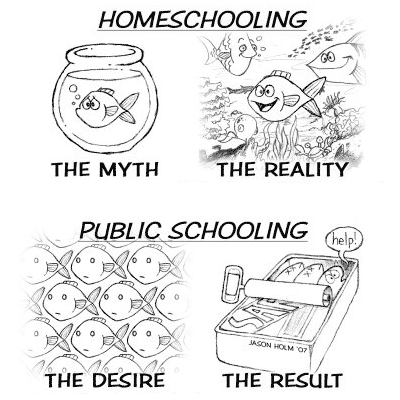
My attitude toward public schooled students was like the comic above. 

was the happy fish, swimming freely, while public schooled students were “locked up” in “government” classrooms, being “taught to be robots,” and were basically brain-dead by the time they graduated, like poor sardines in a can, begging for help!

But it was me that was locked up in a world of prejudice and judgement, shunning people who could have been my friends and who could have opened my eyes to new thoughts and ideas. (Thank God for this awesome public-schooled boy I met in college named Aaron…)

I know that the “us vs. them” attitude of homeschooelers is not dead. I wish it was. Everything I put in quotes in the paragraph under the comic are things I have heard from people I grew up with or from current blogs I have read (usually in the comments section under a controversial homeschooling article).

But when I became a public school mom (an agonizing decision you can read about here), I learned a few amazing things.

My kids are not locked in their classrooms or shackled to their desks (imagine that).

They are not robots, nor are they being taught to be robots (I have a son who constantly reminds me that he has a mind-of-his-own on a daily basis)

They love school and are taught by wonderful teachers who love them.

And, most importantly…

People are people. Not public school kids. Not homeschool kids. Heck, not even private school kids!

No more stereotypes and judgment.

People are people who deserve to be loved and respected for who they are, not judged or discriminated against for the school they attend.

How My Mother Homeschooled Me (Without Screwing Up My Life): Adria Murphy’s Story

Photo courtesy of Adria Murphy.

Adria Murphy blogs at The Still Point. The following post was originally published on her blog on December 7, 2013 and is reprinted with her permission. 

I don’t usually write in reaction to or dialogue with other bloggers. Writing about my own life is emotionally vulnerable, but non-controversial. I don’t blog frequently. When I do write, I do so because I need to say something. But I need to say something right now that is both personal, and possibly controversial.

There has recently been a growing awareness of the devastating problems of abuse and oppression in the conservative Christian homeschooling community, thanks to brave people like my friend R.L. Stollar, a Community Coordinator for Homeschoolers Anonymous.  The stories on H.A. are blood-chilling to me, because they sound so familiar. I knew these people, or people like them.

As I’ve read these stories, I’ve been thinking about my own upbringing in a conservative Christian home. I am not the perfect picture of mental health. I’ve struggled with depression and self-destructive behaviors. I’ve had (have?) my share of identity and image complexes.

Complexes notwithstanding, however, I launched into college and adult life with a strong education, an intact faith, and an overall positive and grateful outlook on my own homeschooling education. So as I read these articles and think about the people I know personally who had horrible homeschooling experiences, I am trying to figure out what made my story different. I have a few ideas.

I do not imagine this to be a definitive or even generalizable list. I am so aware that I grew up in very, very privileged circumstances. I want to write this gently. I want to write in a spirit of gratitude, not out of pride, authority, or judgment.

I want to lend my voice in support of those who have experienced abuse and hardship from the homeschool community.

But the thing I do best with my voice is to tell my own honest story. So that’s what I’m doing. If you are a homeschool parent or considering homeschooling, let me share a beautiful example of wisdom and responsibility with you. If you are someone who has experienced the unhealthy side of homeschooling, I am sorry. I am so sorry. And my prayers are with you. I hope we can make things better.

Before I begin my list, let me describe my background. I was homeschooled from sixth grade through high school graduation, and attended a private Christian school before that. I wouldn’t go so far as to call my parents hyper-conservative, as I am all too familiar with startling extremes more deserving of that title. My parents weren’t trying to marry off my sisters or me as child brides. However, my upbringing was sheltered enough to shock even many of my friends at my conservative Christian university.

I wasn’t allowed to watch Lion King or Pocahontas as a kid, because of the “New Age stuff.” Until I left for college, the only R-rated film I’d seen was Passion of the Christ. I wasn’t allowed to date in high school, and in fact had to ask for permission to date after I was already 18 and in college. I wasn’t allowed to wear spaghetti strap shirts, and sometimes even my tank tops were considered too revealing. I read “I Kissed Dating Goodbye” repeatedly, not only because I was convinced that dating was evil and that courtship was Jesus’ perfect plan for my love life, but because I thought the cute anecdotes about happily courting couples were romantic and even a bit racy. As in, oh my goodness, this is the part where Joshua Harris talks about kissing. Gasp. Giggle.

That’s where I came from. Yet, somehow, I emerged thankful for my upbringing. Given the choice, I’d do it again.

So here is my list. Here are the ways my mother homeschooled me without screwing up my life.

1) She treated homeschooling like a tool, not an agenda.

My mother decided to homeschool my brother, who has Asperger’s Syndrome, when the school system failed to offer a supportive solution for his high IQ and low social skills. She started homeschooling me when I, socially misfit and academically bored, came home from my private Christian school in tears too many times. My two sisters followed suit a year later. However, when my youngest sister showed signs of wanting more social opportunities, my mother put her back in private school. When my brother needed more classroom experience and study skills, my mom drove him to a charter school a few days a week, homeschooling him the rest of the time so he could continue to thrive academically in the most comfortable environment. In high school, one of my sisters butted heads with my mother on academic decisions. Rather than demand compliance, my mother enrolled her in a public high school. Halfway into her second year in public high school, my sister wrote my parents a letter asking if she could try homeschooling again. And they did.

My mom has told me, “It’s very difficult to homeschool a child—especially a teenager—who doesn’t want to be. High school students want and need more autonomy over their education. Some people think that’s a battle you have to win. But I don’t think it’s worth fighting at the detriment of the relationship.”

Because of this continual reevaluation and adjusting of our educational options, at one point my three siblings and I were being educated in four different ways: one in private school, one in public school, one part time at a charter school and part time homeschooled, and one (me) fully homeschooled. My mother homeschooled us, not because she was interested in pushing homeschooling as the only or best option, but only when she believed that it truly was the best option in practice.

2) She made academics a priority.

Not only is my mother a pediatrician, highly educated in mathematics and science, but she is also very knowledgeable about literature and writing. Because of her educational background, my mother not only provided us with a rigorous and fascinating science and math education, she graciously welcomed other homeschooling families to join our academic endeavors. On a weekly and sometimes daily basis, we had “classmates” from other homeschooling families in our dining room dissecting cow eyes and puzzling over trigonometry problems.

However, in areas where my mother felt she could not provide us with a comparable or better education than the private and public schools, she found help. Since she is not fluent in a second language, she hired Spanish tutors for us (and once again invited other homeschooling families over to our house to join our Spanish class). She purchased computer software and videos to supplement—though not replace—her instruction. We utilized distance and online learning programs. She sought out the best.

My mother also made it clear that we would never use the flexible schedule afforded by homeschooling to make academics secondary to our extra-curricular activities. Like many of our homeschooled friends, my sisters and I competed in a national speech and debate league for homeschooled highschoolers. However, we were never allowed to research until our school work on core subjects was completed for the day (the most we could hope for was to work ahead or bargain away our weekends in order to schedule a full day of uninterrupted research). My mother also cautioned against an overly rigorous tournament schedule when she found we were falling behind in our core subject work as a result of too many long, exhausting debate tourney weekends.

We all were involved in athletics and arts, but never to the detriment of our school work. We were all taught domestic skills and were responsible for household chores, but we weren’t expected to be miniature parents. I’ve sewn a few skirts. I’m a reasonably competent cook. That’s about it. Academics came first.

3) She raised her daughters and son with disabilities to have careers.

My mother kind of vetoed my first desired career of International Singing Sensation. In the same breath, however, she warned against hoping to become a stay-at-home mom without a backup plan. “Everyone woman should have a marketable skill,” was her mantra. “You can’t control when you’ll get married. What if you stay single? What if your husband loses his job? Or dies? What if you can’t support your family on one income? You have to have a marketable skill.”

As a physician who gave up a brilliant and beloved medical career in order to homeschool four children, my mother was certainly a fan of stay-at-home moms. I will be eternally grateful for her sacrifice. However, she was also a fan of being realistic. Just because she, by God’s grace, had the financial means and circumstances to homeschool us never meant we should expect the same privilege. She pointed out examples of women in our lives, married and single, who had chosen wise career paths and were capable of supporting themselves and, if need (or desire) be, their families.

At the age of 26, I have never been in a relationship. I could be single forever. But I have a fulfilling career that I love. I shudder to think how my self-esteem would be currently suffering were I waiting on a husband to give me my purpose in life. I shudder to think how I would be affording an apartment of my own right now, had I pursued International Singing Sensation or Rich Husband as my primary provision in adult life.

My brother, meanwhile, just got his first job wrapping silverware at Red Robin. We are so proud of him.

4) She lived like a whole person.

One of the best things my mother has done for her children has been to live like her children are not her whole life. We certainly take up most of her time, and I like to think that we’re the most awesome part of her life. But we aren’t all of it.

Once I came home from college to discover my mother beating on our kitchen barstools with drumsticks. “I’m taking a Taiko drumming class,” she explained. While still homeschooling my youngest sister, my mother has been taking classes on health and medicine in third world countries to prepare her for medical missions trips. She participates in runs and bike races. She takes dance lessons and cooking classes. She calls me to tell me what she’s learning in her Bible studies. She speaks like her world is still getting bigger and brighter.

I believe she loves me unconditionally and deeply. I believe my mother finds joy and fulfillment in parenting. Her dedication and sacrifices attest to this. My mother, however, is also a doctor, friend, chicken enthusiast, poodle lover, thrift store ninja, gardener, health and fitness nut, dedicated church volunteer, and Bananagrams champion. And I am so glad she is all of these things. She sacrificed much—more than most moms, I think, if such comparison be possible or moral. She homeschooled us. She didn’t lose herself in us. Just when I thought she’d poured all of herself into us, she somehow proved that her soul was still individual and exquisite, working out her own salvation with fear and trembling, defining herself by herself and God and not by us. She has never stopped becoming more awesome.

In addition to her insistence on a viable career, my mother’s dedication to lifelong learning and growth and fun have done wonders for my own self-esteem. By behaving like a whole person while unconditionally loving her children, she taught me by example that there is life beyond being a wife and mother, however sacrosanct those roles may be. They are not the entire definition of womanhood—even Biblical womanhood.

My mother has three daughters. We are all conservative Christian women. But we are all fierce.

5) She picked her battles.

This might seem contradictory to the earlier description of my sheltered upbringing, but the truth is that my mom did not micromanage our preferences or choices in many areas.  It’s true that my mother “sheltered” us as kids. However, our dialogues—even when I was young—led me to see that her end goal in doing so was to train our hearts, minds, and habits before entering autonomous adulthood. She didn’t want to control us or turn us into perpetual children. Even when I disagreed with her practices (I remember hours of argument over certain movies or certain boys), her open communication and clear purpose kept me sane. And, true to her word, she recognized and responded to our growing need and merit for more freedom. We not only eventually saw the movie “Lion King,” we saw the live musical as a family.

When discussing my choices, or my siblings’ choices, my mother often said, “If it’s not immoral, dangerous, or illegal, I let it go.” And she did. She has never been the kind of parent who faked superficial approval or “support” when she disagreed with our choices. She’d give advice and make her opinions clear. We’d have long conversations. But she also let go.

When I did end up in a mess because of my choices, she couldn’t be shocked. I could tell her anything, and she never got mad. She never tried to make me feel ashamed. At most, she’d sigh and say to give thanks because things could’ve been worse. And we’d work through it.

Probably the greatest example of my mother’s battle-picking wisdom was when she gave my sister and me the freedom to attend a church of our choice. At one point when I was in high school, my immediate family was spread out over three different churches. Although I knew this was not my mother’s ideal—not only did she dislike the separation in our family, but she had theological and practical issues with the church I was attending—she didn’t insist. She let it go.

Looking back, I realize how untenable her choice might’ve seemed to other conservative families. My mother chose to let us attend a church she didn’t like, recognizing my responsibility for my own soul and placing trust in both God and me to work it out. Far from damaging my spiritual life, her trust—combined with her fervent example of faith and continued encouragement to seek God—prevented me from becoming resentful towards my upbringing and motivated me to earnestly search for truth.

6) She learned, grew, and was willing to change her parenting and teaching practices.

My mother gets excited about learning new things. I cannot count the number of times I’ve heard her say, “I used to think… but I just learned…!!!”

My mother constantly reevaluated our education and family routines, and tried new things. If we complained about a particular curriculum, my mother found something we enjoyed more. If we struggled with a subject, she changed her teaching method. When I was in high school, I wasn’t allowed to have a boyfriend. My youngest sister, currently in high school, has had two boyfriends. She dates with parent approval and supervision (she cleverly jokes about wanting to write a book called “A Homeschooler’s Guide to Dating: Table for Three, Please!”).

A few years ago, my mother called me and asked, “Your sister says you think that not letting you date in high school causes problems with your dating life, now. Do you really think that’s true?” I explained, no, I didn’t think that—well, not exactly… and we talked about the positive and negative outcomes of being allowed to date at a young age.

I will always remember that phone call, because she was willing to initiate a conversation about her parenting choices, and to hear my answers. As she raises my youngest sister and faces many of the same educational challenges she faced with me, she occasionally will ask what I remember of a particular program or educational experience. While her fundamental values have changed very little, my mother is honest with herself and reflective with us about her parenting and teaching.

7) She balanced doctrine with charity.

When my sister and I participated in homeschool debate, we became very analytic about theology and doctrine. The elevated place of knowledge, competition, and piety in the homeschool community was sometimes a deadly combination. My mother recognized the danger in this and did her best to temper it. Although she did support and encourage us in pursuit of Biblical knowledge—ever valuing education and truth—she also cautioned us.

I find it ironic that, in some ways, I was the grumpy fundamentalist in high school, while my mother was the soft voice of moderation. She did her best to check our bent towards theological correctness with love, Christian practice, and relational devotion to God. When I would come home from church with judgmental comments on the sermon, she would remind me to be a charitable listener and learner. “How can you worship when you’re constantly criticizing?” I remember her asking. She was also very quick to remind us not to criticize people in our eagerness to criticize doctrines. She encouraged us to question the motivation of our critical attitudes. She pointed to holy and loving people with limited theological educations.

The older I got, the more I saw, as she had, how theological correctness was used as a pretext for competition and unnecessary division amongst believers. After high school, it was years before I could stomach another conversation about predestination and freewill. Not only was my mother’s attitude godly and loving, but it kept the peace in our sometimes theologically divided household. I can’t imagine the theological brawls that would have occurred in our home, had my mother demanded agreement on every doctrinal point, or not attempted to reign in our zealous debates.

I’ve seen some of my most doctrinally correct and rigid friends—and their hyper-conservative parents—break when their preconceptions about God and reality smashed against tragedy, better arguments, or simply the wear of time. I’ve been there too—nearly. When I ran out of good arguments, though, I still knew God, still knew love, and so I held on. I’ve believed in predestination. I’ve decried it. I’ve attended many churches trying to figure out what this Christianity thing should look like. But I’ve always believed. If not for my mother’s guidance towards love and relationship with Christ, this might not have been true.

But I’ve always believed.

By the way, I let my mom proof-read this post. Her response? She thinks I gave her too much credit. What was she doing when I emailed her? Trying to catch up on sleep in her car between rounds at a homeschool debate tournament, because she woke up at 4:30am. Typical homeschool mom.

Nightmare in Navy and White — Experiencing the Dark Side of ATI: Selena’s Story, Part Three

Screen Shot 2013-11-18 at 12.57.25 PM

Nightmare in Navy and White — Experiencing the Dark Side of ATI: Selena’s Story

HA notes: The author’s name has been changed to ensure anonymity. “Selena” is a pseudonym.

Part Two

Part Three: The Hard Road Ahead

For the first few months, I was a recluse, constantly in my room obsessively praying for God to cleanse me, to forgive me, to surround me with protection from this terrifying world I was thrown into. I was surrounded by a world I had had nothing to do with for these years. I suddenly had freedoms I didn’t know how to handle. I had spent all this time with my every move planned, with every trip to the bathroom a privilege, every little thing a potential reason for shame and punishment. Now the shock was too great.

Eventually, I became suicidal.

I felt I was a failure, I would never be pure. I attempted suicide and my mother sent me to a mental hospital as a last resort. As she had drifted away from ATI’s teachings somewhat, she regained trust in getting medical and psychological help when necessary. Unfortunately, still feeling like the inferior, patriarch-less mother, she leaned on these figures to solve all of our problems and refused to just be a mother to us, unable to handle the responsibility.

At times she would instruct me on what to say when she dropped me off at the mental hospital so that they would admit me as a “danger to myself”, and she didn’t have to deal with me while I recovered from the abuse I had suffered. It was the same problem that had her handing me off to counselors and then Eagle Springs instead of taking time to love and care for me as her child; now the pattern continued to repeat itself time and time again.

My days in the mental hospital were traumatizing as well (the shock of being locked in a facility with people screaming, banging their heads, cursing, being wrestled to the ground and injected with sedatives, and so on is bad enough in and of itself – but here I was with full blown, undiagnosed PTSD, coming from the most sheltered life imaginable straight into this!). But there was one good thing that came out of it. For the first time, when I mentioned very cautiously a small hint of what I had been through, I was told that I had been abused. The counselor worked with me to get me out of my shell, and seemed truly disturbed at my level of trauma.

And for the first time in my life, I got a glimpse of understanding that what had been done to me was wrong.

I went home and began to change. I was an emotional wreck – but for the first time, I was angry, and I was tired of being hurt. Then one day my mother tried to get me to go back to church – the tiny little church we went to full of ATI families. I knew by the way she had been acting that I was likely to be subjected to another series of humiliation, prayers, exorcisms, and so on. And for the first time, something inside me just broke.

Now, all these years I had never truly known the police or CPS could help me; all these years I was told to fear these people, never speak to them, because they might come and get us for being godly homeschoolers. They were our enemy; to us, they were the Romans and we were the suffering righteous church hiding carefully in our own homes. We sent letters of thanks according to Gothard’s teachings – but we were always in this state of fear about the war we thought everyone was waging on believers like us. Now, in the hospital, I had been told the truth: that they could help those who had been harmed. I was told that I had options, if there was abuse in my home.

It really shook my whole view of the world. And I wanted more of this merciful world that I had glimpsed.

Presently, the situation began to escalate. I told my mother I did not want to attend church. She started to grow angry, weeping and yelling, and I knew what it could mean for me. Suddenly, I just looked my mother in the eye, and quietly but confidently threatened to call the police if I had to.

My mother’s eyes filled with shock. She took my sister to church, fearfully avoiding me, and never invited me to church again. I saw through her now, and she could never return me to my naive state again. She knew she had lost me. I was kicked out and sent to live with a relative – who was told a lengthy tale about how rebellious and out of control I had become. I was punished further, but since they worked daily, I was left more or less to myself most days.

And so, at 16 years old, I left ATI.

I was never my mother’s daughter again. They left the cult shortly thereafter, reluctant and angry that I had ruined their happiness again. I would never outlive the title of black sheep. I was able to tell my mother some of what happened before she passed away recently, but it will never truly be resolved.

The rest is history. Raised by a family who was wealthy, my rejection of the cult meant I was instantly plunged into desperate poverty. I spent the next 8 years clawing my way from the brink of homelessness, through a relationship that turned physically abusive (even in retrospect I don’t think I, nor anyone else, could have ever guessed that this guy was abusive, by the way – lest I be lumped in with those stories you hear all the time of abused people jumping from one abusive relationship to the next), past a few brushes with death and finally onto a shred of solid ground. My mother passed away this year; the last of her years were spent spiraling into severe mental illness, paranoia, alcoholism and addiction, and she died suddenly while in rehab.

My siblings have gone on to live the high class life, carefully hiding our family’s dark secrets behind flashy cars, million dollar homes and grand parties. They have long since learned to mimic the abusive behavior of my parents toward me, never really knowing or caring where it began. I have tried to build a life on my own, far away from my family and among kinder people. Circumstances brought me back into contact with a dear friend of mine from when I was young, and today we are engaged and living together in a happy relationship.

Through these years I searched for my own spirituality, and through many twists and turns, I landed somewhere outside the box. I spent years of study simply saying that I was an agnostic; I suppose in a sense that remains true, because I feel that faith is, after all, lacking a certain amount of evidence. Today my faith rests in the wisdom that seems present in most religions and belief systems, and in staying stubbornly aloof from religious control of any kind. I will never believe simply because I’m supposed to again. I will always ask, research, study, seek, and never be too comfortable that I know all the answers. I have settled on a more natural spirituality, and found that in many corners of spirituality I once considered damned to Hell, there are in fact some of the greatest truths I could ever know.

Through the years, I began to listen to secular music, dress normally, and slowly grow accustomed to modern living. Now I can’t see for the life of me what they were so afraid of! I am happier now than I ever was under Bill Gothard’s regime. They promised me freedom, but all I got was enslavement. My life now is true freedom: Responsibility for myself, not for my authorities. To find my own answers, not be forced to believe another’s.

I still suffer from very severe PTSD; I think it’s only to be expected. I’m not sure what healing looks like for this kind of repeated trauma, or if it’s even fully possible; but I try to take it day by day. It’s not the best of endings, but a firm and resolute one.

After all, I’m an “apostate” now – and we never give up!

Matthew and Maranatha Chapman Withdraw from 2014 CHEO Convention

By R.L. Stollar, HA Community Coordinator

As of yesterday, Matthew and Maranatha Chapman are no longer presenting at Christian Home Educators of Ohio’s (CHEO) annual homeschool convention this summer. 

The Chapmans have recently provoked controversy due to increased attention to their advocacy of marrying homeschool girls in their “middle-teens” to older men.

Matthew Chapman was a keynote speakers and his wife Maranatha was slated as a featured speaker. The Chapmans have recently provoked controversy due to increased attention to their advocacy of marrying homeschool girls in their “middle-teens” to older men.

The following statement appeared on CHEO’s convention page as of December 16, 2013 (PDF version):

The CHEO board regrets to inform Ohio homeschoolers that Matthew and Maranatha Chapman have notified us that they will not be attending the upcoming CHEO convention in 2014 as previously planned. The Chapmans deeply desire that all those attending the convention would be built up and encouraged in the Lord, and expressed that they will miss seeing the many friends and acquaintances they made from when they were here several years ago. CHEO appreciates their humble service in ministry and wish for them the best.

CHEO has not specified the reasons for the Chapmans’ change of plans, nor have they made any public comment or statement on the Chapmans’ advocacy of child marriage or whether this advocacy was the reason for withdrawal.