Homeschoolers Are Out: An Introduction

By R.L. Stollar, HA Community Coordinator

*****

“You’re homeschooled? That’s gay.”

I was probably 5 or 6 when a neighborhood kid who attended public school first articulated the idea that me being homeschooled was “gay.” Of course, nothing about my parents’ decision to teach me at home had anything to do with homosexuality. Plus I’m straight. But that’s not what the kid meant, was it?

What that kid meant was that homeschooling was stupid, and stupid things are gay things, thus equating gayness with stupidity. That kid was also 5 or 6. I have not had contact with him since we played games in the middle of our quiet, suburban street in San Jose, California so many years ago. For all I know, he might now be an outspoken straight advocate for marriage equality, or even gay himself. His use of “gay” at the age of 5 or 6 was probably cultural, something he picked up on in school or maybe from a homophobic parent. Pop culture — then and and today — has often associated “gay” with negativity.

As an awkward homeschool kid who had occasional interactions with kids from public schools (we were allowed to play with them after school in our neighborhood), I always encountered one of two reactions from my friends: either (1) homeschooling was awesome to them because they thought it meant we just got to stay home and play video games all day, or (2) homeschooling was gay. I don’t really remember why they would think homeschooling was anything less than awesome (usually I would pretend that, yeah, we did get to play video games all day, just so they would think I was cool). But it’s possible they saw I was a total dork and deduced that, if total dorks are usually called “gay” and I was a total dork who was homeschooled, then homeschooling must be gay, too. That’s kid logic for you. (Ironically, many adults today still use kid logic.)

The numerous times I heard “homeschooling is gay” stick so lucidly to my mind because it was the first time I ever heard about “gayness.” It wasn’t until years later, when I learned from the conservative Christian homeschooling curriculum and worldview programs that homosexuality was evil and political nefarious, that I consciously thought about LGBT things. But from that one moment through probably half way through my undergrad program, both mainstream and homeschool cultures reinforced this idea that “gay” was synonymous with bad.

This idea, this deeply rooted hatred and desire to discriminate, is by no means unique to the conservative Christian homeschool movement. Yes, you have followers of Rushdoony who actively call for LGBT individuals to be stoned. Yes, you have people like Michael Farris who actively campaign against Prop 8 and the simple right of people of any gender to have a foundational relationship based on legal equality. But at the same time, it seems like almost every other day that I read some heartbreaking story of a gay kid in public school who was bullied to the point of suicide. Every time I turn on the radio I hear a hip hop star throwing gay slurs left and right.

The fact is, LGBT individuals face almost insurmountable discrimination and dehumanization on a daily basis. They experience this in their home life, in home schools, in private schools, in public schools, at work, and when they try to do something as simple as hold hands in public at a restaurant.

In creating this week’s focus on LGBT homeschool awareness, it needs to be clear that the pain and hurt that LGBT individuals experience happens universally. It is not unique to homeschooling. Indeed, with the significant amounts of bullying that these friends and peers of ours can experience in public schools, homeschooling can actually be a safe haven. Sex advice columnist Dan Savage minced no words that homeschooling as an educational option could save lives. When a gay 15-year-old boy from La Grande, Oregon hung himself earlier this year on account of being bullied, Savage noted that the boy, Jadin, had begged his parents to home school him to get him away from the cruelty. Savage said,

My heart breaks for Jadin’s parents and I don’t doubt that they’re filled with regret and I don’t want to make their pain worse. But I’m going to repost my advice for parents of bullied gay teenagers because there are other Jadins out there who haven’t harmed themselves but who may be at risk of doing so:

If you know your gay kid is being bullied at his school err on the side of overreacting. Err on the side of doing something drastic. Err on the side of turning your own life upside down. Because you don’t want to find out the abuse was more than your kid could bear when it’s too fucking late to do anything about it.

Straight parents: If you know your gay kid is being brutalized in his school and you’ve complained and it’s gotten worse, get him the fuck out of there. Homeschool him. Homeschool him and sue the school. Move away. Move someplace more tolerant. Move someplace better. If you can’t move away—or if you can’t move right away—send your son or daughter to live with relatives in another city, a better city…. And straight parents? Once you realize your kid is gay—which parents of gay kids usually realize long before their gay kids realize it themselves—take a long, hard look at the community in which you live. Take a long, hard look at the church where you worship. Take a long, hard look at the schools your kid will be forced to attend.

Then decide if staying put is worth your child’s life.

My heart goes out for Jadin, and for every kid that felt or feels so scared of being him or herself that suicide seems the only option. My heart goes out for all the kids that are hiding who they are, because of this fear. Savage makes a really good point, people: when our communities cease to be unsafe, we need to get out. When public schools cease to be safe for bullied LGBT kids, homeschooling can be an ally to the LGBT movement.

That  being said, many of us in conservative Christian homeschooling subcultures know that not all homeschooling communities are safe for LGBT individuals. Growing up gay or trans or even asexual in a world where the loudest voices demonize gay marriage and advocate stoning can be gut-wrenching and brutal. We who have been through this world know the horror stories: the kids that were kicked out of their homes, that were rejected by nearly everyone who knew them, that were forbidden from ever contacting family and friends again.

This week, Homeschoolers Anonymous honors the voices of our LGBT friends and peers. We are giving a platform to the stories of those homeschoolers who weathered the storm: the ones that are still terrified of coming out, the ones that have come out and experienced rejection, the ones that have come out and found acceptance, and the ones that are still processing everything and putting their selves’ pieces back together.

This week is for everyone that has felt different. The L’s, B’s, G’s, T’s, A’s, Q’s — ah hell, this week is for the whole alphabet of humanity!

Homeschoolers are gay. And so many other things, too. And all of us at HA — regardless of our identities and orientations — stand together in solidarity in the affirmation of each other’s humanity, beauty, and worth.

*****

Update, 05/21/13:

The heart and soul of this week’s LGBT homeschool awareness series is to stand in solidarity with our friends and peers of all sexual identities and orientations. I came up with the title, “Homeschoolers Are Gay,” based on consultation with some personal friends who are LGBT homeschoolers. The goal was to use a title that was inclusive, catchy, and poked fun at pop culture’s perjorative use of “gay” and tendency to otherize. That being said, a concern was raised yesterday that this title can feel alienating to some members of the LGBT community. And if even one person feels alienated, that is one person too many. The whole purpose of this week is to include everyone.

So, after further consultation with several of this week’s writers, I am choosing to rephrase this week’s series as “Homeschoolers Are Out.” I would also like to stress that, whenever I say “LGBT,” I am not limiting the week to those specific letters. All identities and orientations are welcome. I will be changing the main graphic for the series to reflect this rephrasing.

My sincerest apologies to anyone that felt excluded.

On another note: thanks, everyone, for the amazing support yesterday as this series begins. The stories we will be hearing this week are near and dear to my heart, as they are the stories of people I care about and love.
The Importance Of Telling Your Own Story: Faith Beauchemin’s Thoughts

The Importance Of Telling Your Own Story: Faith Beauchemin’s Thoughts

The following piece was originally published by Faith Beauchemin on her blog Roses and Revolutionaries. It is reprinted with her permission.

"Story-telling is empowerment."
“Story-telling is empowerment.”

Story-telling is one of the most powerful forms of sharing truth known to humankind. A story can contain so many different kinds of truth.  A story sticks in the mind longer than a syllogism or a propositional truth claim. And the thing about stories is, we all have one.

Sometimes it takes courage to tell your own story. But it is necessary. If you don’t tell your story, chances are someone else will. And whoever tells the story gains power over it. Do you want someone else’s words expressing your personal experiences, or do you want to choose the words of your story yourself?

A couple of months ago, I came across a blog called Homeschoolers Anonymous.  It’s a forum for homeschoolers to tell their own stories.  I began reading story after story, constantly finding mirrored there many of my own experiences.  The stories told tales of spiritual, psychological and physical abuse.  They spoke about the harm of authoritarian parenting, the fact that lack of socialization really is a huge problem for homeschooled children, the pain and regret and family rifts that result from many doctrines pushed by the radical right-wing arm of the homeschooling movement.  Reading these stories I felt angry.  I cried for all of us, for the suffering and for the fact that so many of us were moving on and finding healing and somehow building lives for ourselves.  And most of all, I felt an overwhelming sense of relief.  I am not alone.  We are not alone.  We speak of our personal experiences and find common ground in the very wounds and burned-over fields we had thought no one would be able to relate to.

It was so comforting to find others telling stories similar to my own because I find that I have trouble taking control of my story, even in my own head.  You see, when you grow up in a hierarchical, authoritarian Christian fundamentalist environment, you have a single narrative which your interpretation of your experiences must fit into.  That narrative is reinforced over and over again, especially since many fundamentalists are very quick to talk about other people’s lives or tell you about your own life using these terms.  “Sin,” “rebellion,” “pride,” “selfishness,” “ungodliness,” “worldliness,” “backsliding”…these are the categories I had to fit everything into if it was not in line with my parent’s ideals for the perfect Christian life.

In an authoritarian home, you’re not allowed power over your own story.  You are handed the words of an authority on all matters and you must accept them as true.  Thinking for yourself is sinful.  This is why it has taken me a long time to start framing my story in my own words.  I can see the transition in my diaries, from stilted descriptions of spiritual things which sound like they are just someone else’s words parroted back to convince myself,  or endless agonizing about why I was so sinful, to finally taking my own thoughts seriously and using words that came from my own head to describe my life.

A diary is one thing.  The residual voice in my head narrating my life in Christian fundamentalist terms can be ignored, or argued with, or told to shut up.  But sharing your story out loud is an entirely different matter.  Because when you finally do gather the courage to share your story out loud, most people want to tell you that you’re wrong, and that their interpretation of your life is truer than your own.

These homeschool alumni who bravely shared their stories are being criticized.  Homeschool advocates are trying to negate the stories collected at Homeschoolers Anonymous by claiming “My homeschool is never like that!” or “Your parents didn’t homeschool the right way.” or “Your current viewpoints are proof that your parents never taught you the things I’m teaching my kids.”  Even well-documented claims that the Home School Legal Defense Association is fighting for a parent’s-rights agenda that will be extremely conducive to child abuse are written off by a simple assertion that it’s just not true.

It’s incredibly frustrating seeing this happen. I am willing to hear parents tell stories of how great homeschooling is for their kids (though I’d be much happier to hear young adults who grew up homeschooled tell stories of how great it was, since the players in the conversation are mostly not parents and we’ve already heard from our parents countless times how good they believe homeschooling is). But I am not willing to hear anyone try to negate these stories of how bad homeschooling has been for so many people. I’m especially not willing to hear stories of outright abuse be dismissed with basically a pat on the head and an assertion that the survivor’s experience is totally unique.  If we want to dialogue constructively on a topic, we need to first allow one another the basic respect of listening to each other’s stories and believing them.

One more thought on story-telling. I don’t like hearing an authority figure telling a story about or on behalf of those they have authority over.  I don’t care what the authorities think, I want to hear the people’s stories from their own mouths.  Because story-telling is empowerment.  You want to empower yourself, of course, but you need to empower others as well.  If we all bravely commit to telling our own stories and listening to other people’s stories, we might together be able to find the next steps in human progress.  Whatever our past, there’s something in each of our life stories that can make the world a better place if we speak it and collaboratively explore what it is we have to tell.

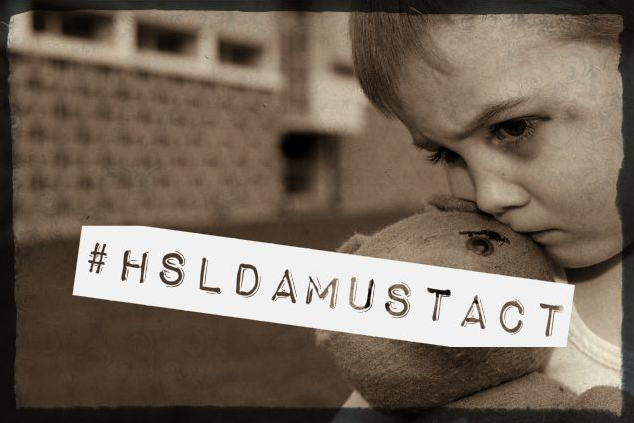
#HSLDAMustAct: History and Related Media

Screen Shot 2014-06-26 at 1.20.57 PM

April 17, 2013

On April 17, Love Joy Feminism’s Libby Anne — a former homeschool student, former attendee of Patrick Henry College’s summer camp on Constitutional Law taught by Michael Farris, and now-parent of two children; also, one of HA’s blog partners — began a five-part series looking at the relationship between HSLDA and child abuse. Of particular concern to many people who have read this series is that HSLDA has slowly but surely moved from homeschool advocacy to — by their own admission — reform of child welfare laws, including opposing anonymous tips, mandatory reporting, and mainstream definitions of child abuse. The five parts to this series are: (1) HSLDA and Child Abuse: An Introduction; (2) HSLDA’s Fight against Child Abuse Reporting; (3) HSLDA’s Stonewalling of Child Abuse Investigations; (4) HSLDA’s Defense of Child Abuse; and (5) HSLDA and the Deregulation of Homeschooling. Part five of the series was published on April 24.

April 20, 2013

The blogger from the Eighth and Final Square, inspired by Libby Anne’s series on HSLDA and child abuse, writes a post about her own homeschooling experience. It is entitled, “we were taught to fear the people who could help.” The author says she, too, was “instilled with a fear of CPS.” As a survivor of abuse herself, she says, “I wonder what would have happened if HSLDA wasn’t around, and the kids had been allowed to talk to CPS workers alone.”

April 22, 2013

Homeschoolers Anonymous started crossposting Libby Anne’s series on HSLDA in conjunction with a week of personal stories that explored the relationships between homeschooling, HSLDA, and the CPS: fears of the CPS, failures of the CPS, and how the CPS could have actually helped those who suffered abuse in homeschooling.

April 23 – May 2, 2013

After finishing her series on HSLDA and child abuse, Libby Anne continues to focus on issues of homeschooling, abuse, and HSLDA. She creates a legislative alert about one of HSLDA’s legislative alerts, urging people to counteract HSLDA’s efforts to stop SB 32, a bill “designed as a way to monitor and protect the well-being of children who are known to be at risk for child abuse or neglect based on prior incidences.” She argues that it is “simply false to suggest that there is nothing about homeschooling that might be attractive to neglectful or abusive parents.” She cites a plethora of horrific stories to explore the idea that, while “most homeschool parents are dedicated, responsible and loving,” “when abusive parents homeschool, the consequences for their children can be absolutely disastrous.”

May 6, 2013

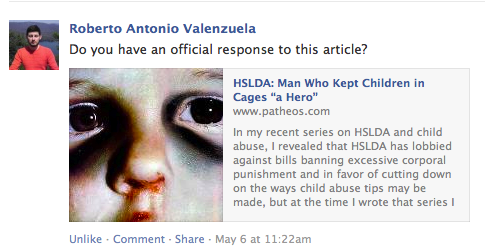
On May 6, Libby Anne writes a post entitled, “HSLDA: Man Who Kept Children in Cages ‘a Hero.'” In this post, she points out that Scott Somerville, an HSLDA attorney, called Michael Gravelle, a man charged with molesting his biological daughter, putting his adopted kids in cages, and later punching and shaking his own wife, a “hero.”

Later that day, someone posts Libby Anne’s article on HSLDA’s wall:

Picture 12 May 7, 2013

The very next day after someone posts Libby Anne’s article on Somerville’s hero comment on HSLDA’s Facebook page, HSLDA chooses to respond via a Facebook status:

Picture 13

The full text of their response is as follows:

It has come to our attention that HSLDA has recently been accused of condoning child abuse. HSLDA does not and will not ever condone nor defend child abuse. 

HSLDA receives hundreds of calls each year from parents who are under investigation by CPS, often based on false, anonymous, trivial, or malicious reports. The vast majority of these are determined by CPS or a court to be unfounded and are dismissed. Because of this, we do not immediately assume that everyone who is the subject of an investigation is guilty of child abuse or neglect. 

As a service to our members, we help homeschool families navigate the legal landscape in the early stages of an investigation before all the facts come to light. This could include helping families know their constitutional rights, helping them understand the legal process, or referring them to a local attorney. If the allegations include homeschooling, we generally will either assist their local attorney to defend homeschooling or represent the family on homeschool matters.

Of the three examples mentioned in a recent article, we did not represent two of the families and in the third we were involved on the question of homeschooling alone after the other issues were resolved by the court. 

We believe that every child deserves a healthy upbringing and that parents have the high honor and duty to meet that child’s needs. For 30 years we have been zealously advocating for the right of thousands of parents to responsibly homeschool their children. To the extent that any statements we may have made could be misunderstood to suggest that we condone the abusive actions of some we repudiate them wholeheartedly and unequivocally.

Libby Anne promptly responded to HSLDA’s response: “I’ve Had Enough: My Reply to HSLDA’s Response”.

Also in response to HSLDA’s response, R.L. Stollar, co-creator of Homeschoolers Anonymous, issued a challenge to HSLDA on their Facebook page: “HSLDA, will your leaders take a public and universal stand against child abuse and launch a public awareness campaign for your members on how to recognize and report child abuse in homeschooling?”

Stollar’s challenge to HSLDA was quickly mirrored by others. Heather Doney, one of HA’s blog partners, wrote, “Demanding an Answer from HSLDA,” where she says, “We deserve to know where the HSLDA stands. We deserve to know that they are thinking about this issue and that they are doing something about it. I, for one, am requesting an answer. Don’t make us wait too long, HSLDA.”

May 7 – 11, 2013

Homeschoolers Anonymous officially launches the #HSLDAMustAct campaign on May 8.

Rebecca Gorman, a former homeschooler, creates the official Change.org petition for the #HSLDAMustAct campaign.

A new website, Homeschooling’s Invisible Children, was launched by former homeschoolers to “to raise awareness of the horrific abuse and neglect that can take place when unfit caregivers use homeschooling as a cover for criminal child maltreatment.”

On May 9, HA announces the official petition in the post, “25 Reasons To Sign The #HSLDAMustAct Petition.”

Here is a full list of posts from bloggers covering the whole Libby Anne/HSLDA issue and the #HSLDAMustAct campaign since May 7:

Wide Open Ground: “Dear HSLDA and Homeschool Parents, What About My Friend Who Died?” and “HSLDA: Discourse Problem Between Fundamentalist and Outsiders”

Anthony B. Susan: “The HSLDA and Abuse: More Denial and Deflection”

Becoming Worldly: “S***t HSLDA’s Homeschool Parents Say”

Ramblings of Sheldon: “HSLDA: We Would Rather Stand Behind Abusers Than Their Victims”

The Home Spun Life: “Homeschoolers, Christians, HSLDA: We Must Do Better, Kids Are Being Abused”

No Longer Quivering: “Petition: HSLDA Address the Problem”

ThatMom: “HSLDA accused of turning blind eye to child abuse: you decide”

Kathryn Brighbill: “HSLDA and Child Abuse” and “Of Fundamental Rights, HSLDA, and Homeschooling”

Anonymous Wonderings: “On Homeschooling”

On May 10, the Christian Post took on the issue but framed it only as a Libby Anne vs. HSLDA issue: “Home School Legal Defense Association Accused of Protecting Child Abusers.” The Christian Post did not attempt to contact Libby Anne; they tried to contact HSLDA, but HSLDA did not respond. They also did not mention the petition.

May 12, 2013

As of Sunday, May 12, the #HSLDAMustAct petition has over 300 signatures from around the world. The signees are almost entirely from the homeschooling community itself. Former homeschool students, former and current members of HSLDA, and former and current homeschooling parents have all signed it. Signees are from everywhere from California to Louisiana to Pennsylvania, from the U.S. and Canada to Germany and Spain.

Also as of Sunday, May 12, HSLDA has still not responded to the #HSLDAMustAct campaign.

Conclusion

We will leave you with these thoughts from Lisa from The Home Spun Life:

“I have been a financial supporter of HSLDA for many years now and I am asking that they become more transparent with how they practice law, how they defend homeschooling, AND how they protect children in a homeschool that is abusive.

I know children are abused in a variety of types of homes. From poor to wealthy, from Christian to atheist, from public school to homeschools. Abuse happens. It’s tragic! We can’t only speak up about abuse when it happens in a public school. We have to speak up no matter where it happens. And we have to learn how NOT to respond to abuse allegations in the homeschool community.

Defending our freedom to choose our children’s education should never trump their freedom to live in a healthy and safe environment.

To the HSLDA,

As a supporter of yours, I am asking for you to clarify your mission to defend homeschool freedom. I am asking that you inform us and SHOW US how you are defending this freedom WHILE defending children in an abusive homeschool environment. HOW do you separate the defense to protect homeschool freedom WHILE NOT enabling abusive parents to further their abuse under your “protection”? HOW are YOU holding abusive parents accountable? HOW are YOU cooperating with local authorities to HELP victims?

We must do better. We must speak up.”

This Isn’t Just A Few Disgruntled People

HA note: The following is reprinted with permission from Kathryn Brightbill’s blog The Life and Opinions of Kathryn Elizabeth, Person. It was originally published on May 9, 2013 with the title “HSLDA and Child Abuse.”

"HSLDA needs to see that this isn’t just a few disgruntled people but that the homeschool community as a whole believes that it’s time for them to do something about this."
“HSLDA needs to see that this isn’t just a few disgruntled people but that the homeschool community as a whole believes that it’s time for them to do something about this.”

I’ve made no secret that I don’t exactly have the most positive opinion about the Homeschool Legal Defense Association’s brand of religious fundamentalism but I never thought that HSLDA was covering for and protecting child abuse. For all of their scare tactics, and for as much as I think that a legal defense organization is unnecessary in a post-Tim Tebow world, I always assumed that the training-up-the-next-generation-of-culture-warriors aside, it really was just about keeping homeschooling legal. That if they were representing a family, it was because the family was wrongly accused.

I found out recently that I was completely wrong.

HSLDA is pursuing a course of action that is helping to protect child abusers while doing nothing to protect kids.

Blogger Libby Anne at Love, Joy, Feminism, herself a K-12 homeschool graduate, has a series of posts exploring HSLDA and child abuse. It’s a long read but I encourage you to take your time to go read it all, it’s an informative series and it opened my eyes as to just how out there HSLDA really is on this.

Seriously, go read it, I’ll wait until you get back.

Have you read everything?

Good, let’s continue.

On Tuesday, HSLDA posted an indirect response to Libby Anne’s series by way of a message posted on their Facebook page. Their response is basically a bunch of buzzwords and denials that doesn’t address any of the actual allegations. Libby Anne responds here.

I had no idea about what HSLDA was really up to and my memories are filtered through the eyes of a homeschool kid reading the Court Report. I rather suspect that this is news to some of the people reading this as well. It makes me mad because this organization that I thought was there to protect homeschooling has ended up protecting abusers. They’d trot out the “success stories,” but they only ever care about the kids if the kids are making them look good. They don’t actually care about the safety and well-being of homeschooled kids, or if they do, their actions are an awfully funny way of showing it.

And here’s the thing.

The advice that HSLDA gives about not letting people into your home without a warrant, not talking without an attorney present, the whole nine yards, is absolutely the right legal advice that attorneys should be giving their clients. The question though, is why is HSLDA even getting involved in child abuse cases? Unless they think that parental rights and homeschooling include the right to lock your kid in a cage or beat, oh sorry, they call it spanking, your kid until you leave bruises and welts, just because a family homeschools shouldn’t mean that a child abuse investigation is automatically a homeschooling issue. HSLDA shouldn’t even be getting involved until the abuse investigation is resolved. And yet, when a friend sent me the link a few days ago to the story of a parents that beat their children until they broke bones and told me to, “prepare to raeg,” I wasn’t the least bit surprised to find out that HSLDA had represented the parents and claimed to World Net Daily that it was social workers persecuting a good Christian homeschool family.

Defending homeschooling should not mean defending abusers. That should be obvious, but apparently it’s not.

I would argue that if you really want to protect the ability to homeschool, making it clear that the homeschool community has a zero tolerance stance towards child abuse is the best way to do it. If HSLDA’s behavior in abuse cases ends up becoming synonymous in people’s minds with homeschooling, then any parent who decides to homeschool is going to be considered suspect. The best way to protect homeschooling is to stop covering for abuse and to make it clear that it will not be tolerated. Covering it up, denying, and stonewalling protects no one but abusers.

Because of this, I am joining with Homeschoolers Anonymous in saying that #HSLDAMustAct. HSLDA needs to stop covering for abusers, they need to acknowledge the problem, and they need to implement an education program to teach their members how to recognize abuse. Instead of instilling so much fear in families about child protective services that people are afraid to call, they need to educate families that abuse can happen in even “good Christian homeschool families” and that child protective services is there to protect kids in those circumstances.

It is high time for HSLDA to take proactive steps to combat abuse.

If you agree that HSLDA must act, add your name to the petition. HSLDA needs to see that this isn’t just a few disgruntled people but that the homeschool community as a whole believes that it’s time for them to do something about this. If you’re a homeschool parent, we especially need you to add your name to the list of people calling them to act. And while you’re at it, I’d strongly suggest considering cancelling your membership. If their complicity in abuse starts hitting them where it hurts—their pockets—they’re going to be more willing to act.

25 Reasons To Sign The #HSLDAMustAct Petition

25 Reasons To Sign The #HSLDAMustAct Petition

Please sign the #HSLDAMustAct petition on Change.org!

Yesterday we issued a challenge to HSLDA to commit to taking concrete steps to address child abuse in homeschooling. Specifically, we called for HSLDA, the public face of American homeschooling, to launch a public awareness campaign to fight abuse within our homeschooling communities.

We have an official petition hosted on Change.org. Please sign it and share it with your friends in person, through email, and via social media sites like Facebook and Twitter.

You might wonder, why should I sign this petition? To answer this question, we would like to share 25 reasons for doing so that were publicly posted on our petition’s page by signees. They come from all over, from California to as far as Germany. They are former homeschoolers, former employees and members of HSLDA, and homeschooling parents. These voices are growing by the day and they need to be heard.

So without further ado, here are 25 reasons to sign the #HSLDAMustAct petition:

*****

Sarah, UNIVERSITY CITY, MO:

This is important to me because I too was an extremely neglected and physically and emotionally abused homeschooled child.

Emily, APO, GERMANY:

As a former employee of HSLDA I am disheartened and sickened to hear of the child abuse cover ups and ignorning blatant neglect of children. This is deeply saddening to me.

Julie Anne, RICHLAND, WA:

Because it’s the right thing to do!

Jessica, BONNY DOON, CA:

I am a survivor of childhood abuse and worked in the field for years- My care goes deep, esp. when children are manipulated about the soul’s deep need to have a relationship with spirit, True Nature – God – by parents, ministers etc who use this need to abuse and distort children’s relationship with themselves, with God or no God.

Samuel, HUNTSVILLE, AL:

As a former homeschooler who did NOT deal with abuse firsthand, I DID witness how the “homeschool community” worked together to hide abuse that was occurring in families within its midst.

Ryan, SPRINGFIELD, OR:

Abuse happens everywhere, and this includes homeschooling families. HSLDA, the public face of homeschooling in the U.S., should make a public and principled stand against it.

Wesley, GRANADA HILLS, CA:

As a homeschooler who befriended children of two abusive homeschooling families, I know that these problems exist and must be addressed. Child abuse, both physical and (perhaps predominately) psychological, is a major problem in homeschooling circles and must be addressed. Parents who abuse their children do not deserve to be legally shielded from the state.

Matthew, COLORADO SPRINGS, CO:

I was a homeschooler, and I’m against child abuse!!!

Alessandra, ROANOKE, VA:

As someone who was homeschooled through highschool, and involved in HSLDA growing up, it’s important that whilst preserving the ability to homeschool, those involved in it not turn a blind eye to abuse and neglect. Fixing that problem needs to start from within the “homeschool movement.”

Mari, WATERTOWN, SD:

I was homeschooled which gave my parents numerous opportunities to abuse me. Homeschooling could be a great thing — but ONLY when it is done in a public manner and ONLY when parents are held accountable for their actions.

Sarah, OVERLAND, MO:

I am so torn about this. As someone who was homeschooled K-12 and homeschools my own children, I am a huge advocate for homeschooling rights and the ability to choose our own curriculum and such. But as a foster parent, I’ve seen abuse. I have friends who have suffered abuse. We cannot protect any abuser, and while I believe in “innocent until proven guilty”, we should not be allowing child abusers to continue homeschooling their kids when we would be fighting for removal of these kids for any other parent. I’ve seen abused kids going back to their abusers. I can’t imagine how it would feel if they were also allowed no escape from the abuser to even go to school. This is a very slippery slope as CPS is called for things like not vaccinating, but it does worry me when people don’t do basic doctor visits under the guise of “autonomy”. I know from experience that most cases of abuse are discovered at school and at dr visits. If we have nothing to hide, then we cannot be defending abusers.

Kierstyn, FREEPORT, ME:

As an ex-homeschooler raised in an abusive family who *are* still members of HSLDA, I’m tired of abusers being defended in court because “homeschooling” couldn’t possibly have anything wrong with it.

Chandra, FESTUS, MO:

It is morally repugnant and hypocritical that an organization that claims to defend parents right to educate their children (predominantly for religious purposes), will not address nor speak to the atrocities and abuses that occur because of the lack of oversight on parents who chose such an option. HSLDA, though in their statement has said, “We believe that every child deserves a healthy upbringing and that parents have the high honor and duty to meet that child’s needs;” will not define abuse, nor have they ever in their 30 year existence ever condoned or supported a piece of legislation that would provide protections for children and thereby recognizing that there are abusive (and even deadly) cases that have occured in the name of home schooling. In a country whose very freedom HSLDA touts, will not grant these same freedoms to the youngest and most vulnerable citizens of this great nation. It is time for a change. This is a human rights issue, and we will not be silent until we have seen such change take place.

Catherine, ALEXANDRIA, VA:

My parents abused me emotionally, physically, and spiritually for 18 years. Because I was homeschooled, they were able to do so constantly and could control every detail of my life. I’ve stayed silent for far too long, and there are many others who want to have a voice, but they are being silenced by their abusers–their parents. It’s time to shed some light on the dark side of homeschooling.

Hannah, MURRAY, NE:

As a former homeschooled student K-12 who was abused, I felt no protection and was told I should not report abuse to authorities, because my parents were told never to talk to CPS or the police by HSLDA. Now a mother, I realize the necessity of accountability for parents, including myself.

Kathryn, GAINESVILLE, FL:

As a homeschool graduate, I believe that it’s high time that HSLDA stop covering for abuse and neglect. It’s time for them to develop an abuse prevention program and to stop pretending this is not a problem.

Cheryl, ALEXANDRIA, VA:

I have spent the last 10 years of my adult life recovering from being given a tool box that does not fit in the world we live in. Scripture should never be used to oppress or to shield abusers. Stand up for the innocent, the children. It’s what Jesus calls us to.

Jai, CHARLOTTE, NC:

I was raised homeschooled. My parents were long time HSLDA members and all of us suffered severe spiritual abuse as well as mental abuse and the problems of the Quiverfull movement. I support this petition and ask that HSLDA school members in the definitions of abuse, child rights, and put forth a system for stopping it and reporting it when it occurs.

Shaney, AUSTIN, TX

As a former homeschooler, I’m appalled at HSLDA’s willingness to ignore, and even indirectly promote, child abuse. This needs to stop.

David, BEAVER FALLS, PA:

I was homeschooled and while I certainly did not live in fear of abuse, I also believe it’d be easy for negligent and abusive parents to go under the radar.

Scottie, TULSA, OK:

I have several friends and even family members who work with Child Protective Services. The information and advice HSLDA spreads in a nominal attempt to help homeschooling families defend their rights in reality only hurts their cause in the long run. Fighting CPS at every turn gives homeschoolers a bad name and makes it extremely difficult to investigate cases of actual abuse. HSLDA should be working WITH CPS and similar agencies to help root out ACTUAL cases of abuse whenever present, refuse to defend or speak well of parents who DO abuse their children, and recognize and communicate that some families SHOULD NOT homeschool their children, at least not without significan oversight and accountability.

Rachel, BLOOMINGTON, IN:

As a homeschooled child growing up, I bought the HSLDA line that Child Protective Services were out to take me and my siblings away from my parents because they were Christian homeschoolers. As a teen I read Michael Farris’s book, Anonymous Tip, which only cemented this fear. Teaching children that those who want to help them are actually out to hurt them is actually a tactic child abusers use to keep their victims under their control, and yet that is the message HSLDA gives to homeschooled children. For shame, HSLDA. For shame.

Naomi, FULTON, MO:

Even if 99% of homeschooling families were functional and happy, HSLDA must do something about the 1% where children are neglected and abused. To do otherwise is to be complicit with the crime and to send a message that HSLDA cares more about power than it does about children.

Scarlettah, LOS ANGELES, CA:

There are growing numbers of former homeschoolers telling of their abusive experiences enabled by the lack of internal and external awareness of and interest in keeping kids safe. There is a vacuum created when parental rights are preserved and elevated to the exclusion of children’s rights. Please work to protect these children, not just their parents.

Rebecca, LOS ALTOS, CA:

As a homeschooled student, I experienced and observed this problem first hand. My parents (and the rest of my homeschooling community) knew of at least one homeschooling family that had rather extreme abuse, but didn’t dare report it because of the message they received from HSLDA not to involve the government, lest it bring any additional oversight of homeschooling families. I believe that every child deserves to have their humanity respected and honored. HSLDA, stand up for children and stand up to abuse.

*****

Thank for your support thus far. Please continue to bring awareness to this crucial matter. Make your voice known on HSLDA’s Facebook page. Tweet HSLDA at @HSLDA with the tag #HSLDAMustAct.

Together, we can make homeschooling better.

Making My Own Way: Matthew’s Story, Part Two

HA note: The author’s name has been changed to ensure anonymity. “Matthew” is a pseudonym.

*****

In this series: Part One | Part Two

*****

High School Years

My first year in high school was wonderful for me. Finally, I was out of the house! I made friends and felt like I could finally breathe. I won’t go into great detail about my high school experience, since that isn’t the point of this story. However, I will point out a few things that I noticed over those four years:

• I discovered that I had a real problem with social anxiety. I’m not sure if this is hereditary or caused by my childhood. After reading some of the stories on this site, I’m thinking that it was a little of both.

• I was plagued by feelings of inadequacy. I thought I was not good enough, smart enough, athletic enough, witty enough… none of it. I did come to the realization that there are things that I’m good at, but it took years. In high school, I wound up trying everything since I had no idea where I fit in – I’d never had other kids around for me to gauge my own ability.

• I was plagued by guilt. Even if I hadn’t done anything wrong, I was often overcome by guilt over my (imagined and real) transgressions. This tied a lot into the messages we were receiving at church, which at this point were downright toxic.

• I had little-to-no self-confidence. As a homeschooler, you become so used to your parents’ authority, that you don’t really know how to make your own decisions, or when you do, you constantly second guess yourself.

So while getting out of the house was a welcome relief, I still felt like I was trying to overcome my upbringing.

At Home – Part 2

While I was off enjoying my high school experience, the “shit was hitting the fan” at home… oh, and how! My oldest younger sister had started hanging out with this girl she met at the homeschooling coop, and they decided they weren’t going to let being at home slow them down. I noticed one night that my sister and this girl, who was sleeping over, were acting really strange and goofy. Turns out, they were drunk! But how did they get the alcohol? After all, my parents didn’t drink. I later learned that my 12-year-old, shy-as-can-be sister stole it from a convenience store!

For my little sister, this would kick off what would become a six year blur of cigarettes, alcohol, promiscuous sex, drugs, and whatever else. To this day, I am convinced that the combination of home schooling and extreme Christian Fundamentalism destroyed her confidence. I remember her telling me, at 11, that she had given up and could never live up to the standard — I really think that she cracked under the pressure of that atmosphere.

She got pregnant at 17, got married, moved out, and hasn’t had issues with drugs or alcohol since. She and her husband now have 5 kids, all of whom are in public school, and her oldest daughter (13) is an exemplary student. All of her kids appear to be doing well.

Because of my sister’s meltdowns, I ended up getting away with a lot that I probably wouldn’t have otherwise. So in a roundabout way, I owe her a “thanks” for taking the pressure off me and humbling our parents. I did take advantage of her recklessness and flew under the radar as I started drinking at 15.

College

The drinking continued on into college. I could never shake the idea that I wasn’t good enough and that I was in a perpetual state of sin, so the alcohol helped me to ease the anxiety and mentally “check out” for long periods of time.

Then I’d get sober, feel horrible, and go cry to my Christian friends about how I was going to hell. My secular friends would shake their heads and wonder why I was so conflicted. This pattern continued until I got sober at about 26 years old.

Other things happened in college as well. My drinking habits combined with my lack of any sort of sex education made me a sitting duck when it came to STDs and unexpected pregnancy.

But despite all that, I managed to graduate.

Adulthood

Today, I don’t harbor any resentment over my upbringing, as I realize it could have been a whole lot worse! There were actually several good things that came out of it:

• Since much of my learning was from reading books and not in the classrooms, I’m very good at figuring things out on my own. This has been a very beneficial skill to have as an IT specialist.

• I don’t mind being alone. This is something I’m starting to see as a blessing. During my four year marriage (yes… I’m divorced) I was miserable most of the time. I always had to come home to a spouse who was either angry with me or trying to drag me to some function that I didn’t really feel like attending. Once I realized that marriage is not for me, I’ve been able to enjoy being a single dad, making my own way. Since as a kid, I often went out and about to do things on my own, it isn’t really much of an adjustment to do things and go places on my own today. I don’t need a large social circle.

• I’ve seen the damage that religious extremism causes and I can spot the warning signs a mile away. While I still attend church, it’s a seeker-sensitive, theology-lite congregation that just loves everyone. I take my kids on the weekends when I have them, but I don’t preach at them. Their faith is between them and God. I expect them to make mistakes and refuse to hold them to a higher standard than the one I hold for myself. I have no idea if God is real or if the Bible is completely true. If he is and his word is true, then I’m sure he’ll get my attention one way or another. But after years of unanswered prayers, a failed marriage, kids from multiple relationships, and alcoholism, I find it hard to believe that he is actively involved in our lives.

• I witnessed first-hand the despair and hopelessness of many disillusioned homeschooling parents. These are people who, by and large, poured their hearts and souls into raising Godly men and women. Seeing this convinced me that it’s best to adopt a “live and let live” parenting model and to love your children unconditionally! Even if my son winds up marching in the local gay pride parade with his boyfriend and my daughter ends up working overtime at the Diamond Club, I will still love them and welcome them in my home with open arms. Life is too short for fallouts over lifestyle choices.

Summary

Homeschooling was really just one piece of the whole dysfunctional puzzle. I’m sure that if other factors had been different, but I was still homeschooled, I might feel differently about it than I do now. That said, it is very encouraging to read accounts from other homeschoolers to confirm that many of my experiences are shared by others.

End of series.

Fighting Abuse Together: #HSLDAMustAct

Fighting Abuse Together: #HSLDAMustAct

By R.L. Stollar, HA Community Coordinator

Please sign the #HSLDAMustAct petition on Change.org!

Homeschoolers Anonymous is made up of a diverse group of people. We don’t really have a “thing” that we all agree on other than this: we have seen or experienced harm within the conservative Christian homeschooling movement and we think those stories should be told. The truth should be known.

The people involved with HA are not homeschooling’s worst nightmare. Rather we are its internal whistleblowers. We are all intimately aware of the problems in homeschooling because we were there. We’re former homeschool kids, former homeschool parents, and even current homeschool parents.

We know how unpopular it is to say, “Hey, I have some problems with homeschooling,” but we care about raising awareness so people can address the issues, make things better, and begin to heal. The first step is recognizing that a problem exists.

The Homeschool Legal Defense Assocation (HSLDA) made a decision yesterday. That decision was to respond via Facebook status (screenshot is here) to criticism from a former homeschooler who has been researching the impact and goals of HSLDA advocacy. This former homeschooler, Libby Anne (a blog partner of HA), came to the conclusion that HSLDA has not handled the issue of child abuse within homeschooling environments appropriately. Instead of responding to allegations of child abuse responsibly, HSLDA passed off these abusers as wrongly “persecuted” Christian homeschoolers.

These allegations are serious. When talking about Michael Gravelle, a man charged with abusing his biological kids and then putting his adopted kids in cages, Scott Somerville — an HSLDA attorney — called him a “hero.” This fact was documented by the Akron Beacon Journal and the Journal article has been preserved.

As if this was not enough, before this abuse case with the cages, Michael Gravelle had sexually molested his biological daughter, who ran away from home at age 16, which she personally disclosed in an interview. After the abuse case, Michael Gravelle punched and violently shook his wife. He was charged with domestic violence. Then a warrant was issued for his arrest because he failed to show up to his court hearing. Then Michael and his wife (not surprisingly) filed for divorce.

A man who molests his own daughter, puts his adopted kids in cages and shoves their faces in toilets as punishment, and then beats his wife is a “hero” to an HSLDA attorney?

With heroes like this, who needs villains?

Somerville made a massive error in judgment in calling this man a hero. If HSLDA does not condone child abuse, they should 100% condemn what Somerville said, and as directly as possible. At the very least. However, HSLDA said, “Any statements we may have made could be misunderstood to suggest that we condone the abusive actions of some we repudiate them wholeheartedly and unequivocally.” This does not cut it.

Perhaps Scott Somerville misspoke or truly did not realize what he was dealing with, but HSLDA is now trying to pass Somerville’s mistake off as a statement that “could be misunderstood.” At the very least HSLDA should have said “Scott Somerville was wrong to call Michael Gravelle a hero” rather than saying that such a comment had instead been “misunderstood.” If HSLDA cares about the well-being of homeschooled children, they should issue  a statement saying what homeschoolers should do when they suspect abuse within the homeschooling community.

Here’s the thing with abuse, people: it’s disgusting, it’s sickening, and we need to stand up to it. Abuse happens everywhere. As homeschooling advocates are so eager to point out, abuse happens in public and private schools. Absolutely! It happens in Christian homes and non-Christian homes, nuclear families and nontraditional ones. It happens in homes of every religion and race and — for all I know — hobby type. We help no one when we just point our fingers at the “others” and not take a good, hard look at ourselves in the mirror.

Abuse happens everywhere. Which means it happens in homeschooling families. It is time to stop whitewashing this fact. It is time that we in the homeschooling community join together and fight abuse in our own communities.

This is why I issued a challenge to HSLDA yesterday on their Facebook page:

Picture 5

Text reads, “HSLDA, will your leaders take a public and universal stand against child abuse and launch a public awareness campaign for your members on how to recognize and report child abuse in homeschooling?”

My call for HSLDA to launch a public awareness campaign against child abuse in homeschooling was quickly mirrored by others:

Picture 6

Picture 7

Picture 9

It has now been over 12 hours since a number of us former homeschoolers have issued this challenge to HSLDA. HSLDA has not responded and made no effort to unilaterally condemn Somerville’s calling a child abuser a “hero” or commit to taking concrete steps to address child abuse in homeschooling.

But.

But HSLDA did have time to post this instead:

Picture 8

It is time to stand together — within and without the homeschooling community — and demand that HSLDA, the public face of American homeschooling, launches a public awareness campaign to fight abuse within our communities. Make your voice known on HSLDA’s Facebook page. Tweet HSLDA at @HSLDA with the tag #HSLDAMustAct.

Whatever you believe about homeschooling, whether you are pro-regulation or anti-regulation, this is your moment. If you believe in self-policing, this is your time to prove it. If you believe in activism and making homeschooling better for the next generation, here is your spotlight.

We are going live with #HSLDAMustAct.

Together, we can make homeschooling better.

Making My Own Way: Matthew’s Story, Part One

HA note: The author’s name has been changed to ensure anonymity. “Matthew” is a pseudonym.

*****

In this series: Part One | Part Two

*****

I have been reading the posts on Homeschoolers Anonymous with great interest for the past few weeks. After giving it some thought, I decided to share my own experiences. I can identify with much of what has been posted here, even though my story isn’t as traumatic as some of those I’ve read here.

Early Childhood

I was homeschooled from grades K – 8 and in public school for grades 9 – 12. I believe that it was my dad’s idea to send me to high school full-time. I give him credit for this since it left my parents open to criticism from members of the church we attended. Had it been solely up to my mom, I probably would have gone to public school for math and science only and been at home for all other subjects. She typically had her own ways of doing things, and her ways didn’t always line up with conventional wisdom.

My parents started homeschooling me in the early 80’s (I’m 33). If I had to guess, I would say that they were influenced to do this by James Dobson’s Focus on the Family ministry and Mary Pride’s book, The Way Home. Back in the mid-80’s, there weren’t nearly as many groups and organizations for conservative, Christian homeschoolers. However, our family managed to link up with a church that had a few other families that were educating their kids at home, so we would get together with these other families on a weekly basis for a homeschooling coop.

Our curriculum was a hodge-podge of Saxon, Bob Jones, and Abeka. My memory is a little hazy on what curriculums we used for each subject, since my mom typically mixed and matched our text books from year to year. I am certain that my parents’ primary reason for homeschooling my three younger sisters and I was to pass on their religious beliefs. It may have had a little to do with my mom’s belief that she could give us a better education than the local public schools, but the main reasons were definitely religious in nature.

The church we attended started off as a group of charismatic, non-denominational Christians who just loved Jesus. Practically every member was a first generation “believer” and many had really traumatic pasts. There wasn’t too much emphasis on theology or formulating a consistent, Christian worldview, but the members were undoubtedly in love with the Lord. The pastor of this church had a particularly abusive childhood and had accepted Christ in his early 20’s. From there, he just started preaching. I don’t believe that he had a formal education at a seminary, but he was very sincere and spent his life studying the Word.

My early childhood was fairly pleasant. I didn’t mind homeschooling, mainly since I didn’t know any different, and because all my best friends were at church. Things were good up to the age of about 9 or 10. But then, slowly and subtly, the environment at church and at home began to change.

At Church

Our congregation started to get heavily involved in the Pro-Life cause and, in particular, Operation Rescue. We became very active in pickets and protests and even started sitting in front of abortion clinics. For a 10-year-old kid, the scene at these early protests and sit-ins leaves a real impression. On one side, you had the Christians, who were singing praise and worship songs while walking in a slow circle or sitting in front of the clinic. I never witnessed any of them behaving in a confrontational manner (although I did witness how they would go limp when the police would start hauling them into patty wagons).

On the other side were God’s enemies – the feminists, liberals, and atheists. These people would spew all kinds of hate and vulgarities at the Christians. As a kid, the contrast was stark. I couldn’t understand why these people were so angry at the Christians who were just trying to save the babies.

(Getting a little off track here… so back to the story.)

Not too long after getting involved in Operation Rescue, our church split up. About half the members stayed at the original church and the other half planted a new one that began meeting at an elementary school. Soon after the split, a new assistant pastor came on board. The new pastor was staunchly reformed and, within a few years, the church adopted a Reformed, Christian Reconstructionist theology. Christian Reconstructionists are fiercely post-millennial, meaning that they believe Christ will not return until all aspects of culture and government are under his “Lordship.”

What does this look like exactly? The book of Leviticus should give you some idea. The pipe dream of this movement is one where the constitution is replaced by Old Testament case laws. Public executions by stoning, slavery, and extreme patriarchy would be the “norm.” Separation of church and state would become a thing of the past. RJ Rushdooney was the patron saint of this movement.

Once our church adopted this theology, homeschooling became the main method for raising up our nation’s next generation of foot soldiers to usher in a theocratic “utopia.” Suddenly, evangelism was replaced by activism and joy was replaced by anger and paranoia. Rather than serving the community, the members became focused primarily on getting the right candidates elected into office, including a few from within our small church.

For years, my family had been the standard by which other homeschooling families in our community were measured. But then all these new homeschoolers started showing up. These families made my parents look liberal by comparison. They adhered to the courtship model and truly believed that public education was a tool of the devil. I did witness one marriage via courtship between an oldest daughter and one of the men in the church. My parents praised them as a shining example of biblical courtship.

They were divorced within a year.

At Home – Part 1

At about age 10, I started to realize that I was “different.” Kids in the neighborhood started asking me why I didn’t go to school. I’d probably give them some canned answer that my parents told me to recite when asked this question. But it still made me feel like an outsider. It also didn’t help that I had weak hand/eye coordination – I couldn’t hit a baseball! I’m sure if you’re a natural leader and athlete like, say, Tim Tebow, being homeschooled isn’t too bad. But for me, it felt like I was getting a double-whammy.

When you also take into account the fact that I was spending every day, 24/7, with my domineering mother and three younger sisters, well… let’s just say the fact I’m straight makes me living proof that homosexuality is not rooted in one’s upbringing.

Around grade 6, I had some sports-related activities going on at the local Middle School. I got to see kids goofing around, having fun, and just being kids. I was incredibly shy and did not know how to join in, but I really wanted to! I was tired of feeling like an outsider. I wanted to jockey for position in the middle school social hierarchy. I wanted to get teased or get in a fight. I wanted to flirt with girls. I was tired of spending my afternoons and summers cooped up with my mom and sisters. I wanted my own life – one that wouldn’t be under the constant supervision of my parents.

A few days later, I mustered up all the courage I had, and told my parents that I wanted to go to school. I’ll never forget my mom’s response: “NO WAY! OUT OF THE QUESTION! THAT’S FINAL!” I was crushed and cried for a few days. On top of this rejection, her and my dad laid a massive guilt trip on me for even wanting to go to school in the first place. Saying things like, “I can’t believe how ungrateful you are for all the sacrifices we have made so that your mother can stay home with you kids” or explaining to me “how disappointed God must be in me for being so ungrateful.” Then my mom would force out some tears to drive the point home.

Of course, whenever we were around my dad’s work colleagues or anyone else who was skeptical of homeschooling, I was expected to suck it up, be sociable, and tell them how great my homeschooling experience was. And I did… every time.

That rejection and those next two miserable years were the worst of my life. My parents used to be fond of telling us that we “have no idea how good we have it” as kids. But I’ll tell you, nothing I have encountered in adulthood rivaled the misery of 7th and 8th grade. It was like I died a little inside. However, worse than the initial hurt was the fact that the seeds were planted for my distrust and animosity not just of my mom, but of women in general. I really believe that those 13 years spent being micromanaged by a controlling, overbearing mother turned me off to ever wanting to live with a woman full-time again.

To be continued.

Staying Silent When I Know There Are Problems

HA note: The following is reprinted with permission from Kathryn Brightbill’s blog The Life and Opinions of Kathryn Elizabeth, Person. It was originally published on April 29, 2013 with the title “Heads Up.”

"If I stay silent when I know there are problems, then I’m complicit in the silencing of other homeschool kids’ voices."
“If I stay silent when I know there are problems, then I’m complicit in the silencing of other homeschool kids’ voices.”

You may be asking why, when I’ve already gone on record that my homeschooling experience was largely positive, I’m contributing to a site that chronicles some of the problems that people have had with the homeschool subculture.

The reason is simple. Those of us who were homeschooled have all seen the problems and the abuses. If we’re honest, we know that those problems exist, even if they didn’t exist in our own families. Implicit in the insistence that we weren’t one of those homeschoolers is the acknowledgment that those homeschoolers exist. Those who are telling their stories of how that the subculture hurt them deserve to have those of us who know the truth acknowledge that their stories are real. That we heard the messages from national homeschool leaders as well. That we saw the same things they saw, even if we did not live them.

I could sit here and insist that because my experiences were largely positive that this is proof that homeschooling works and brush aside those stories, but that would be dishonest. Homeschooling can and does work, but it’s also true that well-meaning parents buy into a lot of the craziness because they just want to be the best homeschoolers they can be and they’re being told that this is the right way to do that. If those of us who know better present a vision of homeschooling that is nothing but positivity, we’re doing nothing to warn parents of those traps.

More importantly, in the discussion about homeschooling, those of us who were homeschooled have a right to be heard. Too much of the talk about homeschooling comes from parents, or it comes from kids who are still in the bubble repeating what their parents have told them, while those of us who have graduated and are out in the real world are only given a voice if that voice is repeating the talking points about homeschooling’s wonderfulness. The moment an actual homeschooled kid speaks up about problems, people try to silence it. Homeschool parents insist that, “not all homeschoolers are like that.” Homeschool leaders insist that anyone with a problem was doing it wrong (even though most of the problems come from following their lead). The Christian media that sings the praises of homeschooling and is quick to publish when a homeschool graduate has something good to say, goes silent. The voices of the people who matter most in homeschooling—the kids—aren’t heard. If I stay silent when I know there are problems, then I’m complicit in the silencing of other homeschool kids’ voices.

Not only that, but when I talk about how I had a positive experience and how I consider myself to be a homeschooling success story, it would be lying of me to leave out that as much as I consider myself a success story, I know full well that the homeschool subculture doesn’t see it that way. The way that the conservative homeschooling subculture is sold to parents is that if you do everything right and follow all the steps, your kids will grow up to believe exactly the same things as you do and to continue down that path that you set out. Success is defined in both academic excellence and becoming an ideological and spiritual carbon copy of your parents. That means that as much as I consider myself a success and believe that I am where I am today because of what my parents taught me (and that that’s a good thing), in the homeschool subculture I’m not a success story, I’m a cautionary tale. And that should be evidence enough that there’s something wrong with the subculture.

A Tool In Someone Else’s Culture War: Philosophical Perspectives’s Story, Part Two

HA note: The author’s name has been changed to ensure anonymity. “PhilosophicalPerspectives” is the author’s chosen pseudonym.

*****

In this series: Part One — We Need Advocates | Part Two — A Tool In Someone Else’s Culture War

***** 

The stories shared so far on HA are rough.  Whenever another story pops up on my blogroll, I take a deep breath before reading – and sometimes I have to cut myself off.  There’s only so much trauma I can read in a day, especially when so much of it triggers my own.

Part of growing up in the homeschool community in the 80’s and 90’s was living defensively.  Our parents felt like they were culture warriors, and everyone and everything in the world was against them and their choice to homeschool. We, their children, were the proof they offered to the world (and each other) that they weren’t screwing up. Not only was it vital that we act like little adults on all occasions, but we had to be well-spoken, articulate, and ourselves advocates for homeschooling. I remember many conversations with my mother at the age of 8, where I agreed with her disapproval of *that* family whose children just couldn’t sit still and be quiet, or walk through a museum and respectful read all the placards. We, on the other hand, were excellent at it – and this meant that we were “good children”.

We visited well-respected leaders in government and business, we politely and persuasively argued the case for our political agenda, all while going through puberty. We were nowhere near normal, but that’s why we appealed to powerful people. Who has ever heard of a 15 year old who argues persuasively in front of the state legislature, instead of hanging out at the mall with her friends? No one.

Except homeschoolers. We sure churn out a lot of teenage spokespeople.

I always cringe when I hear stories like Sarah Merkle’s, because I was one of the kids who spoke before legislatures and guest-lectured in local high schools. I was a tool in someone else’s culture war. I was remarkable for my non-normalcy, and I was praised for it.

My reality check came later. I don’t know Sarah, but when I was in her shoes, I didn’t actually have my own, well researched, well-formed and nuanced thoughts on gun control or any other topic – I had my parents’ thoughts, or my pastor’s thoughts, or the thoughts of another influential adult who told me what the “good arguments” were on the topic in question. I was smart, so I didn’t just take talking points from my handlers – I accumulated a lot of other people’s ideas, and even a couple of dissenting opinions, and synthesized them all so that I could speak from “my own” perspective. The thing is, it didn’t require me to seriously wrestle with dissent, or the complications of policy ideas, it just required me to adopt, reformulate, and regurgitate what I’d heard. What’s worse – I was never really allowed to ask questions about the assumptions that were passed on to me. It wasn’t until I got to college that I was actually free to think and ponder and explore, intellectually as well as personally.

I didn’t have my own thoughts at 15 – they weren’t allowed. As others have noted here, debate is seen as a vital skill for homeschooled offspring – after all, “God’s Harvard” prides itself on the quality of their moot court team (as well as, apparently, soccer…). Debate is important, not because it teaches kids to think, but because it gives us the skill to package propaganda in a convenient, Bill O’Reilly-friendly segment, and makes us appealing politicians and lawyers, ready to be the next generation of culture warriors.

For all our debating, dissent wasn’t allowed. I remember losing debate rounds because an argument that I made sounded something remotely like it could be related to a philosophical principle advocated by Marx. I’m not kidding.

Wait, let me rephrase. Dissent was fine, within a prescribed sphere.

The following topics were open for discussion:

• Infant vs. Adult Baptism

• Predestination vs. Free Will

• The moral weight of a vote for a republican (compared, of course, to a vote for the constitution party)

• The US Farm Bill.

• The failings of other religions and how to prove Christianity was right

• Whether or not it’s morally acceptable to wear a sleeveless dress on your wedding day (the answer: no)

• And, my favorite — the real reasons for the Civil War (slavery or states’ rights?!)

Anyway, the real point — we’ve been parroting a Republican platform and the great things about homeschooling since we were toddlers. Any negative or critical commentary was marked as “rebellious”, and unacceptable, especially when it was directed at homeschooling itself. The options were, repent, or get out. I carried my parents’ defensiveness about the homeschooling movement with me into college, where I had many conversations that started off, “yes, there are some downsides to homeschooling, but…”

It’s taken me a long time away from the homeschooling movement to detox, and come to terms with the pain it inflicted. After eight years away from the movement, I started realizing that I wasn’t just a disobedient, sinful, and rebellious teen. I began naming the things I suffered, and the perpetrators who inflicted them.

I felt totally alone.

None of my non-homeschooled friends had any categories to begin to understand what I was talking about. I was lucky if they’d ever even heard of Josh Harris, and they’d certainly never had personal interaction with his family. They had no concept of a world where it was acceptable for a father to deny a daughter her driver’s license, because her husband might not want her to have that freedom (a position I heard advocated at a young age, at a homeschool conference in my home state). Any time I began a conversation about my own experiences, I ended up answering the same questions. “Did you, like, have a desk in your living room?” “Did you go to school in your pajamas?” “Did you get to sleep in until 10?” Sometimes, we’d get to the real crap, but they were so shocked by the extremes of the movement that they didn’t believe they were real, or that something so blatantly ridiculous had actually impacted my life. I never got to process the things that really changed me.  I never had space to talk about how the patriarchal narrative that reigns uncontested within the homeschooling movement affected my identity as a woman, or how purity and courtship teachings twisted my view of cross-gender relationships, whether platonic or romantic. Two examples spring to mind.

1. I remember telling a prominent female homeschooling leader during my senior year of high school how excited I was to go to the prestigious college to which I’d been accepted. She responded with concern, asking me “whether or not I was planning to pursue a career.”  I think I told her that I didn’t really know, but I was looking forward to all the new opportunities to learn.  The next time I saw her, she gave me a graduation present with a note reading, “with prayers that God will reveal his word and will clearly to you that you might joyfully embrace His ways.” For those not adept at reading between homeschooler lines – my pursuit of a secular education, and potentially a career, she was telling me, was at best based on ignorance of the Word of God, and at worst, on disobedience and rebellion.

With a few swift words and a terrible present, she not only undermined my accomplishments, skills, and personality (I was too ‘leaderly’ for a woman), she questioned my obedience to the God I claimed to follow. I’ve noticed that the thoughts that this woman reinforced (they’d been planted much earlier) have haunted me as I’ve applied for fellowships, talked to recruiters, and pursued career paths.  Despite my (objectively) impressive resume, I find myself wrestling with a toxic combination of shame, insecurity, and guilt whenever I pursue or am offered a prestigious position or set an ambitious goal. Mental accusations of pride, selfishness, or narcissism rush to the forefront. I’m just now learning how to fend them off.

2. I recently came across an Instant Message conversation with the guy I sort of dated in high school (culture notes, for the uninitiated – AIM was a primary source of social interaction for many of us.  I say “sort of dated” because the attraction we felt was taboo, and therefore secret).  It was the conversation where we decided that we “had romantic feelings for each other”.  I was 18 at the time. The exchange went something like this:

Me – “I need to pray about what to tell my parents.”

Him – “What kind of commitment do we have to each other?”

Me – “well, we’re not dating… we can’t”

Him – “just because we haven’t verbalized it doesn’t mean we don’t have one.  I think our commitment should be to prayerfully and cautiously court nine months from now, when you go to college.”

Me – “That sounds great.”

Him – “Shall we state our commitment?”

Me – “I commit to begin a relationship with you for the purpose of exploring a deeper commitment, while bathed in prayer”

Him – “I commit to prayerfully begin a relationship for the purpose of exploring the possibility of a more permanent and concrete commitment, to begin approximately nine months from now.  I intend to ask your father’s blessing when we begin the next phase”.

When I found this conversation, I couldn’t help but laugh. Such contractual language was the model we had for beginning a mature, and godly relationship – and it gave us both the warm fuzzies (I’ll spare you the rest of the conversation). All of this, mind you, was undertaken under much secrecy, because our parents would have objected in a million unimaginable ways.  This doesn’t even begin to cover the number of problematic things about that relationship – but it strikes me how deep courtship culture influenced me.  I saw myself as an object to be negotiated for, between me, my “beau” (as my mom always calls them), my father, and God.  I was “progressive” in that I was willing to strike a deal on my own, at least in the short term.  Thus, this dry, non-salacious exchange between people who were legally adults, via computer, across thousands of miles, was considered both the height of “romance” (because of the bargain we struck) and the height of rebellion (because my dad wasn’t at the negotiating table).

To get back to the point. As I look back at experiences like these, which are far less intense than many others shared on this blog, I realize that I have never had a chance to actually dig into the underlying values I imbibed, and process the pain, anger, and embarrassment that I experienced. I need space to write, and to read, and to be reassured I’m not crazy or alone when I tell stories like mine.

That’s why Homeschoolers Anonymous is so important. We’ve been isolated from each other from a long time. We’ve never had anywhere to share our stories with each other and the world. This is a space for recounting the past and healing from the damage it has done. Trust me, we know the good bits of homeschooling, and we know the ways it’s benefitted us – we’ve been talking about it since we could talk.  What we need now is space to voice the bad.

To be continued.