Why We Fear the Child Snatchers: An Anonymous Story
HA note: The author of this piece has asked to go nameless to ensure anonymity.
I decided to write this post anonymously, to respect my family’s privacy regarding the subject I will be addressing.
*****
I wrote a post for Homeschoolers Anonymous. My parents know. They are supportive. They understand, after years of homeschooling, that there are some crazy people who believe some really crazy things in homeschooling.
I love that they not only understand that, but readily acknowledge it. My parents, like many other homeschooling parents, got sucked into the system. But they broke free, as I did as well.
We’ve been talking a lot lately about HA, in fact. It’s been good. Healing, really. It’s one thing to get affirmation from your peers that you’re not crazy (a watershed moment). But getting affirmation from your parents?
Priceless.
Anyways. So word got around that I contributed to HA. I was never secretive about it. But some people assumed that, since I contributed to HA, I was accusing my parents of child abuse.
Which is weird, because I never said that. I would never say that.
Sure, my parents got sucked into an abusive culture. But I would never say they abused me.
But some people started talking. And that talk got around to my mom. Someone approached her and asked her if she was doing ok.
“What do you mean?”
“You know, with your kid accusing you of child abuse.”
My mom freaked out. She immediately came to me and told me about this.
“I support what you’re doing, but I am terrified!”
“Terrified of what?”
She told me about the previous conversation.
I said, “I never accused you of abuse.”
She said, “I know. But they could take away your brother!”
I have a younger brother, still a minor, thought almost legally an adult.
“What do you mean?” I asked. “Who would take him away?”
“The CPS! Someone who doesn’t like us could read what you wrote and the CPS could take him away!”
I was confused.
“But I don’t understand. I only wrote one thing for HA, and I said you were good parents. I said I found the culture abusive, not you.”
“But they could misinterpret that and use it against us! I support HA, but I need to protect your brother, too!”
“Who is they this time? I don’t understand.”
“The CPS!”
“But… All us kids love you. I would defend you in court. Why would it even go to court? You have one kid at home who isn’t even being homeschooled anymore. And he hasn’t been spanked in probably half a decade. And he’s the most socially adjusted kid in the family. Seriously, there’s nothing to worry about.”
“You don’t know the CPS like we do.”
At this point I was no longer confused. I was simply not following. My family has never interacted with the CPS during my homeschooling experience.
“What do you mean, know the CPS?”
“You might not be aware of this, but the CPS hates homeschoolers. They take kids away.”
Well, I was aware of that line of thinking. But in my entire life of being homeschooled from K-12, we never knew a family that got threatened by the CPS on the grounds of homeschooling. All we knew about such situations was from HSLDA’s e-lerts and Court Reports. In my adult years, I know CPS employees. I even know former homeschoolers that work for the CPS.
But my mom was nonetheless terrified. Despite all her kids but one being graduated with undergraduate (and even graduate) degrees, and the last kid not even being homeschooled, despite the fact that none of us were abused, despite the fact that the CPS wouldn’t even bother with an allegation based on an anonymous tip based on a misinterpretation of a blog post based on general issues not specific to my family, my mom was terrified.
My mom was not terrified because she is gullible. My mom is very thoughtful and perceptive. In all honesty, I understand her fear. See, we were daily bombarded by HSLDA e-lerts telling people the CPS had it out for homeschoolers. CPS workers were the minions of Satan — even worse, they were the minions of secularism. We were trained by my parents how to answer “worried” (read: secular, Satanic busybodies) individuals — neighbors, distant relatives, the grocery store clerk who saw us with our mom during “school hours.” Everyone I knew, universally, feared the CPS. If homeschoolers actually had campfires and told ghost stories in the dark of night, they would tell stories of the CPS — those diabolical child snatchers who rose from the pits of Hell to eat the souls of Christian youth.
This isn’t by any means an experience unique to me. Consider this post from The Eighth and Final Square, entitled, “we were taught to fear the people who could help”:
When we were kids, we heard the horror stories…the kids who were taken away from their parents because they were spanked; the kids who were taken away from their parents because they were playing outside during school hours; the kids who were taken away from their parents because they were Christians; the kids who were taken away from their parents just because they homeschooled. Even Frank Peretti wrote a book about a single dad whose children were taken away because he was a Christian and the demon possessed people thought he molested them.
From a very young age (actually, probably when I started school), we were instilled with a fear of CPS. We were told we had to make our beds or CPS would take us away because we had no sheets. We were told we had to keep our rooms clean because CPS would take us away if our rooms were messy. When those threats didn’t work, my dad took further measures.
This blogger’s dad even preyed upon that fear as a manipulation tactic:
He was trying to get us to do something better or more than we were doing already. We were in the living room. I’m sure he had lectured us, and I don’t even remember what led up to it, but he said something like “because you didn’t do ‘x’ I’m going to call CPS on you and they’re going to take you away.” We were immediately terrified, but I thought he was making a sick joke. Then he went into the other room, to get the phone off mom’s desk. By then, Ben, Joe, and I were completely freaking out and sobbing. One of the boys, I think it was Ben, hid behind the couch. I don’t remember what mom was doing, and my memory of looking at dad is a little fuzzy because of my terror and the tears, but I think I remember him laughing, or at least smiling.
It’s hard to shake this sort of fear when it is daily reinforced from all the people you look up to in life. Years later, it still leaves residue on your brain:
At the end of August (I escaped July 4/5th), an anonymous tipster called CPS on my parents and when I heard about it the terror came rushing over me again. Even though I had just escaped from all sorts of abuse and toxicity, I was terrified my younger siblings would be taken away from my parents and would be separated. Of course my parents followed standard HSLDA procedure (don’t let them in, call HSLDA right away, don’t let them talk to the kids individually alone), and nothing came of it. I wonder what would have happened if HSLDA wasn’t around, and the kids had been allowed to talk to CPS workers alone. Probably still nothing, because even if they hate it, they are still brainwashed to defend my parents. I was.
This fear that so many of us share is not based on reality.
This is based on HSLDA consistently and vehemently telling us to fear the CPS.
Feel free to call the CPS extremists and vigilantes. But the CPS is extreme and vigilant about one thing: protecting kids. And we do them no good by vilifying them. The business of protecting kids is one of the most complicated, intense, and bureaucratic jobs out there. From my experience, the CPS is more in danger of being inadequate than it is of being overreaching. Even HSLDA attests to this, painting (accurately or not) the more publicized “homeschool abuse” stories as CPS failures rather than homeschooling failures.
And for the record, HSLDA has done good stuff, too. So don’t worry about telling me they’ve done good stuff. I know. I’ve read just about every HSLDA e-lert and Court Reports that exists. HSLDA does good stuff, too. There. I said it.
But this is one of the not-so-good legacies HSLDA is leaving — convincing innocent families that the CPS is a bunch of marauding child snatchers. Convincing kids that their potential lifelines are the stuff from which nightmares are made.
So thank you, Michael Farris, for inadvertently convincing my parents that me speaking out about my homeschooling struggles could get my brother taken away.
It’s hard to believe that it was just a month ago that we launched Homeschoolers Anonymous. So much has happened in so few weeks! This is really due to the amazing and wonderful support that you, our community of friends and family and advocates and peers, have so graciously provided.
In a mere month, our WordPress blog has reached nearly 100,000 views. More than 260 comments — almost universally positive — have been made on the site. Our Facebook page has received almost 300 likes. Our most popular post to date, a crosspost by blog partner Kierstyn King (“Sex™ (and the lies I was told about it)”), has been viewed over 3500 times; the second most popular post, R.L. Stollar’s “Homeschool Confidential, A Series: Part One,” has over 3000 views. Michelle Goldberg covered our story on the Daily Beast. We’ve also received coverage by the Daily Mail and Lez Get Real, both Google News providers. We’ve also received inquiries from other major media groups and will keep you posted on those developments.
This is a very difficult project. If you have any experience at all with the conservative Christian homeschooling world, you know how defensive they — we, really — have been, are, and will likely continue to be. You can see how afraid some of us are about speaking out with our experiences. Qualifications and disclaimers abound. The fact that such fear exists, merely about saying one has had a personally negative experience in homeschooling, is indicative that something has gone awry. No one should feel afraid of speaking up about abuse or hurt or pain. That is why we feel this community is so important and necessary. We want to create a platform for sharing and healing. We want to be a voice in defense of those who have been hurt.
It’s truly been a wild ride. We’ve been accused of being nut jobs, anti-God, anti-homeschooling, a vast liberal conspiracy manufactured by Obama, the NEA, and the ATF, and opportunists that want to take advantage of abuse victims in order to achieve vast fame and fortune.
But as someone much wiser than us once said:
Haters gonna hate.
We’re here and we’re not going away. We will continue to share stories, we will not be silenced by intimidation, and we will do our best to represent our collective voice accurately, compassionately, and strongly.
Thank you for your encouragement, support, and love. We are very grateful. Thank you, thank you, thank you.
In honor of our one-month anniversary, we’ve decided to take our top search terms — the phrases that people have Googled that have led them to us — and ask each HA Community Coordinator and Blog Partner to write a paragraph about one of the search phrases. (Some of us went over this paragraph limit.) This was presented to them as a creative challenge. They could write whatever they’d like that they thought was important to say to whoever might be drawn to our site because of the phrase in question. To make this a bit more challenging, we intentionally switched up who wrote about which search term, so it’s different than what that person might normally write about.
The idea is to highlight both the diversity of our voices and the unity of our mission.
So, without further ado, we present to you the first ever group post from Homeschoolers Anonymous!
*****
“homeschoolers abused” — by R.L. Stollar, HA Community Coordinator
Not all homeschoolers experienced abusive situations. Not all homeschoolers have the same story. The fact is, homeschooling is a vast and diverse phenomenon that includes different religions, different political beliefs, and an immense variety of educational philosophies and teaching styles. But from my own personal experience in the conservative Christian homeschooling subculture, I can confidently say that — within my particular subculture — there is a tendency to operate from an “Ideology First” mentality, instead of a “Children First” mentality. And when you elevate the importance of ideology over the humanity and well-being of kids, you can easily create cult mentalities. And cult mentalities can cause immense hurt and pain for so many people. They can create emotional, mental, physical, and sexual abuse.
Not all homeschoolers experienced abusive situations. But many have.
Not all homeschoolers have the same story. But there are striking similarities.
I want their stories — my story, our collective story — to be heard. And if you listen with an open heart and mind, maybe you can help us make homeschooling better in the future.
*****
“homeschoolers anonymous” — by Libby Anne, HA Blog Partner
Why homeschoolers anonymous? I think I understand why. The first time I met someone raised in the Christian homeschooling subculture who had, like me, grown up in a homeschooling family and then questioned and left the pervading ideology of that family and subculture, I was overwhelmed. Before, I had felt alone. Like it was just me. Invisible, unnoticed, an anomaly that people didn’t acknowledge, or even know, existed. When you realize that you’re not alone, that it isn’t just you, everything changes. And some of those who visit Homeschoolers Anonymous may still be in the closet or on the wall, unready or unable to make the leap, to say that there was something wrong, to speak about and acknowledge the hurt and the pain. And that’s why we’re here.
*****
“stand up for my children” — by Vyckie Garrison, HA Blog Partner
I know this will be controversial, but when I was asked to write about the search phrase, “stand up for my children,” I immediately thought of the period of time when all the abuse and dysfunction of our Quiverfull lifestyle culminated in a nasty court battle when I left my ex-husband and sued for custody of our six children who still lived at home.
My lawyer told me that I would need at least three people who would be willing to write affidavits for the judge stating that they were aware of abuse in our home. I was extremely discouraged because I believed I had done such a good job of covering up for my husband and protecting his reputation that nobody, with the possible exception of my mother, had any clue that there was anything amiss in our “big happy family.”
Undaunted, a fellow homeschool mom started making phone calls, and in about a week’s time, was able to gather more than 20 affidavits from friends, family, and acquaintances who all testified that they had been aware that the children and I were being abused.
That’s over twenty Christians who could have stood up for my children and spared us all those years of abuse.
I understand that as evangelical Christians we were all taught to fear the evil government social workers, but looking back now, I can honestly say that the court-ordered involvement of CPS was one of the best things that ever happened for my family.
I have plenty of suggestions for intervention and support (see the NLQ FAQ: How can I help my Quiverfull friend?), but if you clearly see children being abused or neglected, please call this hotline and get the family some outside, professional help: 1-800-4-A-CHILD.
*****
“homeschool uniform denim jumper” — by Nicholas Ducote, HA Community Coordinator
Jumpers, especially the denim variety, were the unofficial uniform of the homeschool mom. My mother had an entire closet full of jumpers in an array of colors, but none rose above her knee. I can count on two hands the number of times I’ve seen my mother wear pants in the last decade. I wish it wasn’t so stereotypical, but a quick Google search of the terms “denim jumper” will bring you to www.denimjumper.com – “your source for everything homeschooling.” Most Christian homeschooling sub-cultures emphasize modesty in young women, especially in reaction to what they see as an over-sexualization of young girls, but their attitudes often read like an unironic guide to rape culture (i.e. The Rebelution’s Modesty Survey). In short, women are told their bodies can make men lust and, in a revolting twist of logic, the immodest women is responsible for “defrauding” the lusting man. Young women are encouraged to hide their curves behind baggy jumpers or long skirts and modest tops. Fashion, they are told, only serves to bring excessive attention to the superficiality of a woman. Modest, godly women do not need to appeal to a man’s lust. Instead, she strokes his ego by serving in the cult of domesticity.
*****
“homeschool cult” — by Anna Ruth Fuller, HA Community Coordinator
Think about what a homeschooler looks like. What comes to mind? If images of religious children passing out pamphlets or holding signs comes to mind, you’re thinking too narrowly. If images of hippies unschooling their children comes to mind, you’re again thinking too narrowly. Broaden your thinking.
Homeschooling occurs everywhere and for all types of reasons. The same is true of public schooling and private schooling. How you choose to educate your children is your choice. However, it is important to remember that in all of this, children have a right to their own views that aren’t necessarily your own. This is true no matter what type of schooling they undergo.
So what happens when parents do not respect a child’s right to their own worldview? Now don’t get me wrong, I’m not talking about letting your children run amok. There’s a difference between pure hedonism and having a worldview.
Not letting your children choose their own worldview is a dangerous road to take. It might seem like a good idea at the time since it is easier to control a child’s thoughts than to guide them. Most parents these days recognize that guiding their chidren’s thoughts is the way to go, but there are those that still cling to controlling them.
It is considered bizarre to isolate your children from the world so that you can protect from worldly things. We are becoming a global society with the advent of the Internet. Preparing your child for the different worldviews they will face (and more importantly, how to respect them for what they are) is crucial to that child’s success. Yet there are many Christian homeschooling parents that purposefully decide to isolate their children from all of this. It is this type of homeschooler we are bringing to light here with our stories.
This brings me to my topic. One of the most popular search terms for our site has been ‘homeschool cult.’ When I learned that, I began think about whether we were really part of a cult as Christian fundamentalist homeschoolers. According to Wikipedia’s article on cults: “The word cult in current popular usage is a pejorative term for a new religious movement or other group whose beliefs or practices are considered abnormal or bizarre by the larger society.”
This definition makes me think we weren’t part of a cult. To have been a cult, we would have needed to have been unified religiously somehow. We weren’t. Each of us went to churches in conflict with each other on various minutiae. There was one thing that united us and that was the need to reclaim this country for the Christian God. Our parents wanted us to dream of a Christian nation and placed that first and foremost in our minds by excluding the teaching of other worldviews (thankfully this didn’t happen nearly as much to me as it did to others). We were trained up in debate to help us become better lawyers and politicians to lead this new country to its destiny. So in reality, we weren’t part of a cult in the religious sense. While there were certainly practices and behaviors that could be seen as cult mentalities to outsiders, we were less a part of a religious movement and more a part of a political movement.
*****
“homeschool and abuse and fanaticism” — by Kierstyn King, HA Blog Partner
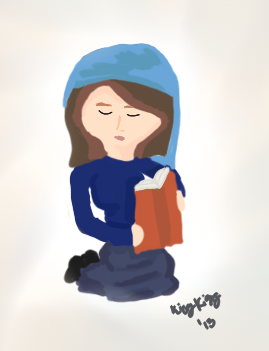
Art by Kierstyn King.
This is a touchy subject, because you’re screwed in the eyes of parents or vehement pro-homechooling-beyond-all-reason-crowds from the start. The fact is, this sentence and search term oddly defines my experience in a very succinct way, and like the lonely oppressed girl over here, it’s not a good thing. Homeschool and abuse and fanaticism don’t have to be related, but sometimes they are and here’s how: parents have the idea to homeschool, they then are told they must homeschool to essentially indoctrinate their children to their cause (fanaticism) which in some way or another usually is along the lines of “taking over the world” (who doesn’t want world domination?). Of course getting to that point means squelching the life out of the individuals you’ve stopped seeing as human and started seeing as arrows – focused solely on your needs, wants, and purpose you deny basic rights, dignity, and sometimes the security of unconditional love to the child you’re supposed to care about above everything else (abuse).
The unnecessarily necessary disclaimer here is: obviously not everyone is like that (but some people are).
*****
“why all of the attacks on homeschoolers” — by Julie Anne Smith, HA Blog Partner
I have been homeschooling my children for the last 20+ years. When I hear about “attacks” on homeschooling, I suspect there could be some confusion. Taking a closer look at the attacks, generally, it is not homeschooling in general that is attacked (ie, the education of one’s children at home), but more specifically, a lifestyle connected with the “Homeschool Movement.” The Homeschool Movement is associated with practices and ideologies not even remotely related to scholastic achievement, e.g., full-quiver lifestyle, patriarchy, purity and modesty teachings, etc. These practices and ideologies have had mixed, and sometimes very sad results. The methodologies employed to enforce these lifestyles can also be troublesome. The Homeschool Movement must not be confused with homeschooling. I believe homeschooling to be a valid and exceptional option for motivated and capable parents who have a vested interest in the proper education of their children.
*****
“homeschooling and mental illness” — by Latebloomer, HA Blog Partner
For a well-informed and supported parent, homeschooling may be an excellent way of supporting a child suffering from a mental illness. It could allow for high quality personalized instruction, easier access to appointments with medical professionals, and protection from peer bullying. Unfortunately, the combination of homeschooling and mental illness also has the potential to do great harm. For instance, children with mental illness can go undiagnosed for much longer if they do not regularly come in contact with trained educators and medical professionals. Distrust of those resources is very common in fundamentalist homeschooling circles, where parents are much quicker to blame unusual behavior on rebellion and worldly influences. An additional concern is the potential for harm when a child is homeschooled by a mentally-ill parent. The child will often be far more affected by the parent’s mental illness because of the increased time spent with the parent and the lack of time with other adults. For such children, the parent’s paranoia, depression, narcissism, etc, define their entire childhood and hinder them from developing positive and healthy relationships with others even in adulthood.
*****
“which is more effective for learning homeschool or public school?” — by Brittany Meng, HA Blog Partner
So you’re wondering which is more effective for learning: homeschool or public school. To answer this question more effectively, you should add the phrase “for my child.”
It all depends on what your child needs to be an effective learner. Here are a few issues to consider about the effectiveness of homeschooling for certain ages and needs.
Elementary school: Homeschool can be very effective for Elementary school because children often need one-on-one time to learn basics like reading and math, which are foundational for a strong education. If your child needs extra help in these subjects, homeschooling might be a good choice. On the other side of the coin, if your child is advanced in these areas, homeschooling might be good for your child as well. Nothing squashes the natural love for learning faster than a child who is bored. Homeschooling allows you to move at your own pace.
Middle School: Let’s just face it—middle school stinks for most people. Homeschooling will not remove all awkwardness, angst, self-doubt, or attitude problems from your child. However, if social issues are getting in the way of your child’s academic success, homeschooling may be a good option for your family.
High School: By this point, most young people are able to voice their educational and social needs. These wants and needs should be taken into consideration. This is also the point where parents need to consider how capable they are to meet the needs of their child, especially if he or she wants to go to college. I believe that homeschooling can be effective in high school but only with a strong outside support and supplemental network: classes at a local high school, community college, and/or homeschool co-op.
Personally, I believe that homeschooling becomes less effective for learning the older the child gets but this is a blanket statement. Only you can determine what your child needs.
You also have to consider the needs and abilities of your family: finances, time commitment (contrary to what many people think, your child needs as much academic attention from you in 1st grade as he does in 10th grade. Kids need accountability, motivation, and a sounding board for ideas), a strong support network, and whether or not you actually want to homeschool. Even if you feel that homeschooling would be the best option for your child, if you don’t want to homeschool, don’t do it. Homeschooling is a huge commitment. You can’t toe the water; you have to jump in with both feet. However, some states allow your child to be homeschooled by someone else. Check into all your options.
When choosing the best learning option for your child, it is important to consider what you and your child need and want both academically and socially. So, which is more effective public school or homeschooling? It all depends on your child.
*****
“pscyholgoy of bad/evil” — by Lana, HA Blog Partner
In conservative circles parents often have a tendency to refer to their children as all good or all bad. In public — that is, among other conservative families — kids often are forced to play the role of the perfect family, the perfect godly family. I felt this a lot as a child when we did cookouts with other homeschool families, or a respected homeschool family came over for dinner. I had to smile and pretend that I was godly (whatever that means) while everyone talked about how we were great and the future of America. At home our house was in shambles, but none of that mattered around our friends. Perhaps this alone would make a child go crazy. Why is it necessary to fake it? Why weren’t we genuine? Was it all in my head that my home was dysfunctional? Was it my fault when I was unhappy? Was my friends’ home totally perfect? These are legit questions that I and many others have experienced, but the confusion goes much further. For every time a child is praised as good, its likely that he or she is shamed as bad for the most ridiculous things at home. I was taught that I was not dressed until I wore a smile. If I did not wear a smile, I was ungrateful. If I expressed frustration (that admittedly did get out of hand sometimes), I was disrespectful. A simply bad act is escalated as totally evil or rebellious. There are plenty of homeschoolers who had it much worse, directly being called evil for not being submissive to an abusive situation. And so the soul is torn between good and evil. Sometimes kids just need to be told they are human. We aren’t perfect. We aren’t all bad. We’re human.
*****
“living my life” — by Heather Doney, HA Blog Partner
What my life was supposed to be was set. One story said that because I am a woman, by the time I was 30 I was supposed to have been married for a decade and have somewhere between 3-6 kids, homeschool them in a nice house, and be involved with a local church. The other story was that I was supposed to have a mid-level office job where I wore business suits and cute pumps, had a comfortable salary with decent benefits, ho-hum dates with guys who wore nice watches, and appletinis with the girls on weekends.
Neither are my life. I truly thought I was supposed to somehow make one or both my reality, that they were in fact the going realities available, but now I know they weren’t, at least not for me. I knew it just didn’t feel right, but I somehow figured I’d still end up in one or the other. I didn’t. I’m still just me, and while I do own a business suit and those cute pumps today, I generally wear flats or leather boots with jeans. I have only a laptop computer, not a cubicle, to go to. If I’d wanted a baby already I expect I could have had one, but I didn’t. I don’t go to church and I don’t even like appletinis (or guys who wear expensive watches, for that matter).
So while I didn’t want my life to look like either of these so-called options, I didn’t know what it should look like. What I knew it shouldn’t look like was what I call “living in the meantime.” I lived in the meantime for a few years and meantime mode is where you just let life happen to you, figuring it knows what is best, not-so-patiently waiting until it resembles one of your ideals. The scary thing is it likely never will. You can easily spend your whole life in meantime mode, waiting on serendipity to rescue you, and the thing most people forget about serendipity is that it isn’t just some happy accident or eureka moment that breaks you out of your ordinary life. Serendipity is what you find while you are out looking for, working on, and doing other things. Because serendipity requires action, it is a lot harder to find while in meantime mode or while you’re living someone else’s idea of your life, just going through the motions.
So to me living your life is not about doing one thing or another but about breaking out of that. It is about actively writing the next chapter to look differently, resetting the script, welcoming the changes, courting serendipity. It is about “if you build it, they will come.” In order to do that you have to do something scary though – be real about the person that you know you are, not stuck on the one you feel you “should” be. You can’t go squeezing yourself into a role that makes you look like you’re wearing somebody else’s style.
To live life, forget the ideal life someone else created for you and said should be yours.
I’ve been reading the stories Homeschoolers Anonymous has published since it launched, and at first didn’t feel comfortable sharing my own experience with homeschooling, since it was unlike most of what I was reading. But, through reading these stories, it’s helped me come to grips with some of what I went through.
I’d like to start out by clarifying that my experience was fundamentally different– and yet, somehow, eerily the same. I spent most of my childhood in an Independent Fundamental Baptist (IFB) Church, and for that reason we were never part of the larger homeschooling movements — at least not organizationally. We didn’t use PACES, I’d never even heard of ATI until I went to Pensacola Christian College, we never went to any conferences, I didn’t travel in debate. In fact, reading about these stories made me slightly jealous; because of the cult-like environment of the church I was raised in, I never had the opportunity to interact with anyone outside of my church. I had one friend — one — from the time I was 9 until I left for college at 17.
But, until recently, I would have said that my experience with homeschooling was a favorable one. I started studying logic in third grade, I started studying Latin and Greek in fourth grade, I started reading the classics of the literary canon at nine. I skipped fifth grade entirely — fifth and sixth grade in math. I always tested extraordinarily well — I started testing on the graduate level in seventh grade, and I got a nearly-perfect score on the verbal portion of the SAT (I deliberately answered one of the questions “wrong” because I felt that the question was asking for a “liberal” political opinion). When I went to college, I maintained a 4.0 GPA my freshman year, and made the Dean’s List for every semester thereafter. I never needed to study — in fact, attending classes always felt like I was being “spoon fed” my education, when I had grown used to learning everything I needed to know simply from the reading. I went to graduate school and got a Master’s degree in English — and, again, did very well academically.
It took me a long time to realize that the academic excess I experienced had its good and ugly moments. The good was that I was an excellent reader, and I became a fairly decent writer and editor. It also gave me a lot of time to study music, and that paid for my first year in college.
There are a few ugly sides, and the first was the extraordinary amount of pressure I felt academically. I imagine many, if not most, homeschoolers can attest to the unbelievable amount of expectations we had to live up to. We had to be so much more amazing than any other kind of education. My parents were immeasurably proud of my achievements, and they lovingly wanted to “show me off,” but the constant pressure to perform resulted in a sense that the pressure followed me everywhere– even into college. I felt like I was constantly and unceasingly being evaluated by everyone I knew. I became an overachiever — to the point where several of my professors repeatedly had to tell me to calm down, relax, and do less work or I was going to kill myself.
Another facet of how homeschooling failed me was in mathematics, and I think my experience is fairly standard. Both of my parents are incredibly intelligent — my father works in a STEM field, and my mother did very well in math. However, while I was in high school, neither of them had a college education (a sacrifice my mother made, ironically, in order to stay at home and homeschool us) — and I was surrounded by an attitude that women didn’t belong in STEM fields because we’re just not suited for it. Our brains aren’t wired that way. So, I grew up believing that part of my identity of being a “good, godly, Christian woman” was being terrible at math. This became a self-fulfilling prophecy, even though I excelled in geometry and musical theory (which somehow were “artsy” so I was “allowed” to be good at them). When I met my husband, some of our conversations centered on his insistence that I would be good at math if I ever tried — and my insistence that no, I wasn’t. Until, one day, he explained algebra to me on a road trip. And it made perfect sense– so much sense, in fact, that I wondered why it had seemed like complete gibberish before.
And some of the things that get so heavily praised in the homeschooling movement ended up being unhealthy for me in the long run. We were isolated– we called it “being called out” and “separate,” and we laughed at people who asked us about “socialization.” We went to Wal-Mart in the middle of the day, and someone would inevitably ask what I was doing there. I would say that I was homeschooled, and without exception they would ask if I was “special needs.” And then, inevitably, I’d have to mount a defense for homeschooling.
As I’ve moved into my adult life, I’m beginning to see how deep the influences go. While we weren’t involved in any type of official organization, I grew up familiar with the Pearls, the Wilsons, and the Vision Forum. I read Beautiful Girlhood and believed that daughters should stay at home until they’re married. Now, I find it incredibly difficult to interact with people in a group setting, and it has nothing to do with not being familiar with “pop culture” (although that is occasionally a factor). I am completely hopeless at reading people, I don’t understand basic social interactions, I can’t navigate basic things like class discussions — even though I am articulate and outgoing. I’m frequently disabled by self-consciousness and nerves, and find it difficult to find a balance between silence or speaking too much. I don’t know how to do simple things like create boundaries with people.
I’m moving toward healthiness, slowly. It’s difficult, and hard going, but it’s happening. And part of my recovery is recognizing that even though I pretty much had the “ideal” homeschooling experience, it was still unhealthy.
The following piece was originally published by Sarah Jones on her blog ANTHONYBSUSAN with the title, “Homeschooling: Creative Alternative or Brainwashing Tool?” It is reprinted with her permission. Sarah has a master’s degree in postcolonial culture and global policy, and another degree in international studies. She was an Evangelical Christian at one point in her life, then a feminist member of the Emerging Church, and now describes herself as “agnostic, leaning atheist. Still a feminist though.”
The Daily Beast’s coverage of Homeschoolers Anonymous has reignited the perennial debate over the homeschooling movement and parents’ rights. As a former homeschooler, this is an intensely personal debate for me: I disliked the homeschool experience and I remain deeply critical of the Christian curriculum my parents employed. My own experience is not identical to the stories detailed in the Daily Beast article. I did not grow up in a Quiverfull home and my parents eventually became wary of the movement’s fringes. As a result, they did agree to send me and my brother to private and then public school. They’re not homeschool activists in any meaningful sense. Nevertheless, this article resonates with me, and I agree with the premise put forward by the members of Homeschoolers Anonymous: that homeschooling left me totally unprepared for the real world, and facilitated religious abuse.
“I hope that this Daily Beast article marks the beginning of a critical national conversation.”
Before I continue I want to make it clear that I understand that homeschooling isn’t intrinsically a social evil. Done well, it can certainly prepare children to excel in higher education. Moreover, I don’t intend to argue that the alternatives are without flaw. The state of public and private schools in the US is a valid concern. I’m not going to summarize that debate here, but I’m referencing it in order to show that I do understand why parents (like my own) may make the decision to homeschool. I’m concerned by a specific branch of the homeschool movement, and its emphasis on religious indoctrination.
Certain common themes emerge from the Daily Beast story. Readers are introduced to adults who spent their formative years engaged in a battle against secularism. There is much praise for homeschooling’s ability to encourage children’s natural gifts, but as these stories demonstrate, many Evangelical and fundamentalist families encourage these gifts in order to advance a specific ideological agenda. Those of us raised in the religious right will recognize the rhetoric. We’re meant to be culture warriors, engaged in battle to return America to its Christian roots. Homeschooling is meant to create a pure environment. Christian parents are free to teach (read: train) their children in an atmosphere free of secular corruption.
For obvious reasons, this attitude toward education lends itself easily to abuse, particularly when you consider that most of these families adhere to traditional gender roles that revere the father as the head of the household. When your father is your chief disciplinarian, spiritual adviser, breadwinner and the principal of your school, a patriarchal structure is so firmly entrenched that the possibility of addressing domestic abuse is incredibly unlikely. Additionally, it reflects the belief that children are the property of their parents, that children have no rights, independent of their parents. The potential consequences this attitude poses for the children subjected to it are evident from the Daily Beast piece and from the other stories provided by Homeschoolers Anonymous.
There are additional points of concern; namely, the overlap between this fringe and Christian reconstruction. R.J. Rushdooney, truly the father of contemporary Christian reconstructionism, advocated homeschooling as an alternative to secular education. Later figures like Michael Farris continue to champion homeschooling as a religious obligation for Christian parents. Precociousness is considered evidence that homeschooling works. In the comments of the Daily Beast piece, you’ll find at least two adolescent homeschoolers engaged in a passionate defense of the movement. They repeatedly cite their personal success, and the successes of their homeschooled peers, as evidence of homeschooling’s superiority.
As a homeschool alumna, I don’t credit my own academic success to my parents’ decision to homeschool. If anything I believe I’ve succeeded in spite of it. I’ve never received accurate scientific instruction and I had to re-teach myself history and government. My decision to pursue political theory at the graduate level is partially inspired by this drive to strip my thought process of the misinformation and bias I learned as a child. Similarly, I reject the belief that my current progressive views are derived from mere rebellion, as many current homeschoolers like to assert. Those of us who object to the movement do so for valid reasons, and I hope that this Daily Beast article marks the beginning of a critical national conversation about children’s rights and the need to better regulate home instruction.
The following piece was originally published by Karen Loethen on her blog Homeschool Atheist Momma with the title, “Still Looking for Disadvantages of Homeschool?” It is reprinted with her permission.Karen describes herself as “a homeschooling mum of two children (ages 15 and 12) and the wife of an amazing man.” She and her family “are Midwestern Americans, currently living in Brisbane, Queensland, Australia.”
I’ve been wondering, do I write pro homeschool stuff because I am simply reinforcing my insecurities about homeschooling?
No.
I write it so that others can find pro-homeschooling stuff easily.
While we can not reparent any of these wounded people who are trying so hard to heal themselves, we can offer them our love and seek to understand their claims. We, as homeschooling parents, should never attempt to discredit someone’s story (as I have seen on some of these sites). No, instead, we must learn from these experiences and offer these people our love and compassion. And offer them our thanks for being willing to share their stories. It takes courage in this world to stand up and disprove the majority. And, besides, they are people who are courageously, fearfully offering their life stories, hoping for healing.
If you go there, write nothing, or write only messages of love and support. It is homeschooling parents who are insecure and fearful themselves who do not allow these voices to be heard without confrontation. I understand that fear, but these boards are not the place to put one’s own issues out there.
As one woman at the Homeschoolers Anonymous website said, today, homeschooling is often portrayed in the media as some great and noble cause or as a quaint, folksy version of the Great American Dream. I’m grateful for the “improvement,” as homeschool has had a fairly dreadful rep for a long time. Sadly, some of that rep is well-deserved. I must also add that most of the stories (all the I have read today, in fact) share a fundamental Christian motivation or Evangelical basis for their isolationist and authoritarian approaches to their homeschooling and parenting. This is not the point of my post, but it is an essential piece of the puzzle.
I think of homeschooling as an extension of, as a part of, parenting.
In my mind there is no way to separate the two.
I think we should all have the right to freely educate our children without state involvement. But this presupposes that all adults are capable of making healthy and wise choices for their families and we know that this is not the case. But whose job is it to decide who should and who should not homeschool? No one is sitting in an office making lists of people who can and should become parents. Anyone can become a parent regardless of maturity, ability, mental issues, all other issues, etc. Parents of all ability levels have always existed in the world.
Maybe we can all agree that not all people who are parents should have been parents.
Similarly, not all people who homeschool should homeschool.
To homeschool, to parent, to the best advantage of one’s children, a parent needs to be mature enough to put the needs of themselves Last on the List and the needs of their children First on the List. A person suited to homeschool and parent children must have no philosophy, culture, or creed that puts anything, anything ahead of the good of the children. A person well-suited to parenting and homeschooling children is a person who is willing and able and apt to reflect upon new information and evidence and use that evidence and make changes, improvements, adjustments when necessary. The person adequately suited to parenting and homeschooling is a person who takes the time to learn about a variety of educational and parenting options and looks at those options carefully, making decisions based on what makes a better human being from each child.
And more, I believe that the best approach to parenting, in my opinion, is a person who manages to believe in their children, who even believes in the human race! I believe the more successful parent and homeschooling parent is one who finds humor in life and looks for fun. I believe it essential to think well of people. I think it necessary to put Love at the center of family life. I think it necessary to be a self-aware adult. And I think it necessary that I spend time locating my own issues, growth areas, and limitations. And seek to improve myself.
Yes, I can be a bit serious about this.
I believe that adults owe it to themselves and to their progeny to become the best people they can be.
Because when they don’t, it’s the kids who suffer.
“I don’t think she ever realized that I just wanted to have my own voice, and be heard.”
I had a conversation with my mom today. The HA group came up. I was, of course, very careful about how I worded things. She is still very much a homeschooling giant, if there is such a thing. She was one of the homeschooling “pioneers” although she laughed today when I told her the name of the group, stating, “Not that long ago everyone in the country was taught at home.”
I’m always careful when I talk to my mother. I can’t tell her that I smoke. She knows that I have in the past, but I never told her I started up again. She’s never seen me smoking.
Today, I was standing on the porch talking to her on the phone while smoking a cigarette. Ironically, after asking her questions about what it was like growing up in the 1960’s, when she was a teenager, she told me about “smoke alley,” at her high school. That was what they called the area beyond the sports fields, where all the smokers would hang out. I asked her if there was a legal smoking age at that time. She said there was, and that likely the students procured their cigarettes from an older sibling, stepdad, or other kids at school.
She told me that there was a radical change in the ‘culture’ from that of the 1950’s. She remembered families spending time together for holidays, girls wearing dresses to school, and “never showing any skin,” in the 50’s. “Then the 60’s came along, and it all went to pot.”
She laughed, then added, “Literally!”
She went on to talk about how when she went to college, she managed to stick to the straight and narrow, even though her classmates went a little overboard with partying. “There was this rebellion…” and kids were drinking, smoking, doing drugs, and the whole Woodstock thing. She thought that a great deal of it was fueled by the controversy over the war in Vietnam, and that the response of the people was “we’re not going to be told what to do,” and she also said that there were similar feelings of unrest that were an underlying cause of some of the rioting that went on during that time.
I told her I was interested to know why the homeschooling movement seemed to pick up and become popular around the 80’s and 90’s, and she agreed that it may have been a reaction by parents to what they had experienced in their school years.
I found all of this fascinating.
My mother is fascinating.
I used to be able to confide in her. I would tell her everything. But as I got older, her thinking what I said was cute, and then telling her friends about it got old, fast. So I’m careful what I talk to her about. I am much more open with people my own age. I think it’s something I learned as a child. Parents, people in authority, and people older than me were not to be trusted, because they could bring a world of hurt crashing down on you should they so choose.
I was careful to point out to my mom that I did not think homeschooling was bad, or wrong, only that some people had been in abusive environments, and were sharing their stories, and supporting each other and healing. I’m also careful how I talk to my mom because she was abused for so many years. First by her parents, then her husband, my dad. So she is used to being attacked. I think she expects to be attacked. Now that I am older, I don’t think she minds as much as she used to when I disagree with her, although it’s mostly trivial things, I haven’t tried to bring any of the big things up with her.
I’ll get to more of what those big things are later.
I remember when I was 12 years old my mom throwing her hands up, exasperated, saying, “If I said the sky was blue, you’d say the sky was green!” Which was stupid, because the sky was blue. And funny, because I’ve seen tornado skies, and they are most definitely green. But I don’t think she ever realized that I just wanted to have my own voice, and be heard. I was becoming my own person, from a very young age. And she didn’t know how to handle that.
I think that when the last kid moves out of her house, she will have no idea of what to do with herself. And she is already trying to ensure that she never has to face that, by keeping my youngest sister forever…
HA note: The author’s name has been changed to ensure anonymity. “Charity” is a pseudonym.
I’ve been following HA from the beginning. I knew from the first moment I saw the Facebook page that I would write my story, even though I do not think there is anything surprising about my life. I was raised in a conservative Christian home, was homeschooled through graduation, and in graduate school dropped Christianity for feminism. That transition, while difficult, felt natural for me. Feminism gave me a language for the discrepancies I could see and feel, but could not name. To this day my parents are dismayed and my brother is bemused about my ideological transformation.
I don’t know what parts of my life are important to tell, which parts are most salient. I just know that along the way I learned to hate myself. Because even though I know that I am smart and beautiful, I also know that I should be better. The only yardstick I have is absolute perfection for whatever it is that is on my plate in the moment. And if I can’t be perfect, then I need to just complete whatever the project is and move on to something else. There is so little joy in that way of living. There is no self-acceptance. Nothing can just be what it is in the moment; the striving is both constant and tortuous. But I’m getting ahead of myself. Let me explain.
I was raised to be a good Christian girl who did the best she could. It just so happens that, aside from math, I’m good at most things I have tried. All of my life I’ve been told that everything I touch turns to gold. There is a shit-ton of pressure in that statement and that pressure is the center of my story.
Until college, my social circle consisted mostly of other homeschoolers and families from church. Basically my life was “all Jesus all the time.” I learned from a very early age that both God and Jesus were perfect and that perfection was the goal. Of course, my parents would deny that they ever taught me that explicitly, because of course perfection is impossible. But try telling that to a child who grows up hearing about how the perfect love of God covers all her sins! I am a typical first-born, Type-A overachiever. Combine that with the teaching that God made it possible for me to be perfect through the perfection of Christ and his sacrifice on the cross, and BOOM. I am a walking shitfest of a mess.
As a teenager I tried to do everything right. I signed the True Love Waits pledge card, and took it one step further: no kissing until marriage. I taught abstinence-only sex education to 7th graders at a local Catholic school. And as if that wasn’t enough, I happily boarded the Joshua Harris I Kissed Dating Goodbye train. I am still baffled as to how I believed that I could do so much talking about sexsexsex, whether it was blatant or veiled, and not want to even think about doing it! I was encouraged and applauded by every adult I met for my amazing character, commitment, and chastity. But what I remember most was feeling shame about every inch of my body and what it wanted, how good it felt when I touched myself, and the simple desire of wanting a boy to like me. How could I be perfect if I wanted to have sex?
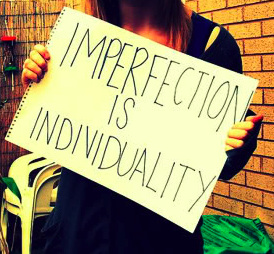
Growing up I lacked imperfect role models…people who were successful, but weren’t afraid to genuinely admit their imperfection.
For the next decade, that was my frame of mind. Any little imperfection ate away at my self-worth. I really bought into Matthew whatever-whatever, ‘be perfect as your heavenly father is perfect.’ Instead of seeing my life as an opportunity to nourish my soul through learning what my mind and body could accomplish, every endeavor became yet another way to measure my failure. How can I be the perfect student if I don’t have a 4.0 (finally got it on my third degree!)? How can I be the perfect yoga instructor if I can’t touch my toes? How can I be the perfect partner if what I want is to leave the man I married? How can I be perfect if one of the few places I find both joy and solace is in a bottle of rum? Growing up in the Christian homeschooling subculture taught to view life from the negative. I want to believe this was unintentional. My flair for the dramatic aside, my biggest regret is that I wasn’t taught to enjoy and love my body or my life. I was taught that both my body and my life were things to be disciplined, controlled, and held in check.
I bought into the belief that not being perfect meant I was a failure.
A different truth is that if I ever achieved perfection, there would be nothing left for which to live.
I took a three-day break after writing that last sentence. I needed time to process. Yesterday morning I was having breakfast with a friend of mine and I told him about this essay. He asked me what my story had to do with being homeschooled, since it sounded to him like a story about being raised super-Christian. Good question. My answer? Being homeschooled meant that I only ever came in contact with other people of the same persuasion, religious/belief system, hell!, life system, as the one in which I was living. Being homeschooled for me was being surrounded by people who were also supposed to be perfect because we were all ‘covered by the blood of Jesus.’ I didn’t know that imperfection was an option. I didn’t know that I could make choices outside of the Bible and still be a good person, that I would still like myself, that people would still like me, that God would still like me. Not that I really believe in God anymore, but that’s for a different essay. It wasn’t until graduate school that I finally came out of my shell—out of my parents house—and realized that there was an entire world in which my identity didn’t hinge on if I was a virgin or read my Bible or went to church or dressed modestly or all the other things my childhood and adolescence was hyper-focused on—because of course, for a woman, those things equal perfection.
Hang on. I’ll be back in another couple of days.
After rereading and thinking and editing, I’ve decided that this is not something I want to come back to. This isn’t really the story I want to tell. So let me start again.
I was homeschooled. I was sheltered. I was raised in a very conservative, Christian home. But I got out. I don’t have any major regrets from high school; I am lucky. I have worked exceptionally hard to get to know myself, to be honest with the people in my life, and to make choices that are good for me. Being homeschooled taught me to hold myself accountable and that at the end of the day, the only person who was responsible for what was or was not accomplished was me. My parents taught me an amazing work ethic that I couldn’t shake even if I tried. Sure, that has led to me being a perfectionist workaholic who sucks at relaxing, but the yoga and rum are helping with that.
My parents and I no longer talk politics or religion, but I know that they love me and have my back. Being homeschooled meant that I had a lot to overcome in terms of finding a footing in the world outside of my parents house; I think it took me a lot longer than average to figure out who I wanted to be because the people I came in contact with were so homogenous—I didn’t have options to pick from until I was in my 20s. But, being homeschooled also taught me to be content with myself because quite often I was left alone to my own devices.
So, all that to say being homeschooled was definitely a curse; in that sheltered, Christian environment I learned some pretty shitty ways of thinking about myself. But being homeschooled also taught me how to look out for myself. Perhaps that part of the equation paved the way for me to become the feminist I am today? My mother would die if she read that. But even so, without both those pieces of the puzzle, I doubt I’d be writing this today.
Feminist philosopher Margaret Urban Walker writes that,
In any case, I think that feminist thinkers are entitled to the excitement and intellectual challenge of forging and intensively testing visionary paradigms, of inaugurating their own discursive communities as sites of solidarity and creative communication in their own terms, and of self-consciously exploring confrontational rhetorics as some instruments, among others, for initiating wholesale intellectual change in their favor. (“Further Notes” 154)
Writing this piece has been a process of “feminist thinking” for me; becoming a part of the HA community has forced me to (re)consider so much about myself. I am grateful for the opportunity to add my voice in solidarity.
“Train up a child in the way he should go: and when he is old, he will not depart from it.” ~ Proverbs 22:6
You see that verse? Probably every homeschool parent heard that verse too many times to count throughout their homeschooling years. It was engrained in us. We did not want our children to depart from “the way they should go” and the solution was to “train” our children. At least that’s what they told us.
Homeschool books from the Smith family library. Photo courtesy of Spiritual Sounding Board.
Ever since my spiritual abuse journey, I have been trying to figure out what led our family to that spiritually abusive church and pastor who sued us in an attempt to discover who our primary influencers were over the years. I found that the most influential people in the last couple of decades have been leaders in the homeschool movement who had a spiritual agenda, not necessarily an educational agenda. We have been taught so strongly to “train our children” and some of us did that quite well. We created little obedient and compliant robot children who were polite, respected authority and looked really good in church all lined up in a pew. People always commended us on our beautiful large family.
These influencers not only taught us how to parent, but taught us what they thought was very important: large families, courtship, modesty and purity, fathers as spiritual heads/priest of the home, mothers as hard-working submissive wives, preparing wholesome meals from homegrown gardens, grinding wheat to make whole grain breads. The boys were taught how to be boys, play like boys, work like boys, helping their fathers in projects around the house. Daughters learned traditional homemaking skills that would last them a lifetime when they got married and started families of their own, because that was their ultimate lot in life. Yes, in many homeschooling families, daughters were discouraged and even forbidden from going to college for any higher level education, they were to stay at home serving dad and their family while they waited to be courted by a young man approved by their father.
True to the homeschooling culture, I did own a denim jumper or two, and I sewed matching jumpers for my daughters who were 7 years apart in age. My five boys may thank me that they never had matching homeschool uniforms like khaki slacks and polo shirts, but they did manage to always match by having jeans with holes in the knees.
Not only did we raise good obedient children, we invested in our children and pushed them towards educational excellence. We made sure they were well-versed on the popular homeschool-movement agendas which we adopted as our own: they knew how to debate creation vs evolution, they were politically involved in their communities, worked on political campaigns, participated in speech and debate classes and competitions, attended worldview conferences, and went on missions trips. In my family, our kids knew how to evangelize the “right way,” how to defend their faith, and knew the tenants of 5-pt Calvinism inside and out. Homeschooled students were good students, usually testing years ahead of their peers. They were accomplished in music, sports, volunteered at Crisis Pregnancy Centers, lobbying at the capital for homeschooling rights, etc. What more could we ask for?
What many are finding out is that those brilliant robots, when released to the real world, start questioning where they came from, what they believed, where they are going. This is a normal response for young adults. But I’ve seeing a disturbing trend especially among young adults who were raised in this kind of environment. Many of these “trained” adult kids are now venturing 180 degrees in the opposite direction, perhaps in response to the controlled environment in which they were raised, some suffering a host of problems similar to what spiritual abuse victims experience that I deal with so often: mental health issues, addiction issues, etc. There is a lot of heartache among this group.
I feel very responsible for buying into this garbage. I will continue to speak out against disturbing aspects of the homeschool movement on my blog. It takes a lot of emotional energy to work up one of these posts because it means I have to admit my failure. Of course my blog will also continue to be a platform for these precious young adults. I believe in a way that some of us parents were cult leaders in our families. We were fed an agenda by those home school leaders. We believed it. We saw their perfect families and wanted to emulate what we saw and expected that kind of obedience and educational excellence from our children. We trained them alright.
Not too long ago, I was asked if I would like to partner with others in a new blog called Homeschool Anonymous. I was thrilled to be asked because I have attempted to use my blog as a Spiritual Sounding Board to the abuses that I’ve noticed in the homeschooling movement. Most of the participants in the Homeschool Anonymous blog are former homeschool students, and two of us have been (or currently are) homeschool moms. Interestingly, you will notice that many of the blog participants no longer connect with their Christian heritage. I think conservative homeschoolers will find this shocking. In fact I admit that I am afraid to post about this on my private Facebook page because I have easily 300+ homeschooling friends/moms who might be pretty upset if I mention this big homeschooling secret: some of our adult kids have departed from the way in which we trained them.
I have long ditched my homeschool mom uniform, the denim jumper. I refuse to go to state-run Christian homeschooling conferences whose conference leaders get to hand-select vendors and speakers based on their approved religious agenda. So as I continue to teach our last two kiddos at home, those destructive religious-agenda influences play no part in our homeschooling anymore.
So yes, I am partnering with R.L. Stollar who is an amazing individual and new friend who was completely homeschooled and put together this group. I have so much respect for what he is doing to help his peers walk through their homeschool journeys and the aftermath or perhaps fallout. I hope Homeschool Anonymous reaches many former homeschooled students and parents and that our collective voices will be heard and considered. It’s never too late, right? Oh my, parenting is a humbling journey – so, so humbling.
A group of former homeschoolers are joining together to bring awareness to, and healing from, different forms of abuse in extreme homeschooling subcultures. The organization, Homeschoolers Anonymous (HA), is being coordinated by former homeschoolers across the United States, including California, Louisiana, Oregon, and Washington.
According to recent surveys, approximately 2 million children are taught at home in the United States. The total number of home-educated kids doubled between 1999 and 2007. While some are being homeschooled in non-Christian families, the National Home Education Research Institute claims almost three-quarters of those 2 million children have conservative Christian parents who aim to pass on their moral and religious values to their kids through home education. This makes religion the primary motivating factor behind this form of education.
HA’s creator is R.L. Stollar, who was homeschooled from K-12 and currently resides in Eugene, Oregon. He has a Master of Arts in Eastern philosophy and religion and is a freelance writer. Stollar says he came up with the idea for HA after realizing that many of his homeschooled peers suffered from some of the same emotional, mental, and physical problems that he does. Stollar says,
“I started talking last August to someone I knew in junior high and high school about some of the issues we both struggle with today. And it was interesting to see these similarities and that we both attributed them to the same things from our backgrounds.”
Stollar realized that many of his peers had stories like this. He decided to created Homeschoolers Anonymous to bring awareness to these stories and to inspire others to speak out. He intends for HA to give others courage:
“I think, for a lot of us, we are afraid to say what we feel, to say we have changed. A lot of us perceived the message of our world as ‘shut up, get in line, and prepare to take back the culture.’ That makes us, even as adults, timid and maybe even scared of community backlash if we were to say, ‘You know, I’m a different person now. I grew up, I’m an adult, and I have my own life.'”
Stollar connected with old friends on Facebook and made new ones. He found a community of people who shared the same vision. One of those people is Nicholas Ducote, who grew up in a family immersed in Bill Gothard’s Advanced Training Institute (ATI). He has his Master of Arts in History from Louisiana Tech University and is currently working on a book about lumber development in North Louisiana.
Ducote considers his upbringing to be a form of fanaticism. To him, fanaticism is any manifestation of an ideology that knows no compromise and uses children as vehicles of ideological advancement. Ducote says,
“The quaint, happy, innocent life of a child can quickly be replaced by the stark absolutes of fanaticism. Muslim, Christian, and Jew are one in the same monster. Their fanatics take different names, they act in different ways, but they are all the same.”
Stollar, Ducote, and team of others are eager to see the launch of their vision. Homeschoolers Anonymous has partnered with a number of well-known bloggers to help bring greater visibility to their stories of abuse and healing. These blog partners include Libby Anne’s Love Joy Feminism, Heather Doney’s Becoming Worldly, Vyckie Garrison’s No Longer Quivering, and Julie Anne Smith’s Spiritual Sounding Board.
About the blog partners, Stollar says,
“I’m really excited to be partnering with these individuals and groups who write about, among other things, their homeschooling experiences. Honestly, they’ve directly inspired [HA] because of what they do. They’ve really paved the way to speaking out about abuse within certain cultures.”
One of the blog partners, Julie Anne Smith, is a homeschooling parent herself. Smith has over 20 years of experience homeschooling her children. She believes HA will help both current and former homeschool kids, even other parents:
“Homeschool students and their parents have become part of a unique culture yielding a mixed bag of results. The first crop of homeschooled students are now adults, establishing their own lives and families. It’s important to take an honest look at homeschool history by reading personal stories — describing the joys and even disappointments of those who paved the homeschool trail.”
While HA hopes to talk candidly about abuse within homeschooling and provide methods of healing from that abuse, the group is careful to point out they do not oppose homeschooling itself. Stollar notes that,
“This isn’t anti-homeschool in any way. At the end of the day, this isn’t even about conservative politics or Christianity. It is more about anywhere and everywhere that communities and adults use religious or political ideology to deny children their humanity and freedom to be for the sake of advancing that ideology. That’s a cult mentality. And wherever that mentality exists, you create emotional, mental, physical, and even sexual abuse and trauma for children. We want to be a strong voice in opposition to that mentality through our life stories, through education and information.”
Homeschoolers Anonymous will be launching their website tomorrow, Sunday, March 17.
*****
This news release may be reprinted without permission in part or in entirety for promotional purposes.


 Homeschoolers Anonymous