Guard Your Heart, Part Two: Kathryn E. Brightbill

Kathryn Brightbill blogs at The Life and Opinions of Kathryn Elizabeth, Person.

*****

In this series: Part One | Part Two

*****

Sometimes the hardest person to come out to is yourself.

After spending a few years post-college working as a wedding and gift registry consultant (turns out I liked studying computer science a lot more than doing it), I decided a change of course was in order, packed up everything and moved to Vietnam to teach for a year. I had a wonderful time and learned a lot about myself and also learned tons from the very talented and accomplished Vietnamese faculty at the university where I taught. Coming back to the US sent me into a tailspin of reverse culture shock and I spent a long few months feeling like I didn’t know which end was up or what ground was solid. During that time I found myself questioning all sorts of things as I tried to figure out what to do with myself and which direction was forward. It was during that time that I began to realize that it wasn’t just that I had been really good at guarding my heart, and that it wasn’t just that I hadn’t found the right guy, it’s that I never was attracted to guys in the first place.

When you’re the model homeschool child, “gay” is something that happens to other people. As a kid it was those people I’d see on TV marching, or who my parents’ religious right friends would rail against, but it’s certainly not the sort of thing that a good little homeschooled church kid would consider to have anything to do with themselves. And it’s most definitely not the sort of thing that even crossed my mind as something to consider as an answer to make sense of things in my life as I was growing up.

In retrospect, all sorts of things about my past make sense, from never having an answer when my sister would ask me who I had a crush on when I was little, to not being able come up with a guy I thought was hot when asked by my hall mates in college, oh, and the reason I watched xXx about six times in the theater my senior year of college wasn’t just because I liked the car chases (though the car chases didn’t hurt), and it certainly wasn’t Keanu Reeves who I was watching The Matrix for. But back then, I was so busy guarding my heart that I didn’t see any of that.

I won’t pretend that finally realizing and coming to terms with being gay was easy because it wasn’t. I knew that I needed to live honestly and that doing so meant that my life wouldn’t be quite the same as I’d envisioned for myself—staying in the closet was not an option I was willing to consider.

I’m fortunate though, in a number of ways. First, by the time I figured it out, I was out of the homeschool bubble. When I was growing up I was the model homeschool child. I don’t think my parents were ever aware of the pressure I felt I was under with other people telling their children to be like me—I never said anything about how kids would comment about what their parents had said about how brilliant my siblings and I were—but when you know that other people think your family is wonderful there’s pressure not to let them down. By the time my younger brother finished school, my parents were more than ready to hand any responsibility they still had off to others and to just be done with the whole homeschool world completely. While I didn’t feel it, there are a lot of queer former homeschoolers who do feel the pressure of what their coming out will do to their parents’ reputation within the homeschool community.

Second, by the time I realized I was gay, I’d already thought for years that LGBT people deserved full equal rights, and had concluded that the belief that it was a sin came from taking scripture massively out of context. For kids, homeschooled or not, who grow up in evangelical households, the sin issue is usually an enormously difficult thing to grapple with.

Ironically, perhaps, I feel like the other issues aside, my background as a homeschooler actually helped me. As mainstream as my family was, and as much as I worked to blend in with my surroundings so I wouldn’t stand out as the “weird homeschooler,” homeschooling—or at least homeschooling during the era I was homeschooled—at its core is a countercultural movement. Fundamental to any countercultural movement is a willingness to go against the mainstream, to stand out, to be different, and to question the dominant paradigm. By homeschooling, parents do not just teach their children academics or a particular set of theological or political beliefs or worldview, the very act of homeschooling is teaching children how to think and act counter-culturally. That’s not something that just gets turned off or erased when you graduate.

The recurring theme when I try to write about my homeschool experiences is the tension that exists between what is and what was supposed to be. Homeschooling was supposed to produce activists, and here I am, an activist, but I’m on the opposite side from where I was supposed to be. It was supposed to teach us how to learn and keep learning on our own, and it did. It’s just that I kept learning enough to learn how much of what homeschool “leaders” were saying wasn’t true. And homeschooling was supposed to produce young adults who could stand up for what they believe and who wouldn’t be buffeted about by external pressure. Well, here I am. I was taught not to care what society thought and I’m not going to suddenly start listening now or bending to external pressure when it comes to my sexual orientation.

I’m sure others in the homeschool world consider me to be a disappointment, wondering what went wrong because I’ve so clearly ventured off of the path that homeschooling was supposed to set me on. I don’t doubt that there are those who are trying to figure out what to do to avoid such an obvious failure as the increasing number of homeschoolers who are coming out must, in their minds, be. And, I am sure there are those—even some who are reading this piece—who are wondering what my parents did wrong, since homeschooling was supposed prevent people like me from happening.

I would argue, however, that my story is a homeschooling success story. The reason I’m here today, the person I am, is because of what my parents did right. I am the person I am today, with the internal fortitude to live my truth openly and honestly and to be my own person because of my experiences as a homeschooler. So what if that person is a politically liberal, openly gay, Christian, nerd with an activist streak a mile wide? The system worked. Just not in the way intended, and that’s a good thing.

End of series.

Guard Your Heart, Part One: Kathryn E. Brightbill

Kathryn Brightbill blogs at The Life and Opinions of Kathryn Elizabeth, Person.

*****

In this series: Part One | Part Two

*****

It turns out that it’s easy to guard your heart when you’re not attracted to someone, but I’m getting ahead of myself here. To begin this story, we need to go back in time, back to when I was a homeschool kid growing up in the ‘80s and ‘90s.

Despite my parents running the private school for homeschoolers, and my mom finding herself spending far more time on the phone giving advice to new homeschoolers than she would have liked, and that one time that they wound up helping to put together a state-wide homeschool convention (something they vowed never to do again), my family wasn’t nearly as connected to the homeschooling subculture as many people. There really wasn’t that much of a homeschooling subculture when my parents started homeschooling, since back in the mid ‘80s there weren’t many homeschoolers.

Most of the national opportunities like debate weren’t around until I was done, or nearly done, with high school. Also, my mom didn’t particularly like hanging out with other homeschool moms and talking about each other’s children, and (with the exception of the aforementioned convention) avoided homeschool conventions like the plague. The parade of supermoms in denim jumpers and white sneakers who sewed all their own clothing, baked all their bread, and still found time to design grade-appropriate unit studies made her feel inadequate—after all, she didn’t do a single unit study in 18 years of homeschooling, hated denim jumpers, and especially wasn’t going to be sewing the aforementioned jumpers. That’s not to say I didn’t have more than my fair share of homeschooled friends, but they were mostly ones I knew from non-homeschool circles, and I never considered myself one of those homeschoolers. We were about as mainstream as they come.

I don’t remember where we first heard about courtship, just that somewhere along the line when I was in middle school it began to become fashionable even among the friends who were mainstream homeschoolers. These were not the people who made their daughters wear shapeless jumpers and wouldn’t let them cut their hair; they were the cool people with the latest clothes who educated their sons and daughters equally, and it all seemed so reasonable couched in the idea that it was all about waiting until you were done with college and had a career before pursuing a serious relationship. And didn’t it make sense? After all, when my parents met my dad had already finished his first master’s degree and my mom was 28, independent, and had even studied in the UK and traveled around Europe. What was the point of rushing into a series of relationships before you even had the chance to live?

This not being the 19th century, none of us knew how this whole courtship thing was supposed to work in the modern era, but then someone had given someone else some tapes from this guy who talked about courtship, and he went by the name Little Bear Wheeler, and, oh, you should listen to him because he might be a little out there but he’s entertaining. And so off my family, who hated homeschool conventions and avoided them like the plague, went to hear this Little Bear fellow speak. That’s how these things seem to work in the homeschool world and how normal families get pulled into extremism. You start out reasonably and the next thing you know you’re wearing your one and only denim skirt (because you instinctively knew that’s what you needed to do to blend in) and you’re listing to a guy cosplaying as a pilgrim who’s telling you that the Puritans didn’t date.

I don’t remember many details, it’s been nearly twenty years, but I do remember hearing, over and over, that you needed to, “guard your heart.” If you guard your heart, then you won’t give pieces of it away to the wrong guy. If you guard your heart, then you won’t have frivolous crushes on guys who would never be suitable mates. Guard your heart. Guard your heart. Guard your heart. If you’re really spiritual and godly, you’ll be able to guard your heart until the right season of your life.

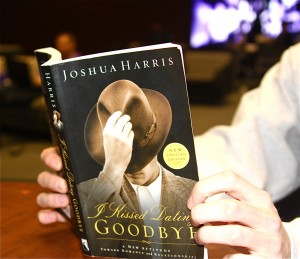
It was a message that grew into a chorus in the homeschool circles I grew up in. Guard your heart, always and in every situation, guard your heart. By the time I neared the end of high school, the chorus had grown into a cacophony, as courtship went mainstream into evangelicalism with Josh Harris’ “I Kissed Dating Goodbye.” And by the time I made it to college, it seemed as though everyone had read it, and even if they called their relationships, “dating,” it was still operating on those general principles.

Through all of this, I patted myself on my back because I wasn’t getting any “frivolous” crushes on guys, and clearly this meant that I was super spiritual and doing a great job of guarding my heart. It turns out it had less to do with being super spiritual than it had to do with being super gay.

But again, I’m getting ahead of myself.

I’ve never asked my parents about this, so I don’t know what they would have done if one of us had wanted to date in high school, or what they would have said if we’d have read all of the courtship material, listened to the speakers, and announced that we thought it all bunk. My parents didn’t have a problem with me voicing an opinion that was different than theirs, and if I had objections to courtship back then, I suspect that I could have brought those up and we would have discussed it. Except that I didn’t have any objections because my siblings and I all bought into it. It didn’t matter that we were as mainstream as they come, that my sister and I both wanted educations and careers and had been taught we could be and do whatever we set our minds to, that my brothers didn’t want to marry someone who wasn’t their equal, we still bought into it. Their experiences and opinions are not my story to tell, other than to say that despite all buying into it, eventually we all decided that the whole courtship system was a problem.

By the time you make it through college you think that you know yourself. College is when you’re supposed to find yourself, after all. And so, even after I decided that courtship was bunk, I never stopped to consider that the reason I hadn’t met the right guy had anything to do with anything other than the fact that my hometown has a serious dearth of college educated, available men. Seriously, it’s quite literally one of the worst metropolitan areas in the country for a college educated single woman to find a guy with an education, and there are plenty of statistics to back that up. It was an easy excuse, especially considering that my sister spent plenty of time complaining about the demographics too. So easy an excuse, in fact, that it never crossed my mind that it was an excuse.

To be continued.

Ticking Time Bombs of Atomic Hormones: Abel’s Story

HA note: The author’s name has been changed to ensure anonymity. “Abel” is a pseudonym. 

Growing up in my homeschool world, I heard constantly from everyone around me about the importance of modesty and purity. Women were supposed to dress up like Victorian-aged puritans because men are so susceptible to lust and we just can’t control ourselves. I never understood this. But I accepted it because everyone else around me seemed to and I never felt I had the right to question it. If I tried to question it, wouldn’t that just be the sexual freak inside me trying to fight God?

Oh. Yeah. I kinda got ahead of myself.

There’s a sexual freak inside of me. Or, well, there’s a sexual freak inside of every male. According to my culture, all males are sexual freaks waiting to happen.

We’re like ticking time bombs of atomic hormones.

You don’t want to let those time bombs out until marriage. And it’s really easy to let them out. That’s why women should all dress so carefully. If a man happens to see a woman readjusting her bra strap, all hell could break loose and men could turn into savage beasts. There is a rapist inside of all men, including me.

I never thought there was a rapist inside of me. I never felt a desire to force myself onto a woman when I accidentally saw a bra strap peaking out of a woman’s denim jumper. But I still felt sick to my stomach when I caught myself looking one second too long at that bra strap. I felt that indicated my inherent dirtiness. I felt nothing but pure disgust for my body. I felt God staring at me from that bra strap, as if he was about to turn me into a pillar of salt, just like he turned Lot’s wife into salt for looking back at Sodom.

I’d stay awake at night, begging God to forgive me.

I’m surprised there’s not a whole generation of homeschooled males that have fetishes about bra straps.

But really, what I took to heart from all this talk about how obsessed men were with sex was not just that there was a rapist inside of me. It was that apparently I had a broken rapist inside of me. Because, honestly, I never felt so overwhelmed by semi-exposed skin that I couldn’t control myself. I spent years thinking there was something wrong with me. Men were supposed to “stumble” when they saw a midriff, or a shoulder, or too much leg. But I never “stumbled” like that — meaning, I never saw a midriff and went home and masturbated about it.

So I decided when I was sixteen that I must be gay.

In retrospect, that only made me feel worse.

Because men never made me “stumble,” either.

Because I’m not gay.

I was actually straight. And as far as straight people go, I was actually normal, too. Apparently normal people — straight or gay or whatever you are — don’t obsess about sex as much as homeschooling parents do.

I was conditioned by all these myths that pervade homeschooling that males are so overwhelmed by sex that they can’t exercise any semblance of self-control. But you know what? We can. And we’re not only hurting women by saying that women are responsible for mens’ thoughts. We’re also hurting men by making us all out to be monsters with uncontrollable sexual urges.

Rape is a horrible thing that should be opposed by everyone. Normal human sexuality is completely different. And I am sad that I grew up in a world that saw no problems with blurring the lines between the two.

It took me years to figure that out. What I used to think was me being gay eventually became me wondering if I just had a really low libido. But then I went to the doctor and found out, no, my libido is fine, too.

Apparently my problem was that I’m not a stereotype manufactured out of thin air by the I Kissed Dating Goodbye courtship cult.

But after everything I’ve gone through, that’s a problem I am ok living with.

Be Perfect as Your Heavenly Father is Perfect: Charity’s Story

true_love_waits_ii_by_oriel94

HA note: The author’s name has been changed to ensure anonymity. “Charity” is a pseudonym.

I’ve been following HA from the beginning. I knew from the first moment I saw the Facebook page that I would write my story, even though I do not think there is anything surprising about my life. I was raised in a conservative Christian home, was homeschooled through graduation, and in graduate school dropped Christianity for feminism. That transition, while difficult, felt natural for me. Feminism gave me a language for the discrepancies I could see and feel, but could not name. To this day my parents are dismayed and my brother is bemused about my ideological transformation.

I don’t know what parts of my life are important to tell, which parts are most salient. I just know that along the way I learned to hate myself. Because even though I know that I am smart and beautiful, I also know that I should be better. The only yardstick I have is absolute perfection for whatever it is that is on my plate in the moment. And if I can’t be perfect, then I need to just complete whatever the project is and move on to something else. There is so little joy in that way of living. There is no self-acceptance. Nothing can just be what it is in the moment; the striving is both constant and tortuous. But I’m getting ahead of myself. Let me explain.

I was raised to be a good Christian girl who did the best she could. It just so happens that, aside from math, I’m good at most things I have tried. All of my life I’ve been told that everything I touch turns to gold. There is a shit-ton of pressure in that statement and that pressure is the center of my story.

Until college, my social circle consisted mostly of other homeschoolers and families from church. Basically my life was “all Jesus all the time.” I learned from a very early age that both God and Jesus were perfect and that perfection was the goal. Of course, my parents would deny that they ever taught me that explicitly, because of course perfection is impossible. But try telling that to a child who grows up hearing about how the perfect love of God covers all her sins! I am a typical first-born, Type-A overachiever. Combine that with the teaching that God made it possible for me to be perfect through the perfection of Christ and his sacrifice on the cross, and BOOM. I am a walking shitfest of a mess.

As a teenager I tried to do everything right. I signed the True Love Waits pledge card, and took it one step further: no kissing until marriage. I taught abstinence-only sex education to 7th graders at a local Catholic school. And as if that wasn’t enough, I happily boarded the Joshua Harris I Kissed Dating Goodbye train. I am still baffled as to how I believed that I could do so much talking about sexsexsex, whether it was blatant or veiled, and not want to even think about doing it! I was encouraged and applauded by every adult I met for my amazing character, commitment, and chastity. But what I remember most was feeling shame about every inch of my body and what it wanted, how good it felt when I touched myself, and the simple desire of wanting a boy to like me. How could I be perfect if I wanted to have sex?

Growing up I lacked imperfect role models…people who were successful, but weren’t afraid to genuinely admit their imperfection.

For the next decade, that was my frame of mind. Any little imperfection ate away at my self-worth. I really bought into Matthew whatever-whatever, ‘be perfect as your heavenly father is perfect.’ Instead of seeing my life as an opportunity to nourish my soul through learning what my mind and body could accomplish, every endeavor became yet another way to measure my failure. How can I be the perfect student if I don’t have a 4.0 (finally got it on my third degree!)? How can I be the perfect yoga instructor if I can’t touch my toes? How can I be the perfect partner if what I want is to leave the man I married? How can I be perfect if one of the few places I find both joy and solace is in a bottle of rum? Growing up in the Christian homeschooling subculture taught to view life from the negative. I want to believe this was unintentional. My flair for the dramatic aside, my biggest regret is that I wasn’t taught to enjoy and love my body or my life. I was taught that both my body and my life were things to be disciplined, controlled, and held in check.

I bought into the belief that not being perfect meant I was a failure.

A different truth is that if I ever achieved perfection, there would be nothing left for which to live.

I took a three-day break after writing that last sentence. I needed time to process. Yesterday morning I was having breakfast with a friend of mine and I told him about this essay. He asked me what my story had to do with being homeschooled, since it sounded to him like a story about being raised super-Christian. Good question. My answer? Being homeschooled meant that I only ever came in contact with other people of the same persuasion, religious/belief system, hell!, life system, as the one in which I was living. Being homeschooled for me was being surrounded by people who were also supposed to be perfect because we were all ‘covered by the blood of Jesus.’ I didn’t know that imperfection was an option. I didn’t know that I could make choices outside of the Bible and still be a good person, that I would still like myself, that people would still like me, that God would still like me. Not that I really believe in God anymore, but that’s for a different essay. It wasn’t until graduate school that I finally came out of my shell—out of my parents house—and realized that there was an entire world in which my identity didn’t hinge on if I was a virgin or read my Bible or went to church or dressed modestly or all the other things my childhood and adolescence was hyper-focused on—because of course, for a woman, those things equal perfection.

Hang on. I’ll be back in another couple of days.

After rereading and thinking and editing, I’ve decided that this is not something I want to come back to. This isn’t really the story I want to tell. So let me start again.

I was homeschooled. I was sheltered. I was raised in a very conservative, Christian home. But I got out. I don’t have any major regrets from high school; I am lucky. I have worked exceptionally hard to get to know myself, to be honest with the people in my life, and to make choices that are good for me. Being homeschooled taught me to hold myself accountable and that at the end of the day, the only person who was responsible for what was or was not accomplished was me. My parents taught me an amazing work ethic that I couldn’t shake even if I tried. Sure, that has led to me being a perfectionist workaholic who sucks at relaxing, but the yoga and rum are helping with that.

My parents and I no longer talk politics or religion, but I know that they love me and have my back. Being homeschooled meant that I had a lot to overcome in terms of finding a footing in the world outside of my parents house; I think it took me a lot longer than average to figure out who I wanted to be because the people I came in contact with were so homogenous—I didn’t have options to pick from until I was in my 20s. But, being homeschooled also taught me to be content with myself because quite often I was left alone to my own devices.

So, all that to say being homeschooled was definitely a curse; in that sheltered, Christian environment I learned some pretty shitty ways of thinking about myself. But being homeschooled also taught me how to look out for myself. Perhaps that part of the equation paved the way for me to become the feminist I am today? My mother would die if she read that. But even so, without both those pieces of the puzzle, I doubt I’d be writing this today.

Feminist philosopher Margaret Urban Walker writes that,

In any case, I think that feminist thinkers are entitled to the excitement and intellectual challenge of forging and intensively testing visionary paradigms, of inaugurating their own discursive communities as sites of solidarity and creative communication in their own terms, and of self-consciously exploring confrontational rhetorics as some instruments, among others, for initiating wholesale intellectual change in their favor. (“Further Notes” 154)

Writing this piece has been a process of “feminist thinking” for me; becoming a part of the HA community has forced me to (re)consider so much about myself. I am grateful for the opportunity to add my voice in solidarity.

Burn In Case Of Evil: Cain’s Story, Part Two

HA note: The author’s name has been changed to ensure anonymity. “Cain” is a pseudonym.

*****

In this series: Part One | Part Two | Part Three | Part Four

*****

"I don’t take spiritual advice from cultists."
“I don’t take spiritual advice from cultists.”

There are two versions of me: my parents’ version of me and my version of me.  Before my high school years, I don’t think there were two versions of me.  Instead, there was just the version my parents wanted.  This is probably true of most children, but my parents were fundamentalist Christians involved in ATI – a homeschooling cult.

In my middle school years (I can’t really tell time by years, or by grades, my youth is blurred and marked by big events or debate resolutions), my parents plunged me into the patriarchal/men-must-be-leaders movements of the 1990s.  They saw homosexuality, single women, women in authority, and feminism as threats to traditional gender roles.  So they trained me to be a warrior for godly men.  ATI’s version of this was called ALERT (Ralph has written about it here) and they liked to play Boy Scouts – but with less fun and more Bible study.  I became a biblical scholar around this age, constantly studying passages, their Greek and Hebrew meanings, cross-referencing those passages in lexicons and study tools, and recording my observations on something called the “Meditation Worksheet.”  Ironically, these worksheets prepared me deconstruct my cultic worldview and to rebuild my own worldview– whoops!

I was that really Christian kid that probably drove you nuts.  I preached to my Christian neighbors that they shouldn’t be reading the NIV because it was Satan’s tool to undermine the divinity of Jesus.  I passed out tracts at restaurants.  I was not afraid to judge everyone, as a thirteen year old, and inform them about the Straight and Narrow Path to Holiness.  Some of my closest friends became the pastor of our small Southern Baptist church – we would regularly discuss theology.

In high school, I started to think for myself and form my version of me (I’ll call it “me-me” and my parents’ version “parent-me”).  Whenever me-me would discuss his thoughts with my parents, I would come into conflict with them.  Their Christian worldview permeated every sector of knowledge – biology, geology, and especially politics, history, and religion.  Throughout my high school years I vacillated between me-me and parent-me.  At will, I could “turn off” all the parts of myself that my parents disliked.  However, when there was something me-me really wanted that I couldn’t just “turn off” my desire for, it drove me crazy.  Usually it was girls.  It wasn’t a sexual thing, I just loved the intimacy and having someone I could share all my teenage angst with.  My parents and I fought for probably five years over girls.

My parents decided that I needed some relationship indoctrination, so I got to learn all about “courtship.”  Courtship is about as traditional and stupid as it sounds.  I was told that I was supposed to “guard my heart” against “serial dating.”  They made dating and breaking up sound like this violent emotional crime that left people with long-term scars.  This meant that, before I entered into any relationship, I was supposed to ask my parents’ permission before I asked the girl’s father for permission to date her.  Mind you, all power and authority over women was supposed to flow through men.  Like any good patriarchy.  Physical contact during a courtship is almost always a strict no-no.  You are not allowed to hold hands, kiss, hug, or even be together alone.  Some of the courtships I have seen have ended in terrible marriages and, in one case, double homicide.

This idea of courtship was huge and fixated on sexual purity and emotional purity.  It grew huge after Joshua Harris’ book I Kiss Dating Goodbye and it was advocated at basically every homeschooling event and by most institutions.  Some groups formed solely for the purpose of educating people about courtship and Patrick Henry College (started by Michael Farris to train homeschoolers to be influential in Washington, D.C. politics).  ATI was huge about courtship, they even advocate betrothal!  That’s where the children have even less power in their romantic lives and the parents “pick” out a decent mate for them, then they are forced into a marriage because it’s “God’s will.”  Of course, only fathers, and occasionally mothers, know God’s will

So commitment in my romantic relationships was usually propelled by the guilt of needing to be in a “courtship.”  Of course, you aren’t supposed to court until the man is financially able to support a woman, which meant I was supposed to avoid romantic relationships til my mid-20s.  This was unacceptable, so I just engaged in quasi-courtship with three different girls through high school – sort of promising to marry them all, planning our lives and futures together, and then usually they broke up with me because God told them to (though I was an ass).

I remember I would form a lot of what would become my identity on the car rides home from something.  My truck became my only escape on a daily basis – with my truck came the first time in my life I had literal freedom.  I could go where I wanted, when I wanted.  That freedom usually provoked thoughts and I would work big issues like courtship in my mind listening to music.  I’m always amazed at how my parents will dismiss me-me and try to guilt and shame parent-me out of the shell.  De-construction and re-construction your identity is not easy and my parents always acted like it was fun for me to rebel.  Yes, when I was a teenager it was fun to let the immature me-me out for a joy ride, only to be clamped down on and repressed.  But that excitement ended in college.  I slowly came to a peace about myself that did not depend on my parents, or their affection.  Finding the me-me was one thing, but synthesizing that into my emotions was much more difficult.

I say all this to try and explain both of the versions of myself.  I can be parent-me, I can turn it on, and turn off my own desires and personality.  It took years for me to even find out what me-me wanted from life and I found a tremendous peace when I discovered my desires and not my parents’.  Throughout college, I would go home and I would let a little more of me-me come out – it was a very slow “coming out,” to borrow a phrase.  I admitted to smoking tobacco.  That I wasn’t a libertarian anymore, I was a liberal – lots of these involved political discussions where my parents felt almost as betrayed that I no longer shared their political beliefs than if I had renounced the faith.  I never did renounce Christianity, only the corrupt vessel of the Christian church.  Admitting I was dating took awhile – I just recently admitted I believed in evolution.  Usually, each admission of the me-me ended in a fight or conflict.  Even in college, they could not let go.

When I first started dating my wife, I asked if she could stay the night in my parent’s house because I needed a ride back to school.  My father said he wasn’t comfortable with that because it would give my younger sister a bad example of “serial dating.  To put this in perspective, this would be the second girl I brought home to my family ever.  I said that I was really serious about this girl and if they chose to act like this, I would tell my girlfriend, and I would understand if she didn’t want my children around them.  This sobered them up quickly and they agreed to let her stay.  But it demonstrates the types of conflicts that would occur when me-me contradicted parent-me.

When my parents manage to convince me to attend their church, my mom always expects me to sing.  My mother and I spent a lot of time bonding in the church choir when I was younger, so she expects me to find the same joy in it now as I did then.  It simply does not work like that.  Me-me does not enjoy church because it reminds me of all the negative feelings of guilt, shame, and intense pressure to be good.  These days when it comes to spirituality, me-me cannot compromise.

Even now that I am married, my parents still want and expect parent-me.  I don’t like the same things, I’m not the same person, and when they laugh and reminisce about the great times they had with parent-me, I can’t help but feel uneasy inside.  They reminisce for parent-me because they know they may never see him again.  They still try to draw on the guilt and shame they instill in me by saying things like “that’s not what we wanted for your life.”  Or telling me the consequences of my sins, then questioning why I don’t think certain things are sins.  When they pressure me-me to revert to parent-me, I get angry, defensive, and emotional.  So I just stop expecting anything, sharing anything, being vulnerable.  I don’t want parent-me for my life – that should mean something.  And I don’t take spiritual advice from cultists.

To be continued.

Homeschool Movement and Abuse, An Introduction

HA note: The following is reprinted with permission from Julie Anne Smith’s blog Spiritual Sounding Board. It was originally published on October 4, 2012.

The lawsuit from my former abusive church has come and gone and I have been doing some deep thinking — trying to figure out what brought us to that particular church — what made that church appealing to us? I had to acknowledge that this church, like other prior churches, was strongly pro-homeschooling. In fact, if you didn’t homeschool, you may not feel very comfortable there. So, it made me go back further, all the way back to the very beginning — before we started homeschooling and were investigating. What I have discovered is alarming:  patriarchal teachings that are often times abusive, parenting styles that are often abusive, and ideas completely outside of mainstream Christianity are going on in the homeschool movement.

My husband and I have been married 27 years and have 7 children from 25 yrs down to our 6-yr old “caboose”.  We have always homeschooled.  We have always believed that this was the best choice for our family.  We have been to many churches due to my husband’s military service and job changes.  Many people have influenced us in our homeschooling, parenting, marriage, and our Christian life journey and right now, I am angry.   I am angry about what I have discovered looking over our marriage, looking at our parenting styles over the years, looking at decisions we have made, looking at people who influenced us — people we trusted to be godly, like-minded and who wanted the best for their children and families.

If you have not been connected with the homeschool movement and click on some of these links, you might say:  ”Um, yea, you drank the Kool-Aid long ago.”  If you’ve been in the homeschool movement, you will probably be nodding along and can reminisce with me. I will take you on a wild journey going back through what I have experienced or seen in the past couple decades as a homeschooling mom.  Here is a sampling, and not in any order, of the kinds of influences, beliefs, philosophies, practices we dealt with or were familiar with among the homeschooling movement over the years:

Why did we have so many children?  How do you know when your quiver is full?  Would we have had this many children if we hadn’t listened to specific teachings?  Who invented the jumper dress?  Why did I sometimes feel guilty if I didn’t wear my denim jumper?  I no longer own a denim jumper.  Who decided Gregg Harris or Michael Farris were the spokesmen for homeschoolers?  Why did so many homeschoolers flock to the articles and books of Mary Pride?

Is it okay to refrain from sex to not get pregnant or is that saying “no” to God’s blessings of children?  Did it really mean one isn’t trusting God if taking measures to prevent pregnancy after cycles returned 6 weeks postpartum (and round-the-clock nursing)?  How many blessings of babies did I prevent by taking matters in my own hands?  Is God mad at me for my “interference” of “His plan”?

What about all of those families who stop having babies after only 4 children or 2 children — are they disobeying God?  Why don’t they want God’s blessings?  Who is targeting the homeschooling community to convince them to pop out babies to overpopulate the world with Christians babies?  Why does this same dude bombard our mailboxes right before Christmas to encourage us to buy Christmas toys (gender specific boy toys for boy and girly girl toys for girls) when their family does not celebrate this “pagan” holiday?

How did I get to the point where I believed that I may be treading dangerously if I was not a member of the Homeschool Legal Defense Association? Who would protect me if someone from school district came to my door and wanted to find out why my children weren’t attending the evil government school down the block?  How many homeschool families printed out instructions on what to say to government officials  if “they” came unannounced to our door to interrogate?  How many of us had HSLDA phone numbers in a prominent place — just in case? Where did all of this fear come from?

Why was I corrected when I said “public” school instead of their preferred “government” school?  Is there an agenda going on? Who is feeding all of this? Who decided that boys should be owning their own home businesses to support their families?  Who decided that all colleges were bad until Patrick Henry College was founded by popular homeschool leaders in the “movement” and then all of a sudden it became “okay” and even “good” to send our kids away to college?

How did the homeschool movement influence my views as far as who I voted for or how involved I was in politics? How did they convince me that I was eating improperly and I needed to grind my own wheat and make my own bread?  How did the homeschool community have the inside scoop before my traditional-schooled friends from church when it was going to become the end-of-life-as-we knew-it during the Y2K scare?  Who brought that hype to the homeschool community?  Would you like to ask me how many homeschoolers I personally know who are still going through their stockpiles of grains? Seriously!

When did I get to the point where I looked down at my friends who were Christians and either sent their children to public or private schools when “they should” be teaching their own?  How did all of this happen?  Why do so many homeschoolers balk at immunizations? Why are some homeschoolers so proud?  Homeschooled kids were the smartest because they always won the National Spelling Bees, right? Who decided that homeschoolers should be involved with speech and debate? Why are so many families going to their state capitals and involving themselves in politics — because they were going to be the movers and shakers of world in the political arenas?  And why is my husband responsible for my faith and the faith of our children? And why do we have to go through him on spiritual matters?  Does God not speak directly to homeschool kids and wives?

Who told me about modesty and how I should be dressing and how my daughters should be dressing?  What does modesty have to do with homeschooling?  Why do all homeschool boys look alike with similar short haircuts?   Who convinced me that my children could never “date”, but must only “court” and that my husband gets to choose our children’s future spouses?  How did, “I Kissed Dating Goodbye” become such a popular book?  Who named the government as “evil” for wanting to know how our children are educated?  Why do homeschoolers assume the worst when they file their “notice to intent” with their local school district?

Why do they assume that the school district secretary doesn’t want to deal with homeschoolers and will instigate more trouble by wanting more information than required by law?  Who made up this purity ring ceremony — and that our teen daughters should wear their purity rings symbolizing their virginity until they replace it with their wedding ring?  Who started this thing where daughters shave their fathers’ beards? Below you will see an invitation to a Father Daughter Tea from Vision Forum. Fast forward to 1:37 to see daughters shaving their fathers. Um, really?

Who decided that boys should have their homes paid for before they get married?   And why are organized sports so wrong?    When did Young Earth creation become a primary issue to be a Christian and that if you didn’t believe it, you might not be Christian?   Why are scientists looked at as if suspect?  Psychology is of the devil.  What’s with all of those pictures of large families with matching clothes on the covers of homeschooling magazines?  Are my children supposed to be wearing matching clothes?  Who decided that was the right way to dress kids?  Who decided that women should only wear dresses?

And what about those who show up at conventions with head coverings — are we bad women if we don’t have them?   Who decided that family-integrated churches were better than traditional churches for our family?  Why is it that homeschoolers brag about their children being able to interact and socialize well, yet you can “pick them out” a mile away because they look and act so “different”?   Who has been instigating the us-vs-them mentality regarding so many of these topics?  Who decided that the only job that we should be teaching our daughters is to be “keepers of the home” and serving their fathers and then serving their future husbands?

Who decided a 1/4-inch plumber’s line was an appropriate tool for spanking?  Who taught us that if we had to repeat a command twice to our children, our children were being disobedient:  First-Time Obedience.   How did we let this group convince us that all infants should be able to go 4 hours between feedings.  What single man decided that fathers were an umbrella of authority over the family below God?  What same man also encouraged men and women to get vasectomies and tubal ligations reversed to allow God to control the size of their families and then paraded post-reversal children in front of the auditorium at conventions?

This is quite a diversion from spiritual abuse in the church, but I need to go there.  I now believe the homeschooling movement made our spiritually abusive church seem appealing to us.  Some of the above is just plain quirky, but other issues go much deeper affecting core spiritual beliefs and agendas.

My daughter, Hannah, is 25 yrs old and she was only homeschooled.  The first traditional school she attended was community college and last spring she became a college graduate. Her peers were from an early generation of the growing homeschool movement. More and more blogs are being published by young adults like my daughter who are “coming out” and sharing their homeschool experiences.  The stories are not pretty.    My daughter has shared some of her story.  And you can read the story I wrote about Hannah’s experience here.  In that story, you can get an idea of the controlling environment in which she lived and how she had to escape – it remains one of the most popular blog posts.

What she experienced at home has probably gone on in many homes.  I bear much responsibility for it.  I went along with it.  I have apologized to my daughter many times for it.   The abusive church we found also aligned with these philosophies of heavy-handed control of children, even adult children.  Hannah was 21 when she moved out.  She was not a child, yet we thought we owned her.

I assumed (yeah, I know about that word), that when we got into homeschooling that it was a safe community — a community where children’s best interest was at heart.  We wanted to have the primary influence in the education of our children.  That’s good, right?

But I have discovered that there is an underlying agenda in the homeschooling community that has been there all along — even years before I started — and it continues to this day. I believe that some of this underlying current — taken to an extreme — could be responsible for breaking up families, causing abuse, wreaking havoc on people’s spiritual life.

I firmly believe that God used the lawsuit in a powerful way to highlight the issue of spiritual abuse in the church.  He was there during the entire time providing amazing support for me.  My life is rich having gone through it.  But now I’m wondering if God is using another experience of my life to share here.

While I have spent countless hours writing blog posts about spiritual abuse in the church, I think there is a setup for spiritual abuse that originates in the homeschool movement. In our abusive church, we felt a “kindred spirit” (and all the homeschool moms just laughed at me with that phrase) in the church because of with like-minded teachings and beliefs. Some of these ideas need to be explored further.

I think it’s important to hear from these young adults who have lived it and are now trying to put the pieces together of their childhood together as they begin their families.