An Average Homeschooler: Part Eight, In Summation

Screen Shot 2014-01-06 at 12.38.16 PM

HA note: This series is reprinted with permission from Samantha Field’s blog, Defeating the Dragons. Part Eight of this series was originally published on December 17, 2013. Also by Samantha on HA: “We Had To Be So Much More Amazing”“The Supposed Myth of Teenaged Adolescence”“(Not) An Open Letter To The Pearls”,  “The Bikini and the Chocolate Cake”, and “Courting a Stranger.”

*****

Also in this series: Part One, Introduction | Part Two, The Beginning | Part Three, Middle School | Part Four, Junior High | Part Five, High School Textbooks | Part Six, College | Part Seven: Graduate School | Part Eight, In Summation

*****

“Common Myths about Homeschooling”

If you search for that term, you’re going to find a lot of articles and videos– some from homeschool kids, but most from homeschooling parents. Most of these articles tend to focus on emphasizing how homeschoolers aren’t strange weirdos, that not all homeschoolers are like that. These posts try to put as much distance between themselves and whatever they perceive to be a “fringe” group that they think make the rest of us look bad. Usually, what gets identified as the “fringe” group is the sort of homeschooling culture I’ve spent the last few days describing: conservative religious (they might say “fundamentalist”) homeschooling.

However, these groups are not as fringe as they’ve been portrayed, and the problem is, what’s “fringe” changes to suit whoever is talking. Kevin Swanson, probably one of the most extreme examples of conservative homeschooling, labeled the stories in the Homeschooling Apostate article fringe“. Fringe, in the sense that many homeschooling advocates use it, doesn’t really mean “peripheral, not in the mainstream”; it means “a position that I think is more extreme than my own.”

So, Myth #1:

Conservative religious homeschooling has virtually no or very little impact on the modern homeschooling culture.

I don’t want to spend a lot of time beating this one into the ground, but I’d just like to point the people who believe this in the direction of the major state homeschooling conferences. Who is coming to these gatherings– still some of the largest and best-attended events in homeschooling culture? Vision ForumInstitute in Basic Life Principles (ATI). Many of the state conventions invite conservative or fundamentalist speakers (like CHEO inviting the Chapmans, although they have apparently withdrawn).

Also, what’s still the most popular curricula? A Beka and BJUPress. Calling those “textbooks” anything but opportunities for fundamentalist indoctrination would be incredibly generous.

Who’s running most of the homeschooling culture media? Homeschooling World is probably still the most significant magazine, and their latest issues includes items like “4 spooky educational trends you should know about” and bemoaning girls who turn from “princesses” into “cowgirls,” articles on how to get your pre-schooler to memorize Bible verses daily, and other titles include words like “ominous” in reference to Common Core.

The Homeschool Legal Defense Association is one of the most powerful educational lobbying groups in America, and the agenda that they are constantly pushing represents an extremely conservative Christian position — in politics especially. Many of the avenues they pursue have nothing to do with homeschooling at all and are instead focused on keeping the US from ratifying the Convention on the Rights of Persons with Disabilities and making sure the Florida legislature stays homophobic.

Myth #2:

Homeschoolers don’t need to take socialization seriously; social interactions with siblings, churches, and co-ops is more than enough.

Or:

Homeschoolers have no reason to be concerned about socialization; you’re doing your children a favor by sheltering them from the influences of The World.

Hopefully I’ve talked about that particular one enough.

Myth #3:

Parents don’t need any form of higher education in order to be good teachers. You do not need training to teach your own children– concerns about high school level materials are misplaced. You can receive enough help to overcome any of the difficulties you might face teaching advanced subjects like chemistry and calculus.

Although many students successfully opt to self-teach or to learn together with an interested parent, the options for children extend well beyond the family. Some families choose to get together to form study groups around a particular subject and to hire a tutor. Some students opt for community college classes. Others barter help with one subject for help in another. Classes over the Internet or the television are increasingly available options for many families, as are videos and computer software.  Learning options are excellent and varied so there is something to meet the needs of every family. [source]

Yes, there are resources for parents who do not feel comfortable teaching the more difficult high school subjects. Personally, I feel that most intelligent parents are capable of homeschooling their child through the elementary grades– however, just because they’re capable doesn’t mean they should, and I think there are parents who should not be teaching even the elementary grades.

When their children hit high school, there are all sorts of opportunities to help balance out what parents might lack– dual enrollment at a community college, distance learning, etc. You might be able to tell that there is a gigantic however coming, and you’d be right:

Although many students successfully opt to self-teach …

Even this article that focuses on “debunking” homeschooling myths admits that self-teaching is the standard. I cannot stress this enough: with extraordinarily few exceptions, fifteen-year-olds are not capable of teaching themselves high school subjects. Yes, many of us are amazing readers and our language skills supposedly test off the charts (when we’re tested, and all of those numbers are self-reported, so, grain of salt). However, that does not mean that we are capable of teaching ourselves things like literary analysis and how to looks for themes and symbols. We are especially incapable of teaching ourselves math and science, however, and that is continually presented as an “acceptable” option for homeschoolers– even though math and science is a consistent weakness in homeschooling.

This does not mean that I don’t think that no one should be homeschooled through high school. I think even high school can be done successfully, but the problem is you have to go pretty far out of your way, and many of the resources available put too much financial pressure on families that were already having a hard time buying textbooks. If you can’t, realistically, take advantage of things like paying to hire a tutor or sending your high schooler to college, then do something else.

Also, since this came up in a discussion a few posts back, giving your child a supposed “love of learning” is not a replacement for giving your child an education.

I find that particular argument to be extremely frustrating. Yes, I obviously love learning, and yes, that could be tied to my homeschooling background. However, and this is anecdotally speaking– I don’t think it’s really connected to being homeschooled. My parents helped give that to me, and they would have done that regardless of whether or not I was homeschooled. I have interacted with many homeschoolers in the last eight years who either hate learning or are so incredibly handicapped that even if they “love learning” they have none of the necessary tools to actually learn.

This idea is usually connected to what is hailed as “self-directed learning,” and unschooling advocates tend to talk about this a lot. Somehow, in these conversations, your child being “interested” in subjects and “pursuing” those interests is painted as being better than your child gaining a broad awareness and basic high school-level education. Speaking as a homeschool graduate who was permitted to pursue my own interests– I don’t use any of those skills today and I would really rather prefer being able to do algebra.

And… that about wraps up what I have to say. At least, until you all comment and get me thinking about something else I haven’t thought of yet! I’d just like to leave you with this: 20 Ways not to Respond to Homeschool Horror Stories.

End of series.

On Child Marriage: Kevin Swanson and Dave Bruehner Defend Phil Robertson

Kevin Swanson (and Dave Bruehner) have now publicly joined the ranks of Phil Robertson and Matthew Chapman in advocacy of child marriage.
Kevin Swanson (and Dave Bruehner) have now publicly joined the ranks of Phil Robertson and Matthew Chapman in defense of child marriage.

By R.L. Stollar, HA Community Coordinator

Kevin Swanson and Dave Bruehner have now publicly joined with Phil Robertson (in particular) and Matthew Chapman (in general) in defense of child marriage.

In their latest Generations with Vision broadcast, “Sexting and Christian Modesty,” Swanson and Bruehner propose that liberals want pre-teen and early teen girls “sexing” it up all over the place, whereas biblically-based Christians should want them… “sexing” it up at that age only in marriage?

Generations with Vision describes the program in the following way: “Public junior high schools are doing more sexting, and Kevin Swanson recommends a biblical view of womanhood and modesty for Christian families.”

Starting at the 13:45 mark, Swanson and Bruehner mount a defense of Phil Robertson’s advocacy for child marriage. Shortly thereafter, Swanson presents his own ideas about child marriage. The transcript of the section is as follows:

*****

Kevin Swanson:

Remember that one concern people had over Duck Dynasty, when the guy came out and said the girls, 15 or 16 years of age, she’s able to get married, they got all mad. Because boy, you get a girl married at 15 or 16 years of age, that’s a sin!

Dave Bruehner:

Well it is because she doesn’t have a whole life of fornication ahead of her anymore.

Swanson:

Yeah!

Bruehner:

I mean, there’s a whole junior high, soon to be a high school, there’s the staff, there’s the janitors, there’s… there’s the police department, there are so many sexual opportunities for a young woman that are cut off if she actually commits to one guy and tries to live a pure life.

Swanson:

Yeah! Yeah! So see, again, the liberals are really excited about getting the kids doing as much fornication as possible. But the rest of us are saying, “Hey, what about God’s law? What about God’s law?” By the way, nothing in God’s law that would prohibit a young girl who’s ready to get married, at 15 or 16 years of age — now it takes some wisdom, it takes some wisdom — but nothing in God’s law that forbids — it’s not like immoral. There’s nothing in God’s law: “it’s immoral for a 15 or 16 year old to get married.”

By the way, my grandmother was married at 15. I think it was 15. My grandmother on my father’s side was married at 15. It was during the Great Depression. Her father had died and her mother was trying to provide for the 5 kids or whatever. So you know it just made sense. She was 15 years old, she was ready to get married. So that kind of thing has happened, friends. But a sin! A sin in a modern world?

I mean, think about what the president of the Girl Scouts would say about this, Dave, if we said, “Hey, these 15 year old girls, 16 year old girls, they may be ready to get married. They don’t have to live these, you know, independent lifestyles.”

Counting Sheep

sheep

By R.L. Stollar, HA Community Coordinator

Recently Kathryn Joyce wrote a story for The American Prospect on the rise of the responsible homeschooling movement. I have never seen a piece on this movement spread as quickly as Joyce’s. It lit up Facebook and Twitter like a forest fire starving for oxygen.

If you haven’t read it, you should do so. (You should also check out responses it inspired from Hännah EttingerChris Jeub, and Kate Schell.) Don’t let the length scare you away. The piece is amazingly detailed, giving voice to a diversity of individuals previously not amplified in this conversation. And don’t let the name, “Homeschool Apostates,” cause you to hesitate. The name is an inversion of Kevin Swanson’s radio broadcast where he himself used the phrase to marginalize and dismiss us.

I shy away from Facebook wall debates when stories like this are shared by my friends. I watch them unfold, silently and from a distance. At the very least, I want to understand how our rhetoric is received and interpreted; I may not comment, but I am listening. I want to know what is being said — both positive and negative — so I can continue to improve my own communication and our shared messages.

One individual’s comment on a friend’s wall stuck with me.

I have heard this sort of comment before. In fact, I considered it ironic that this individual said it in such a way that indicated he thought himself clever. Fact is, it’s dreadfully unoriginal. Everyone in this movement has heard it a million times before. But this time it provoked new thoughts for me. The comment is as follows:

As long as millions of families homeschool, it will always be possible to find some who are outliers and thereby call into question the practice. Tis a common practice of the statistically challenged.

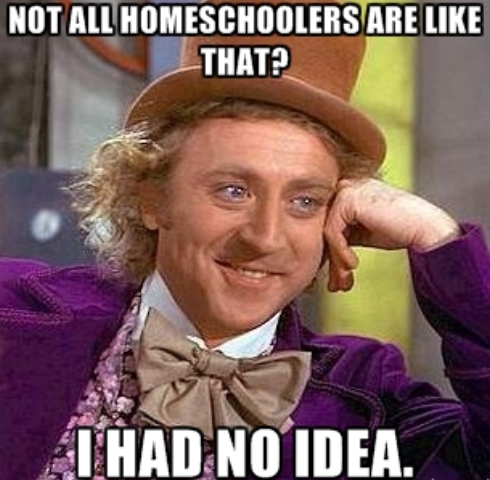
Ah, yes. A jazz riff on the “not all homeschoolers are like that” argument. “Not all homeschoolers are like that” is the broken record of homeschool abuse denialism. My inner sarcastic debater wants to respond like this:

Screen Shot 2013-12-06 at 8.43.30 PM

However, my shared humanity understands that sarcasm isn’t always the best rhetorical strategy. There are better strategies:

  • Reiterating time and time again that we do not think all homeschoolers are “like that”;
  • Reminding the skeptical voices in the conversation that, in the absence of required registration (or at least notification) of homeschoolers (which the mainstream homeschool lobby opposes), we will all remain statistically challenged because we will have no reliable statistics;
  • Pointing out that nearly all homeschool research has involved self-selective surveys that describe the participants but prove nothing about homeschooling in general.
  • Providing counter-self-selective surveys, like the 2013 HA Basic Survey which pretty much “proves” as much as most of Brian Ray’s research — namely, still nothing about homeschooling in general.

If you think the statistical side is lacking, you’re welcome to get in line. We’re right there with you. Those of us speaking up aren’t to blame for a lack of statistics.

That’s the fault of irresponsible homeschool advocates.

(What sort of statistics do you want anyways? Statistics of dead kids? Exactly how many dead kids will it take before we’re taken seriously? While we’re busy trying to make homeschooling better, you get busy figuring out how much abuse you can tolerate before you act, too. Deal?)

For today, however, we are all in the same position: we are feeling around in the dark with anecdotes and stories. You might tell different anecdotes and stories than I might. I choose to respect your storytelling. Whether you choose to respect mine is not in my control.

But at least remember that I have stories. In fact, I probably have more than most homeschool students and parents. I spent a decade of my life traveling around the United States because of homeschool speech and debate — meeting new people, making friends, competing in tournaments, and teaching thousands of homeschool teenagers. I have taught the children of national homeschool leaders.

All this while I was a teenager myself.

As a homeschooled teenager, I saw things that you parents have not seen in your own communities. I have lived a life that you parents have never lived. It is like an alternate universe. My first taste of hard alcohol was provided by the son of one of the most prominent national homeschool leaders. I have lived this life. So while I don’t have statistics for you, and while we in this movement are trying to fix that inherited problem, keep in mind that my “anecdotes” — and our stories — carry the enormous weight of experience.

Have you seen the underside of this world? Because I have. The rabbit hole goes down deep, and I have yet to reach the bottom. There are so many hurting kids, now as there was back when I was a kid. There are secrets and sorrows and fears. We have shared those secrets as friends, we have carried each other’s sorrows, we have whispered our fears like prayers.

But maybe you’re right. Maybe at the end of the day, we’re in the minority.

Maybe we are statistically challenged.

The possibility doesn’t faze me one bit.

Because I don’t look to you for a stamp of statistical approval. I don’t take my cues from your homeschool orthodoxies or your convention speakers.

I take my cues from my conscience. And my conscience says go to where the shadows lurk, to create safe places even where the wild things are.

See, a long time ago, I heard a story. It was about a shepherd who had a flock of 100 sheep. One day, one of those sheep got lost. Instead of remaining with the 99, the shepherd did not sleep, did not stop, until he found that the lost one.

I learned social justice from that story. I learned the meaning of activism. I found the meaning of revolution — that you can “change the world” all you want, you can “redeem the times” ad nauseum. But if you neglect the little ones, it’s all for naught.

See, I learned that Jesus of Nazareth was not content with 99 sheep when 99 sheep means that one gets left behind to suffer in silence and solitude.

And I saw how the Pharisees did not understand. I saw how they looked at each in bemusement, clicked their tongues at Jesus for fretting so much about that one fringe sheep, saying, “Tis a common practice of the statistically challenged.”

But Jesus dealt with human beings, not statistics.

Human beings are what I want to deal with, too.

So go ahead. Keep surveying your 99 award-winning sheep. Us “bitter apostates” will be out in the wilderness, searching for the one you abandoned.

Stiff-Necked Legalism: By Chris Jeub

HA note, October 3, 2014:

In light of recent allegations by Cynthia Jeub (one of Chris Jeub’s daughters), the HARO board is uncomfortable with hosting Chris’s content. You can view the original post and comments as a PDF here.

Kevin Swanson Has Stumbled Upon a Very Real Truth

Screen Shot 2013-10-20 at 7.32.42 PM

HA note: The following is reprinted with permission from Libby Anne’s blog Love Joy Feminism. It was originally published on Patheos on October 17, 2013 with the title, “Kevin Swanson on ‘Apostate Homeschoolers.'”

It seems Homeschoolers Anonymous has made an increasingly large splash in the homeschooling world.

Prominent Christian homeschool leader Kevin Swanson himself felt the need to address the group in a recent broadcast on his Generations with Vision radio show. He gave it the title “Apostate Homeschoolers.” If you click the link to listen, the section on Homeschoolers Anonymous starts at 5:00 and goes until 10:40, when Swanson moves on to the Boy Scouts.

What does Swanson blame for the growth of the “homeschool apostates” and their increased networking and online activism? NCFCA homeschool speech and debate. Oh yes. NCFCA was started by Christian homeschool leaders to equip a generation of homeschooled children to be culture warriors, fighting against the godless secularists and working to establish a Christian America. But apparently, according to Swanson, it’s gone awry, and too many of its homeschool participants have left God’s Truth for the faulty world of man’s intellect and reason.

In other words, Swanson has stumbled upon the very real truth that indoctrination fails when you teach children how to think instead of what to think.

But if ensuring that your young people retain your beliefs requires teaching them what to think without ever teaching them how to think, the problem is with your beliefs, not with the fact that certain of your young people figure out how to think and then walk away. That this is the response of the Christian homeschooling world—that perhaps teaching kids how to think was a bad idea—then what they have to offer is very sad indeed.

And just so we’re clear, this is what Kevin Swanson is now apparently afraid of:

debate1

debate2

debate3

Look how scary we are, with all of our researching and talking and thinking and socializing!

What Do a Sheikh and a Homeschool Leader Have in Common?

Screen Shot 2013-09-30 at 6.44.30 PM

HA note: The following is reprinted with permission from Julie Anne Smith’s blog Spiritual Sounding Board. It was originally published on September 29, 2013.

Just how close is the homeschool fundamentalist version of Patriarchy to the Islamic version?

I think it’s pretty darn close.  Check this out.

Remember this from Christian Homeschool Leader and Pastor Kevin Swanson?

Kevin Swanson – Little Tiny Fetuses Embedded in the Womb

“I’m beginning to get some evidence from certain doctors and certain scientists that have done research on women’s wombs after they’ve gone through the surgery, and they’ve compared the wombs of women who were on the birth control pill to those who were not on the birth control pill. And they have found that with women who are on the birth control pill, there are these little tiny fetuses, these little babies, that are embedded into the womb. They’re just like dead babies. They’re on the inside of the womb. And these wombs of women who have been on the birth control pill effectively have become graveyards for lots and lots of little babies.”

Doesn’t it kind of sound like this?

driving

Driving affects ovaries and pelvis, Saudi sheikh warns women

Saudi women seeking to challenge a de facto ban on driving should realize that this could affect their ovaries and pelvises, Sheikh Saleh bin Saad al-Luhaydan, a judicial and psychological consultant to the Gulf Psychological Association, told Saudi news website sabq.org.

Driving “could have a reverse physiological impact. Physiological science and functional medicine studied this side [and found] that it automatically affects ovaries and rolls up the pelvis. This is why we find for women who continuously drive cars their children are born with clinical disorders of varying degrees,” Sheikh al-Luhaydan said.

Of course Twitter is having fun with this:

twitter

If I do not respond quickly to comments between the hours of 8AM and 12PM, it is because I am out driving, rolling up my pelvis.  Please pray.

How I Learned To Stop Being Afraid and Love Other Religions, Part One: If Satan Made Xanax, And Other Worldview Myths

screen-shot-2013-07-29-at-7-46-16-pm

HA note: The following is reprinted with permission from R.L. Stollar’s personal blog. It was originally published on July 30, 2013.

*****

“Nothing short of a great Civil War of Values rages today throughout North America. Two sides with vastly differing and incompatible world-views are locked in a bitter conflict that permeates every level of society.”

~James Dobson and Gary Bauer, Children at Risk: The Battle for the Hearts and Minds of Our Kids, 1990

*****

Part One: If Satan Made Xanax, And Other Worldview Myths

When I enrolled in the Eastern Classics program at St. John’s College back in 2005, I encountered many and varied responses from fellow evangelical Christians. Some proved encouraging and others not so.

The most common response, though, was: “Are you a Buddhist?”

As the months passed and the time of graduation grew closer, the question changed, but only slightly:

“Have you become a Buddhist?”

At first the question provoked but a smile. As it grew more regular, however, and as I began to know more about Eastern philosophies and religions as well as what actually occurred in the minds of the questioners, it provoked a thought process. I realized that, to many Christians I knew, “Eastern” meant “Buddhist.” And “Buddhist” meant some tranquil species of rebellion against the American Jesus — like if Satan made Xanax for the mind. I vividly remember one individual who commented that, if I were to study Eastern religions, I better not become a Buddhist: Buddhists have no emotions whereas, you know, Jesus wept.

Such comments are likely the result of ignorance regarding world religions. A good number of the people who asked this question in 2005 did not shun inquiry. They merely lacked familiarity with Buddhism. They did not know (as I did not know prior to a year of study in the Eastern Classics) that Buddhism, like Christianity, has a dizzying number of denominations, each vying for doctrinal dominion. Consequently, when someone asks me now if I agree with Buddhism, I experience great difficulty answering the question: “Which denomination?” I have to ask. I have great fondness for the emotional freedom and experience-based practices of Diamond Way Buddhism, for example, whereas I dislike the asceticism of Theravada Buddhism. American Zen Buddhism is another story.

I have thus realized, after these conversations with friends and fellow students, that the American Christian mind (maybe even the American mind) has a paltry understanding of some of the longest-standing and deeply rooted ideas of the world. American evangelicals especially do not take time to appreciate, let alone understand, a good number of their strongest opponents in the sphere of religion. Those who have taken time (seemingly not much) only do so to construct flimsy card-houses with the purpose of a surprise attack.

You have groups like Summit Ministries and Worldview Weekend, training up the next generation with nothing more than an arsenal of generalizations, simplifications, and shameless reductionism.

No one seems interested in taking the ideas of other religions at face value and learning to see any sort of beauty or value in them.

To say that other religions can be beautiful or valuable is not an exercise in relativism. But granting this beauty or value will likely suffer the fate of being interpreted as such by many of today’s “worldview” champions. The old guard of American Christianity and Christian homeschooling — Dobson and Bauer, from this post’s opening quotation, and people like Summit’s David Noebel and John Stonestreet, or homeschooling’s Kevin Swanson and Ken Ham — is terrified of anything that sounds “postmodern.”

Postmodernism is like intellectual dub step to the old guard.

In today’s evangelical culture, a defense of religion as an aesthetic and social phenomenon seems indistinct from a defense of religious pluralism and intellectual apathy. But that’s because this culture is so afraid of “liberal” arts to the point that it cannot comprehend some basic philosophical and sociological concepts. The fact is, to understand religion as an aesthetic and social phenomenon grants humanity the freedom to explore a ground to aesthetics and society that condemns, rather than condones, an unwillingness to pursue truth.

But first: what does “religion” mean? And what would it mean, that one can perceive this noun’s content as “aesthetic” and “social”?

To the evangelical culture, religion is either Christian and thus true or pagan and thus untrue. This proves a stunted understanding, however, because religion is neither one nor many truth-claims which one can either affirm or reject. Religion is no doubt a phenomenon which entails truth-claims. But it also entails much more. Religion is a complex totality of human and other elements, only one element of which is the sort of truth-claim that one can package into propositions.

We need to start seeing religion — and any particular religion — not as a mass of disembodied doctrines but as what sociologist Peter Berger calls a “world conspiracy.” “World conspiracy,” in fact, seems the best definition for religion.

What does this mean?

In The Sacred Canopy, Berger explains that,

“The condition of the human organism in the world is…characterized by a built-in instability. Man does not have a given relationship to the world. He must ongoingly establish a relationship with it.”

The world abounds with the sort of innate precariousness that a Buddhist would term as impermanence — “All things pass,” sighs Kaoru, one of the main characters in Murasaki Shikibu’s Tale of Genji. This line is almost identical to Solomon’s sentiment in Ecclesiastes.

Human and other life forms, buildings and projects, ideas and romances—these all rise and fall, constantly, perpetually, each and every day. As a result of this precariousness, human beings go about selecting structures of meaning in which they can operate. Humans construct families, work places, technology, and institutions in which to control the elements of the world that bear chaos. Out of their constructions human beings hope for an order, a society. Peter Berger says,

“Society, as objective reality, provides a world for man to inhabit. This world encompasses the biography of the individual, which unfolds as a series of events within that world”

But humans need more than order: they need to feel meaningfulness within that order. They require that order to be “ordained” in some way. Thus,

“a meaningful order, or nomos, is imposed upon the discrete experiences and meanings of individuals.”

This nomos is religion:

“Religion is that human enterprise by which a sacred cosmos is established, wherein ‘cosmos’ implies not a galaxy but order.”

This final addition to the human world-building project grants the project and its everyday objects and endeavors a sense of purpose, an all-encompassing reason for pursuing the ends of the society. Berger terms this sense of purpose or reason a “sacred canopy” cast over world-building. It is a “world conspiracy” in the sense that humans work together to give their reality a meaning:

“Religion is the audacious attempt to conceive of the entire universe as being humanly significant”

What Berger as a sociologist calls a “world conspiracy,” or “sacred canopy,” a theologian like N.T. Wright might term “worldview.” (1) Jamake Highwater, a historian and philosopher of sexuality, preferred the term “mythology” in his 1991 book Myth and Sexuality:

“All human beliefs and activities spring from an underlying mythology—those metaphors, informing imageries, and paradigms which deeply influence every aspect of our lives and which determine our attitudes about reality—about the world and about ourselves: good and evil, normalcy and abnormalcy, fact and fiction, justice and injustice, beauty and ugliness, power and powerlessness.”

Whether one prefers world conspiracy, sacred canopy, worldview, or mythology as a descriptive, the common factor among the ideas is that human being itself contains within it a hope and passion for carving out a home in a hostile existence.

This hope and passion — and all its nuances, quirks, failures, and successes — is the stuff of religion.

*****

Part Two: When Buddhism Saved My Life >

Why Surveys? A Critique of the Tools Used to Judge Us All

About the author: Christopher Hutton is a freelance journalist from Bloomington who writes on technology, religion, and the ideas of the day. He currently writes for Christ and Pop Culture and Paste Magazine. He is also the Social Media Manager/Intern for Rivendell Sanctuary, a new education program designed to provide a truly thorough education. Follow Christopher’s blog at http://liter8.net.

Every day I seem to see a new study or statistic being used to prove a point about something.  Beginning in the 1980’s, the religious survey organization known as the Barna Group provided data point after data point in order to reveal truths of our culture and how to interact with it.

Most recently, Generations Radio host Kevin Swanson teamed up with Brian Ray in order to record the social and spiritual conditions of the millennial generation in a survey. (You can find the survey at gen2survey.com.)

Now, to gather research is not bad.  In fact, it’s the very first thing that self-proclaimed culture-reclaimers should do.

But are they doing it effectively?

The problem with surveys is that they rely on the human language to present and record human behavior. Number concepts are different than word concepts because their definitions are clearer. If you say “five”, then people understand you are discussing a quantity. However, if you say the word “religion”, then the topic becomes fuzzier. Cultural and personal circumstances often cause words to be understood in different ways.

This causes companies to create a lot of ideologically inaccurate surveys. Consider a survey by the Barna Group which seemed to state that “only 4 percent of Christians have a biblical worldview”.  This is a big claim, and can seem scary to those fighting for a biblical worldview.

But what does Barna mean by a biblical worldview?  This isn’t obvious at first glance.  Historically, the concept of a Biblical Worldview has historically had only a few tenets which almost all people who argue for it would agree with (Inerrancy of the Bible, existence of God, Personhood of Christ, etc.), but everything else is flexible. So, was Barna adding political elements to their definition?  Were they adding debatable theological ideas into the biblical worldview?  It’s hard to know from how a group like Focus on the Family used the Barna Group’s statistics.

Kevin Swanson’s latest study is another clear example of this.  If you look at the language used in the study, it does focus on his particular form of Christianity, which emphasizes extreme forms of Conservative Christian theology, as well as an instinctual anti-government bent, an emphasis on the family relationship, and limited options for explaining one’s relationship with God, family, and the Church.

This kind of ideological shifting is dangerous, because it causes the otherwise objective data to be skewed and misbalanced.  It will misrepresent its survey-takers. It will also skew the facts.

So, be wary of surveys. Mark Twain once famously stated that “There are three kinds of lies; lies, damned lies and statistics.”  While quantitative data is helpful, it is dangerous if it is not true. So track statistics, check the facts, and never let them skew your take on a topic.

Rewriting History — History of America Mega-Conference: Part Eight, Closing Thoughts

Rewriting History — History of America Mega-Conference: Part Eight, Closing Thoughts

HA note: This series is reprinted with permission from Ahab’s blog, Republic of Gilead. For more information about Ahab, see his blog’s About page. Part Eight of this series was originally published on July 18, 2013.

*****

Also in this series: Part One: First Impressions | Part Two: Doug Phillips on God in History | Part Three: “Religious Liberalism” And Those Magnificent Mathers | Part Four: Kevin Swanson Is Tired Of Losing | Part Five: Messiah States and Mega-Houses | Part Six: Doug Phillips Rages Against the 20th Century | Part Seven: Christian Vikings, Godly Explorers, and Strange Bacon | Part Eight: Closing Thoughts

*****

I’ve infiltrated several Religious Right events for Republic of Gilead over the years, but none left me as drained as the History of America Mega-Conference. The fundamentalism and revisionist history pervading the conference was difficult to digest, but it offered me a glimpse into an disquieting homeschooling subculture. Woven through the conference presentations were several common themes:

Dominionism / Christian Reconstructionism — Dominion theology and Christian Reconstructionist thought were everywhere at the History of America Mega-Conference. From presenters who quoted from Gary North and R.J. Rushdoony, to merchants who sold Rushdoony’s books, to the banner in the dealer room that read “READ RUSHDOONY”, it was difficult to ignore the affection that organizers held for Christian Reconstructionist writers. To boot, speakers such as Doug Phillips and Marshall Foster attributed Christian principles to America’s foundations, ignoring evidence to the contrary.

Patriarchy — A heavy musk of Christian Patriarchy ideology hung over the conference. All speakers were white men, several spoke harshly of feminism, and some romanticized stereotypical gender roles and family arrangements. Glaringly, most of the historical figures they spoke of were men. The idea that women have played dynamic roles in history, or that female presenters could have brought meaningful content to the conference, was ignored. When the speakers spoke of “men” in history, I don’t think they meant humankind, but rather people with Y chromosomes.

Christianity as Monolithic — It soon became clear that when presenters spoke of Christians, they meant fundamentalist Protestants. In more than one talk, America was celebrated as a “beachhead” for evangelical Christianity throughout history. Anti-Catholic sentiments reared their heads in several talks, suggesting that some speakers did not recognize Catholics as Christians. Moreover, Doug Phillips claimed that the church was silent on political and social issues in the first half of the 20th century, ignoring the rich contributions of Catholic and progressive Protestant Christians during that time.

Sanitization of Christianity in History — Speakers trumpeted real or imagined boons from the spread of Christianity while ignoring violence and oppression committed in Christianity’s name. Whether speakers were ignoring the violence of Iceland’s Christianization, the bloodshed of King Sigurd I’s Crusade, or the ethnocide of the Native Americans, the conference painted a very sanitized picture of Christianity’s role in history.

Distrust of Secular Government — Several speakers, including Doug Phillips and Geoffrey Botkin, condemned the U.S. government for its alleged “statism”. Government programs and social services intended to help the vulnerable were caricatured as the tentacles of a “Messianic” state.

Distrust of the Present and of Mainstream Culture — Speakers repeatedly slammed the modern era and its imagined boogeymen — “statism”, secularism, abortion, feminism, evolution, and same-sex marriage — as fallen and evil. Mainstream culture was caricatured as a corrupting influence from which homeschooling must shield children. At times, Vision Forum’s history conferences hints at a longing to return to the past, a past imagined as more virtuous and Christian.

Children as Torchbearers — Presenters understood children to be transmitters of fundamentalist Christianity unto future generations, and thus concepts such as “generational thinking” often came up. The History of America Mega-Conference was a homeschooling conference, after all, and its revisionist ideas were intended for the curricula of homeschooled children. To boot, children are to be steeped in fundamentalist Christian thought and shielded from mainstream culture, according to Kevin Swanson. Presenters refused to consider how such revisionist education might leave children ill-prepared to integrate into American society, and failed to grasp that some children might reject their fundamentalist upbringing altogether.

At the History of America Mega-Conference, I was exposed to a subculture whose worldview is at odds with modern society. As American society slowly embraces religious pluralism, gender equity, LGBTQ equality, and the paradoxes within its own history, fundamentalist subcultures find themselves out of place in their own country. Since these social upheavals show no signs of abating, will fundamentalists subcultures such as this one retreat even further into their own bubbles? Or will they desperately try to reshape society in their own image by molding the minds of the next generation?

As I listened to workshop after workshop on revisionist history, my heart broke for the children being raised in fundamentalist homeschooling households. The vision of the world they were receiving was incomplete and inaccurate, and I worried about how they would integrate into the larger society as young adults. Would they have the curiosity and will to seek out fresh perspectives and new information, or would they be weighed down by the propaganda of their youth?

As people who recognize the problems with fundamentalism, how do we counter the messages of groups such as Vision Forum? By challenging historical revisionism. By remembering that history encompasses many narratives, not just one. By demanding accuracy in homeschool curricula. By reaching out to current and former homeschoolers and making accurate information available to them. And finally, by educating ourselves on the past and recognizing its impact on the present.

To end on a lighter note, after days of listening to History of America Mega-Conference workshops, I think I’ve earned a beer. Let’s toast to a world free of fundamentalism someday!

Photo courtesy of Ahab at Republic of Gilead.

*****

End of series.

Crosspost: Methodological Problems with Kevin Swanson and Brian Ray’s Gen 2 Survey

Crosspost: Methodological Problems with Kevin Swanson and Brian Ray’s Gen 2 Survey

HA note: The following is reprinted with permission from Libby Anne’s blog Love Joy Feminism. It was written by a guest writer, Apodosis, and was originally published on Patheos on July 17, 2013. 

Libby Anne posted recently about a new survey conducted by Brian Ray of the National Home Education Research Institute, a non-profit which conducts studies of questionable scientific validity on homeschooling. As a Ph.D. social scientist myself, I looked over the new survey with a critical eye and I’m sorry to say there won’t be much useable data gleaned from it because it is rife with methodological problems.

The survey has over 100 questions and nearly every question needs revisions, so I’m just going to summarize my main critiques of the study.

1. Institutional Review Board

When you are conducting a survey that collects personal information from the participants, every IRB in the country requires that you have signed informed consent forms for each of your participants. In online surveys, these tend to include a cover page describing the purpose of the study and what is asked of the participants, as well as a signature box to show you have understood your rights.These forms often include the phrases “You may stop the survey at any time without giving a reason” and “You are not obligated to answer any question you don’t want to”. They provide contact information for the primary investigator (PI) and other associated researchers, as well as for the IRB that approved it. “If you feel your rights have been violated, call this number” etc.

In the Gen 2 survey, there is no such information. It is not clear who is being asked to participate (see #2), the goals of the study are not honestly stated (see #3), and there is no contact information for the PI or an IRB to contact if you feel your rights have been violated. I had to dig on NHERI’s website to find the email address of the PI, Dr. Brian D. Ray (it’s bray@nheri.org, btw, in case you feel your rights have been violated), and he actively discourages you from contacting him. Red flag.

A peer-reviewed publication will not publish any results from research that was not overseen by an IRB.

2. Target Population

It is not clear who is being asked to participate in the survey. In the “About” section, Ray says the participants are “those between the ages of 18-38 years old that grew up in religious homes”, but in the FAQ he says “Anyone between the ages of 18-38″ may participate. I am between the ages of 18 and 38; I was raised in a moderate mainline Protestant family, and I am now a progressive mainline Protestant. I honestly cannot tell if he wants my data or not. Though both of those statements about who should participate apply to me, the questions on the survey indicate otherwise.

3. Goals

Which brings me to my most serious methodological critique of the study, which is that the goals are not honestly stated. There are two different studies conflated here which have entirely different goals. Dr. Ray even alludes to this in the “About” section: one goal is “to come up with data points of key influences that either encouraged or deterred the participants from practicing the same faith as their parents”; the other goal is to “use the statistics from this survey to help equip parents to make more informed decisions in the education and spiritual guidance of their children.” That is, in simpler terms, the goals are (A) to find out how young people’s religious views change as they reach adulthood, and (B) to figure out how to make sure young fundamentalists/evangelicals stay in the fold.

In fact, the main goal of the study seems to be (B) with a shallow veneer of (A) superimposed on it. Now, (A) is an interesting study whose results I would look forward to reading. (B) is not a scientific study. You do not perform a scientific study with the goal of achieving a certain result. Social science is about trying to describe and explain human behavior, not about trying to change it or attach value judgments.

Here are some examples of the problems that arise when the two studies are conflated. Dr. Ray pays lip service to the idea that young people may belong to a variety of faiths, as evidenced by his questions:

Generally, what kind of religious service did you attend as a child?

What kind of church or religion do you currently associate yourself with?

Available answers include Atheist, Agnostic, Buddhist, Hindu, Jewish, Muslim, and a variety of mainline Protestant denominations in addition to the exhaustive list of evangelical/fundamentalist groups. However, on the next pages he asks questions like

My current church is serious about applying the biblical principles of eldership, shepherding, mentoring, and church discipline.

Did you ever get any “worldview” training?

How often did your Father/Mother read the Bible to you?

These questions indicate that the primary audience of this study is people raised in a fundamentalist/evangelical/Christian patriarchy home. How are Buddhists and Hindus and Atheists supposed to answer these questions? Note that there is no “Not applicable” option available. This brings me to #4.

4. Not Applicable

It is important in surveys to allow your participants the freedom to answer the questions honestly, and not be forced to pick the “closest” answer. Many of the questions follow the “Have you stopped beating your wife” pattern, where e.g. a person who has never beaten their wife has no honest way to answer the question. “Not applicable” is only an available answer for one of 100 questions in the survey. This becomes a problem with questions like the following:

How distant or close do you feel to God most of the time?

What was the status of your parents’ marriage during your raising?

My father was very involved in our family home life.

How would an atheist answer the first question without “Not applicable”? How would someone answer the second question if they were raised by two parents in a committed relationship who were not married? And in the third case, what if you didn’t have a father?

“Other” followed by a fill-in-the-blank should also occur much more frequently as an available answer in questions such as:

Have you, or your significant other, ever chosen to have an abortion? Yes/ No

Do you think that people should wait to have sex until they are married, or not necessarily? Yes/ Not necessarily

How would you describe yourself when you were a child? I was very rebellious/I struggled with rebellion, but overcame it/I was always fairly obedient and honoring as a child

In the first question, it would be more appropriate to ask “Have you ever had an unwanted pregnancy?” and then to ask how it was dealt with. As it stands, a person who has never been pregnant and a person who has carried a rapist’s child to term would give the same answer. In the second and third questions, there are clearly more than just the possible answers given. My answers would be “No, unless they want to” and “My parents were supportive of what I chose to do and who I chose to be”. Participants in the study need a way to answer these questions honestly, so even if Dr. Ray wants to limit his variables it would be more methodologically sound to provide an “Other” response with a fill-in-the-blank to such questions.

5. Leading/Biased Questions

This brings me to another point: almost every question is leading or has other problems caused, for the most part, by faulty assumptions and a lack of imagination on the part of Dr. Ray.

“What kind of church or religion do you currently associate yourself with?” Some people consider themselves to be a member of a faith without having a specific faith community. Some people consider themselves to be members of multiple faith traditions. A better question would be “How would you describe your religion or faith?” with multiple check-boxes allowed. And he should list all the religions, not just the ones he could think of off the top of his head! He forgot at least (off the top of my head) Baha’i, Sikh, Wicca, Christian Science, Animism, Deist, Shinto, Unitarian Universalist, Not applicable, Other____, and he did not provide any different denominations of Judaism or Islam. In addition, he should have grouped the religions together by type rather than alphabetically—this list makes it very hard to see if your faith is represented. And groups like “Mormons” and “Congregationalists” should be called by their actual names—LDS and UCC, respectively. This list of religions, while it pays lip service to religious diversity, is actually offensive in its exclusions and ignorance. Plus, there is no acknowledgment in this survey of mixed-faith households. What if your parents were of different faiths, or what if you and your significant other do not share a faith?

Questions such as

What is your sex/gender? Male/ Female

How was your relationship with your Mother / Father when you were 16-17 years old?

How often did your Mother / Father explain biblical principles to you?

presume an oversimplified, heteronormative view of gender and family. Sex is not the same as gender; there are quite a few other genders than just male and female; you might have parents of multiple genders or the same gender (and therefore not have a “Mother” and a “Father”); and you might have been raised by other family members, or primarily by friends, or in foster homes. If this was really a survey about changes in young people’s religious views, it would try to get an accurate picture of their lives without limiting them to these binaries. Ray should also ask about people’s sexual orientations if he’s that interested in the status of their romantic lives; however, his reference to “homosexual” “encounters” in one of the questions indicates that he probably does not believe in sexual orientation as a concept (see #6).

6. Limited Mindset

Many of these questions portray a mindset that is isolated to the evangelical/fundamentalist/Christian patriarchy/Quiverfull/Purity movements–it’s possible that Dr. Ray does not even realize there are other ideologies out there. For instance, there is this question/answer set:

What statement most aligns with how many children would you like to have? I don’t want to have children / I want no more than a few children / As many children as God will provide / I don’t know

This really should be divided into multiple questions. First, he should ask “Do you plan your pregnancies?” If no, he should ask about “how many children you hope God will give you”, but if yes, he should ask how many you plan to have. I don’t think Dr. Ray realizes that some people plan their pregnancies. Then there is the following question/answer pair:

If you have—or were to have—children, what form of education do you plan to use for them? Christian school / Christian school and homeschool / Christian school and non-Christian private school / Christian school and public school / Homeschool / Homeschool and non-Christian private school / Homeschool and public school / Private school, non-Christian / Public school / Charter school/virtual charter / Other

At least this one has “Other” as an option, though it doesn’t let you write in your response. First of all, it’s a badly designed question—he should just list the types of school and let you check as many boxes as you want. Second, the question relies on the assumption that parents would choose their children’s manner of schooling before the children even exist. What if the child is gifted or disabled? Would that change the parents’ plans? And Dr. Ray does not even realize that people who would answer like me are out there—”It depends on the child’s needs and wants, as well as other considerations such as expense, distance, quality of education, etc.”

Then there’s this question/answer pair:

Did your parents use corporal discipline (spanking) with you?No / Yes, consistently and they were generally under loving control / Yes, consistently and often they were not under loving control / Yes, inconsistently and they were generally under loving control / Yes, inconsistently, and often they were not under loving control

These answers presuppose a worldview where the value of spanking is not open to debate (spoiler: we don’t live in that world). It would be more accurate to ask “What was your parents’ position on spanking?” “How often were you spanked?” “Are your attitudes toward it positive, neutral, or negative?” “Would you spank your own children?” etc.

And then there’s the part where he puts these two questions next to each other, clearly conflating them (shades of Libby Anne’s two boxes): “Have you had a sexual encounter or physical relationship with someone to whom you are not married?” and “Were you ever sexually abused before age 18?” Note that a girl who was repeatedly raped by her Christian patriarchy father for ten years and a girl who was raped once by an acquaintance at a party as a teenager would probably have different reactions to their faith traditions, though they would give the same “Yes” response. No effort is made to make this distinction in the survey. And nowhere does the survey ask about physical abuse, since Dr. Ray probably doesn’t think it exists.

Or how about the question “If you were unsure of what was right or wrong in a particular situation, how would you decide what to do?” with the available answers: Do what would make you feel happy / Do what would help you to get ahead / Follow the advice of a parent or teacher, or other adult you respect / Do what you think God or the scripture tells you is right / Something else. These answers reveal Dr. Ray’s belief that morality does not exist outside (his brand of) Christianity.

7. Exclusionary Language

The language Dr. Ray uses is exclusionary and often confusing. For instance, he persists in using terms like church, pastor, scripture, prayer, Bible, youth group, Sunday School when these terms are uniquely Christian and do not apply to people of other faiths–he ought to say faith community, religious leader, holy book, prayer/meditation, religious education if he wanted to get accurate data. He also fails to define several terms which I don’t understand because I was not raised in a fundamentalist environment: family-integrated, homeschooling-friendly, shepherding, church discipline, worldview training. In his questions about belief in “God” and “heaven”, he ought to ask separate questions about each property he wants to assign to these words’ meanings (e.g. “Do you believe in a deity or deities?” “If yes, do you believe the deity/deities is/are omniscient? Omnipresent? Omnipotent? Does it/do they have a gender? Does it/do they affect everyday events?” etc.). If Ray wants accurate data, he should define confusing and ambiguous terms.

You should not be able to tell someone’s political and religious beliefs from survey questions designed to elicit yours. You should not be asked to give dishonest answers to survey questions because your honest answers are unavailable as options. You should not have to infer how exclusionary language in the questions would apply to your situation. You should not be asked to give out your personal information without giving your informed consent.

An IRB would not approve this study. I would not rely on any of the conclusions that come out of it.