I Fell in Love with My Best Friend: Achsah’s Story

Screen Shot 2014-12-29 at 5

HA note: The author’s name has been changed to ensure anonymity. “Achsah” is a pseudonym.

I remember attending a wedding. I was maybe eight or ten at the time and the pastor’s oldest daughter was marrying a young man in the congregation. The only real detail I can conjure up is that they made it a point to let everyone know that the couple had saved their first kiss for the wedding.

As I sat watching this first kiss, I remember thinking that it was a beautiful thing and decided to save my first kiss for the marriage altar.

I grew up in a church that was affiliated with Joshua Harris’s church. His books were at our little bookstore, in our homes, and taught like gospel truth. Couple that with my parent’s odd obsession with Vision Forum Ministries, and you have a young girl that knows nothing other than courtship.

When I was about seventeen, my mom realized that I was old enough for the boys to come after me. Or something like that. So, she bought three brand-new copies of I Kissed Dating Goodbye. She kept one, gave one to me, and one to my younger sister. For a few weeks, we would meet in the living room and discuss a chapter. I don’t remember much about the book, looking back. I remember that my younger sister hated everything about it and tried to push back against it all. But I was the example. I had to be the one that agreed with everything my parents believed.

Besides, it sounded good. My younger sister liked guys. But they terrified me. I didn’t want to have to try and navigate a relationship with one of them. Courtship promised a formula that would keep everything in neat little boxes. If I didn’t have sex and saved my first kiss for marriage and made sure to cover up then I would not get my heart broken. If I let my parents lead our relationship, then I would have the perfect marriage. And I wanted it. My life plan consisted of children and my world revolving around them, and, by default, that included a husband. But a man in the picture was just a minor detail in the grand scheme of things.

And then.

Well, then I fell in love with my best friend. Suddenly, all of the songs made sense.

The skies were bluer. I walked on clouds. Everything made sense. But me falling for a girl was so confusing. There was no formula for this new development. I wasn’t able to talk to my parents about it. My heart, it seemed, was not something I could hold on to. It gave itself away before I knew what was going on. And it wasn’t only that. I never knew what attraction was. Or consent. Or that I would actually want to engage in sexual activities. Honestly, the thought had never occurred to me.

My wife and I began dating the month after she came out to me, which prompted me to come out to myself. By then, I knew I would spend the rest of my life with this woman and that it would be good and full of happiness.

Neither of our parents were thrilled. I remember my dad saying that if I had only talked to him about what was going on, he could have talked me out of it.

We moved shortly after that.

In the year-and-a-half since we married and moved across the country, I have been slowly extracting myself from the conservative mindset. As I am trying to figure out how to be a wife, I am realizing how much I don’t know. I have found that instead of wanting me to be self-sacrificing for our family, my wife wants to pamper me and ensure my happiness. I found that instead of demanding my respect, my partner gives me hers. I found that instead of worrying about lines and how far is too far, my wife and I have been able to communicate our thoughts, concerns, worries, and desires.  Previous crushes were supposed to be a big deal; part of my wife’s heart was supposed to be missing. But past crushes didn’t take something from her; they gave her something.

To me, courtship was about putting on a mask and conforming to a list of rules. It was giving someone else complete reign in my life. When we stripped away those rules and took off the masks, I found that I could finally breathe. I understand the concern our parents had when they decided to raise us with courtship in mind.

But it ended up being a cage.

Homeschooled Kids Matter: A Response to Will Estrada

Screen Shot 2015-01-07 at 5.01.14 PM

By R.L. Stollar, HA Community Coordinator

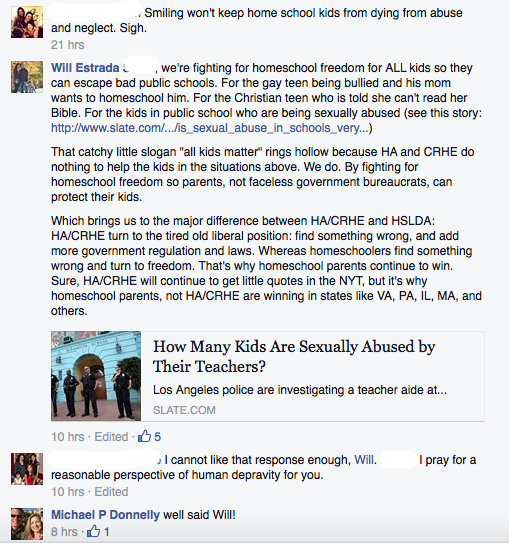
Recently Will Estrada, HSLDA’s Director of Federal Relations, posted on social media an image of himself and HSLDA’s Deputy Director of Federal Relations Andrew Mullins heading to Washington, D.C. with the statement, “Snow won’t keep us from fighting for freedom on behalf of millions of homeschoolers around the world!” A homeschool alumna commented on the image, saying, “Smiling won’t keep home school kids from dying from abuse and neglect.”

Will Estrada responded (and fellow HSLDA attorney Mike Donnelly agreed with in a subsequent comment) with the following:

We’re fighting for homeschool freedom for ALL kids so they can escape bad public schools. For the gay teen being bullied and his mom wants to homeschool him. For the Christian teen who is told she can’t read her Bible. For the kids in public school who are being sexually abused (see this story: http://www.slate.com/…/is_sexual_abuse_in_schools_very…)

That catchy little slogan “all kids matter” rings hollow because HA and CRHE do nothing to help the kids in the situations above. We do. By fighting for homeschool freedom so parents, not faceless government bureaucrats, can protect their kids.

Which brings us to the major difference between HA/CRHE and HSLDA: HA/CRHE turn to the tired old liberal position: find something wrong, and add more government regulation and laws. Whereas homeschoolers find something wrong and turn to freedom. That’s why homeschool parents continue to win. Sure, HA/CRHE will continue to get little quotes in the NYT, but it’s why homeschool parents, not HA/CRHE are winning in states like VA, PA, IL, MA, and others.

Here is an image of the interaction:

estrada

Since Estrada seems unfamiliar with what HA/HARO actually is and does, and confuses us with the Coalition for Responsible Home Education (CRHE), I figured I’d clear up some things for him:

HA is Homeschoolers Anonymous, an internet project of the non-profit organization Homeschool Alumni Reaching Out (HARO). As an organization, HARO gives its unqualified support to children who experience a negative or threatening environment in public schools. This is why, from day one of our organization’s launch, we have made explicit that we support homeschooling. As HARO’s FAQ page states, “We believe that homeschooling is a powerful, useful tool. It represents a democratic approach to educational progress, innovation, and creativity. It allows a child’s learning environment to be tailored to individual and personal needs. When homeschooling is done responsibly, it can be amazing.”

HARO’s mission is to support homeschooling families and communities by educating those families and communities how to make homeschooling safer and more supportive to at-risk children. We created a free curriculum on child abuse awareness that such families and communities can download and utilize. Our presentation Facing Our Fears: How the Voices of Homeschool Alumni Can Help Homeschooling gives multiple constructive suggestions for how homeschoolers can rethink certain ideas that have created problems for alumni. We have more such curriculums and presentations in development. We are currently offering a scholarship for homeschool alumna who are entering STEM fields.

So yes, Estrada, HARO does help kids who want to be homeschooled… by helping to make sure homeschooling is a place that they actually want to be and in which they will thrive.

In contrast, here’s the sad truth about what Estrada said: HSLDA’s “help” for these children ends the day they become homeschoolers. Estrada and his organization are “fighting for freedoms” for homeschooling parents; they have no interest in fighting for the freedoms and rights of homeschooled children. In fact, HSLDA — and Estrada himself — have repeatedly gone on record opposing any rights for children. They refused to launch a public awareness campaign about child abuse for their members. They have made light of educationally neglected children. They have gone to bat for parents who put their children in cages. They have defended convicted child abusers. They have given legal and financial support to more than one abusive high-control group. They have promoted books that encourage physical child abuse and gave a Lifetime Achievement Award to a man who has been accused since the 1980’s of sexually harassing and molesting over 30 women. They even refused to help a homeschool mom who was desperate for guidance after her child was allegedly molested by the child of another homeschool leader.

HSLDA has made the lives of numerous homeschooled children a nightmare.

There are homeschooled children who remained trapped in abusive homes because of HSLDA

So while HARO believes strongly in the power of homeschooling and believes it should be an option for children (especially at-risk children), we are not going to give Estrada gold stars for pretending that somehow bullied LGBT* kids can “escape bad public schools” because of HSLDA. He doesn’t get to whitewash his organization’s history towards either children’s rights or LGBT* issues. And we refuse to entertain Estrada’s revisionist attempt to clothe HSLDA as a champion of LGBT* children when he and his organization daily and explicitly contribute to their dehumanization and oppression.

Finally: HARO is not the same organization as the Coalition for Responsible Home Education (CRHE), which Estrada could have discovered with a simple Google search. HARO has never been quoted in the New York Times. But if we ever have the opportunity, we would tell the newspaper the same thing we would tell Estrada: that HARO’s position is neither to “add more government regulation and laws” nor to “turn to freedom”; HARO’s position is that we must stop turning a blind eye to the children left damaged and abandoned when organizations like HSLDA value “winning” more than actual children’s lives.

Since HSLDA has made clear they are willing to let homeschooled children be the collateral damage of their “winning” strategies, others must rise to the occasion and do the hard work of protecting those in harm’s way. This is the task to which HARO has dedicated itself.

Homeschooled kids do matter. The question is whether or not HSLDA will someday acknowledge that fact.

Silenced Voices, Unspeakable Questions: Lena Baird’s Story, Part Two

Homeschoolers U

HA note: The author’s name has been changed to ensure anonymity. “Lena Baird” is a pseudonym specifically chosen by the author.

< Part One

Women’s voices weren’t the only ones silenced.

LGBT students were condemned, or presumed to be nonexistent.

In a class called “Principles of Biblical Reasoning,” we read a book on natural law by J. Budzizewski. The author argued that all physical acts have inherent, universal meaning, and that a specific sex act between men was literally equivalent to valuing death instead of life. We discussed it in the abstract, without any acknowledgement that we might know gay men. Lesbians were not even mentioned. I cannot imagine how painful that classs must have been for gay or lesbian students. As a straight cis-woman, my voice was often silenced, but at least my existence was acknowledged and (selectively) validated.

Even straight male voices were sometimes silenced. I think it was my junior year when a male student wrote an op-ed for the student newspaper. It was called “Is Bono a better Christian than you?” He argued that concern for the poor might be an essential part of Christianity. While Bono was trying to help the poor, many evangelical Americans focused on less important things.

Apparently, this was a radical statement. The following week, Michael Farris (then-President of PHC) delivered a chapel message in response to the op-ed. He informed the entire student body that Bono was definitely not “a mature Christian.” Mature Christians, according to Farris, do not drink, smoke, or swear. Bono (again, according to Farris) does all of these things. Therefore, he’s not an a mature Christian, and no one should view him as role model.

Even at the time, I thought this was heavy-handed and misguided. What’s the point of a student paper, if students can’t express their opinions? Was this opinion really so shocking that it had to be refuted, publicly, without any opportunity for discussion? Was it really the college president’s job to tell us what to think?

*****

This episode was a harbinger of things to come.

Disagreeing with Farris was dangerous—not just for students, but also for professors.

I was a senior the year of the Great Schism, when several professors who disagreed with Farris left the school (one was fired, several others resigned in solidarity). That story is well documented elsewhere, but it was a dramatic upheaval for the college. When I was a student, I had classes with almost every professor on the faculty, and the few whose classes I didn’t take still knew my name. Eight years later, there are only three professors at the school who would recognize me, including Farris.

I was upset by the professors’ departure. I liked and respected them. Many of us had come to PHC thinking we had all the answers. These professors challenged us, pointing out that we weren’t asking the right questions yet. They encouraged us to respect other points of view—to really understand and engage with other ways of looking at the world, instead of just quoting Bible verses. I didn’t feel like all my questions were addressed, but in their classes, I did not feel dismissed or silenced.

Farris responded to their resignations with personal attacks. He immediately went on the defensive, informing the student body that these professors did not have “a high view of Scripture.” He repeatedly attacked their faith and their character, essentially calling them bad Christians. He did everything in his power to silence them, and to tell the student body that there was only one right side, only one valid opinion: his.

*****

My first two years at Patrick Henry, I had more freedom and more friends than I’d had since I was ten. My high school years had been lonely and isolating, and I was starving for friendship. While some classes were frustrating, others were led by excellent teachers, and I enjoyed the readings the class discussions. I even enjoyed the challenge of final exams, once I realized they weren’t going to kill me.

But by my senior year, I felt lonely and isolated again. Through a summer internship, I’d glimpsed an exciting world outside the small bubble of PHC. When I returned to campus, I felt trapped, like I was returning to a place I’d outgrown. I was also clinically depressed, and didn’t know it. I was processing trauma.

I was asking questions no one wanted to hear.

When things went wrong, my friends said: “God is in control.” They seemed to find it comforting. I didn’t know how to tell them that the idea of a sovereign God made everything worse. If God not only didn’t stop traumatic events, but actively caused them to happen, God was a monster. I couldn’t say that to them. So, once again, I was silent.

I think there were other students I could have talked to; but by senior year, I felt locked into my particular clique on campus. I was one of the good kids—one of the studious, rule-following lit majors. The “rebellious” kids had their own clique, and I’m sure they regarded me with suspicion. I thought some of them seemed cool, but I didn’t know how to reach out, and didn’t want to be disloyal to my friends. I’d broken a few rules, in my quiet way. I drank at my summer internship. I watched French art films on my college-issued laptop (nudity and sex scenes were against the rules). I’d started swearing, mostly in my head, but occasionally out loud. Once, in the dining hall, I almost dropped my tray, and a quiet damn slipped out. I looked around in terror, afraid that someone had heard me and that I would be called to the Dean’s office for a reprimand. Fortunately, no one was listening.

*****

After graduating, I kept trying to be the good Christian girl. It was the only role I knew how to play, but it chafed, like an outgrown pair of shoes. One evening, in a worship service, the pastor preached about David and Bathsheba. He got to the part where the prophet rebukes David, and I realized the prophet—speaking on behalf of God—was rebuking David for stealing another man’s property. Bathsheba was property. She was like a pet lamb.

In a quiet moment of de-conversion, I decided the prophet was wrong, and the God of that story was wrong, too. I was no one’s property. And I was sick to death of silence.

I entered that room thinking that I was still an evangelical Christian. I left it knowing that I was a feminist, and that I would rather have my own story—with all its doubts and questions—than the stories I’d grown up with, where the Bible was infallible, and women’s voices were devalued, and answers preceded and superseded questions.

Life hasn’t been easy since then, but I am finally free. In becoming myself, I became everything a PHC alumna is not supposed to be. I’m single. I’m not a virgin. I’m a feminist. I support marriage equality. I’m pro-choice. I voted for Obama (though I preferred Jill Stein). I don’t smoke, but I enjoy wine (red) and beer (stout), and tequila makes me believe that, while God may not be in control of much, she does love us.

And yes: I still believe in God—just not the patriarchal, sovereign, infallible God of the homeschool world.

I believe in God because I believe in love, and I believe in love because I’ve experienced it. Because I know people, gay and straight, agnostic and atheist, Buddhist and Lutheran, female and genderqueer and male—who live their lives with love, with freedom, with honesty. People who tell their stories, and accept the stories of others, without judgment. People who have given me the freedom, at last, to tell my own story with my own voice—and to be heard.

End of series.

None Dare Call It Education: Anna’s Story

Screen Shot 2014-02-12 at 7.48.57 PM

Series disclaimer: HA’s “Let’s Talk About Sex (Ed)” series contains frank, honest, and uncensored conversations about sexuality and sex education. It is intended for mature audiences.

*****

Hello, my name is Anna.

Like many who write stories for Homeschoolers Anonymous I grew up in a legalistic, controlling, and abusive homeschooling Christian household. When I saw that Homeschoolers Anonymous would be posting a series on sex education I knew I had to write something. My story may be appalling to some, but to others I know it will sound all too familiar. I hope that my story will give you insight and encouragement, and I thank you for taking the time to read it.

My sexual education was completely nonexistent.

I remember that there was a book on one of the living-room bookshelves entitled “Preparing For Adolescence.” I don’t know if the book was intended to prepare parents or children, but neither my parents nor I ever read that book. At 11 and 12 years of age I had long since learned to be ashamed and scared of my body; the lectures on modesty and roles of women had made sure of that.

When my body started changing I didn’t know what was going on, but I stayed silent. My parents were not people I could go to with my fears and questions. My period started without me ever having heard the word before. I had no clue what was happening, and it was probably the most horrifying experience of my life. Again, freaked out as I was, I didn’t tell a soul. My mom noticed the blood when doing laundry weeks later, and she had the only “talk” she ever had with me. Her little discourse included only what do about the “problem” and nothing else.

I got the message: another female attribute to be hidden and feared.

Because my mom seemed oblivious to my needs, my older sister gave me her old bra and bought me my first razor and deodorant, and even these items I felt the need to hide. I was always too scared and shy to ask my mom to buy me anything of an intimate nature. I would use the same razor and wear the same bra for years at a time. My fears were somewhat justified; I remember the time that my mom found a receipt for tampons in my purse and asked me severely if I had bought some. I panicked, lied, and said that I had accidentally picked up someone else’s receipt.

Mom let me know that tampons were strictly off limits.

Throughout my teenage years I gained knowledge about sex years by various covert means. I looked up words in dictionaries and read the books about pregnancy that I found on our bookshelves. I found some answers on the internet when I was able to use it without my mom monitoring me, but I always felt like I was doing something wrong. It wasn’t until I was 18 years old that I went on a research binge and learned the complete picture, including things I should have known much earlier, like the names for my own anatomy.

Though my parents never talked about sex directly, I picked up on their attitudes and beliefs, and sexual thoughts and questions were always accompanied by fear and shame. We were told to save our first our first kiss for our wedding day, that women should never make men “stumble” (I never even knew what that meant, hell, I still don’t know what it means), that dating was giving your heart away to strangers, that to Your Future Husband the most valuable thing about you was your virginity and your pure heart. A fear that consumed my life for years was how I would explain to My Future Husband that I masturbated (at the time I didn’t know the word). I knew he wouldn’t want me, and that it would always be my biggest secret.

I felt I wasn’t a virgin, I was sullied.

I was strange, surely no one else did this. Above all, I was letting God down. I began to lose my faith, because I knew I couldn’t think these thoughts and feel these feelings and still be a Christian. Almost the entirety of my teenage years was spent severely depressed and suicidal, and the overwhelming shame attached to my sexuality certainly contributed.

My mom once told me that when a woman looks at a person, she first looks at their face, but when a man looks at a person, he first looks at their crotch.

Hence, the need for women to wear skirts, (can’t let those men “stumble”). This lovely piece of wisdom made me feel even dirtier, because I began to realize how much I was noticing other people’s bodies. When I saw a person, my eyes would travel up and down their body and linger on their butt and (if a girl) her boobs.

I was clearly some sort of freak, only men were supposed to be this way.

Good grief, was I “stumbling?” I hated the girls I saw walking down the sidewalk in tight jeans. How could they flaunt themselves this way? And how could I help but stare? Deep down though, I envied them. When I was around 15 or 16 I was noticing women’s bodies more and more, and women began to enter my fantasies. In a year or two I was thinking about women in a sexual context just as much as I was thinking about men.

I now had another secret to keep, and this one was absolutely damning.

I heard the sermons and speeches; I read the blogs and articles; I listened to the conversations happening around me. Christians hated gay people. God hated gay people. I knew I could never admit my attraction to women and still be accepted by literally anyone I knew. It hurt me every time someone would talk about gay people as if they were evil beings bent on destroying everything good in America. They were a problem that needed to be fixed, and they were certainly not welcome in a church. I felt better because I knew I wasn’t completely gay; I was still attracted to boys. But then what was I? Where did I fit? Would I always be an outcast?

Today as I have left homeschooling physically as well as mentally, I finally have the freedom to discover and embrace the person that I am.

For the first time I am perfectly happy and confident in my sexuality. I am attracted to the entire range of sexes and gender expressions; masculine men and feminine men, femme women and butch women, androgynous and genderqueer men and women, and everything in between. Would I take a magic pill that could make me be attracted to only masculine men, one color in a whole rainbow? Fuck no! I love my orientation.

I don’t know if I believe in God, but if there is a God who made me, he made me the way I am and he doesn’t have a problem with it.

I have yet to tell my parents or anyone in my old homeschool circles about my more fluid sexuality. It’s really none of their business. But I feel the desire to throw it in their faces. I want to say, “Look at me! A real live non-straight person. Tell me to my face that I’m going to hell. Tell me that I am destroying the moral fabric of America. Fight to keep me from having the right to marry a woman if I wish. Shove a Bible in my face and lecture me about the morality of who I am. Give me pat answers and tell me to pray more. I’m a person, right in front of you, not an ideology or an obscure Bible verse. Do you want to cut all ties to me and keep me away from your children? Am I any different now than you always thought I was?”

But I know I can’t look back; I have to look forward. I can’t worry about how my old acquaintances might view me; I have to focus on making new friends. Vibrant, fun-loving, intelligent, creative, accepting and open people, like me.

As for what I wish to say to my mother, the cause of my thoroughly shitty childhood, “You told me what it meant to be a woman. You were dead wrong. You told me what my future would be. You were wrong. You told me what was right and how to please God. You were wrong. You told me who I had to be. You were wrong. You were wrong to deny me an education; never giving me basic information about my body and sex caused me a lot of pain for many years. You created an absolute hell and kept me prisoner there, but I have come out beautiful and strong. I am now one of those “femi-nazis’ that you spoke about with such derision. I will forever be exactly who I want to be and love who I want to love.

“I no longer follow any of your rules or subscribe to any of your ideologies, and I have never been happier.”

My sister has also written about her sexual education experience; the link to her story is here

The Difficulty with Admitting Trauma: Kandice’s Story

Screen Shot 2015-04-25 at 1.02.37 PM

HA note: The author’s name has been changed to a pseudonym at the request of the author.

My name is Kandice, and I grew up being homeschooled.

My parents were and are members of HSLDA (Home School Legal Defense Association) but in our part of Massachusetts, there weren’t too many other homeschoolers.

My seven siblings and I were all home-schooled together; initially started using a mix of curriculum including Christian Liberty, but my parents quickly switched over to Pensacola Christian College’s (PCC) ABeka Book program. I was homeschooled from 2nd grade through 12th.

My siblings and I were raised with very clearly defined social, political, and religious ideology. Strict Calvinism, coupled with the dogma of Independent Fundamental Reformed Baptist theology was the religious perspective; politically, my father is rabidly conservative – huge fan of the NRA, Newt Gingrich, and Rush Limbaugh etc. Socially, we were taught children to follow Biblical principles as my parents saw them.

We were taught the world is full of sin, and you can’t trust anyone other than fellow Christians as all others are under Satan’s sway.

Curiously enough, unlike many in Fundamental circles, my parents are not racist at all. In fact, they harbor great frustration and confusion over racism – we were taught all people are created in the image of god and therefore physical differences don’t matter; my parents explained differences in appearance and language are stemming from the tower of Babel (Genesis Ch. 11).

I have a B.A., which I got from Bob Jones University, which is private and religious.

I was raised by educated parents who valued learning highly – my mother has a B.A. in English and my father has both a B.A., and his M.Div. My father was a minister at an Independent Fundamental Reformed Baptist church – although his religious views didn’t start out there, they progressed to that point. In my early childhood we were traditional ABC Baptists, but after my father got his own church, things began to change.

My political beliefs changed before high school, largely because I knew I was gay, and then continued transforming.

My dad is an extremely conservative Republican and we were raised with that ideology. My biggest passion in life has been reading, I can’t remember not loving words, and this drove change for me. I started reading literature that changed how I saw things – several authors were powerful in this for me: John Steinbeck, Upton Sinclair, Sinclair Lewis, Pearl S. Buck, Thomas Hardy, and Fyodor Dostoevsky.

By the time I entered high school I already disagreed with my family/father on social justice and equality matters – reading literature made me explore history and social science which really helped to broaden my view.

I knew I was gay from a young age, and in college, in my Ethics class, we were taught “facts” about homosexuality that didn’t connect at all with my experience. Such things as, people become gay through being recruited, usually at a bar (I’d never been to a bar and as far as I knew, I’d never met a gay person); or that Jesus and the Bible condemned homosexuality – well, I read everything Jesus said and he did not ever speak out against the LGBT community; the OT references to Sodom and Gomorrah are referencing the sin of lack of hospitality, not being gay. So in college, my political beliefs opened up still further to be able to fully accept myself as gay, and to be able to say that all people, regardless of religion/gender/orientation etc. should have the same rights and freedoms.

My religious beliefs went through transition as I grew older.

I stopped believing in any way that Jesus was more than a man – he existed, but he is not god or any deity. My view of god changed – I don’t have a definition for the power that some of us use the word god to describe. That power exists, and that power is more than me, but beyond that, I don’t have definitions or rules about religion. I learned to see people in light of who they were and what they do, rather than what the claim to believe – beliefs are only as significant as we let them be, and they’re so tied in to our perceptions of reality that they are often wildly flawed. And contrary to what I was raised with, I don’t think it’s my job or duty to try to “convert” anyone. I think my responsibility today is to live the most spiritual life I can, following the path I’m on, and do my utmost to not cause harm but to be of service to others.

These changes occurred because I was reading, and learning. I took what I read and compared it to what I experienced and saw in the world around me and it didn’t align. Teaching I had been taught in the Bible didn’t match up to my experience, or what I experienced from people who were deemed “sinners” or “apostate” or “lost”. And in fact, what some Christians did to me, and others, was distinctly un-Christlike; there was no logic in saying that their behavior was acceptable because they called themselves Christians, while the person who doesn’t believe in god but does amazing good is going to hell.

I would have to say homeschooling was a traumatic experience for me.

I don’t like admitting that. Because admitting trauma means addressing it beyond the bleak recitation of the facts of what occurred. Diving into how it makes me feel, or affects me, is challenging.  I think that unless homeschooling is done in conjunction with an outside schooling process, it leads to isolation, control issues, lack of contact with reality, social discomfort, low self-esteem and self-confidence, poor communication skills, and significant challenges building healthy relationships.

Homeschooling did have some lasting psychological effects on me. While this is not as powerful as it has been in the past, the scars still remain. My journey involved alcohol use that became alcoholism… that was one of the ways I coped with what I was experiencing/had experienced. I also suffered from severe depression and anxiety, leading to suicidal ideation, and this started around age 11. In college I actually attempted suicide because I just had no coping mechanism, and I didn’t know enough to know there were supports available.

Additionally as an adult, I learned that a lot of the behaviors I had as a kid that my parents labelled as “sin” and tried to punish/discipline out of me, were actually tied in to having Asperger’s and having an IQ/mind that naturally asks questions, and that needs to be challenged. It was actually hard to learn that because it hit me really hard to realize that I had spent so many years and so much time trying to change something that was neurobiologically programmed and that couldn’t be changed. Also, it didn’t need to change – it wasn’t wrong.

But the concept of Autistic persons as being sinful is very prevalent in the community I come from.

My father has repeatedly told me he would do the same thing over again, and that it’s [the way I process things] sin, not the way my brain functions.

Guilt over leaving my younger siblings behind to go to college and then leaving them again when I came out as LGBT is something I’m working through. It’s not as bad as it was, by far, because my siblings hold no animosity towards me. I just felt very responsible for them because as their older sister, I always had been responsible for them. And in big families in these environments, you sometimes feel more like a protector or caretaker than a sibling and that changes things.

Had I been in a public school setting, these experiences would have been very different.

I know this for sure since I was in public school for kindergarten and 1st grade – and in 1st grade, when teachers and administrators began to have concerns over what they saw in me, as well as my siblings, my parents shut the door on the world and began homeschooling. Getting diagnosed at a younger age, having supports in place, learning healthy coping mechanisms – yes I definitely believe this would have made a difference. I can truly say I like myself today, though, so I don’t know that I would want to not experience what I experienced because I don’t know who I would be if I hadn’t gone through that.

In conclusion, homeschooling was a mixed bag for me, very much so.

I enjoyed not being held back or slowed down by anyone else, I enjoyed having no homework, and I felt comfortable (translate – safe/understood) being around my siblings. I’ve been told, as an adult by a psychologist who had done a series of IQ tests on me, that homeschooling was actually a very good thing for me in terms of my intellectual development. So I’m grateful for being homeschooled in the sense that it allowed me to really develop my mind.

Emotionally, socially, psychologically, spiritually – homeschooling was extraordinarily damaging. Not knowing how to interact with anyone comfortably that wasn’t from my family, being raised to not trust other people, not having healthy psychological supports in place or anyone in place who could say, “Wait. This is not ok” – that wasn’t good at all. Being able to learn to reach out to people for help has taken years.  And it’s also taken a lot of work. It’s still not easy. Knowing that’s it is ok to feel something other than gratitude for being one of god’s elect was another learning process; the reality that feelings of sorrow, anger, depression, grief, loneliness – these are ok, also they’re normal and they are not sin was definitely not something I was raised with. Most emotions and thoughts were deemed sinful; learning how to first say “sin is man-made, in fact it’s not real” and then say “feelings are feelings, not good or bad unless I want to assign them so”, that also took many years.

If I were a parent, I would not home school my child.

I think we exist as part of a community, a whole, and that community is so much more than a family or small homogenous group.

I think removing the opportunity for children to learn, from a young age, about differences is unacceptable. It stunts growth emotionally, mentally, and socially. I think raising children in rigid, rule-oriented, controlling and judgmental environments is harmful. Not knowing who you are, not being able to develop your own views through experiences and feelings, is not healthy and it leads to damaging behavior and unhealthy practices in adulthood.

I’m not angry or resentful that I was homeschooled; as I mentioned above I like myself and this is a part of who I am. But I can’t in good conscience recommend or advocate for homeschooling.
The Reason I Despise Fundamentalist Christianity, As Revealed to Me In a Dream

misogyny

HA note: The following is reprinted with permission from Sean-Allen Parfitt’s blog Of Pen and Heart. It was originally published on August 26, 2013.

Recently there has been a series over at the Homeschoolers Anonymous blog, called “Voices of Sister-Moms”. I began reading the introductory post, but could not finish. My entire body was having a negative reaction. I mentioned this to some of my fellow LGBT Homeschooled friends, and they wisely suggested that I step away from the article till I could calm down. I was seriously angry, and had beginning symptoms of a minor panic/anxiety attack.

I was surprised at my reaction to the article.

After all, I am a male, the eldest in my family, who, in the patriarchal/quiverfull system, is in a position of privilege. It’s true that I was expected to do a lot of housework and helped homeschool the kids (see last Friday’s post), but I went to college, got a job, and was allowed to live my own life. (And by “my own life” I mean going to work and coming back home and going to church with the family and sometimes hanging out with friends.)

Well, in the last two years, I’ve come out of the closet, left the fundamentalism my family calls Christianity, meet many new kinds of people, and discovered that what I was taught isn’t necessarily the truth. I am in a relationship with another man, which is for me a clear illustration that the traditionally taught family dynamics are not the one true way. I have even begun to question Christianity itself.

But I couldn’t put my finger on either my anxiety when reading about the mistreatment of Christian girls or my strange negative reactions to other generic mentions of Christianity.

Why did I cringe when I saw a post on Twitter recommending a book about God’s love? Why do I skim past the tweets with Bible verses and references to good times at church?

I believe I got my answer in a dream I had Saturday night.

In my dream, I was visiting my father’s childhood church, which my family had begun re-attending. Mom was in a small-group discussion, and brother T was in the main sanctuary. I walked up to T, but he distinctly turned away without acknowledging me. Once Small Groups was over, Mom came back into the sanctuary. I began following her as she straightened the pews, talking to her. She was upset with me for living openly gay, and I was getting more and more angry with her as the conversation continued.

Then I exploded at her. This is very much out of character of me, as I have only raised my voice at her on a few occasions. I almost tremble is reverent fear of my mother, who has power to unleash unheard-of retribution. Or at least, that’s how I feel. So for me to yell at her actually took me by surprise in retrospect. But what I said to her showed me exactly what I had been feeling but had been unable to express before.

It was the very innermost turmoil that I had not been able to understand.

Do you know what I hate about Christianity?” I shouted at my mother, standing in the very sanctum of the religion I was at that very moment criticizing. “Do you know what it is that makes you unable to accept the fact that ‘I’m gay, and it’s OK’?” My mother just stood there, not replying. And then I said the word. Just one word, a simple 8 letters that encompass the root of my dissatisfaction with the religion in which I was raised, and which has caused irreparable pain to so many people. I opened my mouth, and with conviction, the word thundered through the church:

“Misogyny.”

According to Wikipedia, “Misogyny /mɪˈsɒɪni/ is the hatred or dislike of women or girls.” When used in a religious context, it usually refers to the belief that women are the “weaker sex” (see I Peter 3:7) and are under the authority of men (see I Corintians 11:3and I Timothy 2:12). In practice, this means that women and girls are to be humble servants to men. Girls are groomed to become wives and mothers, and should not aspire to be successful on their own. They are to submit, never questioning their fathers, husbands, or pastors.

When I awoke form my dream, I was surprised at what my mind had expressed while I slept. However, upon reflection, I realized how so very true it is. Misogyny is at the heart of much of the pain I have experienced in my life.

It is the root of the pain that countless other women and gay men have felt.

Wait, sure, you can see how misogyny has caused incredible pain and discrimination for women, but how dare I include myself and other gay men in that category? This is the question I asked myself. But even though I did not express it verbally in my dream, I knew what the answer was.

One major argument used against unions between two men is the call to remember God’s biblical definition of marriage. Thus, marriage is commonly interpreted as a union between one man and one woman. Traditionalists maintain that the proper balance of power places the man in the position of leader and the woman in a submissive position. Women are expected to take care of the home, cleaning, cooking, shopping, teaching, raising children, making life easier for men, and providing sex on demand. Men are expected to go to work, provide money and housing, spiritually lead the family, and lead the family into ministry work.

With this in mind, it’s not hard to extrapolate the effects of misogyny onto gay men. If two men are in a relationship, who has what duty? Men aren’t supposed to do the women’s work. Who leads the family and makes the decision? Which one goes to work and which one cleans the house? In short, which one is the man and which one is the woman?

So many straight fundamentalists can’t grasp the idea that gay men are still men.

A flamboyant gay man is called effeminate and looked down on. When I came out to my mother over the phone, she prayed for me. In that prayer, she cried, saying that she didn’t want me to be her daughter; she wanted me to be her son. I have had several people ask me who is the man in Paul’s and my relationship.

Besides being entirely misguided, such notions and comments are very hurtful. I have been completely cut off form my family. My old friends have told me that we cannot fellowship anymore. They see me as a deviant from the natural order and desires. Because I don’t want to be with a woman. Because I don’t want to exercise headship over my partner. Because I like to engage in “feminine” pursuits such as sewing. Because I care what I look like and plan my outfits to coordinate. Because I wear earrings. Because I am “acting like a woman”, when I am really a man.

I admit I am not sure where I stand on the issue of Christianity. The pain and hurt I have received from the church has made me very wary of the religion of the Bible. When I see others facing the same discrimination I have, I become enraged. It is hard not to be bitter against the very religion that brought me up.

It’s a world of pain, hurt, and rejection, all because of one word: misogyny.

I Was Born With A Severe Immune Disease: Attackfish

positives

I Was Born With A Severe Immune Disease: Attackfish

HA note: The following is reprinted with permission from Libby Anne’s blog Love Joy Feminism. It was a guest post by Attackfish and was originally published on Patheos on February 3, 2013.

I was “homeschooled” (and I’m not sure I am comfortable calling it that) for absolutely non-ideological reasons, and in fact, there was only ever a brief time during my schooling in which I was not enrolled in public school, at the very end, a few weeks before I took my GED.

I was born with a severe immune disease, and along with making me extremely prone to infection, it also causes me to have seizures, narcolepsy, fainting spells, asthma, and circulatory problems, all of which grow worse when my body is run down. This made just getting to school, a building with two thousand people and all of their pathogens, a real challenge for me, and in my freshman year of high school, my family and I convinced the school district to send a teacher home to teach me, as part of a program usually used for students with less chronic illnesses, like pneumonia. I was enrolled in six periods of classes, and the teachers from those classes would send me assignments through the home hospital teacher, so the academics of my schooling were identical to the ones at the local high school, aside from the fact that I was allowed to pace myself.

Every year, I did attempt to go back to attending school, and every year I lasted a couple of months before admitting that no, I wasn’t magically better this year.

We knew that the home hospital program existed, because my elementary school had begged us to take advantage of a similar system when I was in kindergarten, because they were unable to handle my “strange behavior” which would much later be diagnosed as seizures. My seizures aren’t what most people think of as seizures. During them, I lose all awareness of myself, and run around, glaze-eyed and utterly non responsive for up to several hours, looking for a place to hide, attacking anyone who physically tries to stop me.

They happened at least once a week before I was diagnosed and received treatment, and sometimes, they happened several times a day, almost always at school. Before I was diagnosed, the school and my teachers assumed it was some kind of emotional problem, and the other students were terrified of me. Even once I had a diagnosis, the teacher and principal I had at the time both refused to believe they were anything other than a brat’s tantrums.

As I stopped having them, they encouraged the other students to bully me mercilessly as punishment, and I eventually had to change schools because of the abuse.

Although we moved to another state when I was in middle school, the social anxiety, low self esteem, and poor grasp of social cues the earlier bullying, and falling prey to my first of two stalkers, had left me with, marked me out as easy prey for more bullies and another stalker, right up until I withdrew from high school.

My bisexuality having somehow become common knowledge to the student body didn’t help matters.

For years, my family and I had battled bullies and an administration dead set against helping me end the torment I was enduring. I had switched schools, moved, and done everything I could to blend in and keep my head down.

I was out of options and out of hope.

I remember this tremendous sense of relief at the idea of leaving school, and once I had, I felt truly safe for the first time in years.

For the first time, my illness presented the solution. I really was too sick to go to school. The bullies and my stalkers hadn’t driven me out, I could leave school guilt free. Learning at home for me was an overwhelmingly positive experience, giving me space to breathe, heal, and gather my strength. I had become so used to living in fear that I didn’t realize how afraid I had been until I wasn’t any longer. Later I would be diagnosed with PTSD, most likely from the two stalkers, and it took me years to be able to admit to myself that I wasn’t just weak, or a wimp, or an overdramatic teenage girl, that school for me was bad.

It was ugly, and it was bad

Escaping it was a Good Thing.

And it was medically necessary. Given how vital the chance to lick my wounds and put myself back together was, it’s sometimes hard to remember the real reason I left high school was that I kept ending up in the hospital.

I don’t fit in well in the pro-homeschooling camp, because I don’t think it’s the best thing ever and everybody should do it. In my case, it was a last resort, but most students aren’t as horrifically unlucky as I was. It’s more that I believe in everyone’s right to protect themselves and to leave abuse.

For me, that meant learning at home. I’m grateful for it.

When Mennonite Stories Are Your Only Literature: Sean-Allen Parfitt’s Story

Screen Shot 2013-08-23 at 2.22.40 PM

Sean-Allen Parfitt is a a gay software engineer, who dabbles in creative writing, music composition, and fashion design. He lives with his boyfriend Paul in Schenectady, NY. Follow Sean-Allen’s blog at Of Pen and Heart, or on Twitter: @AlDoug. The following post was originally published on Of Pen and Heart on August 9, 2013 and is reprinted with the author’s permission.

*****

HA note: The following is the first of a three-part series by Sean-Allen that we will be posting. This post explores the negative aspects of his homeschooling experiences; the other two posts will explore the positive aspects and will be included in next week’s positives series.

*****

Recently I wrote about how the church keeps us in, because we don’t know any better. This is a concept I call Control Through Ignorance (CTI). Today I’m going to approach it with more detail from a different perspective: homeschooling.

I am the eldest of 8 children, all who have been or are still being taught at home by my mother.

Our parents decided to teach me at home before I was in first grade, so I never went to public school. Everything I came in contact with was carefully selected for my growth and benefit. There are several areas I would like to address. These are places in my life where my access to outside influence was restricted or completely cut off.

The first area was social interaction. Just about the only friends I had were from our church, and that’s the only time I saw them. I never made any friends who had a radically different upbringing that I did.  I never met Muslims, Jews, Hindus, or atheists. I never went over to my friends’ houses for sleepovers. We were often reminded why certain things my friends did were wrong. We were very much kept in the shelter of our own home and my parent’s rules.

Because of this, we actually learned to believe that almost everyone in the world was wrong about something. We were the only ones who had it all right.

Why would we spend time with people who might influence us to back-slide into some sort of sin?

Another way in which we were tightly controlled was through the prohibition of any kind of entertainment except that which my parents approved. Basically, this meant that we were allowed to read Mennonite stories.

Period.

The end.

Here is a list of story elements which were particularly banned, with examples.

  • Animals that talk/wear clothes
    • Winnie the Pooh
    • The Little Red Hen
  • Any sort of magic
    • Narnia
    • Lord of the Rings
    • Harry Potter
    • Any Fairy Tails
  • Anything violent
    • Oliver Twist
  • Anything non-Christian
    • The Bobbsey Twins
    • Sherlock Holmes
    • Good Night Moon
"the only reading material we had were story books published or sold by the conservative Mennonite publishing house Rod and Staff."
“the only reading material we had were story books published or sold by the conservative Mennonite publishing house Rod and Staff.”

There were a very few exceptions to the last rule, such as Children of the New Forest. Generally, though, the only reading material we had were story books published or sold by the conservative Mennonite publishing house Rod and Staff. I generally enjoyed them, but there was a very religious/indoctrinating theme in many of them.

In the last few years I lived at home, I saw the Mennonite teachings from these books make a serious impact on my mother and brothers.

When we lived in England,we studied British history as part of our home school curriculum. However, the books we used were all published before 1980, because our parents didn’t want us to be influenced by modern thinking and interpretation of the facts of history. Thus, we learned very little about the last few decades of history.

We were not allowed to watch TV or movies, either. We watched a few Christian movies till about 2003, when our TV/VCR broke. If we were at a friend’s house, or at a party with the cousins, we were forbidden to stay in a room with the TV or a movie playing. We were not allowed to play video games, because they supposedly teach violence, besides wasting time. Any time on the computer was closely monitored. When I was 24 and still living at home, I had to have my computer set up on a table in the living area, so that I could not visit any site that was not appropriate for school, work, or little children.

As you can see, we were very much isolated from everything around us. I did occasionally wish I went to school, but mostly because I wanted to play video games. We thought we were right and nobody else, so we even judged other conservative families at church.

Ours was one of the most conservative and uptight families.

I am so glad that I’m out of that now, but I ache for my siblings. They are still stuck in that environment, in which they have no opportunity to learn about who I am, that I’m not an evil person! That’s the hardest thing about this. I didn’t know that I was OK. What if one of my siblings is gay or lesbian? What if one is transgender? What about my siblings who want to go to college, but can’t because Mom won’t let them?

And I can’t go back and show them these things.

Why?

Because I no longer fit into the category of acceptance. Thus I am excluded from my family.

And that really hurts.

*****

Part Two: Not Well-Rounded, But Excellent >

Angry Emails And Thoughts On Why They Happen: By Andrew Roblyer

Angry Emails And Thoughts On Why They Happen: By Andrew Roblyer

This past week, Homeschoolers Anonymous has been featuring articles written by former students about their experience in competitive forensics.  These articles have mostly focused on the National Christian Forensics and Communication Association (NCFCA) and Communicators for Christ/Institute for Cultural Communicators (CFC/ICC), but many of the concerns raised in those posts can be found throughout the site, not just in this series.

The legalism, the double standards for men and women, the focus on controlling external appearances and behavior, the desire to appear as put together and perfect as possible to the outside world and especially to other homeschoolers; these are all common threads throughout this tapestry of stories we are weaving here on HA.

And I have some thoughts about why that is.

As I was reading Ryan’s excellent duology about a controversial article he wrote (you should take a moment to read both posts if you haven’t already), I found myself asking why so many people were and are so terrified of criticism within the homeschooling community.  More specifically, why are so many parents scared to hear someone suggest that maybe, just maybe, we should think about things in a different light?

Because in reading Ryan’s article, I saw nothing that attacked or demeaned individual parents, leaders, or students.  I saw nothing that advocated for the dissolution of the competitive NCFCA environment.  I saw nothing that assigned motives beyond that which all the parents I knew in the NCFCA would have willingly reminded students: we are all sinners and fall short of the glory of God.  What I saw was a young man imploring a group of people he knew and loved to be compassionate.  To be understanding.  To live out the love of Christ towards those students that they lauded as representing the epitome of what they hoped their children would be.  It was a criticism of perfectionism and of the very real danger that perfectionism brings.  One would think that conservative Christian homeschooling parents would have eaten that stuff up.  So…why didn’t they?

To find an answer, I turned to the public school system (blasphemy, I know).  Critiquing the public school system in this country does not yield the same percentage of outraged responses from educators as criticism to institutions like the NCFCA yields from parents, in my experience.  I know plenty of teachers who will join with you in listing the flaws of the public school system and their frustrations with the things that prevent them from doing what they love: teaching students how to think.  So why is homeschooling any different?

The difference is that the public school system is separate from the teachers who make it up. The teachers are not the system, they are but one piece of a greater whole, and so, for the most part, criticism of the system is something that they can at least tolerate and even share without any cognitive dissonance.

Homeschool parents, on the other hand, are their own educational system.  They are their schools.  They are entirely responsible for their children’s education, and so it is much harder to separate the teacher from the parent from the education.

I think I first started to realize this a few months ago when I was discussing my public accounts of coming out with my mom.  She told me that she felt like I had painted my “education” and “childhood” with such broad strokes that, for a reader who didn’t know me, it would be easy to assume my parents had contributed to many of the problems that I perceive with both.  And, as she felt that she and my father had tried very hard not to be the cause of problems like my negative self-worth and depression/anxiety, she felt hurt by what I had written.  I quickly tried to reassure her that I didn’t blame her or dad for any of that, and have since tried to do a better job delineating between the loving, supportive home life that I had growing up.

This, I would imagine, is not a unique situation.  I would imagine that, for many of our parents who have poured so much energy and time into us as children, fretting over curriculum and wanting us to be good, Godly people, their methodology is all-too-easily conflated with their intentions and personal character.

I spoke about this exact phenomenon in my article for the Homeschoolers Are Out series, when I struggled to separate the structure of homeschooling from the conservative Christian religious community I was raised in.  To me, homeschooling and NCFCA and CFC/ICC are all structures first and foremost, but I realize now that they are structures informed by a very personal passion of our parents.

As I told my mom, it was true that they never spoke negatively about gay people at home, but we never really discussed it at all.  This meant that I was hearing one message denigrating my self-worth from external sources and silence on the subject at home, so the external message was the one I internalized.  I don’t blame her for this, nor am I in any way upset about it, but it’s something I have to recognize and process as I become more self-aware.  And while it was easy for me to see that this was not a personal failing or character flaw of my parents, I think it was much harder for them not to see that criticism as such.

I say this not to suggest that we should cease criticism of these institutions and structures; quite the opposite in fact.  We should continue to offer thoughtful criticism and tell our stories in full, with the hope of provoking thought and change to those institutions.  However, I think that we must be cognizant of the ease with which a structure like homeschooling or the NCFCA can be conflated with the hearts and souls of those parents who created them.

After all, most parents are not bad people with evil intentions (though as the stories of abuse on this website show, some of them can be), and by working to differentiate between the people and the system(s) we are criticizing, we strengthen our message and, in the process, help ourselves on our journey to self-awareness.  It may be difficult to parse out what criticisms we have about the system and what criticisms we have about individuals, but I think it is worth the effort.

Let me close by saying that this is not a criticism of HA or any of its authors.  Their/our stories need to be heard and I am honored to be a part of a group that wants to tell them.  In addition, I would love to know if you (readers/authors/critics) agree with my thoughts on the conflation of the system with personal character.  Let me know in the comments!

The Lessons I Wasn’t Supposed to Learn: Andrew Roblyer’s Thoughts

The Lessons I Wasn’t Supposed to Learn: Andrew Roblyer’s Thoughts

The 6 years I spent involved in the NCFCA changed my life.  I would wager, however, that my life was not changed in the way that many of the adults in NCFCA leadership wish that it had been.  The dream, espoused to us students many times over the course of our competitive careers, was that we would leave that league trained to do battle against the evil influence of the world, to defend our beliefs, and to convert people to Christianity.  It was, in essence, a conservative (and at times fundamentalist) evangelical pipe dream: a veritable army of thinkers and speakers to fight the good fight and defend their view of the Bible, Truth, and God.

Well, I came out of the league a pretty good thinker and speaker, but I’m also out of the closet, a mainline progressive Christian, and a moderate liberal.  And I am all of those things in large part because of those parents and leaders, some of whom are probably quite disappointed that I didn’t use my influence for their specific idea of what was “Good.”

But before I expound upon my NCFCA experience, I must preface with this: When I set out to write this piece, I did not set out to talk about anything negative.  My experience is one that I normally recall quite fondly (mostly because of the friendships that came out of it), but in reading the other posts this week, some very vivid and painful memories have returned to the surface, and I feel the need to discuss them.  These negative memories center around the league leadership, not the coaches I worked with or really even the parents I knew.  The few criticisms I have included are not intended to be directed at any person’s integrity or reputation.  Many of the adults in leadership while I was competing and coaching are people I have a great deal of respect for.

So, here are six things the NCFCA gave me, including some lessons that I don’t think they intended me to learn.

  • The NCFCA gave me peers, for the first time in my life.  Growing up, I was always “the smart kid.”  I hated that term, but as it was the only way I knew to get respect from both my peers and the adults in my life, I worked hard to perpetuate it.  As a kid, I always had my nose in a book, had very few close friends (but the ones I did have were wonderful), and spent a lot of time alone.  I wasn’t unhappy by any means, but I think that was only because I didn’t know what it was like to have peers.  The students in the NCFCA challenged me.  Collectively, they are some of the most intelligent, dedicated people I have ever met, and I consider myself exceedingly lucky to have met and grown to know and love so many of them.
  • The NCFCA taught me that communication is key.  More than anything intellectual, my time in the league developed the innate passion within me to be in relationship with people.  Communication was prized above anything else, including research and academic prowess.  It didn’t matter what you knew unless you knew how to talk with people and not at them, in a way that they could understand.  This tenet influences decisions I make and endeavors I undertake to this day.
  • The NCFCA taught me how to ask questions.  Whether through cross-examination in debate, extemporaneous speaking, or impromptu, I learned how to ask powerful questions both to gather information and to test the information I had already gathered.
  • The NCFCA taught me that adults are not superior to adolescents just by virtue of their age.  I guarantee you that this was not the lesson that I was intended to learn, because the league leadership rarely empowered us as young adults outside of the debate rounds.  We were looked at and spoken to like children while we were expected to think, speak, and behave like adults.  Even as legal adults, alumni were placed in a special category of judges, being the only ones to have our ballots read for legitimacy, regardless of our reputations.  On the flip side, I can’t tell you how many adult arguments and feuds I saw during my time in the NCFCA, but I can tell you that there were just as many as between students.  My time in the league removed any illusions that communication and maturity became easier as adults, which prepared me for the “real world” in a huge way.
  • The NCFCA taught me (but didn’t mean to) the value of both transparency and trust.  More specifically, it taught me that answering the question “Why?” may be one of the most important things I can do as a leader.  This was due in large part to the lack of transparency and trust between the league leadership (especially the board of directors) and many of the students.  In this area, our questioning skills were often cast in a negative light and we were dismissed.  I remember speaking with a friend about this and saying that it felt we were on a Christian Soldier assembly line, and the adults in the league were trying to control how we behaved and thought at the end of the process.  What they didn’t realize is that much like in the film I, Robot, that method of control provoked exactly what they sought to minimize.
  • The NCFCA taught me that getting know a person’s heart and individual situation is of paramount importance to the development of relationship.  I saw relationships ruined time and again because legalism got in the way of true listening and understanding.  The integrity of the “assembly line” I mentioned earlier often seemed more important than the individual students and parents involved.  This was not as much a top-down issue as it was ubiquitous: most rule violators were problems to be dealt with.  This continued through our time as alumni, dovetailing with the way that we were categorized and talked down to mentioned above.

The people I met during my time in the NCFCA are dear to my heart, including many of the people in league leadership that I knew.  Many of these issues are issues that would likely develop in any institution like NCFCA, but as it is NCFCA we are discussing this week, it is NCFCA I have written about.  Nobody involved in the league leadership was ever a “bad person,” and they all gave so much of their time and energy that it’s a wonder they don’t all have grey hair.  But the league was not perfect, no matter how much I want to remember that time in an entirely positive light. And it’s important to talk about how we perceived both the great and the not-so-great because those things have clearly contributed to who we (as authors) are as people.

So, when people who were or are involved with the league read this, I hope you know that I bear you no ill will. I still to this day recommend the league to students I work with, because it helped make me who I am today.  And I think that’s pretty awesome…even if that person isn’t exactly who the league hoped I would become.