Photo from Blessed Little Homestead’s Facebook page.
HA note: The following is reprinted with permission from Libby Anne’s blog Love Joy Feminism. It was originally published on Patheos on May 9, 2015.
Over the last few days, my social media pages have blow up with comments and articles about Joe and Nicole Naugler, an “off-grid” couple whose ten children were removed by CPS following the discovery that the family was living in tents and had inadequate heat, water, and sewage—a discovery that followed a standoff between Joe and one of the neighbors, in which Joe trespassed on a neighbor’s property in order to steal water, and then, when confronted, threatened to shoot said neighbor.
News articles about the removal tend to have titles like this:
Some homeschooling parents are posting article on the situation to HSLDA’s facebook page to try to get them involved, and I’ve seen scads of homeschooling parents defending the Nauglers as a good, honest, hard-working homeschooling family that just happens to have made different lifestyle choices from other families. If you want an honest look at the situation and what all is involved, see Kathryn Elizabeth’s post, Here Are 7 Surprising Things You Need to Know about Joe and Nicole Naugler. But there’s something slightly tangential that I want to touch on here.
Technically, Joe and Nicole Naugler are not homeschooling.
Technically, the Naugler children are not being homeschooled—they’re truant.
Please don’t think I’m here to nitpick or to suggest that education cannot take place at home if the proper paperwork is not filed. I’m not. Because the Naugler’s self-identify as homeschoolers, I’m inclined to think of them as homescholers even though they’re not considered homeschoolers before the law. This blog post is absolutely not to say that we should reject the family’s identification as homeschoolers (though we absolutely should support them filing the paperwork to homeschool legally).
Why, then, am I bringing this up? Simply put, because it seems like every time a homeschooled child is horrifically abused or killed by his or her parents (such as the cases listed here), anti-oversight homeschooling parents disavow the family as not actually homeschooling. We saw this most recently after the deaths of Stoni Blair and Stephen Berry, who were in fact legally homeschooled regardless of what anti-oversight homeschooling parents claimed. There are other cases of horrific abuse where the parents claimed they are homeschooling but never filed the proper paperwork. In these cases, homeschooling parents are quick to distance themselves and denounce the family as not actually homeschooling. I would understand this if it was consistent, but as the response to the Naugler family makes clear, it’s not.
Homeschooling parents have not (that I’ve seen) questioned Nicole Naugler’s self-identification as a homeschooling mother even though Nicole never filed the required paperwork and her children were therefore legally truant. But it goes further than this. I’ve been told that the Home School Legal Defense Association (HSLDA) accepts families as members even when they’re not following their state’s legal requirements for homeschooling. In other words, HSLDA accepts as members families that are not considered homeschoolers before the law, and are instead legally truant. But then, when horrific abuse comes to light in a family that claimed to be homeschooling but didn’t file the required paperwork, they’re suddenly not actually homeschoolers.
How is it not obvious how inconsistent this is? You either need to not consider any families that are legally truant as homeschoolers, regardless of whether they claim to be homeschooling—and that includes Nicole Naugler—or you need to count all families that are legally truant as homeschoolers if they claim to be so—even if they are revealed to have brutalized or murdered their children.
What is your criteria for including a child in the HIC database?
We include all school aged children (ages 5 to 17) who were the victims of severe or fatal abuse or neglect who were legally homeschooled or whose parents, guardians, or captors claimed to be homeschooling them at the time an incident occurred.
While not everyone may agree with their method of characterizing which children are and are not homeschooled, they do at least have a consistent standard. I’d like to see homeschooling parents who oppose oversight demonstrate the same consistency.
HA note: The following is reprinted with permission from Libby Anne’s blog Love Joy Feminism. It was originally published on Patheos on January 12, 2015.
Among those who homeschool for religious reasons, there is a subculture sometimes called the “patriarchy movement.” Michael Farris, founder of the powerful Home School Legal Defense Association (HSLDA) and probably the most well-known leader in the Christian homeschooling world, has for decades espoused the beliefs of this movement. But in the last year and a half, two of its leaders, Bill Gothard and Doug Phillips, lost their ministries in the midst of sexual abuse scandals.
Last summer Farris issued a white paper that allowed him to throw Gothard and Phillips under the bus and portray himself as reasonable—the good guy in all of this. But not only did Farris make it clear that he does not understand what the word patriarchy means,he also started making exceptions right away, first and foremost for his friend Voddie Baucham, another leader in this movement. Farris pointed out that Voddie had recently enrolled his adult daughter, Jasmine, in a Christian online college program, which apparently (for Farris) makes him not patriarchal.
Who is this Voddie Baucham and what does he stand for?
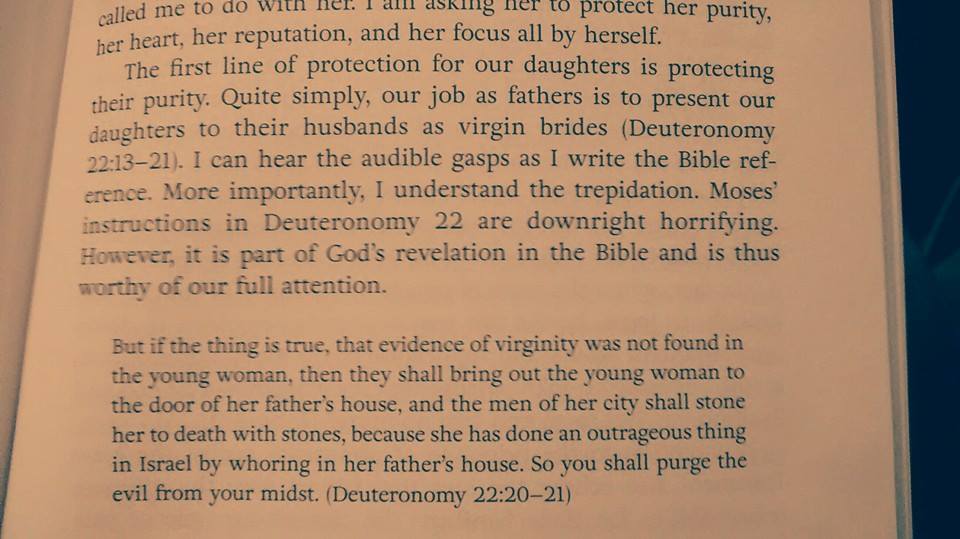
The first line of protection for our daughters is protecting their purity. Quite simply, our job as fathers is to present our daughters to their husbands as virgin brides (Deuteronomy 22:13-21). I can hear the audible gasps as I write the Bible reference. More importantly, I understand the trepidation. Moses’ instructions in Deuteronomy 22 are downright horrifying. However, it is part of God’s revelation in the BIble and is thus worthy of our full attention.
But if the thing is true, that evidence of virginity was not found in the young woman, then they shall bring out the young woman to the door of her father’s house, and the men of her city shall stone her to death with stones, because she has done an outrageous thing in Israel by whoring in her father’s house. So you shall purge the evil from your midst. (Deuteronomy 22:20-21)
So Farris condemns patriarchy, but is willing to make cuddly with this guy.
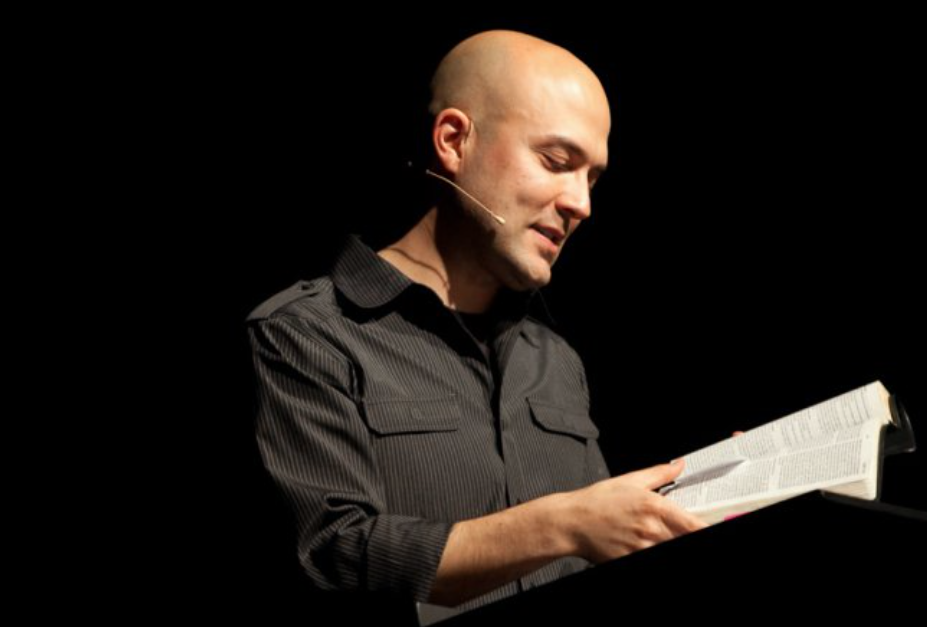
At the moment, you’re probably simply on the edge of your seat, wondering what Baucham says next. I have that for you too:
And here is the text:
Regardless of our revulsion at the idea of a woman being stoned for promiscuity, we cannot avoid the principle inherent in the text. The father is the one responsible for protecting his daughter’s virginity. This is evident for at least two reason. First, the father must provide evidence of his daughter’s virginity. Second, if there is no evidence, and the charges are true, the father must endure the shame and incomprehensible pain of the capital punishment of his daughter at his door!
Note that Baucham is primarily concerned with how hard it would be for the poor father to have his daughter stoned at the altar—not a thought is given to the daughter who is, you know, being stoned to death. Grrr.
Again, no one is arguing for the stoning of promiscuous young women whose lack of virginity is discovered on their wedding day. However, the timeless principle here is the responsibility of a father to present a virgin bride at the marriage altar.
This principle transcends the law/grace divide. This is true for all people in all places at all times. Nothing in the New Testament would remotely suggest that fathers are to stand down as the protectors of their daughters’ virginity. . . .
While the Deuteronomy passage deals with protecting virginity, Exodus 22 address the question of what a father is to do if his daughter loses her virginity.
For anyone who is unfamiliar with this idea, Baucham appears to be in the evangelical camp that believes the laws of the Old Testament are no longer binding, because we now live in the covenant of grace (rather than the covenant of the law), but that the Old Testament laws can still be instructive in understanding God’s character and desires. I was raised in this camp myself.
But you may now be wondering about the Exodus 22 passage Baucham mentioned.
Here’s the text:
If a man seduces a virgin who is not betrothed and lies with her, he shall give the bride-price for her and make her his wife. If her father utterly refuses to give her to him, he shall pay money equal to the bride-price for virgins. (Exodus 22:16-17)
Note that the father has the right of refusal in this matter. The text is unambiguous. The man who seduces the virgin must answer to her father. Moreover, he must do right by the young woman and marry her, unless the father “utterly refuses to give her to him.” Note that the daughter does not give herself to the man in marriage; the father gives her to the man he deems appropriate.
When I talk about the patriarchy? This is what I’m talking about. Men like Baucham believe their adult daughters are bound to obey them in word and deed, and that they possess their daughters’ virginity to hand off to another when they choose. I’m lucky that my father was fairly introverted and hands off, but I still had a hell of a time with it when my courtship when rogue (or, to put it more specifically, when I took the reigns to my own love life).
And while Baucham is against stoning unmarried daughters who are sexually active, one wonders what he thinks should be done with them. It can’t be pretty.
Finally, note that the section above is followed with this heading:
A Patriarch Must Arrange for His Daughter’s Marriage by Finding a Suitable Husband and Making Proper Arrangements
That is what we’re talking about here.
And yet, to Michael Farris, Baucham isn’t patriarchal. Right.
HA note: The following is reprinted with permission from Libby Anne’s blog Love Joy Feminism. It was originally published on Patheos on February 13, 2015 and has been slightly modified for reprinting here.
Lisa Pennington began deleting posts on her blog, The Pennington Post, after her daughter, Alecia Faith, went public with the message that her parents were preventing her from proving her identity. It seems Lisa has realized that her posts—especially those on parenting adult children—seem rather to corroborate Alecia Faith’s story. Fortunately, we have urls and the wayback machine. To quote a friend of mine, “don’t they know the internet is forever?”
I didn’t write my regular, fascinating Monday update yesterday because I was driving.
In fact, have been driving for the past 2 days and sadly I am the only driver in this bunch. Our belief in not letting our kids learn to drive until they are mature and enough to carry that responsibility comes back to bite me when I’m on one of these road trips. I find myself thinking, “I wonder if I could just plop one of the girls in front of the wheel on a long stretch of nothing and tell her to hit the gas.”
This post is from June 24, 2014, a mere eight months ago, three months before Alecia Faith left home, unannounced.
Alecia Faith’s sister Grace commented on my blog the other day, stating that she is the oldest and is 24. Thus if we are generous, when this post went up last summer, Lisa’s oldest child was 23. Alecia Faith was 18 when she moved out and is now 19, so at the time of this post she would have been 18. Alecia Faith is the fourth child in her family, meaning that there were two more siblings between age 18 and 23.
Lisa says they believe in “not letting” their kids learn to drive until they are “mature . . . enough to carry that responsibility.” You may wonder how Lisa can prevent her adult children from getting their drivers licenses until she believes they are ready. Well, when children don’t have birth certificates or social security numbers (and both Grace and her brother Jacob confirmed that this was the case) they can’t exactly get drivers licenses on their own. When (and if) they could do so rested in their parents’ hands.
Lisa states that they believe in not letting their children learn to drive until they are “mature . . . enough to carry that responsibility,” and given that at this point she hadn’t let any of her adult children get their drivers’ licenses we can assume that she didn’t not believe any of them were mature enough. If you do not believe that your adult children, aged approximately 23, 21, 20, and 18, are mature enough to drive, the problem is not with them, it’s with you. Either you completely messed up in raising them, or you are vastly underestimating their maturity (or vastly overestimating the maturity needed to drive).
Being able to drive is incredibly important. In most of the United States, it is almost impossible to gain any sort of independence without being able to drive. Alecia Faith lists Kerrville, Texas, as her hometown. Kerrville appears to be a fairly rural town of 20,000 with no public transportation.
Not being able to drive in a town like this would be crippling.
Of course, two months later, in August 2014, Lisa speaks of her children borrowing her car and writes that her two oldest children are saving to by a car. In her comment on my blog, Grace says that she and her brother Jacob, who is the second child in the family, both have their drivers licenses. She writes that her parents helped walk both of them through the necessary paperwork. It appears, then, that at some point last summer Lisa determined that her two oldest children, aged 23 and either 21 or 22, were finally mature enough to drive.
Let me think for a moment of the things I did when I was 23. Wow. I’d done a lot by that time! I had been driving for six years and I had graduated from college with honors. I had applied for and been accepted into a graduate program at a good university. I had gotten married and had birthed my first child, with all of the medical bills and documentation that involved. My husband was no older than I, yet we had moved across the state and located an apartment and obtained our own rental insurance and health insurance and life insurance and car insurance.
I understand that Grace has self-published several novels and I don’t want to demean her accomplishments. She also states that she has plans to move out of her parents’ home and live a more normal life, and I am happy for her. But I can’t help but feel that preventing an adult child from getting her driver’s license until she is 23 on the grounds that she is not “mature” enough to drive is something worse than terrible parenting. It is actively holding your child back and squashing her potential. I am glad Grace now has her driver’s license, but she should have had the ability to obtain it years ago.
Grace claimed in her comment that her family is trying to help Alecia Faith by looking for documents to prove her existence, but have not been able to find any. But if Lisa and her husband were able to come up with the documentation to prove Grace and Jacob’s identity, there should be documents to prove Faith’s identity as well. Note that while her parents are saying they are willing to help, they are also saying that they do not have any documents. At this point, it appears that Alecia Faith’s grandparents have signed an affidavit for her, and that only one affidavit is needed, so while her parents claim they are willing to sign an affidavit that is irrelevant at this point. What is needed is other documents—and her parents are saying those don’t exist. But somehow, they existed for Grace and for Jacob. Is it just me, or something weird going on here?
Grace also claims that her parents were trying to help Alecia Faith get her license last summer before she left. I find it a bit strange that Lisa would suddenly decide that three of her children were old enough to drive, and that she would be willing to obtain a driver’s license for her 18 year old after making her oldest child wait until she was 23 before deciding she was mature enough, though people do strange things so this may be true. But Grace seems to use this information as proof that it was unreasonable for Alecia Faith to move out. Nope. It doesn’t work like that. First, Alecia Faith had no guarantee that her parents would actually obtain the license, and second, Alecia had reached the age of majority and was within her rights to move out.
I want to be clear that this isn’t an isolated thing.
When a parent home births and homeschools, they have total control over their children’s documents (including control over the very existence of those documents).
I grew up knowing several homeschooling families that didn’t obtain social security numbers for their children. Even birth certificates were something you could forego if you picked the right midwife. Most homeschoolers obtain both birth certificates and social security numbers for their children—mine did, for example—so don’t think I’m saying this is all that common. What I am saying is that home birthing and homeschooling gives parents the ability to deprive their children of these documents in a way that they could not if they didn’t home birth and homeschool—and some parents, like Alecia Faith’s, take advantage of that.
Children who attend public school can obtain copies of their transcripts years later. Homeschool alumni have to get those from their parents. In most cases this isn’t a problem, but when parents are controlling and manipulative, it can be a huge problem. I know someone who lived at home until she was 23 because her parents kept promising to give her her homeschool diploma and transcript, stringing her along for years. I know someone else whose parents told her they would only give her a diploma and transcript of she agreed to go to the Christian college they had picked out. You can read more stories like this here.
In her own comment on my post, a Christian homeschooling blogger stated this:
You understate how controlling Lisa is. It’s shocking really. I know because we used to be friends.
This blogger chose to remove this comment, so I am not going to name her here. But to me, this rather confirms what I said earlier—that Alecia Faith would not have left home unannounced if she didn’t have reason for doing so. Her older sister Grace wrote in her comment that she is making plans to move out herself, but then, she is 24 and the move has not yet taken place yet. Besides, I could see Alecia Faith’s parents realizing that they need to loosen up a bit on their older children or they risk losing them as they lost Alecia Faith, so things may be different in the home than they were when Alecia Faith fled.
In summary, any parent willing to actively prevent a child from getting her drivers license until she is 23 on the grounds that she is not “mature” enough to drive is extremely controlling and manipulative.
I am very glad Alecia Faith managed to get out. You go, Alecia Faith!
HA note: The following is reprinted with permission from Libby Anne’s blog Love Joy Feminism. It was originally published on Patheos on February 2, 2015.
So, have you heard the news? Joshua Harris is stepping down from his role of head pastor of Covenant Life Church and heading to Vancouver to attend seminary at Regent College. I don’t know much about Regent, though the Washington Post described it as “mainstream.” Not only that, but Josh is planning to send his kids to public school while he attends seminary. Public school. This is huge, and it’s hard to describe how much it means to me.
Josh Harris was the oldest child of Gregg Harris, a well known early Christian homeschool leader who traveled the country speaking at conferences and convincing people that homeschooling was God’s plan for families and the best way to raise children. Because of his father’s ideas, Josh did not go to either college or seminary, and instead went straight into ministry, including both writing and preaching.
Josh published I Kissed Dating Goodbye in 1997, and the book took the Christian homeschooling world by storm. Suddenly “courtship” became the word of the hour, and parents of children like myself were deciding that they would not let their children date—and indeed, would teach us that dating is akin to adultery, or worse. Josh Harris singlehandedly created the atmosphere I grew up in with regards to romance and marriage. I not only read his book, I lived and breathed it—as did countless other fundamentalist and evangelical homeschooled teens.
Ten years ago, Josh became the pastor of Covenant Life Church, a nondenominational evangelical megachurch with 3000 members, all without formal theological training. But in recent years, his church and others in its loose association became mired in scandal. The words “Sovereign Grace Ministries” may be familiar to you. The upshot of it all was that Josh and other pastors (most prominently C.J. Mahoney) were dealing with sex abuse allegations internally and not reporting anything to the authorities. Josh himself was not accused of sex abuse, and when everything started going down Josh disassociated his church from the association and made changes.
And now this. It seems that the scandal has made Josh realize that he was not adequately prepared for the position of authority he held, and that formal educational training actually has some merit. This is a huge admission to make as the son of one of the most prominent Christian homeschooling pioneers. I’m sure Josh is doing his best to mollify his father and bring him around, but in making this decision he is admitting that his father was wrong. Not wrong about homeschooling necessarily, but wrong in his opposition to formal education writ large.
And the whole sending his kids to public school while he’s in seminary thing? You have to understand that leaders like Gregg Harris made homeschooling part of the gospel. To be a true Christian, for them, was to homeschool. That and that alone was God’s will for families. I felt great trepidation about how my mother would react to me sending my own children to public school, and my mother has never been a prominent homeschooling leader on the scale of Gregg Harris. For many Christian homeschooling parents (my mother included) having a child grow up to put their own children in public school is a sign of failure. So for Josh to do what he’s doing—that takes guts.
Even going to seminary takes guts for someone like him! Why? Because of this:
For most of his career, Joshua Harris was the kind of evangelical pastor who chuckled at the joke that “seminary” should really be called “cemetery.”
There is a strong anti-seminary bent in the circles Josh runs in. Josh himself admits that he probably would not have been hired on as head pastor at Covenant Life Church if he had been to seminary. Seminary is almost a dirty word. All you need is the Bible! You don’t need to be taught by professors! Biblical criticism? Who needs that! Just listen to the Holy Spirit, read the Bible, and you’re good! And here Josh is, admitting that he does need that, and heading off to seminary.
F. Scott Fitzgerald wrote a short story called “The Curious Case of Benjamin Button.” (Maybe you saw the movie starring Brad Pitt). It’s about a man who ages in reverse—he is born old and with each passing day becomes younger.
In reflecting on my own story, I can’t help but think that I have lived a sort of backwards life. Without meaning to, I have experienced life out of the normal order and sequence of events.
At the end of last year I turned 40 years old. Yet it is only now that I am going to school. I haven’t completed any post-graduate study. I don’t even have an undergraduate degree. In fact, I have never attended a formal school full-time in my life.
I’ve been on a unique educational path my whole life. For the first 17 years of my life I was homeschooled by my mother. My father was a well-known homeschool advocate who traveled the country teaching parents the biblical principles for and advantages of home education. I was “Exhibit A” of my dad’s philosophy that you could learn by doing, be directed in study by your delights and succeed outside of the “system.”
At age 17, when most kids my age were going off to college, I started a ministry called New Attitude. I began publishing a magazine and putting on conferences for teenagers. I felt a clear sense of calling from God to speak to my generation and call them to a passionate pursuit of God. When I was 21, I wrote my first book [I Kissed Dating Goodbye], which met with a good deal of success.
That’s when I met C.J. Mahaney, who was the previous Senior Pastor of our church. In C.J. I found someone who understood me and who was willing to train me. He was a charismatic pastor (in all senses of the word) who pastored a mega-church, led a national network of churches, and embraced both reformed theology and charismatic practice.
Like me, C.J. got his start on the conference circuit before becoming a pastor. Like me he had never received formal theological training, and the group of churches he led, which grew out of the Jesus Movement in the 1970s, at that time didn’t place a high value on seminary training. So instead of attending seminary before becoming a pastor, I moved into C.J.’s basement, worked as an intern in the church, traveled the country with him and began preaching. It was on the job training and I soaked up everything C.J. taught me.
Seven years after I arrived at the church, I was set in as the hand-picked replacement for C.J. I was 30 years old, with no formal theological training and no formal training in organizational leadership, and I was the Senior Pastor of a 3,000 member church. That my friends is a crazy, backwards life!
Yes. Yes.
And so here I am, feeling proud of Josh Harris. What he’s doing is not an easy thing, but it is an important thing. He’s not the only one who feels he led a backward life. I and many others feel the same way too. As teens, we were expected to have the maturity of 30-year-old adults, and only later, as young adults ourselves, were we able to let the facade drop and finally go through adolescence.
Forging our own paths after the level of parental control homeschooling afforded our parents isn’t easy, but it’s worth it. I wish Josh the best as he leaves the conveyer belt he was set on—by both his father and evangelical leaders like C.J. Mahoney—and makes his own decisions and chooses his own path.
Note: It’s probably worth mentioning that Josh has also walked back his ideas about dating and courtship. I hope to write more about this later, once I’ve had time to listen to his sermons on the topic, which seem to be available only as audio files.
HA note: The following is reprinted with permission from Libby Anne’s blog Love Joy Feminism. It was originally published on Patheos on December 31, 2014.
Here is what HLSDA had to say about House Bill 295, a 2013 bill in New Hampshire:
Summary:
House Bill (“HB”) 295 imposes the requirement of criminal background checks on employees and volunteers at recreation and “youth skill” camps. The bill is a potential problem for homeschoolers because of the overly broad definition of “youth skill camps” that could include homeschool groups.
The Senate Health, Education & Human Services committee amended the bill to define “Youth Skill Camps” as “a nonprofit or for-profit program that lasts 8 hours total or more in a year for the purpose of teaching a skill to minors. Such camps include, but are not limited to, the teaching of sports, the arts, and scientific inquiry.”
HSLDA’s Position:
Oppose unless amended to exempt homeschool related groups. HSLDA suggests that the bill be amended to include language similar to:
A “youth skill camp” does not include a group formed by or relating to home education programs.
So in a nutshell, this bill would require criminal background checks for employees and volunteers at a variety of youth camps, and HSLDA was concerned that the language was broad enough that it would require criminal background checks for those teaching in homeschool co-ops.
Let me say a word about homeschool co-ops. They take a variety of forms. When I was a girl, I was involved in a homeschool co-op that met for a morning every other week. We children were divided into classes by age to study subjects chosen by semester. The mothers served as the teachers, creating lesson plans geared to our age groups. When I was a teen I was involved in a weekly homeschool co-op that brought in professional teachers to lead classes in band, choir, and art.
I don’t see a problem with requiring background checks for those who teach in homeschool co-ops. I recently filled out a volunteer form for my daughter’s elementary school. If I want to be a chaperone at field trips, even under the supervision of teachers and other school employees, I have to have a background check. And why not? I’m glad to know that other parents chaperoning on my daughter’s field trips will have background checks on file, to prevent sex offenders or others with questionable criminal histories from having close contact with or authority over my child.
And don’t think this isn’t something that happens in homeschool groups.
I have a friend whose old homeschool group recently let a child sex offender speak at their annual homeschool graduation ceremony. He was one of the parents, and had been tried and convicted. I doubt most of the parents there knew. We saw this come up with The Old Schoolhouse scandal as well, when Paul and Gena Suarez sought to conceal the fact that a friend was being investigated for child pornography from other homeschooling families in their community. In Alabama, the founder of a homeschool “umbrella” school was arrested and convicted for child trafficking, and numerous otherhomeschooltutorsandco-opteachers have been found guilty of child sexual abuse as well. This is a thing that happens.
I understand that requiring homeschool co-op instructors to have criminal background checks does mean paperwork. But shouldn’t it be worth a bit of paperwork to protect children from predators? The practical effects of HSLDA’s opposition to this bill would be to allow parents with questionable criminal backgrounds to teach in homeschool co-ops undetected. Once again, HSLDA seems to care very little about the actual safety and wellbeing of homeschooled children.
And yet, in their commentary on this bill’s ultimate passage, HSLDA vows to work to ensure that homeschool co-ops are not counted as youth camps, concluding that:
HSLDA will be following up on this issue and working to insure that homeschoolers interests are safeguarded.
Whose interests exactly are being safeguarded? Not the children’s, that’s for sure.
HA note: The following is reprinted with permission from Libby Anne’s blog Love Joy Feminism. It was originally published on Patheos on December 24, 2014.
New Jersey is one of eleven states that do not require homeschooling parents to notify education officials of their intent to homeschool, and from time to time bills introduced into the state’s legislature have sought to change this. In 2010, a bill was introduced that would have required parents to provide notice of homeschooling at the beginning of the year and turn in a portfolio documenting the child’s educational progress at the end of the year. Unsurprisingly, HSLDA objected, but it was another part of this bill and HSLDA’s response that caught my eye.
2. A parent or guardian of a home-schooled child shall provide documentation to the resident district board of education no later than September 1 of each school year that the child has undergone an annual medical examination.
You can see the logic here. Annual medical examinations are important. I know several homeschool alumni who have life-threatening medical conditions today—conditions that were preventable and would have been noticed and treated had they seen a doctor as children. Requiring homeschooled parents to take their children to a doctor each year makes sense, and would have made a world of difference for these alumni.
This bill (companion to S3105) treats every homeschool parent like a child abuser by requiring them to give their school system documentation of a medical exam every year for every homeschooled child.
Yes, in HSLDA’s world, if you are required to take your child to the doctor for a checkup each year, you are being treated like a child abuser. This makes especially little sense when you realize that parents of public school children are also required to take their children to the doctor and submit documentation, and that each public school is required to carry out annual hearing and vision screenings and examine children for various chronic conditions. Does this mean that all parents of public school students in the state being treated like child abusers?
Let’s talk about the abuse aspect for a moment, though. When bills are introduced with the intent of making it harder for abusive parents to use homeschooling as a cover for their mistreatment, HSLDA and organizations like it often complain that homeschoolers are being “singled out.” The problem with this argument is that it is rarely true—public school children are seen by mandatory reporters every day, and many states, like New Jersey, require doctor visits and conduct examinations of their own. However imperfect it may be, there is a system in place in the public schools for identifying and dealing with chid abuse or medical neglect. There is no such system for homeschooled students.
I stated already that I think requiring homeschooling parents to take their children to the doctor each year makes sense simply as a way of preventing medical neglect, but there is indeed another aspect as well. HSLDA has this to say of abuse concerns:
The media carried reports recently about the Division of Youth and Family Services (DYFS) failing to protect an allegedly homeschooled child in danger—with tragic results. In effect, S3105 punishes parents for the failures of DYFS.
It’s true: New Jersey has had its share of homeschool child abuse horror stories. But as you can see, HSLDA blames these tragedies solely on DYFS, enabling them to ignore the role homeschooling can play in concealing abuse and making it harder for social workers to gain access to that child. When an report is made about a child who attends public school, social workers will frequently speak with the child on site, before or after school. This is not possible when a report is made about a homeschooled child—and children sometimes die as a result. Similarly, teachers will often report when other adults in a child’s life will not, and removing a child from contact with teachers can mean the end of reports—and theendfor the child. So HSLDA can pretend all they want that these cases are all the fault of social services’ incompetency, but they’re wrong.
Now yes, the vast majority of homeschooled students do not homeschool to hide child abuse—but it does happen. When a child dies or is horrifically neglected, it’s normal for officials and lawmakers to look at the system and ask what went wrong—and how they can change things so this won’t happen again. This happens when the victim attends public school, and when the victim is homeschooled. If having an annual medical examination has the potential to help even a few abused homeschooled children—doctors are mandatory reporters, remember—I’m all for it. After all, what do we lose?
So, what is the practical effect of HSLDA’s opposition to this bill? Put simply, preventing this bill allows homeschooling parents to not take their children to the doctor—ever, if they so choose. While many homeschooling parents will take their children to the doctor regardless, others won’t. Without required medical examinations, it will be easier for abusive homeschooling parents to hide their maltreatment—and in addition, more homeschooled children will have preventable conditions go unnoticed and undiagnosed, in some cases resulting in chronic or life-threatening medical conditions as adults. And I’m not just saying this—I know homeschool alumni who never saw the doctor as kids, and suffer permanent consequences today.
Unfortunately, the bill ultimately died in committee. But if nothing else, HSLDA’s opposition to this bill makes it obvious that they’re not working for the interests of homeschooled children.
HA note: The following is reprinted with permission from Libby Anne’s blog Love Joy Feminism. It was originally published on Patheos on December 22, 2014.
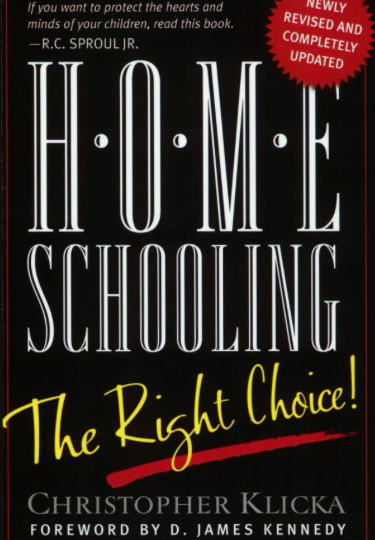
Prominent HSLDA attorney Chris Klicka elucidated on HSLDA’s agenda in a 2001 book, and frankly, when I read it I found even myself slightly surprised, not so much by what their agenda is as by how willing they are to publicly admit it.
The framers of the Constitution, unfortunately, never specifically mentioned in the Constitution the right of parents to educate their children. They took it for granted that parents alone had this right and could choose whatever form of education they saw fit. Since biblical theism was dominant in early America, this right of parents was recognized as a God-give right derived from the Bible and codified in English common law.
In the last fifty years, however, the U.S. Constitution has been so twisted in many areas that it no longer reflects the intent of the framers. The most devastating example of the perversion of the original intent of the Constitution is the creation of the “right” to an abortion, which has resulted in the deaths of millions of babies. This has happened in spite of our Bill of Rights which clearly protects life.
Similarly, the right of parents to chose their child’s education, as held sacred by the framers, has also been gradually eroded in favor of state intervention and control. The parents are no longer solely responsible for the education of their children as established in the Bible and common law. Now the courts recognize the state having an interest in education and the power to regulate that interest. As a result, prior to the 1980s, home schooling was virtually stifled by the state.
However, the tide is slowly being reversed through the application of the various Constitutional or technical defenses in the courts as described in this section or by the legislatures as seen in chapter 19. The ultimate victory will not be reached until the compulsory attendance statues are repealed in every state. However, at this time, repeal of such laws is a long way off. Therefore, the strategy of this author and the Home School Legal Defense Association, in the meantime, is to push back the interest of the state further and further in education, limiting its power to regulate, until that interest finally evaporates. This will take time, relentless efforts, and a great deal of education of our judges, law enforcement officials, and legislators.
If you don’t read anything else of that excerpt, read that last bit in bold. HSLDA’s ultimate goal is to get rid of compulsory attendance. And in the other bit that I made bold, Klicka makes it clear that he believes (and by extension HSLDA believes) that parents should have the right to choose what sort of education their children would get—to choose any form of education they saw fit. Klicka claims that this is what the founding fathers believed, and therefore it should still be so today.
Now first of all, if we did everything like the founding fathers did I wouldn’t be typing this. For one thing, I’m using technology that didn’t exist, and for another thing, I’m a woman, and at the time women were expected to confide their thoughts in private journals or to other women rather than in public. But more than that, Klicka’s claim that compulsory education laws were foreign to the founding fathers, and that the founding fathers took for granted that it was the parent’s god-given right to choose how to educate their children, is simply false.
Forasmuch as the good education of children is of singular behoof and benefit to any Common-wealth; and wheras many parents & masters are too indulgent and negligent of their duty in that kinde. It is therfore ordered that the Select men of everie town, in the severall precincts and quarters where they dwell, shall have a vigilant eye over their brethren & neighbours, to see, first that none of them shall suffer so much barbarism in any of their families as not to indeavour to teach by themselves or others, their children & apprentices so much learning as may inable them perfectly to read the english tongue, & knowledge of the Capital Lawes: upon penaltie of twentie shillings for each neglect therin. . . .
Yes, you read that right. Massachusetts Bay Colony, as it was then called, authorized officials to go check whether parents were teaching their children to read, and to fine those who were not. Somehow this does not sound like allowing parents to educate their children “however they see fit”—it rather sounds like the state deciding the minimum education children must receive. Why? “Forasmuch as the good education of children is of singular behoof and benefit to any Common-wealth.” Yes, that’s right, for the good of the state. Methinks HSLDA has their history a bit off.
There’s more, too. The Northwest Ordinance contained provisions for creating schools because the founding fathers believed that education was critical to a healthy democracy. Have a look:
George Washington: The best means of forming a manly, virtuous, and happy people will be found in the right education of youth. Without this foundation, every other means, in my opinion, must fail.
Thomas Jefferson: If a nation expects to be ignorant and free, in a state of civilization, it expects what never was and never will be.
James Madison: Learned institutions ought to be favorite objects with every free people. They throw that light over the public mind which is the best security against crafty and dangerous encroachments on the public liberty.
Noah Webster: It is an object of vast magnitude that systems of education should be adopted and pursued which may not only diffuse a knowledge of the sciences but may implant in the minds of the American youth the principles of virtue and of liberty and inspire them with just and liberal ideas of government and with an inviolable attachment to their own country.
Benjamin Franklin: A Bible and a newspaper in every house, a good school in every district—all studied and appreciated as they merit—are the principal support of virtue, morality, and civil liberty.
This sounds literally nothing like Klicka’s claims about the founding fathers in the paragraphs quoted from his book above.
And now back to Klicka:
Although you will see in this chapter that parental liberty historically was held to be virtually absolute, many state courts and the passage of compulsory attendance laws in the 1900s have gradually eroded this right. These states have used the language of the United States Supreme Court which recognizes that the states have an “interest” in education. During the past seventy-five years, the power to regulate that interest of the state has steadily expanded.
Home schools have been involved on the cutting edge in pushing back the interest of the state. In 1983, the Home School Legal Defense Association was established for the purpose of shackling the interest of the state by gradually limiting the state’s power over parents. Eventually, I would like to see the interest of the state totally erased, but that may take some time while we educate the judges and legislators.
Meanwhile, it is important for us to master the history of parental rights, especially as established in the courts, so that we are better prepared for the battle for our children that is presently taking place. We need to work to reestablish the historic foundations of parental rights in our country and restore respect of the parents’ right to choose and control the education of their children.
Klicka does not think the state should have an interest in education. Indeed, Klicka would like to see the state’s interest in education “totally erased.” Education, then, would be solely and completely up to a child’s parent.
What I am unclear on is whether Klicka wants public schools abolished, or simply compulsory attendance laws. Regardless, he makes it clear that parents should have the sole and final say on their children’s education and even whether their children receive an education, and that he doesn’t think the state should have any interest at all in ensuring that its citizenry is educated. Ironically, this places him soundly at odds with the very founding fathers he earlier cited as supposedly supporting his position.
So next time HSLDA comes out against this homeschool law or that homeschool bill, bear in mind that they’re not just interested in keeping homeschooling legal, or in reducing oversight of homeschooling. They’re interested in abolishing compulsory education altogether.
HA note: The following is reprinted with permission from Libby Anne’s blog Love Joy Feminism. It was originally published on Patheos on December 17, 2014.
In 2013, Alabama legislators introduced a mandatory reporting law. While all states require teachers and certain medical professionals to report suspicions of child abuse, some go further and make all individuals mandatory reporters. The Alabama bill read as follows:
Any person who knows or has reasonable cause to believe or suspect that a child has been abused or neglected or who observes any child being subjected to conditions or circumstances that would reasonably result in abuse shall report the same . . .
In other words, the bill would have required “any person who knows or has reasonable cause to believe or suspect that a child has been abused or neglected or who observes any child being subjected to conditions or circumstances that would reasonably result in abuse” to report their concerns. HSLDA objected. Their position was as follows:
This bill is well-intended, but it is much too broad. It would require even children of all ages to make reports of abuse or neglect and subject them to prosecution if they failed to do so. Young children should not be responsible for making a determination of whether abuse or neglect has occurred and then reporting it to authorities.
Another problem with this bill is that it requires reporting something that is not even abuse or neglect. Families will be investigated because someone reported “conditions or circumstances” that in the opinion of the reporter could result in abuse. Persons should be investigated only if there is evidence of actual abuse, not conditions or circumstances that might lead to abuse.
This bill should be opposed.
From where I’m currently standing, I don’t see a problem with requiring people to report “conditions and circumstances that would reasonably result in abuse.” Not all social services visits are investigations. It is not uncommon for social workers to offer at-risk family resources or tools, helping them along and preventing things from descending into legal abuse.
As for children being required to report, I did some digging and found that the language in the bill is typical for universal mandatory reporter states, which require any “person” who suspects abuse to report it. So while I would have a problem with penalizing children for not reporting their own abuse, that’s not what’s going on here.
But I promised you more than this, didn’t I? HSLDA goes further—much further.
Colorado—Senate Bill 220: Expands Definition of Mandatory Reporters
Summary:
Senate Bill 220 expands the definition of mandatory reporters for potential child abuse or neglect to include emergency medical service providers.
HSLDA’s Position:
Oppose.
No explanation is given, as though no explanation is needed. The bill ultimately passed through the legislature and were signed by the state’s governor. But HSLDA’s opposition to the bill makes it clear just how far its opposition to mandatory reporting laws goes—all the way. What possible reason could you have for not requiring emergency medical personnel to report suspected child abuse or neglect?
Ostensibly, HSLDA opposes mandatory reporting laws out of concerns about false reports. But then, both Alabama and Colorado already penalize knowingly false reports. Perhaps the concern is accidental false reports. But then, that is why there are investigations—to determine whether a tip can be substantiated.
What is the practical effect of opposing a law that would make emergency medical providers mandatory reporters? Well, without this law emergency medical providers would not be required by law to report suspicions of child abuse and neglect. In other words, it would be legal for an emergency medical provider to notice evidence of abuse or neglect and yet choose not to report it. In other words, the practical effect of opposing a law like this would be to make it harder for child abuse and neglect to come to light.
From what I’ve read of their materials, it appears that HSLDA would like to prevent social services investigations in all but the most severe cases—cases where an investigation hardly need take place at all, so obvious is the evidence. The organization manifests a lack of understanding about how abuse manifests itself and how it affects children. Abusers are generally very good at hiding their abuse—and there is no dichotomy of 100% good parents on the one hand and 100% evil parents on the other. When HSLDA defends child abusers—and they do—they likely do so in part because they have a caricatured image of what an abusive family looks like.
For HSLDA, social services investigations are primarily something that get in the way of parents doing their thing. They are an annoyance to be avoided. By opposing mandatory reporting laws, HSLDA works to cut down on the number of child abuse and neglect reports made. This makes sense in terms of their longterm vision—HSLDA would like the state to have as little power over parents as possible. As a result, the organization seems to weigh these child abuse reports in terms of parental inconvenience, ignoring the negative affect their efforts to cut down on reports made may have on the children involved.
One final note. It is worth asking why an organization whose mission is keeping homeschooling legal would insert itself in mandatory reporting laws. One reason is that homeschooling parents may be reported for educational neglect. But there’s something else involved too: HSLDA defends its member families against accusations of child abuse. Cutting down on child abuse and neglect reports furthers their organizational interests.
Whatever the precise reason for HSLDA’s involvement in mandatory reporting laws, this is another example of HSLDA taking positions that affect far more children than those who are homeschooled.
HA note: The following is reprinted with permission from Libby Anne’s blog Love Joy Feminism. It was originally published on Patheos on December 10, 2014.
Ostensibly, the Home School Legal Defense Association (HSLDA) works to keep homeschooling legal. In practice, the organization does much, much more than that. Over a year ago, I wrote a a series on HSLDA and Child Abuse,but HSLDA does more than oppose mandatory reporting laws. The organization also opposes the UN disabilities treaty and Common Core. HSLDA claims to involve itself in these issues out of concern that they could be used to restrict homeschooling. But while HSLDA’s opposition to the UN disabilities treaty and the Common Core is well known, its opposition to other measures and programs is less well known.
Today I am beginning a new series: Things HSLDA Opposes. I will go through HSLDA’s positions on state legislation over the course of 2013 to examine the breadth of programs and measures HSLDA opposes. This series will have relevance far beyond homeschooling, because HSLDA is intertwined with conservative politics and is part of a conservative mentality that is less about protecting parental rights than it is about imposing a laundry list conservative ideals on families whether parents like it or not.
*****
In 2013, Arkansas legislators introduced a proposal to create voluntary home visitation programs, which would allow parents to request home visits from nurses, social workers, and other professionals to promote child health, effective parenting, and school readiness. Here are some relevant excerpts from the bill:
(2) “Home visitation” means voluntary family-focused services that promote appropriate prenatal care to assure healthy births, primarily in the home, to an expectant parent ora parent with an infant, toddler, or child up to kindergarten entry that address:
(A) Child development;
(B) Literacy and school readiness;
(C) Maternal and child health;
(D) Positive parenting practices;
(E) Resource and referral access; and
(F) Safe home environments;
20-78-902. Home visitation programs — Oversight
(a) A home visitation program under this subchapter shall provide face-to-face home visits by nurses, social workers, and other early childhood and health professionals or trained and supervised workers too:
(1) Build healthy parent and child relationships;
(2) Empower families to be self-sufficient;
(3) Enhance social and emotional development;
(4) Improve maternal, infant, or child health outcomes, including reducing preterm births;
(5) Improve the health of the family;
(6) Increase school readiness;
(7) Promote positive parenting practices;
(8) Support cognitive development of children; or
(9) Reduce incidence of child maltreatment and injury.
The bill was so well liked in Arkansas that it passed both houses of the state legislature unanimously. And it’s easy to see why. Studies have found that home visits from a nurse reduce the number of emergency care episodes in infants by 50%.
Summary: This bill would create a voluntary home visitation program that provides face-to-face home visits by nurses, social workers, and other early childhood and health professionals to teach parents how to be effective according to state standards. While this would begin as a voluntary program, it is very intrusive and comprehensive and could become a mandatory program for all families in the future.
HSLDA’s Position:
Oppose.
This is a theme we’re going to see in this series: HSLDA claims to protect and promote parental rights, but in fact works to impose its ideas on parents. Note that HSLDA opposes the voluntary home visitation programs because they are “very intrusive and comprehensive” (isn’t this for the parents themselves to decide) and because it “could become a mandatory program.” But by opposing a voluntary program because they don’t like it and because it could in the future be made mandatory, HSLDA is in practice working to deprive parents of access to a program they might want to access.
In other words, HSLDA is advocating not for widening parents’ range of choices and options but rather for restricting them.
It’s worth noting that I can’t think of any reason to oppose making programs like this mandatory. Parenting young children is a lot of work, and having access to support is important. When I take my children in for checkups, their doctor asks questions about their development and my parenting and answers any questions I might have. Provided a program like this had accountability and proper funding and supervision, it would provide similar support. But HSLDA sees programs like this as such a threat to parents that explaining why they’re a problem is completely unnecessary.
HSLDA appears to have a very individualistic approach to families. In HSLDA’s view, it seems that families should go it alone, or find support in family, church, and community. Finding support in government programs is an automatic problem, a view likely grounded in HSLDA’s extreme small government conservatism.
CC image courtesy of Flickr, Patrick Gannon. Image links to source.
HA note: The following is reprinted with permission from Libby Anne’s blog Love Joy Feminism. It was originally published on Patheos on November 10, 2014.
I recently came upon a post titled 3 Ways Homeschoolers Socialize Differently than School Kids. Curious, I clicked. I should have known better. Predictably, the post was written by a homeschooling mother who has no idea what it’s like to actually be a homeschooled child. In this post I will respond to the points made by blogger Jennifer Fitz, speaking from my experience as a homeschool alumna.
1. Homeschool kids break their own ice.
I picked up my son from his Confirmation kick-off event, a true microcosm of suburban 9th grade living. We were delayed in departing, and I noticed he was chatting with a boy I’d never met before, who had “Chris” written on his name tag. We got in the car. “So I saw you were chatting with, um, Chris? Is it? Nice kid?”
Usually the boy has a few interesting stories to share about the people he meets. This time he shrugged. “I don’t know. I just started talking to him when you showed up. We were so busy doing ice breakers we didn’t get to actually meet anybody.”
Yeah, homeschool kids don’t get ice breakers. You show up at a new event with people you’ve never met, and your parents leave you to the wolves. “Go find some kids. Or make yourself useful somewhere.”
They always do. It can take as long as five or ten minutes, if it’s a large group event the kids are joining midstream. But my kids never sit in a corner neglected. They are in the habit of introducing themselves, striking up a conversation, and finding something, anything, in common with whomever is tossed their way.
Some children are more extroverted and others are more introverted. What exactly does this have to do with homeschooling? My public schooled daughter walks right up to other kids and introduces herself. My shy homeschooled little sister does not, preferring to hang back much longer until she feels comfortable. Trust me when I say that this isn’t about homeschooling.
2. Homeschool kids spend the bulk of their time with people different from themselves.
Sitting at a lunch table with the same five friends every day, exactly the same age, same academic track, same clubs, and same fashion tastes? Yeah, that never happens in homeschooling. Mixed-age, mixed-neighborhood, mixed-ability social circles are the norm among homeschoolers. Cliqueishness is a no-go, because 1) the parents lose patience with that nonsense fast and 2) on any given day, you might have to be friends with exactly that one person you would have happily excluded if only this were the lunchroom and you had the choice of your favorites.
Growing up, I never, ever had a friend who was not also able bodied, middle class, white, evangelical, and the child of two married heterosexual parents. Heading off to college came as a huge shock because I was suddenly thrown in with people who were completely different from me. But this makes sense, if you think about it. When you are homeschooled your social world is whatever your parents choose to give you. Some homeschooling parents will expose their children to a wide diversity of people, but others will keep their children in a homogenous bubble.
My daughter is only in kindergarten, but already she has been exposed to more different people than I was through high school. There are black and white kids in her class, middle class and poor kids, children with Christian and atheist parents, children with single parents and children with parents who never married, and disabled children. My public schooled daughter is experiencing more different people in kindergarten than I experienced until college.
Jennifer adds this:
From there, it only gets more different: Homeschool kids spend a lot of time with grown-ups. Not just their parents. Not just teachers. (As a kid writing fiction, I could only ever think up “teacher” for a profession for my adult characters, because that was the only profession I was ever exposed to enough to have an idea of what the job entailed.) Homeschool kids spend their formative years going wherever their parents go, doing all the adult chores that grown-ups do. The people who live and work in their community aren’t stage hands for a me-centered teenage drama; they are the community. Homeschool kids get used to having spur-of-the-moment adult conversation with grown-ups of every age, profession, and cultural background.
Actually, socializing with adults is very different from socializing with other children. As a homeschooled child, I never had a problem socializing with adults—I knew they would praise me for how mature and smart I was, how hard working and diligent. Other children, on the other hand? Haha, nope. I got on fine with the other homeschooled children in my social circle, but I was literally afraid of public school children. They were so different from me that I had no idea how to relate to them. They were scary. I had to enter a public high school to take the PSAT, and I was so anxious I was sick that morning—not because of the exam, I wasn’t worried about that in the least, it was the entire idea of being surrounded by public school kids. I couldn’t handle it.
Now I am not saying that every homeschooled child is afraid of public school children, or that this is the natural product of being homeschooled. Absolutely not! But Jennifer makes a mistake in generalizing from how she is socializing her son to how every other parent out there socializes their children. What kind of socialization homeschooled kids get is almost entirely dependent on their parents. Some parents are absolutely crippled by the lack of socialization they have in their homeschooled upbringing while others thrive and develop healthy social skills.
You cannot look at one homeschooled child and predict another’s experience, because the only thing different homeschooling families have in common is that the parents are in sole control of their children’s academic and social development.
3. Homeschool kids form deep, lasting relationships with the people they treasure most.
A reality of homeschool life is that you might have certain very dear friends you only see a few times a year. Of all the many friendly-acquaintances you gather everywhere you go, a few really resonate. They’re ones who understand you. They’re the ones you could spend hours talking to, and when you pick back up again six months later, it’s like you just saw each other yesterday.
School friendships are a little bit like this, in that you socialize all year with whomever is at hand, but very few of those friendships carry forward once you’re no longer in the same class or club. It’s easy to imagine at school you’ve got a real friendship going, when really those friends will drop you as soon as they find something better.
The homeschooling difference is that there’s never any illusion that you’ve got five best friends sitting next to you at lunch each day. You have to be intentional about cultivating your friendships, and you’ve got the mental space to do it in. When you find that one good friend, you make an effort to stay in touch. You learn to use whatever resources you have at hand to arrange a way to get together more often. Sometimes you discover that the friendly acquaintance was only ever just that, or the friendship wanes as your values and interests diverge later in life. But it’s not uncommon for homeschoolers to have multiple deep, lasting relationships that endure for years despite distance and long separation.
Does Jennifer have any idea how hard it was to be 16 and only see one of my closest friends four or six times a year? It wasn’t even that they lived far away, it was just that we weren’t in any of the same activities and we were completely dependent on our parents for transport. Jennifer thinks this is some sort of positive benefit of homeschooling? Does she have any idea how hard it was to go on stating that this person was one of my best friends even as I had no clue what was going on in her life because I hadn’t seen her in months? I just can’t here. Jennifer may look at the five best friends she had at lunch in middle school as only temporary friends, but at least she actually had friends she saw regularly. I didn’t.
Jennifer seems to be applying “absence makes the heart grow stronger” to children’s friendships. It does not work like that.
It’s absolutely true that out of a large group of people you will only resonate with a few. The problem was that, as a homeschool kid, I didn’t have a large group of people to draw from. I had to take whatever I got. Now yes, I had some good, solid friendships. I had to, because if I didn’t I would have had no one. But there were also times I hung on to a friendship with someone who didn’t really fit because, well, they were the only option I had. I read one study that said that homeschooled children have fewer friends than their peers, but that they value the ones they have more. Well duh, I thought.
So what if my public schooled daughter has five best friends sitting by her at lunch who will move on and change and grow different and branch off in different directions as they grow? At least she sees them more often than once every three months. And you know what? My friends from childhood grew and changed too, as did I. Being homeschooled didn’t magically make all of my friendships last forever.
If I had to come up with a list of how homeschoolers actually socialize differently than school kids, what would I include on the list?
1. They more dependent on their parents. While children who attend school see other children daily as a matter of course, homeschooled children only see other children as a result of involvement in various activities or making plans to get together with another family. These things rest solely in the hands of the parents.
2. Keeping up friendships takes more effort. I cannot even begin to count the number of times my siblings and I begged to have a friend over or to become involved in an activity so that we would see a friend. Public school children may be able to fall into friendships, but we didn’t have that option.
3. They can’t afford to be as picky. Mostly, I was friends with the children of my parents’ friends. After all, if our parents weren’t friends it was unlikely we would see each other often enough to have anything you could give the label “friendship.” In other cases, homeschooled children are forced to turn to the internet to find friends.
“What about socialization?” Homeschooled parents have been asked this question over and over again for decades. I understand finding it annoying to get this question so many times, but it’s a good question, and one homeschooling parents should take seriously. I’m really tired of reading blog posts by homeschooling parents arguing that homeschooled children are actually better than public schooled children. Trust me, I heard this growing up, too! Hearing this didn’t make me any less afraid of public schooled children, and it didn’t magic me more friends.
Look, if you are a homeschooling parent, your children’s socialization is up to you. If you do your job right, your children will have a large pool to draw their friends from, have close friends they see regularly, and be comfortable around a wide range of different people. But this is not guaranteed. It’s something you have to work for.
As a final note, I am aware that not all children who attend school simply fall into friendships, and that there are children who attend public school and are still profoundly lonely. I don’t think parents of children who attend school should assume they don’t need to pay attention to their children’s social needs. All I’m saying is that when parents homeschool, they take their children’s social needs solely into their hands, and that’s not a responsibility they should take lightly.




 Homeschoolers Anonymous