Crosspost: Sally’s First Kiss and The Princess and the Kiss

The-Princess-and-the-Kiss1-e1373847077493

HA note: The following is reprinted with permission from Libby Anne’s blog Love Joy Feminism. It was originally published on Patheos on July 24, 2013.

When I was a teen, I did a lot of babysitting for other homeschool families. One day I babysat two families worth of children while their moms went out for lunch—I think there were about ten kids total that I was watching. I was in the kitchen cleaning up from lunch and the kids were in the living room putting on a play wedding as kids sometimes do. The nine year old was presiding over the wedding of the two five year olds, a girl from the one family and a boy from the other.

All of a sudden I heard the older child say “now you’re supposed to kiss each other” and I freaked out and ran into the living room to break it up.

I wasn’t about to let those two five year olds kiss, thus forever depriving each of the chance to save that first kiss for the altar.

In the conservative Christian homeschooling community in which I grew up, a person’s first kiss was incredibly important. Even today, the products of this culture debate this question with great energy, arguing about whether forbidding the first kiss until the altar is a form of legalism or the preservation of a precious gift.

Now, I was taught that part of the reason that the first kiss should be saved for the alter was that it was a gateway into other things. First comes kissing, and then, who knows? Making out, humping, sex—once you open the door, it’s hard to close it. It would seem, then, that five year olds kissing at a play wedding wouldn’t fit this category, given that we’re not talking about a kiss that comes as a result of sexual tension and mutual attraction.

And yet.

The literature I read didn’t make a distinction between preschoolers kissing and teens kissing.

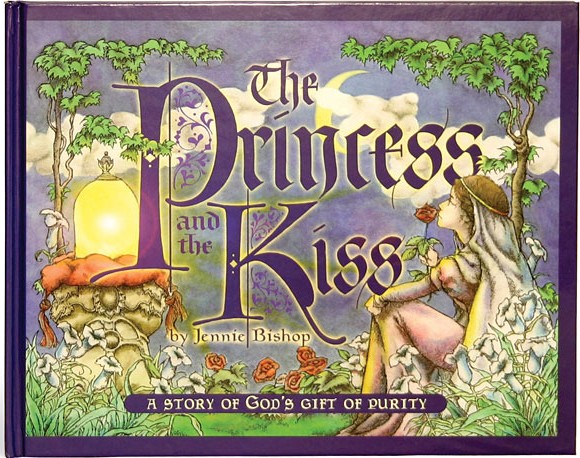
Instead, it simply talked about the importance of saving “your first kiss” for your wedding day. And of course, we were regaled with stories of virtuous couples who had done just that—didn’t we want to be like them? And then there is The Princess and the Kiss, a book marketed to children as young as four.

The book is about a king and queen who help their daughter save her most precious gift, her first kiss, for the prince she will marry. The princess’s first kiss lives in a glass orb, something like the rose in the Disney version of Beauty and the Beast (you can see it on the cover). This book has become very popular in Christian homeschooling circles and beyond, and there are hundreds of thousands in print. This is the sort of thing I was raised on (though this particular book wasn’t around when I was little, lots of kids are growing up on it now).

All of this came rushing back to mind recently when [my daughter] Sally kissed a little boy at her preschool—or, as I would have seen it in the past, when Sally “gave away her first kiss.”

We had gotten together with the family for a play date, and Sally and her little friend did the whole pretend wedding ceremony thing that little kids spontaneously do (I presided over a few in my day myself). At the end Sally grabbed the little boy and planted a kiss on his face. Surprised and bemused, I couldn’t help but recall my reaction to the pretend wedding staged by the five year olds I was babysitting so many years ago. This time, of course, my perception and reaction was different.

Sally didn’t lose anything when she kissed her little friend. Instead, she simply gained a common life experience—something she will look back at and laugh about when she’s grown.

It’s the people who impute a cute childish action with so much meaning who are creating the problem, not my preschooler.

Where Is Your Sense of Compassion, HSDLA?

Screen Shot 2013-07-31 at 2.48.45 PM

HA note: The following is reprinted with permission from Libby Anne’s blog Love Joy Feminism. It was originally published on Patheos on July 31, 2013.

*****

Josh Powell wanted to go to school so badly that he pleaded with local officials to let him enroll. He didn’t know exactly what students were learning at Buckingham County High School, in rural central Virginia, but he had the sense that he was missing something fundamental.

By the time he was 16, he had never written an essay. He didn’t know South Africa was a country. He couldn’t solve basic algebra problems.

So starts a recent Washington Post article about Virginia’s religious exemption.

Powell was taught at home, his parents using a religious exemption that allows families to entirely opt out of public education, a Virginia law that is unlike any other in the country. That means that not only are their children excused from attending school — as those educated under the state’s home-school statute are — but they also are exempt from all government oversight.

School officials don’t ever ask them for transcripts, test scores or proof of education of any kind: Parents have total control.

. . .

Josh Powell eventually found a way to get several years of remedial classes and other courses at a community college.

Now he’s studying at Georgetown University.

. . .

Josh Powell, now 21, wonders how much more he could have accomplished if he hadn’t spent so much time and effort catching up.

“I think people should definitely have the freedom to home-school as long as it’s being done well and observed,” he said. “I don’t see any reason for there not to be accountability.”

Most of all, he worries about his siblings: There are 11. One, old enough to be well into middle school, can’t read, Josh Powell said.

Now he’s trying to get his brothers and sisters into school, to ensure that they don’t have to work as hard as he did to catch up — or get left behind.

Go read the whole thing—the article is excellent. The long and short of it is that Josh’s parents used Virginia’s religious exemption clause to get out of any requirement to teach him anything, and then proceeded to give him what he knew was a substandard education, despite his desire to learn more than they were teaching him. In the end, Josh overcame all of that and managed to obtain remedial classes at a community college (without his parents’ help, I should add) and then gain admission to Georgetown. And now, he wants to see the law changed so that other children will not find themselves in his situation.

What I want to turn to now is HSLDA’s response. Before I do that, I should mention that the article includes a quote from Michael Farris. It’s not long:

The law is completely clear, said Michael Farris, chairman of the Home School Legal Defense Association, who has claimed the exemption for his family. It doesn’t make sense to have the public school system regulate home schools, he said, because he thinks home schools are far more successful.

As to whether there could be children getting an inadequate education, he said: “Well sure, it’s possible. But there are whole public school districts that are slipping through the cracks.”

Dear Mr. Farris: What you said is called “tu quoque.” It is a logical fallacy. You are a lawyer, you should know that.

Now with that out of the way, what I really want to look at is the official response HSLDA issued the day after the Washington Post article came out.

“Oh, my God, I have a chance to learn!” The Washington Post’s recent article about Virginia’s religious exemption statute includes this fascinating quote from Josh Powell, the young man who never attended public school because his parents obtained an exemption on religious grounds.

The article criticizes the law that allows the exemption and lobbies for its change. But let’s slow down and think this through.

How many public school teachers ever hear their students say, “Oh, my God, I have a chance to learn”? Very few. Because sadly, public schools crush many kids’ desire to ever learn again. And this has been documented.

The largest study comparing homeschool students to others (by Dr. Lawrence M. Rudner, University of Maryland) amazingly revealed that homeschool 8th grade students score the same as 12th grade public school students!

Why do homeschool students score an almost unbelievable four grade levels ahead of others by 8th grade? It’s very simple. It’s not that homeschool kids or their parents have higher IQs—I suspect they don’t. It’s simply that homeschools don’t crush a kid’s inborn desire to learn.

What is HSLDA’s evidence that public schools crush children’s “inborn desire to learn” while homeschooling doesn’t? The Rudner study.

Let’s review, shall we?

Somehow I feel like we’ve been over this before. (Also, if you haven’t, you should read this excellent article as well.) What did Rudner’s study say and how does he feel about the way HSLDA uses it?

Rudner’s study was funded and sponsored by the Home School Legal Defense Assocation.  It analyzed the test results of more than 20,000 home schooled students using the Iowa Test of Basic Skills, and it was interpreted by many to find that the average home schooled student outperformed his or her public school peer.  But Rudner’s study reaches no such conclusion, and Rudner himself issued multiple cautionary notes in the report, including the following: “Because this was not a controlled experiment, the study does not demonstrate that home schooling is superior to public or private schools and the results must be interpreted with caution.” Rudner used a select and unrepresentative sample, culling all of his participants from families who had purchased curricular and assessment materials from Bob Jones University.  Because Bob Jones University is an evangelical Christian university (a university which gained a national reputation in the 1980s for its policy of forbidding interracial dating), the sample of participating families in Rudner’s study is highly skewed toward Christian home schoolers.  Extrapolations from this data to the entire population of home schoolers are consequently highly unreliable.  Moreover, all the participants in Rudner’s study had volunteered their participation.  According to Rudner, more than 39,000 contracted to take the Iowa Basic Skills Test through Bob Jones, but only 20,760 agreed to participate in his study.  This further biases Rudner’s sample, for parents who doubt the capacity of their child to do well on the test are precisely the parents we might expect not to volunteer their participation.  A careful social scientific comparison of test score data would also try to take account of the problem that public school students take the Iowa Basic Skills Test in a controlled environment; many in Rudner’s study tested their own children.

Rudner himself has been frustrated by the misrepresentation of his work. In an interview with the Akron Beacon Journal, which published a pioneering week-long investigative series of articles on home schooling in 2004, Rudner claimed that his only conclusion was that if a home schooling parent “is willing to put the time and energy and effort into it – and you have to be a rare person who is willing to do this – then in all likelihood you’re going to have enormous success.”  Rudner also said, “I made the case in the paper that if you took the same kids and the same parents and put them in the public schools, these kids would probably do exceptionally well.”

In other words, the Rudner study doesn’t say what HSLDA says it says, and Rudner himself is frustrated about how HSLDA is misusing and misinterpreting his study. In other words, HSLDA’s supposed “proof” that public school stifles a child’s “inborn desire to learn” while homeschooling does not is proof of no such thing.

Back to HSLDA’s response to the Washington Post article:

When he hit community college, Josh attended remedial classes designed to serve public high school graduates, then zoomed ahead. Now he attends one of the nation’s top 25 universities, earning good grades while working part time and carrying a heavy academic load. Not too bad for a kid who thought he had a bad secondary education!

If Josh had attended public schools, he would have statistically had a 1-in-5 chance of growing into an illiterate adult. The National Assessment of Educational Progress revealed that 21.7% of adults in Josh’s native Buckingham County are illiterate. This is the wreckage of thousands of young people whose desire to learn has been crushed in the public schools.

I wonder if any of the other kids in Josh’s remedial classes went on to attend one of the nation’s top 25 universities. I doubt it.

Maybe Josh didn’t learn that South Africa was a country while he was being homeschooled. But he arrived at the gates of young adulthood with his inborn desire to learn fully intact, and that has served him very well indeed. The Virginia religious exemption statute deserves its place of respect.

The HSLDA response is, in essence, “your bad homeschool experience is nothing to complain about, because you could have a fate worse than receiving an incompetent homeschool education while begging to learn—you could go to public school!” Is HSLDA completely incapable of saying “we’re sorry your situation was so bad, we feel that it is a terrible thing for any child to slip through the cracks”? Are they incapable of hearing “that hurt me” and responding with “we’re sorry”?

All I have to say is this: Where is your sense of compassion, HSLDA?

Crosspost: Methodological Problems with Kevin Swanson and Brian Ray’s Gen 2 Survey

Crosspost: Methodological Problems with Kevin Swanson and Brian Ray’s Gen 2 Survey

HA note: The following is reprinted with permission from Libby Anne’s blog Love Joy Feminism. It was written by a guest writer, Apodosis, and was originally published on Patheos on July 17, 2013. 

Libby Anne posted recently about a new survey conducted by Brian Ray of the National Home Education Research Institute, a non-profit which conducts studies of questionable scientific validity on homeschooling. As a Ph.D. social scientist myself, I looked over the new survey with a critical eye and I’m sorry to say there won’t be much useable data gleaned from it because it is rife with methodological problems.

The survey has over 100 questions and nearly every question needs revisions, so I’m just going to summarize my main critiques of the study.

1. Institutional Review Board

When you are conducting a survey that collects personal information from the participants, every IRB in the country requires that you have signed informed consent forms for each of your participants. In online surveys, these tend to include a cover page describing the purpose of the study and what is asked of the participants, as well as a signature box to show you have understood your rights.These forms often include the phrases “You may stop the survey at any time without giving a reason” and “You are not obligated to answer any question you don’t want to”. They provide contact information for the primary investigator (PI) and other associated researchers, as well as for the IRB that approved it. “If you feel your rights have been violated, call this number” etc.

In the Gen 2 survey, there is no such information. It is not clear who is being asked to participate (see #2), the goals of the study are not honestly stated (see #3), and there is no contact information for the PI or an IRB to contact if you feel your rights have been violated. I had to dig on NHERI’s website to find the email address of the PI, Dr. Brian D. Ray (it’s bray@nheri.org, btw, in case you feel your rights have been violated), and he actively discourages you from contacting him. Red flag.

A peer-reviewed publication will not publish any results from research that was not overseen by an IRB.

2. Target Population

It is not clear who is being asked to participate in the survey. In the “About” section, Ray says the participants are “those between the ages of 18-38 years old that grew up in religious homes”, but in the FAQ he says “Anyone between the ages of 18-38″ may participate. I am between the ages of 18 and 38; I was raised in a moderate mainline Protestant family, and I am now a progressive mainline Protestant. I honestly cannot tell if he wants my data or not. Though both of those statements about who should participate apply to me, the questions on the survey indicate otherwise.

3. Goals

Which brings me to my most serious methodological critique of the study, which is that the goals are not honestly stated. There are two different studies conflated here which have entirely different goals. Dr. Ray even alludes to this in the “About” section: one goal is “to come up with data points of key influences that either encouraged or deterred the participants from practicing the same faith as their parents”; the other goal is to “use the statistics from this survey to help equip parents to make more informed decisions in the education and spiritual guidance of their children.” That is, in simpler terms, the goals are (A) to find out how young people’s religious views change as they reach adulthood, and (B) to figure out how to make sure young fundamentalists/evangelicals stay in the fold.

In fact, the main goal of the study seems to be (B) with a shallow veneer of (A) superimposed on it. Now, (A) is an interesting study whose results I would look forward to reading. (B) is not a scientific study. You do not perform a scientific study with the goal of achieving a certain result. Social science is about trying to describe and explain human behavior, not about trying to change it or attach value judgments.

Here are some examples of the problems that arise when the two studies are conflated. Dr. Ray pays lip service to the idea that young people may belong to a variety of faiths, as evidenced by his questions:

Generally, what kind of religious service did you attend as a child?

What kind of church or religion do you currently associate yourself with?

Available answers include Atheist, Agnostic, Buddhist, Hindu, Jewish, Muslim, and a variety of mainline Protestant denominations in addition to the exhaustive list of evangelical/fundamentalist groups. However, on the next pages he asks questions like

My current church is serious about applying the biblical principles of eldership, shepherding, mentoring, and church discipline.

Did you ever get any “worldview” training?

How often did your Father/Mother read the Bible to you?

These questions indicate that the primary audience of this study is people raised in a fundamentalist/evangelical/Christian patriarchy home. How are Buddhists and Hindus and Atheists supposed to answer these questions? Note that there is no “Not applicable” option available. This brings me to #4.

4. Not Applicable

It is important in surveys to allow your participants the freedom to answer the questions honestly, and not be forced to pick the “closest” answer. Many of the questions follow the “Have you stopped beating your wife” pattern, where e.g. a person who has never beaten their wife has no honest way to answer the question. “Not applicable” is only an available answer for one of 100 questions in the survey. This becomes a problem with questions like the following:

How distant or close do you feel to God most of the time?

What was the status of your parents’ marriage during your raising?

My father was very involved in our family home life.

How would an atheist answer the first question without “Not applicable”? How would someone answer the second question if they were raised by two parents in a committed relationship who were not married? And in the third case, what if you didn’t have a father?

“Other” followed by a fill-in-the-blank should also occur much more frequently as an available answer in questions such as:

Have you, or your significant other, ever chosen to have an abortion? Yes/ No

Do you think that people should wait to have sex until they are married, or not necessarily? Yes/ Not necessarily

How would you describe yourself when you were a child? I was very rebellious/I struggled with rebellion, but overcame it/I was always fairly obedient and honoring as a child

In the first question, it would be more appropriate to ask “Have you ever had an unwanted pregnancy?” and then to ask how it was dealt with. As it stands, a person who has never been pregnant and a person who has carried a rapist’s child to term would give the same answer. In the second and third questions, there are clearly more than just the possible answers given. My answers would be “No, unless they want to” and “My parents were supportive of what I chose to do and who I chose to be”. Participants in the study need a way to answer these questions honestly, so even if Dr. Ray wants to limit his variables it would be more methodologically sound to provide an “Other” response with a fill-in-the-blank to such questions.

5. Leading/Biased Questions

This brings me to another point: almost every question is leading or has other problems caused, for the most part, by faulty assumptions and a lack of imagination on the part of Dr. Ray.

“What kind of church or religion do you currently associate yourself with?” Some people consider themselves to be a member of a faith without having a specific faith community. Some people consider themselves to be members of multiple faith traditions. A better question would be “How would you describe your religion or faith?” with multiple check-boxes allowed. And he should list all the religions, not just the ones he could think of off the top of his head! He forgot at least (off the top of my head) Baha’i, Sikh, Wicca, Christian Science, Animism, Deist, Shinto, Unitarian Universalist, Not applicable, Other____, and he did not provide any different denominations of Judaism or Islam. In addition, he should have grouped the religions together by type rather than alphabetically—this list makes it very hard to see if your faith is represented. And groups like “Mormons” and “Congregationalists” should be called by their actual names—LDS and UCC, respectively. This list of religions, while it pays lip service to religious diversity, is actually offensive in its exclusions and ignorance. Plus, there is no acknowledgment in this survey of mixed-faith households. What if your parents were of different faiths, or what if you and your significant other do not share a faith?

Questions such as

What is your sex/gender? Male/ Female

How was your relationship with your Mother / Father when you were 16-17 years old?

How often did your Mother / Father explain biblical principles to you?

presume an oversimplified, heteronormative view of gender and family. Sex is not the same as gender; there are quite a few other genders than just male and female; you might have parents of multiple genders or the same gender (and therefore not have a “Mother” and a “Father”); and you might have been raised by other family members, or primarily by friends, or in foster homes. If this was really a survey about changes in young people’s religious views, it would try to get an accurate picture of their lives without limiting them to these binaries. Ray should also ask about people’s sexual orientations if he’s that interested in the status of their romantic lives; however, his reference to “homosexual” “encounters” in one of the questions indicates that he probably does not believe in sexual orientation as a concept (see #6).

6. Limited Mindset

Many of these questions portray a mindset that is isolated to the evangelical/fundamentalist/Christian patriarchy/Quiverfull/Purity movements–it’s possible that Dr. Ray does not even realize there are other ideologies out there. For instance, there is this question/answer set:

What statement most aligns with how many children would you like to have? I don’t want to have children / I want no more than a few children / As many children as God will provide / I don’t know

This really should be divided into multiple questions. First, he should ask “Do you plan your pregnancies?” If no, he should ask about “how many children you hope God will give you”, but if yes, he should ask how many you plan to have. I don’t think Dr. Ray realizes that some people plan their pregnancies. Then there is the following question/answer pair:

If you have—or were to have—children, what form of education do you plan to use for them? Christian school / Christian school and homeschool / Christian school and non-Christian private school / Christian school and public school / Homeschool / Homeschool and non-Christian private school / Homeschool and public school / Private school, non-Christian / Public school / Charter school/virtual charter / Other

At least this one has “Other” as an option, though it doesn’t let you write in your response. First of all, it’s a badly designed question—he should just list the types of school and let you check as many boxes as you want. Second, the question relies on the assumption that parents would choose their children’s manner of schooling before the children even exist. What if the child is gifted or disabled? Would that change the parents’ plans? And Dr. Ray does not even realize that people who would answer like me are out there—”It depends on the child’s needs and wants, as well as other considerations such as expense, distance, quality of education, etc.”

Then there’s this question/answer pair:

Did your parents use corporal discipline (spanking) with you?No / Yes, consistently and they were generally under loving control / Yes, consistently and often they were not under loving control / Yes, inconsistently and they were generally under loving control / Yes, inconsistently, and often they were not under loving control

These answers presuppose a worldview where the value of spanking is not open to debate (spoiler: we don’t live in that world). It would be more accurate to ask “What was your parents’ position on spanking?” “How often were you spanked?” “Are your attitudes toward it positive, neutral, or negative?” “Would you spank your own children?” etc.

And then there’s the part where he puts these two questions next to each other, clearly conflating them (shades of Libby Anne’s two boxes): “Have you had a sexual encounter or physical relationship with someone to whom you are not married?” and “Were you ever sexually abused before age 18?” Note that a girl who was repeatedly raped by her Christian patriarchy father for ten years and a girl who was raped once by an acquaintance at a party as a teenager would probably have different reactions to their faith traditions, though they would give the same “Yes” response. No effort is made to make this distinction in the survey. And nowhere does the survey ask about physical abuse, since Dr. Ray probably doesn’t think it exists.

Or how about the question “If you were unsure of what was right or wrong in a particular situation, how would you decide what to do?” with the available answers: Do what would make you feel happy / Do what would help you to get ahead / Follow the advice of a parent or teacher, or other adult you respect / Do what you think God or the scripture tells you is right / Something else. These answers reveal Dr. Ray’s belief that morality does not exist outside (his brand of) Christianity.

7. Exclusionary Language

The language Dr. Ray uses is exclusionary and often confusing. For instance, he persists in using terms like church, pastor, scripture, prayer, Bible, youth group, Sunday School when these terms are uniquely Christian and do not apply to people of other faiths–he ought to say faith community, religious leader, holy book, prayer/meditation, religious education if he wanted to get accurate data. He also fails to define several terms which I don’t understand because I was not raised in a fundamentalist environment: family-integrated, homeschooling-friendly, shepherding, church discipline, worldview training. In his questions about belief in “God” and “heaven”, he ought to ask separate questions about each property he wants to assign to these words’ meanings (e.g. “Do you believe in a deity or deities?” “If yes, do you believe the deity/deities is/are omniscient? Omnipresent? Omnipotent? Does it/do they have a gender? Does it/do they affect everyday events?” etc.). If Ray wants accurate data, he should define confusing and ambiguous terms.

You should not be able to tell someone’s political and religious beliefs from survey questions designed to elicit yours. You should not be asked to give dishonest answers to survey questions because your honest answers are unavailable as options. You should not have to infer how exclusionary language in the questions would apply to your situation. You should not be asked to give out your personal information without giving your informed consent.

An IRB would not approve this study. I would not rely on any of the conclusions that come out of it.
What Do Presents, Chocolate Bars, Roses, Chewing Gum, and Packing Tape Have in Common?

HA note: The following is reprinted with permission from Libby Anne’s blog Love Joy Feminism. It was originally published on Patheos on June 6, 2013.

*****

Question: What do presents, chocolate bars, roses, chewing gum, and packing tape have in common?

Answer: Nobody wants them when they’re used.

Presents, chocolate bars, roses, chewing gum, and packing tape have all been used by abstinence educators and various Christian leaders and teachers to illustrate to young people how having sex before marriage will ruin them and leave them disgusting and unwanted. Those who grew up in the purity culture probably knew the answer to the question asked in the title before even opening this post.

I was reminded of this when reader Laura left this comment on my blog:

I had to go through the True Love Waits program. The “activity” I remember the most was a wrapped present. I held the package and stood at the front of the room. Then, the youth leaders lined up the guys and each of them tore off some of the paper. Then I had to read some paragraph about how virginity is like a gift – no one wants a present that was “meant for them” to have already been opened by someone else.

Because of that one activity, I never told anyone I was raped at 15 until years later. I can’t even imagine the rest of the damage that was done to the other girls in the group.

Laura’s comment reminded me of Samantha’s post from several months back. In her case, the teachings she received about purity led her to stay in an abusive relationship long after she should have left—because she believed that, having given up her virginity, she was ruined for anyone else. Here is why Laura’s comment reminded me of Samantha’s post:

When I was fourteen, I went to a month-long summer camp at the college I would later attend. Like most Christian summer camps, this one involved going to a chapel service twice a day. Most of the time they were fun, lighthearted– until one evening they split up the girls and the boys. Great, I remember thinking, because I knew exactly what was coming. Segregation can only mean one thing– they were going to talk about sex. I sighed when they made the announcement. Again? I thought wearily.

That evening, when the camp counselors had shooed all the men and boys out of the building, the speaker got up to the podium. She didn’t even beat around the bush, but launched right into her object lesson. Holding up a king-size Snickers bar, she asked if anyone in the audience wanted it. It’s a room full of girls– who doesn’t want chocolate? A hundred hands shot up. She picked a girl close to the front that wouldn’t have to climb over too many people and brought her up to the stage. Very slowly, she unwrapped the Snickers bar, splitting the package like a banana peel. She handed it to the young woman, and asked her, very clearly, to lick the chocolate bar all over. Just lick it.

Giggling, the young lady started licking the chocolate bar, making a little bit of a show of it. At fourteen, I had no idea what a blow job was, so I missed the connection that had a lot of girls in the room snorting and hooting. The young lady finished and handed it back to the speaker. As she was sitting down, the speaker very carefully wrapped the package around the candy bar, making it look like the unopened package as possible.

Then she asked if anyone else in the room wanted a go.

No one raised her hand.

And Samantha gives a second example, too:

My sophomore year in college, another speaker shared a similar object lesson– ironically, in the exact same room, also filled exclusively with women. She got up to the podium carrying a single rose bud. At this point I was more familiar with sexual imagery, and I knew that the rose had frequently been treated as a symbol for the vagina in literature and poetry– so, again, I knew what was coming.

This speaker asked us to pass the rose around the room, and encouraged us to enjoy touching it. “Caress the petals,” she told us. “Feel the velvet.” By the time the rose came to me, it was destroyed. Most of the petals were gone, the ones that were still feebly clinging to the stem were bruised and torn. The leaves were missing, and someone had ripped away the thorns, leaving gash marks down the side.

This reminds me too of something teen kidnap victim Elizabeth Smart said, explaining one reason she stayed with her captor and didn’t try to run sooner.

Rescued kidnapping victim Elizabeth Smart said Wednesday she understands why some human trafficking victims don’t run.

Smart said she “felt so dirty and so filthy” after she was raped by her captor, and she understands why someone wouldn’t run “because of that alone.”

Smart spoke at a Johns Hopkins human trafficking forum, saying she was raised in a religious household and recalled a school teacher who spoke once about abstinence and compared sex to chewing gum.

“I thought, ‘Oh, my gosh, I’m that chewed up piece of gum, nobody re-chews a piece of gum, you throw it away.’ And that’s how easy it is to feel like you know longer have worth, you know longer have value,” Smart said. “Why would it even be worth screaming out? Why would it even make a difference if you are rescued? Your life still has no value.”

And finally, Ariel Levy has reminisced similarly:

To illustrate his not terribly complex point, Worley called a stocky young man from the audience onto the stage and then pulled out a length of clear packing tape.

“This is Miss Tape. She looks pretty good, right? She’s tall, right? She’s … what else is she?” Worley raised his eyebrows at us encouragingly.

“Thin!” someone shouted out.

“Right! She’s thin,” he said, and wiggled the piece of tape so it undulated in the air. “And she has nice curves!” Worley winked. “So they have sex.”

To illustrate the act of coitus, Worley wrapped the piece of tape around the volunteer’s arm. After a few more minutes of make believe, we came to the inevitable bump in the road when Worley said the volunteer had decided to move on to other chicks. Worley ripped the piece of tape off his arm.

“Ouch,” said the volunteer.

“How does she look now?” Worley asked, holding  the crumpled Miss Tape up for inspection.

I fought back the urge to yell, “like a dirty whore?”

Presents, chocolate bars, roses, chewing gum, packing tape—these sorts of metaphors abound in circles where what I call “purity culture” is strongest, and each one is used to illustrate how having sex before marriage will ruin you, rendering you dirty and potentially even unable to bond or form real relationships for the rest of your life. In the effort to keep young people from having sex before saying marriage vows, Christian leaders, pastors, and parents resort to threatening their youth, doing their utmost to scare them out of having sex and slut-shaming like crazy in the process.

In case you were wondering, no, this isn’t healthy, and the result of these teachings has been a generation of Christian youth with warped and toxic ideas about sex, dating, and even their own bodies. And in the process, these very teachings have led young women like Laura, Samantha, and Elizabeth to leave their rapes unreported, remain in abusive relationships, and stay with their abductors. This is not okay. 

How about you? What similar metaphors have you encountered, and how have they affected your life?

Homeschooling and Sibling Relationships

HA note: The following is reprinted with permission from Libby Anne’s blog Love Joy Feminism. It was originally published on Patheos on June 5, 2013.

The homeschool literature that my parents read promised them that homeschooling would create perfect sibling relationships among us children, and make us all especially close and really good friends with each other—unlike those public school kids’ distant relationships with their siblings, and rivalries rather than friendships, of course. I want to take a moment, then, to talk about sibling to sibling relationships in my family. This is kind of embarrassing, to be honest—I’m not going to come off so well here.

It’s true that we kids played together all the time growing up. We sort of had to—there wasn’t usually any other option. I mean sure, we had people over, but most of the time it was just us, and so we were each other’s playmates. I have so many memories of exploring creeks, building lego cities, and chasing each other across the pond. I could go on and on—we really did have great times. But here is my first caveat—I’ve found that most of my friends today who were public schooled also had great adventures with their siblings. Sure, they weren’t around each other for quite as many hours of the day, but it’s wrong to think that they didn’t also explore creeks together, build lego cities together, and chase each other across a pond or pool. In fact, come to think of it, I had cousins growing up who went to public school (and lived far away so we very rarely saw them), and I know for a fact that they did all of those things regularly.

Now, anyone who thinks that homeschooling magically eliminates sibling rivalry is sorely, sorely confused. I’m having troubles thinking of how to easily describe it, but we had sibling rivalries, and lots of them. There were literally three years when one of my brothers and I fought every time we had to spend more than half an hour together (which meant it happened multiple times a day, of course). We just set each other off, somehow. One of my sisters and I just had such completely different outlooks that we ended up permanently at odds—she resented me for being a goody-goody, and I resented her for not being the picture perfect Christian homeschool kid. There were several sisters in a row at one point, and this didn’t always work out that well—there were plenty of times when some of them tore down the others, continually, and with no real explanation. But beyond all this, as I’m going to explain, I actually think that in our case homeschooling served to exacerbate sibling rivalry.

For one thing, we kids fought over friends. See, rather than having individual friends our family generally got together with other like-minded homeschool families as families. So, say, the Smiths and their five kids would come over, or the Joneses and their nine kids, and we’d just play with whoever was somewhere around our age. In this process, I stole friends from my close-in-age-sister. Twice. And once I took a friend who by age probably should have been hers, but I got to her first and monopolized her. And no, this didn’t make for much happy-making between my sister and I. But, well, there were a limited number of friends available to us, so we fought with each other over them, and I usually won. If we’d been in school, we would have been in separate classes and had our own individual pools of friends.

In addition, because we were homeschooled we siblings had to spend 24 hours a day together. Sometimes this worked out great, but sometimes we got on each other’s nerves. A lot. A very, very lot. I suspect that if we had had more time apart from each other we might have grated on each other less. It would have given us a break. It would have meant that we could each have our own space and our own things—something we didn’t really have, and something we often sorely needed.

Next, bullying. Talking about bullying is rather difficult because, well, I was the bully. My parents followed the Pearls’ child training methods, which they came to after another homeschool family recommended them. Based on these methods, they gave us older kids the authority to spank the younger ones. I was never sadistic or anything, but I sure wasn’t very nice about it, and I learned after coming of age and leaving home that many of the younger ones saw me as a bully and had come to hate me. Only, in this case I had been a bully they couldn’t get away from. Normally, kids who are bullied at school have a respite at home. Not so my siblings. Sadly, I’ve seen this same pattern copied by others of my siblings, and even today, among those of my siblings still living at home, the older ones are authorized to spank the younger ones. In some ways, it’s rather like parent-approved bullying. As I’ve written before, I deeply regret my involvement in this. Sure, this pattern can exist without homeschooling, but in our case it was a pattern my parents implemented based on the literature and teachings of the homeschool movement, and not something I think they would have adopted had they not homeschooled.

There’s another issue I should probably discuss as well—as junior mom, I had my favorite among the younger kids. I favored her, and the other kids knew it. In fact, more than once when I was presiding as judge over an altercation the other children accused me of taking my favorite’s side just because she was my favorite. And it was probably true. What’s saddest to me about this is actually what happened after I left home—that special relationship didn’t last. My favorite felt I’d abandoned her when all I’d done was left for college—but she was too young at the time to understand. And then things blew up between myself and my parents and there was a long gap when I didn’t visit home at all, and was afraid to have too much contact with my siblings for fear of risking my parents’ disapproval. I wish I still had a special closeness to the girl I mothered as a teen, but it’s gone now and rebuilding it is hindered by a lack of trust. Perhaps this is something specific to me, but I think it suggests that the junior mother-favored little sibling dynamic common in so many homeschool families I knew growing up wasn’t really so healthy as we thought it was.

And now we come to today.

Today, I’m extremely close to several of my adult siblings—but I’m close to them not because of being with them 24/7 growing up but rather because we were bound together by adversity as young adults. These specific siblings also went through problems with my parents when they became adults and started making their own choices, and during this time we cried on each other’s shoulders, blew off steam in long phone conversations, talked about out our backgrounds have affected us, and just generally were there for each other—and we still do this today. The interesting thing is that these aren’t even necessarily the siblings I was closest to as a kid. As for the kids still at home, my relationships with each of them are weird because if I actively try to undermine what my parents are teaching them, my parents will likely limit my contact with them, and avoiding things that will undermine what my parents are teaching them means avoiding talking about basically everything I’m interested in.

I don’t think homeschooling enhanced sibling to sibling relationships in our family. I’m not saying there weren’t some good things—I did spend more time playing with my siblings than public schooled children do, and I have lots of positive memories from these times—but rather that I think the downsides outweighed what we gained. So when I read the following quote by homeschool pioneer Mary Pride, I just had to laugh. With this background, let me offer the quote and some thoughts I had on reading it.

However, in one respect these books do get it right. In school, kids learn to segregate themselves by age. Older kids learn to be embarrassed about spending time with younger kids. Schoolkids also quickly learn the art of the putdown, and all about “ganging up” on the victim of the day. When all these social fighting skills – which clueless folks refer to as “socialization” – are brought home, it can take sibling rivalry to a new level of meanness.

Does she seriously think sibling rivalry only turns mean when kids attend public school and thus learn bullying techniques and bringing those techniques home? Or, conversely, that public school kids naturally have troubled sibling-sibling relationships? Or, to ask a third question, that homeschooling can’t in certain ways serve to increase sibling rivalry? Because my experience and the experiences of friends I now have who were public schooled very much suggests otherwise.

Does she seriously think that homeschooled kids don’t learn how to put each other down or gang up on each other? Goodness, don’t get me started on the ganging up on each other bit—for a long time, my siblings and I were split into two groups and automatically took opposite sides when there was a fight. Sometimes one faction would gang up on one kid in the other faction, and the rest of that child’s action would rush to her rescue. Each faction viewed the other with some degree of suspicion.

Does she seriously think that homeschooled kids never get annoyed by kid siblings and, yes, even at times come to resent them? Let me tell you right now—they do! I wouldn’t say I ever felt actual resentment—though the same cannot be said of all of my siblings—but I did find some of the younger ones quite annoying at times. And sometimes we older ones—some more than others—wished we could get the little kids out of our hair so we could have some space, but when the little kids share a room with you, it’s rather hard to do that.

When it comes to sibling to sibling relationships, my parents would have done better here if they had sought to read about and learn techniques for fostering positive sibling relationships rather than simply assuming that the act of homeschooling would turn us all into singing cherubs. But then, they bought what Mary Pride was selling hook line and sinker.

I want to be clear that I’m not trying to generalize from my experience—while there may be some similar patterns, I think the dynamics of sibling relationships will vary greatly from homeschool family to homeschool family (just as they vary greatly from public school family to public school family). I’m simply saying that the promise my parents were given that homeschooling would create close and blissful sibling relationships—and also would mean that none of us would face bullying—turned out to be false and grossly misleading. And yet, homeschool speakers and organizations are still out there making this same promise to unsuspecting homeschool parents today. Perhaps, in some small way, my story can help.

If you were homeschooled, I’d like to invite you to use this space to talk about how sibling relationships went in your family. And if you weren’t homeschooled, feel free to talk about your own experiences with sibling relationships and how they compare and contrast with the things I talk about here. 

Vision Forum and “Historical Revisionism”

HA note: The following is reprinted with permission from Libby Anne’s blog Love Joy Feminism. It was originally published on Patheos on June 15, 2013.

American history today isn’t what it once was. There was a time when American history privileged the white, the wealthy, and the Christian, and ignored the stories of marginalized, the complexities of events like the American Revolution, and the genocide of the Native American population. This has changed, and universities today tell the stories of the marginalized and challenge traditional black and white patriotic narratives.Not everyone is happy with this, however:

Are you and your children equipped to defend America’s godly heritage against today’s fierce onslaught of historical revisionism? To help address this need, Vision Forum Ministries is pleased to announce the History of America Mega-Conference, an exciting five-day event to be held in Harrisburg, Pennsylvania. Join a faculty of distinguished scholars and thinkers delivering more than fifty stirring lectures on a host of topics concerning America’s past—all from a distinctively Christian worldview.

What all will the conference cover?

This conference will offer the most comprehensive overview of our nation’s history that we’ve ever given to date. Over five days, you’ll receive a thorough and biblically-sound examination of America’s past that you’ll search in vain to find in today’s college classroom. The academically-potent lectures will span four centuries — it’s an American history crash-course you won’t find anywhere else.

Antagonists to the Christian faith are stealing our history, and it’s time we take it back. The engaging messages given at this conference will arm your family with the truth to combat the lies of the Left — to have a sure foundation for the 21st century.

Were our Founding Fathers Deists? How should we view our government’s treatment of American Indians? What are we to make of the War Between the States? These and other raging controversies will be answered.

Here’s the video promo, complete with lots of shots in costume:

There are more videos here, most of which I have not yet watched.

Did I mention that Vision Forum only sells grey civil war cap, and not a blue one? Or that their description of a Civil War history tour is a bit, well, one-sided? And then of course there’s this picture of Doug Phillips’ son posing in front of a monument to the founder of the KKK and the racist blackface knickknack in the Phillips’ home. The most blatant, of course, is the fact that Vision Forum sells books by Robert Lewis Dabney, describing the nineteenth century southern theologian known for his racism and his influence in the post—Civil War South in glowing terms.

In an anthropological sense I think it would be fascinating to be a fly on the wall at Vision Forum’s upcoming History Mythology of America Mega-Conference, but at the same time when I think about what it is they’re teaching, and to a willing audience, I’m absolutely appalled.

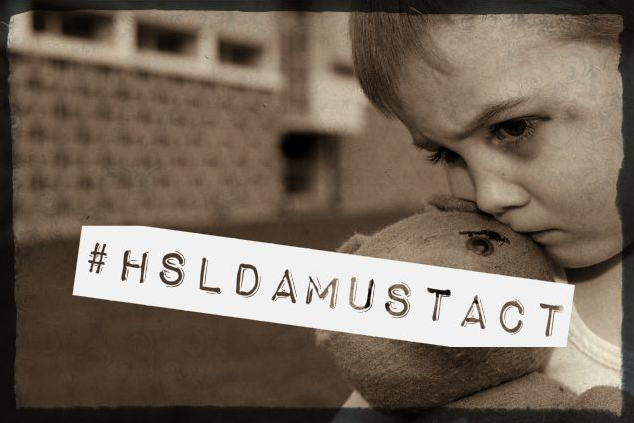
#HSLDAMustAct: History and Related Media

Screen Shot 2014-06-26 at 1.20.57 PM

April 17, 2013

On April 17, Love Joy Feminism’s Libby Anne — a former homeschool student, former attendee of Patrick Henry College’s summer camp on Constitutional Law taught by Michael Farris, and now-parent of two children; also, one of HA’s blog partners — began a five-part series looking at the relationship between HSLDA and child abuse. Of particular concern to many people who have read this series is that HSLDA has slowly but surely moved from homeschool advocacy to — by their own admission — reform of child welfare laws, including opposing anonymous tips, mandatory reporting, and mainstream definitions of child abuse. The five parts to this series are: (1) HSLDA and Child Abuse: An Introduction; (2) HSLDA’s Fight against Child Abuse Reporting; (3) HSLDA’s Stonewalling of Child Abuse Investigations; (4) HSLDA’s Defense of Child Abuse; and (5) HSLDA and the Deregulation of Homeschooling. Part five of the series was published on April 24.

April 20, 2013

The blogger from the Eighth and Final Square, inspired by Libby Anne’s series on HSLDA and child abuse, writes a post about her own homeschooling experience. It is entitled, “we were taught to fear the people who could help.” The author says she, too, was “instilled with a fear of CPS.” As a survivor of abuse herself, she says, “I wonder what would have happened if HSLDA wasn’t around, and the kids had been allowed to talk to CPS workers alone.”

April 22, 2013

Homeschoolers Anonymous started crossposting Libby Anne’s series on HSLDA in conjunction with a week of personal stories that explored the relationships between homeschooling, HSLDA, and the CPS: fears of the CPS, failures of the CPS, and how the CPS could have actually helped those who suffered abuse in homeschooling.

April 23 – May 2, 2013

After finishing her series on HSLDA and child abuse, Libby Anne continues to focus on issues of homeschooling, abuse, and HSLDA. She creates a legislative alert about one of HSLDA’s legislative alerts, urging people to counteract HSLDA’s efforts to stop SB 32, a bill “designed as a way to monitor and protect the well-being of children who are known to be at risk for child abuse or neglect based on prior incidences.” She argues that it is “simply false to suggest that there is nothing about homeschooling that might be attractive to neglectful or abusive parents.” She cites a plethora of horrific stories to explore the idea that, while “most homeschool parents are dedicated, responsible and loving,” “when abusive parents homeschool, the consequences for their children can be absolutely disastrous.”

May 6, 2013

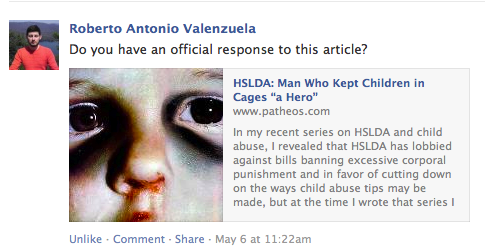
On May 6, Libby Anne writes a post entitled, “HSLDA: Man Who Kept Children in Cages ‘a Hero.'” In this post, she points out that Scott Somerville, an HSLDA attorney, called Michael Gravelle, a man charged with molesting his biological daughter, putting his adopted kids in cages, and later punching and shaking his own wife, a “hero.”

Later that day, someone posts Libby Anne’s article on HSLDA’s wall:

Picture 12 May 7, 2013

The very next day after someone posts Libby Anne’s article on Somerville’s hero comment on HSLDA’s Facebook page, HSLDA chooses to respond via a Facebook status:

Picture 13

The full text of their response is as follows:

It has come to our attention that HSLDA has recently been accused of condoning child abuse. HSLDA does not and will not ever condone nor defend child abuse. 

HSLDA receives hundreds of calls each year from parents who are under investigation by CPS, often based on false, anonymous, trivial, or malicious reports. The vast majority of these are determined by CPS or a court to be unfounded and are dismissed. Because of this, we do not immediately assume that everyone who is the subject of an investigation is guilty of child abuse or neglect. 

As a service to our members, we help homeschool families navigate the legal landscape in the early stages of an investigation before all the facts come to light. This could include helping families know their constitutional rights, helping them understand the legal process, or referring them to a local attorney. If the allegations include homeschooling, we generally will either assist their local attorney to defend homeschooling or represent the family on homeschool matters.

Of the three examples mentioned in a recent article, we did not represent two of the families and in the third we were involved on the question of homeschooling alone after the other issues were resolved by the court. 

We believe that every child deserves a healthy upbringing and that parents have the high honor and duty to meet that child’s needs. For 30 years we have been zealously advocating for the right of thousands of parents to responsibly homeschool their children. To the extent that any statements we may have made could be misunderstood to suggest that we condone the abusive actions of some we repudiate them wholeheartedly and unequivocally.

Libby Anne promptly responded to HSLDA’s response: “I’ve Had Enough: My Reply to HSLDA’s Response”.

Also in response to HSLDA’s response, R.L. Stollar, co-creator of Homeschoolers Anonymous, issued a challenge to HSLDA on their Facebook page: “HSLDA, will your leaders take a public and universal stand against child abuse and launch a public awareness campaign for your members on how to recognize and report child abuse in homeschooling?”

Stollar’s challenge to HSLDA was quickly mirrored by others. Heather Doney, one of HA’s blog partners, wrote, “Demanding an Answer from HSLDA,” where she says, “We deserve to know where the HSLDA stands. We deserve to know that they are thinking about this issue and that they are doing something about it. I, for one, am requesting an answer. Don’t make us wait too long, HSLDA.”

May 7 – 11, 2013

Homeschoolers Anonymous officially launches the #HSLDAMustAct campaign on May 8.

Rebecca Gorman, a former homeschooler, creates the official Change.org petition for the #HSLDAMustAct campaign.

A new website, Homeschooling’s Invisible Children, was launched by former homeschoolers to “to raise awareness of the horrific abuse and neglect that can take place when unfit caregivers use homeschooling as a cover for criminal child maltreatment.”

On May 9, HA announces the official petition in the post, “25 Reasons To Sign The #HSLDAMustAct Petition.”

Here is a full list of posts from bloggers covering the whole Libby Anne/HSLDA issue and the #HSLDAMustAct campaign since May 7:

Wide Open Ground: “Dear HSLDA and Homeschool Parents, What About My Friend Who Died?” and “HSLDA: Discourse Problem Between Fundamentalist and Outsiders”

Anthony B. Susan: “The HSLDA and Abuse: More Denial and Deflection”

Becoming Worldly: “S***t HSLDA’s Homeschool Parents Say”

Ramblings of Sheldon: “HSLDA: We Would Rather Stand Behind Abusers Than Their Victims”

The Home Spun Life: “Homeschoolers, Christians, HSLDA: We Must Do Better, Kids Are Being Abused”

No Longer Quivering: “Petition: HSLDA Address the Problem”

ThatMom: “HSLDA accused of turning blind eye to child abuse: you decide”

Kathryn Brighbill: “HSLDA and Child Abuse” and “Of Fundamental Rights, HSLDA, and Homeschooling”

Anonymous Wonderings: “On Homeschooling”

On May 10, the Christian Post took on the issue but framed it only as a Libby Anne vs. HSLDA issue: “Home School Legal Defense Association Accused of Protecting Child Abusers.” The Christian Post did not attempt to contact Libby Anne; they tried to contact HSLDA, but HSLDA did not respond. They also did not mention the petition.

May 12, 2013

As of Sunday, May 12, the #HSLDAMustAct petition has over 300 signatures from around the world. The signees are almost entirely from the homeschooling community itself. Former homeschool students, former and current members of HSLDA, and former and current homeschooling parents have all signed it. Signees are from everywhere from California to Louisiana to Pennsylvania, from the U.S. and Canada to Germany and Spain.

Also as of Sunday, May 12, HSLDA has still not responded to the #HSLDAMustAct campaign.

Conclusion

We will leave you with these thoughts from Lisa from The Home Spun Life:

“I have been a financial supporter of HSLDA for many years now and I am asking that they become more transparent with how they practice law, how they defend homeschooling, AND how they protect children in a homeschool that is abusive.

I know children are abused in a variety of types of homes. From poor to wealthy, from Christian to atheist, from public school to homeschools. Abuse happens. It’s tragic! We can’t only speak up about abuse when it happens in a public school. We have to speak up no matter where it happens. And we have to learn how NOT to respond to abuse allegations in the homeschool community.

Defending our freedom to choose our children’s education should never trump their freedom to live in a healthy and safe environment.

To the HSLDA,

As a supporter of yours, I am asking for you to clarify your mission to defend homeschool freedom. I am asking that you inform us and SHOW US how you are defending this freedom WHILE defending children in an abusive homeschool environment. HOW do you separate the defense to protect homeschool freedom WHILE NOT enabling abusive parents to further their abuse under your “protection”? HOW are YOU holding abusive parents accountable? HOW are YOU cooperating with local authorities to HELP victims?

We must do better. We must speak up.”

Why Is Calling for Homeschooling Reform Taboo?

HA note: The following is reprinted with permission from Libby Anne’s blog Love Joy Feminism. It was originally published on Patheos on April 15, 2013.

When individuals who attended public school talk about the negative experiences they had, point out that many public schools are failing or that certain practices in public schools leave much to be desired, and call for improving the schools and reforming public education, they don’t face accusations of being anti-public school, of just being bitter, of being angry at their parents, or of over-generalizing and calling all public schools universally bad. No one tries to silence them for “giving public schooling a bad reputation,” accuses them of trying to ruin things for everyone else, or says that the problem was just their shitty family situation.

So why is it that when individuals who were homeschooled talk about their own negative experiences, point out that many homeschools are failing and that certain homeschool practices leave much to be desired, and call for improving homeschooling through implementing reforms, people accuse them of being anti-homeschool, of just being bitter, of being angry at their parents, and of over-generalizing and calling all of homeschooling universally bad? Why is it that people try to silence them for giving homeschooling a bad reputation, accuse them of trying to ruin things for everyone else, and say that the problem was just their shitty family situation?

Why is it that it’s just fine to call for reform of the public schools, hip even, but it’s taboo to call for reform of homeschooling? Why is criticism of public schools widespread and expected, but criticism of homeschooling by those who were homeschooled themselves causes everyone to lose their heads?

How is “people have shitty experiences in public schools too” a sensible answer to calls for reforming homeschooling? Do we shrug and say “people have shitty homeschool experiences too” when people call for reforming and improving public schools?

Why do people respond to calls for homeschooling reform by stating that there’s nothing that can be done to curb abuse, when no one would even think of responding to calls for public school reform in that way?

Why is it that criticism of homeschooling by those who were homeschooled is panned off as some form of adolescent rebellion while criticism of public schools is practically trendy?

Why is calling for reforming homeschooling portrayed as trying to “ruin things for everyone else” while reforming public schools is seen as an effort to make things better for everyone’s children?

Why is voicing criticism of homeschooling or talking about negative homeschool experiences portrayed as being anti-homeschool while criticizing public schools or talking about negative experiences in public schools isn’t similarly portrayed as being “anti-public school”?

Why do people shrug and say that bad homeschooling is just a result of shitty parents and there’s nothing to be done while at the same time arguing that we need school reform to improve shitty schools and implementing programs to help public school kids with shitty family backgrounds?

Why is criticizing public schools and calling for public school reform seen as healthy and good while criticizing homeschooling and calling for homeschool reform is taboo? Shouldn’t we want to improve and reform both, cut down on abuse and neglect in both, and ultimately work toward the best interests of children in whatever educational methods their parents have chosen for them?

Something is very broken about how we discuss this issue.

Sex Miseducation

HA note: The following is reprinted with permission from Libby Anne’s blog Love Joy Feminism. It was originally published on Patheos on July 18, 2011.

Children who go to public school receive sex education. Some sex education programs are better than others, some are more comprehensive, others less so, but at least children attending public schools get sex education. I didn’t. My parents never told me about sex, never had “the talk” with me, nothing. My parents taught me that sex within marriage was the most wonderful thing ever but that sex before marriage was the most sinful thing ever, but they never actually explained what sex was. They just told us that it was a “special way of loving.” Weird? Yes. In an ideal world children will learn both about sex and to hold a healthy view of sexuality from their parents. Unfortunately, this is not an ideal world.

Now of course, I was curious: just what was this “special way of loving?” What was this thing at once so dangerous and so wonderful? And why was it so taboo, kept hidden from me like a secret? I pieced this secret together here and there from various sources over the course of six or eight years using a variety of sources:

A Biology Textbook: When I was in middle school I found a description of sex in a biology textbook. The two or so sentences of clinical explanation horrified me, and I quickly closed the book and put it away, more confused, terrified, and ashamed than enlightened.

An Art Book: Around the same time, I found a book full of pictures of statues in a stack of art books my mother had gotten from the library. The statues were nude. I stared, fascinated, looking at the pictures in an effort to learn more about human anatomy. I then felt incredibly dirty and put the book away quickly before my mother could notice that I had seen it.

A Book Store: When I was around fifteen, I was at Barnes and Nobles and ran across a book on how to tell your child about sex. I hid behind the shelves of books and listened anxiously for footsteps. I skimmed the pages furtively, hungry for whatever information I could find, information that would help explain this confusing thing to me. Given that I was terrified of being found and that the time I had was limited, the only thing I remember learning was about masturbation, which I had never heard of before. I felt extremely guilty and dirty afterward.

A Christian Sex Guide: At some point during high school, I found a Christian guide to improving your sex life in my parents’ bedroom. Closing the door and extremely nervous I might be discovered, I leafed through the book, slightly concerned that my parents might be having marriage problems and very frightened of being caught looking at the book but more curious than anything else. After a few minutes, I returned the book to where I had found it, feeling guilty and dirty, but slightly wiser.

The Internet: When I left for college I could use the Internet without being afraid that my parents would check the computer’s history. Finally I could solve questions that had been puzzling me, like just what “oral sex” was – I had heard the term somewhere several years back and had been curious ever since, but had been unable to find the term in a dictionary. Finally my questions could have answers. I clicked through pages of Christian sex advice websites, always afraid that my search terms might bring up porn sites. I justified what I was doing by reminding myself that I was now an adult and besides I was only looking things up on Christian websites.

A Mirror: I realized during my first year of college that I had no idea what parts I had down there. My parents’ emphasis on purity had made me feel that my private area was somehow dirty and unclean, and I had therefore never paid any attention to it. I didn’t even know where my vagina was, just that it was down there somewhere. Curious, I looked up anatomy images on the Internet and then then stood naked in the bathroom using a hand-held mirror to explore body parts I had not even known I had. I was both fascinated and horrified by what I learned.

Romance Novels: After I had been in college for some time, I held the hand of the man who is now my husband for the first time. This made me feel warm and wet in certain places that I had not known could be warm and wet. I was completely baffled. I had no idea what was happening to my body. I might now know the basic mechanics of sex, but I knew nothing about how it actually worked in practice, or what it meant for the body to be “aroused.” What was this? And so, I turned to the lurid romance novels one of my friends kept in her dorm room, reading the sex scenes in depth to try to find out what sex was actually like.

And that, reader, is how I learned about sex. Is it any wonder that I wish I had had a sex education class? Some years later, after I left my parents’ home and was married, a fifteen-year-old girl in a youth group I helped out with started asking me questions about sex. I answered her questions, every one of them, with the openness and honesty I wish my parents had had with me. I didn’t want her to have to learn about sex by sneaking her mother’s Christian sex book or reading romance novels. I didn’t want her to be nineteen or twenty and completely ignorant of her own anatomy. I didn’t want her to be like me.

I’ll never understand how my parents could on the one hand teach me that sex was something beautiful and sacred and at the same time leave me in ignorance about it and make me feel like it was something dirty and unclean. It was the most wonderful thing ever…but it was completely taboo as a topic. It was a sacred bond between husband and wife…but please don’t mention it or think about it. The contradictory messages I received gave me a very warped view of sex. I both looked forward to the sacred bond of sex with my future husband and felt dirty any time I thought about it. Learning about sex piecemeal here and there didn’t give me a very accurate view of sex either, even discounting the sense of guilt I felt about doing so.

When I finally got to the point of actually having sex, I was disappointed to find that it neither felt sacred nor lived up to the descriptions in the romance novels I had read. Picking up knowledge of sex in bits and pieces here and there while awash in guilt does not lead to a comprehensive understanding of sex or a healthy sexuality. I had no idea that sex took practice or effort, or that sometimes one partner wouldn’t feel like it and the other would, or that it could be sweaty and gross. It has taken me years to iron all this out and to come to a healthy view of sex. I wish that instead of focusing on keeping me ignorant of it, my parents had informed me about sex and focused on giving me a healthy view of sexuality. But then, their beliefs about sex would not allow them to do that.

What I would have given a sex education class, a safe place where I could have found the basic information and asked questions! Sure, it wouldn’t have been perfect, but it would have been something.

But What About Socialization?

HA note: The following is reprinted with permission from Libby Anne’s blog Love Joy Feminism. It was originally published on Patheos on October 10, 2011.

"Socialization matters. It is not a bogeyman or a silly question."
“Socialization matters. It is not a bogeyman or a silly question.”

This is probably the most common question homeschoolers get. As a child, I was well schooled in how to reply to it. “Do you have any idea how many friends I have?” “Segregating children by age group is not a natural form of socialization.” “Socialization is just a code word for peer pressure.”

Today, I read blogs and articles by homeschoolers using these same arguments and insisting that socialization is no problem at all, and I want to scream. More than that, I want to bang my head against the wall.

You see, socialization matters. It is not a bogeyman or a silly question. It is important. And, it is an issue about which I am very passionate.

I arrived at college after being homeschooled through high school. I had had plenty of friends across a variety of age groups. I had been in homeschool co-ops and clubs, including a speech club. I had gone to political events and had spoken with reporters. I was articulate, well spoken, and outgoing. I thought I was socialized. I wasn’t.

The truth is, my first year of college was extremely painful. I had no idea how to interact with people who were different from me. I had no idea how to take criticism. I had no idea how to interact with those around me. I had no idea how to handle myself around large groups of people, or how to act in the ordinary social situations that come up at a large school. I had no idea how to handle someone not liking me. I had no idea how to function in a diverse society. I was incredibly awkward and felt extremely lost, and I cried more than you want to know.

You see, socialization is not about being able to carry on a sentence. Socialization isn’t about being able to make a friend. Socialization is about interacting with people who are different from you. It’s about learning how to deal with the bully or the “mean girl.” It’s about learning how to handle having people not like you. It’s about feeling put down by cliques, but learning to deal with it and surviving. It’s about growing a tough skin. It’s about handling playground politics. It’s about being friends with people who disagree with you.

There is a second issue here too. Homeschooling made me into a cultural misfit. The things the girls I met in college talked about, I didn’t understand. The things they were excited about, I was ignorant of. I experienced – and still experience – a huge cultural disconnection. I’m not saying I wanted to conform or just be a clone of the girls I met in college, but I would have at least liked to understand what made them tick and to have been able to communicate with them on this level. As it was, I couldn’t. I didn’t understand their culture, I had no common experiences with them, I had no basis for communication or identification. I was an outsider looking in.

Wikipedia defines socialization as follows:

Socialization is a term used by sociologists, social psychologists, anthropologists, political scientists and educationalists to refer to the process of inheriting and disseminating norms, customs and ideologies. It may provide the individual with the skills and habits necessary for participating within their own society; a society develops a culture through a plurality of shared norms, customs, values, traditions, social roles, symbols and languages. Socialization is thus ‘the means by which social and cultural continuity are attained’.

You see, socialization has nothing to do with whether you can make friends or hold a conversation. Socialization is about cultural understanding and cultural knowledge. It’s about having shared experiences and a shared system of symbols and languages. It’s about having things in common with those around you. It’s about a common culture. This is why public schools play such an important role in the socialization of our nation’s young. Public schools pass on our common traditions and disseminate our common culture.

In my experience, homeschoolers who laugh at the socialization question don’t have any idea what socialization actually is. They don’t understand the question, and they therefore bungle their answer. And every time I read another homeschool blog or website laughing off the socialization question, I want to bang my head against a wall.

Now, there are some who would say that, as such, socialization is a bad thing. They would argue that socialization is designed to turn children into robots. The problem with this argument is that socialization is not so much about conformity as about shared meaning and common knowledge. A person doesn’t have to accept every cultural value or live the way culture expects in order to be socialized. Instead, a well socialized individual simply needs to understand these things. Having a common culture and common experiences and traditions doesn’terase our differences, it holds us together as a nation despite our differences.

Similarly, there are those who would argue that segregating children by age is not a good way to socialize. These individuals generally point out that public schools are a recent phenomenon and that children used to be socialized in their families and home communities. But this misses the point. Public schools may be a recent phenomenon, but they are still our reality. I understand that many people wish they could return to the past in some aspect or another, but the reality is that we have to live in and work within the present. Proclaiming that children used to be socialized differently is not going to change the fact that this is how children are socialized today. Wishing for the past does not erase the present.

Interestingly, the people I met in college were not the mindless conformers I had been taught to expect coming out of public schools, not in the least. Rather, they were intelligent, confident, and independent. The made a lie of my parents’ claims that public schools are factories that turn children into robots. It’s simply not true. Public schools don’t rob children of their individuality or dumb them down. Socialization isn’t about enforced conformity or pushing children into molds or turning out robots. Indeed, the friends I made in college, every one of them public schooled, were – and continue to be – inspirations to me. They knew how to handle themselves and they understood how to interact with those around them. The were confident and comfortable, and I envied them.

I sometimes wonder if one reason so many homeschool parents cannot seem to understand the real meaning of the socialization question is that, having been socialized themselves, they cannot imagine what it would be like to not be. They don’t understand what it feels like to be a foreigner in your own country. They don’t understand what it feels like to not be able to fit in. They don’t understand what it’s like to be robbed of the ability to be normal because they have the ability to be normal. Parents who homeschool may choose to be different, but their children have no such choice.

Those who are homeschooling for other reasons other than “sheltering” their children don’t get a free pass here. While their children will likely have an easier time adjusting than I did, they will still almost certainly face many of the same problems. The socialization issue is not specific to homeschoolers who shelter their children, but is, rather, common to all homeschoolers. These other homeschoolers, like their more sheltered counterparts, will also not have to learn to handle playground politics and will certainly not have the common experiences of pep rallies or bad social studies teachers. There is some element of dealing with other people that they will miss and a piece of our common culture they will not experience. And while homeschool parents may not see these things as important, their children, like me, may disagree.

Am I arguing that no one should ever homeschool? Not necessarily. I don’t know every situation, and every family is different. I would not presume to speak for every family. What I am arguing is that parents who homeschool need to take the socialization question seriously rather than laughing it off. They need to be aware of the potential socialization problems their children may face and take steps to mitigate them. Most of all, homeschool parents need to understand what socialization is and why it is important, and they need to be fully aware of what they are doing when they remove their children from the public schools.

Socialization is actually the #1 reason I will be putting my daughter in public school when she turns five. Honest.

Note: If you are a homeschooler and you dislike what you have read here, please don’t get all defensive. I am not trying to judge, simply to share my experiences. I was homeschooled. I have been there. I was not isolated or kept in a closet, I had plenty of friends and was involved in plenty of co-ops, but I was nevertheless not socialized, and I regret that. The fact is, socialization does matter. Rather than getting upset and defensive, please just take my perspective and opinion for what it is.