“I’d Leave My Wife Sitting There”: Michael Pearl’s “Pearls of Wisdom”

Screen Shot 2014-07-14 at 10.53.36 AM

HA note: The following is reprinted with permission from Libby Anne’s blog Love Joy Feminism. It was originally published on Patheos on July 12, 2014.

So I recently came upon this video:

I transcribed it for you so you don’t have to watch it.

Debi: Hi, I’m Debi Pearl

Mike: And I’m the big boss Mike.

Debi: We’re here to day to read a question that came in in our mail and to answer it.

Oh goody, a letter! Are you ready?

Hi Mike,

I love my wife, but I find it hard to like her sometimes. Over the years she has gotten more and more competitive or at least I think of it as competitive. But this is an example of what she does. We’ll be in a restaurant and she sort of punishes the waitresses by not tipping them, if they do anything wrong at all. This embarrasses me. If the food is not exactly the way she wants it, she calls the manager out and complains and wants the meal free. She’s a good wife to me, but she is over assertive in many other areas. What should I do?

Talk to your wife. No really, talk to your wife about this.

Seriously, there is nothing in that letter to indicate that the guy has even tried telling his wife how her actions are making him feel. If I were in this situation—and who isn’t in a similar situation at some point?—I would let my wife know that the way she was acting in restaurants was embarrassing me. And then we could talk, and she could explain how she feels, and I could explain how I feel, and we could talk it out.

For instance, Sean used to do this self-deprecating thing about the state of our home. You know, this whole “it’s a bit of a mess, it usually is, sorry about that,” and such. Now first of all, he made our house out to be worse than it usually was. But more than that, because of the cultural idea that women are more responsible for the house cleaning, I knew that his deprecation in this area came back more on me than on him. It made me really uncomfortable and, yes, embarrassed. So guess what I did? I told him how I felt! And guess what? He stopped doing it! He hadn’t even realized how uncomfortable he was making me.

Now obviously, the situation in the letter isn’t completely identical. But still, if one spouse’s behavior is embarrassing the other, the two should talk it over. I mean, that’s kind of the first step. Now if this man’s wife continues to act this way in restaurants, he could tip the waitress on the sly, or he could stop eating out and just say he doesn’t want to go. And if one party doesn’t care about the other’s needs, or if they are fundamentally incompatible, it might be best to part ways. Or goodness, go to couple’s counseling if talking it out doesn’t work!

So now let’s turn to Michael’s advice.

Mike: I tell you what I’d do, I’d get up and walk out of the restaurant and leave my wife sitting there if she was asking in an embarrassing way, or when she treated the waiter or the manager unkindly I’d tip them twenty dollars and apologize in front of her for her actions. Sometimes people, you know, the way we all learn to be socially responsible is by being in social context and bouncing our actions off of other people. if we act in ways that are inappropriate and other people respond to it negatively, then we learn what the boundaries are socially. So I would become boundaries.

In other words I wouldn’t just sit there silently, I would speak my mind about it and try to curb that kind of action. It’s selfish, it’s not considerate of other people, it’s not loving, it’s not kind, it’s not generous, it’s not merciful, it’s not forgiving, it’s not the kind of things we as Christians are toward other people. It’s haughty, it’s arrogant, it’s elitist, it’s acting as if you are the one that matters and the establishment doesn’t, these are just human, these are just people. If you don’t like the cooking, just eat at home.

Shorter Michael Pearl: If your wife embarrasses you in a restaurant, embarrass her back.

But what I really can’t get over is that he goes on and on about how unkind and unloving the man’s wife is being by not tipping and by complaining to the manager, but he can’t see that apologizing for your wife’s actions to the manager, in front of your wife, might also be unkind and unloving.

And notice what he does not even think to suggest? Oh, I don’t know, talking it out privately. Is it really that hard for the man to go to his wife and tell her how embarrassed her actions make him feel?

Well, once Michael finished Debi weighed in as well:

Well I read all the letters the man wrote, some of the examples were on the line, I can see why the woman would think some of these things, but it wasn’t merciful. And how can a man curb his wife if he hasn’t got the kind of personality Mike has, if he’s a gentle, loving husband? You know, I don’t know how a man could do that that wouldn’t be aggressive like Mike except sit his wife down and say is this merciful, or maybe just have a bible study with his wife on mercy, and kindness, and gentleness. But a woman is supposed to be gentle first. And anyway, this is a hard thing for a man to go through.

Is it just me or did Debi just let it spill that Mike is not a gentle and loving husband? I mean I know she’s said things along these lines before, but this is so blatant!

Debi gets closer to saying that the two should talk it out than Michael does. Of course, she’s still seeing it in a dictating-type way, but that’s to be expected. I suppose, then, that in the Pearls’ world “aggressive” husbands are to publicly embarrass their wayward wives while “gentle, loving” husbands are to sit their wayward wives down and chide them.

It’s a pity the Pearls have to make things so complicated when a good, solid egalitarian marriage built on communication and compromise makes these things so simple.

Parenting With Fear: Why I Don’t Agree With It

Screen Shot 2014-06-09 at 1.54.08 PM

HA note: The following is reprinted with permission from Caleigh Royer’s blog, Profligate Truth. It was originally published on October 11, 2013.

I have long pondered and thought about how I was raised and how my siblings, from infants to young adults, were raised. As we get closer, hopefully, to have children of our own, Phil and I have had lots of conversations about how we are going to raise our little ones. My parents went to several of the Pearls’ conferences, had pretty much all of their books, and I distinctly remember sitting in [home]church watching my dad “train” the baby of the family at the time. My sibling was probably 6 months old, and was sitting on dad’s lap. My dad held a flexible rubber plumbing rod in his hand and would swat the child on their leg if they started making any noise or squirmed. Then of course, the child would start crying and they would get swatted again to be silenced.

I remember sitting at the kitchen table with everyone, and dad force feeding another child. The baby didn’t want to eat what was in front of them, and in a few cases, it was because the child was sick. Dad would start yelling at the baby, setting timers, and getting the baby down from the table to be given a spanking, all because they weren’t eating their food. Mom wouldn’t do anything to stop the “disciplining” and all the rest of us kids would sit at the table, petrified that we would be next if we didn’t eat or made a noise. We got disciplined for making too much noise, we got disciplined for running to get mail if we didn’t ask, we got disciplined for not eating or for losing tools we hadn’t even used.

My dad created the illusion of a well disciplined, well put together family, but under it all was this idea that the kids were only there to be seen not heard, and there was no room for children to just be children.

I grew up understanding that children were evil and only capable of disobeying and had to be trained fiercely and kept a close eye on because anything they did was with the intent of disobeying. 

It wasn’t until I started nannying that I began to see just how wrong and destructive my parents’ parenting styles were. I was closely tied into helping raise the little girl I was nannying. I remember many conversations and shared articles between her parents and I. I remember feeling confused and scoffing at the idea that children were their own identities and that their “disobedience” was simply their way of exploring the world they were growing more aware of. I watched my little charge closely to see if maybe my employers were right. I was amazed at what I started seeing as I began adjusting my beliefs on how to raise a child. I saw a child enthralled with the silliest things, things to me that were boring and not worth noticing. But to that little girl, those things were fascinating, something she had never noticed before. The entire world, even if it was only certain areas of the house, was brand new to her. It took a lot for me to break out of the child training ideas I was raised with. It helped seeing how ludicrous those ideas were when it came to this little girl I watched almost every day.

To shut down her healthy curiosity seemed so wrong, to train her to stay in a certain area, even though other areas were safe for her, seemed so cruel. 

I had to go through a massive shift. I couldn’t, in my right mind, treat this little girl like I had been treated growing up. When she cried as she was being put into her highchair, more often than not there was something actually wrong. But, because she couldn’t speak, crying was her way of letting me know something was wrong. It was not her fighting me or being sinful and disobedient. Babies, infants, toddlers, even most young children aren’t fully capable of logically and thoughtfully telling you, an adult, what is wrong. I realized my parents’ ideas of training me and my siblings was as if they were treating us like full grown adults capable of interacting on my parents’ level. There was no leeway given for children’s developing brains, their natural curiosity, their eagerness to understand the bright new world around them even if they can’t understand what is bad for them or not. Nor was there any room given for natural fears a child faces, like a fear of the dark, nightmares, or scary noises. It most likely was just the way my parents were, but I remember there being very little grace and love for any of those natural fears I or any of my siblings faced. Oh, then add in the abuse and yelling my dad did often, and then the entire home environment was one of fear.

My parents raised us through fear; fear of my parents’ spanking stick and the consequences for being a child. I found a quote the other day is the exact opposite of how I was raised.

“Don’t stand unmoving outside the door of a crying baby whose only desire is to touch you. Go to your baby. Go to your baby a million times. Demonstrate that people can be trusted, that the environment can be trusted, that we live in a benign universe.”  Peggy O’Mara

Babies are brought into the world fully dependent on us adults. They only know the warmth of their mother’s womb, the safety in being held by loving arms. An infant has no cause to distrust their safety. Unless we give them cause to distrust and fear us by disciplining a child for something they cannot understand they have done. I am willing to change and give up my comforts to comfort any child I may have. I believe it is very appropriate for moms to find time for themselves and to leave their child(ren) with a friend or family member for some “me” time. But my habits should change whenever we have a baby. I will then be responsible for that child, for its comforts, safety. I shouldn’t expect to continue living as I have and expect my child to adapt to my lifestyle and to force it into unnatural habits.

I believe in teaching a child, when they are old enough to start beginning to understand, the difference between right and wrong. I don’t believe, nor do I agree, in teaching a child, an infant, toddler, or an older child, the theology of sin. If we as adults can’t even fully understand what real sin is, then how can we expect a child, who doesn’t even have half the understand we have, to understand it? Raising a child is raising a fully human being, not a little being you get to twist and train however you so please. They have feelings, they have memories that will haunt or warm them as they get older. But they also need to be guided as they grow and as they begin to understand their place in life. I believe in teaching a child how to make wise choices for themselves and to not be afraid of their own opinions.

I don’t ever want a child of mine to question whether or not they matter, nor do I ever want to give them cause to fear me or Phil. I believe in showing a child respect. Just because a human being is pint sized and needs to be carried by you does not make that person any less important.

Our children are brought into this world helpless, how can we then hit them and treat them like animals to be controlled? 

I heard a phrase once about house-proofing your child. This has got to be one of the most selfish things I have ever heard. The parenting styles my parents’ tried to implement on me and my siblings had to do with them not really changing how they do things, but instead expecting and “training” us to do what they wanted. The only place I think house-proofing anything is appropriate is when you are training a puppy or a kitten to be house trained, but a baby? Hell no. It is so selfish for parents to expect for their children to conform to their ideas of what a well behaved child looks like, instead of taking the time to make the house a safe environment for the unsteady, curious baby. Much less forget about treating a child as a real person.

Comparing my siblings to the little girl I nannyed is heart wrenching. It has only been in the past maybe two years that my siblings have somehow broken the harsh bonds they have been tied up with and are finally starting to act like real kids. But in some cases, it is too late. I never had a childhood. I had to become a full blown responsible adult by the time I was 12. I cooked, cleaned, did laundry, was expected to complete my homework, and became a second mother to my youngest siblings. This is part of the problem I have with having a large family. I know I am not the only one and I know others have not had this experience. But as I have said before, this blog is specifically about what I have been through and my journey out of it.

I want to see my children be happy, allowed to be curious, and their inquiring of how things work to be encouraged. I will respect my children for the amazing little humans they will be. 

11 Homeschool Celebrities Explained With GIFs

By R.L. Stollar, HA Community Coordinator

Homeschool celebrities.

They run our lobbying organizations, write our books, and garner all our blog views. Our parents thought they were God’s messengers and we thought we should keep our thoughts to ourselves. Now that we’re grown, our perspectives have changed a bit. So we think it’s worthwhile to look at 11 current and former homeschool celebrities — and explain them using gifs.

.

1. Michael and Debi Pearl

The Pearls have a unique approach to communicating the love of Jesus to children. It goes something like this:

love

.

2. Doug Phillips

Last year Doug Phillips realized his most Hazardous Journey wasn’t a vacation. It was the public backlash against revelations that he had an extramarital relationship with a woman that involved — well, we weren’t sure exactly what it involved.

When Phillips first admitted infidelity, he spun it as just some species of “emotional fornication” or something:

phillipspre

But then it came out that, no, the relationship wasn’t just “inappropriately romantic and affectionate,” as he originally stated. The “relationship” was Doug Phillips repeatedly sexually abusing a young woman. As far as his original statement went, Phillips was suddenly like:

phillips

.

3. Bill Gothard

Bill Gothard, like Doug Phillips, has discovered that sexually abusing young people doesn’t make you popular. However, unlike Phillips, Gothard faces over 30 individuals accusing him of abuse. At this point his attempts to explain his situation are sounding like this:

jennifer-lawrence-gif-2

.

4. James and Stacy McDonald

As the media and homeschoolers are circling the wagons around Bill Gothard and Doug Phillips, their former fans with crushes on Patriarchy are doing everything possible to now hide that fact. People like James and Stacy McDonald are pulling previously written posts and urging Patriarchy advocates to change the words they use. The McDonalds’ response here boils down to:

“No Patriarchy to see here. Move along!”

1d38007b_tumblr_lh52r8FFry1qhwx3io1_500

.

5. Doug Wilson

Then of course there’s Doug Wilson. When he’s not too busy with obsessing over the latest blog post by Rachel Held Evans, Wilson is fighting the biggest threat Western Civilization has ever faced: women playing unladylike basketball.

tumblr_mov3fh44uE1qe3cxyo1_250

.

6. Jim Bob and Michelle Duggar

Jim Bob and Michelle Duggar have a TV show. The plot of that TV show can be described by staring at this gif for approximately 19 seconds… and counting…

duggar

.

7. Ken Ham

No homeschool celebrity list would be complete without a shout-out to Ken Ham. If you find it somewhat difficult to believe Adam and Eve enjoyed candlelight dinners on the backs of dinosaurs while trying to avoid talking snakes, well, Ken Ham has one message for you:

tumblr_lum894SeOv1qb1zcjo1_500

.

8. Kevin Swanson

Kevin Swanson is like the Drunk Uncle of Christian homeschooling. From defending child marriage, comparing child abuse to “dead little bunnies,” warning people Frozen is Satan’s attempt to indoctrinate children into “the lifestyle of sodomy,” to his actual statement that “There’s a contrast between the feces-eaters and the church,” sometimes we wonder if he rocks himself to sleep at night screaming,

swanson

.

9. Mary Pride

Mary Pride found her way home in 1985. It involved outbreeding non-Christians and calling children “the new n*****s.” When it comes to people and organizations working tirelessly to protect children from abuse, Pride is all,

pride

.

10. Michael Farris

In the midst of all the drama in the homeschooling world, Michael Farris stands in the foreground leading the charge against Obama, Common Core, and the not-Nazi Germans who hate homeschooling as much as he loves freedom. And Michael Farris loves his freedom:

freedom

.

11. Matt Walsh

Ah yes. Finally, there’s Matt Walsh:

loud-noises

Something Is Wrong With Me: Jane’s Story

Screen Shot 2014-05-15 at 11.18.44 AM

HA note: The author’s name has been changed to ensure anonymity. “Jane” is a pseudonym.

I grew up with the Pearl books surrounding me.

My dad had cases of their “To Train up a Child.” The church moms and young married women were constantly talking about Debi’s book “Created to be his Help Meet.” This book was given to every young lady either getting married or recently married. However, in my teenage years my mom thought that the book was not age appropriate to me (I might start asking what sex was!), so I was not allowed to read it.

Despite not being allowed to read it, I picked up on many of the themes in the book from listening to the other ladies in the church talking about it. I remember many times hearing the women talking about what “type” of husband they had. I heard enough of that that I could even figure out what “type” my father and brothers were and especially what type I wanted my husband to be (or not to be – my dad was a “steady” and honestly I couldn’t stand his methodic ways most of the time).

Despite not being allowed to read many books when I was a teenager, I was great at reading books on the sly. When I was 16, I managed to pick up “Created to be his Help Meet” for a few minutes while visiting my recently married sister. Of all the pages to open up to, my highly hormonal, sexually awakening yet so innocent teenage self opened the book to the “Bad Bob” story. I found the story on another website (which also has a great commentary on this story), and reprinted it here (trigger warning for misogynistic language):

*****

Bad Bob

In the following story, the characters, Bob and Lydia, are composites drawn from counseling sessions of two different couples. We have heard the same basic story many times over while ministering to countless married people. 

Bob had an upset stomach and was not hungry, so his family dropped him off at the motel where they would be staying, and then they went to get something to eat. His dad never let them watch the motel TV, but Bob knew they would be gone for at least an hour, and he was bored. The first scene that he saw held him riveted. The music was sensual. Bob stared, trapped in his own shocked silence. There before him in slow motion was a woman walking up steps. All he could see was the woman’s behind encased in a short leather skirt that was slit up the backside. The camera slowly shifted down her long slender thighs until he could see the backless high heels. Then it traveled slowly up her long legs focusing on the open slit as she climbed. He watched as she reached the top of the stairs and stepped into a room; still the camera stayed on her legs. Bob’s heart pounded in anticipation. The soft music began to swell as the camera climbed. A sound on the outside of the motel door jerked Bob back to the present. He hit the off button with such force as to crack the remote and then flung it across the room as if it were a poisonous spider. False alarm, no one was there, but after only two minutes of a mere introduction to soft porn, Bob would never be the same. That day was the first day that Bob masturbated. He was 13 years old.

Two years later, Bob was sitting in church when Lydia, the youth director’s wife, stood up directly in front of him to take her youngest child to the bathroom. His mouth got terribly dry as he stared at her round behind encased in a tight leather skirt with a slit up the back. It is true that Lydia’s skirt was several inches longer than the one that was no part of his daydreams, but when Lydia bent over to pick up the child, several of the young men sitting behind her slowly covered their laps with their songbooks. Bob almost hated Lydia after that day. She was responsible for his torment and temptation. The force of those few seconds of soft porn 2 years earlier, along with the stretched material pulled dangerously high as Lydia leaned over, caused him to empty his semen into his pants, right there in church, resulting in a large wet spot. He found a use for his Bible that day after church. It covered his shame as he rushed out to the van to take the back seat. A week later Bob dropped out of the youth group. His sudden departure puzzled and saddened the earnest youth director. He went to Bob to ask him if there was anything Bob wanted to talk about. Bitter bile filled Bob’s mouth at the memory of the youth director’s wife slowly walking up the church steps with her tight skirt and high-heeled shoes, just like the woman on the TV. Lydia, with her sanctimonious smile, did not deceive him; how could she be so dumb as to not know exactly what she was doing to him? No, he had nothing to talk about, he told Lydia’s stupid husband.

Lydia never knew she had shamed her husband, hurt his ministry, and caused a young man to smolder with bitter hatred and almost falter on the edge of quitting the faith. She would not have believed me (or perhaps she would have been secretly pleased at what she thought was her beauty) if I had pulled her aside and explained how the young men at church were reacting to her and why several treated her with such distain. She would have explained to me that her style was just “her style,” and they needed to get a grip. I know this because I have talked to many Lydias.

Bob had not looked at porn since that first night, but his mind was in a constant struggle, and his battle with masturbation was never-ending. Opened or low-cut shirts were a misery to him. Bare midriffs were bad too, but a girl who had long slender thighs coming to the meetings in mid-length shorts or skirts made him miserable beyond belief.

When Bob was 22 years old, he met a sweet, little peach of a girl with soft, warm eyes and a good, clean heart. They married, and Bob was relieved that his miseries were finally over. For the first three years she was sexually exciting, and he was able to fully enjoy what before had shamed and frustrated him in his youth. He known knew blessed relief from his old enemy, lust, which was finally brought under control in his pure marriage relationship.

Life never seems to roll out easy, and after Bob’s wife had her second child, she stopped being so responsive to Bob in the bedroom. Her excuses were exhaustion, sickness, didn’t want to get pregnant, didn’t feel like it, it hurt because “something seems wrong inside me now,” etc. She knew she had to give him sex once a week, but she came to him half-heartedly, which caused him to never really get total satisfaction. The women at work always dressed sexy and had tried to provoke Bob, but he saw them as a bunch of diseased animals, so although they provoked him, he resented it.

Church was different. Church ladies seemed clean and wholesome. At 25 years old, Bob was in his prime, and he needed his woman. God had designed his body with a sensitive trigger that needed release at least 2 or 3 times a week. He had developed certain habits in order to avoid unexpected temptations. His wife had no idea why he had such strange habits, like picking the spot where they would sit in the church, but she just sat where he led her. Lydia was not a problem anymore. Thankfully, the few years that had passed had played havoc on her beautiful behind and thighs. Bob smiled and said “hi” when he saw her walk by. She still tried to pull on that stupid “what did I do” look, like she really didn’t know why he had always disliked her. It was true, he still did not like her and found a certain sense of gratification at the demise of her beauty. Seeing her made Bob remember when her husband, the youth director, was teaching a small group meeting of young married men, explaining to them that all women go through times of total disinterest in sex, including his own wife, and how important it was to be vigilant against lust during those times. He had felt sorry for him at the time, but now Bob’s own little honey had turned off her water spigot of sweet loving.

“Vigilant, I must be vigilant.” Bob was scanning the church building looking for a safe place to sit when he felt his wife pulling on his arm. “I want to sit over behind the Chandler family.” Bob’s alarm went off. Three tall, long-legged, beautiful teenage girls, who liked tighter, shorter skirts, were members of the Chandler family. He groaned with irritation. His wife caught the groan and took offense. He wished he could explain all this complicated mess to his wife, but she would only get jealous and spend the rest of his life watching where and who he was looking at…. He allowed her to lead him into the row of temptation. If anyone could see his mind while he sat behind the Chandler girls, they would have had him arrested. He knew he was Bad Bob, full of lust, anger, frustration, and defeat. Somehow he always thought bitterly of Lydia when he was feeling defeated: “What a fat cow, no, not a cow, she’s a pig.”

*****

I know this story has so many things wrong with it on so many levels, but I will leave that to others to discuss.

Today I want to talk about what that story did to me and my idea of sexuality. You could probably say I grew up without sex education. My mom went to great extent to not discuss sex with me. In fact, at the age of 16, I was still terrified to sleep in the same bed that my brothers had slept in without changing the sheets because I thought I would get pregnant by my brothers – and that would be the ultimate sin and shame!

When I read Debi’s story, I thought I was given a great secret into the mind of a man.

Between this story and also sneak reading “For Women Only” by Shaunti Feldhahn, I formed the idea that men were sex robots that could be completely turned on and ready to hammer me from just glancing at my butt in tight jeans. Despite rejecting many of the teachings of my fundamental upbringing, I didn’t realize these views on men’s sexuality were so wrong. I hadn’t connected these ideas to the religion because I had never been exposed to how men really were (after all, I could never openly talk about this!). I found these teachings haunted my sexual life years after I had left everything resembling fundamentalism behind. Here I was, thinking that it was a fact of life that men could ejaculate in their pants by just seeing my butt through a tight skirt.

When I became sexually active and eventually married, I thought there was something wrong, ugly, and not womanly about me. Why? Because these men were not aroused the way Debi said they would be by my body. My husband can see me butt naked and may not necessarily be aroused just by the fact that he can see my naked body. This was extremely hurtful for me when all my life I had been taught that the slightest peek of my body could have a man ready to tear my clothes off.

I thought something was extremely wrong with me.

After time and time again of not seeing men aroused the way I was taught they should be by my body, I started to get obsessed with it. I think somewhere deep inside I knew that I wasn’t a defective woman and I wanted to prove that to myself. I turned to man after man to see if I could find one man that reacted to me the way Debi said they should. After all, I thought something was wrong with me, not Debi’s idea of men. I wreaked havoc on my young life with this obsession and felt an immense amount of shame for the extent I went to try to prove that I was actually womanly the way Debi said I should be.

Thankfully, I met my wonderful husband and slowly healed. It wasn’t easy, but over time I think I have gained a more healthy view of men’s sexuality. Or at least realized that I am a normal woman and my husband is a normal man. There’s nothing wrong with either of us, even though he does not react the way Debi says he should. On a side note, he doesn’t even need that release 2 to 3 times a week just to remain faithful to me. I am grateful to say there’s so much more to him than that.

I think one thing Debi (and many other fundamental Christian authors) has done is she writes thinking that the younger, homeschooled, sheltered generation will have many the same experiences as she has. After all, most parents first got a healthy view on men’s sexuality before they are exposed to radical ideas such as Debi’s. By having some exposure to the real world, the parents are able to balance it out more than the sheltered kids are.

I don’t think Debi realizes how much these young, innocent girls truly believe her.

After all, she’s married and she knows what a man is actually like. She knows that her story isn’t entirely the real world. But these sheltered girls don’t know. These sheltered girls spend their entire lives making sure to not have men ejaculating in their pants only to reach the marriage bed and be extremely disappointed when they meet a real man. No one ever told them that sometimes they might be met with a soft dong. If no one ever told them that, they will think something is wrong with them. I don’t know how many of these disappointed young girls took the same route as me.

I don’t know how many of these poor girls may have destructively turned from man to man just trying to prove they are as womanly as Debi says they are.

German Churches Up in Arms over Abuse Study

HA note: The following is reprinted with permission from Jennifer Stahl’s blog Yeshua, Hineni. It was originally published on November 25, 2013.

German Bible. Photo by J. Stahl.

In following the story of the Twelve Tribes, I had become aware of a study on religious families and their children, tendencies towards abuse and such being carried on within Germany. I had heard about the study. But not being registered to either the Evangelical, Free Evangelical or local Catholic Churches, we were not polled for the study, though we are a religious household.

I am somewhat curious as to what was in the survey itself. It seems rather revealing that the Free Evangelical churches are showing many of their members do, in fact, regularly beat their children.

For those who do not know, this is illegal to do in Germany.

One of my many concerns within the homeschooling movement and the greater German church community (especially after coming out of this environment in the United States) is to get away from the punitive and corporal punishment mindset, seeing children as sinful inconveniences unless they’re perfectly behaving like little adults and back to what the Bible actually teaches; namely love and parenting being a job of parent and child to do together.

My second major concern was finding on Amazon.de teachers such as: Michael and Debi Pearl (To Train Up A Child is now removed, but No Greater Joy volume 1volume 2 and volume 3 remain); Ted Tripp has three books represented (this remains, and as does this also); James Dobson‘s harmful books; Bruce Ray’s Withhold Not Correction (also a Spanish edition!); Gary Ezzo‘s books; Elyse Fitzpatrick’sTim Kimmel‘s (there is a second book here), and a couple other religious punitive-based child training manuals can be found.

Finding those books means that there is a market here in Germany. That, as someone who was raised so punitively, terrifies me. It terrifies me because this means there are other children being raised this way, who will not know a day in their lives where just being children is not a sin.

I had heard that some time back, that one branch of the Evangelical Churches in Germany had made statements against corporal punishment and other punitive discipline methods, which created some shock when I saw the results of this study: 45,000 students from 9th grade forward and about 11,500 adults were polled (so over 50,000 individuals) and they found that one in six very religious children are smacked by their parents or given other punitive disciplinary methods against their undesirable behavior(s).

In the Catholic and other Protestant students, the rate is considerably lower, if not rare.

The results of the study were published here, and does run through Google Translate in a mostly discernible manner into English. The name of the study is “Christian religiosity and parental violence. A comparison of familial socialization of Catholics, Protestants and Members of the Free Churches.”

More on the study and why everyone’s up in arms:

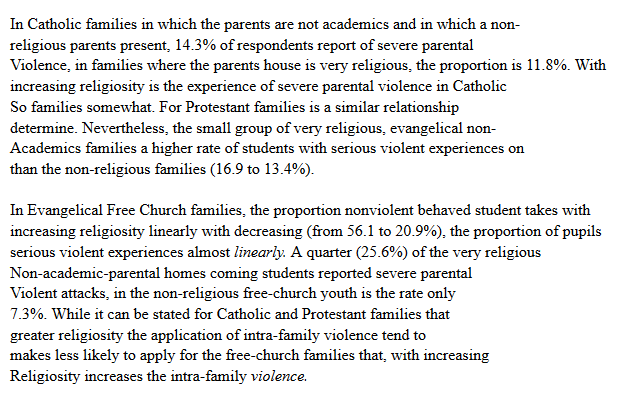
With parents from free churches that have no academic training, but declared themselves as “religious” or “very religious”, the trend is even more pronounced: More than a quarter of the surveyed children from these families has at some juncture suffered massive violence in their household. The study’s authors also provide a possible explanation: There is “a Christian tradition of parental driven beating as discipline for children.”
NDR – Freikirchen wehren sich gegen Gewaltstudie

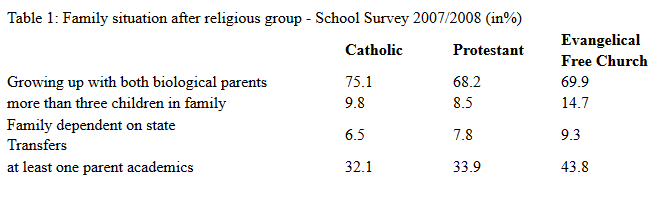
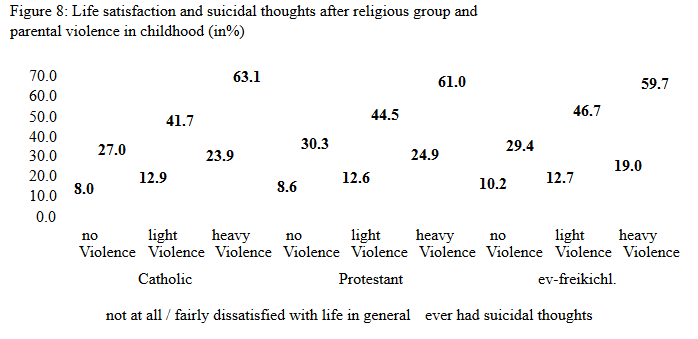
The findings in the survey are quite shocking to me. I’ll post some of the figures below for those of you who don’t have time to sift through a pages long PDF:

image1
Source: http://www.ndr.de/regional/niedersachsen/freikirchen109.pdf
image2
Source: http://www.ndr.de/regional/niedersachsen/freikirchen109.pdf
image3
Source: http://www.ndr.de/regional/niedersachsen/freikirchen109.pdf
image4
Source: http://www.ndr.de/regional/niedersachsen/freikirchen109.pdf

Now, these are in order, but without all of the information behind what makes this all so shocking. What I want to point out is that this is consistent with studies done in the United StatesCanada, the United KingdomAustralia and elsewhere as it pertains to parental violence towards children and its affects on the children involved. One study paper that someone had pointed me towards a couple of years ago was “The Long Shadow: Adult Survivors of Child Abuse.” Psychology Today has several articles about this phenomenon as well. One that stands out in my memory is “The Lingering Trauma of Child Abuse.” (Note: My list is not exhaustive, but just to give an example of what one will find on the subject.)

Articles referenced within this NDR article and the PDF are as follows:

…in the late 90s the German Parliament had established a Study Commission to look at so-called sects and mind-control groups. The study found that in fundamentalist Christian communities there is a widespread “…significant advocacy for physical punishment…”
NDR – Kinder schlagen im Namen Gottes 21.12.2011

NDR.de: Critics say the national church must be clear in distancing themselves from such fundamentalist positions. Shouldn’t you make it clearer that you do not agree with such  positions [about corporal punishment being biblical]?

[Kerstin] Gäfgen-Track: In the case of these parenting books and this position, I can speak for the national church, because we draw a very clear line of demarcation. We have nothing to do with such, so we want to continuing having nothing to do with such. We wish to strongly condemn such counselors. [Ted Tripp and so on]  
NDR:  “Wir verurteilen das aufs Schärfste” 21.12.2011

…as they contradict the law and [Christian Beliefs], there is a secret culture of spanking among devout Christians… Parents who follow these beliefs belong to denominations such as those [found in the] Evangelical Free Churches and the Jehovah’s Witnesses who are apt to taking the Bible literally, and consider doubts about the Word of God as whisperings of Satan.
Süddeutsche Zeitung: Liebe geht durch den Stock 30.9.2010

…It is striking that the violence of evangelical parents seem to have a lasting effect on their young. With [such] systemic beatings, it may be that parents seek to break the will of children so that they would assimilate the beliefs of adults; warn psychologists..
Süddeutsche Zeitung: Schläge im Namen des Herrn  17.10.2010

There was a study published in April of this year (2013) by infoSekte in Zürich, Switzerland entitled “Erziehungsverständnisse in evangelikalen Erziehungsratgebern und -kursen.” (Yes, this too can be run through Google Translate!) It is 61 pages long, detailing “Problematic trends such as corporal punishment or psychological violence arising in connection with certain child rearing methods … [and] possible effects of certain parenting styles.” Also explained in the document is how Switzerland signed and ratified the UN Rights of the Child in 1997; and such parenting styles are incompatible with such an agreement.

The UN Rights of the Child is the very same document that many Christians in the United States have pushed for a refusal to ratify since the 1990s.

(The US has signed, but not ratified as of this date in time.) Also something to note; Michael Farris has really pushed home-schoolers into a frenzy over it as taking away parental rights to discipline punitively and claim it is “biblical.” (For the uninitiated, Michael Farris is the head of Patrick Henry College, The Homeschool Legal Defense Association (HSLDA) and loosely affiliated with Schuzh, which defends many German home-schoolers in court. You may have recently seen Michael Farris in the news pushing against the UN Convention on the Rights of Persons with Disabilities.

If you get a chance, please do read this study. I understand that 61 pages is awfully long, but it is worth it. There is a serious problem when familial violence becomes an accepted piece of one’s culture and religious upbringing — when we normalize it to the extent that no one is shocked at all.

Issues brought forward by the Twelve Tribes in Germany are not at all shocking in many parts of the United States because such methods have become so normalized.

So many people believe it is the right thing to do. Anything contrary is “unbiblical.” That is not to say that there are not Christians, like myself, who believe that corporal punishment is actually what is contrary to the Bible.

If one wishes to claim that the Bible teaches beating their children, I would have to recommend you go back and actually investigate those claims for yourself as this is not understood to be the case within the Jewish community; and from whom we get the proof-text “spanking”/”smacking” passages from. It is a purely Christian phenomenon that came into place some time in the middle ages, as far as I can find at this juncture. Before, corporal discipline was for adult members of the faith who wished to submit themselves to flagellation.

One book that discusses this phenomenon and suggests a better way is Samuel Martin’s Book, Thy Rod And Thy Staff They Comfort Me: Christians and the Spanking Controversy.  I have others, should you wish to peruse them, but they are not free.

There are wonderful articles referenced here in an older post on my blog and I also have a ton on my Pinterest parenting boards, should you have an account there.

If you don’t know about the Pearls and their harmful teaching, I’d be happy to throw you more than the recommendation to read Hermana Linda’s Blog and this review of the Pearl’s ministry.  I would also like to mention that any court willing to speak with me personally is more than welcome to discuss punitive upbringing, homeschooling, corporal punishment proof-texts, etc.  I’m not an expert, but I’ve lived through it and am working to change things with my children and advocating for others to the best of my abilities.

Update: Michael and Debi Pearl and critiques about them and information on the Hana Williams case were on CNN last night via Anderson Cooper. If you still doubt the methods this couple advocates, look no further.

I would like to leave with a closing message by Robbyn Peters. It is “Violence: A Family Tradition.” For those who are still unconvinced, I ask that you please consider Robbyn’s words and investigate for yourself.

The Road to Depression: By RD

Screen Shot 2013-09-06 at 4.18.02 PM

The Road to Depression: By RD

HA notes: The author’s name has been changed to ensure anonymity. “RD” is a pseudonym.

I’ve finally come to terms with the fact that I was abused as a child.

While an uncomfortable reality, it was necessary in order to understand what was wrong with me. To be clear, I wasn’t seriously abused (as if one form was abuse was better than another…) but it was there.

While I don’t remember much of my childhood, there are parts I do remember. If I told a lie, it was (10) spankings with my father’s belt. Same thing for if I snuck something. (Stealing only applied if I took something from a store, which only happened once. And even that is debatable; I was between 5 and 6 years old waiting in line with my mom at the grocery checkout, and I took a pack of gum and opened it. Broad daylight, no subterfuge; I think it was an action born out of ignorance than ill-intent. But “sneaking” was taking any food or candy while at home that wasn’t approved.) If I used a “dirty word” I had my mouth washed out with soap.

My mother was fond of the “wait until your father gets home” method as well.

I can remember days that I had really angered her, and she passed that anger on to my dad via a phone call during the day. As soon as I heard the garage door open that evening, I knew the first thing my father would do was smack me upside the head.

It’s a very odd thing to know you’re about to get hit very hard, but to take no evasive or protective action because doing so only increases the punishment.

This abuse works; that’s the tragedy with the Pearl’s method or other methodologies based on corporal punishment. They work. But it is the underlying psychological impacts that belie the merit of these methods. Cocaine or methamphetamines will help keep you awake, but we all know it’s not wise to take these things. So why is the value of “training” or corporal punishment still debated?

My parents were members of HSLDA. I remember their receiving the Court Report and Focus on the Family magazines and other publications that called homeschooled families to action in order to fight the government from over-reaching. I realize now that many, if not all, of these stories were extremely over sensationalized or outright misrepresentations of the truth, similar to the drama unfolding with the Romeike story.

But to my parents these stories were real and reminded them of the dangers of this world.

As I was growing up, I couldn’t play outside during normal school hours because a city official might see me, think I was skipping school, and something terrible would happen. I was told that if Child Protective Services ever had the slightest suspicion of child abuse, they would show up and take me and my brother away from our parents and put us in a foster home. I was told that psychology wasn’t really valid; a psychiatrist would try to pin all a person’s problems on the parents while prescribing unnecessary pills. All these lessons were carefully crafted to try to create a particular world view, a view that sees anything that is not Christian as evil, harmful, or detrimental.

So what does all this have to do with mental health? I’m getting to that point, but I still have a few more bricks to lay in my foundation.

I’ve mentioned in a previous piece that my parents chose to homeschool me primarily because I was diagnosed as a young child with ADD. I even took Ritalin until I was 11 to 12; I cannot remember at what age I started taking it. I do remember as I grew older that my parents began to express the belief that ADD was over-diagnosed and that children are supposed to have energy and be hyperactive and all that. I’m not sure where they picked up on that idea, if it was from some of the Christian homeschooling circles, but it served to create in my young mind that ADD wasn’t real, that parents used that as an excuse for their child misbehaving or not performing.

My father was also an extreme perfectionist.

I can remember many nights staying up exceedingly late trying to figure out some math or science problem as he berated me because I’m was smart enough that I should know how to do something or that the mistakes I made were because I was being careless.

There is nothing quite as powerful as a backhanded compliment.

“My dad thinks I’m smart, but if I was smart I should be able to figure this problem out. Therefore either 1) I am not as smart as he thinks and thus a failure or 2) I’m as smart as he thinks but I’m failing to apply myself.” This method of thinking, created by a backhanded compliment, is very destructive to mental image.

So where does all this lead?

The abusive methods advocated by people like the Pearls are akin to dog training (very loose analogy) except without positive methods. You are training a child for instant, unquestioning obedience without thought, but you don’t reward the obedience.

You excessively punish the failing.

Thus as a child grows up, as I grew up, I focused on what was wrong, not what was right. Even today when I look at something, my first thoughts are what is wrong with it. While this helps me most times as an engineer, it is a very harmful mindset to have.

When you combine this way of looking at things with the perfectionist mentality I received, it creates a very negative self-image.

When children are raised with the message that if they have faith in Jesus or live their life according to the Bible then they will be blessed, it creates a very false expectation. Anything bad that happens, any misfortune, becomes interpreted as God’s punishment for not being faithful enough, for failing in your walk with him. I’ve seen this illustrated over and over again in the stories I’ve read of people involved in the courtship culture.

Now add to that the distrust of science, society, or psychology. As these negative thoughts, this negative self-image grows in the mind, the fundamentalist worldview pops up and says “you can’t be depressed; there’s no such thing. You are having these thoughts, this self-loathing, because you realize how out of tune you are with God’s will.”

This only creates a downward spiral that leads to more depression.

In my case, this spiral was fueled by my ADD. Throughout college I still carried my parents’ view that ADD wasn’t real; it was simply children being children. While I don’t deny that there are many cases of ADD (now ADHD) that are wrongfully diagnosed, I understand it is very real. Any adult reading this who suffers from ADHD will know exactly what I mean (and if you don’t suffer from it, you can find some excellent lectures by Russel Barkley on YouTube.). I cannot focus or concentrate if there are external distractions; put simply, ADHD is an executive function failing of the brain.

As I struggled through university with my ADHD untreated, I constantly felt like a failure as my GPA slowly dropped down to a 2.9. This lead to depression and even self-mutilation for a time. It wasn’t until several years into my professional career that I began to see a counselor, and later a psychiatrist, and began to identify the problem and take the steps to correct it.

But this is the danger of the fundamentalist’s method of child rearing. By linking bad things, misfortunes, with disobedience to god and equating negative thoughts as god’s working to convict the wayward child, it establishes a tragic downward mental spiral that if left untreated can end in suicide.

Corporal Punishment and The End of The Red Stick: Heather Doney’s Story, Part Two

Screen Shot 2013-09-10 at 7.44.43 PM

HA note: The following is reprinted with permission from Heather Doney’s blog Becoming Worldly. It was originally published on February 18, 2013. Read Part One of Heather’s story for HA’s To Break Down A Child series here.

*****

Trigger warning for To Break Down a Child series: posts in this series may include detailed descriptions of corporal punishment and physical abuse and violence towards children.

*****

This picture could be anybody’s little sister blindfolded and hitting a piñata at her Dad’s house for another sibling’s birthday.

My little sister lives in a different world than I did.

But it isn’t. It’s my little sister.

She lives in a different world than I did. One with her own bedroom and court-ordered visitation and Christmas presents from a kind stepmother. She has never been homeschooled. She does not remember a time when our family didn’t celebrate birthdays, or was too poor to buy a piñata, or was too “modest” for her favorite summer clothes to be allowed.

She could be using any stick to hit this piñata but she isn’t. She’s using the “red stick,” the most infamous spanking implement our family had.

As far as I know, none of the younger siblings attending this party were ever touched by the red stick and I imagine just a few had been threatened, but the grim knowledge of what it was used for had been passed down.

The red stick had started out as a handle to a child-size broom and then when the broom broke 25 years ago, it became a toy (a walking stick, a bat, a pretend sword) left in the yard until my Dad picked it up off the patio one day, tapped it against his palm a few times and said, “This would make a real good spankin’ stick.”

Then it became something totally new. An object of fear.

It stayed hanging on a nail or propped in a corner in my Dad’s bedroom or office for years except when it was picked up and used to threaten or to leave welts.

“Daddy, please don’t spank me. I’m tender.” No red stick today, only fodder for years of teasing. “Aww, is my little heatherjanes still tender?”

“Do you want a spanking? Don’t make me get the red stick.”

Mom catches one sister padding her underwear with toilet paper in anticipation of a beating. After that, it’s bare bottomed.

“Pull down your pants. Bend over.” Red stick.

Sitting in the “punish chair” corner ’til sundown, hearing the car crunch gravel in the driveway, shaking, hands going cold. Red stick.

“But I don’t want to try and eat a pickled pig lip out of that jar, Dad. It looks just like apig’s lip.” “If you don’t try it, you’ll get the red stick. You’d better eat it and like it.” Tears. Gagging. Spitting chunks of pickled pork into the sink. Red stick.

Pain, shame, anger, fear. Yelling. Red stick.

Running, cursing, slipping, falling, being caught and dragged. Red stick.

Grabbing the red stick tightly, just as tall, if not quite as strong as the woman holding it. “Let go,” Mom says.

“No,” I say, “You’re gonna hit me with it.”

“Yes,” she says.

“Well,” I say, “I’d be an idiot to let it go then, wouldn’t I?”

It strikes me that this photo is the only known picture of the red stick. The only official proof of it ever existing or being used is in a pleasant scenario. As it happens, the red stick finally died that happy day, broke while connecting with the piñata and ended up in the garbage.

A sibling sent me a message informing me that the red stick had met its end and that when Dad was out of range, they had celebrated its demise. I was glad, too: glad it was gone and that it did not die the way I had always imagined it would — splintering into pieces over a child’s behind.

It would never be used to hurt anyone again.

It had broken being used the only way it should have ever been used, in the original spirit it had once had — innocently in child’s play.

Public Schools and Home Dictators: Keziah’s Story

Screen Shot 2013-09-10 at 7.44.43 PM

HA note: The author’s name has been changed to ensure anonymity. “Keziah” is a pseudonym.

*****

Trigger warning for To Break Down a Child series: posts in this series may include detailed descriptions of corporal punishment and physical abuse and violence towards children.

*****

I have half-moons on the sides of my nose. They are actually the third set of bags under my eyes. I didn’t cry all night, or stay up late with a baby. In my mid-thirties, I cannot sleep at night. Once my distractions and duties rest for the day, ghosts play in my dreams and the memories of fears warn me to stay awake. The dark is when bad happens and my parents trained me to fear it.

A lack of light is evil.

Even now, I want to write anything but this. Writing is my life’s work, but this shouldn’t be my story to write. I shake my head, furious that I know this tale, my stomach forcing me hunched over.

I won’t write it – fuck them. Then I remember the other “them,” and write. I sigh. The quiet “them”no one talks about. My being a “them” that no one talks about, that my parents still try to silence.

*****

I remember a tired face, another face of my current age; this face was my face, only on a different person, twenty years ago.

This face stood over a five-year-old me, throwing fists on a starving body, as punishment for adding sugar to cereal or adding pepper to an already perfected meal, thus insulting the cook. I saw this face as I stood shaking every morning as it scowled at the unruliness of my hair, turning my scalp to fire so that it was perfect – a twisted mix of undiagnosed OCD and passion to present perfect children, so the ultimate secret remained so. I turned green every morning and threw up many and that face didn’t care. It showed anger that I was wasting food, wasting hair-fixing time so it could return to bed.

And yes, I was going to school – a public school.

You see, a home dictator doesn’t have to be a homeschool parent, or a religious zealot. A home dictator needs a cause – which can be simply to bury their pain or to feel powerful. My home dictator was mentally ill, and surrounded by enablers: my dad, her siblings, her parents, and once I was old enough, me.

You see, if an outsider catches a glimpse of a home dictator, they recoil – in fear, in disbelief, or with thanks their kids are unaffected.

You see, a child victim’s role in life is to protect the person assigned to protect them who actually fails the most. Any psychological means keeps that victim quiet, even in a public school. The maelstrom of life creates a lack of words for people still learning their words.

If the victim speaks out, that teacher or counselor must act because revealing the fear may happen only once.

You see, an outsider who escapes has little recourse. Often suffering and sometimes still dependent, she gets little help from a state agency – especially once she is no longer a minor. When I contacted CPS for my younger brothers and sisters, the initial phone worker asked little and the investigator saw food in the fridge and left.

American culture (and perhaps others, too) can change this. When I contacted my state’s child services, they wanted to know what they would find. I told them they would find no evidence – only children who believe those workers will take them to a new home, one where they will be raped and beaten, maybe experience the same treatment they do now, only worse, because they will have no parents who love them.

And those children will lie and protect. They will be confused and scared.

You see, there will be no evidence of abuse.

The weltschmerz of these children has inspired action and a weird happiness kept me reading Homeschoolers Anonymous. I fit in, even though I was never homeschooled a day in my life.

This movement that the Internet has enabled, comprised of parents and victims, the growth of psychology and the explanations of science and brain functions the masses can understand and access, this can be the kairos to educate about child abuse.

The identity of “them” is often formed in the name of God, for pride, for the appeasement of elders, for the appearance of good parenting. Homeschooling provides a hidden world, a place of acceptable child abuse.

The same stories happen with “them” in public schools, out in the open, with the same training methods so that children remain silent.

Corpses Don’t Rebel: ExPearlSwine’s Story

Screen Shot 2013-09-10 at 7.44.43 PM

HA note: The following is reprinted with permission from Vyckie Garrison’s blog No Longer Quivering. It was a guest post by ExPearlSwine originally published on Patheos on November 2, 2011.

*****

Trigger warning for To Break Down a Child series: posts in this series may include detailed descriptions of corporal punishment and physical abuse and violence towards children.

*****

The death toll from parents following Michael and Debi Pearl’s teachings continues to mount. Another child is has been “biblically chastened” to death via corporal punishment, and Michael Pearl is defending his teachings in the mainstream media while promoting his new bookGary Tuchman and Anderson Cooper both reported on the death of 13-year-old Hana Williams, whose adoptive parents Larry and Carri Williams subjected her to beatings and neglect while following the teachings of the Pearls.

Michael Pearl defends himself and his teachings during his CNN interviews using two arguments:

First, the presence of his book, To Train Up a Child, and the presence of his other teaching materials on “biblical chastisement,” in the homes of homicidal parents, is purely circumstantial. It makes no more sense, Pearl argues, to blame To Train Up a Child for discipline-turned-abusive-turned-murderous than to blame Alcoholics Anonymous brochures in the home for deaths due to drunk driving, or weight-loss materials in the home for obesity.

As Anderson Cooper pointed out, this defense is illogical.

AA literature says not to drink, especially while driving. Pearl literature emphasizes inflicting physical pain on children in order to break their wills and achieve total obedience to parents. In the Cooper interview, Pearl talks about physically chastising to “get the child’s attention.” What if your child still isn’t paying attention?

Pearl’s second argument comes up every time his teachings are linked to children beaten to death: kids end up abused and killed because parents, despite owning copies of his teachings and trying to follow them, aren’t really following his teachings. They are missing the joy part, the reconciliation part, the praying part, the loving part, or whatever. They discipline in anger instead of in love.

Or—and I suspect this is what Pearl really thinks but can’t say without contradicting his own child-training directions—they should have known when to stop, when they were being cruel and abusive instead of loving, even if the child was still in rebellion and hadn’t budged an inch. At some point, a loving parent with some sense and a conscience will stop inflicting more pain. This is what Pearl believes, or at least one would hope this is what he believes.

This isn’t what he teaches.

I followed the Pearls’ teachings for years, and the children I subjected to “biblical chastisement” are very much the worse off for it. I’m wondering which part of Michael Pearl’s teachings he’d say I was missing:

  1. Get Pearl’s teachings and read every single word and pray. Check.
  2. Start striking infants with objects on the hand or in the buttocks area as soon as they are able to reach for something you don’t want them to touch and ignore your “No.” Check.
  3. Hit them harder if they continue. Check.
  4. When they cry, lovingly console them and “reconcile” them to yourself and God. Check.
  5. Always use physical chastisement on them when they don’t respond to spoken correction. Check. If I didn’t strike them, my husband did.
  6. Believe that they will end up juvenile delinquents and go to hell if you slack off. Check.
  7. Pray and study the Bible some more. Check.
  8. Be joyful about chastising your baby all day. Praise God while you slap a three-month-old’s hand with a ruler and think about how godly he’ll turn out. Half a check. It was hard.
  9. The children will quit rebelling and be wonderful children who sweetly, quietly obey and love you to pieces. . . No check.

This is what I was missing: the part where the Pearls’ teaching worked. Only one child out of the oldest four quietly obeyed in response to chastisement, but she also had signs of severe emotional disturbance. She withdrew into herself and didn’t speak until she was two. The other three oldest children out of my Quiver Full of kids would rebel. And rebel. They would go to the wall rebelling. They would rebel until the cows came home and the bulls came home and calves were born.

The more you hurt them, the more they rebelled.

Michael Pearl has only three methods to deal with continued rebellion in children, since his teachings are straight from the Bible, and therefore infallible:

  1. Blame yourself. You must not be getting my teaching right.
  2. Hit harder. Pain is of the essence.
  3. Blame the kid. What else is left? Other people’s kids give in and act godly.

Oh, and don’t forget to be loving and joyful and kind and patient just like Jesus (only I can’t see Jesus removing the diaper of a baby to inflict any degree of pain on her whatsoever using any object or even his hand, by any stretch of my imagination). Butdon’t give in. Don’t stop chastising, and make sure it hurts. Don’t let the kid (and the devil in the kid) win.

When the Pearls’ methods failed, I got stuck on method a. Blame yourself.

 I re-readTo Train Up a Child. When I knew I had it right, I hit harder. Prayed harder. Did the whole disciplinary routine smiling from ear to ear and cooing like a dove. My babies acted freaked out by my grin (it was a lot like Debi Pearl’s vacuous, huge grin in the Tuchman interview) and were enraged by my efforts to “lovingly reconcile” with them after spankings. They kept up the fight. At this point, I think I would have admitted to myself that something was wrong with this whole child-training method and stopped torturing the toddlers all day to no avail. If you have to be cruel to get the Pearl method to work on some kids, it’s wrong. I had a husband, however, who was firmly convinced that Pearl was right. He went right for the b. and c. options: hit harder and blame the kid.

Options b. and c. are hard to do without getting angry. They are hard to do without leaving bruises, especially since Pearl discipline is cumulative: faced with entrenchedrebellion, you are supposed to hit repeatedly and in the same areas. My ex-husband got angry with the kids for thwarting the Pearl method, but he remained coldly self-controlled. He also left bruises. A lot of bruises.

Why didn’t I stop him? I finally did, but early in my marriage I was paralyzed by fear and brainwashed by bad teaching.

We both feared raising ungodly kids. We were looking for confirmation that some part of this system worked, and my ex-husband began to get results. The children flinched when he even moved. Cowered when he reached for a spanking implement. Had semi-seizures on the carpet following “biblical correction.” We got compliance with our wishes. Eventually, there wasimmediate and unquestioning compliance. My ex-husband had quelled the rebellion in three kids. He had created unfocused, freaked-out little robots who obeyed. The joy and the peace that was supposed to suffuse our home according to Pearl, we thought we could dispense with. Maybe it would come later; the Pearls are a little vague on where the peace and love should come into the process, just as they are a little vague on how you can keep “chastising” repeatedly with progressively increased force in the same places without leaving bruises.

To Train Up a Child is a manual of progressive violence against children.

Not only are there no stopgaps to prevent child abuse, the book is a mandate to use implements to inflict increasingly intense pain in the face of continued disobedience. The part about not causing injury is vague and open to interpretation, but the part about never backing down or shirking your parental duty to spank harder and harder is crystal clear. The Pearls’ teachings will lead, inescapably, to extremely strong-willed kids being abused and sometimes murdered by fundamentalist parents who are determined to “break” those children.  The Pearls’ defenders will say, “Oh, they took it to an extreme and should have known better.” If anyone knows better than to keep inflicting more severe discipline on an intractable child, they can only apply that knowledge by scuttling the Pearls’ sadistic teaching and being more reasonable.

I think Hana Williams was a lot like my oldest three kids, only stronger. I think Lydia Shatz, the other recent Pearl casualty, was a lot like them too. Maybe their iron wills and endurance came from being born in Africa and living under harsh conditions. Perhaps, like some of my children, they had some innate sense that their parents were screwed up and that all their parents’ so-called “Christian love” did not cancel out or justify their own physical suffering. They resented being classified with the demons for daring to disagree, for wanting a relationship with their parents that wasn’t based on changing their behavior, personality, or identity. The pain only stiffened their resistance. They were not going to be broken by people who continually inflicted pain on them.

The only way to break the wills of children like this is to kill them.

The 911 call that Carri Williams made to the police dispatcher says it all.

Operator: What’s the emergency?

Carri Williams: Um, I think my daughter just killed herself.

Operator:  Why do you say that?

Carri Williams, Um, she’s really rebellious, and she’s been outside refusing to come in, and she’s been throwing herself all around, and then she collapsed.

What’s wrong with Hana? “Um, she’s really rebellious.” She won’t do what we say.

No, she’s not, she’s dead. She can’t rebel any more. And you’re blaming her, saying she did it to herself.

Thank God I escaped from thinking like you, Carri Williams. Thank God some of my babies were mothered without pain, once I got away from their father and all the right-wing fundamentalist teachings that had ruined my life, Pearl’s teachings included. Will I ever forget the confusion and pain in the wide baby eyes of the oldest ones, when I first swatted their tiny hands? They were startled, bewildered. And then they opened their mouths and cried the cry of the completely betrayed, the absolutely alone in the world. I was the only person they even recognized yet, and I had hurt them.

To this day, it haunts me, as you will be haunted by your last glimpse of Hana alive, just before she collapsed. Hana’s last stand.

My Regret: Quick Silver Queen’s Story

Screen Shot 2013-09-10 at 7.44.43 PM

HA note: Quick Silver Queen blogs at The Eighth and Final Square. This story is reprinted with her permission. Also by Quick Silver Queen on Homeschoolers Anonymous: “All My Fault, Not Good Enough.”

*****

Trigger warning for To Break Down a Child series: posts in this series may include detailed descriptions of corporal punishment and physical abuse and violence towards children.

*****

I wish I hadn’t done a lot of things, and wish I could change other things, but basically, I have one regret in my life. One thing that I wish I had done differently. One thing that still angers me to think about, because of the cruelty.

Thanks to a friend of mine who posted the link on facebook, I read an article titled “First time obedience, really?” First-time obedience is something that is extremely important in my family. It pretty much goes along with formula parenting. The example my dad would always use as to the merits of first-time obedience is if one of his very small children ran out into the street (which wouldn’t happen anyway), and a car came, he would say “Stop!” or “Come back!” and they would do it immediately, unlike (again, his example) “your cousins”. (Sorry, uncles and aunts. Don’t feel bad, though…at least your kids still have brains that aren’t being controlled!)

So while seeing the downside to it (which I will elaborate on in a minute), I was also warring inside myself. It would save someone from death, right? So it’s good? But on the other hand, I saw what happened, and it was most certainly not good.

Two years old. Rebellious. Self-willed. Wicked. Too young to like or dislike anything. Too young to have opinions.

Wait…what?!?

Uhh yeah, that’s my parents for you. They don’t believe in the “terrible twos”…they believe in “terrible hearts”.

You know, the verse in Proverbs that says foolishness is bound up in the heart of a child but the rod of correction will drive it from him. And the verse that the heart is wicked and who can know it. So the first problem is, they don’t come to parenting with the view that these are people. They come to parenting with the view that these are wicked little sinners who need a radical change, whose thoughts and feelings and opinions and likes and dislikes don’t matter because it is all selfish willfulness.

Cue the dinner table. There’s a very small child in the high chair, whom dad is feeding. This child is a baby, really…crawling, maybe walking; can’t even say real words yet.

“Open up!” dad says, moving the spoon towards her.

She accepts that bite, but doesn’t like the food, and spits it back out.

“No, you eat it,” dad says, scooping it back up and attempting to give it to her again.

She makes a disgusted face and turns her head. We all laugh at the cute little shudder she makes.

“Don’t laugh, it encourages her,” dad says, still trying to force the bite with the slightly more stern command “Open”. He presses the spoon against her soft mouth, trying to force it open.

When she continues resisting, he moves her head to face him and commands sternly, “Open.”

She may open her mouth at that point, or she may not; in which case he takes the tray off the chair and gives her a few loud swats, sets her back down, and resumes with the “open” stuff.

Meanwhile the rest of us try to ignore it and eat our dinners.

If she still doesn’t open her mouth, again with the swats, and she sits there crying, looking at him with terror in her eyes, her nose running all over the place. If her mouth is open from crying, he shoves it in. If she tries to spit it out, he doesn’t let her, and she accepts that she has to keep it in her mouth.

Then comes the battle to get her to swallow.

What one- or two-year-old do you know who knows the meaning of the word “swallow”, let alone “open”? Most one- and two-year-olds are lucky to know the word “no”.

I’m sitting there, dying inside, longing to take her in my arms, wipe her tears, blow her nose, and cuddle her safe in my arms.

Nobody, not even mom, was allowed to give her any comfort. Not even dad did, until she did whatever he wanted. And if he got tired of spanking her, he sent her to bed…and when she got up she had to eat the same thing she disliked. Because her likes and dislikes didn’t matter.

Nothing mattered except that she obeyed the first time, every time.

My only regret is that I didn’t stick up for her, for them, every time it happened with I don’t know how many of them, probably all, at one time or another.

The last time it happened when I was there, I was so close to exploding that had he spanked her one more time, I would have done something. I just wish I had…that I had stood up long before.

And that is my regret.