Soy Makes Kids Gay and Babies Masturbate!

Screen Shot 2014-07-30 at 1.47.52 PM

By R.L. Stollar, HA Community Coordinator

On Monday, one of the stories we received for our “Homeschoolers U” series about Patrick Henry College experiences mentioned a curious anecdote. The anecdote involved a PHC freshman who believed soy products make people gay. Here’s the story according to Lillia Munsell:

Midway through my first semester, a fellow freshman insisted that soy milk turned people gay. Trying not to choke on the ridiculously expensive dining hall food, I asked what he meant. “It’s the estrogen,” he explained to me with all the confidence that came from studying high school biology at the kitchen table. “It turns people gay. How else do you explain California?” I don’t know how to explain California, but this did explain the rumors about my lactose-intolerant Cuban friend who poured soy milk over his cereal and said deviant phrases like “what the hell.”

While this story might just provoke laughter and ridicule towards a freshman who would believe such asinine pseudoscience, it might be better to direct that laughter and ridicule towards the source: the so-called educated adults from which that student learned the pseudoscience. And honestly, you don’t have to look far to find them.

This student was a homeschool kid attending Patrick Henry College. The man who created PHC, Michael Farris, is a self-declared “buddy” of Joseph Farah, the editor of WorldNetDaily, a website that pretends to do legitimate journalism. (In fact, one of Farah’s own kids has attended PHC.) Farris has featured Farah on HSLDA’s radio program, Home School HeartBeat. That program is where Farris mentions Farah is “my buddy”. Farah has returned the sentiment, making Farris an exclusive WND columnist in 2006.

You know what else happened in 2006?

WND published a series entitled “SOY IS MAKING KIDS ‘GAY.'”

Yes, WND ran six-part series by James “Jim” Rutz, a dominionist who wrote a book called Megashift that teaches you how to “prepare yourself to take part in a total makeover of Planet Earth.”Rutz’s soy series is full of ridiculous pseudoscience about soy. Here’s an excerpt:

There’s a slow poison out there that’s severely damaging our children and threatening to tear apart our culture…

The dangerous food I’m speaking of is soy. Soybean products are feminizing, and they’re all over the place. You can hardly escape them anymore…

Soy is feminizing, and commonly leads to a decrease in the size of the penis, sexual confusion and homosexuality.

But Rutz is not alone in fearing the evil power of the soy bean. Nor is he the first. In 2001, half a decade before Rutz wrote “SOY IS MAKING KIDS ‘GAY,'” Debi Pearl — yes, homeschool guru Debi Pearl from No Greater Joy Ministries — wrote an article entitled, “Soy Alert.” Pearl, unfortunately, was entirely blind in 2001 as to how soy makes kids gay. But she was fortunately enlightened enough to realize another danger of soy:

Soy makes babies masturbate!

Yes, you read that right. I’ll let Pearl try to explain:

We regularly get letters from parents that are shocked and horrified to have discovered that their babies, as young as 18 months, are, without doubt, masturbating. It is a shocking but growing phenomenon. Some of the problems are associated with small children clutching vibrating toys, but not in all cases. Yet, there must be a predisposing prompted by hormones. Could it be caused by the hormone element in soy formula?

Pearl never answered the question. Which is convenient for her. But she also insinuated that marriage problems could be related to soy:

If your husband lacks leadership and male dominance, but you seem to have a strong assertive drive, then stop eating soy and do some research.

All of the “evidence” she found led her to a rather gloom conclusion:

Soy is a drug, like many herbs. It is too powerful of a drug to use freely as a food.

But fear not. Pearl discovered a biblically-based solution:

When men try to improve on what God gave, it should be questioned. Cereal should be grains; milk should be the way it was in the Promised Land; meat should be as it was when Jesus fed the multitude, or when Abraham fed the angels of God.

With homeschool “leaders” like Debi Pearl and “news” sources like WND teaching these myths, it’s no wonder a homeschooled college freshman at PHC thought they were real. Hopefully he has learned real science since then.

Hopefully, too, homeschoolers will start demanding real science from their leaders and news sources.

***** UPDATE: It seems the source of these myths might very well be the Weston A. Price Foundation (WAPF). WAPF is a lobbying organization that is immensely popular in homeschooling circles (just take a look at the comments on this popular homeschool blogger’s post). Homeschool curriculum company Sonlight sells the Foundation’s foundational textbook, the cookbook Nourishing Traditions. (It’s hard to exaggerate the adoration some homeschool families have for the book. It’s right up there next to the Bible.) According to WAPF itself, “The most prominent group warning about the dangers of modern soy consumption would be the Weston A. Price Foundation.” And what would that warning be? Again, according to WAPF: “The fact that soy can feminize males and masculinize females is evidence of soy targeting the brain.” WAPF’s president, Sally Fallon, first gained notoriety for attacking soy in 2000, a year before Debi Pearl’s 2001 “Soy Alert.” In 2000, Fallon called soy “the next Asbestos” and claimed it caused sexual problems for kids. It seems reasonable to assume this was source for Pearl in 2001, considering the Pearl family uses WAPF material.

Apostate: Lillia Munsell’s Story

Homeschoolers U

My first year at college involved no drinking, a lot of prayer circles, and five hour exams. This is not an experience I recommend to others.

I paid dearly for the privilege of a year at Patrick Henry College, the conservative Christian school frequently called God’s Harvard. PHC was founded in 2000 by Moral Majority darling Michael Farris, a constitutional lawyer who also began the Home School Legal Defense Association. Homeschooling is both an educational model and a lifestyle, growing from 800,000 in 1999 to over 2 million in 2012. As a homeschooler born at the end of an era of legal oppression, I owed a debt to Mr. Farris. I was taught I must continue his work by challenging the liberals and conquering the culture for Christ. At homeschooling conventions, young men in suits extolled the virtues of PHC, calling it a haven for homeschoolers, a place that would understand my lack of a GED and provide me with the Ivy League experience without the East Coast liberalism. My mother was immediately sold and began pushing for PHC in 2002, while the first class were still sophomores. Ten years later, I was in a Subaru Outback crammed between a printer and a mattress protector, making the drive to my shiny new fundamentalist future.

There are 1,318 miles between my childhood home and my gender-segregated PHC dorm, and I cried for at least 600 of them, but for all the wrong reasons. I should have been questioning the wisdom of leaving behind family, friends, and a newly acquired boyfriend for a school that isn’t accredited. I wish I could blame my mother for this decision—parents are the best scapegoats. But it was me who decided to embrace my childhood religion and sign a statement of faith that promised I would never have premarital sex and always deny the lie of evolution.

Depending how you count, there are five to eight passages in the Bible that refer to homosexuality, and Patrick Henry College made sure I knew each one. Midway through my first semester, a fellow freshman insisted that soy milk turned people gay. Trying not to choke on the ridiculously expensive dining hall food, I asked what he meant. “It’s the estrogen,” he explained to me with all the confidence that came from studying high school biology at the kitchen table. “It turns people gay. How else do you explain California?” I don’t know how to explain California, but this did explain the rumors about my lactose-intolerant Cuban friend who poured soy milk over his cereal and said deviant phrases like “what the hell.”

Another student refused to say the word “naked” because it was too profane. She carried around a stuffed bunny and sang opera at all hours and locations.

To many, PHC is an idyllic sanctuary of innocence nestled in the green Virginia farmland. Set back from Highway 7 on the edge of Purcellville, a small town with southern charm, terrible restaurants, and undertones of racism, the college was close enough to DC to funnel interns to work under the Bush Administration and far enough away to shield us from the liberal rallies. When Loudon County suggested extending the metro line out towards Purcellville, Mr. Farris objected because too much secularism could travel over the metal rails. The 24 hour Harris Teeter grocery store across the street was the most fun PHC students had, especially before they banned kick scooters in the isles.

To drum up numbers, free Chick-fil-a was offered to students who attended an anti-abortion rally. These were the pictures that appeared on my classmates’ instagrams with hashtag phrases like “God is good,” “protect the innocent,” and “Aslan is on the move.”

Student clubs littered stairwell bulletin boards with posters advertising their platforms. I was asked to join the Wilberforce society, a group devoted to moral reform, especially a local government ban on porn. To the best of my knowledge, they pursued this goal by picketing the one adult store near town and drafting legislation proposing a parental control that could be placed on all Loudon county internet.

“How can you tell these stories with a straight face?” My incredulous (and public schooled) friend asked me one night after I mentioned how a senior professor used the term “honey-trap” when referring to a vagina. “Because they’re true,” I shrugged. Later that year, the same professor was the keynote speaker on Faith and Reason Day, the most important event of the semester. Three hundred and fifty students sat in rapt attention as this doctor argued that divorce is a state conspiracy to destroy the family by emasculating the father. He claimed campus rape was over-reported and not a real problem, but rather a feminist ploy of crying “wolf!” and destroying godly young men. Although I heard from faculty members and students who insisted he didn’t speak for the whole school, the speech was edited and approved by the administration.

Of course, this is the same administration that interrogated journalism students, accused them of slander, and threatened to expel them after they circulated an independent article that criticised a professor.*** This is the same administration that ignored accusations that one of their blonde PHC poster boys had blackmailed and sexually abused two female students.

He was later elected class president and his sins conveniently swept under the rug.

One of the most disturbing things about an insulated community is the echo-chamber effect. I’ve met a lot of Christians who don’t believe in Reaganomics or distinct gender roles, but at PHC, they were considered the suspicious fringe believers. In US History, I heard arguments defending the Trail of Tears. In Economics, students leaped to condemn workplace safety laws. To be fair, many of the professors walked the narrow line of challenging these views without telling the students they were wrong. One female professor confided in me that plagiarism was an epidemic in her class, but she feared that if she reported it, the administration would fire her for being a woman and stirring up trouble.

Detachment became a coping mechanism. I realized I was in a nest of crazy, and there was nothing I could do about it. I tried to skip the mandatory daily chapel hour, but my RA caught on and confronted me, so I began sitting in the back and sneaking homework between the pages of my Bible. The cafeteria was a hive of debates about free will vs. predestination and whether slavery had anything to do with the civil war, so I never sat down to eat. The library, built in a basement and stocked with a few rows of carefully selected books, was functionally useless. With only two academic buildings and five dorms—two of which I couldn’t go in, because they were men-only—PHC lacked hiding spots. I holed up in my room and found solstice in the internet, especially when I purchased a virtual private network that shielded me from the nanny software that sent every url I visited to my RD and blocked me from buying a new bra because the product pictures were deemed “pornographic.”

I was raised to believe the Bible is completely inerrant. Although I had struggled with my faith growing up, I always came back to this idea because I thought it gave me a solid, consistent worldview. Worldview is a term fundamentalists love, thanks largely to the work of 20th century theologian Francis Schaeffer, who famously wrote, “Most people catch their presuppositions from their family and surrounding society the way a child catches measles. But people with more understanding realize that their presuppositions should be chosen after a careful consideration of what worldview is true.” I know this quote by heart because I used it over and over in academic papers. PHC made me reconsider my worldview by showing me its conclusion. I entered the school hopeful and convinced I was not a racist and maybe even a feminist, and I fled disillusioned with my own prejudice but also with a better knowledge of ancient Greek.

After two semesters, I left my friends and religion behind. I wrote a letter trying to explain the former, but I resisted publicly admitting the latter. To admit a lack of faith is to lose the soapbox. I will become secular, a honey-trap, a feminazi, a wolf in sheep’s clothing—a homeschool apostate, to use the term recently coined to describe the kids who have grown up and aged out of dogma. When I moved to Austin, one of the few liberal areas of Texas, one student proclaimed “that explains it,” and refused to elaborate.

I wish I could explain things that easily, but a year spent living in black and white opened my eyes to the shades in between.

*** UPDATE 2 pm Pacific, 07/28/14: A previous version of this story incorrectly stated that (1) journalism students were threatened with expulsion for writing a critical piece about a professor and (2) the professor whom the critical piece was about was the same aforementioned professor who gave the Faith and Reason Day presentation.

Q: What Do Doug Phillips and Bill Clinton Have in Common? (Besides the Whole Preying-on-Women Thing.)

Screen Shot 2014-07-05 at 2.54.07 PM

By R.L. Stollar, HA Community Coordinator

A: They both supported Michael Farris’s efforts to pass the Religious Freedom Restoration Act, the law at the heart of the recent Hobby Lobby case before the Supreme Court.

You’ve probably heard about the Religious Freedom Restoration Act (RFRA). It’s at the core of the Burwell v. Hobby Lobby Stores, Inc. Supreme Court case, which (on a 5-4 decision) held that,

As applied to closely held corporations, the regulations promulgated by the Department of Health and Human Services requiring employers to provide their female employees with no-cost access to contraception violate the Religious Freedom Restoration Act.

If you’ve been following the Hobby Lobby case, you probably have a strong opinion one way or another about whether the case was appropriately decided. You’ve also probably heard your “liberal” friends on Facebook mourning the fact that RFRA exists or your “conservative” friends trying to rub RFRA’s existence in their liberal friends’ faces by saying something like, “Bill Clinton signed it! Chuck Schumer signed it! Ha!”

But whatever side you take, and however liberal or conservative you might be, one salient fact stands out: a Democrat president might have signed the Religious Freedom Restoration Act into law, but it was master-minded by none other than Michael Farris, president of HSLDA. My source for that claim? Michael Farris himself.

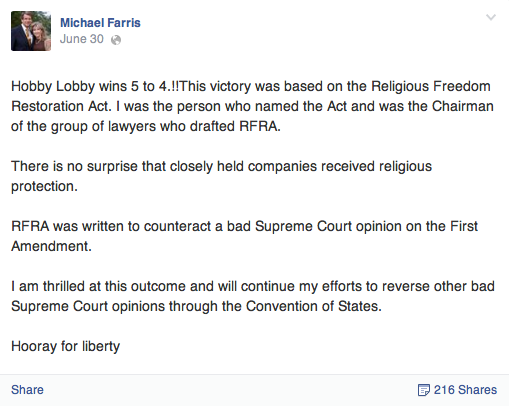
The day the Hobby Lobby decision came out, Farris wasted no time in claiming credit for it on his public Facebook page:

Screen Shot 2014-07-02 at 11.48.20 AM

Relevant text is:

Hobby Lobby wins 5 to 4.!!This victory was based on the Religious Freedom Restoration Act. I was the person who named the Act and was the Chairman of the group of lawyers who drafted RFRA.

Really, Farris is being modest in just saying he named the RFRA and supervised the drafting of his text. The fact is, he also “organized a broad coalition of groups to support it” and worked to assuage “pro-life groups” who “feared that the RFRA would extend women’s legal rights to get abortions.” Farris’s work immediately payed off, as HSLDA was able to capitalize on the RFRA in homeschool legal cases and then-HSLDA attorney (now former) Jordan Lorence used it to champion explicit housing discrimination against an unmarried couple.

Historically speaking, it is ironic that the RFRA is now being championed by “conservatives” as a “conservative” piece of legislation. Almost 2 decades ago, libertarian groups were criticizing the RFRA, contending it was unconstitutional because it “exceeded Congress’ power to regulate state and local government” and was merely “Congress’s attempts to redefine constitutional rights via the enforcement clause of the Fourteenth Amendment.” (In fact, the Supreme Court partially agreed, striking down parts of the RFRA, with Justice John Paul Stevens declaring it was a “law respecting an establishment of religion’ that violates the First Amendment to the Constitution.”) Legal scholars similarly argued it “establishes an across-the-board scheme that deliberately singles out religious practices, en masse, as a congressionally favored class of activity.”

(Of course, if you are familiar with Michael Farris’s actual legal theories and not just his rhetoric, none of this should surprise you. Farris is a far cry from actual conservatism and a far cry from federalism. He is more of an opportunistic expansionist. This is evidenced no more humorously in the fact mentioned above: that the Supreme Court struck down part of a law Farris oversaw the drafting of because it was an unconstitutional expansion of the federal government’s powers over and against states’ rights. Nonetheless, HSLDA continues to praise the RFRA.)

But here’s the best part, for all you homeschool trivia buffs out there: After Farris got to name the RFRA and chair the group of lawyers who drafted it, and after it passed the House and Senate and was sent to then-President Bill Clinton to sign, Farris was unable to make the signing ceremony. So who did Michael Farris send in his stead, to be there on this momentous occasion and celebrate one of his crowning political victories?

Doug Phillips.

Yeah, that Doug Phillips.

I’ll let HSLDA tell its own story, since they already did in the 1993 November/December Court Report:

Religious freedom regained significant protection on November 16, as President Clinton signed into law the Religious Freedom Restoration Act of 1993 (RFRA). Home School Legal Defense Association president Michael Farris was one of the original drafters of the bill. HSLDA had worked diligently over a three year period for RRFA’s passage.

Among those in attendance at the ceremony for the signing of the RFRA in the White House Rose Garden, was Doug Phillips, Director for Government Affairs for the National Center for Home Education. Phillips attended in the place of Farris, who was out of town and unable to attend. After the signing, President Clinton spoke with Phillips and extended his gratitude for the role Farris played in the RFRA drafting and coalition-building process. “Tell Mike, I really appreciate the work he did drafting [the RFRA],” President Clinton told Phillips.

It’s interesting how all these so-called “fringe” individuals — individuals like IBLP’s Bill Gothard and Vision Forum’s Doug Phillips — keep popping up in cases of immense national import. Gothard directly influenced the ideology of the Hobby Lobby owners, the ideology that inspired Burwell v. Hobby Lobby Stores, Inc. And Farris, Phillips, and HSLDA ensured the success of the RFRA, the law that ensured Hobby Lobby’s legal success. So fringe, you know?

“Fringe.”

You keep using that word, I do not think it means what you think it means.

Talking To Kids About Social Services, Part II

cps

HA note: The following is reprinted with permission from Libby Anne’s blog Love Joy Feminism. It was originally published on Patheos on June 12, 2014.

Part One

I wrote yesterday about the fear of social services I received from my parents and from the wider homeschooling community. Once I grew up I realized that this fear was both irrational and counterproductive. Social services was not the enemy, and social workers do important work protecting children from abuse and neglect. Sure, social services isn’t perfect, and they sometimes make mistakes. But what good does teaching children to be afraid of social services do? Absolutely none at all. When I had children of my own, then, I determined to do things differently.

I wanted Sally and Bobby to see social services not as an enemy but as a friend.

Several months ago we got from a store and Sally refused to get out of the car. She was tired and was comfortable where she was. She was four at the time, and I needed to take her inside and get on with my list of things to accomplish for the day. My options, as I saw them, were to either pick Sally up and carry her into the house or to convince her to come inside voluntarily. I decided to try the later and save the former for last resort.

“I can’t leave you out here,” I told her. “I’m your mom and it’s my job to take care of you.”

“I don’t care about that, mom!” Sally insisted. “I don’t mind if you leave me out here!”

“Okay, let me see if I can explain this,” I said, and I got down on her level. “Kids don’t know everything yet, and sometimes they can get hurt. Kids can get lost or hit by cars or stolen or drown or any manner of things. So parents’ job is to protect their kids and take care of them. That’s me—that’s my job.”

I took a deep breath and considered whether to go on.

I didn’t want to give her my childhood fear of social services, but I wanted her to understand that I really truly and honestly am required by law to take care of her, and that leaving her outside in the car alone is literally not an option. Sally likes understanding how the world works and having reasons for things, and she tends to be fairly mature for her age. So I went on.

“There are laws that require me to take good care of you,” I told her, “and if I don’t take good care of you I will get in trouble. There is an agency called social services that helps make sure children are taken care of. If parents do not take good care of their children, social services will come and tell them they have to take good care of their children. And if parents still do not take good care of their children, social services will find them a new mommy and daddy so that there is someone to take care of them.”

Sally considered for a moment.

“Okay, I’m coming inside, mommy,” she finally said, climbing out of the car. “You have to take good care of me, because that’s your job.” And she looked at me and smiled. “It’s your job to take good care of me!”

Sometime later we were at an outdoor event when Sally asked if it was fine if she go off on her own. I told her that I was okay with her moving around a little bit but that she had to stay close enough that I could see her and would know where she was. I reminded her that it’s my job to protect her and take care of her.

“That’s right mommy, it’s your job to protect me!” she said. “And you can’t protect me if you can’t see me!” And with that, she laughed as though she’d told a joke—and she stayed close enough for me to keep tabs on her throughout the event.

I was glad to see Sally being more understanding of times I had to tell her “no” because what she was asking was not safe. Sally had definitely taken to heart that it was my job to take care of her. But I still worried that she might take the bit about social services finding new mommies and daddies for kids who were not taken care of the wrong way, and end up feeling afraid.

Some time after this I was carrying a load of groceries from the car into the house, and Sally was dawdling and lagging behind.

“Come on Sally!” I called over my shoulder. “Hurry up!”

“I’m coming, mommy!” Sally called out as she picked up per pace and jogged to catch up. “Because you have to take care of me, mom, or they will find me a new mommy and daddy, and I don’t want a new mommy and daddy!”

And there it was. Had I messed up, I wondered?

Was I giving her the same fear I had had? After the groceries were safely on the counter and we were both in the house, I pulled Sally aside.

“Sally, daddy and I try very hard to take good care of you,” I told her. “If social services came here to check on you, they would see that we take good care of you. Social services only takes children away from their parents if their parents are not taking care of them at all, or if their parents are hurting them. Does that make sense?”

Sally paused to think. “Those kids need new mommies and daddies, because they need someone to take care of them!”

“That’s right,” I responded. “Social services comes to check things out if someone calls them and says, ‘that child’s mommy and daddy are not taking care of her, she needs help.’”

“And then they help?” Sally asked.

“Yes,” I told her. “They try to help the family, and they only find kids new mommies and daddies if their parents still refuse to take care of them. If social services ever comes to our house and a social worker wants to talk to you, don’t worry about it, they’re just trying to make sure you’re taken care of and happy. They’re nice people and they want to make sure kids are safe. If that ever happens you can just answer their questions, okay? It is their job to make sure children are taken good care of, and that’s a good thing, because it is good for children to be taken care of and not get hurt. Does that make sense?”

“Oh!” Sally exclaimed, “If they come to our house, they will say, ‘do your mommy and daddy take good care of you?’ And I will say, ‘yes, they do!’” And then they will say, ‘that is good, we like mommies and daddies to take care of their kids!’ Right mommy? Right?”

“Wow, um, yes, that’s absolutely right,” I responded. I’m telling you, you just never know with this kid. She does voices and everything. And with that, our conversation was over and Sally was off to play.

It has been some time now since this second conversation, and Sally has not expressed any fear of social services. Indeed, her comment as she ran to catch up with me—the comment that prompted our second conversation—was less one of fear than one of stating facts. Sally is a very logical and ordered child, and tends to be matter of fact like that.

I have to remind myself not to let my own childhood fear of social services determine my interpretation of Sally’s comments.

That it is my job to take care of her, and that I’m required by law to do so, has continued to help at moments when Sally would really like to be outside alone, or to wander around on her own at an event, and I can’t let her. It means that Sally understands that I don’t let her do those things because it is my job to take care of her and I’m required to do so, and not because I want to kill all of her fun.

Now I’m not saying any of this as a prescription. I don’t know for sure whether I’ve handled this topic correctly, or whether I should have held my tongue and found some other way to coax her out of the car that time several months ago—say, offering her a cookie once we got inside, or emphasizing all the things I had to get done in the house that evening. I do know that I just looked around the internet and couldn’t find a single guide to talking to your children about social services. Perhaps that means most people say nothing, and maybe that’s what I should have done too. But with my background of fear, and my parents in my children’s lives, I think part of me wanted to offer Sally a healthy perspective rather than leaving her with a vacuum.

End.

Talking To Kids About Social Services, Part I

Screen Shot 2014-06-15 at 6.36.09 PM
“I grew up afraid of social services.”

HA note: The following is reprinted with permission from Libby Anne’s blog Love Joy Feminism. It was originally published on Patheos on June 11, 2014.

I grew up afraid of social services.

Social workers were something of a bogeyman in the homeschooling community, and my parents bought into it completely. In fact, in a recent conversation on the topic with my mother, she insisted that social workers today do in fact take children away from their parents for nothing more than homeschooling. That she still says this today says a lot about just how high fear of social workers was in our home when I was a child.

In fact, my parents walked us children step by step through what we should do if a social worker came to the door when they were not home. We were not to let a social worker in the door under any circumstances, and we were to call the Home School Legal Defense Association and get a lawyer on the line immediately. My mom had the phone number on the inside of a cupboard by the phone.

I’ve spoke to others raised in the same background as me who actually had drills that involved them hiding in the attic, or in a basement. While we didn’t do this, I well remember hearing conversations about the horrible things social workers do—strip-searching children to search for bruises or interviewing children without their parents present. The homeschooling literature I read was full of references to the evils of social services.

When I was a teen, I read a novel by Michael Farris titled Anonymous Tip. In it the main character’s daughter is taken away from her based on a false tip called in by a malicious ex. When the social workers realize that the tip was false, they fake evidence to keep the little girl away from her mother. One of the social workers was a Wiccan, and her boyfriend worked for the ACLU.

The novel helped cement my fear and dread of social services.

I think to really get across what we’re talking about here I’m going to have to share a story of a terrifying event that took place when I was about fifteen. In fact, this moment may well be the most scared I’ve ever been in my life.

I was home alone with a few of my siblings while my mom and the others were at a friend’s house. I tried to call the weather phone number to get the forecast, but our phone was old and not all the buttons went through. I had dialed 911 without realizing it. As soon as the 911 operator came on, I hung up because it was a person rather than the weather recording I had expected. And then I realized too late that I had just hung up on the 911 operator.

I called my mother in an absolute panic. I was incredibly afraid. I knew that there was a strong likelihood that a police officer would come to our house to check if everything was alright, and there I was home alone with a few of my siblings. Looking back, my fear was entirely misplaced. My mother assured me that it would be fine, that I should simply tell the officer what had happened. I don’t think she realized the depth of my fear, or where it was coming from. The fear I was given of social services bled over into this experience.

As it happens, everything was fine. Two police cars did make their way up our driveway that morning, and a police officer got out and talked to me at the door. I told him what had happened—that I had dialed 911 on accident and hung up as soon as I realized I had the wrong number—and that was enough. But a police officer coming to the door to ask me questions and check the situation out while my parents were away was too similar to a social worker doing the same for me not to be terrified.

Fear—we’re talking real, visceral fear.

So far, this blog post could well be titled “How Not to Talk to Kids about Social Services.” My parents and the homeschooling community taught me to see social workers as the enemy and to fear social services in such a visceral way that it made my stomach hurt. This is how not to do it. Is social services perfect? No. But social services is set up to protect children from abuse and neglect, and it does a lot of good for a lot of kids. Social services should be seen as an ally, not an enemy, and teaching children to fear an agency set up to help protect them serves to prevent children who really need help from seeking it or speaking out—and result in a lot of unnecessarily frightened children.

Tomorrow I will write about how I talk about social services today with my own children. Is it necessarily to talk to children about social services? Maybe not, but given my background and the fact that my parents are a part of my children’s lives, I would rather give my children a positive foundation for understanding these things than leave them with a vacuum.

Part Two >

Christian Patriarchy on Educating Daughters

girl-reading

HA note: The following is reprinted with permission from Libby Anne’s blog Love Joy Feminism. It was originally published on Patheos on May 12, 2014.

Okay, let’s take a few minutes to hash out Christian Patriarchy’s view towards women and education. I think this is necessary because I hear one side saying “you don’t believe in educating girls” and the other side saying “no no no, we do educate our daughters, your accusations are ridiculous.” So what is really going on here? I can’t necessarily get at what the ordinary family on the ground is doing, but what I can get at is what the leaders of the movement say. So let’s take a look, shall we?

In a nutshell, the leaders of the Christian Patriarchy movement teach that daughters should be educated for their role as wives, mothers, teachers-at-home, and Proverbs 31 women, but not educated for careers outside of the home. This is summed up in a quote by Michael Farris from his book, The Home Schooling Father:

I want my daughters to have business savvy like the woman honored in Proverbs 31. But I don’t want them chasing the feminist dream of the two-career marriage (or shall we say “living arrangement”). They can’t have it all, as many feminists are beginning to find out. I want to avoid the twin evils of neglecting the proper career training of my daughters, on the one hand, and pushing them to the feminist career mold, on the other. Proverbs 31 teaches a godly balance: A woman who possesses work skills and financial resources, but who uses those skills in a way that keeps her home with her children and husband. The woman in Proverbs 31 does not stay home barefoot and pregnant watching soap operas. She is busy with more than garden clubs and poetry societies. Yet, she is first and foremost at home with her children and husband.

In fact, home schooling offers women the best of both worlds. Home schooling is a job that society values–teaching academics to children. It provides serious intellectual stimulation. It provides many opportunities to be held in esteem by people outside your family. . . . The pay is low. But the ability to be home with your children while working is second to none.

My wife was a very good student in high school and college. Before we began home schooling she would sometimes complain about the lack of intellectual activity in her life of wiping spills, changing diapers, and doing laundry. A couple of times she even wondered out loud about the idea of going to work.

Since we have been home schooling, her need for intellectual challenged has been abundantly satisfied. She has always believed that a mother’s place is in the home. But home schooling turned this belief into an intellectually satisfying lifestyle which provides many tangible rewards. The career I will ‘push’ at my daughters is the same one practiced by their mother.

The leaders of this movement, in other words, want daughters to be taught skills beyond diaper changing and laundry, but they don’t want daughters’ education to orient them towards a career outside the home. Interestingly enough, I can see how these ideas played out in my own life. My sister Heidi and I both attended college but sought degrees that would allow us to bring in extra income by working on the side, out of the home, while filling our proper roles as homeschooling mothers. When we both decided that was not what we wanted, we faced the challenge of turning an education intended to bring in pocket money into one we could forge careers out of.

Anna Sophia and Elizabeth Botkin, daughters of Geoff Botkin and authors of So Much More, similarly endorsed educating women in a blog post last year:

We all want to equip ourselves to be godly women, but do we really know what that equipping should look like? A diet of books on modesty, courtship, and cake decorating will definitely fill the bill if the role we aspire to is simply one of wearing modest clothes, going through a courtship, and decorating cakes. But if we truly believe the biblical role of women is bigger and more significant than this, we need put our money where our mouths are and pursue education and training to match.

They went on to emphasize the importance of women studying law, economics, business, history, and the sciences, among other things. They argued that daughters at home should put their time and energies into becoming educated in a variety of fields, not simply into cooking or cleaning or childcare.

Farris and the Botkin sisters are not the only ones arguing that daughters should be educated, though not for careers outside of the home. Voddie Baucham had his daughter Jasmine, who lives in his home as an obedient “stay-at-home daughter,” obtain a bachelor’s degree and now a master’s degree. Doug Wilson emphasizes the importance of a strong classical education for both sons and daughters and takes a pride in his daughters being well educated and well spoken.

Even Doug Phillips has weighed in:

An encouragement for fathers with older daughters might be for them to be involved in directing “higher education” at home. Having daughters that have graduated from high school still at home is usually something parents have not prepared for. For some families the encouragement needed is for the young ladies to learn all the homemaking and mothering skills required to create an inviting, Christ—honoring home. But, many girls have worked on these skills for years and seem to lack inspiration and vision to study God’s Word in depth and become firmly grounded in theology, church history, world—view, child training, philosophy of education, etc. for themselves. We feel that these are crucial issues for fathers to take responsibility for and direct their daughters in.

In other words, the leaders of the Christian Patriarchy movement are not against educating daughters. What they are against is educating daughters for careers outside of the home. They also have concerns about how their daughters go about being educated—namely, they do not want their daughters educated at secular universities. There is a lot of fear of secular education in these circles, and daughters are often seen as even more in need of protection than sons. Sons are to grow up and enter the world and be accountable straight to God. Daughters, in contrast, are fathers’ responsibility until they hand them off in marriage. Secular education, these leaders believe, provides only a truncated and twisted education that is not a real education at all. In fact, they argue that secular education as currently manifested is explicitly designed to corrupt young believers and lead them to atheism or, at the very least, to a liberal faith that “denies the gospel.”

This is why Michael Farris sent his daughters to Christian colleges. This is why Voddie Baucham enrolled his daughter in College Plus. Christian colleges, and, increasingly, online Christian colleges, are considered a safe alternative—although, again, daughters enrolled in these programs should have being a properly prepared wife, mother, and teacher-at-home as their goal, not a career outside the home. Some, such as Geoff Botkin and Doug Phillips, have continued their adult daughters’ education at home themselves, often focusing on a classical education approach and emphasizing law, economics, and history. Daughters are to be educated, but they should receive an education that teaches “truth,” not a perverted corrupted secular education.

I should note that all of this focuses on the leaders and not on the followers. What do the ordinary families following this ideology do? I suspect that class plays a large role here. The ordinary family may be overwhelmed both financially and emotionally by an ever-growing flock of children, and unable to properly educate even their sons. In this context, daughters’ academic education may seem less important, especially given that the daughters may be kept busy helping with the children and keeping the house running. Most families cannot afford a live-in nanny/helper like the Phillips could, after all.

And the leaders of the Christian Patriarchy movement say things that play into the devaluing of daughters’ academic education in families that are overwhelmed already. For example, R. C. Sproul [Jr.] wrote the following of his exchange with a homeschooling mother:

The mother made a confession to me. She told me, “You know, my nine-year-old daughter doesn’t know how to read.” Now here is a good test to see how much baggage you are carrying around. Does that make you uncomfortable? Are you thinking, “Mercy, what would the school superintendent say if he knew?” My response was a cautious, “Really?” But my friend went on to explain, “She doesn’t know how to read, but every morning she gets up and gets ready for the day. Then takes care of her three youngest siblings. She takes them to the potty, she cleans and dresses them, makes their breakfasts, brushes their teeth, clears their dishes, and makes their beds.” Now I saw her rightly, as an overachiever. If she didn’t know how to read, but did know all the Looney Tunes characters, that would be a problem. But here is a young girl being trained to be a keeper at home. Do I want her to read? Of course I do, as does her mother. I want her to read to equip her to learn the Three Gs. [From earlier in the book, he notes the “Three Gs”: Who is God? What has God done? What does God require?] But this little girl was learning what God requires, to be a help in the family business, with a focus on tending the garden.

I’m not suggesting that the goal is to have ignorant daughters. I am, however, arguing that we are to train them to be keepers at home. These two are not equivalent. Though we aren’t given many details we know that both Priscilla and Aquila had a part in the education of Apollos. I’m impressed with Priscilla, as I am with my own wife. She is rather theologically astute… My point is that that brilliance isn’t what validates her as a person. It’s a good thing, a glorious thing, and an appropriate thing. But it’s like the general principle we’ve already covered. Would I rather be married to a godly woman who was comparatively ignorant, or a wicked person who was terribly bright? Who would make a better wife and mother, someone who doesn’t know infra- from supralapsarianism, but does know which side is up on a diaper, or a woman about to defend her dissertation on the eschatology of John Gill at Cambridge but one who thinks children are unpleasant? It’s no contest, is it? Naturally we want everything. We want all the virtues to the highest degree. But virtues come in different shades and colors in different circumstances.

In other words, educating daughters academically is good and important . . . but it’s more important that daughters learn to willingly and cheerfully change a diaper and make a bed. Doug Phillips has made similar statements:

The Bible actually has a great deal to say about what distinguishes a girl from a woman. For one thing, a mature Christian woman is one who has demonstrated that she has been trained and is ready for marriage. Historically, parents understood that it was their mission to raise their daughters to marriageable maturity so they could enjoy the husband “of their youth.”

To raise a daughter without thought to marriage, to instill in them a spirit of independence from the family, or to focus their training on a career outside the home, is actually to disqualify them for graduation and the next step in life. In contrast, a woman who meets the biblical requirements for graduation is one who is comfortable being under the jurisdiction of her father and seeks to make him successful in every way. She recognizes that God calls women to be under the authority of God-appointed men, first in the form of fathers, and later as husbands.

Note the similarity here to the Michael Farris quote I began with—”To raise a daughter without thought to marriage, to instill in them a spirit of independence from the family, or to focus their training on a career outside the home, is actually to disqualify them for graduation and the next step in life.” Daughters are to be educated, yes—but not for a career outside of the home.

The leaders of the Christian Patriarchy movement believe that preparation for being a wife, mother, and teacher-at-home involves more than simply learning to change diapers and do laundry. They believe that being a proper Proverbs 31 woman should involve learning business, economics, history, law, and education. But all of this is seen as preparation for life as a homemaker and homeschool mother—not for a career outside the home. Indeed, these leaders—from Michael Farris to Doug Phillips—argue that daughters should be actively discouraged from even considering a career outside the home, and should instead be “pushed” towards homemaking and homeschooling as their lifelong destiny.

I don’t have a problem with a woman choosing to be a homemaker and homeschool mother, but that should be a choice, not the only option available to them. And given how unstable the world can sometimes be, even women who choose to stay at home should make sure they have career options available in case of death, divorce, or economic downturn. Heidi and I were lucky. We attended college and received degrees. Even so, our choice of majors was so limited by our assumption that we were not preparing for careers outside the home that we had to make some tough choices when we decided careers outside the home were what we really wanted. How much worse it must be for those who do not receive a college degree, or even more, for those whose parents are so overwhelmed that their education goes on the back burner entirely.

If you tell someone involved in the Christian Patriarchy movement that they do not believe in educating their daughters, they will object to your portrayal and cease to listen to what you are saying. If you, in contrast, tell them that they do not believe in educating their daughters for careers outside the home, they will likely agree. Then, perhaps, you may be able to begin a conversation.

Farris: Patriarchy Makes Kids Gays and Atheists

Photo source: http://www.theproudatheist.com/products/gaytheist

HA note: The following is reprinted with permission from Libby Anne’s blog Love Joy Feminism. It was originally published on Patheos on June 4, 2014.

If you read my blog, you’re probably aware of the Christian homeschooling subculture’s patriarchy problem. A variety of prominent Christian homeschool leaders have been promoting patriarchal family structures at homeschool conventions and in homeschool publications for well over a decade, and two of those leaders—Bill Gothard and Doug Phillips—have recently fallen, engulfed in scandal. Michael Farris, another prominent Christian homeschool leader, has since come out criticizing these leaders and the “patriarchy” they taught. Now Farris has openly criticized “patriarchy” as part of a keynote address while keynoting at a homeschool convention in Florida.

Here is a clip from Farris’s speech, followed by a transcription. In this section of his speech, Farris speaks of homeschool graduates who grew up in patriarchal homes.

The majority, I think, are walking with God. A significant minority, however, have rejected God entirely. A significant number are way way out there. And the critics that we’re seeing arising from inside the homeschooling movement—from young people in their twenties, mid-twenties mostly are the oldest group that are loudly criticizing homeschooling on the internet and so on and in other venues—were almost all raised in these kinds of homes, almost all, and there is no pretense of christianity in most of their lives. There are open homosexuals involved, there are atheists involved, there are people that utterly reject everything that we believe in and make no pretense about it. And so the idea that people are going to create generational patriarchal legacies, that didn’t work out for them very well. We’re not seeing that. You erect a false view of god for your children, don’t be surprised if they reject god entirely. That ‘s what’s going to happen. So what do we do as a movement first I would suggest that we run as far away from patriarchy and legalism as we can.

Okay, wow. I have been excited about Farris condemning patriarchy because, regardless of his motives, his words may prevent at least some families from going down that toxic rabbit hole. But this? The patriarchy turns kids into gays and atheists? That is why he’s condemning it? Not, oh I don’t know, patriarchal homeschooling hurts people? Farris has read the stories on Homeschoolers Anonymous (or at least is aware of them), but his conclusion is not “patriarchal homeschooling is toxic” but rather “patriarchal homeschooling turns kids into gays and atheists”? For serious? 

Is Farris unaware that this is still formula parenting? Farris is saying homeschool parents should run away from patriarchy because it will turn their children gay and atheist. He’s acting as though you just have to find the right form of parenting and then, viola! Your children will not be gaytheists.

What Farris apparently does not realize is that for many of us our parents’ insistence on us adopting their exact religious beliefs was just as constricting and painful patriarchal aspects of our upbringing, if not more so. My troubles with my parents started not when I rejected patriarchy but rather when I determined that God had used evolution to create the world. Ardent young-earth creationists, my parents all but disowned me. That they could treat me like that, and that they could insist on young-earth creationism in the face of clear scientific evidence, made me realize I needed to think through everything they had taught me, because any bit of it could be wrong. That path didn’t lead straight to atheism, taking me first through some other flavors of Christianity.

If anything “made me” an atheist, it was not my parents’ belief in a patriarchal family structure but rather their insistence on blatantly unscientific beliefs and their decision to value their religion over their children, punishing me emotionally for any step I took away from their party line. But I sincerely doubt we will hear Farris speak out against any of this, because frankly, he’s the one who planted these seeds in my parents in the first place.

Farris told homeschool parents, including my parents, that they were the Moses generation, removing their children from Egypt (the public schools) and educating them in the wilderness of Sinai (homeschooling). We children, Farris said, were the Joshua generation, raised up to take back the promised land of Canaan (aka to “retake America for Christ”). But then some of us, myself included, rebelled against the entire purpose we were being raised for and decided Canaan was just fine the way it was and that slaughtering its inhabitants sounded like a very bad idea. That is what provoked our parents’ backlash against us, as they sought for something to blame for our utter failure. That is why we felt suffocated, as our parents blamed us for falling short of the lofty goals Farris had fed them.

But you know what? I don’t see Farris backtracking on any of that.

For more on Farris’s suggestion that patriarchal homeschooling turns kids gay, I’d point you to Kathryn Elizabeth’s excellent piece on the topic, “We’re Here, We’re Queer (and patriarchy had nothing to do with it).”

But I would be remiss if I didn’t mention another problem with Farris’s speech, and that is how he defined “patriarchy.” If Farris were telling his audience that they should give up their belief in male headship and female submission, even if he were saying it to prevent children from turning out as gaytheists, I would be honestly and truly impressed. Why? Because Farris has for years taught that wives must submit to their husbands even if their husbands tell them not to go to church, or not to listen to tapes of sermons at home. Farris rejecting the belief in wifely submission so common to the Christian homeschooling subculture could be game-changing. And his stern rejection of “patriarchy” ought to indicate that he’s doing just that, right? Wrong.

In his speech, Farris stated explicitly that wives are to submit to their husbands. Farris may be oblivious to this fact, but that is patriarchy. Farris made this statement to eschew what he apparently thought was patriarchy—the belief that every woman must submit to every man. But this idea was never taught by anypatriarchal Christian homeschool leaders. Think you that Doug Phillips would have had his daughters submit to the man they walk by in the grocery store? No. In fact, Phillips’ argued that if everyone woman remained in submission to her god-given male authority, he would protect her from the wiles of other men. Similarly, Gothard coined the term “umbrella of authority” and promised his followers that if they submitted to their god-given authority (singular), they would be safe from the storms of this world.

In other words, Farris set up and knocked down a straw patriarchy and endorsed actual patriarchy in a speech ostensibly condemning patriarchy. Can you tell I’m frustrated? This thing writes itself like a comedy sketch.

But by all means, Farris, make the real problem gay and atheist homeschool graduates (hi!), not the actual suffering caused by toxic ideologies. I should point people back to my post on Monday, because this is yet another example of a homeschooling parent making homeschool graduates like myself the problem rather than actually engaging our concerns. In other words, it isn’t that Farris has a problem with the toxic ideas we’re calling out, it’s that he has a problem with our existence.

But you know what? At least we have their attention now.

We’re Here, We’re Queer (and patriarchy had nothing to do with it)

Screen Shot 2014-06-04 at 11.08.04 PM

HA note: The following is reprinted with permission from Kathryn Brightbill’s blog The Life and Opinions of Kathryn Elizabeth, Person. It was originally published on June 4, 2014.

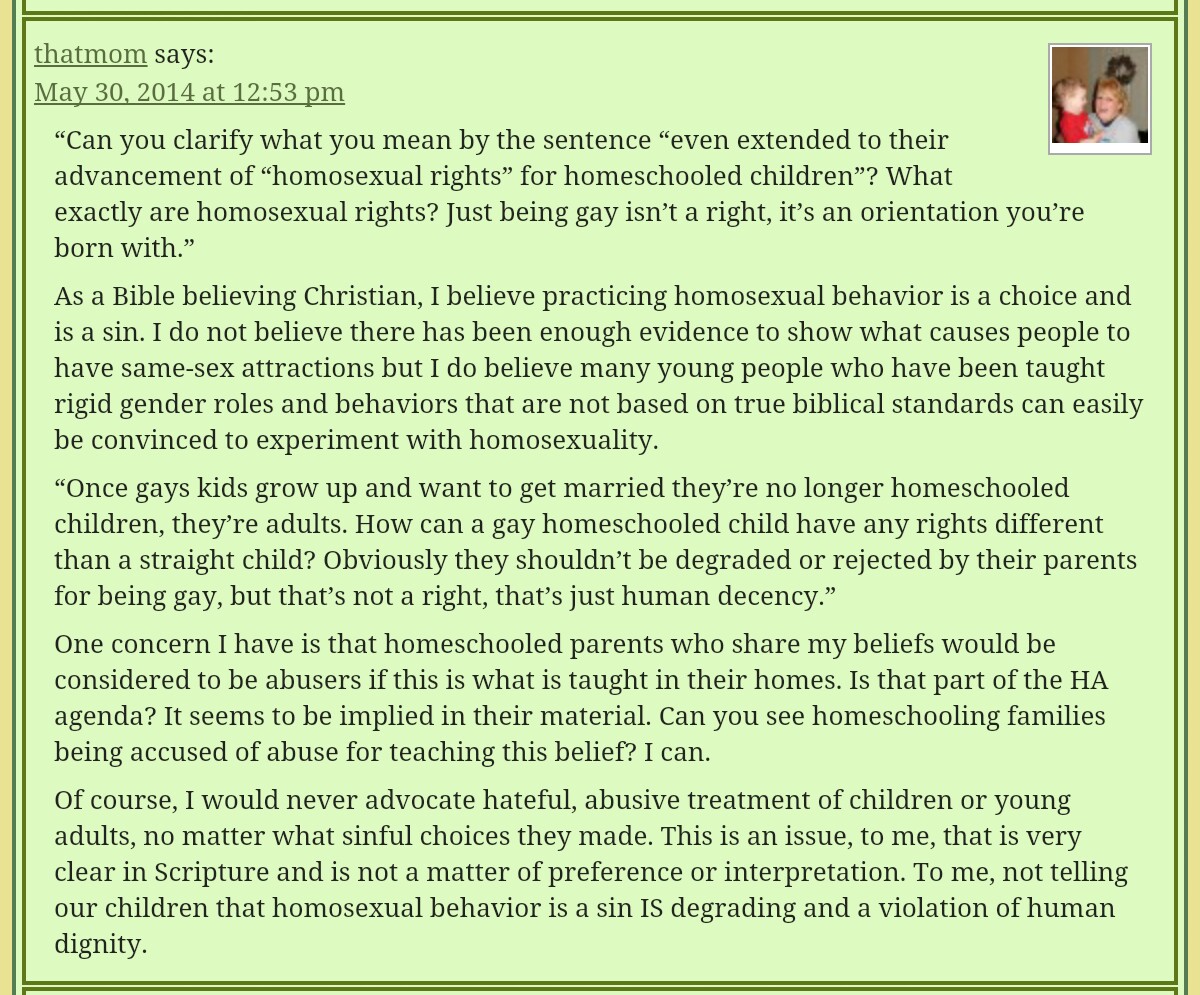
I’m not sure if two examples counts as a trend, but over the last few weeks both HSLDA founder and Patrick Henry College chancellor Michael Farris and well-known homeschool mommy blogger Karen “that mom” Campbell have both suggested that the blame, as it were, for LGBT homeschoolers lies at the feet of patriarchy.

Under this narrative, patriarchy has so harmed and broken us that we have not only rejected patriarchy itself, but have fallen off into a morass of sin and depravity.

Farris’ version of the story, as given in his May 2014 keynote address at the Florida Parent-Educators Association (FPEA) Leaders Forum, is that homeschool alumni critics of homeschooling are almost all victims of patriarchy, and in rejecting that we’ve also rejected God and some of us have become “open homosexuals.” It’s all very Romans 1 of him.

Transcript:

“But the majority, I think, are walking with God. A significant minority, however, have rejected God entirely. A significant number are way, way out there. And the— and the critics that we’re seeing arise from— in the homeschooling movement from young people who are in their twenties and— twenty— mid-twenties, mostly, is kind of the oldest group— that are loudly criticizing homeschooling on the internet and so on and in other venues— were almost all raised in these kinds of homes. And there is no pretense of Christianity in most of their lives. There are openly homosexuals involved, there are atheists involved, there are people that utterly reject everything that we believe in and make no pretense about it, that are— but they came. And so the idea that people are going to create generational, patriarchal family legacies, and we’re counting for them very well, you’re not seeing that. You erect a false view of God for your children, don’t be surprised if they reject God entirely. That’s what’s going to happen.

So what do we do as a movement? First, I would suggest we run as fast and as far away from patriarchy and legalism as we possibly can.”

Full audio can be found here.

Now, aside from the fact that Farris has painted all former homeschoolers who are critical of the homeschool movement as gaytheists who reject everything they’ve been taught, completely ignoring the significant number of critiques from committed Christians (myself included—”gay” and “Christian” are not mutually exclusive), and ignoring that gaytheists deserve a say too, this is balderdash.

While I will grant him the assertion that creating a hateful, vengeful image of God isn’t exactly conducive to producing children who believe in God, blaming our queerness on patriarchy, or at least the fact that we’re open about it, isn’t going to fly.

For one, patriarchy can’t turn anybody LGBT, sexual orientation and gender identity have zilch to do with the kind of environment you grew up in. What is particularly silly though, is the idea that being raised in an environment of fear, isolation, and repression where the odds are good that you heard at least one person suggesting that people like you should be stoned, somehow makes it more likely that Christian homeschool kids will become, “openly homosexuals.”

Although my own coming out experience was uneventful, at least in part because the days of my family’s dabbling in patriarchy by way of the courtship movement were long since passed, the kids raised in the kind of hardcore patriarchy that Farris condemns go through hell to come out. If only it were so easy as to just rage quit patriarchy and become “openly homosexual” in the process.

And well, I feel for the queer kid whose parents heard that talk and assume that by ditching patriarchy they’ll produce good little heterosexual children. Patriarchy doesn’t make a kid queer, and not following patriarchy doesn’t make a kid straight. The only relation that patriarchy has to sexual orientation or gender identity is to make the life of kids growing up queer a living hell. That’s not going to change in Farris’ ideal world since, as I have already documented, he advocates the same ideas that make life miserable for LGBT kids growing up in patriarchy.

My second data point for this whole patriarchy-turns-kids-gay trend is Karen Campbell’s post last week, “Patriarchy on Trial, part 4.”

I don’t particularly feel like getting into the bit in her post where she conflates Homeschoolers Anonymous/HARO with the organization that I’m part of, the Coalition for Responsible Home Education (CRHE), suggests that we’re some sort of gay rights advocacy organization (we’re not, and we have a grand total of zero mentions of anything LGBT-related anywhere in our policy positions), and then in the comments implies that our end game is to define being anti-gay as abuse (it’s not, and the idea literally never crossed my mind until she wrote it).

What I would rather talk about is the comment she left on her post, where Campbell suggests that young people raised in patriarchy, “can easily be convinced to experiment with homosexuality.”

karen

Ms. Campbell really doesn’t understand how this whole gay thing works if she thinks that being taught rigid gender roles is going to confuse someone into homosexuality. Also, while we’re at it, bisexuality is a thing too, though I doubt Campbell thinks it exists.

Rigid gender roles are bad, and should be rejected outright, but forcing a kid into a rigid gender role has nothing to do with who they’re attracted to. For that matter, there are kids who fit quite happily into rigidly defined gender roles but are still attracted to the same sex, and kids who don’t fit at all but who are entirely straight.

Homosexuality is about who you’re attracted to, and whether or not a kid fits into a rigid gender role is about gender identity and expression, another issue entirely. For a kid who is gender non-conforming, being forced into a rigid box isn’t going to confuse them into gayness, it’s just going to make their life unpleasant.

Besides, I didn’t grow up forced into rigid gender roles and I’m still queer. In fact, I’d wager that my parents’ version of homeschooling is one that would get the Karen Campbell seal of approval, but hey, here I am and no one convinced me into anything.

Are we so weak that she thinks we can easily be misled into gayness? I graduated from high school at 17, got a degree in computer science as the only female student in all but one class, moved overseas by myself to teach in Asia, and have my JD. That I could “easily be convinced” of anything, much less of something that makes my life harder, is insulting.

There are many things that I will lay at the feet of patriarchy, but nope, you’re not going to be able to write off LGBT homeschoolers this easily. Patriarchy did not make us, this is who we are, and there is nothing wrong with that.

We’re here, we’re queer, patriarchy had nothing to do with it, and it’s high time you get used to it.

Christian Homeschooling and Child Abuse Denialism

Screen Shot 2014-06-03 at 3.18.35 PM

HA note: The following is reprinted with permission from Libby Anne’s blog Love Joy Feminism. It was originally published on Patheos on June 2, 2014.

If you’re a long-time reader, you’re likely aware my series on HSLDA and child abuse, which includes their fight against child abuse reportingtheir stonewalling of child abuse investigations, and their defense of child abuse. You’ve probably also read my viral “HSLDA: Man Who Kept Kids in Cages ‘a Hero.’” If you read Homeschoolers Anonymous, you probably know that Doug Phillips, former HSLDA attorney and founder of the now-defunct Vision Forum, stated in 2009 that “We understand that the core problem with Child Protective Services is its existence.”

What you may not be aware of is that in 1985 Mary Pride published a book titled The Child Abuse Industry: Outrageous Facts About Child Abuse & Everyday Rebellions Against a System that Threatens Every North American Family

Who is Mary Pride? If you’ve ever homeschooled, you’ve almost certainly heard of her. She has had so much influence in homeschooling circles that has been dubbed “the queen of the homeschool movement.” Historian Milton Gaither has dubbed Pride as one of homeschooling’s two most influential curriculum reviewers. Pride first published her Big Book of Home Learning in 1986 and has updated it regularly since. It now has four volumes. Pride is also the publisher of the “wildly popular” Practical Homeschooling magazine, with as many as 100,000 subscribers, and has published numerous other popular homeschooling how-to books. Pride is also the author of The Way Home, published in 1985 and credited with launching the Quiverfull movement (not to be confused with the Patriarchy movement).

And then, of course, there is The Child Abuse Industry. According to R.L. Stollar, the book is “a remarkable read that calls for a ‘Second North American Revolution’ — namely, having babies, abolishing no-fault divorce, going to church, eliminating foster care, homeschooling, re-instituting “biblical” executions of criminals, and getting rid of abuse hotlines.” Stollar is currently writing a multi-part review, which I will definitely promote when it comes out.

Here are ten quotes from Pride’s book, courtesy Stollar’s post on Homeschoolers Anonymous:

10. “The major problem is that the public has been convinced that child abuse is a major problem.”

9. “Are one out of four adult women (or one out of three, or two—the statistics keep getting wilder) really the victims of savage lust perpetrated in their youth?Isn’t it possible to organize a bridge party without staring at an abused woman across the table? Where do these wild statistics come from?”

8. “Never vote for a candidate whose campaign promises include ‘doing more for children.’”

7. “Child abuse hysteria is a self-righteous coverup for anti-child attitudes.”

6. “If [child abuse prevention programs] are allowed to proliferate, we will produce for the first time an entire generation of males who have been trained to consider raping their sons and daughters as passably normal behavior.”

5. “If sex has nothing to do with having babies, you can have sex with anyone or anything. Including children.”

4. “We need to stop allowing the unsupported testimony of childrenwho are of an age where they can barely distinguish fantasy and reality.”

3. “Don’t hotline anyone.”

2. “A retarded daughter told contradictory tales of sexual abuse by her step-brother and other male relatives… So here we have a girl who probably made up the story in the first place.”

1. “Age segregation increasingly alienates children and adults. Children are the ‘new n*****s.’” (not censored in Mary Pride’s version.)

My interest piqued by Stollar’s quotes, I cracked open my copy of HSLDA’s Chris Klicka’s 2006 book, Homeschool Heroes: The Struggle and Triumph of Homeschooling in America. I opened to the chapter on social workers.

At Risk from Social Workers

. . .  Homeschoolers are at risk. They are not at risk because they have big families or teach their children at home or neglect their children in any way. They are at risk because the child welfare system has lost control. Many social workers are trained in a philosophy that is antiparent, antifamily, and antireligious.

I can’t say I’m surprised, but here it is again. Look, I know that social services isn’t perfect, and that it’s badly in need of better funding. But that’s not what this sounds like it is about. According to Klicka, the issue isn’t that social services is underfunded and understaffed, but rather that social services is antifamily. This is the same sort of line Mary Pride was promoting in her book.

HSLDA is both a policy advocacy and legal defense group. HSLDA defends member families if they have any problems in their interaction with local public schools or social services. The organization’s website describes it like this:

Why does HSLDA help member families in the initial stage of a child abuse investigation?

HSLDA’s mission is primarily to advance homeschooling rights. Sometimes homeschooling parents get reported to CPS because people misunderstand homeschooling. They may see children playing outside during school hours and think that the parents are allowing them to be truant. Other times, families are reported for other types of suspected abuse or neglect. Investigations of all such allegations begin the same way: a social worker visits the family’s home, or contacts them requesting to set up a visit.

HSLDA advises our members in these initial contacts with social workers in order to ensure that their constitutional rights are protected. Once the allegations are revealed, we continue to represent our members if the allegations relate to homeschooling.

In other words, according to HSLDA’s website, they advise member families any time there is a social worker at the door, but only represent member families going forward if the allegations involve homeschooling. Along these same lines, an announcement on HSLDA’s facebook page last year asserted that “HSLDA does not and will not ever condone nor defend child abuse.” But some of the stories Klicka relates from his years working for HSLDA tell a different story.

There’s this one, for instance:

A homeschool father in Michigan picked up his two-year-old child by the arms, taking her into the house while she was crying and was reported for child abuse by a nosy neighbor. I set up a meeting with the social worker and counseled the family on what htey should say. I told themI told them to explain their religious convictions concerning raising their children from “a positive standpoint” avoiding Bible verses like if “you beat him with the rod, he will not die.” Or, if you “beat him with the rod,” you will “deliver his soul” from hell. Not a good idea. Social workers just don’t understand those verses.

Instead I told them to explain their beliefs by emphasizing verses such as Matthew 18:6 that states that if you harm or offend a child, it is better that a millstone be tied around your neck and you be thrown in the deepest part of the ocean. In other words, their religious convictions demand that they not do anything that will harm their children. When the family began presenting these religious beliefs to the agent, he became visibly uncomfortable, and suddenly announced that he would close the case.

And this one:

In Fairfax County, Virginia, a pastor gave a seminar on child discipline that included the requirement in the Bible to spank. A parishioner had to discipline her child while a neighbor was visiting a few days later. She spanked the child in the other room and then explained to the neighbor a little of what she had learned from the pastor.

The neighbor, who happened to be against spanking, reported the pastor to the child welfare agency for “bruising their children and for twenty-minute spanking sessions.”

To clarify, this suggests the pastor spoke in his sermon of bruising his children and carrying out twenty-minute spanking sessions.

The social worker who then initiated the investigation told me she thought she might have a religious cult on her hands that abuses children. I expressed my disbelief to the social worker that she was seriously investigating what an anonymous source claimed she heard from a person who heard it from another person. That is thrice removed hearsay. I told her that her evidence was flimsy and set the parameters for a meeting.

In preparation for the meeting, I told the homeschooling pastor and his wife not to recount any specific incidents of spanking since the social worker had nothing on the family that would stand up in court. I told them that they should emphasize again the positive verses such as Matthew 18:6. Since the social worker had no evidence, the only evidence she could acquire would be from what information she could gather from the pastor and his wife. Since the parents carefully avoided all specific examples and spoke in general terms, the social worker had nothing and had to close the case.

Perhaps those at HSLDA would argue that they never defended someone against child abuse in court. But in this layman’s eyes, this constitutes defending child abuse. I mean, did they even ask the pastor if it was true that he bruised his children and spanked them in twenty-minute sessions? Or did they de facto believe he was innocent and not bother checking, as seems to be their habit? I’ve expressed my frustration with this before.

And there is a similar distrust of children’s testimony with Klicka as with Pride:

Another family in Bradington, Florida, was visited by social workers. Allegations were made by one of their seven adopted children, who was the only one not being homeschooled. He had made up a story and told it to his science teacher, who had then passed the information to a social worker. I was able to talk to the social worker and keep them out of the home and away from the children. The case was finally listed as unfounded. The mom said, ‘This is why I spend twenty-six cents a day. People are crazy not to join HSLDA. I have an attorney ready to help me at a moment’s notice.’

There is also advice on how to hide abuse and avoid being reported:

Know Your Family Doctor

We have had numerous situations where doctors turned homeschoolers in to social workers because they found a bruise or mark on the child . . . I learned early on that each family needs to know their doctor well. If the doctor is familiar with the patients and trusts them, they do not have to turn them over to a child welfare agency, even if they have a mark or bruise. It is completely the doctor’s discretion.

The orientation toward social services is the same in Klicka’s book as in Pride’s—one of opposition. They are the enemy. In fact, Klicka began his chapter on social workers with I Peter 5:8-9—”Be sober; be vigilant; for your adversary the devil walks about like a roaring lion, seeking whom he may devour.” The assumptions about the veracity of the parents’ and children’s testimony is the same—parents’ word can be trusted, children’s cannot.

We need to be careful not to assume that all homeschoolers engage in this sort of denialism and defense of child abuse. I do not know whether the themes explored here extend beyond the leaders of the conservative Christian homeschooling subculture, and we should not assume that we do. But with that subculture, this is a problem. With these sorts of narratives, how can we expect those within this subculture to even self-police, much less report suspicions of abuse?

From Pride’s The Child Abuse Industry to Michael Farris’s thrill-horror novel Anonymous Tipthis is a problem. 

Oh, and also? If there are Christian homeschoolers out there who are upset by what I’ve said here, the correct response is to go about condemning the words of these Christian homeschool leaders and creating a new narrative, a narrative that affirms reporting suspicions of child abuse and doesn’t de facto trust parents’ word over that of their children. Condemning me for saying these things or arguing that I am anti-homeschooling would be the incorrect response.

11 Homeschool Celebrities Explained With GIFs

By R.L. Stollar, HA Community Coordinator

Homeschool celebrities.

They run our lobbying organizations, write our books, and garner all our blog views. Our parents thought they were God’s messengers and we thought we should keep our thoughts to ourselves. Now that we’re grown, our perspectives have changed a bit. So we think it’s worthwhile to look at 11 current and former homeschool celebrities — and explain them using gifs.

.

1. Michael and Debi Pearl

The Pearls have a unique approach to communicating the love of Jesus to children. It goes something like this:

love

.

2. Doug Phillips

Last year Doug Phillips realized his most Hazardous Journey wasn’t a vacation. It was the public backlash against revelations that he had an extramarital relationship with a woman that involved — well, we weren’t sure exactly what it involved.

When Phillips first admitted infidelity, he spun it as just some species of “emotional fornication” or something:

phillipspre

But then it came out that, no, the relationship wasn’t just “inappropriately romantic and affectionate,” as he originally stated. The “relationship” was Doug Phillips repeatedly sexually abusing a young woman. As far as his original statement went, Phillips was suddenly like:

phillips

.

3. Bill Gothard

Bill Gothard, like Doug Phillips, has discovered that sexually abusing young people doesn’t make you popular. However, unlike Phillips, Gothard faces over 30 individuals accusing him of abuse. At this point his attempts to explain his situation are sounding like this:

jennifer-lawrence-gif-2

.

4. James and Stacy McDonald

As the media and homeschoolers are circling the wagons around Bill Gothard and Doug Phillips, their former fans with crushes on Patriarchy are doing everything possible to now hide that fact. People like James and Stacy McDonald are pulling previously written posts and urging Patriarchy advocates to change the words they use. The McDonalds’ response here boils down to:

“No Patriarchy to see here. Move along!”

1d38007b_tumblr_lh52r8FFry1qhwx3io1_500

.

5. Doug Wilson

Then of course there’s Doug Wilson. When he’s not too busy with obsessing over the latest blog post by Rachel Held Evans, Wilson is fighting the biggest threat Western Civilization has ever faced: women playing unladylike basketball.

tumblr_mov3fh44uE1qe3cxyo1_250

.

6. Jim Bob and Michelle Duggar

Jim Bob and Michelle Duggar have a TV show. The plot of that TV show can be described by staring at this gif for approximately 19 seconds… and counting…

duggar

.

7. Ken Ham

No homeschool celebrity list would be complete without a shout-out to Ken Ham. If you find it somewhat difficult to believe Adam and Eve enjoyed candlelight dinners on the backs of dinosaurs while trying to avoid talking snakes, well, Ken Ham has one message for you:

tumblr_lum894SeOv1qb1zcjo1_500

.

8. Kevin Swanson

Kevin Swanson is like the Drunk Uncle of Christian homeschooling. From defending child marriage, comparing child abuse to “dead little bunnies,” warning people Frozen is Satan’s attempt to indoctrinate children into “the lifestyle of sodomy,” to his actual statement that “There’s a contrast between the feces-eaters and the church,” sometimes we wonder if he rocks himself to sleep at night screaming,

swanson

.

9. Mary Pride

Mary Pride found her way home in 1985. It involved outbreeding non-Christians and calling children “the new n*****s.” When it comes to people and organizations working tirelessly to protect children from abuse, Pride is all,

pride

.

10. Michael Farris

In the midst of all the drama in the homeschooling world, Michael Farris stands in the foreground leading the charge against Obama, Common Core, and the not-Nazi Germans who hate homeschooling as much as he loves freedom. And Michael Farris loves his freedom:

freedom

.

11. Matt Walsh

Ah yes. Finally, there’s Matt Walsh:

loud-noises