Oh Daughters of Fundamentalism, Take Upon Yourselves the Cloak of Self-Deception

Screen Shot 2014-04-16 at 10.28.56 PM

HA note: The following is reprinted with permission from Sarah Henderson’s blog Feminist in Spite of Them. It was originally published on her blog on August 28, 2013.

I recently witnessed a young girl who is struggling a bit who expressed that she was a bit unhappy with her life, being told that she just needs to take it one day at a time, and be happy with it. To me it is shameful to express to a child or a teenager that their discomfort or unhappiness with a difficult situation stems from their own inability to cope. What message is being given to girls when they are told that although they are not the creators of the bad situation, they must be the authors of the solution, but the solution must only be to swallow their feelings and smile.

This is a relatively common comment made to daughters in conservative families. The basic idea stems from the idea if you are unhappy with your life, it is important to change your attitude about your life. Girls are not taught that they can cause change in their own lives. Of course this serves the purpose of preventing girls from making plans to get out. If they are responsible for their own happiness, and they do not get to make their own choices, fundamentalism is able to produce a new generation of women who not only do not fight back and fall in line with whatever rules and tasks are assigned to them, in the ideal scenario they will actually start to enjoy the fact that they are fulfilling their purpose, and own their own oppression.

This is a very difficult concept to understand if you did not grow up in patriarchy. How can women not only agree and allow themselves to be oppressed, but also seem to be happy and flourish in their own oppression? How can women become party to their own oppression, and in fact add their own restrictions to their own activities and assign themselves even more responsibility for the physical and mental well-being of the men around them? Because they are taught to believe it.

They believe that women are created to complement their husbands. They believe that any unhappiness they experience is selfish and sinful. They in fact quench their own desires and resentment at being treated as chattel, and tell themselves they enjoy it. Today I had the misfortune of reading the story of a young woman who was picked up from work by her husband with an entourage of other people to celebrate her last day of work. There was a banner on the car stating that she was free at 27, but her exit interview read that her new employer was her husband, and she would be a house wife from then on.

Teenaged girls in quiverfull families are taught that their purpose it to serve as a daughter, and then as a wife and mother. They try to fulfill their purpose in life by working hard, taking care of younger siblings, and generally not trying to rock the boat. They do not ask for things that they want or need, they do not tell their parents if they are pain, and they do not ask questions about their futures or their bodies. I can tell you that there are probably many teenaged girls right now that are suffering from severe menstrual cramps or low energy due to health problems, that will not say anything because they do not want to cause shame to their families by not being a strong contributor to the family.

These girls are trotted out at family and church gatherings to showcase their homemaking and child-rearing skills. To fail at cooking a dish or to not be able to handle several children at a time would be an unbearable humiliation. No self-respecting girl would allow that happen, and after a girl has put all of her time and effort into being a homemaker and mother for a few years, she is taught to take pride in it, and also starts to take pride on her own. After all, how many girls of 13 are capable of running a household of 8 or 10 or more on their own. How many girls can feed a dozen people with very few ingredients? How many can juggle a house cleaning and cooking a dinner and calming a crying infant and changing a toddler at the same time?

Untold numbers of innocent teenagers are living this life every day, and they take pride in their ability. They put their own desires away and learn to run a family that isn’t even theirs to keep. They are encouraged to compare their accomplishments with other girls, and on a church day they will go to their mothers and offer to take care of the babies for their mothers. They plan for their own happy families and wash laundry and cook meals and put band aids on babies. They change diapers and administer assembly line baths to dirty children. They make beds and clean up toys and wipe noses and do not go to school. They teach phonics and math and sewing and read the Bible to little children and make sure they listen to the parts about obeying your parents and making sure you do not think bad thoughts.

They tell themselves that this is what they want and that they can’t wait to have their own families and carry on god’s plan. And now they will grow up and teach their own baby girls to serve men and god. To deceive themselves.

Michael Farris, Patriarchy, and Doug Phillips: An Expose

HSLDA President J. Michael Smith, Doug and Jubilee Phillips, and HSLDA board member Dick Honnaker at HSLDA's 2004 National Leadership Conference in Spokane, Washington.
HSLDA President J. Michael Smith, Doug and Jubilee Phillips, and
HSLDA board member Dick Honnaker at HSLDA’s 2004 National Leadership Conference in Spokane, Washington.

HA note: The following is reprinted with permission from Libby Anne’s blog Love Joy Feminism. It was originally published in a slightly longer version on Patheos on April 15, 2014.

Yesterday’s WorldNetDaily article on Lourdes Torres’s lawsuit against Doug Phillips quotes at length from Michael Farris’s reaction to Doug Phillips downfall. I thought it was worth going over that section specifically, and placing it within the context of other things I have written about Michael Farris, HSLDA, and Patrick Henry College, both to clarify the issues here and to reveal the serious dishonesty of Farris’s statements.

I will begin by quoting the section, and will then respond.

Before Phillips founded Vision Forum, he spent six years as an attorney for the Home School Legal Defense Association, or HSLDA, a nonprofit advocacy organization that defends the right of American families to homeschool their children.

HSLDA Chairman Michael Farris told WND, “The reason Doug left HSLDA is because [President] Mike Smith and I, who were his bosses, were growing more and more uncomfortable as he started developing his patriarchy theory. We started limiting his ability to speak on those things while traveling on our behalf. We basically made it clear that he could not pursue those things with his HSLDA hat on. So he eventually chose to leave us so he could do those things because we were not comfortable with where he was headed.”

As for the patriarchy movement, Farris said the teachings are not widely accepted in the broader homeschool community.

“It’s a minority of homeschoolers that believe in it,” he said. “But unfortunately, until very recently, they were getting a lot of visibility in certain places. We have sought to avoid inviting any patriarchy speakers to speak at our national conference.”

While state homeschool organizations run their own events and may choose to have such speakers, Farris said HSLDA has never promoted them.

“Doug has never been invited to speak at our national conference since he left,” Farris said. “We have tried, by example, to keep this stuff outside the mainstream of the homeschooling movement.”

He added, “Frankly, we think it’s time for us to stand up and publicly say this is just wrong.”

Background

And here we need some explanation. Within the Christian homeschooling movement, and by that I mean those Christians who choose to homeschool for religious reasons, whether in part or in whole, there is a range of belief on gender roles. In general, beliefs about gender roles fall somewhere on a spectrum between the following two camps:

Complementarianism: Many of those in the Christian homeschooling movement, including both Farris and my own parents, hold fairly conventional conservative evangelical views on gender roles. The wife’s role is to obey her husband, nurture her children, and serve ask a keeper at home. The husband’s role is to be the head of the family, provide for the family, and protect the family. Men are to be masculine and manly, women are to be feminine and womanly. God has laid out different and complementary roles for each gender, but all are equal before God.

Biblical Patriarchy: Some of those in the Christian homeschooling movement go farther. They proudly use the word “patriarchy” and teach that daughters are to be under their father’s authority until marriage, serving as “stay-at-home daughters.” They argue that daughters should not go to college, or hold jobs outside the home, and that daughters must obey their fathers even as adults. Only when daughters marry (through a courtship process controlled by their father) do they leave their father’s authority and transfer to their husband’s authority.

I don’t have numbers on how many Christian homeschoolers adhere to complementarianism versus how many adhere to biblical patriarchy, but I also don’t think it’s completely clearcut. Even those solidly in the complementarian camp will have noticed promoters of patriarchy speaking at homeschool conferences, will have seen their literature, and will have met those in its folds. My own family was fairly solidly in the complentarian camp, and yet they adopted some of the beliefs of the biblical patriarchy camp even as they rejected others (they sent me off to college, but believed I was still to obey my father, as an adult daughter under his authority).

Biblical patriarchy differs little from complementarianism except in its open embrace of the term “patriarchy” and its teachings about the role of adult daughters.

Michael Farris

So where does Farris fall, particularly? From what I’ve read of his writings Farris very much believes that wives must obey their husbands and that a woman’s role is in the home nurturing her children. But what of the rest? Farris’s strong rejection of the patriarchy movement as quoted above and his recent strong words for the stay-at-home daughter movement in a facebook comment would seem to indicate that he falls in the complementarian camp rather than the biblical patriarchy camp.

There is also this from a statement written in response to February’s article on sexual assault at Patrick Henry College and read aloud during chapel at Farris’s Patrick Henry College.

Some readers have wondered if the overall aim of the article is to associate PHC with a set of anti-women attitudes that we do not hold, and to insinuate that we are connected with outside movements that we positively reject (like the “Quiverfull/Christian Patriarchy Movement”). This philosophy, incorrectly attributed in the article to Dr. Michael Farris, Chancellor, espouses that college is inappropriate for Christians in general, and especially women. As his own life at PHC and with his own children reflect, Chancellor Farris has never agreed with such an offensive philosophy.

Farris rejects the word “patriarchy” and is not against daughters going to church. In fact, this statement from Farris’s Patrick Henry College indicates that Farris views biblical patriarchy as “anti-woman” and “inappropriate for Christians.”

But even as he rejects biblical patriarchy, Farris believes that wives should obey their husbands to the extent of not attending church if her husband so commands, and he believes that daughters, even as they go to college, should be preparing ultimately for motherhood rather than for careers. I think maybe this is why Farris’s continued refrain of “no no no, I’m not like him, he believes crazy things!” strikes so many as so odd. Farris is not as far removed as he would like us to think.

But there’s something else going on here too.

The Entanglement

Farris insists that he has long gone to great lengths to publicly distance himself and HSLDA from Phillips in particular and biblical patriarchy in general. Unfortunately for him, this is simply not true.

A quick search of HSLDA’s website reveals that the company was openly advertising for Vision Forum. From a 2010 email alert to HSLDA members:

—[ 20% Off at Vision Forum! 5 days left! ]————————–

Extra 20% Off at Vision Forum! Code: HSLDA. Toys, Books, Movies, More. Everything on sale for 5 Days only!

http://www.hslda.org/alink.asp?ID=282

Indeed, this sort of advertisement for Vision Forum has been a bit of a trend for HSLDA, complemented by positive recommendations of various Vision Forum products.

It’s also worth noting that Farris was at the very least being grossly misleading when he said of HSLDA that “Doug has never been invited to speak at our national conference since he left” and that “We have tried, by example, to keep this stuff outside the mainstream of the homeschooling movement.”

As R.L. Stollar wrote a year ago, before Phillips’ downfall:

1996 seems to be the last year that Phillips appears as an HSLDA attorney. But since then, HSLDA has made zero efforts to distance themselves from his viewpoints. In fact, almost a decade after Phillips left HSLDA to run Vision Forum, he was still featured by HSLDA as a peer. In 2007, HSLDA referred to Phillips as one of “the nation’s top leaders.” Also in 2007, Chris Klicka received an award from Doug Phillips and Vision Forum for his homeschooling advocacy. In 2008, HSLDA says of him that he is “one of the most popular conference speakers in the nation today because of his ability to encourage, inform, and inspire.” In fact, HSLDA proudly sponsored a reception at an event where he was the keynote speaker. The official relationship between HSLDA and Doug Phillips is thus one of continued mutual admiration.

I’m unsure of how Farris expected people to understand that HSLDA disapproved of either Phillips or biblical patriarchy when continually wrote of Phillips and his abilities as a homeschool speaker with such accolades. And this wasn’t the only time. HSLDA advertised Doug Phillips as a speaker at event after event. HSLDA member families were urged to attend. They also allowed Doug Phillips to advertise in their publication, the Home School Court Report, as recently as 2012.

Beyond this, HSLDA has also promoted other leaders whose teachings center on biblical patriarchy, including Voddie Baucham and Geoffrey Botkin. And to the best of my knowledge, HSLDA as an organization and Farris as an individual have never denounced any one of these leaders.

There was more, too. In 2007 Vision Forum published Passionate Housewives Desperate for God, by Jennie Chancey and Stacy McDonald. Jennie Chancey founded Ladies Against Feminism and Stacy McDonald founded Steadfast Daughters. Both are not just complementarian but fully embrace biblical patriarchy. Farris’s wife Vickie wrote a review of the book, which can be viewed on Amazon:

Jennie Chancey and Stacy McDonald have spoken the Truth with a capital ‘T’ in their wonderful book Passionate Housewives Desperate for God. Totally grounded in Scripture, this book winsomely presents the true picture of a godly homemaker. Prepare to be stimulated, challenged, and encouraged as a woman. This book is a real gem!—Vickie Farris, wife of HSLDA founder, Michael Farris, Esq.

Now maybe Chancey and McDonald tone it down in Passionate Housewives Desperate for God, or maybe Farris and his wife disagree here. But Farris has to be aware how these sorts of endorsements will come across to Christian homeschoolers.

My Question

Now I want to turn back to the recent article I began with.

After insisting that HSLDA has never collaborated with a supporter of patriarchy—an assertion I have here called into question—Farris added that ”Frankly, we think it’s time for us to stand up and publicly say this is just wrong.” And that is where I have to wonder—why didn’t Farris stand up publicly and say this prior to Phillips’ resignation and disgrace? Because he didn’t.

Further, Farris wrote that “Doug has never been invited to speak at our national conference since he left” and that “We have tried, by example, to keep this stuff outside the mainstream of the homeschooling movement.” Was Farris unaware that, regardless of whether he invited Phillips to speak at HSLDA’s national conference, if he spoke nary a negative word about Phillips in public and HSLDA wrote of Phillips only to promote him, the message that would come across to the homeschool community would be one of approval?

My sources tell me that Farris views Bill Gothard and Michael Pearl in the same negative light that he has long viewed Doug Phillips. Why, then, does he not publicly warn homeschool families against them? Why does he remain silent?

I think I know the answer. HSLDA operates off of membership dues. If Farris or HSLDA come out and publicly denounce toxic homeschool leaders, they will lose members. Farris has felt that Phillips was in error and dangerous for years, but only when Phillips was already defrocked and dethroned did he feel comfortable saying that out loud. Farris would rather tolerate patriarchy in the Christian homeschool movement than lose money for denouncing it.

Farris, it seems, is only willing to shoot patriarchy when it’s down.

Two Messages that Children Internalize that Contribute to Bullying in Patriarchal Church and Homeschool Groups

Screen Shot 2014-02-13 at 10.50.41 PM

HA note: The following is reprinted with permission from Sarah Henderson’s blog Feminist in Spite of Them. It was originally published on her blog on January 4, 2014.

Homeschooled children sometimes experience bullying from peers. Part of this stems from the messages that children absorb about themselves.

1. Children respond to the tiered authority by owning the message that they are the not as good as other people and exist to serve people who appear to be more powerful than they are;

2. Children respond to the opposite message that they are the best and brightest and most privileged and enact that power on others. 

I have mentioned the issue of bullying in homeschool groups in passing in a previous post, but bullying in homeschooling families and homeschool groups is a serious issue. In a well-meaning homeschooling family from a conservative background, there are several patterns, such as adherence to patriarchal family systems and the sense of responsibility held by the parents to teach their children to succeed in life and grow up to be adults with the same mindset and goals as the parents. There is also often a commitment to having a large family.

This creates unique family power dynamics.

Depending on how the family works, they will send a message to their children that corresponds with one of the point above: that the child is valued and special, or that the child is part of a plan that has nothing to do with the child.

Socialization has become almost a joke to both sides of the homeschooling debate, but the reality is that children who are homeschooled spend less time with other non-siblings, and sometimes this is even the goal of homeschooling. In patriarchal families, children are often authority-tiered in birth order, although preference in the ranking is sometimes given to boys. Sometimes this happens in large families due to the difficulty in parenting large numbers of children, and mothers bring in older daughters to take on various aspects of homemaking and parenting.

There is a large amount of anecodotal evidence that speaks to how damaging sibling parenting can be. There is a series posted by Heather Doney that tells the stories of sister-moms. Many of the personal stories shared on both No Longer Quivering and Homeschoolers Anonymous also outline the difficulties of being an adult who helped raise their own siblings. Children who are part of this tiered authority find themselves always as part of a ranked system, which is different from the experience of children who attend school, who are grouped with peers in spite of status struggles.

Homeschool groups and church “families” are touted as a significant source of socialization opportunities for homeschooled children. However, this means that children who spend most of their time in a tiered family structure are then tossed together as an artificial peer group and left to find their own status among themselves, which is one of the things that some homeschooling parents say they are attempting to avoid. The source for the information in this post is lived experience.

Children in homeschooling groups and church groups vie for status at the expense of each other, just as children do in public and private schools. They put each other down, and use similar ways of determining popularity as public schooled children do, including appearance, status of parents, ownership of desired items, and overall apparent confidence levels. They sometimes use physical strength to exert control as well. Parents do not always see the bullying but it does take place.

However, homeschooled children in these families are also subject to real responsibility/authority status and a tight social circle that is includes all available peers.

Girls sometimes compete to exhibit which is the more capable parent, and it is not uncommon to see these children carrying other children around, usually their own siblings or the young children of family friends. Because it is valued for girls to learn to perform homemaking tasks, girls are put on display to demonstrate proficiency in cooking and parenting, which creates resentment between peers. Financial struggles are a common problem among families with a stay-at-home mother and many children, so girls find themselves ranked in their peer groups according to whose parents have time to contribute to social activities and by common status symbols such as clothing. These families also share clothing, so children with a lower financial status have to wear the cast-off clothing of the more affluent families.

Very young boys in patriarchal families do not always realize that they are being groomed to take part in a power structure, but they do attempt to exert power over each other as much as public schooled boys do. The big difference here between public schooled children and homeschooled children is that since children tend to be part of a self-regulating system (and the parents are busy) there is not as much supervision and few complaints. As stated above, children either internalize that they exist to serve or exist to control. This results in children who are taught to stick to their ranking and do not usually object to unfairness.

Mental health problems are often not identified and treated in children in these circles, and some of the aspects of patriachal homeschooling life may contribute to the development of mental health disorders. This leaves suffering children even more vulnerable to bullying since children suffering from depression and similar struggles may only appear to be quiet and awkward, whereas in a public school they may have been identified as needing a teacher-mentor or recommended to see a mental health professional. An additional problem unique to church and homeschool groups that prevents children from being protected from bullying is that there is no central figure that children can turn to if their life isn’t working like a teacher or principal. Each parent usually has faith in their own children, and all parents in the church group or homeschool group has faith in their system, and it threatens their choices if the system doesn’t work, so there is simply no room for a bullied child to seek help.

Please share your input regarding the differences between bullying in public schools and patriarchal church and homeschool groups!

The Day I Left

Screen Shot 2014-02-10 at 8.44.52 PM

HA note: The following is reprinted with permission from Caleigh Royer’s blog, Profligate Truth. It was originally published on February 3, 2014.

February 6th three years ago marks the day I packed all of my meager belongings and left my family’s house.

It was almost exactly two weeks after my dad had kicked me out. He had walked into my room, told me I wasn’t worth his time anymore, he was tired of dealing with me, then proceeded to blame me for all of the issues he was having with my siblings. After his little speech, he told me I had two weeks to leave, if I needed help finding a place, I could ask, but basically I was on my own. He looked around my room and pointed out the pieces of furniture I could take or what had to stay behind. I was only allowed to take my trunk, my desk, and a dresser I had just happened to buy.

I left that house and never looked back. 

I believe my therapist was right in telling me I had cut ties with my family years ago, but leaving that day was the final string. My dad celebrated that night by taking my family out to dinner, a very rare occurrence. I was asked if I wanted to come as if I was already no longer part of the family. My siblings were confused, here was their dad telling them about how much of a rebellious and bad girl I was. I was an extremely bad example all because I had chosen the man I was going to marry and wasn’t going to back down no matter how much my dad abused me and tried to manipulate me.

I was finally standing up to his vicious anger and this was the consequences.

I fought for my siblings, it was me who held them together, only, no one saw that until I was no longer there. My siblings couldn’t see that, they couldn’t see what I had been protecting them from all of those years; the man behind the mask who grew more and more manipulative and abusive as the years passed. I have never really processed the emotions that went with this event. 

I often feel burning anger towards my dad and also great sorrow because I can see how blinded and truly sick he is.

*****

Recently my younger sister Emma has been starting to find her voice.

She is speaking out about what it was like to grow up, and I am proud of her for standing up to the man whose sperm just happened to be part of creating us kids.

She is calling the bullshit as she’s seen it and she is not skirting around the real issues.

It does my heart so good to see her taking the steps I have taken before her in what will hopefully be a healing journey for her.I am going to stand by her and lift up her words because more of us need to speak out.

It struck me the other day how often the abusers get a free pass. I see the discomfort cross faces when I bring up what my dad has done and how I’m working through it. I hear the sorrow in their voices and see it in their eyes when I say I will not allow my dad to go anywhere near this child of mine. It isn’t sorrow for me so much as it is sorrow that I don’t have the daddy-daughter relationship I’m somehow supposed to have. It’s sorrow and discomfort because my life hasn’t gone the way people would rather have seen it gone. Very very few people I have interacted with in regards to my dad’s abuse has actually had what I consider the right response. Very few people have actually gotten angry, upset because of what he has done. 

Abuse is not something to just brush over with “grace” and “pray for your persecutor.” 

Abuse in any form is worthy of anger and worthy of being stood up against.

I remember when I first started sharing my story and starting to peel back the layers of pain hardened emotions to find the wound holes. No one seemed to understand why I needed to speak. It was all “hush, hush, you shouldn’t say that, it’s slander.” By keeping silent I was allowing his abuse to continue, I, the victim, was being told my story didn’t matter, it wasn’t appropriate to share. 

“Protect the men and their egotistical reputations at all costs!” is apparently the unspoken mantra in the circles I grew up in.

Girls, families, I had spent a lot of time with no longer speak to me, I can’t stand going to reenactments because of running into those people and having to deal with the sad pitying looks they give me because I am the black sheep, I spoke out against the abuse I have suffered, I chose a good, good man to marry and all they saw was a rebellious girl thumbing her nose at the authority “God had placed over her life.”

I swore never to be silent whenever and wherever human beings endure suffering and humiliation. We must always take sides. Neutrality helps the oppressor, never the victim. Silence encourages the tormentor, never the tormented. – Elie Wiesel

A friend of mine wrote a post about “Rage and Grace” recently, and I really can relate to her words.

It is difficult to find the balance between not answering the abusers, the tormentors, with how they have approached us, and with being appropriately angry and upset about something we should be upset about. Abuse is never something you should brush off. Yes, the abusers are strong, they are used to getting their way and crushing us.

But just as a little flame can turn into a raging fire, so can our words and our taking stances about abuse, speaking out, and healing from our abuse make a difference.

*****

The day I left was a significant day.

That was the day I stood up and said no more. My mom kept telling me I could appeal to my dad, she seemed desperate to keep me at home. But my heart had already left, this was simply my body making it’s departure from the family I had grown up with. 

I will never stop defending my ground as a survivor and continuing to put up healthy boundaries to protect the fragile healing my heart is still undergoing.

I will never stop standing up and doing my best to aid the siblings who come to me for help. It has taken time, but I believe they are starting to see I am not the bad sister my dad has made me out to be. Not talking with my dad is my choice and it is not a sad choice. It is not something worth your sorrow. It is the choice I have made to protect myself, protect my marriage, and to protect my child. He is a dangerous man and it is not worth placing myself back until his toxicity just for the sake of making people feel like I am showing him “grace.”

I am content and very happy with my life, so please be happy for me?

My life is not about my family. My life is about me, Phil, and my little boy.

See those other survivors who are struggling with family relationships and friend relationships? Be happy for them with the life they have chosen. Be willing to set aside your preconceived ideas about what family relationships should look like, and be happy for us when we share an exciting discovery in our healing or our own personal ventures.

We need you to stand beside us and to be angry at the abuse and celebrate the good.  

Jonathan Lindvall and Child Marriage: The Maranatha Story

HA note: The following is reprinted with permission from Libby Anne’s blog Love Joy Feminism. It was originally published on Patheos on December 2, 2013

Maranatha’s courtship story has been told and retold in homeschooling circles at least since the 1990s, and is held up by many as an ideal. But there’s one thing that is routinely left out of the story. Just how old was Maranatha Owen when she married Matthew Chapman at the culmination of a parent-guided courtship/betrothal process?

We often think about child marriage as something that happens in other countries, but not here.

I’ve generally thought of it that way too, even with my background. I grew up in a conservative evangelical/fundamentalist homeschool community where no one dated and everyone talked about and aspired to courtship. But in my community essentially no one started courting before attaining legal adulthood. Recently I’ve been hearing other stories, though, far different stories—and one of those stories is Maranatha’s, which I will tell in a moment.

There were a couple of relevant reasons those in my community put off courtship. First, courtship was scary, and the consequences were huge. If you courted and then broke it off that had the potential to look really really bad. After all, the whole reason for foregoing dating was the idea that for every romantic relationship you have, you give away a piece of your heart that you will never get back. Second, courtship was about finding a marriage partner, and long courtships or engagements were seen as causes for fleshly temptation. Therefore it made no sense to begin a courtship before you were actually ready for marriage. And thus we waited.

There are some Christian homeschooling leaders, Jonathan Lindvall primary among them, who brush these reasons aside and preach the godliness of youthful courtship.

Lindvall argues for avoiding the heartache of broken courtship by means of heavy parental control and what he likes to term “betrothals.” If parents help their children find godly partners, love will follow eventually, or so his argument goes. Lindvall and others like him also argue that young people are ready for marriage far earlier than “the world” may recognize, and that waiting rather than marrying young only leads to temptation and the possibility of going astray.

And now we turn to the story of the 1988 betrothal and marriage of Matthew Chapmen and Maranatha Owen. I will begin by summarizing the story as told by Lindvall, and will then answer the question of the couple’s age.

Having began saved at age 19, Matthew Chapman felt led to the ministry. He attended Baylor University’s ministerial program and began serving as a ministerial intern at a large church in Waco, Texas. During this time he began to look for mentorship from an older man at the church, a homeschooling father named Stan Owen. Stan became Matthew’s spiritual father, and the two spent a great deal of time together. In the summer of 1986, Stan began to feel that God had destined Matthew to marry his daughter Maranatha. Without talking to either Matthew, his spiritual son, or Maranatha, his biological daughter, Stan dedicated the two together in marriage in prayer before God.

In early fall of 1986, Matthew confessed to Stan that he was troubled by a strong attraction to Stan’s daughter Maranatha.

He confessed that he found her “very attractive” and that she had become “a distraction.” “I don’t know what to do about it,” he said. According to Lindvall’s telling, “Matthew was certain this attraction could not be right since Maranatha was so much younger than he.” ”Have you ever considered that this may be a good thing?” Stan asked him in response, “How do you know this isn’t from the Lord?” But Stan went on to tell Matthew that Maranatha wasn’t ready for marriage yet, and that he therefore needed to put a hold on his feelings for a while. Matthew continued to be a frequent guest in Stan’s home, constantly in contact with Maranatha and the rest of the family, but was forbidden to tell Maranatha about his feelings or have any physical contact with her.

Shortly after this Maranatha told her father that she had “an interest” in Matthew. As time went by Maranatha found her “attraction” to Matthew “increasingly distracting.” She told her father about her crush as she had been taught to do. Stan told Maranatha that she needed to “keep her heart pure and focused on the Lord” and to “wholly give herself to the Lord without any lingering desire for Matthew.” And Maranatha obediently sought to do just that. Of course, Stan had already decided to give Maranatha to Matthew, so this was simply a matter of biding his time until he decided Maranatha was ready.

A year later, in early fall of 1987, Matthew felt that God had told him by direct communication that he, Matthew, was to marry Maranatha. Matthew shared with his mentor what God had told him, and asked permission to propose to Maranatha. Stan confirmed that the thoughts may well have been from God, but asked Matthew to wait a little longer, promising to share when he had heard from God himself.

Several months went by and Christmas arrived. Stan’s Christmas present to Matthew was a Christmas card with the words “This year for Christmas, I am going to give you the greatest gift I could ever give you” on the front.

Inside was a photograph of Maranatha.

There were also instructions: “On January 1st, you may ask Maranatha to marry you.” The instructions stated, however, that while Matthew and Maranatha could become engaged Stan would not give Maranatha to Matthew until he determined she was ready, which might be months or years. Matthew proposed and Maranatha accepted.

Stan wanted to do things as they were done in the Bible, when betrothal was legally binding. Therefore, on February 22, 1988, just over a month after Matthew’s proposal and Maranatha’s acceptance, the two were legally married at the courthouse. Maranatha continued to live in her father’s home until her official “wedding” day, which, although she was already legally married, would be when she would begin her married life.

The summer of 1988, Stan decided that Maranatha was ready. In the six or so months since Matthew’s proposal and Maranatha’s acceptance, Matthew had prepared a home for them to live in and Maranatha had sewed a wedding dress. After dinner one day, Stan unexpectedly and without prior warning informed Matthew and Maranatha that the time was fast approaching. But Stan wanted to reenact the Biblical story of Jesus as bridegroom and the Church as his bride, so he did not give either Matthew or Maranatha a date.

Immediately after Stan’s surprise announcement, Maranatha was taken by her family members to the home of another Christian family. There Maranatha waited for Matthew to come and claim her. Every day between 3 pm and midnight she dressed in her wedding dress and sat with her suitcase, waiting. Finally, at long last, Stan told Matthew that the day had arrived, and Matthew came to the house where Maranatha was staying, claimed her, and took her to a surprise wedding feast Stan had prepared, complete with guests, singing, and dancing. The couple then left on their honeymoon and began their married life.

So now let’s talk ages.

When Matthew first expressed his interest in Maranatha—interest Stan affirmed as from God but asked Matthew to put on hold—Maranatha was 13 and Matthew was 26.

When Matthew heard from God that he was to marry Maranatha, and begged Stan to let him propose marriage to her, Maranatha was 14 and Matthew was 27. When Stan gave Matthew the go ahead to propose to his daughter, Maranatha was 15 and Matthew was 27. They were the same ages when they married just over a month later, and when Maranatha left her father’s home and the couple began their married life together Maranatha was 15 and Matthew was 28.

The original story doesn’t include any ages at all. I suspect that Lindvall and others felt these ages were appropriate, but were concerned that some might be put off by the idea of a 15-year-old girl marrying a 27-year-old man. I found the ages by looking them up on public record. They’re not available on the internet or in print otherwise.

Marrying girls off so early does several things. For one thing, it precludes them having other options. They have not finished their academic education and are not qualified for anything besides homemaking. And even then, what fifteen-year-old is truly ready to run a home in today’s world? For another thing, such early marriage means a girl marries before she has time to completely mature and form her own outlook on life. But then, sadly, that’s rather part of the point. This sort of arrangement, after all, functions not as an independent adult making her own decisions but rather as a property transfer—and it is explicitly stated as such.

Matthew wrote this in an article titled Thoughts on Betrothal (15 Years Later):

I know that in my case, I cannot even begin to fully communicate the wonderful gift Maranatha’s father gave to me in his daughter on the day we married. All her life, he had called her to trust him and follow him, even when she didn’t understand or, perhaps, even agree with how he was leading her, and she did. A few nights before our wedding feast, when Maranatha was dressed and ready and waiting for me to come, the doorbell rang and it was her dad who showed up instead. He assured her the wedding feast was not that particular night, and asked her to change her clothes and join him for a special dinner. He took her to a nice restaurant where they had a wonderful evening talking and sharing and laughing and crying together. Then, at one point, he told her, “Sweetheart, all your life you have submitted to me, trusted me, and followed me, and you have done this well. But, when Matthew comes and takes you, all of that transfers over to him, even if that means he leads you in ways that vary from how I would do things.” And when I went to get her, she followed her dad’s final lead right into my headship of her. Wow! Did I walk into a good deal or what?! I’ll tell you what though, having a wife with a heart like that makes you all the more want to seek the Lord and lead her faithfully.

Parents, I would also charge you to consider this. The way many Christian homeschooling parents raise their daughters, they mature rather quickly and develop significant capacities by a relatively young age. By their middle-teens, many daughters (but by no means all) possess the maturity and skills to run their own home. My point is to encourage you to be open to the Lord and take to heart that some of your daughters may be ready to marry sooner than your preconceived ideas have allowed for. And why not, if they are truly ready? What is the purpose of holding out for a predetermined numeric age if they are legitimately prepared and the Lord has brought His choice of a young man along for her? Don’t be surprised if this is some of the fruit of your good parenting in bringing forth mature, well-equipped, Godly young daughters. However, I seldom think this will be the case for most young men—it takes them (us) a lot longer to get to where they need to be. I have also seen that, oftentimes, a difference in age—even a significant one—with the man being older, helps make for a better fit.

Matthew says that homeschooled girls mature quickly.

While I’m sure there are some homeschooled girls for whom this is true, I know the sort of homeschooled girls he’s talking about—they’re the ones raised to care for big families, cook, clean, and take care of babies, wear long dresses, practice submission, and learn a modest temperament. Maturity isn’t the ability to make a pie or change a diaper. Maturity isn’t the ability to quote a Bible verse or stay silent rather than gushing over the latest fad. And while we’re at it, running a home in today’s world takes more than knowledge of cooking, cleaning, and childcare.

Let me take a moment to address two objections I’ve seen raised. First, it is true that many girls in mainstream society date as early as 14. However, the courtship or betrothal process is closer to actual literal wedding planning than it is to dating. Courtship and betrothal are quite literally about getting married, and not at some nebulous time in the future but now. Second, it is true that it used to be more common for women to marry younger, even as young as 15. However, it was never as common to marry so young as we tend to think it was looking back (in fact, there are entire historical periods where people married just as late as we do today), and besides, the world today is not the same as the world of the past. Average age of marriage is generally a result of societal and economic factors that actually, like, matter.

Maranatha’s story is an extreme, yes, but it is not the only one of its kind. In 2008, only weeks after turning 16, Maranatha’s daughter Lauren married a man who was 26, a man who had already been interested in her for several years. And I’ve been hearing other stories too, stories of courtships begun at age 14 and marriages entered into at 16 or 17. Right now, my heart is sad for girls married off before they have the time to live, to learn who they are, to forge their own beliefs and outlook on life—girls married off so early other options are severely limited, and in such a patriarchal setting that even consent is curtailed.

In case you’re wondering, Matthew and Maranatha were married in Texas.

The law in that state requires parental permission for marriages involving those who are 16 or 17, and a special court dispensation for marriages involving those under 16. I suspect that the law was different in 1988, and that this is the reason Maranatha’s daughter Lauren married immediately after turning 16 rather than before.

This Road I’ve Traveled

Screen Shot 2013-11-27 at 1.47.01 PM

HA note: The following is reprinted with permission from Caleigh Royer’s blog, Profligate TruthIt was originally published on January 20, 2013.

For awhile now, I have been wanting to write a background for everything that I am working through… I want to write about myself, and who I really am.

Exactly two years ago, I found out that one of my dearest friends passed away from two brain aneurysms. Not only that, Phil’s guitar mentor passed away, the day before my friend, from ALS. Two days later, my dad kicked me out of the house. All through this time as well, Phil and I were trying to get married and get my dad’s blessing. This time was the climax of many years of hurt, emotional, verbal, and spiritual abuse, and it was the climax of Phil’s and my relationship.  That January of 2011 was a train wreck for both of us, and since then I have been deconstructing my faith, my past, and my broken heart.

I am the oldest of 9, 10 technically, with 3 sisters and 5 brothers. Being the oldest has given me heavy responsibility and has made me “old” before my time. I half jokingly say at times that I am an old soul in a young body. As with many typical Patriarchal and Quiverfull families, I — as the oldest — got the brunt of the house work. I took care of the children, made almost all of the meals, and all while trying to keep up with my school work for homeschool. I love all of my siblings, and I could never imagine life without them, but I will never have that large of a family. I don’t blame my parents, but when there are major issues that screw up the family, a lot of the love and togetherness that a “normal” family experiences ends up greatly lacking.

I don’t ever want to put my children through what I have been through growing up.

My husband Phil and I recently left Covenant Life Church for the purpose of finding a smaller church. But that wasn’t really my only reason for leaving. I needed to get out of an environment that told me that I had to forget and forgive, I had to not say anything negative, nor could I be angry over something that I should be angry about. For years, all of my life in fact, I have tried to block out, tried to forget, purposefully felt nothing (this didn’t really work though) whenever I saw my dad yell at my siblings, manipulate my mom, or whenever he got mad enough and started throwing things or getting in the kids’ faces. Getting kicked out two years ago, after all of the years I was my siblings’ protector to the best of my ability, all of the years that I have helped raise my youngest siblings, or made dinner consistently to feed the 11 mouths in the house, was the pinnacle of tolerance for me. I knew from a very young age that something wasn’t right in my family, and that something wasn’t right with my dad.

As my family bounced around over the years with dad being in the military, we have been in many different churches. And at each church, we would get a verbal beating from my dad on the way to church, but as soon as we pulled up, all of the fake smiles would go up, and the family would act like nothing was wrong. I could never do this. I could never put the fake smile on and pretend that I hadn’t watched my dad throw the breakfast dishes in the sink that morning because someone dared to speak back to him.

I couldn’t stand by and watch my siblings suffer while no one knew what happened behind the doors of my family’s home.

I don’t remember when my parents got introduced to Bill Gothard’s patriarchy ideas, but I have seen this stuff totally mess up my family, myself, and many other families. One of my biggest griefs with his version of patriarchy is that it enables narcissistic, controlling, manipulative, and abusive men to continue their abuse under the name of “God-given authority as the husband and father to rule over the wife and children.” Fathers who are abusive are enabled through this ideology by basically being “God” for their family.

There is no one above them, and they are the ultimate rulers.

God speaks through them, and never to the wife or children. It’s no wonder that I have seen, read, and watched so many children who were raised under this mindest leave the faith because of the hypocrisy they had seen in their dad.

Bill Gothard’s “patriarchy” says that women are simply baby-making machines who bow down to their husband’s rule, and who aren’t allowed to have a voice. “Patriarchy” says that young women are their father’s property and are to be traded to off to the father-chosen men when the times comes.  ”Patriarchy” seems to have this unspoken rule that even if it is a living hell at home, you don’t tell anyone else. “Patriarchy” told me that when I questioned something dad said, with the purpose of understanding better, I was not honoring him, or respecting him. “Patriarchy” said that when I fell in love with Phil, I was being idolatrous, lustful, and that I wasn’t honoring my dad. “Patriarchy” says that when I talk about the pain, the truth, the real life that I have experienced, I am not being forgiving, I am bitter, I am angry.

Well, “patriarchy,” I am angry.

I am angry that there are so many men out there taking advantage of this so called right to hold abuse over their wives and families and not being held accountable for the pain they inflict. Forgiveness is a difficult animal to deal with. It is not a one time deal, nor is it something I am always dealing with, or never dealing with. Writing these things out are just barely touching the surface. These are the truth, and these are not things I am bitter about, nor are these not forgiven. Patriarchy says that once you forgive, you must go on living life as if nothing happened.

I say hell no, and that is never the case in forgiveness.

When I wrote about reading my bible, and I wrote about how difficult it is for me to open my bible without being triggered, I meant that I can’t open my bible without hearing my dad’s hypocrisy, or without hearing the gut wrenching sobs that I had when my dad told me that he didn’t have time for me, that I was a bad influence on my siblings, that he wanted me to leave as soon as possible, and that he had had enough of me. Even though I have done my best to honor my dad, to initiate time and time again daddy-daughters dates so that we could have an actual father daughter relationship, he tossed all of that out when he told me to leave. I can’t open my bible without hearing the verses that have been thrown at me with the means of showing me how my pain is sin. I can’t open my bible without having flashbacks that start bringing on a panic attack. It’s hard enough opening the app on my phone to look up verses when I do make it out the door to church.

I can’t open my bible without feeling guilty of sin I did not commit and remembering the people who felt obligated to tell me about that so called sin.

The more that I have acknowledged the pain that is hidden in my heart, the harder it’s become to go to church, read my bible, sing worship songs, hear certain phrases, or even speak the lingo. Why? Because in all of those things I have been hurt, I have been burned, I have been broken.

I am eager to get to the place where I can once again enjoy all of those, but I am not there yet.

I am still rifling through the ashes trying to find the burning embers that are still burning me. I will, I promise, be able to open my bible again one day, but the promises that comfort so many of you, bring cries of pain and panic attacks for me right now. I find comfort in knowing that my salvation is never in question, and Jesus is always by my side. Through the uncovering of my broken heart, I am finding peace. But it takes a long time. The number of pieces that my heart has been shattered into time and time again makes it even more difficult to make sure that I have each shard back into place. I don’t think I will ever fully heal, but fully healing is not my goal right now.

My goal is to be able to admit to myself that yes, I have been hurt, and yes, it’s okay to cry.

This I believe is the step I need to take right now towards healing.

My story is an uncomfortable one. It sucks, it hurts, it has made me dissolve into a puddle of tears and totally forget entire weeks at a time because the pain is too great. I have learned great tolerance, compassion, and understanding for those who have been where I have been, and still are.

I can weep with those who are weeping, and I cheer the bold and brave who are finding their voice and stepping forth with their story.

My Father, An Enigma

HA note: The following is reprinted with permission from Libby Anne’s blog Love Joy Feminism. It was originally published on Patheos on November 21, 2013

“Libby, you could be an engineer. You have the mind for it.”

My dad made this comment while we were in the car, driving by a factory of some sort. I was probably around sixteen. My dad’s comment was completely offhand, and I didn’t bother to respond. Inside, though, I was baffled.

Why would my dad suggest such a thing?

Didn’t he realize that my lot in life, the lot God had designed for me, was to be a homemaker, raising children, caring for my husband, and tending the home? Couldn’t he see that engineering was not even remotely related to homemaking, and that if I were going to learn a trade it should be something feminine like teaching or nursing?

Why would he even suggest that I could be an engineer? It made no sense!

I wrote recently about something similar regarding my mother. I grew up seeing that Above Rubies magazine on the counter, in mom’s bedroom, or on the stool in the bathroom, and I myself read it voraciously. It was clearly approved reading material, and I never heard my parents contradict it or disagree with it, so I assumed that my parents believed everything in it. I adopted its beliefs myself, and it shaped my conception of myself as a woman and my dreams for my future. And yet, my mother told me several months ago that she had never believed everything in that magazine.

I had had no idea.

Every so often I am reminded of my father’s offhand comment and I am bothered. When I was growing up, I was immersed in the literature of the Christian homeschooling movement and was surrounded by the patriarchal ideas I found there. These ideas shaped my understanding of the world and the trajectory of my life. But did I miss something? Did my father not actually hold all of these beliefs?

Did he honestly think that being an engineer would have been a perfectly legitimate life choice for me?

The mothers and fathers of my parents generation of homeschooling had no idea what it was like to grow up homeschooled in the Christian homeschooling communities they saw as so safe and godly. They may not have realized how deeply we children were imbibing and embracing ideas the that flowed through the Christian homeschooling movement—ideas they may not always have agreed with. Perhaps our parents took many of these things with a grain of salt—but if they did, unless they were vocal about this we had no way of knowing it. And so we believed.

As for my father, I honestly cannot say for sure. When I was in college and things started going haywire, he very clearly expected me to obey him, and very clearly believed that he was my male authority and that I was bound by God to submit to him. But was this perhaps simply the way he responded in his fear of losing me? How deeply did he actually hold those ideas? At the time, I took his reaction as confirmation that he bought into the entire slate of patriarchal beliefs that so characterized the Christian homeschooling world of my childhood and youth.

Now, I’m not so sure.

Now, I wonder.

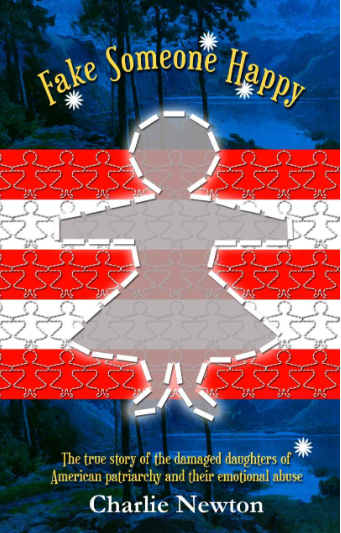
“Fake Someone Happy”: A Book Review by Rebecca Irene Gorman

Also by Rebecca on HA: “I Was Beaten, But That’s Not My Primary Issue With Homeschooling.”

Possibly over half a million American women obediently serve their parents’ households, locked in a perpetual childhood, with no means of escape.

Charlie Newton's "Fake Someone Happy" is about a young English musician who accidentally becomes entangled in the American Patriarchy movement.
Charlie Newton’s “Fake Someone Happy” is about a young English musician who accidentally becomes entangled in the American Patriarchy movement.

Call it the Quiverfull Movement, Christian Patriarchy, the Stay at Home Daughter Movement, or Reconstructionism — that’s as close as you’ll get to giving it a name. Adherents simply call it ‘obeying God’ or, even, ‘loving God’. What it is at essence is the modern American denial of women’s humanity, the entire deprivation of her rights, the erasure of her personality. And it’s vividly portrayed Charlie Newton’s recent non-fictional, anonymized short novel, ‘Fake Someone Happy’.

The story is about a young English musician who accidentally becomes entangled in the American Patriarchy movement. What begins as a joyful immersion into a community of loving, picture-perfect families devolves into an horrific submersion into a world of exploitation, coercion, and betrayal which challenges the heroine’s understanding of friendship, the world, and herself.

I highly recommend this book as a window into the world of American Christian Patriarchy.

As a survivor of this subculture, I can vouch for the accuracy of the depiction. In fact, this world and the plight of its survivors is rarely depicted in such vivid detail. Some might nit-pick at the fact that the writing does not constitute a literary masterpiece; however, the author has achieved the significant triumph of transporting her readers to this vast, hidden, and rarely-depicted dark world.

I do have some reservations about the book’s depiction of a survivor after her escape. The heroine’s unfamiliarity with the psychology of second-generation cult members and American Christian cultural norms manifests in understandable frustration which, however, the author fails to resolve. My suggestion to readers is to read this book in combination with others that delve deeper into the psychology of survivors of Christian Patriarchy and their journey of recovery, healing and growth.

To that end, I recommend the following books:

Quivering Daughters, by Hillary McFarland — The story of the exploitation of a daughter of Christian Patriarchy and her theological journey to empowerment and freedom.

Pilgrim’s Wilderness, by Tom Kizzia — A journalist’s masterfully written and insightful account of a Patriarchal family with subjugated adult children which moves to the Alaskan wilderness, with an excellent treatment of the psychology of captivity and escape.

Quiverfull, by Katherine Joyce — A rigorous investigation of the modern Patriarchy/Quiverfull movement.

“My Daughters Are Not Going Off to College”: When Homeschooled Girls Are Trapped

Screen Shot 2013-10-12 at 1.44.36 PM

HA note: The following is reprinted with permission from Julie Anne Smith’s blog Spiritual Sounding Board. It was originally published on October 12, 2013 with the title “Homeschooled Adult Daughters Held Captive at Home, Prevented from Getting College Education.”

*****

“There are too many homeschooled girls who need help overcoming the legal obstacles their parents put in their path to a college education. It also bothers me that the leaders of the Christian homeschooling movement preach that young girls shouldn’t get a ‘regular’ education – that they should only be trained in domestic arts and ‘female’ tasks.”

~ Nick Ducote, “Reflections on Malala, Patriarchy, and Homeschool Advocacy”

*****

In an effort to “raise up a child in the way they should go,” some Christian homeschool parents are essentially kidnapping their daughters, only teaching “homemaking” skills, even denying and preventing them from getting a college education.

The father is involved in all aspects of his adult daughter’s lives until marriage.

Earlier this week, my young friend, Nicholas Ducote, co-founder of Homeschoolers Anonymous, wrote something that resonated with me.  It hit me hard because this was a path our family was heading down.  He was writing about the plight he has seen among a number of young ladies who are part of the “Homeschool Movement,” the subculture of fundamentalist Christians who adhere to the Patriarchal lifestyle in which the father is very involved in all aspects of his adult daughters’ lives, even through adulthood until they are married — married to a husband approved by the father.

Nick, a former homeschool student, has earned his Master’s degree.  He knows the challenges he faced in getting his degrees. But it struck me how Nick was clearly upset about the injustices he saw facing his female homeschool peers.

In the Homeschool Movement, this educational imbalance among the sexes is not perceived as an injustice whatsoever. In fact, to even think of sending an adult daughter “off to school,” is to some, heretical.  As recent as a month ago, a homeschool mom and friend of mine posted on Facebook that her adult daughters would not be going to college — that she and her husband “just don’t believe in that.”

It makes me wonder: did her parents make all of her decisions when she became an adult?  Probably not.

Here is a screenshot I saved from a homeschool wives group on Facebook several months ago and you can see the similar mindset:

daughters1

I used to believe this way.  

In the Homeschool Movement, I was taught to believe that if we sent our daughters off to college, they would want to use that education, get a job, might even earn more money than their husbands.  This was “not right” because husbands were supposed to be the breadwinners and mothers were to be busy at home with the children.   They claimed this was all the work of feminists and the feminist influence on society was breaking up families and demeaning men.

Feminism was the cause of the moral decay in society.

I’ve been a homemaker for nearly 27 years.  I have loved staying home with the children.  It is wonderful for mom to stay home with her children.  But is it the only way?  Is it always possible?  Is it really all that black and white as “they” portray it to be?  Can we have decent families in which a mom works part-time?

Leaders in the Homeschool Movement spend an exorbitant amount of time selling their rhetoric in words and in materials (books, videos, blog articles) sharing what they believe to be the ultimate role of women as homemaker:  how to be respectful and submissive wives, how to cook, sew, how to raise children, etc.

If you are a young girl raised in this environment, your know your lot in life is:  get married to your approved husband, have many children, teach your children at home, and hopefully, your children will do the same.

It is important to note the basis of this ideology. The ultimate goal in the Homeschool Movement is to be fruitful and multiply and “take dominion” of the world.  Dominionism and Reconstructionism are foundational roots from which everything in the movement is cultivated.

Nick then discussed a young lady who has been in the spotlight lately, Malala.  If you are unfamiliar with Malala, I encourage you to read about this courageous young lady who is making her voice be heard in a country where women’s voices are squelched.

“Malala Yousafzai is a Pakistani school pupil and education activist from the town of Mingora in the Swat District of Pakistan’s northwestern Khyber Pakhtunkhwa province. She is known for her activism for rights to education and for women, especially in the Swat Valley, where the Taliban had at times banned girls from attending school. (Source)

Here is a video Nick included of Malala.  The Taliban tried to assassinate this young lady because of her powerful voice and she survived and her voice is even stronger and now has international attention.   Please listen to this amazing interview.

Nick writes:

What is especially disturbing is when you hear Malala talk about how the Taliban in the Swat Valley of Pakistan wants to take education away from girls. You would hope, in the 21st century, young women would have basic access to education.

I will be loud and proud about my homeschooling advocacy because my heart is broken on a regular basis when homeschooled teenagers trapped in fundamentalism contact me trapped, struggling to assert themselves and pursue the future they want. Sometimes parents deny FAFSA signatures, or they edit their transcript if they apply to an “unapproved” school. I have talked to homeschooled girls who were literally trafficked (for sex and for labor).

Some homeschooled adult daughters fare no better than Pakistani young ladies when it comes to education.

Nick is right.  We expect this kind of thing in Pakistan, but not in the US.  Some of these young ladies who have officially graduated from their homeschool high school are not allowed to even choose whether they go to college or not. College is simply not allowed. They are destined to be a “stay-at-home-daughter,” serving parents, helping with the remaining children at home, help with cooking, cleaning around the house, etc.

In the United States of America, we have young female adults — I said adults — who are living at the home of their Christian homeschooling parents, unable to make adult decisions of where they can live, where they can go to school, who they can be friends with, where they go on the internet, etc.  They are essentially forced to follow the path of their parents.  They are cut off from the outside because their internet use, cell phone use is highly monitored.

Now some of these young ladies go along with this without any dissension. This is the only life they’ve ever known. They have been sheltered from the “world” or society.  Their friends are people from church, from homeschool groups, etc.

This is their norm.

Some may do fine with this. They will allow their parents to help select a husband for them, get married, have babies and continue living the legacy their parents planned for them.

However, there are other young ladies who want to explore life outside of the life and rule of their parents.  They want the opportunity to go to school and further their education. But they are not allowed this opportunity. They are prevented.  How can this be? In this day and age?

These parents hold the keys to their adult daughters’ freedom. They are the ones who decide whether they will turn over their signed homeschool high school transcript. They are the ones who must sign and turn over info for FAFSA documentation for financial aid. They decide whether their daughters can get a driver’s license, work outside the home, etc.

In the United States of America, there are young ladies held against their will in their parents’ homes and they are trapped.

They don’t know where to go. They don’t know how to escape. They don’t know how to get schooling. They are completely isolated.

This is happening in our country — the USA.

Reflections on Malala, Patriarchy, and Homeschool Advocacy

Malala

By Nicholas Ducote, HA Community Coordinator

There are too many homeschooled girls who need help overcoming the legal obstacles their parents put in their path to a college education. It also bothers me that the leaders of the Christian homeschooling movement preach that young girls shouldn’t get a “regular” education – that they should only be trained in domestic arts and “female” tasks.

Some choice quotes from the Men’s Leadership Summit:

…It is the fathers who have a duty of lovingly leading their family, and fathers, not moms, will be overseeing the home education discipleship of their family.

…the movement within home education circles of creating an androgynous educational system where we view boys and girls as having the very same outcomes of careerism and world independence is contrary to the principles of the Word of God, which teaches that we should be training our daughters, ultimately to prepare themselves for the assumption . . . –and the assumption is, they will be married, they will be keepers at home.

…We will lose this movement and this work of God, men, if we do not govern our households. And that means lovingly shepherding our wives. The less you love your wife and the less you shepherd your wife, the more you create an open door for the female sin of the internet. The male sin of the internet is pornography. The female sin of the internet is gossip-mongering… They spend their day going from blog to blog gossiping. And some of you are letting them.

…The world is watching. When the lesbian, feminist, transgender publishing house Beacon Press decided to release their exposé this month on families that believe in large households, they knew exactly who to go for. Go to the internet assassins. Go to the blogosphere gossips and get the information to denounce and divide the homeschool movement directly from the wives who live on the internet, gossiping 24/7.

What is especially disturbing is when you hear Malala Yousafzai talk about how the Taliban in the Swat Valley of Pakistan wants to take education away from girls. You would hope, in the 21st century, young women would have basic access to education.

I will be loud and proud about my homeschooling advocacy because my heart is broken on a regular basis when homeschooled teenagers trapped in fundamentalism contact me trapped, struggling to assert themselves and pursue the future they want. Sometimes parents deny FAFSA signatures, or they edit their transcript if they apply to an “unapproved” school. I have talked to homeschooled girls who were literally trafficked (for sex and for labor).

Enough is enough.