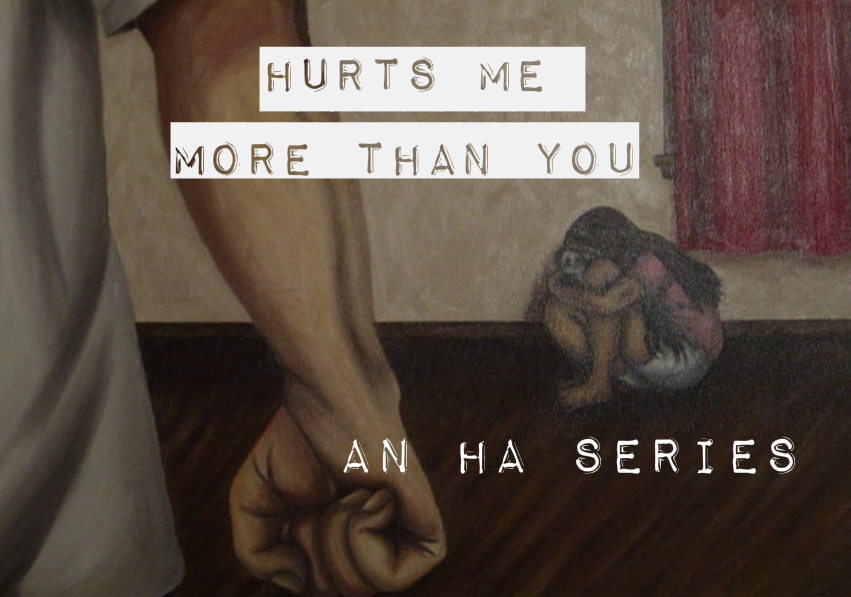
Hurts Me More Than You: glor and Gary’s Stories

Screen Shot 2014-09-23 at 10.15.16 AM

*****

Trigger warning for Hurts Me More Than You series: posts in this series may include detailed descriptions of corporal punishment and physical abuse and violence towards children.

*****

glor’s Story

My father’s study was a terrifying room, from birth until I moved out of the house. I’m sure it still is for my siblings. But I seem to have been the only one to get as much pain there that I did. I try not to think about why that is, because it’s a long, dark, ugly road. But it stands: my father beat me, though not with a rod. He started with a belt, and moved to a wooden spoon and then “the paddle.” It was one of those cutting boards, oak, I think… 5”x8” or so and about an inch thick. It was terrible.

It was terrible not just because I was getting smacked with a giant board – but because I became intimately acquainted with how it felt on bare skin. Yeah, bottomless. A lot of boundaries that should have existed were ruined when that thing came into the family. There’s a lot more I could say on that, but… that memory section has mostly vanished into the depths of my PTSD.

What hasn’t is the non-hitting corporal punishment: the physical labor.

I was tasked with a lot of stuff that my brothers were not, since I was the girl and all. All the laundry, most of the dishes, making sure all the bedrooms were clean, and so on. One of my doctors has said that she thinks I have fibromyalgia because of the abuse and work I was made to do. I know some of you are thinking that that’s not possible. But try “being forced to manually turn a garden and plant bulbs in the middle of a Colorado October while sick with pneumonia.”

That is why corporal punishment is bad: not only are you hurting your kid in the immediate, but you lose all sense of boundaries the child should have… like helping them to be healthy instead of seeing them as someone you can force to do things because they’re terrified of being punished.

Trust me… while I’m not physically still being punished [I moved out seven years ago], it’s still punishing me. Through my PTSD, my flashbacks, and the nightmares where I wake up screaming in the middle of the night.

I may be free from more, but I will be punished the rest of my life by what I’ve already experienced…  thanks to corporal punishment.

*****

Gary’s Story

I never heard my parents say anything even remotely close to “It hurts me more than you.”

For one thing my “spankings” were very rarely thought out. They were rarely “punishment” for some infraction, they were most often spontaneous beatings by my enraged father, enraged for any number of trivial reasons.

One episode demonstrates this best.

I was nine years old.

My father had been hired on a contract basis to clear brush from 180 acres of forest land. The man who owned the land assumed that my father would be working this job himself. Of course this was far from true. My father would wait till he knew the man was not in town, pile all us kids into the van, drive us to the land and work us, for a solid eight or more hours. Unpaid. Under the radar. During school hours.

“This IS your “schooling” he would say, “Learning how to work”.

This kind of thing was standard for my childhood, and one of the major reasons we were homeschooled. Work. Hard work. Unpaid work. Grueling work. Dangerous work. Mind numbing work. 

Not chores. Not house hold duties.

Work. Real work. Work with chainsaws and lumber, work with shovels and rakes and hoes. Work that left blisters.

Work that my father was paid for on a “per job” basis.

Work us children never got a dime for.

All of this work was made possible only because we were homeschooled, because we could be worked 8-10 hours a day any time of the year.

It was early spring. Snow still held the shadows under the trees in an icy grip. As we headed into the forest to work, breath puffing in the cold predawn air, my father turned to me and said: “I forgot the gas for the chainsaw, go back and get it out of the van, and don’t dawdle.”

His voice was level and normal, showing absolutely no sign of the rage to come. I walked back, walked carefully, one foot in front of the other. Why? Because we were on a rutted logging road, and the deep ruts were filled with water several inches deep, crusted over with a thin film of ice.

And my boots were old and full of holes, passed down from 3 siblings before they got to me. I had never owned a new pair of shoes. Not once. My first pair of new shoes was bought for me by my Grandparents when I was 12 years old, so I wouldn’t have to wear ragged sneakers to their 50th wedding anniversary. I knew that if I got my feet wet I would work in the cold and snow for 8 or more hours with wet feet. No question about it. So I walked carefully, one foot in front of the other down the ridges between the water filled ruts.

This, was apparently, “dawdling.”

I heard an enraged scream from behind me, and turned just in time to see my father rip an ice encrusted tree limb from the frozen ground, it was a big one, two and a half feet long and twice as thick as a broom handle.

The beating went on for about 30 seconds.

Do you know how many times a enraged man can swing a club in 30 seconds?

Do you know what kind of damage it does to a 9 year old boys body when swung with the full force of grown man’s work hardened muscles?

That night my mother was worried enough about what she had seen to ask me to “show her”. Even she recoiled in shock.

I was covered in now black bruises about three inches wide from my lower calves to my lower back. At least 30 blows had rained down on my skinny frame.

This kind of beating didn’t happen all that frequently. But I still have nightmares at least twice a year.  At 31 years old I still wake up with clenched teeth and a racing heart. In my dreams, I am small and helpless.

In my dreams I cannot escape. In my dreams my father is beating me.
I Am a Survivor: Elizabeth W.’s Story, Part Two

Screen Shot 2014-09-16 at 11.30.22 AM

< Part One

Trigger warning: graphic descriptions of physical and verbal abuse.

Part Two

Looking back, I can see that after we moved and no longer had immediate neighbors to hear the screaming when she beat me or my brother, she felt much less restrained and the violence increased in frequency and intensity.

If I was quiet and withdrawn (which was pretty much always) and mom decided my quietness was “rebellious” or “disrespectful”, or if I forgot to say “ma’am” after addressing or answering her she would begin screaming at me, calling me a disrespectful whore/slut/tramp/bitch, while simultaneously slapping me across the face hard enough to knock me down. She began to use bigger and better weapons than her hands and the bristle side of a hairbrush. I was beaten with length of copper pipe, pieces of two by four, a thick wooden yardstick (which broke on me eventually), thrown down stairs, had my wrists twisted until she forced me to my knees, screaming in agony, was dragged around the house by my hair and my head bounced off any and all hard objects. She tried to suffocate me several times, held me down and forced a pillow onto my face with all her weight, while screaming she was going to kill me and she wished I would die. I had my head and face forced under a pouring tub faucet and held there until I thrashed my way out of her grasp.

These things happened at least several times a week, sometimes more than once a day, interspersed with the verbal abuse, and her refusal to address me by name, but rather as “bitch” or “slut’. I was regularly told I was “ugly”, “fat”, “disgusting”, “crazy”, and “stupid”.

For those who think I may have been a “difficult” teenager from 11-16 or so when this pattern really took off – I never raised my voice to my mother, never cursed at her, never had friends over or snuck out, never wore anything other than black, baggy clothes (which is hardly slutty), never disobeyed a direct order, never did an illegal drug, smoked or drank, and only ever argued by politely stating I didn’t want to do something, or I thought she was mistaken. The latter two always resulting in a beating or several, so rarely did I dare say no to anything.

In public, my siblings and I were always perfectly behaved, rarely speaking, never making noise of stepping out of line. Mom only had to give us that angry glare that promised later retribution for us to think twice about doing anything at all. There was no one around who knew us beyond the brief homeschooling afternoons with the LEAH group who could have possibly known that anything was terribly wrong in our house. We were so isolated, there was no one I could have spoken to, even had I found the courage to do so.

We’d been trained to fear the authorities and Child Protective Services and had no friends or family to speak of.

Mom “volunteered” me to go work at St. Vincent de Paul soup kitchen once a week to win points with the local Catholic church she dragged us to once in a while. At first I was furious that she had volunteered me without even asking me, but after a while I realized it was a few hours a week out from under her thumb and grew to enjoy it. Mom also signed me up for confirmation classes at the local Catholic church, after she had begun attending workshops run by a fundamentalist Catholic homesteading family who also homeschooled their twelve children.

Mom decided it was time for all of us to get more “spiritual”, and began three times a day “prayer circles” where we would all be forced to sit and read aloud from the Bible and sing hymns that the “Fahey’s” (the Catholic family she was imitating) sang. She instituted a clothing change, head-coverings for the girls (I refused), she began making ankle length dresses for herself and us (I also refused), and only long sleeved button down shirts for the boys. She threw out our shorts and t-shirts, started getting rid of her college feminist lit, and any and all of our books she found too “worldly”. Mom sold the computer my grandparents had bought for us, got rid of our tiny video and cd collection, and began instituting even stricter rules for us to follow. So during these changes I attended confirmation classes at the local church, which I despised and between the forced Bible study there and the forced Bible study at home quickly grew to despise Christianity and the confining, narrow-minded tenets the Bible espouses. I never spoke my thoughts aloud, but my mother could tell from my face when I wasn’t agreeing or complaisant enough and my face invariably led to new beatings and verbal abuse.

Mom began to use the Bible as an additional weapon, quoting the “Thy shall honor thy father and mother”, and telling me that God said I must be obedient and respectful to her. (Even though I was always obedient and never voiced any disrespect.) This just furthered my disgust for the Bible, although I now see that, like homeschooling it was simply being used by my mother to her ends, not necessarily bad unto itself.

I was falling deeper and deeper into a depression that seemed like it was swallowing me whole. I started sleeping really late every day, shuffling through my duties with my head down and my mouth shut. I began snapping at my siblings when mom wasn’t looking, I had no patience for their demands for my attention or their quarrels. My brothers began fighting viciously with each other, first when mom was out, later even when she was home, resulting in beatings for them as well as me. I knew my mother hated me, I didn’t know why.

I tried so hard, for so long, to be what she wanted me to be, obedient, respectful, responsible, but never seemed to find her approval or even a respite from her rage.

I am, at my core, fundamentally an honest person, having no talent for acting, for pretending to be happy when I am not. This was my downfall. If I had only been a better actress, perhaps I could have fooled her into thinking I was, in fact, what she wanted me to be, rather than merely doing whatever I was told with my face betraying my misery and despair.

I tried to kill myself twice.

Once, at summer camp, I stepped in front of an oncoming semi truck with a feeling of exultant freedom and calm. A boy who liked me happened to be standing nearby and turned around and yanked me out of the road as the truck went by. The second time, my brother Alexander and I were coming home from the paper route and I decided the easiest way to end my misery would be to poison myself. I picked a handful of deadly nightshade berries and was about to throw them down my throat when my brother jumped up and slapped them out of my hands and started screaming and crying hysterically.

I felt sad, resigned, and guilty for terrifying him so, and didn’t try to kill myself again.

1997, was the last year of my paper route as mom decided it was allowing me too much freedom and she wasn’t making enough money off of it/me to be worth the trouble, so she called my boss and “quit” for me. I was devastated by this, as it was among my last outlets for momentary respite from the hell that was my home.

The following year I got my first real job, washing dishes at a local pizzeria for minimum wage. I was ecstatic at being able to get out of the house a few evenings a week and being allowed to save a little money to buy a puppy for my sixteenth birthday. After about six months, my mother called and told my employer that I could no longer work there because I was sleeping with a married 30 year old man who was a coworker there. All this because I had spoken to him on the phone (about a dog) while she was listening in, and she said she could tell we were having sex by the tone of his voice. Really. There was no other evidence for her accusation, that was it. Mom convinced herself that this was true even though both he and I told her she was mistaken and crazy. She then beat me, off and on, for the next two days for this delusional belief until I could stand it no longer.

I packed my things and lived on the streets of Buffalo for next three weeks.

I camped out in the basement of an abandoned apartment building, slept in a refrigerator box when I could, and mostly just tried to process what on earth to do next. Going home was not an option, if I stayed another minute I knew I would kill myself, I felt as if I was being slowly crushed by my life and there was only a spark of life and spirit left. After a few weeks, I found a runaway shelter who helped me track down my biological father who came and got me.

My mother’s insults and degradations became ever more creative and hateful, designed to wound. They did. To this day, simply recalling these things makes me shake uncontrollably and I do not believe that my littlest sisters should have to wait until things get as bad as they were when I was driven to the streets before someone should step in. I have only waited this long because I had hoped that mom had changed her behavior as she claims, and because she is still my mother and I was, (and still am) hesitant to speak the truth and have her never speak to me again.

Contrary to what I’ve been told by DCS when I made a statement regarding my two sisters still trapped there, physical abuse is not the only threat to a child at home. Emotional and verbal abuse leave damage far deeper, with myriad consequences to a child. Emotionally fragile, sensitive teenage girls do not need to have what little self confidence and self respect they have destroyed by the one person in the world who is supposed to support them, believe in them, and give them strength to take on the struggles of life. My mother does not, and never has provided any of those things.

On the contrary, her words tore me down to the ground and I have spent half my adult life rebuilding my self image and confidence solely because of the things she said every day of my childhood.

End of series.

I Am a Survivor: Elizabeth W.’s Story, Part One

Screen Shot 2014-09-16 at 11.24.07 AM

Trigger warning: graphic descriptions of physical and verbal abuse.

Part One

My name is Elizabeth and I am a survivor.

I am the oldest of seven children, two of whom are still trapped in the isolated, abusive world created by our mother. My mother began “homeschooling” in the fall of 1993, immediately after three of her four children were returned to her by the state of New York. I had been placed with my biological father for the previous nine months, while my siblings were in a foster home as both their biological father and our mother were in jail.

Our mother had been charged with child endangerment and was mandated to attend counseling.

I am unsure whether she did or not, however, her abusive and violent behavior continued only to escalate after this time. I had been miserable being placed with a father who was virtually a stranger to me, and over a thousand miles away from my brothers and sisters. In October of 1994, I finally convinced my dad that I wanted to be with mom and my siblings, so he took me back. A decision I would live to regret in many ways, but looking back, would not have chosen differently at the time.

My mother informed me that from now on we were all going to be “homeschooled” so that no more nosy teachers would be interfering in “our” (her) lives. One of my youngest step-siblings had made some mention to a teacher of the rampant domestic violence that routinely rampaged through our home. (Thus the subsequent investigation and arrest of both our parents.)

Homeschooling was the first step my mom took to make sure no one could get involved through children’s loose tongues ever again.

While mom had always been explosively violent with me I didn’t remember quite so many constant beatings and verbal abuse before this all happened. After my return from my dad’s house, mom began to turn on me with sudden and unpredictable rage. She slapped me across the face multiple times, knocked me down and dragged me around by my hair, repeatedly slamming my head off the floor or walls. All the while screaming that I was lazy, stupid, ungrateful, “just like your father”, “you’re a traitor, you’ve betrayed me”. Often the attacks seemed to be triggered by her simply looking at me, and not liking my facial expressions, she would look at me and say that I was looking “rebellious” if I happened to be unhappy and withdrawn that day. I often heard that I looked just like my father, which also seemed to set her off. We stayed in the new apartment for another month or two before mom and my stepdad got back together and moved into a new place in Buffalo, New York in December 1993.

Mom and my stepdad together were a volatile mix, two different kinds of mentally unwell and two different kinds of violence. My stepdad beat her and she in turn beat us, mostly me. She often told us that if we ever spoke to anyone about what was going on that we would be separated and sent to foster homes and juvenile detention centers for bad children where we would be beaten every day.

She also taught us to fear the police and whenever she saw one or they were called to the house to investigate all the screaming, she would freak out and tell us to hide and keep our mouths shut.

Once in the new apartment, mom continued to “homeschool” us, which consisted of buying a few textbooks (sometimes grade appropriate, sometimes not) and telling us to go to our desks and “do school”, for a few hours a day. Many, many days I was interrupted by mom telling me I needed to “watch” the newest baby for several hours while she talked on the phone or went and did errands. I spent so much time caring for my newborn sisters that two of them actually called me “ma”, until mom heard. This was one of many things that set off her punching, kicking, pulling me by the hair and trying to break my face routine. I can honestly say that was the extent of my “schooling” for the next six years until I left. Mom did the New York State required “quarterly reports” on our progress, usually late and always false. We also took the mandatory annual CAT tests and usually scored fine on some subjects and poorly on others. Mom officially enrolled us in the Clonlara Homeschool Association that year, which meant she bought “curriculums” from them (which we never used) and we went to their annual conferences a few times.

Spring of 1994, my mother arranged for me to work a large paper route that covered 12 city blocks on our street. I worked that route for the next four years, eventually adding another 12 blocks. I was robbed twice in two years, first when I was thirteen and a guy in a football helmet jumped out of the bushes and held a gun to my back and demanded I hand over the money (paper route money). My mother took all of the money I earned except for what I needed to buy dog food for my dog. She also pushed me to take other jobs. I mowed people’s yards, did landscaping, house cleaning and babysitting. I was never allowed to keep any of the money – this was how she was supplementing the family budget, as she never worked.

Soon after we moved to Buffalo, Mom joined a local homeschooling chapter of born again Christian homeschoolers, LEAH (living education at home). Aside from the one or two weeks a year I was allowed to go to a local YMCA camp, and the occasional summer soccer games with the kids on our street, LEAH was the first regular social interaction I’d been allowed since I left public school in 1993. None of us kids were thrilled with the group, being very religious and preachy and we were not (yet). However it was a few hours a week that we got to leave the house and be out from under mom’s constant supervision and iron rule, so we made the best of it.

The winter I turned 14 our car was repossessed and mom began sending my little brother and I to do all the errands during “school” time.

We walked miles through the Buffalo snow to get groceries and the mail (at the post office) every few days. I was also expected to do nearly all of the housecleaning, mopping every room, sweeping, dishes, folding laundry (for seven people) as well as most of the babysitting. There was very little time I could have done “school” even had I been brilliant enough to teach myself a sixth thru tenth grade school education. As it was I spent my free hours immersing myself in books I borrowed from the library, ranging from fiction to history, anthropology, classic literature to feminist studies. I credit the natural inclination of my curious and inquiring mind combined with my access to a library with my ability to survive any and all later academic pursuits.

Before long the constant screaming of our mom and my stepdad echoing through our apartment drove our neighbors crazy and they asked the landlord to evict us. Winter of 1996, we moved a mile down the road into a HUD (low income fixer upper) house, the first my parents had ever owned. Outwardly, things continued much the same, I had my myriad jobs, housecleaning and babysitting duties and mom sat at home and talked on the phone or did “bills” all day. We still attended the LEAH group, though not regularly, and often escaped for a week or two of summer camp.

After the move, we didn’t make new friends, so spent even more time in the house, and grew gradually ever more isolated. Mom slowly alienated her family although her parents and sisters made a valiant attempt to stay in touch long distance. Mom had an unparalleled ability to say cruel and hurtful things and make people recoil and stay away. My stepdad’s family was not accepting of the biracial aspect of our family and with the exception of one uncle, made no attempt to be part of our lives. Neither mom nor James had a single friend that I knew of, no one ever came to our house. We weren’t allowed to have friends over, talk on the phone, use the computer, listen to music, or even have uncensored mail.

This quickly put a stop to any attempt on our parts to have even casual friends.

Part Two >

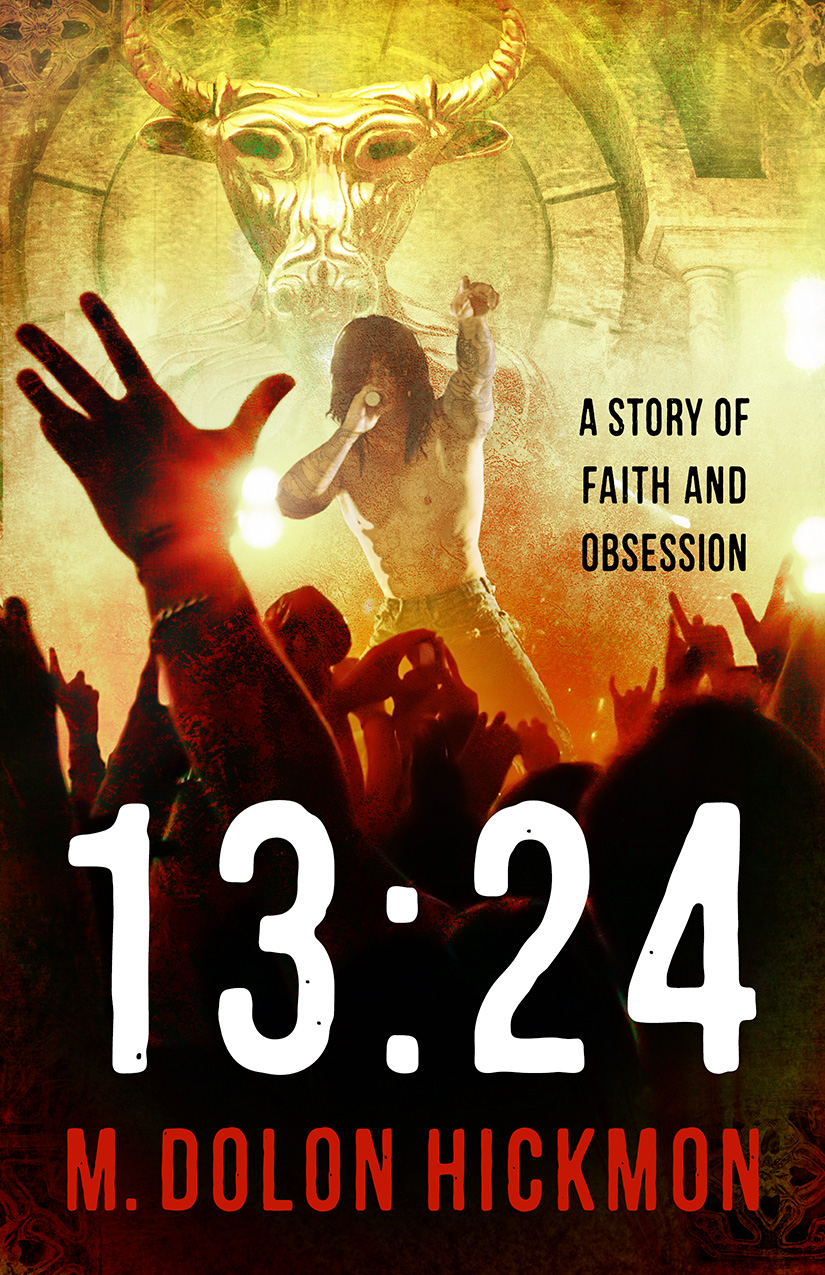
An Interview with “13:24” Author M Dolon Hickmon

Artwork courtesy of "13:24," http://1324book.com.
Artwork courtesy of “13:24,” http://1324book.com.

Note from R.L. Stollar, HA Community Coordinator: I am honored to interview M Dolon Hickmon, author of the brand new novel “13:24,” for HA You can read my review of his novel here. Hickmon is a child abuse survivor, a writer and an anti-abuse activist. He married his wife in 2007, and they have one daughter together. He dedicates his time and skills to advocating on behalf of mistreated children, often in cooperation with children’s rights groups and other advocates. Learn more about him at his book’s website here.

*****

M Dolon Hickmon is a child abuse survivor, a writer and an anti-abuse activist.

HA: Thank you for being willing to do this interview. Can you tell us a bit about your personal background?

MDH: My parents were ‘saved’ in an Independent Baptist church when I was between three and four years old. It was a high-control group, with a family model based on male dominance. My earliest memories are of beatings and of witnessing domestic violence. Our pastor’s solution to spouse- and child abuse was to call for perfect obedience, so that the family head would have no reason to be provoked. Fortunately my mother kept trying until she found a secular psychologist who helped convince our abuser to leave that church.

HA: 13:24 is an intense, brutal, and deeply personal — yet vastly accurate — read. What inspired you to write it?

MDH: The easiest way to answer that is with a comparison: Thirty years ago, child molesters were pictured as violent rapists, who attacked unwary strangers. Victims were expected to make an immediate outcry. Meanwhile, accusations against coaches, parents, or priests were met with disbelief, or dismissed as bizarre flukes. Today, we know that society had those percentages backwards; it was actually stranger attacks that were a vanishing minority. But it took decades for sexual abuse survivors to convince schools, churches, police officers, prosecutors and judges that their policies were based on bad assumptions.

Today, on the subject of physical abuse, society is where we were on sexual abuse fifty years ago. Our entire system of thought is based on a set of almost clownish stereotypes. 13:24 exposes our false assumptions. It is based on real crimes, on real science, and on real survivors’ experiences. But what makes it disturbing is that when people are exposed to the truth, they immediately realize that our entire culture is off in the woods, when it comes to dealing with this problem. We are fighting imaginary boogeymen, while the actual perpetrators walk free among us.

HA: There are so many different ways you could have written something powerful about your personal experiences and the impressive amount of research you have done of the subject of religiously-motivated physical abuse. What attracted you to a novel as your method of delivery?

MDH: Outside of therapy groups, discussions of physical abuse tend to be dominated by the opinions of people who have not experienced it. These people are often kindhearted and well intentioned, but their understanding of the problem is shallow. It’s hard to address their mistaken beliefs, because they hold the majority and agree with one another. The novel is unique because we remember what we’ve read as if it were a personal experience. I think this is the key—for the majority to have a way of adding the victims’- and survivors’ perspective to their pool of shared experience.

HA: It has been noted — by people who grew up in cultures similar to the ones you describe in your book — how uncannily accurate your descriptions are of certain thought-patterns and sociopolitical realities within conservative American evangelical worlds. You also go into great detail about police and social work. Can you describe what your research process was and how long it took?

MDH: Often, it was as easy as Googling a phrase that I recalled my abuser had said. I also consulted with quite a few authorities, including a psychologist and trauma researcher, a retired vice detective, an active Postal Inspector, a working dominatrix, a police dog trainer, and others.

HA: Even though you tell the story through words in a novel, you really paint a vivid picture of Rehoboam’s music — lyrics, rhythm, melodies, even what their live performances feel and sound like. Why did you place such an emphasis on music?

MDH: In several instances, readers see an instigating childhood experience, and then discover through Josh’s lyrics how his adult mind has processed that event. However, the music is also part of a much bigger social dilemma: When a teenager commits murder, society is quick to consider to the influence of music, television or videogames; but when innumerable parents discipline their children to death, people are reluctant to examine the claims that are being made in the parenting advice that all of them read. I don’t know the answer, but I found the double-standard interesting to consider.

HA: 13:24 ends on an emotionally somber note: neither prescriptively hopeful, nor necessarily hopeless. Without giving anything away, can you talk about why you chose to end on the particular emotional note you did?

MDH: People who overcome child abuse are remarkable, because they have accomplished something that is both difficult and rare. I think the media belittles that accomplishment by making it seem as if every child abuse victim overcomes and is stronger for that experience, in the end. The reality is that there are a lot of unhappy endings. Children die, and those who survive often wind up addicted, or in prison; they make messes of their marriages, and do regrettable things to their own kids. I think 13:24 offers readers a balanced ending, which reflects the range of responses that are normal for human beings.

HA: In your discussion of religiously-motivated physical abuse, both in the novel and elsewhere, you hold nothing back in pointing to how pervasive the relevant problems are: existing not only private schools and home schools, but also public schools. What are some facts you think are important for homeschool advocates in particular to know about parallel problems in private and public schools? And how can or should we work together to address these problems?

When it comes to sexual abuse, we now realize that it is not enough for adults to be watchful and protective; children must be taught to protect themselves, because when abuse occurs, it is usually only the victim and the perpetrator in the room. We need a similar revolution in our thinking about physical abuse. You can’t leave it to parents, because abusers are never going to willingly give victims advice on how to escape. So whether you are a pastor, a neighbor, or family member, the obligation is for all adults to appropriately discuss physical abuse with the children they come in contact with. Kids should know that discipline does not leave children injured or scarred, or feeling worthless or terrified.

HA: One of my favorite sections in 13:24 was the “group therapy” scene were characters talk about the real physiological impacts trauma can have on the body, particularly the brain. Do you think there’s any connection between religious fundamentalists’ fear of taking mental health issues seriously and their unwillingness to talk about child abuse?

MDH: The church is certainly not the only institution that is failing to fully address those two issues. But given that corporal punishment is no longer recommended by any group of secular experts, I think the responsibility is now on pastors to be proactive in educating very young church members about the difference between discipline that is constructive, and physical abuse, which only contributes to mental health problems, substance abuse and rebellion.

HA: What’s next for you? Are you writing another novel?

MDH: I am in the pre-planning stages for a second novel. This one will also deal with abuse and spiritual themes.

HA: Thank you once again for doing this interview. Any closing thoughts?

MDH: I would like to ask everyone to consider how your own conversations about child discipline might seem to a child who is being physically abused. Are you explaining correction so that a five- or nine year old abuse victim can understand when she needs help? Do your words convey that abuse is unacceptable and that other adults will believe and protect? Because if you are not teaching kids to protect themselves from physical abuse, who will?

*****

Homeschoolers Anonymous is pleased to announce that we are teaming up with M Dolon Hickmon to give away free hard copies of his powerful new novel, 13:24Click here for information on how to enter.

This Present Darkness: A Review of M Dolon Hickmon’s “13:24”

* Read our exclusive interview with M Dolon Hickmon and enter our 13:24 Giveaway. *

By R.L. Stollar, HA Community Coordinator

The highest praise I can give M Dolon Hickmon’s debut novel is a trigger warning: While I believe that everyone everywhere needs to read this book, I must urge those with a history of physical or sexual abuse to approach this title with care. I personally had a nervous breakdown after I finished it; I couldn’t breathe because it felt like someone had punched me in the gut. And I could not console myself by saying, “This is fiction.” It isn’t, as anyone who has experienced child abuse will recognize.

1324
Hickmon gives readers an uncommon gift: a brief look behind the curtain of tragedy, a fleeting chance to understand a little more than we did.

In his prologue, the author explains his intentional use of real-life parallels, based on his childhood experiences and research into religiously-motivated child abuse. Also examined are the intersections between child trafficking rings, physical and sexual abuse, and fundamentalist cults. Woven with fictional elements, these create the book’s complex, dark, and brutal narrative.

13:24 is the story of two young men: Josh, a rising rock star, and Chris, the neglected teenaged son of a drug addict. Their stories begin distinct and distant, but as the novel develops, their pasts—and futures—are revealed to be connected in ways that both shock and disturb.

The story opens on a gruesome murder. While the body count rises, questions multiply as a small-town detective chases Chris as a murder suspect. Along the way, readers encounter events and characters with uncanny real-life parallels: Josh has flashbacks of being abused by his minister father, who resembles Michael Pearl and advocates harsh physical punishment; in another thread, a controversial parenting manual is linked to a spate of discipline-related deaths, bringing to mind real-life cases, like those of Hana Williams and Lydia Schatz. Elsewhere, an imprisoned child abuser is freed through the efforts of a “homeschool legal defense fund”, reminiscent of the Home School Legal Defense Association. At the same time, an oily “Christian psychologist” heads a James Dobson-esque media empire, with tendrils in state and national politics.

13:24 may be fiction, but it describes the lives of any number of people I have known. In its imagery, I recognize moments that friends and colleagues have breathed and suffered through. That is what made this novel so hard for me to read.

The book exposes what many religious and homeschooled children experience every day. Readers witness their pain and hear their cries. We see their misery multiplied when it is justified in the name of God; we see their tragedies covered up to save face and preserve religious “freedom”. And unlike a Frank Peretti novel, there are no angels rushing in to the save the day. We must pick up the pieces and fight this present darkness.

Despite the darkness, 13:24 has a poetic beauty. That beauty is in the narrative symmetry: a murder begins it and a murder concludes it. While death marks where the story begins and ends, there is a profound shift in what those deaths mean. This is the power of Hickmon’s prose: he delves deep into pain, into what he has described in his subtitle as “faith and obsession,” and shows us the human faces behind news headlines’ “monsters.”

13:24 is not easy reading. It is neither uplifting nor redemptive. It will crack your heart open, set your blood on fire, and turn your screams into music. Most significantly, the characters’ actions are neither justified nor condemned by the author. He simply allows them to exist. In doing so, Hickmon gives readers an uncommon gift: a brief look behind the curtain of tragedy, a fleeting chance to understand a little more than we did.

When Homeschoolers Turn Violent: Matthew Liewald

Screen Shot 2014-03-02 at 5.36.11 PM

Series note: “When Homeschoolers Turn Violent” is a joint research project by Homeschoolers Anonymous and Homeschooling’s Invisible Children. Please see the Introduction for detailed information about the purpose and scope of the project.

Trigger warning: If you experience triggers from descriptions of physical and sexual violence, please know that the details in many of the cases are disturbing and graphic.

*****

Matthew Liewald

On September 26, 2011, 15-year-old Matthew Liewald called 911. The North Carolina teenager said he shot his father and stepmother.

On September 26, 2011, 15-year-old Matthew Liewald (center) shot his father and stepmother to death.

Matthew was being homeschooled by his father, 43-year-old Christian Hans Liewald. Christian called the homeschool “Liewald Alternative School.” Christian was married to 24-year-old Cassie Meghan Buckaloo.  According to neighbors, “Matt rarely came out of the house and the family kept to themselves.” Christian, Matthew, and Cassie were “beloved members” of Morningstar United Methodist Church, according to their church’s pastor. The pastor described Christian and Cassie as “generous and loving.”

Matthew’s birth mother, however, described Christian as “hyper controlling and wouldn’t allow her to see her friends.” Christian had several prior wives, all of whom said they “suffer physical abuse” at his hands. Matthew himself said he “was afraid of his father,” was physically abused, and forcefully confined to his room. He had wanted to run away from his home, but his father allegedly told him that, if he ever ran away, he “would find him.” In 2007, Matthew personally witnessed his father shoot his neighbor in the chest during an argument.

On the day of the murders, Matthew waited until his father and stepmother came home and then ambushed them. He shot Cassie 8 times and Christian 4 times. He then called 911 and said he needed help, refusing at first to say why and hanging up. He then called 911 a second time, saying that he had shot his parents. He told the police that he would be “sitting on a nearby street corner waiting for officers to arrive.”

Matthew was charged with two counts of murder, armed robbery, and attempted auto theft. He pleaded guilty and was sentenced to 300 to 378 months in prison.

View the case index here.

Wifely Duties and Baseball Bats: Morgan Dawn’s Story

Screen Shot 2014-01-21 at 3.47.26 PM

HA note: The author’s name has been changed to ensure anonymity. “Morgan Dawn” is a pseudonym.

Trigger warnings: rape, extreme physical abuse.

At the age of 3, I was adopted by a Navy couple.

Life was great for about 6 weeks, when they adopted a baby boy. That was when the horror began.

I was pushed aside, because I was “just a girl.”  By the time I was 10, the couple had 3 biological kids, on top of myself and the other adopted boy. My adopted mother had lots of health issues, so she was either pregnant or sick.

My adopted father decided that since his wife wasn’t able to perform her “wifely duties,” that job would fall to me. The rapes were a weekly occurrence from then on. When I went to a DOD school official, my family decided that the “safest” thing for me was to be homeschooled. After all, I was a pathological liar.

Right there, my life changed.

They started reading everything they could about “To Train Up a Child” and proper disciplines for “obstinate children.”  Drop a glass on the floor?  I had to stand on that glass until my feet were bleeding badly.  Slam a door?  My hands were slammed in doors until I couldn’t help but pass out from pain.

I would sneak out of the house to see my boyfriend at night. One thing led to another, and by 13 I was pregnant. The father was killed in a drive-by shooting when I was 6 months along.  I managed to hide the pregnancy (my adoptive father was on deployment to the Middle East, so no one was close enough to tell) until he got home. He wanted sex, and I said no.

O, the pain that “no” would cost me.

He took a baseball bat to my body for hours.  By the time the paramedics were called, I was hanging by a thread, and in preterm labor.  They said I’d never walk or talk again.  My daughter was given (without my permission) to a family “friend” who let her drown in a pool on her 6th birthday.

Homeschooling hid everything.

No one really saw me anyways, so not seeing me at all because I was in body casts didn’t alert anyone. When my face had to be reconstructed for the 2nd time, everyone was told that my biological family had passed on defects that needed fixed. Schooling was “Here’s a book, read it and be prepared to debate on it”, but if the debate wasn’t “right” I’d get beat. It was hell.

By 18, I was ready to leave. By then, there were 10 kids total, and I was expected to sacrifice college to take care of them all. I couldn’t. So, one night, I left and never looked back. I’m now forbidden to talk to anyone in the family.

They were all told that all I was was a whore who left because I was pregnant.

I moved out of state with the help of a few friends that had known me before I was pulled from school. Apparently I was the only reason for homeschooling, as the other kids are all back in school. I was the evil sinner who needed punished.  And now, I love that title.

At least this “evil sinner” is now living life the way she wants. I’m currently in school for Social Work, living with my biological mother, engaged to a wonderful man, and happy.  The happy is so strange, but I like it.

There is hope out there.

To My Baby Brother: The Things You’ll Never Know, by Jessica

sisterbrother

Also by Jessica on HA: “Copy Kids—The Immorality of Individuality” and “Christian Discipline, A Child’s Perspective.”

To my baby brother:

I know we don’t have the best relationship.

I know you think I’m ungrateful for the things my parents gave us. I know you think I ran away that day when I was 18.  I remember the day you told me I abandoned you.  I know you weren’t as mistreated and I am glad for that, because I’m your big sister.  I love you.

I can prove I love you in the things you’ll never know.

When you were little, you  liked to flush things down the toilet.  Dad was always snaking the drain in our little 2 bedroom trailer house.  It’s a  quirky kid thing.  One day, when you were 3 and I was 7 or 8, you flushed a match box car and clogged the drain.  Dad found out.  You ran to the bedroom screaming and locked the door.  You were 3.  You weighed 30 lbs soaking wet.  When dad got that door open, he sat down cross legged on the floor with you on his lap and started punching you.  I ran for him.  She made him stop.

I took a beating for you that night.

It was worth it and I would do it again.  This was the first time, it wasn’t the last.  I learned to take credit for your mistakes whenever I could when you were little.  I wish I had told him I flushed the car.

That day when I was 18, the day that made me leave, I cried all night.  I knew I had to leave.  I knew I wasn’t safe.  I knew being choked by my dad wasn’t normal.  I didn’t cry because I was worried for myself or that I was going to miss my parents.

I cried because I couldn’t take you or my older brother with me. 

I want you know though, I fought for you.  I spoke to your school about counseling for you.  I talked to social services. I spoke to an attorney.  I wasn’t trying to abandon you.  I thought about you every day and grieved when I was told their was nothing I could do.

You were just barely a teenager then and whether they will admit it or not, my parents learned something about smothering a teenager.  It backfires. You, little brother, were in public school after kindergarten and received a full education.  Be grateful for that, you’ll never know how valuable that is.  You were able to take drivers ed.  I heard one year that you were out celebrating halloween with your friends and I cried that day because I realized they were giving you freedom.  You were allowed to date.  You were given a car and they assisted you with college.

I am glad that they gave you a better a life. 

You were however, still abused.  I can’t say that enough and you need to hear it.  Dad was beating you too.  I remember your middle of the night cries.

So little brother, when we discuss these painful things, I need you to try to remember how things were.  I payed a price in love to try to make your life a little better.  I need to you to try to remember and see things from a little different perspective.  I don’t want you to stop loving mom and dad.  You guys have a good relationship.  I just want you to know that I fought for you.

I did not just run away. I didn’t abandon you.

Christian Discipline, A Child’s Perspective: Jessica’s Story

Screen Shot 2013-10-23 at 9.59.19 PM

Also by Jessica on HA: “Copy Kids—The Immorality of Individuality.”

*****

Trigger warning: graphic description of physical abuse.

*****

Awaking from a fitful slumber, I turn over and squint to see the clock.

It’s 2 am, dad is home.

Who will it be tonight? If I hear one of my brother’s screaming, it probably won’t be me. I close my eyes, clasp my hands. “Dear God, I know you’re busy and I know this is selfish, but please just let dad go to bed tonight.”

I hear boots in the hallway and I curl into the fetal position under my blanket, shaking.  Please not me. Please not me.  Please not me and click, my door knob turns.  It’s me.  I pretend to be asleep.

“Get up.” 

No explanation. I do not know what I did. It does not matter. I stand up, shaking. Dad slings me over the side of the bed and I sob, “Please dad, please don’t.”

Swat. 1….2….3…

I make the mistake, I put my hands over my buttocks.

“Daddy please stop”

Crack!

A heavy leather mechanics belt slices into my hands, instantly excruciating and yet numb. I move them quickly or he will hit them again.  Painfully slowly, biting my cheek until it bleeds. I count in my head. 4…5…6….7……..18….19…20…21….22…. and it ends.

I collapse on the bed.

Dad says “I love you.” Then he turns and walks out shutting my door behind him. 

I listen to the boots walk down the hall and disappear. Silently, I walk into my bathroom, vomit into the toilet, clean it up and then run my hands down my 10 year old lower back, backside and thighs.

I have welts.

Some of them are bleeding.

My hands are already purple. I need a story, how did I get that shape mark on my hands… I’ll think of it in the morning. I go back to bed and finally allow myself to cry and think about how good life would be if my father were dead. Simultaneously, though, sad that he would be gone.

He is my dad after all. 

Tomorrow my classmates will know he hit me.  I won’t tell them, they won’t see the bruises, they’ll just know. They’ll see how awful I must be to make my dad hit me like that.  Why am I so awful?

I know I deserved it God, that’s why you didn’t stop him.

Recovering…: By Lana Martin

Screen Shot 2013-09-06 at 4.18.02 PM

Recovering…: By Lana Martin

A while back, I had a vivid dream.

I am standing in my parents’ house. The house I grew up in. The house that, in my waking hours, sends shivers down my spine at the mere thought. Police have ordered an evacuation of the area.

Something terrible is about to happen.

I tell my parents they need to leave the house. Get in my car and drive away with me. They seem to not hear me. My dad is sitting in his chair, watching a muted TV. My mom is sleeping in bed. No, really, I tell them: we all need to go. I feel panicked. I’m responsible for moving them to safety. As they fail to look at me or stir, I realize that I have to leave. Their bodies seem trapped in a soundless chamber. There’s no hope for us to escape together. If I stay, I will die. I go back to my car. As I pull onto the highway, I feel deeply sad and guilty. I feel as though I’m abandoning my family and that I should to go back for them.

As I drive on down the highway, I sense a giant explosion behind me. The house I grew up in has disappeared into a massive, fiery mushroom cloud.

This dream took place at a point in my life when I was actively confronting my past.

I was coming to terms with the physical abuse, the emotional abuse, the spiritual abuse. I was trying to shed the deep shame I had long carried about the way I was homeschooled for eight years. I lived, for the most part, in isolation and received no parental education. I read and “graded” my own workbooks. I assumed domestic responsibility and took care of my mother, whose mental health and functionality deteriorated as our years spent homeschooling progressed.

The house that exploded was my prison for eight years.

The living room was where my mother slept on the sofa all day. The kitchen was where my slapdash dinners of canned and frozen food were consumed in uncomfortable silence. My parents’ bedroom was where my father beat me as a small child. The family bathroom was where I nursed the bruises and welts.

My bedroom was a sanctuary, almost shielded from my mother’s overbearing scrutiny of my thoughts and emotions.

The field behind this house, it was the true oasis. Freedom could only be found in the open prairie grassland. Trees, unlike my distant father, do in fact hug back.

Children who are homeschooled in the fundamentalist Christian subculture are particularly vulnerable to the effects of unmanaged mental illness. Stigma surrounding mental health problems is particularly strong when one’s wellbeing is tied to a positive relationship with God. Fundamentalist Christians often avoid psychiatric help and effective talk therapy due to their skepticism of scientific and humanistic thought. Learning disorders are seen as malevolent inventions of the public school system. Violence toward women and children can be normalized and justified with authoritarian, patriarchal ideology.

Black-and-white thinking and paranoia-driven behavior nicely fill the Reconstructionist mold.

Adolescent depression is perceived not as a medical condition or experiential phenomenon, but as a sinful teenage rebellion. The imposed isolation characteristic of many abusive homeschooling situations only worsens these problems for both parents and children who are struggling to identify and manage a mental illness.

I used to see myself as just another survivor of child abuse and family dysfunction, another piece of collateral damage in the Christian fundamentalist “culture war”. My homeschool situation was a failed social experiment, a delusional fantasy of my mother’s quite realized, a convenience for my father. These are clinical, academic terms and they reflect the stark lens through which I rigidly viewed myself, my history, and the psychiatric symptoms I experienced as a young adult.

And, so I thought, my depression, anxiety, insomnia, hypervigilance, dissociative episodes, panic attacks, persistent sadness, suicidal thoughts, and explosive anger might be easily resolved once removed from the toxic home in which I grew up. I should be able to get over the past and move on with life once free, employed, and college-educated. But it didn’t work out that way.

Ten years later and 1500 miles away, I still felt like an awful person, permanently damaged, incomplete.

I still drowned in shame when I thought about my past, but couldn’t shed a tear over my injuries and losses. And I still experienced quite a few undesirable symptoms of unresolved stress and trauma. I judged myself harshly for this perceived failure.

Fast-forward to a point in my life, five years into therapy, when this stoic attitude begins changing. I see my parents more clearly for who they are: selfish, exploitative, and severely maladjusted. I know that neglect impacted me perhaps more so than abuse. I struggle to feel present because I was not seen, valuable because I was not respected, calm and centered because I was not protected. I cannot remember a time when I did not feel responsible for my parents’ welfare, simultaneously fearful of my dad’s anger and my mother’s psychotic delusions.

In working with these memories and feelings in therapy, I have gradually let down my defenses. I have peeled the proverbial onion down to the part where, if I was hurt by the other person in the room, my usual defense tactics of denying, rationalizing, dissociating, and, perhaps, hissing and growling would not be enough. But the other person in the room has not hurt me, and deep vulnerability has in fact not been unpleasant.

My instinct to fortress my soul is quite strong; my desire to regenerate and heal is yet stronger.

Reacquainting myself with buried emotions has led me to feel more fully human and deserving of kindness. Through the years of sorting through my fragmented memories with my therapist, through time I remember, feel, and react to them in a new way. A way that resonates in some deep place I hadn’t known existed. That feels more relieving than triggering. That clears self-doubt from my narrative.

My therapist demonstrates empathy for me through each of these developmental phases; in turn I feel compassion and forgiveness for myself in the past and present. Because of this experience, I’m hopeful that one day I will feel comfortable discussing my past outside of that oasis.

I want to believe my therapist is not the only person capable of appreciating my true self and the strange experiences of my childhood.

Hindsight tells me that my intuition led me to this place because I wanted to see what it would feel like. I spent a young lifetime fearing authority, internally fighting coercion, and managing my image to please others, prevent conflict. I was curious what it would feel like to let go, to allow someone else to do the fixing, the soothing, the pushing, thinking of the right words to say and being most concerned with how I might feel in response to them.

At some point I began to sense this happening. It felt incredibly, intoxicatingly good.

Some days I feel really sad without knowing exactly why. I often dream of losing something very dear but not actually knowing what it was. Now I know at least part of this loss. And now I grieve my injuries and losses, in words and tears, alone and with others.

At the end of my dream, I did not mourn the shattered house.

I kept driving away, without looking back.