The Homeschool Lobby Now Has Public School Children in Its Crosshairs, Too

safe2tell

By R.L. Stollar, HA Community Coordinator

I am getting tired of all the parentsplaining.

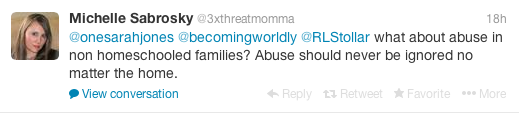
I am getting tired of those homeschool parents who, when presented with case after case of abuse in homeschool settings, go to Default Response #1 and say, “If you care about abuse so much, why don’t you focus on public schools instead?”

For example:

Screen Shot 2014-01-26 at 3.04.12 PM

It’s time we all called bull@#$% on this response.

I’m sorry, but parentsplainers and abuse denialists no longer get to control this narrative. These people not only are unmotivated to stop homeschool abuse, they are also unmotivated to stop public school abuse. Their pointing to public schools serves as a red herring. But even more than that, it is disingenuous — because the moment we try to focus on public school abuse, spoiler alert: they’re still standing right in our way. Because these are the same people joining the homeschool lobby in calling for the end of child protective services as we know it. These are the people actively trying to prevent public schools from addressing abuse.

Why do I say this?

The homeschool lobby is coming after Safe2Tell, a program critical to your kids' ability to safely report violence in the public schools.
The homeschool lobby is coming after Safe2Tell, a program inspired by Columbine, that has saved over 1,000 lives, and is critical to your kids’ ability to safely report violence in the public schools.

Because last Friday, January 24, HSLDA — the mouthpiece of the homeschool lobby — issued a legislative alert about Mississippi House Bill 480. HB 480, proposed by Mississippi Representative Bobby Moak, establishes the Safe2Tell program to allow public school students to “anonymously report threatening behavior or endangering activities.” (You can read a summary of the bill here; you can read the bill’s full text here.)

HSLDA is opposing this bill.

Some background: The Safe2Tell program began as a non-profit organization in Colorado. The program was based on

the Columbine Commission Report’s recommendation that students need a safe and anonymous way to keep lines of communication open.  They realized that tragedies could be prevented if young people had a way to tell someone what they knew without fearing retaliation.

Since 2004, Safe2Tell has “prevented 1,000 suicides and 31 school attacks… It has already received reports of 16 planned attacks since the beginning of the 2013-14 school year.” The program has since partnered with state governments, beginning with Colorado in 2007. The movement is “spreading across the country with momentum building for a national Safe2Tell hotline.” Mississippi is next to recognize that violence in public schools needs to be addressed and that allowing students a way to report bullying and violence anonymously is crucial. HB 480’s text acknowledges this fact:

In eighty-one percent (81%) of dangerous or violent incidents in schools, someone other than the attacker knew the incident was going to happen but did not report or act on that knowledge… The ability to anonymously report information about unsafe, potentially harmful, dangerous, violent or criminal activities before or after they have occurred is critical in reducing, responding to and recovering from these types of events in schools.

This has nothing to do with homeschooling. As Libby Anne has pointed out, “This bill is explicitly not about homeschooling in any way, shape or form. This bill is about protecting public school children from school violence.”

Yet the homeschool lobby is aiming to destroy this effort to protect public school children. In their paranoid mindset, “Broadly applied, this legislation would permit anyone to make such a report against a homeschooling family.” They are using a hypothetical slippery slope — without a single example to point to since Safe2Tell began in 2004 — to roadblock a chance to solve actual violence.

Said another way: The homeschool lobby is coming after Safe2Tell, a program inspired by Columbine, that has saved over 1,000 lives, and is critical to your kids’ ability to safely report violence in the public schools.

If you are a non-homeschooler, this is exactly why you should care about the homeschool lobby. This is so much bigger than homeschooling at this point.

The mentality advanced by HSLDA and the homeschool lobby is one of unquestioned dominion of parents over children. It is the mentality expressed by Rosanna Ward (“the government [has] no right to hold me accountable”), Matt Walsh (“we [should] have the unquestioned and absolute right to teach and raise our own children”), and HSLDA’s Scott Woodruff (“a child’s right to an education is held by his parents as custodian until he attains majority”). It is the mentality spoken of with no apologies by Doug Phillips and Kevin Swanson at the 2009 Men’s Leadership Summit (“the core problem with Child Protective Services is its existence”), where HSLDA’s Chris Klicka and NHERI’s Brian Ray also spoke.

And now that mentality is coming after non-homeschooled children, too.

This is not a conspiracy theory.

This is an explicit belief system that is spoken of casually and publicly. I witnessed this first-hand last week in Virginia: when a Virginian Republican delegate unabashedly said, “Parents have a right to screw up their kids,” merely a day after Rita Dunaway (Board Member of the Virginia Christian Alliance) said — in the context of joining HSLDA in opposition to HJ 92 — that children do not have any rights.

This should be alarming to every segment of society that has a vested interest in protecting children.  I said this last May, and I will keep saying it: “This is no longer about homeschooling and child abuse in homeschooling communities. This is about protecting every child in this country.”

When your only concern is protecting “parental rights,” when you have no qualms sacrificing children’s rights and wellbeing on an altar of parental dominion, then you are going to see all children — not only homeschooled children — at risk. You are going to see HSLDA and the homeschool lobby slowly (but not silently) chipping away at the cornerstones of the child protective system — a system that is a safety net to public school and private school children as well.

If you do not want to see homeschooling regulated more (or even if you do), if you want see better child protection laws, then get off your Freedom High Horse and do the work of actually protecting children. Stop paying dues to an organization that called a child abuser a “hero”. Stop defending a lobby that is actively working to not only dismantle child protection laws, but is actively opposing opportunities to make public school children safer.

The homeschool lobby will not content itself with making homeschooled children less safe. They aim high and public school children are now in their crosshairs, too.

My Kids Are Now The “Public School Kids” I Used To Judge

HA note: The following is reprinted with permission from Brittany’s blog BAM. It was originally published on December 4, 2013.

I sat on a blanket in my friend’s yard watching my 6 year old twins run and climb with ten other children on an unseasonably warm fall day.

The other moms and I sipped coffee and started chatting.

“So, where do your older ones go to school?” I asked.

“We homeschool,” she smiled.

“We do too,” another mom stated, with more of a look of resignation on her tired face. It was 4pm on a Wednesday, after all.

We talked and laughed and commiserated together. A few minutes later, I realized that out of the 4-5 women present, I was the only public school mom at our play date.  I listened to their discussions about curriculum and homeschool groups and contributed to the conversation where I could.

But I felt an emotional twinge, like I was an outsider.

I inwardly laughed: Me, feeling like an outsider for being a public school mom after I spent my entire childhood and adolescence feeling like an outsider because I was home schooled.

It really was funny… and so, so ironic.

I watched my kids climb into the treehouse and play good guys and bad guys, wielding sticks and plastic swords with their friends.

Then, my smile faded as a realization struck me.

My kids are the “public school kids.”

My kids are now the kids that, as a homeschooler, I used to judge… the kids I thought weren’t smart enough, good enough, or Christian enough. My friends and I even whispered about “wayward” home schoolers, saying “Look at her! She’s acting so…public schooled!”

It was the worst insult we could slap on a person.

Although I have long come to the realization that my prejudices as a child and teen were unwarranted and flat out wrong, it wasn’t until this moment that I felt the tragedy of my own hateful judgement toward others.

What if these sweet home schooled children think my boys are “less than” because they go to public school? 

What if they think that my twins aren’t smart because they aren’t home schooled?

Source: http://jewishworldreview.com/strips/mallard/2000/mallard061002.asp

What if they shake their heads in pity, thinking my boys can’t possibly learn to love Jesus because, don’t you know? God isn’t allowed in public school. 

As I watched the children play, I saw no discrimination, no judging thoughts, no distinction whatsoever. Only play and fun and equality. 

It was only my own mind that was tortured by the demons of my past. Wave after wave of guilt and shame hammered my soul as I watched the kids play so freely and so free of judgment and I thought:

Why did I think this way?! My parents never taught me to think I was better than other people. They taught us to love and serve others.  

But somehow this attitude crept in. Maybe it was that first generation homeschoolers felt like they had something to prove. Homeschooling was new and uncharted waters, after all.
Society questioned, doubted.

So we homeschool students were taught to prove our worth, defend our education: Our education was just as good as a public school education. No, it could be it was even better!

Or maybe it was because I heard about the “evils” of public school at homeschool conferences in or in overheard discussions from parents.

Source: http://heartofwisdom.com/blog/homeschool-arent-you-worried-about-socialization/

While I was growing up, comics like the one above scared me yet also created a smug sense of security and self-importance. Those pieced, spiked, belly-showing, long-haired “creatures” could not be my friends. Oh, I should love them, but from afar, at arms length, as people that should be witnessed to because if they went to public school, they obviously did not know Jesus. But I had to be careful because their bad influence might rub off on me.

I even treated the kids I interacted with at church like this. We were the only homeschooling family in our large church and, to be honest, I was really weird. I mean, I wore a pinafore with 4 inch lace frills (that I sewed myself!) to church… when I was in 8th grade.

I was low on the social totem pole.

But there were sweet, kind girls that invited me to their birthday parties and for sleepovers.

I went but I never reciprocated. I judged them in my heart because they wore knee length skirts, gushed over Justin Timberlake, and talked about (gasp) hickies! I was horrified and I judged those good Christian girls like the bow-wearing, pink-clad homeschool girl judges her public school peers in the comic above.

Source: http://www.dummies.com

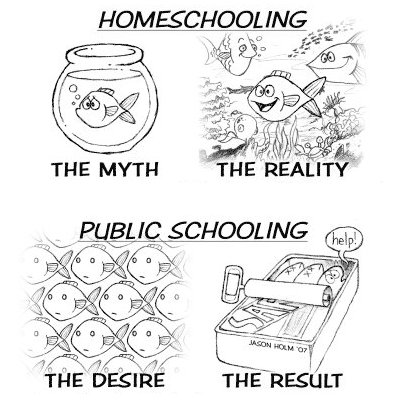
My attitude toward public schooled students was like the comic above. 

was the happy fish, swimming freely, while public schooled students were “locked up” in “government” classrooms, being “taught to be robots,” and were basically brain-dead by the time they graduated, like poor sardines in a can, begging for help!

But it was me that was locked up in a world of prejudice and judgement, shunning people who could have been my friends and who could have opened my eyes to new thoughts and ideas. (Thank God for this awesome public-schooled boy I met in college named Aaron…)

I know that the “us vs. them” attitude of homeschooelers is not dead. I wish it was. Everything I put in quotes in the paragraph under the comic are things I have heard from people I grew up with or from current blogs I have read (usually in the comments section under a controversial homeschooling article).

But when I became a public school mom (an agonizing decision you can read about here), I learned a few amazing things.

My kids are not locked in their classrooms or shackled to their desks (imagine that).

They are not robots, nor are they being taught to be robots (I have a son who constantly reminds me that he has a mind-of-his-own on a daily basis)

They love school and are taught by wonderful teachers who love them.

And, most importantly…

People are people. Not public school kids. Not homeschool kids. Heck, not even private school kids!

No more stereotypes and judgment.

People are people who deserve to be loved and respected for who they are, not judged or discriminated against for the school they attend.

Homeschool to Public School

school

HA note: The following is reprinted with permission from Heather Doney’s blog Becoming Worldly. It was originally published on December 23, 2012.

I figured since I am one of the rare former Quiverfull kids that was both homeschooled and public schooled, I’d talk about my experience. First off, though, I want to say that I find the debate about whether homeschool or public school is inherently better to be the educational equivalent of arguing whether Coke or orange soda is better. It’s utter foolishness when people act like their personal preference is the only one that counts. Overall I believe that human beings are resilient and adaptable creatures, capable of learning in many different environments if given the opportunity and some quality mentoring. If I was choosing how to educate my own kids, I’d want mixed methods, the best of both worlds.

I realize looking back that I have had two different kinds of homeschooling and two different kinds of public schooling, so figured I’d share my experience with each.

Neglectful Unschooling

The first kind of homeschooling I had was unschooling without the very necessary cultivation and introduction to resources aspect.

Basically it was educational neglect.

This is a pretty common problem in the unschooling world from what I understand. I also got intensive religious messages and was forced to submit to rigid and oppressive gender roles. The bits of educational instruction I got were often pretty abusive too because every now and then, when my Dad got it in his head to formally teach me something, the session would generally end with me getting a spanking, grounded, or having the papers thrown at me in disgust because I was “being stupid,” “obstinate” or “stubborn and difficult.” Unsurprisingly, all that did was leave me with a pretty decent math phobia and worries about my mental capabilities. My parents also often told my sister that she was just stubborn and didn’t want to learn to read.

Thing is, my Mom said she didn’t really teach me how to read. She just read me books out loud when I was small and soon I was reading them back to her. That pattern didn’t happen with my sister or any other siblings because it isn’t typical. Yet my parents expected it to work that same way somehow.

They had little understanding of how kids actually learn, or what motivates them, or that it simply isn’t the same for each kid.

I was a self-directed learner who ate up the few books that had been donated to us by other homeschoolers and the boxes full of classic literature that my Grandad sent me. I didn’t get to go to the library. I just read these books and sometimes when I got too absorbed and forgot to wash dishes or change diapers, my Dad came in, snatched my book from me, hit me with it, and yelled at me. My Mom went from claiming that my book reading was “constructive” to saying that it was “selfish.”

Classic Home Tutoring

After this first kind of homeschooling experience had been thoroughly put to shame by my grandparents and the Sylvan standardized testing they secretly got for me and my sister, I started the second kind of homeschooling. It generally involved sitting at a desk every day at the same time, working through problems, diagramming sentences, having problem sets to solve and a row of sharpened pencils, with regular interspersed “field trips.”

Now I had to answer to my tough, tattooed up old Grandad, a former Navy commander who’d never homeschooled anyone or previously had the desire to.

He had flown me out West to stay with them for a few months and to give an excellently intensive if sometimes harsh go of his brand of tutoring, motivated by his love and concern for me.

My Grandad and I drove each other crazy at times but ultimately bonded for life. He loved being a homeschooling grandfather. He would go on to do the same with my other school age siblings, and later told me that he found his role in his grandchildren’s education to be one of the most satisfying things he’d done in retirement.

He was not motivated by any sort of religious instruction goals, but rather valued and had respect for classical curriculums that connected history to current events, modern life, and a versatile skill set. He also said being cosmopolitan and well-rounded was the primary goal of education.

It wasn’t just about finding a job or about knowing stuff, but making yourself question and think, being a world citizen.

He introduced me to books on Native American history, and Greek and Roman mythology. He brought me outside at night to point out the Seven Sisters of the Pleiades among the stars and tell me the story, and recount what these constellations had meant to sailors of old. He and my Grammy took me to museums and national parks and to go try sushi, fried rattlesnake, and spanikopita. They brought me to see Phantom of the Opera. They got me once a week snow-skiing lessons with teens my age. I was encouraged to find pen pals among them and to practice penmanship, and so I did. I was told to keep a diary and a scrapbook where I wrote down my experiences and saved mementos from events.

I still have those things and they are some of my most valued belongings.

My Grandad continually said, “The world needs lerts, so be alert!”

At the end of our intensive tutoring sessions or a day walking in the redwoods, or a day learning about volcanic activity while swimming at Mammoth Lakes hot creek, my brain would feel tired in a satisfied sort of way. I knew without a doubt that I was learning and it made me much happier about life. I loved it.

When I went back home to my parents, my Grandad gave me a self-study schedule written out on a yellow legal pad so I could hopefully somewhat replicate this rapid rate of absorption. I wish I could say I kept up with the books like he’d had me doing at his house, but I didn’t. No one was pushing me at home, so I only studied what I liked, and what I liked were novels that I could become totally absorbed in and ignore the stressful reality of a family situation I now loathed even more.

Cliquey Public School

Because my parents still weren’t teaching us and my Mom had pretty much given up, the next year we all got sent to public school.

I was both excited and scared. The local high school was known as the “bad school in the good district.” Over a third of the kids (including me) got free lunch because their parents were poor, and it was about half white, half “people of color” — mostly black and creole, a few Hispanic and Vietnamese. My school did really well in sports, less so in academics.

At registration nobody checked to see if I was up to grade level or oriented me to what public school would be like, instead simply assigning me to 9th grade based on my age.

The first week of classes were absolutely overwhelming.

I got laughed at on the bus for handing the driver the paperwork and saying, “My Mom said to give you this.” After being isolated so much, now I was constantly surrounded by people my own age, hundreds of conversations going on in the lunchroom at once, but nobody wanted to sit by me. They already had friends. I was an unwelcome stranger. Someone even threw my backpack on the floor and told me to go sit somewhere else. Finally I got invited to sit at a lunch table by a guy who had a lisp and I gratefully shared eating space with him, a “super-senior,” a pregnant girl, and a tall skinny gamer who wore his backpack on one shoulder and ran to lunch when the bell rang in order to be first in line. They were nice to me, the first friends I made, and I will be forever grateful. They reassured me and gave me hints after I got lost going to my home room class, received a detention for lateness, and got glared at often because I apparently unknowingly stared at people. I’m sure I did stare.

These teenagers were fascinating and I’d never seen anything like it.

Then there was the weirdness of learning how to do homework and study for tests and figure out when and how you are or aren’t supposed to ask questions in class while surrounded by people who’d done these things their whole lives. Everybody assumed I should just know this stuff and was from another planet when I didn’t.

By the end of the first week I was pretty much singled out as a weird kid, by both teachers and students.

One teacher thought I might have a learning disability and scheduled a parent-teacher conference. Classmates made fun of my Walmart shoes. Some boy asked me for a blow job and got people laughing when it was obvious I had no idea what that was. A group of girls walked by and one put gum in my hair. A boy hit me in gym class, I hit back, and we both got suspended for fighting under the “zero tolerance” rules. That’s how for a short time I became one of the “bad kids.”

I had to attend three nights of “PM school” with other suspended kids from around the district, some who’d thrown chairs at teachers, had sex in the bathrooms, set things on fire, or brought vodka to school hidden in Sprite bottles. We all sat around in a circle and talked about what we did wrong and what we should do better next time. Most of them were pretty disrespectful and said school was stupid and they couldn’t wait to drop out when they turned 16.

I really hit the culture shock head on right there.

Why didn’t they want an education? I’d had to fight so hard to get mine and I had no intention of letting anything take it away from me.

Around that time I discovered that high school was two-tiered. There were the regular and remedial classes and then the honors classes and advanced placement classes. The kinds of people who took either of the latter were treated better. Honors and AP classes also had people who were more invested and were given more in-depth information, but nobody else in that classroom seemed to feel as enthusiastic about learning as me. I was absorbing everything all at one time — the coursework was only part of it. How to walk, how to talk to people, what were appropriate topics of conversation, what to wear, what not to say seemed even more crucial.

Often it seemed there were more important things I was missing in my education than book learning, and I just made social mistake after social mistake. I was made fun of ruthlessly about them, remembering even one of the coaches laughing when some boys threw balls of paper at me in civics class.

I told my parents about the bullying once.

When my Dad’s response was, “Well, it’s ok with me if you drop out.” I never said another word about it.

I didn’t want them to have any excuse to pull me out. I just soldiered through. I made up my mind I would not be one of the dropout crowd. Here’s the thing about bullying though — it often just happens to new kids. Once your quirks and social status have been thoroughly made fun of, then you start to become accepted. The hazing (however wrong it is) is over. Girls start to give you tips about how to dress and talk and ask if you want a cigarette (no thanks), and guys start to flirt and ask to copy your homework (um, no. Well…maybe an exception for that cute one).

The learning curve that first year and a half was quite steep and I was stuck between different educational worlds where I had to know very different things to get by. I failed my first algebra class (what on earth were those letters doing in the math problems?!) and so sophomore year I took remedial math and honors English and history. I got invited to work on the school newspaper and the literary publication due to my work in honors English, and I got suspended again for getting in another fight (in the middle of class, no less) in remedial Algebra. This time I knew what these school fights required, so when the girl called me out and threw a punch, I grabbed her by the hair and hit her in the head a bunch of times until some guys pulled us apart. Now I figured people would get the message and nobody was going to threaten or try to fight me again.

I was also going to make her pay for ruining my perfect attendance record.

After serving my suspension, I apologized profusely to my poor math teacher (she was this nice Pentecostal lady who patiently tutored me during free time in math class and at lunch), and about six months later I made peace with the girl I’d fought.

I’d listened to the principal talk to her Mom and realized her home life was harder than mine.

Still, what would have once seemed counterintuitive to me — fight harshly to avoid more fights — had worked. Nobody tried fighting me again and the bullying subsided.

College-Bound Academic Track

By the time junior year came around I pretty much had the high school thing down. I was now one of the “smart kids” due to being in honors and AP classes. I rarely got detentions and never got suspended again. I found myself being nice to new people and often befriending exchange students, giving them the same tips I’d needed myself. I made a number of good friends, had lots of acquaintances, got good grades, passed notes in class, had a couple short-term boyfriends, and went to a number of high school dances.

I was passing for normal, working at the local grocery store, and feeling like my life was headed in the right direction.

Except for how awful it often was at home.

Quiverfull Values vs. Public School Values

My parents were still ideologically attached to the Quiverfull stuff even though their marriage was disintegrating and it was plain to see that actively living it was no longer doable. I had thoroughly rebelled against all of it and my younger siblings were now oriented in a similar direction. According to my Mom I was a bad example — disrespectful, a negative influence, and I had a poor attitude.

When I was given a Good Attitude Award at school for all my Key Club volunteer work, I waved it at her as vindication.

It was ignored though. Her criteria were different. I faced one perspective at school and another at home. At home I had to help care for a bunch of younger siblings in addition to homework, and was still hit by my Dad as “punishment,” (even though I fought back) right up until I moved out at age 17. After that I tried to throw all of it in the past, start college, and successfully “pass as normal.”

So do I think homeschooling can be great?

Yes.

Do I think public school can be great?

Yes.

Can they each be mediocre and uninspiring? Yes.

Can they both be awful and hurtful and soul sucking and practically the worst thing ever? Yes.

Can you work to overcome the bad stuff? Yes.

It’s all about implementation and setting goals and neither can be successfully done in a vacuum, ignoring what else is going on around you.

When people just look at the labels and decide whether it’s good or bad based on only that, they are being incredibly shortsighted. Education has so much more to do with mentorship, respect, and access to a challenging and inspiring curriculum.

I loved the type of homeschooling my Grandad did, and I loved my AP high school classes and the friends I made (some of whom I am still close to).

But most of all I loved going to college. It was like the best of the homeschooling and public school worlds combined. I could choose my classes, topics, and schedule, yet I had people guiding and supervising my work, helping me improve it.

I value my education and expect to always be committed to lifelong learning, no matter the setting.

An Open Letter to My Former Highschool Teachers: By Sarah Henderson

HA note: Sarah Henderson blogs at Feminist in Spite of Them about her journey from Quiverfull to Feminist. The following post was originally published on her blog on October 15, 2013 and is reprinted with her permission.

Dear Teachers,

When I came to the high school at age 17, I had absolutely no idea how to be a student.  

Many of you know by now that I didn’t know what a teacher-student dynamic was. I hope you understand that up to that point I had been around adults who mostly made stuff up as they went along, and expected respect from authority that was derived simply from being bigger and older, not from legitimate accomplishment. To a scared 17 year old, it looked the same at first, because of the authority aspect.

In the three years I went to high school, I learned to respect you for the knowledge and expertise you represent. I think I was supposed to respect you simply for being teachers, adults, and authority figures, but instead I respected the time and effort it took to become teachers, and the skill and patience that kept you there.

I remember sitting in my first class, which was a grade nine math class. That was a difficult thing for me, to enter a class with people three years younger than I was. But to the teacher who taught that class, and the second teacher who took over part way through (this was when the big math shuffle happened), thank you.

Thank you for seeing my anxiety and deciding to explain to the entire class what the 8:25 bell was, even though they clearly knew.

Thank you for for patiently explaining what the relationship between decimals and fractions was. I really didn’t know. To the librarian, thank you for making the library a safe place. I would have been very afraid of that environment and never gone there, especially because some students really avoided it. But you always said hello to me and that made me feel special even though you did that with everyone.

I liked that you knew my name. It made me feel less anonymous and afraid.

To my language teachers, thank you for doing what it took to allow me to have the best swath of language courses that I could in three years. To my drama and music teachers, these classes pulled me out of my shell the most. I learned that for the first time I could be a meaningful part of something significant. You taught me to not be afraid and to simply do, and that putting myself out there was not dangerous. Thank you for recognizing my ability to create, and giving me the chance to do that with costumes.

To my science teachers, thank you for creating a safe environment to learn. It was a bit of a rocky road for me, and a lot of that came out in science classes for some reason, but you were patient and somehow I never failed a science class, for which I am grateful.

To my guidance counselors, thank you for not making me muddle through a grade nine phys. ed. class with 13 and 14 year olds and expose my complete lack of knowledge about various sports. Thank you for taking the time to place me in the appropriate levels of classes and being willing to juggle that for three years. Thank you for the time you spent listening to me and believing me.

Thank you for calling family and children’s services with me.

Thank you for trusting that even though I didn’t always know how to act appropriately, I was learning as quickly as I could, and thank for seeing that I could succeed. Thank you for not punishing me when I engaged in self-injury at school. I didn’t know how inappropriate that was until you told me.

I didn’t actually know that self-injury was a “thing” or a big deal. I had never heard of it

But I had been doing it for a decade by then.

To my principals, thank you for not suspending me or punishing me for mistakes I made, and thank you for trusting that they were legitimate errors and not deliberate. Thank you for making allowances where you did but also for drawing the line where you did. The fact that you did draw some lines and said that there were certain things I did need to do, helped me learn to function more fully in a society with expectations. I learned that there are provisions for when you need them, but I also learned to take responsibility and action when I was able. Thank you for recognizing how challenging school was for me, and thank you for doing it in a way that celebrated success, not difficulty.

To my English teachers, thank you for the impact you have had on my life. From Grade 11 English where you gently explained to me what an essay actually was and how to write one (I really didn’t know), to writer’s craft and children’s literature where I had a chance to be creative, these classes allowed me to feel successful because I was able to achieve decent grades and take pride in what I wrote. You recognized when I was trying hard even if my results were not stellar. You explained to me how to improve when I was not happy with a grade. You suggested books for me to read as you started to learn more about my past. Thank you for being available to me and hearing me. Thank you for supporting me and helping me process through these classes. Thank you for letting me start off doing presentations in private but pushing me to do them to the class when you knew I was ready.

Thank you for teaching me the value of writing. That positive experience is why I am able to use the written word to share my story now.

To all the teachers and other staff at the high school, thank you for encouraging me and helping me learn how to be a student. Thank you for treating me with dignity even when I didn’t act very dignified. Thank you for being willing to overlook my shortcomings in exchange for investing in a brighter future. Thank you for being kind even when I was rude, thank you for knowing when to let things slide and when to push me to do better.

Thank you for being gentle with me when I was going through rougher times, and thank you ever so much for taking it as a given that I would go to university. Once I reached a certain point in high school, it was not really treated by you as optional that I would go, instead it was simply a question of where and what.

I owe a great deal to you.

People do not always get a chance to hear about the positive impact they had with a smile or a short conversation, and this letter is intended to make sure you are aware of that impact.

Thank you.

Sincerely,
Sarah Henderson

Christian Discipline, A Child’s Perspective: Jessica’s Story

Screen Shot 2013-10-23 at 9.59.19 PM

Also by Jessica on HA: “Copy Kids—The Immorality of Individuality.”

*****

Trigger warning: graphic description of physical abuse.

*****

Awaking from a fitful slumber, I turn over and squint to see the clock.

It’s 2 am, dad is home.

Who will it be tonight? If I hear one of my brother’s screaming, it probably won’t be me. I close my eyes, clasp my hands. “Dear God, I know you’re busy and I know this is selfish, but please just let dad go to bed tonight.”

I hear boots in the hallway and I curl into the fetal position under my blanket, shaking.  Please not me. Please not me.  Please not me and click, my door knob turns.  It’s me.  I pretend to be asleep.

“Get up.” 

No explanation. I do not know what I did. It does not matter. I stand up, shaking. Dad slings me over the side of the bed and I sob, “Please dad, please don’t.”

Swat. 1….2….3…

I make the mistake, I put my hands over my buttocks.

“Daddy please stop”

Crack!

A heavy leather mechanics belt slices into my hands, instantly excruciating and yet numb. I move them quickly or he will hit them again.  Painfully slowly, biting my cheek until it bleeds. I count in my head. 4…5…6….7……..18….19…20…21….22…. and it ends.

I collapse on the bed.

Dad says “I love you.” Then he turns and walks out shutting my door behind him. 

I listen to the boots walk down the hall and disappear. Silently, I walk into my bathroom, vomit into the toilet, clean it up and then run my hands down my 10 year old lower back, backside and thighs.

I have welts.

Some of them are bleeding.

My hands are already purple. I need a story, how did I get that shape mark on my hands… I’ll think of it in the morning. I go back to bed and finally allow myself to cry and think about how good life would be if my father were dead. Simultaneously, though, sad that he would be gone.

He is my dad after all. 

Tomorrow my classmates will know he hit me.  I won’t tell them, they won’t see the bruises, they’ll just know. They’ll see how awful I must be to make my dad hit me like that.  Why am I so awful?

I know I deserved it God, that’s why you didn’t stop him.

Deconversion: Vanessa’s Story, Part One

conversion

HA note: Vanessa blogs at Fiery Skull Diaries. She “recently uprooted [herself] from kentucky to florida,” where she enjoys “fresh springs, the magical fragrance of orange groves, and copious amounts of sunblock daily.” Vanessa considers herself “an exchristian, atheist, and antitheist, unapologetically.” This post was originally published on July 16, 2013 and is reprinted with her permission.

this process is difficult for me to write about because there’s so much to it. i’ve been putting it off for too long, feeling overwhelmed.

no more excuses. i need to write this story for my sake and the sake of others. i will be doing it in small, to-be-continued pieces until i get it all out. no more waiting. no more feeling like i have to write the entire thing before i can share any of it.

let’s get started.

my parents both grew up pretty poor in the same town in western kentucky their parents had grown up in, and their parents before that. neither was raised very religiously.

at the age of sixteen years and six days, my mom left her abusive childhood home to join in holy matrimony with my abusive father, age eighteen and six months. i was born twelve years later. i am the eldest of two girls; my sister is almost to the day two and a half years younger than me.

for reasons still unknown to me, my parents became fairly religious between the time they got married and the time i was born.

for my mother, i think it was about finding comfort. for my father, it was about appearing to be a stand-up guy in the community and getting to look at teenage girls in the youth groups, in which he somehow was always heavily, though superficially, involved.

most of my earliest memories are from the church we went to until i was three. after i turned three, we moved to a house outside of town and started attending a different church closer to our new home. like the one before, this was also a southern baptist church. we were there every sunday morning, sunday night, and wednesday night. i went to preschool at this church. my mom painted and wallpapered the bathrooms and several sunday school rooms in the church. my dad was on the volleyball and softball teams (i learned to rollerskate on my own in the church gym at age four by going with him to “bolleyball” practice on tuesday nights), and, of course, he was involved in the church youth group.

one sunday afternoon, when i had reached the age of reason at seven years old, my mom helped me pray the sinner’s prayer in our bathroom before she even got off the pot.

yes, you read that right. she could not bear to make the soul of her tearful, distraught seven year old, who had realized her sinfulness and eternal destiny, wait a second longer to accept jesus. so, sitting there on my mom’s lap, who was sitting on the toilet, i asked jesus to forgive me and come into my heart.

much to my extended family’s never-ending dismay, my mom decided to homeschool my sister and me when it was time for me to start kindergarten at the age of five. part of that decision was that she couldn’t stand the thought of putting her smaller-than-average five year old on a big, scary school bus at six in the morning.

the other part of that decision was to shield me from mean kids and unbiblical secularisms (*ahem*…EVOLUTION) taught in public school. (“public school” was a bad word in my vocabulary for my entire childhood.)

in other words, though she did not realize it, my mother chose, in part, to homeschool me to ensure my indoctrination.

*****

Part Two >

Public Schools and Home Dictators: Keziah’s Story

Screen Shot 2013-09-10 at 7.44.43 PM

HA note: The author’s name has been changed to ensure anonymity. “Keziah” is a pseudonym.

*****

Trigger warning for To Break Down a Child series: posts in this series may include detailed descriptions of corporal punishment and physical abuse and violence towards children.

*****

I have half-moons on the sides of my nose. They are actually the third set of bags under my eyes. I didn’t cry all night, or stay up late with a baby. In my mid-thirties, I cannot sleep at night. Once my distractions and duties rest for the day, ghosts play in my dreams and the memories of fears warn me to stay awake. The dark is when bad happens and my parents trained me to fear it.

A lack of light is evil.

Even now, I want to write anything but this. Writing is my life’s work, but this shouldn’t be my story to write. I shake my head, furious that I know this tale, my stomach forcing me hunched over.

I won’t write it – fuck them. Then I remember the other “them,” and write. I sigh. The quiet “them”no one talks about. My being a “them” that no one talks about, that my parents still try to silence.

*****

I remember a tired face, another face of my current age; this face was my face, only on a different person, twenty years ago.

This face stood over a five-year-old me, throwing fists on a starving body, as punishment for adding sugar to cereal or adding pepper to an already perfected meal, thus insulting the cook. I saw this face as I stood shaking every morning as it scowled at the unruliness of my hair, turning my scalp to fire so that it was perfect – a twisted mix of undiagnosed OCD and passion to present perfect children, so the ultimate secret remained so. I turned green every morning and threw up many and that face didn’t care. It showed anger that I was wasting food, wasting hair-fixing time so it could return to bed.

And yes, I was going to school – a public school.

You see, a home dictator doesn’t have to be a homeschool parent, or a religious zealot. A home dictator needs a cause – which can be simply to bury their pain or to feel powerful. My home dictator was mentally ill, and surrounded by enablers: my dad, her siblings, her parents, and once I was old enough, me.

You see, if an outsider catches a glimpse of a home dictator, they recoil – in fear, in disbelief, or with thanks their kids are unaffected.

You see, a child victim’s role in life is to protect the person assigned to protect them who actually fails the most. Any psychological means keeps that victim quiet, even in a public school. The maelstrom of life creates a lack of words for people still learning their words.

If the victim speaks out, that teacher or counselor must act because revealing the fear may happen only once.

You see, an outsider who escapes has little recourse. Often suffering and sometimes still dependent, she gets little help from a state agency – especially once she is no longer a minor. When I contacted CPS for my younger brothers and sisters, the initial phone worker asked little and the investigator saw food in the fridge and left.

American culture (and perhaps others, too) can change this. When I contacted my state’s child services, they wanted to know what they would find. I told them they would find no evidence – only children who believe those workers will take them to a new home, one where they will be raped and beaten, maybe experience the same treatment they do now, only worse, because they will have no parents who love them.

And those children will lie and protect. They will be confused and scared.

You see, there will be no evidence of abuse.

The weltschmerz of these children has inspired action and a weird happiness kept me reading Homeschoolers Anonymous. I fit in, even though I was never homeschooled a day in my life.

This movement that the Internet has enabled, comprised of parents and victims, the growth of psychology and the explanations of science and brain functions the masses can understand and access, this can be the kairos to educate about child abuse.

The identity of “them” is often formed in the name of God, for pride, for the appeasement of elders, for the appearance of good parenting. Homeschooling provides a hidden world, a place of acceptable child abuse.

The same stories happen with “them” in public schools, out in the open, with the same training methods so that children remain silent.

Can’t You Say Anything Good About Homeschooling?: Libby Anne

positives

Can’t You Say Anything Good About Homeschooling?: Libby Anne

HA note: The following is reprinted with permission from Libby Anne’s blog Love Joy Feminism. It was originally published on Patheos on March 31, 2013.

I’ve been fairly critical of homeschooling in a good number of blog posts over the past two years.

One thing I’ve been asked a number of times is whether, looking back, there was anything about my homeschooling experience that was positive. It’s true that Sierra of the Phoenix and the Olive Branch and Lana of Wide Open Ground, while generally critical of many things about homeschooling and their own homeschool background, have both written posts outlining the things they found positive about their homeshooling experience. Can’t I do the same? So here it is, my attempt to write about the positives side of my homeschool experience.

But I’m going to warn you up front that I don’t think this is going to go all that smoothly.

1. Self motivation.

I’ve always been a very self-motivated person. There were some years I worked ahead in my subjects and finished all of my schoolwork for the entire year by the end of March. I was always extremely hard working and driven, and this followed me into college as well. No one had to make me study. My parents have always chalked my self motivation up to the fact that I was homeschooled—and I used to do the same. Indeed, self-motivation is one thing I always see listed as a benefit of having been homeschooled. But I’m afraid I no longer buy this—at the very least, it’s not this simple.

Even as I was self-motivated, many of my siblings weren’t. I watched many of my siblings procrastinate and drag their feet and sometimes flat out lie about whether or not they were doing their work. I watched them work all summer trying to catch up for everything they’d fallen behind on during the school year. There were several years when my siblings literally finished their math textbooks for the previous year a week or two before the next school year started. Even today, I see this same thing happening with some of my siblings who are still at home, being homeschooled. Some of them seem to lack self motivation entirely, and will only do their work when there is the threat of losing some privilege over their head.

Now after high school I attended a state university on scholarship. Because of my grades, I was enrolled in the university’s honor college and lived in the honors dorms. I suddenly found myself surrounded by a cohort of extremely self-motivated public school graduates. This confused me. I honestly had not expected to see that level of self motivation in the products of public schools. I had thought they all just did the bare minimum to pass standardized tests, because of the way public schools were set up, and that they weren’t self motivated like us homeschoolers. I was wrong. Yes, I know that these kids were honors kids, and thus not representative of the public school population as a whole, but still, they proved to me that you absolutely didn’t have to be homeschooled to be self-motivated.

So did homeschooling make me self-motivated? After thinking about it, I doubt it. Some homeschoolers are self-motivated. Some aren’t. Some public schoolers are self-motivated. Some aren’t. I have no idea what makes people self motivated, or what part is simply innate, a chance of birth. But I can say with confidence that, if the family and homeschool community I grew up in is any indicator, being homeschooled does not automatically make someone self-motivated. So yes, I was homeschooled and I ended up being self-motivated. But does that really mean anything? Probably not.

2. Love of Learning

As a child, I loved learning. I checked out books from the library, explored the fields beckoning from my back door, and taught myself to knit. The world was my textbook, and I loved it. At the time, I was taught to chalk my love of learning up to being homeschooled. And for a long time, I thought there was a connection. But I don’t anymore, and for—I think—good reason.

For one thing, being homeschooled does not guarantee that you will end up with a love of learning. I know a guy who was homeschooled K-12, and his experience actually stunted his love of learning. For him, homeschooling consisted of sitting at the kitchen table, or at a desk in his room, filling out workbooks. And that’s it. Every day for twelve years—thirteen if you count kindergarten. Nothing interactive, nothing collaborative, just workbooks. To this day, thinking of school or any sort of formal learning gives him mild PTSD symptoms. So this idea that being homeschooled automatically makes one love learning? Yeah, that’s absolutely false.

Further, the friends I made in my honors college dorm in college all shared the same passion and love for learning that I had—even though almost every one of them had attended public school. They didn’t just study what they had to for their classes, or just do their homework because they were required to. They went above and beyond and loved learning for its own sake, whether it was required or not. And they didn’t limit learning to their academic coursework, either. For them, learning was a part of life, as natural as breathing. Once again, this confused me. I had been taught that public schools stunt children’s love of learning, and also that attending public school causes a person to divide their life into learning—i.e. formal school—and not learning—i.e. everything else. But I found that, for these honors kids at least, this was absolutely not the case.

So did homeschooling give me a love of learning? In the end, I don’t think so. I think my love of learning came from my parents, not from being homeschooled.

They made it obvious that they loved learning, and they sought to make every moment a teachable moment—and in a fun way.

We were always learning things, whether it be gardening or carpentry or zoology or the culinary arts, and my parents encouraged us to love learning, and worked to make learning fun. If I’d attended public school, my parents still would have taught me to love learning. They wouldn’t have suddenly stopped making every moment of life interesting and teachable. They wouldn’t have stopped encouraging us to learn, and teaching us to see learning as enjoyable and just a part of life.

In the end, I honestly don’t think gaining a love of learning is determined by the method of education.

3. Freedom

One thing both Sierra and Lana hammered on in their discussion of the positive aspects of homeschooling was the sense of freedom it gave them—freedom to follow their own interests and study at their own paces, and freedom from the constriction of a public school schedule.

When I look back on being homeschooled, this is indeed what I look on most fondly.

In elementary school, my mom set my schedule, including what I studied and when I studied it. However, homeschooling did allow the flexibility for spontaneous trips to the zoo, or spur of the moment park dates. In middle and high school my mom still set the subjects I studied each year—always asking me for input first—but I was free to determine when to study and for how long. I wasn’t required to have fixed hours, I was merely required to complete the textbooks I’d been given by the end of the year.

I loved this—like I said above, I sometimes rushed through and finished some or all of the subjects early.

I loved the flexibility of choosing when to study, and in what order to study. I frequently got up early in the morning and would set myself the challenge of finishing all of my seatwork—meaning things like math and science and vocab, but not things like free reading or debate research or music—by breakfast time. I wasn’t usually able to fit quite everything into that time, but I was always finished by lunch time, leaving me the afternoon free for reading or sewing projects or digging for medicinal herbs or baking a pie.

But—and this but is important—this freedom was limited to choosing when and at what speed and in what order to do my academic work. I wasn’t free to go to the mall with friends, or free to have a part time job, or free to randomly go over to a friend’s house. I wasn’t free to go anywhere at all. Because I was homeschooled I didn’t have an outlet away from my family. Instead, I was home all of the time, both home to have my comings and goings and friendships micromanaged and home to be on call as a junior mom 24/7. As I’ve mentioned before, my parents didn’t believe in teenagers. They expected me to go straight from child to adult, and I wasn’t allowed to do the sort of things normal teenagers do.

In some sense, was given the freedom of a two year old and the responsibility of a thirty year old.

I grew up as the oldest of twelve children. There was always a baby in the house, and there were always toddlers and preschoolers who needed constant attention and help. When I think back on my time spent doing school work, the image I get is of sitting at the desk in my room doing math problems while also supervising two or three toddler and preschool age siblings playing nearby, because mom needed them out of her way so that she could teach the middle ones. For several years I was also in charge of all of the laundry for the family, and for a while I was in charge of all—yes, all—of the cooking. I was also expected to teach some subjects to my younger siblings, as a sort of tutor. My mom figured that teaching the subjects would help cement them in my mind, and also that helping with the children and housework was good practice for my future, when I would be a homemaker and stay at home homeschool mom.

All of this responsibility also meant that I rarely got to actually spend time alone with friends, or out of the house—in fact, when I think back on hanging out with friends, the image I get is of chatting with a friend while making mountains of peanut butter sandwiches and watching our 15+ collective younger siblings, our mothers having gone out for lunch together. I don’t want to give the impression that I begrudge my mother these lunches out—she needed them for her sanity! And besides, by that time watching kids came as second nature, and I savored what time I did have with friends, so the memories I have of chatting over mountains of sandwiches and quick roll counts of children to make sure we hadn’t lost any are actually pleasant ones.

So did homeschooling give me more freedom? In the end, I think it was a wash.

Yes, I had more freedom to set my academic schedule—when to study and what to study and how to study—and I thoroughly enjoyed that. But at the same time, because I was always at home under my mother’s watchful eye and able to be on call to help with whatever needed doing, be it children or food or housework, I had much less personal freedom than I would have had I attended public school. And when I compare my thoughts here to those of Sierra and Lana, I am reminded that Sierra was an only child and Lana was one of only four. So it’s not surprising that my experience here might be a bit different.

Conclusion

So, are there positive things I can say about my homeschooling experience? Sure. But every time I locate one, I end up finding a negative flip side. And maybe that’s why I haven’t spend a lot of time trying to draw out the positives.

I simply don’t feel that I can discuss them outside of the more nuanced context.

Homeschooling can help students develop self-motivation and a love of learning—or it can limit both of these. Some kids simply work best with formal teachers for each subjects, and with the firm academic deadlines formal schools provide. I’ve also seen cases where homeschool kids end up well educated in the subjects their parents find interesting, and not well educated at all in other subject—and this is something having the variety of teachers formal schools offer serves to counteract.

Homeschooling frees kids from the formal schedule of the public school—but it also places them 24/7 under the complete control of their parents, who may give them personal freedom or may, well, not. And besides that, some homeschool parents—like the parents of the young man I mentioned—simply reconstruct the formal schedule of the public school at home, just without the same level of peer interaction.

In the end, it’s complicated.

Learning Together: Emily

positives

Learning Together: Emily

HA note: The following is reprinted with permission from Libby Anne’s blog Love Joy Feminism. It was a guest post by Emily and was originally published on Patheos on February 24, 2013.

My parents didn’t set out to homeschool.

The fluke of my birthdate put me either the youngest or the oldest of my class, and after being the youngest in kindergarten my parents decided to homeschool for a year before first grade. That year went so well that they homeschooled for another, then another, reevaluating each year. My mom thoroughly enjoyed the experience and my dad supported it wholeheartedly, though was not often involved in hands-on teaching. I have one younger homeschooled sibling, but I’ll focus on my experience.

In 4th grade I started doubting my academic competency due to lack of comparison. I spent a half a year in public school for 5th, and after discovering that I was, indeed, on track academically, begged to come home. We homeschooled through middle school and I entered public high school in 9th grade. I went to a private Christian university and a public university for a master’s and PhD. I’m midway through my PhD.

First, I want to point out some social-location factors that positively frame my homeschooling experience. The big ones include my family’s upper middle class economic status, my parents’ education, our family size (2 kids), large suburban location, and Christian faith.

Had those variables been different I would be telling another story.

My mom homeschooled as a Christian but I missed out on the quiverfull/CP, Vision Forum, etc. My parents decided to avoid those circles. There is a family story of going to a homeschooling event where a couple of the other dads talked seriously to my dad (whom they had just met!) about the small size of his quiver.

His snarky response was, “Actually, my quiver is full! It’s a two-arrow-holding quiver.”

Early on, we used some Bob Jones and Abeka history, but that got ditched, especially as more homeschool resources were made available each year. I got my fair share of gender roles at church, but it wasn’t Christian Patriarchy as such.

I will start with what I see as strengths of my homeschooling experience. First, we were often not at home. We had season passes to the aquarium, the zoo, amusement parks (yep – when other kids were at school!), tickets to anything appropriate for kids at the city’s performing arts center, state parks, library programs, art, science, music camp. Plus, my dad’s work requires travel to cities around the country and we would all go along and tour each city’s historical and cultural landmarks during the day. My parents’ approach was “180 school days per year, distributed as necessary,” so we didn’t follow the public school calendar and continued through summer.

I thrived in self-directed, participatory learning.

I’m reading Freire’s Pedagogy of the Oppressed this week and I missed out on what he terms the banking model of education, where the student is an empty account into which the expert teacher makes deposits (till high school and college, at least). In contrast, my mom always talked about how we all learned together.

I often participated in setting the agenda, and she provided the resources and helped guide the investigation. It was that way as far back as I remember. Clearly, there was stuff I just had to learn, like cursive and long division. Still, I had the freedom to say if a method wasn’t working and I wanted to try it a different way. I read like a girl possessed, mostly uninterrupted, completely uncensored. If it was at the library or Barnes and Noble, I had access to it. I was well-prepared for honors and AP classes in high school, the SAT, then the honors college, on the GRE, and now in a PhD.

No academic regrets.

Socially, I largely avoided some challenges and my parents orchestrated good opportunities to form relationships. I got a very low dose of the girl-on-girl relational violence of adolescence. Given my social location, this was a real threat. Since I was relatively chill during the day I had lots of energy for after school activities. I participated in competitive soccer, Girl Scouts, a children’s chorus, church activities, and community theater. When I did enter public school in 9th grade, it was new and fresh. I didn’t develop senioritis and I wanted to get to know all kinds of people. I didn’t have as many labels to apply to others as my peers did. Also, with our homeschool peers, there was no age hierarchy for building friendships.

There were some things I had to compensate for later. In a word: algebra.

Saxon Math was awesome for word problems, critical thinking, and the basics. Except later, I really needed someone to explain how to solve for X and my mom’s skill set didn’t extend there. Math in high school was a battle. That said I am now proficient in statistics, which I am constantly using in my PhD studies. I will never catch up from missing the peer-to-peer sexual education that happens during middle school.

For example, I only know, like, four words for semen and I realize there are about a thousand in current use.

I don’t consider this a deficiency. I know I miss some social queues.

Transitioning to a 2,300 student high school was a big adjustment. Here’s what was hard: asking permission to go to the bathroom and having requests denied, stopping in response to the bell, even if the algebra question on the board was left unanswered, the sheer noise of the lunchroom, hallways, etc., bomb threats and lockdowns (this was Columbine-era), learning how to respond to different teachers’ expectations and methods, academic competition, watching discrimination happen, being “made” to do stuff by authorities (like fundraise for a new football field house), and the amount of wasted time. I came home really tired each day.

That said, I’m so glad I did it. I really enjoyed many of my teachers and the new subjects I took, as well as the friendships I developed. Playing soccer was fantastic, as was my involvement with the FFA.

The Freedom From a One-Size-Fits-All Approach to Education: Apollos

positives

The Freedom From a One-Size-Fits-All Approach to Education: Apollos

HA note: The author’s name has been changed to ensure anonymity. “Apollos” is a pseudonym.

I loved being homeschooled.

Homeschooling gave me freedom. The freedom to explore my interests. The freedom to follow my heart’s passions. The freedom to study the things that I wanted to study.

It was an overwhelmingly positive experience that I would never trade for anything.

I was homeschooled all the way through. Starting in kindergarten through highschool graduation. Religion was a factor and I don’t mind that. My parents are Christians, we were in a Christian homeschool co-op, and I am still a Christian. I am not ashamed to say I love Christianity and I love homeschooling.

But what I love about my homeschooling experience was the lack of structure.

It’s not that there was zero structure. I had to learn the basics. Ya know, math, science, history, language arts. But there was no per se “curriculum.” We’d start with some general outline: read this book, or that book. My parents would assign me a book on U.S. history, for example. And when I read something interesting about William Jennings Bryan, I was allowed to focus on Bryan and progressive Christian politics. I wasn’t forced to only study the side of history (or the ideas on that side) that a particular group of people liked.

This freedom really fostered my creativity and my innate desire to explore new ways of thinking.

In a very true, deep way I was not taught what to think, but how to learn.

And again, my family was Christian.

But they didn’t let their ideas about religion get in the way of my education. In fact, their willingness to let me look at ideas they personally disagreed with ultimately led me to see that Christianity doesn’t have to be believed from a fearful, reactionary stance.

In the last few years, I’ve noticed a big push in homeschooling towards “Classical Christian Education.” (I’m just going to call that “CCE” for short.) Which is funny, in itself, because that push comes from Mr. Slavery Apologist himself, Doug Wilson; which, insofar as slavery is truly a classical institution, demonstrates that “classical” isn’t all that it’s cracked up to be. Wilson’s books, Recovering the Lost Tools of Learning and The Case for Classical Christian Education, have been credited by many people in the CCE movement as being inspirational. Lots of Christian homeschoolers I know are now moving in this direction; Classical Conversations is one such manifestation.

I find this odd. Key to the CCE movement is the radical integration of one particular worldview into all subjects and a reliance on Middle Ages pedagogy. Is everyone forgetting that these are the very things that Protestants did when they created the public school systems in the first place — the systems that us homeschoolers have tried so hard to break free from?

I don’t see much difference between the public school mentality and what CCE homeschoolers are now doing.

They’re both using the same top-down techniques and one-size-fits-all pedagogies which — when I was being homeschooled — were explicitly rejected by the homeschooling movement.

But I digress.

The main thing I wanted to say was how thankful I am that homeschooling, for me, freed me from a one-size-fits-all approach to education. It liberated me from a one-size-fits-all curriculum, too.

That freedom made me an enthusiastic student, as well as strengthened my relationship with Christ.