The “Homosexual Agenda”: Libby Anne

The “Homosexual Agenda”: Libby Anne

HA note: The following is reprinted with permission from Libby Anne’s blog Love Joy Feminism. It was originally published on Patheos on March 21, 2012.

I was (probably unwisely) perusing the conservative Catholic blogosphere, and it has started to get to me. I’ve read numerous blogs talking about the “homosexual agenda” that is taking over the country and oppressing everyone else. I remember being taught this growing up, to the exact minutia. Reading about it now, though, it makes me angry.

You know what the “homosexual agenda” is? Gay people want to be able to live their lives without threat, hold jobs without fear of being fired for their sexual orientation, and be legally allowed marry people they love. Right now, they can’t do that. The “homosexual agenda” is not about “oppressing” Christians, it’s about letting gay people be full human beings. It’s not about giving gay people more rights than everyone else, it’s about giving them the same rights as anyone else.

I think the reason reading about the evils of the coming “homosexual agenda” has been bothering me is that I have numerous gay friends. They’re great friends who are always ready to help me in a pinch, they have their own dreams and ambitions, and they have crushes and relationships just like anyone else. And so when I hear about the “homosexual agenda” and then think of my friends, I get mad. Mad, because those who speak with fear of the “homosexual agenda” want to deprive my friends of the right to hold a job without fear of being fired for who they are and the right to marry who they love. I feel mad because in some parts of this country my friends might still find their lives under threat, simply because they are sexually and romantically attracted to members of their own sex

I remember believing the whole “homosexual agenda” thing. Back then, I was afraid of gay people. They were different and scary. They were pedophiles who should not be trusted around children. I wonder if that’s how the people writing the blogs I was reading feel when they talk about the “homosexual agenda” – fear of something different, scary, and “unnatural.” But that fear does not excuse the actions anti-gay activists take, actions that seek to deprive my friends of their basic rights and to relegate them to second class citizens.

I was willing to change my views when confronted with actual gay people, and in response to additional information (for example, the fact that gay people are statistically less likely to be pedophiles than are heterosexual people). I rather suspect, though, that the individuals whose blogs I read probably aren’t ready to change their views when confronted with contrary evidence.

When reading predictions of the takeover of the “homosexual agenda,” the common theme seems to boil down to “gay people want to force us to accept them as normal.” Well yes, yes they do. Because they are. But in actuality, the actions gay activists tend to take are directed not so much at personal beliefs as at physical actions that harm them.

Remember when I said that “religious freedom is not a get out of jail free card“? Well that’s what’s going on here too. Your religious freedom is violated if someone forces you to believe that gay marriage is okay or forces your church to perform gay marriages, but it’s not violated if gay people are allowed to get married. Your religious freedom is violated if someone tells you what you have to believe about God’s view of gay people, but it’s not violated if teachers are required to stop students from bullying gay kids and to explain as school employees that being gay is not considered a disorder by the scientific community, or if people are not allowed to fire someone just for being gay just as they are required not to fire someone just for being black. What’s at stake here is people’s actions, actions that do real harm to gay people, not their beliefs. You are free to believe as you like, but if your actions will do actual harm to others, you are not allowed to act as you would like.

Now sure, I’d really like to change people’s beliefs too. I don’t like beliefs that see some people as lesser than others, especially when these beliefs are based not on any evidence but simply on specific interpretations of a stone age text. I seek to oppose misogyny and homophobia both through fighting actual discrimination and through working to change people’s minds. Wanting to change people’s minds, however, is not the same as legislating what people are allowed to think or putting people in jail for their views, though those decrying the “homosexual agenda” don’t seem to realize that.

I’ve decided not to browse the conservative Catholic blogosphere. It’s not good for my blood pressure. But will continue to fight for LGBTQ rights and I will continue to work on countering homophobia by changing people’s minds.
From Homophobe to Gay Rights Advocate: Libby Anne

From Homophobe to Gay Rights Advocate: Libby Anne

HA note: The following is reprinted with permission from Libby Anne’s blog Love Joy Feminism. It was originally published on Patheos on January 16, 2012.

I didn’t meet a gay person growing up. “Homosexuals” were talked about in tones of disgust and sorrow, and we children knew that it was wrong for “men to kiss men” and “women to kiss women,” and that the Bible condemned homosexuality, but it was all in the abstract. It was about those depraved people who were out there trying to ruin marriage and subvert youth, not about any actual people we knew.

This is the story of how I met gay people, heard their stories, realized that they were human, and changed my position on homosexuality.

I met my first gay person in college. I didn’t know he was gay when I met him. Bobby was just the clean-cut, fun-loving guy who hung out in the dorm lounge and cheered everyone up with his words of encouragement. Bobby was smart, compassionate, and encouraging, he was there for everyone and everyone loved him. He came from a good family and was extremely successful in school, headed toward a career in computers. Halfway through freshman year Bobby came out as gay. This was completely unexpected.

Growing up, the most important things my parents and church had emphasized about homosexuality was that it was a choice, and that it was a horrible, ruinous, depraved lifestyle. Bobby challenged the later of these two teachings, for I could not understand how this wonderful, loving, compassionate young man could be holding such depravity inside. I had expected every gay person I met to be sporting piercings, tattoos, outlandish clothing, foul language, hedonism, depression, and likely several incurable diseases leading him to his grave. Bobby challenged this expectation because he did not fit it, not in the least.

Later in college I met a biology graduate student, Eric, who was openly gay. Like Bobby, Eric was clean-cut and respectable. I enjoyed talking to him about evolution, global warming, and other science-related issues. Because I knew him only ephemerally, I felt comfortable enough to ask him how he first figured out that he was gay. He explained to me that when he was nine or ten a friend of his showed him a playboy magazine he had found, and that was when he first realized he was different, because that magazine was doing something for his friend that it didn’t do for him. As he went through adolescence, he was never sexually attracted to females. Instead, he was sexually attracted to other males. This was not, he explained, something he had chosen, and it was not something he could change. After all, being gay had cost him his entire family, which had rejected him when he came out.

Eric thus challenged the second thing I had been taught about homosexuality, that it was a choice. Eric explained most emphatically that being gay was not something he had chosen and not something he could change, not anymore than I could change being sexually attracted to males.

In graduate school, I had a gay coworker, Doug. His background was similar to mine, growing up in a conservative religious family very involved in the church. Doug explained that being gay was never something he asked for, and that as a teen he prayed that it would disappear. He heard the teachings of his church about the evils of homosexuality, and he came to despise himself, to wish that he were dead, to feel that he and his family would be better off if he were dead. Finally, halfway through high school, he attempted suicide by swallowing a bottle full of pills. This left him violently ill, vomiting blood, but did not kill him. In college, after years of hiding it, he finally came out as gay, and for the first time the depression lifted and he felt that he could truly be himself. For the first time, he was truly at peace, truly happy, truly fulfilled.

Meeting gay people thus threw into question the things I had been taught about homosexuality as a child: that it was a choice and that it was a depraved, hideous lifestyle. Yet even with this, I had been taught that the Bible condemned homosexuality. I knew that if this was the case then whether or not homosexuality was a choice and regardless of how nice or loving or normal-seeming gay people might be, it was wrong. Yet it was during these same years that I realized that I could not take the Bible literally, and and that I must understand it in its proper cultural and historical context. I soon learned that the Bible’s condemnation of homosexuality is not at all as clear cut as I had been raised to believe it, and I did not see how a God of love could create people with homosexual attractions and then condemn them for it. As I began to see God’s love as more important than his judgement, and his ways as less black and white than our narrow understandings, I reevaluated my theological position on this issue. A few years later I became an atheist, which made what the Bible says or does not say about homosexuality irrelevant.

Today, I feel completely comfortable around the gay people I meet and befriend. They are people just like me, with their own hopes, dreams, and interests. They are not defined by their homosexuality any more than I was by my heterosexuality. Today at long last I can accept gay people without any remnant of my earlier inside squeamishness or disgust.

Furthermore, stories like Doug’s have turned me into a big of a gay rights activist. Something like 30-40% of gay youth attempt suicide just like he did, not because being gay gives them depression but because the homophobic messages they receive from their families, churches, and communities make death seem more attractive than life. Last week on NPR I heard the story of a gay young man whose mother suspected he was gay when he was only ten, and took him out into the woods, pointed a loaded gun at him, and told him that this was the place she would shoot him through the head if he ever became a “faggot.” There is also the story of my bisexual friend who was rejected from her religious community when she came out as bisexual, even though she had been raised in that community from infancy.

There is also the fact that if Bobby, or Eric, or Doug wanted to marry their partners (two of the three are in long-term relationships), in the states where they currently live they could not. They would not be allowed to visit each other in the hospital or make medical decisions, they could not file joint tax refunds or have any of the other benefits that go to married couples. I hear people like twice-divorced Newt Gingrich condemning gay marriage as a threat to the institution of marriage, and I become angry inside. Bobby, Eric, Doug, and the other gay people I have befriended are not bad people. In fact, they are some of the most loving, accepting people I know. They deserve to have the right to marry the person they love just as much as I, or Newt Gingrich, or any heterosexual person can.

I understand where people like Newt Gingrich are coming from. I understand that they believe God has condemned homosexuality and that they harbor a veritable library of destructive myths and stereotypes about gay people. They are my parents. They are the church I grew up in. I get it. It’s just that I no longer agree with them. Today, I believe in equality.

LGBT, Queer, And Other Things That Make Us Say, “What Does That Mean?”: Deborah

LGBT, Queer, And Other Things That Make Us Say, “What Does That Mean?”: Deborah 

HA note: The author’s name has been changed to ensure anonymity. “Deborah” is a pseudonym.

I grew up hearing a great deal about how evil gay people were and how the whole world was going to be destroyed either directly by them or by God because “the righteous” didn’t murder all of “the gays”.  So I thought I knew what it meant to be gay and really didn’t care if that was different from transgender, queer, or any number of other terms I heard.  In fact, none of these terms mattered all that much to me because (forgive my even using the term) I just lumped them all together and called them “sodomites” and figured that they were all pedophiles as well.

Then one day I began to realize that these were real, live people I was talking about in such hateful terms and would have treated like trash if I had met them.  These same people with hopes and dreams and feelings were really just as human as straight people were.  At that point, I decided to meet some of these people, do some research, and see what was really going on with them.  It was very awkward at first.  I knew I had to put away the offensive words, but I really didn’t know what was or wasn’t offensive or what the non-offensive words meant.  Thankfully, I had some patient friends who walked me through all of that.

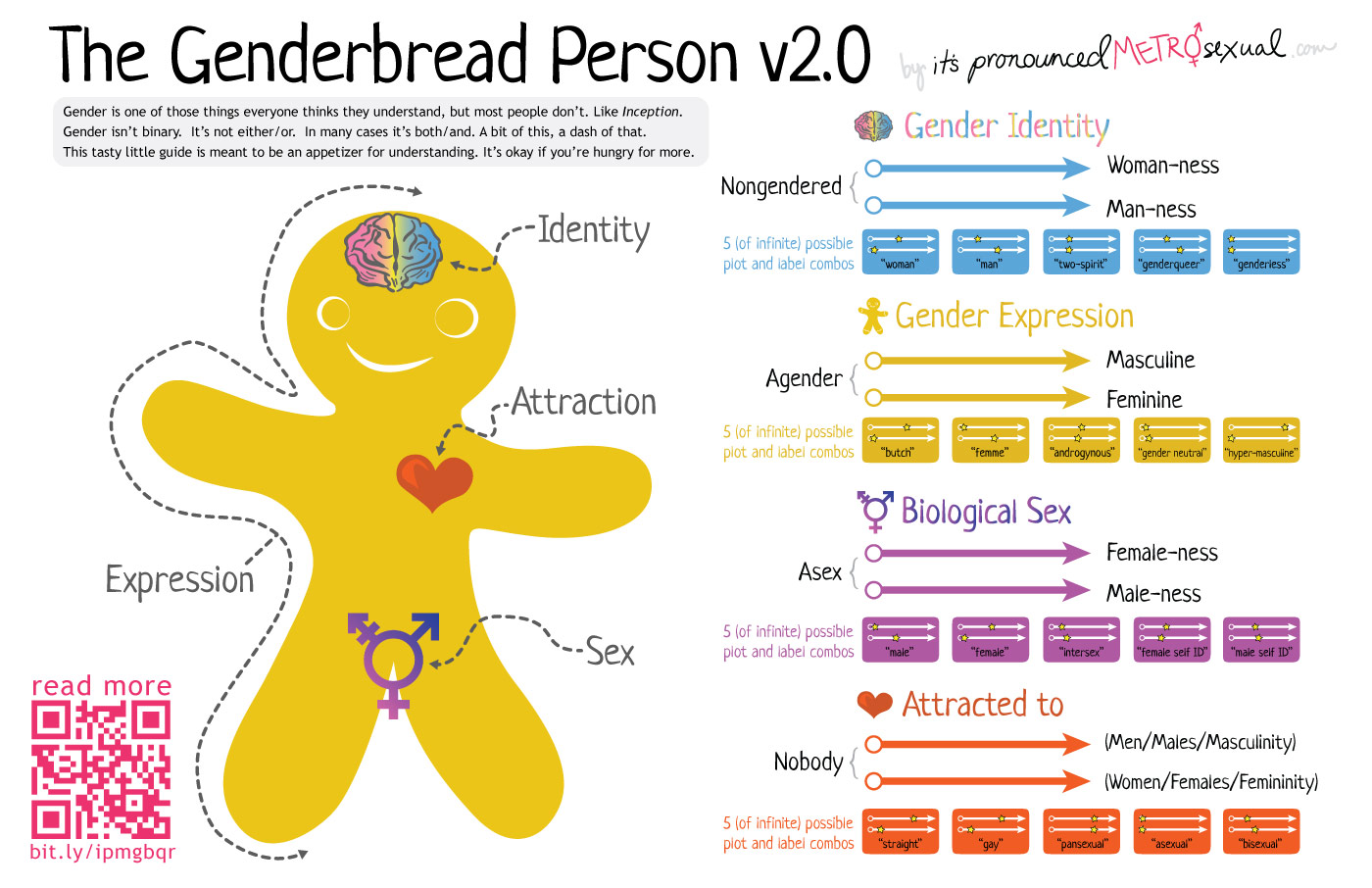
If you relate to this dilemma, let me help you out.  Here is my little friend, The Genderbread Person 2.0

Genderbread-2.1

I know it is confusing at first.  You may notice that each category is on a continuum.  That is because these things are not completely black and white.

Gender Identity: Here we have the most commonly known terms “male” and “female” as well as other possibilities.  This is a person’s truest gender and can only be determined by that person.  Always, when referring to people, use words that line up with their gender identity. If that is unknown or they identify as something like “genderqueer” or “genderless” then gender neutral pronouns  such as “ze” or “zir” may be appropriate.  It is never ok to call a person “it”.

Gender Expression: Not to be confused with biological gender or gender identity, gender expression refers to outward things such as clothing, hairstyle, and mannerisms.

Butch: gender expression that is toward the masculine side

Femme: gender expression that is toward the feminine side

Androgynous: gender expression that has characteristics of both the masculine and the feminine

Gender Neutral: gender expression that is neither characteristically masculine nor feminine

Biological Gender: This is a person’s physical gender. While we generally refer to people in terms of male and female, some people don’t fit very well into either category.   We are not all born with clearly male or female genitalia.  Those who have both male and female physical characteristics at birth are said to be “intersex”.   (Here is where I discourage use of the term “hermaphrodite”, which is no longer appropriate.)

Attracted to: (Also often referred to as “sexual orientation”) Just like the heading says, it really is all about who you are attracted to.   Please don’t question someone’s sexual orientation.  If you say you are hungry for tacos, it would just be silly to tell you that you really want lasagna.

Straight: a person who is generally attracted to people of the “opposite” gender.

Lesbian: a woman who is generally attracted to women.

Gay: a man who is generally attracted to men.  (“Gay” is also used when referring to lesbians.  Lesbians are gay, but gay men are not lesbians.)

Bisexual: a person who is attracted to both men and women.

Pansexual: someone who can be attracted to people of any biological gender or gender identity.

Asexual: someone who has little to no sexual attraction to anyone.  Again, please do not question this.  If you say you are not hungry, it would be rude of me to say that you have just never tried good food or don’t know what you like or want.  Also, do not say that most women are asexual.  This is untrue and offensive.

And now for some other terms that you may be wondering about.

LGBTQ: This refers to the subset of humans who do not fit the mold of  “cisgender person who is only attracted to persons of the opposite gender”. The letters stand for Lesbian, Gay, Bisexual, Transgender, and Queer or Questioning. There are other acronyms such as QUILTBAG, and sometimes people will leave out a letter or two that they don’t like. I hate to say it but there are some in the LGBTQ community who, in spite of everything they have experienced, have a hard time accepting those unlike themselves. Personally, I think the entire culture is becoming more accepting and that includes the queer community. GLBT is the same as LGBT, just with a couple letters switched. I’m sorry I can’t cover the whole queer alphabet soup, so if you hear something and wonder about it, there is always Google.

Cisgendered: a person whose biological gender and gender identity match from birth.

Transgender: a person whose biological gender at birth is different from their gender identity. Transgender persons may be Male to Female (MTF) meaning that their biological gender at birth was male, but their gender identity and therefore true gender is female; or Female to Male (FTM) meaning that their biological gender at birth was female, but their gender identity and therefore true gender is male.  “Gender dysphoria” is the term for the negative feelings a transgender person has toward their biological gender before transitioning.  This feels much the same way a cisgendered person would if they woke up one day and found that their gender had changed while they slept.  The difference would be that the transgender individual would be expecting to wake up in the wrong body – so there might be somewhat less screaming from shock involved.

When referring to a transgender person, always use terms associated with their gender identity, not their biological gender.  Terms like “he-she” or “shemale” are completely unacceptable in this context.  They tend to imply that the person is a sex-worker.  Transgender persons often dress based on their gender identity, take hormone replacement therapy (HRT), and have surgery so that their body matches their gender identity.  It is impolite to ask them where they are at in the process or for details on how these things work.  If you want information on what transgender individuals go through physically, look it up.  Would it be appropriate if I asked you what your genitals look like and what hormones you have in your body?

Queer: used as an umbrella term to cover anyone who is not exactly straight and cisgendered.  Some people still feel negative vibes are associated with this word, so I personally would not use it to refer to an individual unless they first used it to refer to themselves.   It can be used to refer to the whole community when alphabet soup gets tedious.

A: This is another letter that is sometimes added to the alphabet soup.  It stands for Allies.  If you are straight and cisgendered, but support equal rights for all, you are an Ally.  Wear the title proudly.  (Just please don’t try to make yourself sound cool by using this title if you don’t actually support anti-discrimination laws and gay marriage. Many in the community can respect you for being on the fence or even not wanting these laws, but don’t try to pretend you are doing us favors simply because you don’t use cruel language or don’t tell people we should be killed.  It shows that you have no idea what it is like to be us.) If you are an ally, we welcome you to the community and thank you for your support.

If you are still a little worried that you will use the wrong word at the wrong time, take heart.  The important thing is that people know you are trying to choose kind and appropriate words. Don’t be afraid to apologize if you make a mistake or ask if you are not sure about something. If you don’t insist on using offensive language, most people are more than willing to overlook a few mistakes.

Ok, wow! If you made it through all of that, you deserve a little fun.  A friend showed me this. Maybe you will like it.  If you have an iphone, take it out, press and hold the button, then ask, “Siri, are you a boy or a girl?”  Siri will likely say something along the lines of, “Animals and nouns have genders.  I do not.”  It is easy to imagine Siri as a woman because ze has a “woman’s voice”  in English (American).  If, however, you  switch to English (United Kingdom) ze suddenly has a “man’s voice”.  While I have a tendency to prefer thinking of zir as a woman, ze is genderless. I now respect Siri’s gender identity and use gender neutral pronouns.