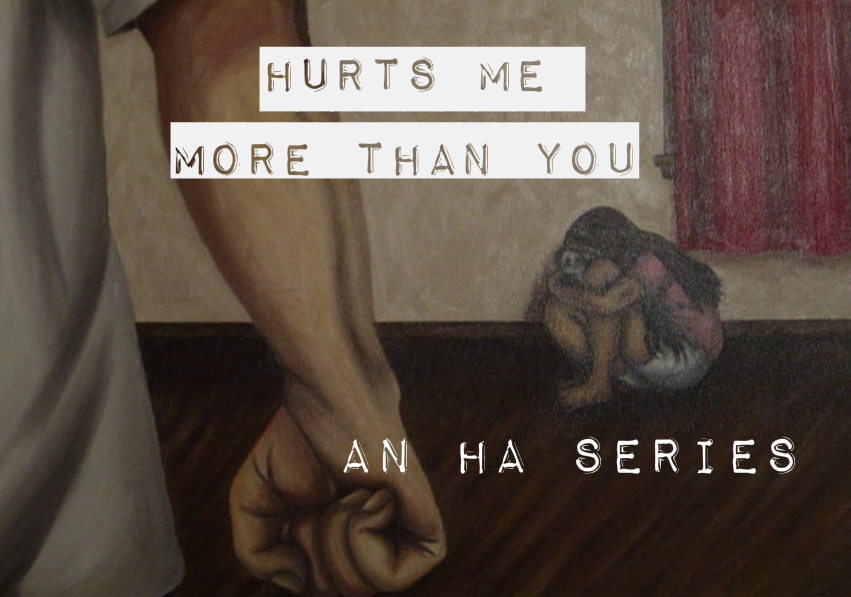
Hurts Me More Than You: Jessie’s Story

Screen Shot 2014-09-23 at 10.15.16 AM

*****

Trigger warning for Hurts Me More Than You series: posts in this series may include detailed descriptions of corporal punishment and physical abuse and violence towards children.

*****

Jessie’s Story

Childhood Recollection

You know where the best place to color is? The walls. You know where the biggest canvas in all of creation? The walls.

You know where you get punished for coloring?

The walls!

Can you guess where your stubborn, imaginative baby’s gonna draw anyway? You guessed it baby. The temptation’s too strong. Even when your parents tell you not to, even when you know a spanking will follow. The urge to fill those empty dull spaces with the marks of your creative genius are too powerful to be denied.

Pain is a baffling thing, how it’s subjective and personal and always in flux, and apparently always “your own fault.” As the blows fall, some tiny voice in the brain braces against the sting with the mantra of “only have to make it to ten.”

Experience has taught that around the 10th you stop feeling the pain. The sting won’t bite so hard and the following burn won’t scorch so badly. “Hold your breath,” I tell myself… sometimes it doesn’t hurt so badly if you hold your breath, and with face down in their scratchy comforter I try to hang on. But then I’m betrayed by my own body. I was expecting a sensory overload and a full shutdown to see me through this ordeal. But I’ve never been swatted so many times, and at the thirteenth strike I’m ambushed by the pain again. The walls of ‘otherwhere’ I’ve built to protect me in this moment collapse inward and I’m drug under the burning blinding pain. Everything’s on fire, I’m on fire, in fact in that moment I could believe I’m made of fire.

That’s when the screaming truly starts. To her credit, my mother doesn’t shush me. She goes about her work of discipline as I go about mine of endurance. All told, there are twenty blows- accumulated for each time I draw on the walls. If I disobey again, there will be twenty-one in store for me. She has me sit beside her on the bed when it’s done, on my newly scorched flesh. We pray and she looks grim but determined to win this struggle. She reminds me that “we” agreed to this and I nod still crying.

I am seven years old, and I agreed this.

I’m seven years old, and I agreed to this… apparently.

Adult Retrospection

When you’re a strong-willed child you learn so many things about spanking, about discipline in general. It becomes both the axis and guiding star to nearly every aspect of your life and your parents. Everything’s a battle of wills that your parents are going to win, no matter the cost.

I was spanked so many times growing up, and for so many reasons. I can say it was usually done in an emotionally restrained fashion. But I also can recall times I was hit from a state of rage. Once I was picked up by my lapels and shook. While my mother screamed that she wanted to throw me through the screen door onto the hood of our family car. I reminded her of that incident in my adult years … she didn’t remember, and chuckled as she hoped I had forgiven her. The worst spanking I ever received was for drawing on the walls. She set down an arrangement with me when I was seven, for every instance of vandalism I would receive an extra swat. I took twenty (20) blows before I plain stopped drawing altogether.

The chief instrument was a series of hard plastic cooking spoons. They sat next to the stove in a large wooden vase, like a bouquet of pain. To this day the sound of a spoon being drawn from the bunch causes my brothers and I to visibly flinch. My mother used to complain that I never wanted to learn to cook, but I wanted to be as far from those spoons as possible. Once I spoke to a school councilor about the spankings. It felt surreal, and when I told my mother, I had to spend the rest of the day comforting her.

As an adult I can actually withstand her screaming now. It’s easy to drift away and not care if she yells herself hoarse.

Though I spend a fair amount of time wondering if she’ll slap me … and if this time I’ll actually slap her back.

Hurts Me More Than You: Traveler’s Story

Screen Shot 2014-09-23 at 10.15.16 AM

*****

Trigger warning for Hurts Me More Than You series: posts in this series may include detailed descriptions of corporal punishment and physical abuse and violence towards children.

Additional trigger warning for Traveler’s story: descriptions of self-injury.

*****

Traveler’s Story

Here are the lessons I learned from spanking:

1) Suppress your conscience; avoid the consequences of your actions.

When I was very, very young, I unrolled a roll of toilet paper in the bathroom and then left the mess behind when I got distracted by something else. The mess was discovered, and I feared being spanked if I was implicated. Instead of confessing, I asked “what will happen to the person who says they did it?”

“Nothing except they will have to clean it up,” my mother responded.

“Oh, well in that case, I did it,” I said, and gladly cleaned my mess.

With the fear of violence removed, I was happy to answer my own conscience and fix my mistake.

2) You can’t make up for your mistakes; you can only suffer for them.

One morning, I was late starting homeschool because I had gotten distracted during my chores.  It didn’t matter if I was sorry, or if I promised to do better, or if I made my bed on time for the rest of the week, or if I even offered to do other chores to make up for it.  Forgiveness could not be obtained from my mother until she hit me until I cried.  I truly wanted to make my mother happy and to do right by her.  But, a spanking taught me that there was no way to make things right anymore.

The only way for me to be forgiven and returned to my valued place in the family was to submit to physical pain.

3) Violence and humiliation can be deserved.

When my family rejected me as an adult for my sexuality, I began to abuse myself.  I thought of it as a method of atonement. I would beat my shins against a table to raise welts and bruises.  I would scratch at the skin on my stomach, upper thighs, and arms to make myself bleed.

I felt like I deserved to hurt.

I deserved violence.  I deserved humiliation. I deserved emotional abuse.

And why shouldn’t I?  My family had always taught me never to let anyone hurt me.  But yet, they crossed those boundaries repeatedly when I was a child.  I learned that there were situations where violence, humiliation, and a lack of self-respect were deserved.

Is it so hard to imagine that these toxic thoughts could have carried over into my adulthood?

Hurts Me More Than You: glor and Gary’s Stories

Screen Shot 2014-09-23 at 10.15.16 AM

*****

Trigger warning for Hurts Me More Than You series: posts in this series may include detailed descriptions of corporal punishment and physical abuse and violence towards children.

*****

glor’s Story

My father’s study was a terrifying room, from birth until I moved out of the house. I’m sure it still is for my siblings. But I seem to have been the only one to get as much pain there that I did. I try not to think about why that is, because it’s a long, dark, ugly road. But it stands: my father beat me, though not with a rod. He started with a belt, and moved to a wooden spoon and then “the paddle.” It was one of those cutting boards, oak, I think… 5”x8” or so and about an inch thick. It was terrible.

It was terrible not just because I was getting smacked with a giant board – but because I became intimately acquainted with how it felt on bare skin. Yeah, bottomless. A lot of boundaries that should have existed were ruined when that thing came into the family. There’s a lot more I could say on that, but… that memory section has mostly vanished into the depths of my PTSD.

What hasn’t is the non-hitting corporal punishment: the physical labor.

I was tasked with a lot of stuff that my brothers were not, since I was the girl and all. All the laundry, most of the dishes, making sure all the bedrooms were clean, and so on. One of my doctors has said that she thinks I have fibromyalgia because of the abuse and work I was made to do. I know some of you are thinking that that’s not possible. But try “being forced to manually turn a garden and plant bulbs in the middle of a Colorado October while sick with pneumonia.”

That is why corporal punishment is bad: not only are you hurting your kid in the immediate, but you lose all sense of boundaries the child should have… like helping them to be healthy instead of seeing them as someone you can force to do things because they’re terrified of being punished.

Trust me… while I’m not physically still being punished [I moved out seven years ago], it’s still punishing me. Through my PTSD, my flashbacks, and the nightmares where I wake up screaming in the middle of the night.

I may be free from more, but I will be punished the rest of my life by what I’ve already experienced…  thanks to corporal punishment.

*****

Gary’s Story

I never heard my parents say anything even remotely close to “It hurts me more than you.”

For one thing my “spankings” were very rarely thought out. They were rarely “punishment” for some infraction, they were most often spontaneous beatings by my enraged father, enraged for any number of trivial reasons.

One episode demonstrates this best.

I was nine years old.

My father had been hired on a contract basis to clear brush from 180 acres of forest land. The man who owned the land assumed that my father would be working this job himself. Of course this was far from true. My father would wait till he knew the man was not in town, pile all us kids into the van, drive us to the land and work us, for a solid eight or more hours. Unpaid. Under the radar. During school hours.

“This IS your “schooling” he would say, “Learning how to work”.

This kind of thing was standard for my childhood, and one of the major reasons we were homeschooled. Work. Hard work. Unpaid work. Grueling work. Dangerous work. Mind numbing work. 

Not chores. Not house hold duties.

Work. Real work. Work with chainsaws and lumber, work with shovels and rakes and hoes. Work that left blisters.

Work that my father was paid for on a “per job” basis.

Work us children never got a dime for.

All of this work was made possible only because we were homeschooled, because we could be worked 8-10 hours a day any time of the year.

It was early spring. Snow still held the shadows under the trees in an icy grip. As we headed into the forest to work, breath puffing in the cold predawn air, my father turned to me and said: “I forgot the gas for the chainsaw, go back and get it out of the van, and don’t dawdle.”

His voice was level and normal, showing absolutely no sign of the rage to come. I walked back, walked carefully, one foot in front of the other. Why? Because we were on a rutted logging road, and the deep ruts were filled with water several inches deep, crusted over with a thin film of ice.

And my boots were old and full of holes, passed down from 3 siblings before they got to me. I had never owned a new pair of shoes. Not once. My first pair of new shoes was bought for me by my Grandparents when I was 12 years old, so I wouldn’t have to wear ragged sneakers to their 50th wedding anniversary. I knew that if I got my feet wet I would work in the cold and snow for 8 or more hours with wet feet. No question about it. So I walked carefully, one foot in front of the other down the ridges between the water filled ruts.

This, was apparently, “dawdling.”

I heard an enraged scream from behind me, and turned just in time to see my father rip an ice encrusted tree limb from the frozen ground, it was a big one, two and a half feet long and twice as thick as a broom handle.

The beating went on for about 30 seconds.

Do you know how many times a enraged man can swing a club in 30 seconds?

Do you know what kind of damage it does to a 9 year old boys body when swung with the full force of grown man’s work hardened muscles?

That night my mother was worried enough about what she had seen to ask me to “show her”. Even she recoiled in shock.

I was covered in now black bruises about three inches wide from my lower calves to my lower back. At least 30 blows had rained down on my skinny frame.

This kind of beating didn’t happen all that frequently. But I still have nightmares at least twice a year.  At 31 years old I still wake up with clenched teeth and a racing heart. In my dreams, I am small and helpless.

In my dreams I cannot escape. In my dreams my father is beating me.

Hurts Me More Than You: Dom and Scout’s Stories

Screen Shot 2014-09-23 at 10.15.16 AM

*****

Trigger warning for Hurts Me More Than You series: posts in this series may include detailed descriptions of corporal punishment and physical abuse and violence towards children.

*****

Dom’s Story

They did everything right.

It was never in anger. We were told exactly why it was happening. They made us hug them afterwards. They said “I love you” during the act. My parents abused us exactly the way they were told to. You’d never guess. We were well-behaved, happy kids. My parents are loving and supportive.

And yet, they spanked me. And though they did everything “right,” though they did exactly what the Christian leaders told them to do, they did abuse us. To admit that to myself is jarring.

Most of my adult life I’ve been a spanking apologist. After all, look at me. I am okay. I don’t hate my parents. I am a well-reasoned adult. But that was before my life fell apart. Before my psyche imploded. Some mental breakdowns, suicide attempts and ideation, panic attacks, psychotic breaks, and a PTSD diagnosis later, I’m wiser now and have been able to admit to myself the damage that has been done to me. Not all of my problems are due to spanking. But the fact of the matter is, no matter how much my parents said they loved me, no matter how “right” they did it, spanking broke me.

They claimed that was never the goal. But that’s what it did.

I didn’t realize it was abuse until I let myself remember. When I remembered through the lens of absue, memories that had not made sense fell into place. I’d had homicidal thoughts towards my parents while I listened to the cries of my siblings. Fear gripped me physically in what I now realize was probably a panic attack. Perhaps the most confusing part is that my parents weren’t abusive otherwise. They occasionally yelled. But mostly they listened and loved us well.

Most of my childhood memories are happy ones. Perhaps that is why when they hit us, it broke me. The incongruity scarred the deepest levels of my soul. One of my closest friends recently admonished me that not everyone in my life is trying to hurt me. It hit me then that I live like that, without even realizing it. I let people get closer than they ought to and yet am constantly expecting them to hurt me – especially the people I let in the farthest. Not all of my problems are from spanking.

But I was spanked the “right” way. And it still broke me.

*****

Scout’s Story

Additional trigger warning: sexual abuse

My parents did spanking “right.”

They never spanked in anger, never with excessive force, and always explained what I had done wrong. I didn’t feel traumatized by spanking, because I knew I deserved it. When I was 3 or 4 years old, I remember my mother spanking me for some childish infraction. She had tears streaming down her face, as she told me how she hated to do this, but she had to, because she loved me. By the time my little sister came along, she was able to hit us ten or more times, without a twinge of emotion on her face. She had finally learned to love us correctly.

But it didn’t work–sure we got complimented on being well behaved kids, but most of our behavior revolved around not getting hit. Not being humiliated, naked and crying, in front of that increasingly cold face. We got better at it, and more creative. We coped by becoming skilled hiders and liars. We knew how sinful we were–how many more times we deserved to be hit, then we actually were.

By the time I was 12, I snapped. I realized that the person designated by God to dole out the punishment was given the job, not by virtue of their goodness, but by virtue of being bigger and more powerful. I was strong and nearly as tall as my punishers, now. The day I wrestled the wooden paddle out of my mother’s grasp, and told her, voice quivering in anger, that if she ever hit me again, I would beat her without mercy, I became a monster–but at least I was my own monster. Heavenly retribution came however, several years later, in the form of the middle aged man, pinning my teenage body onto the bed, telling me that I deserved this, because I dressed like a whore and wore too much makeup. And I didn’t scream, because I knew I deserved it.

God surely didn’t enjoy this, but he must hurt me, because he loves me.

Spanking teaches children that it is ok for someone to violate their body and hurt them, if that person truly loves them. It teaches them that they are evil, and worthy of abuse.

Spanking teaches children that violence is love.

Hurts Me More Than You: Sophia and Odessa’s Stories

Screen Shot 2014-09-23 at 10.15.16 AM

*****

Trigger warning for Hurts Me More Than You series: posts in this series may include detailed descriptions of corporal punishment and physical abuse and violence towards children.

*****

Sophia’s Story

My mom said that she received smacks on the head by her mom with a ruler as a child, but not very often, because she always “learned from her mistakes.”

I was spanked so often because I was a “strong-willed child,” and refused to learn from mine.

I didn’t mean not to learn. I just wasn’t ever sure of what it was I was supposed to be learning. I’ve blocked most of these episodes out, but there are a few that stick in my memory. There was the time I was 8 and my sister was 6, and my father was convinced that we had deliberately killed his favorite plant in our garden. He took the “rod,” a zingy rubber object, marketed by a Mennonite company specifically for spankings, and told us to go to my sister’s room.

All spankings were bad, but we particularly hated “The Rod.” When my mom first jubilantly returned from a homeschooling convention with it, my dad tested it on a stack of newspapers, cutting through several of them with a moderate hit. That afternoon, my dad decided to use it on us to force us to confess that we’d killed his plant (which we’d never touched. It probably died because it was the wrong kind of plant in the wrong kind of climate.)

He alternated between us two bare-bottomed little girls, zinging each of us repeatedly, giving us an opportunity to confess, and then zinging us again.

We cried and cried until my sister decided to make up a confession, but she didn’t understand what she was confessing to (because she’d done nothing wrong). This made my dad madder, and he continued until he got tired, then sent us to our rooms to “think about what we’d done”.

My mom found me in my room later, sobbing and reading Lamentations. I picked Lamentations because my Sunday School teacher told me the word meant a deep expression of sorrow. I hoped it would make me feel better, but I was pretty sure God wasn’t there anyways.

I may have only been 8, but I already knew about fear, and pain, and hate, and injustice, and wishing I could die.

*****

Odessa’s Story

“If you only had listened..”

“The Bible commands it..”

“What if you had broken the instruments they used or threw them away? Then they couldn’t have hit you any more!”

I was powerless and indoctrinated to believe I deserved it and was rebellious for not wanting it over quickly. Society says I should have had power and told someone, yet the culture I lived in has repeatedly informed me that I should have listened and I never would have been hit, not even once.

Those who use the Bible to justify hitting their children, stop. It is time for a re-evaluation of what the Bible really says. It’s time to ask deep questions of yourselves.

Those of you secular parents, please reconsider.

It doesn’t matter how fast, how hard, or with which instrument you use – whether it’s your hand, or something else entirely – spanking your children truly does damage their very heart, soul and mind; not to mention their little bodies.

You may not think you will ever harm your child. If you are hitting them, you are every single time you lay a hand or instrument on their little bodies.

The truth has been repeated often for over 30 years: Spanking leaves long-lasting effects on children.

No matter how calmly or “biblically” you spank, you are still damaging your children. The Bible never actually commands spanking, not once. That the quote “spare the rod, spoil the child” is from a bawdy poem called “Hudibras” and is talking about sex, and the “rod” in the Bible was a symbol of parental or ruling authority, denoting discipline; not physical harm. It makes me wonder how a sexual poem came to justify child abuse and was conflated with the Bible.

Here are a few things your child may experience, or are at high risk for, if they are spanked:

  • Alcohol or Drug dependency
  • Asthma
  • Attachment Disorders
  • Auto-immune Disorders
  • Cancer
  • Cardiac Disease
  • Decreased Language Skills
  • Externalizing behaviour
  • Mental Disorders or Emotional Disorders (Aggression, Low Self-Esteem, Oppositional or Anti-social behaviour)
  • Poor moral internalisation/regulation
  • Reduced Empathy
  • Suicide or Suicidal Ideation

Please reconsider your discipline methods if corporal punishment is one of them and talk (often!) with your children. No one deserves to be harmed by their parent for any ideology, even if it is part of your culture. If you truly want world peace, it starts with your babies.

Hurts Me More Than You: Darcy’s Story

Screen Shot 2014-09-23 at 10.15.16 AM

*****

Trigger warning for Hurts Me More Than You series: posts in this series may include detailed descriptions of corporal punishment and physical abuse and violence towards children.

*****

They Spanked Me “Right”: Darcy’s Story

(You can read more about Darcy on her blog)

My parents disciplined us “right” — just like the books said.

They were always calm and loving, rarely spanking out of anger. They truly loved us and believed that if they did not punish for wrong-doing with a spanking, we would not turn into good, moral people. They were not selfish and did nothing for their own benefit, but for ours.

Usually, a discipline session would start when one of us would do something wrong. This could be any infraction from “back-talking” to disobedience to lying. And “back-talking” could mean anything other than “yes, ma’am”. Because obedience should be instant and cheerful with no negotiating or it’s not true obedience. We could not have an opinion, only first-time obedience.

We would get sent to our parent’s room to wait til it was convenient to them to come discipline us. There were times when they’d forget they sent us there. Then they’d feel guilty and let us off the hook.

We often hoped they’d forget about us.

We’d sit there waiting in mental agony. One of them would come into the room, sit us on their lap when we were little, or when we were older, just sit next to us on the bed. They somberly explain that foolishness is bound in the heart of a child and a spanking will drive it far from us. That children are to obey their parents in the Lord, for this is right. That they had to spank us because they had to obey God and God wanted them to punish our sin, just like God punishes their sins. Then we’d lay on the bed, often with our pants off since pants provided cushion from the blows, and get 3-4 swats with a wooden spoon or switch, never their hands (although hands were last resort if they couldn’t find a wooden spoon). If we resisted at all, it would be another 3-4 swats for not submitting to the deserved punishment.

I had a very difficult time laying there still while being hit so I often got double or triple spankings.

Submission and a broken will were just as important as the punishment for our sins. After all, if your heart is not right, what good will a punishment do? They’d then hug us for a while, tell us they loved us, that they had to do this because they loved us and loved God and wanted to obey God. I remember seeing tears in their eyes on occasion.

When they said “this hurts me more than it hurts you” I believe they really believed that and that it really did hurt them.

Not everyone trapped in fundamentalism can completely shut off their hearts.

I often sat there in rage waiting for my parents to come spank me, angry at myself for getting caught or not being able to keep my mouth shut, making myself feel better by plotting all kinds of revenge on them. I have a very distinct memory of being 6 years old and laying on my bed after a spanking, rage consuming me, longing for the day when I was bigger and stronger and I could hit them back, dreaming of all the violent things I would do to my mom. This made me feel overwhelmingly guilty yet satisfied at the same time.

The very last time I was spanked, I was 13 years old. I had “back-talked” to my mom, and in a fury she sent me to my room. She came in to spank me and I initially tried to submit, but I couldn’t take it any more. I was taller than her by that time. I turned around and tried to grab the spoon, defending myself. She became even more enraged, but I also sensed her surprise. We repeated this multiple times, both of us crying, until she gave up and told me to stay there til my dad came home. Hours later, Dad came into the room and sat down. I was sullen and depressed. But, for the first time, I realized that I was able to stop them now and this elated me. Dad talked to me, I don’t remember what was said or if I was even listening at that point, but that was the end of the day-long discipline battle. They never tried spanking me again. My other siblings weren’t spanked past 8 or 9 years old.

My parents were often asked “How do you get your kids to obey like they do? Your children are so well-behaved!” They’d smile and counsel other parents on godly discipline. I smiled on the outside like the good girl I was, but on the inside I seethed and thought “if only you and they knew that we’re just really good at not getting caught.”

Spanking and authoritarian parenting didn’t make us “good kids”.

It made us sneakier kids, clever kids, kids who knew how to play the system to get what we wanted and avoid what we didn’t.

I daresay that when people proclaim “My parents spanked us right, never in anger”, they would describe a spanking like my parents practiced. And perhaps their parents were like mine, good people duped into thinking that if they didn’t punish and control their children, those children would end up rebels, perverts, and in jail. They took literally the proverb that promised if children are beaten, their souls would be saved from hell. Parents like mine were not the abusers you read about: people who were perverted and got off on beating their kids. They were not evil. Yet they practiced abusive parenting techniques because they listened to the wrong people, accepted fear as a motivator, and gave in to the tantilizing promise that they could direct their children’s future “in the way they should go”.

They made the wrong choices for all the right reasons.

Stories of horrendous abuse abound in our circles, but I write this to show that abuse happened even among the non-extreme families, inflicted by the parents who only wanted good for their kids. That abuse in discipline is not just physical but often psychological and almost always spiritual.

I saw what I now know to be glimpses of empathy and doubt in my parents, the logic inherent in them trying to get through the illogical spiritual abuse of the system that they were in, that they were inflicting on their kids. It’s not so easy to just be angry at them when I see them as victims of pervasive spiritual abuse. Yet they did have a choice.

They chose that abusive system, a system that hurt them and hurt their children.

Eventually much later, they chose to leave it. But that was not before the damage had been done, damage I and my siblings and my parents are still recovering from a decade later. My story and others like mine are complicated. The emotions that follow us are complicated. Rage and anger are mixed with empathy and forgiveness, and there’s no telling which one of those will come out on any given day — as memories come to the surface and our stories are processed and healed. I have given myself permission to feel them all, without trying to justify my feelings to myself.

Yes, they loved me. But they also hurt me. One of those is not more real than the other.

My parents spanked us “right”. Yet it was all still so very wrong.

Hurts Me More Than You: Lana and Kate’s Stories

Screen Shot 2014-09-23 at 10.15.16 AM

*****

Trigger warning for Hurts Me More Than You series: posts in this series may include detailed descriptions of corporal punishment and physical abuse and violence towards children.

*****

Lana’s Story

My father never hugged me. The only physical contact I had with him as a child was from being beaten. He used the belt that he wore looped through his jeans every day, and he struck me with the leather end enough times to leave bruises and welts. Apologizing for the back-talk or broken object was pointless, I was told, because “it was too late for apologies.” The point now, I was told, would be that I learn from my mistakes. This happened to me, I was told, as young as age four or five because the Bible said that children needed to be trained to respect their parents in order to learn to respect God.

I guess the Bible didn’t command that he hug me. Or, if so, I wasn’t ever told that it did.

I just wanted a hug when I was a kid. Being a kid is tough, especially when your mother is difficult and has mental problems. I was scared of my father and never felt comfortable showing him things I made. Drawing, poems, dances. I used to hide from him. One time he said children were indentured servants who paid their way with chores until they turn 18. This could have been funny but he never hugged me. My mother would admire and appreciate my creativity, but not my dad. He could be so mean and sarcastic. And it really hurt, especially the threats, because I knew too well what it felt like to be beaten. The only times I remember him being nice was when other people, outside of the house, were around. He was always so much nicer to other people than he was to me as a child. This broke my heart.

The sight of a leather belt still makes me nervous. Belts made of other materials are okay. If I let my mind wander to a certain dark place, I can still feel the terror of anticipating being hit with his belt and hearing myself sob, “no, stop. really. i’m sorry. i mean it.”

I can still feel the terror of knowing my words meant nothing and would change nothing.

My dad never really told me that he loved me. He would sometimes send my adult self gifts and letters, and it would make me feel weird and guilty. I don’t want things from him. I can’t love him back. I know he’s lonely now and he wants attention from me, but I can’t do it. I just can’t. This kills me.

Kate Birney’s Story

HA note: For more information about Kate Birney, visit Kate’s page at BJUnity.

I came across this definition of spanking:

“A form of physical punishment in which a beating is applied to the buttocks.”

That’s not entirely incorrect although in my case (and my siblings) spanking involved being beaten or hit on any available body part, including face and head. It included getting pushed or shoved against furniture or walls, or getting grabbed so hard that welts were left on my arms. I’ve been hit with rulers, leather belts, the buckle of the belt, metal spoons, wire whisks, acrylic spoons, yard sticks, and of course hands & fists.

I’ve been hit for not eating, for eating too much, for not going to bed, for taking a nap, for talking back, for not talking, for being disrespectful, for not taking care of my younger siblings properly, for not making my bed, for not cleaning the house…the list goes on.

Always ALWAYS being told “I do this because I love you”, and “this hurts me more than it hurts you”. And also being told that God requires this as discipline.

Well, when you grow up from a young age with physical violence being intimately connected to love and religion, it affects how you relate to other people. It makes it hard to believe that people who don’t hurt you DO love you. It makes you believe that when you’re ok and not being harmed, it means no one cares. Rewriting that kind of messed up thinking is a difficult process.

And more so, it’s so very hard to unwind and relax. You grow up on edge, never knowing what you’re going to do wrong today that will end up with you being “punished”.

I don’t support corporeal punishment. I don’t believe that violence is intended in any religion – I think it’s a misinterpretation designed to control people and outcomes. It leads to isolation because you learn very young and very quickly that the people who are supposed to be safest & love you will always hurt you, so what does that mean for the rest of the people in the world?

Hurts Me More Than You: Rachel’s Story

Screen Shot 2014-09-23 at 10.15.16 AM

*****

Trigger warning for Hurts Me More Than You series: posts in this series may include detailed descriptions of corporal punishment and physical abuse and violence towards children.

Additional trigger warning for Rachel’s story: descriptions of self-injury.

*****

Rachel’s Story

Maybe I’m the oddball, but, I was reading some articles on the lifelong effects that spanking children has on their emotional and mental development when it hit me.

Being spanked as a child is a large part of why I started self-harming as a teenager.

Let me unpack this statement a little bit.

From a child, I had been taught through example that physical punishment was the Biblically advocated way of training your children. To be fair, my mother absolutely hated spanking us, and would cry at night because she believed it was wrong, but according to Mike and Debi Pearl, corporal punishment until actual pain was achieved is the only way to properly “train up a child”. And, indeed, Proverbs supports this methodology to a degree. We were spanked for back talking, direct disobedience, rebellion, tattling…and the list goes on. Being spanked teaches a child that physical pain is the only appropriate atonement for his/her misdemeanors. While my parents truly loved us and believed that spanking was the Biblical way to train their children, I have come to question the subconscious impact which this ideology has had on the way I personally relate to punishment.

When I was 15, I reached a particularly low point in my life. My parents had just found out about a young man who I was involved with, and were extremely displeased with the content of some of our conversations (eg. swearing, his expressing a desire to kiss me, etc..) among other things. Feeling that a relationship was not in my best interest at this point, they grounded me for a week and lectured me extensively.

But, for me, this punishment wasn’t enough.

Although I didn’t realize it at the time, I had become subconsciously convinced that punishment which did not cause physical pain was not adequate punishment.

Because, after all, a lecture was never good enough when I had sinned as child. Spanking was always in order. Therefore, as soon as I found myself alone in my room, I, almost instinctively, physically lashed out against myself, taking a disposable razor to my wrist until it was dripping blood. I felt instantly better. After which, I cleaned it up, bandaged it, and fell asleep.

Dad commented the next day that I seemed happier. I was even smiling!

It became a vicious cycle. Whereas when I was a child, if I did something wrong, I was immediately spanked and then the incident was forgotten, as I got older the spanking became less frequent, and lectures replaced corporal punishment. What I didn’t realize was that I had unwittingly adopted the notion that physical punishment is the only adequate punishment. So, if I did something wrong, or my parents were displeased with me, hurting myself became second nature.

I cannot tell you how harmful this mentality is.

When Christ died, HE took the physical pain punishment for ALL my sins. Knowing that my parents are displeased, natural consequences, or rebuke, should be punishment enough for me. Of course, there are consequences, but these should be natural consequences. For instance, if you eat twenty pieces of cake, you’re going to make yourself sick. This doesn’t mean that wrong should be condoned. If my brother hits me, he’s going to be told why that’s wrong and if he persists in wrongdoing, should be punished by a timeout or something similar.

Obviously, circumstances are different for every family, but for me, at least, being spanked unwittingly implanted the idea in my head that physical pain is the only valid form of punishment.

I’ve wondered for months why it was that, when I reached that point where my parents were so upset at me, hurting myself was an almost instinctive reaction. I didn’t even think about it. It felt natural. It felt…right. There was no question in my mind that I completely deserved the physical pain for disappointing my parents, allowing myself to have romantic feelings for a boy, and using bad language. I believe a large part of it is that when I was young, I knew I was in the doghouse if I had acted wrongly. Apologizing didn’t fix things. Being lectured didn’t change things. BUT, as soon as I had gotten the appropriate amount of spankings, everything was forgiven and I was reminded again of how loved I was. How does one make the mental transition from “I need to be physically punished for any transgression” to “Now that I’ve reached a certain age, a lecture or being grounded is adequate punishment”?

And for those who argue that Proverbs commands parents to spank their children (Mike and Debi Pearl, I’m looking right at you!), my response is that Proverbs is in the Old Testament, and although I don’t believe we should discount it merely because it happens to be before the birth of Christ, please show me a passage anywhere in the New Testament under the New Covenant which commands spanking children as a form of punishment! The verses in the New Testament on child rearing say to not provoke your children to wrath but rather bring them up in the nurture and admonition of the Lord. Admonition is NOT the same as spanking.

And, while I’ll readily admit that my ideas on child raising aren’t completely developed yet, I agree far more with those who advocate not spanking your children, or only using spanking as a very last resort, than those who spank their children constantly for any real or imagined misdemeanor.

Hurts Me More Than You: Introduction and Abiram’s Story

Screen Shot 2014-09-23 at 10.15.16 AM

By Nicholas Ducote, HA Community Coordinator 

*****

Trigger warning for Hurts Me More Than You series: posts in this series may include detailed descriptions of corporal punishment and physical abuse and violence towards children.

*****

Corporal punishment has become a national conversation after a former NFL Most Valuable Player (MVP) was indicted for child abuse in Texas.

Pictures of the injuries (trigger warning: graphic wounds) can be seen here. A surprisingly large group of people defended Peterson’s actions, many cited his intent to “reasonably” discipline his son, or their own harsh treatment as children. Sean Hannity literally removed his belt and beat his news desk, later remarking that he “deserved” a punch to the face from his father:

These responses remind me of my childhood and young adult, when I thought being spanked bare-bottomed with a plumbing line marketed as “The Rod” was reasonable. It shocked me to the core to realize that The Rod was a literal embodiment of the “plumbing line” advocated by child-abuse manuals like Michael and Debbie Pearl’s To Train Up a Child. The same plumbing line that left no visible marks, but killed Lydia Schatz because it broke down her muscles leading to organ failure.

In my own life, spanking predictably created in me a violent child. My parents always note my “sensitivity” as a very young child, then they became fundamentalists and the corporal punishments increased. Suddenly, I hurt animals, got in fights with neighbors, began my obsession with war, justified violence, and I often fantasized about engaging in violent actions. G.A. Henty’s historical fictions did nothing but stir up those fantasies.

It wasn’t until I read about the impacts of spanking on children that I connected the dots. Antisocial behavior, violence against animals, violent fantasies are all more likely as the frequency and intensity of corporal punishment increases (see endnote for academic reading).

I have wanted to start a conversation about this, but I couldn’t harness the energy for an extensive post on the topic. I’m an ardent football fan and my conversations with abuse apologists on internet forums the last two weeks have been exhausting. Today, “Abiram” sent me his story, similarly inspired by conversations about Adrian Peterson.

*****

Abiram’s Story

“Are your parents dying?

Are you being persecuted for being a Christian?

Then why are you crying?”

I can’t even count the number of times I heard those words. Always associated with a spanking. For most people. The Adrian Peterson story is either a non-story or something that just doesn’t make sense. For me, it is inescapably real. I have been hit with a paint stirrer, a pizza paddle, a belt, a dowel. Always accompanied by the saying “this hurts me more than it hurts you.” But it doesn’t. Have you ever stared into a mirror wishing that either you would die or your parents would. Have you ever clenched your jaw thinking that maybe your were demon possessed. Have you ever avoided talking to a parent for days because you thought the Holy Spirit would tell them that you had unconfessed sin?

Well I have.

It seems laughable to most, but it is real for me. I was spanked for disagreeing about my actions. Spanked for covering my bottom from swats with the paint stirrer. Spanked hours after being corrected because no lesson would be complete without physical punishment. No one should think back on their childhood and have their most poignant memories be of pain, but I do. My parents weren’t monsters. They can’t be dismissed as an aberration. They are mainstream America. There are no bruises on me today. No physical scars. All the welts have healed.

But my childhood will stay with me till the day I die and possibly after that. I can remember every time in the last 13 years that I have cried. Each time because I felt like someone else had been hurt, not me. But reading about Peterson reminds me that I was hurt. That my brothers and sisters were hurt. May still be hurt. And I don’t know how to make that better. And that kills me inside almost as much as those swats with the belt…. Don’t kid yourself and think that your children won’t remember what happens when they are children.

 We remember everything.

*****

What was your experience with corporal punishment?

Describe your experience with physical discipline in less than 400 words, in any format — first person, stream of consciousness, short essay, et al. How did the corporal punishment impact you as a child and does it continue to impact you as an adult? If you have children of your own, what is your reaction to the thought of disciplining them as you were?

Submit your stories to: homeschoolersanonymous@gmail.com

Endnotes:

  • “Spanking and the Making of a Violent Society,” Murray A. Straus, Pediatrics 98, no. 4 (October 1996), 836-842. [Link]
  • Murray A. Straus, Emily M. Douglas, Rose Anne Medeiros, The Primordial Violence: Spanking Children, Psychological Development, Violence, and Crime (Routledge, 2013). [Link to Preface]
  • Akemi Tomoda, MD, PhD, Hanako Suzuki, MA, Keren Rabi, MA, Yi-Shin Sheu, BS, Ann Polcari, PhD, and Martin H. Teicher, MD, “Reduced Prefrontal Cortical Gray Matter Volume in Young Adults Exposed to Harsh Corporal Punishment,” Neuroimage 47(Suppl 2), Aug 2009. [Link]

Failing to Understand the Dynamics of Abuse: Focus on the Family on Adrian Peterson and Corporal Punishment

Screen Shot 2014-09-17 at 1.29.11 PM

HA note: The following is reprinted with permission from Libby Anne’s blog Love Joy Feminism. It was originally published on Patheos on September 17, 2014.

Yesterday, Time Magazine’s parenting section featured an article by Focus on the Family’s Jared Pingleton. The article, titled “Spanking Can Be an Appropriate Form of Child Discipline,” addresses the controversy surrounding Adrian Peterson’s suspension from the Minnesota Vikings on pending child abuse charges after leaving open lacerations on his son. In his article, Pingleton makes a case for corporal punishment while clearly calling Peterson’s actions abuse.

Pingleton begins his article with this stand-alone sentence, in bold:

We won’t go wrong if we exercise a firm and consistent hand with a soft and loving heart.

The problem with this statement is that Peterson was exercising a “firm and consistent hand,” and he was disciplining “with a soft and loving heart.” After being taken to court for injury to a child and then suspended from his team, Peterson apologized for causing his son harm, but he was very clear initially that he did not see anything wrong with his actions—and for good reason. After administering corporal punishment to his son, Peterson texted this to the child’s mother:

Never do I go overboard! But all my kids will know, hey daddy has the biggie heart but don’t play no games when it comes to acting right.

This is exactly what Focus on the family and other groups that advocate corporal punishment promote—the argue that a parent should act from a heart full of love, but exercise a firm hand when it comes to obedience and doing what is right. Is it any wonder that Peterson felt he had done nothing wrong? Many Americans were outraged by pictures of Peterson’s son—and for good reason!—but it makesabsolutely no sense to respond to this case by stating that corporal punishment should involve “a firm and consistent hand” and “a soft and loving heart.” In Peterson’s case, it did.

A parent can have “a firm and consistent hand” and “a soft and loving heart” and still abuse their children.

Before I go on, a few words of background. My parents used corporal punishment and did everything “right,” but my experience was nevertheless negative. Today I practice positive parenting and gentle discipline with my own children. Based on my experiences and a wide array of research, I would like to see corporal punishment phased out. I consider all forms of corporal punishment ethically wrong, though it’s worth noting that I do understand that not all are equally harmful. Slapping a child on their clothed bottom in an attempt to make a point is not the same thing as striking a child with an object and leaving bruises or welts. I dislike the term “spanking” because it erases these sorts of distinctions and everyone seems to define it differently. Finally, to avoid confusion I tend to adhere to the guidelines generally followed by social services and reserve the label “abuse” for corporal punishment that causes bodily injury (i.e. bruises, welts, and worse). That is the definition I will be using throughout this post.

My concerns with Pingleton’s article are twofold. First, Pingleton others child abusers to the extent that he makes it impossible to consider that seemingly normal, loving people could be child abusers. The reality is that child abusers often get away with their actions because they can fool those around them into seeing them as kind, loving people who would never harm their children and thus can’t be child abusers. Second, Pingleton reinforces the many justifications child abusers use to defend their actions. Child abusers are rarely malicious or sadistic. More often, they believe that they are just trying to do right by their children, and that pain is how children learn. Yes, Pingleton condemns child abuse, but he seems to lack any understanding of the dynamics of abuse. If he actually understood these dynamics, he would see that his words also serve to make abusers invisible and reinforce their justifications.

Here is an example of how Pingleton others child abusers:

There is a giant chasm between a mild spanking properly administered out of love and an out-of-control adult venting their emotions by physically abusing a child.

In creating this dichotomy between abusive and nonabusive parents, Pingleton is clearly putting Adrian Peterson’s actions in the “out of control adult venting their emotions by physically abusing a child” category. But there has been no indication that Peterson was out of control (i.e. that Peterson was not in careful control of his actions the entire time) or that he was venting his emotions (Peterson has been clear that the punishment was administered to teach his child to not shove other children). Pingleton is trying to shove Adrian Peterson into a child abuse box he has fashioned many sizes too small, because he doesn’t understand who child abusers are or how they operate.

The reality is that there is no “chasm” between “mild spanking properly administered out of love” and “an out-of-control adult venting their emotions by physically abusing a child.”

Instead, there is a sliding scale. There is also no clear and obvious line between a “spanking” and a “beating.” This is what corporal punishment advocates like Pingleton miss. Adrian Peterson was not on one side of this scale or the other—he was somewhere in between. Different people put the line between acceptable parental behavior and abuse at different points on that line, as is made obvious by the fact that some Americans have defended Peterson’s actions as not abusive. This idea that there is a “chasm” between reasonable discipline and child abuse is nonsense.

We often have this caricature of a child abuser in our mind—out of control, angry—and while some abusers do fit that profile others do not. But when we believe abusers look like this caricature we have created, we create a situation where Adrian Peterson can still insist that he is not a child abuser—because he does not look like that. But the reality is that child abusers often don’t look like that at all. In fact, sometimes they look like this:

This idea that child abusers are some sort of monsters and that normal, loving people do not abuse their children a serious, serious problem.

It allows us to miss and overlook very real abuse because the perpetrators are nice, and smile, and say the right things. The reality is that abusers are very good at fooling others and looking picture perfect, and if we don’t understand that we will be likely to brush warning signs under the rug when they do appear.

Pingleton goes on:

It is vital, however, that spanking be administered within proper guidelines. The reports about the punishment meted out by Peterson to his son, and the consequent injuries his son suffered, indicate his behavior on that occasion was far outside those boundaries.

If this is what he wants to argue, Pingleton needs to drop his whole “we won’t go wrong if we exercise a firm and consistent hand with a soft and loving heart” schtick, because Peterson followed that short line of advice and did go wrong. Does Pingleton seriously think that parents who abuse their children don’t believe in being firm and consistent and administering discipline out of love? Does he not know that most parents who abuse their children say things like “this is for your own good” and “I’m only doing this because I love you”? Is he unaware that child abusers say things like “children need a firm hand” and “we have to be consistent”?

I’m glad that Pingleton recognizes that Adrian Peterson abused his child, but I’m troubled by his total lack of understanding of why it happened. He seems completely unaware that what he thinks is a caution against abuse—”we won’t go wrong if we exercise a firm and consistent hand with a soft and loving heart”—is in fact the very argument Peterson used to insist that there was nothing wrong with what he did when he left his son with open lacerations. If Pingleton wants to protect children from being abused, he needs to stop making abuse-enabling statements like that.

That Pingleton has no understanding of the dynamics of abuse is bizarre given that he is the director of Focus on the Family’s counseling program.

Pingleton goes on to give some guidelines for appropriate corporal punishment. He says that it should only be used in “cases of willful disobedience or defiance of authority,” and that “a child should always receive a clear warning” first and understand why they are being punished. The punishment should take place in a private area and should be “lovingly administered” and should not involve “the potential to cause physical harm.” Afterwards, the child should be told once again why they were punished, to ensure that they understand and have learned the intended lesson.

From what I have read, it appears that the only point where Peterson did not follow Pingleton’s advice was in causing physical harm—the open lacerations. But once again, the line here is less obvious that Peterson thinks. My own mother carefully followed the guidelines Pingleton laid out, but she did on very rare occasions leave bruises or welts, and on one occasion she drew blood with a switch. She nevermeant to leave bruises or welts, and certainly never intended to draw blood that one time. But when you’re hitting your child’s soft, bare bottom with a wooden paddle or a switch cut from a tree (my mother used both), it’s harder to make sure you don’t leave bruises, welts, or cuts than one might think. And as Peterson has said many times, he never intended to leave open lacerations—he did not realize that the switch he used would do that much damage to his son’s skin.

What I’m trying to point out is that while Pingleton thinks he is drawing an obvious and simple line between abuse and appropriate discipline, the line he is drawing is not nearly as obvious or clear as he thinks. A parent following Pingleton’s guidelines for administering corporal punishment can leave marks on a child completely unintentionally. After all, striking a child naturally involves some risk of harm. Lydia Schatz’s parents used a plastic switch to administer corporal punishment. This switch broke down the girl’s muscle tissue, and when fragments of muscle tissue entered her bloodstream it caused liver failure.

Lydia’s parents never intended for this to happen and in fact had no idea it could happen, but Lydia still died.

Later on in his article, Pingleton makes it very clear that corporal punishment should hurt. After explaining that parents have a responsibility to discipline their children, Pingleton quotes from the Bible:

No discipline seems enjoyable at the time, but painful. Later on however, it yields the fruit of peace and righteousness to those who have been trained by it. (Hebrews 12:11)

Pingleton argues that teaching children right from wrong should hurt—even that it must hurt—but that it’s for the child’s own good and will yield longterm fruits. This idea that discipline has to hurt, but will pay off in the long run—this was also part of Adrian Peterson’s justification for his actions. Whether Pingleton realizes this or not (and given his understanding of the dynamics of abuse it is likely that he does not), this is yet another argument commonly used by abusers—what they’re doing should hurt, they say, because that’s the only way the child will learn their lesson.

In his texts to his son’s mother, Peterson explained that the reason he went on for so long was that the child did not cry. He took that as an indication that he wasn’t hitting hard enough to get the message across—because getting the message across had to involve pain. Because of his belief that correcting his child’s actions must involve pain, Peterson denied that he had done anything wrong.

Pingleton ends his article with this paragraph:

Parenting is a hard job. None of us do it perfectly. And to make it even more challenging, none of our kids come with an instruction manual attached. But our children need us to do it to the best of our ability, with all the wisdom, love, gentleness and strength we can muster. We won’t go wrong if we exercise a firm and consistent hand with a soft and loving heart.

Pingleton finishes with the same sentence with which he began. He clearly wants to emphasize it. Pingleton says over and over again that abuse is a tragedy and is wrong, wrong, wrong, but he does not seem to recognize that his own words are inadvertently reinforcing child abusers’ justifications for their actions. Does he not realize that child abusers say things like “I’m only trying to make them a better person“? How is he unaware that child abusers say things like “pain is how children learn“?

Ultimately, this is one of my biggest problem with the arguments made by advocates of corporal punishment. Most of their arguments in favor of corporal punishments are the same arguments used by child abusers to justify their abuse. Their only caution against abuse appears to be clarifying that corporal punishment should be administered out of love rather than anger, but this plays into incorrect stereotypes about what child abuse looks like and is less helpful than they seem to think. Suggesting that parents use their own judgement to make sure they don’t go to far is equally unhelpful.

Most child abusers tell their children they are doing this because they love them, and most would deny that they’ve gone too far, or that they ever intend to harm their children.

How can Pingleton not see how his own words can be used to justify not only corporal punishment he considers appropriate but also actual child abuse? How can he not see that child abusers are not all evil monsters venting their anger on their children, and that suggesting that there is a huge “chasm” between child abusers and other parents serves to keep parents from self reflection and prevent people from seeing child abuse right in front of their eyes? How can he be Focus on the Family’s head of counselingand not see this?