I feel like my parents were easily swayed into ideas they may not have agreed with. They made the decision to homeschool us when we were driving around our new neighborhood located in the Kern River Valley. They were so convinced because a couple young teens were riding horses with their mother, and they had mentioned what homeschooling was for them. We must have sat in our van on that dirt road for an hour or two. But this conversation resulted in my older sister’s journey into boys and teenage-hood. My 12 year old sister entered into 6 years of homeschool chaos, while me being 8 got to watch and wish that I had a life. My parents thought we could travel around and see historical and educational places in our area — get some hands on learning.
That rarely happened.
I am very lucky though; I was not homeschooled through high school (thank you Jesus). My sister has hated me, in a sense, since the day my parents said they wanted to enroll me in high school.
Something I always noticed in one of my sets of curriculum was little comics. The characters had weird names, like “Happy,” and they implied good morals and obeying God — which is good, I guess. But the one that will always stick out to me is one of a boy, “Pudgy,” earning money and giving it all to the offering in church. It struck me as very strange at 9 or 10 because all I wanted to spend my money on was candy. But now that I know what those homeschool companies are trying to do, it’s very unfair. Sure, giving to the church is not bad. But the money isn’t going directly to God, as implied when I read it.
I see now that the indoctrination is very strong with these Christian homeschool families, but maybe not mine. I know many homeschool parents that raised sin-committing rebels from their pure and Godly homes. Homeschooling did not work for most of the kids I knew. I realized this when they became 18 and had their first girlfriend or boyfriend. Our friends that are boys would come over to swim in our pool, and all the kids would have to cover up their swimsuits as to not attract sexual attention. We were Tweens! My sister and I didn’t know what a penis was!
What exposed me to the world was my best friend, a girl that moved in next door about a year or two after we moved there. She introduced me to Punk Rock, Tiger Beat, MTV (we didn’t have cable), hair dying, cursing, and everything else that makes me who I am today. I am so lucky to have met her, or else I would have been the weird homeschool girl in high school. I would have not survived. We even took her to our home school prom and she almost got us kicked out for sucking the helium out of balloons. All the home school moms freaked out and did not know what to do. It’s on Youtube! We were some rebels back then…
Now that I am older and have experienced more public school than just 3rd grade. I look back at my homeschooling years and I can see it was a manic decision by my parents, and it screwed up one of their children. My dad is bipolar and depressive, so our education was in his indecisive hands and it did not turn out pretty. But really, I am thankful for my short 5 years of homeschooling because I’ve learned that particular society may not be what I want to participate in, and that the Republican Party may not be the best just because they are the Christian party. I’ve learned more than enough about the Civil War, and got to run around outside when it snowed.
But yes, that’s a bit of my story. All I can say for other homeschool kids is find out things for yourself, listen to music besides Worship or Christian, and watch the news — get out of the Christian bubble! I am Catholic now, and I appreciate church now more than ever because I don’t feel judged or like a sinning teenager. I finally feel like going to church isn’t a joke, or mandatory to please my parents. And that is a blessing. But homeschooling never hurt my relationship with God — it was too safe. Getting out into the real world tested my relationship with God, and made it stronger.
Home Is Where The Hurt Is: Mary’s Story, Part Seven
HA notes: The author’s name has been changed to ensure anonymity. “Mary” is a pseudonym. The following series is an original non-fiction story that spans 33 pages of single-spaced sentences. It will be divided into 10 parts. The story begins during the author’s early childhood and goes up to the present. At each stage the author writes according to the age she is at.
Trigger warnings:various parts of this story contain descriptions of graphic, often sadistic, physical abuse of children, apologisms for religious abuse, deprivation of food, as well as references to rape.
Tonight is bath night. I am so happy about that because we don’t have to do any mopping. Mom sends Abby and I to take our baths and we hurry to obey. We love taking baths together and we have fun together. I love getting in the warm water because it feels so good on my sore feet and bottom from all the spankings.
We get in and start playing. We brought our Barbies in with us because we love playing with them in the tub. Abby has a special Barbie that has a bathing suit that changes color when you put it in the water. We are having so much fun that we lose track of time. All of a sudden we hear stomping down the hall way and we know that Mom is coming to get us. I am terrified because I know we are in big trouble. We have still not washed our hair yet. Mom storms into the bathroom with the belt and screams at us why we are not out yet. I do not know what to say so I say I don’t know.
She yells at us to stand up and turn around and she starts spanking us and screaming that “I don’t know” is not an answer and that we are in trouble for wasting time. When she is finally finished spanking she tells us to drain the water. I try not to cry because I know that this means we will be getting an ice cold bath. When the water finishes draining she starts running all cold water then stomps out of the bathroom to go get ice from the kitchen.
She fills up the tub with ice and tells us that we have 10 minutes to get all washed and rinsed and that she will come check to make sure we did it right. We hurry as best as we can to wash and rinse our hair in the freezing water and then wait for Mom. We are so cold. I cannot make my teeth stop chattering. Mom walks back in and starts checking our hair. She starts screaming that we did not rinse it properly and pulls us down under the water by our hair and holds us there while she rinses it correctly. She finally says it’s done and lets us get out of the water.
She says that we have ten minutes to be dried off and dressed, with the bathroom cleaned up and our towels hung in their place, or we are in more trouble. She finally leaves the bathroom but says that we are not allowed to close the door because we took too long. I hold my towel for Abby so she can get dressed without anybody seeing her naked and then she holds her towel for me. We clean the bathroom as fast as we can and get done right before the timer goes off. Mom still gives us more spankings and tells us that we get cold water baths for a week because we took too long in the tub.
*****
It is now after lunch and all of us are doing our school work at the kitchen table. I am trying to concentrate on my work but Mom is mad again and stomping all over the house. I am worried that she will find something else to make her even more mad. She is stomping down the hallway now and I hear her stop at the hall bathroom. I groan because I know that she has found something.
“WHY IS THE BATHROOM LIGHT ON??”
I know we are in trouble. She stomps to the kitchen and says that we all have a five page paper because she found the bathroom light on again. She says that the bathroom is also a mess and that we have a $3 fine every time she passes the bathroom and it is still a mess. I ask her if we can go clean it up and she says no because we are in the middle of school time. We cannot go clean it up until our lunch break. Before lunch break she passes the bathroom ten times. She adds $30 more to our debt record.
Nobody got their chores done before the timer went off and we are all lined up outside her door for our turn to get spankings. I go in for my turn and she tells me to pull down my pants. I start counting to try to help keep my mind off the pain. I think she is at sixty right now. I think I may have lost count. She finally stops at one hundred and I can no longer feel my bottom. I get out of her room as fast as I can and go to finish my chores. I am still not done when she is finished spanking but she says that I have to stop because it is school time and that I will have to finish them during the next meal time.
*****
Coping
Mom and Dad are in a fight. They are screaming at each other and I am scared. I run and hide under my bed to try to get as far away as I can. I hear Mom scream that she is leaving and never coming back. She says this all the time and she never does.
I pray this time that she means it.
I hear her stomp out of the house and I pray that she never comes home. I still don’t get out from under my bed because I like hiding there. I can make up my stories and I know that Dad will not bother me. I pretend that I am a princess and that I am in hiding because someone is trying to kill me. I pretend that Mom is the evil lady that I have to live with and that she doesn’t know I am a princess but that when my father the king comes to get me that she will be punished for the way she treated me.
Mom is still not home and it is dark outside now. Dad still hasn’t called me and I know we are not getting supper so I stay under the bed longer. I think of another story. Now I am Mary again but I have been kidnapped. The man that kidnapped me is evil and he rapes me. I am scared of him but I know that Dad is going to come save me because he has to save his daughter. When he saves me then I will know that he loves me.
*****
Rita
They have taken Rita away from me again.
This time I am really scared.
Mom and Dad said that I am not getting her back this time. I am fourteen and they say I am a baby to still love a baby doll so much. I don’t care if I am because I love Rita so much. She is mine and I sleep with her every night when I have her. She catches almost all of my tears. Today I was able to sneak in Mom’s closet and hold her for a while.
I am really scared.
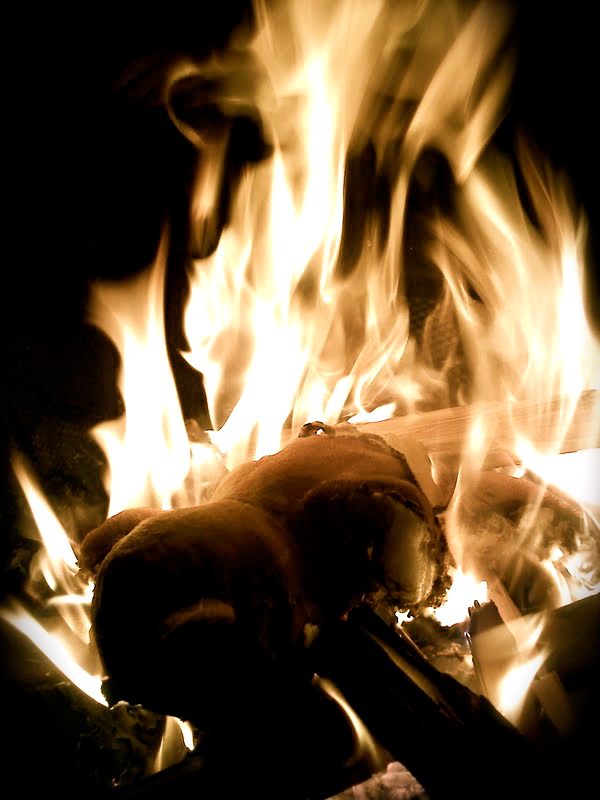
I hear Mom tell John to go get some wood and make a pile in the backyard garden. After a few minutes Mom yells for us all to go outside in the backyard. Mom and Dad say that they are going to burn some of our things. Dad has started a bonfire and we have to sit there. Mom brings out John’s BB gun and my art kit, lunch box and Rita. The lunch box my Uncle Tommy gave me and it has my name sewn on it. The art kit Grammy gave me. I watch as Dad puts my art kit and lunch box on the fire. I am angry but I don’t know what to say. Dad all of a sudden changes his mind about putting John’s gun on the fire and tells him that he has just lost it for two years (they gave him the gun for his birthday).
I watch in horror next as Dad takes Rita and walks toward the fire. He puts her on and Mom tells me I have to watch as she burns. It really doesn’t matter anyway. I cannot make myself look away. I am frozen.
I watch as my precious doll starts to melt.
Her arm falls off and burns up. Her face shrivels up and she is unrecognizable.
I cannot think. I cannot move. I cannot cry. Something is stabbing me in the chest.
I cannot breath.
Hope is sobbing on the other side and Mom is screaming at her to shut up. She looks at me waiting for me to cry.
I cannot.
My heart is broken and torn. I hurt deeper than I ever have before. Mom looks very satisfied at what she has done.
Mom yells at us to go back inside and get back to work. I am in a trance. I don’t know what is going on and I don’t know how I get to bed. I lay in the dark and cannot sleep. My mind finally starts to work and I know that I hate them. I hate Mom and Dad and I want to them dead. The tears come and I cannot stop them. I sob and sob. I do not go sleep for hours but I just keep crying. I finally cry myself to sleep.
The next morning I wake up and I know that I will never let Mom or Dad see me cry about this or anything else in my life.
HA note: The author’s name has been changed to ensure anonymity. “Noah” is a pseudonym.
“There is a homeschooling machine, whether some people want to admit it or not. There is a Man Behind The Curtain.”
My family started homeschooling because they didn’t like the public schools.
This had nothing to do with God or the feared specter of Marxism. There was no prophetic mandate from above, no urge to add more offspring to Michael Farris’ cultural Illuminati. No, my parents’ reason for homeschooling was really that simple: they didn’t like the public schools. They thought the public schools were a failure.
But my story is a common one. It has a theme mirrored in so many of my friends’ stories. As time went by, my family got slowly but surely sucked into the vortex that is a particular type of homeschooling: the conservative Christian type. While a lot of people want to lay the blame at my parents’ feet, that’s not really fair. And it’s disingenuous. Because the people wanting to blame my parents are specifically not wanting me to blame homeschooling. But those people don’t know my parents. And they don’t know what my early homeschooling looked like. Those people don’t want to acknowledge that it was the homeschooling machine that changed my parents.
There is a homeschooling machine, whether some people want to admit it or not. There is a Man Behind The Curtain. Or, rather, many men (and women). Call me crazy or a conspiracy theorist. But why do all our stories bring up the same names? Gregg Harris. Michael Farris. Mary Pride. David Barton. Ken Ham. Little Bear Wheeler. Michael Pearl. Josh Harris. Etc. Etc. Etc.
You do realize that that a shit ton of money is being made by all these people, right? There is literally a homeschooling industry that is profiting off these peoples’ ideas. Their ideas are being pedaled at homeschooling conventions all over the country, month after month, year after year. Their books are being promoted in every edition of every homeschooling magazine (well, the conservative Christian magazines, but I think you know I’m talking about a particular subsection). Their ideologies are reinforced in state and local support groups, where parents that don’t follow the line get ostracized, just like the so-called “Four Pillars of Homeschooling” have long ostracized the secular homeschooling movement.
It’s really, honestly, a type of bullying. My parents experienced this from the beginning, when they tried to get into a local homeschool group when we were young. We weren’t “Christian” enough (even though we were Christians!). The other homeschooling moms talked shit about my mom until, in tears, she almost gave up on homeschooling us entirely. She eventually found a more supportive homeschooling group, but, as the years went by, she started turning into the moms she originally hated. It’s, strangely enough, just like peer pressure. As one “cool thing” like courtship became a fad, as soon as the “cool” family picked it up, everyone else had to as well. If you didn’t, if you weren’t into courtship, you became that kid in public school who got his shoes at Goodwill. You were ostracized and made fun of, rejected and abused. It’s no wonder that my parents slowly became what originally almost turned them off from homeschooling.
That’s not to say people aren’t responsible for their own actions. But my parents have honestly tried to do their best for me. I respect them and love them. But they respected and loved me not because of the homeschooling community. They respected and loved me despite the homeschooling community.
It’s really ironic, that homeschoolers hold up their practice as this alternative to the evils of bullying and peer pressure in the public schools. Because there is so much bullying and peer pressure between homeschooling parents, it’s ridiculous. Watching homeschool moms tear each other apart with their words is really scary. They’re brutal to one another.
I’m deeply grateful that I had parents that stood up for me. And I’m glad finally people are standing up for people like my parents (and in a sense, against what my parents later became), by standing up against the systematic bullying, peer pressure, and brainwashing that pervades the homeschooling world.
The conservative Christian homeschooling world, that is. I know I already said that.
The following is a list of things that range from impolite to incredibly disrespectful that I have heard since I started speaking out about this issue. I’m (unfortunately) not making any of these up and I’ve actually had every single one of them either said to me or seen them said to others. If you don’t want to be a jerk, please don’t say any of the following:
Concerning homeschooling:
1. Tell me how good of a homeschooling experience you or someone you know had and imply that it cancels out mine.
2. Say that obviously it was just a parenting problem, not a homeschooling problem at all.
3. Say that obviously it was a religious fundamentalism problem/bible-based cult problem, not a homeschooling problem at all.
4. Say that I am not describing real homeschooling so I should not be talking about my experience like it was homeschooling at all.
5. Say that I need to be careful, that openly speaking about this will help enemies of homeschooling (nosy neighbors/government/the minions of the Antichrist) have the political cover to mess up or destroy homeschooling for the good homeschoolers.
6. Say that obviously because I am standing here today with a job/degree/spouse/all four limbs that the homeschooling I got really wasn’t too bad and therefore we all should keep calm and carry on.
7. Say that my parents only homeschooled because it was a problem with the school district and obviously any public school in my area/state/nation/world would have been worse.
8. Say that maybe my homeschooling experience was even secretly good and I likely don’t know enough about what I’d be comparing it to, with public school being so awful and all.
9. Say that you/your kid/someone you know had a much worse experience in public school/government school/a hole in the ground and so I should quit bellyaching and overdramatizing my homeschooling experience and instead just be grateful it wasn’t as bad of a story as the one you just told.
Concerning abuse:
10. Say that what happened to me was so uncommonly rare that it’s not something we need to be generally concerned about.
11. Say that you are sure that it was that my parents were uneducated/rural/brainwashed/obviously raised wrong and that’s why they did what they did, even though you know nothing about my parents’ background.
12. Say it is obvious that I am so hurt/broken/angry/bitter/emotional/weird/vengeful that I have lost track of reality, don’t know what I’m talking about on any of this, and no one should listen.
13. Say that I need to just let the past be the past, understand that parents make mistakes/are not perfect, then go forgive mine (immediately assuming that I haven’t), and stop disrespecting them by talking about this issue.
14. Say that the way life works is that your parents can raise you however they want/force you to be the person they ask/mess you up for the first 18 years of your life and then it will be your turn when you have your own kids.
Concerning religion and politics:
15. Say that if my parents were real Christians that this never would have happened.
16. Say that this is obviously a problem with Christianity itself and all homeschoolers should respond by being secular/atheist/Buddhist/some other faith.
17. Say that you seriously doubt (or had it laid upon your heart by Jesus himself) that it is in God’s will/my best interest/society’s interest for me to be talking/thinking/spreading lies like this and you will pray/worry/be quite concerned for me.
18. Ask me if I am aware that when I talk about my story it is mainly going to be helping people who hate homeschoolers/Christians/parents/Americans/suburban white people unfairly stereotype/hurt/oppress all of your group because people will mistakenly think you are like me and my family and obviously you are nothing like us at all.
19. Accuse me of being put up to this by teachers unions/liberal brainwashing/feminism/Satan and not having actual good reasons for how I characterize a problem I lived through and/or am studying.
20. Accuse me of being anti-homeschooling, anti-Christian, and anti-family all in one fell swoop because I said what happened to me should not happen to other kids.
Now that I’ve listed all the rude, insensitive, selfish, and potentially threatening things I can think of that you should not be saying to people who have shared their horrible (or even just a little bit bad bordering on mediocre) homeschooling experience (I’m sure I left some out, so please feel free to include them in the comments), here are eight examples of something that might be a good idea to say:
1. Thank you for sharing your story.
2. I am trying to understand where/when/how this occurred. Can I ask you? How did X, Y, or Z happen/come to be/take place?
3. What helped you get out/get better?
4. What do you think could have made this situation better/not happen at all?
5. What do you think someone like me might do or keep in mind to prevent this from happening to others?
6. What do you like to do today, now that you’ve left that environment?
7. Can I share what you said with my friend/relative/pastor/neighbor/blog readers/Facebook?
8. I wish you well and hope that tomorrow/this week/life/the future will be good for you.
Also, even if this stuff is foreign to you and you really have no idea (or maybe don’t care) what it is like to walk in the shoes of someone who has had this kind of homeschooling experience, please try for a moment to imagine how it would make you feel and what it might lead you to do and then have compassion. Personally, I love to argue and I have a lot of “fight” in me, but for many people who are sharing their story, just finding the words and the strength to do so is incredibly hard. People should not, under any circumstances, be pushing someone who’s telling a survivor story to defend themselves or expect them to deal with the kind of obnoxious behavior I listed above.
I was sexually abused. At the age of 11. And then again at 14.
“She didn’t believe me. She said I was making it up.”
The first time around, I didn’t really know what to do about it. It took me months to confide in my best friend, who was like an older sister to me. When I told her what had happened to me, she was horrified. She suggested I tell my parents, because they needed to know. I was scared, but because I truly valued her opinion, I took the risk, and told them.
They freaked out, and then talked to the parents of the kid who did it, because he was a minor. No one got the police involved. In fact, I don’t know that the police have ever been involved in any crimes that happened to any family members, unless an outsider decided to take it upon themselves to intervene. I felt that somehow the abuse was my fault. Not because anyone told me that it was, but because I wasn’t really told differently, and because of the level of stress my parents seemed to be under upon hearing the news.
I was never given the opportunity to get counseling.
I wasn’t even told what sex was until I was 14, and by then I already knew.
If you think that is bad, I’ll tell you what happened the second time. My brother would come into my room at night, and try to touch me, when I was sleeping. He also tried to place mirrors in strategic places so he could watch while I changed my clothes, or took a bath, or went to the bathroom. I became accustomed to having to close curtains, check everywhere for mirrors, and wedge a towel under the door for fear of being seen. When I first told my mother, she didn’t believe me. She said I was making it up.
So here I was, on the defense daily, sleeping wedged between my mattress and the wall on the top bunk. I think this must have been when my insomnia started. I didn’t want to go to sleep, for fear of being molested in my sleep. To this day, I have a hard time sleeping until the house is quiet, and everyone else is in bed. I’ll tell you one thing, if you want to kill your child from the inside out, tell them you don’t believe them when they say they are being sexually abused. There is not a higher level of “I don’t care about you” unless you stomp on their head, and even then it might be easier for them to recover.
Finally, I found a mirror inside my room, and told my mom to come look at it. She was shocked. So then she finally believed me. My dad put a lock on the inside of my door and yelled at my brother for a while, and that was it.
Again, no authorities. No counseling. They didn’t try to get him any help, either.
Finally, when he was 19 years old, he sexually assaulted my disabled sister, who had to go to the hospital because of it, and somehow, the police were called. My parents didn’t call them. I don’t know who did. But I am eternally grateful to them.
My brother is still in prison. I don’t believe that he is a horrible person, or a child molester. I think he is the product of a messed up marriage, being abused himself, and sexual repression. My mom thought that because sexuality was rampant in her day, that isolating us from information on sexuality was the way to go. So far none of her children have been virgins before getting married. My dad and his pornography addiction were the predominant exposure to any kind of sexuality to my brothers and sisters and me. As far as dating, my parents believe in courtship. None of their kids have really done a courtship. I think one sister did, but it was short, and the guy was an alcoholic, trying to fix himself by jumping into ministry at a church.
But we are all becoming well-adjusted adults, after years of counseling, and a lot of soul-searching.
Unfortunately, debate and other high school classes don’t look that great on resumes. I am the only child in my family who has had more than a year of college. My disabled sister, who is an adult now, is still living with my parents. My mom told me once that she would live with them for the rest of her life. I questioned it, because my parents will probably not outlive her. So maybe she’ll live with them for the rest of their lives… and then she can live with me.
It’s hard to believe that it was just a month ago that we launched Homeschoolers Anonymous. So much has happened in so few weeks! This is really due to the amazing and wonderful support that you, our community of friends and family and advocates and peers, have so graciously provided.
In a mere month, our WordPress blog has reached nearly 100,000 views. More than 260 comments — almost universally positive — have been made on the site. Our Facebook page has received almost 300 likes. Our most popular post to date, a crosspost by blog partner Kierstyn King (“Sex™ (and the lies I was told about it)”), has been viewed over 3500 times; the second most popular post, R.L. Stollar’s “Homeschool Confidential, A Series: Part One,” has over 3000 views. Michelle Goldberg covered our story on the Daily Beast. We’ve also received coverage by the Daily Mail and Lez Get Real, both Google News providers. We’ve also received inquiries from other major media groups and will keep you posted on those developments.
This is a very difficult project. If you have any experience at all with the conservative Christian homeschooling world, you know how defensive they — we, really — have been, are, and will likely continue to be. You can see how afraid some of us are about speaking out with our experiences. Qualifications and disclaimers abound. The fact that such fear exists, merely about saying one has had a personally negative experience in homeschooling, is indicative that something has gone awry. No one should feel afraid of speaking up about abuse or hurt or pain. That is why we feel this community is so important and necessary. We want to create a platform for sharing and healing. We want to be a voice in defense of those who have been hurt.
It’s truly been a wild ride. We’ve been accused of being nut jobs, anti-God, anti-homeschooling, a vast liberal conspiracy manufactured by Obama, the NEA, and the ATF, and opportunists that want to take advantage of abuse victims in order to achieve vast fame and fortune.
But as someone much wiser than us once said:
Haters gonna hate.
We’re here and we’re not going away. We will continue to share stories, we will not be silenced by intimidation, and we will do our best to represent our collective voice accurately, compassionately, and strongly.
Thank you for your encouragement, support, and love. We are very grateful. Thank you, thank you, thank you.
In honor of our one-month anniversary, we’ve decided to take our top search terms — the phrases that people have Googled that have led them to us — and ask each HA Community Coordinator and Blog Partner to write a paragraph about one of the search phrases. (Some of us went over this paragraph limit.) This was presented to them as a creative challenge. They could write whatever they’d like that they thought was important to say to whoever might be drawn to our site because of the phrase in question. To make this a bit more challenging, we intentionally switched up who wrote about which search term, so it’s different than what that person might normally write about.
The idea is to highlight both the diversity of our voices and the unity of our mission.
So, without further ado, we present to you the first ever group post from Homeschoolers Anonymous!
*****
“homeschoolers abused” — by R.L. Stollar, HA Community Coordinator
Not all homeschoolers experienced abusive situations. Not all homeschoolers have the same story. The fact is, homeschooling is a vast and diverse phenomenon that includes different religions, different political beliefs, and an immense variety of educational philosophies and teaching styles. But from my own personal experience in the conservative Christian homeschooling subculture, I can confidently say that — within my particular subculture — there is a tendency to operate from an “Ideology First” mentality, instead of a “Children First” mentality. And when you elevate the importance of ideology over the humanity and well-being of kids, you can easily create cult mentalities. And cult mentalities can cause immense hurt and pain for so many people. They can create emotional, mental, physical, and sexual abuse.
Not all homeschoolers experienced abusive situations. But many have.
Not all homeschoolers have the same story. But there are striking similarities.
I want their stories — my story, our collective story — to be heard. And if you listen with an open heart and mind, maybe you can help us make homeschooling better in the future.
*****
“homeschoolers anonymous” — by Libby Anne, HA Blog Partner
Why homeschoolers anonymous? I think I understand why. The first time I met someone raised in the Christian homeschooling subculture who had, like me, grown up in a homeschooling family and then questioned and left the pervading ideology of that family and subculture, I was overwhelmed. Before, I had felt alone. Like it was just me. Invisible, unnoticed, an anomaly that people didn’t acknowledge, or even know, existed. When you realize that you’re not alone, that it isn’t just you, everything changes. And some of those who visit Homeschoolers Anonymous may still be in the closet or on the wall, unready or unable to make the leap, to say that there was something wrong, to speak about and acknowledge the hurt and the pain. And that’s why we’re here.
*****
“stand up for my children” — by Vyckie Garrison, HA Blog Partner
I know this will be controversial, but when I was asked to write about the search phrase, “stand up for my children,” I immediately thought of the period of time when all the abuse and dysfunction of our Quiverfull lifestyle culminated in a nasty court battle when I left my ex-husband and sued for custody of our six children who still lived at home.
My lawyer told me that I would need at least three people who would be willing to write affidavits for the judge stating that they were aware of abuse in our home. I was extremely discouraged because I believed I had done such a good job of covering up for my husband and protecting his reputation that nobody, with the possible exception of my mother, had any clue that there was anything amiss in our “big happy family.”
Undaunted, a fellow homeschool mom started making phone calls, and in about a week’s time, was able to gather more than 20 affidavits from friends, family, and acquaintances who all testified that they had been aware that the children and I were being abused.
That’s over twenty Christians who could have stood up for my children and spared us all those years of abuse.
I understand that as evangelical Christians we were all taught to fear the evil government social workers, but looking back now, I can honestly say that the court-ordered involvement of CPS was one of the best things that ever happened for my family.
I have plenty of suggestions for intervention and support (see the NLQ FAQ: How can I help my Quiverfull friend?), but if you clearly see children being abused or neglected, please call this hotline and get the family some outside, professional help: 1-800-4-A-CHILD.
*****
“homeschool uniform denim jumper” — by Nicholas Ducote, HA Community Coordinator
Jumpers, especially the denim variety, were the unofficial uniform of the homeschool mom. My mother had an entire closet full of jumpers in an array of colors, but none rose above her knee. I can count on two hands the number of times I’ve seen my mother wear pants in the last decade. I wish it wasn’t so stereotypical, but a quick Google search of the terms “denim jumper” will bring you to www.denimjumper.com – “your source for everything homeschooling.” Most Christian homeschooling sub-cultures emphasize modesty in young women, especially in reaction to what they see as an over-sexualization of young girls, but their attitudes often read like an unironic guide to rape culture (i.e. The Rebelution’s Modesty Survey). In short, women are told their bodies can make men lust and, in a revolting twist of logic, the immodest women is responsible for “defrauding” the lusting man. Young women are encouraged to hide their curves behind baggy jumpers or long skirts and modest tops. Fashion, they are told, only serves to bring excessive attention to the superficiality of a woman. Modest, godly women do not need to appeal to a man’s lust. Instead, she strokes his ego by serving in the cult of domesticity.
*****
“homeschool cult” — by Anna Ruth Fuller, HA Community Coordinator
Think about what a homeschooler looks like. What comes to mind? If images of religious children passing out pamphlets or holding signs comes to mind, you’re thinking too narrowly. If images of hippies unschooling their children comes to mind, you’re again thinking too narrowly. Broaden your thinking.
Homeschooling occurs everywhere and for all types of reasons. The same is true of public schooling and private schooling. How you choose to educate your children is your choice. However, it is important to remember that in all of this, children have a right to their own views that aren’t necessarily your own. This is true no matter what type of schooling they undergo.
So what happens when parents do not respect a child’s right to their own worldview? Now don’t get me wrong, I’m not talking about letting your children run amok. There’s a difference between pure hedonism and having a worldview.
Not letting your children choose their own worldview is a dangerous road to take. It might seem like a good idea at the time since it is easier to control a child’s thoughts than to guide them. Most parents these days recognize that guiding their chidren’s thoughts is the way to go, but there are those that still cling to controlling them.
It is considered bizarre to isolate your children from the world so that you can protect from worldly things. We are becoming a global society with the advent of the Internet. Preparing your child for the different worldviews they will face (and more importantly, how to respect them for what they are) is crucial to that child’s success. Yet there are many Christian homeschooling parents that purposefully decide to isolate their children from all of this. It is this type of homeschooler we are bringing to light here with our stories.
This brings me to my topic. One of the most popular search terms for our site has been ‘homeschool cult.’ When I learned that, I began think about whether we were really part of a cult as Christian fundamentalist homeschoolers. According to Wikipedia’s article on cults: “The word cult in current popular usage is a pejorative term for a new religious movement or other group whose beliefs or practices are considered abnormal or bizarre by the larger society.”
This definition makes me think we weren’t part of a cult. To have been a cult, we would have needed to have been unified religiously somehow. We weren’t. Each of us went to churches in conflict with each other on various minutiae. There was one thing that united us and that was the need to reclaim this country for the Christian God. Our parents wanted us to dream of a Christian nation and placed that first and foremost in our minds by excluding the teaching of other worldviews (thankfully this didn’t happen nearly as much to me as it did to others). We were trained up in debate to help us become better lawyers and politicians to lead this new country to its destiny. So in reality, we weren’t part of a cult in the religious sense. While there were certainly practices and behaviors that could be seen as cult mentalities to outsiders, we were less a part of a religious movement and more a part of a political movement.
*****
“homeschool and abuse and fanaticism” — by Kierstyn King, HA Blog Partner
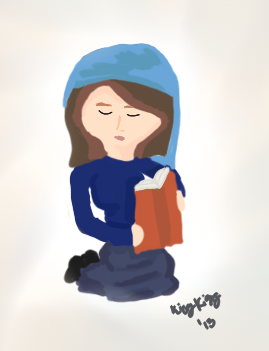
Art by Kierstyn King.
This is a touchy subject, because you’re screwed in the eyes of parents or vehement pro-homechooling-beyond-all-reason-crowds from the start. The fact is, this sentence and search term oddly defines my experience in a very succinct way, and like the lonely oppressed girl over here, it’s not a good thing. Homeschool and abuse and fanaticism don’t have to be related, but sometimes they are and here’s how: parents have the idea to homeschool, they then are told they must homeschool to essentially indoctrinate their children to their cause (fanaticism) which in some way or another usually is along the lines of “taking over the world” (who doesn’t want world domination?). Of course getting to that point means squelching the life out of the individuals you’ve stopped seeing as human and started seeing as arrows – focused solely on your needs, wants, and purpose you deny basic rights, dignity, and sometimes the security of unconditional love to the child you’re supposed to care about above everything else (abuse).
The unnecessarily necessary disclaimer here is: obviously not everyone is like that (but some people are).
*****
“why all of the attacks on homeschoolers” — by Julie Anne Smith, HA Blog Partner
I have been homeschooling my children for the last 20+ years. When I hear about “attacks” on homeschooling, I suspect there could be some confusion. Taking a closer look at the attacks, generally, it is not homeschooling in general that is attacked (ie, the education of one’s children at home), but more specifically, a lifestyle connected with the “Homeschool Movement.” The Homeschool Movement is associated with practices and ideologies not even remotely related to scholastic achievement, e.g., full-quiver lifestyle, patriarchy, purity and modesty teachings, etc. These practices and ideologies have had mixed, and sometimes very sad results. The methodologies employed to enforce these lifestyles can also be troublesome. The Homeschool Movement must not be confused with homeschooling. I believe homeschooling to be a valid and exceptional option for motivated and capable parents who have a vested interest in the proper education of their children.
*****
“homeschooling and mental illness” — by Latebloomer, HA Blog Partner
For a well-informed and supported parent, homeschooling may be an excellent way of supporting a child suffering from a mental illness. It could allow for high quality personalized instruction, easier access to appointments with medical professionals, and protection from peer bullying. Unfortunately, the combination of homeschooling and mental illness also has the potential to do great harm. For instance, children with mental illness can go undiagnosed for much longer if they do not regularly come in contact with trained educators and medical professionals. Distrust of those resources is very common in fundamentalist homeschooling circles, where parents are much quicker to blame unusual behavior on rebellion and worldly influences. An additional concern is the potential for harm when a child is homeschooled by a mentally-ill parent. The child will often be far more affected by the parent’s mental illness because of the increased time spent with the parent and the lack of time with other adults. For such children, the parent’s paranoia, depression, narcissism, etc, define their entire childhood and hinder them from developing positive and healthy relationships with others even in adulthood.
*****
“which is more effective for learning homeschool or public school?” — by Brittany Meng, HA Blog Partner
So you’re wondering which is more effective for learning: homeschool or public school. To answer this question more effectively, you should add the phrase “for my child.”
It all depends on what your child needs to be an effective learner. Here are a few issues to consider about the effectiveness of homeschooling for certain ages and needs.
Elementary school: Homeschool can be very effective for Elementary school because children often need one-on-one time to learn basics like reading and math, which are foundational for a strong education. If your child needs extra help in these subjects, homeschooling might be a good choice. On the other side of the coin, if your child is advanced in these areas, homeschooling might be good for your child as well. Nothing squashes the natural love for learning faster than a child who is bored. Homeschooling allows you to move at your own pace.
Middle School: Let’s just face it—middle school stinks for most people. Homeschooling will not remove all awkwardness, angst, self-doubt, or attitude problems from your child. However, if social issues are getting in the way of your child’s academic success, homeschooling may be a good option for your family.
High School: By this point, most young people are able to voice their educational and social needs. These wants and needs should be taken into consideration. This is also the point where parents need to consider how capable they are to meet the needs of their child, especially if he or she wants to go to college. I believe that homeschooling can be effective in high school but only with a strong outside support and supplemental network: classes at a local high school, community college, and/or homeschool co-op.
Personally, I believe that homeschooling becomes less effective for learning the older the child gets but this is a blanket statement. Only you can determine what your child needs.
You also have to consider the needs and abilities of your family: finances, time commitment (contrary to what many people think, your child needs as much academic attention from you in 1st grade as he does in 10th grade. Kids need accountability, motivation, and a sounding board for ideas), a strong support network, and whether or not you actually want to homeschool. Even if you feel that homeschooling would be the best option for your child, if you don’t want to homeschool, don’t do it. Homeschooling is a huge commitment. You can’t toe the water; you have to jump in with both feet. However, some states allow your child to be homeschooled by someone else. Check into all your options.
When choosing the best learning option for your child, it is important to consider what you and your child need and want both academically and socially. So, which is more effective public school or homeschooling? It all depends on your child.
*****
“pscyholgoy of bad/evil” — by Lana, HA Blog Partner
In conservative circles parents often have a tendency to refer to their children as all good or all bad. In public — that is, among other conservative families — kids often are forced to play the role of the perfect family, the perfect godly family. I felt this a lot as a child when we did cookouts with other homeschool families, or a respected homeschool family came over for dinner. I had to smile and pretend that I was godly (whatever that means) while everyone talked about how we were great and the future of America. At home our house was in shambles, but none of that mattered around our friends. Perhaps this alone would make a child go crazy. Why is it necessary to fake it? Why weren’t we genuine? Was it all in my head that my home was dysfunctional? Was it my fault when I was unhappy? Was my friends’ home totally perfect? These are legit questions that I and many others have experienced, but the confusion goes much further. For every time a child is praised as good, its likely that he or she is shamed as bad for the most ridiculous things at home. I was taught that I was not dressed until I wore a smile. If I did not wear a smile, I was ungrateful. If I expressed frustration (that admittedly did get out of hand sometimes), I was disrespectful. A simply bad act is escalated as totally evil or rebellious. There are plenty of homeschoolers who had it much worse, directly being called evil for not being submissive to an abusive situation. And so the soul is torn between good and evil. Sometimes kids just need to be told they are human. We aren’t perfect. We aren’t all bad. We’re human.
*****
“living my life” — by Heather Doney, HA Blog Partner
What my life was supposed to be was set. One story said that because I am a woman, by the time I was 30 I was supposed to have been married for a decade and have somewhere between 3-6 kids, homeschool them in a nice house, and be involved with a local church. The other story was that I was supposed to have a mid-level office job where I wore business suits and cute pumps, had a comfortable salary with decent benefits, ho-hum dates with guys who wore nice watches, and appletinis with the girls on weekends.
Neither are my life. I truly thought I was supposed to somehow make one or both my reality, that they were in fact the going realities available, but now I know they weren’t, at least not for me. I knew it just didn’t feel right, but I somehow figured I’d still end up in one or the other. I didn’t. I’m still just me, and while I do own a business suit and those cute pumps today, I generally wear flats or leather boots with jeans. I have only a laptop computer, not a cubicle, to go to. If I’d wanted a baby already I expect I could have had one, but I didn’t. I don’t go to church and I don’t even like appletinis (or guys who wear expensive watches, for that matter).
So while I didn’t want my life to look like either of these so-called options, I didn’t know what it should look like. What I knew it shouldn’t look like was what I call “living in the meantime.” I lived in the meantime for a few years and meantime mode is where you just let life happen to you, figuring it knows what is best, not-so-patiently waiting until it resembles one of your ideals. The scary thing is it likely never will. You can easily spend your whole life in meantime mode, waiting on serendipity to rescue you, and the thing most people forget about serendipity is that it isn’t just some happy accident or eureka moment that breaks you out of your ordinary life. Serendipity is what you find while you are out looking for, working on, and doing other things. Because serendipity requires action, it is a lot harder to find while in meantime mode or while you’re living someone else’s idea of your life, just going through the motions.
So to me living your life is not about doing one thing or another but about breaking out of that. It is about actively writing the next chapter to look differently, resetting the script, welcoming the changes, courting serendipity. It is about “if you build it, they will come.” In order to do that you have to do something scary though – be real about the person that you know you are, not stuck on the one you feel you “should” be. You can’t go squeezing yourself into a role that makes you look like you’re wearing somebody else’s style.
To live life, forget the ideal life someone else created for you and said should be yours.
Author edit to clarify my call for more oversight: I recommended intra-community policing in my post. State action should be a last resort. Those that care to preserve their parental rights to homeschool need to hold other parents accountable. Unfortunately, fundamentalist homeschooling communities are often isolated from anyone who would question the parents. I don’t have a solution, but I know we can’t just assume the status quo will fix things. Hopefully, projects like this will scare other parents enough to make them confront other parents. But let’s be honest, do you see that happening in these sort of communities? Most of these people laugh at the idea of children having rights and would never support anything that encroaches on their ability to teach their children whatever they want. If you suspect child abuse or neglect in a family you know, please report them to Child Protective Services.
Homeschooling, as a method of instruction, is not intrinsically bad, dangerous, or damaging. I saw many children raised in homeschooling who were not abused by religious fundamentalism – even if they were Christians. However, as a society, we have to realize that the current state of homeschooling gives parents unique power over their children. Yes, many homeschooled children are a part of co-ops, interact with neighbors, and have relatively normal social interactions. But other homeschoolers are isolated in rural areas, with no contact with neighbors, or the outside world. Abuse develops in these environments because there is no oversight from outside the parents and, if criticism if lodged, the parents are defensive. To many homeschooling parents, homeschooling (the method) is part of a larger worldview that involves rejections of secularism, science, and academic institutions.
I developed claustrophobia, a generalized anxiety disorder, and panic attacks in high school. At the time, I assumed my panic attacks were the result of the Holy Spirit convicting me of my sins. The most common trigger for my panic was sexuality. As a teenager, I would often shake uncontrollably after masturbating. Homeschooling can make children feel trapped because they are literally never away from their parents. When I was quasi-dating girls in high school, behind my parents’ back because they wanted me to court, I would have a mini-panic attack when the phone rang – scared that my parents would find out. When I got in trouble it meant a few hours with mom and dad, crying and arguing about what God told them to do, ending in me feeling completely trapped. When I woke up the next day, I had no choice but to bottle up my anger, shame, and humiliation and go “do” homeschooling. In ATI, many leaders preached about how listening to rock music would literally result in demonic possession. This is abusive to teach to children. To this day, I struggle with anxiety before I fall asleep. I was taught, by my parents and by ATI’s leaders, that demons were very real and they could possess rebellious Christians. Many in the homeschooling movement conceptualized the “culture war” as spiritual warfare — the secular humanists were literally portrayed as the minions of Satan.
Spiritual abuse is a difficult term for many people to wrap their heads around. It may seem like we are trying to say that raising children in a religious tradition is abusive, which we are not. However, I can say that when homeschooling is mixed with religious fundamentalism, abuse almost always occurs.
There is a distinction between religious fundamentalism and mainstream religions. I once told my mom, “I would have been fine if you stayed Baptist. It’s when you drifted into fundamentalism that hurt me.” What many people fail to realize is that most parents don’t wake up one day and decide they need to start controlling their childrens’ lives and prepare them for the culture wars. Yes, my parents are to blame for subscribing to fundamentalism, but the homeschooling community and movement are also to blame.
In many states in the 1990s and 2000s, homeschooling parents received most of the curriculum, instruction, and indoctrination at state, regional, or national conferences. There are a myriad of institutions and groups that formed the movement, so it is impossible to point to a single root cause of the abuse in homeschooling. But I know abuse doesn’t just happen because of bad parenting. The bad parenting that people indict was being advocated on stage before thousands of people. There is a reason why so many homeschooling alumni share stories and experiences. Tens of thousands of homeschoolers attended state Christian Home Educator Fellowship (CHEF) conferences, where they were exposed to
The Harris family and their beliefs about Biblical courtship
David Barton and Little Bear Wheeler’s revisionist history
Evangelical leaders that scared everyone about the evils of secular humanism
Michael and Debi Pearl’s harsh ideas on corporal punishment and misogynistic ideas of gender roles
Huge book sales populated mostly by Christian fundamentalist textbooks — advocating creationism, teaching math based around the Gospel message, or other “educational tools.”
All of these ideas circulated around the homeschooling communities and trickled down to local CHEF chapters.
Parents’ responses have been mixed, but many of them see our blog as a tool to take control of their children away from them. Parents emphasize their rights to raise their children however they want. But, as a society, we have already decided that parental rights end where abuse begins. Thus, one of the main issue in this debate becomes whether or not a homeschooling environment is emotionally or spiritually abusive.
You might think this is only a problem of the past decades — that now, in this new zenith of modernity, fundamentalist homeschoolers that spiritually abuse their children are dying out. You would be wrong. Yes, there is growing momentum behind secular homeschooling, but there is no hard social science about homeschooling. At this point, observational data is almost all that exists about homeschooling and its demographics. We know very generally how many people homeschool and for what reasons. But ten states do not even require the parents to inform them of their childrens’ “enrollment” in homeschooling.
This is the start of an important conversation about homeschooling. I am opposed to religious fundamentalism in all forms and I believe that the abuse that occurs when fundamentalism is allowed to dominate homeschooling has no place in the modern world. I’ve heard so many Evangelicals and homeschooling parents mock the Islamic madrasas for their religious instruction, but fundamentalist homeschooling isn’t different by much.
To those homeschoolers who are afraid of this exposure, it’s time to own up. These abuses happened, the community’s leaders encouraged it, and the community does not regulate itself. If the homeschooling community is not willing to regulate itself – lest a parent tell another parent their methods and ideologies are abusive! – then someone else will.
I am tired of sitting around hoping that the abusive fundamentalist culture within homeschooling will die out. I don’t want it to die out, I want to trample it out so that no other children face the sort of abuse I, and many other, went through. Part of the means telling the honest, visceral truth about what happens in many homeschooling homes. Yes, abuse is ultimately the fault of the perpetrators, but why does everyone leave the homeschooling community blameless for how it brainwashed my parents?
The issue of abuse in homeschooling is an issue of the distortion of parental rights and the reality of systemic indoctrination.
You cannot stop the abuse without exposing the advocates.
I clearly remember having conversations with my mother about how “those people weren’t really homeschooling” and how our family and friends were getting it right. We talked about how they weren’t really part of any home school community, and their parents were just trying to get away from the responsibility they bore for the abuse they inflicted, by claiming the title “home schoolers.” The home school community distanced itself from these stories, claiming that the abuses of a few “nutjobs” shouldn’t impact the rights of the whole homeschool movement.
It’s been interesting to hear the same lines come up in response to the stories shared on this blog. In comments on other sites, I’ve read many things like, “you could find 30 abused kids in any school system!,” or “these kids’ parents were just crazy. That’s not what home schooling is really like!” It seems like many people invested in the homeschooling movement are reading this blog in the same way my mom read stories like the ones mentioned above — as extreme examples of abuse from people on the far fringes of the homeschool movement. I’ve read comments that go so far as to dismiss these stories outright. More people, though, lament the suffering they read about, but make comments that distance themselves from the problem. These extreme cases are hard to catch, the sentiment goes, because these families never show up to homeschool groups or 4-H clubs or churches or anywhere we (homeschoolers) might be able to intervene. “These kids were totally isolated! It’s not our fault!” they declare, explicitly or implicitly.
This is misguided.
For many of us who are sharing our stories, our families were not on the fringes of the homeschooling movement — we were at its center. Our parents were the ones running the debate leagues, and founding the AWANA programs. We were the ones winning awards, respect, and acclaim. We are the poster children of the homeschooling movement.
And yet, we suffered serious abuse and neglect, and no one intervened on our behalf.
As a survivor, I started asking why. I was (almost constantly) involved in a myriad of extracurricular activities, and none of the adults in my life intervened in the neglect I experienced. They either didn’t notice, or didn’t care.
This is what isolation looks like in the homeschooling community.
I interacted with many adults outside of the homeschool movement, in many different contexts, and I honestly don’t think any of them had an inkling of what was really going on. Homeschoolers have always been trained to put on our most adult, most mature face to the outside world. This has to with the ways we’ve been socialized and the pressure we face to be walking proof of the “success” of homeschooling — but that’s another post. Regardless, we’re excellent at being polite and reciting (often eloquently!) the ideas we’ve been taught. We therefore often make a very positive impression on outsiders — I can’t tell you how many times I was told how grown-up, how mature, how insightful I was when I was a tween. Most of the adults outside of the movement were so blown away by my irregularity (and my ability to discuss the classical origins of astronomical nomenclature) that they never asked deeper questions about my education or physical well-being, let alone about the emotional and spiritual abuse that was present in my home.
I also regularly interacted with adults within the homeschool movement, where parents should have been able to notice what was happening — and still, no one spoke up. Many of them didn’t (and still don’t) consider what many of us endured abuse — it’s just part of the process of “training up a child.” Many bought into the same vision of religious indoctrination and corporal punishment. The “us vs. them” mentality was huge, and “them” was often Child Protective Services. I’d still be surprised to hear of one home school parent reporting another. Even when the “moderate” parents didn’t agree with the techniques of the more fundamentalist ones, the “rights of the parent” continuously won out over the rights of the child. This line of reasoning is currently being used by the HSLDA to justify the refusal to ratify the UN Convention on the Rights of the Child.
The combination of these factors created a unique culture that fosters and covers up or ignores the abuse and neglect that happens at the center of its community. The case against Sovereign Grace Ministries, an evangelical denomination that promotes homeschooling, is just one example. We’ve experienced it, and we’re hurt. There was a deep sense of community in the homeschool movement, and many of us, as kids, trusted deeply in its people and institutions. Now that I’m an adult reflecting on my experiences, I feel betrayed. The people I trusted perpetuated the systems of indoctrination that harmed me, and facilitated my parents’ neglect.
This is what isolation looks like in the homeschooling community.
The invitation that this blog presents to the homeschooling community is to begin to take abuse, neglect, and indoctrination seriously, and refuse to look the other way. The children of homeschooling need advocates, and our parents aren’t always looking out for our best interest. Neither is the HSLDA.
HA notes: The author’s name has been changed to ensure anonymity. “Mary” is a pseudonym. The following series is an original non-fiction story that spans 33 pages of single-spaced sentences. It will be divided into 10 parts. The story begins during the author’s early childhood and goes up to the present. At each stage the author writes according to the age she is at.
Trigger warnings:various parts of this story contain descriptions of graphic, often sadistic, physical abuse of children, apologisms for religious abuse, deprivation of food, as well as references to rape.
Extra trigger warning: this particular part of the story also involves a description of rape.
We sit there as she walks from room to room of the house, trashing every room as she goes through it. She comes back in the living room and says we have 15 minutes to get the whole house spotless. Abby and I go in our room, but I don’t even try. I know that I’m going to get beat no matter what and I know that it is impossible for us to get it all clean in 15 minutes. Abby is crying again and trying to clean the room. She looks desperate. She says that she knows she should be able to get it cleaned up in time the way Mom wants it. I tell her that it is pointless but she begs me to help. I try for her because she looks so weak. I cry inside for her. I can’t let her see me cry because I need to be strong for her.
I try to make her feel better. I tell her that we are princesses in disguise and that Mom is the evil person that we will be able to punish later when our father comes to save us. She smiles a little and we work hard.
Mom comes to the door and screams that we are not working hard enough. She grabs Abby and yanks her into her room. As I listen to her cries of pain, I yank on a pair of shorts under my pants as fast as I can to try to add more padding. I am next and she tells me to pull my pants down this time. I know I am in more trouble. She sees my shorts and gives me extra spankings with the belt and then tells me I now have a 10 page paper on lying. I try to pull my pants back up and get out of her room as fast as possible.
We only have 2 minutes left to clean the house and we haven’t even finished our room.
We don’t make it before the timer goes off. Back in Mom’s room we go.
I try to keep count of the spankings to keep my mind focused on something besides the pain. I refuse to cry. I know that’s what she wants and I won’t give it to her. Wait, was that 120 or 130? I’ve lost count again.
After that round of spankings, she trashes the house again and we start all over.
I know this is going to go on for the rest of the day. We haven’t even finished our regular chores for the day or started our school work. All of today’s school work is going on our undone lists. Mine is about 5 note book pages long. She says that we will only get yucky meals till we are completely caught up. I know it is impossible.
As we start to clean the room again I let my mind wander. I am a princess again. My father is away for a long time and my stepmother is forcing me to be her slave. I just keep hoping that my father will come home and rescue me soon.
Oh no! I just heard the front door slam. Dad is home. That means another meeting and another round of spankings. At least this round of spankings will be from Dad. He doesn’t spank as hard.
*****
“LEE!!! WHY ARE THE CHIPS IN THE WRONG CABINET?? YOU ARE SUCH AN IDIOT! THE CHIPS HAVE BEEN IN THE LAUNDRY ROOM CABINET FOR YEARS! CAN’T YOU DO ANYTHING RIGHT?!?”
Why is Dad letting Mom yell at him like that? Mom is treating him like a child. Maybe she will get mad enough and leave the house. Yes she is! I hear the door slam and the car roar out of the driveway.
Abby and I look at each other and sigh a sigh of relief. I pray while we finish cleaning that she gets in a car wreck and dies. I hate her. I want her out of my life.
After we finish cleaning, Dad asks us if we have eaten today. He tells us to eat a bowl of cereal and then go to bed. It’s after 9 pm.
We climb into bed and Abby goes right to sleep. I lay there and start thinking.
It starts happening again. I feel myself losing control of my mind again. I start getting chills.
I’m laying on some pavement. I don’t know where I am but I look up and am surrounded by four men looking at me in a way that I don’t understand but it terrifies me. I suddenly realize that I am naked. One at a time they start doing things to me. I don’t understand what, but it hurts. After they are done, they start laughing with an evil laugh. I still can’t figure out why I can’t get up.
They have me tied down somehow. One of the men walks away and comes back with sheets of ice. He starts covering me with ice and laughing. I don’t understand the looks they are giving me. What is funny?
I am freezing. Then they all come over and start peeing on me. Why are they doing this?
I am screaming for them to stop. This goes on forever. Finally they stop. One of them brings over a bucket of freezing water and uses it to wash me off. Then they all start to do things to me again. This time I really don’t care because I am so cold. At least them being on top of me is warming me up.
Suddenly the side door slams and I am jolted back to my room. I realize that my hand is between my legs and I am all slimy and wet and it’s not pee. I don’t know what that stuff is but I think it’s gross.
I sneak to the bathroom to clean up. I try to be quiet because I know that Mom is home again. As soon as I have cleaned up, I rush back to my bed again. Abby has woken back up and is crying. We both know that Mom is about ready to come yank us out of bed again. We know that we didn’t get the house cleaned like she wants it.
We sit and hold each other while listening to Mom and Dad fight and scream. Even if she doesn’t come get us up, we can’t go to sleep with that going on. Sure enough, a few minutes later she storms in our room and screams for us to get out of bed because we didn’t have permission to go to bed. She yells at us to all go into the living room. She screams at Dad to bring our desks in the living room. She says that we are not allowed to go to bed till we each have 20 undone school assignments done and passed.
I look at the clock. It’s 11. It’s going to be a very long night.
She says that if she finds us asleep at all then we will get a ton of spankings. She lays down on the couch and goes to sleep with the belt across her lap. I know we will be here all night. I try to work on the school work but I am so tired I can’t think. I lay my head on my desk for just a minute.
I wake up with a sharp pain across my back. I jolt up and see Mom standing over me with the belt coming down again. This time it hit my head because I arched back to stop her from hitting my back again. She yanks me out of the desk and then the belt lands across my chest. The swings keep coming.
She stops and pulls me off the floor and shoves me back into the desk. She wants to see the math page that she told me to work on. I can’t figure out this problem and I asked her for help, but she says that she isn’t going to help me because I should be able to figure it out on my own. She says that I am stupid because I can’t figure it out. She says I can’t be her daughter because a child of hers can’t be that stupid.
*****
It’s about 4 am now and she finally gets tired enough to want to go to bed. She says that we can finally go to bed but we will resume this in the morning. Abby and I go collapse in our bed.
The next thing I realize is that I am cold and soaked. Our whole room smells like pee. No! I peed in the bed again! I wake Abby up and try to get the sheets changed on our bed as fast as I can without waking Mom up. It is so hard because her room is right across the hall. I can’t do it and Mom storms in our room. She calls me a baby. She says that I should still be in diapers and that she is going to tell everybody how I am such a baby.
It’s about 6 now and she decides that we have to stay up. I start to let my mind wander again. If I don’t, I won’t survive. This time I have been kidnapped and sold as a slave and I’m praying that my father will find me and save me. Why does my father never actually save me?
*****
Yay! Mom is getting a headache! She says that she has to go lay down. I know that she will sleep a long time because she didn’t sleep last night. She goes in her room and shuts the door.
I head to my room and crawl under the bed. I am so tired… my mind drifts….
Am I dreaming or is this real? I honestly don’t know anymore.
I’ve been reading the stories Homeschoolers Anonymous has published since it launched, and at first didn’t feel comfortable sharing my own experience with homeschooling, since it was unlike most of what I was reading. But, through reading these stories, it’s helped me come to grips with some of what I went through.
I’d like to start out by clarifying that my experience was fundamentally different– and yet, somehow, eerily the same. I spent most of my childhood in an Independent Fundamental Baptist (IFB) Church, and for that reason we were never part of the larger homeschooling movements — at least not organizationally. We didn’t use PACES, I’d never even heard of ATI until I went to Pensacola Christian College, we never went to any conferences, I didn’t travel in debate. In fact, reading about these stories made me slightly jealous; because of the cult-like environment of the church I was raised in, I never had the opportunity to interact with anyone outside of my church. I had one friend — one — from the time I was 9 until I left for college at 17.
But, until recently, I would have said that my experience with homeschooling was a favorable one. I started studying logic in third grade, I started studying Latin and Greek in fourth grade, I started reading the classics of the literary canon at nine. I skipped fifth grade entirely — fifth and sixth grade in math. I always tested extraordinarily well — I started testing on the graduate level in seventh grade, and I got a nearly-perfect score on the verbal portion of the SAT (I deliberately answered one of the questions “wrong” because I felt that the question was asking for a “liberal” political opinion). When I went to college, I maintained a 4.0 GPA my freshman year, and made the Dean’s List for every semester thereafter. I never needed to study — in fact, attending classes always felt like I was being “spoon fed” my education, when I had grown used to learning everything I needed to know simply from the reading. I went to graduate school and got a Master’s degree in English — and, again, did very well academically.
It took me a long time to realize that the academic excess I experienced had its good and ugly moments. The good was that I was an excellent reader, and I became a fairly decent writer and editor. It also gave me a lot of time to study music, and that paid for my first year in college.
There are a few ugly sides, and the first was the extraordinary amount of pressure I felt academically. I imagine many, if not most, homeschoolers can attest to the unbelievable amount of expectations we had to live up to. We had to be so much more amazing than any other kind of education. My parents were immeasurably proud of my achievements, and they lovingly wanted to “show me off,” but the constant pressure to perform resulted in a sense that the pressure followed me everywhere– even into college. I felt like I was constantly and unceasingly being evaluated by everyone I knew. I became an overachiever — to the point where several of my professors repeatedly had to tell me to calm down, relax, and do less work or I was going to kill myself.
Another facet of how homeschooling failed me was in mathematics, and I think my experience is fairly standard. Both of my parents are incredibly intelligent — my father works in a STEM field, and my mother did very well in math. However, while I was in high school, neither of them had a college education (a sacrifice my mother made, ironically, in order to stay at home and homeschool us) — and I was surrounded by an attitude that women didn’t belong in STEM fields because we’re just not suited for it. Our brains aren’t wired that way. So, I grew up believing that part of my identity of being a “good, godly, Christian woman” was being terrible at math. This became a self-fulfilling prophecy, even though I excelled in geometry and musical theory (which somehow were “artsy” so I was “allowed” to be good at them). When I met my husband, some of our conversations centered on his insistence that I would be good at math if I ever tried — and my insistence that no, I wasn’t. Until, one day, he explained algebra to me on a road trip. And it made perfect sense– so much sense, in fact, that I wondered why it had seemed like complete gibberish before.
And some of the things that get so heavily praised in the homeschooling movement ended up being unhealthy for me in the long run. We were isolated– we called it “being called out” and “separate,” and we laughed at people who asked us about “socialization.” We went to Wal-Mart in the middle of the day, and someone would inevitably ask what I was doing there. I would say that I was homeschooled, and without exception they would ask if I was “special needs.” And then, inevitably, I’d have to mount a defense for homeschooling.
As I’ve moved into my adult life, I’m beginning to see how deep the influences go. While we weren’t involved in any type of official organization, I grew up familiar with the Pearls, the Wilsons, and the Vision Forum. I read Beautiful Girlhood and believed that daughters should stay at home until they’re married. Now, I find it incredibly difficult to interact with people in a group setting, and it has nothing to do with not being familiar with “pop culture” (although that is occasionally a factor). I am completely hopeless at reading people, I don’t understand basic social interactions, I can’t navigate basic things like class discussions — even though I am articulate and outgoing. I’m frequently disabled by self-consciousness and nerves, and find it difficult to find a balance between silence or speaking too much. I don’t know how to do simple things like create boundaries with people.
I’m moving toward healthiness, slowly. It’s difficult, and hard going, but it’s happening. And part of my recovery is recognizing that even though I pretty much had the “ideal” homeschooling experience, it was still unhealthy.





 Homeschoolers Anonymous