HA note: Gabrielle Cerberville wrote the following composition for HA, “inspired by all our collective experiences of coming out from under the veil of illusion that homeschooling so often can create.” The Ligeia String Quartet graciously agreed to record it.
About Gabrielle: Gabrielle Cerberville (b. 1991) is an American composer, artist, and musician from Pennsylvania and New York. She holds a Bachelor of Music from Butler University in composition, and has studied with Dr. Frank Felice and Dr. Michael Schelle. Gabrielle is inspired by the sensual nature of the world around her, and seeks to create art that is both practical and innovative, with an edge of wit and natural sarcasm. Many of her works comment on absurdity, complexity, and the poignancy of nature and culture, as well as delving into the deeper questions of life, the universe, and everything. Gabrielle currently lives and works in Indianapolis with her husband Jordan and their two cats, Zaphod and Bartók.
Program notes by Gabrielle: I wrote this piece after obsessing over HA blog posts for months. Hearing so many people saying the same thing inspired me: We once were blind, and now we see. We don’t all see the same thing, but at least now we’re looking out of our own eyes.
There has been a healthy debate over the significance of Ebenezer when it comes to the Creationism vs. Evolutionism debate. Ham believes Ebenezer will “expose the scientific problems with evolution” and “help us defend the book of Genesis.” In contrast some have argued that, depending on how much or little data was collected during its excavation, Ebenezer might be “useless scientifically.”
But there are other — and maybe more significant — debates buried underneath the surface. Just this last week there’s been widespread discussion over whether the Creation Museum should have accepted the gift of the bones in the first place. The bones were donated by the Elizabeth Streb Peroutka Foundation, a foundation that focuses primarily on “putting an end to the catastrophe of abortion.” The catch is that Michael Peroutka, the man who runs the foundation (along with his brother, Stephen Peroutka), appears to be a white supremacist sympathizer.
Also during his 2004 campaign, Peroutka was endorsed by the League of the South — a white supremacist and nationalist organization and Neo-Confederate hate group. The League’s founder, Michael Hill, has expressed his organization’s white supremacy quite blatantly, describing American slavery as “God-ordained” and calling for a hierarchal society composed of “superiors, equals and inferiors.” In 2013, Peroutka joined the Board of Directors of the League of the South. (You can see Peroutka’s name on the League’s website in this December 2013 archived screen capture.)
But even more curious that Peroutka’s disturbing connections with white supremacy is the actual history of Ebenezer the Allosaurus. The Creation Museum, Ken Ham, and Answers in Genesis have all conveniently neglected to mention this history. And I say “convenient” because they are all entirely aware of that history.
See, Ebenezer the Allosaurus is the dinosaur that Doug Phillips lied about and stole.
You won’t find this in many of the news articles about Ebenezer. (Except for Right Wing Watch and io9. Props to them for connecting the dots.) Somehow this origin story has been forgotten. So let’s review:
Answers in Genesis geologist Andrew Snelling says that Ebenezer was “found in the Morrison Formation of North America (specifically in northwestern Colorado).” And in their October 2013 press release first announcing the dinosaur donation, Answers in Genesis said the following:
One blessing in getting the allosaur was that the Creation Museum did not seek it out. Ten years ago, the Elizabeth Streb Peroutka Foundation bought the specimen and housed it. Thousands of hours later, the bones of this magnificent fossil are almost completely cleaned and restored thanks to the DeRosa family of Creation Expeditions.
Ah, yes. The DeRosa family of Creation Expeditions. That rings a bell.
Peroutka said his foundation is a small family charity he and his brother, Stephen, established and named after their mother. It was meant to give financial aid to groups “dedicated to ending the holocaust of abortion,” he said.
But the organization’s mission took a “slight detour,” Peroutka said, after a meeting with the DeRosa family of Crystal River, Fla., during a home-schooling excursion.
He said the family told him they were part of a group that discovered a dinosaur specimen in Colorado and that there were competing claims over its ownership.
Peroutka said his foundation purchased the fossils “to settle those claims.” It’s unclear how much the charity originally paid for them.
The skeleton was excavated about 10 years ago on private property owned by a Christian woman near the town of Dinosaur, Colo., museum representatives said.
So we have several indicators of what allosaurus this is:
1) Northwestern Colorado
2) The DeRosa family
3) A home-schooling excursion that ended with “competing claims” over ownership
Well, there’s only one allosaurus that fits that description. And we’ll let WorldNetDaily circa 2002 handle this one:
A dinosaur fossil expedition for home educators has excavated a large, rare, intact allosaurus, a discovery that organizers say helps debunk the theory of evolution… Under the leadership of Doug Phillips, president of Vision Forum and an adjunct professor of apologetics with the Institute for Creation Research, and Peter DeRosa, a veteran archaeologist and paleontologist with Creation Expeditions, the team of 30 home schoolers spent a week earlier this month hunting for and excavating fossils in a privately owned location in the Skullcreek Basin of northwest Colorado.
Yes, the allosaurus that Peroutka’s foundation bought — which has now been donated to Ken Ham’s Creation Museum — is the very same one “discovered” by Doug Phillips and his homeschooling paleontologist stars over a decade ago. This was the subject of Phillip’s so-called “documentary” Raising the Allosaur.
Except that, you know, Doug Phillips lied about all of it.
In 2004, Terry Beh (former writer for Promise Keepers and Focus on the Family) and Mary Gavin (home-school parents of five children and nine grandchildren) wrote a blog post titled, “Villainy Behind the Mask of Virtue: Vision Forum Unmasked.” In that post, Beh and Gavin call Doug Phillips and his documentary out for “grossly violating” Christian ethics, in particular ethics against stealing and lying. Basically, a group of individuals discovered Ebenezer and did the hard work of extracting the bones, and then Doug Phillips swooped in and completely rewrote the history about what happened — and then sued the original people involved in order to claim full credit. Here’s an excerpt from Beh and Gavin’s post:
The controversy surrounds the excavation of an allosaurus discovered in northwest Colorado by landowner, Dana Forbes. Forbes, who originally found the allosaur in October 2000 and is featured in the beginning of Phillips’ film, was not given credit for the discovery. The Forbes abandoned both their land and their dream of blessing the creation community through tours and scientific studies on the land through the deceitful actions of Doug Phillips.
Vision Forum deceived and bullied many parties involved in order to profit from the exciting discovery. Chief among them is Joe Taylor, who owns perhaps the largest creation fossil museum in the world which is located in Crosbyton, Texas. Taylor, the lead site manager for the allosaur excavation [and part owner of the allosaur], is not featured in Phillips film at all.
Tom DeRosa, president of Creation Studies Institute and Mike Zovath, field representative for Answers In Genesis [presently vice-president of AiG] were part of the original dig. When the Vision Forum group came to the Forbes property in May of 2002 to film “Raising the Allosaur” over three partial days of digging, all that was left of the allosaur was the end of the tail, which had been plaster cast the year before to protect it from erosion.
By the time the Vision Forum group (composed primarily of homeschool families that paid $999.00 per person) had departed, the skull had not yet been found. This is why there is no footage of it being excavated in the film….
Legal demands and threats were made against Taylor to surrender the bones. Under threat of a lawsuit, and believing it wrong to sue a brother, Taylor reluctantly let them have it. The bones were taken to a makeshift “lab” owned by Doug Phillips. Consequently, Taylor suffered devastating financial losses and has had to shut his museum down several times as well as sell his museum displays just to survive.
Another account about Doug Phillips’s unethical and bullying behavior regarding Ebenezer the Allosaur can be found on Under Much Grace. Joe Taylor was also sued by the DeRosa family for speaking out against Doug Phillips’s film. (The DeRosa family were the stars of the film.)
Ken Ham and Answers in Genesis are well-aware of this history. Their field representative, after all, was present during the original dig. However, neither Ham nor his organization have ever called out Phillips’ attempts at deception and theft, despite being asked to in 2007. Instead, Ham eagerly accepted Vision Forum’s “George Washington Award Man of the Year” from Doug Phillips, saying Phillips was a “ministry friend” and he was “honored” to accept the award. Ham and Phillips continued to speak together over the following decade at homeschool convention after convention, all the way through last year, when both were the keynote speakers at the 30th Annual CHEA Homeschool Convention in California, along with HSLDA’s Elizabeth Smith. (This was mere months before Phillips resigned due to his sexual abuse of Lourdes Torres-Mantufuel being discovered.) Then again, Ham’s silence in this case proved to benefit him: he was the one who ended up with Ebenezer, a $1 million boon to Ham’s creationist empire — an empire built by Ham’s own history of him bullying others, much like Doug Phillips.
My most popular post ever, the one on courtship and emotional purity, is making the rounds again, as it does every few months. And with it come the loads of ridiculous assumptions, explaining, excuses, and outright dismissal of everything from my character to my experience to my beliefs. This isn’t anything new. It’s been happening since I started telling my story. It happens to all of my friends from Homeschool Land who also tell their stories. It’s woefully predictable.
“She wasn’t really raised Biblically.”
“He isn’t a good example of proper homeschooling.”
“She’s bitter.” (Because obviously being bitter means you’re making stuff up. Or something.)
“His parents obviously didn’t do it right.”
“She’s not indicative of all homeschoolers.”
“He obviously courted in a legalistic way, but that’s not the right way, the way we will do it.”
“The experience she writes about is extremism and not the Godly way of raising kids/homeschooling/courtship/whatever.”
And after every dismissal, an explanation of why they’re different, they’re doing it right, they know better. Their kids will turn out as promised. They have it all planned.
But what these people that comment on our blogs fail to understand is that my parents had it all planned too. They did everything “right”. They read the right books and followed the right teachings that explained how to raise their kids in such a way as to ensure they will grow up to be Godly offspring. People who are the exemptions. People who are whole and full of light and unstained by the world. The next generation of movers and shakers. People who are super Christians.
Had these people who so easily dismiss us met my family 15 years ago, they would’ve wanted to BE us. We were the perfect family. We dressed right, acted right, said all the right things. People used to ask my parents to help their family look like ours; to help them make their kids as good as we were. They called us “godly”, “a refreshment”, “a good example”, and so much more. These people who now turn up their noses in disbelief at me now would’ve been our best friends back in the day.
I think that these people, who are overwhelmingly current homeschooling parents, have to have some way of making sense of the phenomenon of the so-called Homeschooled Apostates. They have to find some reason why what they follow and believe to be “God’s Plan” didn’t work. They encounter people like me and have no idea what to do with us.
Because I was not supposed to happen.
We were not supposed to happen. Every last one of us who was raised in a culture that promised abundant life and Godly children and have now since rejected all or part of our upbringings were not supposed to happen. Sites like Homeschoolers Anonymous, with it’s stories of horrific abuse, neglect, and everyday pain were not supposed to happen. We shouldn’t exist and our stories weren’t supposed to sound the way they do. Not according to all the promises made to our parents, made by our leaders and the authors of the books and the speakers at the homeschool conventions. Yet, here we are.
We who have grown up, evaluated, rejected, and chosen a different path for us and our children….we are threats. Our very existence is a threat to the happy little paradigm that is the conservative homeschool movement. We are realities that threaten to unravel the idealistic fabric of their worldview. They have no idea what to do with us.
They say “well your parents did it wrong, but we’re doing it right!” as we watch them practice the exact same things that damaged and hurt and broke us. We’re desperately waving red warning flags only to be completely disregarded, blamed, and even attacked. Our lives and real stories are no match for the rosy promises of the perfect life, couched in beautiful scripture and Christian idealism. Instead of critically thinking through anything we have to say, evaluating and considering the experiences of countless numbers of people, instead of re-evaluating their own choices and philosophies, against all reason and logic they dismiss us. Pretend we aren’t how we say we are. Convince themselves and others that we and our parents aren’t like them; we did it all wrong and the formula isn’t broken, we’re the ones who are broken. Even after the formula keeps producing the same result, they cannot let go of it.
But we aren’t going away. We happened, we exist, we aren’t abnormalities…..we’re just people. People who all lived similar lives in a movement our parents all followed for very similar reasons. Every day there are voices added to ours. When I first started blogging, there were very few people telling the story of the homeschool alumni. We had only begun to grow up and process our lives and many of us thought we were alone in this. In the last 5 years, that number has grown exponentially and I predict will continue to do so.
Homeschooling parents today have two choices: ignore the now thousands of warning voices of experience, or carefully listen, reconsider and change direction. I often wonder how many children of the people who dismiss us will end up on our blogs or with blogs of their own that are just like mine. Parents, don’t fool yourselves. You aren’t “doing it right” any more than our parents were “doing it right” when you’re doing the exact same things they did and following the exact same teachings. Your children are not more special than we were.
They are people with free will who will grow up to make their own choices, either because of you or in spite of you.
HA note: The following is reprinted with permission from Libby Anne’s blog Love Joy Feminism. It was originally published on Patheos on July 12, 2014.
So I recently came upon this video:
I transcribed it for you so you don’t have to watch it.
Debi: Hi, I’m Debi Pearl
Mike: And I’m the big boss Mike.
Debi: We’re here to day to read a question that came in in our mail and to answer it.
Oh goody, a letter! Are you ready?
Hi Mike,
I love my wife, but I find it hard to like her sometimes. Over the years she has gotten more and more competitive or at least I think of it as competitive. But this is an example of what she does. We’ll be in a restaurant and she sort of punishes the waitresses by not tipping them, if they do anything wrong at all. This embarrasses me. If the food is not exactly the way she wants it, she calls the manager out and complains and wants the meal free. She’s a good wife to me, but she is over assertive in many other areas. What should I do?
Talk to your wife. No really, talk to your wife about this.
Seriously, there is nothing in that letter to indicate that the guy has even tried telling his wife how her actions are making him feel. If I were in this situation—and who isn’t in a similar situation at some point?—I would let my wife know that the way she was acting in restaurants was embarrassing me. And then we could talk, and she could explain how she feels, and I could explain how I feel, and we could talk it out.
For instance, Sean used to do this self-deprecating thing about the state of our home. You know, this whole “it’s a bit of a mess, it usually is, sorry about that,” and such. Now first of all, he made our house out to be worse than it usually was. But more than that, because of the cultural idea that women are more responsible for the house cleaning, I knew that his deprecation in this area came back more on me than on him. It made me really uncomfortable and, yes, embarrassed. So guess what I did? I told him how I felt! And guess what? He stopped doing it! He hadn’t even realized how uncomfortable he was making me.
Now obviously, the situation in the letter isn’t completely identical. But still, if one spouse’s behavior is embarrassing the other, the two should talk it over. I mean, that’s kind of the first step. Now if this man’s wife continues to act this way in restaurants, he could tip the waitress on the sly, or he could stop eating out and just say he doesn’t want to go. And if one party doesn’t care about the other’s needs, or if they are fundamentally incompatible, it might be best to part ways. Or goodness, go to couple’s counseling if talking it out doesn’t work!
So now let’s turn to Michael’s advice.
Mike: I tell you what I’d do, I’d get up and walk out of the restaurant and leave my wife sitting there if she was asking in an embarrassing way, or when she treated the waiter or the manager unkindly I’d tip them twenty dollars and apologize in front of her for her actions. Sometimes people, you know, the way we all learn to be socially responsible is by being in social context and bouncing our actions off of other people. if we act in ways that are inappropriate and other people respond to it negatively, then we learn what the boundaries are socially. So I would become boundaries.
In other words I wouldn’t just sit there silently, I would speak my mind about it and try to curb that kind of action. It’s selfish, it’s not considerate of other people, it’s not loving, it’s not kind, it’s not generous, it’s not merciful, it’s not forgiving, it’s not the kind of things we as Christians are toward other people. It’s haughty, it’s arrogant, it’s elitist, it’s acting as if you are the one that matters and the establishment doesn’t, these are just human, these are just people. If you don’t like the cooking, just eat at home.
Shorter Michael Pearl: If your wife embarrasses you in a restaurant, embarrass her back.
But what I really can’t get over is that he goes on and on about how unkind and unloving the man’s wife is being by not tipping and by complaining to the manager, but he can’t see that apologizing for your wife’s actions to the manager, in front of your wife, might also be unkind and unloving.
And notice what he does not even think to suggest? Oh, I don’t know, talking it out privately. Is it really that hard for the man to go to his wife and tell her how embarrassed her actions make him feel?
Well, once Michael finished Debi weighed in as well:
Well I read all the letters the man wrote, some of the examples were on the line, I can see why the woman would think some of these things, but it wasn’t merciful. And how can a man curb his wife if he hasn’t got the kind of personality Mike has, if he’s a gentle, loving husband? You know, I don’t know how a man could do that that wouldn’t be aggressive like Mike except sit his wife down and say is this merciful, or maybe just have a bible study with his wife on mercy, and kindness, and gentleness. But a woman is supposed to be gentle first. And anyway, this is a hard thing for a man to go through.
Is it just me or did Debi just let it spill that Mike is not a gentle and loving husband? I mean I know she’s said things along these lines before, but this is so blatant!
Debi gets closer to saying that the two should talk it out than Michael does. Of course, she’s still seeing it in a dictating-type way, but that’s to be expected. I suppose, then, that in the Pearls’ world “aggressive” husbands are to publicly embarrass their wayward wives while “gentle, loving” husbands are to sit their wayward wives down and chide them.
It’s a pity the Pearls have to make things so complicated when a good, solid egalitarian marriage built on communication and compromise makes these things so simple.
HA note: The following is reprinted with permission from Kierstyn King’s blog Bridging the Gap. It was originally published on February 9, 2014.
Alright, you have my attention. Anyone who can wield a soldering iron like that is worth some attention. […]
– youtube commenter (comment since removed by author – creepy part, also removed…by me)
I was denied physics because I was born female. I had been taught all my life leading up to that point that girls don’t use power tools, that girls don’t build, that girls can’t understand higher math, that girls can’t hammer straight, that girls can’t and don’t understand science or engineering, and that all of those things are for boys.
So when we moved and joined science olympiad and I was partnered with people who needed partners, and one of them was a dude and our project was to make an egg-car thing and get the egg to go so far and hit a tiny wall without breaking, I was unable to assert myself. I was told to sit on the sidelines because this was boy stuff, all the boys – my dad, brother, grandpa, and my partner, took over the project while I was a mere bystander.
Anytime I did try to help, I was laughed at and ridiculed because I couldn’t hammer a nail straight – because I was never allowed to build – my entire life, I was never allowed to build – I could hammer a nail into a wall to hang something, but not into two pieces of wood, that was boy stuff. They took my inability as an excuse to continue to take over the project and leave me out of it.
My job, in my science project was to put the rubber bands on the plexiglass wheels that the boys decided were best, and load the weights into the pulley that held the car-holder door shut and released the car/opened the door when it dropped (because weight). The only enjoyment I had was to call them tiny footballs because they were fishing weights and looked like footballs and everyone ridiculed me for that. I was so devastated about the entire project that I was just like, THIS IS THE ONE JOY I HAVE OKAY, LET ME CALL THEM THAT.
It was horrible. The entire time no one bothered to give me anything but cursory detail about what they were doing or how it worked. No one bothered to teach me physics, because I was a girl and wouldn’t need to know anyway, I was just there so my partner could enter. No one taught me the math or told me about the calculations or why they decided on plexiglass wheels and a twist system besides “this would work best because you (not me, my partner) can calculate how many turns you need for the distance”.
My entire life I have been afraid of power tools and under the impression that I would never be able to use them effectively because of my genitalia (like a vagina is power tool kryptonite). I was convinced that somehow something world ending would happen were I to try – or maybe not world ending, but it at least would break and not work. I was never allowed to touch anything, only told to stay away, barely allowed to watch, never taught.
I am angry that because I was born in this body I was not allowed to learn how to build, to learn about physics, but instead I was only told I was bad at it and ridiculed every time I made the slightest attempt to understand.
I would never need to know these things to be a wife and mother, so why bother wasting the energy, right?
Sexism and gender roles ruined my math and science education – they denied me either, and instead lied to me, tying my mental ability to my genitalia, and my life’s purpose to bodily functions.
This is why building ikea furniture, and houses in minecraft, and learning how to solder, and making little electronics work is so huge to me.
This is me standing up against my parents – who were my teachers – and learning SCIENCE because I CAN, because it is WORTH LEARNING, because I am SMART and I HAVE ALWAYS LOVED SCIENCE and was never allowed to try, never given the math skills or the time of day to learn it because I was told my entire life it was pointless for ME to learn it. I was relegated to the sidelines when I was supposed to be being educated, but I’m not anymore.
I am building things and I am soldering and I am damn good at it.
I hate it when I’m made out to be magical because I both have boobs and enough dexterity to solder. It’s not magic, I am not a unicorn, and thinking that it’s somehow remarkable for a person with female genitalia to hold a soldering iron is sexist. It’s the same kind of sexism that kept me from learning math and science in high school, and it is not okay.
Go ahead and be impressed that I can do things, but be impressed because I’m fighting against my past, because I’m carving my way out of the cage my parents tried to place me in, not because I have boobs and dexterity.
Many people find the beginning of parenthood marks the sudden decline of their friendships.
Babies are constantly needy and deprive you of sleep, energy, and coherence. Toddlers, when awake, need constant monitoring; and even their sleep must be prioritized in your schedule. Preschoolers are fast and fearless and can disappear in an instant because of a whim. And for all of them, their constant stream of needs and your constant stream of worries, day and night, can completely shut down your ability to think of any other topic.
But somehow, although all of those things are true about my two kids, that does not describe my experience. And I’m forever grateful for that, because increasing my already unbearable feelings of isolation just might have killed me.
Somehow, in the haze of new parenthood, I actually connected to a group of other new moms. Maybe it was because they were in a similar haze, and we were all in the trenches together. Crying, worrying, laughing, celebrating together. Just what I had always wanted, for my whole life, but never experienced even once.
And it didn’t stop there. I also began to feel closer to a few other friends that I had always wanted to connect with more. And I began to meet even more people, around the neighborhood, in kid classes, through friends, through preschool. Was it my newly increasing confidence and happiness? Was it the oxytocin boost of motherhood that made me better able to connect?
Whatever it was, I wish that myself as a child could have known that a good future was coming, so that the dark nights didn’t seem quite as cold. However, the coldness of the past makes me value even more the warmth of friendship now. The empty silence of the past, the years of absolutely no conversations with anyone, make me value so much even the broken snippets of conversations that moms have while also monitoring active young children. The lack of attention and lack of empathy from my parents means that I don’t take the attention and empathy of my friends for granted today.
Thank you friends, if you are reading this, for being you and letting me be me.
I wish it weren’t true, but unfortunately my past does still sometimes reach all the way here to my good life today. Sometimes I still struggle with depression. Sometimes another person’s choices or mistakes hit me in an area where I am vulnerable, leaving me shaken and crippled with emotion. Sometimes, when my mind is stretched between sleep deprivation and two active kids, I find I have no bandwidth left to function socially, and then I resent the deficit I have to work with, and the fact that basic social skills and conversational skills that come naturally to many others require so much extra attention for me.
But now I can better fight my way out of those dark moments. Instead of trying to “be better” so I’m not a disappointment to God, now I have the positive motivation of wanting to connect with my husband, connect with my kids, and connect with my friends. Because, now that I know what it feels like to connect with others in a healthy and non-codependent way, there is no way I’m ever letting go of that.
HA Editorial note: The author’s name had originally been changed to ensure anonymity. “Shiphrah” was a pseudonym. I am editing this today because I am ready to say that Shiphrah is me. I wrote this and asked that it was posted anonymously because I had only begun to explore the depths of my memories and my pain at that time and I needed an outlet to work through it. I no longer feel the need for anonymity, no longer am I afraid to claim the darkest parts of my story. I am Darcy, and this is my story and my pain and my healing. ~Darcy Anne, HA Editorial Team
Unworthy of love, nice things, friends, God’s favor. I strove to be the kind of person who would be worthy of these things, but always fell short. I did everything I could to look the part on the outside: I dressed modestly and acted like a godly young lady and played the part as best I could.
“Fake it til you make it,” my Mom liked to say to me.
My journals of that time are so filled with anguish and desire to be accepted and to be good. I can barely read them. I want to go back there and hug that girl and tell her that she WAS worthy, she WAS good, she was enough. But I can’t. I can’t go back there and comfort that girl with the broken heart that was broken by the ones who were supposed to protect it. I am left with the woman she has become. The woman who has had to teach herself how to be loved and how to accept worthiness and how to see herself and the world through different eyes.
When a boy fell in love with me, and I with him, they all did their best to convince him that I was a terrible, selfish person and he would be sorry if he married me. That they knew me better and I was just putting on an act to impress him. He was skeptical, but thought maybe they really did know better. So he watched me, befriended me, and realized I was every bit the person he thought I was and my mom and sister were crazy.
I coudn’t understand why he would persist in loving a person like me, but he did and it was such a wonderful feeling.
I was so afraid he would find out who I really was and would run far away. But that didn’t happen. We fought for our relationship against my parent’s wishes and we married very young and very in love. Not too long after we were married, we were talking and I said “Well, I am a selfish person”. He looked at me in surprise and said, “Why do you say that?” It was my turn to look at him in confusion and say, “Well, my mom and sister always told me I was selfish and I struggled my whole life to not be, but I guess it’s just who I am and I thought you knew that.” He took my face in his hands, looked right into my eyes, and said, “You are the most selfLESS person I have ever met. Never let anyone convince you otherwise. You can’t fool me. I know who you are. They don’t know who you are.”
I cried that day, at 20 years old, for the first time thinking that maybe I wasn’t the person my family had tried to convince me I was, that my religion tried to convince me I was, that I needed to hide and pretend not to be so people would love me. Maybe I really was loveable and the fact this man had married me wasn’t because I had fooled him into it. But it would be 5 more long years before I was able to clearly see how dysfunctional my past was, the part that fundamentalist religion and homeschool culture played, and began to heal and figure out who I was really and to fight for myself. It would be 10 more long years before I was able to put a label on the treatment I received from them.
Emotional Abuse. The systematic diminishment of another person….their worth, their dignity, their character.
“Emotional abuse is like brain washing in that it systematically wears away at the victim’s self-confidence, sense of self-worth, trust in their own perceptions, and self-concept. Whether it is done by constant berating and belittling, by intimidating, or under the guise of ‘guidance,’ ‘teaching,’ or ‘advice,’ the results are similar. Eventually, the recipient of the abuse loses all sense of self and remnants of personal value. Emotional abuse cuts to the very core of a person, creating scars that may be far deeper and more lasting than physical ones.” (University of Illinois, Counseling Center)
Spiritual Abuse. The use of religion and spirituality to control, manipulate, coerce, dominate, and beat down. To control behavior and thoughts by religion.
“Spiritual abuse occurs when someone in a position of spiritual authority, the purpose of which is to ‘come underneath’ and serve, build, equip and make God’s people MORE free, misuses that authority placing themselves over God’s people to control, coerce or manipulate them for seemingly Godly purposes which are really their own.” (Jeff VanVonderen, The Subtle Power of Spiritual Abuse)
I can’t tell you what came first: the dysfunction or the religion.
But they worked together to create a complete brain-washing and erasing of my self-worth and self-concept. Our religion taught that self-esteem was really pride and God hates a prideful heart. We were not to think highly of ourselves but to remember that we were nothing without God and probably nothing even with His help. To be told that I was a selfish, horrible person but that they loved me anyway “because you’re our daughter/sister” is no different than this view of God that makes us all worms who are only worthy of anything because God created us and therefore must love us. Turning the idea of a “relationship with God” into an abusive relationship between a narcissist and a victim. A manipulative power-play. Is it any wonder that “God’s people” turn out abusive when they see Him as such?
If I try to say any of this to my family, to recount my experiences and feelings, I am told I’m overreacting, too sensitive, too emotional, that these things never happened or “didn’t happen like that”. I’m told that even if they did happen, I should forgive and move on because family is the most important thing in life and I’ll regret making a fuss over the past. That I was raised in a good home and was loved and am ungrateful. I am denied, belittled, and word has spread that I’m a crazy, unstable person who has a chip on my shoulder and is trying to tear apart our happy family. But I am done accepting their definition of who I am, their portrayal of my identity.
I am not who they think I am. I am so much more.
I am worthy of love. I am a good person. I am a human being, wife, mother, and friend. I love unconditionally and fiercely. I fight for the people I love and for people I don’t even know because I desperately want them to know that they are worth it. I fight my own demons to give my children a healthy mother and so I can explain the scars to them someday and they can know that I valued them by valuing myself —
— That I fought for them by fighting for myself. That I broke the cycle.
“Adult survivors of emotional child abuse have only two life-choices: learn to self-reference or remain a victim. When your self-concept has been shredded, when you have been deeply injured and made to feel the injury was all your fault, when you look for approval to those who can not or will not provide it—you play the role assigned to you by your abusers.
It’s time to stop playing that role, time to write your own script. Victims of emotional abuse carry the cure in their own hearts and souls. Salvation means learning self-respect, earning the respect of others and making that respect the absolutely irreducible minimum requirement for all intimate relationships. For the emotionally abused child, healing does come down to “forgiveness”—forgiveness of yourself.”
I read an article the other day entitled, “5 Simple Ways Men Can Better Respect Women.” You should go check it out.
The article inspired me to think of a parallel list for homeschool parents who are interested in how they can better respect us alumni speaking up about our homeschooling experiences. (And while we’re at it, Heather Doney made a great list a while ago called “20 Ways Not to Respond to Homeschool Horror Stories.” You should check her list out, too.)
So without further ado, here are 5 simple ways homeschool parents can better respect alumni:
1. Don’t Parentsplain; Validate.
Parentsplaining is simple: in the same way that “mansplaining” is the act of a man speaking to a woman with the assumption that she knows less than he does about the topic being discussed on the basis of her gender, “parentsplaining” is the act of a parent speaking to a homeschool student or alumni with the assumption that they know less than the parent does about the topic being discussed on the basis of their not-being-parents.
For example, when someone shares an article on Facebook about the damage Christian Patriarchy does to homeschool students’ perceptions of healthy sexuality, and some homeschool parent you haven’t talked to in years randomly pops up and says, “I’ve been homeschooling for decades and I’ve never encountered this so you should stop obsessing with fringe cultures.”
Cue eye rolls from all of us alumni.
Parents, we know you’ve been homeschooling for decades. You know why? Because we’ve been homeschooled for decades. You are welcome to explain to us about all the behind-the-curtains drama among parents, about why you chose this or that curriculum, and if you’d do things differently if you could. But you don’t get to dictate to us whether our experiences were true or valid. We are the ones who have to do that. They are our experiences, not yours. And as the people in the conversation who actually experienced homeschooling — You didn’t experience it, remember? You created the experience — we get to explain the experience, not you.
So stop telling us that we experienced what you created differently than how you intended us to experience it. That’s on you, not us. Maybe you should have thought about that before you created the experiences for us in the first place.
2. Talk to Us Like We’re Adults.
The use of diminutives by homeschool parents starts early. When homeschool alumni are kids and disagree with their parents, parents tell them they will “understand” x or y “when you grow up.” Then alumni do grow up and still disagree. So the parents tell them they will “understand” x or y “when you have kids.” Then alumni do have kids and still disagree. So the parents tell them they will “understand” x or y “when your kids start going to school.” Then alumni’s kids do go to school and still disagree and —
— and you get the point. Sometimes it seems like alumni will only be fully human and only capable of having their own opinions when they are grandparents. Though even then it probably won’t be enough.
So let’s just clear this up: Whatever argument you’re setting forward is either valid or invalid. If it’s valid, its validity cannot rest on whether or not my genitals made a baby with another set of genitals. So explain your argument’s validity and don’t talk down to us. If you cannot actually explain why your position is valid, then realize you haven’t thought it through. Go back to the drawing board and re-engage when you have a better argument than, “But you haven’t done some baby-making yet!”
3. Educate Yourself.
Education isn’t bad. In fact, groups like Homeschoolers Anonymous (and Recovering Grace, and Rethinking Vision Forum, and so forth) exist specifically to educate you. Many of us are constantly educating others, explaining what this or that acronym means (“HSLDA? VF? ATI? IBLP? YMCA?”) or what this or that individual did (“Jonathan Lindvall is to Reb Bradley as Doug Phillips is to Michael Farris?”).
But.
But don’t be lazy. You don’t need to be a walking encyclopedia of homeschool trivia like some of us are. But you can at least take it upon yourself and do your own research once in a while. Instead of demanding we justify why we think Michael and Debi Pearl are child abuse advocates, go read To Train Up A Child. Or read it again, if you haven’t in 20 years. Or go read Libby Anne’s extensive and detailed analysis of every single paragraph in the book. And if you didn’t know such an analysis existed, ask. If you actually do care about making homeschooling better, then we expect you to be a little more motivated than you seem to come across as.
Otherwise you seem more motivated to disprove us than to actually find out the truth for yourself.
Stop asking us for education. Get educated yourself.
4. Speak Up.
Seriously. Do you care about anything we’re talking about? Then speak up already!
Since groups like HA and Recovering Grace have launched, there have been a few parents and homeschool-convention speakers who have extended an olive branch. These are quick attempts at support and then they go back to their lives, rarely to speak of the interaction ever again. Homeschool celebrities will write a single, solitary blog post and pay lip service to the idea of taking abuse seriously — only to fall silent once again and continue their lives as if the whole deck is not being daily stacked against those of us refusing to be silent.
You can’t be neutral here, parents. You can’t write one blog post and then pretend like you actually did something. You can’t share one post from one alumni group and then act like you contributed to making the homeschooling world a safer place.
If you want to be an advocate for abuse victims and survivors, you need to start raising a ruckus. You need to throw caution to the wind and come along side us and fight for our voices to be heard. You need to start calling out fellow speakers and celebrities — including even your friends — when they advocate legalism, patriarchy, mishandling of child abuse, warped teachings on sex and sexuality, marginalizing attitudes towards LGBT* individuals, and so forth.
Speak up already.
5. Show, Not Tell.
There’s always that one parent who just has to interject and derail a conversation with the phrase, “Not all homeschoolers are like that.” They show up like the Kool-Aid Man:
Dear parents who aren’t “like that”: We know. If you’re not the problem, then you’re not problem. You don’t need to point it out just like a million other parents have pointed out. You don’t need to defend yourself or anyone else who isn’t a terrible human being. You don’t need to apologize “on behalf” of the terrible parents; you don’t need to show us how “with it” you are in terms of Millennial jargon; you don’t have to feel bad if you can’t relate to our memes and jokes.
Here’s what you can do instead: act.
Because actions speak louder than words.
Don’t tell us you listen. Listen. Listen, learn, support, and then go out and help us make the world a better place. We’d love for you to join us.
A: They both supported Michael Farris’s efforts to pass the Religious Freedom Restoration Act, the law at the heart of the recent Hobby Lobby case before the Supreme Court.
You’ve probably heard about the Religious Freedom Restoration Act (RFRA). It’s at the core of the Burwell v. Hobby Lobby Stores, Inc.Supreme Court case, which (on a 5-4 decision) held that,
As applied to closely held corporations, the regulations promulgated by the Department of Health and Human Services requiring employers to provide their female employees with no-cost access to contraception violate the Religious Freedom Restoration Act.
If you’ve been following the Hobby Lobby case, you probably have a strong opinion one way or another about whether the case was appropriately decided. You’ve also probably heard your “liberal” friends on Facebook mourning the fact that RFRA exists or your “conservative” friends trying to rub RFRA’s existence in their liberal friends’ faces by saying something like, “Bill Clinton signed it! Chuck Schumer signed it! Ha!”
But whatever side you take, and however liberal or conservative you might be, one salient fact stands out: a Democrat president might have signed the Religious Freedom Restoration Act into law, but it was master-minded by none other than Michael Farris, president of HSLDA. My source for that claim? Michael Farris himself.
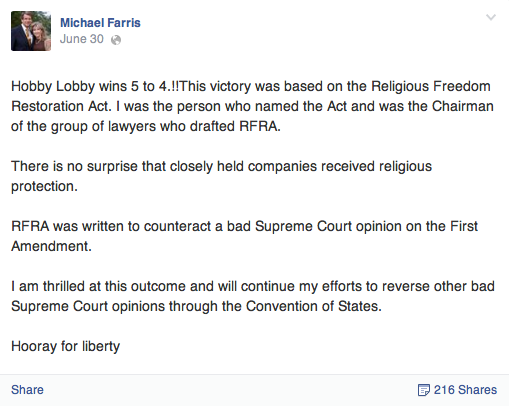
The day the Hobby Lobby decision came out, Farris wasted no time in claiming credit for it on his public Facebook page:
Relevant text is:
Hobby Lobby wins 5 to 4.!!This victory was based on the Religious Freedom Restoration Act. I was the person who named the Act and was the Chairman of the group of lawyers who drafted RFRA.
Really, Farris is being modest in just saying he named the RFRA and supervised the drafting of his text. The fact is, he also “organized a broad coalition of groups to support it” and worked to assuage “pro-life groups” who “feared that the RFRA would extend women’s legal rights to get abortions.” Farris’s work immediately payed off, as HSLDA was able to capitalize on the RFRA in homeschool legal cases and then-HSLDA attorney (now former) Jordan Lorence used it to champion explicit housing discrimination against an unmarried couple.
Historically speaking, it is ironic that the RFRA is now being championed by “conservatives” as a “conservative” piece of legislation. Almost 2 decades ago, libertarian groups were criticizing the RFRA, contending it was unconstitutional because it “exceeded Congress’ power to regulate state and local government” and was merely “Congress’s attempts to redefine constitutional rights via the enforcement clause of the Fourteenth Amendment.” (In fact, the Supreme Court partially agreed, striking down parts of the RFRA, with Justice John Paul Stevens declaring it was a “law respecting an establishment of religion’ that violates the First Amendment to the Constitution.”) Legal scholars similarly argued it “establishes an across-the-board scheme that deliberately singles out religious practices, en masse, as a congressionally favored class of activity.”
(Of course, if you are familiar with Michael Farris’s actual legal theories and not just his rhetoric, none of this should surprise you. Farris is a far cry from actual conservatism and a far cry from federalism. He is more of an opportunistic expansionist. This is evidenced no more humorously in the fact mentioned above: that the Supreme Court struck down part of a law Farris oversaw the drafting of because it was an unconstitutional expansion of the federal government’s powers over and against states’ rights. Nonetheless, HSLDA continues to praise the RFRA.)
But here’s the best part, for all you homeschool trivia buffs out there: After Farris got to name the RFRA and chair the group of lawyers who drafted it, and after it passed the House and Senate and was sent to then-President Bill Clinton to sign, Farris was unable to make the signing ceremony. So who did Michael Farris send in his stead, to be there on this momentous occasion and celebrate one of his crowning political victories?
Religious freedom regained significant protection on November 16, as President Clinton signed into law the Religious Freedom Restoration Act of 1993 (RFRA). Home School Legal Defense Association president Michael Farris was one of the original drafters of the bill. HSLDA had worked diligently over a three year period for RRFA’s passage.
Among those in attendance at the ceremony for the signing of the RFRA in the White House Rose Garden, was Doug Phillips, Director for Government Affairs for the National Center for Home Education. Phillips attended in the place of Farris, who was out of town and unable to attend. After the signing, President Clinton spoke with Phillips and extended his gratitude for the role Farris played in the RFRA drafting and coalition-building process. “Tell Mike, I really appreciate the work he did drafting [the RFRA],” President Clinton told Phillips.
It’s interesting how all these so-called “fringe” individuals — individuals like IBLP’s Bill Gothard and Vision Forum’s Doug Phillips — keep popping up in cases of immense national import. Gothard directly influenced the ideology of the Hobby Lobby owners, the ideology that inspired Burwell v. Hobby Lobby Stores, Inc. And Farris, Phillips, and HSLDA ensured the success of the RFRA, the law that ensured Hobby Lobby’s legal success. So fringe, you know?
“Fringe.”
You keep using that word, I do not think it means what you think it means.
HA Editorial note: The author’s name had originally been changed to ensure anonymity. “Shiphrah” was a pseudonym. I am editing this today because I am ready to say that Shiphrah is me. I wrote this and asked that it was posted anonymously because I had only begun to explore the depths of my memories and my pain at that time and I needed an outlet to work through it. I no longer feel the need for anonymity, no longer am I afraid to claim the darkest parts of my story. I am Darcy, and this is my story and my pain and my healing. ~Darcy Anne, HA Editorial Team
Part One
I was never good enough.
From as far back as I can remember, I was never good enough. I was told I was selfish, lazy, prideful, rebellious, and argumentative. I was told I needed to ask God to forgive me and make me a good person through Him (because we could never be good on our own, only with Jesus’ help and then it was never to our credit, only to His).
When my little sister picked fights with me and I lashed out at her, I was the one scolded, grounded, spanked, had things taken from me, forced to spend time with her to “help us get along”, told to get along and be nice and stop being so selfish and be a better example because I was the oldest. She often got away scott-free, even when she started it. I was told numerous times that if I couldn’t learn to get along with my sister then I couldn’t have friends. Family is more important than friends and how you treat your family tells you how you will treat friends. And if you treat friends better than family, you’re a special kind of hypocrite. I tried to explain why it was easier to treat my friends better. Because they were nice to me.
I was then told that Jesus said “what good is it if you love those who love you?” but loving people who aren’t nice to you is much better in God’s eyes.
Everything I did was criticized. It was never good enough. There was always something to be fixed, some way to do things better. I remember being about 12 years old and telling my mom in exasperation, “All you ever do is criticise me. You never tell me what I do right, only ever what I do wrong.” She first acted surprised and denied it, then promised to try to notice the good before telling me the bad. That didn’t last very long and felt very fake even when she tried. Like she was straining to find something good to say to get it out of the way so she could go on to grasp “this teachable moment”. Of course, when I resisted the “teachable moment”, I was the one at fault for being “unteachable”.
To this day when someone says “teachable moment” I recoil.
I was always “unteachable” because I often argued with my mom’s criticism. Because her words stung and fighting them off was my only defense, as little as it was. I was good with words and knew how to wield them as weapons of defense. I often had Proverbs quoted at me that said that people that were unteachable were fools and only those willing to listen to constructive criticism were people of good character whom God loved. So I guess that was just another thing that God hated about me too.
I was told constantly that I was selfish, and it didn’t take long for my sister to take up that anthem against me. Of course, sister had “a servant’s heart” and was selfless and kind and I should be more like her. She was generous and I was stingy. I only thought of myself and my needs and God was not pleased with that. I should ask God to give me a servant’s heart. I spent many hours as a child crying to God to give me this elusive servant’s heart that I apparently lacked and needed before my mom would accept me and my actions. Then maybe my sister wouldn’t hate me either. We were given roles very early in life and we played them well. She learned early how to manipulate our parents against me and she was always believed over me.
I was a child of many emotions. Sensitive, thinking, opinionated, deeply feeling.
But I quickly learned that some emotions were not acceptable, maybe even a sin, and I was not allowed to express them.
I learned that if I was angry, it was “godly” to forgive and forget that anger and definitely don’t express it. “Be angry but do not sin” meant “be angry but never tell anyone or show it”. There were times I wanted to scream because of the pent-up feelings of anger at my parents, anger at my sister, and anger at myself for being angry with them. I must be the terrible person they said I was because I couldn’t stop being angry and sad all the time. I begged God to make me nice and happy and sweet. “Why can’t you be sweet like your sister?” was something I heard often. I often escaped with a book into my favorite tree, away from everyone I could possibly sin against, away from the constant criticism of my actions and “bad attitudes” and the reminders that I was rebellious against God and my parents.
When I was an early teen, things only got worse. Thanks to a cult leader called Bill Gothard and his seminars and his followers, my family finally found answers to all our problems and embraced the promises to have the perfect godly life if we followed the Basic Principles. I was 14 and I thought, yes! This is the answer! The rule list that will finally make me a good person whom my family will love, who will be worthy of their love and acceptance. I poured my heart and soul into the materials, spending hours praying to God to forgive me for all the ground I gave to Satan. For not accepting my parents as the hammer and chisel that were molding me into the diamond I was meant to be. My resistance of their umbrella of authority must be the reason I’m a bad, selfish person. I was determined to finally fix my broken soul. I befriended many “godly girls” who were homeschoolers and whose families understood and followed the secrets of a godly life, hoping their goodness would rub off on me. Eventually, those girls popped into arguments between me and my mom….”why can’t you be more like them? They would never treat their parents and sister the way you do.” I wanted nothing more than to be “more like them” and tried even harder.
I had many teary confessions to my parents for being rebellious. They piled on the modesty books and the courtship books and all the books that told me I was a naturally bad person and needed my parents as my authority because I couldn’t trust my heart to know what was best for me. I ate them up, thinking i would find the answer to all my problems. When my sister would lie about me, get me into trouble, pick fights with me until I snapped at her, I would take a breath, search my own heart for any evil thoughts, and beg her to forgive me for being selfish. She always did, of course. It was very magnanimous of her as a good, generous person to forgive my selfish actions.
There were some dark times in there. For a while I was convinced that since I was such a terrible person and my family hated me so much, that maybe God hated me too and what was the point of me living? I began to fantasize about ways I could kill myself and relieve my family of the burden of me. I never went through with anything.
I was afraid of death, that God really did hate me and would send me to hell and I couldn’t die until I turned into a better person.



 Homeschoolers Anonymous