I Am Not A Victim, I Am A Survivor

HA note: The following is reprinted with permission from Sheldon, who blogs at Ramblings of Sheldon. It was originally published on Confessions of a Heretic Husband on June 21, 2013.

“Where are you going?” she kept asking over and over again, with defiance and a hint of amused contempt as she stood in the middle of the only doorway out of the room. I had told her just minutes before that I was leaving, and she immediately blocked the door. I had some of my stuff packed, and I was desperate to leave her home for good, but she just stood there and said I had “no right” to leave.

Was I some pouting 12 year old kid at the time? No, I was 21 years old. I was desperate enough that I was willing to leave the home of my Mom and Dad with just a few hundred dollars to my name and an old van.

What drove me to this point? It was many different things, and I should start from the beginning. Just two years earlier, I had come back from a prominent Southern Baptist college after a nervous breakdown that included severe depression with constant fatigue, muscle pain/weakness, and some bizarre panic attacks. Needless to say, I couldn’t keep it together, and had to return home.

When I did return home, I explained what had happened, and all of it was dismissed as “guilt” and “not having a right relationship with god”. You see, in her mind, my struggles with mental illness were not an illness, they showed a lack of character. Her attitude reflected much of what what can be seen in fundamentalism: that true happiness can only come from serving god, and if you aren’t happy, then that must be a sign that your relationship isn’t right.

The real kicker is that I actually believed for this for two years, and generated a lot of self hatred and frustration. I couldn’t figure out why it wasn’t working. I begged god for “forgiveness”, I doubled down on my dedication to my faith, but it wasn’t working. I was beginning to realize that the relationship with god had little to nothing to do with it, and that I had a real disorder. The problem was that my mother was never going to see it that way, and dealing with her ignorance left me feeling trapped in this situation.

It was pushing me to the point that I was starting to become suicidal. For a while I pondered jumping off a local bridge during the winter, but then I started to think that if I did, I would be giving my mother exactly what she wanted: control over me for my entire life. That thought bothered me more than the thought of ending my life. I knew I had to do something, anything, to break away, but I was stuck.

At the time, I was in a local college, and I was starting to realize that they were a scam, but of course, she didn’t see it that way. I proved it to her in so many different ways, I even told her what some people in the field that my major was in told me at a summer job (that the college was a scam), but all to no avail. It didn’t work.

She told me the only acceptable plan for my life was to go to college, and she kept pontificating about how supposedly I would never make it financially without that piece of worthless paper from the scam of a college I was in at the time.

Allegedly, I would be working 3 minimum wage jobs, have no time for anything, and would be starving. She called me “lazy” because I would rather work (I still haven’t figured out the logic behind that argument). She tried to make me feel without hope, that I would never leave, and that I couldn’t make it without her. I knew that was a lie, and meant to keep me defeated and powerless. I knew I wasn’t getting anywhere while trying to reason with her. I knew that if I stayed, it would be many more years suffering under her rule, and it might just lead me to finally end my life.

So I packed some things, and was going to leave that morning, but there she was, standing in the doorway to barricade me in the room. “Where are you going?” It’s not as though she didn’t know, I explained it to her just minutes before. It was more of a challenge than a question. I had a phone sitting out, because as angry as I knew she would get, she hadn’t become violent with me since I was 11 years old. But she loved to threaten it when nothing else worked, and I couldn’t be too sure. 

She noticed the phone sitting out, and insisted to know why it was laying on a desk. She figured it out, and told me (keep in mind I was 21 years old at the time), that if she were to hit me, I would deserve it. I pointed out to her how hypocritical her statement was, due to the fact that she was always ranting about how bad her childhood was with a physically abusive father (and rightfully so). She had nothing to say for once, she simply walked away.

I realized that if I was to ever reclaim my life, and get back any sense of hope, I had to push back, and resist in any way possible. Eventually I would wear her out, reasoning sure wouldn’t work. I refused to go along with her plans, and finally won on the college front. I got a job (not three minimum wage jobs), and saved my money, paycheck by paycheck

She tried to slow me down by making pay “rent” for living in her home (the home “I had no right to leave”),  which I payed, but I kept pressing on anyway. The muscle pain and weakness came back, but I fought through it, sometimes working up to 64 hours a week, despite the pain and stiffness. She told me that I was so lazy, that even if I did get a job, I wouldn’t stay at it very long.

Guess what? I have not only been at the same company since September 2011, I have moved up within the company (thankfully to a job that is no longer physically demanding). I saved up enough money over the last 2 years to buy a foreclosure house, and closing procedures will take place next week (the week of June 10, 2013) [Note: this has happened!]. I paid cash for it, and won’t ever have to worry about house payments. My finances will be a little stretched to say the least while rebuilding it, but I never would have thought I would have gotten this far only 3 years after that day that I was barricaded in that room.

There are times, like when I’m writing a post like this, that I feel much the same way I did that day: defeated, humiliated, like a victim, but then I remember, I’m a survivor. I fought, and clawed my way towards finally getting the right to start my own life, and won. I survived the toxic self hatred and ignorance of fundamentalism, and cast it aside.  I have a long way to go to rebuild my life, financially, emotionally, and in so many different ways, but I won the fight for my freedom.

Authoritarian Parenting Is Poison: Faith Beauchemin’s Thoughts

Authoritarian Parenting Is Poison: Faith Beauchemin’s Thoughts

The following piece was originally published by Faith Beauchemin on her blog Roses and Revolutionaries. It is reprinted with her permission. Also by Faith Beauchemin on HA: “The Importance Of Telling Your Own Story” and “Starship Captains and Dinosaurs.”

My parents wanted to be the best parents they could be.  It’s a pity that I barely even speak to them. It’s not really their fault, and I would forgive them immediately if they ever admitted their parenting had been wrong.  But they defend themselves and make excuses and believe that they were doing it all to the glory of God.  And if something is to God’s glory, of course it’s going to be good for every person involved.

But that’s not true at all. I suffer significant psychological and emotional distress to the point of being developmentally stunted in several ways because of my parents’ “god-centered” parenting techniques.

All the books and sermons available to my parents convinced them that their parenting techniques were correct.  Multiple authors and preachers basically bullied my parents and many others like them to completely dominate and break their childrens’ wills, because total obedience was God’s plan for children and if children could not obey their parents, how would they ever know how to obey God?  My parents were convinced that my eternal salvation rested on their success as parents.  If they did everything right, I would follow the Lord and be happy all my days.  Too bad I only started being truly happy after I left home and left the church.

In the interests of doing everything right, my parents chose to homeschool me and my siblings.  This, along with the very tiny church which was our only social interaction, meant my dad’s ideas and will completely dominated every aspect of my life growing up.  He passed it all off as God’s ideas and God’s will, but there was of course only one correct way to think of everything and that was my dad’s interpretation of Christianity.

As a young child, I was happy, imaginative, precocious, friendly, outgoing, intelligent, excited to explore new ideas, devouring books about dinosaurs, about history, and every story I could lay my hands on.  By the time I went to college, I was quiet, depressed, frightened of everything, unable to speak in public, socially awkward to a painful degree, and self-censoring as to what ideas I was willing to even entertain or think about. I channeled my intelligence into proving the few points that I believed were true, and disproving everything else.  My mind wasn’t just closed, it was completely locked down.  It took four long years at college to return me partially to the outgoing, intellectually curious, adventurous personality I had lost.

My parents broke my will.  They wanted to make me follow a prescribed course of life.  They had a particular bundle of beliefs that they wanted me to adopt and take with me forever.  Any flicker of self-interest, self-will, was seen as rebellion and immediately crushed.  Any personal desire contrary to their wishes was deemed sinful, and spanked out of me.  And, I cannot emphasize this enough, I never got away from my parents.  I was always in their home, always dominated by their influence, their thoughts and desires.  I had one channel of freedom, the books I checked out of the library.  But when every other part of my life was controlled so totally, I tended to closely self-censor on what books I would read or how I would interpret them.

The adversarial form of parenting, the one which sees the child’s self as automatically opposed to the parent’s authority, is unbelievably harmful to the parent/child relationship.  It took me a very long time to relate to my mom as a person rather than just an authority figure. I still can’t relate to my dad as a person, his whole being is consumed with his religion, and with trying to prioritize God in his life. He has obsessed for a long time over the fact that he’s the authority figure in the family and everyone needs to honor him, which come to think of it makes me a little worried about his mental health.  He hasn’t realized that it’s wrong to put your ideology before your children.  He doesn’t understand why we barely ever speak to him.

Even hearing about homeschooling families or reading materials written by people in the homeschooling or fundamentalist Christian movement can trigger flashbacks.  I am still working, every day, on reclaiming my self.  I wonder, sometimes, what life might have been like if I had been allowed to develop my own path instead of being forced to follow so closely my parents plan for my ideas and my life.  What might I have accomplished if I hadn’t wasted the first 19 years of my life focusing all my time and energy on matching up to this ideal Christian model held up by my parents.  Perfection was the goal and therefore it took all of my time and energy to try to reach that goal.

I have only just now, at age 23, begun with any kind of seriousness to figure out my place in the world.  Once I realized I had spent the vast majority of my life in a tiny insular principality, ruled by my father, which had very little to do with the rest of the world, I felt completely lost.  And who am I supposed to turn to to figure it out?  My parents? They’re the ones who screwed up my life this badly.

I have to rely on myself, the self that was squashed and harangued and abused almost out of existence.  I’ve survived, and I’ll go on to do something important and real and lasting in this world, but I will never know what could have happened in those years that are lost.

Rewriting History — History of America Mega-Conference: Part Six, Doug Phillips Rages Against the 20th Century

Rewriting History — History of America Mega-Conference: Part Six, Doug Phillips Rages Against the 20th Century

HA note: This series is reprinted with permission from Ahab’s blog, Republic of Gilead. For more information about Ahab, see his blog’s About page. Part Six of this series was originally published on July 10, 2013.

*****

Also in this series: Part One: First Impressions | Part Two: Doug Phillips on God in History | Part Three: “Religious Liberalism” And Those Magnificent Mathers | Part Four: Kevin Swanson Is Tired Of Losing | Part Five: Messiah States and Mega-Houses | Part Six: Doug Phillips Rages Against the 20th Century | Part Seven: Christian Vikings, Godly Explorers, and Strange Bacon | Part Eight: Closing Thoughts

*****

On the evening of Friday, July 5th, attendees gathered in the Radisson’s grand ballroom for prayer, music, and videos. The evening began with a Puritan call-and-response song lead by Doug Phillips, followed by a benediction. Next, the ballroom screens showed short videos on Vision Forum’s latest projects. I distinctly remember the Hazardous Journeys Society, an all-male organization that seeks to explore the world through the lens of conservative Christianity. Hazardous Journeys Society presented itself as an alternative to National Geographic, which has allegedly interpreted the world through the lens of evolution.

After Danny Craig sang “America, America”, several young women performed haunting renditions of traditional American songs on violins and harps. After a mixed sex Civil War Choir performed in historical garb, Doug Phillips delivered a talk entitled “The Meaning of the 20th Century: A Providential and Theological Overview”.

The 20th century ushered in a new era, Phillips began, and to fully understand the 21st century, we need to understand the 20th. On the ballroom screens appeared a collage of 20th century images: Che, Einstein, Ayatollah Khomeini, a mushroom cloud, Earth from space, and many others.

Phillips recounted his time as a writer for the George Bush administration and a private driver for Billy Graham. While chauffeuring Billy Graham around Washington D.C., Phillips learned about history as Graham pointed out places where he met dignitaries and took part in events. Phillips used this story to explain that the best way to understand history is to study primary documents and meet the people who shaped it.

Phillips shared his version of early 20th century history, beginning with the revivalism of preachers such as Billie Sunday. However, the century would prove to be one of “God-hating nihilism” and genocide”, he said. For the first fifty years of the 20th century, he claimed, the church was silent and withdrawn from public debate.

Huh? I thought. That’s not what I remember from my college history classes.

Phillips had apparently forgotten Reinhold Neibuhr, Dietrich Bonhoeffer, Adam Clayton Powell Sr., Dorothy Day, the Catholic worker movement, the social gospel movement, Quadragesimo Anno, American preachers’ condemnation of Nazism, regional church roles in Europe’s anti-Nazi resistance movements, and countless other voices among the world’s Christians. If by “the church”, Phillips meant the global body of Christians, then “the church” was anything but silent in the early 20th century.

Phillips claimed that the 20th century church wasn’t prepared to deal with genocide and the Holocaust. For this reason, abortion and birth control have now spread through Christendom, he lamented. One third of the people who could have been at the conference that night were “killed by their parents” thanks to abortion, he fumed.

In effect, the 20th century forgot God and turned against him, Phillips told listeners. He depicted the 20th century as an era that saw the rise of “rationalism” and the rejection of God as a higher authority. Enlightenment thinking had given rise to 19th century movements such as Marxism, feminism, socialism, and evolutionism. Then, despite the “restraining” influences of the British Empire and the Christian Queen Victoria, the 19th century’s “compromises” produced the 20th century, he argued.

Phillips held considerable scorn for Sigmund Freud and Margaret Sanger. Freud introduced people to psychology, and today, every single branch of psychology is saturated with “anti-God” ideas and “evolutionary scientism”, he claimed. Like many other anti-abortion activists, he blasted Margaret Sanger as possibly the most dangerous person of the 20th century, more dangerous than Stalin, Hitler, or Mao. Satan seeks to foment racist extermination efforts, convince people to see babies as dangers to be eliminated, and make parents hate their children, he claimed, seeking to literally and figuratively demonize Sanger. Phillips accused Sanger of embracing eugenics, branding her “the killer angel” who spawned the modern abortion movement and allegedly fueled the ideology of Hitler and Stalin. “The death count is in the billions!” he grieved.

Belief in the state-as-God gave rise to 20th century totalitarian leaders and their genocides, Phillips claimed, pointing to the Armenian genocide, the Holocaust, and Japanese atrocities during World War II. A century of supposed enlightenment produced barbarism, thus showing the failure of societies that reject Christ. (Phillips conveniently forgot that Germany was solidly Christian during the Third Reich, that some Nazis wove Christianity into Nazi ideology, and that earlier Christian anti-Semitism set the stage for Nazi racial policy.)

However, Phillips assured the audience that God uses such horrors as part of a larger plan. One of those who fled the Armenial genocide was Christian Reconstructionist author R. J. Rushdoony, for example. Amidst the events of World War II, the hand of God was upon Winston Churchill, he claimed, who was used for a “godly” purpose. Phillips described Churchill as an “indefatigable” and “indomitable” man who stood up against evil.

Tell that to Dresden. And Poland, I thought. Wasn’t Churchill allied with Stalin, that tyrant you condemned a few minutes ago? The problem with seeing the “hand of God” on political leaders is that it makes it difficult to acknowledge their morally ambiguous choices. I realize that Churchill fought the Nazi regime — a noble and necessary task — and had a net positive impact on the world. However, I also believe that lionizing political leaders as “godly” is highly problematic.

Phillips blasted 20th century “statism”, condemning Roosevelt’s New Deal as a means of making government a “parent” and overriding the family and church. He similarly slammed Johnson’s Great Society programs as “leftist propaganda” that funded abortion and feminist movements.

Predictably, Phillips seethed at the thought of feminism, which began with Eve and exploded in the 20th century, he claimed. He was particularly livid at the thought of women working outside the home. For six thousand years, he insisted, children were raised in the home by mothers, but 20th century women working outside the home changed that. (Actually, women have been working outside the home for centuries. Slaves of both sexes were hired out to work outside the home in Roman times. Plenty of women worked in factories and textile mills in the 19th century. This is not a new phenomenon.)

Decade by decade, the U.S. plummeted into confusion, he explained. He tried unsuccessfully to bring up an image on the ballroom screens, then told listeners that the picture was of the size of babies who never made it into the world. When we reflect on Hitler, we should also reflect on the “abortuary” down the street, he instructed the audience. Phillips lamented the current state of the church, disgusted that even Christian women were having abortions.

Phillips did not want to end on an ominous note, however. He celebrated Christian publishing, apologetics, teachers who have inspired “men of action”, and preaching that creates “warriors for God”. He also held warm sentiments for the Christian homeschool movement, which sprang from the 20th century’s apologetics and activism, he said. The 20th and 21st centuries are times of antithesis, Phillips preached, a time of abortion, evolution, and totalitarianism versus you, versus people who want Christ to be king in their home. The task before Christians, thus, is to choose between death or life, Phillips concluded.

Phillips’ talk was laden with the usual Religious Right chestnuts: abortion and the Holocaust as morally equivalent, disdain for feminism, and historically inaccurate caricatures of prominent figures. Behind the chestnuts, however, was a glimpse at how the Religious Right views the present. For right-wing Christians such as Phillips, the present is a time of barbarism and delusion, which Christians must struggle against. This distrust of the present era and refusal to recognize complexity and nuance in the 20th and 21st centuries reveals a great deal about the Religious Right mind.

More to come soon on Vision Forum’s History of America Mega-Conference. Stay tuned!

*****

To be continued.

Adult Homeschoolers Speak Out: Part Three, Why Parents Homeschool

Adult Homeschoolers Speak Out: Part Three, Top 3 Reasons Parents Homeschool

HA note: The following series is reprinted with permission from Brittany’s blog BAM. Part Three was originally published on May 25, 2012.

*****

Also in this series: Part One: Why I Wanted To Write This | Part Two: Survey Stats and Large Families | Part Three: Top 3 Reasons Parents Homeschool | Part Four: Academic and Emotional Experiences, K-8 | Part Five: The Highschool Experience | Part Six: College? Prepared or Not? | Part Seven: What About Socialization? | Part Eight: The Best Thing vs. What Was Missing | Part Nine, Do Former Homeschoolers Want to Homeschool? | Part Ten: Are the Stereotypes Better or Worse?

*****

Part Three, Top 3 Reasons Parents Homeschool

While growing up, I heard my mother describe homeschooling as “a lifestyle” countless times to curious inquirers who wondered why anyone would embark on such an endeavor. In the late 1980s, when my family started homeschooling, the question of “why” was very apropos, considering that homeschooling was illegal or newly legal in many states.

Keeping in mind these historic details, I was very intrigued to discover the answers to the question “Why did your parents choose to homeschool, from your understanding?” from first generation homeschoolers. (To learn more about why I decided to explore these questions, click here!)

(While reading, please keep in mind the last part of the question: from your understanding. All of these responses come from the adults looking back on their experiences and to understand why their parents decided to homeschool).

An example from my own family might give insight into the wide variety of answers I got:

My oldest sister, (Amberley, 33 years old), gave this answer:

Well, homeschooling was not legal in Nebraska when I started school, so I don’t know if Mom would have homeschooled me from K or not… But she said I was a brat and wanted me to get along better with my siblings. But I think there was also the religious aspect of things, where they wanted me to be able to study the Bible and learn about things from a Biblical perspective (ie. Bible as a subject, creation).

My second oldest sister, (Chelsea, 30 years old) also mentioned the “getting along with siblings” part, as well as religious reasons.

I, personally, don’t remember my sister being “a brat” (that just makes me laugh a bit). However, the following story is what I remember my parents telling us about why they started to homeschool:

My oldest sister was in the AWANA program (a church based Bible memory club) that met on Wednesday nights. Amberley was so tired in the morning that she had a very difficult time getting up for school. My parents decided that Biblical education (like the AWANA program provided) was of greater value that academic education that required my sister to get up early in the morning. These circumstances greatly influenced my parents’ decision to start homeschooling. 

My younger brother (Kellan, 23 years old) gave this reason:

Well, all of you guys were homeschooled so by the time I rolled around I guess they just had to.

My brother’s answer, of course, is very tongue-in-cheek, but I think it gives a good example of how siblings can have different perceptions of the same event.

Most of the homeschoolers who took the survey cited multiple reasons that influenced their parents’ decision. But the # 1 reason for homeschooling on the surveys mirrored my own family’s reasons for homeschooling: Religious Reasons or Convictions. 

Here are some direct quotes from the survey:

(To see Survey Statistics, Click here)

Melissa Ann G., 26 from VA:   Parents decided to homeschool us for religious reasons.

Christine M., 31 from KS: [My parents] wanted us to have a religious foundation to our education

Jeremy D., 18 from VA: My parents didn’t like “ungodliness” of public school . . . they felt God calling them to homeschool us.

Emily M., 26 from FL: I believe it was primarily because they are very conservative and strong christians and they felt that public schools taught things they didn’t believe and they also thought that it opened up a lot of room for temptations and misguidance.

Elina C., 25 from KS: They didn’t like the evolution stance that was being taken in the school system and wanted to have the freedom to teach us creation.

Jenna C., 28 from KY: [My parents homeschooled] to keep us sheltered from many of the negative influences of the world, and to instill a love of God in our hearts.

And many others:

  • 12 people (myself included) specifically mentioned “religious conviction”as a primary reason for homeschooling
  • 6 people said that their parents wanted to protect them from “worldly,” “ungodly,” or “bad influences
  • 3 people stated that their parents “wanted to teach the Bible”

While religious convictions was the # 1 answer, the next highest response was related to Academics or dissatisfaction with Public or Private Schools.

Stuart G., 29 from VA mentions academic reasons along with others:

My parents were unhappy with the public school environment and the quality of education we were receiving. The straw that broke the camel’s back was an incident in which my sister was being bullied and the administration was ineffective in dealing with the perpetrator. After this incident, my parents decided to try homeschooling on a trial basis. After the first year, it was clear that homeschooling was the right way to go for our family.

Elizabeth J., 24 from VA stated:

My mother wanted to protect us from the negative influences found in public schools, and later (after my sister spent 3rd grade at a private Christian school) to give us a more personalized, at-our-level, education. My mother taught us at the level that we were capable of, not holding us back or going on ahead of us. She also wanted to avoid the bullying and cliche-ishness that were in the schools. 

Kaitlin G., 22 from KS explained that “My brother and I needed more 1 on 1 attention in certain subjects and we were not getting that in public school.”

  • 7 people stated that their parents believed “they could do a better job” than public/private school
  • 5 mentioned that parents “didn’t like the public schools”
  • 2 cited that the parents wanted to have more control over their child’s education
  • One mentioned being “bored” in school
  • One family had a child who was academically advanced

Finally the third highest response after Religious Convictions and Academics was because parents did not want their children being taught Sex Education (5 people mentioned this, though this reason was primarily coupled with religious convictions).

One participant saidThey believed it was God’s will for parents to take active responsibility for their children’s education. This was precipitated by early sex-education in my older brother’s second grade class.


Kelly C. 29 from VA also gave this reason: [My mom] did not want the public school system’s influence (in particular evolution and sex education) on my education. She preferred being able to teach me with a godly influence.

I found these top 3 reasons for deciding to Homeschool fascinating. Other reasons included:

  • Military/ lived overseas (4)
  • Bullying (3)
  • Private/ Christian School too expensive (3)
  • Family closeness (3)
  • Flexibility (3)
  • Disagreement w/ school
  • Thought it would be fun (I particularly liked this answer!)

In closing this very long and informative post, I wanted to share what, I believe, is is a uniquely insightful response for why parents decided to homeschool.

Christy L., 28 from CA said:

My mom started out homeschooling (I am the oldest) and did it for my first two years of school. Before I started second grade she decided to put my brothers and I into public school for two reasons 1. She does not enjoy teaching kids how to read 2. My brother was chronically ill and it was getting to be too much to homeschool and care for him. My parents then decided to homeschool all 5 kids during 6-8th grade. They wanted to ensure that we had a good bible education and felt that middle school is the time that kids really pull away from their parents and they didn’t want that. 

I so enjoyed this response because I believe it shows wise parent(s) who knew her likes and dislikes (nothing wrong with not enjoying teaching kids to read!) personal limitations (having a child who was chronically ill), and their own personal convictions about teaching the Bible and their faith, as well as developing family closeness. Christy eventually went back to public school from 9-12 grade and felt prepared and grateful for this new experience as well.

What about you?

If you were homeschooled, why did your parents choose to do so (from your understanding)?

If you homeschool your children today, what are your primary reasons for doing so?

Please feel free to comment on the above responses, or ask questions! I will do my best to answer them and provide what insight I may.

*****

To be continued.

Brainwashed Shock Troops

HA note: The following is reprinted with permission from Libby Anne’s blog Love Joy Feminism. It was originally published on Patheos on July 17, 2013.

Michael Farris, founder of the Home School Legal Defense Association and probably the most visible Christian homeschool leader, is fond of calling his generation the Moses Generation and my generation the Joshua Generation. Christian homeschooling parents, he says, removed their children from the perils of Egypt (aka the public school system) and educated them in the wilderness (aka homeschooling them) in order to send them forth to conquer Canaan (aka take America back for Christ). This really is the entire point of Christian homeschooling (as opposed to homeschooling done by those who may or may not happen to be Christian but do not have religious motivations for homeschooling). This is also why Farris’s daughter started NCFCA—to train Christian homeschool youth in argumentation and debate in an effort to prepare them for their assault on “the world.” In that light, I recently saw an interesting comment left on a Homeschoolers Anonymous post:

The idea that someone thinks that they can find really bright young people, teach them exceptional skills of debate and argument, and then unleash them upon the world as adults while still controlling their thoughts and attitudes is nothing short of insane. Young people have been growing up into adults who reject the authoritarian views imposed upon them for literally centuries. Why does this group of fundamental Christians – who often behave abusively to that self-same group of bright young people – think that they are exempt from the questioning and breaking away process that all young adults do as they grown into independence?

Because they believe they have completely brainwashed their young people into absolute loyalty to The Party as part of their training/indoctrination. Like the Uruk-Hai coming from the spawning pits below Isengard, they were raised and indoctrinated to be living weapons and nothing more.

Why do they think they are exempt from their best and brightest living weapons breaking away? Divine Right, of course.

My father spoke at my graduation. It was a homeschool graduation held at a local church, of course, and each father presented his son or daughter and gave a short speech. I was preparing to begin university the following fall. In his speech, my father said that many people had questioned his wisdom in sending me off to a secular university, asking whether I was ready for that. His response, he said, was that the real question was not whether I was ready to attend that university, but rather whether that university was ready for me. His confidence in my performance disappeared over the following years as I did indeed become “corrupted” by my time at university, and halfway through college my father launched into a tirade against me in which he brought up his remarks at my graduation and told me, his voice full of emotion, that those who had warned him against sending me off to a secular university had been right, and that he wished he could go back and undo that.

What happened?

Put simply, the commenter quoted above is right.

It is completely unreasonable for Christian homeschool parents to think that they can train up ideological clones whom they can train in debate and argument and then unleash upon the world without at least some of them going rogue or asking questions they shouldn’t. If these parents limit their children’s interaction with the world outside of their religious communities and avoid teaching their children critical thinking skills, creating ideological clones is simpler. But if you’re going to train them in argumentation and debate and then send them out into the world to wage ideological war on your foes, well, that’s more complicated. My parents equipped me with the very tools that ultimately led me to think my way out of their mindset, and meeting and getting to know people in “the world” meant that I realized the portrayal of “the world” my parents had given me growing up was wrong and extremely backwards. The system my parents constructed around me, in other words, was built with an internal weakness.

Why, then, did my parents have so much confidence? The commenter quoted above does have a point when referring to divine right—my parents believed that they were right, that their ideology was sound and true and demonstrably so. They therefore assumed that if they equipped me with Truth, that would be enough.

That I might grow up to disagree with them on what is true and what is not wasn’t really a concern, because they believed that the truth of their beliefs was completely obvious to anyone with eyes. When they would talk about people who “left the faith,” they would always attribute it to some sin—the person just wanted to have premarital sex, or to be able to be selfish and not care about others, or what have you. In their conception, it was never a disagreement about fact that led people once saved astray, but rather fleshly desires—because the truth of their beliefs, they were certain, was manifestly obvious to anyone and everyone.

There was something else, too, something more related to Christian homeschooling. My parents believed they had hit upon the perfect formula for raising children who would never fall astray. They believed this because this is what they were told by the books, magazines, and speakers of the Christian homeschool world. And they had done everything on the list from keeping me from friends who might be bad influences to teaching me with curriculum that approached each issue from a Christian perspective. This, quite simply, is what I consider the number one reason my father said what he did at my graduation. He was convinced that he had produced a culture warrior, following the proper formula and all of the proper advice, and that I was, in a sense, infallible—that I couldn’t possible go wrong.

But what was I, really?

I was chock full of apologetics arguments and conservative talking points, but utterly without lived experience or any real understanding of the arguments against the ideas my parents had taught me. After all, I’d never really interacted with people with different ideas or beliefs and my parents provided me only with straw man versions of opposing arguments in order to then knock them down. I’d grown up in an echo chamber and was happy contributing to that echo chamber, but I had no experience stepping outside of it.

I wasn’t a culture warrior. I was a teenage girl who thought she knew everything and wanted very much to please her parents.

Confessions of a Homeschooler: Iris Rosenthal’s Story, Part Two

Confessions of a Homeschooler: Iris Rosenthal’s Story, Part Two

Iris Rosenthal blogs at The Spiritual Llama. This story is reprinted with her permission.

< Part One

"I remember how hard it was for me to adjust to being outside of the homeschooling bubble and in some ways, eight years later I am still adjusting."
“I remember how hard it was for me to adjust to being outside of the homeschooling bubble and in some ways, eight years later I am still adjusting.”

Since my original post I have come to the realization that I have just scratched the surface on everything that I have to tell about homeschooling. One of the problems I have with home education is that there is hardly any regulation. During the time I was homeschooled, K-12, I never once had to take the SAT or ACT or any other sort of evaluation test.

As long as it looked like I was studying I was pretty much left alone. The only subjects my mother was constantly involved in were; math, spelling and english. Occasionally she would check my work in the other subjects, but for the most part I was left to fend for myself and once I reached the age of 15 any involvement from her pretty much came to a stop.

I often hear the argument that not all parents homeschool are like this and that my mom was doing it wrong. While that may be the case, I don’t think that this should be lightly brushed off. We are talking about the education of children here! It is my belief that whichever route you choose, it’s very important that your children receive the best possible education. Be involved, be a part of their lives, listen, be aware of what they are learning about and learn with them!

With the lax requirements in place for homeschooling it only flings open the door for cases such as mine to happen. So much for homeschooling being better than public school (for those who don’t know me, that was sarcasm)!

I know my story is not the only one, my brother & sister and close friends have also experienced the same lack of education and preparedness to function in the real world because of being homeschooled. However, I’m not here to tell their story for them, I’m here to tell mine.

My first full time job experience happened when I was 21 at a call center. Yes I’d had jobs previously, but they were just odd jobs and the people I worked for I already knew from either homeschool group, church or 4-H. So I was always within that bubble my mother had me living in.

While working at the call center I got to know people who *gasp* went to public school, it was then that I started to realize that there were holes in my education. I didn’t know any math beyond the basic add and subtract. I could barely multiply or divide. Forget fractions and algebra.

I also realized that I was spelling a lot more words wrong than what I originally thought I was. It’s pretty bad (not to mention embarrassing) when your manager brings back your vacation time off request (written in clear handwriting) and asks you to tell what words you meant to put down. I found myself sticking out a lot in all the wrong ways, and my judgmental attitude towards people who were different than me didn’t help with that at all!

I had never been around so many people from so many different backgrounds before, it was quite an eye opener and culture shock for me! I still remember the first time I heard someone swear. If I didn’t agree with something someone said or did I made sure to let them know that it offended me. If I knew someone was a Christian and I heard them say something that I didn’t believe a Christian should say I made sure to let them know how wrong they were.

Looking back, I was quite obnoxious and judgmental towards my coworkers at that job. It is no small wonder that barely any of them talk to me anymore and I can’t say that I blame them!

I am so thankful that I have learned since then and now at my current job I am known among my coworkers for being helpful and a team player. I no longer allow my homeschooling experience to define me, in fact I hardly ever bring it up. I don’t feel as though I should have to defend my education (or lack thereof) to anyone.

It is my desire that people know and define me by who I really am, and not as some “failed product of home education.”

I hope that by sharing my experiences I can somehow prevent them from happening to someone else. I remember how hard it was for me to adjust to being outside of the homeschooling bubble and in some ways, eight years later I am still adjusting.

If anyone is reading this and is going through that rough transition period from the bubble to the real world, just know that you aren’t the only one who has traveled that path. It may be rough now, but in the end you will be stronger and wiser for it!

Rewriting History — History of America Mega-Conference: Part Five, Messiah States and Mega-Houses

Rewriting History — History of America Mega-Conference: Part Five, Messiah States and Mega-Houses

HA note: This series is reprinted with permission from Ahab’s blog, Republic of Gilead. For more information about Ahab, see his blog’s About page. Part Five of this series was originally published on July 9, 2013.

*****

Also in this series: Part One: First Impressions | Part Two: Doug Phillips on God in History | Part Three: “Religious Liberalism” And Those Magnificent Mathers | Part Four: Kevin Swanson Is Tired Of Losing | Part Five: Messiah States and Mega-Houses | Part Six: Doug Phillips Rages Against the 20th Century | Part Seven: Christian Vikings, Godly Explorers, and Strange Bacon | Part Eight: Closing Thoughts

*****

On Friday, July 5th, I observed an afternoon workshop entitled “The Rise of the Messiah State: From Wilson to Johnson”. Geoffrey Botkin of the Western Conservatory of the Arts and Sciences delivered a talk on the supposed ills of social safety nets and the evolution of the so-called “Messiah state”. Botkin, a long-time ally of Vision Forum, has a controversial history with Great Commission Ministries, according to commentaries at Under Much Grace (see here and here).

At the start of his workshop, Botkin explained to his audience that a major challenge is to communicate how society should be organized to a culture unused to thinking theologically. “All history is theological,” he insisted, echoing the sentiments of other speakers at the conference.

Botkin complained that the U.S. is comfortable with a “Messianic state” now. Quoting Christian Reconstructionist thinker Gary North, he claimed that the “welfare state” died when the Roman Empire fell in 400 AD, but reemerged in the 20th century. From 1913 to 1973 — from the Wilson administration to the Johnson administration — America’s social order changed theologically to a “welfare-warfare state with fiscal and moral deficits of crushing … consequences,” Botkin claimed.

Botkin understood the state, church, and family to be God-created institutions, each with their own sphere of influence. However, the modern American state is so divorced from God’s will that its power to do good has decreased, he said. Over the span of a few decades, “the power of the state to do evil” allegedly grew.

Botkin shared quotes from Christian Reconstructionist authors on the alleged evils of an overbearing state. One quote from Gary North claimed that the “welfare state” is defended as a network of social safety nets, in which business profits are seen as a tax base for the welfare state. Another quote from R. J. Rushdoony caricatured humanists as revering the state as their lord and savior. Revealingly, Botkin’s presentation shared another quote from Rushdoony which accused society of succumbing to the “heresy of democracy”. In Botkin’s eyes, “statists” cannot revere God because they revere the state instead.

“Messianic statism”, as Botkin defined it, is an organization of men who provide answers to all of humanity’s problems through reorganization of society under the scientific/secular/socialist state, rather than Christ. The state, in effect, replaced God in people’s minds, he explained. Changing, man-made laws result in society’s “moral dissipation”, he claimed, making the state a “maternalistic necessity”. As a result of Messianic statism, men become “emasculated”, unable to take responsibility in their lives, Botkins claimed. A cycle of dependency emerges, where the more men descend into moral dissipation, the more they need a “nanny” or “mommy” state to care for them.

Emasculation? “Maternalistic necessity”? Mommy states? Someone has masculinity issues, I thought.

Tastelessly, Botkins used natural disasters as an example of dependency on the state. When a hurricane causes devastation, everyone whines “Where is my Messianic state!?”, he sneered. His utter callousness to the suffering of disaster victims and disdain for any safety net to help them recover startled me.

Botkins proceeded to caricature the policies of U.S. presidents from Woodrow Wilson to Lyndon B. Johnson. He reserved special animosity for income taxes, Social Security, the New Deal, Lyndon Johnson’s Great Society, and public education, which he derided as “free babysitting”.

His diatribe was peppered with fundamentalist commentary and disgust for real or perceived immorality. For instance, he described Woodrow Wilson as an agent of “totalitarian experimentation” who did not trust the authority of scripture. He defended Warren G. Harding as a president striving for normalcy in a country destabilized by jazz music, movies, and prostitution. He spoke approvingly of the Hays Code, claiming that it prevented entertainment from undermining society, as it allegedly does now. Tellingly, he painted women’s organizations lobbying for pensions for mothers and widows during the Coolidge administration as “less productive” people seeking to exploit the system by looking for handouts.

In his conclusion, Botkin likened the Messianic state to ancient god-kings and notions of divine kingship. He shared a quote from R. J. Rushdoony likening state worship to Moloch worship, calling both examples of “political religion”. Like the ancient god Moloch, the Messianic state demands total sacrifice from its subjects, he warned the audience.

I don’t think Botkin grasps the purpose of social services or a social safety net. Such measures are not the sinister tentacles of a “Messianic state”, but a means by which governments and communities help people in need. The mark of a civilized society is its willingness to help its most vulnerable members gain self-sufficiency. Frankly, I do not want to return to a society where the downtrodden are without recourse. A country without a social safety net, with charities in the place of fair programs, would have a devastating impact on the populace, as S. E. Smith recently observed. The callousness with which Botkin demonized the U.S. social safety net struck me as cold-hearted.

I also found Botkins’ workshop highly ironic. A man trumpeting Christ and scripture while ignoring Jesus’ teachings on compassion left me shaking my head. Whatever happened to “For I was hungry and you gave me something to eat, I was thirsty and you gave me something to drink, I was a stranger and you invited me in, I needed clothes and you clothed me, I was sick and you looked after me, I was in prison and you came to visit me”? Whatever happened to “whatever you did for one of the least of these brothers and sisters of mine, you did for me”? Matthew 25:31-46 is lost on such people.

*****

Later that afternoon, Vision Forum director Doug Phillips and Weir Capital Management founder Erik Weir spoke at a workshop entitled “How Architecture Helped to Shape the Character of the American Family”. Phillips posited that a symbiotic relationship exists between architecture and the family, influencing each other in countless ways. This relationship isn’t a function of income level, he insisted, but of vision, making it applicable for tents and palaces alike. Phillips listed three foundations — aesthetics, design, and architecture — for designing homes.

Phillips argued that modern-day architecture is diverging from the past, elevating form over function, often abandoning aesthetic principles, and neglecting to consider the family. He looked askance at the deconstructivist school of architecture, contrasting photos of eye-catching deconstructivist buildings with a photo of Monticello.

C’mon Doug. A little architectural experimentation is perfectly fine, I thought.

Phillips stressed the importance of bringing every aspect of the home into obedience to Christ. He asked aloud if a home is to be designed to unite families in common spaces, or to cocoon them in separate bedrooms. Colonial and frontier homes, he observed, were organized around a central hearth where the family interacted, for example.

Monticello held special appeal for Phillips, who praised it as a reflection of Thomas Jefferson’s worldview. Monticello functioned as a place to entertain guests, a site of industry and production, a personal study, and a setting in which the new American spirit would be modeled. I noticed that Phillips conspicuously left out Monticello’s underground slave areas, where unseen slaves produced food and sundries for Jefferson’s guests. This, too, was a reflection of Jefferson’s worldview (specifically, his acceptance of slavery), a stain that Phillips left out.

Phillips also praised Montpelier, the historic plantation of James Madison. He described Montpelier’s central core, in which children were educated, parties hosted, heads of state entertained, and the family business operated. Montpelier, like other estates of the era, was built with the assumption that future generations would live there an exert an ongoing influence on the area.

Phillips contrasted the communal homes of the past with the homes of the present, which he likened to “flophouses”. In the past, it was common for three or more generations to live under the same roof, either out of custom or necessity, he said. He contrasted such multigenerational homes to the dwellings of the “selfish generation” which segregates its elders. Today, families are getting smaller while houses are getting bigger, so families tend to share less space. By living and working near each other, families experienced less infidelity, closer ties existed between parents and children, and more economic incentives to perpetuate family life.

I chuckled to myself at Phillip’s assumption about infidelity, as the reality was far less pleasant. Less infidelity? Hardly. Slave owners sexually abused slaves in that time period. Plenty of men patronized brothels in that time period. There was plenty of infidelity.

Phillips stressed the importance of generational thinking regarding architecture and the home. For example, he encouraged listeners to avoid faddishness and cheap quality in home decorations and furnishings in favor of long-term, durable furnishings that will last for many years. In choosing and designing homes, Phillips encouraged listeners to consider multiple considerations: geography, climate, space use, flow, and many others.

It occurred to me through the talk that Phillips’ home advice, while well thought-out, would only be applicable for well-to-do families. If families are struggling economically, they won’t be able to afford the durable, long-term furnishings. If families are limited in what kind of housing they can afford, they may not be at liberty to base home or apartment choices on a wide range of considerations. In an ideal world, everyone could consider furnishings, geography, and flow in their home choices, but we do not live in an idea world.

This realization grew stronger as I listened to Weir’s part of the workshop. Weir’s wealth was evident as he described his home, Magnolia Hall Plantation, inspired by the Oak Alley Plantation in Louisiana. His family chose a large property that would allow space for future growth, including a row of oak or magnolia trees and on-site housing for his children, he explained. Sharing photos of his home, he proudly pointed out the “manly” Doric columns they chose instead of “flutey” Corinthian columns. As photos from the inside of the home flashed on the screen, Weir explained that he wanted to create an inviting interior. (The foyer, while sleek and pristine, struck me as cold and a little too perfect, however.) Weir and his wife chose fine wood for their floors so that guests with children wouldn’t have to worry about sullying a carpet with spills.

This is great, but … how does this apply to middle and working class families? I thought. Most of the people in the audience probably can’t afford to make these choices.

In short, the workshop on architecture was a paradox, an example of intricate thought and little thought. On one hand, Phillips and Weir clearly spent time reflecting on aesthetic values and home functionality, demonstrating a level of forethought that I respected. On the other hand, they seemed oblivious to the fact that only well-off people could meaningfully apply these principles. Weir’s home, while lovely and well-planned, is the home of a wealthy man. How relevant would Weir’s description of his home be to a couple struggling to feed and clothe multiple children? After taking in Botkin, Phillips, and Weir that afternoon, I wondered how often they reflect on the middle and working class.

Stay tuned for more on the History of America Mega-Conference!

*****

To be continued.

Adult Homeschoolers Speak Out: Part Two, Survey Stats and Large Families

Adult Homeschoolers Speak Out: Part Two, Survey Stats and Large Families

HA note: The following series is reprinted with permission from Brittany’s blog BAM. Part Two was originally published on May 24, 2012.

*****

Also in this series: Part One: Why I Wanted To Write This | Part Two: Survey Stats and Large Families | Part Three: Top 3 Reasons Parents Homeschool | Part Four: Academic and Emotional Experiences, K-8 | Part Five: The Highschool Experience | Part Six: College? Prepared or Not? | Part Seven: What About Socialization? | Part Eight: The Best Thing vs. What Was Missing | Part Nine, Do Former Homeschoolers Want to Homeschool? | Part Ten: Are the Stereotypes Better or Worse?

*****

Part Two: Survey Stats and Large Families

Here are the demographic statistics from the survey I conducted about the experiences of adults who were homeschooled.

To better understand the following data, here is my own demographic information:

  • Name: Brittany Arpke Meng
  • Born in: Nebraska
  • Grew up in: Kansas
  • Currently live in: Virginia
  • Age: 28
  • Number of siblings: 4
  • Number of years homeschooled: 12 (1st-12th)
  • Marital status: Married; spouse was not homeschooled

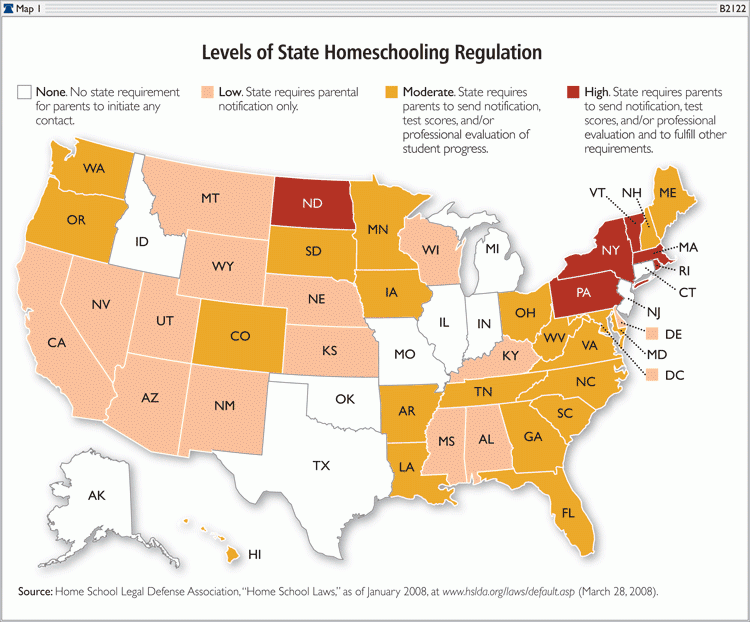
Current info about levels of government regulation for homeschoolers per state.

Total number of surveys: 44

Women: 34

Men: 10

(Sadly, the results are a little estrogen heavy, but the male perspective I received was excellent!)

These homeschoolers grew up in:

  • Kansas (16)
  • Virginia (7)
  • South Dakota (3)
  • New York (2)
  • Nebraska (2)
  • Florida (2)
  • Wisconsin
  • Illinois
  • New Mexico
  • North Dakota
  • Washington
  • Texas
  • California
  • Georgia
  • South Carolina
  • North Carolina
  • Ohio
  • Colorado
  • Illinois
  • Military family (3)
  • Overseas

These adults now live in:

  • Virginia (13)
  • Kansas (6)
  • Mississippi (2)
  • Georgia (2)
  • Florida (2)
  • California (2)
  • Oklahoma (2)
  • Iowa
  • Texas
  • North Carolina
  • West Virginia
  • Delaware
  • Missouri
  • Kentucky
  • Ohio
  • Nebraska
  • Washington
  • France
  • Japan (2)
  • Germany
  • Cayman Islands
  • Turkey

Age range: 18-37 (my minimum requirement was for the participant to be out of the house for at least one year)

Average age: 26

Fun fact: this means that earliest these families started homeschooling was around 1980!

Number of siblings range: 0-13

Average: 3 siblings

Number of years homeschooled range: 5-13

Average: 11 years

Marital status:

  • 22 married (4 spouses had homeschooling experience)
  • 16 single
  • 2 Divorced
  • 2 Engaged
  • 2 in a relationship

I included the sibling information because, in my own experience, homeschooling families tend to have large families. As you can see, the range of siblings in each family is pretty dramatic (from an only child to a family of 14 children!) The average of 4 children in a family seems pretty “normal” to me. Many homeschoolers talked about relationships with siblings in the surveys so that is why I included this information.

I also wondered though, “Does the “largeness” of a family affect the homeschooling experience positively or negatively?” I didn’t receive overwhelming data on this point but I think that two examples may provide a good contrast to answer this question.

M. M. a 29 year old from CA was the oldest of 8 children. She describes a negative experience related to family size:

My mom didn’t seem to be involved very much in my individual learning or invested in only my education since there was so many kids. I felt this was a disadvantage to me . . .My mom would start at the youngest child and work her way up to the oldest in going over their homework, teaching, etc. I don’t think she got to me very often.”

In 12th grade, M. M. did her homeschooling with another family where the other mother kept all of the young people accountable for their work.

This is just one example, of course. But in this case, family size seemed like a detriment to M.M’s homeschooling experience.

Contrasted with this is Beka R’s story, a 25 year old from Kansas and the 2nd oldest in a family of 14 children. Though Beka came from the largest family in survey group, she implied that academics were a very strong focus and stated that family relationships were the most positive part of her experience:

“One of the best things homeschooling did was allow for strong family relationships – we had school on Saturdays and had Thursdays off because that reflected my dad’s work schedule, and those Thursdays with my dad are something I’ve always cherished. I think that the primary influencers of my foundational years were my parents and grandparents, and that is something that has always shaped my values.

Most responders had a very strong family and the number of children did not seem to negatively affect the homeschooling experience (or they didn’t mention it). I think it is interesting that homeschoolers have large families though and, in my own experience, homeschooling helped make relationships with my family stronger.

What do you think? 

Did you come from a large family who homeschooled? Did it enhance or take away from your education?

Please comment or ask any questions!

*****

To be continued.

Visualizing “The Myth of the Unsocialized Homeschooler”

HA note: The following is reprinted with permission from Heather Doney’s blog Becoming Worldly. It was originally published on July 7, 2013.

I googled “homeschool” to see what pictures came up. Many of them had to do with socialization and the messages that homeschool parents get and give about it. So I figured I’d talk about homeschooling and the issue of socialization today and use some of the cartoons I found in the process. Some of them are a little disconcerting in the way they point out issues I see, just maybe not quite in the ways the cartoonists intended.

What is This “Socialization Problem” You Speak Of?

So first a bit about what socialization is and how it relates to homeschooling. This diagram explains socialization pretty simply and it comes from a site that talks abut stopping cycles of discrimination that are often passed on intergenerationally.

soc1

I think the site the diagram comes from – Parenting for Social Change – makes an excellent point – that this is generally how socialization is done but socialization can sometimes be bad. You can absolutely be taught harmful things as well as positive things in the course of your socialization and most people are taught a mix. What homeschooling parents often become inclined to do though is try to eliminate or greatly reduce these “bad” things by winnowing their child’s socialization opportunities down to only parentally vetted and approved sources and quite often those approved sources are fellow homeschoolers, religious leaders, highly edited texts and media, other “likeminded families,” and sometimes, when the parent is particularly controlling or inept at socialization themselves, nobody at all except for the immediate family.

Yes, this last one is a real big problem because terrible things can happen when families get isolated like that and it is a big risk factor for all kinds of abuse, neglect, and poor mental and physical health. Thing is, this social isolation problem happens in homeschooling much more frequently than it should. In fact, even in Brian Ray’s wacky (and so methodologically unsound that I am stopping myself from going on a rant about how many problems it has) “Strengths of Their Own” study included something I found interesting about it. See if you can catch it.

soc2

That’s right. The third bar from the bottom. The yellow one. If 87% of the children in Brian Ray’s highly self-selective study play with “people outside the family” (and I will leave you to ponder right along with me as to why this wording is not “other children outside the family”) then that means that 13% of children in Brian Ray’s study do not play with others outside of their own family, which I would most definitely define as a socialization problem. If Brian Ray, excellent fudger, misconstruer, self-quoter, and ideological spit-shiner of homeschool data extraordinaire, has almost 15% of the kids in his rather cherry-picked study having this issue, how common must it actually be in real life and how do people in homeschooling react to this issue? Well, let’s see…

Socialization Sarcasm

This cartoon makes fun of the concept that socialization problems exist in homeschooling. To me it implies that socialization happens so naturally that it simply isn’t something a homeschool Mom could forget. Why? Well, I’m honestly not exactly sure. Socialization is a component that definitely can be ignored or accidentally left out and it has openly (and wrongly) been discounted as being unimportant by many prominent homeschool leaders. Because it has been ignored and dismissed as a necessary part of many homeschool curriculums is the main reason why homeschoolers have gotten the reputation for being unsocialized in the first place.

soc3

Most homeschool kids don’t like being stereotyped as unsocialized or feeling like they are unsocialized (I mean really, who would?). So there’s also some memes and jokes that have been spread by teenage homeschoolers implying how inherently dumb or inappropriate they think it is when people make socialization an issue. Most of these involve poking fun at the “myth” that socialization is a problem in homeschooling. There is this YouTube video by a homeschooled girl who is trying to do this by distinguishing “the homeschooled” from “the homeschoolers” and while I find it funny, I’m quite sure that her pie chart is wrong and she perpetuates elitist stereotypes she has likely heard throughout her homeschooling experience.

This blog had a post by a homeschool graduate complaining about people asking what’s become known as the “socialization question” and in her post she uses a picture I’ve seen fairly often. There’s even t-shirts with this printed on them that you can buy.

soc4

Socialization is Fishy

So what do homeschooling parents think about the socialization issue when theydo actually address it? Let’s start out with this cartoon, as it’s used a lot. It claims that a lack of socialization in homeschooling isn’t just a rare problem, but an outright myth. It implies that homeschool kids are not only actually in diverse environments as part of a natural ecosystem but are thrilled about it. It also implies that children who are socialized in public school are like half-dead sardines in a can rather than the school of likeminded fish they are expected to be.

soc5

This cartoon is a direct dismissal of there being any merit to the “socialization problem” and it is compounded with a public school counter-stereotype. This is unsurprising to me as the argument that homeschool socialization problems are an outright myth is quite often included with something disparaging about public school or insulting to teachers (and this cartoon is no exception). Notwithstanding how insulting it is to imply that most people who go through public school are like dead fish, is this depiction of homeschool versus public school in any way accurate? Well, I imagine for the occasional situation it is, but in general, certainly not.

Oddly this cartoon was actually almost the exact opposite of my experience. In the CHEF homeschoolers group I was in it was all white Christian families and our parents had to sign a statement of faith to join. It was absolutely a school of fish all swimming the same way and because we got together infrequently, I generally felt like that fish in the fishbowl. Also, when I went to public school in 9th grade I was certainly no canned sardine, even if I wasn’t exactly the manic fish thrilled at the ecosystem in the upper righthand corner. The teachers often tried to corral us into all doing things the same way but we didn’t make it altogether easy for them and generally I expect it was a bit like herding cats. We were all individuals, as were the teachers. I had favorite teachers and subjects and ones I didn’t like and I made friends of different races and beliefs and political persuasions, many of whom who are still my friends and acquaintances to this day.

The Dark Knowledge of Teen Degenerates

Here’s another cartoon about homeschool kid socialization from a slightly different angle, and this one does address the idea that kids don’t always do what you want them to do and by invoking the dreaded “peer pressure,” implies that its all bad. Which one is it – are they lobotomized sardines in a can or are they violent and rebellious ingrates? Make up your mind! Also, how realistic is this, do homeschool moms actually think public school kids are like this? Where are the public school kids who are not “at-risk” of being part of the school to prison pipeline? Why aren’t there any of those at the bus stop?

soc6

Also, in this little dystopian cartoon, gang members with knives read books on values (morally relativistic ones, no doubt), evolution, meditation, and “new age” religion (if that isn’t a culture wars, fearmongering buzzword, I don’t know what is) and pregnant girls read about sex ed and still don’t know what made them pregnant. This cartoon is crazy stuff. People don’t drink beer and shoot up heroin (yeah, there’s a needle on the ground in the cartoon) while waiting for the school bus (although some do smoke cigarettes). People who read a lot don’t typically join gangs. People who know about comprehensive sex ed aren’t any more likely to have sex than kids who don’t and they are much less likely to accidentally get knocked up. Honestly, if this is what anyone actually thinks the world is like then they are not fit to educate other human beings and they probably need some mental help themselves.

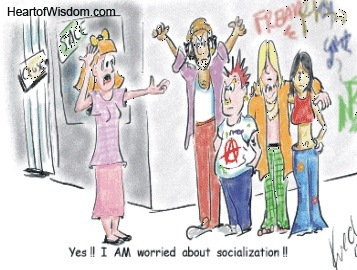
Sweet Homeschool Girl in the Ghetto

This cartoon is similar to the previous one in that it also indicates that public school socialization is all bad, but it depicts the expected reaction of the homeschool girl in the public school and implies that if your daughter goes to public high school (obviously radiating her feminine purity with a big hair bow and below-the-knee church skirt) that she will soon be shocked and horrified to encounter people dressed immodestly, young people openly dating, tattoos and piercings everywhere, vandalism and crime, blatant teenage rebellion, and big scary black boys that look more like grown men. So obviously the answer is to just have her at home not knowing that people who are different from her exist, and make most of the people her age out to be disgusting, immoral, and scary, right?

soc7

I followed this cartoon to its site, a blog called Heart of Wisdom, trying to get a higher resolution picture. The blog talked about how homeschool kids should only selectively socialize with other Christians and claims this is biblical. Yep, this is just the type of homeschooling “socialization” I am familiar with. It’s a form of social isolation and indoctrination called “sheltering.” This stuff is all about parental fear and desire for control and helicopter parenting to this extreme is very unhealthy for your child. It will mean that in adulthood that they won’t know how to function at an optimal level. You cannot shield your kid from all “bad influences” and indeed there is nothing in the bible that says your kids cannot play with the kids of people who have different beliefs. That is quite a stretch and it is insular, cultish thinking.

My Homeschool Kid is Smarter than Your Honors Student

That same Heart of Wisdom blog had this other cartoon about homeschooling, so I followed that link and it was to a page dedicated specifically to homeschool cartoons. When I see stuff like this cartoon I have to once again ask – is this supposed to be funny? Do these people actually think this is accurate? My main question, though, is why the elitism and negativity? Even if your kid is getting a much better education in homeschooling, why talk trash about children who through no fault of their own don’t have as good of an education? Why make it into a competition, act like homeschool kids in general are “better” than other kids? It shows me some immature and defensive parenting, really. If you revel in it when someone else isn’t doing as good as you it shows you are 1) being a jerk and 2) secretly worried that you’re no good at what you’re doing. Nobody should ever be excited about other kids having a sub-par education, thinking it makes them and their kids look better. That’s just gross.

soc8

As it is, I find that there is a grain of truth in this cartoon but perhaps not quite in the way the cartoonist intended. I’ve known a lot of homeschool kids who do use big words in conversations and they soon realize that it comes across as awkward when they socialize with other non-homeschool kids. Admission: I was that kid myself. I read a lot of classic literature and became familiar with words that simply aren’t used in everyday speech anymore. Trying to use them in peer-to-peer conversations didn’t reflect on me being smarter. It reflected on me not having a modern day frame of reference as to what is appropriate. It reflected on me being socially backwards. Lots of public school kids who are bookworms like I was know many big words. They also know the right words to use for their audience. Context is everything. An unsocialized homeschool kid doesn’t have that context and very well might find that using 18th century literary terms in a conversation about basketball will indeed get people looking at them sideways. If homeschool parents want to be proud of that, think it makes their kid (and by extension them) “better,” it shows they truly don’t understand the issue at hand.

Parental Fear & Social Anxiety

That’s where I think we hit the crux of this whole thing. I think the main issue is parental angst and fearfulness. Too many homeschooling parents socially struggled in school themselves and/or got into drugs or unhealthy sexual relationships. Instead of taking a broader view today, they expect that they need to hide their kid away from these settings or the exact same thing will happen to their kid even though their kid is in a different school district in a different generation and *gasp* a different person. These parents become scared of or hurt by the society we live in, withdraw, and then use homeschooling as an excuse to be separatist, snooty, and helicopter over their kids. These are not positive reasons for homeschooling and these are the exact kind of fearful and overbearing attitudes that lead to socialization problems for homeschool kids.

soc9

Because people with strong views often find themselves in positions of leadership, those with exclusionary, separatist, and elitist attitudes often end up running things and then set this negative and divisive tone for the homeschooling group and the community it serves. It’s so pervasive that even some “second choicers” who start homeschooling simply because the other educational options in the area aren’t up to meeting their child’s particular needs (which is an excellent reason to homeschool, in my opinion), can get sucked into this culture, an “us versus them” mindset where homeschooling represents everything that is pure and good and healthy for children and public school and the people and structures that support it represents everything bad. This creates a parallel society of sorts and then you see people start calling public schools “government schools” in a pejorative sense. All this “us versus them” talk fans the fear that homeschooling parents are vulnerable (although still superior) outsiders who are or soon will be discriminated against and this in turn leads to easy exploitation of these scared people.

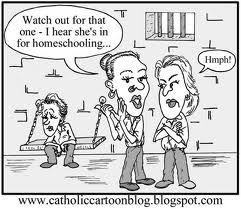
Why does widespread homeschool participation in things like the fundamentalist-led HSLDA, which capitalizes on these fears and requires dues money (that then goes into their cultish culture wars arsenal) for unnecessary “legal protection” exist? Because many these people are too freaked out to do anything more than cling onto a protector, ignoring all evidence that their “protector” just wants to use them – financially and for furthering a disturbingly anti-democratic agenda. This fear grows and leads to the kind of mindset that spawns ridiculous cartoons like the one below.

soc10

Put in prison for homeschooling – really? Of course in this cartoon there’s that same (expected) depiction of scary people with piercings, this time instead of a shocked daughter (projecting much?) it’s got a dejected homeschool Mom being shunned by hardened criminals who sarcastically note that her “crime” was homeschooling.

Homeschooling parents who follow these “leaders” (often starting because their local homeschool support group requires or recommends HSLDA membership) hear these divisive messages and become scared to death of being framed, exposed, persecuted, worrying that they will land in jail just for homeschooling. It may be a wacky and unrealistic fear given what’s actually going on, but if people hear it often enough they often come to believe it, along with the bogus stats and stories claiming that homeschooling is as close to perfect an educational option one can get in such a messed up society, and the myth that there is no evidence to the contrary because homeschooling is just so awesome.

soc11

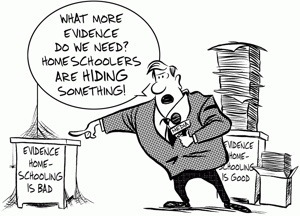
Because homeschoolers test scores aren’t made public and often not even expected, registration isn’t even required in many states, and most people don’t pay much attention to homeschooling unless their kids are being homeschooled. Homeschool movement leaders have been able to get away with exhibiting the cream of the homeschooling crop as representative of all homeschoolers. This has painted an inaccurate picture and hurt the vulnerable kids by leaving them ignored as they fall through the cracks.

Saying “our homeschool kids are socialized but socialization doesn’t matter and in fact it generally sucks if it isn’t coming directly from parents” is a very unhealthy attitude to go into educating with. Responsible homeschooling parents really need to do a bit of soul-searching as to why they tolerate these inaccurate depictions of what socialization is and isn’t, why there is this the across-the-board maligning of all public schools within many homeschool communities, and why so many participate in this ugly (and frankly in my opinion undeserved) elitism, and contribute to such extreme (and inaccurate) stereotyping and putting down of children who have had to attend lower quality inner-city schools, all in order to inflate the merits of homeschooling.

Two big question:

(1) Does this kind of attitude help do anything beyond artificially boosting homeschool egos?

(2) Is there any need for this behavior if homeschooling is really so awesome?

Also, if there is no good data on the problems of homeschooling then instead of celebrating the cobwebs we need to be collecting more data. Every single education method in this world has problems and the places where the problems are denied is where child maltreatment can and does flourish.

The Truth Between “Stereotype” and “Myth”

I get the message that not all homeschoolers are cloistered and don’t know how to talk to people their own age, but the fact is that too many are and we need to recognize that it is a real problem affecting a sizable percentage of homeschool kids. Also, homeschoolers are simply not the most brilliant people in the world or inherently “smarter” than other kids, and as such they shouldn’t need to feel pressured to achieve perfection, perform as child prodigies, or that there’s a black mark on them if they mix up “asocial” and “anti-social” in a conversation.

soc12

This “myth of the unsocialized homeschooler” is an issue in homeschooling but the prevalent idea that the socialization problem is a myth is the real problem, not the legitimate questions and concerns about socialization that homeschool parents keep being asked. Those questions actually need to keep happening because social isolation and ostracism in any setting (including homeschooling) often follows a person into adulthood, and can leave people struggling with social anxiety, a small social network, low levels of social capital, mental health issues, and an unnecessary amount of sad and lonely memories.

The least we can do is stop making fun of people, stop being in denial, stop pointing fingers elsewhere, and acknowledge that it is real, it happens too often and it should be assessed and addressed as the serious problem that it is.

Rewriting History — The History of America Mega-Conference: Part Four, Kevin Swanson Is Tired Of Losing

Rewriting History — The History of America Mega-Conference: Part Four, Kevin Swanson Is Tired Of Losing

HA note: This series is reprinted with permission from Ahab’s blog, Republic of Gilead. For more information about Ahab, see his blog’s About page. Part Four of this series was originally published on July 9, 2013.

*****

Also in this series: Part One: First Impressions | Part Two: Doug Phillips on God in History | Part Three: “Religious Liberalism” And Those Magnificent Mathers | Part Four: Kevin Swanson Is Tired Of Losing | Part Five: Messiah States and Mega-Houses | Part Six: Doug Phillips Rages Against the 20th Century | Part Seven: Christian Vikings, Godly Explorers, and Strange Bacon | Part Eight: Closing Thoughts

*****

After celebrating July 4th, I returned to the History of America Mega-Conference on July 5th to observe more workshops. On Friday morning Kevin Swanson presented a workshop entitled “Why 19th Century Literature Was at War with God”. Swanson, host of Generations Radio, has a long history of eccentric comments documented by Right Wing Watch, and he was no different in person. I’m not sure what troubled me more: Swanson’s acidic tone, or the hyperbolic content of his talk. His seething hatred for The Scarlet Letter, Nathaniel Hawthorne, Mark Twain, and other 19th century writers was both irrational and unsettling.

Swanson began his talk by lamenting that America is not the Christian nation it supposedly once was and is not doing as well as it had in the past. The United States is breaking down, he claimed, because the Western world is slowly “apostatizing” as families and civilizations disintegrate.

Swanson reserved special rancor for liberal professors. Citing Ken Ham’s 2011 book Already Compromised, he told listeners that liberal arts professors in Christian colleges are highly likely to believe in evolution because of their liberal leanings. Apostasy always begins in the liberal arts departments of Christian colleges, Swanson insisted, adding that many liberal arts colleges are “corruptible” because of their very foundations. Harvard and Princeton have already been “compromised”, and many professors at Wheaton College voted for Obama, Swanson said with regret.

Swanson further caricatured liberal arts studies with bombastic words. He sneered at liberal arts departments for their admiration of Karl Marx, whom he called a “Satanist” and “atheist” with an wrong-headed epistemology and a flawed view of history. Swanson also looked askance at liberal professors for their love of Harry Potter books and the gay Dumbledore character. Society is locked in a battle between worldviews, one with battle lines laid out in liberal arts departments where the next generation is receiving its education, he said.

“I am tired of losing!” Swanson shouted. “Is anyone else tired of losing?” The audience applauded.

Swanson proceeded to rant disjointedly against Catholics, LGBTQ persons, and other people he blamed for “apostasy”. The Roman Catholic church represents so much “apostasy” from the Christian faith is because of its liberal arts heritage, starting with Thomas Aquinas, he claimed. He wondered aloud how America went from the Christian primers of its early history to children’s books such as Heather Has Two Mommies.

Swanson seemed baffled that America has allegedly come to lead the “Neronic* agenda”, his term for the LGBTQ equality movement. Even “pagan” leaders in Africa were disgusted by the “hatred toward God” expressed by President Obama’s support for same-sex marriage.

The root of the present situation, Swanson posited, is that powerful intellectual men, “many of whom were possessed by the Devil himself”, introduced dubious ideas into universities. Swanson called these men nephilim (a reference to human-angel hybrids in Genesis 6:4 and Numbers 13:33) because they led to the destruction of the world through the Great Flood in the Bible, just as they are destroying society today.

Feverishly, Swanson launched a polemic against Thomas Aquinas. In Summa Theologica, Swanson explained, Aquinas separated sacred and philosophical knowledge, with philosophical knowledge based on human reason. This division of knowledge gives man the ability to “think autonomously” apart from God, which Swanson blasted as Aquinas’ greatest error. Over a span of 400 years, thinkers such as Locke and Descartes celebrated philosophical knowledge and the supremacy of the human mind, which Swanson branded as toxic to faith.

In the 1700s and 1800s, tension between the Bible and classical writings — the beginnings of “apostasy” — could be found in the writings of the Founders, Swanson asserted. By the turn of the 19th century, most Americans rejected the idea that God holds authority over human actions, Swanson claimed. Such was the idea undergirding 19th century “cults” that rejected the idea of the Trinity and embraced Arianism, he insisted.

Swanson was furious that in today’s world, science says that the universe is billions of years old, parents are discouraged from spanking children, and the Bible is being rejected because it doesn’t jive with humanism. Ethics, philosophy, and science have been divorced from the Bible, he lamented.

Swanson pointed to Emersonian Transcendentalism as a powerful influence on 19th century American religion. Emerson’s aunt raised Emerson in the Hindu religion, Swanson claimed, describing Emerson as a pacifist who encouraged others to follow their hearts and make it up as they go along. Swanson further caricatured Transcendentalism as a system in which man allegedly defines his own ethics as he goes along and creates his own reality.

Swanson was especially livid over the popularity of Nathaniel Hawthorne’s The Scarlet Letter in high school and college literature classes. He accused Hawthorne of hating his Christian heritage and dying a nihilist who allegedly saw no purpose in life. He further blasted Hawthorne for allegedly attending seances, marrying into one of the worst “progressive” families of his era, and having ties to Horace Mann, a supporter of public schools. Hawthorne allegedly mocked Christianity in his writings, referring to Cotton Mather as a devil. Finally, Swanson accused Hawthorne of allegedly doing enormous damage to America’s Christian heritage with his writings. Events such as the History of America Mega-Conference have such small attendance because people have read Hawthorne and become corrupted.

And here’s where things get … weird.

Swanson believed that Hawthorne’s sister was “demon possessed” and sought to see Hawthorne’s children possessed as well. He claimed that an unearthly force moved Hawthorne’s hand as he wrote The Scarlet Letter, a story “forged in Hell”. Outrageously, he claimed that both Hawthorne and Herman Melville admitted to being demon possessed (!?).

Swanson shuddered at the alleged power of The Scarlet Letter, warning listeners not to underestimate the ways that its “Satanic effects” can change nations. Attacking the novel as “stupid” and a “farce”, Swanson claimed thatThe Scarlet Letter represents two gospels. The gospel of Dimmesdale, he claimed, preaches repentance without faith in Christ, as Dimmesdale finds self-atonement rather than substitutional atonement for his adultery. The gospel of Hester, on the other hand, is one of love divorced from law, thus rendering love meaningless, he said.

Swanson’s wrath toward the fictional Hester was brutal. He called Hester a “prophetess” of adultery in a later age, when high divorce rates, premarital sex, and out-of-wedlock births would surge. Swanson also accused Hester of being the predecessor of Margaret Sanger, Margaret Mead, Gloria Steinem, and other feminists with “unyielding and rebellious hearts”. Hester, in short, was the harbinger of a “feminist world” in which the family is crumbling.

As the workshop churned on, Swanson’s gave voice to more visceral hatred ofThe Scarlet Letter. The moral of the novel, he insisted, was that witchcraft, homosexuality, incest, and feminism are better than Christianity. The Bible commands the death penalty for adultery, but Hawthorne and today’s average Christians loathe the death penalty.

Wait a minute. Did I just hear Swanson defend capital punishment for adultery? I thought. The audience sat rapt, apparently unfazed by Swanson’s rant. Are you people okay with this? Hello!?

Swanson observed that many Christians are embarrassed by what the Bible commands regarding adultery, homosexuality, and witchcraft. Such Christians love Jesus but hate his law, he said, and thus American religion is solidly anti-Biblical law.

Swanson lobbed similarly hateful accusations at Mark Twain, stunned that so many homeschooling families have Twain’s books in their homes. According to Swanson, Twain was an “apostate”, communist, atheist man who hated the Biblical God and was possibly possessed by Satan (!?). As proof of this, Swanson said that Twain allegedly acknowledged he was writing letters from Satan himself when he composed Letters from the Earth. Twain also encouraged women to commit adultery, Swanson asserted with no small amount of disgust.

Predictably, Swanson blasted Huckleberry Finn, criticizing the eponymous main character for not fearing God and mocking the notion of divine judgment. The novel, he explained, was about slavery, with Huckleberry Finn choosing to help his enslaved friend at the risk of his eternal soul. Rather than praise Finn’s moral courage, Swanson launched into a diatribe about vast numbers of Americans being “enslaved to the welfare state” today. He branded “Muslim” slavery, in which people are kidnapped and sold, as evil, but said that he wished he had time to discuss a Biblical view of slavery. 

Huh? I thought. Slavery is wrong, no matter who practices it. Full stop. I don’t care if there’s a “Biblical” form of slavery. It’s wicked. What is wrong with this man?

“Do not read the heathen stories to your children,” Swanson warned the audience. He urged listeners to teach their children the Bible first, instead of giving them a “Greek” education. “Give them the Bible! Let them know the book of Deuteronomy better than they know The Scarlet Letter,” he demanded, to which the room erupted in applause.

Deuteronomy? I fumed. You mean the Deuteronomy brimming with bloodshed and genocide? The Deuteronomy with guidelines for owning slaves? The Deuteronomy that allows warriors to take conquered women as sexual booty? The Deuteronomy that instructs communities to stone rape victims and women who don’t bleed on their wedding nights? No, Kev, I’m NOT teaching THAT to a child.

Swanson concluded by encouraging listeners to give their children a “war of the worldviews”, to give them Biblical context for supposedly ungodly classics they might read. A 14 year-old is not ready for Plato and Aristotle, he claimed; rather, parents should give their children Christian ideas and writers first, then expose them to “heathen” works in their late teens. That way, children will understand how evil such “heathen” ideas are.

In short, Swanson was advocating a closed information system for homeschooled children, in which parents shield their offspring from non-Christian ideas until they approach adulthood. In my opinion, this approach could only produce children who are utterly disconnected from their cultural heritage, from mainstream America. When such isolated children reach adulthood and leave their bubble, how will they navigate American culture if so many important ideas have been either demonized in their eyes or left out of their education altogether?

Then again, maybe I should be more optimistic. In an age of book stores, libraries, and the internet, young people are likely to encounter ideas outside of their upbringing and read books such as The Scarlet Letter.  Swanson and his ilk may find that creating a closed information system for children will be harder than they imagined.

Later, as I recuperated from the workshop in a nearby pub, I tried to digest what I’d just heard. Demon possessed authors? Capital punishment for adultery? Biblical slavery? A closed information system meant to stifle the minds of children? This is sick, I thought. This. Is. Madness.

Swanson’s feverish words, and the audience’s approval, impressed upon me a disturbing truth: Christian Reconstructionism and superstitious hysteria are alive and well in small corners of our culture. People like Swanson earnestly embrace a fundamentalist worldview, and have every intention of inflicting it on the next generation of homeschooled children.

Stay tuned for more talks from Vision Forum’s History of America Mega-Conference!

* A reference to the Roman emperor Nero.

*****

To be continued.