Check Out HARO’s Free Curriculum, “Child Abuse Awareness 101 for Homeschoolers”

The goal of HARO’s Child Abuse Awareness 101 for Homeschoolers curriculum is simple:

cover1To empower and equip you and your homeschool community with the information necessary to recognizing and fighting child abuse.

We developed this curriculum — which includes both an instructor guide and attendee packets — to teach your homeschooling community how to do the following:

1) Define the major types of child abuse and neglect

2) Recognize the main warning signs of each major type of child abuse

3) Identify the characteristics of the average child abuser

4) Report child abuse to the proper authorities

5) Start making families and homeschooling communities safer

6) Engage in continuing education about child abuse prevention issues

This curriculum is a free service provided by HARO.

Read more at HARO’s website.

The Christian Homeschool Movement and Nostalgia

race

HA note: The following is reprinted with permission from Libby Anne’s blog Love Joy Feminism. It was originally published on Patheos on August 29, 2012.

When I was eight or ten, my mom was really interested in finding a particular geography book to use in homeschooling us. Frequently when we would go to a historical home or a museum, she would see it on a shelf and say “There! That’s the book I want!” It was published in 1902, you see. Frye’s Geography. She’d heard it promoted somewhere, at a conference or in a homeschool magazine. She eventually found it used somewhere and was thrilled.

She began using it with us, and while the images were beautiful, it wasn’t hard for me to pick up on the blatant racism it contained.

laFor some reason, the homeschoolers I came in contact with – fundamentalist and evangelical Christians homeschooling for religious reasons – always seemed to have this idea that anything that was old must be better than what we have now. But, as Frye’s Geography made clear to me, just because something is old doesn’t mean it’s better.

Frye’s Geography is only one example. When it came female advice, I read Stepping Heavenward and Beautiful Girlhood, both also over a hundred years old. I was assigned chapters of Beautiful Girlhood as punishment sometimes, when mom decided, I suppose, that my girlhood was not being “beautiful” enough.

I also spent years and years studying Latin. And you know what? I really haven’t used it, and I don’t really foresee myself using it in the future. Sure, word roots and all that, but you can get a lot of that from studying a language like Spanish as well, or from taking just a year or two of Latin, as opposed to ten. Honestly? I wish I’d studied Spanish. But Latin, you see, was old, and back in the nineteenth century every school child studied Latin, so Latin it was.

It seemed like recreational reading was similar – anything that was published a hundred years ago or more, or even fifty years ago, was more approved and smiled on than something published today. We grew up reading dozens of Elsie Dinsmore books and G. A. Henty books, most purchased from Vision Forum. Once again, these  books were racist. The Elsie Dinsmore books idealized the Old South while G. A. Henty books were wrought through with British imperialism. But they were old, dag namit! They were written over a hundred years ago, so they must be good and godly!

I think that’s what it comes down to, really. In Christian homeschooling circles there’s this idolization of the past and this demonization of the present to the extent that anything that’s old is almost as default seen as good and anything that is new is by default held as suspect. Given that reality, it’s really not a surprise that companies like Vision Forum not only live in the past but also market the past, or that companies like Lamplighter operate by republishing old books and marketing them to homeschoolers.

The thing is, the “olden days” were not some sort of wonderland without divorce, sexual promiscuity, or violence. The faults of the present day that Christian homeschoolers are so quick to point to existed then too. Believe it or not, New York City already had a gay subculture. Prostitution thrived. Divorce rates may have been lower, but the trade off was abusive marriages. Women still got pregnant out of wedlock, and people still had premarital sex. And even more than all that, racism was rampant, the poor starved to death, and children died early deaths working in the coal mines.

The reality is that the “good old days” Christian homeschoolers look at so wistfully didn’t exist, and that just because something is old doesn’t mean it was better.

Unfortunately, plenty of Christian homeschoolers are more than willing to go on idolizing a myth, and part of that idolization means buying up all the old books companies like Vision Forum and Lamplighter can find space to print.

Why Homeschoolers Should Encourage Multi-Cultural Appreciation: Lisa’s Story

race

Lisa is a homeschool graduate currently attending Patrick Henry College.

I was homeschooled my entire life. I’m the oldest in a large family. I’m also a second-generation immigrant kid. My parents are both immigrants from India.

Indian homeschoolers are very rare, and in 15 years of being homeschooled, I’ve only met about 3 other Indian homeschooled families. I must say that I have never been discriminated against because of my race. However, in my experience, the general attitude of the homeschool community towards non-white cultures leaves much to be desired.

Fitting into American society as a first or second-generation immigrant presents its own dilemmas. In my experience, not many in the homeschool community seem interested in understanding these challenges. When explaining this to a friend, she began to complain about (in her words) “hyphenated Americans.” Indian-American, African-American, and Japanese-American were terms that bothered her. She asked, “Why the prefix? Why can’t they just be Americans?” When I wondered whether I could wear a sari for a formal school even, someone said, “But you’re American, right?”

It doesn’t help that the majority of homeschooling material seems to bear a “West is best” mentality.

It often feels as if only exports from Europe and America merit careful study. My parents did a great job teaching us about our own culture, but there was a time when I accepted the idea that America must be inherently better than any other place in the world. It wasn’t until I had the opportunity to live in India that I truly appreciated my heritage. My brother takes online video classes from a prominent homeschool curriculum provider. In his World History and Geography class, the teacher wrote three things about India on the whiteboard: Hinduism, socialism, caste system. (None of those things are necessarily false, but if that’s all you can teach about one of the world’s oldest civilizations, something’s wrong.) The subsequent teaching made it obvious the only positive things about India are the Western missionaries that came there.

It would be unfair to act as though these experiences completely defined my experienced as a non-white homeschooler. For example, I only considered wearing the sari because another homeschooled friend suggested it. At Patrick Henry College, I wear Indian outfits on occasion and no one seems to mind. The history professor who teaches Western Civilization talks to me about Indian politics and his love of South Indian food. Throughout my homeschool experience and even more so at college, I have met many homeschoolers who are genuinely interested in learning about other cultures. At the same time, I have heard many fellow students wholeheartedly defend Western colonization and dismiss accusations of imperialism as part of a liberal, anti-Western agenda.

While I’m certainly not asking that every homeschooler be an expert in non-Western cultures, some respect, appreciation, and understanding would be welcomed. I think that this is even more vital as society becomes increasingly globalized. This does require exposure, for how can you appreciate something that you’ve never experienced? Non-Western cultures have history, music, art, and literature as rich as any European country and equally worth studying. Today, this is as easy as a library run, a Google search, or a field trip. If it considered important, Tagore and Japanese haikus can easily fit in a homeschooled lesson plan alongside Wordsworth and Austen.

I think that fostering multi-cultural appreciation can, and should be, encouraged in the homeschool community.

In my personal experience, it has not been a priority for homeschoolers in general. If it were, homeschooling would be more attractive to an increasingly diverse range of people. Kids, parents, and the movement as a whole would only benefit.

God’s Plantation: Vision Forum and the Old South

race

About the Author: Jonathan Wilson is a Ph.D. student in American intellectual history at Syracuse University. An earlier version of this article was posted in November at The Junto: A Group Blog in Early American History. It is reprinted in a modified version here with permission.

Late last year, Doug Phillips, the president of Vision Forum Ministries, publicly admitted to an inappropriate extramarital relationship and resigned. Shortly afterward, the Vision Forum board of directors decided to shut down the San Antonio ministry. In the months since then, World Magazine has reported additional terrible details about Phillips’s alleged behavior toward a woman under his care.

The story made even secular news. For years, Vision Forum and Doug Phillips had enjoyed oversized influence in homeschooling circles as leaders of the “Quiverfull” movement, encouraging Christians to have (and homeschool) large families as a way of exercising influence in the world.
Vision Forum providential historyThey were champions of “biblical patriarchy,” the principle that family life (and ultimately society at large) should be organized under the authority of divinely ordained fathers and husbands. According to one manifesto prepared by Vision Forum, “the erosion of biblical manhood and leadership,” caused by modern ideologies that undermine God’s authority, “leads to the perversion of the role of women, the destruction of our children, and the collapse of our society.”

To be fair, Vision Forum’s view originated in a specific theological tradition to which most members of the “Religious Right” probably do not belong. And it leads to some conclusions that many Christian conservatives find repellent. Yet some of Vision Forum’s teachings have been disproportionately influential in the American homeschooling movement. And they are especially important for understanding the movement’s relationship to the painful history of American racism.

*****

What sorts of conclusions did Vision Forum draw from its theology? First, there are the obvious ones.

Vision Forum advocated very well-defined gender roles. Through its for-profit merchandise catalog aimed at homeschooling families, it distributed books like an updated version of William Gouge’s Of Domesticall Duties, a 1622 treatise on family life. (A sample of the original wording: “Mildness in a wife hath respect also to the ordering of her countenance, gesture, and whole carriage before her husband, whereby she manifesteth a pleasingness to him, and a contentedness and willingness to be under him and ruled by him.”) The online store sold a two-DVD set called “Tea and Hospitality with Michelle Duggar,” inviting viewers to “celebrate the fruit of the womb with [mother-of-nineteen] Michelle!”

Vision Forum outdoor adventureVision Forum also sold homeschooling families highly gender-specific toys like an “all-American boy’s crossbow” and a “Princess Virginia” dress meant to encourage a girl as she “identifies with Mommy and experiences how unique and wonderful it is to be a girl, to be a daughter of the Most High King—to be His little princess!” Vision Forum’s entire merchandise catalog encouraged as much differentiation as possible between boy leaders and girl followers.

Interestingly, there was also a pronounced nationalistic dimension to gender in this catalog. Vision Forum boys and girls were always American boys and girls. Although many evangelical bloggers and journalists have been highly critical of Vision Forum’s attitudes toward gender, they have often overlooked this.

Vision Forum promoted American nationalism on the basis of their brand of Calvinist covenant theology, which implied that an authoritarian family structure would regenerate God’s special covenant with the United States of America. Yet militant identification with the United States—and especially with its early history—is evident everywhere in Vision Forum’s catalog, especially in its merchandise for boys.

*****

Even more important, however, is that Vision Forum promoted a vision not just of male leadership in the family and the nation, but more specifically a vision rooted in an ideology of white male mastery. And it promoted not just American nationalism, but Southern nationalism—the nationalism of the Confederacy.

To be clear, Vision Forum was not an avowedly racist organization. It did not directly or consciously advocate white supremacy. But it did deliberately promote nostalgia for the white supremacist social order of the Old South.

In fact, one of Doug Phillips’s first books, published in 2003, was a short edited collection of writings by Robert Lewis Dabney, a Southern Presbyterian theologian. Its subtitle is The Prophet Speaks. Dabney, though technically an opponent of secession, was an enthusiastic defender of southern slavery. He served in the Confederate army as a chaplain and as an aide to Stonewall Jackson, and after the war, he published A Defence of Virginia, and through Her, of the South. This book defended human slavery, endorsing the notion that God instituted black slavery through the “curse upon Canaan” after Noah’s flood. Dabney also published an admiring Life of General Jackson and later a pamphlet denouncing racial integration in Presbyterian churches.

None of this meant that Doug Phillips consciously endorsed white supremacy. In his collection, instead, Phillips printed excerpts of Dabney’s later diatribes against public education and feminism. Yet Phillips was clearly enamored of Dabney as a person and as a cultural figure.

“Perhaps no Christian leader of the nineteenth century,” Phillips wrote about Dabney, “filled the role of prophet with greater proficiency.” He even wrote that “for those individuals who long for the days in which a gentleman could hold the door for a lady without some indignant feminist snorting at him, Dabney’s writings will seem refreshingly virile.” As for Dabney’s pro-slavery views? Phillips just coyly asked his readers to consider “the context of the War itself.”[1]

Indeed, the depth of Phillips’s personal admiration for Dabney—and for Stonewall Jackson—was evident in several of the items for sale by Vision Forum. They included a reprint of Dabney’s biography of Jackson, a collection of Jackson’s letters, and even a doll meant to remind girls of Stonewall Jackson’s “godly wife.”

Vision Forum doll collectionWith this doll, Vision Forum strayed deep into what I call “Plantation Chic”—nostalgia for the prewar, slaveowning South. “Stately homes, horse-drawn carriages, and beautiful dresses were special delights for Southern young ladies,” sighed the catalog. “Now you can attire your doll in the feminine and delightfully flouncy styles of the mid-1800s!”

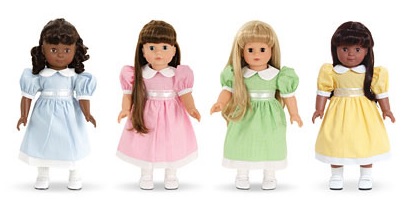
Even more revealing was the Vision Forum “Beautiful Girlhood” doll collection. It featured four dolls—two black and two white. The white dolls were both named after the ideal of freedom; Vision Forum called them Liberty and Jubilee. One of the black dolls was simply named Abigail. And the other black doll? Her name was Fidelia, helpfully translated as “Faithful One.”[2]

*****

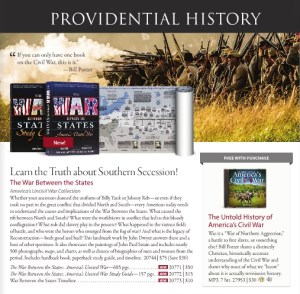
Meanwhile, Vision Forum sold various history books and audio albums that discussed the Civil War itself. The online descriptions were vague, but these materials had the usual earmarks of what historians call the “Lost Cause” interpretation of the war—the discredited claim that secession was not about slavery, that the North was oppressive, and that most African Americans actually preferred to be slaves.

For example, Vision Forum’s books sometimes referred to the war as “the War between the States,” a term preferred by many Confederacy defenders. They fixated on the supposed nobility of southern “Christian warriors” like (of course) Stonewall Jackson and Robert E. Lee. And they seemed to imply that slavery’s role in the war was not what most historians say. (One blurb in Vision Forum’s print catalog warned that “most of what we ‘know’ about it is actually revisionist history.”)

As an American historian, I can say with confidence that Vision Forum was wrong about this. In the 1860s, Confederate leaders said without any hesitation that their goal was to protect slavery.

According to its official secession declaration, South Carolina left the Union because northerners called slavery “sinful” and had elected a president (Abraham Lincoln) “whose opinions and purposes are hostile to slavery.” My home state seceded because its leaders thought the federal government was “destroying the institutions of Texas and her sister slave-holding States”—specifically, the institution of slavery. Mississippi seceded in order to defeat “negro equality,” declaring that “our position is thoroughly identified with the institution of slavery.”

Confederate leaders talked a lot about how the federal government was supposedly taking away their rights. But the key right they had in mind, according to their own words, was the right to own black people. They insisted that white men had this right not only in their own states but also in free states and territories, even if the whites there objected. To protect this “right,” they not only decided to leave America but also deliberately fired on a U.S. military post. In the American Civil War, the Confederacy formed to defend slavery, and then it fired the first shot.

Vision Forum Fidelia dollBut Vision Forum’s pro-Confederate position probably shouldn’t be surprising, given Vision Forum’s close resemblance to (and relationship with) the better-known ministry of Idaho pastor Douglas Wilson.

Douglas Wilson, an unbelievably prolific writer, may be the best-known advocate today of a conservative Calvinist vision for patriarchal family life and gender roles. He is still quite influential in the homeschool movement. He’s also notorious for writing two books on slavery, Southern Slavery: As It Was and Black & Tan, both of which are available online.

These two books about the Old South include condemnations of racism. But they deny that slavery is wrong. “Was slave ownership malum in se, an evil in itself?” Wilson asks at one point in Black & Tan. “The answer to that question, for anyone who believes the Bible, is that it was possible for a godly man to own slaves, provided he treated them exactly as the Scripture required.” Wilson also calls proslavery theologian Robert Lewis Dabney a “virtually prophetic” man, just as Doug Phillips did. Wilson acknowledges and condemns Dabney’s racism, but he apparently has almost nothing to say about Dabney’s views on slavery itself.[3]

*****

All of this leaves us with an important question. Why would Christian homeschooling advocates who claim not to be racist promote this kind of nostalgia for the antebellum South? Why would they encourage us to idolize the Old South’s slavery-based plantation culture, its slaveowning white men, and its self-serving views about the federal government?

Oddly enough, it seems fairly clear that racism isn’t the place to start. Although fondness for the antebellum South often does result from racism, I don’t think it would be helpful to assume that’s the key reason for Vision Forum’s views. There is little direct evidence that Vision Forum was consciously racist, and there’s quite a bit of evidence that they didn’t want to be racists. If nothing else, blaming racism is the least interesting thing we could say about what was going on in their ministry.

But we need to recognize that in real-life America, slavery is inextricable from racism, and so is the history of the Confederacy. The association between slavery and racism isn’t accidental or irrelevant. When you claim the right to own an entire category of people as slaves, you cannot see them as equal human beings.

And we also need to see that Vision Forum’s nostalgia for a white slaveowning society was directly related to its nostalgia for an authoritarian code of sexual ethics. The right to own slaves may not have been the point of Vision Forum’s preaching, but the nearly absolute authority of the male householder, commanding all other members of the family, certainly was.

No amount of talk about “complementary” roles for men and women can conceal what Vision Forum was actually eager to announce: that its key concern was patriarchy—a system of governance, not just a distribution of responsibilities. From that perspective, the Old South represented a convenient image of white manhood and womanhood. To Vision Forum, the Confederacy’s fate served as perhaps a hint of why authoritarian manhood seems endangered today.

In addition, the failure of the Confederacy may be a convenient explanation for the supposed decline of Christian civilization in what Vision Forum claims was a providentially founded Christian nation. For them, the Civil War can serve as the moment when God chastised his people in America (just as he did the ancient Hebrews) for straying from their appointed course. It also seems to represent what can happen when a society fails to cohere—when its authority structures, and thus its values, fail. It explains what went wrong in God’s own nation.

We need to recognize that this authoritarianism is a vision of slavery and death. We can empathize with people who yearn for a lost culture. We can try to understand their anxiety and alleviate their fears. But we must call their vision what it is and offer another way.

_________________________

  1. See the introduction, especially pages 8-10.
  2. Though this name has highly offensive proslavery implications, Vision Forum seems not to have realized it. In fact, the doll seemed to be designed with freedom in mind. Fidelia, the online catalog said, “can brave the voyage to New England as Priscilla Mullins, help Lewis and Clark find the Northwest Passage as Sacagawea, serve tea at the White House as Dolley Madison, and stroll the deck of the Titanic as Nan Harper.”
  3. Here’s Wilson’s comment in fuller context: “The issue is whether a Christian man could have lawfully owned a slave in 1850 America without being necessarilyguilty of a moral outrage. Was slave ownership malum in se, an evil in itself? The answer to that question, for anyone who believes the Bible, is that it was possible for a godly man to own slaves, provided he treated them exactly as the Scripture required. In a sinful world, slave ownership generallyis sinful, and it is a system that invites abuse. Over time the gospel will overthrow all forms of slavery. But again, the kingdom arrives like yeast working through the loaf, and not like a coup de main. In the meantime, to have the likes of the abolitionist Charles G. Finney (who said that it is impossible to be on the right side of God and the wrong side of the slavery issue) hurling his taunts at Abraham and Philemon is a bit thick.” Douglas Wilson, Black & Tan: A Collection of Essays and Excursions on Slavery, Culture War, and Scripture in America(Moscow, Idaho: Canon Press, 2005), 69. For Wilson’s remarks about Dabney, see pp. 79-94.
The Racism In Our Science Books

race

HA note: The following is reprinted with permission from Libby Anne’s blog Love Joy Feminism. It was originally published on Patheos on January 22, 2013.

I grew up reading copious amounts of literature from Answers in Genesis and attending conferences where Ken Ham and other leading creationists were speakers. I’ve been to the Creation Museum, and I’ve been reading Answers in Genesis’ Answers Magazine for close to a decade now. And one thing that was drilled into me over and over again is that racism is rooted in the theory of evolution and that creationism, which teaches that all humans are descended from Adam and Eve, is the antidote to evolution.

oneblood
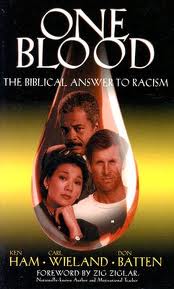
One Blood: The Biblical Answer to Racism is Ken Ham’s contribution to efforts to mend racial prejudice.

One Blood: The Biblical Answer to Racism is Ken Ham’s contribution to efforts to mend racial prejudice, and I do think Ham is genuine in his efforts. He believes that the understanding that all humans are descended from Adam and Eve, and ultimately from Noah’s three sons, is what is needed to curb racism. He also believes that the roots of racism are found in the theory of evolution, and that it was this theory of the races that inspired such atrocities as the Holocaust. Ham’s ideas – that racism stems from evolution and that creationism is the antidote – are echoed by other prominent creationists, including creationist heavyweight Henry Morris.

I grew up reading this literature and firmly rejecting both (overt) racism and the theory of evolution.

Here is an image from the Creation Museum, an image which describes a theory of human origins that I accepted as gospel truth until college:

babel

I was taught, and Answers in Genesis teaches, that Africans are the descendants of Ham, that Europeans are the descendants of Japheth, and that Asians and Middle Easterners are the descendants of Shem. I’m not surprised, then, to learn that some public school classrooms in Texas are using creationist textbooks that contain the following image:

racial

Growing up in a Christian homeschool family, the textbooks we used for subjects like history and science were suffused with religion, and this theory of racial origins is exactly what I was taught – and what Answers in Genesis teaches. What I didn’t realize, and what Answers in Genesis seems weirdly oblivious to, is this:

This theory of racial origins is actually, well, racist.

Somehow this flew over my head growing up – which is weird, given my familiarity with the Bible – but the story of Noah’s three sons is not somehow equal or without preference or value judgment.

Genesis 9: 18-27

The sons of Noah who came out of the ark were Shem, Ham and Japheth. (Ham was the father of Canaan.) These were the three sons of Noah, and from them came the people who were scattered over the earth.

Noah, a man of the soil, proceeded to plant a vineyard. When he drank some of its wine, he became drunk and lay uncovered inside his tent. Ham, the father of Canaan, saw his father’s nakedness and told his two brothers outside. But Shem and Japheth took a garment and laid it across their shoulders; then they walked in backward and covered their father’s nakedness. Their faces were turned the other way so that they would not see their father’s nakedness.

When Noah awoke from his wine and found out what his youngest son had done to him, he said,

“Cursed be Canaan!

The lowest of slaves

will he be to his brothers.”

He also said,

“Blessed be the Lord, the God of Shem!

May Canaan be the slave of Shem.

May God extend the territory of Japheth;

may Japheth live in the tents of Shem,

and may Canaan be his slave.”

“The curse of Ham” was used by antebellum Americans as a justification for slavery.

Africans, after all, were descended from Ham, and Ham was cursed by God and ordered to serve his brothers Shem and Japheth. (For more background, I highly recommend Sylvester Johnson’s The Myth of Ham in Nineteenth-Century American Christianity: Race, Heathens, and the People of God.) In other words, in spite of what Answers in Genesis maintains, racism both long predates the theory of evolution and has frequently sprung from the Bible and from the creation account itself.
Am I saying that the theory of evolution has never been used to justify racism? Of course not. Am I saying that modern creationists are of necessity racist? Not at all. What I am saying is that Answers in Genesis’ insistence that racism stems from the theory of evolution and that creationism is automatically anti-racist is both overly simplistic and factually incorrect. While I am very glad Ham wants to combat racism, I don’t think he completely understands that he is working to do so by promoting a theory of origins – that all men descend from Shem, Ham, and Japheth – that has long been seeped in racism. While this idea may hold no racist implications for him, it does for many others, especially in the American South.

(After writing the above I read this excerpt from One Blood, and I suddenly wonder if I am giving Ham too much of the benefit of the doubt. I clearly need to reread the book. Ham argues that “the curse of Ham” was actually only meant to be a curse on Canaan, but he somehow does that without making things much better at all.)

Begging God To Make Me White: Rachel’s Story

race

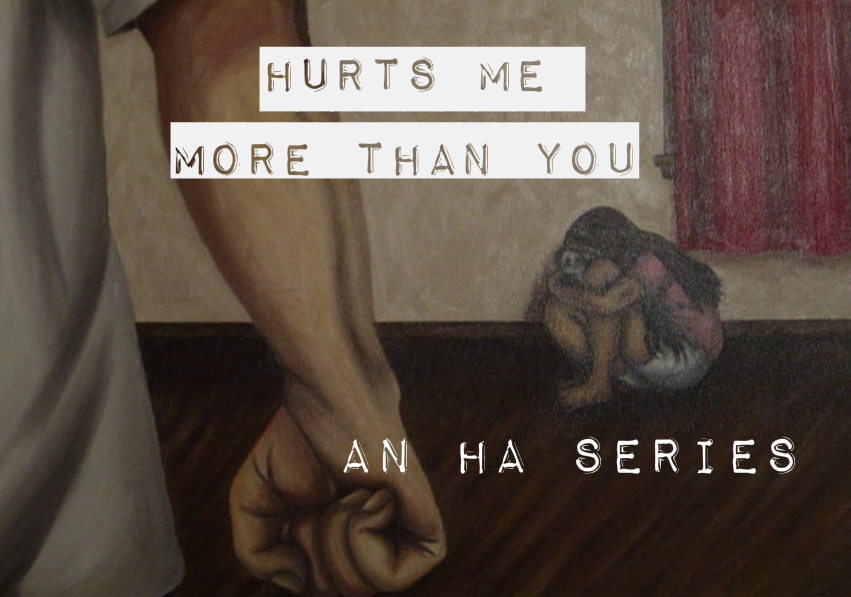
Also by Rachel on HA: “Hurts Me More Than You: Rachel’s Story.”

I never realized what an anomaly my family was at homeschool conventions or homeschool co-ops until recently we ran into another Indian family at one. The first I have ever met. And they were only looking into homeschooling. They weren’t even homeschooling yet!

See, my family is not your typical homeschooling family. We’re brown. But more than that, we’re Indian. Like, from India.

And we are still the only Indian homeschool family to date that I know.

For years I’ve felt like an outsider at homeschool conventions because I would look around and every single other person was white, with either brown or red hair neatly tucked into a bun, a traditional jean jumper or skirt, and a nicely demure aura, and there I was with my brown skin, long straight black hair hanging loose, jeans, and gauzy shirt. You can imagine the looks I got.

And here’s where it gets personal.

Race is a very big thing in the homeschool community, I’ve discovered. Douglas Wilson has been skyrocketed into the spotlight for his classic white supremacist views, and his book excusing slavery in the American South, but before I even read his book I started having problems with a class I was taking at the time: Gileskirk Christendom, based on the beliefs of a certain Dr. George Grant. He portrayed Western Civilization, and, most notably white people, as the “greatest flowering of Christianity”, and descrys the rest of the world as pagan, primitive, and ungodly.

It’s as if Christianity equals White.

When I was 12 and 13 I had a mad crush on a young man who was a personal friend of our family. I thought he was fantastic. I adored him pretty much. But he was a good 7-8 years older than me and never realized my hopeless obsession. Before long I realized that there was no way he would ever fall for me, and I remember my mom telling me that it was hopeless because his mom would decide who he courted, and the girl he married would have to be white. (His mom was just that kind who read all the “white supremacy couched as christian” homeschool literature, and raised her kids on Westerns where white = good and dark = bad).

After all, good upstanding white Christian homeschooled guys want a “clean” girl. They want someone with white skin and brown hair, who’s tall and fair and a poster child for homeschooling. They don’t look for shorty curvy brown girls who have way too much passion and poetry in their veins.

And believe me, I’d read all the books. On how you had to be meek and quiet and not rebel or listen to secular music; and all the books made a white southern lifestyle seem equatable with Christianity. You know, where you didn’t go to college, and waited for the perfect Prince Charming. What particularly impacted my view, though, was that the books said that being seductive or sexy was “the sin of Bathsheba” therefore it was considered taboo.

Now, one considers white skin inherently “seductive” or “exotic”, yet those are exactly the stereotypes which come with having copper colored skin. I was convinced that had I only been white, he may have cared for me and it broke my heart and plunged me into extreme self-hatred.

I can remember writing a teary-eyed journal entry begging God to make me white because if I was white, then he would love me. Well, he turned out courting a girl who is just that: white. tall. fair. with brown – blonde hair and who’s pretty much perfect.

And while we all have ideas of what our first heartbreak will be, little did I think that it was my skin color which would break my heart.

I came across a small homeschool pamphlet on courtship yesterday which listed a number of factors which would disqualify a person as a potential spouse. One of them was entitled “race”.

My eyes filled with tears and I threw the book across the room.

It’s just that mindset which is so contrary to the Word of God which says that in Christ there is neither “Jew nor Greek” and that God is no “respecter of persons”, that frustrates me so much. Perhaps this is because I personally have experienced it. I know firsthand the destructive consequences.

It has taken me years to see anything beautiful in my skin color. It’s still a struggle. There are days I’m ok with it, and days I hate it because it’s so…. brown.

If race is something I have no control over, then what makes a white girl more christian simply because she, through no superiority or fault of her own, was born with less melanin in her skin than me?

And after years spent with SPF 100, whitening creams, etc. I give up.

I’m me and that has to be enough.

But I can 100% assure you that those books aren’t helping anything. It’s stupid to hold one skin color up as “better” than another. Because in the eyes of God we are all equal, no matter.

It’s about time the homeschool community discards the religious baloney and heads back to Scripture on this one.

HSLDA Members Put Naked Child in a “Cage With Feces and Urine”

hslda

By R.L. Stollar, HA Community Coordinator

5 years ago, in 2009, the Home School Legal Defense Association (HSLDA) claimed Karen S. Tolin and Timothy E. Tolin as a victory for their organization. According to an HSLDA press release on January 12, 2009 (archived as a PDF here),

“When Tim and Karen Sue Tolin received notice that officials with Ubly Community Schools in Michigan had called a due process hearing for their son Sean, they turned to HSLDA for help… They currently have nine adopted children, seven of whom they homeschool. Sean, their 8-year-old, has been diagnosed with multiple challenges… The Tolins withdrew Sean from public school to homeschool him… School officials insisted that the Tolins have Sean undergo the evaluations they recommended and that he be given an Individual Education Plan… Mr. and Mrs. Tolin refused.”

The Tolins were members of HSLDA and contacted the organization for help. HSLDA attorney Darren Jones put pressure on the school district and “Ubly Community Schools dropped the proceedings.”

Fast forward 5 years. Last month, this headline appeared:

Two arraigned on charges after teen found in cage in Michigan’s Thumb

That headline eerily resembles the case of Michael Gravelle, the abusive father and husband that HSLDA attorney Scott Sommerville once called a “hero” and who was later indicated to be a child abuser and wife-beater. Gravelle had similarly placed his adopted children in cages. As it turns out, the two arraigned on charges last month were — you guessed it — Karen S. Tolin and Timothy E. Tolin, the parents HSLDA defended in 2009.

Here are the conditions the Tolins forced their developmentally disabled child into:

Police responded to investigate a civil dispute about 4 p.m. Monday, Oct. 20, to a home at 3700 Minden Road south of Priemer, when they discovered the mentally challenged male teen in a caged bed with the door chained shut, the Huron County Sheriff’s Department said in a prepared statement. 

“The odor was very noticeable as the deputy began to climb the stairs,” Hanson said.

Huron County Prosecutor Timothy Rutkowski said the teen was found naked in the cage with feces and urine around him, based on his review of the police report. The 19-year-old has a developmental disability called Angelman syndrome

Libby Anne at Love Joy Feminism first discovered this story, and made the following observation:

“This is another verifiable case where HSLDA defended the rights of people who turned out to be abusers. In this case, it was actual legal assistance. (I know several individuals whose abusive parents were also defended by HSLDA, but these are stories where social services never became involved and the abuse was never discovered.) Now yes, abusers should have legal defense. It’s how the system works. But HSLDA doesn’t position itself as an organization that defends all comers and sometimes has to do dirty work, it positions itself as the family-friendly smiling face of homeschooling and actively works to shape policy. That HSLDA doesn’t vet those it defends, and does in fact defend abusive and neglectful families, needs to be more widely understood.”

Yes, I Am Latino; No, I Am Not Joking: Joe Laughon’s Story

race

Also by Joe Laughon on HA: “Engaging the World — Debate and the BJU Protest: An Interview with Joe Laughon.”

First I think the sensitive nature of this topic demands me to explain what this piece is not about. It is not intended as a litany of racial incidents I saw or a list of microaggressions allegedly inflicted upon me. It isn’t some blanket condemnation of the society home education creates, painting it as a reborn White Citizens’ Council. Nor is it intended to be a condemnation of identifying as American, being of European background, middle class, Christian or conservative. Lastly, I am not going to pretend like I was oppressed by any means. (Sidenote: For those who are far more learned in this subject, I would like to note that my subject of study has not been critical race theory, postmodernism or even sociology but rather was rather early modern European political theory and the Near East. So, mea culpa, if I use imprecise terminology. By all means let me know.)

That being said, I feel like my experience in home education can possibly provide a helpful perspective. My experience in homeschooling has slowly taught me how race operates in our society. It’s rarely some KKK bogeyman but rather is often unconscious and structural rather than personal, and is usually unthinking. In particular it’s made worse by what theorists call whiteness.

Now what do I mean by “whiteness”? By this I do not mean simply being of a European background but rather a society system in which being labeled as “white” (a constantly changing definition with several criteria such as light skin, European background/features, English speaking, Judeo-Christian and being seen as “respectable” and middle class) is the unconscious presumed default in society and is seen as best, where one is given the benefit of the doubt. The more checkboxes you can list off the more benefit of the doubt you will be given (throw in American born, and male in there and you won the bingo game). Today that has often meant:

1. Not being classed as a criminal.

Pastor Matt Chandler, of the Acts 29 network, made a really helpful insight when he stated that his son, blonde and blue eyed, would never be followed around in a store with the assumption he was up to no good.

2. Historically seen as more accepted in society and those people of color who do conform to what we see as respectable are labeled as “courageous” or peculiar.

3. Thanks to the mistakes and outright misdeeds of history, someone who is white is more likely to be better off, better educated and safer.

This does not discount personal success or personal failure but it does mean that history does play a role into where in society we start. Historically being white has afforded economic privileges such as not being redlined, being considered acceptable for credit, being shown houses that were often denied to people of color. This meant that their children could use equity to build more opportunities such as college education and business loans, which creates more opportunity. There is nothing inherently wrong with this ladder of opportunity itself, but the fact that the rungs have been traditionally denied to people of color.

4. Lastly, and most powerfully with recent news, it means that, being white, you will not be inherently defined as suspicious or a threat.

For instance, even the rate of drug usage, possession and sale is the same across the board among ethnic and racial groups, people of color will find themselves targeted for prosecution more often and, when equally prosecuted given harsher sentences for the same crime o the same severity.

Now how did my experience play into this? Specifically I saw how the way we racially and ethnically construct identities is a game in which whiteness determines the rules and gets to decide what identity you have. For instance my family’s identity is not monolithic. English is my language, I have an Anglo sounding surname and my mother’s family is pretty stock European Midwestern-southern white folks. On the other hand, my father’s family is entirely from Mexican from South Texas and Los Angeles and I usually identified most with the Latino community, especially growing up in a neighborhood dominated by this demographic and going to Catholic school in which I was certainly the whitest there.

In my old neighborhood I was certainly an anomaly perhaps but not totally unheard of as “gueros” (“blondies” or “whiteys”) can be more common in some parts of Latin America. Thus my friends didn’t really question what I called myself (although I do remember parents laughing when I had told my class my father was born in Mexico. I simply assumed, “We’re Mexican, he must be from Mexico.”). However once we moved and I began to homeschool, I noticed a subtle shift in how the identity game was played. If you don’t even fit into one identity, one will be chosen for you. Period. I can’t remember the amount of times I’ve explained to folks, “Yes, my skin is very light. Yes, I am Latino. No, I am not joking.” (This could turn into an Abbot and Costello routine as one father literally refused to believe me.) My particular favorite was during our testing and a mother witnessed me filling in the “Latino/Hispanic” bubble. She quickly pulled me aside and noted that if I was mixed I needed to put mixed. No exceptions.

However, I won’t pretend that being white didn’t bring privileges. Besides those listed above, I didn’t have to act as the spokesman for all things Latin. What was also interesting was, as my hand was stamped, I got to see how history and society is shaped by the default of being white.

In particular I saw that a self-reinforcing narrative is created when being white isn’t just assumed to be the default, but it often is the default in homeschooling (especially when you get to subsume everyone else’s identity into the team). Which means seeing the events of history and issues in society entirely through the eyes of one “side.” Every other narrative is conveniently ignored because it is assumed to not exist.

This occurred most notably in the NCFCA and in the wider homeschool debate scene.

Having to combat civil war revisionism (Did you know that it was just over tariffs and slavery was just totally incidental to the entire war? Yeah, me neither), or even remind some students that slavery was not a “win-win” for everyone involved, became a full time occupation as a competitor and coach. But by being white, no one would think twice about sharing their fairly one sided opinion with you as they unwittingly reinforced whiteness by engaging in a host of presumptions about undocumented immigrants or why democratic governance “can’t work” in Arab society. Around me, there was no self aware look over the should to see if any of “them” might hear but rather the opinions about how Latin immigrants will “balkanize” America and how a “Euro-American majority” is needed for society to work could be shared freely.

The catalyst for this realization came when the BJU protest occurred. To recap, NCFCA chose Bob Jones University, a school associated with racial segregation, discrimination combined with a virulent fundamentalism combined with a healthy dose of violent anti-Catholicism (if you don’t believe that last one ask why Northern Irish loyalist demagogue Ian Paisley has an honorary doctorate). Many, in particular coaches, competitors and families of color objected to associating a multiracial, multiethnic and multiconfessional organization with a tainted institution.

The response was total tone deafness from some. We were asked why we were so bitter about “ancient history”, why we can’t bring ourselves to forgive BJU (I was unaware institutions have souls to absolve) and why it was acceptable to let historically black colleges exist but there were “no colleges for whites.” I finally realized that whiteness meant not only getting to decide the rules of identity, not being afraid of spouting off nonsense about race, but also never having to acknowledge the legacy of racism today and in the past.

This is not to say that I experienced a culture of open bigotry or one filled with racial strife. More often I saw a loving, tranquil multiracial group that genuinely enjoyed each other’s company. However I also saw implicit racial assumptions and privilege reinforce itself through a lack of acknowledgement and understanding in a way that was somewhat unique to the home education scene.

So how do we move forward? I think the obvious way is to rely on what unites us and it’s not our identity as homeschoolers, as Americans or as conservatives, but rather our common faith identity, which clearly rejects such constructs (Acts 10:34-35).

The first way we do this is by listening to each other.

This is some basic advice given from James as we are told to be “quick to hear.” However unfortunately our lack of hearing has created a huge perception gap. Last year the Association of Religious Data had a telling study which demonstrated a wide gap in how different groups in America viewed the interaction between race and society. The first step to overcoming our empathy gap is to overcome our perception gap. That is going to take listening. In particular that is going to take hearing narratives on race and how it effects us from others that don’t include ourselves. Rather than get defensive and jump to meaningless tropes such as “What about black on black crime?” or “What about affirmative action?” maybe we should be quicker to hear and slow to speak.

But we need to take this further.

Pastor Scott Williams, author of Sunday: The Most Segregated Day of the Week, pointed out how the institution homeschoolers are most likely to share in common is also the institution that is most racially segregated. Roughly 90% of American churches are dominated by 90% of one ethnic or racial group. Now part of this trend reflects simple demographics and part of this trend reflects the effects of historic exclusion of people of color for mainline Protestant churches. However it should give us a reason for concern. How can we understand each other and start to break down the toxicity of race in America if part of our lives that is most significant to us is the one that is the most racially segregated? Movements like Church Diversity and Operation: Desegregation are the beginnings of something that could be truly healing.

I’m not saying this will solve everything. Homeschoolers who aren’t Christian or are excluded in other ways, such as gender or sexuality, may not find much solace in this. But it could be a start.

The general principles of listening and engaging in community with The Other hold real promise to ameliorate the problem of racism and white privilege in homeschooling.

Hurts Me More Than You: Clay’s Story

Screen Shot 2014-09-23 at 10.15.16 AM

*****

Trigger warning for Hurts Me More Than You series: posts in this series may include detailed descriptions of corporal punishment and physical abuse and violence towards children.

*****

Clay’s Story

My parents didn’t spank in anger, usually.

They were convinced that they were practicing biblical discipline.

They believed that spankings were to be delivered calmly, leave no serious injury (red marks and the occasional bruise were OK), end with reconciliation and a forced hug, and be painful. As a child I was spanked nearly every day. But I got off easy.

Dad said that children in the old testament got stoned to death for rebelliousness, so it was a good thing I didn’t live back then.

Spankings ranged from three to ten swats. I remember feeling really lucky the few times I only got one or two. Mom and Dad both spanked but it hurt more when Dad did it. I think that was just because Mom wasn’t capable of hitting as hard. When Dad spanked he swung with his whole arm like he was trying to hit a home run on our butts. We weren’t allowed to keep our pants on, but usually we could keep on our underwear.

When Mom or Dad spanked it was painful enough to make me see stars. One time after getting spanked by Dad the pain was so much I almost vomited. When I told my Dad this he laughed and said that was impossible.

We were supposed to be still and quiet while receiving a spanking. If we resisted at all we got spanked more. Spankings with our hands in the way didn’t count. If we screamed we got spanked more, and told that CPS would come and take us and we’d never see our family again. We were allowed to cry, but it had to be sorry cries, not angry cries, or we would just be spanked more.

My Dad chose wooden instruments that would leave as few outward marks as possible. Usually something flat like a wooden kitchen spatula. As my brother got older Dad spanked him more, and harder. He started breaking wooden spoons and spatulas on him. Dad made a paddle out of a thick piece of wooden molding or something. It was about two and a half inches wide, half or three quarters of an inch thick, and a couple feet long. He drilled a couple big holes in it so that there would be no air cushion, that it would sting as much as possible.

I always thought I was a bad kid. We got spanked more than anyone else we knew, so it followed that we must be the most disobedient. It didn’t occur to my childish mind that maybe my parents were spanking too much. I remember when I was eight years old realizing that I had gone three days without a spanking.

I thought that was really cool because I had set a record for being good.

Maybe if I had gone on that long I’d be able to be good forever and never get a spanking again. Alas, I got a spanking later that day.

I always wished I could be my cousins. It must be easy for them to be good. I wished it was easy for me to be good. I didn’t understand why it was so hard for me to be good. Impossible, in fact. My parents explained that it was because I was a sinner, but that didn’t explain why I was apparently a worse sinner than anyone else my age. I couldn’t wait to grow up, because grown-ups don’t sin — that’s why they don’t get spankings. My last spanking was when I was twelve, I think, but the threat didn’t go away. Mom would tell me that a teenaged friend of mine still got spankings for rolling her eyes, so I’d better watch myself.

My parents stated goal in all this discipline was to break our wills.

A child’s will was something evil, something that needed to be eradicated.

They never really explained what this meant in detail, but it had something to do with us never having desires that misaligned with theirs. I can only imagine that the desired result was to condition us to have a visceral reaction to the thought of going against their wishes. It worked very well on me. I learned early on that the best way to cope was just to go along with what they wanted, to say what they wanted to hear, to hold still and not resist, it would be over most quickly that way.

It didn’t work so well on my brother, he would fight. Not fight physically — he’d fight by not crying, or by saying that the spanking didn’t hurt. That’s why Dad had to hit him so hard that wood broke against his flesh.

Yet, I’m not convinced that my strategy was better. It seemed so at the time because it was the path of least pain, but there were long-term consequences. For years into adulthood I wasn’t able to act in my own best interest. Doing something just because it was the best decision for me was so far off my radar I rarely contemplated it. I lived my life with pleasing my parents in mind. It wasn’t even conscious, it just was. When I started making decisions I knew they would disagree with I had physical reactions that were so intense I would sometimes be incapacitated for days. It would start with my whole body shaking, then my throat would close up. Then my heart rate would soar, like my heart was trying to escape my chest. My mind would race, and then I would start vomiting. Even after the vomiting stopped it would take a day or so before I could eat normally again. It would take several to get my energy back.

I’m shaking just writing this post.

My parents always told me that they spanked us because they loved us. It is true that they loved us. But I don’t think that was their primary motivation in spanking.

Spanking gave them a tremendous amount of power over us: power to break and then remake us according to their will.

The Nightmares

CC image "Nightmare" courtesy of Fernando Rodríguez.
CC image “Nightmare” courtesy of Fernando Rodríguez.

HA note: The following is reprinted with permission from Darcy’s blog Darcy’s Heart-Stirrings. It was originally published on October 19, 2014.

I keep having these dreams that my parents are keeping my husband away from me, or me away from him, like they did 12 years ago, only worse. Sometimes they have me locked up somewhere, sometimes they deny he ever existed. Always I’m trapped and defenseless and frantically searching for him, trying to find him, to get back to him. Always I can’t find him, or he can’t hear me, and my parents gain control and drag me away from him.

In the last dream I had, I woke up and was back in my childhood home near Seattle. I was scared, I ran upstairs from my basement room, asking where my children were, where my husband was. Everyone looked confused and didn’t know what I was talking about. They treated me like I was mentally unstable and insane and making stuff up. They said I didn’t have any children, that we’d never moved to eastern WA, and that I’d never been in love or married. I became frantic, begging them to let me out, to go search for my family. They refused and locked me in the basement, saying it was for my own good, that I was sick. I started to think they were right, but something happened to make me sure that I did have children, that I was married, that I had a life, and that I had to fight with everything I had to get out of that house and away from those people who claimed to be my family and claimed to love me. I knew that my kids were missing me and my husband was probably looking for me, they probably all thought I’d run off and didn’t love them anymore and that broke my heart. I sat in the basement room, screaming, bloodying my knuckles trying to escape. I knew I wasn’t crazy but….what if I was? What if they were right and there is no husband, no children, and I am truly sick, trying to escape walls that keep me safe?

I hate these dreams.

I hate that 10 years after I won and took control and chose my own way in my life, I still fear being controlled.

I still fear losing control over my own life and losing the man and children who are mine. I can still feel the agony and helplessness of being trapped, even though the cage was really in my own mind and theirs and nothing physical was keeping me from walking away back then, only spiritual manipulation and fear. I wonder when these dreams will ever stop. I wake up from these dreams in a panic, reaching for my husband, putting my hand on my baby son in his crib next to me, tangible evidences that I am in my own bed, in my own home, in my own life.

And I try to reconcile in my mind the parents I know now who come to visit to bring gifts to their grandkids and have coffee in the mornings and do a little bit of life with us, with the parents back then who controlled and manipulated and who had convinced me they had power over me and my choices and whom I believed. And I wonder how long I can keep saying “my parents weren’t abusive, they weren’t like those horror stories you read about. They loved us” as I wake up in a cold sweat from these dreams. Do motives really matter in the end? Because it was the actions that broke me; their motives can’t fix that. I wonder if we are ever going to talk about it, to go back there and expose all the ugliness that was my life 12 years ago, and if I will ever stop having these nightmares if we don’t.

I am 30 years old, a successful mother and student and advocate. I control my life and my choices. I am loved deeply by the man I share my life with, the man who fought for me. I have four children whose lives I nurture and guide. I chose to live every day with a whole heart, with vulnerability, with honesty, with empathy, with authenticity, with deep joy in my amazing life and my beautiful family. Yet one dream every few months with the same theme over and over again, touching a very broken place in my soul, and I am completely undone. I have to fight yet again to convince myself that no one controls me but me. That I am free and no one can take that from me.

This is the power of childhood psychological abuse, emotional abuse, and spiritual abuse.

It breaks parts of us that no one can see. That often even we can’t see. But that are evident in the panic attacks, the recoiling from normal things, the nightmares.The rage that comes out of nowhere as an instinctual defense. The feeling of being a helpless child again. The confusion when presented with two differing stories of the same incident and being told yours is the incorrect version.

This story isn’t over. But as dark and unfinished as it is, it’s a necessary one to tell right now, in this moment, so others living the same story don’t feel quite so alone. We fight and we win. I know we win. I have already won so much. And I’m not finished yet.