Today I realized (aka found it amusing) how few words would have to be changed in Disney’s The Little Mermaid’s song, “Part of Your World,” to make it into a “homeschool edition” of the song. So I tinkered a few minutes and came up with the following.
Tip: it’s better if you sing/hum the tune as you read. 😉
.*****
Part of “That” World
*****
Look at this stuff
Isn’t it neat?
Wouldn’t you think my life’s purpose complete?
Wouldn’t you think I’m the girl
The girl who has everything?
.
Look at this shelf
Treasures untold
How many Christian books can one bookshelf hold?
Looking around here you think
Sure, she’s got everything
.
I’ve got Bibles and siblings a plenty
I’ve got homework and housework galore
You want jean skirts? I’ve got twenty!
But who cares?
No big deal
I want more
.
I wanna be where the people are
I wanna see, wanna see ‘em dancing;
Movin’ around to those – what do you call ‘em?
Oh – BEATS!
.
Stayin’ at home you don’t get too far
Socialization’s required for friendships, dating
Attending a youth – oh – what’s that word again?
Retreat?
.
Out where they walk, out where they run
Out where friends cut away and have fun
Wanderin’ free – wish I could be
Part of that world
.
What would I give if I could live out of this hell-house?
What would I pay to spend a day free from control?
Bet’cha the world, it understands
That you don’t subjugate your daughters
Bright young women, sick of submission
Not here to command
.
And ready to know what the people know
Ask ‘em my questions and get some answers
What’s a condom and how does it – what’s the word?
Work?
.
When’s it my turn?
Wouldn’t I love, love to explore the world they talk of?
HA note:Aaron Gotzon is a homeschool alum and one of the regular contributors toThe Ontological Geek, a website that examines videogames through various critical lenses. The following was originally published on The Ontological Geek on April 24, 2013 and is reprinted with permission.
*****
Beat your plowshares into swords and your pruninghooks into spears: let the weak say, I am strong. – The Book of Joel
Frequent readers will note my intimate familiarity with the Evangelical subculture. It wasn’t until I grew out of my larval form that I recognized just how sub that culture was. To me, it was normal to repudiate the machinations of the secular, decry the subversive whims of a liberal media, and lionize such defenders of the faith as the Billy Graham Crusaders, the Gaither Vocal Band, and Randy Hogue.
In TobyMac, Switchfoot, and Relient K, we had our own music; a pro-family, pro-social answer to every genre of song – many Christian acts of the late 90’s and early 2000’s, in fact (the heydecade of the movement) consisted of popular secular tunes repurposed to affirm our social agenda. We had our own cartoons, some of them actually rather clever and technologically groundbreaking. We had huge rallies in stadiums of millions, and popped out “world outreach centers” like sneezes: some of which have passed on into obscurity, some remain a force with which to be reckoned, and a certain quite famous one in my hometown is under scrutiny for harboring some dark practices within ostensibly benign, if radical, quarters.
We had hit novels, major motion pictures. We refitted holidays to eliminate pagan (or even neutral) elements, and had our own youth organizations, like AWANA, as a cultural counterpoint to the Deistic-in-theory American Scouting movement. It might be said that, for some, or even many of us, the Boy Scouts weren’t conservative enough.
And, of course, we had our own games.
This impulse was borne from the Pauline commandment to “be not conformed to this world, but be transformed by the renewing of your mind.”
“Worldly” was a slur.
The 1980s: BibleBytes, and Kidware Shareware Adware Underwear
The gameplay and presentation in “Noah’s Ark” are similar to that of the American Super Mario Bros. 2.
The concept of the Christian computer game began with the uprising of modern Evangelicalism with its soon-to-be-realized theocratic tendencies and its reconstructionist emphasis on the budding culture war between the “old-time Religion” and the open secularization of the West. Focusing on the Family meant meeting the public mainstream culture point for point: in politics, in art, in hobbies and entertainments all alike.
As with certain evangelical leaders (Dr. James Dobson), internationally recognized conservative think tanks (Focus on the Family), and popular, still-running radio programs (Adventures in Odyssey), the “Christian” game was born in Colorado. BibleBytes was founded by the Conrod family with the express mission of bringing computer games into the mainstream with overtly religious messages. This being the early 1980s, videogames weren’t met with the scorn we witnessed in the early-to-mid 2000s, for example, on the charge of being unspeakably violent (and certainly they’ve earned that distinction, regardless of how that makes you feel personally). Instead, this was an answer to the emergent popularity and rampant growth of infant gaming, another tit-for-tat appropriation of an aspect of modern culture and integration into the fledgling Christian subculture.
BibleBytes was successful in marketing the first Christian games on the era’s microcomputers, which included those manufactured by Radio Shack, Texas Instruments, and Timex.
The overwhelming majority of Christian games produced during this period were developed by BibleBytes, and ported to the appropriate hardware platforms, including the Atari 2600 and Commodore 64, as those became widely available. The games were released in multiple volumes and iterations as a collection rather straightforwardly entitled Bible Computer Games.
Today, BibleBytes continues to operate as the dreadfully named “Kidware Software,” selling primers on programming basics designed for children of homeschooling families. They’ve since stopped supporting the old software, and no longer develop or distribute new games.
The wave of Bible games had begun, but it had yet to swell, until…
The 1990s: The Tree of the Knowledge of Dreams and Piracy
Like BibleBytes before it, the role of Flagship Developer of Bible Games fell to Wisdom Tree – the company formerly known as Color Dreams – during Our Most Awkward Decade.
Color Wisdom Dreamtree has several notches on its Belt of Contributions to Gaming History, the first being its development and distribution of the first-ever side-scroller for “IBM Compatible” (as the parlance went) PCs. The next two honorable mentions aren’t nearly as honorable, though they’re certainly not unimpressive: Color Dreams managed to develop a workable hardware bypass for Nintendo’s 10NES chip, the silicon gatekeeper of the Japanese company’s famously strict licensing rules. Later in the decade, they’d also publish the only unlicensed SNES title ever, Super Noah’s Ark 3D.
Wisdom Tree’s first release after their rebranding was Bible Adventures, for the NES, a three-in-one-pack featuring the following:
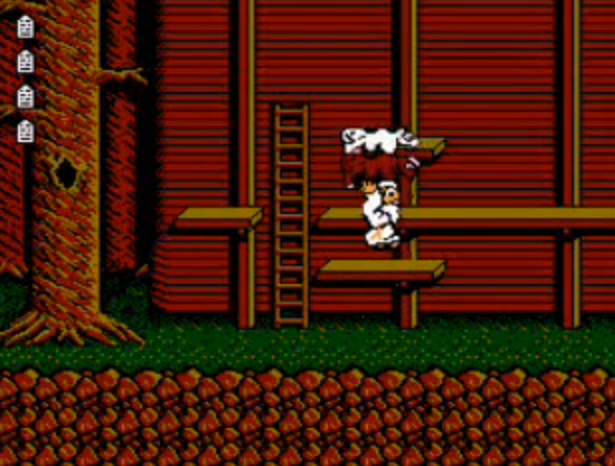
Noah’s Ark, a platformer wherein the goal is to gather up all of the animals by picking them up. The animals are presented as being hoisted above Noah’s head, and they can be stacked one atop the other, making Noah only slightly weaker than Superman (which I don’t remember from the Bible). The gameplay and presentation are similar to that of the American Super Mario Bros. 2.
Baby Moses, in which the player takes on the role of Moses’ sister Miriam, attempting to deliver him safely to the palace while evading guards after Pharaoh’s decree that all male Hebrew firstborn be killed. Miriam, like Noah, transports her charge by holding him directly above her head. Intriguingly, she is able to throw the infant prophet around the screen with no penalty damage to the child. She is, however unable to use the invincible slave-spawn as a bludgeoning weapon.
David and Goliath is similar. You’re still picking up animals as the psalmist shepherd and stacking them over your head. Except this time, once David succeeds in carrying enough sheep to safety, he is transported to the front lines of the Philistine war armed with a slingshot, with which he eventually defeats Goliath in the final stage by landing the perfect shot right in the giant’s forehead.
The Bible Adventures compilation was ported to the Sega Genesis as well, with virtually no changes to either graphics or gameplay.
Wisdom Tree would continue to release games throughout the rest of this decade, many of them with elements borrowed heavily from other more popular titles, like Zelda expy Spiritual Warfare for Game Boy, NES, and Sega Genesis. Sometimes, the games would be outright clones and re-skins of titles Color Dreams released before they re-styled themselves as a Christian developer, like top-down puzzlers Exodus: Journeyto the Promised Land and Joshua: Battle of Jericho, both of which used the same gameplay mechanics and level layouts as the secular Crystal Mines, with different graphics reflecting the biblical theming.
Perhaps the most bizarre was the aforementioned Super Noah’s Ark 3D, which could only be played by loading a licensed cartridge on top of Noah while it was connected to the SNES console. It was an actual level-for-level clone of the popular Wolfenstein 3D by id Software, with Noah replacing the meaty muscled bloody guy (did he have a name?), a slingshot for a weapon, and various animals standing in for Nazis. A widely-spread rumor claims that id Software gave the source code of their Wolfenstein game to Wisdom Tree as a revenge on Nintendo for releasing an inferior port of their popular game, making it a point to tone down the violence (Nintendo was known for being especially particular about games for their system being Family-Friendly). The details surrounding this bit of corporate intrigue have never been released, and the facts remain unclear to the present day.
Technically, Wisdom Tree is still active, selling their own games and those of even smaller developers on their website, on which they promise to make their entire past library available for the current versions on Windows, eventually.
So, you know, if you ever really, really wanted to pay $22.95 for a videogame called JESUS IN SPACE, now’s your chance.
The 2000s: Cacti and Catacombs
One of the only explicitly Christian games to enjoy significant mainstream success and recognition was Catechumen.
So far, the formula for most Christian games, as codified by Wisdom Tree, was to adapt well-known stories from the Bible into playable adventures, most often by taking an existing secular game and copy-pasting kitschy religious imagery (the standards, mostly; bearded men in dresses and plenty of camels). In the early 2000s, the standard began to shift from adaptation to symbolic imaginings of the Christian journey and comic-style portrayals of spiritual warfare.
Arguably, one of the only explicitly Christian games to enjoy significant mainstream success and recognition was Catechumen, a first-person shooter which tasked the player with a journey to travel down into a Roman-inspired catacomb to defeat a demonic horde ensconced therein. Along the way, the player character increased in spiritual power until finally gaining enough strength to banish Satan himself from his lair in the bottommost parts of the caverns. The quality of the action, progressive gameplay, and “mature” theming drew many gamers from both inside and outside of the Evangelical community.
Cactus Game Design entered the scene a little later in the decade, bringing yet another more adolescent-oriented shooter offering, Saints of Virtue, to the range of Christian games available to consumers. The player journeyed into the center of a young man’s heart in an attempt to purge it of sinfulness from the outside in, gathering items representing the different pieces of the “full armor of God” along the way. These were accompanied by verses explaining different facets of the Christian inner life, and at times could be oddly introspective in its rather personal, if clichéd and Totally Rad! ™, exploration of the meaning of the modern Christian walk. The weapon in the game was the “Sword of the Spirit,” which was not used as a typical bladed tool. Instead, the player was able to fire bolts of lightning at the (quite scary) enemies, masks which took the names and traits of various sins or follies.
The Saints of Virtue characters would come to be used again in Cactus’ Magic-like trading card game, Redemption. Instead of draining the opposing player’s life points, the objective of matches in the card game was to come into possession of the opponent’s so-called “Lost Souls,” claiming them for the Kingdom of God with biblical hero characters, while at the same time defending their own souls with evil characters. The game worked well, and became pretty successful for a few years, hosting national and local tournaments and gaining a cult following even among those Christians not expressly invested in the culture of Evangelicalism.
The latter portions of the decade saw a trilogy of Left Behind games, based on the popular and long-running series of novels sets after a premillennial dispensationalist’s idea of the Rapture, which faced some controversy from the mainstream regarding various charges of cultural insensitivity and (of all things) violence.
Other than this briefest of debacles, and a few rhythm games, which were basically Dance Party and Guitar Hero but with contemporary praise and worship music, the rest of this decade saw no noticeable influence of explicitly Christian games on the mainstream.
The Present
We’re now well into the New Tens, and, as it turns out, they’re suspiciously absent of any noteworthy Christian games. Many of the old developers are either closed completely, or sustaining themselves by repackaging, reselling, and sometimes halfheartedly supporting or updating their old titles. It seems that, by and large, the Evangelical subculture has given up on appropriate games into itself. This may reflect the poor quality of the early games, the lack of significant commercial success of the newer ones, or the Evangelical movement’s withdrawal from the impulse to create a new, “Christian” world in lieu of being participatory in the new one.
It’s true that religious themes abound in modern games, as interactive media matures and becomes able to comment on more and more aspects of culture, layering complexifying narratives over dynamically evolving artistic structures and play mechanics. As with BioShock Infinite and Fallout: New Vegas, these new representations of Christianity and other religions seem to refrain rather cautiously from commenting on popular religion specifically, choosing instead to focus on general themes, patterns from history, or minority faiths (Mormonism is a popular one, and by some accounts New Vegas managed a nuanced and respectful portrayal of the Latter Day movement).
This advancement of a more subtle religious theming has allowed the faithful among us to project our journeys onto the adventures we undertake in our gameworlds of choice, without the exclusivity implicit in playing a “Christian game.” We’re allowed to think about the spiritual paths we choose, even as we consider the paths we undertake when synched-up to player characters. We’re allowed a wider discourse, incorporating gamers of other faiths, or no faith, to engage with us in our universal quest for personal, immediate, and transcendent truths. We’re allowed to put our problems, like violent impulses, misogyny, and all those sundry troublesome –isms, on display without fear of retribution from a community which once sought to burrow in and ignore or downplay the difficult issues which come along with being human, indeed, being fundamentally worldly.
There may well be something profound to be said of a freedom in Christ, but it seems like today’s secular games offer us a lot more freedom (even to be in Christ more fully and honestly, should we so choose) then would Christian games, had they gotten the chance to become as successful or ubiquitous as our more familiar, religiously neutral engagements.
Perhaps the central impulse of the Christian subculture of the past twenty years was slightly twisted: being “in the world, but not of it,” does mean rejecting ties to historical barbarism, checking destructive primal urges, and striving to create a more balanced, peaceful social order. All great ideals, but if we want to achieve them, we do have to be “in” the world. We don’t get to opt-out of the realities of earthly life before we’re through with it. Before we’ve managed to accomplish being in it, even if we choose to identify with an otherworldly ideal. Even if you suspect that your Real Home might be elsewhere, this is definitely where it is now.
So, “worldly,” perhaps, shouldn’t be a slur. Succeeding in embracing the world, loving it, being Home-for-Now, might be the first step toward transforming it into something better, toward making the “world” something not to be rejected, but to be cared for and nurtured. Something to be proud of.
So, yeah.
Anyway, go play some games.
“What is the kingdom of God like? What shall I compare it to? It is like a mustard seed, which a man took and planted in his garden. It grew and became a tree, and the birds of the air perched in its branches.” – The Book of Luke
*****
A note: for some fun, check out the Angry Video Game Nerd’s three-part series on Bible Games. He covers just about all of the Wisdom Tree titles of the 90s in detail, with his typical humor (which means the videos aren’t safe for work, obviously, and screw you for watching YouTube at work, you lazy ass).
….And when the soldiers came, the brave little girl took the Bible and ran out to the garden and hid it under some cabbages… On Grandma S’s flannelgraph board was a picture of a little girl hiding a Bible under some cabbages. Grandma S was teaching her weekly Bible class, and this week we were learning about early Christians who were persecuted for their faith. I forget the rest of the story, but as a plant loving youngster, the idea of hiding a Bible under cabbages intrigued me. At the conclusion of class when we drew pictures and snacked, I drew a picture of the girl hiding a Bible under the cabbages and Grandma S wrote on the picture what it was.
Grandma S, my maternal grandmother, moved to Indiana from Ohio to live with us when I was 7. She needed a way to way to stay busy and loved her Lord and grandchildren. Holding a weekly Bible class for her four grandchildren enabled her to stay busy and show her love for both Lord and grandchildren.
Using a flannelgraph, drawings, or books with large illustrations, Grandma S taught us all the Bible stories Christian children learn — David and Goliath, Elijah, the Christmas story, the Easter story, Jesus’ parables etc. She also taught stories about missionaries, early Christians, Christian concepts, and the stories behind Thanksgiving and the Fourth of July.
Grandma S was a quiet, sober, simple, independent woman. Yet using her simple media, she held her four grandchildren (and later two friends of those grandchildren) spellbound as she gave her lessons. Even though I secretly disliked formal religious services, I don’t remember being bored with Grandma S’s stories. At the time of Grandma S’s Bible classes, we were attending a homechurch with no children’s Sunday School.
Grandma S’s Bible classes filled that void.
Each Bible class began and ended with prayer. Often Grandma let one of us children do the praying. Next up: singing. Each of us children got to choose a song. Because I loved animals, I usually chose “The Birds Upon the Treetops”
“The birds upon the treetops;
Sing their songs.
The angels chant the chorus,
All day long.
So why shouldn’t I?
Why shouldn’t you?
Praise Him too.
After we sang, Grandma S gave her Bible lesson. At the conclusion of class, Grandma gave us a snack and drawing materials. As we enjoyed the snack, we drew pictures of what we learned or other thing that interested us. Grandma posted each new picture on her refrigerator and kept all of our pictures in the folders she kept for her grandchildren.
Sometimes Grandma would give us a word and have us try to get as many words from it as possible. Today all four of her grandchildren love books and are good writers.
Grandma S’s Bible classes were something I took for granted. Only now as an adult do I see their value and treasure the few memories I have of them. Only now do I see the hard work and love Grandma S put into each class. Only now do I see her wisdom in letting us draw what we wanted after class, even when what we drew had nothing to do with what she had taught.
Grandma was a woman of God and understood the importance of letting a child voice what he had just learned or experienced in order to understand it.
And only now do I see the great blessing of learning those Bible truths from my grandmother in her quiet, simple way. Had I been in a loud Sunday school that used the latest technological media and involved complicated crafts and lots of people, I would not have learned those truths so thoroughly and treasure the memories so much.
Grandma S’s Bible classes ended the year I turned 14 when my older brother got a job and she got sick. Before the year was gone, Grandma S fell asleep in her Lord in the spot where she’d given so many Bible classes with Mom and I at her side.
I’ve written this in the room where Grandma S gave her Bible classes and fell asleep in Jesus. As I think of her, the day a trumpet sounds and we are reunited at the feet of Jesus in the rapture cannot come soon enough.
“Rock” music. Simultaneously my oppressor and my escape, we have an unusual relationship. Going from “anything with a strong beat will fill you with demons” to “oh hey, I just bought the newest VNV Nation album!” may seem extreme, and I admit that I sometimes suffer from whiplash, but at the same time it’s been a very freeing evolution and something that mirrors my general escape from my childhood/immediate family.
The first memories I really have about specific music was trying to defend myself at a camp-out.
I’d been found crying in a dark place by myself, and my fellow campers [all the same general age as myself, 9-12ish] didn’t believe me that the song made me cry because it reminded me of a friend who’d died. The song was played at his funeral. It was the first example of exactly how strongly music hits my emotional centers – and for that song, having to “prove” it made it hit me all the stronger in the following years.
Following that, the next set of memories is about music being “awesome” – or rather, not. The cult we were in at the time were very adept at using the “Sunday morning worship” to twist us this way and that, and I can distinctly remember how you could tell what the sermon would be about by the first half of the very first song of the day. I remember dirge-like music playing as we lined up in a school’s gymnasium to “repent of our sins.” I remember the slightly happier songs that the children danced to. I remember everyone in the room being scathingly rebuked because one of the singers had dared to say that a song was “awesome” – because, you know, only God is awesome. Never anything else, even a song literally praising his name.
The music collection at home wasn’t too much better. Michael Card. Sandi Patti [maybe… if we were lucky]. Some random Maranantha song tapes. Plenty of classical. That was about it, that I remember. I had very little interest in music outside of that, for the most part, simply because I didn’t know anything about it. There was the usual hush-hush about KISS and Marilyn Manson, stuff like that, but it was all mostly above my head. Then, I was introduced to DC Talk and Michael W Smith and Steven Curtis Chapman. My brain just about exploded from glee – finally, something that fit me!
I could put my emotions onto these songs and I could finally understand things about what I felt that I never could before.
See, I have bipolar disorder. I have rapid and multiple mood swings, from seriously depressed to extremely manic, and until that point, none of the music could encompass either end of the curve. Everything was beautiful and nothing hurt [because Jesus!] – to steal from Vonnegut. Any emotion other than happiness and joy was Wrong. You were a bad Christian – nay, a bad person, if you weren’t always basking in the love and companionship of Jesus. Being human, though, that wasn’t possible. So I struggled along in my lonely childhood self, trying to deal with these big emotions and not having anywhere to turn.
And then lo, DC Talk and “Jesus Freak.” They were my introduction to a larger world, and were, in fact, the very beginning of my long and slow departure from the church.
Teenagerhood hit. I was “rebellious,” according to my parents, and it was all because of my music. They had it backwards, of course. I was in an abusive home situation and I had found an escape in the music that expressed all the emotions I was feeling and allowed me to survive day after day, because there was nowhere else to go. Once again I was stifled under the “no emotions except happiness” expectation – which became more and more difficult the worse my bipolar got. It’s very hard to be “blissfully happy in Jesus” when one day you’re suicidal and the next you’re on a cloud and can do ANYTHING! that you could think of. I hid my music and snuck it as often as I could [or dared… woe betide me if I was found listening to [oh my!] Superchic[k] or the Newsboys or [quadruple gasp here, people] the Cruxshadows.] All of the songs that I listened to held deep emotion and symbolism for me, and allowed me to blindly feel my way through the disaster that was my home life.
There were fights about the music. My mother tried to convince me that rock music was of the devil. She emailed me all these “studies” about plants and rats [and since those have been addressed elsewhere on HA, I’ll refrain from doing so here], talked about the “demon beat,” and tried to take my CDs away. Fortunately, by that point, there was the internet and it was easily accessible. When it got really bad and my parents tried to take that too, I was attending the local community college and could use their computer lab to retrieve what I needed.
Eventually, I escaped. Barely.
When I got out of their home, I stopped attending church, I stopped seeing them, and I fairly quickly stopped identifying as Christian. My music needs changed – from the “life sucks and God’s still there for you” of the Christian rock world to the “you’re alive, you’ve survived some awful shit, and you’re still here” of VNV Nation, the Cruxshadows, Linkin Park, movie soundtracks, and so many other artists I can’t even list them. For the longest time, my playlists were nothing but loud anger and rage. I had to purge that from within myself eventually, I knew, but at the time all I could do was cope.
*****
I was sexually assaulted at work. More rage and bitterness. And the music was there.
I was extremely sick and almost lost my job. And the music was there.
I moved halfway across the country. And the music was there.
I was raped. And the music was there.
I had a psychotic break… and the music was there.
*****
Four years later, I had enough, and said “this anger, this bitterness, this rage and hate and harm will not be a part of me any more.”
And the music was there.
*****
It was there as I burned out the bitterness, screaming my tears of pain to the heavens. It was there as I sobbed in my friend’s arms. It was there the nights that I woke up screaming from the nightmares of the pain and the terror.
And the music was there when I finally broke through and let the love out.
Maybe it’s about the time To let all of the love Back in the light Maybe it’s about the perfect place To let go and forget About the hate
Trigger warning: If you experience triggers from descriptions of physical and sexual violence, please know that the details in many of the cases are disturbing and graphic.
*****
Appendix 2: Exclusions
We have chosen to exclude from this archive a number of individuals charged with murder or attempted murder whom news reports have referred to as “homeschooled.” The reasons for excluding them vary, so we will list each below:
Alton Romero Young:
In 1993, 17-year-old Alton Romero Young raped and strangled to death 57-year-old Shirley Mullinix. Alton was being taught at home due to suspension from Hammond High School. Shirley Mullinix was a home-hospital teacher in the Howard County school system, tasked with teaching students unable to attend normative classes on account of disciplinary or health problems. Thus while some news reports refer to Shirley as a “home school tutor” and Alton as homeschooled, he must be excluded from this list since his homeschooling was directly under the authority of a public school system and a public school teacher.
Jeff Weise:
In 2005, 16-year-old Jeff Weise — a student at Red Lake Senior High School in Red Lake, Minnesota — went on a shooting spree and killed a total of 9 people. He first killed his grandfather and his grandfather’s companion and then went to the school and killed 7 others (as well as wounded 5). Following the attacks, he committed suicide. Jeff was living on the Red Lake Indian Reservation of the Ojibwe people. While he has occasionally been referred to as “homeschooled,” there are no verifiable records of this fact. All records seem to indicate short periods of time when he simply did not attend school due to depression and bullying.
Aaron Kean:
In 2003, 10-year-old Aaron Kean from Woodbridge, New Jersey sexually assaulted 3-year-old Amir Beeks and then beat the young child to death with a baseball bat. While some sources have described Aaron as “home-schooled,” there is no evidence that this is the case. He was expelled from public school 6 months before the attack, but the school itself made an arrangement for him to receive tutoring from a teacher at the local library but Aaron remained delinquent from the arrangement.
Jade Gonzalez:
In June 1999, 12-year-old Jade Gonzalez from Albuquerque, New Mexico was charged with shooting her father in the head and killing him. Jade has correctly been described by some sources as homeschooled. However, in 2007, when she was 20 years old, the case against Jade was dismissed and her father’s death was ruled an accident.
HA note: The series conclusion of “When Homeschoolers Turn Violent” is written by Rachel Coleman, Rachel Lazerus, and Dr. Chelsea McCracken from Homeschooling’s Invisible Children.
*****
Homeschooling communities assume that homeschooled kids escape the pernicious influences of the wider world — if violent behavior is something that you catch, like a disease, homeschooling families assume that they can protect their children from exposure. Some homeschooling advocates also claim that those who have been homeschooled properly will never turn out to be violent criminals or have mental health issues.
The assumption that homeschoolers are essentially good kids is also held by members of the general public. Joshua Komisarjevsky was sentenced to only nine years for his role in burglarizing 18 homes, despite the maximum statute being ten years for each offense. When he came before the parole board, he was seen as “young, white, bright, home-schooled, remorseful, never identified as a person with high mental health needs.”[1] He was paroled in April 2007, and invaded the Petit family home on July 23rd, 2013.
Homeschool advocate Brian Ray implicitly endorses this view, writing:
Discussion with leaders in the homeschool movement of the past several years of news and careful Internet searches reveal 2 and possibly 3 homeschooled teens (ages 14 to 17) who were accused or convicted of homicide during the past 8 years. …If home-based education of teens of ages 14 to 17 comprises 3% of that age-group population and calculations are adjusted for number of homicide offenders and number of years (with a liberal estimate of 3 during 8 years), then homicide offenders of homeschool students ages 14 to 17 would be about 0.004 per 100,000. If true, this would mean that the general-population teen of this age is 2,500 times more likely to commit homicide than a home-educated teen.
In this conclusion post to our series on homeschoolers who have turned to violence, we would like to explain why it is both unfair and unscholarly to compare homicide rates in the way Ray does — and how these flawed assumptions make homeschooling families and communities less safe.
First, we would like to note that it is unscientific to conclude from anecdotes that there were only two or three homeschool homicides during the previous eight years. For one thing, our list includes more than twice this number, and we do not assume it is a complete list. Not every youth homicide makes the news, not every news story on a youth homicide discusses the offender’s educational background, and not every story that makes the news is easily accessible on the internet. To accurately compare the rate of homeschool homicides to the national rate, one would need to access the criminal records for all youth homicides within a given time period and look at the educational background of each. It is irresponsible to speculate on youth homicide rates without this data.
Even more importantly, comparing youth homicide rates between the homeschool population and the general population would not actually tell us anything about whether homeschooling itself affects the youth homicide rate. When comparing homicide rates between two populations, it is crucial to consider all of the ways the populations differ. In other words, if the homicide rate is indeed lower among homeschooled youth, which it may be, this might be because homeschooled youth differ from youth in the general population in various ways that are unrelated to school choice.
When comparing crime rates in two populations, it is important to take into account various factors that might impact the crime rate. For example, one cannot compare Alabama’s high crime rate with New Hampshire’s low crime rate without taking into account the difference in poverty rates: Alabama has one of the highest poverty rates in the country while New Hampshire has one of the lowest. According to the National Center for Child Death Review, “Major contributing factors [to youth homicide] in addition to poverty include easy access to handguns, involvement in drug and gang activity, family disruption and school failure.” Other factors which may also contribute to crime rates include education level, community involvement, availability of mental health services, condition of law enforcement, etc. When comparing two populations, all of these factors must be taken into account.
The homeschool population varies from the general population in a number of ways. The homeschool population tends to be more rural than urban, and homeschooled children are more likely to live in households with two parents than are children in the general public. It has traditionally been thought that parents who homeschool tend to be wealthier and better educated than average (although this has recently been called into question). All of these factors correlate with lower crime and homicide rates. Without correcting for these various factors, it is impossible to know whether homeschooling might play any role in lowering homicide rates.
Many homeschool families also have high levels of parental involvement, which is not easily quantifiable. Parental involvement leads to higher educational attainment in any educational setting and also correlates with lower crime rates and lower engagement in risky behaviors. As a result, lower homicide rates among homeschooled youth could be a result of high parental involvement rather than of homeschooling per se — and highly involved parents would affect their children’s lives in this way regardless of the educational method they chose.
Could these background factors be corrected for? Yes. To do so, one would first have to collect accurate data on homeschooled students and their families. Then, one could compare the homicide rate among homeschooled youth with the homicide rate among youth in the general population with the same background factors. In other words, if homeschooled youth are more likely to be rural, more likely to have two parents, more likely to live in families with slightly higher incomes and educational attainment, and more likely to have high parental involvement, the homicide rate among homeschooled youth would need to be compared to the homicide rate among a sample of the general population that is also more likely to be rural, more likely to have two parents, more likely to live in families with slightly higher incomes and educational attainment, and more likely to have high parental involvement. That way one could isolate any effect educational method might have.
As the director of the National Home Education Research Institute, Ray has conducted a number of studies on homeschoolers; however, he has consistently failed to correct for these background factors. In several of his studies, for example, he gathers testing data from a nonrepresentative sample of highly educated, high income, highly involved homeschool families and then deceptively attributes their predictably high test scores to the fact that they were homeschooled. (For more, see reviews of Ray’s work here.)
When a youth homicide occurs, the student’s educational background, whether public, private, or homeschool, is not generally the causal factor. Attending public school does not cause an adolescent to commit a homicide any more than being homeschooled causes an adolescent to commit a homicide. Rather than focusing on which educational method is correlated with the lowest homicide rate, we should instead study how various factors may contribute to adolescent homicides in any educational setting. We prefer to focus on keeping youth safe, not on making an ideological point.
We do not have the data to know whether homicide rates are higher or lower among homeschooled youth, or what role homeschooling plays. However, there are some factors we may observe as common themes in homeschool homicides. In many of the cases we have collected, homeschoolers who commit homicide come from families with extreme religious or ideological beliefs (patriarchy, white supremacy, anti-government views, etc.). Many of these youths have easy access to firearms in their homes. They may have untreated mental health issues or developmental disabilities. Several youths come from disrupted homes, either through adoption or divorce. Parental abuse and neglect, as well as drug and alcohol abuse, also play a role. Though in some cases these factors may correlate with homeschooling, this does not imply that homeschooling causes homicides — the same factors have been implicated in homicides committed by youths who attend school.
It is a common and understandable impulse to try to keep ourselves and our community safe by believing that violence could never happen to us. Unfortunately, this reaction is not productive. The best way to keep homeschoolers safe is not to deny that there could ever be any problems, but rather to learn about the factors that contribute to problems and to be on the lookout for mental illness and abuse among homeschooled students, homeschool grads, and homeschool parents.
[1] Rep. Mark Lawlor, Chairman, CT Judicial Committee in The Cheshire Murders, HBO documentary, 2013.
Trigger warning: If you experience triggers from descriptions of physical and sexual violence, please know that the details in many of the cases are disturbing and graphic.
*****
Schaeffer Cox
On June 18, 2012, 28-year-old Schaeffer Cox was found guilty of conspiracy to commit murder against law enforcement officers, transforming Alaska’s incendiary 2nd Amendment activist from a rising right-wing celebrity into a criminal conspiracy theorist.
On June 18, 2012, 28-year-old Schaeffer Cox was found guilty of conspiracy to commit murder against law enforcement officers, transforming Alaska’s incendiary 2nd Amendment activist from a rising right-wing celebrity into a criminal conspiracy theorist.
After high school graduate, Schaeffer briefly attended the University of Alaska before he dropped out to start his own construction business. He jumped into politics in 2008, running for the Alaskan House of Representatives and supporting Sarah Palin. He began his extreme advocacy of 2nd Amendment rights in 2009 when he founded the Second Amendment Task Force, drafting the organization’s first declaration that the U.S. must be abolished if gun rights are restricted more. Schaeffer founded another organization in 2009 as well: the Alaska Peacemakers Militia, which almost immediately landed on the Southern Poverty Law Center (SPLC)’s list of anti-government groups. SPLC called him “a modern-day poster boy of sorts for the militia movement.” The FBI began to take notice of Schaeffer’s activities once he began bragging about the size of his militia and how, as he put it, “we’ve got rocket launchers and grenade launchers and claymores and machine guns and cavalry, and we’ve got boats.”
According to the FBI, Schaeffer became angered in 2011 by perceived harassment by authorities and announced a murder plot “called ‘241’ (two-for-one) to four members of his Peacemakers Militia.” This murder plot involved militia members kidnapping “two law enforcement officers if Cox or other militia members were arrested. Two targets were to be killed if Cox was killed, and two government buildings were to be burned if Cox’s house is seized.” The plot was foiled because an FBI mole was traveling with militia members when Schaeffer announced the plans to them.
The trial of Schaeffer and other militia members began in May 2012. While Schaeffer and company were originally charged with a diverse number of crimes, most of the charges were dismissed due to evidence being improperly gathered by the government. In the end Schaeffer (and one other individual) was convicted of conspiracy to commit murder and sentenced to 26 years in prison. As of December 26, 2013, his attorney was seeking an evaluation of Schaeffer to determine if he was mentally ill. Schaeffer, however, continues to insist he is “a victim of a government conspiracy.”
Trigger warning: If you experience triggers from descriptions of physical and sexual violence, please know that the details in many of the cases are disturbing and graphic.
*****
Cylena Crawford
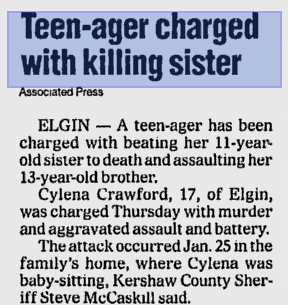
On January 25, 2001, 17-year-old Cylena Crawford from Elgin, South Carolina was left to feed, care for, and discipline her brothers and sisters while her mom worked and her father was otherwise occupied. That day, however, her “discipline” meant brutally beating both her 13-year-old brother Michael and 11-year-old sister Korresha — and the latter fatally so. Korresha died the following day from bleeding to death.
On January 25, 2001, Cylena Crawford brutally disciplined both her 13-year-old brother Michael and 11-year-old sister Korresha — and the latter died as a result.
Cylena was the oldest child in the Crawford family. Her mother Sylvia worked 2 jobs to support the family and her father Lawrence was a Nazarite priest who believed in Pentecostalism. All of the Crawford children were allegedly homeschooled by Lawrence, though “he often wasn’t home” and neighbors “rarely saw the children” outside their mobile home. Cylena had four siblings: Michael (13), Korresha (11), and 2 others (a boy, also 11 years old, and a girl 9 years old). Cylena reportedly “often was left in charge.” The entire responsibility of her siblings fell to her: she fed them and, “if they got out of line, would spank them.” In 2000, the year prior to the murder, social services were called to the Crawford home due to an anonymous tip about neglect, but no neglect was able to be substantiated.
On the day of the beatings, Cylena was left in charge of her siblings as was usual. After Michael and Korresha did something wrong (it remains unclear what exactly), she started disciplining them with a 1-1, 18 inch board. However, according to reports, something went wrong: “Once she started, she got carried away with the 11-year-old.” Authorities said Cylena beat Korresha “on the head, body, arms and legs,” and Michael “in the back and about the body.”
Complicating the situation was the fact that Lawrence was home this day. Not only that, but Korresha was still alive when her mother returned as well. Despite being disoriented, Korresha told her parents about the beatings at 10 pm the same day. They did nothing, however, until the following morning when Lawrence found her unconscious on her bedroom floor. Despite being rushed to the hospital, Korresha was unable to recover. Officials said she “bled to death after blood seeped through her muscle tissues for several hours.”



 Homeschoolers Anonymous