When Homeschooling Gets Crunchy: Darcy S.’s Thoughts

crunchy

Darcy blogs at Darcy’s Heart-Stirrings. Darcy is a wife and mother to two girls and two boys and lives in the mountains of central Montana.

So I’m a bit of a hippie.

I believe the popular term nowadays is “crunchy.” I’m a huge supporter of Attachment Parenting, I birthed my babies at home, breastfeed toddlers, harvest my own herbs, make my own house-hold cleaners, have lived off-grid, can milk a goat and make kefir out of the fresh milk. I don’t eat placentas, though. I have standards.

I’m a non-conformist, even among the non-conformist community.

I follow a lot of hippie/crunchy pages and blogs. I have many friends that live this lifestyle, including a great local Attachment Parenting group where I’ve enjoyed hanging out with other parents similar to me.

I’m seeing a movement, a push maybe, toward homeschooling and “unschooling” that is making me feel unsettled.

These are not religious people and most aren’t homeschooling for religious reasons at all.  I completely support responsible homeschooling and the right to homeschool, and I support the right for children to have the best education possible. But I’m seeing homeschooling completely and utterly romanticized by people in my generation who were not homeschooled, not a part of the culture of homeschooling pioneers that I grew up in and experienced firsthand. These people paint homeschooling as the best most awesome experience, many of them never having experienced it, and they all read each other’s blogs that only talk about how great it is and how bad and “unnatural” public schools are. I see people being drawn to homeschooling for reasons that seem…..off to me, and unrealistic and downright misguided. I often want to ask “Are you sure you know what you’re getting yourself into?” but many times from the sound of the conversations, it doesn’t seem like they do.

Many of my crunchy mom friends have expressed surprise that my own kids are in public school.

They just cannot fathom that someone who was so “blessed” to be homeschooled would not “give that gift” to their own kids.

I’m at a loss what to think or say because these are not the fundy homeschoolers of my past. They’re hip, tolerant, non-religious, very nice, educated people, who have been given a pretty picture of homeschooling from blogs that only paint half the picture. I realize that the concept of homeschooling is new and exciting for them while it’s old news to me. But I feel like the picture they have of homeschooling from all these blogs is very unrealistic, and they may be setting themselves up for a harsh dose of reality.

The ideas that are flying around on crunchy virtual hang-out spots about homeschooling also sound suspiciously like everything I was taught about homeschool versus public school. There’s a lot of fear and misinformation and lines being draw in the sand. I’m seeing our schools being demonized, painted as the enemy of our children, the enemy of education and free-thinking, “social experiments” — and don’t forget to throw in a few Hitler references to make it complete.

Then there’s the dogma.

Which really baffles me because I’m used to dogma coming from religion. This meme was posted by a non-religious, progressive parenting page I follow on Facebook:
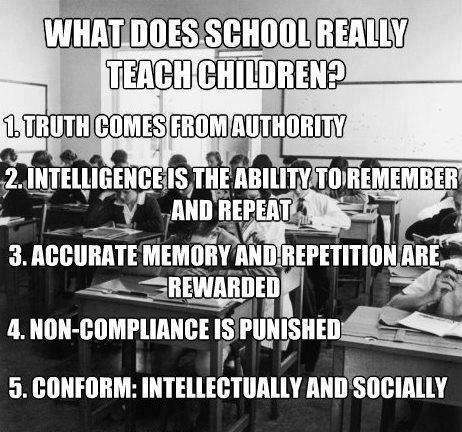
programming_conditioning

Now, this meme is old news for me.

My fundy homeschool buddies have been passing it around Facebook since Facebook began.

The fact that this is now being passed around by proponents of homeschooling and “unschooling” who are not religious and considered “progressive” is concerning. It seems that there is a new hatred of public school that is beginning to take root, and it has nothing to do with Christians. All the illogical, misinformed, sensationalist arguments against public schools that I’ve seen for years, is being repackaged, regurgitated, and spit out all over the websites of people who think they are some kind of pioneers, that this “rebellion” against formal education is all their idea. They ridicule other parents who put their kids in school, saying we must not love our kids if we send them to “government brainwashing centers” (sound familiar?). Which, of course, usually makes me laugh out loud because I’m pretty sure the homeschooling leaders of the conservative movement of the ’80’s invented that term.

Really though, all they’re doing is perpetuating the exact same dogma that has turned so many of us first-generation homeschoolers away from homeschooling.

You don’t have to be religious to be bigoted or to promote propaganda. A young child of non-religious home-schooling parents just told my daughter “Oh I don’t go to school. School is bad.” Now where have I heard that before?

I feel that I am in a unique position.

My past is colliding with my present. Alumni like me have a lot to offer to the conversation of “new wave homeschooling,” but I feel that often our concerns are brushed aside since “oh, well, we aren’t religious so we won’t have the same problems you did.”

But they already are showing signs of the same problems the original homeschoolers had, just from a completely different point of view.

Ultra-sheltering of children, polarizing, dogma, misinformation, and fear are present in this new generation as much as they were in the old. I’m worried about where this might be going, feeling like I’m watching history on repeat, a helpless bystander as some very familiar insanity is marching by me.

I guess what I want to communicate to my hippie homeschooling friends is this: by all means, homeschool your children. But let me tell you what kind of commitment that’s going to require if you want your kids to have a good education. Because all those blogs you’re reading aren’t telling the whole story. Your kids aren’t going to learn what they need to excel in the world by cooking and painting and playing outside all day. Let me tell you how my mom devoted 27 years of her life to doing nothing but educating us because in order to give us a good education, she had time for nothing else. Allow me to tell the story of how sheltering children in the name of “protection” can utterly backfire. Can we talk about what kind of attitudes surrounding homeschooling can damage the children you love and how to raise healthy kids? Perhaps I can offer the perspective of someone who was raised the way you’re dreaming of, only without the rosy glasses you seem to be looking through. And can we not hold to an “us versus them” mentality? Been there, done that, did its damage. Homeschooling can be awesome. But it can also be horrible. Can I tell you my story and the stories of my friends?

Maybe together, the alumni and the neo-homeschooler parents, we can keep some of the disastrous results of the first homeschooling movement from repeating themselves.

On Feeling Betrayed, Validated, and Brave: Jeri Lofland’s Thoughts

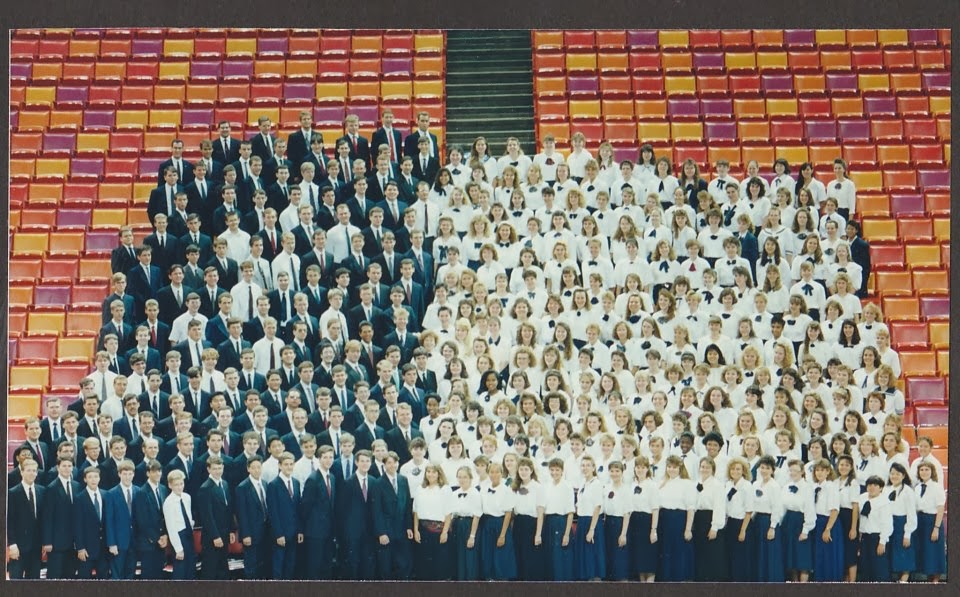
An IBLP seminar in Atlanta.

Jeri Lofland blogs at Heresy in the Heartland. The following was originally published by Jeri on January 30, 214, and is reprinted with permission.

*****

And since your history of silence
Won’t do you any good,
Did you think it would?
Let your words be anything but empty

Why don’t you tell them the truth?

 Say what you want to say
And let the words fall out
Honestly 
I want to see you be brave
 
Show me how big your brave is
~ Sara Bareilles, “Brave”

*****

Watching the Grammys was a last-minute decision. We’d kissed the kids goodnight but knew our congested sinuses wouldn’t let us sleep yet. So we turned on the TV and I’m so glad we did!

I had never heard of Sara Bareilles–no, I really don’t keep up with popular music–but I recognized Carole King right away. I sat absolutely enthralled with their amazing duet performance, only to be surpassed by their comments of mutual admiration afterward. Somehow the three minutes of interaction between those women affected me deeply. I have watched the segment again and again and replayed it in my head countless times.

Carole King’s words, her music, the emotions she shared with Sara and all of us in the audience, along with Sara’s passion and her song, felt like a gift with miraculous powers to repair some damage done to my heart long ago. I feel like a more complete person than I was before hearing them sing. The rest of the show was fun and amazing in its own way, but that one piece represented to me the magic of Art: sharing a gift with enriching powers of its own.

Perhaps “Brave” struck me the way it did because the last week has been so emotionally turbulent. Not in a bad way, but still…

Last week a shocking new series of revelations appeared on the Internet, exposing Bill Gothard, our cult leader of days long past, for the pathological fraud he was (and is). Reading the story as it dribbles out in serial form has been surreal. With each installment, I can picture my bedroom in Oak Brook, picture window facing Gothard’s office across the driveway.

I learned while working on Gothard’s staff that he was not what he appeared to be.

Not what many of his followers took him for. Not who my parents thought he was. While we his brainwashed army of second-generation devotees mentally flogged ourselves for every potential breach of the cult protocol, Gothard did not adhere to his own “non-optional, universal life principles”.

My husband and I each slipped away from IBLP quietly. I was sent away by Gothard in the summer of ’99, Chris left on his own six months later. From that point, we set about freeing ourselves from the legalism and reprogramming our poisoned minds. We weren’t aware of the poison at first, though. We were still nostalgic about our years at the Institute. It was where our relationship began, after all. We’d go back to visit friends occasionally, or just drive around the grounds reliving the good memories. Over time the locations lost their pull on us. We had dreams–sometimes nightmares–about going back to work there.

Judging Gothard’s teaching by its “fruit”, we concluded that many of his ideas were downright toxic. It was hard to speak out, though. So many of our friends, family members, and even new acquaintances were Gothard supporters, or had been exposed to his seminars in their youth and didn’t see anything dangerous in them. We just sounded “bitter”, the strongest pejorative in Gothardom.

When we felt safe we could sometimes talk about how “inconsistent” Gothard was in practice. Even this made some uncomfortable. People feel defensive when you question the authenticity of someone they trust, or trusted once upon a time. The more distance we put between ourselves and the past, the more clearly we could see that Gothard was just another manipulative cult leader.

Sadly for us, he was a slick fellow who convinced our parents he had the answers.

I started my blog partly as a safe place to question the Gothard narrative and to recount my experiences and the “bad fruit” it produced. I tried to maintain an even, journalistic tone, even as I personally came to regard William Gothard as a fucking asshole, a sham and a predator hiding under a guise of exceptional holiness.

Reading the firsthand account of Gothard’s former secretary over the last week, and watching others come out to corroborate her story, has been tremendously validating to me. While her tale might not seem all that offensive on the surface, it is damning when read in light of Gothard’s own teaching and strict standards for others. He made generous allowances for himself, while tolerating nothing less than perfection and submission from his subordinates. He patently violated his own rules, which he marketed as the very wisdom of God. Nothing I have ever said about my former employer was as harsh as he deserves.

As satisfying as it feels to be validated and to watch Gothard’s house of cards collapse, it is exquisitely painful at the same time. I rejoice to see his empire fall, much as a former prisoner would applaud the demolition of the walls of his captivity. And yet, that empire was built of my blood, sweat, and tears. Thousands of us can point to pieces of our selves that we sacrificed to advance that sick man’s vision. We lost much of irreplaceable value.

And that is why tears rolled down my face this week as I stood in my kitchen spreading cheese on lasagna noodles, listening to “Brave” and the rest of Sara Bareilles’ album The Blessed Unrest. They were tears to memorialize the things I was encouraged to “yield” in favor of Gothard’s ideal, for God’s sake. These things died before drawing breath, miscarriages I never knew in an adolescence I never had: my first date, holding hands, a boyfriend, my first curious kiss in a quiet corner, even talking to male peers without feeling queasy, pulling on an old pair of jeans, experimenting with makeup, realizing I was a free adult in the eyes of the law, choosing a college major, getting a degree, a high school graduation for that matter, a prom dress, high school pictures, a wedding dance with my dad, my favorite artists in concert, feeling sexy as I became a woman, feeling the sun on my legs, getting tan lines before stretch marks, years when I could have been earning money or college credits…

And the pain of steeling myself to believe in “God’s will”!

Against my emotions. Against what my body was sensing. Of giving myself fortifying speeches in the corner every time I felt my heart would come out of my chest, reminding myself that my heart was deceitful and wicked and not to be trusted. The times I cried myself to sleep, or pounded out my frustration on the piano in the dining room because the rest of Christendom wouldn’t see “the truth”.

My friends and I made these sacrifices and others to serve our God by working for his “servant” Bill Gothard. Now, I want Gothard’s empire to collapse, for the good of humanity. I am more than willing to help bring it down. At the same time, I recognize that each brick I tear out represents a child’s education, a man’s career, an abused child, a couple’s budding relationship, all burned on the IBLP altar in the belief that God would be pleased.

But Bill was a fraud and his empire was built on lies.

And we are all breaking the silence.

So after I cried over my lasagna, I danced in my kitchen. Because bravery is a beautiful thing.

sun

Bill Gothard, Sexual Predator

Doug Phillips and Bill Gothard.

HA note: The following is reprinted with permission from Libby Anne’s blog Love Joy Feminism. It was originally published on Patheos on February 6, 2014.

Bill Gothard has been a big name in the Christian homeschooling movement since its very inception.

Gothard runs the Advanced Training Institute (ATI) and the Institute for Basic Life Principles (IBLP), puts on family life seminars, and produces curriculum and “wisdom booklets” used by Christian homeschooling families across the country, including the Duggars (Bill Gothard himself spoke at Josh Duggar’s sister-in-law’s wedding, which was featured on the Duggars’ television show). Gothard’s influence in the Christian homeschooling world likely eclipses that enjoyed until recently by Doug Phillips, and certainly eclipses that of the Pearls or Botkins.

While my own parents were not strict Gothard followers and were more influenced by other leaders, they did adopt some of the ideas he taught (umbrella of authority, anyone?). Further, I was in an all-girls Gothard Bible study for a time (COMMIT), and several families I was close to were Gothard followers.

Bill Gothard never married. In the years that I’ve been blogging, I’ve heard more than a few people comment on this. How odd that someone who makes his living off of preaching about godly family life never married! It’s not like there would have been a shortage of picture-perfect Christian women who would have been honored to marry him, after all.

Well, the reason Gothard never married is starting to come to light—and it’s very, very ugly.

I’ve been following Recovering Grace, a group focused on correcting the errors of Bill Gothard’s teachings and exposing problems in his ministry, since they launched several years ago, and I soon noticed a pattern in some of the posts. It seems Gothard has displayed some weirdly improper behavior, and even harassment, toward some of the many teenage girls who staffed his ministries and offices, often working as volunteer interns and often coming at his personal invitation. It was very common among Gothard followers for parents to send their teen and twenty-something daughters to work for Gothard, and remains so today—one of the girls from the Gothard Bible study I attended as a girl is actually currently at headquarters, working for Gothard.

Many questions have run through my mind as I have read these stories of impropriety on Recovering Grace. One question is how these things could go on without anyone noticing. But as I’ve read, I’ve noticed another pattern—Gothard’s followers were so sotted with hero worship that they refused to see. In story after story, graduates of Gothard’s programs have said they thought it odd that Gothard would spend so many hours alone with teenage girls, behind closed doors, but he was Gothard—and Gothard could do no wrong.

But things have now turned a corner. Recovering Grace has put up a new post, this one pulling together the threads and providing background information, not only about Gothard’s recent past but also about his distant past—a past many of his followers have been unaware of for the past three decades.

The Recovering Grace team has decided that over the next couple of months we are going to release a large volume of information concerning the life and ministry of Bill Gothard. This information will come in the form of personal accounts, never-before-published documents and correspondence, and factual reports of events that were swept under the rug years ago. Additionally, many of the coming articles will clearly show how individuals attempted to reconcile with Bill Gothard and/or follow the Matthew 18 process but were met with persistent refusal to acknowledge the issues, distortion of the truth, and a resistance to follow biblical steps towards humble repentance.

Then came Charlotte’s story. Her story was the first that moved beyond grooming accompanied by uncomfortable and unwanted hand holding, caressing, and footsie. Her allegations are so serious that the Recovering Grace team felt the need to publish the confessions of two witnesses backing up her story. You can read Charlotte’s story yourself, but I do want to post an excerpt (HA note: trigger warnings for child molestation if you read the full version):

We went to a conference in Knoxville in July of 1992. That’s where I first met Bill Gothard. I remember he wouldn’t let go of my hand, and he kept telling my parents how sweet, beautiful, and pure I was… I was 16 years old… He wanted me around him as much as possible, wanted me to be with him as much as he could get me… He’d keep me with him to “talk.” It started out with him telling me how beautiful I was, how I inspired him, and how I made him feel alive. It went to hand-holding, then long hugs. He would touch me and hug me after devotions and then take me to the eight o’clock staff meeting session. His assistant would drive us to the staff meeting…We would meet after dinner in his office around 7 or 8 p.m. That’s when he started really touching me…

I am sure the statute of limitations has passed for a lot of this, and I don’t know whether Gothard can be taken down legally. I’m sure the Recovering Grace team is looking into it. Regardless, I would like to hope that Gothard will be increasingly seen as the sexual predator he is, and that this will dethrone him from his prominent position in the Christian homeschooling world.

I’m increasingly seeing the Christian homeschooling culture as an unsafe place for girls and young women.

I wonder about my childhood friend and her work at headquarters, and I worry for the girls Gothard continues to surround himself with even today. And when I remember that Bill Gothard had successfully weathered a sexual abuse scandal even before I was born, I despair of things changing.

At least now we know why Gothard never married.

Ham on Nye

Screen Shot 2014-02-06 at 9.37.40 PM

HA note: The following is reprinted with permission from Kierstyn King’s blog Bridging the Gap.  It was originally published on February 6, 2014.

I actually didn’t plan on writing anything about the Ham on Nye debate Tuesday night.

I planned on drinking and eating popcorn and watching  everything implode in a talk-past-each-other kind of way. My mouth hurt (still does, I have even better numbing stuff now, but it makes my lips stick together), we ended up getting milkshakes because Ham is more triggering and milkshakes are more comforting.

The debate went as I suspected it would – more cathartic for me and those of us who have left the Young Earth Creationist camp we were raised with. Ham had all the same material, I’d heard everything he’d said before at VBS, in DVD’s, and his theology permeated my “science” books even though they weren’t exclusively AIG. I knew all his answers, I’d seen all of his graphics, he said absolutely nothing new, at all, I remembered everything verbatim from my previous encounters with AIG as a child. To Nye, this idea is so unfathomable that he had trouble grasping and understanding his audience and I don’t know that he knew what he was getting into. To the people in that room, YEC is more than a science…theory(?), it is, in a very real way, a (the) foundation of their religion.  Believing in a Young Earth is somehow, essential to this brand of christianity, my whole family, I think, is Young Earth, my immediate definitely, if not my grandparents too.

None of the arguments made in the debate were really going to change anyone’s minds I don’t think. I don’t know how many people were listening to it like a presidential debate, being really on the fence about religiously-intoxicated creationism and mainstream science, but who knows.

During the Q&A session though, Nye said one thing, one groundbreaking thing, and I don’t know if he even realized it.

He said “I don’t know“.

What he probably didn’t know (or maybe did) when he walked into a room and an audience loaded with people who have been raised or told all of their lives and all of their childhood that they have to know all the answers to everything all the time and that “I don’t know” is not an answer and if you don’t know, something is wrong – saying “I don’t know” in a way that did not have defeatist or negative connotations is something that people raised in this sheltered and toxic environment have probably never heard. Their parents may have, but have denied themselves and their children that option, they’ve rejected the idea of not knowing for the burden of having to always know and have thrust that upon their children at very young ages.

Fellow homeschoolers have written about having to know the answers to all questions – even questions about the legality of homeschooling from the time they were like 6. This is true and this is devastating and this is too much, no one, let alone any child should be required to know the answer to everything. Yet this is what fundamentalists do – they require themselves and everyone they gather into their brand of religion (or non-religion) to have all of the answers to everything. They must always be able to back up a question with a pre-scripted answer that allows for no nuance. I don’t know is invalid.

People asked him the questions creationists are scripted to ask evolutionists (because they don’t know the answer but we do! HA!) and he answered, happily, excitedly, unashamed, and like he had been waiting to say it all night because it’s such a beautiful answer: I don’t know.

Ken Ham, and every entrenched creationist in the audience I’m sure scoffed at Nye’s reply. But what he said, in those three words, is something more powerful than he can know.

Because to the people who were watching who are tired of having to know everything because they realize they don’t know, who are maybe doubting, who are maybe thinking, who are maybe just trying to keep their head down to get by but secretly (even so secretly they may not realize it yet) want to taste something different, something not straight out of the book, Bill Nye just introduced the concept of freedom.

Because the freedom to not know (and that be an okay, even good thing) after coming from an environment where you must know is so so powerful. But one of those things, where you only realize it’s power once you’ve come to terms with the idea that it’s okay to not have the answers.

Bill Nye just introduced hundreds or thousands of people to the idea that “I don’t know” is valid, and okay, and not wrong.

That is the most important thing (I think) that happened in the debate, that’s what I haven’t been able to get out of my head. I don’t know. And it’s beautiful.

How I Left My Parents’ Home

Screen Shot 2014-02-04 at 12.06.32 AM

HA note: The following is reprinted with permission from Sarah Henderson’s blog Feminist in Spite of Them. It was originally published on her blog on September 2, 2013.

Several people have asked me about actually leaving my parents. It’s kind of hard to explain exactly what happened, because there was not one day when I decided to leave.

When I was 16, I was still attending a conservative church with my parents. In my family we were still expected to wear head coverings all the time, but the church we attended only expected them in churches. So in December of 2004 (when I was 16) I decided to stop wearing one at all – to me you either follow that verse 100% or not at all, and I wasn’t going to be the only one. I also secretly purchased jeans and changed into them on rare occasions when I was allowed out with church friends.

The summer of 2005 around my 17th birthday, I went for a week to visit my very secular grandparents in another province. They asked me some questions about what I wanted to do for a career.

I had not been asked that question, as my destiny was to get married and be a homeschooling mom even though I didn’t want that.

My grandparents mentioned that I couldn’t go to university without a high school diploma, and explained that I probably couldn’t even get a GED with how little schooling I’d had. This was news to me since I’d always been told our way was the best way to do anything, but it had the ring of truth.

When I got home, I looked into schools. I found I needed to have parental signatures to attend at age 17, so I privately convinced and cajoled my mom to sign, which she did, although it is my belief that she thought I would give up. My father refused to sign when he found out, and no one told him my mom signed, and the school accepted one signature and none for the bus (as I recall) because by then my mom was too scared to sign anything else. What is confusing about this is that in the summer my father drove me to take an ACT test (useless in Canada) which seemed to encourage academia, but it was with a bunch of homeschoolers so maybe it was the in thing to do for homeschoolers.

Miraculously my parents did not physically prevent me from going to school on the first day, I think because they knew it would probably be noticed if I didn’t go after all the trouble to sign up and get placed into many different classes across all four high school grades. I was expected to wear dresses. That lasted for a few weeks, and then I pulled out the secret pants. My parents tried to force me to change but I refused, and I ran out to catch the bus in a whirlwind of shame.

I quickly made friends with Christian kids at school that were mostly my age, some a bit younger. Two friends I made were sisters, and I would go to their house sometimes for ‘homework projects’. We were on the same bus route so it was easy to do, and their parents drove me home if they asked.

I was invited by other friends to a youth group at a mainstream Pentecostal church. I asked my parents for permission and they said yes sometimes and no sometimes and sometimes would drive me and other times refused when it was too late to find another ride. This was about November.

During this time I opened up a bit to the family I mentioned above with the two sisters. Once at their house I mentioned how hopeless life was with my family and that I was very upset (I didn’t really know what depression was). They told their parents, and somehow I ended up staying at their house for the weekend and just never went home (about November or early December 2005). I know that their dad went to several meetings with my dad and his church friends, and the consensus from my dad’s angle was that at 17, CAS would not force me to return home and it was better not to get the police involved to try and get me back since I was too far gone in rebelliousness anyways, and CAS might take a hard look at seven younger children who were not attending school.

I was able to get a few things from my parents’ home, but my father didn’t waste any time to completely pack up my room, junking most of it and putting lots of my stuff into the damp garage. I basically started life over with the family, I continued going to school, getting decent grades, going to church and youth group, and spending time with friends.

I’ve never really talked publicly about this before, but I need to talk about mental health here. I believe that I spent my first 17 years in some kind of survival state of mind. When I got out and was living with another family, I experienced a whole different lifestyle. The parents worked and provided for the family. I had a few chores like some laundry and dishes, but my job as a student was to do school.

There was also this whole unconditional love bit, and for the most part the emotional state of others in the home was predictable.

Children got pats on the back for doing something well. There was a certain expectation for behaviour and no one really crossed it- it just wasn’t optional. There were no out of control behaviours, because they were taught how to behave when they were younger.

One big problem I had was that I was so used to being told no that I assumed that parents just said no to be nasty. I had to learn at 17, at home and at school, that some stuff was ok and other stuff wasn’t,  and how to tell the difference. I had to learn in a flash how to use judgement because I was never taught that. My philosophy had just been ‘do whatever you need to do to stay out of trouble and try to enjoy life’. But in school and normal family life there are rules to follow so that you don’t violate the rights of others and everything runs smoothly.

I didn’t know that.

It was very hard on me to experience this “culture shock” and to realize how bad I was at relationships.

I had to go to grade 9 math, which I found very shameful. I didn’t know what the bells meant at school. I didn’t know how to share tasks at home. I realized I was very selfish after years of looking out for myself for all those years, and it was impossible to just switch that off when I was in an environment where there wasn’t too many people competing for too few resources. I also realized by comparison how chaotic, unreasonable and toxic my home environment had been. I didn’t know. And then it hit me that I still had siblings there.

It was a very difficult few years. I fell into depression for a while, but I somehow continued school because in this family school wasn’t optional so thankfully if you weren’t sick you went. The family also supported me in making regular calls to CAS over the next two years, so by the fall of 2006 my next brother and sister were enrolled in school at CAS’s recommendation, and the following fall my father was forced to leave the home by CAS for non-compliance and all the siblings were enrolled in school.

I also had many excellent teachers over my three years in high school who seemed to look for the good in students and were compassionate as long as I was trying. Between being granted some credits and earning the rest in three years, I graduated at 20 with a real diploma and I was given a plaque from the principal at commencement – a student leadership award. After graduating high school I was able to go to university and get both a BA and a post graduate degree in four years, and graduate from university on the Deans list.

I no longer have any kind of relationship with my father at all, and my relationship with my mother is complex, as do many of my siblings still live with her.

There is no one reason why I left. Obviously I had quite a bit of help, and there must have been a certain obstinate streak for me to seek out that help.

I have been free for 8 years now. It’s great. 

Lauren Dueck Joins HARO as Board Chair

We are pleased to publicly announce Lauren Dueck has joined Homeschool Alumni Reaching Out as our Board Chair.

Lauren Dueck.
Lauren Dueck.

While she has been working behind the scenes for months, Lauren is now officially joining HARO’s other founding board members — R.L. Stollar, Nicholas Ducote, Andrew Roblyer, and Shaney Lee — as we move forward in the creation of our non-profit. The HARO board recently meet in Chicago to plan our next steps. We are excited with what the future has in store as we all work together towards HARO’s vision of “Renewing and transforming homeschooling from within.”

About Lauren:

Lauren was homeschooled from Pre-K through high school, primarily in Colorado, where she was involved in a myriad of homeschooler activities ranging from Christian Home Educators of Colorado (CHEC) to Colorado Advocates for Home School Arts (CAHSA). She was also a part of the founding classes of CREDO Academy and the Colorado chapter of the National Homeschool Honor Society. In high school, Lauren competed, judged, and coached around the country in the National Christian Forensics and Communication Association (NCFCA), and contributed to several NCFCA sourcebooks as well. She received both the Boettcher and Coca Cola scholarships.

Lauren attended the University of Chicago, where she became deeply invested in a Christian student movement aimed at cultivating thoughtful, passionate faith in the university environment, and soon began to work on multi-ethnicity issues. In 2009, she graduated from the University of Chicago with a BA and MA in Slavic Languages and Literatures, and earned a place as a finalist for the Rhodes Scholarship before joining the staff of a national evangelical campus ministry. Serving as Campus Staff at the University of Chicago for four years, Lauren became known as a specialist in crisis intervention and cross-cultural ministry. She has been a featured speaker at several national events, including Chicago’s Coming Together 6 conference.

Most recently, Lauren accepted a national role with the same campus ministry. In her spare time, she writes movie and TV reviews at Three Second Reviews and makes and sells vintage handicrafts. She also has a chronic case of wanderlust, and blogs about her travel adventures at FollowLauren.com.

Why Feminist Homeschoolers Are a Fatuous Professor’s Worst Nightmare: Teresa’s Thoughts

jane-austen1

Teresa would like to give a shout-out to Libby Anne and all the people who comment on her blog. She reads Love Joy Feminism every day. 

Let us leave out, for the moment, this gullible prof’s extreme shortsightedness, when it comes to the longevity of the average college student’s views on life.

I take issue with this man’s definition of feminism.  He is straw-manning those with whom he disagrees.  Dismissing the commonsensical idea that feminism might have something to do with “equal pay for equal work,” Dr. Markos declares that “academic feminism rests on the fiercely-held belief that there are no essential differences between the sexes.”

Dr. Markos, I must tell you: as one of the homeschool girls you praised for being capable of challenging your “masculine view of the world” (your words sir, not mine) I would appreciate it if you refrained from telling me how to be a feminist.

To me, it sounds as if you are delineating a certain caricature of feminism I grew up with: that to be a feminist means being mannish.  And unlovely. 

Is this honest, professor?

I wonder what you would say, Dr. Markos, if one of those doted-on homeschool graduates informed you that the ideas you’d praised her for disowning, had never been adequately or honestly presented to her in the first place?  

Suppose one of them ventured to admit that there was actually something to this idea of leading a rich and full life.  That there was value in the idea of women being capable of independence, and of courage.

Would you admire the dear girl less, Dr. Markos?  My idea is that you would quickly prop up your flattened straw-man:  “My dear young lady, pray remember that a feminist hates being a woman and longs to be a man!  Consider how unattractive feminism will make you to men!  To ME!”

Feminism was born to save us from such.

You praise us because we resemble Jane Austen’s characters.

And yet, if there is one thing that all of Jane Austen’s heroines had in common, it is the fact that they were completely dominated (though not necessarily fooled) by what Betty Friedan would one day call the “feminine mystique”.

If you are an admirer of this system, I do not think you stand with Jane Austen.

What I find in Pride and Prejudice, alongside the sparkling narrative, is a nagging problem (a precursor to “the problem that has no name”.)  It is well fleshed out in the part where Charlotte Lucas decides to marry a guy she isn’t crazy about:

Without thinking highly either of men or matrimony, marriage had always been her object; it was the only provision for well-educated young women of small fortune, and however uncertain of giving happiness, must be their pleasantest preservative from want.

I hope you would agree, Dr. Markos, that the circumstances that created Charlotte’s situation are not good.  Self-preservation should be an option for women regardless of whether marriage is on the table.

So much for Charlotte Lucas.  But, what if the core problem isn’t just Charlotte’s?  Suppose it extends to every woman, young and old, that lives in a world like the one in that book?

Let’s take a look at Elizabeth Bennet, whose youth and beauty enabled her to reach the pinnacle of success (in such a system): marrying a wealthy guy she actually likes.

Surely you, and I, and most Austen fans, have occasionally wondered…

Now what?  What does she do with the rest of her life?

But Austen avoids the question.  She stops the book.

It’s as if she knows there is no answer. 

Dr. Markos, I would argue that Betty Friedan gave us that answer.  Or, at least, fresh hope that we would find one (since the answer is surely different for every human being, in every age.) Betty Friedan asked us a question eternally asked by people who resemble Elizabeth Bennet, post-marriage...  people who had gotten the husband they wanted, but still felt the need to do something with the rest of their lives:

Each suburban wife struggles with it alone.  As she made the beds, shopped for groceries, matched slipcover material, ate peanut butter sandwiches with her children, chauffered Cub Scouts and Brownies, lay beside her husband at night- she was afraid to ask even of herself the silent question– “Is this all?”

Dr. Markos… I am a former homeschooled girl who decided that it isn’t.  

This isn’t all.  

One last thing I think you and I need to address:

Feminists, whose view of the world is far more masculine than my own, do not like homeschooled girls, for such girls explode all the vicious and untrue stereotypes that feminists have been propagating for the last several decades.

Careful there, professor.

The stereotype you explode may be your own.

Christian Patriarchy is Alive and Well: NCFIC’s Scott Brown Moves to Fill the Void

Source: https://ncfic.org/about/internship

HA note: The following is reprinted with permission from Julie Anne Smith’s blog Spiritual Sounding Board. It was originally published on January 31, 2014.

With the demise of Vision Forum Ministries and the vacancy left by Doug Phillips after the public disclosure of his sexual immorality, the most likely candidate has stepped up to the plate to fill that void: Scott Brown.  Scott Brown is the director of National Center for Family Integrated Churches (NCFIC), which was originally part of Vision Forum Ministries, but later branched off into an independent ministry effort.

One of the highly acclaimed programs at Vision Forum was the internship opportunities for young men (read:  Christian Patriarchy Indoctrination 101 and free labor help for Doug Phillips). Mr. Brown has jumped on that bandwagon and is now putting out the call for his new internship program at the National Center for Family Integrated Churches whose goal is:

dedicated to promoting the restoration of biblical church and family life. We believe that God’s design for the church family will not be realized unless men reclaim the mantle of sacrificial leadership at home, in the church, and in society, at large.

What does NCFIC intern program look like?

You as an intern will learn about the biblical doctrines of church and family, work to communicate the message of the NCFIC, and provide the manpower necessary to carry out various conferences. 

Here is the list of books interns must bring with them (recent editions preferred):

  • The Sovereignty of God, A.W. Pink
  • The Expository Genius of John Calvin, Steven Lawson
  • Knowing God, J.I. Packer
  • The Deliberate Church, Mark Dever
  • How God Wants Us to Worship Him, Joe Morecraft
  • Lectures to My Students, Charles Spurgeon
  • Father, Son, and Holy Spirit, Bruce Ware
  • God-Breathed, Louis Gaussen
  • Preaching: How to Preach Biblically, John MacArthur
  • Evangelism and the Sovereignty of God, J.I. Packer
  • Revival and Revivalism, Iain Murray
  • The Institutes of the Christian Religion, John Calvin (McNeill)
  • Systematic Theology, Louis Berkhof
  • The Lord’s Day, Joseph A. Pipa, Jr.
  • Always Ready, Greg Bahnsen
  • God’s Gospel of Grace, Jeff Pollard
  • Family Reformation, Scott Brown
  • A Weed in the Church, Scott Brown
  • Building a God-Centered Family, Matthew Henry

Because the interns will be serving at Hope Baptist church, they will be required to sign some paperwork first:

Before coming to Wake Forest, interns must read the Hope Baptist membership package and doctrinal statement. Interns must also be in agreement with and sign the Hope Baptist church covenant, effective for the duration of their internship.

This is part of the application paperwork:

Source: https://ncfic.org/uploads/about/NCFIC_-_Intern_Applicationdocx.pdf

Some of the questions asked on the application:

  • Explain the key elements of the biblical doctrine of the family

(AKA: They want to know, did your daddy teach you that you will be ruling over your wife and children?)

  • Explain key elements of the biblical doctrine of the church

(AKA:  They want to know,  do you know your Reconstructionism doctrine?)

  • Explain key elements of the biblical doctrine of repentance

(AKA: they want to make sure you don’t embarrass them like Doug Phillips did.)

Folks, if you thought Christian Patriarchy Movement was dying out because of Doug Phillips, think again.

I suspect the Christian Patriarchy crowd will be stronger than ever in their attempts to spread their Patriarchal and essentially Reconstructionist message to the masses.  What a great way to vamp up this message by getting free and enthusiastic labor from young men who are already sold on these ideas.

P.S.  Did Scott Brown — ahem — “borrow” intellectual property when making up the intern application? Here is a cached version of the Vision Forum’s application.

A Brief History of ATI and HSLDA’s Relationship

Screen Shot 2014-02-02 at 10.06.53 PM

By R.L. Stollar, HA Community Coordinator

Numerous discussions have arisen online about the relationship between HSLDA and IBLP/ATI. The following is a detailed account of what can be publicly confirmed about that relationship.

Originally called the Institute in Basic Youth Conflicts (IBYC), The Institute in Basic Life Principles (IBLP) was founded in 1961 by Bill Gothard for the purpose of “introducing people to the Lord Jesus Christ.” IBLP’s headquarters are in Oak Brook, Illinois. IBLP has a number of educational programs, one of which is the Advanced Training Institute (ATI, previously ATIA). ATI — which HA covered during our “Inside ATI: A Homeschooling Cult” series — is IBLP’s homeschooling program, the core curriculum of which are the “Wisdom Booklets,” described by IBLP as “a 3,000-page amplification of the Sermon on the Mount.”

According to the Advanced Training Institute, “In the scope of the ATI curriculum, the Bible is the main textbook, the Wisdom Booklets are the core curriculum.” That “core curriculum” began development in 1984 by a team that worked under the direction of 3 individuals: Bill Gothard, Dr. Larry Guthrie, and Inge Cannon.

Bill Gothard and Michael Farris

Bill Gothard, as previously stated, is IBLP’s founder.

Less known, however, is that Michael Farris and his wife Vickie embraced the Quiverfull lifestyle specifically because of him.

As documented in Kathryn Joyce’s Quiverfull, Michael Farris “came to his Quiverfull beliefs through the ministry of Bill Gothard.” In the 1980s, Gothard preached that God should determine family size. And “one of Gothard’s early converts was [HSLDA’s Michael] Farris, who was already primed for the message of letting God control Vickie’s fertility by early anti-contraception literature and his immersion, in the late 70’s, in a conservative Christian movement in Washington State.”

Vickie Farris herself explains this in her book A Mom Just Like You, saying,

Mike had recently been ordained through our local church in preparation for his new job in Washington, DC. He was invited to a pastors’ seminar taught by Bill Gothard, and one of the things Bill discussed that day was the fact that children are always mentioned in the Bible as unqualified blessings… He encouraged the men at the seminar to have as many  children as their faith could handle! When Mike came home and told me the things Bill had said, we decided then and there, with some trepidation, to trust God and stop using birth control. (page 68)

This influence led Vickie to pass on the message and “encourage other women to reject birth control methods and embrace motherhood.”

Inge Cannon and HSLDA

A graduate of Bob Jones University, Inge Cannon was truly the overseer of launching ATI’s Wisdom Booklets in 1984. According to HSLDA’s accounting, it was while working at Maranatha Baptist Bible College that “she was first introduced to the concept of home education. Bill Gothard, founder and president of the Institute in Basic Life Principles, invited Inge to attend a special conference to plan the foundation of the Institute’s home education curriculum, the Advanced Training Institute of America.” In 1985, Cannon moved to Oak Brook specifically “to direct the ATIA program.” She then continued to develop ATI — both the program itself and the curriculum — until 1990. In 1990, after 6 years of working with Gothard and directing ATI, Michael Farris himself sought her out to find a Director of HSLDA’s new division, the National Center for Home Education. She filled the position herself, becoming “the first executive director of the National Center.”

It ought to be stressed that Inge Cannon is responsible for the ATI curriculum — especially the Wisdom Booklets. More than that, as documented by Jeri Lofland, Cannon discouraged young people from going to college during ATI conferences in Knoxville. As Lofland notes,

I was just one of thousands of young people who were told that we didn’t need college credits, that college would corrupt our minds with “vain philosophies” and threaten our faith, that there are some things “God doesn’t want us to know”, and that employers would come looking for us because of our diligence, obedience, and virtue. So, many of us dutifully eschewed degrees in favor of home-based study.

Cannon being recruited by HSLDA’s Michael Farris was not mere coincidence. Cannon herself points out that she and her work is officially “endorsed” by not only Bill Gothard, but Michael Farris (as well as Bob Jones, III).

Larry Guthrie, Inspiring Speaker

The third person overseeing the development of the Wisdom Booklets in the 1980s was Larry Guthrie. In addition to writing “science and medical curriculum materials” for ATI, Guthrie is “the former director of the Children’s Institute”. The Children’s Institute, as discussed by Lana Hope, was where children “started learning about the umbrella of authority from the age of 5.” He also wrote some of the Character Sketches sold by Gothard’s ALERT program.

Still a keynote speaker at homeschool conferences, Guthrie has been promoted by HSLDA as “inspiring.” In 2011, HSLDA promoted the Minnesota Association of Christian Home Educators Annual Conference and Curriculum Fair, featuring Guthrie. Similarly in 2013, Peter Kamakawiwoole, HSLDA Staff Attorney, encouraged HSLDA members to attend a conference with Guthrie as keynote speaker.

Beyond Curriculum Developers

The warm camaraderie and partnerships between ATI and HSLDA extend beyond the direct relationships between ATI’s Wisdom Booklet developers (Gothard, Cannon, and Guthrie) and HSLDA. Dianne Hurst, ATI’s grammar curriculum developer, was featured on HSLDA’s Home School Heartbeat for a week. Hurst is also married to HSLDA’s Membership and Human Resources Director, Chuck Hurst. Steve Wells, who worked with Gothard and ATI to develop an online distance learning engineering program (the parent to IBLP’s Telos Institute and Verity College), also appeared on Home School Heartbeat for a week. Inge Cannon was similarly featured on Home School Heartbeat — and more than once.

Vicki Bentley, HSLDA’s coordinator for Toddlers to Tweens and Group Services, recommends ATI for “Bible/Character Training” in the Virginia Homeschool Manual she compiled.

In the 2008 edition of HSLDA’s Court Report, HSLDA featured a history of “The Early Days of Homeschooling.” HSLDA highlights Bill Gothard and Inge Cannon, saying ATI “helped many families get started.” Additionally, ATI is featured on HSLDA’s official curriculum list. ATI is also an HSLDA Discount Group, and just last summer HSLDA promoted an ATI “success story” in Court Report.

In 1989, prior to Inge Cannon joining HSLDA, she helped support a memorandum in Ohio written by HSLDA’s Michael Smith. This memorandum explained “that there is no legal requirement in Ohio that a homeschooling instructor possess a college degree.” According to HSLDA,

Mrs. Inge Pohl [Cannon], Director of Education for the Advanced Training Institute of America (a nationwide homeschool program), testified at trial in North Dakota that in testing 5,000 youngsters pursuant to their program, they found no significant correlation between the parents’ education and their children’s success in testing.

ATI and Patrick Henry College (started and initially funded by HSLDA) also share a rich donor. Dr. James Leininger, a Texas physician, homeschooling parent, and part-owner of the San Antonio Spurs, has long bankrolled conservative Christian projects. He was a founding director of Vision Forum. He served on the Advisory Board for IBLP. And not only was he “one of the first and most significant contributors” to HSLDA’s Patrick Henry College, he also is currently on that college’s Board of Trustees.

Jordan Lorence, ATI, and HSLDA

More than anyone, Jordan Lorence represents the working relationship between ATI and HSLDA. (You might recognize Lorence most recently as the lawyer representing the New Mexico photographer who refused to photograph a same-sex ceremony.)

In the late Christopher Klicka’s book Home School Heroes: The Struggle & Triumph of Home Schooling in America (a book endorsed by Lorence himself, which you can see on the book’s back cover), Klicka points out that Lorence worked with HSLDA from the very beginning. Starting in 1984, Lorence worked part-time for HSLDA and handled legal contacts with homeschoolers. It was Lorence, along with Michael Farris, that interviewed Klicka when he was hired by HSLDA.

In 1985, Lorence served as HSLDA’s Director.

In 1991, Lorence became a full-time staff attorney for HSLDA, focusing on HSLDA’s presence in Canada.

During this time, Lorence also worked with Bill Gothard and IBLP/ATI. Lorence spoke for several years at ATI conferences held in Knoxville and Oklahoma; he was a welcome and well-known guest. There is an online record of his presentation at a 1994 ATI conference in Knoxville. In 1996, Lorence represented IBLP in the court case Institute in Basic Life Principles, Inc. v. Watersmeet TP.

Jordan Lorence  also played an instrumental role in Oak Brook College of Law, as discussed next.

Oak Brook College of Law and HSLDA

The final and most significant relationship between ATI and HSLDA involves Oak Brook College of Law.

Oak Brook College of Law (based in Fresno, California but sharing the same name as IBLP’s geographical location — namely, Oak Brook, Illinois) was launched by ATI itself. In fact, OBCL is still listed on IBLP’s website as one of IBLP’s educational programs and their graduation ceremonies were held at IBLP Training Centers. Not only that, but law students at OBCL study Bill Gothard’s Basic Seminar material.

Law students do not simply study Gothard’s Basic Seminar material, however.

According to Oak Brook’s official college policies as of last year, a “prerequisite for admission” into the school is “attendance at all the sessions of the Seminar in Basic Life Principles sponsored by the Institute in Basic Life Principles.”

When OBCL was launched in 1995, it was done so as a joint effort between ATI and HSLDA stakeholders. Bill Gothard served as the law school’s Chancellor (and he still is the Chancellor), Michael Farris served on the Board of Trustees, and former HSLDA director and staff attorney Jordan Lorence served (and continues to serve) as the school’s Constitutional Law Professor as well as is Chairman of Oak Brook’s Board of Advisors. ***

The relationship continued when graduates of Oak Brook faced difficulties taking the bar in states other than California. In 2005, HSLDA specifically supported Texas House Bill 826 (which ultimately failed to pass) because “homeschoolers who graduate from the distance-learning school Oak Brook College of Law in California are currently prohibited from taking the Texas Bar Exam.” HSLDA highlighted that Oak Brook students “have worked as Legal Assistants for the HSLDA Legal Department” and HSLDA “hired two graduates of the school to work as lawyers in our office.”

Graduates of Bill Gothard’s law school have indeed gone on to work for HSLDA. HSLDA attorney Darren Jones graduated from Oak Brook. Will Estrada, HSLDA’s Director of Federal Relations, graduated from Oak Brook. HSLDA Legal Assistant Elliot Ko graduated from Oak Brook. HSLDA attorney Tj Schmidt graduated from Oak Brook. Former HSLDA legal assistant Daniel Beasley graduated from Oak Brook.

*** Update, February 15, 2014: Jordan Lorence emailed Homeschoolers Anonymous on February 10 and said that, as of February 10, he had “resigned from all of [his] connections with Oak Brook College of Law.” There is no official statement from the college itself on the matter. However, a screenshot from Oak Brook’s website on January 20 shows Lorence listed as faculty; their current faculty page no longer lists him.

The Ideal Homeschool Girl

Screen Shot 2014-01-29 at 8.55.03 PM

HA note: The following is reprinted with permission from Faith Beauchemin’s blog Roses and Revolutionaries. It was originally published on January 29, 2014.

There’s a sick little article floating around the homeschool/ex-homeschool blogosphere right now.  It’s basically one college professor’s gross fetish fantasy about “homeschool girls” (meaning, his formerly homeschooled students who are actually presumably grown women).  He likes them so much because they’re so feminine (“just like a Jane Austen character,” he says repeatedly, leading me to wonder how drastically this English professor has misread Austen and other groundbreaking female writers) and not like those ugly mean selfish feminists.

My most creepy-crawly feeling while reading the article came from the total objectification and dehumanization of women who have been homeschooled.

Mr. Markos, you revel in interactions with homeschooled women because homeschooled women were brought up specifically to please men like you. What goes on behind the scenes to craft that “glorious and unashamed femininity”?  You see the finished product, a woman poured into the mold of a conservative Victorian ideal and seemingly content there (“enthusiastic”, you say, and I am trying to remember any of the legions of homeschool girls I’ve ever known who was truly enthusiastic about performing any part of traditional femininity that was not already rooted in her own personality).  You don’t see how many girls are brainwashed, shamed, abused on a daily basis before they are finally broken down to the point where they can be thus remade.

You would admire my sewing skills, but you would never know about that winter day when me and all my homeschool girl friends were stuck inside learning to quilt while our brothers played in the snow.  You wouldn’t know how badly I longed to be outside, sledding and throwing snowballs, instead of inside learning the traditional feminine arts.

Performing traditional Victorian femininity can be fun….

You might be impressed that I can draw, until you learned that most of my drawing was used to illustrate a fantasy universe that was populated by women having adventures, going on quests, fighting battles side by side with men.  Or used to illustrate my Star Wars fanfic, where I piloted a space ship and spied for the Rebels.  Or used to design dresses not to be sewn by me, but as part of a secret dream to move to New York City and be a fashion designer.

You’d have praised my “razor-sharp wit” when it was parroting Ann Coulter or whatever I’d learned at church that week, but now that I use it to eviscerate folks like you, it is “marred and twisted by the politics of identity and victimization.”  (And see here you set yourself up to win against all critics, because if I argue that our original identities, pre-brainwashing, are not like the “femininity” you describe, I am now playing the victim card and am therefore “unfeminine” and undeserving of your time).

You might not know, Mr. Markos, anything real about these formerly homeschooled women you interact with.  

Because do you know what we learn above all?  We learn to hide.  

We learn that our real selves are not acceptable.  Anything within us that does not fit into the mold doesn’t necessarily go away, we just have learned not to show it to authority figures or, many times, to potential suitors.  Those in authority over us are the ones enforcing the “ideal girl” model, so the quickest way to avoid punishment and shaming is to perform femininity as we have been taught to.  Because we aren’t taught to be feminine.  Where someone falls on or off the gender spectrum is, I believe, something that is found on one’s own, inside, not something that is taught (gender does not really make sense in my head, but I think that’s probably a side effect of growing up with such strict gender roles).  A person can learn to perform gender traits that have no real resonance with who they are.

And wouldn’t you?  If you were constantly under threat, continually told that god, your parents, and your future husband (who is The Most Important Person You’ll Ever Meet) would all hate you and shun you and turn up their noses in disgust at you if you didn’t fit this particular mold, wouldn’t you force yourself to fit it?  If you were constantly told that “this is what a good woman is,” by everyone around you, wouldn’t you think that you were the problem, that you were a thing to be fixed?

You don’t know these “homeschool girls” you’re talking about, Mr. Markos.  

You don’t know the actual story of their lives, possibly because the real world of homeschool women is kept very segregated from the world of men.  And you don’t know how many of them will join me and my friends in the feminist camp before too long.

…but then, swinging on a vine across a chasm to escape Stormtroopers is pretty fun too.

So stop fetishizing my pain.  

It is distressing to see you and so many other Christian men drooling over a neo-Victorian mold of “femininity” (that you label it “Austen-esque” just adds insult to injury).  Drooling selfishly over the idea of a woman whose only purpose in life is to keep your home and to keep you happy.  Drooling over the thought of a woman whose only thought is to please and serve you and maybe oh-ha-ha-ha take you down a peg or two if you are being too “bombastic” but only because she respects you so much.

Women who fit the classic “feminine” mold aren’t less human than women who don’t.  I have never, and will never, think so.  But you’re not saying your personal romantic/sexual preference is women who are quietly intelligent and skilled in the arts.  Many people have romantic/sexual preferences, and that’s completely acceptable.  What’s not acceptable is generalizing your personal and oh-so-weirdly-specific preference and turning it into what everyone born with a particular genital configuration “should be.”  You’re saying that all women, in order to be true women, in order to be truly “feminine” (feminists, you say, are more “masculine” than even you! *gasp*) have to be like this.  And you’re looking at homeschooled women, who were brought up in a culture that thinks like you do, and praising them for being, as you think, monolithically “feminine.”  That perception is not true, not fair to homeschooled women, and insofar as it does bear resemblance to reality, is because of cultural pressures and religious threats, not because of any innate “feminine” qualities.

I’ve seen too many women (and too many people who were assigned female at birth but, surprise, aren’t female, because yes Mr. Markos gender is not the same thing as what you consider biological sex, and conflating the two as you do causes untold damage), myself, my friends, my sister, unspeakably harmed and psychologically and physically abused all for the sake of fitting into that false ideal mold.  I’ve seen peoples’ vibrant personalities little by little give way, squashed into the mold.  I’ve seen other friends who weren’t brought up this way torture themselves, briefly, to go from independent woman to some Christian boy’s submissive ideal, and fortunately escape before any lasting harm was done.

Any man who marries a woman because she fits the “ideal homeschool girl” mold is only perpetuating oppression.  And maybe that’s why they all think feminists are “mean”:

Because we’ll never stop calling you out on this.

Mr. Markos, you can go home and rub one out to Lizzy Bennett as many times as you want, but please stop reducing real human beings to nonconsensual players in your little fetish game.