HA note: The following is reprinted with permission from Libby Anne’s blog Love Joy Feminism. It was originally published on Patheos on October 1, 2013.
I can’t believe you are almost thirteen.
I remember holding you in my arms when you were a baby. I remember rocking you, smiling at you, cooing to you. I remember your tiny fingers and your dark, soft hair. I remember dressing you, bathing you, cuddling you close. I was always the first to jump up and volunteer to get you up when that sweet plaintive wail came from your cradle.
Thirteen. Wow. You’ve grown so big, so tall and clever. I know what thirteen means. Dad will take you out to dinner and give you a ring. You will put it on your finger and promise him that you will not have sex until the day you marry. I know you will because I did too. And when you say it, you will mean it. I know that. So did I.
But I want you to know something, my sweet little sister. You are worth so much more. Your worth is not defined by what has or has not been in your vagina. Yes I know, hearing that word spoken so openly embarrasses you. I remember. But what I’m saying is important. You have so much to offer the world. You are smart. You have interests. You have talents. Those things matter. In fact, those things matter a whole lot more than the state of your vagina. Yes I know, awkward. But it’s true, and I want you to remember that. You matter.
There’s more, too. It is wrong, what they are telling you. Should you choose not to have sex until your wedding day, your virginity is not the most precious gift you will ever give your husband. In fact, depending on whether or not your husband will come from the same religious and cultural background as you, he may not even see your virginity as a gift at all. And if he doesn’t, don’t hold that against him, okay? The idea that virginity is something of value is “culturally constructed.”
That’s just a fancy way of saying “made up.”
There’s something else I want to tell you as well. You probably think that I didn’t have sex until my wedding night. Well, that’s not true. We almost waited until the wedding, but not quite. Yes I know, telling you that is awkward.
But I want you to know that they are wrong when they saying that having sex before you get married will damage your relationship.
It hasn’t.
I don’t regret doing it, and I don’t think it messed up anything at all. In fact, I wish I hadn’t waited as long as I did. I tell you this not to tell you which way of doing things is right and which way is wrong, because that is up to you and is yours to decide, but simply to give you another perspective.
But the most important thing I want you to know, little sister, is that your body is yours.
You get to choose what you want to do with it. You will have people telling you what you can and can’t do with your body, when, and how much, and how far. But you don’t have to listen to them. Your body is yours, and don’t let anyone make you forget that. What you do with it is up to you. It’s your choice. Own that, and don’t let anyone else make your choices for you.
I’m not going to send this letter to you, little sister, because mom and dad wouldn’t like it. Putting it here is the best I can do. Perhaps someday you will find it, and read it, and then you will know how frequently you are on my mind.
This week, the Duggars announced that their daughter, Jessa, had begun a “courtship” with Ben Seewald. News articles have been floating around in my facebook feed about this, and as I read a few of them . . . my heart sank. Many people are mocking the family, Jessa, Ben, her parents, for how they’ve chosen to handle this.
I can’t get behind the mocking.
All I can feel right now is compassion for Jessa and Ben.
It’s an emotion they might dismiss as completely unwarranted– from all appearances, they’re blissfully happy, and this courtship is what they’ve always envisioned for themselves. I don’t know about Ben, but everything I’ve seen from Jessa is familiar territory– she’s carefully “guarded her heart” so one day she could date with “intent and purpose.” The way she’s been taught to respond to romantic relationships probably feels very mature and sensible. It’s designed to be safe. Everything about it is carefully vetted, monitored, and controlled. There won’t be any unexpected surprises for them. This process will help ensure a happy, Spirit-filled marriage.
But, if I could sit down with Jessa over a cup of tea and talk with her, there’s a few stories I would share.
*****
The eldest daughter of my “pastor,” Leah*, was in her early twenties when an evangelist that came to our church every year suggested a young man, Steve*, to her father. Over the next month or so, her father carefully vetted this young man. The first time Steve came to visit, he didn’t even meet Leah. Her father took him out to dinner, then they sat in his truck for hours while he grilled him from pages of notes and questions. Barely any stone was left unturned– but I remember my father commenting offhand that it’s not likely that Steve was really honest about most of those questions.
The next time Steve came, he and Leah were never given a moment’s privacy. They were never allowed to be more than a few feet away from another member of the family. When he left, they were not allowed to talk on the phone, and could only communicate through letters that were read, out loud, in front of the entire family.
They did, eventually, get married. The next thing I heard about her was that she and Steve had not yet consummated their marriage, not even after being married for months. They were complete strangers when they got married. They didn’t know anything about the other– the only person they had gotten to know had been the person her parents expected to see. Without any private moments, without the ability to talk without being constantly monitored, they didn’t really know anything real.
They’d “courted” a performance, not a person.
*****
When I was in college, one of my best friends got married.
Their courtship story was perfect– charming, adorable, romantic in a Victorian sense. Her parents called him her “suitor” and his visits were “calls.” They had no physical contact– her father put the engagement ring on her finger when he proposed on the beach, in the moonlight– in front of their families. When they went through the wedding rehearsal, they held a handkerchief instead of holding hands. Their first kiss was at the altar, and Charity* looked like she was about to burst with happiness for the rest of the day.
It’s been a few years now, since they got married, and they’ve experienced some significant marital “bumps” in that time. There were a few moments when no one was sure if their marriage would make it. My mother was trying to give hers some comfort and advice during one of those hard times, and I remember hearing her start crying:
“I don’t understand, I just don’t understand. We did everything right. None of this was supposed to happen.”
*****
My own courtship experience was . . . ugly.
We “talked,” getting to know each other strictly in group settings, just like we were supposed to. I asked my parents to come meet him, and we all went out to dinner. I made sure that my father had plenty of time to talk with him, to get to know him. John* asked their permission to “court” me, and we did under the supervision of both our parents. By the end of the summer, he laid out his plan for them, what he planned to do and how he planned to accomplish it, and asked their permission to marry me. When he proposed at a fancy restaurant, my parents were sitting at a table directly across the aisle. For the first six months, everything seemed perfect. It was all going exactly how I’d been taught it should.
But, after I had that ring on my finger and I was in the middle of planning a wedding, and after all our families were on board and we’d announced it to everyone we knew… that was when the abuse began in earnest. It was abuse he kept carefully concealed from anyone– abuse I was promised I was protected from, because, after all, we were courting. We’d done everything exactly how we were supposed to.
And I was trapped.
Because I’d been told to guard my heart, that once I give my heart away, I won’t have my whole heart to give to my husband.
Because I’d been taught that it was my duty, my responsibility, to make sure our relationship was perfectly chaste. He knew that– he sexually assaulted me, he raped me, and he used what I’d been taught against me. I was a cup full of spit. I was a half-eaten candybar. I was that rose with all the petals torn off.
No one would want me, I wasn’t good enough for any other man.
*****
That’s what I’d tell you, Jessa, if I could talk to you.
I’d tell you that courtship doesn’t guarantee that you’ll actually get to know that person. I’d tell you that yes, you have to know how a person interacts with people who aren’t you, but you also have to know how he’ll interact with you when no one is watching.
I’d tell you that courtship doesn’t guarantee a happy marriage. There’s no magical promise that is impossible for either one of you to break. Following all the courtship procedures and rules means nothing when you realize that life has changed around you, and you might not believe everything you always did– and he hasn’t changed with you. Courtship doesn’t automatically grant you the ability to communicate without fighting or to have patience with each other. Most of the things you need for a healthy marriage you don’t get through having your parents monitor all your texts and never touching each other longer than a 30-second side hug.
I’d tell you that courtship doesn’t guarantee you won’t get hurt.
People are very capable of hiding. People can be very good at cloaking everything about themselves– especially when they are given an insanely precise checklist to follow. The roadmap, the rules, the procedure– they’re not going to shield you from a man using those rules to get close to you so that he can hurt you.
You might be getting to know this person on an honest, deep level– I don’t know. It’s possible that he’s a genuinely wonderful man and both of you are being completely, bluntly honest. It’s probable that you were raised with the understanding that you never hide anything from your parents– and up to this point, why should you? But, it’s also just as possible that you’re both innocently unaware that you’re not really getting to know each other.
Courtship, you’ve been told, promises a safe adolescent experience, free from the trauma and heartache of a thousand “crushes.” Courtship holds the sweet sanctuary of your parents’ blessing and God’s promises. Courtship is about commitment, and honor, and responsibility, and those are the things that will keep your marriage strong.
And maybe– maybe it will.
But, in the end, if you make it, it won’t be because you courted. It won’t be because of all the questions your father asked him or all the times you wanted to be alone but suppressed the desire. It won’t be because you kissed for the first time after the pastor said “you may.”
It’ll be because of who you are, Jessa, and who he is.
Results of HA Basic Survey, Part Five: Fundamentalism as a Factor in Educational Quality, Abuse, and Other Areas
Whether or not respondents were homeschooled in a fundamentalist Christian environment made the most dramatic differences in both educational quality and abuse. The results are fascinating. There are also interesting differences between fundamentalist environments and non-fundamentalist environments concerning HSLDA membership, parental education, and the current level of respondent education.
Before continuing, it is important to note once again that this survey is self-selected and should not be construed as representative of anything other than the 242 respondents that took this survey.
Fundamentalism and HSLDA Membership
While the Home School Legal Defense Association claims to defend any and all homeschoolers, it has a reputation as a conservative fundamentalist organization. There is a plethora of documentation concerning HSLDA’s projects that fall outside mere advocacy for the legality of homeschooling. Those projects are traditional, conservative fundamentalist projects, such as opposition to same-sex marriage and UN treaties as well as support for candidates like Mike Huckabee and Rick Santorum.
Considering that context, it is interesting to note that — for respondents — membership in HSLDA did not rise or fall according to whether a family was fundamentalist or non-fundamentalist.
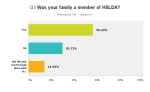
Filtered by fundamentalist. 2013 Homeschoolers Anonymous Basic Survey.
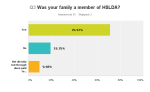
Filtered by non-fundamentalist. 2013 Homeschoolers Anonymous Basic Survey.
For respondents who grew up in fundamentalist Christian families, the following was true:
56.22% said their families were directly members of HSLDA.
14.05% said their families were indirectly members of HSLDA through dues paid to a homeschool organization.
29.75% said their families were not members of HSLDA.
For respondents who grew up in non-fundamentalist Christian families, the following was true:
70.97% said their families were directly members of HSLDA.
9.68% said their families were indirectly members of HSLDA through dues paid to a homeschool organization.
19.35% said their families were not members of HSLDA.
In our pool of respondents, therefore, there was not that much of a difference in HSLDA membership (approximately only 5%) between fundamentalist and non-fundamentalist families. Furthermore, the percentage of HSLDA members among non-fundamentalist families was slightly higher.
Fundamentalism and Parental Education
The level of education achieved by the primary teachers of respondents was slightly higher among non-fundamentalist Christian families compared to fundamentalist ones.
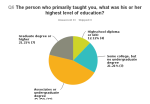
Filtered by fundamentalist. 2013 Homeschoolers Anonymous Basic Survey.
Filtered by non-fundamentalist. 2013 Homeschoolers Anonymous Basic Survey.
For respondents who grew up in fundamentalist Christian families, the following was true concerning the highest level of education of their primary teacher:
4.32% had no high school diploma or GED.
15.14% had a high school diploma or GED.
23.78% had some college but no degree.
41.62% had an associates or undergraduate degree.
15.14% had a graduate degree or higher.
For respondents who grew up in non-fundamentalist Christian families, the following was true concerning the highest level of education of their primary teacher:
12.12% had a high school diploma or GED.
21.21% had some college but no degree.
45.45% had an associates or undergraduate degree.
21.21% had a graduate degree or higher.
Whether respondents grew up in fundamentalist or non-fundamentalist families, that did not seem to significantly increase the highest level of parental education of the primary teachers.
There are a few differences — for example, all respondents that grew up in non-fundamentalist families had a teacher that at least had a high school diploma or GED (compared to 4.32% without them in fundamentalist families). Also, the level of education did increase slightly: there were more teachers with college or graduate degrees in non-fundamentalist families, but only by a few percentage points.
Fundamentalism and Respondent Education
Whereas the level of parental education did not change much between non-fundamentalist and fundamentalist Christian families, the highest level of education that respondents personally achieved did change in noticeable ways.
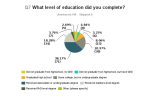
Filtered by fundamentalist. 2013 Homeschoolers Anonymous Basic Survey.
Filtered by non-fundamentalist. 2013 Homeschoolers Anonymous Basic Survey.
For respondents who grew up in fundamentalist Christian families, the following was true concerning the highest level of education they personally achieved:
4.84% have no high school diploma or GED.
3.23% have a GED but no high school diploma.
8.06% have a high school diploma.
23.66% have some college but no degree (this includes the 2.69%, or “Other,” which fit the “some college” category).
38.17% have an associates or undergraduate degree.
18.28% have a masters-level degree.
3.76% have a PhD-level degree.
For respondents who grew up in non-fundamentalist Christian families, the following was true concerning the highest level of education they personally achieved:
18.18% have some college but no degree (this includes the 3.03%, or “Other,” which fit the “some college” category).
54.55% have an associates or undergraduate degree.
12.12% have a masters-level degree.
15.15% have a PhD-level degree.
This means that 100% of respondents from non-fundamentalist families have some level of college education, compared to 83.87% of respondents from fundamentalist ones.
Indeed, among respondents from non-fundamentalist families, the first three categories — (1) no high school diploma or GED, (2) GED but no high school diploma, and (3) high school diploma — disappeared. All numbers began with at least “some college.”
This also means that 81.82% of respondents from non-fundamentalist families have a college degree or higher, compared to only 60.21% of respondents from fundamentalist ones.
Fundamentalism and Educational Quality
How respondents rated the quality of their educational experiences dramatically changed when results were filtered by fundamentalist versus non-fundamentalist environments. Indeed, the changes are striking.
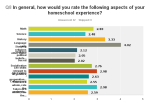
Respondents from fundamentalist Christian families gave their homeschool experiences — in totality — an average score of 2.81, less than the median score of “So-so”:
Filtered by fundamentalist. 2013 Homeschoolers Anonymous Basic Survey.
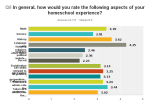
Respondents from non-fundamentalist Christian families their homeschool experiences — in totality — an average score of 4.2, higher than the base score for “Adequate.” The visual difference here is striking:
Filtered by non-fundamentalist. 2013 Homeschoolers Anonymous Basic Survey.
This is an increase of almost one and half points between fundamentalist and non-fundamentalist respondent groups. This is one of the most significant increases seen in this survey yet.
Fundamentalism and Abuse
While the difference in educational quality between respondents from fundamentalist families and non-fundamentalist families was striking, the difference in experiences of abuse is even more so.Indeed, the difference in experiences of abuse is the most glaring of all of the results from this survey.
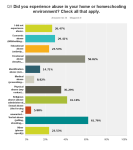
The majority of respondents from fundamentalist Christian families (71.2%) experienced one or more forms of abuse.
The most common forms were emotional abuse (61.41% experienced this), verbal abuse (52.72%), religious abuse (46.74%), and physical abuse (33.70%). This means that the majority of respondents from fundamentalist Christian families experienced emotional and verbal abuse.
Filtered by fundamentalist. 2013 Homeschoolers Anonymous Basic Survey.
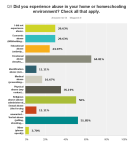
The overwhelming majority of respondents from non-fundamentalist Christian families (93.55%) did not experience abuse.
Whereas 61.41% of respondents from fundamentalist Christian families experienced emotional abuse, only 6.45% of respondents from non-fundamentalist families did. Whereas 46.74% of respondents from fundamentalist Christian families experienced religious abuse, only 3.23% of respondents from non-fundamentalist families did. Whereas 33.7% of respondents from fundamentalist Christian families experienced physical abuse, only 3.23% of respondents from non-fundamentalist families did.
Filtered by non-fundamentalist. 2013 Homeschoolers Anonymous Basic Survey.
As this is — once again — a self-selected survey, these results do not accurately represent the frequency of educational quality and abuse in fundamentalist or non-fundamentalist Christian homeschool families. The results do suggest, however, that fundamentalism is a highly significant factor in the quality of education and the experiences of abuse for the adult graduates of the Christian homeschool movement that took this survey.
In fact, fundamentalism is the most significant factor thus far.
HA note: The following is reprinted with permission from Caleigh Royer’s blog, Profligate Truth. It was a guest post by Katharine Diehl for Caleigh’s “I Have a Voice” series andoriginally published on September 16, 2013.
About the author: Katharine Diehl is 22 and lives in Brooklyn, NY. She has a BA in psychology and her poetry has been published in Squalorly and Fickle Muses. She works part-time but she needs more money, so if anyone would like to pay her to write or be a professional poet, she is available. She blogs about writing and writes about other stuff at frozenseawriting.tumblr.com.
*****
I can never tell if I have forgiven my parents.
Not for spanking my baby brother, who was crippled from neuroblastoma and died at the age of 5. The spankings were rare, compared to other families; my dad had a sort of business going, creating “spankers” out of conveyer belt. My sister and I laughed at the children we knew whose parents hit them with spoons or pieces of wood. I was tough. I could take it. But I hid and shivered when I knew they were doing it to my sick brother.
Later my dad held my brother, after the coma, after he was gone, and sobbed.
Once I put a few acorns in my winter coat pocket and zipped it up; when I opened it months later, there were tiny dead worms. I was a little girl and squeamish and terrified, and my dad yelled at me for not knowing that the worms would hatch, and he put the worms in his hand and chased me in a circle around the living room, trying to get me to touch them and clean out my coat. Later I had a nightmare he was chasing me with a WWII Japanese sword his grandfather had given him.
When I told him about it, he cried because he did not know I was afraid of him.
That is the essence of my childhood. I think that my parents loved us but were disappointed that they did not have good children, and blamed themselves, and read too many books by Dobson and the Pearls. I was not good. I had a rebellious attitude. I asked too many questions. My sensory integration problems made me afraid to touch terrycloth or crumbs or let others brush me lightly, and loud noises made me feel ill, and my parents worried that they were signs of rebellion. The other children in our church were so well behaved.
My friends’ parents told them not to tolerate my behavior.
Things got better after the black years of early adolescence — nights when even God would not listen to my pleas to take the burden from my heart and cleanse it. I prayed to him every day and read the Bible, especially the Psalms, but the peace that passes all understanding would not come. But I began college on a scholarship, found new friends, and took long, lonely walks for hours where I was able to inhabit my body instead of dissociating constantly.
I learned to soothe myself with reading and walking instead of food.
My parents, grown more liberal, allowed me to visit a therapist after some panic attacks, and when I got on medication it was as if the dirty pane of glass blocking me from the world had finally lifted and there I was, naked and standing in the singing air.
Last fall my progress shattered, that delicate glass framework that held me up, when my little sister overdosed on ibuprofen. I had seen her, homeschooled, isolated, only one friend who lived a state away, spending more and more time in bed during the day. She woke, ate breakfast, and retreated to wrap herself in a blanket and sleep again. She looked like a sad burrito, I joked, and she looked at me blankly. I found her thinspiration blog, and saw the cuts in her arms. I was afraid to tell my parents, though they were concerned, because I felt homeschooling caused her isolation and I could not say that to their face. After all, I’d turned out okay. Maybe it was a phase. I am ashamed to say that I did not advocate for her, did not tell another adult.
I was afraid like a little girl instead of the woman that I was. That I am.
I was about to present my proposal for my senior honors thesis before a group of professors when she called my cell and hung up. I called back and left a message. Finally she picked up — she was home alone — and asked me what happened when you took too many pills. I said she should go to the hospital, and she started to cry. So I did the only thing I could do. I called 911 and they swooped in and took my skinny little sister, cuts all over her arms, to a hospital and kept here there for a week.
She told the doctors she was trying to kill herself, and then she changed her story.
My parents believed the second story.
She, too, has gotten better — it was the catalyst allowing her to receive therapy. She also has Celiac, and her moods have improved since changing her diet. She went through an out-patient eating disorder program and she is a healthy weight now. She is dealing with other problems now that I don’t feel comfortable sharing, but all together, she is healing herself. She is making herself whole and it has ripped me apart and put me back together, I think, being able to see her do that.
My boyfriend has helped me. He has been my rock and my shelter, as blasphemous as it is to say that- because he is not a god, but a friend and a lover. I met him when I was 20 (I’m 22 now), and he is not a Christian. My mother has suggested I marry him (a law student) and “be very poor” with him. I think she doesn’t want us to live in sin any longer, because when I visit him, I stay overnight. Whenever I return home, my dad says he hopes I had fun — but not too much fun.
My sister says I am wounding my family by dating an agnostic. My aunts asked me if he loved Jesus with all his heart.
The answer is no.
But I love him with all of my heart.
And that is that. My parents have apologized for things that never bothered me — criticizing me too much, fighting too much. I know they love me, but they will never see that their insistence on those rigid Christian values and their insular homeschooling, their need to shelter us, are the things that have harmed.
They did not cause my little sister to become suicidal, but like a mushroom grows best in moisture and the dark, the conditions were there.
I had a dream once that my dad’s mother — an alcoholic in his childhood — came to me and told me that she was the mother of all our sorrows. I have always tried to place my troubles (and triumphs) in a narrative, in archetypes, because it makes them easier to bear; but I have rarely had dreams with such truth in them.
Trouble and sadness are generational. My grandmother’s mother, a strict Spanish Pentecostal, made her kneel on rice and pray for hours until her knees were embedded and encrusted with the raw grains. My dad’s father died in his childhood. My mother told me once that she felt she lived her life in a dark room with no windows. My parents have never forgiven themselves, though I have made halting progress toward forgiving them.
I say this to say that placing blame, no matter how it helps, can also hurt.
My blood has sadness in it from generations of mental illness and cruel religion. I don’t know who to blame. Myself most of all and least of all, perhaps. The blame is dispersed and I hope and pray and tremble that the sadness will leave us — that my children, if I have them, will never be taught about an angry God or fear that they are not scrupulous, pleasing, or pretty enough.
My precious children, I will say, you exist. That is beautiful and I know that is enough.
I pray that God, whoever or wherever He is, feels the same.
Results of HA Basic Survey, Part Four: Parental Education as a Factor in Educational Quality, Abuse, and Current Religious Beliefs
In every one of the following categories — educational quality, abuse, and current religious beliefs — parental education seemed to correlate to a decrease or increase. As parental education increased, the following consistently occurred: the quality of education improved, abuse decreased, and homeschool experiences were less likely to have influenced respondents’ current religious beliefs. Also, as parental education increased, those who experienced a fundamentalist Christian environment decreased.
Parental Education and Educational Quality
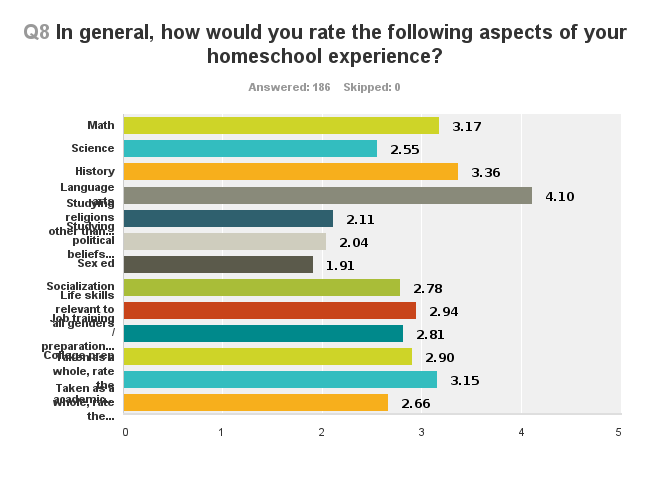
Averaging the scores for all aspects, respondents gave their educational experience a score of 3.06, slightly above the median score category of “So-so.”
When the primary teacher had no high school diploma or GED, respondents’ scores for their educational experience averaged at 2.21.
When the primary teacher had a high school diploma or GED, respondents’ scores for their educational experience averaged at 2.74.
When the primary teacher had some college education but no degree, respondents’ scores for their educational experience averaged at 2.76.
When the primary teacher had an associates or undergraduate degree, respondents’ scores for their educational experience averaged at 3.23.
When the primary teacher had a graduate degree or higher, respondents’ scores for their educational experience averaged at 3.47.
Filtered by no high school diploma or GED. 2013 Homeschoolers Anonymous Basic Survey.
Filtered by high school diploma or GED. 2013 Homeschoolers Anonymous Basic Survey.
Filtered by some college but no degree. 2013 Homeschoolers Anonymous Basic Survey.
Filtered by associates or undergraduate degree. 2013 Homeschoolers Anonymous Basic Survey.
Filtered by graduate degree or higher.
There is a significant decrease in expressed educational quality from respondents whose primary teachers had a graduate degree to those who primary teachers had no degree or diploma whatsoever — a decrease of 1.26 points. Not only that, but perceived educational quality consistently decreased as parental education decreased.
Notable areas in which educational quality dropped significantly are: (1) socialization, dropping from 3.63 (graduate degree or higher) to 2.62 (high school diploma or GED) and ending at 1.78 (no high school diploma or GED); (2) college prep, dropping from 3.51 (graduate degree or higher) to 3.0 (high school diploma or GED) and ending at 2.11 (no high school diploma or GED); and (3) intangibles in general, dropping from 3.66 (graduate degree or higher) to 2.63 (high school diploma or GED) and ending at 1.67 (no high school diploma or GED)
Parental Education and Abuse
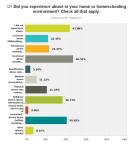
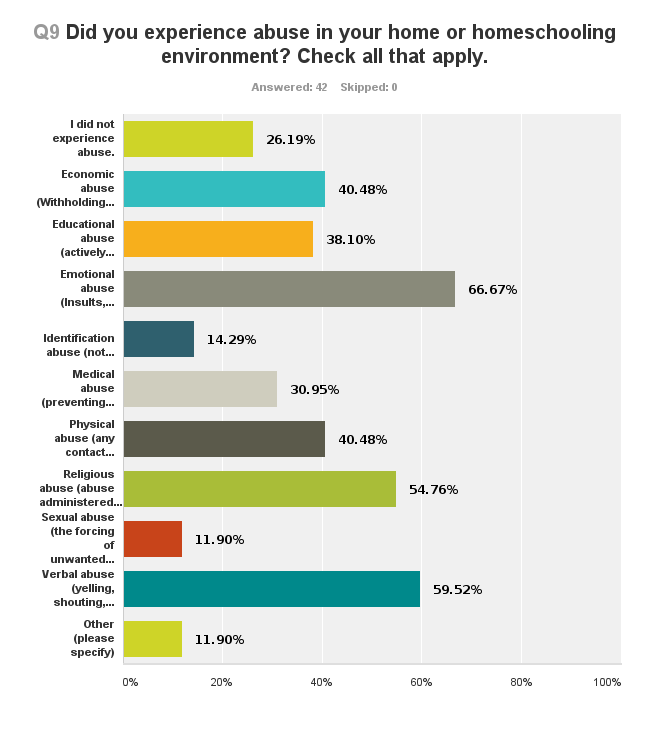
The majority of respondents (60.92%) experienced one or more forms of abuse in their homes or homeschooling environments.
2013 Homeschoolers Anonymous Basic Survey.
When the primary teacher had no high school diploma or GED, the percentage of respondents who experienced abuse was 88.89%.
When the primary teacher had a high school diploma or GED, the percentage of respondents who experienced abuse was 75.53%.
When the primary teacher had some college education but no degree, the percentage of respondents who experienced abuse was 70.37%.
When the primary teacher had an associates or undergraduate degree, the percentage of respondents who experienced abuse was 56.12%.
When the primary teacher had a graduate degree or higher, the percentage of respondents who experienced abuse was 41.46%.
This is a remarkable drop in experiences of abuse from respondents whose primary teachers had graduate degrees or higher to respondents whose primary teachers had no degree or diploma. This is a decrease of 47.43% in experiences of abuse.
Filtered by no high school diploma or GED. 2013 Homeschoolers Anonymous Basic Survey.
Filtered by high school diploma or GED. 2013 Homeschoolers Anonymous Basic Survey.
Filtered by some college but no degree. 2013 Homeschoolers Anonymous Basic Survey.
Filtered by associates or undergraduate degree. 2013 Homeschoolers Anonymous Basic Survey.
Filtered by graduate degree or higher. 2013 Homeschoolers Anonymous Basic Survey.
Notable areas in which abuse increased significantly as parental education decreased are: (1) physical abuse, increasing from 17.07% (graduate degree or higher) to 35.29% (high school diploma or GED) and ending at 77.78% (no high school diploma or GED); (2) verbal abuse, increasing from 21.95% (graduate degree or higher) to 61.76% (high school diploma or GED) and ending at 88.89% (no high school diploma or GED); and (3) emotional abuse, increasing from 34.15% (graduate degree or higher) to 58.82% (high school diploma or GED) and ending at 88.89% (no high school diploma or GED)
Parental Education and Current Religious Beliefs
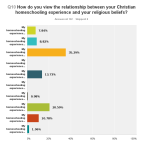
The majority of respondents (78.84%) said their homeschool experience was fundamentalist Christian.
The overwhelming majority of respondents (92.53%) believe that their homeschool experience influenced what they believe today about religion.
When the primary teacher had no high school diploma or GED, the percentage of respondents who said their homeschool experience was fundamentalist Christian was 100%. Also, the percentage of respondents who believe that their homeschool experience influenced what they believe today about religion was 100%.
When the primary teacher had a high school diploma or GED, the percentage of respondents who said their homeschool experience was fundamentalist Christian was 85.29%. Also, the percentage of respondents who believe that their homeschool experience influenced what they believe today about religion was 97.06%.
When the primary teacher had some college education but no degree, the percentage of respondents who said their homeschool experience was fundamentalist Christian was 81.48%. Also, the percentage of respondents who believe that their homeschool experience influenced what they believe today about religion was 94.44%.
When the primary teacher had an associates or undergraduate degree, the percentage of respondents who said their homeschool experience was fundamentalist Christian was 77.44%. Also, the percentage of respondents who believe that their homeschool experience influenced what they believe today about religion was 92.16%.
When the primary teacher had a graduate degree or higher, the percentage of respondents who said their homeschool experience was fundamentalist Christian was 68.3%. Also, the percentage of respondents who believe that their homeschool experience influenced what they believe today about religion was 85.37%.
The strongest sense of correlation between parental education and current religious beliefs concerned those respondents that have turned their backs on Christianity in favor of agnosticism, atheism, or another religion.
Keep in mind here that the primary teachers of the overwhelming majority of respondents were their mothers. Mothers were the primary teachers of 80.91% (195) of the graduates.
2013 Homeschoolers Anonymous Basic Survey.
When the primary teacher had no high school diploma or GED, the percentage of respondents who turned their backs on Christianity was 88.88%.
When the primary teacher had a high school diploma or GED, the percentage of respondents who turned their backs on Christianity was 44.13%.
When the primary teacher had some college education but no degree, the percentage of respondents who turned their backs on Christianity was 42.59%.
When the primary teacher had an associates or undergraduate degree, the percentage of respondents who turned their backs on Christianity was 33.33%.
When the primary teacher had a graduate degree or higher, the percentage of respondents who turned their backs on Christianity was 14.64%.
Filtered by no high school diploma or GED. 2013 Homeschoolers Anonymous Basic Survey.
Filtered by high school diploma or GED. 2013 Homeschoolers Anonymous Basic Survey.
Filtered by some college but no degree. 2013 Homeschoolers Anonymous Basic Survey.
Filtered by associates or undergraduate degree. 2013 Homeschoolers Anonymous Basic Survey.
Filtered by graduate degree or higher. 2013 Homeschoolers Anonymous Basic Survey.
(The category descriptions in the pictures above get cut off, so see Part Two for a reminder of what each category is.)
A correlation seems to exist, therefore, between how educated primary teachers — interestingly, mothers for 80.91% of respondents — are and whether respondents retained their Christian beliefs.
It’s no secret that my life has been a little weird.
I’ve been trying to deal with my bizarre past in the last few months. The process still feels like probing a wound, and I’m trying to figure out right now if I can afford the therapy I know I need.
Some weeks are fine. This past week was most definitely not. Homeschoolers Anonymous was running a series on child discipline, which was good and necessary and appropriately headed by trigger warnings. I read the stories, I couldn’t stop reading them, and they brought back some of the most traumatic memories of my childhood. Memories I had repressed. An onslaught of things I hadn’t really thought about in years.
I would be physically shaking by the end of each story, and yet I had to read more, to try and process the fact that yes, I had been abused as a child.
Just when you think you have a handle on your life, and then it spins completely out of control and you’re dumped into a jungle of memories and problems without a clue where to begin looking for a way out. That’s one of the reasons I’m looking for a therapist, because hopefully she’ll at least have a compass.
I tried to go out last night with my friends. I said I was out of money so I couldn’t drink at the bars, which was true, but I turned down a free shot too, because the truth is, as badly as I wanted to block out this past week, I didn’t trust myself to. I was already being super weird and swinging like a pendulum between talking about myself too much and being weirdly quiet.
If I got drunk, I’m pretty sure I would have started babbling about what was actually bothering me, and “Hey guess what I just realized I was physically, emotionally, and psychologically abused as a child by loving, well-meaning parents” isn’t exactly acceptable party talk.
So I went home early, leaving without saying good-bye, walking alone several blocks to my truck and driving home stone-cold sober. I got home, tried to start writing about the memories I’d been rehashing this week, and was so upset I just curled up in a blanket and stared at the wall until I fell asleep.
That scared me, when I woke up this morning. Is my grip on a normal life really that fragile? I got up and started my day, but when I was flat on my back during my yoga routine, I remembered the thought that has gotten me through other difficult situations:
You are you.
I’m still me. I am the same person I have always been. Yes I’ve grown and learned and developed as a person through things I’ve done and things I’ve experienced and things that have been done to me. But I’m still me. That used to be a horrifying thought, back when I hated myself and believed that my natural self uninfluenced by God was purely evil. But I’ve learned to love myself and so now that thought’s a comfort.
I am strong and I am a survivor.
If I could handle everything that has happened to me, I sure as hell can handle dealing with what those memories mean to me now.
My will, my personality, my spirit was never fully broken. I’m the same person who faced down near-daily spankings and dealt with it partly by creating imaginary adventures about escaping dungeons and forced servitude and unreasonable authority figures. I’m the same person who was unbearably weird and unbelievably unsocialized and managed to purposefully, intentionally, painfully catch up on most of that missed socialization (though I’ll be the first to admit I’m still pretty weird). By now I have done and lived through enough that I look back at points in my life and can say, “Yeah, I did that. Yeah, I survived that.”
Whatever happens, I will always be me.
Hopefully I’ll continue to strive upward and continue to turn into improved versions of me. One of the ways I can do that is by dealing with shit from the past, with help of course. But there’s that core, that consciousness, that continuous self, and somehow that knowledge gives me the courage to move forward.
Those I tell about my past find it tragic, unbelievable, and hard to understand.
I want them to understand my past so that they’ll know that I am an intelligent, social, motivated, hardworking woman, not the misanthrope slacker I may appear to be to the casual observer. I want them to know that I’m making positive life choices and tackling challenging issues everyday, even if they are not immediately visible to the outside world, due to the cruel grip of past violence, reaching through time.
Japan progresses into the future with the complex issues of radioactive waste ever-present. Development and renewal in Haiti includes rebuilding after the earthquake. The America we build today for our children and grandchildren is built upon an America that experienced 9/11 and the Patriot Act. We may forgive the past, but it always continues to exist in the way it molds the present.
My preparations for sleep include putting a band-aid on my nose, threading floss through an oral appliance and braces, rinsing with hydrogen peroxide and oral wound care, turning on a white noise machine and a HEPA air purifier on high, propping myself up on pillows in hot-washed cases, tightly binding a strap around my chin, and attaching an air-blowing tube to my face.
If I’m lucky, I’ll wake up before noon, without sleep inertia, and untraumatized by any lingering nightmares – an encouraging start to my day.
My evenings and mornings – my evenings and mornings now – could have been like your evenings and mornings. But someone made a choice for me, more than twenty years ago, that this instead would be my life today.
Today, I can stand in line at the grocery store. I’m no longer sitting on the ground, in an ankle length dress, while I wait for the sales clerk to ring up my purchases. Today, as long as I remember to take my morning and afternoon medication, I can clumsily attempt a game of volleyball or tennis without needing to sit down between serves.** I can stand long enough to conduct my business professionally. If I were to join a tour through a museum or town, I would probably seek out a chair only once or twice. But this isn’t the way I lived for twenty years.
I make a note on my calendar on days I don’t have nausea, night sweats, dizziness, or hot flashes.
I know that if I go out for a Friday night of teetotaler fun, I’ll still be recovering on Monday.
Sometimes I skip a meal because I don’t have easy access to food that won’t make my symptoms worse.
I embrace the joys of being twenty-nine. The friends I can spend an evening with, or email or Skype. Beautiful afternoons in parks. The companionship of two quirky felines. The occasional party and obscenely long recovery period.
But when I meet a stranger at an event, and he inevitably asks me ‘What do you do?’, the answer resonates in my mind: ‘Not as much as you.’
Not out of lack of ambition. Not because I was born with a disability. Not because I was in an accident. Only because the individuals that the state gave complete control of my fate decided that my pain and the limitation of my life and potential wasn’t worth preventing or treating. My captors, in designer apparel, would corral me into their luxury vehicle, to be paraded before their high net-worth clients, boosting their social equity and enlarging their income. I must perform as a trained animal, smiling through my pain, submitting to verbal abuse when I sat before I fainted, suppressing my personality and self-identity and playing my role perfectly.
I lived in a dirty, dust-bunny-colonized room, with antique furniture, floral curtains, mold plated windows, and spiders between my sheets. If I read, I could mentally block out the sound of yelling, until its source burst into the space – and my face. I learned that the appropriate response was to immediately cower and obey: the longer I delayed, the more ensuing punishments would accumulate.
More than once a week, I was allowed the exercise of a supervised quarter mile walk. More than once a week, I was allowed an hour or two of supervised co-existence with children my own age in a structured educational context. The phone and television were off limits, but I was provided with instructional material in mathematics and grammar with which I could, and did, provide myself with an education.
The age of majority didn’t apply to me. I would live with my masters indefinitely, servicing their home and work and satisfying their needs for intimacy and emotional support.
Today, when I look a little awkward at that party, or move a little strangely when we do business, it’s because I’m still assimilating into your culture.
And assimilate I must. I do not have a native culture to return to or celebrate.
Is my story tragic, unbelievable, and hard to understand? That’s because you didn’t come from my world. I’m glad for that.
** This was true only briefly. A year after gaining my mobility, I lost it again to wrongly developed hips. Until I go under the knife and complete the ensuing recovery, volleyball and tennis, as well as moderate walks, are off the menu for me.
Results of HA Basic Survey, Part Three: Economics as a Factor in Educational Quality, Abuse, and Current Religious Beliefs
Economics and Educational Quality
Averaging the scores for all aspects, respondents gave their educational experience a score of 3.06, barely above the median score category of “So-so.”
For the lower class, the average score was 2.71, below “So-so.”
For the middle class, the average score was 3.10, above “So-so” and slightly above the average for all class scores.
For the upper class, the average score was 3.37, well above “So-so.”
Filtered by lower class. 2013 Homeschoolers Anonymous Basic Survey.
Filtered by middle class. 2013 Homeschoolers Anonymous Basic Survey.
Filtered by upper class. 2013 Homeschoolers Anonymous Basic Survey.
Certain aspects of homeschool experiences were significantly different between economic classes. For example, Math was ranked by those in the lower class at 2.83; this significantly increased in the middle class to 3.39, and to 3.89 in the upper class. Similarly, Science was ranked by those in the lower class at 2.48; this significantly increased in the middle class to 2.81, and to 3.39 in the upper class.
Certain aspects of homeschool experiences did not change much regardless of economics. Sex education, for example, stayed within a narrow range between “Inadequate” and “So-so.” The lower class ranked it at 2.02, the middle class at 2.23, and the upper class at 2.5. The same occurred with political diversity: lower class ranked it at 2.05, middle class at 2.36, and upper class at 2.61.
In general, every single aspect of respondents’ experiences seemed to improved as wealth increased.
The only exception to this, interestingly, is socialization.
The lower class ranked socialization at 2.76; this increased to 3.14 in the middle class. But then it decreased to 3.11 in the upper class.
The most telling way in which economics related to educational quality is in the scores for the category Academic Experiences (As A Whole). The lower class rated their homeschool experiences in totality at 2.98, the middle class at 3.44, and the upper class at 3.96. That is an increase in nearly an entire point between the lower class and the upper class, raising the quality of the academic experience from “So-So” to “Adequate.”
Economics and Abuse
In contrast to educational quality, abuse did not seem to necessarily correlate to a decrease or increase in wealth for respondents.
The average for all economic classes for those that experienced abuse in their home or homeschooling environment was 60.92%.
The average for the lower class for those that experienced abuse in their home or homeschooling environment was 73.81%. The average for the middle class for those that experienced abuse in their home or homeschooling environment was 57.49%.The average for the upper class for those that experienced abuse in their home or homeschooling environment was 60.71%.
Filtered by lower class. 2013 Homeschoolers Anonymous Basic Survey.
Filtered by middle class. 2013 Homeschoolers Anonymous Basic Survey.
Filtered by upper class. 2013 Homeschoolers Anonymous Basic Survey.
There was a substantial decrease in abuse (of 16.32%) moving from the lower class to the middle class. That decrease did not continue, however, moving from the middle class to the upper class. Rather, abuse increased (by 3.22%) from the middle class to the upper class. Thus there did not seem to be a direct correlation between wealth and the frequency of abuse in general.
Some specific forms of abuse, however, did seem to correlate with wealth. For example, economic abuse decreased as wealth increased: from the lower class (40.48%) to the middle class (23.95%) to the upper class (17.86%).
Medical abuse also decreased as wealth increased, and in fact was non-existent in the upper class: from the lower class (30.95%) to the middle class (10.78%) to the upper class (0%).
Educational abuse also decreased as wealth increased: from the lower class (40.48%) to the middle class (20.96%) to the upper class (14.29%).
Emotional and verbal abuse were the main categories in which abuse did not consistently decrease as wealth increased. Each decreased from the lower class to the middle class, but then increased from the middle class to the upper class: Emotional abuse went from 66.67% (lower) down to 48.5% (middle) and then up to 53.57%. Verbal abuse went from 59.52% (lower) down to 41.92% (middle) and then up to 42.86% (upper).
Thus while specific forms of abuse did correlate to a decrease or increase in wealth, this fact was not consistent enough to generalize a direct correlation. In fact, several forms of abuse increased in frequency from the middle class to the upper class.
That said, what can be generalized is that abuse was consistently the highest in families in the lower class or below the poverty line.
Filtered by lower class. 2013 Homeschoolers Anonymous Basic Survey.
Economics and Current Religious Beliefs
78.84% of respondents said their homeschool experience involved fundamentalist Christianity.
This number was highest in the lower class, at 88.1%, dropping to 77.77% in the middle class.
This number was then lowest in the upper class, at 71.42%. So while the overwhelming majority of respondents grew up in fundamentalist Christian environments regardless of economic class, those environments were slightly less fundamentalist as wealth increased.
Filtered by lower class. 2013 Homeschoolers Anonymous Basic Survey.
Filtered by middle class. 2013 Homeschoolers Anonymous Basic Survey.
Filtered by upper class. 2013 Homeschoolers Anonymous Basic Survey.
The most interesting trends, as far as a correlation between economics and current religious beliefs are concerned, is the percentage of respondents who grew up in fundamentalist Christian environments and then left Christianity for agnosticism, atheism, or another religion (cited were Paganism and Satanism).
In the upper class, only 24.99% believed their fundamentalist Christian homeschool experience influenced them towards agnosticism, atheism, or another religion. This increased to 35.08% in the middle class.
In the lower class, 45.24% believed their fundamentalist Christian homeschool experience influenced them towards agnosticism, atheism, or another religion.
Filtered by lower class. 2013 Homeschoolers Anonymous Basic Survey.
That is approximately 20% more than those in the upper class (and 10% more than those in the middle class) influenced towards agnosticism, atheism, or another religion.
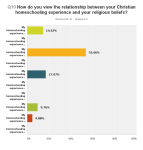
These findings seem to suggest that, as wealth decreases, fundamentalist Christianity in homeschooling experiences increases — but only slightly so. However, as wealth decreases, the number of respondents — with fundamentalist Christian environments — turning their backs on Christianity significantly increases.
Just how close is the homeschool fundamentalist version of Patriarchy to the Islamic version?
I think it’s pretty darn close. Check this out.
Remember this from Christian Homeschool Leader and Pastor Kevin Swanson?
Kevin Swanson – Little Tiny Fetuses Embedded in the Womb
“I’m beginning to get some evidence from certain doctors and certain scientists that have done research on women’s wombs after they’ve gone through the surgery, and they’ve compared the wombs of women who were on the birth control pill to those who were not on the birth control pill. And they have found that with women who are on the birth control pill, there are these little tiny fetuses, these little babies, that are embedded into the womb. They’re just like dead babies. They’re on the inside of the womb. And these wombs of women who have been on the birth control pill effectively have become graveyards for lots and lots of little babies.”
Saudi women seeking to challenge a de facto ban on driving should realize that this could affect their ovaries and pelvises, Sheikh Saleh bin Saad al-Luhaydan, a judicial and psychological consultant to the Gulf Psychological Association, told Saudi news website sabq.org.
Driving “could have a reverse physiological impact. Physiological science and functional medicine studied this side [and found] that it automatically affects ovaries and rolls up the pelvis. This is why we find for women who continuously drive cars their children are born with clinical disorders of varying degrees,” Sheikh al-Luhaydan said.
Of course Twitter is having fun with this:
If I do not respond quickly to comments between the hours of 8AM and 12PM, it is because I am out driving, rolling up my pelvis. Please pray.
I didn’t have answers, just tears and shame and frustration that I couldn’t seem to make myself get things done. I was convinced that I had no self-control and that if only I could try harder, care more, something… maybe it would stop. (But probably not, so who cares.)
I would go to bed at night and math problems jumbled up with random digits would float around in my head; grey-ish white numbers on an endless black background… and I would want to scream and pound my pillow because I could never seem to get away from it.
My brain was numb.
I became continually tired and listless. “Privileges” were taken away—I didn’t care anymore if I never saw my few, kind-of sort-of friends that I tried to cultivate in my pitiful excuse for a social life. I didn’t care if they took away desserts. I didn’t care if I had to stay home from some outings. It seemed sort of embarrassing when I was threatened to be made to take my schoolwork with me when we would go over to someone’s house for dinner, but trying to get it all done in time was stressful and made me feel sick and mentally exhausted, so I resigned myself to the shame because I didn’t see any way around it.
I did get raving mad on the inside when my music lessons were threatened—the one thing that I actually enjoyed and people said I was good at—but nothing registered on the outside.
I cried myself to sleep several nights out of a week, but I couldn’t explain my feelings, and I was constantly questioning myself and swinging between giving up and guilting myself into more tiresome, useless effort.
Finally, eventually, I had scraped by until I had gotten through Algebra 2, barely getting a passing grade, despite the fact that I easily passed tests for concepts I had never studied when placing for college classes. My parents “graduated” me at 17, and I was told to either get a job or go to college.
Since I had no work history and no degree or training, I picked college—and the program that looked the easiest, didn’t take four years, and had minimal math requirements, anything that would just get me a job so that I could earn money and move out and not be around my mom any more.
I didn’t know how to function in society because I had basically been closeted away in a little pocket of Christian subculture until that point.
Interacting with other people was scary, awkward, and frequently embarrassing. I was still depressed and didn’t know how to express my needs to anyone; I didn’t know what exactly my needs were. I felt angry sometimes, but didn’t know whether it was justified or what exactly sparked it.
I got good grades, I tutored other students even, but I didn’t believe it when my professors told me I was good at what I did. After all, I was just opting for the easiest way out. Miraculously, I made it without a major public meltdown. Unless you count the time I cried unashamedly in the cafeteria because a creepy guy had asked me out and that was the straw that broke the camel’s back on that particular day. Or the time when I started yelling at my sister to stop telling me about how global warming was going to flood India, because I didn’t care. I had too many things of my own to worry about and was just barely keeping it together as it was.
Today, three years after having graduated with my measly little degree, I am not even working in that field.
I haven’t touched anything academic until very recently, because my love of learning was completely stripped away. I did what I had to do to survive, and spent my spare time watching the “stupid” movies and television shows that I never saw, hiding from society because I was too emotionally exhausted to deal with people. An avid bookworm in my childhood, I stopped reading anything except for brief stints where I would read the first chapter and then never picked the book up again.
I have read on the internet a lot—cathartic bits that helped me integrate my thoughts and feelings and put words to my hurts and angries. Things that helped me decide what was wrong and what was right about what happened. Things that have helped me learn not to beat myself up or be scared to do something new.
I still have a relationship with my family, albeit a “safe” sort of one—I see them once or twice a month as my schedule allows, but I keep my dreams and goals and personal life to myself. My parents presumably have no idea that I consider my homeschool career to have been hellish. They have not asked my thoughts on the subject, and I am loathe to bring it up unnecessarily. But if it did come up, I would want to ask: why?
Why did they make me waste those years of my life like that?
From their perspective, I suppose they do not think they “made” me do it—but why, why did they handle things the way they did? How bad did it need to get for them to decide to try something different than threats and punishments? Why did they not try a different curriculum? Why did they not make more effort to work more closely with me, instead of relegating me to work in the loneliest corner of the house on my own? Why didn’t they get me a tutor?
If public school wasn’t ever actually evil like I assumed they thought it was, why didn’t they send me there for someone else to hassle with? Why was the busywork involved in “preparing for college” so important that they let “preparing for life” slip to the wayside?
I still love homeschooling as a concept. I think it is a great alternative to public school and I currently plan to be involved in homeschooling in the future.
But I also consider my home school experience to be a valid example of how not to do it.






















 Homeschoolers Anonymous