Click here to download a PDF copy of Wisdom Book #1.

Wisdom Booklet #1


Click here to download a PDF copy of Wisdom Book #1.

Pseudonym note: The author’s name has been changed to ensure anonymity. “Mahlah” is a pseudonym.
I grew up in Alberta, Canada with a single mom and three siblings. We were low-income and we moved around a lot, from rural Alberta to cities like Calgary.
In highschool, my oldest sister experienced some bullying and so my mom decided to homeschool her. Since my mom worked full time, often two jobs, my sister was expected to keep on top of her studies by herself. In elementary school, my brother and I experienced some minor bullying as well. So my mother pulled us out and homeschooled us as well.
I was only in the first grade.
We were homeschooled through the group Wisdom Homeschooling, a faith-based group whose credentials are not recognized by Canadian Universities and whose credits are not convertible to standard provincial diplomas. Essentially, it sets you up to fail because you are not a holder of any recognized high school diploma when you are 18.
The majority of our school books came from US publishers such as Apologia Educational Ministries, which taught everything from how evolution is a lie to how great manifest destiny is. Often my mother had not ordered all the books we needed, so when I should have started grade 4 math, I started grade 6 instead.
Every year we would have a program facilitator from Wisdom Homeschooling come and do a review to see how we were making progress. It should have been clear that we did not have appropriate school books, that our mother was too absent to properly administer any supervision, and that on any given year myself or my siblings were not doing sufficient work that children in public education would be completing.
By the time I was a teenager I began realizing how dire the situation was.
My two older siblings technically did not graduate, even by Wisdom Homeschooling’s standards. I was very worried. I knew I wanted to go to university, but nothing I had done up until that point would be accepted by any university, except private Christian schools.
Except, I didn’t know that.
My program facilitator told me I could compile a “portfolio” of my work, essentially self-testing that I had completed and kept a record of, some of my art work, a list of books I’d read. Clearly that was a lie. Universities would not accept that.
I wanted to go to public school and finish highschool. I begged to go to public school. But my mother said no.
By 14 I was working full time. I spent more time working than completing my totally useless fundamental Christian studies. I used my money to help pay for groceries and save for university.
Again my facilitator was willfully ignorant of the fact that I was not doing nearly enough work on my school books.
At 16 I called him to ask more questions about university. The conversation took a turn when he asked me about my mother. He asked me if she had been drinking the last time that he had come for his scheduled visit. I said yes.
During that visit, my mother had an outburst at me. She yelled in front of the facilitator and it was extremely awkward. She always yelled at me when she had been drinking.
She had a problem. I wanted to get out so badly.
On the phone with the facilitator, I broke down crying. I told him everything. I told him about the drinking, I told him about the emotional abuse I had been enduring. And my fears for my education. I didn’t want to end up like her. Poor with 4 kids.
I basically asked him for his help. The facilitator told me he can’t confront her, because she will feel attacked and may feel that she should pull us out of homeschooling and put us into public school.
That was his biggest concern.
That we stayed in homeschooling.
That we didn’t tarnish the name of Wisdom Homeschooling.
A year later I moved out. I took American SATs to use as entry into Mount Royal University in Calgary and the process was complicated and daunting.
Homeschooling ruined my life. Even today I am struggling to overcome social anxieties and awkwardness due to lack of socialization.
I have no math skills and I struggle to understand basic science.
When I wanted to join the military, they denied me because I didn’t have a high school diploma, even though I am a university student.
Somehow, I have managed to get control of my life. Today I am working for the government and I am about to graduate from university. I have not spoken to my mother in years.
I did not receive a real education. In the face of flagrant child abuse, I was ignored.

HA note: The following is reprinted with permission from Jonny Scaramanga’s blog, Leaving Fundamentalism. It was originally published on August 26 2014, and has been modified for publication on HA.
So here’s the most horrible thing I’ve found in a while: White Pride Homeschooling.
I don’t even want to give their page the extra traffic, so I’m linking to an archived version of their website (from August 2014).
From their website (Warning: you are about to read racist propaganda):
The biggest increase in intermarriage has occurred in recent years, due to the social interaction of children of different races in the school room and subsequently the board room and then bedroom. In the year 2000 – 9 percent of married men and women below age 30 were intermarried, compared with 7 percent of those ages 30 to 44, 5 percent for those ages 45 to 59, and about 3 percent among those age 60 and older. Obviously school busing, the promotion of interracial marriages by “Christian” preachers, visible images in all types of media, and 12 (plus) years of social conditioning in the schools for each and every child has had a devastating effect on the racial integrity of white America.
Gotta love the use of square quotes around “Christian” in the above paragraph, because obviously true Christians are racist Christians.
Yup, this is a Christian organisation. No doubt you are wondering which curriculums they suggest parents can use without polluting the minds of their pure Aryan offspring.
In no particular order:
Alpha Omega (pretty much a clone of ACE, but reputedly more academically challenging)
CLASS (the Christian Liberty Academy School System, which produces a custom curriculum based on a mixture of texts from publishers including A Beka and Bob Jones)
And, of course, Lighthouse Christian Academy, which is the homeschool wing of Accelerated Christian Education.
*****
You may be surprised. You should not be.
Now, I am not saying that Accelerated Christian Education is a white supremacist organisation. I’m sure ACE would prefer to distance itself from such racism (Side note: Dear ACE, if you publicly condemn this organisation, I will write one blog post in which I say nothing but nice things about you). But it is telling that the bigots at White Christian Homeschool find ACE’s materials entirely compatible with their aims.
The fact that ACE’s cartoons depict segregated classrooms means that Mrs White Supremacist Homeschool Mom can rest assured that the materials will reinforce what she is already telling her children: White kids should be separated from the other kids. After all, these white supremacists don’t hate black people. They even link to the National Black Home Educators Resource Association, explaining: “As we encourage a Christian lifestyle for all races and do not believe in integrated classrooms – we are providing this link.” See, they’re thoughtful really.
Bob Jones University’s presence in this company is even less of a surprise, given that organisation’s history of white supremacism. It’s not entirely clear when BJU would have abandoned its discriminatory entrance policy if the political climate had not forced it to do so by 1975.
If all this is shocking you, clearly you need to bone up on your history.
Biblical literalism lends itself quite comfortably to racism. “Slaves obey your masters” is a clear-cut instruction. Although my Christian teachers loved to remind me that the British Abolitionist William Wilberforce was a Christian, they tended to gloss over the fact that most of those opposing him were Christians too.
As Mark Noll noted of the US Civil War, and Carolyn Renee Dupont argued about American segregation, racists have always found ammunition in the pages of the Bible. And this is partly because of the way they read it.
Today fundamentalists condemn racism (and they find Bible verses to support that, too). But the way they encourage children to read the Bible has not changed. As a non-believer, of course, I don’t hold the Bible sacred at all, but it seems clear to me that if you’re going to study it, you need to pay attention to the context in which things were written. The Bible is a compilation of books by different authors who made different points, so you cannot conclude “what the Bible says about X” from any single passage.
It’s funny, isn’t it, that Christians suddenly started noticing that the Bible was opposed to racism shortly after it became culturally unacceptable to be racist.
I don’t care whether you can find more verses in the Bible to support racism or to condemn it. All that matters is that it’s possible to support both positions quite well from the text. And this proves that the way ACE (and its ilk) teach children to read the Bible in fact does nothing to prepare them for the real world.
About the author: Jonny Scaramanga blogs on Accelerated Christian Education and leaving fundamentalism at his blog, Leaving Fundamentalism. He is building a resource on ACE here, and collects survivor stories from students with experience of ACE. Also by Jonny on HA: “How I (Barely) Survived Home Schooling.”
I remember staring at the text:
Economics is the major reason that apartheid exists. Some people want to abolish apartheid immediately. That action would certainly alter the situation in South Africa, but would not improve it.
It was 1996; I was 11. Nelson Mandela had been president of South Africa for two years, and apartheid had been officially abolished in South Africa for five. I was not exactly well informed about the situation. I knew it was complicated, and that the country was not exactly without problems. But I also knew that apartheid had been an evil thing that had treated black people as less than human. I suspected my book was written by a racist. I didn’t say anything about it to my parents though. That wasn’t how ACE worked. You just got on with it in silence.
ACE (Accelerated Christian Education) was at one time the leading curriculum for Christian day schools and home schools. It’s still big; ACE doesn’t publish numbers of home schoolers using it, but a claimed 6,000 schools worldwide are on the ACE program. I wasn’t the first person to notice that the curriculum had some ugly things to say about apartheid. In 1993, David J. Dent (writing for the New York Times news service) quoted an ACE book that said:
Although apartheid appears to allow the unfair treatment of blacks, the system has worked well in South Africa … Although white businessmen and developers are guilty of some unfair treatment of blacks, they turned South Africa into a modern industrialized nation, which the poor, uneducated blacks couldn’t have accomplished in several more decades. If more blacks were suddenly given control of the nation, its economy and business, as Mandela wished, they could have destroyed what they have waited and worked so hard for.
This quotation came to light when a black student, Priscila Dickerson, complained about it. Her school’s principal claimed that ACE’s racism was part of the reason the school used it. Dent quotes him as saying, “Racism still exists, and that’s one advantage of using a curriculum like this because we can show students that.”
Not long after I finished the lesson on apartheid, I struck up an email friendship with a disgruntled employee of ACE in Texas. I told him I’d noticed one or two things in my books which seemed kinda racist, and asked him what things were like where he worked. “Put it this way,” the ACE employee replied. “The only black guys working here are the janitors.”
In 1998, the book I’d used was finally updated. Now it said, “God’s Word teaches that no people should ever be wrongfully treated because of their race, since all people are created in God’s image.” That’s a lot better. But it also says this:
Apartheid was excused for several decades because of the advanced industrialization of the nation. However, due to the carnal nature of man, apartheid was also used to exploit the nonvoting black majority.
ACE, Social Studies 1086 (1998 revision)
I’ll let you judge whether I’m being biased about this, but I’m still not happy with that wording. The second sentence says apartheid was “used to exploit” black people because of “the carnal nature of man”. To me this sounds like they’re saying apartheid is not intrinsically exploitative; it was just used that way because men are sinful. In a perfect, non-sinful world, it seems to imply, you could have a system of apartheid were people were kept officially separated but not exploited, and this would be fine. That’s no world I want to live in.
In 2009, ACE again hit the headlines for defending apartheid.
Actually, ACE had worked hard to avoid allegations of racism. In his 1980 book Under Tutors and Governors, ACE’s VP Ronald Johnson devoted an entire chapter to denying that the schools were for whites only. According to Paul F. Parsons’ book Inside America’s Christian Schools, by 1987 ACE had a policy of refusing to sell its curriculum to schools with discriminatory admissions policies. There are one or two explicitly anti-racist statements in the curriculum, too. They hailed Martin Luther King as a Christian hero, and praised the Supreme Court decision that outlawed segregation in American schools (although these blips are not enough to stop ACE from being endorsed by white supremacists).
There had always been a suspicion that private Christian schools in America were associated with racism, fuelled by the fact that their explosion in popularity happened shortly after segregation was outlawed in public schools. In ACE’s case, the suspicion was intensified by the fact that ACE’s founder, Donald Howard, had attended Bob Jones University, at that time a notoriously white supremacist institution. BJU’s chancellor had long preached about how God intended for the races to be separate, and BJU did not accept black students until 1971—as Wikipedia notes, this was eight years after the University of South Carolina and Clemson University were integrated by court order—and even then only if those black students were married. In 1970, institutions with racially discriminatory admissions policies were barred from receiving tax exemptions. BJU filed suit to stop the IRS from removing its tax exemption. Ultimately BJU changed its policy and allowed all black students to enroll, just moments before the Supreme Court decision that made it illegal for colleges to discriminate based on race. Still, BJU didn’t allow students of different ethnicities to date until the year 2000.
I can find no record of Donald Howard or anyone else from ACE ever speaking out against BJU’s racism. Instead, Howard wrote (in his 1979 book, Rebirth of Our Nation):
Regardless of the reactions of the media, the Christian school movement is not racist. Schools are opening in white and black communities alike. Schools are segregated, integrated, multiracial, and as cross-sectioned as any program that’s all-American.
So the schools are integrated and segregated, huh? He seems to be saying that the schools can choose whether to be segregated or not. I wonder if he also thought slavery was a states’ rights issue.
It wasn’t until years after I escaped my ACE ordeal that someone pointed out what had been staring me in the face: ACE’s books depict segregated schools. Most ACE books have cartoons set in a fictional city called Highland. There are two Christian schools (and adjoining churches) in Highland: Highland Christian School, and Harmony Christian School. The students and the staff at Highland are all white. The students and staff at Harmony are all black. According to one of ACE’s books, Social Studies 1029 (page 7), “Harmony is a part of the larger community of Highland.” So it’s a ghetto, then.
In the last five years, ACE has been revising its curriculum entirely, and the new editions feature new cartoons. You’d think that in this new era, when even BJU has publicly apologised for its racist past, ACE would redraw the cartoons with integrated communities.
That is not what they’ve done.
Instead, they’ve added a new, third church-school, called Heartsville. The ethnicity of those in Heartsville is best described as “other”: Some appear to be Asian, and some Latino. Rather than abolishing segregation, ACE has reinforced ethnic divides by splitting its fictional universe into “white”, “black”, and “somewhere in between”.
I feel lucky that I noticed ACE’s stance on apartheid was ugly. Because I recognised it was racist, I could choose to reject it, although I worried about other students who might not. I’m much more bothered about the page-and-a-half of casual racism that introduces ACE’s study of Asia, because I only noticed it when I re-read it last year. I never noticed at the time, which means I thought this was OK (or I just didn’t bother reading it, which is completely possible given that you can complete ACE work just by skimming the text to find the missing word to write on the blank):
Michael tried to fight his panic as he raced from place to place, searching vainly for something familiar.
…
In desperation, Michael watched the people passing him on the street, but their physical appearance provided him no comfort. Their skin was light brown, their hair was dark and straight, and the inner fold of their eyelids made their eyes seem to slant.
…
If you were suddenly transported to a village like the one in which Michael found himself, how would you react? Far Eastern cultures, languages, and religions seem alien to most Europeans and Americans. Oriental people appear mysterious and inscrutable, and their religions seem strange. Do these people have anything in common with European or American Judeo-Christian heritage and beliefs?
ACE, Social Studies 1106 (Geography), 2002 revision.

People I trusted gave me this as a schoolbook, and none of them ever commented on it to me. Either they too thought it was OK, or they didn’t read it. And whichever one it is, it’s inexcusable coming from people whose job was to teach me.
I don’t think ACE would accept that their books are racist, and I don’t think they intend to be. The newest books have pictures of a more ethnically diverse group of people than the old ones, and I even found two cartoons (TWO!) where black children are pictured in the same classroom as white ones. I don’t think ACE’s authors are hateful; they’re just ignorant. But when education is your business, ignorance is no excuse.
Every year, ACE holds regional and international student conventions. Students from ACE schools and home schools around the world come together to compete in various events, from athletics to preaching. As you’d expect from a fundamentalist organisation, the dress code is very strict.
And it has different acceptable hairstyles for black boys and white boys.
If you’re a white boy, you can have hair any length as long as it is off your collar and above your ears. If you’re black, though, your hair can’t be longer than one inch.
Oh, it doesn’t say this is a racially discriminatory policy. The exact wording is “Extra curly or afro hair is not to exceed one inch in length”. But the fact that this is also going to affect a small minority of white students doesn’t change the fact that this policy discriminates against black boys. While most white boys’ hair is neat and appropriate at three inches, a black boy’s natural hair at the same length is somehow offensive and indecent. And if you turn up with hair that doesn’t fit the dress code, you’ll be turned away: “Those who require a haircut will not be permitted to register until they have located a barber and complied with the Student Convention standards.”
ACE’s ugly history of racism seems to still be alive and well.

Aaron K Collett is currently a Communication major, with an emphasis in Digital Film making. Aaron blogs at Bringing Thought to Life.
< Part One
Part Two: Bullied and Bullying
Unlike many people coming out of homeschooling, I technically was not isolated – I got to go to a school with other people, I wasn’t stuck at home, and we referred to it in all ways as if it were a real school (spoiler: it kind of wasn’t). But “not technically being isolated” does not equal “had the opportunity for healthy relationships with my peers”.
For one thing, the school was K-12 with 60 students. We were almost literally a one-room schoolhouse. Now, the reasoning is student will learn to interact with people better if they have to interact with all ages. That can be true. It’s also true that it gives bullies a wider range of targets. And Christians are often not good at identifying and mitigating bullying, especially since the idea of God put forth by ACE is the biggest bully of all.
I was bullied pretty much from the time I started at RMCS in 1998 until the time I left in 2004.
It wasn’t the same person the whole time; sometimes it was older students, sometimes it was the teachers. In at least one occasion, to my eternal shame, I was the bully. It wasn’t any one thing – bullies are adaptable like that. But often it was because of my success academically, as far as the other students were concerned.
People lash out when they feel threatened. Because I hadn’t been in the program since elementary school, I was seen as an outsider. Since I worked so well in a self-paced program, I was an outsider that was threatening the status quo – I was better than them at “their” thing.
The teachers did not help, however. In fact, the teachers were a big part of the problem. Once, I reached the end of my patience, and went to the principal to report one particular person who had been terrorizing me particularly badly one week. Her response was to give me a chapter from the Bible to read and take care of it myself***.
Unfortunately, as is all too common, the abused becomes the abuser. Steeped in a culture which portrayed God as a merciless bully and being bullied every day myself, I projected. I became a bully myself. Not all the time, but once is enough. I shamed someone because of their height. The thing people have perhaps the least control over. I found out later she went home sobbing every day. I don’t know if she ever forgave me; I probably never will. But even if she did, I still did that harm. That won’t ever go away.
The curriculum, combined with the culture of abuse and bullying, created an awful high school experience for me.
I begged to go to a public school, or even home-school. I got to be home-schooled for one year, which was spectacular. I still had the curriculum issues (which I wasn’t aware of at the time), but the bullying had stopped. I didn’t have to worry who was going to terrorize me when I got to school in the morning.
I could just get up, have breakfast, and learn on my own, which was all I really wanted to do anyway.
End of series.
*** The passage in question was Matthew 18. Here’s the relevant bit:
“Moreover if your brother sins against you, go and tell him his fault between you and him alone. If he hears you, you have gained your brother. But if he will not hear, take with you one or two more, that ‘by the mouth of two or three witnesses every word may be established.’[b] And if he refuses to hear them, tell it to the church. But if he refuses even to hear the church, let him be to you like a heathen and a tax collector.”
Those are instructions for adults. Who mostly have the same power level as each other. This particular student had at least two years, 100 lbs, and 12 inches on me. When you tell children to deal with their “problems” that way, you are setting them up to be bullied even more. It was almost criminally irresponsible for the principal of the freaking school to give those instructions to a child being bullied. And that’s even without the implied shaming for “tattling” on another student, or the implied shaming of failing to “turn the other cheek”.

Aaron K Collett is currently a Communication major, with an emphasis in Digital Film making. Aaron blogs at Bringing Thought to Life.
Part One: I Was Once Considered A Success Story In The ACE World
My homeschooling story is a bit different than a lot of people’s.
I wasn’t beaten, I wasn’t isolated (technically), in fact, I was only technically home-schooled for one school year. But oh, how I wished I were homeschooled while I was actually in school.
From the fifth grade through high school, excepting my freshman year in home-school, I attended Rocky Mountain Christian School. RMCS was a “private Christian school” – in all respects, though, it was really just a church-school. We used a fairly well-known home-school curriculum (Accelerated Christian Education), so it really was like being homeschooled at a different building.
Well, almost.
Before I came out as an godless apostate heathen atheist, I was considered a success story in the ACE world.
ACE is a self-paced program, which means students sit at a desk and do their work independently, only getting help when and if they need it. While I don’t have a problem with that idea necessarily, it has the same problem lecture-style teaching does: it pigeonholes students into one way of learning. It worked fantastically for me; I “graduated” a year early. Other students were not able to self-learn like I can, and suffered under the non-guided learning style. But the self-paced style was not the largest problem with the curriculum.
I “graduated” in 2004. “Graduated” because while I have a diploma, I learned very little actual things from ACE. As I’ve said before, I was fantastically lucky. My mother had a background in education, and she really was my teacher. She taught me how to write, she taught me how to read, and she taught me how to math and science. And when I got to college, I could do those things fairly well.
Unfortunately, other subjects were…less well-taught.
ACE history books start with Genesis. So do their science books. We learned that evil scientists who hated God were hiding the evidence for a six-day creation 7000 years ago. Ken Ham and Kent Hovind were our heroes. They were standing up to the evil scientist conspiracy.
History was a joke. We were spoon-fed the stories of Genesis as if they were fact. As if Mid-Eastern origin myths were at the same level as modern professional historians and archaeologists. We learned….well, nothing, actually. Pretty much all of my history and all of my science education has happened in college. I can fake it – I’ve taken it upon myself to learn on my own – but I didn’t get the opportunity until I was in my 20s.
But the lackluster schooling was not the worst part of Rocky Mountain Christian School.
To be continued.
Jeri Lofland blogs at Heresy in the Heartland. The following was originally published by Jeri on September 10, 2013, and is reprinted with permission. All photos are courtesy of Jeri.
History was my favorite subject as a kid.
I devoured the Little House on the Prairie series, was enchanted by Ben and Me, and giggled through Jean Fritz’s junior biographies of King George III, Samuel Adams, and Patrick Henry. I would slip away into “the study” to read and re-read the fourth grade A Beka textbook on the American colonists, the lives of the presidents in our 1968 World Book, or tales of Marco Polo and Christopher Columbus.
Later, our bookshelves bulged with biographies of Lincoln, Anabaptist stories of the Reformation, and thick volumes from Bob Jones University Press skimming across the centuries from ancient Greece to World War II. Once, Dad brought me home a copy of Kennedy’s Profiles in Courage. And I could recite most of the dialogue from “A More Perfect Union“, Brigham Young University’s dramatic film about the Constitutional Convention.
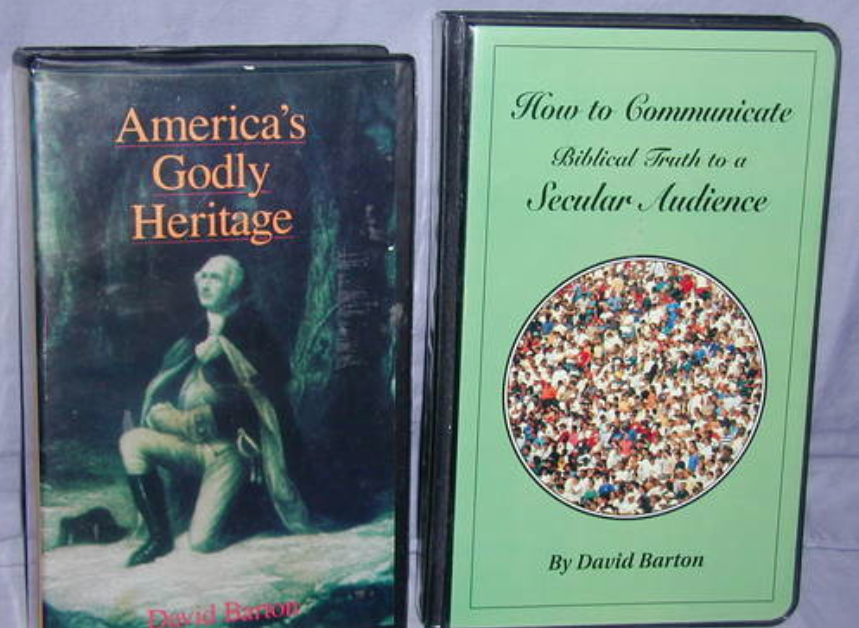
When Bill Gothard first distributed David Barton‘s “America’s Godly Heritage” to homeschooling families in his Advanced Training Institute, I was entranced. We listened to that first cassette together and marveled at Barton’s rapid-fire diction. After that, I would follow along with the tapes with my notebook and pencil and try desperately to copy out the quotations from the Founders as Barton galloped from one to the next at rodeo speed. Protected as I was from secular influences and celebrity worship, Barton was the equivalent of a rock star in my world. I collected Barton’s numerous books and a stack of cassettes. I copied out and memorized my favorite lines. When he addressed the national ATI conferences in Tennessee, I was giddy with excitement. I wished the audience would quit applauding so he could fit in more of his speech!
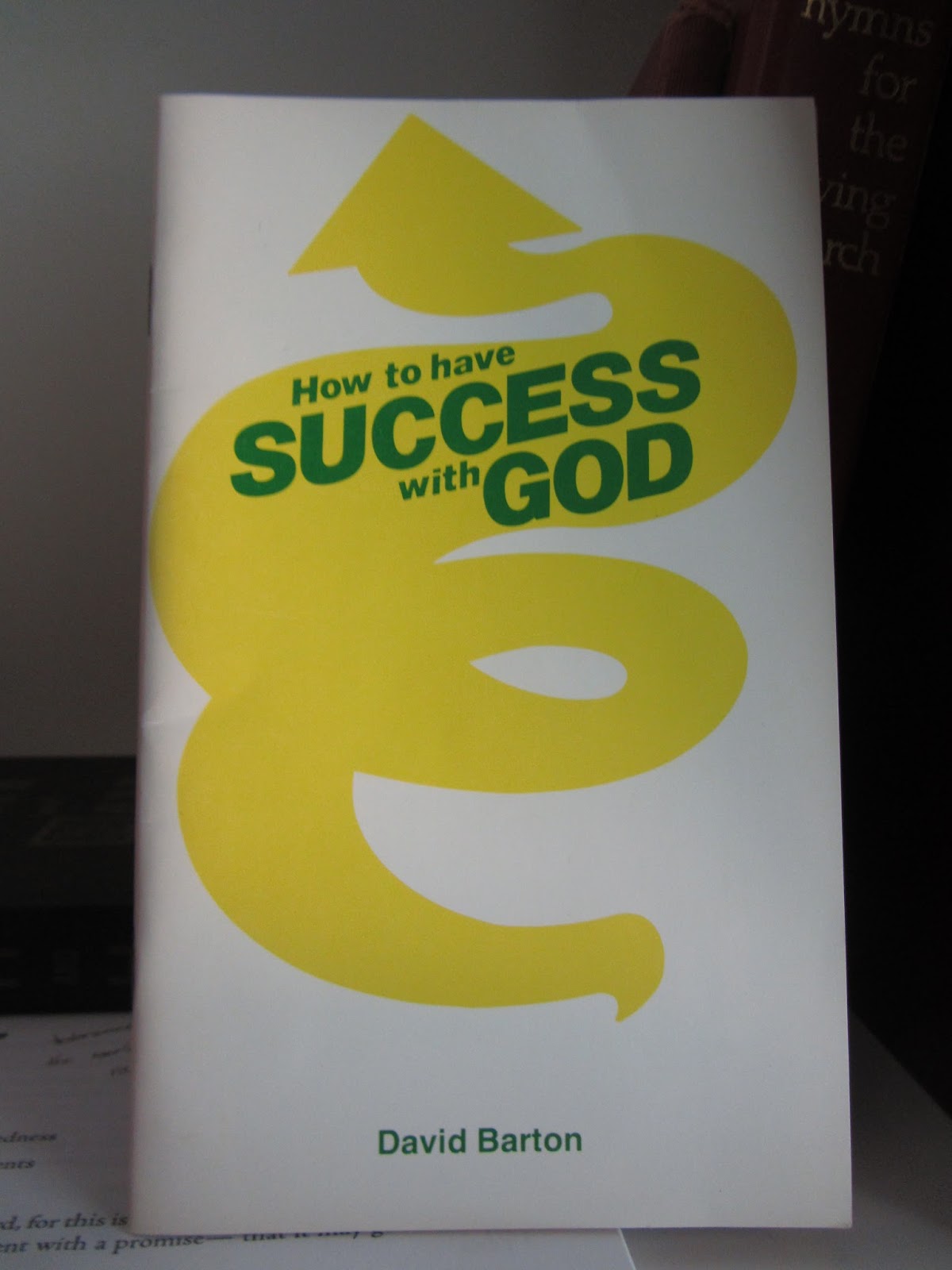
Besides Barton’s books on American history, I even purchased his obscure 31-page booklet How to Have Success With God, published in 1984:
“To God, obedience is better than anything.”
“The more you do of what you hear from God, the more you will hear from God what to do!”
“Be a Christian who enjoys obeying God and you will enjoy being a Christian!”
Today, “David Barton is a former Vice Chairman of the Republican Party of Texas and a political consultant for the Republican National Committee. He is also a bestselling author and political activist who has worked diligently to arouse true patriotism and restore America to her Biblical foundation.”
But back then, Barton and his organization Wallbuilders had not yet gained notoriety outside Texas. In time he would get chummy with Sen. Sam Brownback of Kansas, U.S. Rep. Todd Akin of Missouri, and the chairman of Gothard’s Board of Directors, Congressman Sam Johnson of Texas. Brownback would say of Barton, “His research provides the philosophical underpinning for a lot of the Republican effort in the country today — bringing God back into the public square.” And that was a mission I supported wholeheartedly.
When my worldview began to unravel, however, I revisited the Wallbuilders’ website, curious for answers that would settle some of my doubts. For the first time I realized that David Barton has no credentials as an historian or an archivist. He holds a B.A. in religious education from Oral Roberts University and has been both a [math and science] teacher and a principal at a private Christian school in his hometown of Aledo, Texas.
As a homeschooled student myself with limited exposure to the ways of academia, I could sympathize with Barton’s ignorance of correct protocol for citing sources. But I was flummoxed to learn that he lacks primary sources for some of his quotations. Including some of my favorite quotations–lines I used to recite glibly at candidates who brought up the spurious “separation of church and state”. Now this was unsettling.
I hadn’t heard David Barton for well over a decade when he appeared as a guest on “The Daily Show with Jon Stewart”. Well, here was a blast from my past! I settled in to listen to the Texan’s familiar too-rapid drawl and was surprised. Before, I had only heard Barton lecture to sponge-like crowds. His material seemed much less concrete in an interview before a skeptical audience. (And this incredible exchange with Glenn Beck puts Barton much closer to “unintentional comedian” than “educator.”)
Disillusioned with Barton, and with those who unquestioningly accept his version of the past, I discarded the remaining Wallbuilders publications on my bookshelf and set out to round out my re-education on American history and the variegated experiences and ideals of the brilliant yet flawed men who penned our founding documents. Thus did they launch these United States on her voyage into their future, hoping that we would prove equal to the task of sailing her, of maintaining her trim and keeping her prow pointed forward.
Even if we were to concede that America was intended to be a “Christian” nation (in spite of plain evidence to the contrary), even if we acknowledge that weather patterns were divine intervention on behalf of the Continental Army and that the Holy Spirit inspired the writing of the Constitution, even if we were to accept Barton’s version of the past, how would that enlighten our present conversation? It does not therefore follow that George Washington would now use his influence in favor of creationism in science textbooks. It would be presumptive to assume that John Adams would cast his vote today for pointless transvaginal ultrasounds or that James Madison would oppose national healthcare. We could not even conclude that Thomas Jefferson would want his children reciting a pledge to a flag, much less to a nation “under God”.
Mike Huckabee thinks our country would be improved we the people were all forced “at gunpoint, no less” to listen to David Barton’s spin on our history. But I cannot help wondering how our Founding Fathers would respond today if they could hear Barton’s appeal to an unrecognizable tradition. These men jettisoned the heavy time-worn design in favor of a revolutionary new ship of state they believed capable of carrying “we the people” through the vicissitudes of history. They were open-minded scientists, philosophers, and inventors, eagerly seeking and adopting new information and technological advances. Certainly, our nations’ founders looked to the past for guidance as they plotted a new course. But to David Barton, history and tradition are anchors with which to slow progress and avoid forward-thinking.
When my daughter was very young, she used to protest when we explained disagreeable facts. “I don’t want that to be true!”, she would cry. Perhaps Barton is ignorant of the way he misleads and misinterprets evidence in order to achieve his political agenda.
Or perhaps he just doesn’t want history to be true.

By R.L. Stollar, HA Community Coordinator
In case you missed the news, the Creation Museum — labor of love par excellence of Ken Ham and Answers in Genesis — acquired some dinosaur bones. Those bones, belonging to 30-foot-long, 10-foot-high Ebenezer the Allosaurus, are valued at $1 million. According to Ham, Ebenezer is named after the “stone of help” that the Hebrew prophet Samuel set up to honor his God. Ebenezer was unveiled to the public on May 23 of this year.
There has been a healthy debate over the significance of Ebenezer when it comes to the Creationism vs. Evolutionism debate. Ham believes Ebenezer will “expose the scientific problems with evolution” and “help us defend the book of Genesis.” In contrast some have argued that, depending on how much or little data was collected during its excavation, Ebenezer might be “useless scientifically.”
But there are other — and maybe more significant — debates buried underneath the surface. Just this last week there’s been widespread discussion over whether the Creation Museum should have accepted the gift of the bones in the first place. The bones were donated by the Elizabeth Streb Peroutka Foundation, a foundation that focuses primarily on “putting an end to the catastrophe of abortion.” The catch is that Michael Peroutka, the man who runs the foundation (along with his brother, Stephen Peroutka), appears to be a white supremacist sympathizer.
Michael Peroutka is currently a debt collection lawyer and a Republican candidate in Anne Arundel County, Maryland. He is more known, though, as the presidential candidate for the Constitution Party in 2004. (The Constitution Party was started in 1992 by Howard Phillips, the father of Doug Phillips — disgraced former HSLDA attorney, president of Vision Forum, and homeschool celebrity, now being sued by his nanny on charges of molestation.) During Peroutka’s 2004 presidential campaign, he ran as “the home-school candidate.” This image wasn’t helped, however, by revelations that he “had disowned two teenage stepdaughters who accused him of abuse.” (One of his daughters claimed he sexually abused her, though she later retracted that claim.)
Also during his 2004 campaign, Peroutka was endorsed by the League of the South — a white supremacist and nationalist organization and Neo-Confederate hate group. The League’s founder, Michael Hill, has expressed his organization’s white supremacy quite blatantly, describing American slavery as “God-ordained” and calling for a hierarchal society composed of “superiors, equals and inferiors.” In 2013, Peroutka joined the Board of Directors of the League of the South. (You can see Peroutka’s name on the League’s website in this December 2013 archived screen capture.)
But even more curious that Peroutka’s disturbing connections with white supremacy is the actual history of Ebenezer the Allosaurus. The Creation Museum, Ken Ham, and Answers in Genesis have all conveniently neglected to mention this history. And I say “convenient” because they are all entirely aware of that history.
See, Ebenezer the Allosaurus is the dinosaur that Doug Phillips lied about and stole.
You won’t find this in many of the news articles about Ebenezer. (Except for Right Wing Watch and io9. Props to them for connecting the dots.) Somehow this origin story has been forgotten. So let’s review:
Answers in Genesis geologist Andrew Snelling says that Ebenezer was “found in the Morrison Formation of North America (specifically in northwestern Colorado).” And in their October 2013 press release first announcing the dinosaur donation, Answers in Genesis said the following:
One blessing in getting the allosaur was that the Creation Museum did not seek it out. Ten years ago, the Elizabeth Streb Peroutka Foundation bought the specimen and housed it. Thousands of hours later, the bones of this magnificent fossil are almost completely cleaned and restored thanks to the DeRosa family of Creation Expeditions.
Ah, yes. The DeRosa family of Creation Expeditions. That rings a bell.
And here is how Michael Peroutka explains the situation, as quoted in the Capitol-Gazette:
Peroutka said his foundation is a small family charity he and his brother, Stephen, established and named after their mother. It was meant to give financial aid to groups “dedicated to ending the holocaust of abortion,” he said.
But the organization’s mission took a “slight detour,” Peroutka said, after a meeting with the DeRosa family of Crystal River, Fla., during a home-schooling excursion.
He said the family told him they were part of a group that discovered a dinosaur specimen in Colorado and that there were competing claims over its ownership.
Peroutka said his foundation purchased the fossils “to settle those claims.” It’s unclear how much the charity originally paid for them.
The skeleton was excavated about 10 years ago on private property owned by a Christian woman near the town of Dinosaur, Colo., museum representatives said.
So we have several indicators of what allosaurus this is:
1) Northwestern Colorado
2) The DeRosa family
3) A home-schooling excursion that ended with “competing claims” over ownership
Well, there’s only one allosaurus that fits that description. And we’ll let WorldNetDaily circa 2002 handle this one:
A dinosaur fossil expedition for home educators has excavated a large, rare, intact allosaurus, a discovery that organizers say helps debunk the theory of evolution… Under the leadership of Doug Phillips, president of Vision Forum and an adjunct professor of apologetics with the Institute for Creation Research, and Peter DeRosa, a veteran archaeologist and paleontologist with Creation Expeditions, the team of 30 home schoolers spent a week earlier this month hunting for and excavating fossils in a privately owned location in the Skullcreek Basin of northwest Colorado.
Yes, the allosaurus that Peroutka’s foundation bought — which has now been donated to Ken Ham’s Creation Museum — is the very same one “discovered” by Doug Phillips and his homeschooling paleontologist stars over a decade ago. This was the subject of Phillip’s so-called “documentary” Raising the Allosaur.
Except that, you know, Doug Phillips lied about all of it.
In 2004, Terry Beh (former writer for Promise Keepers and Focus on the Family) and Mary Gavin (home-school parents of five children and nine grandchildren) wrote a blog post titled, “Villainy Behind the Mask of Virtue: Vision Forum Unmasked.” In that post, Beh and Gavin call Doug Phillips and his documentary out for “grossly violating” Christian ethics, in particular ethics against stealing and lying. Basically, a group of individuals discovered Ebenezer and did the hard work of extracting the bones, and then Doug Phillips swooped in and completely rewrote the history about what happened — and then sued the original people involved in order to claim full credit. Here’s an excerpt from Beh and Gavin’s post:
The controversy surrounds the excavation of an allosaurus discovered in northwest Colorado by landowner, Dana Forbes. Forbes, who originally found the allosaur in October 2000 and is featured in the beginning of Phillips’ film, was not given credit for the discovery. The Forbes abandoned both their land and their dream of blessing the creation community through tours and scientific studies on the land through the deceitful actions of Doug Phillips.
Vision Forum deceived and bullied many parties involved in order to profit from the exciting discovery. Chief among them is Joe Taylor, who owns perhaps the largest creation fossil museum in the world which is located in Crosbyton, Texas. Taylor, the lead site manager for the allosaur excavation [and part owner of the allosaur], is not featured in Phillips film at all.
Tom DeRosa, president of Creation Studies Institute and Mike Zovath, field representative for Answers In Genesis [presently vice-president of AiG] were part of the original dig. When the Vision Forum group came to the Forbes property in May of 2002 to film “Raising the Allosaur” over three partial days of digging, all that was left of the allosaur was the end of the tail, which had been plaster cast the year before to protect it from erosion.
By the time the Vision Forum group (composed primarily of homeschool families that paid $999.00 per person) had departed, the skull had not yet been found. This is why there is no footage of it being excavated in the film….
Legal demands and threats were made against Taylor to surrender the bones. Under threat of a lawsuit, and believing it wrong to sue a brother, Taylor reluctantly let them have it. The bones were taken to a makeshift “lab” owned by Doug Phillips. Consequently, Taylor suffered devastating financial losses and has had to shut his museum down several times as well as sell his museum displays just to survive.
Another account about Doug Phillips’s unethical and bullying behavior regarding Ebenezer the Allosaur can be found on Under Much Grace. Joe Taylor was also sued by the DeRosa family for speaking out against Doug Phillips’s film. (The DeRosa family were the stars of the film.)
Ken Ham and Answers in Genesis are well-aware of this history. Their field representative, after all, was present during the original dig. However, neither Ham nor his organization have ever called out Phillips’ attempts at deception and theft, despite being asked to in 2007. Instead, Ham eagerly accepted Vision Forum’s “George Washington Award Man of the Year” from Doug Phillips, saying Phillips was a “ministry friend” and he was “honored” to accept the award. Ham and Phillips continued to speak together over the following decade at homeschool convention after convention, all the way through last year, when both were the keynote speakers at the 30th Annual CHEA Homeschool Convention in California, along with HSLDA’s Elizabeth Smith. (This was mere months before Phillips resigned due to his sexual abuse of Lourdes Torres-Mantufuel being discovered.) Then again, Ham’s silence in this case proved to benefit him: he was the one who ended up with Ebenezer, a $1 million boon to Ham’s creationist empire — an empire built by Ham’s own history of him bullying others, much like Doug Phillips.
By R.L. Stollar, HA Community Coordinator
Homeschool celebrities.
They run our lobbying organizations, write our books, and garner all our blog views. Our parents thought they were God’s messengers and we thought we should keep our thoughts to ourselves. Now that we’re grown, our perspectives have changed a bit. So we think it’s worthwhile to look at 11 current and former homeschool celebrities — and explain them using gifs.
The Pearls have a unique approach to communicating the love of Jesus to children. It goes something like this:

Last year Doug Phillips realized his most Hazardous Journey wasn’t a vacation. It was the public backlash against revelations that he had an extramarital relationship with a woman that involved — well, we weren’t sure exactly what it involved.
When Phillips first admitted infidelity, he spun it as just some species of “emotional fornication” or something:

But then it came out that, no, the relationship wasn’t just “inappropriately romantic and affectionate,” as he originally stated. The “relationship” was Doug Phillips repeatedly sexually abusing a young woman. As far as his original statement went, Phillips was suddenly like:

Bill Gothard, like Doug Phillips, has discovered that sexually abusing young people doesn’t make you popular. However, unlike Phillips, Gothard faces over 30 individuals accusing him of abuse. At this point his attempts to explain his situation are sounding like this:

As the media and homeschoolers are circling the wagons around Bill Gothard and Doug Phillips, their former fans with crushes on Patriarchy are doing everything possible to now hide that fact. People like James and Stacy McDonald are pulling previously written posts and urging Patriarchy advocates to change the words they use. The McDonalds’ response here boils down to:
“No Patriarchy to see here. Move along!”

Then of course there’s Doug Wilson. When he’s not too busy with obsessing over the latest blog post by Rachel Held Evans, Wilson is fighting the biggest threat Western Civilization has ever faced: women playing unladylike basketball.

Jim Bob and Michelle Duggar have a TV show. The plot of that TV show can be described by staring at this gif for approximately 19 seconds… and counting…

No homeschool celebrity list would be complete without a shout-out to Ken Ham. If you find it somewhat difficult to believe Adam and Eve enjoyed candlelight dinners on the backs of dinosaurs while trying to avoid talking snakes, well, Ken Ham has one message for you:

Kevin Swanson is like the Drunk Uncle of Christian homeschooling. From defending child marriage, comparing child abuse to “dead little bunnies,” warning people Frozen is Satan’s attempt to indoctrinate children into “the lifestyle of sodomy,” to his actual statement that “There’s a contrast between the feces-eaters and the church,” sometimes we wonder if he rocks himself to sleep at night screaming,

Mary Pride found her way home in 1985. It involved outbreeding non-Christians and calling children “the new n*****s.” When it comes to people and organizations working tirelessly to protect children from abuse, Pride is all,

In the midst of all the drama in the homeschooling world, Michael Farris stands in the foreground leading the charge against Obama, Common Core, and the not-Nazi Germans who hate homeschooling as much as he loves freedom. And Michael Farris loves his freedom:

Ah yes. Finally, there’s Matt Walsh:


HA note: The following is reprinted with permission from Libby Anne’s blog Love Joy Feminism. It was originally published on Patheos on May 14, 2014.
Sometimes I feel like I have to play this thing from both sides.
When I and other bloggers talk about some of the problems in the conservative Christian homeschooling subculture, we are informed by secular homeschool parents that not all homeschoolers are religious, and in fact that religious homeschoolers are just a minority today and not really a problem to be worried about. Well yes, we know that not all homeschoolers are religious. However, it’s a simple fact that many—perhaps even the majority—are.
When I read comments on mainstream news articles about things like Clare being kicked out of her homeschool prom for her dress, I see individuals who assume that all homeschoolers are religious, that all homeschooling is about religious indoctrination, and that homeschooling should therefore be shut down plain and simple. This is not helpful and certainly not true. There are secular homeschool leaders, textbooks, support groups, and conventions. A significant and growing percentage of homeschoolers are not religious homeschoolers.
And here I am, caught in the middle of misperceptions on both sides.
There is a lot I could say here, but I think it might just be simplest to quote from information put out by the Coalition for Responsible Home Education. This passage comes from “Reasons Parents Homeschool,” a page on the organization’s website.
Sociological research on homeschool families and their motivations, practices, and characteristics suggests that, going back as far as the late 1970s and early 1980s, there have been two main groups of homeschooling parents. First are evangelical and fundamentalist Christians who want to give their children a Christian education, and second are progressives who believe that formal schooling stifles children’s natural creativity and that education takes place best outside of the classroom. Throughout the past three decades, these two groups have coexisted in what sociologists and historians have described as an often uneasy tension. While the two groups at times cooperated, they also each created their own local, state, and national homeschool groups, conferences, and organizations. Research suggests that those with religious motivations have been the larger group by far since the 1980s, and that this group has also been the more successful at networking and building organizations and infrastructure.
Recent work suggests that these two groups continue to exist with very similar motivations and characteristics as in the past. Many parents today continue to homeschool for religious reasons, and religious homeschool curriculum is common. Conservative evangelical speakers teaching the supreme importance of the family and the scientific reality of creationism make their rounds speaking at homeschool conventions and before homeschool audiences across the country. At the same time, progressive educational reformers such as John Taylor Gatto speak at “unschooling” conferences and gatherings, encouraging parents to forgo classrooms and textbooks and engage in radically child-led learning.
Even as many parents continue to homeschool for religious or pedagogical reasons, recent sociological work suggests that an increasing number of parents are choosing homeschooling for purely pragmatic reasons: because the academic quality of the local schools leaves something to be desired, or because of bullying or health problems. Some families homeschool in order to be closer as a family, or simply so that children may have access to an individualized education. While homeschooling in the past has often been an act of religious or pedagogical protest, homeschooling has today become mainstream and accepted as a valid educational option. In an era of increasing school choice, parents turn to homeschooling for a variety of practical reasons that are often very family-specific.
I also want to quote briefly from “How Have Scholars Divided Homeschoolers into Groups?“, which adds another dimension to this.
The most recent addition to scholarly literature on homeschooling is Jennifer Lois’ 2012 Home Is Where the School Is (Lois, 2012). In contrast to earlier scholars, Lois focuses specifically on homeschooling mothers. Perhaps the most notable thing about her work is that she categorizes these mothers slightly differently than previous scholars. Rather than dividing them into ideologues and pedagogues or believers and inclusives, she divides them into “first choice” and “second choice” homeschoolers. First choice homeschoolers, she says, are mothers who feel that they are called to homeschool, whether for conservative religious reasons or progressive pedagogical reasons. In fact, Lois’ work seems to suggest that both types of mothers similarly find root for their choice to homeschool in their common identities as mothers. Second choice homeschoolers, in contrast, are those who come to homeschooling after other educational methods fail their children. For these mothers, homeschooling is not an identity but rather a temporary educational options. Lois finds that first choice homeschooling mothers report higher levels of satisfaction and that second choice homeschooling mothers are likely to look forward to the day when their children are grown or back in school.
Feel free to read these entire pages if the excerpts interest you. The basic point I want to make is that, yes, religious homeschoolers make up a significant percentage of both the homeschool population and the infrastructure of the homeschooling world, and that, at the same time, there are many who homeschool for pedagogical or pragmatic reasons that have nothing to do with religion. It is wrong to assume that all homeschoolers are religious (or that all religious homeschoolers are extremists) and it is wrong to assume that religious homeschooling is a marginal or insignificant part of homeschooling as a whole.
I want to finish with a chart from the National Center for Education Statistics. The data displayed was collected in 2011.

When reading the chart, bear in mind that many scholars feel that sociological work may get at parents’ motivations more accurately than a survey of this sort. I tend to agree, as my parents might put academics down as their number one reason for homeschooling on a survey like this even though they are very clearly and solidly religious homeschoolers. Further, “a concern about environment of other schools” may mean a variety of things, religious or secular. Finally, some scholars question whether religious homeschoolers may be less likely to participate in a government survey of this sort, and whether that may skew the results.
If you want to read more, you may also find “A Brief History of Homeschooling” and “Homeschool Demographics” of interest.
 Homeschoolers Anonymous