Isolating Kids to Shield Them from “The World” Is Not Only Harmful, but Counter Productive

HA note: The following is reprinted with permission from Sheldon, who blogs at Ramblings of Sheldon. It was originally published on October 28, 2013.

Recently, I published a post titled Can You Sincerely Believe in Something If You Have Never Doubted or Questioned It?, it was a repose to a blog post by Christian blogger Kansas City Bob about the “Idol of Certainty”. I had said that I can’t really see how a belief in anything, politics, etc, but especially religion can be a personal belief, a true and powerful part of someone’s identity if they have never seriously questioned it or doubted it at some point.

Blogger Jack Vance had this to say in response to the post:

Here was my long, rambling response, which really got me thinking about the fundamentalist homeschooling movement and how it makes questioning downright impossible when a young person is in it, due to the constant isolation in order to protect children from “the world”:

Not only question the maturity of it, but the strength of it? How strong can someone’s beliefs be when held up to questioning and opposition if someone has never questioned and tested it?

I think that was kind of a fatal flaw of the current fundamentalist system. Fundies like to blame secular colleges for their kids leaving the faith, as though professors are actively trying to de-convert students (you of all people would know that’s the farthest from the truth), (Sheldon’s note: Jack Vance is a university professor in Mississippi) but it’s not the colleges that are leading to the de conversions, it’s being allowed to experience the outside world for the first time, being exposed to all varieties of people, and realizing that the world doesn’t fit in a nice little fundamentalist box, and that some people aren’t as bad as they were lead to think.Their faith is being confronted with reality, and it has never been questioned by reality before. They’ve never asked the hard questions about their faith, because they haven’t been outside of fundie land, and never been faced with questions before.

I think the forced isolation is not only destructive, but counter productive to the efforts of thew parents to keep their children in the faith. Because their faith has never had to face the hard questions of life before, you end up with young students that know their faith well, and can repeat all the lines and canned arguments, but their faith has never been hardened by being exposed to outsiders, and facing the hard questions that facing reality will bring about.

They have never had to ask “Is this truly what I believe?” because they have never had to make the choice to believe.

Any normal, rational person can see how isolating a child from the outside world is harmfully psychologically, and that kind of closed environment is a fertile breeding ground for abuse (if you can’t see it, just spend about 30 minutes on Homeschoolers Anonymous, if that doesn’t convince you, I don’t know what will).

Fundamentalists isolating their children in order to protect them from”the world” don’t seem to realize that not only will they be creating adults who feel like a foreigner in their own country, and have a hard time coping as adults, but that their efforts in trying to keep their children in the faith well into adulthood (which they think will happen by keeping the out of the corrupting influences of “the world”), are actually counter productive.

Let me explain.

I sincerely believe that in order for a faith to be real, and personal to someone, a major part of their internal identity, they have to at some point question what they believe.

Without questioning, the faith is merely what that person believes due to the fact that it is all they have ever  known in their culture, or just what they have believed due to the fact that is the way they have always seen the world, and they don’t want to change that fact.

To me, genuine faith can not come about without questioning, or doubting at some point, without it, it can’t true representation of who that person is, and what they believe with every fiber of their being. Questioning usually comes about as a result when someone is questioned about their faith, or confronted with new perspectives that they have not encountered before.

Neither of which can happen if someone has never been exposed to the outside world.

When a person raised in such an environment finally has to go out and be in the outside culture, whether that be in the workplace, college, etc, their faith gets shaken even harder than it would have been had they ever been allowed the opportunity to question, because though in some cases, question leads to an abandoning of the faith (like in my case), if someone can sincerely question the faith, and still decide to remain in it, it comes out on the other side as a much stronger faith than before.

Fundamentalists don’t seem to understand this, and they are scared of questioning, they try to limit their children’s exposure to the outside world to keep them from questioning, and it ends up creating a generation of people, who until they are able to walk away from such an environment, don’t even know how to question and explore their beliefs.

It’s a very closed culture where outside ideas are not allowed in, questioning isn’t just discouraged, but up to a point, the very concept of it doesn’t exist. Questioning is only allowed, and can only be comprehended in very limited ways. When taught how to debate, they are only taught how to use certain talking points to back up what they already believe, with consideration ever given to the possibility that what is taught is wrong on some level.

Questioning in such a way is a concept that someone in that culture, especially young people can’t even grasp. Words are redefined, as many different bloggers showed in the Learning the Words project organized by Samantha of Defeating the Dragons.

It’s a deliberate tactic to keep their children in the fold (hopefully for life), and it bears an uncanny resemblance to Newspeak in the book 1984.

Newspeak was a new language designed for the people of the empire of Oceania, whose main goal was to make dissent impossible. Here’s an excerpt from chapter 5 of 1984 where the main character, Winston, a government clerk, is talking to Syme, a clerk responsible for helping to create Newspeak dictionaries:

(Syme is speaking in this conversation):

‘Don’t you see that the whole aim of Newspeak is to narrow the range of thought? In the end we shall make thoughtcrime literally impossible, because there will be no words in which to express it. Every concept that can ever be needed, will be expressed by exactly one word, with its meaning rigidly defined and all its subsidiary meanings rubbed out and forgotten.  

‘By 2050 earlier, probably — all real knowledge of Oldspeak will have disappeared. The whole literature of the past will have been destroyed. Chaucer, Shakespeare, Milton, Byron — they’ll exist only in Newspeak versions, not merely changed into something different, but actually changed into something contradictory of what they used to be. Even the literature of the Party will change. Even the slogans will change. How could you have a slogan like “freedom is slavery” when the concept of freedom has been abolished? The whole climate of thought will be different. In fact there will be no thought, as we understand it now. Orthodoxy means not thinking — not needing to think. Orthodoxy is unconsciousness.’ 

George Orwell was right, orthodoxy is unconsciousness, it’s believing without thinking. That is the goal of this kind of thinking, people who believe without sincerely questioning. They think this will result in children growing up to believe it as a matter of fact for the rest of their lives without questioning it.

The problem is, at some point, a person, has to become an adult, they have to be able to work outside the home, they will end up moving out, and having unbelieving neighbors and co-workers, or maybe just simply people who are Christians, but not as extreme as them. At some point, this exposure to the outside world will become overwhelming to them.

They will be for the first time, forced people who don’t look, act, think like they do, forced to face the reality that exists outside of the narrow confines of the world they grew up in. It automatically either forces them to retreat into a lonely shell, or make them face questions that they never had before, which is a highly emotional process that they don’t quite know how to deal with, because they have never been able to honestly question before.

They don’t know what to believe, or what to think of the world around them, because they have never experienced it before.

Suddenly the canned response they were taught to give in response to challenges to the faith (lovingly called apologetic in the world) seem to be falling short in response to this new internal struggle. They will be forced to re-evaluate everything they have been taught, and decide for themselves what they truly believe.

For some, they will end up coming back to fundamentalism somehow, and more determined to be a “better Christian”, but most will either come back to Christianity in a more moderate form, it give it up all together, the experience will lead to their former fundamentalist beliefs collapsing like a house of cards.

The parents who wanted to try to keep their children in the faith by isolating them don’t realize that that their tactics are back firing on them, creating a generation of former fundamentalist who have given it all up, and who realize just how toxic that belief systemis, people like me and Lana Hobbs, Jonny Scaramanga, and Samantha Field, just to name a few.

In trying to create a army of fundamentalist foot soliders who follow orders, and believe what they are told without objection or question, they have actually created toxic fundamentalism’s worst enemy:

A generation of people willing to tell the truth about fundamentalism.

Crosspost: Dear Sister, On Your Thirteenth Birthday

Screen Shot 2013-10-03 at 6.08.50 PM

HA note: The following is reprinted with permission from Libby Anne’s blog Love Joy Feminism. It was originally published on Patheos on October 1, 2013.

I can’t believe you are almost thirteen. 

I remember holding you in my arms when you were a baby. I remember rocking you, smiling at you, cooing to you. I remember your tiny fingers and your dark, soft hair. I remember dressing you, bathing you, cuddling you close. I was always the first to jump up and volunteer to get you up when that sweet plaintive wail came from your cradle.

Thirteen. Wow. You’ve grown so big, so tall and clever. I know what thirteen means. Dad will take you out to dinner and give you a ring. You will put it on your finger and promise him that you will not have sex until the day you marry. I know you will because I did too. And when you say it, you will mean it. I know that. So did I.

But I want you to know something, my sweet little sister. You are worth so much more. Your worth is not defined by what has or has not been in your vagina. Yes I know, hearing that word spoken so openly embarrasses you. I remember. But what I’m saying is important. You have so much to offer the world. You are smart. You have interests. You have talents. Those things matter. In fact, those things matter a whole lot more than the state of your vagina. Yes I know, awkward. But it’s true, and I want you to remember that. You matter.

There’s more, too. It is wrong, what they are telling you. Should you choose not to have sex until your wedding day, your virginity is not the most precious gift you will ever give your husband. In fact, depending on whether or not your husband will come from the same religious and cultural background as you, he may not even see your virginity as a gift at all. And if he doesn’t, don’t hold that against him, okay? The idea that virginity is something of value is “culturally constructed.”

That’s just a fancy way of saying “made up.”

There’s something else I want to tell you as well. You probably think that I didn’t have sex until my wedding night. Well, that’s not true. We almost waited until the wedding, but not quite. Yes I know, telling you that is awkward.

But I want you to know that they are wrong when they saying that having sex before you get married will damage your relationship.

It hasn’t.

I don’t regret doing it, and I don’t think it messed up anything at all. In fact, I wish I hadn’t waited as long as I did. I tell you this not to tell you which way of doing things is right and which way is wrong, because that is up to you and is yours to decide, but simply to give you another perspective.

But the most important thing I want you to know, little sister, is that your body is yours

You get to choose what you want to do with it. You will have people telling you what you can and can’t do with your body, when, and how much, and how far. But you don’t have to listen to them. Your body is yours, and don’t let anyone make you forget that. What you do with it is up to you.  It’s your choice. Own that, and don’t let anyone else make your choices for you.

I’m not going to send this letter to you, little sister, because mom and dad wouldn’t like it. Putting it here is the best I can do. Perhaps someday you will find it, and read it, and then you will know how frequently you are on my mind.

I love you, little sister.

Libby

Crosspost: My Advice on How to Cope with the Outside World Post-Fundamentalism

Screen Shot 2013-09-12 at 2.32.43 PM

HA note: The following is reprinted with permission from Sheldon, who blogs at Ramblings of Sheldon. It was originally published on September 6, 2013.

Recently, I ran across a post from Lana Hope of Wide Open Ground about her struggles in trying to deal with the outside world. Here’s an excerpt:

When I write about cultural disconnect or socialization problems, I am not just talking about some short painful period after high school, where I went to college, experienced intense culture shock, and then got over myself and became a regular adult. If only that were true.

I am bombarded weekly with mainstream cultural references and ideas, and 90 times out of 100, it’s met with a blank “What The Heck Are You Saying?” from me. In other words, my childhood stabs me in the back, constantly.

She then goes on to talk about an incident with a neighbor where the neighbor mentioned the fact that the 70’s band, the Eagles, grew up in a town not far from her hometown, and the neighbor’s astonishment at the fact that she didn’t realize who the Eagles were.

Reading the entire post, I just wanted to reach through the computer screen and hug her (though I don’t know if she would be comfortable with that, lol). I’ve been there, it makes you feel like an idiot sometimes when you don’t know what someone else is talking about, or makes you feel so disconnected and out of touch from everything around you. I’ve had a double dose of that feeling, both because of my fundamentalist upbringing, and the way that my mind works, it can make communication with people in person difficult enough, then to throw in the cultural disconnect makes it far worse.

There is so much that you miss out on being so isolated from the outside world. It can be embarrassing sometimes to not know what someone is talking about. My biggest problem was the lack of proper sexual education in an environment like that.

It’s embarrassing to say that I wasn’t even familiar with what masturbation was until I was 18 years old.

I’m sure that are more people out there who are dealing with this right now.

Though I’m definitely not the shining example of fitting into society, here are a few things that I have learned, and maybe, I hope that it will be able to help others who are dealing with this same problem.

Here are my biggest tips on trying to adjust:

When trying to learn about modern music, to better understand its influence on culture, YouTube is your best friend.

Just immerse yourself into music, dive into it. It’s especially important to familiarize yourself with classic rock, because it has had quite a bit of influence on American culture, especially among people from the baby boomer generation. YouTube now has entire albums and full concert recordings up on the site. Get familiar with groups like AC/DC, the Rolling Stones, and yes, even the Eagles. You will be surprised just how much their music influences various cultural references.

Learn more about sex and sexual health from reliable, sex-positive sources.

I can’t stress this enough, this is one thing you will need to catch up on. I suggest for a start, the Sex + Show with Laci Green on YouTube, and the Loveline radio show with Dr. Drew Pinsky.

Familiarize yourself with good comedy.

This may not seem very important, but it is. It will help you to understand people a little better in conversations, not necessarily because of cultural references, (though that does help), but it will help you understand speech patterns that people often have, and the way they try to joke around. Growing up in a closed fundamentalist environment, you were likely not made very familiar with things like intentional double meanings, sarcasm, etc.

Fundamentalists tend to not use such mannerisms; they tend to be very literal about most everything that they say. I suggest for a start, sarcastic comedians like George Carlin, the rather deadpan humor of David Sedaris, and watching a lot of sitcoms like The Big Bang Theory, Two and a Half Men, How I Met Your Mother, etc. Sitcoms tend to use a lot of humor with double meanings, in a more conversational style.

Realize that many aspects of mainstream culture will make you uncomfortable at first.

Rock music will sound like senseless noise to you at first, a racy line from a comedian may make you cringe (especially if it’s something sexual, or poking fun at Christianity), it will be hard for you to handle, but you will get used to it, and even enjoy some aspects of it, some of it you may feel awkward about, but then grow to love.

Also, it may happen that you may actually feel some guilt over watching/listening to all of this. Voices of disapproval may echo in your head, the old guilt machine embedded into you by parents, your minister, and even just the fundamentalist culture in general may spring up to haunt you. Ignore them as best as you can, and keep going.

Immerse yourself in the culture, but give yourself a break at times, take time to be alone.

There will be times it will feel too overwhelming, and that’s OK, it’s normal, allow yourself time once in a while to shut it all out to keep from becoming completely unraveled.

Take a cue from my namesake, the character Sheldon from The Big Bang Theory. This clip is from the episode “The 43 Peculiarity”  Howard and Raj were desperately trying to figure out what exactly Sheldon was doing in a storage room during his lunch break at the university that they all work at.

Communicating with people primarily online may be easier, but you have to practice in person as well.

It maybe easier, and more comfortable to only communicate online, because it is so much easier to understand simple text without reading tone of voice, body language etc, but you need the practice of speaking to people in person.

I’ve gotten this practice because of my job, getting out in the workplace forces you to interact with people in person constantly. Dealing with 80-150 truckers in a 12 hour period several days a week was uncomfortable, and frustrating, but it sharpened what little ability I had to carry on basic conversations.

Realize that you may understand the outside culture intellectually, but it will never fully feel like home to you.

This may seem like a depressing piece of advice, but once you learn to accept it, you will have more peace of mind. You will often feel like a foreign in a strange land, or a cultural anthropologist studying a native culture somewhere, and that’s OK.

To use the example of the anthropologist, you can learn the habits and practices of the culture around you, learn plenty about the behavior of people around you, understand what they are doing, maybe a little of why they do it, but you will not understand everything about the culture, because it is not truly your home culture. There will always be gaps in what you understand about it, even if you can advance to the point to where you can blend in and become rather accepted by the outside culture.

Trying to hard to understand everything will result in plenty of unneeded frustration, and will end up with you stressing yourself out trying to overanalyze everything and everyone. Here’s a secret: Most people don’t understand themselves why they do the things that they do, or why they act a certain way.

Like Winston Smith in 1984, you may understand how but not why. You may learn how our culture works, but not why it operates that way.

Reach out to fellow former fundamentalists.

It’s essential, they are the only people that can understand what you have been through, and can tell you what they have done to help get them through these struggles, learn from them, reach out for support from them.

When Mennonite Stories Are Your Only Literature: Sean-Allen Parfitt’s Story

Screen Shot 2013-08-23 at 2.22.40 PM

Sean-Allen Parfitt is a a gay software engineer, who dabbles in creative writing, music composition, and fashion design. He lives with his boyfriend Paul in Schenectady, NY. Follow Sean-Allen’s blog at Of Pen and Heart, or on Twitter: @AlDoug. The following post was originally published on Of Pen and Heart on August 9, 2013 and is reprinted with the author’s permission.

*****

HA note: The following is the first of a three-part series by Sean-Allen that we will be posting. This post explores the negative aspects of his homeschooling experiences; the other two posts will explore the positive aspects and will be included in next week’s positives series.

*****

Recently I wrote about how the church keeps us in, because we don’t know any better. This is a concept I call Control Through Ignorance (CTI). Today I’m going to approach it with more detail from a different perspective: homeschooling.

I am the eldest of 8 children, all who have been or are still being taught at home by my mother.

Our parents decided to teach me at home before I was in first grade, so I never went to public school. Everything I came in contact with was carefully selected for my growth and benefit. There are several areas I would like to address. These are places in my life where my access to outside influence was restricted or completely cut off.

The first area was social interaction. Just about the only friends I had were from our church, and that’s the only time I saw them. I never made any friends who had a radically different upbringing that I did.  I never met Muslims, Jews, Hindus, or atheists. I never went over to my friends’ houses for sleepovers. We were often reminded why certain things my friends did were wrong. We were very much kept in the shelter of our own home and my parent’s rules.

Because of this, we actually learned to believe that almost everyone in the world was wrong about something. We were the only ones who had it all right.

Why would we spend time with people who might influence us to back-slide into some sort of sin?

Another way in which we were tightly controlled was through the prohibition of any kind of entertainment except that which my parents approved. Basically, this meant that we were allowed to read Mennonite stories.

Period.

The end.

Here is a list of story elements which were particularly banned, with examples.

  • Animals that talk/wear clothes
    • Winnie the Pooh
    • The Little Red Hen
  • Any sort of magic
    • Narnia
    • Lord of the Rings
    • Harry Potter
    • Any Fairy Tails
  • Anything violent
    • Oliver Twist
  • Anything non-Christian
    • The Bobbsey Twins
    • Sherlock Holmes
    • Good Night Moon
"the only reading material we had were story books published or sold by the conservative Mennonite publishing house Rod and Staff."
“the only reading material we had were story books published or sold by the conservative Mennonite publishing house Rod and Staff.”

There were a very few exceptions to the last rule, such as Children of the New Forest. Generally, though, the only reading material we had were story books published or sold by the conservative Mennonite publishing house Rod and Staff. I generally enjoyed them, but there was a very religious/indoctrinating theme in many of them.

In the last few years I lived at home, I saw the Mennonite teachings from these books make a serious impact on my mother and brothers.

When we lived in England,we studied British history as part of our home school curriculum. However, the books we used were all published before 1980, because our parents didn’t want us to be influenced by modern thinking and interpretation of the facts of history. Thus, we learned very little about the last few decades of history.

We were not allowed to watch TV or movies, either. We watched a few Christian movies till about 2003, when our TV/VCR broke. If we were at a friend’s house, or at a party with the cousins, we were forbidden to stay in a room with the TV or a movie playing. We were not allowed to play video games, because they supposedly teach violence, besides wasting time. Any time on the computer was closely monitored. When I was 24 and still living at home, I had to have my computer set up on a table in the living area, so that I could not visit any site that was not appropriate for school, work, or little children.

As you can see, we were very much isolated from everything around us. I did occasionally wish I went to school, but mostly because I wanted to play video games. We thought we were right and nobody else, so we even judged other conservative families at church.

Ours was one of the most conservative and uptight families.

I am so glad that I’m out of that now, but I ache for my siblings. They are still stuck in that environment, in which they have no opportunity to learn about who I am, that I’m not an evil person! That’s the hardest thing about this. I didn’t know that I was OK. What if one of my siblings is gay or lesbian? What if one is transgender? What about my siblings who want to go to college, but can’t because Mom won’t let them?

And I can’t go back and show them these things.

Why?

Because I no longer fit into the category of acceptance. Thus I am excluded from my family.

And that really hurts.

*****

Part Two: Not Well-Rounded, But Excellent >

Crosspost: Sally’s First Kiss and The Princess and the Kiss

The-Princess-and-the-Kiss1-e1373847077493

HA note: The following is reprinted with permission from Libby Anne’s blog Love Joy Feminism. It was originally published on Patheos on July 24, 2013.

When I was a teen, I did a lot of babysitting for other homeschool families. One day I babysat two families worth of children while their moms went out for lunch—I think there were about ten kids total that I was watching. I was in the kitchen cleaning up from lunch and the kids were in the living room putting on a play wedding as kids sometimes do. The nine year old was presiding over the wedding of the two five year olds, a girl from the one family and a boy from the other.

All of a sudden I heard the older child say “now you’re supposed to kiss each other” and I freaked out and ran into the living room to break it up.

I wasn’t about to let those two five year olds kiss, thus forever depriving each of the chance to save that first kiss for the altar.

In the conservative Christian homeschooling community in which I grew up, a person’s first kiss was incredibly important. Even today, the products of this culture debate this question with great energy, arguing about whether forbidding the first kiss until the altar is a form of legalism or the preservation of a precious gift.

Now, I was taught that part of the reason that the first kiss should be saved for the alter was that it was a gateway into other things. First comes kissing, and then, who knows? Making out, humping, sex—once you open the door, it’s hard to close it. It would seem, then, that five year olds kissing at a play wedding wouldn’t fit this category, given that we’re not talking about a kiss that comes as a result of sexual tension and mutual attraction.

And yet.

The literature I read didn’t make a distinction between preschoolers kissing and teens kissing.

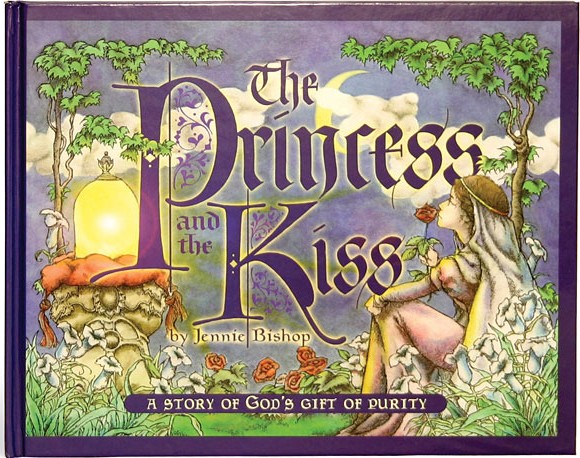
Instead, it simply talked about the importance of saving “your first kiss” for your wedding day. And of course, we were regaled with stories of virtuous couples who had done just that—didn’t we want to be like them? And then there is The Princess and the Kiss, a book marketed to children as young as four.

The book is about a king and queen who help their daughter save her most precious gift, her first kiss, for the prince she will marry. The princess’s first kiss lives in a glass orb, something like the rose in the Disney version of Beauty and the Beast (you can see it on the cover). This book has become very popular in Christian homeschooling circles and beyond, and there are hundreds of thousands in print. This is the sort of thing I was raised on (though this particular book wasn’t around when I was little, lots of kids are growing up on it now).

All of this came rushing back to mind recently when [my daughter] Sally kissed a little boy at her preschool—or, as I would have seen it in the past, when Sally “gave away her first kiss.”

We had gotten together with the family for a play date, and Sally and her little friend did the whole pretend wedding ceremony thing that little kids spontaneously do (I presided over a few in my day myself). At the end Sally grabbed the little boy and planted a kiss on his face. Surprised and bemused, I couldn’t help but recall my reaction to the pretend wedding staged by the five year olds I was babysitting so many years ago. This time, of course, my perception and reaction was different.

Sally didn’t lose anything when she kissed her little friend. Instead, she simply gained a common life experience—something she will look back at and laugh about when she’s grown.

It’s the people who impute a cute childish action with so much meaning who are creating the problem, not my preschooler.

Confessions of a Homeschooler: Iris Rosenthal’s Story, Part Two

Confessions of a Homeschooler: Iris Rosenthal’s Story, Part Two

Iris Rosenthal blogs at The Spiritual Llama. This story is reprinted with her permission.

< Part One

"I remember how hard it was for me to adjust to being outside of the homeschooling bubble and in some ways, eight years later I am still adjusting."
“I remember how hard it was for me to adjust to being outside of the homeschooling bubble and in some ways, eight years later I am still adjusting.”

Since my original post I have come to the realization that I have just scratched the surface on everything that I have to tell about homeschooling. One of the problems I have with home education is that there is hardly any regulation. During the time I was homeschooled, K-12, I never once had to take the SAT or ACT or any other sort of evaluation test.

As long as it looked like I was studying I was pretty much left alone. The only subjects my mother was constantly involved in were; math, spelling and english. Occasionally she would check my work in the other subjects, but for the most part I was left to fend for myself and once I reached the age of 15 any involvement from her pretty much came to a stop.

I often hear the argument that not all parents homeschool are like this and that my mom was doing it wrong. While that may be the case, I don’t think that this should be lightly brushed off. We are talking about the education of children here! It is my belief that whichever route you choose, it’s very important that your children receive the best possible education. Be involved, be a part of their lives, listen, be aware of what they are learning about and learn with them!

With the lax requirements in place for homeschooling it only flings open the door for cases such as mine to happen. So much for homeschooling being better than public school (for those who don’t know me, that was sarcasm)!

I know my story is not the only one, my brother & sister and close friends have also experienced the same lack of education and preparedness to function in the real world because of being homeschooled. However, I’m not here to tell their story for them, I’m here to tell mine.

My first full time job experience happened when I was 21 at a call center. Yes I’d had jobs previously, but they were just odd jobs and the people I worked for I already knew from either homeschool group, church or 4-H. So I was always within that bubble my mother had me living in.

While working at the call center I got to know people who *gasp* went to public school, it was then that I started to realize that there were holes in my education. I didn’t know any math beyond the basic add and subtract. I could barely multiply or divide. Forget fractions and algebra.

I also realized that I was spelling a lot more words wrong than what I originally thought I was. It’s pretty bad (not to mention embarrassing) when your manager brings back your vacation time off request (written in clear handwriting) and asks you to tell what words you meant to put down. I found myself sticking out a lot in all the wrong ways, and my judgmental attitude towards people who were different than me didn’t help with that at all!

I had never been around so many people from so many different backgrounds before, it was quite an eye opener and culture shock for me! I still remember the first time I heard someone swear. If I didn’t agree with something someone said or did I made sure to let them know that it offended me. If I knew someone was a Christian and I heard them say something that I didn’t believe a Christian should say I made sure to let them know how wrong they were.

Looking back, I was quite obnoxious and judgmental towards my coworkers at that job. It is no small wonder that barely any of them talk to me anymore and I can’t say that I blame them!

I am so thankful that I have learned since then and now at my current job I am known among my coworkers for being helpful and a team player. I no longer allow my homeschooling experience to define me, in fact I hardly ever bring it up. I don’t feel as though I should have to defend my education (or lack thereof) to anyone.

It is my desire that people know and define me by who I really am, and not as some “failed product of home education.”

I hope that by sharing my experiences I can somehow prevent them from happening to someone else. I remember how hard it was for me to adjust to being outside of the homeschooling bubble and in some ways, eight years later I am still adjusting.

If anyone is reading this and is going through that rough transition period from the bubble to the real world, just know that you aren’t the only one who has traveled that path. It may be rough now, but in the end you will be stronger and wiser for it!

What Do Presents, Chocolate Bars, Roses, Chewing Gum, and Packing Tape Have in Common?

HA note: The following is reprinted with permission from Libby Anne’s blog Love Joy Feminism. It was originally published on Patheos on June 6, 2013.

*****

Question: What do presents, chocolate bars, roses, chewing gum, and packing tape have in common?

Answer: Nobody wants them when they’re used.

Presents, chocolate bars, roses, chewing gum, and packing tape have all been used by abstinence educators and various Christian leaders and teachers to illustrate to young people how having sex before marriage will ruin them and leave them disgusting and unwanted. Those who grew up in the purity culture probably knew the answer to the question asked in the title before even opening this post.

I was reminded of this when reader Laura left this comment on my blog:

I had to go through the True Love Waits program. The “activity” I remember the most was a wrapped present. I held the package and stood at the front of the room. Then, the youth leaders lined up the guys and each of them tore off some of the paper. Then I had to read some paragraph about how virginity is like a gift – no one wants a present that was “meant for them” to have already been opened by someone else.

Because of that one activity, I never told anyone I was raped at 15 until years later. I can’t even imagine the rest of the damage that was done to the other girls in the group.

Laura’s comment reminded me of Samantha’s post from several months back. In her case, the teachings she received about purity led her to stay in an abusive relationship long after she should have left—because she believed that, having given up her virginity, she was ruined for anyone else. Here is why Laura’s comment reminded me of Samantha’s post:

When I was fourteen, I went to a month-long summer camp at the college I would later attend. Like most Christian summer camps, this one involved going to a chapel service twice a day. Most of the time they were fun, lighthearted– until one evening they split up the girls and the boys. Great, I remember thinking, because I knew exactly what was coming. Segregation can only mean one thing– they were going to talk about sex. I sighed when they made the announcement. Again? I thought wearily.

That evening, when the camp counselors had shooed all the men and boys out of the building, the speaker got up to the podium. She didn’t even beat around the bush, but launched right into her object lesson. Holding up a king-size Snickers bar, she asked if anyone in the audience wanted it. It’s a room full of girls– who doesn’t want chocolate? A hundred hands shot up. She picked a girl close to the front that wouldn’t have to climb over too many people and brought her up to the stage. Very slowly, she unwrapped the Snickers bar, splitting the package like a banana peel. She handed it to the young woman, and asked her, very clearly, to lick the chocolate bar all over. Just lick it.

Giggling, the young lady started licking the chocolate bar, making a little bit of a show of it. At fourteen, I had no idea what a blow job was, so I missed the connection that had a lot of girls in the room snorting and hooting. The young lady finished and handed it back to the speaker. As she was sitting down, the speaker very carefully wrapped the package around the candy bar, making it look like the unopened package as possible.

Then she asked if anyone else in the room wanted a go.

No one raised her hand.

And Samantha gives a second example, too:

My sophomore year in college, another speaker shared a similar object lesson– ironically, in the exact same room, also filled exclusively with women. She got up to the podium carrying a single rose bud. At this point I was more familiar with sexual imagery, and I knew that the rose had frequently been treated as a symbol for the vagina in literature and poetry– so, again, I knew what was coming.

This speaker asked us to pass the rose around the room, and encouraged us to enjoy touching it. “Caress the petals,” she told us. “Feel the velvet.” By the time the rose came to me, it was destroyed. Most of the petals were gone, the ones that were still feebly clinging to the stem were bruised and torn. The leaves were missing, and someone had ripped away the thorns, leaving gash marks down the side.

This reminds me too of something teen kidnap victim Elizabeth Smart said, explaining one reason she stayed with her captor and didn’t try to run sooner.

Rescued kidnapping victim Elizabeth Smart said Wednesday she understands why some human trafficking victims don’t run.

Smart said she “felt so dirty and so filthy” after she was raped by her captor, and she understands why someone wouldn’t run “because of that alone.”

Smart spoke at a Johns Hopkins human trafficking forum, saying she was raised in a religious household and recalled a school teacher who spoke once about abstinence and compared sex to chewing gum.

“I thought, ‘Oh, my gosh, I’m that chewed up piece of gum, nobody re-chews a piece of gum, you throw it away.’ And that’s how easy it is to feel like you know longer have worth, you know longer have value,” Smart said. “Why would it even be worth screaming out? Why would it even make a difference if you are rescued? Your life still has no value.”

And finally, Ariel Levy has reminisced similarly:

To illustrate his not terribly complex point, Worley called a stocky young man from the audience onto the stage and then pulled out a length of clear packing tape.

“This is Miss Tape. She looks pretty good, right? She’s tall, right? She’s … what else is she?” Worley raised his eyebrows at us encouragingly.

“Thin!” someone shouted out.

“Right! She’s thin,” he said, and wiggled the piece of tape so it undulated in the air. “And she has nice curves!” Worley winked. “So they have sex.”

To illustrate the act of coitus, Worley wrapped the piece of tape around the volunteer’s arm. After a few more minutes of make believe, we came to the inevitable bump in the road when Worley said the volunteer had decided to move on to other chicks. Worley ripped the piece of tape off his arm.

“Ouch,” said the volunteer.

“How does she look now?” Worley asked, holding  the crumpled Miss Tape up for inspection.

I fought back the urge to yell, “like a dirty whore?”

Presents, chocolate bars, roses, chewing gum, packing tape—these sorts of metaphors abound in circles where what I call “purity culture” is strongest, and each one is used to illustrate how having sex before marriage will ruin you, rendering you dirty and potentially even unable to bond or form real relationships for the rest of your life. In the effort to keep young people from having sex before saying marriage vows, Christian leaders, pastors, and parents resort to threatening their youth, doing their utmost to scare them out of having sex and slut-shaming like crazy in the process.

In case you were wondering, no, this isn’t healthy, and the result of these teachings has been a generation of Christian youth with warped and toxic ideas about sex, dating, and even their own bodies. And in the process, these very teachings have led young women like Laura, Samantha, and Elizabeth to leave their rapes unreported, remain in abusive relationships, and stay with their abductors. This is not okay. 

How about you? What similar metaphors have you encountered, and how have they affected your life?

Crosspost: Homeschooling’s Unwilling Boosters?

Crosspost: Homeschooling’s Unwilling Boosters?

HA note: The following is reprinted with permission from Kathryn Brightbill’s blog The Life and Opinions of Kathryn Elizabeth, Person. It was originally published on June 12, 2013.

Note from Kathryn: The following guest post is a follow-up to my posts, The One Thing You Should Never Ask a Homeschool Kid, and Well, That Was Certainly Not Something I Expected to be ControversialThe author wishes to remain anonymous.

***

Kathryn blogged [a few weeks ago] about homeschool children who are asked to defend homeschooling to strangers who want to know if they’re well educated and well-adjusted. What does it look and feel like when our parents and homeschooling community expect us to be apologists for homeschooling?

This kind of upbringing can lead to 2 results:

1. You grow haughty about your own superiority and stand at a distance from your peers

2. You don’t learn to be self-reflective, and you end up a crippled version of yourself because you don’t change the things you need to change to become a fully developed adult and.

I know this, because I’ve both seen it in others and lived it myself.  As a homeschool student from K-12, I too was asked by many strangers and friends to defend my experience as a homeschooler.  But the same expectation existed within my own community.

My homeschooling experience started in the early days of the homeschooling movement.  I was often asked by my parents to describe the benefits of my homeschooling experience because they were proud of me, but also because homeschooling still required defense in a lot of circles.  At my graduation, the unwritten expectation of my homeschool community was that I would speak about how my experience was superior to that of my peers.

This expectation exists for most homeschool graduations I’ve been to—parents expect their children to stand as apologists for their homeschool experience.  I once attended a graduation where the two speakers talked about the superiority of their educational upbringing—they were confident, articulate, and very convincing.  Except that I’ve known one of the two speakers since she’s a baby, and I can say quite confidently that she is poorly prepared for the world and hasn’t been given a foundation of independence or critical thinking about her experience or the experiences of other 18 year olds preparing to step into the world.

I went on to college, completed a master’s program, and am a successful young professional.  However, it was only when I was able to objectively look at my homeschool experience and see the good and the bad of it that I was able to grow into a mature adult and shake off the fears of others that kept me from growing into the most complete version of myself.

The problem with those 2 results of being a homeschool apologist?

1. When you’re haughty about the superiority of your homeschool education, you hold all others at arm’s length and rich relationships are impossible.

2. When you continue to insist on the perfection of your own experiences, you are blind to your imperfections and you stay in a static state.

No person is perfect, but inflexibility and a closed view of those who aren’t like you are often a byproduct of becoming a haughty homeschool apologist.  The opposite characteristics – flexibility and openness – are two characteristics that make good friends.  If you can’t be open and flexible in your understanding of the experiences of others, you won’t be a good friend.

Any parent who homeschools their children should give them the freedom to live within their homeschool experience without having to be a homeschool booster.  If you tell people that your children are intelligent and capable of having intelligent discussions, allow them to be a part of the dialogue about the educational choice you’ve made.  Let the discussion be real, and let them tell you why the homeschooling is or isn’t working for them.

If your children really do love and buy into the homeschooling choice – then – they will be the best booster.

Crosspost: That Was Certainly Not Something I Expected To Be Controversial

Crosspost: That Was Certainly Not Something I Expected To Be Controversial

HA note: The following is reprinted with permission from Kathryn Brightbill’s blog The Life and Opinions of Kathryn Elizabeth, Person. It was originally published on June 7, 2013.

When I wrote my post The One Thing You Should Never Ask a Homeschool Kid a few weeks ago, it didn’t cross my mind that it might generate controversy. It was basically just a rant about something that’s bugged me since I was really little, and since most homeschoolers I know have complained about random people quizzing them about homeschooling, I didn’t think it would be a big deal. “Don’t put homeschool kids on the spot to defend their education,” pretty simple, right? I figured that maybe a few people would see it and think twice before quizzing the homeschool kids they come across and some kids could be spared the general weird awkwardness of those encounters.

So yeah, turns out that I’m a bad judge of what’s controversial.

[The next] Tuesday my little rant was crossposted to Homeschoolers Anonymous. I assumed that the most it would get was a few former homeschoolers commiserating about how much we were annoyed by the questions while we were growing up. That’s the response I got when I posted my original blog post to my personal Facebook.

It seems, however, that some homeschool parents just really aren’t a fan of people saying anything negative about homeschooling—not even if parents are only mentioned in one line of a post that’s mostly about bad behavior by non-homeschooling adults. In my estimation, there should be nothing about saying that no six year old should be expected to explain homeschooling laws, history, and philosophy to adults that could cause defensiveness on the part of parents.

This leads me to ask the following question:

If I, someone who has repeatedly said that I had an overwhelmingly positive homeschooling experience, cannot talk about a negative that is more pet peeve than anything without getting push back from parents, when are homeschoolers ever going to be given the space to be honest about their childhoods? I wasn’t criticizing my parents with that post, I wasn’t criticizing other homeschool parents, I was criticizing the elements of the non-homeschooling public who lack appropriate boundaries in interacting with kids.

Are we only allowed to speak about our experiences if they are positive?

I can tell the positive stories.

I could talk about how when I was diagnosed with ADD as an adult, my doctor told me that homeschooling was probably the best thing for me because the smart quiet kid who stares out the window for hours yet still gets good grades usually falls through the cracks. Or I could write about the research that shows that it’s experiences in middle and high school that scare girls away from computer science and engineering, but that I never had anyone to tell me I wasn’t supposed to be good with computers until I’d gotten to college and already knew my capabilities. It would all be true, but it wouldn’t be the whole truth, and deliberately leaving out important information that would allow people to make informed decisions is an awful lot like lying.

The truth is that for as many good things as I can relate, defending homeschooling to strangers before I even lost all my baby teeth was not fun. Neither was spending a good chunk of my childhood and college years trying to make sure that no one would think I was one of those “weird homeschoolers.” Ditto for the pressure of knowing that people thought I was the model homeschool child (it’s impossible to even rebel when your options seem limited to finding some counter culture and possibly being seen as “weird”—what you’ve been trying to avoid, or else becoming the cliche of the goody two shoes who goes wild).

Do those negatives outweigh the positive for me? No. If I had to do my life over again and was given the choice of being homeschooled I’d probably go for it. That doesn’t mean those experiences and feelings weren’t very real and aren’t the reason why I’ve been reluctant for years to discuss anything one way or another about homeschooling.

When homeschooling parents discount the experiences of those of us who actually lived it and have found our way through to the other side as adults, they’re saying to us that we don’t matter. That it’s irrelevant that we were the guinea pigs, and because the results of the little experiment didn’t come out quite like they wanted they’d rather we just disappear.

If I can’t tell my story without generating controversy and flack from parents who don’t want to hear anything negative, then how are the people who had genuinely bad experiences going to be heard?

So again I ask, are we only allowed to speak if we tell you what you want to hear?

A Childhood Inside: Richard’s Story

A Childhood Inside: Richard’s Story

This is the story I’ve been trying to write for twelve years.

For the nine years before that — when most expected me to attend elementary school and learn to read and write, find my adolescence in middle school and stumble towards adulthood in high school — I stayed at home. The most logical name for this would be homeschool. However, I’m a little disturbed by the ease of that word – as if a situation so complex and incomprehensible could be so effortlessly labeled, a simple hybrid of the home and the school; a natural consequence, like homeoffice or schoolroom. It wasn’t just that the school was brought into the home; it was much more.

The specifics are easy to relate, I’ve had to explain them many times when the subject is brought up. However, the actual feelings are more difficult to write about. It was as if the nervousness the night before my first day at Kindergarten was extended infinitely and awkwardly. My entrance to school was delayed, forever. I had secret expectations of eventually going to a brick and mortar institution, the schools I read about in Judy Blume novels and saw momentarily on television. Looking back, I thought all schools were indoor hallways of lockers shut down on snow days, neither of which actually happen in West Coast schools. When I made a distinction between what I saw and what I was — my life at home and how I thought everyone else lived — I posed philosophical questions about my situation. My dad was always working, so they were directed at my mother/teacher. I questioned reality and my disconnection from it: “Why don’t I go to real school?” I tried to explore the paradox of our history: “Why did you two go to public school and I can’t?” My mother could only defend our unique separation from everything outside, rather than explain it.

Homeschooling is illegal, or exists in perilous legal terrain, in most developed countries. In Germany, families are not allowed to legally withdraw their children from school and train them within the family unit – this law is intended to “to prevent the emergence of parallel societies based on separate philosophical convictions.” Here they were able to carefully capture the essence of the homeschool: not only does it prescribe a separate education, but encourages a removed existence – separate lives running along parallel to the lives of others, distinct and never touching.

My parents both had advanced degrees. My father was a librarian, my mother a teacher. Their own education, rather than making them cosmopolitan, led them to construct a strict hierarchy along the lines of religion, culture, and race. Rather than seeing themselves on the top, they adopted the Protestant ethic: they were low beings scratching their way up to the top under the vengeful eyes of God. Both attended public schools and grew up in fairly secular households. The roots of how I was raised came not from their upbringings, but rather how they made themselves as adults. My mother attended a private Christian college and, after obtaining her teaching credential, only taught at small Christian schools. My father came from a family Catholic by default, but converted to Protestantism as an adolescent. He tells a story where he was bedridden from sickness and studied the Bible until he found his answer: a religion separate from others, distinct in its purity and historicity. His move from one aspect of Christianity to another, if one could call it a conversion, probably created a need to constantly entrench his position, to lay ideals and notions to ground. My parents, of course, met each other in church.

From what I understand, they came to homeschooling on their own; or perhaps there was some inspiration from others. This was before the echo box of the Internet. We were involved in a loose homeschooling network, but then stopped. We opened our doors to other families in our church for a year or two. Pictures show us: three original children in desks in a wing of the house we called our schoolroom. In a way, we were pioneers, doing something radically different, that had only been done many times before in equal isolation. Just like the picture book “The Little House”, we were an old-fashioned red schoolhouse, the world growing and developing around us as we remained undisturbed and alone, frozen in time.

In fact, the past is a big feature of religious fundamentalism, as I see it. It’s a refuge, a inspiration, a sourcebook. We used old textbooks in our school – they were cheaper, after all, and we didn’t have to rip out contradictory scientific notions. My friends, attending other schools also in their homes, watched Shirley Temple movies and listened to Nat King Cole alone in their rooms, as if stuck in a previous time. We prayed before food, consecrating it with our thoughts and guilt. We spoke in our parents’ dialect, adopting every manner of speech and idiom along with their beliefs, hopes, and dreams. We didn’t know any better than what was given us, and no one told us any different until much later.

I received a robust schooling. There was no “un” attached to what I had, no exploration of my inner motivations or allusions to natural learning. My mother knew how to teach. Our learning was structured, undemocratic, and curricular. But, as our numbers grew and waned, the three of us learned how to be independent. Many who had this type of “structured homeschooling” transition fairly well to future schools and colleges — academics isn’t a problem. When it comes to talking to other people and not pissing your pants in public, it’s a separate question.

I lived between a high school and middle school. The exteriors were familiar, while what was inside was a mystery. On some weekends, I would climb over the locked gates and wander onto the empty playgrounds and fields — empty fragments of something I didn’t quite understand.

I would run around the track or sit on the swings.

Alone.