CC image courtesy of Flickr, mollybob.
By R.L. Stollar, HA Community Coordinator
Note: the following piece is a long-form article. If you prefer to download and print the article for more convenient reading, you can view and download the article as a PDF here.
*****
To whom do children belong?
Anthropology and history indicate that cultures and societies since the beginning of time through today have many varied and conflicting answers to the question. A simplistic synopsis of the most common answers would be:
- Children belong to their community.
- Children belong to their parents.
- Children belong to their god/gods.
- Children belong to the government.
- Children belong to themselves.
One can observe cultures and societies around the world that have held to each of these positions. In Sub-Saharan Africa, for example, children belong exclusively to their immediate families: “Child rearing is the exclusive province of the family into which outsiders of any sort, whether neighbors or representatives of government agencies, are not licensed to intrude. Parents believe that they should be at liberty to handle their offspring as they think fit.”[i] In Papua New Guinea, however, “The raising of children is in many respects a public activity…Sociological parenting is, practically speaking, more important than biological parenting. Furthermore, even small children are free to change residencies, at least temporarily, if they become angry or feel mistreated.”[ii] In Japan, one would traditionally see a hybrid of concepts: while “from the mother’s standpoint, her children, especially her sons, remain extensions of herself,” “the Japanese believed that for the successful growth of a child, rearing by its biological parents alone was not enough. The child needed the nurturance and protection of many other people who played the role of its ‘ritual parents.’”[iii]
But one does not have to look to foreign countries for such diversity. Even within the United States one can observe cultures and societies that have held to each of these positions. The Puritans in Massachusetts in the 1600’s, for example, believed that government should have the final authority in child-rearing: “Parents were expected to teach their children the principles of religion and the fundamental laws. However, because a child’s salvation was at stake, child rearing was too important to leave to unsupervised parents. Far more than the schools and government do today, Puritan authorities oversaw the upbringing and education of children.”[iv]
In contrast, many Native American families feature “extensive involvement of extended family members in childrearing. Involved caregivers ranged from aunts and uncles to great-grandparents….Native American family values most often demand cross-group relational behavior, instead of autonomy and independence, and extended family systems strongly promote interdependence.” To many Native Americans, “Child rearing is a collective responsibility with ingrained cultural traditions governing everything from respecting one’s elders to individual character.”[v] McClellan Hall, Executive Director of the National Indian Youth Leadership Project, has also noted that, in many Native American groups, children belonged to their community, not simply their birth parents: “The understanding that it takes a village to raise a child…was the norm in Native communities. There was no concept of other people’s children. A child was regarded as a gift from the Creator and members of the community shared responsibility for the upbringing.”[vi]
In sharp contrast to both the Puritan and Native American concepts of family (as well as HSLDA’s, as we shall soon see) stands John Holt, one of the early pioneers of homeschooling in the United States. Holt rejected the concept of the nuclear family: “Not only is the modern nuclear family a very bad model of adult and social life, because it is so incomplete and distorted, but it is its isolation from the world that creates the need for models.”[vii] Holt did not see this rejection as radical; rather, he saw the nuclear family concept itself as radical, even ahistorical: “The family we talk so much about preserving,” he said, is “a modern invention.”[viii] While Holt leaned more towards a community concept of child-rearing — “What we need is to recreate the extended family” — he believed that children belong to themselves and thus should have the autonomy to determine what or who that extended family involved: “We need to allow, encourage, and help young people create extended families of their own.”[ix]
In terms of anthropology and history, therefore, there is no single model — nor even a monolithic “American” model — for answering to whom children belong. Instead there are multiple, diverse, and conflicting answers. The purpose of this present exposition is to accurately chart Home School Legal Defense Association (HSLDA)’s answer. From charting their answer we can extrapolate their philosophy of parental rights and better understand their opposition to children’s rights.
As this exposition’s purpose is descriptive, personal commentary will not be given. Critiques will be provided only when relevant to pointing out logical gaps or internal consistencies in HSLDA’s own analysis.
God, Parent, Child
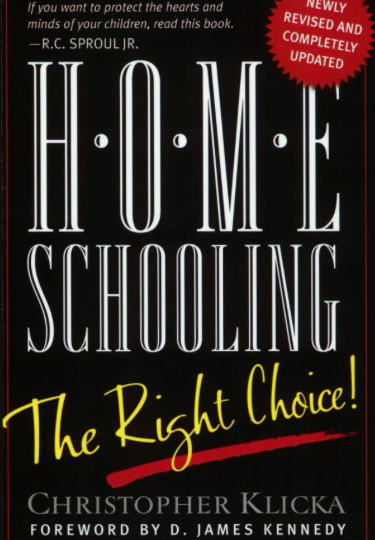
The late Chris Klicka was HSLDA’s senior counsel and, according to HSLDA founder Michael Farris, “one of the most important pioneers of [the homeschool] movement.”[x] Klicka wrote his seminal book The Right Choice: Home Schooling in 1995. Fellow homeschool leader Gregg Harris’s company, Noble Publishing Associates, published the book. In Chapter Four of the book, entitled “The Biblical Principles: A Support for Home Schooling and an Indictment of Public Education,” Klicka articulated his and HSLDA’s understanding of the child-world relationship.
According to Klicka, children are the property of God but they are — in a sense — on loan to their parents: “Children belong to God, but the responsibility and authority to raise and educate them is delegated to their parents.” Parents have a responsibility to “craft” their children to be weapons for God: “God describes our children as arrows in the hands of a warrior!…Have we diligently crafted our ‘arrows’ so they can be trusted to hit their target as we launch them into the world?…Have we personally guaranteed our ‘arrows’ are the most carefully crafted and have the sharpest point?”[xi]
This “children as weapons” concept is shared by Michael Farris. In his book How a Man Prepares His Daughters for Life, Farris uses weaponization as a metaphor for “Setting Spiritual Goals” for one’s children. He says, “No army general would ever try to train soldiers in the haphazard way many of us try to train our daughters to serve our Lord. An army has an organized plan and a training course of increasing rigor designed to produce soldiers capable of winning the battle. Our duty to train our children is no less important. It is equally necessary for us to develop goals and plans for the training of the spiritual warriors whom God has entrusted to us.” According to Farris, this spiritual weaponization requires a child-training plan that is “essentially behavioral in nature.”[xii]
Klicka’s ideal of Christian-based homeschooling is key to his and Farris’s shared goal of child behavior modification via spiritual weaponization: “God, not the state, has given parents the sole authority and responsibility for the education of their children…Parents must train their children to think God’s thoughts…Home schooling enables families to properly and comprehensively train their children’s minds.”[xiii] Klicka clarifies this does not mean children are solely the property of parents; rather, they are the property of God and parents simply “steward” God’s property: “Although God has ‘given’ children to parents, children are a ‘gift of stewardship,’ which means that parents do not really ‘own’ their children. Parents, therefore, are not free to raise their children any way they want because God gives the parents certain ‘conditions’ that must be met.”[xiv]
While the above statement might make it sound like Klicka believes children have rights that parents must respect, his meaning is actually quite different. Klicka explains that parents not being “free to raise their children any way they want” means parents should homeschool, not put their children in public school where there is an “anti-God curriculum and complete lack of values.” Klicka says parents who put their children in public school “sacrifice their children,” comparing such parents to Israelites in Ezekiel 16:20-21 who “slaughtered [their] children” by fire. In his mind, parents who enroll their children in public school are guilty of spiritual child-murder.[xv]
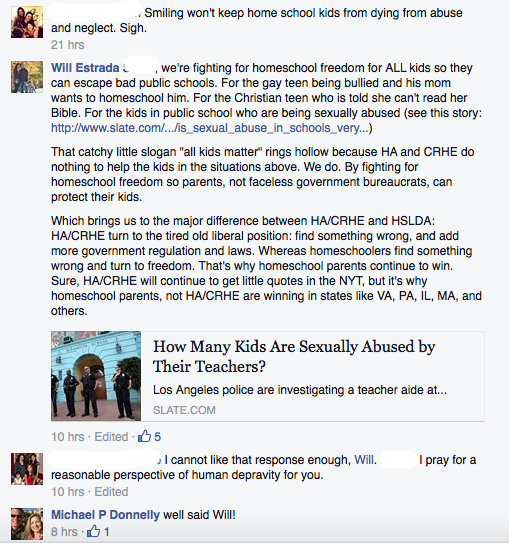
Klicka’s philosophy about children ultimately belonging to God but legally stewarded by their parents continues to be HSLDA’s philosophy to this day. Will Estrada, HSLDA’s current Director of Federal Relations, reiterated this philosophy just last year in an interview with The Daily Caller. Estrada stated that, “Children are given by God to parents and to families to be loved, to be raised and to be prepared to go on to become leaders in their community. It doesn’t take a village to raise a child. It takes parents—loving parents in a home—to raise a child.”[xvi]
This philosophy of HSLDA’s — as expressed by both Klicka and Estrada — was previously found in the Christian Reconstructionist position advocated by R.J. Rushdoony and the organization he founded, the Chalcedon Foundation. Both Rushdoony and Chalcedon inspired HSLDA[xvii] and were favorites of Klicka. (He quoted warmly and frequently from Rushdoony in his book The Right Choice: Home Schooling.[xviii]) Rushdoony not only “testified in courts around the country on behalf of Christian home-schoolers,”[xix] he also “provided expert testimony in early cases brought by the HSLDA. Rushdoony saw homeschooling as not just providing the biblical model for education but also a way to bleed the secular state dry.”[xx] The Chalcedon Foundation declared, in a paper on the UN Convention on the Rights of the Child, that, “Children are not the property of the state, nor of their parents. We are all God’s property, who created us and bought us with a price. We speak of human rights, but it is God who has the rights…Parents do not own their children, but God’s law assigns to them the duty to care for and instruct their children and guide them safely into adulthood.”[xxi]
One observes a tension in this understanding of to whom children belong as expressed by both HSLDA employees and the Chalcedon Foundation. On the one hand, children are God’s property; on the other hand, God has transferred the daily care and maintenance of that property to parents. So while parents do not own their children in a transcendent, spiritual sense (because God owns everyone), they nonetheless own them in an immanent, pragmatic sense. Parents are stewards with an exceptional amount of power over children. As Klicka said, parents have “sole authority and responsibility” over children and have the divine right to “carefully craft” their children’s lives and minds — and all of this in a concrete, legal sense. Parents must have enough legal dominion over children so that, as Rushdoony said (and Klicka agreed), “the child’s will” can be “broken to God’s purpose.”[xxii]
For all legal intents and purposes, therefore, HSLDA does envision children as some species of parental property. Theologian Janet Pais expresses the end result of this vision: “Adults, often unconsciously, act toward children out of an attitude that the child is a possession properly subject to their control…An adult may value a child for what the child can do or achieve, but this is not the same as valuing the child simply for being who and what the child is.”[xxiii] Pais calls such a parental vision “a contemptuous attitude” towards children; HSLDA, on the other hand, sees such an attitude as biblical. Children must be properly subject to parental control for behavior modification to be successful and spiritual weaponization achieved.
Parents Over All
One best observes the fact that HSLDA sees children as parental property when the organization argues who does not have rights to children’s lives. Namely, no one other than parents — not the government, not the surrounding community, not even the children themselves — have such rights.
There are many obvious examples of HSLDA opposing government and/or community rights to children. On April 9, 2013, HSLDA released a statement on MSNBC’s Melissa Harris-Perry’s video declaration that, “Kids belong to whole communities.”[xxiv] HSLDA called Harris-Perry’s declaration a “radical and controversial idea” that “threatens to impose the state between parents and children.”[xxv] HSLDA then connected this threat to homeschooling freedoms in general and the Romeike family’s situation in particular, saying, “Today the Romeike family is facing deportation from the U.S. because Attorney General Eric Holder doesn’t believe that the right of parents to direct the upbringing and education of their children is not a fundamental right worthy of protection.” (The Romeike family is a German homeschooling family who attempted to receive asylum in the U.S. because homeschooling is generally not allowed by the German government. While the Romeike family lost their asylum appeal, the Obama administration nonetheless granted them indefinite stay.[xxvi])
HSLDA’s logic is that the concept of children belonging to a community (rather than parents) creates a slippery slope to a world in which parents do not have the right “to direct the upbringing and education of their children.” This does not logically follow nor is it reflective of actual history; however, HSLDA does not attempt to give any further explanation. But what is most notable about HSLDA’s response to Harris-Perry is its title: “Do Our Kids Belong to Us—or to the Community?” In other words, in HSLDA’s mind, children can only belong to either their parents (the “us”) or to the community. While this is itself a false dilemma, HSLDA obviously does not believe children belong to the community. Thus HSLDA must believe children “Belong to Us” — in other words, children belong to parents. There is no option presented for children to belong to themselves.
This sentiment — that children are parental belongings — is shared by allies of HSLDA. The most notable ally is former U.S. Senator Rick Santorum. Santorum, a homeschooling father himself, was given a stamp of approval during his presidential campaign by Michael Farris[xxvii] as well as by Will Estrada.[xxviii] Santorum is a frequent guest on HSLDA’s radio program Home School Heartbeat,[xxix] a partner with HSLDA in their advocacy against international disability rights,[xxx] and was even dubbed “Sir Santorum” by HSLDA’s youth mobilization program, Generation Joshua.[xxxi]
Part of Farris’s reasoning for approving Santorum’s presidential campaign was that, according to Farris, “As a fellow homeschooler, [Santorum] knows how important it is to protect parental rights.”[xxxii] Santorum’s understanding of parental rights, for which Farris has bestowed him with such praise, is exactly the same as HSLDA’s. In an April 16, 2013 column for Townhall, Santorum declared that, “Children Belong to Parents, Not Government.”[xxxiii] And just like HSLDA, Santorum took aim at Melissa Harris-Perry’s statement that, “Kids belong to whole communities.” Santorum declared this to be “hark[ening] back to Marxism” and then, again like HSLDA, related a loss of parental rights to a threat against homeschooling (and the Romeike situation specifically). “The president, like so many on the left,” bemoaned Santorum, “believes that the state should form the hearts and minds of our youths so they think the way the government wants them to think.”
It must be noted that, like HSLDA, Santorum presents a false dilemma: either children belong to parents or they belong to the state. Santorum does not have a problem with someone other than a child itself forming that child’s heart and mind to think the way that someone wants the child thinks. Rather, Santorum simply wants parents to do that forming, rather than the state. This is because Santorum believes, like HSLDA, that children belong to their parents — hence the very title of Santorum’s column. Children are still property to Santorum, just not the property of the state.
From Divine Rental Property to Common Law
HSLDA’s concept of children as divine rental property forms the basis for HSLDA’s understanding of parental rights as expressed through common law. HSLDA attempts to ground many of its arguments for religious liberty and homeschooling on a Western concept of common law, especially as expressed by English jurist William Blackstone in his work, Commentaries on the Laws of England. In The Right Choice: Home Schooling, Klicka wrote, “One of the most influential common law sources on which the founders of our country relied was Sir William Blackstone’s Commentaries. Blackstone recognized that the most important duty of parents to their children is that of giving them an education.”[xxxiv]
Blackstone’s advocacy of parental rights, Klicka argued, became the cornerstone of an Oklahoma Supreme Court Case that Klicka considered key: “Building on this traditional liberty of parents as enunciated by Blackstone, the Oklahoma Supreme Court in School Board Dist. No. 18 v. Thompson secured the right of parents to control the education of their children.”[xxxv] This was key to Klicka because he and HSLDA desired to return to a previous era where “parental liberty historically was held to be virtually absolute,”[xxxvi] and the Thompson case argued that, “In this empire [the United States], parents rule supreme during the minority of their children”[xxxvii] [emphasis added by Klicka].
Because Klicka considered this court case to be of such significance, it is worth reviewing what aspects of the case Klicka neglected to mention. It is true that in 1909 the Oklahoma Supreme Court ruled in School Board Dist. No. 18 v. Thompson that, “In this empire parents rule supreme during the minority of their children.” However, the Thompson case also situates this parental supremacy in only one figure: the family patriarch. The case declared that, “The father was vested with supreme control over the child.” In terms of legal rights, “A mother, as such, is entitled to no power.”[xxxviii]
What the Thompson case declared — that the family patriarch has supreme power over his children (and the mother or wife has no legal power whatsoever) — is exactly what one should expect to find in traditional Western common law. Traditional Western common law is specifically grounded in the property-rights paradigm descended from classical Roman patriarchy. It goes back to the Roman legal concept of patria potestas (Latin for “power of the father”). Patria potestas meant that the male head of a household, otherwise known as the pater familias (father of the family), “not only…had control over the persons of his children, amounting even to a right to inflict capital punishment, but that he alone had any rights in private law.”[xxxix] The pater familias’s power went beyond his children: “The pater familias could do as he pleased with his family members: from dictating the conditions of marriage and divorce to disposing of his wife, children, and slaves through adoption, sale, or death.”[xl] Under such a paradigm, rights are distributed according to property. Since adult Roman men (the family patriarchs) were the only ones allowed to have property, they were also the only ones allowed to have legal rights. Children, women, and slaves had no legal rights. They were all considered property under traditional Western common law — even to the point that they could be bought and sold: “In early law the paterfamilias could sell children into slavery… [The paterfamilias] had available to him the standard proprietary remedies of an owner. Thus, if a child was kidnapped, it was regard as ‘stolen’ which enabled the paterfamilias to recover it through a vindicatio and to sue for damages under the action for theft.”[xli] Similarly, “in controlling his wife, a man was simply exercising control over his own person or property.”[xlii] This is the tradition to which Klicka appealed and to which HSLDA continues to appeal.[xliii]
A primary reason for such appeals is that the United States Constitution does not explicitly mention the rights of parents. Thus HSLDA appeals to the tradition of common law to deduce the rights of parents from “the laws of nature” found in Western Civilization, in other words, property rights. Chris Klicka and fellow former HSLDA attorney Doug Phillips made this very argument in a 1997 article for Educational Leadership. In their section “Roots in Common Law,” Klicka and Phillips say, “The United States Constitution does not explicitly mention parental rights. Like other legal principles at the time of the nation’s founding, the right of parents to direct the education and upbringing of their children was an implicit and necessary assumption of society. That parents had a God-given duty as well as right to make all decisions with respect to the future of their unemancipated children was part of the higher law that the Declaration of Independence termed ‘the laws of nature and of nature’s God.’” They say these “laws of nature and of nature’s God” were enshrined in Western common law: “For more than a thousand years, the doctrine of parental rights had been a bedrock principle of the Western legal tradition, expressed throughout the ‘common law.’”[xliv]
Farris himself explicitly ties this concept of Western common law to HSLDA’s advocacy of conservative Christianity and his organization’s understanding of what conservative Christianity teaches about parental rights. Farris says, “Our nation was founded upon the traditions of Western Civilization. This civilization was founded on the principles of the Word of God. God gives children to parents—not to the state, and not to doctors.”[xlv]
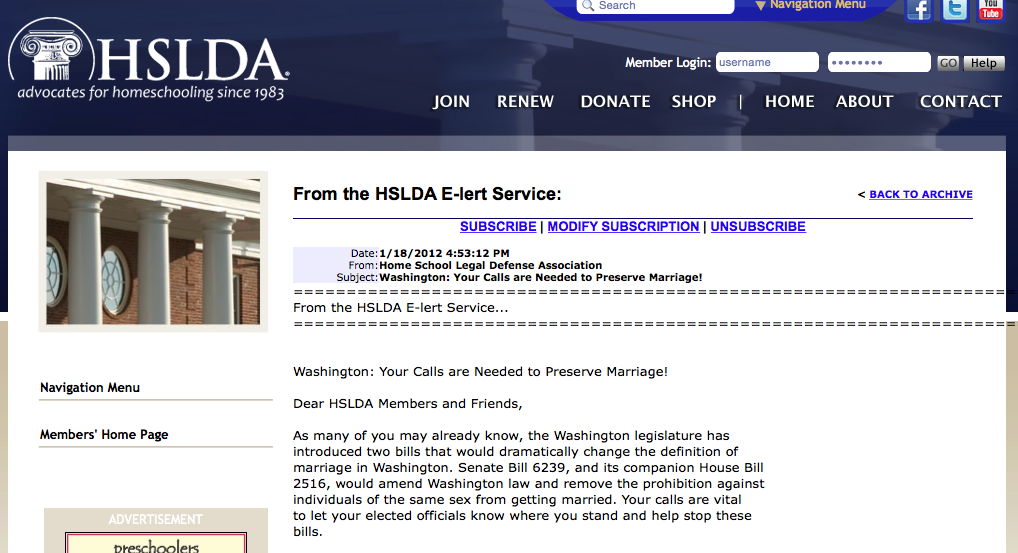
To Farris and HSLDA, therefore, any threat to traditional Western common law or Western civilization could be perceived as a threat to homeschooling. One sees this fear directly in the rationale HSLDA has given for making opposition to same-sex marriage part of its homeschool advocacy. On their web page entitled “Why HSLDA is Fighting Against Same-Sex Marriage,” HSLDA states that, “Parental rights are a recognized constitutional right despite the fact that they are not explicitly stated in the Constitution. It is a fair question to ask: if they are implied rights rather than explicit rights, what is the source of parental rights?…Parental rights are based on ‘western civilization concepts of the family.’ When those concepts are no longer the legal definition of the family in this nation, then the foundation upon which parental rights are based is completely removed…Therefore, HSLDA will continue to fight against same-sex marriage. Same-sex marriage attacks the traditions of the family in western civilization. This is an attack on parental rights.”[xlvi] HSLDA takes this “attack on parental rights” so seriously that it has supported a constitutional amendment to ban not only same-sex marriage, but also civil unions for same-sex partners by means of “the Institution of Marriage Amendment.”[xlvii]
The problem with grounding parental rights in common law (on the one hand) and then denying children should be treated as parental property (on the other hand) is that, as we just saw, common law is a property-based system. These “traditional rights” of parents come from a tradition wherein the male patriarch of a household rules supreme. The patriarch is the sole recipient of legal rights. This tradition continued even through 1909 in the Oklahoma Supreme Court case Thompson that Chris Klicka eagerly cited. In that case we see the vestiges of the tradition: the father alone has supremacy over everyone; the mother has no legal supremacy; the children have no rights until maturity; slaves have no rights whatsoever. Thus HSLDA is holding a logically tenuous position by trying to claim that, because of the Western common law tradition, parents should have sole legal authority over their children and yet children should not be considered those parents’ property. This not only creates a legal Twilight Zone. It also means that granting anyone other than the father of a household any rights would (as it has) upset the entire tradition.
The Threat of Children’s Rights
HSLDA’s view of children as divine rental property thus does not lead to a simple defense of parental rights. It leads HSLDA to directly attack any and every attempt to recognize children’s rights because such attempts are considered outright attacks on Western tradition — the foundation of HSLDA’s legal paradigm.
“Children’s Rights are Wrong,” declares the title of an August 3, 2011 article on HSLDA’s website.[xlviii] This basically encapsulates HSLDA’s position on children’s rights: they are a threat to parental rights and thus are wrong. HSLDA has a track record of opposing just about every effort to put into law any declaration of children’s rights, whether those efforts involve international treaties like the UN Convention on the Rights of the Child (which the aforementioned 2011 article addresses) or specific countries’ domestic legislation. For example, HSLDA’s official affiliate in Bulgaria, Peter G. Porumbachanov, declared opposition on HSLDA’s website to a Bulgarian draft “Children’s Rights” bill.[xlix] Porumbachanov said the bill was “state genocide against the Bulgarian family” because it “wants to give rights to the children.” Porumbachanov believes that parents instead should have the right to “control the child’s dangerous strivings toward self-destruction” by “form[ing] character in the child by teaching their philosophical and religious views.”
The Threat of the Village
When one understands HSLDA’s insistence upon parents having the “sole authority” to “carefully craft” their children’s lives and minds, while denying those children any rights of their own, it is understandable that other answers to whom children belong — such as themselves, the government, or the community — are seen as threatening. These other answers redistribute rights away from parents and towards non-parental units. But one particular answer — Hillary Rodham Clinton’s “it takes a village” answer — has received a disproportionate amount of attention from the organization.
HSLDA employees seem inexplicably obsessed with Hillary Rodham Clinton and her advocacy for children’s rights. Klicka said Clinton had “declared war on parents’ rights in America”[l] because of her support of the UN Convention on the Rights of the Child. Farris made one of the villains in his fictional book Forbid Them Not a character named “Helene Rodman,” whom he describes as “the first female president of the United States” with a “perfectly plastic smile,” a “feminist agenda,” and a desire to attack “home schooling.”[li] Farris has freely admitted that Rodman is based on Clinton.[lii] In Forbid Them Not‘s alternate universe, “Rodman” (or Clinton) takes advantage of “a landslide election, which swept a Democratic majority into both houses of Congress” and immediately signs the UN Convention on the Rights of the Child. Naturally, all hell breaks loose and a Farris-esque hero named Cooper Stone (a lawyer who moved from Washington State to Loudon County, Virginia,[liii] just like Farris) must swoop in and save the day.
Other HSLDA employees have also obsessed with Clinton,[liv] in particular her book It Takes a Village that called for “comprehensive early education programs for disadvantaged children and their families.”[lv] The “it takes a village” concept has long been a target of conservative Christians (beyond just HSLDA) — which is odd, because the concept is nothing new nor did it begin with Clinton. As stated in this exposition’s introduction, the “Children belong to their community” answer to the question “To whom do children belong?” dates back millennia. It is neither Clintonian nor Marxist — nor anything else modern, for that matter. Yet conservative Christians today (including HSLDA) fixate on Clinton as the arch-nemesis of their own values who threatens to bring Big Brother into families’ living rooms and bedrooms.
The most explicit articulation of this sentiment comes from Michael Farris’s 1999 presentation before the Howard Center for Family, Religion, & Society’s World Congress of Families in Geneva, Switzerland.[lvi] Farris says “it takes a village” advocates (whom Farris equivocates with child welfare workers) use terrorist-like tactics: “Those who believe that ‘it takes a village to raise a child’ are willing to use coercion, threats, raw police power, and intimidation to enforce their agenda. Parents who raise children in a manner that the village doesn’t like have learned to fear the knock on the door lest they hear the dreaded words, ‘I’m from the government and I’m here to help raise your children.'”
Farris relates international children’s rights efforts to these terrorist-like tactics. He specifically calls out a number of children’s rights as negative, such as: (1) “the right of the child to express his/or her opinion” concerning the child’s own education; (2) the right of a child to not be physically hit by parents; and (3) the right of “children, particularly adolescents, to pursue, medical or legal counseling without parental consent”. Children should not have these rights, Farris makes clear. And if children are granted them, Farris believes the consequences will be dire: “It is up to this generation of parents to act for the generations to come to ensure that we protect the family in the black and white of our Constitution lest the global village overtake our homes.”[lvii]
These three children’s rights — the right to self-determine education, the right not to be physically hit by parents, and the right to self-determine one’s medical treatment — are consistently targeted by HSLDA. In fact, nearly every statement HSLDA has made in the past (and continues to make today) against the UN Convention of the Rights of the Child — or any other declaration of children’s rights — calls out these three rights negatively. It is worthwhile, therefore, to look at each respectively:
The right to self-determine education
The right to self-determine education is, of course, a direct threat to HSLDA’s specific form of homeschooling advocacy. HSLDA holds back little on this count: Klicka was forthright about the fact that, if children had rights, then they could say no to homeschooling — which Klicka would not tolerate. “If children have rights,” he said, “they could refuse to be home-schooled.”[lviii] Thus to protect the ideal of homeschooling, Klicka denounced giving children rights. In fact, in a later article written on behalf of HSLDA by both him and former HSLDA attorney Doug Phillips, to “give children fundamental rights enforceable against their parents” was explicitly said to be a “threat.”[lix] As Klicka and Phillips later define “fundamental rights” as rights such as “speech, press, religion,” one can deduce that HSLDA does not believe children should have rights to speech and religion enforceable against their parents. Indeed, the Washington Post has noted that two reasons HSLDA opposes the UN Convention on the Rights of the Child are “the group fears that ratifying the treaty would mean children could choose their own religion” and “a child’s ‘right to be heard’ could trigger a governmental review of any decision a parent made that a child didn’t like.”[lx]
Klicka made this explicit in The Right Choice: Home Schooling. He explained that rights such as “freedom of expression,” “freedom of religion,” “freedom of association,” and “right to privacy” “would virtually undermine parents’ rights as we know it in the United States. Parents no longer would have the basic right to control [their children],” in particular “what church they attend.” Giving “children the fundamental rights of freedom of association, freedom of expression, freedom of religion,” and so forth is thus “in direct opposition to of [sic] those parents’ rights.”[lxi]
The right to not be physically hit by parents
The right to not be physically hit by parents is a direct threat to HSLDA’s advocacy of corporal punishment. The aforementioned quote by Chris Klicka continues as follows: “If children have rights, they could refuse to be home-schooled, plus it takes away parents’ rights to physically discipline their children.”[lxii] Klicka and HSLDA not only defend the right of parents to physically hit children, they actively fight to expand that right to include foster parents physically punishing foster children: “[Klicka] had a similar explanation for [HSLDA’s] opposition to increased federal child abuse laws — more laws would mean more likelihood that corporal punishment could be defined as child abuse…Administrators from Patrick Henry College were among those testifying before the Virginia Department of Social Services for a measure that would allow foster parents to physically discipline foster children.”[lxiii]
It is important to highlight that HSLDA does not simply defend the right of parents (natural or foster) to physically hit children. Rather, HSLDA explicitly promotes parents doing so. Michael Farris has declared that, “I am a firm believer in—dare I say it?—spanking. When the children are little I will spank either gender for deliberate disobedience of a rule that they have been taught.” Farris describes a father who will not use corporal punishment on his daughter as a “pushover” who “loves his daughter in principle, but…hates her in practice.”[lxiv] In Klicka’s book The Right Choice: Homeschooling, Gregg Harris contributes a guest chapter (“How Should We Then Teach? Walking In Light Of God’s Principles Of Education”) where he instructs parents that, “Spanking is one divinely mandated method which must not be ignored,” and that if parents do not spank, their children “could become another statistic in the war on drug abuse, AIDs, and drunk driving.” Parents who do not use corporal punishment are “disobey[ing] God by discarding a clearly biblical method of child discipline.”[lxv]
The right to self-determine one’s medical treatment
The right to self-determine one’s medical treatment is a direct threat to HSLDA’s defense of parents’ religious freedom — contextually defined as the right of parents to withhold medical treatment from their children if their religion thus dictates. Religious freedom forms the cornerstone of HSLDA’s objection to mandatory vaccinations, for example. Chris Klicka has declared that, “Immunizations should not be mandated for all children [because] many parents have strong religious convictions against vaccinating their children.”[lxvi] Klicka defends medical religious exemptions because, “Religious exemption statutes simply codify the protections of an individual’s right to freely exercise their religious belief as guaranteed by the First Amendment of the U.S. Constitution and parallel portions of the state constitutions.” However, Klicka never explains how an individual’s right to religious expression implies a right to impose that expression on another individual — i.e., a child’s medical treatment.
Similarly, HSLDA’s current senior counsel Dee Black has expressed support for parents exempting their children from not only immunizations but other health care as well. HSLDA offers support to homeschooling parents who “claim a religious exemption from immunizations,” Black says, “and health and medical services.”[lxvii] Farris believes this is appropriate because, even when it comes to complicated medical procedures of which parents have zero education or expertise, “God has delegated these kinds of decisions to parents, not to doctors, social workers, or courts.”[lxviii]
Since “the village” — the concept of community taken for granted by many cultures and societies throughout history — could potentially lead the recognition of one or more of these 3 rights, it takes on a purely nightmarish quality to Farris and HSLDA. This nightmare drives them to shrink the circle of necessary and desirable socialization to the nuclear family — as we see, for example, in the aforementioned statement by Will Estrada that, “It doesn’t take a village to raise a child. It takes parents.”
But note: while mass mobilization on a national or international scale via government-funded programs (such as public schools, day care, health care, etc.) to recreate the “village” atmosphere lost due to the last few centuries of industrialization is indeed a relatively novel idea, so too is the idea that a nuclear family can adequately carry all the responsibilities previously carried by the “village.”[lxix] (This is why John Holt, as previously mentioned, argued that, “The family we talk so much about preserving is a modern invention.”[lxx]) While HSLDA does not hesitate to point out the former, they never provide any justification or rationale for the latter. Whether this is due to historical ignorance or intentional omission is unclear. What is clear is that they believe, contrary to actual facts, that the 20th century, American, heterosexual two-parent nuclear family concept is the historical norm.
Conclusion
As demonstrated in this exposition, HSLDA believes that children are divine rental property who at no point belong to themselves. God owns every soul. But when parents create or adopt a child, God essentially rents that soul out to the parents who have the responsibility to maintain that child to the satisfaction of God. When the child becomes a legal adult, the child takes the rental lease over from the parents — but still belongs to God, not itself. The child (as a legal adult) now has the responsibility to maintain itself to the satisfaction of God.
Depending on whom you are talking to, how much of the rental lease the child takes over from the parents may vary. Former HSLDA attorney Doug Phillips, for example, believes unmarried children never take the lease over until they get married.[lxxi] Michael Farris, though publically condemning his former HSLDA colleague for going “far beyond even a very traditional view of Scripture’s teaching,”[lxxii] agreed in his 2004 book What a Daughter Needs From Her Dad with Phillips to a significant extent with regards to female children. Farris argued that you should never push your daughters towards a “career as her first priority,” because “God-given female distinctiveness” means “marriage and motherhood are the highest.” Female children should be encouraged towards such responsibilities, where they will immediately fall under the authority of their husbands: “The Bible correctly teaches that a woman should be submissive to her husband.”[lxxiii]
Regardless, the consensus of HSLDA employees (both past and former) is that children belong to God in a transcendent sense but in an immanent sense belong to their parents. They are the property of their parents, rented from God until they become legal adults. HSLDA rejects outright any other answer to the question “To whom do children belong?” HSLDA is adamant that children do not belong to the government, the community, or themselves. Their rejection of the first two explain their general opposition to government intervention and community-based programs of intervention, while their rejection of the third explains their intense denouncement of children’s rights. If children belong to themselves, as autonomous human beings they would have every claim to human rights that any other human beings have. Insofar, therefore, as HSLDA believes that children must belong to their parents in a legal sense, children are to have no fundamental rights — and fundamental rights for children are seen as a monumental threat to not only the homeschooling movement, but more importantly the parental rights agenda on which HSLDA has chosen to ground that movement.
******
Citations
[i] Sarah LeVine and Robert LeVine, “Child Abuse and Neglect in Sub-Saharan Africa,” Child Abuse and Neglect: Cross-Cultural Perspectives, edited by Jill E. Korbin, published by University of California Press, 1981, p. 38.
[ii] L.L. Langness, “Child Abuse and Cultural Values: The Case of New Guinea,” Child Abuse and Neglect: Cross-Cultural Perspectives, edited by Jill E. Korbin, published by University of California Press, 1981, p. 26-27.
[iii] Hiroshi Wagatsuma, “Child Abandonment and Infanticide: A Japanese Case,” Child Abuse and Neglect: Cross-Cultural Perspectives, edited by Jill E. Korbin, published by University of California Press, 1981, p. 133, 131.
[iv] John Hollitz, “The Raw Materials of History: Childhood in Puritan New England,” Thinking Through the Past: A Critical Thinking Approach to U.S. History, Volume I, 3rd edition, 2005, published by Houghton Mifflin, p. 21-22.
[v] Tamara Camille Newcomb, “Parenting Characteristics in Native American Families,” Oklahoma State University, 2005, link, accessed on December 9, 2014.
[vi] McClellan Hall, “Facilitating a Natural Way: The Native American Approach to Education,” National Indian Youth Leadership Project, 2000, link, accessed on December 9, 2014.
[vii] John Holt, “Free the Children; They Need Room to Grow,” Pyschology Today, October 1974.
[viii] John Holt, Escape from Childhood, published by Holt Associates, 1996.
[ix] Holt, 1974.
[x] HSLDA, “In Memoriam: Christopher J. Klicka,” October 12, 2009, link, accessed on December 12, 2014.
[xi] Chris Klicka, The Right Choice: Home Schooling, Noble Publishing Associations, 4th printing and revised edition, 1995, p. 103.
[xii] Michael Farris, How A Man Prepares His Daughters For Life, Bethany House Publishers, 1996, p. 52-53.
[xiii] Klicka, The Right Choice, 1995, p. 102, 108-109.
[xiv] Ibid, p. 104.
[xv] Ibid, p. 105, 104.
[xvi] Will Estrada as quoted by The Daily Caller, “Homeschool advocate obliterates MSNBC host over ‘collective’ view of children,” April 14, 2013, link, accessed on December 12, 2014.
[xvii] Charles H Lippy, Peter W Williams, “Education: Homeschooling Movement,” Encyclopedia of Religion in America, Granite Hill Publishers, 2010, p. 644: “For Rushdoony, the family was divinely instituted to train warriors for Christ who would fight to subject all nations to his law. Rushdoony’s theories inspired many of the leaders who created the institutional infrastructure supporting both the Christian day and home school movements, including Paul Lindstrom’s Christian Liberty Academy Satellite Schools (CLASS) with its Accelerated Christian Education (ACE) curriculum, John W. Whitehead’s Rutherford Institute, and the Home School Legal Defense Association (HSLDA).”
[xviii] Klicka, The Right Choice, 1995. In Chapter 3, “The Philosophical Crisis in Public Education,” Klicka repeatedly cites Rushdoony’s 1968 book, The Messianic Character of Education. Appendix A of Klicka’s book, “The Difference Between Christian Education and Humanistic Education,” is a reprinted section from Rushdoony’s 1981 book, The Philosophy of the Christian Curriculum.
[xix] Marcia Clemmitt, “Home Schooling: Do parents give their children a good education?”, CQ Researcher, Volume 24, Issue 10, March 7, 2014, p. 217-240.
[xx] Kathryn Joyce, “The Homeschool Apostates,” American Prospect, December 4, 2013, link, accessed on December 10, 2014.
[xxi] Lee Duigon, “Will UN Treaty Abolish Parents’ Rights?” Chalcedon Foundation, 2009, link, accessed on December 10, 2014.
[xxii] R.J. Rushdoony in Klicka, The Right Choice, 1995, p. 422.
[xxiii] Janet Pais, Suffer the Children: A Theology of Liberation by a Victim of Child Abuse, Paulist Press, 1991, p. 10-11.
[xxiv] For context about Harris-Perry’s statement, see KJ Dell’Antonia, “Melissa Harris-Perry’s ‘Uncontroversial Comment’ About Children,” New York Times, April 10, 2013, link, accessed on December 9, 2014.
[xxv] Michael Farris as quoted by HSLDA, “Do Our Kids Belong to Us—or to the Community?”, April 9, 2013, link, accessed on December 7, 2014.
[xxvi] Ben Waldron, “Home Schooling German Family Allowed to Stay in US,” ABC News, March 5, 2014, link, accessed on January 3, 2015.
[xxvii] Rick Santorum, “Press Release – Home School Legal Defense Association Chairman Michael Farris Commends Rick Santorum to the Voters,” January 20, 2012, archived by the American Presidency Project, link, accessed on December 7, 2014.
[xxviii] Daniel Burke, “Rick Santorum’s secret army: home-schoolers,” Religion News Services, March 5, 2012, link, accessed on December 7, 2014.
[xxix] HSLDA, Home School Heartbeat, “American Patriots: An Interview with Rick Santorum,” April 29–May 3, 2013, Vol. 115, Programs 51–55. Accessible online: link.
[xxx] HSLDA, Home School Heartbeat, “Understanding the UN CRPD: An Interview with Rick Santorum,” March 4–8, 2013, Vol. 115, Programs 11–15. Accessible online: link.
[xxxi] Burke, 2014.
[xxxii] Santorum, “Press Release,” 2014.
[xxxiii] Rick Santorum, “Children Belong to Parents, Not Government,” Townhall, April 16, 2013, link, accessed on December 7, 2014.
[xxxiv] Klicka, The Right Choice, 1995, p. 339.
[xxxv] Ibid.
[xxxvi] Ibid, p. 338.
[xxxvii] SCHOOL BD. DIST. NO 18 GARVIN COUNTY v. THOMPSON, 1909.
[xxxviii] Ibid.
[xxxix] Encyclopedia Britannica, “Patria potestas,” link, accessed on December 30, 2014.
[xl] A. Javier Treviño, The Sociology of Law: Classical and Contemporary Perspectives, Transaction Publishers, 2001, p. 21.
[xli] Paul du Plessis, Borkowski’s Textbook on Roman Law, Oxford University Press, 2010, p. 112-113.
[xlii] James G. Dwyer, Religious Schools V. Children’s Rights, Cornell University Press, 1998, p. 72.
[xliii] See, for example, Michael Farris, “Parental Rights: Why Now is the Time to Act,” Court Report, Marcy/April 2006, link, accessed on December 12, 2014: “The legal principle used in Pierce was first announced in Meyer v. Nebraska. The Court announced that ‘those privileges long recognized at common law as essential to the orderly pursuit of happiness by free men’ were protected under the Due Process Clause…If implicit rights are tied to history, then there is a solid basis for determining what was a recognized right at a particular point in time.”
[xliv] Christopher J. Klicka and Douglas W. Phillips, “Why Parental Rights Laws Are Necessary,” Educational Leadership, November 1997, Volume 55, Number 3, link, accessed on December 8, 2014.
[xlv] Michael Farris, “Who Makes the Really Tough Decisions: Parents? Or Doctors?”, HSLDA, November 29, 2011, link, accessed on December 12, 2014.
[xlvi] HSLDA, “Why HSLDA is Fighting Against Same-Sex Marriage,” link, accessed on December 12, 2014. Archived as a PDF here.
[xlvii] Michael Farris, “Questions and Answers Regarding a Constitutional Amendment on Same-Sex Marriage,” HSLDA, April 15, 2004, link, accessed on December 12, 2014. Archived as a PDF here.
[xlviii] Marten Schultz, “Children’s Rights are Wrong,” HSLDA, August 3, 2011, link, accessed on December 8, 2014.
[xlix] Peter Porumbachanov, “Children’s Rights vs. Parental Rights?”, HSLDA, January 22, 2012, link, accessed on December 8, 2014.
[l] Klicka, The Right Choice, 1995, p. 243.
[li] Michael Farris, Forbid Them Not, Broadman & Holman Publishers, 2002, p. 398-400, 448.
[lii] Michael Farris, “Parental Rights: Why Now is the Time to Act,” Court Report, Marcy/April 2006, link, accessed on December 12, 2014: “In 2002, I published a novel, Forbid Them Not (Broadman & Holman), with the premise that a thinly-disguised Hillary Clinton had been elected president. The first act of her new administration was to secure the ratification of the UN Convention on the Rights of the Child (UNCRC). I do not claim the gift of prophecy, but there is a looming possibility that I may be proven right.”
[liii] Ibid, p. 27-28
[liv] Examples of HSLDA’s singling out of Hillary Clinton include: (i) Michael Farris, “Appeals court rejects coerced entry to home,” Washington Post editorial, September 7, 1999, link, accessed on December 8, 2014. Michael Farris begins generalizing about the “it takes a village” people: “We have heard from the ‘it-takes-a-village people’ that the government’s need to protect children from abuse.” (ii) HSLDA’s autobiographical series, “1983-1998: Marking the Milestones — A Review of History: Hardwon Freedoms,” describes Clinton’s “village” concept in its “International Threats” section: “So-called child advocacy groups, such as Children’s Defense Fund—part of the ‘it takes a village to raise a child’ establishment—have begun to use international bodies, like the United Nations, to gain more control over the world’s families.” See link, accessed on December 8, 2014. (iii) HSLDA, “Pray for Parental Rights,” January 5, 2005, link, accessed on December 8, 2014. HSLDA declared it is “increasingly concerned about the erosion of parental rights, especially when religious parents want to do something that offends modern secular sensibilities. There is a profound tension between the rights and responsibilities of parents, on the one hand, and the increasingly popular ‘It Takes a Village’ mentality on the other.” (iv) Michael Farris, Home School Heartbeat, “Parental Rights, Part 1 — Lessons from History,” Volume 67, Program 1, April 24, 2006, link, accessed on December 8, 2014. Farris says, “There are three direct threats to parental rights,” one of which is, “There’s a rising number of anti-parent politicians who believe, like Hillary Clinton, that ‘it takes a village’ to raise a child.” (v) Michael Farris, “New World Playpen,” American Conservative, October 1, 2009, link, accessed on December 8, 2014. Farris describes “a coalition seeking ratification of the United Nations Convention on the Rights of the Child” as “the faithful, who subscribe to the notion that ‘It Takes an (International) Village to Raise a Child.'” (vi) Will Estrada, HSLDA, “Whose children are they? UPDATE: HSLDA’s Will Estrada counters Melissa Harris-Perry on The Daily Caller,” link, accessed on December 8, 2014. Will Estrada, HSLDA’s Director of Federal Relations, criticizes MSNBC’s Melissa Harris-Perry by way of criticizing Clinton: “It doesn’t take a village to raise a child. It takes parents…This leftist ridiculous idea that children somehow belong to the state—I thought we defeated this back with socialism, back with fascism.” (vii) One of Will Estrada’s speech presentations takes direct aim at Clinton: “The U.N. Convention on the Rights of the Child—It Takes a Village to Raise Your Child.” See link, accessed on December 8, 2014. These are but a few of many possible examples, all of which indicate HSLDA is particularly bothered and/or threatened by not only the “village” concept in itself, but perhaps more importantly by Hillary Clinton’s specific articulation of it.
[lv] Katherine Paterson, “First, Families,” New York Times, February 11, 1996, link, accessed on December 12, 2014.
[lvi] Michael Farris, “Remarks to The World Congress of Families II,” presented at the 1999 World Congress of Families, The Howard Center for Family, Religion & Society, link, accessed on December 8, 2014
[lvii] Ibid.
[lviii] Chris Klicka, as quoted by Helen Cordes, “Battling for the heart and soul of home-schoolers,” Salon, October 2, 2000, link, accessed on December 8, 2014.
[lix] Klicka and Phillips, 1997.
[lx] Karen Attiah, “Why won’t the U.S. ratify the U.N.’s child rights treaty?”, Washington Post, November 21, 2014, link, accessed on December 8, 2014.
[lxi] Klicka, The Right Choice, 1995, p. 247, 249, 253.
[lxii] Klicka, as quoted by Helen Cordes, 2014.
[lxiii] Ibid.
[lxiv] Farris, How A Man Prepares His Daughters For Life, 1996, p. 30-31.
[lxv] Gregg Harris in Klicka, The Right Choice, 1995, p. 188, 190.
[lxvi] Christopher Klicka, “Immunizations: A Parent’s Choice,” HSLDA, September 13, 2007, link, accessed on December 8, 2014.
[lxvii] Dee Black, “Homeschool Affidavits: Health and Medical Services/Immunization Requirements,” HSLDA, January 6, 2014, link, accessed on December 8, 2014.
[lxviii] Farris, “Who Makes the Really Tough Decisions: Parents? Or Doctors?”, 2011.
[lxix] In fact, there is growing evidence that this will only further strain the health of nuclear families. For example, see Emelie A. Olson, “Socioeconomic and Psycho-Cultural Contexts of Child Abuse and Neglect in Turkey,” Child Abuse and Neglect: Cross-Cultural Perspectives, edited by Jill E. Korbin, published by University of California Press, 1981, p. 96: “[There is] another result of the increased [modernization in Turkey]: children are valued more for ‘primary group ties, affection, and love’ and less for security in old age and utilitarian values. Ironically, as children become relatively more important as sources of love, support, and companionship to parents cut off from their family and neighborhood networks, it is possible that the parents’ unmet emotional needs may lead to increasingly high expectations and unrealistic demands on their small children and thus to more classic child abuse.”
[lxx] Holt, 1996.
[lxxi] Vision Forum Ministries, “The Tenets of Biblical Patriarchy,” retrieved from the Internet Archive, link, accessed on December 12, 2014: “Both sons and daughters are under the command of their fathers as long as they are under his roof or otherwise the recipients of his provision and protection. Fathers release sons from their jurisdiction to undertake a vocation, prepare a home, and take a wife. Until she is given in marriage, a daughter continues under her father’s authority and protection. Even after leaving their father’s house, children should honor their parents by seeking their counsel and blessing throughout their lives.”
[lxxii] Michael Farris, “A Line in the Sand,” HSLDA Court Report, August 2014, link, accessed on December 12, 2014.
[lxxiii] Michael Farris, What a Daughter Needs From Her Dad, Bethany House, 2004, p. 113, 110, 114, 109.







 Homeschoolers Anonymous