My most popular post ever, the one on courtship and emotional purity, is making the rounds again, as it does every few months. And with it come the loads of ridiculous assumptions, explaining, excuses, and outright dismissal of everything from my character to my experience to my beliefs. This isn’t anything new. It’s been happening since I started telling my story. It happens to all of my friends from Homeschool Land who also tell their stories. It’s woefully predictable.
“She wasn’t really raised Biblically.”
“He isn’t a good example of proper homeschooling.”
“She’s bitter.” (Because obviously being bitter means you’re making stuff up. Or something.)
“His parents obviously didn’t do it right.”
“She’s not indicative of all homeschoolers.”
“He obviously courted in a legalistic way, but that’s not the right way, the way we will do it.”
“The experience she writes about is extremism and not the Godly way of raising kids/homeschooling/courtship/whatever.”
And after every dismissal, an explanation of why they’re different, they’re doing it right, they know better. Their kids will turn out as promised. They have it all planned.
But what these people that comment on our blogs fail to understand is that my parents had it all planned too. They did everything “right”. They read the right books and followed the right teachings that explained how to raise their kids in such a way as to ensure they will grow up to be Godly offspring. People who are the exemptions. People who are whole and full of light and unstained by the world. The next generation of movers and shakers. People who are super Christians.
Had these people who so easily dismiss us met my family 15 years ago, they would’ve wanted to BE us. We were the perfect family. We dressed right, acted right, said all the right things. People used to ask my parents to help their family look like ours; to help them make their kids as good as we were. They called us “godly”, “a refreshment”, “a good example”, and so much more. These people who now turn up their noses in disbelief at me now would’ve been our best friends back in the day.
I think that these people, who are overwhelmingly current homeschooling parents, have to have some way of making sense of the phenomenon of the so-called Homeschooled Apostates. They have to find some reason why what they follow and believe to be “God’s Plan” didn’t work. They encounter people like me and have no idea what to do with us.
Because I was not supposed to happen.
We were not supposed to happen. Every last one of us who was raised in a culture that promised abundant life and Godly children and have now since rejected all or part of our upbringings were not supposed to happen. Sites like Homeschoolers Anonymous, with it’s stories of horrific abuse, neglect, and everyday pain were not supposed to happen. We shouldn’t exist and our stories weren’t supposed to sound the way they do. Not according to all the promises made to our parents, made by our leaders and the authors of the books and the speakers at the homeschool conventions. Yet, here we are.
We who have grown up, evaluated, rejected, and chosen a different path for us and our children….we are threats. Our very existence is a threat to the happy little paradigm that is the conservative homeschool movement. We are realities that threaten to unravel the idealistic fabric of their worldview. They have no idea what to do with us.
They say “well your parents did it wrong, but we’re doing it right!” as we watch them practice the exact same things that damaged and hurt and broke us. We’re desperately waving red warning flags only to be completely disregarded, blamed, and even attacked. Our lives and real stories are no match for the rosy promises of the perfect life, couched in beautiful scripture and Christian idealism. Instead of critically thinking through anything we have to say, evaluating and considering the experiences of countless numbers of people, instead of re-evaluating their own choices and philosophies, against all reason and logic they dismiss us. Pretend we aren’t how we say we are. Convince themselves and others that we and our parents aren’t like them; we did it all wrong and the formula isn’t broken, we’re the ones who are broken. Even after the formula keeps producing the same result, they cannot let go of it.
But we aren’t going away. We happened, we exist, we aren’t abnormalities…..we’re just people. People who all lived similar lives in a movement our parents all followed for very similar reasons. Every day there are voices added to ours. When I first started blogging, there were very few people telling the story of the homeschool alumni. We had only begun to grow up and process our lives and many of us thought we were alone in this. In the last 5 years, that number has grown exponentially and I predict will continue to do so.
Homeschooling parents today have two choices: ignore the now thousands of warning voices of experience, or carefully listen, reconsider and change direction. I often wonder how many children of the people who dismiss us will end up on our blogs or with blogs of their own that are just like mine. Parents, don’t fool yourselves. You aren’t “doing it right” any more than our parents were “doing it right” when you’re doing the exact same things they did and following the exact same teachings. Your children are not more special than we were.
They are people with free will who will grow up to make their own choices, either because of you or in spite of you.
There are many times that I don’t realize just how much strange teaching I’ve had to “un-do” in my life until I try to explain them to someone else. This happened to me the other night. A dear friend and I were talking about our kids and how to help them transition from children to adults. The topic of dating and relationships came up and we started talking about my story. Sometimes it’s actually comforting to me to be met with blank or incredulous stares from people I consider “normal”, good Christians. It somehow validates my belief that some of the teachings I grew up with were very wrong.
I’ve also lately started facing the ways in which the teachings of “emotional purity”, (a la Josh Harris, the Ludys, and others) have damaged the part of my brain that makes healthy relationships function.
I define “emotional purity” in the same way that popular homeschool writers have: it is the idea of “guarding your heart”. Which sounds all noble and righteous and everything but in this context is really just a facade for fear. Fear of loving and losing. Fear of making the wrong choice. Fear of getting hurt. Fear of being damaged. Fear of not measuring up. In my life it meant never having a crush on a guy, never allowing myself to “fall in love”, basically training myself to shut down a normal, healthy, functioning part of my human heart.
I’m 27 years old, been married for almost 7 years. I rejected the teachings of courtship and emotional purity when I was 19. But their effects have yet to leave.
There are several ways that these teachings can damage a person’s heart.
1. They cause shame.
Shame because sometimes you can’t help but like one guy a little more than another. Shame because that’s “sinful” and “emotionally impure”. Shame because it sets a standard and proclaims that you are somehow shameful if you cannot keep it. You are considered damaged goods if you have fallen in love and had your heart broken. It was Josh Harris in I Kissed Dating Goodbye and the Ludy’s in several of their books that popularized the idea that everytime you fall in love or get “emotionally attached” to someone, you give away a piece of your heart. The more pieces you give away, the less of your heart you have to give to your spouse someday. He even went so far as to say that each of those former flames actually have some sort of hold on you. This has got to be the most bogus and the most damaging teaching of this entire movement. Love doesn’t work that way. The more you give, the more you have. My 3rd child doesn’t have less of my heart just because I’ve loved two other children before him. And, really, I haven’t given them “pieces” of my heart. I’ve given them each all of my heart. The miracle of love is that it multiplies by being given.
Each person I love has “a piece of my heart”…my best friend, my sisters, my husband, my parents, my kids. It is ridiculous to suggest that there is not enough of my heart to go around.
And what view of redemption does this teaching proclaim? Not one that I want anything to do with. It is an incompetent redemption.
2. They cause pride.
Pride because suddenly you are better than everyone else. Because you have never had a crush on a guy. You have kept your heart for your spouse. You didn’t say “I love you” til your wedding day. Pride in human accomplishment. Pride because you are so much more spiritual than that poor girl over there who is crying because her boyfriend broke up with her. Because your heart is whole and she just gave a piece of hers to a guy she isn’t married to. Pride because you did it right, she did not. You have more to give your future husband than she does. She is damaged goods, you are the real prize.
This is exactly what happened to the Pharisees. They made up laws that God never condoned, then patted themselves on the back for keeping them, while looking down on those who didn’t. This has nothing to do with the righteousness and grace of God, and everything to do with the accomplishments of man. I remember watching a video where one of the biggest names in the courtship movement bragged with obvious arrogance that he didn’t tell his wife he loved her until their wedding. And I thought “how twisted can we get?” We took something as simple as saying “I love you”, built a strawman rule around it (“saying I love you is defrauding”) then hung it like a trophy on our walls. Job well done, folks.
3. They create skewed views of relationships which lead to dysfunction
This is where I still struggle. Where others see nothing wrong, I am suspicious of every look, every situation, every witty exchange. I am still uncomfortable hugging one of my best friends who is a guy. Because we were never to hug or have physical contact, even innocent, with a guy. Voices in my head scream “defrauder!” just by giving a friend a quick hug. I feel ill at ease sometimes even talking to other men. Oh, they never notice. Because I’m really good at pushing those feelings away and acting “normal”. But I am bothered by my reaction to everyday situations. We were taught never ever ever to be alone with a guy. Because it could look bad. He could be tempted. You might start thinking impure thoughts. You might even *gasp* flirt!
I was trying to explain this to my friend and it came out sounding so….crazy and embarrassing. I told her if she was to walk out of the room, leaving me and her husband in the same room, my first reaction would be one of panic. “This might look bad…. what if he talks to me…what if someone else sees us….what is he thinking…” My second reaction, close on the heels of the first, would be a coping mechanism that I learned long ago: I calmly tell myself that “this is perfectly normal and perfectly innocent…he probably doesn’t even notice me…this is a Godly man I know and trust….the only person who would ever freak out about this is me….to the rest of the world there’s nothing wrong here”. I then calm down, act normal, and hope nobody noticed my crazy internal battle. Cuz they’d probably admit me to a psych ward. Thank you, Josh Harris and Co. I hatethis about myself! I am a strong, confident person. But the idea that I can defraud just by a look, that I could become emotionally impure just by a thought, that I might become damaged goods with pieces of my heart strewn all over tarnation, and that guys “only have one thing on their mind” and we need to help them control themselves, has truly negatively affected what should be normal interactions with my friends. Honestly, I don’t get embarrassed talking about much. But this admission isn’t easy for me.
Guess what? In the real world, men and women can have innocent relationships. They can talk to each other without one of them thinking there’s ulterior motives. They can laugh and exchange wits and, yes, even drive in a car together without anybody thinking anything dubious is happening. They are not naiive but they are not afraid of their own shadows. Purity and integrity in relationships can be there without being unnaturally freaked out about it. The other night, I stuck my tongue out at a guy friend who was teasing me and his wife cracked up laughing. As I laughed, I felt myself looking down on the situation, amazed that nobody thought twice about it, then amazed that I DID…that I had to push away feelings of guilt because what if someone thought I was *gasp* flirting?! This is one dysfunction that I really wish I could be freed from. Maybe time is the only cure and I need to be more patient with myself. These teachings have deep, rotten roots and it takes time to pull them all out.
4. They teach us to make formulas to be safe
1 + 1= 2. Emotional purity + Biblical courtship = Godly marriage. But life doesn’t work that way. You can do everything “right” and your life can still suck. You can do everything “wrong” and still be blessed. Rain falls on the good and evil. Time and chance happen to them all. People who follow the courtship formula still get divorced. Or stuck in terrible marriages. Courtship is not the assurance of a good marriage. Life is too complicated for that. Love involves vulnerability. When you choose to love, you are choosing to accept risking a broken heart. No formula can protect you. Life involves risk. Following God involves risk. He is not a “safe” God. But He is good.
God doesn’t seem to like formulas. Because formula is the opposite of faith. Formula says “I will follow a God that I’ve put neatly in a box, to give me the desired results”. Faith says “I will follow You even when I can’t see where I’m going, even when the world is collapsing around me”. Formula says “I will not risk, I will be in control of my future”. Faith says “I will risk everything, I will trust Whom I cannot see, surrender what I cannot control anyway.” Formula is the assurance of things planned for, the conviction of things seen. Faith is the assurance of things hoped for, the conviction of things not seen (Heb. 11:1). But we are afraid. So we control instead of trust. We don’t take a step unless we can see where we’re going. We build neat little formulas and say “THIS will keep me safe!” Then we blame God when our puny formulas fail.
These teachings need to be stopped. They were new in my generation and now I, and others like me, are reaping the fruit of them. And the fruit is rotten to the core. I’m sure those who promoted such ideas had good intentions. But good intentions aren’t enough. Without Truth and Grace they can do more harm than good. Thanks to those good intentions, we are seeing an entire generation of homeschool alumni who have no idea how to have normal relationships. I have talked with literally hundreds of alumni my age, and am not exaggerating the extent of the issue. It’s nice to know I’m not alone in my dysfunction but discouraging as well. What is encouraging is that most of us have determined to stop the insanity. We will not be passing these things to the next generation. Instead we will teach our children to love God with all that they have, all that they are; and to love and respect others as they love themselves.
I leave you with the words of a very wise man:
“To love at all is to be vulnerable. Love anything, and your heart will certainly be wrung and possibly broken. If you want to make sure of keeping it intact, you must give your heart to no one, not even to an animal. Wrap it carefully round with hobbies and little luxuries; avoid all entanglements; lock it up safe in the casket or coffin of your selfishness. But in that casket- safe, dark, motionless, airless–it will change. It will not be broken; it will become unbreakable, impenetrable, irredeemable.”
Sometimes I feel like I’m from another country. Or maybe another era. I’m a child of the 80’s, yet I know nothing about being a child of the 80’s. I can’t relate to pop-culture references and feel awkward when people my age laugh about something I’m supposed to know about but don’t. I see funny posts entitled “You Know You Grew up in the 80’s and 90’s When….” and I get maybe 2 references in the entire article. Sometimes it’s funny and I laugh at myself. Sometimes it’s frustrating. Sometimes I sit in a group of people and wish I knew what they were talking about, wish I had that camaraderie they all seem to have, wish I didn’t feel like an oddball, like I will always be an oddball. Sometimes I like being an oddball, when it’s of my own choosing. Sometimes I wish I had a choice in the matter.
I’m studying all kinds of fascinating things as I’m finishing the last half of my BA in liberal studies. The psychology and sociology-related classes are my favorite. I came across this word and concept a few weeks back: Cohort. And suddenly, things started falling into place in my head; ideas with a lot of gaps and holes and flashes of pictures started forming and making sense, like pieces of a puzzle that were missing but aren’t anymore. Cohorts…..cohort effects……and it hit me:
Homeschoolers are basically their own cohort.
No matter what part of the country we are from or how old we are, we experience a cohort effect that other people in our age group do not. Even though all people from our generation are technically in the same age cohort, homeschoolers are actually in their own cohort with their own sociocultural-graded influences that the rest of our culture did not experience. We often joke among us that we were our own sub-culture. But I think it’s deeper than that.
I was asked as an essay question for a class to write a couple paragraphs on how cohort effects have shaped my worldview on things like politics, gender, science, and religion. And I thought, where do I even start? I’m not just in the cohort that was born in middle class white America in the 80’s. Matter of fact, I have very little relatability with anyone in my birth/generational cohort because I basically grew up in a completely different cohort.
Oxford Reference describes “Cohort” as: “A group of people who share some experience or demographic trait in common, especially that of being the same age …”
The Psychology Dictionary defines “Cohort Effects” as: “The effects of being born and raised in a particular time or situation where all other members of your group has similar experiences that make your group unique from other groups”
This is usually used to describe a group of people born at the same time, who experienced similar history, and their similarities in development. Like Generation X. Or Millennials. Or Baby Boomers. People born in the same time and the same place. Though it can also be used to describe sub-cultures within cultures.
The cohort effect is something that must be taken into account when studying developmental psychology or lifespan development, because something could be erroneously attributed to an age group that actually describes a cohort, a group of people that shared specific happenings, demographics, or historical events. This article has a very good, simple example of this effect in studies, and why it matters.
Those of us who were part of the pioneer Christian homeschooling movement, no matter how extreme or not, no matter where on the spectrum of conservative to liberal we were, we relate to each other in ways we cannot relate to the rest of our age cohort. In reality, we experienced history differently. We had our own culture and our own leaders and our own historical events that the rest of America knew nothing about, but that were very important to us. They defined us and we were proud of that. It’s not the fact that we were all home educated that creates this dynamic. It’s the fact that we were all part of a home education movement that was not just counter-cultural, but *anti* cultural.We were raised in a movement with varying degrees of the same teachings and varying degrees of sheltering, for all the same reasons. We were, most of us, raised under the influence of the same leaders.
Find me a religious homeschooler from the 80’s and 90’s that doesn’t know who Josh Harris is. Or has never heard of courtship. Or HSLDA. If you don’t, you are the exception and your parents were probably hippies that didn’t want government interference in their families so they homeschooled you in a bus on a mountain somewhere (like my husband. Heh.) Think about these concepts for minute and the pictures and memories they conjure up: Ken Ham, Abeka, Rod and Staff, homeschool conventions, the Pearls, modesty, denim jumpers, fear of going outside before 2PM, Bill Gothard, courtship, parental rights, I Kissed Dating Goodbye, evils of rock music, submission, Saxon math, biblical manhood and womanhood, women’s roles, keeper at home, “what grade are you in?” “I have no idea”, Creationism, ATI (either you were in, or you thought that at least you weren’t as weird as the people that were), R.C. Sproul, Howard Phillips, quiverfull/huge families/ “are they all yours?!”, Mike Farris, government brainwash centers (aka public schools), evils of dating, head coverings, fear of child-snatching CPS, evils of feminism, evils of sex ed, evils of Halloween, evils of pagan Christmas, evils of kissing before the alter, evils of peer pressure, homeschool co-ops, culottes, endless questions about how you get socialization and whether you do school in your PJs, skirts-only, Biblical Worldview, Republican conventions, government conspiracy theories, 15 passenger vans, no TV, Mary Pride, family bands with matching clothes, and King James vs. NIV. To name a few.
Not included in that list are the major historical events that we *didn’t* know about or experience the way that most people in our age cohort did. The killing of John Lennon, the Challenger disaster (which I didn’t know about until I was an adult), the fall of the Berlin wall, the massacre of Tiananmen Square, the Rodney King trial, Princess Diana. Not to mention the lack of knowledge of entire segments of history such as the Civil Rights Movement or the Suffragette Movement. We knew nothing of pop culture: music, movies, art, except that they were “worldly”. These were deemed contemporary, products of a relativistic worldview, and thus worthless, while we studied the Reformation period or the Founding Fathers or the Civil War instead.
We are the products of a pioneer movement; the good, bad, and ugly. A movement many of us have grown up and left behind, some of us floundering in the world we are trying to be a part of now but were never prepared for because we were told we were not supposed to be “of this world”. We have similar memories, both positive and negative. We look back on our own lives and we relate to one another, even if we’ve never met in person. Thanks to the internet age, we who thought we were alone and weird and oddballs have found each other, found people that are as oddball in all the same ways as we are. We have found that we are not alone in a culture we don’t understand but pretend to anyway. We may be in similar or vastly different places in life right now. But no matter where we are in life, and what we believe now, we have a shared experience that no one else in our generation has.
This can be a difficult concept to share with other people. Last night I was out with some new friends and they were exchanging stories of their first kiss and getting in trouble for sneaking out or smoking or drinking or playing hooky, and when it was my turn, I said “Well, I got in trouble for wearing pants”. The silence and stares were deafening. Had I said that in a group of ex-homeschoolers, there would’ve been laughter and rolling eyes and sympathy. Because we *know*. We get it. We lived it. We can laugh about it together.
“The effects of being born and raised in a particular time or situation where all other members of your group has similar experiences that make your group unique from other groups”
Perhaps I’m using these terms all wrong and someone smarter than me can correct me. I just know that for better or for worse, the definition fits. And it really explains a lot.
So here’s the deal, and I’m just gonna lay it out for you.
When I and my friends discuss “the homeschool culture” or the “homeschool movement”, when we tell stories about growing up in that culture and its effects, we are not talking about all people who educate at home.
We are talking about a very specific religious sub-culture, with specific teachings, whose purpose was to create an entire culture based on certain principles that were purposefully counter-cultural.
So can we please just stop with the comments about how not all homeschoolers are “like that”? We get it. We’re not saying all home educators are the same. We’re not dissing homeschooling. We’re not saying “if you homeschool, you fit the shoe we’re throwing”. Just stop already. If the shoe doesn’t fit, quit complaining to us about how the shoe we’re describing doesn’t fit you and maybe realize we’re not talking about your foot. If you can’t relate, it’s probably because you didn’t grow up in the homeschooling culture and you’re not part of it now. That’s perfectly OK. Matter of fact, it’s wonderful!
What gets tiring are the comments that decry how unfair we are to all homeschoolers. Those are major facepalm moments for me and my friends. We wonder if you even read what we wrote or care to understand it. Why you feel the need to defend yourself when*we’re not even talking about you*. (The people who just have to comment about how they’re not even religious but they’re homeschoolers and nothing like what we describe really make me want to bang my head on my computer.) This seems like it should be self-explanatory but apparently not.
When I write about my experiences, when Libby Anne writes about a specific sub-culture and how unsafe it is for women, when anyone on Homeschoolers Anonymous writes just about anything, someone (or several someones) just have to cry foul about how unfair we’re being even though we’re not talking about them or about home educators everywhere. I would completely understand the outcry if we were going around writing about how horrible homeschooling is and how terrible are the people that home educate and how all homeschooling should be banned because homeschooling = BAD. But, we’re not.
So, for the record, we know that “not all homeschoolers” are “like that”. The culture we grew up in that is still alive and well IS “like that”. If you’re not “like that”, we’re not talking about you. OK? OK. Good talk.
I’m in several online groups consisting of thousands of the homeschool alumni of my generation, the “Joshua Generation”, the products of the Christian homeschooling pioneers. And one major theme going on in our conversations right now is an overwhelming frustration that we cannot talk to our parents. We cannot be real with you.We want a relationship but don’t know how to get past the mental and emotional walls you have put up to protect yourself, the denial that your choices for us caused pain. Your disapproval of our choices and rejection of how you raised us is thick enough to be cut with a knife, and weighs very heavy on our shoulders. Can we just for a moment sit here together, walls and guards down, and be honest with each other? There’s so much we want to say to you, to help you understand. So much WE want to understand. So this is my attempt to give voice to so many, including myself.
Unless you’re never on the internet, I’m sure you know by now that your kids’ generation isn’t turning out how you’d hoped and planned. How you were assured we would if you only followed the rules. Dissatisfaction, pain, anger, and disillusionment are plastered all over the internet by your children and their cohorts. Story after story written by the adult alumni of the homeschool movement, honest and real and painful. Stories of dysfunction and inability to cope in the real world because of the choices you made for them. Stories of pain suffered, feelings of betrayal, and honest, raw emotions that are probably hard for you to see and hear. Words like “spiritual abuse” everywhere, directed at you and the people you trusted to teach your children how to be godly. “Survivor blogs” are popping up, being written by your adult offspring. That’s gotta hurt. We are walking away from so much that you held dear. We are raising our own kids so differently than you raised us. Even the leaders you followed have turned out to be frauds.
I’ve seen your reactions. Denial. Anger. Verbal lashings. Tears. Disbelief. Shunning. Excuses and justifications. Feelings of betrayal. Guilt. So much pain.
“How dare they!”
“We were just doing what we thought was best.”
“We only wanted to protect you.”
“We were trying to follow God the best way we knew how.”
“We gave you the best we could and you repay us by rejecting it all and plastering your discontent all over the internet?!”
“You are dishonoring us by focusing on the bad!”
“You’re just bitter and need to move on.”
“We loved you and this is how you repay us?”
“It wasn’t that bad.”
I understand the sheer amount of unexpected consequences and the reactions of your children must be overwhelming. You didn’t expect this. You did everything “right” and followed the people who had all the answers, who made promises about how your family would turn out if you did what they told you was “God’s will”. And when it didn’t work, those teachers and their followers blamed you and your “rebellious” children. “You must not have followed the rules correctly.” The broken relationships are like a knife in your heart.
Our rejection of your ways is not personal. It’s not a “reaction”, as we have been accused of ad nauseam. Many of us were taught to “stand alone”, to figure out what was right and then go do it regardless of what everyone else was doing.
Well….that’s what we’re doing.
We have weighed the teachings of our past and found them wanting. We have chosen different paths for our own families, much like you did for yours. We have taken what was good and thrown out what was not, some of us throwing out everything because, honestly, there wasn’t much good left to hold on to. Many of us are lost and dysfunctional, trying to put together pieces of a puzzle, trying to live in a world we were not prepared for because we were told we weren’t part of it. Many of you have taken this as ungratefulness toward what you did for us, but this is not about you. This is about us….our lives, our choices, our own children who we must now make choices for.
Can you please stop making this about our rejection of you and instead see it as our embracing of our own lives?
We are your children yet we are not children anymore, many of us older than you were when you set out to raise your family the way you saw fit. We want to have relationship with you, but not as your children. As your equals. As friends. As fellow human beings. Please stop treating us as rebellious children. Think back to when you chose differently than your parents and remember what that was like before you treat us with the same disdain and disappointment.
For those of you invalidating our stories, saying “it wasn’t that bad”, can I ask you to take a step back for a moment? To gain a broader perspective? Because what may have been only a small part of your life, was our ENTIRE lives. You were adults when you chose to attend that Basic Seminar, when you picked up your first courtship books, when you decided to promote the modesty culture, when you chose to become part of a patriarchal system, when you made the choice to spend your kids’ childhoods sheltered from the world in your own little reality and the culture you created. But us? We were born into it. We were raised our whole lives immersed in it.
We spent the most formative years of our cognitive and emotional development in an alternate religious culture ruled by fear, shame, legalism, and authoritarianism. We had no choice. We knew nothing else. We had no other experience and knowledge and discernment to ground us like you did, to give us perspective, to compare anything to.
For you, this was 10-20 years of your life. For us, it was our whole lives. It was all we knew. Our entire lives have been built upon a time period that was just a small part of your own life. So, yes, it was “that bad”. Our experiences were nothing like yours and you’ll have to see them through our eyes if you want to understand.
You had a different life before this, and a different one after. This homeschooling movement and the resulting culture is all we know. It made us who we are, for better or for worse. Our stories cannot be separated from it. We are the products of that movement. You were the facilitators who got to choose what affected you and what didn’t. We didn’t have the capacity as children to even begin to make that choice. What you only observed and instigated and perpetuated, we lived, felt, internalized, and became.
You keep telling us we’re overreacting. You’re offended because we “don’t appreciate” what you did for us. But this is not about you. How we tell our stories and work through the consequences of your choices for us is not about you. It’s about us. Our lives. Our hearts, souls, minds, marriages, relationships, spiritual journeys, and futures. The things we write about how teachings like emotional purity, the umbrella of authority,modesty, and courtship affected us, how they hurt us, messed us up, how we’re working through the messages we received and internalize….these things are not about you. We aren’t telling our stories to “dishonor” you. We’re telling them because truth sets free and light banishes darkness. Because wounds fester in silence and heal in openness. We can love you, forgive you, and have a relationship with you and still tell our stories. We HAVE to tell them and tell them truthfully. Because sometimes it’s the only way to wade through the muck and the crap and the dysfunction that you inflicted on us and we are leaving behind.
Some of you have regrets. You look back and say “What were we thinking?!” You know you made mistakes, big ones, and you know it hurt us, hurt our relationship with you. Some of you are watching your children struggle to overcome the consequences of your choices for them and hurt for them and are angry at yourself. Can you please just say it? Be as open and honest as we are. You know what I don’t hear in the reactions of our parents that I listed above? “We are so sorry.” Why is that so difficult to say? I know it’s scary to think that the choices you made damaged your children. I’m a parent. I have the same fears that my choices will hurt my kids. But as a parent, I cannot imagine NOT telling them “I’m sorry” when they come to me and lay bare their souls, and explain how I’ve hurt them and how they’re healing. Yes, it hurts. But I guarantee that holding it inside and bearing that burden alone will hurt you and your children far more than being honest with them about your regret.
So many of us get it. We get that you were duped. That you were victims of spiritual abuse yourself, who went on to unwittingly inflict that abuse on your kids. Give us a chance to express that. To openly forgive and to honestly work through the anger and the pain with you. Many of us have forgiven you, but we cannot talk about it with you because you refuse to go there. It’s easier for you to just deny the past, our pain, and your part in it. Keep that up, and the denial and facade will eat out your soul til there’s nothing left, while we move on with our lives without you. We want to have a real relationship with you, to repair what was broken, but you are holding so tightly to your elephants in the room, and we have to stay on the surface and walk on eggshells around you, playing your game of pretending that everything was peachy, trying to live well in the present while denying the past. Meanwhile we are frustrated and wonder how much longer we can keep up your charade.
Please stop.
As scary as it is to face pain you caused, it’s much worse to pretend it never happened. So many of us are ready to start building a real relationship with you, to include you in this conversation. But it’s your move. I can’t promise it’ll be easy or good, that’ everything will turn out the way it is supposed to, but it will be worth it, for yourself and for your family. Honest and human is the only way to live.
I asked some of my friends…your children who are now grown…what they would say to their parents if they could. I’d like to end with their words. Listen to their hearts.
“Can you please stop focusing on the extremely few truly good things there were about the way you raised me and just admit, “I was wrong” with no conditions, qualifiers, buts or brakes? Can you please just admit that you were far too strict on standards which had nothing to do with my relationship with God and only hurt my relationships with others, without inserting qualifiers about how your extremism was justified because ‘there was so much evil in the world?”
“The scars from our past are not the fruit of bitterness, but part of the healing process for us. It would help if you acknowledged our feelings and apologized for the pain you caused us instead of passing the blame to us. We don’t demand any retribution for the hurt in the past, but for our relationship to be fully whole we need to be able to talk through what happened without being made out to be the bad guys.”
“If what you did was perfectly right, why did you change with my younger siblings? And if you were wrong… why don’t you acknowledge it??”
“You rejected how you were brought up, how is it wrong of me to do the same?”
“I know you’ve changed, I know you’re trying to love us as best you can. But can you stop pretending the past was perfect? Can you please just say ‘our choices hurt you and we’re sorry’? I’ve forgiven you. But I’m tired of playing your charade, walking on eggshells, pretending that I wasn’t hurt that I’m not still trying to wade through the mess of my past. Can we just talk about it, really, truly, honestly? You want me to ‘move on’ and I will, with or without you. I’d prefer with you. But we have to go back in order to go forward.”
“You disagree with some of my life choices, but I disagree with some of your life choices as well. That is just everyday life: there are very few people with whom you will ever truly agree 100%. We’re both mature adults and need to learn to respect one another’s choices and learn to have a relationship despite our differences.”
“I would like for my Mom to stop whitewashing the past. Instead I’d like her to acknowledge that she and my dad were controlling and manipulative, that they were abusive and authoritarian, that they didn’t trust me (instead treating me as guilty until proven innocent) and they demanded things from me (like my heart) that was not theirs to demand. A lot of what I’d like to hear them say could be summed up as “I’m sorry”. That would go a long, long way for me. But they can’t even say that, not without 60,000 disclaimers like “We were doing our best” and “We were following God”, or worse “YOU DID x, y, z”. If they could ever acknowledge that they did something wrong without attempting to share blame with me… I’d really, really like that.”
“There are parts of me I hide from you because even though you say you love me, I know they would break your heart and make you want to scream. I know because you’ve told me how you felt about my siblings. Since I can’t share these vital parts of myself without disappointing you, I feel like an adult relationship between us is impossible.”
“Please don’t write off my opposition to Christian patriarchy as ‘an ax to grind’ and attribute all my adult decisions to a reactionary attitude or desire to flip off people who haven’t been a part of my life for years. I make decisions based on what’s best for my mental health. And you have to admit, I’m a lot more balanced and cool-headed than you were at my age. Did you get involved in the fringe movements you did as a reaction against your parents? If you did, please consider that I’ve learned from your mistakes and am not repeating them.”
“Why do you act like I’ve turned my back on my upbringing and my faith, just because I don’t agree completely with you? I still love you very much, and it kills me to avoid so many topics with you because you get upset and sad if I’m not parroting you perfectly. You made completely different life choices from your parents and yet you still love and respect them. Why can’t you see that I’m in exactly the same place?”
“Even if you don’t see anything as wrong in the way you raised me or treated me, please recognize and acknowledge I had a very different experience than you perceive. Acknowledge that I was hurt, deeply, and don’t invalidate my childhood.”
“I feel like I don’t need any retribution for the pain of the past, but it would really help to have our feelings acknowledged. That would make a huge difference in moving forward.”
Please, let us have these difficult, but so necessary, conversations with you.
Darcy blogs at Darcy’s Heart-Stirrings. Darcy is a wife and mother to two girls and two boys and lives in the mountains of central Montana.
So I’m a bit of a hippie.
I believe the popular term nowadays is “crunchy.” I’m a huge supporter of Attachment Parenting, I birthed my babies at home, breastfeed toddlers, harvest my own herbs, make my own house-hold cleaners, have lived off-grid, can milk a goat and make kefir out of the fresh milk. I don’t eat placentas, though. I have standards.
I’m a non-conformist, even among the non-conformist community.
I follow a lot of hippie/crunchy pages and blogs. I have many friends that live this lifestyle, including a great local Attachment Parenting group where I’ve enjoyed hanging out with other parents similar to me.
I’m seeing a movement, a push maybe, toward homeschooling and “unschooling” that is making me feel unsettled.
These are not religious people and most aren’t homeschooling for religious reasons at all. I completely support responsible homeschooling and the right to homeschool, and I support the right for children to have the best education possible. But I’m seeing homeschooling completely and utterly romanticized by people in my generation who were not homeschooled, not a part of the culture of homeschooling pioneers that I grew up in and experienced firsthand. These people paint homeschooling as the best most awesome experience, many of them never having experienced it, and they all read each other’s blogs that only talk about how great it is and how bad and “unnatural” public schools are. I see people being drawn to homeschooling for reasons that seem…..off to me, and unrealistic and downright misguided. I often want to ask “Are you sure you know what you’re getting yourself into?” but many times from the sound of the conversations, it doesn’t seem like they do.
Many of my crunchy mom friends have expressed surprise that my own kids are in public school.
They just cannot fathom that someone who was so “blessed” to be homeschooled would not “give that gift” to their own kids.
I’m at a loss what to think or say because these are not the fundy homeschoolers of my past. They’re hip, tolerant, non-religious, very nice, educated people, who have been given a pretty picture of homeschooling from blogs that only paint half the picture. I realize that the concept of homeschooling is new and exciting for them while it’s old news to me. But I feel like the picture they have of homeschooling from all these blogs is very unrealistic, and they may be setting themselves up for a harsh dose of reality.
The ideas that are flying around on crunchy virtual hang-out spots about homeschooling also sound suspiciously like everything I was taught about homeschool versus public school. There’s a lot of fear and misinformation and lines being draw in the sand. I’m seeing our schools being demonized, painted as the enemy of our children, the enemy of education and free-thinking, “social experiments” — and don’t forget to throw in a few Hitler references to make it complete.
Then there’s the dogma.
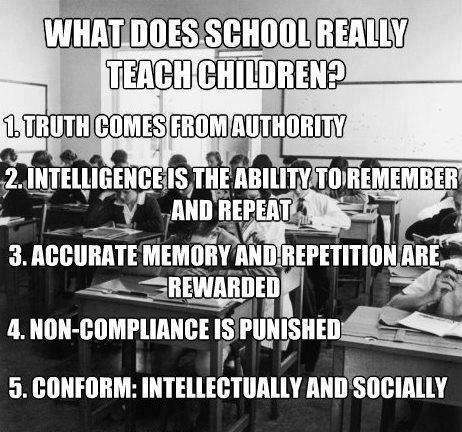
Which really baffles me because I’m used to dogma coming from religion. This meme was posted by a non-religious, progressive parenting page I follow on Facebook:
Now, this meme is old news for me.
My fundy homeschool buddies have been passing it around Facebook since Facebook began.
The fact that this is now being passed around by proponents of homeschooling and “unschooling” who are not religious and considered “progressive” is concerning. It seems that there is a new hatred of public school that is beginning to take root, and it has nothing to do with Christians. All the illogical, misinformed, sensationalist arguments against public schools that I’ve seen for years, is being repackaged, regurgitated, and spit out all over the websites of people who think they are some kind of pioneers, that this “rebellion” against formal education is all their idea. They ridicule other parents who put their kids in school, saying we must not love our kids if we send them to “government brainwashing centers” (sound familiar?). Which, of course, usually makes me laugh out loud because I’m pretty sure the homeschooling leaders of the conservative movement of the ’80’s invented that term.
Really though, all they’re doing is perpetuating the exact same dogma that has turned so many of us first-generation homeschoolers away from homeschooling.
You don’t have to be religious to be bigoted or to promote propaganda. A young child of non-religious home-schooling parents just told my daughter “Oh I don’t go to school. School is bad.” Now where have I heard that before?
I feel that I am in a unique position.
My past is colliding with my present. Alumni like me have a lot to offer to the conversation of “new wave homeschooling,” but I feel that often our concerns are brushed aside since “oh, well, we aren’t religious so we won’t have the same problems you did.”
But they already are showing signs of the same problems the original homeschoolers had, just from a completely different point of view.
Ultra-sheltering of children, polarizing, dogma, misinformation, and fear are present in this new generation as much as they were in the old. I’m worried about where this might be going, feeling like I’m watching history on repeat, a helpless bystander as some very familiar insanity is marching by me.
I guess what I want to communicate to my hippie homeschooling friends is this: by all means, homeschool your children. But let me tell you what kind of commitment that’s going to require if you want your kids to have a good education. Because all those blogs you’re reading aren’t telling the whole story. Your kids aren’t going to learn what they need to excel in the world by cooking and painting and playing outside all day. Let me tell you how my mom devoted 27 years of her life to doing nothing but educating us because in order to give us a good education, she had time for nothing else. Allow me to tell the story of how sheltering children in the name of “protection” can utterly backfire. Can we talk about what kind of attitudes surrounding homeschooling can damage the children you love and how to raise healthy kids? Perhaps I can offer the perspective of someone who was raised the way you’re dreaming of, only without the rosy glasses you seem to be looking through. And can we not hold to an “us versus them” mentality? Been there, done that, did its damage. Homeschooling can be awesome. But it can also be horrible. Can I tell you my story and the stories of my friends?
Maybe together, the alumni and the neo-homeschooler parents, we can keep some of the disastrous results of the first homeschooling movement from repeating themselves.




 Homeschoolers Anonymous