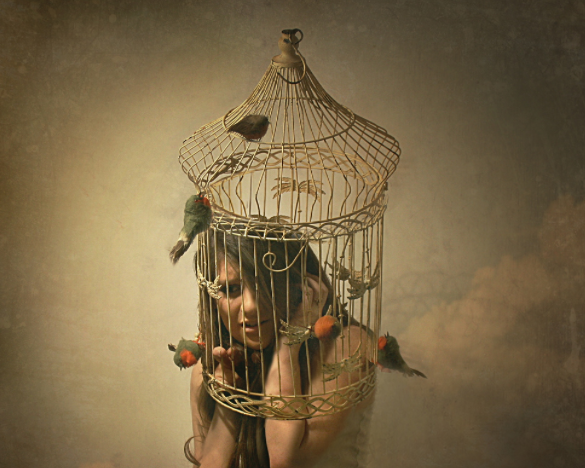
“My Daughters Are Not Going Off to College”: When Homeschooled Girls Are Trapped

Screen Shot 2013-10-12 at 1.44.36 PM

HA note: The following is reprinted with permission from Julie Anne Smith’s blog Spiritual Sounding Board. It was originally published on October 12, 2013 with the title “Homeschooled Adult Daughters Held Captive at Home, Prevented from Getting College Education.”

*****

“There are too many homeschooled girls who need help overcoming the legal obstacles their parents put in their path to a college education. It also bothers me that the leaders of the Christian homeschooling movement preach that young girls shouldn’t get a ‘regular’ education – that they should only be trained in domestic arts and ‘female’ tasks.”

~ Nick Ducote, “Reflections on Malala, Patriarchy, and Homeschool Advocacy”

*****

In an effort to “raise up a child in the way they should go,” some Christian homeschool parents are essentially kidnapping their daughters, only teaching “homemaking” skills, even denying and preventing them from getting a college education.

The father is involved in all aspects of his adult daughter’s lives until marriage.

Earlier this week, my young friend, Nicholas Ducote, co-founder of Homeschoolers Anonymous, wrote something that resonated with me.  It hit me hard because this was a path our family was heading down.  He was writing about the plight he has seen among a number of young ladies who are part of the “Homeschool Movement,” the subculture of fundamentalist Christians who adhere to the Patriarchal lifestyle in which the father is very involved in all aspects of his adult daughters’ lives, even through adulthood until they are married — married to a husband approved by the father.

Nick, a former homeschool student, has earned his Master’s degree.  He knows the challenges he faced in getting his degrees. But it struck me how Nick was clearly upset about the injustices he saw facing his female homeschool peers.

In the Homeschool Movement, this educational imbalance among the sexes is not perceived as an injustice whatsoever. In fact, to even think of sending an adult daughter “off to school,” is to some, heretical.  As recent as a month ago, a homeschool mom and friend of mine posted on Facebook that her adult daughters would not be going to college — that she and her husband “just don’t believe in that.”

It makes me wonder: did her parents make all of her decisions when she became an adult?  Probably not.

Here is a screenshot I saved from a homeschool wives group on Facebook several months ago and you can see the similar mindset:

daughters1

I used to believe this way.  

In the Homeschool Movement, I was taught to believe that if we sent our daughters off to college, they would want to use that education, get a job, might even earn more money than their husbands.  This was “not right” because husbands were supposed to be the breadwinners and mothers were to be busy at home with the children.   They claimed this was all the work of feminists and the feminist influence on society was breaking up families and demeaning men.

Feminism was the cause of the moral decay in society.

I’ve been a homemaker for nearly 27 years.  I have loved staying home with the children.  It is wonderful for mom to stay home with her children.  But is it the only way?  Is it always possible?  Is it really all that black and white as “they” portray it to be?  Can we have decent families in which a mom works part-time?

Leaders in the Homeschool Movement spend an exorbitant amount of time selling their rhetoric in words and in materials (books, videos, blog articles) sharing what they believe to be the ultimate role of women as homemaker:  how to be respectful and submissive wives, how to cook, sew, how to raise children, etc.

If you are a young girl raised in this environment, your know your lot in life is:  get married to your approved husband, have many children, teach your children at home, and hopefully, your children will do the same.

It is important to note the basis of this ideology. The ultimate goal in the Homeschool Movement is to be fruitful and multiply and “take dominion” of the world.  Dominionism and Reconstructionism are foundational roots from which everything in the movement is cultivated.

Nick then discussed a young lady who has been in the spotlight lately, Malala.  If you are unfamiliar with Malala, I encourage you to read about this courageous young lady who is making her voice be heard in a country where women’s voices are squelched.

“Malala Yousafzai is a Pakistani school pupil and education activist from the town of Mingora in the Swat District of Pakistan’s northwestern Khyber Pakhtunkhwa province. She is known for her activism for rights to education and for women, especially in the Swat Valley, where the Taliban had at times banned girls from attending school. (Source)

Here is a video Nick included of Malala.  The Taliban tried to assassinate this young lady because of her powerful voice and she survived and her voice is even stronger and now has international attention.   Please listen to this amazing interview.

Nick writes:

What is especially disturbing is when you hear Malala talk about how the Taliban in the Swat Valley of Pakistan wants to take education away from girls. You would hope, in the 21st century, young women would have basic access to education.

I will be loud and proud about my homeschooling advocacy because my heart is broken on a regular basis when homeschooled teenagers trapped in fundamentalism contact me trapped, struggling to assert themselves and pursue the future they want. Sometimes parents deny FAFSA signatures, or they edit their transcript if they apply to an “unapproved” school. I have talked to homeschooled girls who were literally trafficked (for sex and for labor).

Some homeschooled adult daughters fare no better than Pakistani young ladies when it comes to education.

Nick is right.  We expect this kind of thing in Pakistan, but not in the US.  Some of these young ladies who have officially graduated from their homeschool high school are not allowed to even choose whether they go to college or not. College is simply not allowed. They are destined to be a “stay-at-home-daughter,” serving parents, helping with the remaining children at home, help with cooking, cleaning around the house, etc.

In the United States of America, we have young female adults — I said adults — who are living at the home of their Christian homeschooling parents, unable to make adult decisions of where they can live, where they can go to school, who they can be friends with, where they go on the internet, etc.  They are essentially forced to follow the path of their parents.  They are cut off from the outside because their internet use, cell phone use is highly monitored.

Now some of these young ladies go along with this without any dissension. This is the only life they’ve ever known. They have been sheltered from the “world” or society.  Their friends are people from church, from homeschool groups, etc.

This is their norm.

Some may do fine with this. They will allow their parents to help select a husband for them, get married, have babies and continue living the legacy their parents planned for them.

However, there are other young ladies who want to explore life outside of the life and rule of their parents.  They want the opportunity to go to school and further their education. But they are not allowed this opportunity. They are prevented.  How can this be? In this day and age?

These parents hold the keys to their adult daughters’ freedom. They are the ones who decide whether they will turn over their signed homeschool high school transcript. They are the ones who must sign and turn over info for FAFSA documentation for financial aid. They decide whether their daughters can get a driver’s license, work outside the home, etc.

In the United States of America, there are young ladies held against their will in their parents’ homes and they are trapped.

They don’t know where to go. They don’t know how to escape. They don’t know how to get schooling. They are completely isolated.

This is happening in our country — the USA.

To My Past — I Wouldn’t Be Who I Am Today Without You

Screen Shot 2013-08-13 at 4.10.13 PM

HA note: The following is reprinted with permission from Faith Beauchemin’s blog Roses and Revolutionaries. It was originally published on June 30, 2013.

I was raised in a home and a church with certain expectations.

Most of the people I grew up with have lived up to those expectations.  They’re all good Christians, remaining doctrinally pure and behaviorally righteous. Most of them are married and gearing up to raise the next generation of good Christians, in homes where the father is the leader and the mother is submissive.

My peers who have followed this path are the pride of their parents and the future of their church.

I have flouted all of these expectations. I quit attending fundamentalist churches years ago, and quit altogether around the time I graduated college.  Although my parents think it’s okay for a single woman to work, they also think a woman’s highest calling is wifehood and motherhood.  I’m nowhere near being a wife and I intend never to have children at all.  My politics are so far removed from those of my parents that we can barely discourse on the topic due to fundamentally different worldviews.  My behavior, as well, is far from the stringent moral standards held up by my former community, although somehow I think I’m still a pretty good person (mysteriously, drinking, going out to bars, and similar behaviors have not turned me into some kind of monster).

But it is clear to me that, however far removed I am from the outcome intended by the key players in my past (my parents and their church), my politics and anti-authoritarian worldview are a direct result of that past.

My parents made the mistake of teaching me to think for myself, to go against the mainstream, to be willing to believe what I know to be right.  They homeschooled me partially in order to keep me from conforming to ordinary culture.  Then they expected me to accept the exact same conclusions and ideas they themselves had accepted.

My church was, for a fundamentalist congregation, quite intellectual.  They taught us to look at textual and cultural context and to know (their version of) church history. They taught us to argue for our faith.  Then they expected that we would use each of these skills only to defend their particularly narrow viewpoint.   I attended a Christian college, where I took classes which taught me how to reason, how to gather evidence, how to think for myself and effectively communicate with others.

But that same Christian college naively assumed that its graduates would toe the party line. 

There were immense cultural pressures from my parents, their church, and my college to conform to a particular point of view, but all of them also gave me the tools to make my own way in the world, to reject conformity and with it the point of view they so desperately demanded I embrace.

At the same time as my parents, their church, and my college gave me the tools I needed to think for myself, they also taught me important lessons about fascism and forced conformity and loyalty to a particular ideology.  I saw and I experienced in my own life the terrible consequences of valuing ideology and power structures over people.

I learned that unquestioning acceptance of authority often leads to very negative outcomes. 

I learned that although those in authority demand implicit trust, I cannot implicitly trust them because they almost never truly have my best interests at heart.  As I have said before, fundamentalism is simply religious fascism.  It didn’t take long for my opposition to religious fascism to translate into the political arena as well.  Also, my past taught me the harm of a “we few vs. the rest of the world” mentality.  By its nature, conservative Christianity is elitist, claiming an inside track on knowledge and a superiority to unbelievers.

I am now utterly opposed to absolute power and I am wary of elitism in whatever form it takes.

So however critical I am of those in my past who attempted to control my life, I must also always be grateful to them. 

They gave me early experiences which formed my current worldview.  They gave me tools with which I was able to break out of the prisons they constructed around me and then build my own life, a life which looks nothing like they want it to but a life which I inhabit very happily.

Rewriting History — History of America Mega-Conference: Part Six, Doug Phillips Rages Against the 20th Century

Rewriting History — History of America Mega-Conference: Part Six, Doug Phillips Rages Against the 20th Century

HA note: This series is reprinted with permission from Ahab’s blog, Republic of Gilead. For more information about Ahab, see his blog’s About page. Part Six of this series was originally published on July 10, 2013.

*****

Also in this series: Part One: First Impressions | Part Two: Doug Phillips on God in History | Part Three: “Religious Liberalism” And Those Magnificent Mathers | Part Four: Kevin Swanson Is Tired Of Losing | Part Five: Messiah States and Mega-Houses | Part Six: Doug Phillips Rages Against the 20th Century | Part Seven: Christian Vikings, Godly Explorers, and Strange Bacon | Part Eight: Closing Thoughts

*****

On the evening of Friday, July 5th, attendees gathered in the Radisson’s grand ballroom for prayer, music, and videos. The evening began with a Puritan call-and-response song lead by Doug Phillips, followed by a benediction. Next, the ballroom screens showed short videos on Vision Forum’s latest projects. I distinctly remember the Hazardous Journeys Society, an all-male organization that seeks to explore the world through the lens of conservative Christianity. Hazardous Journeys Society presented itself as an alternative to National Geographic, which has allegedly interpreted the world through the lens of evolution.

After Danny Craig sang “America, America”, several young women performed haunting renditions of traditional American songs on violins and harps. After a mixed sex Civil War Choir performed in historical garb, Doug Phillips delivered a talk entitled “The Meaning of the 20th Century: A Providential and Theological Overview”.

The 20th century ushered in a new era, Phillips began, and to fully understand the 21st century, we need to understand the 20th. On the ballroom screens appeared a collage of 20th century images: Che, Einstein, Ayatollah Khomeini, a mushroom cloud, Earth from space, and many others.

Phillips recounted his time as a writer for the George Bush administration and a private driver for Billy Graham. While chauffeuring Billy Graham around Washington D.C., Phillips learned about history as Graham pointed out places where he met dignitaries and took part in events. Phillips used this story to explain that the best way to understand history is to study primary documents and meet the people who shaped it.

Phillips shared his version of early 20th century history, beginning with the revivalism of preachers such as Billie Sunday. However, the century would prove to be one of “God-hating nihilism” and genocide”, he said. For the first fifty years of the 20th century, he claimed, the church was silent and withdrawn from public debate.

Huh? I thought. That’s not what I remember from my college history classes.

Phillips had apparently forgotten Reinhold Neibuhr, Dietrich Bonhoeffer, Adam Clayton Powell Sr., Dorothy Day, the Catholic worker movement, the social gospel movement, Quadragesimo Anno, American preachers’ condemnation of Nazism, regional church roles in Europe’s anti-Nazi resistance movements, and countless other voices among the world’s Christians. If by “the church”, Phillips meant the global body of Christians, then “the church” was anything but silent in the early 20th century.

Phillips claimed that the 20th century church wasn’t prepared to deal with genocide and the Holocaust. For this reason, abortion and birth control have now spread through Christendom, he lamented. One third of the people who could have been at the conference that night were “killed by their parents” thanks to abortion, he fumed.

In effect, the 20th century forgot God and turned against him, Phillips told listeners. He depicted the 20th century as an era that saw the rise of “rationalism” and the rejection of God as a higher authority. Enlightenment thinking had given rise to 19th century movements such as Marxism, feminism, socialism, and evolutionism. Then, despite the “restraining” influences of the British Empire and the Christian Queen Victoria, the 19th century’s “compromises” produced the 20th century, he argued.

Phillips held considerable scorn for Sigmund Freud and Margaret Sanger. Freud introduced people to psychology, and today, every single branch of psychology is saturated with “anti-God” ideas and “evolutionary scientism”, he claimed. Like many other anti-abortion activists, he blasted Margaret Sanger as possibly the most dangerous person of the 20th century, more dangerous than Stalin, Hitler, or Mao. Satan seeks to foment racist extermination efforts, convince people to see babies as dangers to be eliminated, and make parents hate their children, he claimed, seeking to literally and figuratively demonize Sanger. Phillips accused Sanger of embracing eugenics, branding her “the killer angel” who spawned the modern abortion movement and allegedly fueled the ideology of Hitler and Stalin. “The death count is in the billions!” he grieved.

Belief in the state-as-God gave rise to 20th century totalitarian leaders and their genocides, Phillips claimed, pointing to the Armenian genocide, the Holocaust, and Japanese atrocities during World War II. A century of supposed enlightenment produced barbarism, thus showing the failure of societies that reject Christ. (Phillips conveniently forgot that Germany was solidly Christian during the Third Reich, that some Nazis wove Christianity into Nazi ideology, and that earlier Christian anti-Semitism set the stage for Nazi racial policy.)

However, Phillips assured the audience that God uses such horrors as part of a larger plan. One of those who fled the Armenial genocide was Christian Reconstructionist author R. J. Rushdoony, for example. Amidst the events of World War II, the hand of God was upon Winston Churchill, he claimed, who was used for a “godly” purpose. Phillips described Churchill as an “indefatigable” and “indomitable” man who stood up against evil.

Tell that to Dresden. And Poland, I thought. Wasn’t Churchill allied with Stalin, that tyrant you condemned a few minutes ago? The problem with seeing the “hand of God” on political leaders is that it makes it difficult to acknowledge their morally ambiguous choices. I realize that Churchill fought the Nazi regime — a noble and necessary task — and had a net positive impact on the world. However, I also believe that lionizing political leaders as “godly” is highly problematic.

Phillips blasted 20th century “statism”, condemning Roosevelt’s New Deal as a means of making government a “parent” and overriding the family and church. He similarly slammed Johnson’s Great Society programs as “leftist propaganda” that funded abortion and feminist movements.

Predictably, Phillips seethed at the thought of feminism, which began with Eve and exploded in the 20th century, he claimed. He was particularly livid at the thought of women working outside the home. For six thousand years, he insisted, children were raised in the home by mothers, but 20th century women working outside the home changed that. (Actually, women have been working outside the home for centuries. Slaves of both sexes were hired out to work outside the home in Roman times. Plenty of women worked in factories and textile mills in the 19th century. This is not a new phenomenon.)

Decade by decade, the U.S. plummeted into confusion, he explained. He tried unsuccessfully to bring up an image on the ballroom screens, then told listeners that the picture was of the size of babies who never made it into the world. When we reflect on Hitler, we should also reflect on the “abortuary” down the street, he instructed the audience. Phillips lamented the current state of the church, disgusted that even Christian women were having abortions.

Phillips did not want to end on an ominous note, however. He celebrated Christian publishing, apologetics, teachers who have inspired “men of action”, and preaching that creates “warriors for God”. He also held warm sentiments for the Christian homeschool movement, which sprang from the 20th century’s apologetics and activism, he said. The 20th and 21st centuries are times of antithesis, Phillips preached, a time of abortion, evolution, and totalitarianism versus you, versus people who want Christ to be king in their home. The task before Christians, thus, is to choose between death or life, Phillips concluded.

Phillips’ talk was laden with the usual Religious Right chestnuts: abortion and the Holocaust as morally equivalent, disdain for feminism, and historically inaccurate caricatures of prominent figures. Behind the chestnuts, however, was a glimpse at how the Religious Right views the present. For right-wing Christians such as Phillips, the present is a time of barbarism and delusion, which Christians must struggle against. This distrust of the present era and refusal to recognize complexity and nuance in the 20th and 21st centuries reveals a great deal about the Religious Right mind.

More to come soon on Vision Forum’s History of America Mega-Conference. Stay tuned!

*****

To be continued.

His Quiver Full of Them: Jeri Lofland’s Thoughts

His Quiver Full of Them: Jeri Lofland’s Thoughts

Jeri’s post was originally published on her blog Heresy in the Heartland. It is reprinted with her permission. Also by Jeri on HA: “Generational Observations” and “Of Isolation and Community.”

Decades ago, I cross-stitched a scripture motto for my parents from Psalm 127, the favorite psalm of large families.

“Lo, children are a heritage of the Lord: and the fruit of the womb is his reward.”

The psalmist goes on to say: “As arrows are in the hand of a mighty man; so are children of the youth. Happy is the man that hath his quiver full of them…”

The term “quiverfull” is now used as both a noun and an adjective to describe a theology and lifestyle that glorifies human fertility while maintaining that God will provide the resources to raise as many children as he allows a couple to conceive. Contraception is held to be “playing God” and a violation of the command to be “Be fruitful and multiply”. The ideal Quiverfull couple are always open to “more blessings”, regardless of financial situation, health concerns, housing limitations, or needs of existing children.

I’m not certain when my parents decided that contraception was immoral. As a high schooler, Mom was an advocate of zero population growth and intended to adopt rather than bear children. A few years later, she graduated from a strict Catholic nursing school and married my dad. I was born a year later, my brother two years after that, and so on for the next 20 years.

Mail would arrive periodically from the Couple to Couple League and my parents had a couple of books by Catholic authors John & Sheila Copley explaining the practice of abstinence and/or breastfeeding as a means of birth control. Of course, even “natural family planning” (NFP) sounded too much like the evil “Planned Parenthood” so it was usually referred to as “child spacing”. Somewhere along the line my parents abandoned NFP (turns out it’s not all that effective at preventing pregnancy!) and the babies began to come even closer together.

Certainly Mom was influenced by Mary Pride’s 1985 book The Way Home, a story of the author’s journey from feminism to what she calls “reality”. Mary had just three young children when she wrote the book, in which she blasted away at contraception, lingerie, Marabel Morgan’s The Total Woman, and even Christian schools.

All forms of sex that shy away from marital fruitfulness are perverted. Masturbation, homosexuality, lesbianism, bestiality, prostitution, adultery, and even deliberate marital barrenness–all are perverted.”

“Since the word used for female is connected so strongly with the idea of nursing babies, whereas it has no connection at all with the idea of sexual activity, I believe that God is saying here that when women exchange their natural function of childbearing and motherliness for that which is ‘against nature’ [that is, trying to behave sexually like a man], the men tend to abandon the natural sexual use of the women and turn to homosexuality. When men stop seeing women as mothers, sex loses its sacredness. Sex becomes ‘recreational’, and therefore the drive begins to find new kicks.”    (Mary Pride, The Way Home, 1985)

(Pride’s position against family planning was more extreme than even the Catholic Couple-to-Couple League’s, prompting a correspondence between her and John Kippley, president of CCLI, and leading Pride to grudgingly endorse NFP in some situations in her sequel to The Way Home.)

Pride went on to birth six more babies and became a powerful force in the new homeschooling movement. My mom used to share The Way Home with all her friends and donated it to church libraries when she could. (When she encouraged me to read it, I was confused. Especially by the story about the lady wearing saran-wrap. Sexually naive young women raised in patriarchal, homeschooling isolation were definitely not Pride’s target audience.)

Mary Pride’s views fit rather well with the teachings of Bill Gothard–a middle-aged bachelor who handed out plenty of sexual and parenting advice at his seminars and encouraged couples to have surgeries to reverse previous vasectomies and tubal ligations. One of Gothard’s books informs us, “Labor in childbirth… was given to the woman for her spiritual benefit…” and points out that the God of the Old Testament “cursed several women by closing their wombs.” Attendees of Gothard’s conferences learned to associate infertility with God’s judgement. A full quiver, on the other hand, was a sign of God’s favor, a spiritual status symbol.

In 1990, a Nebraska couple published A Full Quiver: Family Planning and the Lordship of Christ. In this book, Rick and Jan Hess (homeschooling parents of ten) invite the reader to imagine a world where no one has ever had more than two or three siblings, effectively eliminating many historical figures. This exercise concludes with visualization of a future where enormous families are normal and God provides spacesuits for a missionary family moving their brood to evangelize a colony on the moon. My parents had this book, probably purchased at an IBLP seminar and still available on Gothard’s website.

Then there was Nancy Campbell’s occasional magazine for moms, Above Rubies. Nancy is a fierce promoter of anti-feminism from her compound in Tennessee. Her website includes multiple articles by women who felt guilt and regret over “the biggest mistake” of their life. After they repented, they went on to expand their families by four, five, six more babies. What mistake is reversed by more pregnancies? An abortion, perhaps? No, as it turns out, the biggest mistake of these women’s lives was a tubal ligation. Nancy also sells a book, A Change of Heart, encouraging couples to have surgeries to reverse both vasectomies and tubal ligations.

Vickie Farris, whose husband Mike is president of the Home School Legal Defense Association, homeschooled their ten children and lived to write a book about it. She encourages other women to reject birth control methods and embrace motherhood. Quiverfull women like Farris, and Michelle Duggar of “Nineteen Kids and Counting”, have built their lives on the mantra “God won’t give anyone more than they can handle”, sometimes phrased as “What God orders, he pays for”.

My parents were opponents of both birth control and sterilization. They even encouraged some of their friends to have reversal surgeries, resulting in many more babies. My mom had eleven children over 24 years, including ten [unassisted home]births. Pregnancy was not easy for her–she often referred to herself with the phrase from St. Paul, “a living sacrifice”. She spent most of my childhood breastfeeding, diapering, potty-training, and homeschooling on top of that. I understood that this was not culturally normal, but sought to convince myself that God was pleased with this self-sacrifice. I spent my teen years watching my mom’s body swell and deflate, and changing thousands of diapers.

In my twenties, as I waited for my turn to become a wife and mother, I quietly ticked off how many children I could have in years. I may have been ideologically persuaded that contraception was wrong, but I didn’t want to spend twenty years lactating either. When I got impatient for God to bring me a husband (no boyfriends on the horizon), I consoled myself by guessing how many fewer children I would bear in a shorter window of fertile sexual activity.

Fortunately, when I did get married, my husband and I quickly began to realize that many aspects of Quiverfull thought and practice were contradictory to our values. Not before taking NFP classes from a Catholic certified trainer, though. When we got pregnant anyway, we were told the method worked fine–we’d just had sex when [it turned out!] we were actually fertile. Well, what do you know?

I think my relationship with the Quiverfull movement finally ended a few years ago as I was perched on the end of an exam table in my doctor’s office. Looking up from my chart, she compassionately observed, “You’ve been raising kids for a long time,” and I burst into unexpected tears.

These days, stories of ex-Quiverfull moms and their “quivering daughters” are multiplying on the Internet like rabbits in the spring. The fruit of the movement has not turned out to be sweet; we deal with health problems, poverty, anxiety, depression, PTSD, eating disorders, cutting, sexual abuse, emotional incest, and divorce. (You can read far more than you want to know at the Homeschoolers Anonymous blog.)

In spite of these firsthand horror stories, Quiverfull continues to enjoy wide support in America and is gaining traction in other nations. Earlier this year, the BBC reported on the movement’s growth in the United Kingdom. You can listen to more, including scary-sounding clips from Nancy Campbell, here.

Meanwhile here in the States, Hobby Lobby and Catholic hospitals gnash their teeth over their employees’ rights to use birth control. Texan teenagers are taught that contraceptives don’t work. (The result? Texas has more than 10% of America’s teen births.) And TLC continues to profit from shows like “Nineteen Kids and Counting”, promoting Quiverfull ideology to some unsuspecting viewers.

The show should include a disclaimer: For your own safety, don’t try this at home.

How NCFCA Taught Me to Fight Sexism: Philosophical Perspective’s Thoughts

How NCFCA Taught Me to Fight Sexism: Philosophical Perspective’s Thoughts

HA note: The author’s name has been changed to ensure anonymity. “Philosophical Perspectives” is the author’s chosen pseudonym.

Being a woman in the NCFCA was confusing.

It was a high-pressure, high-performance situation – or, at least, it was for some of us. I know a few people who were able to engage with the league as a hobby, taking a “if I win, great!” attitude – but me and my friends were never that laid back. We worked hard, labored long, and got deep into out rounds. We were gunning for Nationals, and then the national championship.

We traveled around the country for tournaments, saving up to pay entry fees and airfare, cutting corners by staying with host families when we were competing away from home. We figured out how to live in suits for days on end, what shoes to wear to tournaments so that we could look professional and still walk at the end of them, and how to make second-hand suits look “modest” and fashionable.

The larger purpose of all of this was to learn how to think critically, to be able to eloquently and winsomely communicate a “biblical worldview” in the culture at large – we were supposed to become world-changers and culture makers. It was a compelling invitation, and one I took seriously. I dreamed of becoming a professor, and writing books that would change the way that people thought about faith and reason, or changing foreign relations, or implementing better, fairer, and more just foreign aid. I wanted to have a career where I could have a voice, where I could influence people for the better and make a lasting impact on the world.

It didn’t take long, though, before I realized that my invitation to become a world-changer came with a caveat. While my male friends were planning and preparing for high-powered careers in politics and law, I was warned not to be unfaithful by “pursuing a career,” any career at all.

See, while my male friends were supposed to go to impressive colleges to make their way in the world and change policy, I was supposed to go to a Christian school only so that I would be better able to educate my children. Oh, I was still supposed to be a world-changer – but the sphere in which I was supposed to work was already prescribed. My intellectual development was important in as much as it made me better able to birth and raise future world-changers. 

My public person was to be shaped by this future. The tone with which I spoke in rounds, the ways in which I asked cross-ex questions, the clothes I wore, and the people I hung out with were all policed to make sure that I was working towards this end. This came through in ballot comments – while my male peers were praised for their forthright honesty, I was told to be “less aggressive” and “more lady-like”.  I was given fashion advice on ballots – “that black suit-jacket is too masculine – you should wear more color”, “it’s distracting that I can see your bare leg under your slacks when you sit down,” “I don’t appreciate it when women wear pantsuits. Skirts are more appropriately feminine”. Between rounds, watchful mothers would pull be aside to reprimand me on taking off my suit jacket to reveal a sleeveless shirt (and therefore my bare shoulders). Women I didn’t know would come up behind me and pull my shirt down if there was a gap between its bottom and the top of my slacks.  I was scolded for sitting on floors in hallways (not lady-like!), and questioned about my conversations with male friends (leading them astray?). While every parent was watching for my suitability as a future wife, I met very few adults who actually took interest in my speaking skills.

At the same time, I was surrounded by powerful women. Women ran the tournaments, coached the clubs, initiated the conversations. People like Teresa Moon and Christy Shipe were strong, thoughtful, assertive leaders. They certainly didn’t seem to be yielding to men at every turn. And they weren’t the only ones. While their husbands were working, our mothers were pioneering a completely new movement. The women around me modeled powerful leadership in the face of incredible opposition, yet taught submission and subservience that they rarely showed us. To their credit, they modeled what a full life that didn’t include a career could look like – but they also sent me very mixed messages about what I (as a woman) were supposed to do with my life.

The NCFCA was where I got most of my cues, as a young adult, about my purpose in life and the avenues that were open to me. When I conformed to the (spoken) standards of “biblical femininity,” I was a role-model, a shining example of what a homeschooled girl should be – thoughtful and smart, yet “modest” and self-effacing. But I was never one to follow the “do as I say, not as I do” model of teaching. So I decided to behave and speak in the ways that came naturally to me, which I also saw lived out in the women around me. I was a leader, so I acted like one. I spoke kindly and thoughtfully, but directly. I made decisions and acted on the Christian principles I’d been taught – principles of love, equality, justice, righteousness, and freedom – even when others disapproved. I made responsible choices. And I pursued the dream I’d always dreamed – of a university where I would be challenged by new ideas, where I could think rigorously and work hard. I wanted to study philosophy, so I could learn this history of the ideas and theologies I’d held dear, and so that I could more thoroughly understand my own faith.

And my star fell as quickly as it had risen. The parents who had held me up as a role model quickly changed their tune. Few voiced their concerns directly to me, more just stopped talking, stopped investing, stopped asking me what I thought.  A few made their objections clear in indirect ways. I heard disapproval second hand, from their kids – often couched in how they were concerned about how often I traveled to tournaments without my parents, or questioning my relationships with various male peers, or my wardrobe. Sometimes it would come up in conversation, when I told adults about my plans for the future. They would say, “I wish you all the best!” followed by a litany of the things that they would never let their daughter do (go to college / a secular college / live away from home / pursue a career / etc.) There were a few parents who continued lukewarm encouragement, but only after I stopped talking about pursuing a philosophy degree (philosophy departments were not only the bastion of liberalism, but also hotspots of professorial trickery, where fast-talking faculty would trick you out of your faith and your virginity).

When I eventually did attend my secular alma mater, far from home, I lost touch with most of the homeschool parents I’d known. The people who had said they were invested in my growth and development disappeared as soon as I departed from the path they endorsed for me as a woman – even though I was still invested in their vision of being a world-changer, and I’d embraced the bold female leadership and the determination to fight for what was right that I’d seen lived out. The rejection I felt was confusing, and it was painful. 

In retrospect, I think the NCFCA taught me skills that led to my professional success, but set me up for failure, and, probably to its surprise, taught me how to recognize and fight sexism (though I wouldn’t have used those words then).

As many others have said, in debate I learned how to think, how to argue, and how to speak publicly. I internalized the message that I could be someone important and influential in the world, and that my voice and my message was valuable. Yet, when I tried to act on that message, I was shut down and sidelined because of my gender. The unintended gift of the NCFCA was a desire to fight for what was good, and right and true, and a willingness to pursue it regardless of the consequences. So I fought to go to college, and I fought to be heard when others would silence me because of my gender. I fought to stay in college when others disparaged the usefulness of my education, or question the “waste of money” (commentary I never heard directed towards my male peers). I fought to pursue a career, and I am still fighting against sexism in the church.

For the strength, determination, and tools to fight, I thank the NCFCA. 

Starship Captains and Dinosaurs: Faith Beauchemin’s Thoughts

Starship Captains and Dinosaurs: Faith Beauchemin’s Thoughts

The following piece was originally published by Faith Beauchemin on her blog Roses and Revolutionaries. It is reprinted with her permission. Also by Faith Beauchemin on HA: “The Importance Of Telling Your Own Story.”

A fundamentalist Christian family is a hard place for a woman to grow up.

I was taught by my parents (and, more urgently, by all the books available to me) that a woman’s place is in the home.  A woman’s highest calling is marriage and child-rearing.  All of my talents and abilities and dreams could be met and fulfilled in building a happy home for my family.  If (god forbid) I were to end up single, I could be a nurse, like Florence Nightingale, or a missionary, or maybe a teacher.  I didn’t know anyone with a career, as far as I knew.  There actually were some women at church who had jobs, but they were either single or else I didn’t know that they had jobs.  It was just assumed by everyone that the normal pattern was for a woman to marry and give up her job as soon as she had kids, to dedicate herself full-time to taking care of them and, most likely, homeschooling them.  After all, Paul wanted women “to be keepers at home.”  And what someone wanted for women two thousand years ago is obviously the best thing possible for all women throughout time.

But two women slipped through the cracks and crept into my early image of successful womanhood.  Of course later, as my view of the world widened, there would be others, but these two I knew from early on in my childhood, and each holds a place in my heart.

When you asked me what I wanted to be when I grew up, I (not feeling that motherhood right away would be my path) would respond either teacher or nurse, and singer.  Singer?  What a random career option.  This is because we had some old records by Amy Grant, which my mom had recorded onto tapes, which I listened to constantly.  She inspired me to enjoy singing, and I wanted so badly to be like her, singing such beautiful songs for a living. I imagined being on a stage, people clapping for me.  The dream was squashed by two things.  First, when Amy Grant got a divorce, I felt terribly betrayed.  I was too young to understand the reasons why it was actually a good thing for her to get out of that marriage, and I had been taught that divorce is a horrible sin.  I wouldn’t listen to her music for months afterward.  The second dream-squasher was being taught that everything needs to be done for god, not for oneself.  This led me to believe that performance was in some way wrong, perhaps not for other people but for a selfish, prideful person like me, it certainly would be.

My other early female inspiration was Captain Kathryn Janeway, from Star Trek: Voyager.  The series ran from the time I was five years old until I was eleven, and oh, how I wanted to be Captain Janeway.  I recall in particular one birthday party, I couldn’t have been older than six, where we went to a park and played on one of those big playground structures.  I ignored all the other kids at the party and ran around the playground structure pretending to be Captain Janeway commanding the starship Voyager.  I sucked in my stomach because I thought that made it look like I was a grown-up woman with boobs, lending me more credibility in the character of female spaceship captain.

I have literally no clue how I continued to want to be Captain Janeway alongside being taught harmful patriarchal bullshit about having to be a totally submissive wife and mother with no career or dreams or goals of her own except serving her family.  I don’t know how Janeway survived my upbringing, how she remained enshrined in my heart as a totally badass role model, but she did.

Maybe it’s like the way I believed in both evolution and creation at the same time.  My Grandpa gave us books about dinosaurs and fossils and I devoured them (as I devoured all books), and somehow held separate in my mind two alternate timelines for the universe.  The first timeline was illustrated by the pictures in my bible story books, god creating everything from nothing, the luscious garden scenes, the temptation and fall of mankind, the flood, and then it appeared that everybody lived in the desert for a long time, with camels and stuff.  The second timeline was illustrated by the dinosaur books and a couple other books that managed to slip through the cracks.  There were volcanoes and organisms crawling out of the water, sea monsters and dinosaurs and cave men.  There were magical words like “Jurassic” and “Cretaceous” and “trilobite.”  The evolutionary timeline seemed more like a fantasy than the biblical timeline, just because it wasn’t continuously reinforced during every waking moment.  But the evolutionary timeline was so taboo I got an almost sexual thrill from thinking about it, reading about it, looking at those strange landscapes and animals, and I thought that it, too, along with the bible taken in a strictly literal sense, was true.  There’s no way to reconcile how I was taught the bible with the evolutionary theory, but yet those beliefs coexisted in my mind.  In the same way, there’s no way to reconcile the patriarchy I was brought up in with an admiration of Captain Janeway, but I held on to both anyway.

Maybe it’s because, deep down, I liked a world where dinosaurs roamed exotic forests and then millions of years later a woman could captain a starship better than a world that had been around for brief few thousand years of history in which women were always morally obligated to be subjected to men and never aspire further than the home.  And maybe it’s because, deep down, I knew as soon as I encountered it what I actually believed, no matter how strenuously I tried to make myself believe what I was being taught.

Homeschooled Girls and Trash Cans: Latebloomer’s Story, Part Six

Homeschooled Girls and Trash Cans: Latebloomer’s Story, Part Six

HA note: The author’s name has been changed to ensure anonymity. “Latebloomer” is a pseudonym. Latebloomer’s story was originally published on her blog Past Tense, Present Progressive. It is reprinted with her permission.

*****

In this series: Part One | Part Two | Part Three | Part Four | Part Five | Part Six | Part Seven

*****

Part Six: A Tomboy in Christian Patriachy

"If I had known the term 'badass' back then, I would have applied it to myself with pride."
“If I had known the term ‘badass’ back then, I would have applied it to myself with pride.”

I was not the type of daughter that my mother wanted. I was a tomboy.

My hair was very short and I preferred blue clothes. I wanted to run faster and climb higher than anyone. I wasn’t afraid of slimy frogs and worms, and I could kill a spider without batting an eye. I looked with confusion and disdain at the passive little girls with their hair-bows, sitting and talking about clothes and boys. If I had known the term “badass” back then, I would have applied it to myself with pride.

When I was young, my mom was more tolerant of this. After all, in the early days, there were mostly boys in my age group in our small homeschooling community. So I was free to run wild with the boys and join their sports games during our weekly park days.

However, puberty was looming, and it signaled the end of my adventurous life. It was time for me to learn to act like a “lady”, and the means of teaching was through one sentence: “That’s not very ladylike”.

I was a difficult student; after all, the rules seemed very arbitrary and I couldn’t see any advantages that compensated for the extra restrictions. The heart of the message seemed to be that I had to become extremely aware of my body in order to keep other people from being aware of it. A lady did not run. A lady did not sit with her knees apart. A lady did not lie down in public. A lady did not make random bodily noises or find them amusing. A lady did not use crude language like the word “crap” or “fart.” A lady did not wear tight or revealing clothing — for awhile, that meant no shorts or sleeveless shirts. A lady never pointed to or discussed her own body in public. And most of all, a lady never called boys or invited them into her bedroom (not even when I was 23, in a group, with my family home and my door open! What did my mom think I was going to do, have a blatant daytime orgy before my first kiss??).

And besides the extra restrictions, there were also extra responsibilities. I had to learn to sew and cook, things that my brother was exempt from. I tried and tried, but I was never able to enjoy these womanly skills. Eventually my mom gave up on me and moved on to teaching these skills to other more grateful homeschool girls, leaving me feeling jealous and rejected.

It didn’t help my situation that my sister took naturally to wearing cute dresses, having tea parties, and making crafts. She didn’t even need coaching, while I was unsatisfactory even with coaching. As I watched my brother leave for his many outdoor adventures with other boys, I felt cheated and limited, having been born a girl.

In some ways, I was lucky compared to many other girls in the Christian Patriarchy culture that attended Hope Chapel with us. I was never required to wear only dresses or have long hair. I didn’t have to take care of innumerable younger siblings. But most importantly, I was actively encouraged to go to college.

For many conservative Christians, higher education is seen as suspect because of the so-called “secular liberal bias” of universities and professors. That was the case for my family as well. However, my parents were unusual in our church and homeschooling community because they believed that even a daughter should be educated enough to support herself if necessary. So they encouraged me to attend a very conservative Christian college such as Bob Jones University, Pensacola Christian College, or Moody Bible Institute. They advised me to choose an area of study that would allow me to supplement my future husband’s income by working from home after I had children.

So, why didn’t I head off to college right away? After all, I was completely miserable at home due to the extremely authoritarian parenting style that my church promoted. There were really two reasons: first, my severe social anxiety made the thought of college overwhelming and terrifying. Second, my parents’ pro-college message was drowned out by the sexist anti-college message of my church.A couple more years of worsening family relationships, of increasing depression, of a sense of purposelessness, of no prospects of a church-approved way out of that mess — that was exactly what I needed to reach my breaking point. My exact thought process at the time was this: “I’ve been praying for guidance about my future for years, and I haven’t heard anything. I can’t go on like this. I’m going to just start moving and hope that God will steer me if I go the wrong direction.”As I left home for the first time at age 23, I felt small, weak, timid, and vulnerable, heading out into the great wide world all alone. There was no trace of my former badass self from childhood. So is the Christian Patriarchy right about women after all?People tend to live up to the expectations of those around them, what others believe they are capable of.  The sexist beliefs then become a self-fulfilling prophecy. The women in the church were told over and over that they were easily deceived and easily swayed by their emotions and needed a man’s protection/guidance. But denying women education and experience is what made them that way.College was a time of transformation for me; I was overcoming my severe social anxietydiscovering my true identity, learning to be comfortable with sexuality, and learning to set boundaries and take responsibility for myself.   Marriage has only continued that process, as my husband and I work to maintain an equal partnership–something truly beautiful that I didn’t know existed 7 years ago.Now I am a feminist stay-at-home mom.  I stay at home because I want to, because I love the bond I have with my little one and the adventures we have together as I introduce him to the world.  I can understand his excitement as he discovers what he’s capable of — because I’m finally feeling. it too.

*****

To be continued.

Burn In Case Of Evil: Cain’s Story, Part Three

Burn In Case Of Evil: Cain’s Story, Part Three

HA note: The author’s name has been changed to ensure anonymity. “Cain” is a pseudonym.

*****

In this series: Part One | Part Two | Part Three | Part Four

*****

Why It’s Not Just About the Past and My Bitterness

"Their identity as conservative Republicans is almost as important as their identity as Christians."
“Their identity as conservative Republicans is almost as important as their identity as Christians.”

As I sat down to a steak dinner with my parents after my MA graduation ceremony (8-2012), the conversation drifted to my younger sister’s future plans.  She is being homeschooled much in the same way I was, except with a hefty dose of Victorian ideas on gender roles and sexuality. (She is truly brilliant and reads tremendous amounts of literature. She could likely score a 30+ on the ACT and receive a scholarship.) I asked her if she still intended to go to college — she used to talk of being a veterinarian – and she replied that my father gave her a choice. She could either have him pay for her wedding or her college. I said that giving a young girl such a choice was cruel and my father replied that he had “lost confidence in college since [my] education obviously failed me.” And I said, “Well, I guess it failed [my older sister] too.” He said, no it hadn’t, because she is now a Christian, homeschool mother who generally agrees with them religiously. So basically, he said college failed me because I don’t believe what he does. 

Throughout my years at college, in a rural town in the Bible Belt, he has used this line of thought many times. I discovered in conversation with my extended family that he led them to believe I’d been “brainwashed” at college by my professors. I’d confronted my father numerous times about how insulting this was, but he really didn’t get it. Not until I told him that my being a liberal was actually going against the grain did he begin to respect me.

They continue to expect me to be a person that I’m not. I’ve written about how there are two versions of me and I want to focus on a few occasions during and after college that illustrate how their beliefs have continued to hurt me. Nearly every time we get together, conversations devolve into arguments about politics because their identity as conservative Republicans is almost as important as their identity as Christians. They insult my beliefs by saying that they are just a phase – when I am living in the “real world,” I will surely be conservative like them.

When I tried to explain that their twisted worldview makes nearly every minute political and social issue into a religious issue, my father simply did not understand. He responded…“Yes I try to live my life in obedience to the Word of God in the Bible. That means these beliefs inform all I do in my life. If that insults you then truly Jesus was correct in stating that those that followed Him would enter into conflict, even with their own family.”

When I visited home for Christmas with my then-fiancé, my mother started a conversation on Christmas morning about how the rise of feminism ruined America. To give some background, my wife is incredibly close to her mother, who divorced when she was young. My wife’s mother worked extremely hard and worked her way up the corporate ladder. My wife draws a lot of inspiration from her mother. Now to the conversation. My mother said that women should never have been given the right to vote, that birth control broke down the American family, and women in the workforce was simply not the proper place for women. My mother subscribes completely to the submission doctrines of fundamentalist Protestantism and, suffice it to say, my wife is very empowered. Like most Christmases with my family, it devolved into a heated argument and my wife was very offended by what my mom said. My mom was literally saying women like my wife’s mother were ruining America.

Nearly six months after my graduation-fight with my parents, my mother finally decided to weigh-in. My father and I sent a barrage of emails back and forth, because I cannot control my emotions when we get into arguments.  After a lot of small talk, the conversation turned to my sinful lifestyle. My mom asked me if I was “pure” on my wedding day. I told her no I wasn’t and I didn’t want to talk about my sex life with her. She reminded me of a pledge I made to her at the age of fourteen, promising abstinence until marriage. I told her that was very unfair to bring up something like that. Then she proceeded to tell me how I would face “consequences” later in my marriage because of my sins.Then she told me the reason we fight is because I just “feel guilty” about all my sinning. She never said anything about my living with my fiancée before our marriage. Only after we were married did she choose to judge me. She didn’t even understand why her comments were judgmental – to her she was just imparting some righteousness. It’s like she forgot to judge me two years ago, so she did it then. But to my mother, it’s not “judging,” it’s just telling the truth – she likes to call herself a prophet.

So I told her some truth. That I think they raised me in a fundamentalist cult and that’s why I don’t get along with them. Especially because they believe all the same things they used to. She tried to say they believe differently now, but couldn’t name a single area where they’ve changed their minds, except they watch more TV now. So when mom is crying on the phone telling me that “we don’t get along because your conscious is guilty” or that I broke a promise to “stay pure” that I made to her at 14, I go to a very dark place.

Whenever we go back to arguing about the things we’ve literally been arguing about for a decade, I am physical affected. The sort of panic attacks I used to have come back and I have a lot of trouble controlling my emotions. They still think rock is evil, they are going to push my sister into courtship like they did me, they are going to fuck her up.  My only twisted hope is that I can reach out to her when they start to become senile.

I don’t enjoy spending any time with them because I just leave feeling shitty. I’m so sick of it. It’s emotionally and intellectually exhausting. They say things like “we’re proud of you” but they only ever talk about my accomplishments. When it comes to my intelligence, morals, or ethics, I’m just a dirty liberal sinner to them. The fact that, after seven years of this, they still refuse to see past my political beliefs and have made no real efforts to get to know me is incredibly discouraging. I have made a lot of efforts to be more reasonable, less argumentative, and I try to never bring up an issue that would spark an argument.  The reason it’s still hard for me is because they aren’t over it and they still inject it into my life. In the past, it was easier to pretend like it didn’t bother me and I figured mom and dad would grow out of it (like almost all of my friends’ parents).

It would be different if my parents made an effort to get to know me – instead of the me I used to be. They still give me Lamplighter books for Christmas, which are out-of-print works of fiction, re-printed by Christian Book Distributers because they are explicitly Christian. I have no interest in these shitty books – I will be reading Harry Potter to my children. I recently moved across the country and they have taken literally no interest in my safety or my new home. Part of why I moved was to get away from them. I don’t want to be obligated to see them – ever.  Maybe after years of space, I can start to forgive them. It feels like every time I make myself vulnerable, usually against my better judgment, it ends in pain. Every time I let things go, more gets piled onto me.  It’s unfortunate, but the less time I spend interacting with my parents, the happier I am.

To be continued.