Voices of Sister-Moms: Part Four, Electra’s Story

Screen Shot 2013-08-19 at 5.21.49 PM

HA note: This series is reprinted with permission from Heather Doney’s guest series on her blog, Becoming Worldly. Part Four was originally published on July 5, 2013. “Electra” is a pseudonym chosen by the author. If you have a Quiverfull “sister-Mom” story you would like to share, email Heather at becomingworldly (at) gmail (dot) com.

*****

Also in this series: Part One: Introduction by Heather Doney | Part Two: DoaHF’s Story | Part Three: Maia’s Story | Part Four: Electra’s Story | Part Five: Samantha Field’s Story | Part Six: Mary’s Story

*****

Part Four, Electra’s Story

(HA note: Yesterday, we shared the story of Maia, Electra’s older sister.)

My life started out just as my parents’ belief in the quiverfull/patriarchal system began.

I had two older brothers and an older sister, and my parents had just started homeschooling them when I was born. By the time I was 6, I had two younger sisters and another brother. Another younger sister and brother were born by the time I reached 8 years old.

I, being the second oldest daughter, didn’t have quite as many responsibilities as my older sister Maia.

However, I was very aware of her important servant role in our home. She was responsible for meals, taking care of the children, and all the cleaning, as well as getting us to do our endless chores. She was supposed to home school us, as my parents, both unemployed, were either out “somewhere” during the day, or in their bedroom fighting over authority.

She also was in charge of the discipline, and expected to submit to the authority of my older brothers. She would give some of this authority to us younger kids, to delegate some of the responsibility. I had some duties too, I was responsible for making my younger siblings beds, doing all the dishes, sweeping the floor, among other cleaning duties, and being full time baby sitter for my youngest brother, who had medical issues. If he got out of line, I was the one punished.

Our home school, like many others, cannot really be defined as education.

It was more a cover so that my parents could do as they pleased. When my older sister went to high school when I was 12, I was expected to take on her servant role wholeheartedly, and enjoy it. I tried for a while, but I became very ill, with pneumonia.

I have long term respiratory issues because my parents chose not to vaccinate for whooping cough.

I had it when I was five and was ill for months with little to no medical care and as a result have had pneumonia many times, only receiving medical care one time. I was sick in bed for over two months, during which time my parents’ marriage continued to fall apart.

My role as a sister-mom completely failed.

There was a lot of physical abuse in the home, and when my older sister moved out the physical abuse loosened up a bit. The emotional abuse and blame game however, was intensified. It was flavour of the week, and my parents blamed whoever they were most annoyed with for the changes happening to our family.

I rarely talked to my parents at this point, and most of our interactions were them rebuking me for not respecting my role in the house, by having friends they didn’t approve of and hanging out with them behind their backs, and me trying to reason with them. It grew to the point that by the time I got better, I was rarely speaking to my parents, simply doing my duties as a daughter and then disappearing to my room.

Luckily for me, I was enrolled into high school later that year, unknown to my father. My illness and inability to properly mother my siblings was one of the many determining factors in their eventual separation.

Soon after my parents were separated the power struggle at home with my mother trying to maintain control ended with me moving out to a friend’s house. Over the next four years, I worked at getting my high school diploma while moving from couch to couch, living with my mother off and on. Eventually I cut her off altogether along with my father, and am now able to live a life free of power struggles, control, and cloistering.

With a stable job and income, heading to university while living independently I can definitely say, it was difficult to find a life for myself in the normal world after being a sister mom. I worry about my five younger siblings. They are still with my mother, and her rules and problems with neglect have gotten much better, as she is now under close supervision by CPS.

But I sincerely hope they somehow get out of there, and are able to make a life for themselves like I did.

*****

To be continued.

Voices of Sister-Moms: Part Three, Maia’s Story

Screen Shot 2013-08-19 at 5.21.49 PM

HA note: This series is reprinted with permission from Heather Doney’s guest series on her blog, Becoming Worldly. Part Three was originally published on July 5, 2013. “Maia” is a pseudonym chosen by the author. If you have a Quiverfull “sister-Mom” story you would like to share, email Heather at becomingworldly (at) gmail (dot) com.

*****

Also in this series: Part One: Introduction by Heather Doney | Part Two: DoaHF’s Story | Part Three: Maia’s Story | Part Four: Electra’s Story | Part Five: Samantha Field’s Story | Part Six: Mary’s Story

*****

Part Three, Maia’s Story

My family started out in a pretty normal way.

But where most families stop creating new children and start raising them, my parents forged ahead having more. I don’t know what came first, but my parents got excited about having a lot of children (being Quiverfull, as the Bible says), homeschooling, and being very literal Christians.

I am child #2, the oldest daughter. My daily activities were pretty normal until I was 8. I was asked to do a few chores but not too many. We were somewhat effectively homeschooled until that point, and my parents were ramping up their enthusiasm for radical religion.

Then came child #6. I was 8 years old. 

It was explained to me by my father that my mother had cervical cancer during the pregnancy and was at risk of losing the baby, and therefore I needed to step up and help. She was born in May. As I understand it was a difficult labor. My father’s way of parenting during my mother’s recovery time was to lock us outside to fend for ourselves except for meals.

This was for about several weeks. It is important to note that this is also when my father stopped working.

He interpreted some of the ATI based teachings to mean that it was improper for him to be under a woman’s authority in a workplace.

When we were allowed back, my life was totally different. Overnight I learned how to cook meals for my family and clean bathrooms, etc, under the tutelage of my father.

That was also the end of effective homeschooling.

Child #7 came when I was 9, and child #8 when I was 11. I was present for both these births, one in the hospital and one at home. In that time my parents fled the province to escape from a CAS investigation. #7 and #8 were mine. #8 was born with the cord wrapped around his neck, and did not breath for almost ten minutes after birth. My father was still in hide-from-CAS mode [HA note: CAS are Children’s Aid Societies, similar to CPS).

So he didn’t seek medical care for him until day 3 when he started having seizures. 

So I learned how to administer medication to a baby. I got them dressed and fed them and loved them and rocked them — knew what they liked and didn’t like, and they called me mom. My parents encouraged all of this — except if they heard the boys call me mom. Then I got in trouble (I didn’t discourage them from saying that, it made me happy).

When I was 13 child #9 came along. By then I was very established as a mini-mom. My parents didn’t work but would frequently leave the house in the morning and come back late at night.

To this day I have no idea where they went.

So I would cook, serve and clean up three meals a day, care for an epileptic toddler, care for a new infant, and teach child #6 and #7 the best I could. When they didn’t leave the house they would often lock themselves up in their bedroom and yell at each other. When child #9 was an infant, my mother went to have gall bladder surgery and then went to recuperate a family member’s home.

There was some help in the house through some of these times, but I was still the trophy oldest daughter.

My father was proud of showing other people how much work I did in the home.

One day a young woman who was over was asked by my father if she also fed meals to her younger siblings when they were infants, and she said no. So I didn’t have to do that when we had company anymore, but still in private. I believe that my mother had a lot of health problems and post-partum depression, and that is part of why so much of daily life fell to me to run.

I wouldn’t even mind it so much if it wasn’t that she completely denies that this took place.

She thinks she was home that whole time and cooking, etc. I know for sure that some of what my parents were doing when away from home revolved around conservative ideology and reading parenting books, because one day they came home with a set of dowel rods in various sizes and tried them out on my younger siblings to see what was the most effective size for spanking each child.

I believe this comes from the Pearl parenting books.

Leaving my siblings when I was 17 to go to school and pursue my own life was the hardest thing I ever did. My three youngest siblings still live with my mom to this day and they have no understanding of the feelings I have about them based on what I did when they were infants/toddlers. I pushed so hard to get them into school, coming over at night to confront my father and pressure my mother into signing so my next youngest siblings could go to school, which she eventually did.

When I moved out, sister-mom duties immediately shifted to Electra, the next girl in the family, who is #4.

(HA note: Tomorrow, we will share the story of Electra, Maia’s sister.)

*****

To be continued.

Voices of Sister-Moms: Part Two, DoaHF’s Story

Screen Shot 2013-08-19 at 5.21.49 PM

HA note: This series is reprinted with permission from Heather Doney’s guest series on her blog, Becoming Worldly. Part Two was originally published on June 25, 2013. “DoaHF” is a pseudonym chosen by the author. If you have a Quiverfull “sister-Mom” story you would like to share, email Heather at becomingworldly (at) gmail (dot) com.

*****

Also in this series: Part One: Introduction by Heather Doney | Part Two: DoaHF’s Story | Part Three: Maia’s Story | Part Four: Electra’s Story | Part Five: Samantha Field’s Story | Part Six: Mary’s Story

*****

Part Two: DoaHF’s Story

I loved kids and I always wanted to help with the babies that my mom kept having.

I was always “too young” to help out with baby #5, and when baby #6 came along she was fussy and stuck to only my mom or my older sister. She hated anyone else who tried to hold or care for her, and my mom still mentions to this day how I ‘reneged’ on my desire to care for babies when #6 came around.

Why does she mention it? Because her next babies were mine.

When the oldest child in our family (a girl) turned 10, she began caring for baby #5. At 12, she took care of baby #6. When I was 10 and a half years old, baby #7 was born.

I was downstairs with everyone else that January day, trying to focus on doing school work when I got called upstairs to take my mother’s blood pressure. My grandmother and my father were the only ones attending the birth. They had covered her lower half with a sheet. My grandmother’s automated blood pressure cuff could not get a bp reading. I had gotten a stethoscope and a sphygmomanometer for Christmas that year and I had learned how to use it at the local hospital where the nurses all thought I was cute.

I took my mom’s blood pressure and I mumbled out some numbers. They didn’t seem right, so I tried again. It just wasnt making sense or working. I got pushed aside as they readied my in-and-out-of-consciousness mother for a trip to the nearest real hospital for an emergency D&C (we lived outside of the United States at this time).

Somewhere along the way it was decided that the oldest girl would stay at home with the 4 kids. #7 was handed to me and I kept close to my dad and my mom on the mattress. Halfway to the main city, the ambulance broke down. A call was dispatched and the ambulance crew from that city had to be woken up and come to pick us up so we could resume our journey. As we waited and my dad haggled with the locals and I tried to keep the curious hands from touching the new baby and lifting sheets and opening the broken down ambulance doors.

At the hospital my mom was rushed to surgery and I remember sitting in a cold air-conditioned room either sleeping or holding baby #7. At one point I sat beside her as she was recovering from anesthesia. She kept asking me the same questions over and over again.

And that is how baby #7 became mine.

During my mom’s convalescence, I was usually called upon to care for her and she seemed to love being in my arms. When it was bedtime I was always handed her because she fell asleep in my arms so fast. At night when my mom would nurse her and couldn’t get her back to sleep she would wake me up to “deal with her.” I learned how to sing softly, rock in the glider rocker, and manage to lay her in bed without waking her very quickly.

Nights that I couldn’t get her to lay down I would hold her for hours, rocking with one foot while I dozed in and out. I had been changing diapers for a couple years already, so I didn’t have to learn anything new in that department, but I learned how to make do on little sleep, or to do things half-asleep.

My mom loves babies.

She kept having them because the old babies grew into “little brats” all too often.

Well, that and she believed she had to be Quiverfull.

Baby #8 was a similar story. She had a much better delivery (still with complications, but not as severe) and after #8 graduated from the swinging cradle in my parents’ room (about 4 months) he slept in my room. I was almost 13 at the time. Every night I would wake up with him and take him to my mom to nurse. I would wait in the hallway (catching sleep where I could) and then take him back to my room to get him to sleep.

I still have a very angry diary entry at 14 where my mom scolded me for “being irresponsible” and letting him cry till his face was bright red about something. She told me I was bad at taking care of him and I stormed off to my room.

I wrote in all capital letters that he was MY BABY and that she had no right to take him from me.

To this day she disputes my claim to both #7 and #8 especially. She says that I overestimated what I did and that I was being dramatic.

Once our family moved back to the US in 2004 I had to do a lot more housekeeping duties than I had otherwise done. The babies were getting bigger and not in diapers any more, so I spent more time cooking and folding laundry than specifically caring for them.

As a girl, I wasn’t allowed to get a job.

But once I got ‘done’ (unofficially) with high school I spent hours in the garden weeding and planting. I turned our hundreds of tomatoes into tomato sauce and I spent almost all day cleaning up after kids. My younger brothers (#s 4 and 5) seemed to alternate hating my guts passionately. I don’t know if it was because they resented the power I held as a second (or third) mom or if they just were reacting to me ordering them around, but without fail once they hit a certain age they fought with me every second they could.

At one point my mom wouldn’t allow us in the same room without a parent.

The younger siblings were still small enough for me to intimidate/control although it fluctuated. Sometimes I was not allowed to spank/slap them, and other times it passed under the radar. Technically I was never allowed to hit them, but other times I was told to administer discipline.

It was severe cognitive dissonance.

My dad would be out working with the boys, my mom would take #6 with her grocery shopping and I would be left with the other 3 or 4. I would be given a list of duties (usually dinner, clean the rooms, vacuum, dishes, and a certain amount of work from the younger kids).

If I didn’t get everything done I was chastised or disciplined.

Technically the younger kids needed to help since they made all the messes, but when I wasnt allowed/supposed to be disciplining them, I was given a toothless command. I felt like for every room I cleaned, they made a mess of two more. They told on me for spanking them or yelling at them, but at the same time I was under a huge amount of pressure.

I resented them and they resented me.

However, I definitely favored my babies. I called them both “my” babies and they sometimes called themselves that. I would try to protect them from some of the mental and spiritual abuse going on, but I felt helpless myself. I tried to take all of their anger and frustrations myself so that they would not have to deal with the repercussions of having the parents see.

Even so, my baby #8 developed severe anger issues.

By age 5 he was having insane tantrums where he would scream at the top of his lungs and writhe about wildly, hitting things and lashing out.

Once my dad tried to spank it out of him.

Only once that I remember. And that night I wanted to die. My little “shun-shine” #7 developed severe self-acceptance issues, always afraid that she was fat and/or ugly. It was a downward spiral.

I left home at age 20 against the wishes of my parents.

I have not seen the kids again, except for the two older boys who are on good terms with me and call me semi-regularly. I see pictures every now and then and I can’t imagine how their lives are now. They are so much bigger. I get to hear them over the phone every now and then. Baby #8 keeps asking me to come home again to visit him for his birthday. I tell him that I want to desperately, but that situations that he cannot understand keep us apart.

I only hope that someday they can forgive me for abandoning them.

I did it to save myself, and in doing so I left them exposed to every horror my parents might bring down upon them. I wish there had been another way.

When people ask me these days if I want to/plan on having kids I usually say: “Once I get over losing the babies I already had.” Most people look at me strangely, but it is the truth. I cannot be a good mother because I am too afraid of losing my kids once they turn 8 or 10. Until I can clear my conscience with how I treated them, I fear I will not be a fit mother to any biological children I might have.

*****

To be continued.

Voices of Sister-Moms: Part One, Introduction

Screen Shot 2013-08-19 at 5.21.49 PM

HA note: This series is reprinted with permission from Heather Doney’s guest series on her blog, Becoming Worldly. Part One was originally published  with the title “Quiverfull Sorority of Survivors (QFSOS) & Voices of ‘Sister-Moms'” on June 24, 2013. This is a slightly modified version of the original post. If you have a Quiverfull “sister-Mom” story you would like to share, email Heather at becomingworldly (at) gmail (dot) com.

*****

Also in this series: Part One: Introduction by Heather Doney | Part Two: DoaHF’s Story | Part Three: Maia’s Story | Part Four: Electra’s Story | Part Five: Samantha Field’s Story | Part Six: Mary’s Story

*****

Part One: Introduction by Heather Doney

I hosted a guest blog series about the experiences of “sister-Moms” in Quiverfull families.

This was actually the first time I’ve had people do guest posts on Becoming Worldly. I was excited about it  — and really couldn’t think of a better topic to start with!

Before beginning with the first guest post, an account by a young woman who’s going by “DoaHF,” I figured a brief intro about the kinds of issues young women and girls who were raised in these sorts of environments often face would be appropriate. This intro is a generalization. But based on my experiences, research, reading blogs, and conversations with many other Quiverfull/Christian patriarchy daughters, the following troubling patterns and issues for girls emerge:

  • Being a “parental child” and having an adult level of responsibility within the home starting at a young age.
  • Inappropriate and enmeshed relationships with parents, particularly fathers, encouraged by daughter-to-father purity pledges, purity balls, and purity rings and teachings saying that daughters are under their father’s “spiritual covering,” much like a junior wife of sorts, until (and if) they receive permission to marry through a parent-guided or arranged process.
  • Lack of age-appropriate financial, social, emotional, physical, or educational independence during formative years (and often into adulthood).
  • Social isolation and indoctrination as part of a controlled, restricted, and separatist “us v. the ungodly world” perspective.

In May I briefly spoke out about my personal experiences as part of a BBC World Radio Heart & Soul documentary on the Quiverfull movement. The “A Womb Is A Weapon” radio piece is half an hour long, with some adorable British accents and one distinctive New Zealand one. I speak starting at minute 11, and Nancy Campbell totally sounds like a racist Disney villain. Yep…not even kidding!

Within this sort of isolated, dogmatic, and restricted environment where the parents are consumed by what they see as duty to “the Father,” the eldest daughters of Quiverfull families are enlisted as junior mothers to their own siblings. While Quiverfull proponents such as Nancy Campbell often talk about how helpful this system is to mothers of large families and focus on how much these daughters are learning about childcare, the drawbacks of the lifestyle to the daughters doing this constant care are numerous. They are only recently coming to light because, as these daughters ourselves, we speaking are out about them.

That is the focus of this “Voices of Sister-Moms” guest post series.

Note: The rest of these issues apply to daughters of Christian patriarchy as well as Quiverfull daughters. While many in Christian patriarchy families did not have to care for numerous siblings, most still had the rest of the accompanying teachings, rules, and expectations.

The “Dad in charge of everything, particularly guarding his daughter from the interest of young men” is a standard thing in Christian patriarchy (with a watered-down and often more symbolic version of this occurring in mainstream society). But it can become much more extreme when a daughter is homeschooled. Then she literally can be hidden away from all outside men and boys, encouraged to look to Daddy as the manliest of manly examples in her life, and I don’t think I have to get into how very wrong this can sometimes go.

Daughters who do eventually disobey or disagree with their fathers (often by choosing higher education without approval or planning to marry someone he disapproves of) describe a subsequent shunning that takes place by dear old Dad as being “like a bad breakup.”

This, folks, can be referred to by the icky name for what it actually is — emotional incest.

Some young women report not being allowed to work outside the home in their teens and early 20′s, others report being able to do so under heavy monitoring and sometimes then only at certain types of workplaces seen as appropriately “feminine” or gender-segregated enough, and others report being able to only work in or start home-based businesses or do tutoring and childcare. Some report engaging in long hours of unpaid labor for family businesses, others being forced to turn over their earnings to their parents, and others having what they are allowed to spend their savings on tightly controlled by their parents.

Either way, becoming physically and financially independent is often not allowed.

A number of Quiverfull/Christian patriarchy daughters say that they were not permitted to get their diploma, a GED, or their drivers license. Some even did not have social security numbers issued to them due to being the product of an unreported home birth.  Their parents chose to use withholding these things as a way to control them. Some have even said that they were told it would be their future husband’s choice as to whether they eventually got these things, or were simply told that they would not need them for a life of housewifery and motherhood.

For many, a college education is intentionally set out of reach, whether being described as an unbecoming or immoral goal for daughters.

The young woman is repeatedly told she is not intelligent enough or doesn’t have the right aptitudes to obtain higher education. Or her parents might refuse to sign FAFSA paperwork enabling her to be eligible for student financial aid.

Many girls report only being able to socialize with siblings or the daughters of likeminded families, and then only under supervision, steeped in a strong “informant culture” inculcated into the children that generally curtails secret-telling. In addition to often being kept away from peers, most girls report being encouraged or required to wear “modest” dresses that are several sizes too big or more appropriate for someone several years younger or a great deal older, having their Internet and phone conversations closely monitored, and having friendships with boys disallowed or ended for superficial reasons.

Another thing often mentioned by young women who grew up in Quiverfull and Christian patriarchy homes is that very coercive and often both emotionally and physically abusive “discipline methods” were regularly used on them to keep them toeing the parental line. “Spankings” that consist of multiple hard hits with a belt, a piece of plumbing line, or a wooden stick or utensil (sometimes occurring well into their teenage years), “taking of privileges” that may include meals or basic necessities, and being put “on restriction” by being given punishing chores and/or temporarily shunned and shamed by the family for any form of questioning or disobeying.

Often there are threats of having even minimal contact with the outside world removed and replaced with punishments if a girl gives so much as a hint of showing disagreement or displeasure towards her parents, which is referred to as “having a bad attitude.”

As such, smiling and “being joyful” are often the only moods permitted for young women like us and the struggles with depression, guilt, self-harm, and self-esteem that might be expected in such an emotionally repressive environment occur with regularity. In addition, and this is often reported to be one of the most painful of the control techniques, young women raised in Quiverfull/Christian patriarchy families often are told that they are risking their very souls, God’s wrath, and the entrance of demonic and satanic forces into their lives if they do not “honor their mother and father” by cheerfully complying with every parental request. Some parents will also tell their children that the bible permits and may even require rebellious offspring to be put to death.

For most young women who do choose to leave (or are forced to leave) the Quiverfull/Christian patriarchy way of life, the outside world can be quite overwhelming and scary in many ways and the transition difficult on many levels. Some initially find shelter in marriage and family, others though university attendance, others through paid employment, and still others through the help of extended family and friends.

A few even manage to find their way to places like Meadowhaven for cult deprogramming.

As we come of age and grow in our understanding of what happened to us and gather to tell our stories, there is a sense of comfort, healing, and solidarity in finally being able to compare and share our experiences, to know that we are not broken, we did not “imagine things,” and we are not alone. Together we can face the truth and recognize (if not come to an in-depth understanding of something seemingly so unfathomable) that the indoctrination that took place in our formative years was indeed done by the same people who brought us into this world and our parents were likely indoctrinated themselves.

While growing up in this lifestyle may seem pretty extreme or foreign to someone looking at it from the outside (or even to someone like me who grew up in it but didn’t really see it through this sort of framework until many years later) there is something important to keep in mind. First, it was normal for us because it was what we knew. Also, although it certainly can bring hardship and pain — after all we never asked or chose to be raised in such an environment — there are many strong, smart, dedicated, and likable young women who have escaped it and “pass for normal” in our society today.

I have so much respect for many of the ones I’ve had the honor of meeting and getting to know and look forward to being introduced to more.

When you choose to move on despite the fear, the hardships, the shouted threats by “leaders” and patriarchs, even while knowing you may face a loss of connection with your own family, you do it because something inside you says you have to be free to live, not because you want to leave your loved ones behind. Despite the unnecessary hardships that many of us have had to overcome (and are still overcoming), today we know that we have both the right and the ability to let ourselves out of the cage that this harsh and harmful lifestyle is.

As more of us come of age, more will continue to do so.

We hope to make it easier for them.

The Quiverfull/Christian patriarchy movement is still young. It’s mostly the “big sisters” who are speaking out right now.

But as time goes on our little sisters will likely join us.

So while these sorts of formative experiences do leave scars, today those of us who are out can choose what directions we would like our lives to go. We can take back these stolen parts of our lives. And as we let others know what happened and how we felt about it, we can find assurance in the knowledge that we are discovering and shedding light on a dark side of human nature. We are also highlighting the resilience of the human spirit and the power of community.

We might have each felt hopelessly alone and silenced while we went through this stuff before, as children, teens, and young women. But we are not alone today.

We now have the words and confidence to share what happened to us, what is still happening to others, and the confidence to ask you to understand and help us do something about it.

*****

To be continued.

The Space To Be Human: Jayni’s Story

The Space To Be Human: Jayni’s Story

I was fourteen when I was introduced to CFC/NCFCA. The mother of another large home schooling family approached my mom with the “great opportunity” to provide all of the meals for a CFC conference she was coordinating. “If you make all of the meals the conference fees are waived for your family and I thought of you, since you have so many children.”

The conference was terrible. There were very clear expectations of what each attendee should look like and how they should act.  The conference was full of bright, happy, perfect home schoolers with impeccable manners. They all looked like they had stepped out of a Lands’ End catalog. (Lands’ End: the modest J. Crew) I was embarrassed to have to re-wear the only two skirts I owned for a full week. I was ashamed to be a “scholarship” kid.  I inwardly raged at the attitude that you were a bad Christian if you were not a good speaker. Naturally shy and introverted, I balked at the idea of ending the week by giving a short public speech.

It was very clear to me that I was an outsider. But by the end of the conference my mother was sold: her kids needed to do this NCFCA thing. And by the end of the conference I was hesitantly intrigued by debate: my mother would support me verbally fighting with people? Awesome.

Looking back at the few years I spent in NCFCA, I am struck by the contrast I experienced. On one hand, every organized experience (both in and out-of-state conferences, CFC, and Masters) were terrible. On the other hand, I met people who saved my life.

The first year I partnered will my unenthusiastic older brother. Wisconsin was very new to NCFCA and there was only one in-state tournament. We were warned ahead of time that all of the “community” judges were biased towards the hosting debate club. We were assured that if we lost every single round it was not an indication of our debating ability. We went 2-4 and I was devastated. I saved every ballot and poured over them incessantly, trying to find the key to my failure. For a league that touted Communicating for Christ there was very little grace for the losers.

The next year my brother went to public school. I was partner-less in a rural area with no club. I turned to everyone’s favorite online phorum to find a partner and debate coaching. It was extremely intimidating: apparently I was the only one who had not spent every waking moment since I was 12 obsessed about debate. I began spending upwards of six hours a day researching (I’ll admit, now, often without a clue about what I was looking for.)  I found an out-of-state partner and began pushing my parents to let me attend more tournaments. This meant expensive out of state travel; something my mother had not planned on. My birthday present that year was attending a practice tournament in Indiana.

The comments on my ballots that year were evenly split between admonishments of “have more confidence! =)” and “you are too intimidating and forceful, try to be more lady-like.” The capstone was at that year’s aforementioned state tournament. In a semi-final round my partner and I were debating against the tournament coordinator’s son. Before the round began when we all filed into the room to introduce ourselves to the [impartial] judges and shake their hands, one of them leaned over the table to give this guy a hug and mentioned something that happened at church last Sunday. I shook it off; I knew this team relied on smooth talking for the win, but nobody could ignore my heavy box of evidence. They were affirmative and the case was weak.  I jumped out of my chair to cross examine him after the 1A. There was a huge hole in the case and I dived right in. He talked around the question. I asked it again. He changed the subject. I rephrased and asked the same question. It got heated.

I doubt I even have to tell you that we lost the round because I was “rude.” The kicker? The timekeeper was the guy’s younger sister. My father was in the room watching the round and said afterward that when it was clear that I “had him,” the girl stopped the clock and called time.

Losing that round prevented me from going to nationals. Knowing my season was finished, I decided to focus on the friendships I had built through the online phorum instead. The phorum became a huge outlet for me. Thinking about this is still hard, and it’s hard to put into words. Looking back, the largest flaw I see in the home school debate world was the propensity to radiate perfection in everything. Because, obviously, if we’re Christians, we’re perfect.

I was envious of those “perfect” debators, and the more popular and perfect they were, the more I hated them, knowing I could never be them. I was fifteen the first time I typed over AIM that I was depressed. It took a long time to type those words because it took a long time to realize them. My closest friend, the one I had chosen to tell, responded by saying he didn’t think depression was a real thing. As my reputation grew on the phorum, I was increasingly known as the crazy girl, the rebel, the one who took things too far. Outwardly I embraced it. Inwardly I was embarrassed and ashamed. That reputation had a bright side, however. Asking questions like “Why do you believe in God?” sparked deep friendships with the girl from a single-parent home, the boy who was bipolar. These were the friends who supported me when I very shockingly announced I would no longer be a part of NCFCA because I was going to public school.

I was assailed with comments like, “you’re going to the dark side!” People were genuinely appalled; some genuinely thought this was a clear indication that I was no longer a Christian. The truth was that being home schooled in a heavily patriarchal home with an abusive father had led to suicidal depression.

The very fact that Homeschoolers Anonymous exists is a testament to the emotional trauma endured by many, and it’s very important that we have an open dialogue to ask why. Home schooling and debate are entwined worlds for many, and the individual answers will vary.

I rarely think back to my years in the NCFCA.  For the most part I prefer to forget it ever happened. When I do think back, I regret that façade of perfection we all felt pressured to adopt. Time has taught me that’s all it is: a façade. I wish that teaching us to change the world with our radical communication skills was not NCFCA’s sole focus: there was no space given to teach us to be human.

A Life With No Future: Rebecca’s Story

A Life With No Future: Rebecca’s Story

HA note: The author’s name has been changed to ensure anonymity. “Rebecca” is a pseudonym.

Trigger warnings: abuse and mentions of suicidal thoughts and self-harm.

My homeschooling story has similar themes to many of the others on Homeschoolers Anonymous: religious indoctrination, abusive dynamics, and educational neglect. Overall I feel like homeschooling inadequately prepared me for adulthood.

I was fourth in a family of six kids and I was homeschooled for every grade except kindergarten. We used the Christian Liberty Academy Satellite Schools curriculum for most of my education but had changed to Switched-On Schoolhouse (Alpha and Omega) for the later grades. I had a couple of friends and acquaintances in the local homeschool group, I attended church, and sometimes took community classes such as gymnastics and swimming. Still, my primary friends were my siblings.

Educational Neglect

Our family was not impoverished but we were lower class. Having enough money was a continual concern and a source of household stress. My parents spent a lot of time working to make ends meet and maybe it was because of this that they didn’t really interact with me much or supervise my education closely. The usual routine was that I would wake up, do the assignments in my workbooks by myself, and spend the rest of the day left to my own devices. Most days I only needed help for spelling tests. Despite the religious slant to the books, I did learn a lot from them and I’m glad that at least I had the basics of spelling, math, history, and so on drilled into me.

The teen years were when I started running into educational problems. I had done all right in math so far–I needed help sometimes, but I could do the workbooks more or less on my own– until I hit Algebra 1 and I could no longer make sense of it without help. I had Saxon Math, which had been working for me until that point, but it was just not clicking anymore. Unfortunately my mom was burnt out by all the working and homeschooling and she didn’t prioritize my education very highly.

By that point I was perhaps several grades behind in assorted other subjects. I wasn’t doing that badly at most of them but I had been lazy about finishing the work on a schedule, my parents never put the heat on me to learn, and gradually I stopped bothering with the schoolwork.

My formal learning ended with a whimper. There was no graduation or diploma, we just gave up. As far as I can remember, I never got past the equivalent of Junior year. I am not sure though, since I was often clueless as to what grade I was supposed to be in.

Household Dynamics

My parents were converted to Christianity at the time of the hippie-led Jesus Movement, and they brought their relatively relaxed approach to life to our upbringing. Unlike many Christian homeschool families, we were not an authoritarian household. Since we were fundamentalist/evangelical Christians, there were definitely lots of little red flags you had to look out for (Harry Potter? Bad. Secular music? Bad. Spaghetti strap tank tops? Bad), but for the most part our parents let us have freedom. I was allowed to dress in punk clothing. We could listen to any style of music as long as it was Christian. We could be friends with whoever we wanted. Our parents tended to trust our judgment in these things even during the dreaded teen years. I’m glad that we were allowed to be individuals, and that the homeschooling gave us lots of free time to play and read.

The problem was that this undisciplined parenting approach was at times neglectful, not only for my education but also my physical and mental health. I think I was undernourished as a little girl. I had chronic stomach pains that went unaddressed, and my parents were aware of my continual depression but didn’t do anything about it. My older siblings were the ones who most often paid attention to me, comforted me when my stomach hurt, and tried to help me cheer up. When they got jobs, they were the ones buying half my meals and I finally caught up to a normal weight level.

There was a pressing problem with my mother.

She had major personal/mental health problems that did not get treated adequately. Sometimes she would go into fits of rage and terrorize me and my siblings, or threaten to kill herself or my dad. When she was at her best, she was a laughing, curious person who loved to explore the world with her kids. When she was at her worst, I thought of ways to run away from home or kill myself to escape from her. Sometimes I did run away from home and self-harm. Rarely, the abuse was physical, but she only needed to sigh rudely for my heart to start pounding. I wish she had gotten help for her problems, and I wish she had not taken them out on us.

It has taken me a long time to realize how fucked up it was.

No Future

My major issue with my homeschooling experience is the fact that it didn’t seem to be progressing towards anything. My parents didn’t seem to realize that they were supposed to raise us to become adults, not just Christians. Instead my life seemed to exist in a warped kind of Never-Never Land in which I was rocketing towards adulthood equipped with only a child’s skill set.

I knew little or nothing about household maintenance, how to hold onto a job, how to work hard or make myself useful, fix a car or drive one, how to handle a romantic relationship, take public transport, talk to adults, or how to get a scholarship or apply to a college or even exactly what college was. It’s tough to raise kids on a shoestring budget, but there was no reason my parents shouldn’t have taught me this kind of stuff or helped me see a life beyond the four walls of our house. I was told on one occasion by my parents that they didn’t care what my future ended up looking like as long as I was Christian. That was the only time they gave me any guidance about my future. (I am now an atheist, incidentally.)

When I was a little girl I would talk about all the things I would grow up to be, but that stopped before long. There was a misogynist stigma in our family that women who had careers were evil (a job to make ends meet was one thing, but being a Career Woman was another). I did not have a good experience with the food-service job I briefly held when I was 14 and I have not been able to handle even entry-level jobs since. I get severe anxiety. In my teenaged years, I was aware of no way out of my parents’ house except to get married to someone with a job.

College was not on the table, since there was just no way for 6 kids from a low-class family to make it unless we paid for it ourselves (which only one of my siblings has managed to accomplish so far). There was also a sort of contempt for higher learning that I picked up on. Part of me wonders if this I-don’t-need-no-fancy-education attitude was based on a sense of inadequacy, like if it was out of our reach, we would pretend we were too good for it. When my friends graduated they all went on to college to broaden their horizons, leaving me in a small town with nobody to hang out with. I deeply resented and envied them because I was acutely aware that my life was going nowhere. I feel like if I had been public schooled, there is a chance that a teacher or counselor might have been able to help me see a bigger picture of my life. Instead the only option I thought I had was getting married. At 20, that’s what I did, and I moved out.

Catching Up

To this day, I still feel as if I’m 10 years behind my peers.

I’m 27 and only now exploring college options and figuring out how to get a diploma equivalent, which is something most other people are starting to look at when they’re still teenagers. I think this experience is familiar to some homeschoolers as well as some people who grew up disadvantaged, and I was both. My future is in my own hands now, and my success or failure depends on me, but I don’t believe I was given the best possible shot at life. I feel inadequate when people ask where I went to college, or what my career is.

The truth is, I don’t know how to explain that I was set up to have no future.

If you set out to educate 6 kids at home, you have to follow through all the way to adulthood with each and every one of them. You have to admit when you’re in over your head and put the kids first and not your ideology. I wish my parents had done that.

Now it’s up to me to pick up the pieces and make my life into something worthwhile.

Rewriting History — The History of America Mega-Conference

Rewriting History — The History of America Mega-Conference: Part One, First Impressions

HA note: This series is reprinted with permission from Ahab’s blog, Republic of Gilead. For more information about Ahab, see his blog’s About page. Part One of this series was originally published on July 3, 2013.

*****

Also in this series: Part One: First Impressions | Part Two: Doug Phillips on God in History | Part Three: “Religious Liberalism” And Those Magnificent Mathers | Part Four: Kevin Swanson Is Tired Of Losing | Part Five: Messiah States and Mega-Houses | Part Six: Doug Phillips Rages Against the 20th Century | Part Seven: Christian Vikings, Godly Explorers, and Strange Bacon | Part Eight: Closing Thoughts

*****

On the evening of Tuesday, July 2nd, I observed the History of America Mega-Conference at the Radisson Hotel Harrisburg in Camp Hill, PA. The event is sponsored by Vision Forum, a ministry with a strong Christian Patriarchy slant that focuses strongly on “Biblical education” for children. The History of America Mega-Conference features workshops on the past four-hundred years of American history, filtered through a conservative Christian lens. (More here.) The description of the event at the Vision Forum website left no ambiguity about the conference’s agenda.

“Are you and your children equipped to answer the politically-correct, historical revisionism that dominates higher academia and the mass media today — to defend our nation’s godly heritage with nuance and precision against the fierce onslaught of secular skepticism?

Antagonists to the Christian faith are stealing our history, and it’s time we take it back. The engaging messages given at this conference will arm your family with the truth to combat the lies of the Left — to have a sure foundation for the 21st century.”

This week marks the 150th anniversary of the Battle of Gettysburg, and given the proximity of Camp Hill to Gettysburg, many attendees dressed in Civil War era costumes. The costumes, while lovely, made navigation tricky. I almost fell over a woman’s enormous hoop skirt, then got accidentally whacked in the knee by a scabbard swinging from a passing man’s belt. When did Religious Right events become this hazardous!? I thought.

"The New Geneva Christian Leadership Academy table was stocked with books by Christian Reconstructionist author R. J. Rushdoony."
“The New Geneva Christian Leadership Academy table was stocked with books by Christian Reconstructionist author R. J. Rushdoony.”

About a dozen vendors were manning tables at the conference — mostly books, DVDs, and homeschooling curricula — and their titled amused me. The National Center for Family-Integrated Churches seemed keen on gender roles, judging by book titles such as Preparing Boys for Battle and Feminine By Design. At the Vision Forum merchandise table, alongside toy guns, toy swords, and books such as Large Family Logistics were DVDs with titles such as Tea with Michelle Duggar and Birth Control: How Did We Get Here?, a video on the evils of “child prevention”. I chuckled at the title of a video on food culture, Food Heresies: How to Reform Our Theology of Food Without Becoming a Selfish Marxist, a Radical Environmentalist, or an Imbalanced Vegan.

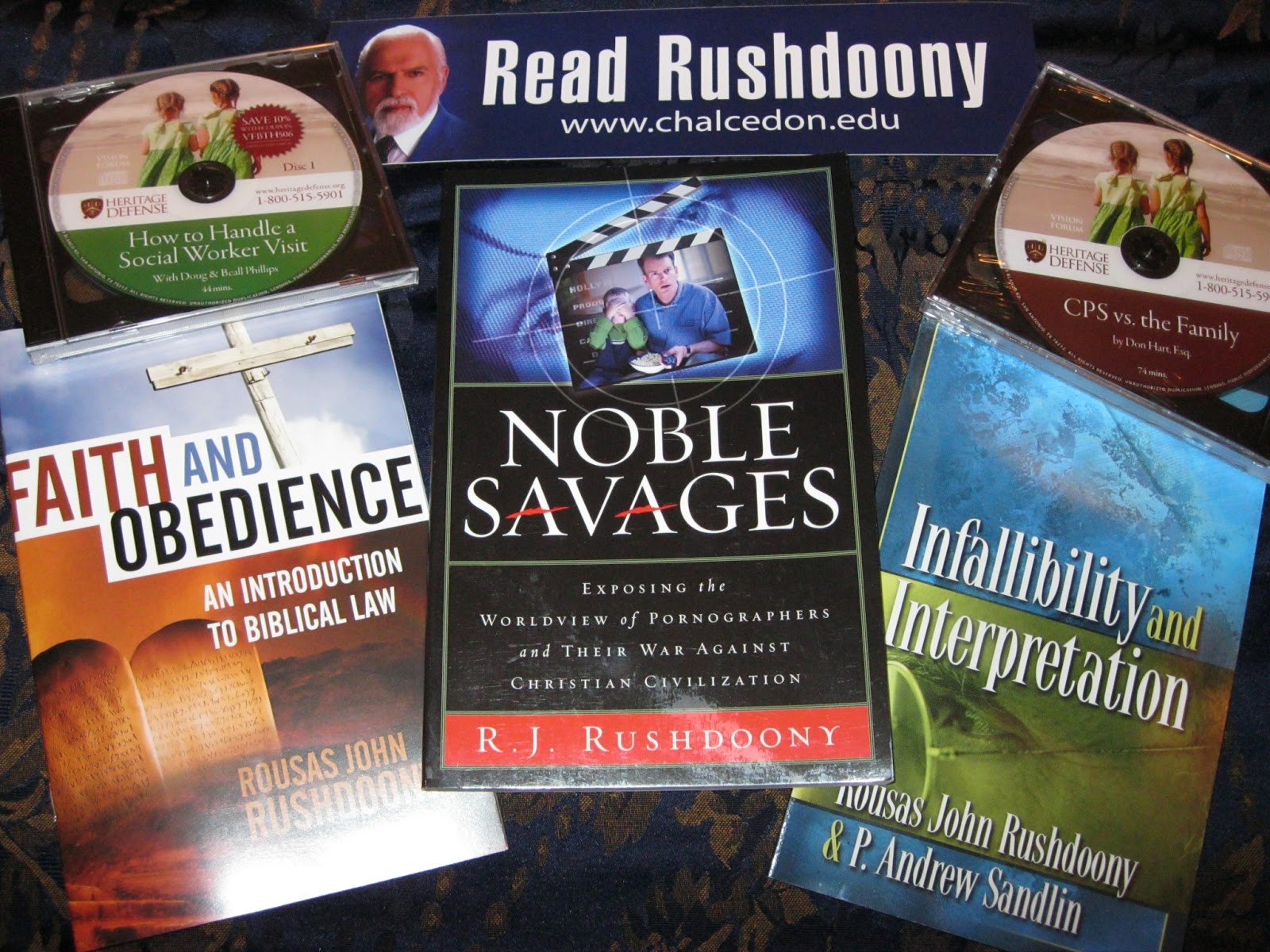
The New Geneva Christian Leadership Academy table was stocked with books by Christian Reconstructionist author R. J. Rushdoony, such as the colorfully named Noble Savages: Exposing the Worldview of Pornographers and Their War Against Christian Civilization. 

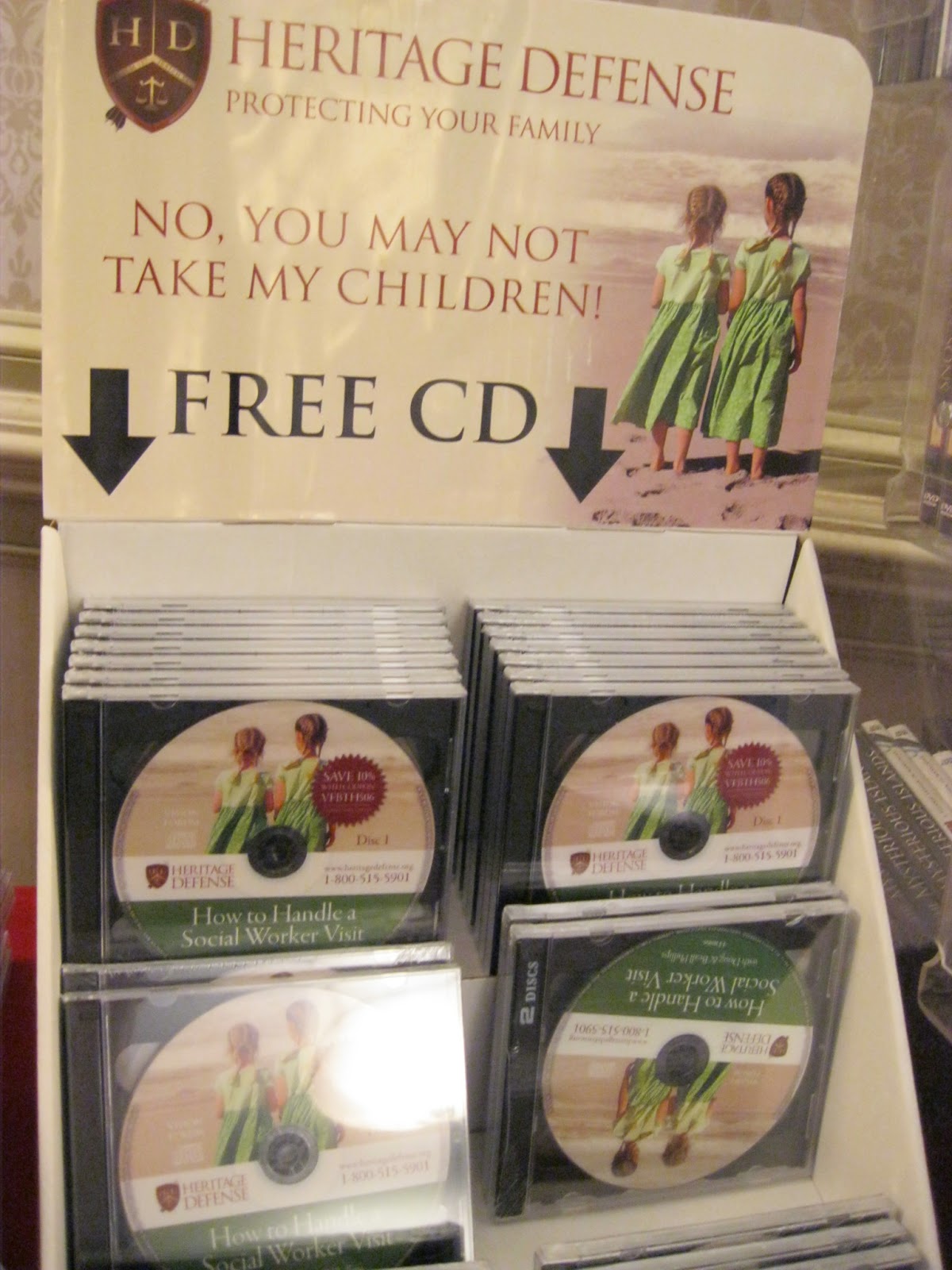
However, one display made my blood run cold. In the hotel’s grand ballroom was a display from Heritage Defense that read, “NO, YOU MAY NOT TAKE MY CHILDREN!” Sitting in the display were free DVDs such as CPS vs. the Family and How to Handle a Social Worker Visit. Upon reading the flyers at the foot of the display, I realized that Heritage Defense was casting child protective services as an opponent to Christian families. On its flyer, Heritage Defense claimed that it empowers Christian families by “uncovering social services abuses” and “holding abusive social workers accountable”. The flyer also celebrated the organization’s efforts to protect families from the following “threats” from social services:

  • Corporal Punishment
  • Sanctity of Life Decisions
  • Medical Choices like vaccinations and midwifery
  • Mandatory Reporters such as doctors, nurses, dental care providers, law enforcement, child-care services, nursery workers, coaches, counselors, and others…
  • Accidents in which children are injured
  • Premature Births or special-needs children
  • Anonymous Tips by those who wish to harm families
  • Harassment by extended family, neighbors, or mere acquaintances regarding disagreements concerning philosophical/religious direction and training of children
  • False reports generated by rebellious, disobedient, or indiscreet children within the home
  • Targeting of Profiling of Christian families because of faith, number of children, or other family dynamics
"Heritage Defense was casting child protective services as an opponent to Christian families."
“Heritage Defense was casting child protective services as an opponent to Christian families.”

Suggesting that mandatory reporters and anonymous tipsters are “threats” casts child abuse reporters as troublemakers rather than responsible citizens. To boot, the branding of children who seek help from CPS as liars or “rebellious, disobedient, or indiscreet” made me shudder. When child abuse occurs in fundamentalist families, where can victims find refuge if they’ve been taught that CPS is monstrous and that those who report are wrongheaded? When fundamentalists witness or suspect child abuse, could rhetoric like this make them reluctant to do the right thing? CPS is by no means perfect, but it does protect children from abuse and neglect, and thus this kind of demonization benefits no one.

Opening ceremonies for the conference began at 6 p.m., and hundreds of participants streamed into the grand ballroom. As the crowd filed in, I noticed several things about the attendees. First, the gathering was overwhelmingly made up of white families. Second, practically all of the women were wearing casual dresses or skirts, which I assumed had something to do with Christian patriarchy subculture. Finally, many of the families I saw had at least three children, often more, and babies were a common sight.

To be fair, everyone I met was gentle and helpful, and the families I observed treated their children with warmth. I struggled to reconcile these kindly people with the jarring messages I would hear from workshop speakers. It wasn’t just the workshop content that gave me pause — although polemic workshop titles such as “Why 19th Century American Literature Was at War with God” and “The Rise of Religious Liberalism” left me scratching my head — but the presenters of those workshops as well. I wondered how the women felt about a conference with only male presenters, or how anyone felt about a conference with all white presenters.

Stay tuned for posts on Doug Phillip’s opening speech and Wednesday’s workshops!

For more information on Vision Forum’s History of America Mega-Conference, visit the conference’s website.

*****

To be continued.

TeenPacters Speak Up: Part Three, She’s Not TPA

TeenPacters Speak Up: A Series by Between Black and White

HA note: This series is reprinted with permission from Between Black and White. Part Three was originally published on May 21, 2013.

*****

Part Three: She’s Not TPA, by Alessandra

To any TeenPacter, there are three words that represent ultimate ruling at any event – Teen Pact Appropriate. Oft abbreviated to the acronym TPA, it was bandied about concerning clothing, actions, and topics of discussion. It was the vague final standard that floated over attendees, replacing a popular evangelical choice of WWJD with, “Is that TPA?”

It was easy to tout it as well as ay other… during my first year. TPA was presented as hip, cool, and in to a sect of the population who often made their friends and had the most socialisation at TeenPact. I saw no problem deeming ankle length skirts and blouses a size or two too large as professional attire to wear to the capitol when I started out. I listened intently to the “girl talk” about causing en to lust. I very carefully kept any talk of Lord of the Rings or other such subjects to nothing more than hushed whispers.

My second year, I ran for governor of TeenPact Maine on the slogan “Vote AJK, She’s TPA.” Even so, there were tendrils of doubt forming in my mind. There were rebukes given to women who dared hold the door open instead of waiting–or letting–a man do it. I wondered what really happened during the “guy talk,” and why all the responsibility for men’s lust was being placed on the women. I had spent more time at the capitol between the two state classes, and didn’t understand why pantsuits for women were not allowed — something that came up again later in my TeenPact history. Then, of course, came the comments that shook my faith in my gubernatorial victory: the number of people who remarked that they didn’t know how I could have won, when they all voted for the other candidate.

I tried not to worry about it, but, for an organisation that promotes integrity above all else, there should never be any doubt.

I tried not to let my concerns shake my faith in the organisation, and proud of my newfound determination to prove the equality of women, I set off for my second National Convention on the presidential campaign trail. The historical inauguration of the first female governor of TeenPact Maine was fresh in my memory, and I was determined to make TeenPact history once more. My running mate and I knew we had our work cut out for us as the first girl/girl team, but, we were more than willing to embrace it.

What I was not prepared for ere the incredulous looks on the faces of boys and girls as they stopped by our campaign booth. Riding in a van with Mr. Echols on the way to a church service was not the first time, nor the last, that a fellow TeenPacter asked me how a girl running for president was TPA. After all, women should never be in positions of leadership over men!

The first time I was asked if it was TPA, I was flabbergasted. Still, my answer did not change. If Deborah could do it, so could I. Besides, I was just as capable as every other guy there, at the very least – why shouldn’t I run? In the end, though, I was the one with questions. The popular vote recorded for my state did not match the number of votes from my supporters. I wasn’t the only one with doubts that election, but, who were we running against?

Popular vote doesn’t matter when determining whether someone is TPA enough.

That same year I had an interview for staffing state classes the following year. I was very excited about the chance to do it, and was counting down the time until my interview. Things seemed to go well, up until my interviewer put her pencil down and looked me straight in the face. “How do you reconcile the TeenPact statement of faith with being Orthodox?”

I blinked.

I wasn’t sure if she was concerned because I had been running for president, or she just didn’t know what being an Orthodox Christian meant. The result of the interview was that I could staff the one-day class for 8-13 year olds, but that they weren’t comfortable with me staffing the four-day class.

From there, however, I turned to another side of TeenPact, and the hypocrisy therein: TeenPact Judicial…

To be continued.

TeenPacters Speak Up: Part One, Intro to TeenPact

TeenPacters Speak Up: A Series by Between Black and White

HA note: This series is reprinted with permission from Between Black and White. The following introduction was written specifically for Homeschoolers Anonymous to provide background on TeenPact as an organization.

*****

Part One: Intro to TeenPact, by Kierstyn King

Kierstyn King blogs at Bridging the Gap.

TeenPact is an organization that teaches students about government, political activism, and christian values. Their website says, “Our mission is to train youth to understand the political process, value their liberty, defend their Christian faith and engage the culture at a time in their lives when, typically, they do not care about such things.”

TeenPact started in 1994, founded by Tim Echols. When I was involved, the slogan was “TeenPact: turning students into statesmen.”  TeenPact is currently active in 39 States. Their introduction into the organization takes place at the “State Class” which is four days of training about how-the-government-works (not to say it isn’t saturated with conservative values) and one day of public speaking. After you have attended the State Class you are eligible to attend “alumni events.”

The alumni events they have range from being biblical man/womanhood camps (Venture and Endeavor), to camps specifically tailored to the individual branches of government — Congress, Judicial, and Back to DC which tends to be around the time that the Values Voters Summit takes place (students attend at least one day of the conference as part of the class — or at least did the two years I was there). The two most popular camps are National Convention and Survival.

The goal of every camp, but especially National Convention and Survival, is to “challenge” students’ spiritual walk. Every camp teaches students from an evangelical christian conservative (patriarchal) viewpoint. “Taking the nation back for God” is ultimately what TeenPact hopes its alumni will grow up to do.

For many homeschoolers like myself, TeenPact is one of our only means of socialization — and our only means of socialization outside of our parents’ eyes (because they trust TeenPact, and the group is relatively homogenous). TeenPact offers a seemingly innocent product — a state government class taught by conservative/homeschool-friendly leaders. They offer students an opportunity to meet other people their age, and they help teach students how to think (from their point of view).

To be continued.

Homeschooled and Kept Ignorant, But Still Queer: Melissa

Homeschooled and Kept Ignorant, But Still Queer: Melissa

HA note: Haley, Melissa’s spouse, shared her thoughts yesterday. Their courtship and coming out stories have been shared by Melissa on Patheos.

I was homeschooled from kindergarten through adulthood. I was the oldest in a large family, and very sheltered. We had the patriarchal beliefs common in the Christian homeschooling movement, so my role in life was very defined. I liked a lot of things about being a girl, but I sometimes wished I was a boy so I would have more freedom to go places, study something in college etc.

At the same time, I was fine with dressing modestly. The idea of getting male attention wasn’t really that appealing to me. I had a hard time imagining a guy I would feel comfortable submitting to and living with, and yet I had been told from early childhood that someday I would grow up and marry a good Christian man who would protect me from the world and support us financially while I stayed at home and had lots of babies to homeschool.

I wanted to be “right”. I wanted to be approved of. I wanted to fit in with my community and become that older Proverbs 31 Woman that all the younger girls asked for advice. I did the best I could to pay attention and please my parents by being who they wanted me to be. By age 17 I was very depressed, and thought about suicide often. I wanted to get out of my parents’ house and away from the expectations and restrictions so badly. As a female, the only way that was going to happen was when I got married. So whenever we were in places where I could potentially meet eligible young men such as homeschool conferences or homeschool gatherings I would anxiously watch and hope that someone would notice me.

I had no idea gay people existed until I was 14 and reading World Magazine and came across a negative reference to the dangers of “homosexuals”. I asked my mom what homosexual meant, she said it was when two men thought they could be together in the same way a husband and wife are together. It seemed like she thought it was a big deal, a bad thing. Of course at the time I didn’t have any real understanding of sex either. I knew that babies grew in a mothers belly, and I had attended the births of several siblings, so I knew how they got out, but I was still under the impression that sex was a magical transference of seeds needed to start a baby, that happened while you slept in the same bed. I started to suspect there was something more to it when I was reading all the purity books about how amazing sex was after you were married, and how hard it was to stay pure before you were married. If sex was supposedly this amazing, there had to be more to it than just sleeping. I tried looking up sex in the dictionary, but “act of copulation” didn’t help me very much. Eventually when I was almost 17 I found a book in the library that I did not dare to check out, but read as much as I could as fast I could in the corner until it was time to go home. It was here that I first learned about penetrative sex and what an erection was. It didn’t dawn on me that if men could be together, then there was such a thing as gay women as well until a year later.

I may not have known what sex was, or what being gay actually meant, but I knew I had a hard time imagining being with any of the guys I encountered. I hoped that my mom was right, and that god really was going to help locate he perfect guy for me. I did not have friends my age, most of the homeschooling families we knew had much younger children, and we didn’t go to church.

By the time I was 18 I had had enough sexually arousing dreams about women and enough urges to kiss or touch the breasts of friends I hardly knew to start to question if this was normal. My sisters or cousins would talk about celebrity guys who were attractive in their opinion and I didn’t know what to say, so I picked whoever was the most stereotypically masculine to hide the fact that I thought Catherine Zeta Jones was way sexier. I asked my mom what had attracted her to my dad, and when she said his broad shoulders that became what I would say I found attractive when people asked what my “type” was.

Eventually I got up the courage to ask my dad what our beliefs about gay people were supposed to be, I didn’t say I was asking for myself. He told me that homosexuality was caused by an especially disgusting demon, he almost seemed to shudder just thinking about it. My dad claimed to have heard and seen both demons and angels, so I felt that he must know what he was talking about. I was pretty sure I had never encountered a demon, and I had been very careful to follow the rules of the house so as to stay under the “spiritual umbrella of protection” my father provided, so I did not understand how I could have allowed demonic influence into my life. Maybe I wasn’t gay. So I asked about bisexuals, what did we believe regarding them? My dad said they did not really exist, that the only true bisexuals were demonically influenced witches. I knew I wasn’t a witch, and I was too scared to inquire further and give myself away.

So I told myself I was imagining things. This wasn’t really true about me. The only reason I was attracted to women, was because I had zero sexual experience, and the only body I had access to was my own, as soon as I got safely married and had sex, I would be attracted to men like I was supposed to be. I had never read anything that portrayed gay people in a positive light. I had never met a openly gay person, or even seen one to my knowledge. I didn’t know what was wrong with me, but I was sure that getting married would fix it.

The amazing thing is, that only a year after we began going to church, I met someone who I thought was a boy and fell in love. He was tall and had beautiful blue eyes and soft full lips that I so wanted to touch even though we were not allowed. We could talk for hours and he actually listened to and thought about the things I said. I had never had anyone treat me so kindly and respectfully. We had a parent supervised and controlled courtship, and got married after 10 weeks, and only 8 days after kissing for the first time. Basically, I went from having never held hands to having sex in a little over 2 months.

As you can imagine, sex was still an awkward topic. The attractions I thought would magically disappear after marriage, didn’t. I didn’t dare talk too openly about it, but sometimes it worried me. I was happily married, I was attracted to my spouse, but I was still very attracted to women and worried that I was a bad person for feeling the way I did. I had many other detrimental beliefs related to sex as well. I had an understanding that I was obligated to be there to service my husband’s sexual requests whether I felt like it or not. I had always been told that god had designed men with very active sex drives, and that if they were rejected by their wives, men would turn to pornography, or even another woman, and I would have no one to blame but myself. I had no concept of consent. In fact when I was first married I had made a promise to myself that I would never say no to a sexual advance from my husband, even if I was sick or exhausted. I also had a lot of anxiety about my worth being tied to how often my spouse wanted to have sex. When my spouse was too tired or just not really interested in having sex, I worried that I wasn’t attractive enough or wasn’t performing adequately. Sex was often one big ball of worries fear and second guessing.

Five years later I had the surprise of my life when my husband came out to me as transgender. What happened next was a 2 year journey that inspired more growth both in our relationship and as individuals than ever before. We discovered just how much each of us had been hiding from the other for our entire marriage. Shedding that fear of rejection and judgment and being honest is one of the most powerful transformations I have ever experienced. When Haley told me that she needed to transition to female and live as she truly was, I wasn’t really phased, and that fact led me to face my sexuality head on for the first time in my life. Haley was patient, and waited while I read and read and asked her question after question. Eventually when Haley felt ready to transition, we came out publicly to our families and started our marriage over again as a lesbian couple. I couldn’t ask for a better partner or co-parent, and the respect we have for each other has only continued to grow. Reactions were about what we expected, and we were reminded many times over why we had hidden for so long. Some people cut us out of their life and refused to speak to us. People who hadn’t communicated with us for years sent us long emails detailing how wrong and evil we were for making this “choice”. It was exhausting and draining, and I was so grateful that we were adults and financially independent before we had dared to come out.

Sometimes I wish that I hadn’t had to spend so much of my life living someone else’s idea of who I needed to be. It has been quite the task to learn how to relax and just be rather than second guessing every single thing I think, do or say. I also wish I had known how many wonderful supportive people were out there, just waiting to embrace us for exactly who we were. Coming from such an isolating, restrictive and judgmental community growing up, it has been a new experience to meet people from all backgrounds, religions and sexual orientations who are accepting and loving. I have also been surprised by how many people from our old life have come around in some way. My parents in particular come to mind, after a rocky start and 3 months of silent censure, my parents have found the ability to be tolerant. Even though they do not understand or affirm our sexuality or the journey our marriage has taken, they have chosen to try to love us and be with us.

It’s been almost 8 years since we got married, 3 years since Haley came out to me, and 1 year since we came out to the world. I thought we had a unique story, but since telling our story on my blog we have been contacted by so many other couples who married in the closet and stayed together after coming out. There are so many years that we lived in shame, sometimes we can get frustrated with all that time wasted, and pain endured. Only one year in, sometimes it feels like the new goals and dreams will never happen. It’s been a lot of work starting over from ground zero, some days we fall into bed too exhausted to even say goodnight. Sometimes old messages haunt us, telling us that we are not good enough, that we are failures, that who we are is somehow less than. But overall there is something about the honesty of this life that feels really good. We have the story that we do. We came from the background we did, and it took as long as it did for us to overcome the shaming messages and be ok with who we are.

There really is nothing to regret, only a life to live, fully.