Ignorance is Safety?: Christina’s Story

Screen Shot 2014-02-12 at 7.48.57 PM

Series disclaimer: HA’s “Let’s Talk About Sex (Ed)” series contains frank, honest, and uncensored conversations about sexuality and sex education. It is intended for mature audiences.

Pseudonym note: The author’s name has been changed to ensure anonymity. “Christina” is a pseudonym.

Trigger warnings: the following story contains descriptions of physical and sibling sexual abuse of a child.

*****

“I know a bad word.”

I was seven, standing in the bathtub and my mom was washing my hair.

“Tell me what it is.”

“I don’t want to say it.”

“Tell me what it is or else I’ll spank you.”

I was petrified, my heart was racing a mile a minute. I couldn’t tell mom; I was afraid of being punished for even knowing the word. I was shaking and crying. My mother took out the hot-glue stick that we were regularly beaten with and proceeded to spank me there in the bathtub. Between each swat she would order, “tell me!” until, sick with fear and pain, I told her.

The dirty word: Bra.

Hello, my name is Christina. My purpose for writing this today is to help those who have gone through something similar to me and to spread awareness to those who haven’t.

Growing up, my mother told us nothing about sex. Nothing. As girls, she didn’t educate us about having your period, bras, body changes, nothing.

I was introduced to sex when my brother molested me on Christmas day when I was eight years old. He was only eleven at the time and I write this with his permission. In the last year my brother told me stories of what led up to that day. He was only four years old when our mother would “spank” him until bruises formed for “touching his penis”. Other than these beatings he had received no sexual education at all when he stumbled across pornography on the internet. He didn’t even know the word pornography when he described to me what he had seen. I didn’t know what it was but I knew it was wrong. I was too scared to tell anyone what happened on Christmas, so I kept quiet for four months. In the meantime my brother had molested my little sisters as well, and I knew about it. I told my brother not to hurt my sisters anymore, so when it didn’t stop I finally got up the courage to tell my older sister.

My sister told my mom, who called our youth pastor for help.

Our youth pastor called Child Protective Services, and my brother was removed from the home.

He lived in foster care for a year and we weren’t allowed to see him during that time. When he finally came home things were awkward between us for a while, but when we were willing to open up to each other he was able to apologize, and we were able to talk openly about what happened. If I wasn’t terrified to go to my mom for help, the whole situation might have been prevented. My mom was not a person I could go to with my fears and questions. She never talked about sex, and never made us feel that we could talk with her about whatever we needed to talk about.

I thought I had cancer. I was eleven and scared to death. After weeks of worrying I built up the courage to talk to my mom. I told her I was developing these lumps.

Her exact words were, “welcome to adulthood.” Nothing else.

I lay awake that night and put the pieces together. I wasn’t dying after all. In the months that followed I stole my sister’s bra, and on three separate occasions I shoplifted bras from stores. During that time I kept dropping hints to mom, but she made it awkward, and I was so nervous. My mother never made herself available for any serious conversations. Even when approached, she would make the conversation as short and surface as possible. Finally, at age thirteen, I got up the courage to confront her. I told her how I had been shoplifting and taking from my sisters and her reply was, “why didn’t you tell me I needed to take you shopping?” I told her that she made it hard for me, but she wouldn’t listen. She waited seven months before she took me bra shopping for the first time.

I began to watch pornography regularly when I was eleven.

I don’t know how to tell you why. I would go to great lengths to be able to access a computer with internet. I began to masturbate. It was an unsaid rule in our household that anything sexual outside of marriage was evil. Because of this, I felt guilty for masturbating, I felt like I was defying God. I prayed to God, promising that I would never masturbate again. The next day I broke that promise. I felt like shit, like I had let God down. I was weighed down with a load of guilt. I felt I deserved death.

I was prepared to hang myself; the only thing that kept me from tightening the rope was the thought that if I left them, my little sisters will go through exactly what I did, and I want to be around to prevent that from happening.

When I was fourteen I tried to be open with my mother. I told her what I went through as a pre-teen and a teen, and her response was to send me to therapy; she didn’t want to handle me herself. One day on the drive home I was trying to explain to her how she wasn’t there to help me as a kid going into my teenage years, but she refuses to listen. We start talking about masturbation, and she tells me anything sexual outside of marriage is wrong. There I was, opening up to my mother and sharing how I tried to hang myself as an eleven year old because I felt so guilty, and she contributes to my guilt, telling me that what I did was wrong. No comfort, no empathy, no help. Just guilt. I ask her, “from a biblical perspective, how is it wrong?” She can’t answer me.

I pushed the question, and she finally told me, “you need to move out. I don’t want you around your little sisters.”

I am no longer living with my mom. I feel free to talk about masturbation, sex, and gender expression with my siblings, something I never felt I could do before. My brother and I have had conversations I never saw us having. Today I am inspired to help others, and I feel more confident about how I want to raise my children. My mother lost custody of my younger sisters in August and I know that they have a brighter future ahead of them.

I am so grateful that they will never experience what I did.

My sister has also written about her sexual education, the link to it is here.

My Body, Foreign Territory: Richard’s Story

Screen Shot 2014-02-12 at 7.48.57 PM

Series disclaimer: HA’s “Let’s Talk About Sex (Ed)” series contains frank, honest, and uncensored conversations about sexuality and sex education. It is intended for mature audiences.

*****

My body, foreign territory

At one point in my life I was convinced that I had two assholes.

I won’t disclose my age when I held this belief, but it was certainly in the double digits. I’m not sure how I came to believe in this extra anatomy, but I was completely and absolutely sure of its existence. When I discovered the truth – for any young homeschoolers reading this, human beings have one anus – it was an uncomfortable collision between a grounded belief and new information: certainly one collision among many.

I can’t remember my imagined purpose for a second anus, but most likely it was something about sex, and was a byproduct of a complete ignorance of my own body and the shaming of new information.

I didn’t know anything about sex, and I certainly was afraid to ask. I lived under an umbrella of religion where a ban on sex extended to thoughts of questions about basic anatomy. Information was taboo. Curiosity was not a neutral disposition: curiosity exposed was met with animosity and speeches, and was immediately parceled with shame. To ask about sex is to engage in it. Sin is a mystic frontier that should not be visited, seen, or talked about. Ignorance in sex is strength.

Sex by wireless transmission

I should have counseled the Internet, but we didn’t have it. Instead, I turned to an older medium for my sex education: radio. Between the hours of ten and midnight, a local radio station broadcasted a show called Loveline, a call-in program about relationships, sex, and medical issues. It counterbalanced an informative doctor with a disparaging comedian and radio host. A typical call-in would go like this:

Adam: It says here you had a threesome with two girls?

Caller: Yeah.

Adam: No. No. Too squirrelly. First off, nobody named “Oliver” gets a threesome at fifteen years old.

Guest Everlast: [Laughing.] You’re wrong, dude.

Adam: Naw, no one named Oliver! Maybe Oliver Stone or Oliver Twist.

Caller: Dude, Oliver’s a tight name.

Adam: Yeah… It’s… I don’t know… It’s not the kind of name that gets a guy laid. Not at fifteen. Not in a threesome! You did not have a threesome.

Caller: Well, it was oral.

Drew: All right, well, that’s not a threesome.

Adam: Oral threesome?

Caller: Yeah.

Adam: I might count that.

Jokes were made, advice then dispensed. The format was undoubtedly devised to hook in teenagers with dirty humor, and give them practical advice about sex and diseases, and dispel free-range myths teenagers enjoy cultivating. Like two anuses. The show was brilliant.

I would listen in at ten o’clock, with my radio on a bookcase at the head of my bed, headphones plugging in, with the cord running incognito under my pillow and into my ear. Most nights I would stay up until the show ended, and some mornings I would be waken up by the radio buzzing in my ears, having fallen asleep with it on. It wasn’t just entertainment, it was my sex education. I had no idea what a condom or a menstrual cycle was, so they informed me. My curiosity was finally being addressed, rather than suppressed.

Rituals: talking about it

When I was a Peace Corps volunteer in rural Africa, I found a common perception of sex that was very familiar: the communities identified overwhelmingly as Christian and there was a conversational taboo around sex. Parents never talked about it with their children, and teachers avoided the topic as well. It was difficult to pierce the veil of silence about sex in order to talk about HIV/AIDS, a subject already colored by Bush era programming of abstinence, marriage, and fidelity.

However, there were two particular moments within the culture, when the sex conversation was allowed to bloom. The first occurs during coming of age rituals, for girls or boys, where advice is offered freely and traditions about sex and everything else were passed down. The second happens at “kitchen parties,” where married women share thoughts about marriage, children, and sex with soon-to-be brides.

Perhaps the homeschool or conservative religious community needs these kind of rituals where a taboo subject can be spoken about in an open, constructive, and safe environment. Clearly a philosophy of “not talking about it” doesn’t work – states populated with the conservative religious have the highest teen birth rates by being “more successful in discouraging the use of contraception among their teenagers than they are in discouraging sexual intercourse itself.” So-called comprehensive sex education has shown to reduce pregnancy, compared to abstinence education, which doesn’t even reduce teenage sex.

Perhaps rituals would involve actually participating in sex education in the home, church, or school. I know this is highly contentious terrain as long as knowledge about sex is still considered tainted by sin and a dangerous prerequisite to the act itself. Information is power, and it can be tempered with the guidance and kind instruction Christians often claim to offer yet rarely practice, particularly when it comes to sex.

While the idea of twin assholes is comical and suits the purpose of this essay, but it’s clearly the least dangerous misconception about sex teens can have when they’re not educated.

Abstinence from sex can work, but certainly abstinence from information has failed many communities.

Two Messages that Children Internalize that Contribute to Bullying in Patriarchal Church and Homeschool Groups

Screen Shot 2014-02-13 at 10.50.41 PM

HA note: The following is reprinted with permission from Sarah Henderson’s blog Feminist in Spite of Them. It was originally published on her blog on January 4, 2014.

Homeschooled children sometimes experience bullying from peers. Part of this stems from the messages that children absorb about themselves.

1. Children respond to the tiered authority by owning the message that they are the not as good as other people and exist to serve people who appear to be more powerful than they are;

2. Children respond to the opposite message that they are the best and brightest and most privileged and enact that power on others. 

I have mentioned the issue of bullying in homeschool groups in passing in a previous post, but bullying in homeschooling families and homeschool groups is a serious issue. In a well-meaning homeschooling family from a conservative background, there are several patterns, such as adherence to patriarchal family systems and the sense of responsibility held by the parents to teach their children to succeed in life and grow up to be adults with the same mindset and goals as the parents. There is also often a commitment to having a large family.

This creates unique family power dynamics.

Depending on how the family works, they will send a message to their children that corresponds with one of the point above: that the child is valued and special, or that the child is part of a plan that has nothing to do with the child.

Socialization has become almost a joke to both sides of the homeschooling debate, but the reality is that children who are homeschooled spend less time with other non-siblings, and sometimes this is even the goal of homeschooling. In patriarchal families, children are often authority-tiered in birth order, although preference in the ranking is sometimes given to boys. Sometimes this happens in large families due to the difficulty in parenting large numbers of children, and mothers bring in older daughters to take on various aspects of homemaking and parenting.

There is a large amount of anecodotal evidence that speaks to how damaging sibling parenting can be. There is a series posted by Heather Doney that tells the stories of sister-moms. Many of the personal stories shared on both No Longer Quivering and Homeschoolers Anonymous also outline the difficulties of being an adult who helped raise their own siblings. Children who are part of this tiered authority find themselves always as part of a ranked system, which is different from the experience of children who attend school, who are grouped with peers in spite of status struggles.

Homeschool groups and church “families” are touted as a significant source of socialization opportunities for homeschooled children. However, this means that children who spend most of their time in a tiered family structure are then tossed together as an artificial peer group and left to find their own status among themselves, which is one of the things that some homeschooling parents say they are attempting to avoid. The source for the information in this post is lived experience.

Children in homeschooling groups and church groups vie for status at the expense of each other, just as children do in public and private schools. They put each other down, and use similar ways of determining popularity as public schooled children do, including appearance, status of parents, ownership of desired items, and overall apparent confidence levels. They sometimes use physical strength to exert control as well. Parents do not always see the bullying but it does take place.

However, homeschooled children in these families are also subject to real responsibility/authority status and a tight social circle that is includes all available peers.

Girls sometimes compete to exhibit which is the more capable parent, and it is not uncommon to see these children carrying other children around, usually their own siblings or the young children of family friends. Because it is valued for girls to learn to perform homemaking tasks, girls are put on display to demonstrate proficiency in cooking and parenting, which creates resentment between peers. Financial struggles are a common problem among families with a stay-at-home mother and many children, so girls find themselves ranked in their peer groups according to whose parents have time to contribute to social activities and by common status symbols such as clothing. These families also share clothing, so children with a lower financial status have to wear the cast-off clothing of the more affluent families.

Very young boys in patriarchal families do not always realize that they are being groomed to take part in a power structure, but they do attempt to exert power over each other as much as public schooled boys do. The big difference here between public schooled children and homeschooled children is that since children tend to be part of a self-regulating system (and the parents are busy) there is not as much supervision and few complaints. As stated above, children either internalize that they exist to serve or exist to control. This results in children who are taught to stick to their ranking and do not usually object to unfairness.

Mental health problems are often not identified and treated in children in these circles, and some of the aspects of patriachal homeschooling life may contribute to the development of mental health disorders. This leaves suffering children even more vulnerable to bullying since children suffering from depression and similar struggles may only appear to be quiet and awkward, whereas in a public school they may have been identified as needing a teacher-mentor or recommended to see a mental health professional. An additional problem unique to church and homeschool groups that prevents children from being protected from bullying is that there is no central figure that children can turn to if their life isn’t working like a teacher or principal. Each parent usually has faith in their own children, and all parents in the church group or homeschool group has faith in their system, and it threatens their choices if the system doesn’t work, so there is simply no room for a bullied child to seek help.

Please share your input regarding the differences between bullying in public schools and patriarchal church and homeschool groups!

The Many Valuable Lessons I Learned in ATI: Laura’s Story

HA notes: The author’s name has been changed to ensure anonymity. “Laura” is a pseudonym.

The 14 years I spent as a student in ATI taught me many valuable lessons for my life. Here are some of the highlights:

* Parents are always right.

* Men are always right. Therefore, your father is double-right.

* Getting out from under the “umbrella of authority” means you will have many problems, including being raped. (Not sure what the warning is for boys who get out from under their umbrellas. I’m a girl so always heard the rape thing.) The fiery darts of Satan will have nothing to stop them from hitting you. We all know that an umbrella is the best possible analogy because their thin, flammable fabric is the perfect substance with which to stop fiery darts.

* If your umbrella – dad or husband – has holes, then Satan will get you unless you pray really hard that they’ll patch up their holes. If you don’t, you’ll probably get raped.

* Family is everything. Except when young people go to a Training Center or Headquarters. Then it’s okay to not be together as a family unit. Or when young people go to Apprenticeship Sessions at Knoxville and make binding vows that their parents know nothing about. That’s okay. You do not need to seek your father’s permission to make such vows that will control what you do the rest of your life. Your father’s permission is implied because he sent you to this Apprenticeship Session.

* Young people, given the option, will always choose the wrong spouse. Therefore, their parents – most of whom chose their own spouse – will choose or at least approve their spouse for them.

* If you date, you’ll have all sorts of problems and can never have a happy marriage. Dating is practice for divorce. Courtship is practice for marriage. If your parents dated and have a happy marriage anyway, it doesn’t matter – dating is still bad and you will get divorced if you date.

* You should court (aka “let your parents pick or approve your spouse”) so you don’t get divorced.

* Talking to a boy is dating him. Especially if either of you have romantic thoughts about the other one. To be on the safe side, it’s best never to talk with young men. (At some Training Centers, talking with a person of the opposite sex for longer than a few seconds, unless it was obviously work-related, was grounds for discipline and/or being sent home.)

* Even thinking about a boy is probably dating him. You should immediately confess any such stray thoughts to your father, ask his forgiveness, and make yourself accountable to him lest you be tempted to have any more thoughts about boys

* If it happens that the boy you are thinking about has already asked your father for your hand, or does so in the future, you will not be informed of this until your father deems it the appropriate time. This means you could spend years fighting attraction to the man you will eventually marry, but it’s still a sin to think these thoughts.

* If you marry the “wrong person,” then after you’re married they become the “right person,” aka God’s new will for your life. You’re stuck. Deal with it. You shouldn’t have dated him anyway, or married him without your parents’ permission. We know you either dated or married without parental blessing or both, because duh, you married the “wrong person” and you would never have done that if you’d courted and gotten your parents’ blessing!

* If your parents lead you to marry a guy who’s in the Mafia (yes, this example is in the Basic Seminar, or maybe the Advanced Seminar… it’s been a few years since I watched either of them) then you need to be submissive anyway. Because your parents chose him for you, God will bless your marriage even though he’s in organized crime and likes to beat you when he gets home. You still can’t divorce him.

* Not only should you NEVER EVER EVER marry someone who’s divorced, but you probably shouldn’t marry the *child* of divorced parents.

* The sins of the fathers will be passed down to the children unless a very specific prayer is prayed over said children. We are very blessed to live in a time when we have Bill Gothard to teach us such things. Thousands of years’ worth of Christians simply had to fight inherited sins on their own, without Mr. Gothard to show them the RIGHT way to overcome such things!

* Adoption is bad. You don’t know what “sins of the fathers” are being introduced into your home.

* Birth control is bad. God will give you as many children as you deserve. Susanna Wesley was a favorite example – she had 19 children although less than half of them survived infancy.

* If you can’t have children, then something must be wrong in your life. Clearly God gives many children to those whom he favors. He really loves Mrs. McKim. (Now I’m showing my age… these days it would be Mrs. Duggar!)

* Only have sex between days 15 and 28 of the wife’s menstrual cycle. Days 8-14 are maybe okay, but if you’re trying to be ultra-Godly, or get pregnant, wait until day 15. You want the “seed” as strong as possible.

* It’s not awkward to talk about periods and sex in mixed company when single “fellas” and single “girls” are present in the room, as long as it’s in the Advanced Seminar. Plus, we use terms like “relations” and “monthly cycle” instead of “sex” and “periods,” so we’ll all just pretend we don’t know what we’re talking about so it’s less awkward.

* Tampons will kill you. Toxic shock syndrome and all that. They’re bad. Follow God’s design for your monthly cycle and wear pads.

* Rock music is bad. It will kill your plants and cause you to be demon-possessed. It will also cause you to drink, take drugs, have sex with anyone and everyone, wear jeans, and generally rebel against everything Godly. Rock music with Christian words is even worse.

* If your family visits a restaurant or store that is playing ungodly music, you must ask the server or store employee to turn the music off. If they refuse, then the most Godly thing would be to leave the premises immediately so that your family is not harmed by the ungodly music. Plus, you’ll be a testimony of God’s principles.

* The only okay music is hymns. Classical music is okay as long as it doesn’t have a back beat. But if you’re really Godly, you’ll listen to hymns. Preferably played on a harp. The harp is the most Godly of instruments. After all, David used it to charm the demon out of King Saul. Until King Saul threw a javelin at him. Twice. During harp music. Somehow that part never got talked about when I was in ATI. Forget that. Just listen to harp music anyway.

* Cabbage Patch Kid dolls will cause you to be demon-possessed. They will also cause your mom to have her labor stall, until the doll is found & burned, at which moment, labor will resume and the baby will be born within minutes. (Another anecdote, told in the Basic Seminar I believe.)

* To be on the safe side, better not have My Little Pony, Care Bears, troll dolls, and definitely no souvenirs from Africa such as masks or figurines. You will be demon-possessed. They must be burned. Simply throwing them away is not good enough to break the demon’s power over you. It doesn’t matter if such toys are your child’s favorite toy(s), they must be burned anyway.

* Denim is bad. It’s a sign of rebellion. Even boys should wear Dockers, etc., not denim jeans.

* T-shirts are bad. They’re a sign of rebellion. Only collared shirts are allowed. Therefore, a polo shirt is acceptable attire for “fellas” or girls. A t-shirt is not. (How a girl wearing a polo shirt is not “wearing that which pertaineth to a man,” I don’t know. I never heard that addressed.)

* If you are going to rebel and wear a t-shirt, don’t ever wear one with words or a design on the front. Girls, don’t you know what when a man’s eyes are reading the words or looking at the picture, they’re really checking out your body? You’re going to get raped if you encourage men to read your chest – I mean, shirt – instead of focusing on your bright, Godly countenance.

* Beards are bad. They’re signs of rebellion. (During the 1980’s and part of the 1990’s, if the dad had facial hair, the family would not be allowed to join ATIA/ATI.)

* Men must have short hair that is obviously masculine in style. The best hairstyle for a “fella” causes you to look like your photo – complete with a navy suit – could fit right in to a high school yearbook from the 1950’s.

* Women should have long hair, with gentle curls. If God made your hair straight, then you must curl it. If God made your hair ultra-curly, then you must straighten it. Blonde is the best color. The Principle of Design (accepting your body as God made it) is suspended for hair. Mr. Gothard dyes his hair so apparently hair dye doesn’t violate the 10 Unchangeables regarding physical features or aging.

* Pants or jeans or shorts on women are so bad that I can’t even begin to stress how important this is. Men will lust after your body. You will get raped. (Girls can’t wear pants because they pertaineth to a man, even though men in Bible times wore “dresses” or robes. That was okay, though, because their robes were distinctly masculine in style, so it was still easy to tell at a distance if you were looking at a man or a woman. But pants are never okay on women because they’re too much like men’s garments so you can’t tell from a distance if it’s a man or a woman.)

* Hosiery should be skin-toned and should never have a pattern woven into it. This is an eye trap, and will draw rapists’ – I mean, men’s – eyes from your bright and shining coutenance down to your legs. He will be so busy looking at your patterned hosiery that he may very well rape you without even realizing what he’s doing, and it won’t be his fault, because you were the one wearing the eyetrap.

* The most modest attire for a woman is a navy skirt, a white blouse, and a navy neckbow. Or in later years and/or if you or a close friend have been to Russia, you may wear a black painted Russian pin at your neckline, as the ATI version of a status symbol. (Just don’t let it rain while you’re wearing your modest white blouse, or it becomes… um… less modest and more see-through… maybe *that* is why were were always supposed to be under an umbrella… and Heaven help the full-chested girl whose blouse kept wanting to gap or pop buttons in the wrong place…!)

* You must vow (not promise, but VOW) to never go to a movie theater. Bill Gothard made such a vow when he was a young man, and look how wonderful his life has been! Therefore, you MUST make this same vow.

* You should also commit to fasting regularly, at least on Sundays. Bill Gothard made such a vow when he was a young man, and look how wonderful his life has been! Therefore, you MUST make this same vow.

* You must also vow to read your Bible every day for the rest of your life. At least 5 minutes a day. Bill Gothard made such a vow when he was a young man, and look how wonderful his life has been! Therefore, you MUST make this same vow.

* You must also memorize Scripture. Preferaby by the chapter. Or the book. The most Godly of Godly people memorize the whole New Testament, *and* Psalms, *and* Proverbs. But at least start on Matthew 5, 6, & 7. And Romans 6, 7, 8, & 12. And James 1, 2, 3, 4, & 5. If you memorize random scattered verses, you aren’t Godly enough.

* Simply reading the Bible isn’t enough. You must also *meditate* on Scripture. If you meditate on Scripture, then you will get good grades in school. You will breeze through college. Bill Gothard made such a vow when he was a young man, and look how wonderful his life has been! Therefore, you MUST make this same vow.

* Public school is bad. Christian school is almost as bad as public school. Homeschooling is good. Bill Gothard attended public school, and look how… oh, wait, never mind.

* Sunday School is bad. Children’s Institutes are good. Groups of peers are bad. Young people must spend time in groups of all ages. If you insist on attending Sunday School at your church, then you should attend a class as a family, because then your children won’t be tempted to make friends with people their own age.

* Character is the most important thing in life. Education doesn’t matter – just have character. Just have good character and employers will hunt you down and beg you to come work for them. Unless you’re a girl. In which case you’d better not work for anyone but Bill Gothard or your dad, or you will have sex with a co-worker or boss. Or get raped.

* College is bad. Public school is bad. Christian school is bad. Normal homeschooling is okay but less Godly than enrolling in ATI. If a girl goes to college, she’ll almost certainly get raped. Boys who go to college will be taught about how great Satan is. After all, Bill Gothard went to college, and look how… oh, wait. Never mind again.

* The most Godly homes have Scripture posted on the walls. Generic pictures of landscapes or portraits of people were never forbidden, but if you’re *really* Godly, you’ll have Scripture on your walls. Or CharacterFirst! posters.

* It’s okay to teach in public schools, but only if you are teaching the CharacterFirst! materials. Otherwise you should avoid any and all contact with the public schooled, sex-crazed, denim-wearing, rock-music-listening, rebellious youths of the world.

* TV is bad. Horribly, horribly bad.

* The Interent is bad. But since so many of you insist on having it in your home, you should buy protection from CharacterLink. It will cost you a bunch of money every month, and won’t let you see half of the perfectly-legitimate sites you want to visit, but you must spend the money on it anyway. Especially if you have men or boys in the home. Men or boys who are allowed to touch a computer without CharacterLink installed on it will become addicted to porn and will probably become rapists. (Bet this one’s really hard to enforce nowadays, since CharacterLink is no longer owned by ATI, and iPods and iPhones and iPads and their cousins would be incredibly hard to control. I suppose ATI kids these days aren’t allowed access to such technology.)

* If you are visiting friends or relatives who turn on a TV or a computer or do anything else that goes against your Scriptural convictions, including the ones for which you have no Scriptural basis, you must stand alone. You must say, “I’ve given my life to Jesus and I can’t do that.” Sleepovers are probably not a good idea because it’s almost certain that someone will do something to offend you, at which time you must stand alone, and probably call your parents to come pick you up from said sleepover. (A sleepover where the mom decided to hold a seance was the example given. As a mother, I don’t send my children to sleepovers unless I know the parents well enough to trust my child to their care. However, in the example, the parents who sent the child there were never criticized. Rather, the child was praised for refusing to participate in a seance.)

* Whole wheat bread is the answer to all of the world’s health and nutritional needs. It only counts if the wheat was ground *that morning,* the bread was made *that day,* and you eat it *that day.* After all, “give us this day our daily bread” definitely does NOT refer to bread purchased at the grocery store, or even made the day before. White flour will kill you. Whole wheat flour will save your life. Eat lots of whole wheat bread every day. (We have to assume that Celiac Disease and gluten intolerance are the figments of evil people’s imaginations. We’ll never know, since Celiac & gluten intolerance were unheard-of back then. I suppose that if those people were eating whole wheat bread, then they wouldn’t have Celiac Disease. ‘Cause whole wheat bread is the answer to all of the world’s health and nutritional needs.)

* A desire for white bread was a major factor in beginning the French Revolution.

* You’ll know you’re getting enough fiber when your, um, bathroom business floats. (During that Wisdom Booklet and for a time thereafter, our family announced our results to each other after leaving the bathroom.)

* Don’t eat pork. Ever. It’s bad.

* Don’t eat dairy and meat together. It’s bad. No more cheeseburgers, ever. Or milkshakes with a burger. But sometimes we’ll order pizza at our Training Centers, with pepperoni toppings. That’s okay.

* Don’t chew gum. It’s a sign of rebellion since that’s what rebellious teen-agers do.

* Games are a waste of time. Unless it’s Character Clues or Commands of Christ.

* You should avoid any game that teaches you about demons or hell. Except Commands of Christ. Its picture of hell is okay.

* Dungeons and Dragons is a game that must be avoided at all costs. It will cause you to be demon-possessed.

* Folly of any kind is a waste of time and damages your testimony. Avoid all practical jokes. Avoid loud laughter. Your time would be more productively spent reading your Bible, memorizing character qualities, or fasting and praying.

* If you memorize all 49 character quality definitions, including the ones that are so similar that no one but Bill Gothard can differentiate them, then you will not only have such great character that you don’t need college to be successful in life, but you will also beat everyone else in Character Clues. Every time. Just don’t be proud of that fact, or you obviously don’t have Humility. Since very character quality has a Bible verse reference on its card, you know they came straight from the Bible.

* There are seven non-optional principles of life. Aren’t we lucky – oops, can’t say “lucky” – fortunate – no, can’t say that either – BLESSED to live in this time of history when Bill Gothard has figured out what these seven non-optional principles are? We are so much better off than people like the Apostle Paul, becuase he didn’t have Bill Gothard to help him know how to live.

* If you reject the way God made you – any of the 10 Unchangeables – then you will be bitter and have a horrible life. (“Principle of Design”)

* If you get out from under your umbrella of authority, the boogeyman will get you and you will be either demon-possessed, raped, or both. (“Principle of Authority”)

* If you don’t meditate on Scripture, your life will be mediocre at best. (“Principle of Success”)

* If you zone out during most of the Basic Seminar and fifteen years later can only remember three of the seven non-optional principles of life, then you are surely doomed!!

* Bitterness is the root problem in this world. You need to learn how to draw little checkerboard diagrams with castles, so you can remove the strongholds of bitterness that Satan has in your life, and so that you can then teach other people how to clear their checkboard souls of Satan’s castles.

* If I, as a 12-year-old student, followed these principles in my life, then not only was I qualified to teach adults how to solve their marriage and financial and business problems, but the leaders of Russia would practically fall on their faces to worship me as a Godly young lady attired in modest navy and white with a navy neckbow. Or I might even be given a walkie-talkie to carry around at Knoxville!

* “Bright eyes” are the ultimate expression of one’s spirituality. One can accurately gauge the depths of another person’s commitment to Christ by looking at their eyes. If their eyes are “dark,” then they clearly listen to rock music and therefore have given all sorts of ground to Satan and have strongholds all over their checkerboard soul. (Note: native Russian speakers have since clarified that “bright eyes” is the translation of a Russian idiom meaning that a person is happy. It has much more to do with one’s emotional state than with one’s spiritual state.)

* If someone compliments you on anything, from having “bright eyes” to playing the violin in church, you must deflect the praise. The best praise-deflectors can turn every compliment into an opportunity to thank God (for the musical talent), but of course one must also praise one’s parents (for paying for the violin lessons) and one’s teacher (for teaching so skillfully and diligently). No compliment is ever to be answered with a simple “Thank you.” That would be prideful.

* If you’re enrolled in ATI and have learned all of these Godly principles, then you don’t really need to go to church. The only reason you would go to church is to minister to others. Or be a testimony to them. Since you can’t subject your family to the evils of rock music, if your church has compromised to the point of allowing such music, you must either stand up and leave as soon as a rock beat starts, or if this is a regular occurrence, you must time your arrival at church to coincide with the end of the song service so that your family will not be exposed to the evil rock beat. If a rock beat is used during the invitation time as well, then you must leave at the end of the sermon. Because a large, floral-jumper- or navy-suit-clad family parading in and out of church to avoid the back beat is a definite testimony of God’s principles at work in your life.

* When you are in church, you don’t really need to listen to the sermon, because you know all of these non-optional principles, therefore you are wise – wiser than your teachers, which includes the pastor of your church. Anything your pastor or anyone else says that is in opposition to the teachings of IBLP/ATI is clearly wrong. If possible, such a preacher or teacher should be lovingly confronted with the truth, as taught in the big red textbooks and/or Wisdom Booklets. (Presumably one never becomes wiser than their primary teachers, their parents. Because parents are always right.)

* If you are persecuted for your Godly testimony or standards and/or for shoving such testimony or standards down other people’s throats, rejoice! And be exceeding glad! For great is your reward in Heaven.
Robot Training: Raya’s Story

Screen Shot 2014-02-12 at 8.16.00 PM

HA notes: The author’s name has been changed to ensure anonymity. “Raya” is a pseudonym.

Though my family did not officially enter Gothard’s ATI until I was in eighth grade, my parents began attending his seminars when I was about three. His teachings drastically changed our way of life. Gothard teaches there are three root causes to all sin, bitterness, greed, and lust.

A recent flashback I experienced reminded me of how my mom was a vigilant detective, always trying to find out why I behaved poorly.

My parents recently came into town to see their grandkids. We were all chatting around the dining room table after dinner when my six-year-old son grabbed my mother’s hand, “Grammy, I want to show you something.” He pulled her into the living room, over to the computer and navigated to the Toys R Us website like a frequent flyer.

He showed her all his latest toy needs, and my mother laughed, “I remember laying on the floor with the Sears Roebuck catalogue when I was a kid. I would look through it for hours and daydream about all the things I would have when I grew up. I guess things haven’t changed all that much, just the technology.” She then looked thoughtful and paused for a few seconds. She looked at me, but her eyes seemed to be seeing the child I used to be. Then she said, “You were a weird child though… You never seemed to want anything or ask for anything. You didn’t daydream about stuff.”

In that moment I sped through time and space back into my five-year-old body.

The sun is so bright I squint my eyes. All around me I hear the squeals and chatter of my cousins. We are playing with a motorized jeep and motorcycle, racing around our Uncle’s sprawling house. My cousin, Grace, comes running out of the house carrying a box so big she can barely get her small, preschooler arms around it, “Does anyone want to see my treasure?”

Amidst yells of “Ooooh!”, “I do!”, and “Let me see!” we all run to Grace.  She opens the box one flap at a time, then, one by one lifts out each item she has saved. “I wore this barrette on my first day of school”, she says. “This ribbon is from my best Easter dress.” We all oooh and aaah over each special thing as she pulls it out of the box and then carefully places it back with the other treasures.

While Grace is showing us a top, I notice something gold and shiny. It is as if someone hit the mute button on the world. I reach into the box and pull out the prettiest watch I have ever seen. The face is even my favorite color of cobalt blue! I really wish I had a watch like this, I think to myself. Then I notice everyone has gotten quiet.  I look up from the watch and see Jenny staring at me. Her face is no longer animated; it has become cold and stern. I ignore this and ask, “Where did you get this? It’s so pretty.”

“From my nana. It was hers.”

My nana? Why did she let you have it?”

“No, my other nana. It don’t work no more, so she let me have it.”

While Grace and I are talking, our other cousins have started to wander off and resume playing. Grace sees this and shoots me a look of resentment. As she packs up her things in the box and places it in the back of the jeep I try on the watch. I stretch out my arm and turn it one way then the other. One day I’m gonna get one of these… I wonder where her nana got it… Look at how it sparkles in the sun…  The sounds of playing and motorized toys start getting farther and farther away. I look up. They left me behind! “Hey, wait up,” I yell. I start to run after everyone, but the watch is so big it falls off my wrist. I pick it up and put it back on. I start running and yelling, but it falls off again. Now, everyone it out of sight. I can hear their distant laughter. I hate being left behind. I can’t run with this stupid watch. If I put it in my pocket it won’t keep falling off, and I can run faster. I run as fast as I can and join in the fun. We race, play tag, climb, and swing until dinner time.

A few days later my family and I leave our relatives and make the long drive home.  The first day back my mother begins to erase all evidence of our trip, starting with the piles of vacation laundry.

I know not to get in the way of my mother’s quest for perfect cleanliness and order, so I go to my room to play by myself. 

I am sitting in the floor with a huge strawberry playset in front of me and am surrounded by fruit scented dolls and their pets. Just when Strawberry Shortcake is saving the day from Purple Pie Man I hear, “Raya! Get in here. Now!”

I know when I hear my mother sound like that, I better get there quick. What did I do this time? I think. I run into the kitchen. For some reason there aren’t any lights on. My mother is sitting at the kitchen table. Her legs are crossed and her face cold. She is silent. Then I notice she is holding something in her hand. It’s Grace’s watch! Oh no, I forgot to put it back in the box after I caught up with the jeep! I’ll have to mail it to her. I’ve never mailed a…

“Where did you get this? You stole it, didn’t you?” she demands.

There are a few moments of silence. “I said…where did you get this?”

“I didn’t steal it. It’s Jenny’s. She showed it to us. I forgot it was in my pocket.”

My mother stands up and walks towards me. Her face is turning bright red, “You just admitted it doesn’t belong to you. You took something that does not belong to you.” She starts shaking the watch, “That is stealing!”

I start to cry. I am desperate to convince her of the truth. Otherwise, my punishment for sinning could be severe if she is in one of her moods. If she is feeling generous, I may only lose a few privileges.

If she’s not…I could be left hurting for days.

“It was an accident! I had it on my wrist. Everyone ran off to play without me. I didn’t want to be alone. I put it in my pocket so I could run. I forgot it was there!”

“Don’t you lie to me!”

My face is burning, my hands start tingling, I hear a buzzing in my ears and the room starts spinning. Just a few months ago my mother was convinced I lied to her. I had not. She yelled and yelled at me to confess. I knew I had done nothing wrong and felt confused when she wouldn’t believe me. At the time I had thought about how the Bible says it is wrong to lie. If I confessed to something I didn’t do wouldn’t that be a lie? I even asked my mother that question, but it only seemed to make her angrier.

When I wouldn’t confess, my mother locked me in the guest room.

The only things in the room were a bed, nightstand, a clock, and a lamp. She only let me out to use the bathroom and said I had to stay there till I confessed. I lay in the bed crying and asking God how I could obey my mother and not lie by confessing to something I didn’t do. I begged and pleaded with my mother to believe me. There was nothing but silence from the other side of the door.

After three days alone in the room, I gave up. I confessed to a sin I did not commit.

“I know you are a liar. You are so stubborn in your sin it took you three days to confess to your last lie,” she yells at me.

Crying, I look up at her and whisper, “It was an accident.”

My mother’s face is so filled with rage she is starting to look like a Picasso portrait. “You coveted this watch and that is why you took it. You are a greedy, envious, ungrateful child.”

I pause. I didn’t mean to take the watch. I did really want one like it though. Maybe that’s what it means to covet. I look up at my mother. Her eyebrows raise and her eyes brighten. She can sense a change in me. “I did really like it and wanted one like it. But I only put it in my pocket so I could catch up with everyone. I meant to put it back in the box!”

“God says in Exodus that coveting is a sin. David coveted another man’s wife and it led him to murder. Your covetousness led you to become a thief! That is the root of your sin.  You are such a disappointment to God. He is sitting in heaven crying because of your sinfulness. Even if you were the only person who ever lived, Jesus would have had to die because of your sin! Your sin caused Jesus to be tortured and killed.

“It is just like you were there hammering the nails into him.”

I start to sob. I don’t want God to be disappointed in me. I don’t even want my mother to be disappointed in me. I love Jesus so much. I imagine me taking the place of the Roman Solider in the picture that hangs at church, who is at the cross hammering the nails into Jesus. It is more than I can bear. I am a horrible person. How can God ever forgive me? She must be right; after all, she is my mother. She knows more about the Bible than me. I look at my mother, “I coveted Jenny’s watch, and then I stole it.”

I feel like a bug that someone just stomped on.

My mother stands up tall. The rage and anger she had been emitting are now replaced with an eerie calm and satisfaction. She says, “I’m glad you told the truth. Now you need to pray and ask God to forgive you.”

Sobbing, I bow my head, “Dear God, please forgive me for coveting Jenny’s watch and then stealing it. I am sorry you had to die for me. In Jesus’ Name I pray, Amen.”

“Now you need to write a letter to Grace and tell her you are a thief, you stole her watch, and you are sorry.”

I sit at the table and my mother tells me what to write.

I detail my covetousness which culminated in my thievery and ask for her forgiveness. I mail the letter and the watch back to Jenny. I never hear back from Jenny and the next time I see her I ask if she forgave me for stealing her watch. She says she doesn’t know what I am talking about.

Soon after the watch incident, my mother and I visit my favorite doll store. Life-sized China dolls, sculpted to resemble real babies, cover every shelf and surface. They are dressed in long, pastel, christening type gowns with little old-fashioned bonnets on their heads.

Every time I enter this store I am filled with longing.

Today when I sense that familiar emotion, I feel guilty about it. I really shouldn’t want something I don’t have. That’s sin. I’m not being grateful. I feel so bad I almost start crying. Immediately, I bow my head and pray, Dear Jesus, I’m sorry for not being grateful for what you’ve given me and wanting more. In Jesus’ Name I pray, Amen. I look around the room. Everything looks so much brighter. I don’t even feel like I want one of these dolls anymore. That is amazing! From now on, all I have to do is confess my covetousness to God and he will help me not want things.

I traveled back into my adult body in the living room of my own home.

I looked at my mother and shrugged my shoulders, “Yeah, I was kinda weird. I wonder why…”

Over the next few days, these scenes from my childhood were vivid in my memory. Just as I have done countless other times in my adult life, I attempted to make sense of the pain of my childhood. I realized this fear of greed led to a fear of all desire. It set up a lifetime of stunted emotions and lack of feeling. This also resulted in an inability to feel joy over normal childhood experiences like birthdays and Christmas.

Ultimately, I lost the ability to dream.

I felt it was Godly to just accept each day as God brought it and greedy to have big plans for my future. Gothard’s teaching did a great job at programing me into an emotionless robot that followed instruction.

It has taken much of my adult life to undo that programming.

If You Weren’t Homeschooled, Don’t Make Homeschooling Your Punchline

Screen Shot 2014-02-10 at 9.14.13 PM

By R.L. Stollar, HA Community Coordinator

I was dismayed the other day to read Amanda Marcotte’s piece “Bill Nye vs. Ken Ham: It’s not about science versus faith. It’s about public education.” I was dismayed for a number of reasons, but I want to focus on the reasons related to Marcotte quoting me in her piece.

First (and least importantly), Marcotte — while trying to make the case that fundamentalists are stupid — failed to spell my last name correctly. And my last name isn’t hard to spell. Second, she took the words I said in Kathryn Joyce’s amazing piece on homeschooling for the American Prospect completely out of context and haphazardly slapped them onto her piece as if they had something to do with her own point. Which they don’t.

Third, and most importantly, Marcotte’s whole piece drips with condescension towards those “stupid fundamentalists.” “They may not be the smartest bunch,” she says — qualifying that by saying they “aren’t that stupid.” Implying that, well, they’re still pretty damn stupid.

Yes, there are some truly fascinating individuals out there with some truly remarkable ideas. There is a wealth of material for stand-up comedians.

But to Marcotte as well as atheists and progressive Christians who like to rubberneck when observing fundamentalists:

Please don’t appropriate my life and my words and the lives and words of other homeschool alumni for your hit pieces against fundamentalism. We have zero interest in being your meme.

Homeschool alumni are not telling our stories for your entertainment.

We’re not telling our stories so that you can call our culture or parents stupid. If you do that, then honestly, you’re no better than our culture or parents.

We’re done with being pawns on the culture war chessboard. We’re not pawns for Christians and we’re not pawns for atheists. We are neither cautionary tales nor anti-Christian fodder.

We have spent our entire lives overcoming stereotypes. Our parents pushed us to the point of breaking because they wanted us to prove those stereotypes wrong; we forced ourselves into all sorts of predicaments to break free from those stereotypes. We are now shouting as loud as we can that some of those stereotypes have truth to them and they need to be taken seriously.

But here all the bystanders come, sweeping in and trotting out the stereotypes all over again, just to get a laugh or content for another asinine Buzzfeed article.

That’s not cool.

We are more than the stereotypes foisted upon us by our parents and by people who think our parents are “not the sharpest bunch.”

Many of the stories we share are painful, so painful, just to think about — even more painful to write. But we summon the courage to share our stories because we want to help each other as well as kids being raised just like we were. We want to reach out to them and show them a path away from fundamentalism. But when you stereotype and mock, you are making our job that much harder.

Pointing and laughing is not helping. Instead, it adds fuel for those who grow increasingly hostile and terrified of “the world” because people like you — the “evil atheists” and “liberal Christians” — say the things you do. In turn, the fundamentalists feel more pressure to isolate their children — from people like you, but also from people like us.

If you actually care about people like us, about the homeschool kids and alumni out there who have been impacted by fundamentalism, then help us. Tell our stories.

Treat our stories as more than anti-fundie click bait.

Otherwise, let us do our work in peace.

The Day I Left

Screen Shot 2014-02-10 at 8.44.52 PM

HA note: The following is reprinted with permission from Caleigh Royer’s blog, Profligate Truth. It was originally published on February 3, 2014.

February 6th three years ago marks the day I packed all of my meager belongings and left my family’s house.

It was almost exactly two weeks after my dad had kicked me out. He had walked into my room, told me I wasn’t worth his time anymore, he was tired of dealing with me, then proceeded to blame me for all of the issues he was having with my siblings. After his little speech, he told me I had two weeks to leave, if I needed help finding a place, I could ask, but basically I was on my own. He looked around my room and pointed out the pieces of furniture I could take or what had to stay behind. I was only allowed to take my trunk, my desk, and a dresser I had just happened to buy.

I left that house and never looked back. 

I believe my therapist was right in telling me I had cut ties with my family years ago, but leaving that day was the final string. My dad celebrated that night by taking my family out to dinner, a very rare occurrence. I was asked if I wanted to come as if I was already no longer part of the family. My siblings were confused, here was their dad telling them about how much of a rebellious and bad girl I was. I was an extremely bad example all because I had chosen the man I was going to marry and wasn’t going to back down no matter how much my dad abused me and tried to manipulate me.

I was finally standing up to his vicious anger and this was the consequences.

I fought for my siblings, it was me who held them together, only, no one saw that until I was no longer there. My siblings couldn’t see that, they couldn’t see what I had been protecting them from all of those years; the man behind the mask who grew more and more manipulative and abusive as the years passed. I have never really processed the emotions that went with this event. 

I often feel burning anger towards my dad and also great sorrow because I can see how blinded and truly sick he is.

*****

Recently my younger sister Emma has been starting to find her voice.

She is speaking out about what it was like to grow up, and I am proud of her for standing up to the man whose sperm just happened to be part of creating us kids.

She is calling the bullshit as she’s seen it and she is not skirting around the real issues.

It does my heart so good to see her taking the steps I have taken before her in what will hopefully be a healing journey for her.I am going to stand by her and lift up her words because more of us need to speak out.

It struck me the other day how often the abusers get a free pass. I see the discomfort cross faces when I bring up what my dad has done and how I’m working through it. I hear the sorrow in their voices and see it in their eyes when I say I will not allow my dad to go anywhere near this child of mine. It isn’t sorrow for me so much as it is sorrow that I don’t have the daddy-daughter relationship I’m somehow supposed to have. It’s sorrow and discomfort because my life hasn’t gone the way people would rather have seen it gone. Very very few people I have interacted with in regards to my dad’s abuse has actually had what I consider the right response. Very few people have actually gotten angry, upset because of what he has done. 

Abuse is not something to just brush over with “grace” and “pray for your persecutor.” 

Abuse in any form is worthy of anger and worthy of being stood up against.

I remember when I first started sharing my story and starting to peel back the layers of pain hardened emotions to find the wound holes. No one seemed to understand why I needed to speak. It was all “hush, hush, you shouldn’t say that, it’s slander.” By keeping silent I was allowing his abuse to continue, I, the victim, was being told my story didn’t matter, it wasn’t appropriate to share. 

“Protect the men and their egotistical reputations at all costs!” is apparently the unspoken mantra in the circles I grew up in.

Girls, families, I had spent a lot of time with no longer speak to me, I can’t stand going to reenactments because of running into those people and having to deal with the sad pitying looks they give me because I am the black sheep, I spoke out against the abuse I have suffered, I chose a good, good man to marry and all they saw was a rebellious girl thumbing her nose at the authority “God had placed over her life.”

I swore never to be silent whenever and wherever human beings endure suffering and humiliation. We must always take sides. Neutrality helps the oppressor, never the victim. Silence encourages the tormentor, never the tormented. – Elie Wiesel

A friend of mine wrote a post about “Rage and Grace” recently, and I really can relate to her words.

It is difficult to find the balance between not answering the abusers, the tormentors, with how they have approached us, and with being appropriately angry and upset about something we should be upset about. Abuse is never something you should brush off. Yes, the abusers are strong, they are used to getting their way and crushing us.

But just as a little flame can turn into a raging fire, so can our words and our taking stances about abuse, speaking out, and healing from our abuse make a difference.

*****

The day I left was a significant day.

That was the day I stood up and said no more. My mom kept telling me I could appeal to my dad, she seemed desperate to keep me at home. But my heart had already left, this was simply my body making it’s departure from the family I had grown up with. 

I will never stop defending my ground as a survivor and continuing to put up healthy boundaries to protect the fragile healing my heart is still undergoing.

I will never stop standing up and doing my best to aid the siblings who come to me for help. It has taken time, but I believe they are starting to see I am not the bad sister my dad has made me out to be. Not talking with my dad is my choice and it is not a sad choice. It is not something worth your sorrow. It is the choice I have made to protect myself, protect my marriage, and to protect my child. He is a dangerous man and it is not worth placing myself back until his toxicity just for the sake of making people feel like I am showing him “grace.”

I am content and very happy with my life, so please be happy for me?

My life is not about my family. My life is about me, Phil, and my little boy.

See those other survivors who are struggling with family relationships and friend relationships? Be happy for them with the life they have chosen. Be willing to set aside your preconceived ideas about what family relationships should look like, and be happy for us when we share an exciting discovery in our healing or our own personal ventures.

We need you to stand beside us and to be angry at the abuse and celebrate the good.  

When Homeschooling Gets Crunchy: Darcy S.’s Thoughts

crunchy

Darcy blogs at Darcy’s Heart-Stirrings. Darcy is a wife and mother to two girls and two boys and lives in the mountains of central Montana.

So I’m a bit of a hippie.

I believe the popular term nowadays is “crunchy.” I’m a huge supporter of Attachment Parenting, I birthed my babies at home, breastfeed toddlers, harvest my own herbs, make my own house-hold cleaners, have lived off-grid, can milk a goat and make kefir out of the fresh milk. I don’t eat placentas, though. I have standards.

I’m a non-conformist, even among the non-conformist community.

I follow a lot of hippie/crunchy pages and blogs. I have many friends that live this lifestyle, including a great local Attachment Parenting group where I’ve enjoyed hanging out with other parents similar to me.

I’m seeing a movement, a push maybe, toward homeschooling and “unschooling” that is making me feel unsettled.

These are not religious people and most aren’t homeschooling for religious reasons at all.  I completely support responsible homeschooling and the right to homeschool, and I support the right for children to have the best education possible. But I’m seeing homeschooling completely and utterly romanticized by people in my generation who were not homeschooled, not a part of the culture of homeschooling pioneers that I grew up in and experienced firsthand. These people paint homeschooling as the best most awesome experience, many of them never having experienced it, and they all read each other’s blogs that only talk about how great it is and how bad and “unnatural” public schools are. I see people being drawn to homeschooling for reasons that seem…..off to me, and unrealistic and downright misguided. I often want to ask “Are you sure you know what you’re getting yourself into?” but many times from the sound of the conversations, it doesn’t seem like they do.

Many of my crunchy mom friends have expressed surprise that my own kids are in public school.

They just cannot fathom that someone who was so “blessed” to be homeschooled would not “give that gift” to their own kids.

I’m at a loss what to think or say because these are not the fundy homeschoolers of my past. They’re hip, tolerant, non-religious, very nice, educated people, who have been given a pretty picture of homeschooling from blogs that only paint half the picture. I realize that the concept of homeschooling is new and exciting for them while it’s old news to me. But I feel like the picture they have of homeschooling from all these blogs is very unrealistic, and they may be setting themselves up for a harsh dose of reality.

The ideas that are flying around on crunchy virtual hang-out spots about homeschooling also sound suspiciously like everything I was taught about homeschool versus public school. There’s a lot of fear and misinformation and lines being draw in the sand. I’m seeing our schools being demonized, painted as the enemy of our children, the enemy of education and free-thinking, “social experiments” — and don’t forget to throw in a few Hitler references to make it complete.

Then there’s the dogma.

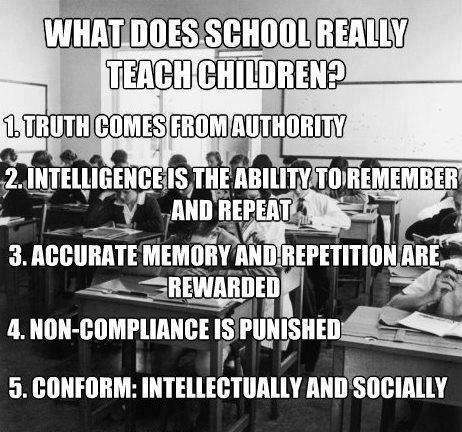
Which really baffles me because I’m used to dogma coming from religion. This meme was posted by a non-religious, progressive parenting page I follow on Facebook:

programming_conditioning

Now, this meme is old news for me.

My fundy homeschool buddies have been passing it around Facebook since Facebook began.

The fact that this is now being passed around by proponents of homeschooling and “unschooling” who are not religious and considered “progressive” is concerning. It seems that there is a new hatred of public school that is beginning to take root, and it has nothing to do with Christians. All the illogical, misinformed, sensationalist arguments against public schools that I’ve seen for years, is being repackaged, regurgitated, and spit out all over the websites of people who think they are some kind of pioneers, that this “rebellion” against formal education is all their idea. They ridicule other parents who put their kids in school, saying we must not love our kids if we send them to “government brainwashing centers” (sound familiar?). Which, of course, usually makes me laugh out loud because I’m pretty sure the homeschooling leaders of the conservative movement of the ’80’s invented that term.

Really though, all they’re doing is perpetuating the exact same dogma that has turned so many of us first-generation homeschoolers away from homeschooling.

You don’t have to be religious to be bigoted or to promote propaganda. A young child of non-religious home-schooling parents just told my daughter “Oh I don’t go to school. School is bad.” Now where have I heard that before?

I feel that I am in a unique position.

My past is colliding with my present. Alumni like me have a lot to offer to the conversation of “new wave homeschooling,” but I feel that often our concerns are brushed aside since “oh, well, we aren’t religious so we won’t have the same problems you did.”

But they already are showing signs of the same problems the original homeschoolers had, just from a completely different point of view.

Ultra-sheltering of children, polarizing, dogma, misinformation, and fear are present in this new generation as much as they were in the old. I’m worried about where this might be going, feeling like I’m watching history on repeat, a helpless bystander as some very familiar insanity is marching by me.

I guess what I want to communicate to my hippie homeschooling friends is this: by all means, homeschool your children. But let me tell you what kind of commitment that’s going to require if you want your kids to have a good education. Because all those blogs you’re reading aren’t telling the whole story. Your kids aren’t going to learn what they need to excel in the world by cooking and painting and playing outside all day. Let me tell you how my mom devoted 27 years of her life to doing nothing but educating us because in order to give us a good education, she had time for nothing else. Allow me to tell the story of how sheltering children in the name of “protection” can utterly backfire. Can we talk about what kind of attitudes surrounding homeschooling can damage the children you love and how to raise healthy kids? Perhaps I can offer the perspective of someone who was raised the way you’re dreaming of, only without the rosy glasses you seem to be looking through. And can we not hold to an “us versus them” mentality? Been there, done that, did its damage. Homeschooling can be awesome. But it can also be horrible. Can I tell you my story and the stories of my friends?

Maybe together, the alumni and the neo-homeschooler parents, we can keep some of the disastrous results of the first homeschooling movement from repeating themselves.

Bill Gothard, Sexual Predator

Doug Phillips and Bill Gothard.

HA note: The following is reprinted with permission from Libby Anne’s blog Love Joy Feminism. It was originally published on Patheos on February 6, 2014.

Bill Gothard has been a big name in the Christian homeschooling movement since its very inception.

Gothard runs the Advanced Training Institute (ATI) and the Institute for Basic Life Principles (IBLP), puts on family life seminars, and produces curriculum and “wisdom booklets” used by Christian homeschooling families across the country, including the Duggars (Bill Gothard himself spoke at Josh Duggar’s sister-in-law’s wedding, which was featured on the Duggars’ television show). Gothard’s influence in the Christian homeschooling world likely eclipses that enjoyed until recently by Doug Phillips, and certainly eclipses that of the Pearls or Botkins.

While my own parents were not strict Gothard followers and were more influenced by other leaders, they did adopt some of the ideas he taught (umbrella of authority, anyone?). Further, I was in an all-girls Gothard Bible study for a time (COMMIT), and several families I was close to were Gothard followers.

Bill Gothard never married. In the years that I’ve been blogging, I’ve heard more than a few people comment on this. How odd that someone who makes his living off of preaching about godly family life never married! It’s not like there would have been a shortage of picture-perfect Christian women who would have been honored to marry him, after all.

Well, the reason Gothard never married is starting to come to light—and it’s very, very ugly.

I’ve been following Recovering Grace, a group focused on correcting the errors of Bill Gothard’s teachings and exposing problems in his ministry, since they launched several years ago, and I soon noticed a pattern in some of the posts. It seems Gothard has displayed some weirdly improper behavior, and even harassment, toward some of the many teenage girls who staffed his ministries and offices, often working as volunteer interns and often coming at his personal invitation. It was very common among Gothard followers for parents to send their teen and twenty-something daughters to work for Gothard, and remains so today—one of the girls from the Gothard Bible study I attended as a girl is actually currently at headquarters, working for Gothard.

Many questions have run through my mind as I have read these stories of impropriety on Recovering Grace. One question is how these things could go on without anyone noticing. But as I’ve read, I’ve noticed another pattern—Gothard’s followers were so sotted with hero worship that they refused to see. In story after story, graduates of Gothard’s programs have said they thought it odd that Gothard would spend so many hours alone with teenage girls, behind closed doors, but he was Gothard—and Gothard could do no wrong.

But things have now turned a corner. Recovering Grace has put up a new post, this one pulling together the threads and providing background information, not only about Gothard’s recent past but also about his distant past—a past many of his followers have been unaware of for the past three decades.

The Recovering Grace team has decided that over the next couple of months we are going to release a large volume of information concerning the life and ministry of Bill Gothard. This information will come in the form of personal accounts, never-before-published documents and correspondence, and factual reports of events that were swept under the rug years ago. Additionally, many of the coming articles will clearly show how individuals attempted to reconcile with Bill Gothard and/or follow the Matthew 18 process but were met with persistent refusal to acknowledge the issues, distortion of the truth, and a resistance to follow biblical steps towards humble repentance.

Then came Charlotte’s story. Her story was the first that moved beyond grooming accompanied by uncomfortable and unwanted hand holding, caressing, and footsie. Her allegations are so serious that the Recovering Grace team felt the need to publish the confessions of two witnesses backing up her story. You can read Charlotte’s story yourself, but I do want to post an excerpt (HA note: trigger warnings for child molestation if you read the full version):

We went to a conference in Knoxville in July of 1992. That’s where I first met Bill Gothard. I remember he wouldn’t let go of my hand, and he kept telling my parents how sweet, beautiful, and pure I was… I was 16 years old… He wanted me around him as much as possible, wanted me to be with him as much as he could get me… He’d keep me with him to “talk.” It started out with him telling me how beautiful I was, how I inspired him, and how I made him feel alive. It went to hand-holding, then long hugs. He would touch me and hug me after devotions and then take me to the eight o’clock staff meeting session. His assistant would drive us to the staff meeting…We would meet after dinner in his office around 7 or 8 p.m. That’s when he started really touching me…

I am sure the statute of limitations has passed for a lot of this, and I don’t know whether Gothard can be taken down legally. I’m sure the Recovering Grace team is looking into it. Regardless, I would like to hope that Gothard will be increasingly seen as the sexual predator he is, and that this will dethrone him from his prominent position in the Christian homeschooling world.

I’m increasingly seeing the Christian homeschooling culture as an unsafe place for girls and young women.

I wonder about my childhood friend and her work at headquarters, and I worry for the girls Gothard continues to surround himself with even today. And when I remember that Bill Gothard had successfully weathered a sexual abuse scandal even before I was born, I despair of things changing.

At least now we know why Gothard never married.

Ham on Nye

Screen Shot 2014-02-06 at 9.37.40 PM

HA note: The following is reprinted with permission from Kierstyn King’s blog Bridging the Gap.  It was originally published on February 6, 2014.

I actually didn’t plan on writing anything about the Ham on Nye debate Tuesday night.

I planned on drinking and eating popcorn and watching  everything implode in a talk-past-each-other kind of way. My mouth hurt (still does, I have even better numbing stuff now, but it makes my lips stick together), we ended up getting milkshakes because Ham is more triggering and milkshakes are more comforting.

The debate went as I suspected it would – more cathartic for me and those of us who have left the Young Earth Creationist camp we were raised with. Ham had all the same material, I’d heard everything he’d said before at VBS, in DVD’s, and his theology permeated my “science” books even though they weren’t exclusively AIG. I knew all his answers, I’d seen all of his graphics, he said absolutely nothing new, at all, I remembered everything verbatim from my previous encounters with AIG as a child. To Nye, this idea is so unfathomable that he had trouble grasping and understanding his audience and I don’t know that he knew what he was getting into. To the people in that room, YEC is more than a science…theory(?), it is, in a very real way, a (the) foundation of their religion.  Believing in a Young Earth is somehow, essential to this brand of christianity, my whole family, I think, is Young Earth, my immediate definitely, if not my grandparents too.

None of the arguments made in the debate were really going to change anyone’s minds I don’t think. I don’t know how many people were listening to it like a presidential debate, being really on the fence about religiously-intoxicated creationism and mainstream science, but who knows.

During the Q&A session though, Nye said one thing, one groundbreaking thing, and I don’t know if he even realized it.

He said “I don’t know“.

What he probably didn’t know (or maybe did) when he walked into a room and an audience loaded with people who have been raised or told all of their lives and all of their childhood that they have to know all the answers to everything all the time and that “I don’t know” is not an answer and if you don’t know, something is wrong – saying “I don’t know” in a way that did not have defeatist or negative connotations is something that people raised in this sheltered and toxic environment have probably never heard. Their parents may have, but have denied themselves and their children that option, they’ve rejected the idea of not knowing for the burden of having to always know and have thrust that upon their children at very young ages.

Fellow homeschoolers have written about having to know the answers to all questions – even questions about the legality of homeschooling from the time they were like 6. This is true and this is devastating and this is too much, no one, let alone any child should be required to know the answer to everything. Yet this is what fundamentalists do – they require themselves and everyone they gather into their brand of religion (or non-religion) to have all of the answers to everything. They must always be able to back up a question with a pre-scripted answer that allows for no nuance. I don’t know is invalid.

People asked him the questions creationists are scripted to ask evolutionists (because they don’t know the answer but we do! HA!) and he answered, happily, excitedly, unashamed, and like he had been waiting to say it all night because it’s such a beautiful answer: I don’t know.

Ken Ham, and every entrenched creationist in the audience I’m sure scoffed at Nye’s reply. But what he said, in those three words, is something more powerful than he can know.

Because to the people who were watching who are tired of having to know everything because they realize they don’t know, who are maybe doubting, who are maybe thinking, who are maybe just trying to keep their head down to get by but secretly (even so secretly they may not realize it yet) want to taste something different, something not straight out of the book, Bill Nye just introduced the concept of freedom.

Because the freedom to not know (and that be an okay, even good thing) after coming from an environment where you must know is so so powerful. But one of those things, where you only realize it’s power once you’ve come to terms with the idea that it’s okay to not have the answers.

Bill Nye just introduced hundreds or thousands of people to the idea that “I don’t know” is valid, and okay, and not wrong.

That is the most important thing (I think) that happened in the debate, that’s what I haven’t been able to get out of my head. I don’t know. And it’s beautiful.