Growing Kids the Abusive Way: Auriel’s Story, Part Two — Isolation and Ideology

Screen Shot 2013-08-12 at 3.13.05 PM

*****

Trigger warnings: references (sometimes graphic) to emotional, physical, religious, and sexual abuse.

*****

HA note: The author’s name has been changed to ensure anonymity. “Auriel” is a pseudonym. Auriel blogs at Drying My Wings.

*****

Also in this series: Part One: Growing Kids the Abusive Way | Part Two: Isolation and Ideology | Part Three: Mini-Parents | Part Four: The Sound of a Sewing Machine | Part Five: The Aftermath of Childhood Abuse

*****

Part 2: Isolation and Ideology

 At 16 years old, I was not allowed to cross our property line without another human being with me.

Like a caged dog, I paced back and forth, crying at the injustice of it all. The bonds that held me weren’t physical. I was chained by my sheltered life. The isolation came from homeschooling.

Until high school, I only had three close friends outside of my siblings, and I only saw them once a month. Although I was involved with many extra-curricular activities, I was not allowed to be friends with boys, non-homeschoolers, nor kids whose families my parents did not know.

So, no friends.

Pop and rock ave evil beats, movies with kissing or language — let alone violence — will make you copy them, gyms make you compare people’s bodies, TV shows are so sexualized they’re evil, iPods hurt your spiritual life, and so on. At least, that’s why I was not allowed. My siblings and I snuck around, listening to Christian music here, pop music there, watching TV when our parents were gone.

I’m still trying to get caught up on movies, pop culture, and music references.

Courtship was introduced as the only method of finding a spouse. We read books like the Courtship of Sarah McLean, I Kissed Dating Goodbye, Boy Meets Girl, The Princess and the Kiss, and so many more. It was like my dad was supposed to own me, and any potential mate would have to ask for my father’s permission both to be near me and to eventually own me.

It’s so damaging to think of oneself as property.

Now, I want to date to find someone to marry, but my father does not own me. I do not need to be under his “vision” for my family. I have my own vision, which does not include abuse.

"Girls were to have babies, homeschool their kids, and be dominated by men."
“Girls were to have babies, homeschool their kids, and be dominated by men.”

Mom held a sexist view of girls: they should not work outside the home. Girls were to have babies, homeschool their kids, and be dominated by men. Many Vision Forum books cemented this view in her mind like So Much More, What’s a Girl to Do, the Beautiful Girlhood books, Mother, and Joyfully at Home. Mom taught me needlework like a good Victorian girl, but I hated these activities! Just because I’m a girl does not mean I have to knit and drink tea!

I’m a person! I’m not a gender stereotype.

I was taught to be afraid of gays, Islam, and black men. It’s tough to grow up in a homophobic, Islamophobic, racist, sexist environment and come out unscathed. While it’s a struggle, I have learned to love everyone as made in the image and likeness of God.

The modesty teachings were awful. Modesty was focused more on covering skin than on ensuring the dignity of each person. I learned to watch my back for guys who would lust after me.

I heard that what I wore made me a rape target.

At first, Mom dressed me in denim jumpers or Easter and Christmas dresses from the local stores. Eventually, she forced me to sew my own dresses and skirts. When I was 9 years old, she told me that having my hair down made me look like a “lady of the night.” Even though I was a shy, modest girl, Mom constantly told me that something I did or wore was sinful, displeasing to God, and might turn on my dad or my brothers.

I was so scared that I was going to lead my brothers or dad into sin for lusting after me.

If that’s not twisted thinking, I really don’t know what is. Bleh.

I cried so many tears over how ugly I thought my body was, thanks to the baggy clothes I wore. Looking back, I was a healthy weight and my body was great. But shirts had to have sleeves and couldn’t come below the collarbone. Pants were forbidden after age 6. Swimwear was culottes that puffed full of water. The lifeguards even chided me for not wearing appropriate swim attire. I wanted to scream, “It’s not me!” My skirts had to be several inches below the knee, or else I was “showing some leg,” and that would “give guys a little jolt.”

When I finally turned 18, I had to beg a friend to help me pick out my first real pair of pants since Kindergarten. Of course, Mom called me a “slut” and a “whore,” declaring she could see intimate parts through my pants that would have been impossible for her to see. It was just to shame me.

Oh boy, here comes the scary part.

Sex.

No one in my homeschooling community talked about sex. I got the talk at 12, earlier than any of my homeschooled friends. However, I only knew about one type of intercourse. I didn’t even know people did it lying down, lol. Because puberty, sex, and all related words were so hush hush, I stopped asking my mother questions.

The first time I heard another girl even mention her period, I was 16.

I stared at her in shock! “Did she just speak of her period?” I wondered. When I turned 18, I succumbed to searching dictionaries to learn the rest of the words and meanings.

I was also incredibly afraid of CPS. Through HSLDA and my parents, I learned that foster homes are terrible places that abuse children by burning their hands on stoves, and more. Well, it worked. I didn’t call hotlines, tell the speech moms who cared about me, or beg my few friends for help.

When CPS showed up at our doorstep, my siblings and I lied for fear of being separated from each other forever.

The community that attended our very conservative Catholic church supported the sheltered, so-modest-its-frumpy, sexist views of my parents. I even was bullied at church for failing to meet up to the standards of the kids my age. In the midst of all this, I got comments asking if I was part of a cult, Amish, or Mormon. It hurt deeply that people thought I was a freak. “IT’S NOT BY CHOICE!” I wanted to scream. But I couldn’t.

When people think you’re part of a cult, they tend to ignore you or avoid you.

The few people I told about the abuse after I escaped looked at me with shock and said, “I had no idea.” The isolation of homeschooling added with the isolation of a cultic appearance equals an ideal environment for abuse to continue.

*****

To be continued.

Growing Kids the Abusive Way: Auriel’s Story, Part One

Screen Shot 2013-08-12 at 3.13.05 PM

*****

Trigger warnings: references (sometimes graphic) to emotional, physical, religious, and sexual abuse.

*****

HA note: The author’s name has been changed to ensure anonymity. “Auriel” is a pseudonym. Auriel blogs at Drying My Wings.

*****

Also in this series: Part One: Growing Kids the Abusive Way | Part Two: Isolation and Ideology | Part Three: Mini-Parents | Part Four: The Sound of a Sewing Machine | Part Five: The Aftermath of Childhood Abuse

*****

Part One: Growing Kids the Abusive Way

“Turn around, put your hands on the bed.” You scream, “No mommy, please!” She’ll grab you by your arm, wrist, shoulder, lapel, jaw or hair, shake, twist, or drag you, scratch, pull, shove, slap or kick you if you don’t move your butt to her room. “You selfish, spoiled rotten brat! You’re just a little ingrate, you little jerk. Let’s have a spanking!” she yells. Escape is futile. 

“You’re abusing me! How could you be so cruel?” your mom asks in tears over her rage. You clench your fists and teeth at the injustice, but can do nothing. After all, you’re an “idiot” and a “stupid a-hole.”

She has told you that this hurts her more than it hurts you.

*****

My parents were abused as kids.

They perpetuated the cycle with us.

With their first child, my parents discovered Growing Kids God’s Way by the Ezzos. True to the teachings, my parents controlled our hearts with fear, and later taught Growing Kids classes to dozens of families over the years, and taught me the classes to use on my younger siblings. I grew up in a Catholic, upper middle class family, and was homeschooled K-12, starting out under an umbrella charter school, moving to become our own private homeschool when I entered high school.

As far as didactics go, I learned a great deal. While my friends used Mother of Divine Grace (MODG) or Seton, we used an eclectic mix of those and other curriculums like Abeka since the Catholic curriculums usually require an overload of coursework. My education was classical and informative until middle school when my chronically and mentally ill mom gave up on teaching us. From there, I had a tutor, online classes, or taught myself through my textbooks. Lucky for me, I had a passion for learning and was pretty studious. I ended up graduating early!

Unfortunately, the damage was done.

I was physically, sexually, emotionally, and spiritually abused and neglected as a child.

"With their first child, my parents discovered Growing Kids God’s Way by the Ezzos. True to the teachings, my parents controlled our hearts with fear."
“With their first child, my parents discovered Growing Kids God’s Way by the Ezzos. True to the teachings, my parents controlled our hearts with fear.”

From the time I was 6 months old, up until I was a teenager, my parents beat me with a leather strap. This was based on the Ezzo’s teaching of chastisement. My parents would force me to pull up my dress, and if I were especially stubborn, they’d have me pull down my panties. Just the humiliation was enough to fuel my ire. The pain only compounded the injury. Flinching, screaming, or crying meant longer beatings. So, you learn to shut up, have “first time obedience,” “right away all the way with a happy heart.” Don’t show even a flicker of anger, sadness, discontent, or any negative emotion. Those are signs of rebellion.

I often had scratches and bruises, in various stages of healing. They’d start out as the new red or white fingerprint marks or welts, moving to purplish blues, healing to ugly greens and sickly yellows.

Some days, the punishment was only receiving smacks from a wooden ruler, running scores of laps around the yard or being flicked in the face. Other times, punishment was no supper.

My stomach would suffer, painfully contorting, gnawing at the emptiness, and I would cry myself to sleep.

Sometimes we would only be fed plain oatmeal or bread and water for the week as punishment. My brothers were locked outside or forced to sleep naked on the cold floor as punishments. And it’s hard to imagine the amount of screaming we bore.

Back then, tears were weak. They could be used against you. I couldn’t let anyone see them, or they’d be powerful. I’d curl in a ball on the floor in a corner, and just sit, and rock, and cry, soothing myself in the dark. I reverted to thumb sucking when I was 8. Even today, I still rub my arm and hug myself to self-soothe.

I tried to protect my siblings by covering for them on chores and standing up to my parents for them. My littlest sibling even called me Mommy, and would call to me for help and protection. We’d take beatings for each other too. But if no one confessed to a failure on a chore (read: perfectly swept floor), everyone would suffer. If we brought a sibling into our mistakes, we would be held outside the room, while our parents reminded us that the screams of our siblings were our own fault. Overtime, you become jaded to pain. It no longer hurts you, and the screams of others become mundane and almost comical.

To be honest, I was so sheltered, I didn’t even know I was being beaten or abused. I thought this was legal spanking.

Nightly, we’d fall asleep to domestic violence, fights, slamming doors, broken glass. After a nice tuck in and a whispered, “Jesus loves you,” we’d hear Mom attacking Dad. She’d claw, scratch, knee, hit and punch him, pounding her fists into his chest and back, smacking him with objects.

A few snapshots of my home life:

  • Mom threatening Dad with a knife in our kitchen right in front of me
  • Dad leaving me in my Mom’s room to talk her out of suicide
  • Dad throwing my brother into a bedpost
  • Mom driving recklessly nearly driving into oncoming traffic or a telephone pole
  • Mom yelling at us and publically humiliating us in restaurants

In the end, I learned to lie to save my skin.

I learned to take my siblings away from domestic violence. I learned that violence was acceptable.

This is not to say that my parents didn’t love me.

I firmly believe they did, and see it in countless examples. They hugged me, cared for me, kissed away my childhood scrapes, bought me gifts just because, and told me that they loved me. Birthdays and holidays were special, and they taught me fervently, took me on outings, gave me my faith, drove me to events, encouraged me to learn musical instruments, play sports, and compete in speech and debate.

It’s not like they are monsters.

But they are hurt people who probably should never have had kids. The abusive techniques propagated by the Ezzos jived with my parents’ abusive upbringings. It was their normal, supported by “experts.”

I don’t hate my parents.

I don’t know how to hate human beings. All I feel for them is love, pity, and a need to be far away from them out of self-preservation.

*****

To be continued.

Visualizing “The Myth of the Unsocialized Homeschooler”

HA note: The following is reprinted with permission from Heather Doney’s blog Becoming Worldly. It was originally published on July 7, 2013.

I googled “homeschool” to see what pictures came up. Many of them had to do with socialization and the messages that homeschool parents get and give about it. So I figured I’d talk about homeschooling and the issue of socialization today and use some of the cartoons I found in the process. Some of them are a little disconcerting in the way they point out issues I see, just maybe not quite in the ways the cartoonists intended.

What is This “Socialization Problem” You Speak Of?

So first a bit about what socialization is and how it relates to homeschooling. This diagram explains socialization pretty simply and it comes from a site that talks abut stopping cycles of discrimination that are often passed on intergenerationally.

soc1

I think the site the diagram comes from – Parenting for Social Change – makes an excellent point – that this is generally how socialization is done but socialization can sometimes be bad. You can absolutely be taught harmful things as well as positive things in the course of your socialization and most people are taught a mix. What homeschooling parents often become inclined to do though is try to eliminate or greatly reduce these “bad” things by winnowing their child’s socialization opportunities down to only parentally vetted and approved sources and quite often those approved sources are fellow homeschoolers, religious leaders, highly edited texts and media, other “likeminded families,” and sometimes, when the parent is particularly controlling or inept at socialization themselves, nobody at all except for the immediate family.

Yes, this last one is a real big problem because terrible things can happen when families get isolated like that and it is a big risk factor for all kinds of abuse, neglect, and poor mental and physical health. Thing is, this social isolation problem happens in homeschooling much more frequently than it should. In fact, even in Brian Ray’s wacky (and so methodologically unsound that I am stopping myself from going on a rant about how many problems it has) “Strengths of Their Own” study included something I found interesting about it. See if you can catch it.

soc2

That’s right. The third bar from the bottom. The yellow one. If 87% of the children in Brian Ray’s highly self-selective study play with “people outside the family” (and I will leave you to ponder right along with me as to why this wording is not “other children outside the family”) then that means that 13% of children in Brian Ray’s study do not play with others outside of their own family, which I would most definitely define as a socialization problem. If Brian Ray, excellent fudger, misconstruer, self-quoter, and ideological spit-shiner of homeschool data extraordinaire, has almost 15% of the kids in his rather cherry-picked study having this issue, how common must it actually be in real life and how do people in homeschooling react to this issue? Well, let’s see…

Socialization Sarcasm

This cartoon makes fun of the concept that socialization problems exist in homeschooling. To me it implies that socialization happens so naturally that it simply isn’t something a homeschool Mom could forget. Why? Well, I’m honestly not exactly sure. Socialization is a component that definitely can be ignored or accidentally left out and it has openly (and wrongly) been discounted as being unimportant by many prominent homeschool leaders. Because it has been ignored and dismissed as a necessary part of many homeschool curriculums is the main reason why homeschoolers have gotten the reputation for being unsocialized in the first place.

soc3

Most homeschool kids don’t like being stereotyped as unsocialized or feeling like they are unsocialized (I mean really, who would?). So there’s also some memes and jokes that have been spread by teenage homeschoolers implying how inherently dumb or inappropriate they think it is when people make socialization an issue. Most of these involve poking fun at the “myth” that socialization is a problem in homeschooling. There is this YouTube video by a homeschooled girl who is trying to do this by distinguishing “the homeschooled” from “the homeschoolers” and while I find it funny, I’m quite sure that her pie chart is wrong and she perpetuates elitist stereotypes she has likely heard throughout her homeschooling experience.

This blog had a post by a homeschool graduate complaining about people asking what’s become known as the “socialization question” and in her post she uses a picture I’ve seen fairly often. There’s even t-shirts with this printed on them that you can buy.

soc4

Socialization is Fishy

So what do homeschooling parents think about the socialization issue when theydo actually address it? Let’s start out with this cartoon, as it’s used a lot. It claims that a lack of socialization in homeschooling isn’t just a rare problem, but an outright myth. It implies that homeschool kids are not only actually in diverse environments as part of a natural ecosystem but are thrilled about it. It also implies that children who are socialized in public school are like half-dead sardines in a can rather than the school of likeminded fish they are expected to be.

soc5

This cartoon is a direct dismissal of there being any merit to the “socialization problem” and it is compounded with a public school counter-stereotype. This is unsurprising to me as the argument that homeschool socialization problems are an outright myth is quite often included with something disparaging about public school or insulting to teachers (and this cartoon is no exception). Notwithstanding how insulting it is to imply that most people who go through public school are like dead fish, is this depiction of homeschool versus public school in any way accurate? Well, I imagine for the occasional situation it is, but in general, certainly not.

Oddly this cartoon was actually almost the exact opposite of my experience. In the CHEF homeschoolers group I was in it was all white Christian families and our parents had to sign a statement of faith to join. It was absolutely a school of fish all swimming the same way and because we got together infrequently, I generally felt like that fish in the fishbowl. Also, when I went to public school in 9th grade I was certainly no canned sardine, even if I wasn’t exactly the manic fish thrilled at the ecosystem in the upper righthand corner. The teachers often tried to corral us into all doing things the same way but we didn’t make it altogether easy for them and generally I expect it was a bit like herding cats. We were all individuals, as were the teachers. I had favorite teachers and subjects and ones I didn’t like and I made friends of different races and beliefs and political persuasions, many of whom who are still my friends and acquaintances to this day.

The Dark Knowledge of Teen Degenerates

Here’s another cartoon about homeschool kid socialization from a slightly different angle, and this one does address the idea that kids don’t always do what you want them to do and by invoking the dreaded “peer pressure,” implies that its all bad. Which one is it – are they lobotomized sardines in a can or are they violent and rebellious ingrates? Make up your mind! Also, how realistic is this, do homeschool moms actually think public school kids are like this? Where are the public school kids who are not “at-risk” of being part of the school to prison pipeline? Why aren’t there any of those at the bus stop?

soc6

Also, in this little dystopian cartoon, gang members with knives read books on values (morally relativistic ones, no doubt), evolution, meditation, and “new age” religion (if that isn’t a culture wars, fearmongering buzzword, I don’t know what is) and pregnant girls read about sex ed and still don’t know what made them pregnant. This cartoon is crazy stuff. People don’t drink beer and shoot up heroin (yeah, there’s a needle on the ground in the cartoon) while waiting for the school bus (although some do smoke cigarettes). People who read a lot don’t typically join gangs. People who know about comprehensive sex ed aren’t any more likely to have sex than kids who don’t and they are much less likely to accidentally get knocked up. Honestly, if this is what anyone actually thinks the world is like then they are not fit to educate other human beings and they probably need some mental help themselves.

Sweet Homeschool Girl in the Ghetto

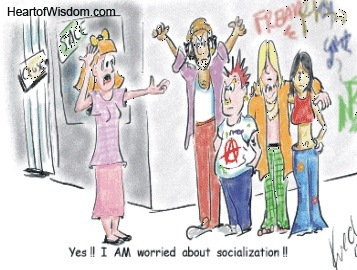
This cartoon is similar to the previous one in that it also indicates that public school socialization is all bad, but it depicts the expected reaction of the homeschool girl in the public school and implies that if your daughter goes to public high school (obviously radiating her feminine purity with a big hair bow and below-the-knee church skirt) that she will soon be shocked and horrified to encounter people dressed immodestly, young people openly dating, tattoos and piercings everywhere, vandalism and crime, blatant teenage rebellion, and big scary black boys that look more like grown men. So obviously the answer is to just have her at home not knowing that people who are different from her exist, and make most of the people her age out to be disgusting, immoral, and scary, right?
soc7

I followed this cartoon to its site, a blog called Heart of Wisdom, trying to get a higher resolution picture. The blog talked about how homeschool kids should only selectively socialize with other Christians and claims this is biblical. Yep, this is just the type of homeschooling “socialization” I am familiar with. It’s a form of social isolation and indoctrination called “sheltering.” This stuff is all about parental fear and desire for control and helicopter parenting to this extreme is very unhealthy for your child. It will mean that in adulthood that they won’t know how to function at an optimal level. You cannot shield your kid from all “bad influences” and indeed there is nothing in the bible that says your kids cannot play with the kids of people who have different beliefs. That is quite a stretch and it is insular, cultish thinking.

My Homeschool Kid is Smarter than Your Honors Student

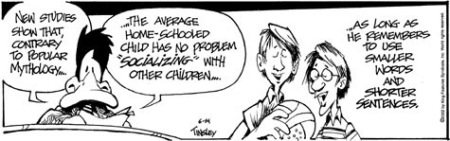
That same Heart of Wisdom blog had this other cartoon about homeschooling, so I followed that link and it was to a page dedicated specifically to homeschool cartoons. When I see stuff like this cartoon I have to once again ask – is this supposed to be funny? Do these people actually think this is accurate? My main question, though, is why the elitism and negativity? Even if your kid is getting a much better education in homeschooling, why talk trash about children who through no fault of their own don’t have as good of an education? Why make it into a competition, act like homeschool kids in general are “better” than other kids? It shows me some immature and defensive parenting, really. If you revel in it when someone else isn’t doing as good as you it shows you are 1) being a jerk and 2) secretly worried that you’re no good at what you’re doing. Nobody should ever be excited about other kids having a sub-par education, thinking it makes them and their kids look better. That’s just gross.
soc8

As it is, I find that there is a grain of truth in this cartoon but perhaps not quite in the way the cartoonist intended. I’ve known a lot of homeschool kids who do use big words in conversations and they soon realize that it comes across as awkward when they socialize with other non-homeschool kids. Admission: I was that kid myself. I read a lot of classic literature and became familiar with words that simply aren’t used in everyday speech anymore. Trying to use them in peer-to-peer conversations didn’t reflect on me being smarter. It reflected on me not having a modern day frame of reference as to what is appropriate. It reflected on me being socially backwards. Lots of public school kids who are bookworms like I was know many big words. They also know the right words to use for their audience. Context is everything. An unsocialized homeschool kid doesn’t have that context and very well might find that using 18th century literary terms in a conversation about basketball will indeed get people looking at them sideways. If homeschool parents want to be proud of that, think it makes their kid (and by extension them) “better,” it shows they truly don’t understand the issue at hand.

Parental Fear & Social Anxiety

That’s where I think we hit the crux of this whole thing. I think the main issue is parental angst and fearfulness. Too many homeschooling parents socially struggled in school themselves and/or got into drugs or unhealthy sexual relationships. Instead of taking a broader view today, they expect that they need to hide their kid away from these settings or the exact same thing will happen to their kid even though their kid is in a different school district in a different generation and *gasp* a different person. These parents become scared of or hurt by the society we live in, withdraw, and then use homeschooling as an excuse to be separatist, snooty, and helicopter over their kids. These are not positive reasons for homeschooling and these are the exact kind of fearful and overbearing attitudes that lead to socialization problems for homeschool kids.

soc9

Because people with strong views often find themselves in positions of leadership, those with exclusionary, separatist, and elitist attitudes often end up running things and then set this negative and divisive tone for the homeschooling group and the community it serves. It’s so pervasive that even some “second choicers” who start homeschooling simply because the other educational options in the area aren’t up to meeting their child’s particular needs (which is an excellent reason to homeschool, in my opinion), can get sucked into this culture, an “us versus them” mindset where homeschooling represents everything that is pure and good and healthy for children and public school and the people and structures that support it represents everything bad. This creates a parallel society of sorts and then you see people start calling public schools “government schools” in a pejorative sense. All this “us versus them” talk fans the fear that homeschooling parents are vulnerable (although still superior) outsiders who are or soon will be discriminated against and this in turn leads to easy exploitation of these scared people.

Why does widespread homeschool participation in things like the fundamentalist-led HSLDA, which capitalizes on these fears and requires dues money (that then goes into their cultish culture wars arsenal) for unnecessary “legal protection” exist? Because many these people are too freaked out to do anything more than cling onto a protector, ignoring all evidence that their “protector” just wants to use them – financially and for furthering a disturbingly anti-democratic agenda. This fear grows and leads to the kind of mindset that spawns ridiculous cartoons like the one below.
soc10

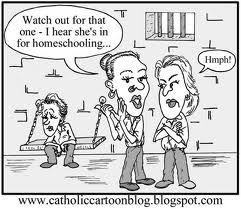
Put in prison for homeschooling – really? Of course in this cartoon there’s that same (expected) depiction of scary people with piercings, this time instead of a shocked daughter (projecting much?) it’s got a dejected homeschool Mom being shunned by hardened criminals who sarcastically note that her “crime” was homeschooling.

Homeschooling parents who follow these “leaders” (often starting because their local homeschool support group requires or recommends HSLDA membership) hear these divisive messages and become scared to death of being framed, exposed, persecuted, worrying that they will land in jail just for homeschooling. It may be a wacky and unrealistic fear given what’s actually going on, but if people hear it often enough they often come to believe it, along with the bogus stats and stories claiming that homeschooling is as close to perfect an educational option one can get in such a messed up society, and the myth that there is no evidence to the contrary because homeschooling is just so awesome.
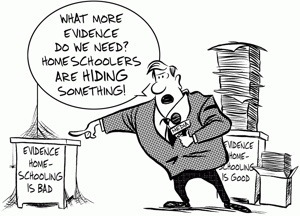
soc11

Because homeschoolers test scores aren’t made public and often not even expected, registration isn’t even required in many states, and most people don’t pay much attention to homeschooling unless their kids are being homeschooled. Homeschool movement leaders have been able to get away with exhibiting the cream of the homeschooling crop as representative of all homeschoolers. This has painted an inaccurate picture and hurt the vulnerable kids by leaving them ignored as they fall through the cracks.

Saying “our homeschool kids are socialized but socialization doesn’t matter and in fact it generally sucks if it isn’t coming directly from parents” is a very unhealthy attitude to go into educating with. Responsible homeschooling parents really need to do a bit of soul-searching as to why they tolerate these inaccurate depictions of what socialization is and isn’t, why there is this the across-the-board maligning of all public schools within many homeschool communities, and why so many participate in this ugly (and frankly in my opinion undeserved) elitism, and contribute to such extreme (and inaccurate) stereotyping and putting down of children who have had to attend lower quality inner-city schools, all in order to inflate the merits of homeschooling.

Two big question:

(1) Does this kind of attitude help do anything beyond artificially boosting homeschool egos?

(2) Is there any need for this behavior if homeschooling is really so awesome?

Also, if there is no good data on the problems of homeschooling then instead of celebrating the cobwebs we need to be collecting more data. Every single education method in this world has problems and the places where the problems are denied is where child maltreatment can and does flourish.

The Truth Between “Stereotype” and “Myth”

I get the message that not all homeschoolers are cloistered and don’t know how to talk to people their own age, but the fact is that too many are and we need to recognize that it is a real problem affecting a sizable percentage of homeschool kids. Also, homeschoolers are simply not the most brilliant people in the world or inherently “smarter” than other kids, and as such they shouldn’t need to feel pressured to achieve perfection, perform as child prodigies, or that there’s a black mark on them if they mix up “asocial” and “anti-social” in a conversation.

soc12

This “myth of the unsocialized homeschooler” is an issue in homeschooling but the prevalent idea that the socialization problem is a myth is the real problem, not the legitimate questions and concerns about socialization that homeschool parents keep being asked. Those questions actually need to keep happening because social isolation and ostracism in any setting (including homeschooling) often follows a person into adulthood, and can leave people struggling with social anxiety, a small social network, low levels of social capital, mental health issues, and an unnecessary amount of sad and lonely memories.

The least we can do is stop making fun of people, stop being in denial, stop pointing fingers elsewhere, and acknowledge that it is real, it happens too often and it should be assessed and addressed as the serious problem that it is.

A Life With No Future: Rebecca’s Story

A Life With No Future: Rebecca’s Story

HA note: The author’s name has been changed to ensure anonymity. “Rebecca” is a pseudonym.

Trigger warnings: abuse and mentions of suicidal thoughts and self-harm.

My homeschooling story has similar themes to many of the others on Homeschoolers Anonymous: religious indoctrination, abusive dynamics, and educational neglect. Overall I feel like homeschooling inadequately prepared me for adulthood.

I was fourth in a family of six kids and I was homeschooled for every grade except kindergarten. We used the Christian Liberty Academy Satellite Schools curriculum for most of my education but had changed to Switched-On Schoolhouse (Alpha and Omega) for the later grades. I had a couple of friends and acquaintances in the local homeschool group, I attended church, and sometimes took community classes such as gymnastics and swimming. Still, my primary friends were my siblings.

Educational Neglect

Our family was not impoverished but we were lower class. Having enough money was a continual concern and a source of household stress. My parents spent a lot of time working to make ends meet and maybe it was because of this that they didn’t really interact with me much or supervise my education closely. The usual routine was that I would wake up, do the assignments in my workbooks by myself, and spend the rest of the day left to my own devices. Most days I only needed help for spelling tests. Despite the religious slant to the books, I did learn a lot from them and I’m glad that at least I had the basics of spelling, math, history, and so on drilled into me.

The teen years were when I started running into educational problems. I had done all right in math so far–I needed help sometimes, but I could do the workbooks more or less on my own– until I hit Algebra 1 and I could no longer make sense of it without help. I had Saxon Math, which had been working for me until that point, but it was just not clicking anymore. Unfortunately my mom was burnt out by all the working and homeschooling and she didn’t prioritize my education very highly.

By that point I was perhaps several grades behind in assorted other subjects. I wasn’t doing that badly at most of them but I had been lazy about finishing the work on a schedule, my parents never put the heat on me to learn, and gradually I stopped bothering with the schoolwork.

My formal learning ended with a whimper. There was no graduation or diploma, we just gave up. As far as I can remember, I never got past the equivalent of Junior year. I am not sure though, since I was often clueless as to what grade I was supposed to be in.

Household Dynamics

My parents were converted to Christianity at the time of the hippie-led Jesus Movement, and they brought their relatively relaxed approach to life to our upbringing. Unlike many Christian homeschool families, we were not an authoritarian household. Since we were fundamentalist/evangelical Christians, there were definitely lots of little red flags you had to look out for (Harry Potter? Bad. Secular music? Bad. Spaghetti strap tank tops? Bad), but for the most part our parents let us have freedom. I was allowed to dress in punk clothing. We could listen to any style of music as long as it was Christian. We could be friends with whoever we wanted. Our parents tended to trust our judgment in these things even during the dreaded teen years. I’m glad that we were allowed to be individuals, and that the homeschooling gave us lots of free time to play and read.

The problem was that this undisciplined parenting approach was at times neglectful, not only for my education but also my physical and mental health. I think I was undernourished as a little girl. I had chronic stomach pains that went unaddressed, and my parents were aware of my continual depression but didn’t do anything about it. My older siblings were the ones who most often paid attention to me, comforted me when my stomach hurt, and tried to help me cheer up. When they got jobs, they were the ones buying half my meals and I finally caught up to a normal weight level.

There was a pressing problem with my mother.

She had major personal/mental health problems that did not get treated adequately. Sometimes she would go into fits of rage and terrorize me and my siblings, or threaten to kill herself or my dad. When she was at her best, she was a laughing, curious person who loved to explore the world with her kids. When she was at her worst, I thought of ways to run away from home or kill myself to escape from her. Sometimes I did run away from home and self-harm. Rarely, the abuse was physical, but she only needed to sigh rudely for my heart to start pounding. I wish she had gotten help for her problems, and I wish she had not taken them out on us.

It has taken me a long time to realize how fucked up it was.

No Future

My major issue with my homeschooling experience is the fact that it didn’t seem to be progressing towards anything. My parents didn’t seem to realize that they were supposed to raise us to become adults, not just Christians. Instead my life seemed to exist in a warped kind of Never-Never Land in which I was rocketing towards adulthood equipped with only a child’s skill set.

I knew little or nothing about household maintenance, how to hold onto a job, how to work hard or make myself useful, fix a car or drive one, how to handle a romantic relationship, take public transport, talk to adults, or how to get a scholarship or apply to a college or even exactly what college was. It’s tough to raise kids on a shoestring budget, but there was no reason my parents shouldn’t have taught me this kind of stuff or helped me see a life beyond the four walls of our house. I was told on one occasion by my parents that they didn’t care what my future ended up looking like as long as I was Christian. That was the only time they gave me any guidance about my future. (I am now an atheist, incidentally.)

When I was a little girl I would talk about all the things I would grow up to be, but that stopped before long. There was a misogynist stigma in our family that women who had careers were evil (a job to make ends meet was one thing, but being a Career Woman was another). I did not have a good experience with the food-service job I briefly held when I was 14 and I have not been able to handle even entry-level jobs since. I get severe anxiety. In my teenaged years, I was aware of no way out of my parents’ house except to get married to someone with a job.

College was not on the table, since there was just no way for 6 kids from a low-class family to make it unless we paid for it ourselves (which only one of my siblings has managed to accomplish so far). There was also a sort of contempt for higher learning that I picked up on. Part of me wonders if this I-don’t-need-no-fancy-education attitude was based on a sense of inadequacy, like if it was out of our reach, we would pretend we were too good for it. When my friends graduated they all went on to college to broaden their horizons, leaving me in a small town with nobody to hang out with. I deeply resented and envied them because I was acutely aware that my life was going nowhere. I feel like if I had been public schooled, there is a chance that a teacher or counselor might have been able to help me see a bigger picture of my life. Instead the only option I thought I had was getting married. At 20, that’s what I did, and I moved out.

Catching Up

To this day, I still feel as if I’m 10 years behind my peers.

I’m 27 and only now exploring college options and figuring out how to get a diploma equivalent, which is something most other people are starting to look at when they’re still teenagers. I think this experience is familiar to some homeschoolers as well as some people who grew up disadvantaged, and I was both. My future is in my own hands now, and my success or failure depends on me, but I don’t believe I was given the best possible shot at life. I feel inadequate when people ask where I went to college, or what my career is.

The truth is, I don’t know how to explain that I was set up to have no future.

If you set out to educate 6 kids at home, you have to follow through all the way to adulthood with each and every one of them. You have to admit when you’re in over your head and put the kids first and not your ideology. I wish my parents had done that.

Now it’s up to me to pick up the pieces and make my life into something worthwhile.

Fundamentalist Homeschooling Is A Poison: Isaiah’s Story

Fundamentalist Homeschooling Is A Poison: Isaiah’s Story

HA note: The author’s name has been changed to ensure anonymity. “Isaiah” is a pseudonym. 

"Fundamentalist homeschooling is a poison. I say this from experience. It spreads like a virus, and not just among the conservative Christians who form its natural hosts."
“Fundamentalist homeschooling is a poison. I say this from experience. It spreads like a virus, and not just among the conservative Christians who form its natural hosts.”

I have mixed feelings about homeschooling, to say the least. While I find many, if not most, of the common criticisms of homeschooling to have some kind of validity, I still feel myself cringe when homeschoolers are caricatured as deranged fundamentalists since I know from experience that there is more to the story. My experience with homeschooling consists of extremely varied highs and lows — the highs of a dedicated and capable parent as a teacher, an education that fit with my self-motivated personality, and freedom from rigid schedules; and the lows of religious indoctrination and the personal struggles caused by living in an insular environment. If the good side of my homeschooling experience was very good — and it was — the bad side was very bad, and I still feel its effects to this day.

I was homeschooled for my entire lower-level education — kindergarten through high school — and in that time I knew homeschoolers from all sides of the social spectrum. I knew unschoolers, conservative Christians, liberal Christians, vaguely religious people, non-religious people, and even a Wiccan at one point (though I didn’t know what “Wiccan” meant until some time later). I knew people — or more accurately, the children of people — with a fairly wide range of beliefs and philosophies which had led them to homeschool, rather than just the evangelical families so well-represented in cultural tropes about homeschoolers.

But in spite of the diversity I was exposed to, my experiences have led me to be very suspicious of homeschooling in general, for a simple reason: in the homeschooling movement, the most extreme voices are the majority. There is a reason why the archetype of homeschoolers as fanatical morons is so popular. For every parent who chooses to homeschool for health reasons, extenuating circumstances, or educational philosophy (ie, that of unschooling), it seems like there are ten who homeschool because they are part of the fundamentalist or Quiverfull movements. Knowing what I know now about the history of homeschooling, this makes sense. After all, the Quiverfull movement openly says its goal is to produce large broods of future homeschoolers who will repeat the process over and over until they outnumber everyone else, and while the majority of Christian homeschoolers tend to be less brazen, they often only believe in milder versions of the same philosophies touted by Michael Farris and the other leaders of the Fundamentalist/Quiverfull movement.

Fundamentalist homeschooling is a poison. I say this from experience. It spreads like a virus, and not just among the conservative Christians who form its natural hosts. There are people of milder faith who get progressively sucked into more and more conservative elements of the homeschooling movement. Sometimes, through ignorance of fundamentalism’s real motives and philisophical underpinnings, a person can be lulled to sleep by the superficially attractive images of evangelical rhetoric and never notice the bigotry and delusion lurking right below the surface. I’ve seen it happen to people, and my mother was one of them.

As is probably typical for non-fundamentalists, many things contributed to my mother’s decision to homeschool me. Essentially, she believed — not without reason — that the public schools I would go to were dirty, violent, overcrowded, had poor curricula and bad funding. We couldn’t afford a private school, so she as a stay-at-home parent began to consider homeschooling.

By the time I had reached four my mother decided not to enroll me in preschool or kindergarten, and for the next three years did a wonderful job both educating me and socializing me with other children and adults. Even though I was an only child, I had a healthy and very normal social life, and was able to be educated above my age group, starting grade one at five years old. These were some of the best years of my childhood, and I still believe to this day that with sufficiently intelligent, caring and involved parents, early life education does not require formal schooling of any kind (although I see nothing wrong a with a good formal early education either).

After this successful start, when I had turned about seven, we decided to continue homeschooling through grade school. This marked the beginning of our brush with the conservative homeschooling movement. The HSLDA, which previously had been only an abstract form of social insurance to us, began to be a resource for our studies, and its sister organizations were used to help choose my formal curriculum. We spent a while before the start of my third grade school year deliberating on what system offered the best education, and ultimately decided on a hybrid approach. Other than the notoriously dry Saxon math textbooks, we chose a fundamentalist Christian curriculum called LIFEPAC and its digital equivalent, Switched-On Schoolhouse. This might seem incongruous, since we weren’t fundamentalists, but my mother was a religious conservative in the sense that she had a very hard time criticizing anyone who claimed to represent Christianity, and always gave religious individuals and organizations a great deal of respect even when her values were utterly opposed to their beliefs.  She never looked beyond the very thin religiously moderate veneers that the HSLDA and other conservative Christian organizations put up, and so she assumed the curriculum was merely a good Christian education, and nothing more.

If the thought had ever crossed her mind that the curriculum I used for ten years would progressively harm me intellectually, psychologically and spritually, she would have thrown it back on the shelf in an instant. But as it turned out, this curriculum would prove to be the central destructive influence of homeschooling on my life. It was from these textbooks and lessons that I was poisoned by fundamentalism, and they are largely responsible for the part of my homeschooling experience which stunted my development and left me struggling with extreme self-doubt, self-hatred and depression as years went by.

The lesson plan started off innocuously — even with a bible study textbook as one of the main subjects (right next to science, history, and English), the first few grades were of decent quality and generally avoided controversial material. Thanks to excellent teaching I excelled consistently in my studies and everything seemed to be going well. But as the years went by, little oddities started to present themselves when I studied my textbooks or took lessons on the family computer. Starting around the sixth grade — once biology and astronomy became serious subjects — science seemed to take a strange path, and as grades progressed upwards the tone of the text became more and more defensive, with the writers eventually resorting to actually mocking biology and astronomy (evolution and the big bang were the biggest targets) rather than merely promoting creationism. The extreme immaturity of using mockery in a textbook apparently never occured to the writers of the lesson plan.

History not only consisted of the standard American whitewashing, which strains a person’s grip on historical facts badly enough, but also a Biblically literalist whitewashing, an almost colonial view of non-Europeans, and to top it off, no acknowledgement that anything over six thousand years old could exist at all. It is not an exagerration to say that everything I actually know about history I learned outside of that curriculum, and that beyond certain parts about Rome, colonial Britain and early America, I have had to erase and relearn much of what I was taught to get an accurate picture of the world. As with the science curriculum, history lessons progressed in their deviance from standard textbooks over time, in this case by including slightly more biblical content in each grade level, marked as “history” right next to the founding of Rome or the pyramids of Egypt. Bible study, needless to say, was extremely focused on inculcating the “right” beliefs into students as quickly as possible and didn’t pull its ideological punches as much as the other subjects did. Although it did review the whole Bible (starting at about the 6th grade) it only did so in a literalist context, progressing in nastiness and pushiness by grade. All this time I had continued to use Saxon’s math textbooks — which I loathed, but did seem to work — and occasionally found myself welcoming their dry dullness near the end of the school day.

Saxon didn’t preach — it merely made you fall asleep.

The curriculum as a whole struck very softly with indoctrination, couching it in well-written and produced textbooks as well as computer applications that included media and games. The packaging was, as a whole, fairly slick, and if you weren’t looking it was easy to miss the poison that peppered the whole thing.

In addition to the other beliefs I described, all the subjects I studied promoted complementarian sexism, sexual abstinence, chastity, Edwardian/Victorian style gender roles, human exceptionalism, and of course Biblical Literalism, though they all did so in different ways. What strikes me now is how subtle some of this propaganda could be — it was even present in English class, not only in the books on the required reading list but occasionally written bluntly between otherwise unrelated text in the middle of a lesson. Now and then harsh Bible quotes would appear beside inspiring ones, as if in warning, and heaven, hell, angels and satan were all real characters in the context of the textbooks.

Before I make this look too bad, though, I have to say that I didn’t even notice much of this until the last years of my education, although I always noticed, ignored and then tried to forget all kinds of little doubts I had about what I was learning.  I read voraciously, including many science and history books that contradicted what I was taught, but until I became an older teenager I never really paid much attention to the contradictions, and through some kind of doublethink held that both ideas could be true. My mother remained an excellent teacher, I continued to hold a healthy social life, and I was otherwise quite whole as a person. Because fundamentalism only came from one part of my life and it was not promoted — though it was also never criticized — by my family, I had a lot more intellectual freedom than do most of the children who use this kind of curriculum. While some problems were simmering within me, my middle school life was overall a good experience even with my inane curriculum.

Personal issues during my high school years finally drove me to look back on, question and eventually discard the philosophy I was taught. A move to a faraway state had left my social life in tatters and it never recovered for the rest of my teenage years, I was forced to realize my own sexuality (both the existence of a sexual instinct itself, and that I was bisexual), I learned enough about real science and history to know that my education had not given me the whole truth, and I began to realize the terrible cruelty and undesirability of the world that fundamentalism sets out before people. All the little doubts and moral outrages I had repressed over the years came flooding back piece by piece, and after a long and hard struggle that included four years of constant depression I left both the fundamentalist part of my education and religion in general, becoming a happier and better person for it.

Only a couple of years after that last break from fundamentalism, my feelings on homeschooling remain mixed because my experience was mixed, and while the high points were great, the low points could be awful and intolerable. My mother’s dedication and inherently tolerant and empathetic nature gave me not only a good basic education, but a diverse and varied social life, ethical feelings I could seperate easily from religion, and intellectual freedoms that most homeschooled children never enjoy. But my curriculum, much of the media I watched or listened to, and the culture I grew up in contained no voices arguing actively against fundamentalism. Because of this, I became a host to the virus of religious paranoia and self-hatred, which I only recently managed to shake off enough to do things like write this essay. I was taught a much more warped perspective of history than even the average American middle-schooler, and my knowledge of useful science was very small until I studied real science for enough time to fix what my curriculum had broken. My relative intellectual freedom as a young child had left me well-prepared for this and I have managed to “catch up” without much fuss, but not everyone gets that opportunity.

Ultimately, I can’t say what my views are on what should or shouldn’t be legal in homeschooling. No matter what, I believe that there must be a strict basic code of regulations on homeschooling to prevent indoctrination and abuse, but I also understand the position of Germany and Scandanavia when they choose to simply ban it outright except in exceptional circumstances. I have met a few secular homeschoolers, unschoolers and other non-fundamentalist homeschoolers who have done well with their children’s education and have nothing to do with religion, let alone religious indoctrination. But the poison of religious fundamentalism is very potent, and the potential for even non-religious abuse within homeschooling is still high, regulated or not. I was a very loved and nurtured child in a relatively liberal household, and yet I suffered at least some of what children in deeply authoritarian Christian homes do.

I can’t imagine what I would be right now if I had grown up in a family of true fundamentalists, Quiverfull members, or right-wing evangelicals.

I can only say I’m glad that I didn’t.