Michael Farris’s Testimony Before the Senate on the UN Convention on the Rights of Persons with Disabilities, Part 2: By Rachel Lazerus

sources

HA note: The following is reprinted with permission from Libby Anne’s blog Love Joy Feminism. It was a guest post by Rachel Lazerus and was originally published on Patheos on November 12, 2013. Rachel Lazerus received her MPP from the Harris School of Public Policy at the University of Chicago in 2012. She is currently researching comparative methods of reporting homeschooling achievement.

Part One

In his opening argument against the UN Convention on the Rights of Persons with Disabilities, Farris asserted that the pro-treaty side was not doing its due diligence and had not thoroughly analyzed the full legal effect of the law. “We don’t hear citations to articles of the treaty,” he intoned. “We don’t hear consideration of the reports, the concluding observations, by the Committee on the Rights to Persons with Disability. We don’t hear the kind of legal analysis that would be appropriate for analyzing the legal impact of this treaty.” Consistent with this criticism, Farris cited two experts known to be sympathetic toward the treaty in order to support his legal analysis: Columbia University’s Louis Henkin, one of the most influential legal scholars in the realm of human rights and international law, and University of London’s Geraldine Van Bueren, a leading human rights expert.

If you read my previous post on Michael Farris’s testimony before the Senate Foreign Relations Committee—and you should—you will know that prominent homeschool advocate Michael Farris is arguably the holdup to the Senate signing the UN Convention on the Rights of Persons with Disabilities (CRPD). Last week he testified before the Senate Foreign Relations Committee, arguing that the Senate should not ratify the treaty because doing so would limit parents’ rights to make decisions for their children and ultimately have a negative effect on homeschooling—even though Farris is essentially the only one to interpret the treaty in this way. When the Senate signs a treaty, it often also has to pass new laws for implementation, which will put the treaty into effect. This is not the case with the CRPD, because the CRPD itself is based on the Americans with Disabilities Act, which is already a part of U.S. law.

Farris denies that this is the case: he believes that ratifying the CRPD will inexorably lead to changes in US law.

During his testimony, he cited references to Henkin and Van Bueren, whose arguments he claims the Senators have neither read nor even considered. But the problem here is not the Senate: it’s Farris.

Out of my desire to understand his reasoning, I looked up Farris’s citations and read them in their original context. What I found was stunning: the simple reality is that Farris took both Henkin’s and Van Bueren’s statements out of context and misapplied them to his own twisted legal theory. By citing each quote out of context, Farris was able to, as Senator Menendez said, take “a noncontroversial statement and twist it into something that’s rather sinister.”

The very basis of Farris’s protestations against the CRPD, then, is a lie.

The Henkin Citation

In his opening statement, Farris quoted this line by Louis Henkin:

[…] the United States apparently seeks to ensure that its adherence to convention will not change or require change in US laws, policies, or practices, even when they fall below international standards. […] Reservations designed to reject any obligation to rise above existing law and practice are of dubious propriety: if states generally entered such reservations, the convention would be futile. […] Even friends of the United States have objected to its reservations that are incompatible with that object and purpose and are therefore invalid. The United States, it is said, seeks to sit in judgment on others but will not submit its human rights behavior to international judgment. To many the attitude reflected in such reservations is offensive. The conventions are only for other states, not for the United States.

Louis Henkin.
Louis Henkin.

Note the bracketed ellipses.

For those readers unfamiliar with academic conventions, an ellipsis is used to indicate that text has been left out of a longer text. This is why a movie critic can write a review saying “this movie was no fun or good, you should stay home and spend the money for your family’s tickets on a new couch” and the movie producers can run an ad saying the critic said “fun…good…for your family”. Ellipses can disguise or hide what someone really said. Always take note when you see lots of ellipses.

Farris’s usage here was less egregious than the hypothetical movie producer’s ad, but did leave out important context. The full context of what Henkin said is found in an article he authored titled “U.S. Ratification of Human Rights Conventions: The Ghost of Senator Bricker,” published in The American Journal of International Law, Vol. 89, No. 2 (Apr., 1995), pp. 341-350. If you have access to JSTOR, you can read it here. The words Farris left out are in bold.

By its reservations, the United States apparently seeks to assure that its adherence to a convention will not change, or require change, in U.S. laws, policies or practices, even where they fall below international standards. For example, in ratifying the International Covenant on Civil and Political Rights, the United States refused to accept a provision prohibiting capital punishment for crimes committed by persons under eighteen years of age. In ratifying the Torture Convention, the United States, in effect, reserved the right to inflict inhuman or degrading treatment (when it is not punishment for crime), and criminal punishment when it is inhuman and degrading (but not “cruel and unusual”).

You can see why Henkin—again, a leading human rights lawyer—would be rather appalled at the US ducking such a provision, which is indeed contrary to the “object and purpose” of the treaty. (Indeed, the Supreme Court later prohibited capital punishment for persons under the age of eighteen in 2005’s Roper v. Simmons.)

Farris admitted that while the context was different, Henkin’s “principle was applicable” to the treaty at stake. This is denying a rather major contextual change. The main difference between Henkin’s argument in 1995 and Farris’s argument in 2013 is that when ratifying the International Covenant on Civil and Political Rights (ICCPR), the United States used a reservation in order to create a loophole, thus allowing the US to continue to execute juveniles under the age of 18 who were convicted of capital crimes. There is no such similar loophole being created by any proposed reservations to the Convention on the Rights of Persons with Disabilities (CRPD). Farris may genuinely believe that the reservations create such a loophole, but Farris also has a rather idiosyncratic view of both the phrase “the best interests of the child” and the purpose of the UN that is not reflected in mainstream thought and would not be supported by Henkin.

Furthermore, the issue remains: why cite Henkin? Henkin’s legal opinion is that the US should ratify treaties with fewer reservations in order to increase accountability to other UN member nations and that the US should enact legislation that would bring it to the same human rights standard as other foreign nations. Farris, who wishes to “enact an amendment to the Constitution so the demogogues [sic] in Washington DC can never again subject this nation to the duty to follow the law of the United Nations”, clearly does not wish to cede any type of sovereignty or oversight to the UN. He certainly would not want the US to follow the same kind of homeschooling laws currently practiced by Germany. It is very strange that Farris would be citing Henkin’s views on this one particular issue even as he admits that he disagrees with the substance of Henkin’s views, as well as with the conclusions that Henkin draws: Henkin thought that the US should stop using RUDs to duck responsibilities to foreign nations, while Farris would apparently prefer that the US stop signing treaties altogether.

(Perhaps Farris is regularly sloppy, or perhaps he’s just not very good with details, but it’s interesting to note that not only did Farris misspell Henkin’s name twice in his written brief, he also continually referred to Henkin in the present tense during his testimony. He did not seem to realize that Professor Henkin had passed away in October 2010. In contrast, Senator Menendez properly referred to Henkin using the past tense, and noted that not only would Henkin be in favor of the treaty, the human rights institutions that Henkin had founded and participated in also support ratification of the treaty.)

The Van Bueren Citation

Geraldine Van Bueren.

I earlier mentioned Farris’s idiosyncratic views on the phrase “the best interests of the child.” It’s certainly one he uses often; he referred to it six times during his testimony. In Farris’s view, this phrase is the smoking gun that reveals the perfidious nature of the UN treaty and its sinister aim to steal children from their parents’ authority and place them under the government’s control. His citation for this claim is always the same quote from Geraldine Van Bueren, which he cites as “Geraldine Van Bueren, International Rights of the Child, Section D University of London, 46 (2006).

Best interests provides decision and policy makers with the authority to substitute their own decisions for either the child’s or the parents’, providing it is based on considerations of the best interests of the child.

This is clearly a passage that has imprinted on Farris’s brain, as he cites this exact quote in eight different documents on ParentalRights.org (in addition to citing various other quotes from different sections of the same document of Van Bueren’s).

Like the previous quote from Henkin, it is incomplete and taken out of context.

I found a more complete version of Van Bueren’s quote in her 1995 work, “The International Law on the Rights of the Child,” on page 45—46, in a section called “The New Principles of Intervention.” The fuller context of the quote, which I located, makes it clear that Van Bueren is providing a historical overview of the way that the best interests standard has been applied, rather than stating the definitive legal view of the position.

Although the best interest of the child is common in domestic legislation it is not expressedly incorporated into many major human rights instruments. So, for example, neither the European Convention on Human Rights nor the International Covenant on Civil and Political Rights includes any such reference. This is partly because the rights approach of human rights treaties is at odds with the traditional welfare approach of best interests which undermines the child’s autonomy. Therefore, the inclusion of best interests of the child in a rights treaty, the Convention on the Rights of the Child, suggests that this traditional concept has been remoulded. In its broadest application the principle is articulated in article 3(1) of the Convention, which provides that, “In all actions concerning children whether undertaken by public or private social welfare institutions, courts of law, administrative authorities or legislative bodies the best interests of the child shall be a primary consideration.” [ . . . ]

As has been frequently observed, although the question is viewed from the child’s best interests, the answer is frequently given from an adult perspective. Best interests provides decision and policy makers with the authority to substitute their own decisions’ for either the child’s or the parents’, providing it is based on considerations of the best interests of the child, Thus the Convention challenges the concept that family life is always in the best interests of children and that parents are always capable of deciding what is in the best interests of children.

Farris may not agree with this expanded version any more than he agrees with the limited quote he has been using, but by placing Van Bueren’s quote in context, it’s clear that she is discussing the way that one specific convention—the UN Convention on the Rights of the Child (CRC)—uses the phrase “the best interests of the child”. And in fact, an unbiased look at the full context of Van Bueren’s work would show that, far from Farris’s view of a static and nefarious concept, Van Bueren argues that the phrase “best interests of the child” is not a “legal term of art” but rather an evolving legal concept that has been interpreted differently over time by various conventions on human and child rights.

(Since Farris also opposes the ratification of the CRC, it is worth including a short parenthetical on that treaty. Contrary to Farris’s assertions on the subject, the CRC actually supports the child’s right to be raised by his or her parents and includes numerous other provisions on the importance of parental involvement and decision-making in children’s upbringing. Yes, the CRC challenges the idea that parents always know what is best for their children—and the existence of abusive and neglectful parents suggests that this idea very much needs to be challenged—but it does not in fact make children wards of the state as Farris would have his followers think. For more, see this fact sheet published by UNICEF.)

The attentive reader will wonder why I am using a different text than Farris did for this quote.

The answer is quite simple: the book that Farris cites does not exist.

Van Bueren has never published a book called “International Rights of the Child”, nor does she list any books published during the year 2006. Searching for the same citation that Farris used in his written testimony only turns up documents on his website ParentalRights.org, or articles referring positively to Farris and his views. Indeed, I may be the first person ever to check Farris’s citation for accuracy.

I suspect, though I cannot outright prove, that instead of citing Van Bueren’s work directly, Farris is citing a study guide from a class he took for his distance-learning LLM.

The circumstantial evidence for this conclusion is very great. The program that Michael Farris has likely enrolled in can be found here, and it advertises as a selling point that the programs “have been developed by academics within Queen Mary and UCL Law departments.” Van Bueren is a professor at Queen Mary College at the University of London, and a course called “International Rights of the Child” is listed in the course catalogue for the distance-learning LLM (page 40). The required text for the class is a book written by Van Bueren. The class is broken down into four sections labeled A, B, C, and D, which matches the citations Farris uses throughout ParentalRights.org. While I was not able to locate the study guide for Section D, I did find a study guide for Section C, which seems to be a summary of Van Bueren’s earlier work. It appears that Van Bueren took part in preparing or at least approved the adaptation of her previous work into modules for the course offered by the University of London, which would explain why an identical sentence shows up in two works dated 11 years apart.

I have reached out to Michael Farris on his Facebook page and asked if he could clarify his sourcing for the Van Bueren quote. He has not yet responded to me, though he has posted several links since I asked. I would welcome any clarifications he can provide, and I’m sure Libby Anne would give him space to reply to this and the other questions I’ve raised.

It is not clear to me that Farris is deliberately twisting the context of Van Bueren’s quote, at least not in the same way that he knowingly used Henkin’s quote to apply to a different situation than the one Henkin intended. It is entirely possible that Michael Farris, while doing the required coursework for his online LLM degree from the University of London, stumbled upon the truncated quote he cites so regularly in his articles. If the quote appeared on its own when placed in the study guide, he may not have realized the greater context of the quote, and thus may have interpreted it as a prescriptive guide for using the phrase “best interests of the child”, and not as a descriptive definition given at one point in time, by one particular convention on children’s rights. If this is so, then Farris, like many graduate students before and after him, simply skipped doing the further required reading. In this scenario, he is guilty of doing only the bare minimum reading in order to graduate, rather than being guilty of the odiousness of deliberately and repeatedly twisting the context of the quote in order to further his own agenda.

Or, as he did to Henkin, he understood the context of Van Bueren’s quote, but deliberately took her words out of their original context in order to mislead others.

In both cases, he has committed the very great sin of improperly citing an unpublished study guide or course module as though it were a published book, incidentally making it very difficult for anyone to find the original citation. It’s almost like Farris felt he had something to hide.

And while it is a great rhetorical device to cite the direct and unvarnished words of your opponent—the observant reader will note my fondness for the tactic—it works best when you understand your opponents’ arguments. Farris does not understand Van Bueren’s text, and is willfully misapplying Henkin’s argument. His appeals to authority and expertise are thus invalid.

Conclusion

Now let’s return to Farris’s testimony last week.

Farris said on his facebook page afterwards that giving his testimony to the Senate “wasn’t really any fun.” I must admit, tearing apart Michael Farris’s flimsy excuses for a legal argument has been great fun for me, though I do worry it is unsporting to be fighting a battle of wits with someone who shows every indication of having arrived unarmed.

Here’s the real problem, though. For all my snark here? Farris has won. And he is continuing to win.

Farris may have made himself look like a fool in front of the Senate, but he has shifted the Overton Window of homeschooling policy.

We are unable to talk about ratifying a treaty on the disabled—a treaty which we are already following all of the requirements of—without multiple reassurances that homeschooling will remain unrestricted. These are completely unrelated topics and they should never have been conflated in the first place. The only reason we are talking about them together now is because of the twisted and outright false legal reasoning of a man who cannot string a sentence together about why homeschooling and disability are being discussed together without resorting to fallacies, and a man who hours afterwards is already trumpeting how persecuted he was. He cannot tell the truth about an event, even when the Senate session is broadcast exposing him for what he is.

On his Facebook page, Farris posted the following:

The shots were cheap and it wasn’t really any fun.

But here is the point. When the left stoops to these kinds of tactics, it is a sign of two things:

1. They have no effective answers to the substance of my arguments.

2. I am having an impact.

I hope that these blog posts have demonstrated to you that there are indeed very effective arguments for Farris’s arguments, and that Senators Boxer, Durbin, and Menendez used them well during the committee hearing. But I cannot deny the truth of Farris’s second assertion. He is having an impact. He has an agenda. And he has been using the members of HSLDA to implement that agenda.

It is long past time to take control away from the abuser.

In the same Facebook post I cited above, Farris claimed that “the left” is targeting certain Republican senators who have previously voted against the treaty and ask them to change their vote. It’s now long past time for the left—and the center, and the right—to do just that. On PBS’s Newshour, Senator Menendez said that he counts 61 votes affirmed for the treaty, including Democrats, Republican, and Independents. For the Senate to pass the treaty, he needs 67. You can—and should—get involved. It’s as simple as picking up your cell phone.

To quote Farris himself in a fashion he may agree with, “If we let [Farris] get away with these tactics—our movement, indeed our country is doomed.” Truer words.

Michael Farris’s Testimony Before the Senate on the UN Convention on the Rights of Persons with Disabilities, Part 1: By Rachel Lazerus

HA note: The following is reprinted with permission from Libby Anne’s blog Love Joy Feminism. It was a guest post by Rachel Lazerus and was originally published on Patheos on November 11, 2013. Rachel Lazerus received her MPP from the Harris School of Public Policy at the University of Chicago in 2012. She is currently researching comparative methods of reporting homeschooling achievement.

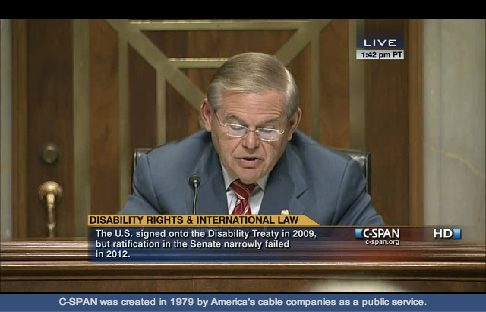
Last year, Michael Farris, homeschool advocate and founder of the powerful Home School Legal Defense Association, was instrumental in blocking the ratification of the UN Convention on the Rights of Persons with Disabilities (CRPD), despite its complete irrelevancy to homeschooling issues. Senator Robert Menendez (D-NJ) is now bringing the treaty back to the Senate, hoping to ratify it in this current session. Last week, Michael Farris was a witness for the Senate Foreign Relations Committee, testifying on why he thinks this treaty would be bad for the U.S.

farris

You probably didn’t watch Farris’s testimony last week, and his followers probably didn’t either. In fact, Michael Farris is banking on them not having seen it. You see, Michael Farris hopes they will accept his description of the hearing, of how mean and unbalanced it was, and how vicious the “Democrat” senators are. Farris hopes his followers will call their senators and demand that they vote no on the treaty. And of course, Farris hopes his followers will donate money to HSLDA in their outrage!

The problem is that Michael Farris’s description does not match up with reality.

While Farris told his followers that the Democratic senators sought to “vilify and destroy” him, in actual fact they treated his arguments against the treaty with the respect they deserved. Many of Farris’s legal analyses were countered by the other witnesses and the Senators. His demeanor throughout the hearing was aggressive and at some points incredibly rude and disrespectful to sitting Senators. And the “petty, silly, and personal attack” that Farris decries was, in fact, a response to Farris’s appeal to his own authority, one which he has used both here and previously to brush off criticism of his legal analysis.

In this post I will examine Farris’s description of the hearing, what actually happened, and some of the issues involved. I will look at Farris’s exchanges with Senators Boxer, Durbin, and Menendez, and contrast what actually took place with how Farris portrayed what took place in a fundraising letter he sent out to HSLDA members later that day. In my next post I will delve more into the legal issues at hand. I believe that this is an issue you should care deeply about, because the political power that Farris has is predicated on his position as leader of HSLDA, and his rejection of the UN Convention on the Rights of Persons with Disabilities (CRPD) is entirely consistent with the philosophies he’s built his political base around—and also because there are compelling reasons the U.S. for the U.S. to sign the CRPD.

Of course, you don’t have to take my word for any of this. You can watch and read Farris’s testimony for yourself and judge whether or not my description is accurate. First, you can watch the Senate hearing here (or here). Second, you can read my own transcription, which I made while watching it, my curiosity piqued by Sarah Jones’ description (my transcription is not perfect and may have some flaws or typos). I was not able to transcribe the entire two-and-a-half hours of the panel, and therefore I have not included all of the arguments or debate on the CRPD, but I was able to cover all of Farris’s testimony, as well as his back-and-forth conversations with Senators Corker, Boxer, Durbin, Johnson, Menendez, and Coons.

Background

Before I dissect Farris’s arguments and his back and forth with the various senators, I want to lay out some basic, noncontroversial, unchallenged facts about the Convention on the Rights of Persons with Disabilities (CRPD):

  1. The CRPD has already been ratified by over 130 countries around the world.
  2. The US has signed but not ratified the CRPD.
  3. Until the US ratifies the CRPD, no US representatives are able to take part in the Committee on the Rights of Persons with Disabilities, which monitors implementation. This limits US involvement in implementation of disability laws in other countries — of concern to US citizens traveling abroad — and in the interpretation of the treaty by the UN.
  4. Michael Farris is the most prominent voice opposing the ratification of the CRPD. Farris’s argument is that because there is no explicit mention of parents’ right to determine their children’s education, ratifying the treaty could potentially affect homeschooling. This is not in line with legal precedent of how the courts determine the US’s obligations under treaties such as these.
  5. Under debate currently in the Senate are a number of RUDs—reservations, understandings, and declarations—that the US may attach to its ratification of the treaty. While these are a common practice by the US and other countries, Farris is arguing that the only type of reservation he would accept is one invalidating the treaty.
  6. According to his opening testimony, Farris agrees with the emotional and political arguments in favor of ratification, but he believes that despite every assurance he has received to the contrary, ratifying the CRPD will change US law.
  7. If Farris had not decided to protest the CRPD, it is very likely it would have been ratified last December.

While Farris has characterized the pro-treaty side as being “Democrat” and “left”, this is not actually the case.

The CRPD has bipartisan support in the Senate, with Democrats, Republicans, and Independents all being in favor of the treaty. While Farris noted that two of the witnesses were “sitting senators”, he neglected to note that both Mark Kirk (IL) and Kelly Ayotte (NH) are sitting Republican senators, or that the other pro-treaty witnesses included Tom Ridge, a Republican who served as Secretary of Homeland Security under President George W. Bush, and Richard Thornburgh, a Republican who served as Attorney General under President George H.W. Bush. The Americans with Disabilities Act, on which the CRPD is based, was signed in 1990 by President Bush and passed the House by a vote of 377 to 28 and the Senate with a vote of 91 to 6. Several of the at the committee hearing made note of the remarkably bipartisan nature of this bill, and made it clear that supporting the rights of the disabled and of veterans is neither a Democratic nor a Republican issue, but a human rights issue.

Farris’s characterization of the treaty as a plot by “the left” is thus both fundamentally dishonest and a cheap ploy to get donations from people who dislike the “Democrat” party.

Barbara Boxer’s “Attack”

boxer

With this background, we now turn to the substance of Farris’s characterization of his interactions with three Senate Democratic committee members. Farris described his back-and-forth by Senator Boxer this way:

After we gave our introductory remarks, the personal attacks began. Senator Barbara Boxer (CA), the second most senior Democrat senator on the committee, asked me if HSLDA or ParentalRights.org has ever raised money during our battle against UN control over children and families with disabilities. Instead of asking her if she had ever raised money during her campaigns for U.S. Senate, or whether any of the pro-UNCRPD organizations raise money for their fight, I explained that HSLDA is funded by you, our members. ParentalRights.org is funded solely by donations.

Senator Boxer’s attack, however, was not really against me or HSLDA. It was against you, and every other homeschool family who has ever supported HSLDA because you believe in our mission to defend the God-given right of parents, not faceless bureaucrats, to care for and educate our children. Senator Boxer thinks that your membership in HSLDA and your support of our critical work to defend homeschooling, support widows and single parents through the Home School Foundation, and the work of ParentalRights.org to pass a constitutional amendment makes you an evil special interest that must be vilified and defeated.

Contrast this description with what was actually said during the two minutes that Senator Boxer spent addressing Farris. You can view the relevant video here or read the transcript as follows:

Boxer: “Now, Dr. Farris, you say that you’re speaking for the disabled, but your statements are directly contradicted by organizations that work every day, 24/7, to protect disabled kids, like the United States International Council on Disabilities who states, quote, ‘this treaty protects parental rights and highlights the important role of parents in raising children with disabilities.’ Unquote. And TASH, you know that organization, says quote, ‘nothing included in this treaty prevents parents from homeschooling. This treaty embraces the spirit of the Individuals with Disability Education Act, the Americans with Disabilities Act, and all disability non-discrimination legislation.’ But you, Dr. Farris, argue the opposite. You once even said, and I quote,‘the definition of disability is not defined in the treaty and so my kids – my kid wears glasses, now they’re disabled. Now the UN can get control of them.’ Well, I have to say in my opinion, that is nonsense that if a child wears glasses [Boxer touches her own glasses], then the child is considered disabled. So I wonder what is behind your fight. And I just ask this question for the record. Have you ever tried to raise funds by telling parents this treaty will limit their ability to decide what is best for their children?”

Farris: “Senator, our organization is funded by membership dues, not by contributions.”

Boxer: “So you’ve never sent out an e-mail asking for funds to fight—”

Farris: “No, the Homeschooling Legal Defense Association, um, is associated also with a group called ParentalRights.org. Parentalrights.org has indeed sent out fundraising emails—”

Boxer: “Thank you very much.”

Farris: (overlapping) “But, Senator, the substantive answer is, the treaty doesn’t ban homeschooling. What the treaty does is shift the decision-making power from the parent to the government. That is what the meaning of the best interests standard is.”

Boxer: “Well, that is not something that I agree with, nor do any of the organizations.

Farris: (overlapping) “Well—”

Boxer: “Thank you very much.”

Farris lied when he categorized Boxer’s questioning as an attack on HSLDA families. Boxer was not attacking, or even coming close to attacking, any HSLDA family. She simply asked Farris a question—whether he was using his opposition to the CRPD as a fund-raising cash cow—that he was embarrassed to answer. She never used the words “evil special interest”—an interesting choice of words by Farris, given that he has done more than anyone else to turn homeschooling families into a special interest group. Perhaps Farris, flushed in his residual embarrassment after his performance, accidentally admitted his private categorization of HSLDA families.

What Senator Boxer was actually getting at was Farris’s practice of issuing bald-faced lies about the implications of the CRPD in order frighten homeschooling parents so as to raise money for his organizations.

And the fact that Farris turned around and sent this letter out—including a P.S. asking for money (“Finally, even though Senator Boxer doesn’t want you supporting the battle against the UNCRPD and for U.S. sovereignty, you can donate if you wish”)—is an example of his inability to understand either what Senator Boxer was getting at or that what he is doing is fearmongering and wrong.

For the record, this very e-mail reveals that Farris is officially sending fundraising e-mails from HSLDA.org in order to fund “the battle against the UNCRPD and for U.S. sovereignty”—the exact thing he denied doing just hours earlier in front of the Senate Foreign Relations Committee, when he claimed that he only sent out such emails from ParentalRights.org. Senator Boxer was onto something. Farris is indeed making inflammatory and incorrect assertions about what happened in order to raise money. Ironically, his attack on Senator Boxer justifies her line of questioning.

Senator Durbin’s “Misunderstanding”

durbin

Next came Farris’s mischaracterization of Senator Durbin, the Democratic senator from Illinois. Here is Farris’s description of their interaction:

Next, Senator Dick Durbin (IL), another senior Democrat on the committee, falsely argued that HSLDA’s position is that the Americans with Disabilities Act (ADA) is the threat to homeschool freedom. The fact is that HSLDA strongly supports the ADA and other laws advancing the freedom and dignity of persons with disabilities which our democratically elected representatives have passed. What’s more, the UNCRPD would actually threaten parental rights which are enshrined in the IDEA [the Individuals with Disabilities Education Act]. I explained to him that it was the UNCRPD, not the ADA, which was the threat. He ignored me and persisted in stating that HSLDA believes the ADA was the threat. Logic teachers call this a straw man argument, which is used by people who do not wish to debate the merits of an issue.

Again, Farris’s recollection is simply incorrect. You can view the relevant video here, or read the transcript as follows:

Durbin: “I am just stopped cold with this argument by Mr. Farris that the Americans with Disabilities Act is going to put an end to homeschooling in America. Is that your position?”

Farris: “That’s not my position. My position is that the treaty changes the, the legal requirements in this country that it’s just not correct to say that there is no duty to change American law in accordance with the treaty. So, since I believe there will be required to be, uh, an implementation act that complies with the requirements of the treaty I think that at that point in time that’s when the problems will arise.

Durbin: “Mr. Farris—”

Farris: (overlapping) “Not under the ADA itself.”

Durbin: “Mr. Farris, the fact that the administration is not asking for an implementation act and made it clear that it’s not seeking it because the Americans with Disability Act already is controlling, and has been extensively litigated, sets disability standards in our country higher than any in the world, you don’t find that convincing.”

Farris: “That’s the same administration that’s prosecuting the homeschooling family to try to expel them from the United States who came here—”

Durbin: “Under the ADA? Under the Americans with Disabilities Act?”

Farris: “No, they came here under our law of asylum. But the question of the case is—that case is also pending before the Supreme Court, and the question is—”

Durbin: “Well, Let me just say Mr. Farris—”

Farris: “I guess you don’t want me to answer the question.” *flounces back in his seat*

Durbin: “I don’t think you can answer because you want to talk about something other than the American Disability Act or the convention on disabilities, and that’s what we’re here to discuss.”

Farris: “The convention with disabilities has a different legal standard than the ADA.”

Durbin: “I can tell you—”

Farris: (overlapping) “There are numerous disability organizations that say so. I include their citations in my written testimony. I’m not the only one that says that. The CRPD committee agrees with me.”

Durbin: “And I would just say to you, Mr. Farris, that if we’re going to have a battle of the organizations supporting or not supporting this, I think we’re going to prevail. Because we have the mainstream disability organizations across America who are supporting the adoption of this convention on disabilities. And I—I just, I struggle with this notion that we are somehow going to stop this effort, this effort to extend the rights to the disabled around the world for fear of something which you can’t even clearly articulate when it comes to homeschooling. […] This is not going to affect homeschooling, it’s very clear that it will not. And the Americans with Disabilities Act for twenty years has not affected homeschooling. I yield back my time.”

Far from “stating that HSLDA believes the ADA was the threat”, Durbin is very clear: because the US is already bound by the ADA, which holds the US to a higher standard than the CRPD would hold the US, there will be no changes required in US law should the US ratify the CRPD. As Farris originally got involved with this treaty obstensibly in order to prevent changes in homeschooling law, this is not an irrelevant point that Durbin is making.

(Farris actually talks quite a bit about the Romeikes, a German family that is trying to get asylum in the U.S. on the basis of Germany’s essential ban on homeschooling. I personally don’t see the relevance of the Romeike family to the CRPD, and connecting the two seems to fall under the slippery slope fallacy. You can read more about the Romeike family hereherehere, and here.)

It is also clear from the video and transcript that Farris is not exactly acting with the proper decorum due to a sitting US senator or expected in a senate hearing. He is rude, interrupts the senators multiple times, and, when frustrated, resorts to mouthing off. Once I got over my initial shock, I found myself full of questions. Personally, I was not homeschooled, nor have I ever participated in any type of moot court. Is this kind of display in this sort of formal setting considered acceptable for homeschooled students? For participants in moot court? Wouldn’t judges dock points for display of temper? Surely Farris knows that when giving testimony as an expert witness, it is advisable not to behave like a lawyer on “The Good Wife”?

But let us not let our shock at Farris’s visible display of disrespect distract us from Farris’s legal disrespect of Durbin’s very sound arguments.

Durbin, a former trial lawyer, makes numerous strong legal points that poke holes in Farris’s flimsy argument. For example, a large part of Farris’s argument relies on the assumption that US law will need to change in order to accommodate the new treaty. As the treaty is non-self-executing, this would have to be accomplished with an Implementation Act passed by both Houses of Congress and signed by the President. However, as Durbin pointed out, this is not necessary in the case of the CRPD. This is corroborated by the UN website on the Treaty on Disabilities:

Except in the rare case that the laws in a country already conform fully to the requirements of the Convention, a State party will normally have to amend existing laws or introduce new laws in order to put the Convention into practice.

As Durbin states, the US is exactly that “rare case” that the laws already conform to the requirements of the Convention—because the Convention was based on our current disabilities law! Perhaps Farris should consider this an example of American exceptionalism in action?

It is also incredibly ironic that Farris describes Durbin as using a logical fallacy (“straw man argument”) when in fact a large part of part of Farris’s own argument against ratifying the CRPD relies on a logical fallacy–the slippery slope fallacy. See for example what Farris said in response to a question by Senator Menendez about whether or not Farris views this treaty as a “wedge issue” (you can also view the video here):

“I believe that, uh, this treaty would be the first in a—in a line of human rights treaties that would be coming before this treat—before this committee. The committee—the convention on the rights of the child—Senator McCain misspoke, I’m sure, earlier—we have not ratified that treaty. And so, I think that would be coming next. The convention on the elimination of all forms of discrimination against women, that would be coming after that. I think that, that this treaty is the first of many treaties that would be in this, in this range, that is what is intended by that comment.”

As Farris should be well aware, a slippery slope fallacy is often “used by people who do not wish to debate the merits of an issue.” Perhaps he would agree that it is used only by those who lack the ability to make more substantive arguments.

Senator Menendez’s “Dismissal” 

Menendez

This leads us to discuss Senator Menendez’ questions. Although Menendez’s questioning of Farris lasted over eight minutes (you can view the full video here), Farris seems to have only remembered a brief snippet of the exchange (which you can watch here). In Farris’s own words:

And finally, near the end of the hearing, Senate Foreign Relations Committee Chairman Bob Menendez (NJ) said, by way of dismissing HSLDA’s legal arguments about how the UNCRPD is binding under international law, “I appreciate that you have an LLM from London which is as I understand from a distance learning course….” The room packed with supporters of the treaty burst out in rude and loud laughter, forcing Chairman Menendez to gavel the room to order.

Again, while this was a personal attack aimed at me intended to sideline my arguments, Chairman Menendez was admitting that he had no response to HSLDA’s arguments about the dangers of the UNCRPD and international law. He showed that he will resort to petty, silly, and personal attacks rather than substance.

Let me first say that I find it repugnant for anyone, regardless of where they obtained their education, to dismiss anyone else solely on the basis of their education.

It is a sad truth that access to education is not equally distributed across the world, and very often access is limited to people who are already relatively privileged in money, time, and social status. Distance learning courses and degrees can be used to change this: in fact, it is very likely that due to Article 24 of the CRPD, on educational rights of persons with disabilities, would lead to the increasing availability of distance-learning courses and degrees such that “persons with disabilities are not excluded from the general education system on the basis of disability.”

However, I do not believe that this was an attempt by Senator Menendez to attack Farris in order to distract from “substance.” Rather, I believe that Senator Menendez’s comment about Farris’s degree is justified by Farris’s earlier attempt at credentialism and, in yet another logical fallacy, an appeal from authority.

In his opening statement, Farris said to the committee (view the video here):

Turning to the issue of homeschooling, uh, I’ve been criticized by many in the press for, uh, fearmongering on this topic. But I have never seen anyone write a legal analysis. It’s just simply conclusions, just assertions that I have incorrectly analyzed the lawness. I have an LLM in International Law from the University of London, I have coached six—excuse me, seven—national championship moot court teams that debate constitutional law, I have written the legal analysis and I dare anyone to read my legal analysis and answer it with legal analysis, not conjecture and raw assertion.

Farris is the one who introduced his credentials—the only person testifying to do so, and in my opinion a rather gauche move—as his authority for making this legal argument.

Farris, while mentioning that he did receive his LLM from the University of London, notably did not include the fact that it was from the distance-learning program, leading the casual viewer to believe that Farris attended the University of London in-person, rather than through the distance-learning program.

In fact, this is something of a pattern for Farris. His bios on both HSLDA.org and ParentalRights.org mention the LLM from the University of London but do not indicate that it was a distance learning program. He also represented himself this way to a reporter from the Boston Globe:

Farris, meanwhile, stood by his assertion that he understood the treaty better than Republican supporters such as Thornburgh. Farris, a graduate of Gonzaga University School of Law, said he has better legal training when it comes to treaties.

“I have an LLM in international law from the University of London,” Farris said, referring to a postgraduate degree that is similar to a master’s program. Asked for details, Farris said he didn’t go to London for the degree; it came in a “distance learning” course and culminated in a proctored exam at a local community college.

“He is just flat wrong,” Farris said of Thornburgh’s sworn testimony that the treaty won’t change US law. “If he wrote that on an international law exam, at any law school, he would fail.”

Farris is misrepresenting himself and his law degree in public all the time, and yet he uses this misrepresented law degree as the authority backing his legal opinions. Does Farris believe that there is a distinction between “University of London” and “University of London, distance learning program”? If not, why does he continually forget to mention the type of program he went through?

In short, I believe that contrary to Farris’s account, Menendez was not making fun of Farris’s degree at all. He was instead making fun of Farris’s appeal to authority. If Farris was honest about the provenance of his degree, if he did not so frequently use it as a justification for his legal theory, then Farris would not be able to be so easily and frequently embarrassed by anyone pointing out the actual program he attended. And if Farris’s legal arguments were stronger, he would not need to resort to the fallacies of credentialism and appeals from authority at all—which is, by the way, yet another fallacy.

(As a side note, Farris complained on his Facebook account after the hearing that “they attacked me personally for ‘fear-mongering,’ misrepresentation, fund-raising, political motives, and having earned an LLM through distance learning.” As I listened to the video of the entire conference, I kept count: the only reference to ‘fearmongering’ made during this Senate hearing was the above reference made by Farris himself. That said, I myself prefer to interpret this as Farris accusing himself of fearmongering.)

Perhaps it’s because he was so embarrassed with the jibe about his degree, but Farris does not seem to have understood any of Menendez’s actual legal points, some of which will be discussed in my next post. As a matter of fact, Menendez actually states Farris’s position more clearly than Farris is able to articulate it: “you argue that the treaty creates obligations others do not see, and then you suggest that the United States must follow your interpretation as in terms of ratifying the treaty.”

In short, Menendez does engage with Farris’ legal arguments and legal reasoning.

Menendez goes on to say:

“I think that where we have a fundamental disagreement here, is that under the Constitution, the President and the Senate determine our obligations under international treaties and therefore the reservations, understandings, and declarations are the resolution and consent—are what are binding.”

Farris is welcome to all the opinions he likes—that’s his Constitutional right as an American. But his opinion of legal theory is not considered binding. The Senate determines the boundaries of the reservations attached to the treaty—this is its Constitutional duty under Article II, Section 2. In Farris’s attempt to protect the United States from encroachments on its sovereignty by the UN, he seems to be ignoring the parts of the Constitution which guarantee the American people freedom from him.

Conclusion

But don’t just let Senators Boxer, Durbin, and Menendez convince you that Farris’s arguments are ridiculous. I may not have a law degree, but I do know how to read and I’m willing to do a little bit of legwork when it comes to research. Farris claims again and again that his opponents have attacked his motives or his degrees rather than attacking his actual evidence—a claim that is false, as we have seen. Farris also continually pads his arguments with citations from other legal scholars, using these experts as a buoy to support his claim that his interpretation of the CRPD is the correct one. In my next post, I will do what Farris urges—but what I don’t think he actually expects anyone to do. I will read the experts he cites to back up his interpretation—and I will do so in their original context.

And when I do so, I think I can prove to you that he never expected anyone to do this, or else he wouldn’t have left himself so very open to being exposed as such a fraud.

Part Two >

So… About That “Homeschooled Hero” George Washington

george-washington-portrait

By R.L. Stollar, HA Community Coordinator

George Washington is the greatest homeschooler of all time.

Homeschool advocates love that sentence. It’s like the knife driven into the heart of public education, the garlic wielded against the vampiric detractors of homeschooling.

What a solid sentence. The syntax is perfect.

There’s just one problem with it: it simply isn’t true.

I honestly don’t know where the myth of George Washington as homeschooler originated. When Rob Shearer wrote about Washington back in 1998 for Practical Homeschooling, he never mentions Washington was homeschooled. He says that Washington was “one of the most important figures in American History.” So if he was homeschooled, that would seem like a good time to mention that fact. But he doesn’t.

My guess would be the myth originated three years later with alternative education activist John Taylor Gatto, who is widely celebrated in homeschooling circles. In Gatto’s classic critique of American public education, the 2001 book The Underground History of American Education, he states:

“Washington had no schooling until he was eleven, no classroom confinement, no blackboards. He arrived at school already knowing how to read, write, and calculate about as well as the average college student today… Washington also studied geography and astronomy on his own…”

Gatto, however, never says Washington was “homeschooled.” Though he does point out that, “Washington attended school for exactly two years.” Which is not “exactly” true, but we will get to that in a bit. The point is, Gatto says that Washington mainly taught himself but also received formal education to complement that self-teaching.

Yet somehow Washington is today considered a classic example of homeschooling’s power. He is included in those many and sundry lists of “famous homeschoolers.” There’s even a website for “Famous Homeschoolers” (www.famoushomeschoolers.net) that includes him. (Does anyone fact check those lists, by the way? Because I swear 75% of the people listed in most of those do not qualify, just like George Washington.)

Just last week, the Homeschool Legal Defense Association (HSLDA) dedicated the entirety of its Home School Heartbeat radio program to Washington.

Just last week, the Homeschool Legal Defense Association (HSLDA) dedicated the entirety of its Home School Heartbeat radio program to Washington.

The title of their week’s series was — surprise! — “Homeschooled Leader: George Washington.” The series’ description says, “The father of our country was a surveyor, general, president—and homeschooler.”

HSLDA’s Mike Smith gushed throughout the week about Washington and his homeschooling and how wonderfully it shaped him and his legacy for the U.S. (emphasis added):

“Who was America’s greatest homeschooler? Some say it was George Washington… America owes its very existence to one of the greatest homeschoolers of all time… Like most frontier families at this time, homeschooling was the most viable option for a child’s education… This homeschooler and statesman transformed the world, setting the course for freedom and away from tyranny… Americans owe their freedom to the efforts of our Founding Fathers and to this man who diligently studied and learned the truths of life at home.”

Just one small problem: George Washington is neither an example of homeschooling nor an example of education done well.

To some extent, deciding whether someone was/is homeschooled or not is complicated. There are so many different forms of home education these days. So let’s go ahead and set some arbitrary definitions. For “homeschooling,” we will use “to teach school subjects to one’s children at home.” And for “homeschooled” we will use a definition that HSLDA could agree with — the definition that HSLDA’s research buddy Brian Ray used earlier this year: “one should consider a person to be ‘homeschooled’ if the majority of his school years were in homeschooling.”

So let’s look at George Washington.

There isn’t a lot of information about Washington’s early life. Any legitimate account of his early life and education will admit this. So here are a few different accounts of what we do know:

George Washington’s education resulted from a process of close study and imitation of the Virginia elite… Born into mid-level gentry status, Washington seized opportunities to fill in gaps in his formal education… A formal education alone could not have imparted him with such admirable self-control. Washington’s social education enabled him to maintain a delicate balance between ambition and modesty throughout his life. (Source)

In the normal course of events, George Washington would have become an Oxford don and followed the profession of his English father… He received the least formal schooling of any of the Founding Fathers and remained self-conscious about this lack all his life… George Washington did not sit down and write of his childhood, as Thomas Jefferson and Benjamin Franklin did… He seems to have been ashamed of his impoverished childhood and his poor education… He apparently began to learn to read, write, and keep sums from a tutor, a convict… By the time his brother Lawrence returned in his red-and-blue uniform, George was already crossing the river each morning to the log schoolhouse in Fredericksburg… In all, George Washington received between seven and eight years of schooling. For nearly four years, he took the ferry each morning to Fredericksburg. (Source)

Between seven and eight years of schooling. Four under the tutelage of a convict and four at a public log school. This is a very different story than Gatto’s “two years” fable. And what schooling Washington got was scarce, so scarce that Gatto saying Washington’s lack of formal education was somehow positive is an insult to Washington’s experience. Why? Because Washington did not consider his lack of formal education to be positive:

Washington had only limited formal schooling. In later life, he felt somewhat self-conscious about what he considered his ‘defective education.’ Spurred by this sense of deficiency, he developed a lifelong habit of reading… Despite this effort, he remained unsure of his learning.” (Source)

So self-conscious was he of his lack of education, and so defective did he consider the little bit of education that he received, that Washington went out of his way to educate his stepson, Jack Custis. He hired a private tutor for both Jack and his sister Patsy for over six years. He sent Jack to boarding school in Maryland. After boarding school Washington sent Jack to New York for college. And note, Wasington “left the direction of Jack’s schooling to these instructors.”

This cannot be overstated: George Washington was embarrassed by his lack of education. Self-conscious. Ashamed. You can see how this influenced him in his advocacy for public education near the end of his life:

As George Washington ended his term as the first president of the United States, he left with a few parting words. Washington’s Farewell Address of 1796 delineated many of the recommendations Washington had for the future of his country. Amongst these suggestions was a public education system. (Source)

In this address Washington said,

Amongst the motives to such an Institution, the assimilation of the principles, opinions and manners of our Country men, but the common education of a portion of our Youth from every quarter, well deserves attention. The more homogeneous our Citizens can be made in these particulars, the greater will be our prospect of permanent Union; and a primary object of such a National Institution should be, the education of our Youth in the science of Government. (Source)

So let’s get this straight: Washington’s dad bought a full-time tutor for him. Washington also attended an institutional school for at least 50% of his education. And somehow he was homeschooled? Since when was homeschooling considered 50% being tutored by a convict and 50% attending a public school?

This fails both the definition of “homeschooling” and the definition of “homeschooled.”

Even if you still consider Washington to be homeschooled, there’s the more important aspect of this story: George Washington had the least formal education of the Founding Fathers and considered that a bad thing. He considered his lack of more formal education to be defective to the point that it obviously haunted him for his entire life. This spurred him to push for public education for his own relatives and the brand new United States of America.

That’s a “homeschooled” hero?

Look, I don’t mind if people create lists of famous homeschoolers. It’s a testimony to the fact that homeschooling can be awesome and has been awesome and that education should be democratic and flexible and tailored to every individual.  But if you’re going to create a list of famous homeschoolers, I have two very simple rules:

(1) Make sure the people were actually homeschooled.

(2) Make sure the people don’t consider their education defective.

Including George Washington violates both of those rules.

Of course, if George Washington were alive today and said his “homeschooling” (if you still want to consider it that) was lacking and defective and he wished he could have gone to that log school more, we already know from Josh Powell’s situation how HSLDA would respond. It would be something like, “Buck up, kiddo! Log schools crush creativity! Be glad you got taught by that convict at home!”

Falling from Family Dysfunction into Nightmares Realized — Another Story of Homeschool Abuse: Lana Martin’s Story, Part Two

Screen Shot 2013-10-29 at 5.41.48 PM

< Part One

My life during this time was bleak.

I was almost completely isolated, subject to my mother’s personal drama on a daily basis. She lost control of her hoarding behavior, eventually lining the walls of our home with piles of dusty books, magazines, and papers which seemed dearer to her than family living space and respiratory health. She instigated disputes with her siblings and raged about perceived injustices. She spent time planning parties that never happened. Until the last few years, she refused to work outside the home, even though her supplemental income would have enabled me to enroll in music or foreign language lessons. When she finally began working part-time, she spent the income on a new car. She fretted about falling behind in educating me, while doing nothing to improve the situation.

She instructed me to lie about our daily routine.

Despite her awareness that this situation had become quite terrible, she still believed keeping me at home was preferable to exposing me to the horrors of public school. HSLDA purports homeschooling is all but necessary to preserve a child’s decency.  It was, no doubt, far easier for my mother to ignore the reality of the situation while consoled with this noble image.

Despite isolation, my mother continued to monitor my behavior, watching for signs of emergent “teenage behavior” and un-Godly beliefs which might have seeped into our household against her wishes. Laughing at the wrong joke in a movie, for example, might unleash a torrent of shaming rage. One day, wearing nail polish would be acceptable and “pretty” — another day, it would be shamefully worldly and warrant usage of the label “slut”. By the age of 16, I became severely depressed and had lost significant weight, but was not offered counseling or medical treatment.

My mother instead chastised me for exhibiting teenage rebelliousness.

For a while I was suicidal, high-risk given my secrecy and feasible plans. No adult in my life acknowledged that this stress and isolation might have negative effects on me. No one asked me if I felt I was being prepared to enter the adult world or to attend college. My father, despite living in the same house, never inquired about my education or wellbeing. Grandparents expressed concern and curiosity but were silenced by my mother’s convicted assertions. More distant family members inquired skeptically but were blown off with her combative resolve. I felt trapped and hopeless, unwanted and invisible.

*****

I did escape this situation at the age of 18.

My mother’s employment during the last few years enabled me to get out of the house more often and, in turn, my mental health improved. I earned my GED, began working in retail, attended community college, then moved to another city and supported myself through university. I somehow emerged with a strong sense of self and the ability to form healthy social relationships. Perhaps unsurprisingly, I have always had my doubts about Christianity. Today I follow a self-constructed spirituality stemming from Buddhist philosophy, yoga, and meditation, with occasional dabbling in occult divination via cartomancy.

However, there is a dark side of myself that only a close few know.

For years I have struggled with PTSD symptoms, depression, social anxiety, and low self-esteem. Often I cannot identify with my peers as the experiences of my first 18 years were so atypical and potentially stigmatizing. I mourn the loss of my childhood and the absence of positive parental figures.

These days I can’t imagine away the pain of this long-term isolation and having been physically abused.

I was thrown under the bus to fulfill my parents’ fantasies of the perfect family.

Nor can I align myself with my parents’ perspective that children and teenagers are indentured servants. I can’t stop caring about how poorly they treated me, nor suppress the feelings of disgust and unease that arise when I see them or imagine visiting them.

I am currently no-contact with my parents. My mother flatters herself with historical revisions, presenting my acceptance to a prestigious graduate program as the success of her home education efforts. They have not acknowledged the truth of our shared history, and I do not know how to relate to them as anyone other than authority figures. I have no emotional attachment to them, and for now their presence in my life merely reminds me of the horrible things they did to me.

But, gradually, I am feeling less shame about what happened to me. I am starting to feel less embarrassed by it and more proud of how I overcame the situation. I am beginning to empathize with my past self, appreciating the things I did then to help me survive into the present. Lately I feel more “human” in some vague sense. Specifically, I feel more capable of relating to other people and knowing what I want and need. On that note, my therapist of five years is a total rock star.

*****

At its core, this is clearly a story about growing up in a dysfunctional family and with an abusive mother failing to manage her mental health issues. However, several aspects of the Christian subculture homeschooling movement stand out as fueling the existing fire of my misfortune, or creating the perfect storm of an abusive, neglectful homeschooling situation.

Regulations on homeschooling may have discouraged my mother from wanting to homeschool, or brought outside attention to my terrible situation. Currently, in many states, future homeschool students silently fade away behind a vague letter of withdrawal and intent. Registration with the local school district would require parents to face school officials and engage in dialogue about their rationale and preparations. Annual lesson plan approval and testing would encourage earnest academic investment and would identify on-going cases of neglect. It has become apparent lately that, upon legal emancipation, many homeschooled teenagers no longer desire to attend Bob Jones University or marry into a Quiverfull movement. Documenting grades and filing transcripts with the local school district would expand higher education opportunities for these children. Such regulations would have imposed reality on my mother’s mostly unchallenged fantasy world, one which placed me at a severe disadvantage.

HSLDA’s promoted image of homeschooling provided an ideal fantasy for my mother to latch onto.

She saw herself most importantly as a warrior for Christ, less so a dedicated teacher. HSLDA propaganda, in fact, less heavily emphasizes the importance of proving quality education and social opportunities for children. One can walk away from an HSLDA forum thinking, “the most important thing is that I remove my child from the evil public school environment.” Dispassionate, research-based information about the work needed for legitimate homeschooling would place the value of teaching above “fighting the culture war”. Availability of such information may have undermined my mother’s romanticized image of the homeschool-mom as an anything-goes hero-by-default. HSLDA’s insistence to avoid regulations and legitimate research on homeschooling does nothing to protect or improve home education, only to help obscure appalling cases such as mine.

It’s clear from my description of family dynamics that one may not expect me to have had a “good-enough” childhood regardless of how I was educated. Sometimes I ask myself, “how would public (or private) school have improved my situation?” My parents failed to educate me; it would have provided a baseline education that was, at least, better than nothing. My parents believed that children should not be allowed a voice; it would have provided access to adult mentors who might have listened to and respected me. My parents were socially isolated, lacking friendships; it would have provided opportunities to acquire developmentally-appropriate social skills rather than learning it all at once as a working college student. My parents did not provide extracurricular activities for me; it would have provided a means to expand myself with arts or athletics.

Finally, my parents did not offer a structured means by which I could assess my personal changes and growth. Formal schooling, no matter how angst-ridden it might be for many young people, at the very least grants the student a sense of autonomy in deciding whether they love or hate school, admire or despise authority figures, agree or disagree with society at large.

My parents robbed me of that experience by imposing their selfish whims on me, unchecked by the isolation.

Although I survived with a fair bit of myself intact, going through this experimental phase while an employee and student, alone in a new city, was both risky and terrifying.

*****

A question I continue to grapple with — and perhaps will, for a while — is: who do you turn to when your own mother is trying to destroy your metamorphosis into a healthy, functional adult? When your father ignores your plight?

What do you do?

No adult in my immediate or distant family intervened, nor were child protective services ever alerted to my condition. Family members cannot be depended on to identify and report educational neglect and abusive behavior. Turning a blind eye is easier for many than dealing with a difficult person or sacrificing the perfect family image for a child’s so-called “rights”.

Homeschooling is a dangerous plan when abuse, isolation, and dysfunction already exist within a family. Homeschooling is also a unique challenge when parents or children already struggle to maintain mental health. A first step toward preventing tragedies similar to my own would be access to dispassionate home education information and enactment of regulations that screen for high-risk families.

Until stories like mine cease to appear, influential organizations such as HSLDA owe such efforts to the wellbeing of these particularly vulnerable children.

Doug Phillips Resigns from Vision Forum, Cancels Speaking Events, Due to “Inappropriate” Relationship

Screen Shot 2013-10-31 at 11.32.58 AM

By R.L. Stollar, HA Community Coordinator

Yesterday, Doug Phillips resigned as president of Vision Forum Ministries*** and discontinued future speaking engagements.

Doug Phillips is a former attorney for the Home School Legal Defense Assocation (HSLDA). As an HSLDA attorney, he was the architect behind what is probably HSLDA’s most significant legal event: rallying opposition to H.R. 6. Phillips was “the person who received the phone call from the office of Congressman Dick Armey alerting the Home School Legal Defense Association of a threat posed by bill H.R.6.” He then “launched a national e-mail alert and physically gathered a brigade of valiant home educators to descend upon the Capitol en masse.” (Phillips’s and HSLDA’s handling of H.R. 6 sharply divided the homeschooling community.)

After serving as an attorney and Director of the National Center for Home Education at HSLDA for six years, Phillips founded Vision Forum in 1998. He also founded a number of other groups and projects, including the National Center for Family-Integrated Churches and the Beautiful Girlhood Collection catalog. He is an advocate of homeschooling, the family-integrated church movement, as well as Quiverfull and Patriarchy ideologies.

Phillips is an extraordinarily popular speaker in the Christian homeschool movement. He has been a featured or keynote speaker at homeschool conventions across the United States. Just in the last two years he has spoken at: 2012 FPEA Florida Homeschool Convention (2012, FL), 2012 CHEF of Missouri 28th Annual Convention (CHEF-MO) (2012, MO), Christian Family Schools (CFS) 28th Annual Expo Homeschool Convention (2012, CA), 1st Annual 2012 Teach Them Diligently Homeschool Convention in Spartanburg (2012, SC), 2013 29th Annual Home School Book Fair (2013, TX), 2013 Christian Heritage Homeschool Conference (2013, WA), 2013 CHEF of Missouri 29th Annual Convention (CHEF-MO) (2013, MO), and 30th Annual CHEA Homeschool Convention (2013, CA).

Phillips was one of the main speakers at the 2009 Men’s Leadership Summit, where Phillips spoke alongside Kevin Swanson, Voddie Baucham, Brian Ray, and Chris Klicka and declared that, “We understand that the core problem with Child Protective Services is its existence” and called for “eliminating it altogether.” It was also at this conference that Phillips declared that, “It is on your watch, it is on my watch that the sodomites are redefining marriage in our land,” and that “We will lose this movement and this work of God, men, if we do not govern our households. And that means lovingly shepherding our wives.” Which to him meant keeping one’s wife from “the female sin of the internet” — namely, blogging.

But in a statement released yesterday by Vision Forum, Doug Phillips resigned as president of his organization and discontinued future speaking events not because of “the sodomites” or because he did not “govern [his] household.” He resigned not because of female blogging. Rather, he resigned because he himself “engaged in a lengthy, inappropriate relationship with a woman.” This relationship was apparently not physical but was instead some form of — “emotional fornication”? He is not clear: “While we did not ‘know’ each other in a Biblical sense, it was nevertheless inappropriately romantic and affectionate.”

Phillips is therefore no longer the president of Vision Forum Ministries for the time being, choosing instead to focus on “nurturing [his] wife and children and preparing my older sons and daughters for life.”

The full text of Doug Phillips’s resignation from Vision Forum follows. You can read it on their website here or view an archived version of it on HA here.

Statement of Resignation

by Douglas Phillips, Esq., October 30, 2013

With thanksgiving to God for His mercy and love, I have stepped down from the office of president at Vision Forum Ministries and have discontinued my speaking responsibilities.

There has been serious sin in my life for which God has graciously brought me to repentance. I have confessed my sin to my wife and family, my local church, and the board of Vision Forum Ministries.  I engaged in a lengthy, inappropriate relationship with a woman. While we did not “know” each other in a Biblical sense, it was nevertheless inappropriately romantic and affectionate.

There are no words to describe the magnitude of shame I feel, or grief from the injury I caused my beloved bride and children, both of whom have responded to my repentance with what seems a supernatural love and forgiveness. I thought too highly of myself and behaved without proper accountability. I have acted grievously before the Lord, in a destructive manner hypocritical of life messages I hold dear, inappropriate for a leader, abusive of the trust that I was given, and hurtful to family and friends. My church leadership came alongside me with love and admonition, providing counsel, strong direction and accountability. Where I have directly wronged others, I confessed and repented. I am still in the process of trying to seek reconciliation privately with people I have injured, and to be aware of ways in which my own selfishness has hurt family and friends. I am most sensitive to the fact that my actions have dishonored the living God and been shameful to the name of Jesus Christ, my only hope and Savior.

This is a time when my repentance needs to be proven, and I need to lead a quiet life focusing on my family and serving as a foot soldier, not a ministry leader. Though I am broken over my failures, I am grateful to be able to spend more time with my family, nurturing my wife and children and preparing my older sons and daughters for life. So, for these reasons I want to let my friends know that I have stepped down as a board member and as president of Vision Forum Ministries. The Board will be making provision for the management of the ministry during this time. To the friends of this ministry, I ask for your forgiveness, and hope that you will pray for the Phillips family at this time, and for the men who will be responsible for shepherding the work of Vision Forum Ministries in the future.

Doug Phillips

Update, November 1: As Kathryn Brightbill has pointed out, “What is not clear is whether Phillips’ resignation is solely from Vision Forum Ministries, the non-profit arm of Vision Forum, or if it is from the for-profit Vision Forum, Inc. as well” (emphasis added). In fact, “Business is usual at the for-profit VisionForum.com site, with no indication of Phillips’ resignation.”

*** Update, November 6: While Phillips resigned from the non-profit Vision Forum Ministries because he “engaged in a lengthy, inappropriate relationship with a woman,” he announced today that he “retains ownership” of the for-profit Vision Forum, Inc., which sells all of his books, teachings, and products and will continue to do so. Here is the text of his blog post today on the for-profit Vision Forum, Inc.:

Last week, I announced my resignation from the presidency of Vision Forum Ministries, a 501(c)3 organization. I retain ownership of Vision Forum, Inc., a distinct and private company, but consistent with my desires to lead a quiet life focusing on my family and serving as a foot soldier, I will not be giving speeches or running conferences at this time of my life under the banner of VFI or VFM. In addition, Doug’s Blog will become the Vision Forum Blog and will be focused on publishing reports and articles by others, along with news and information from Vision Forum, Inc.

View an archived version of today’s announcement here.

Falling from Family Dysfunction into Nightmares Realized — Another Story of Homeschool Abuse: Lana Martin’s Story, Part One

Screen Shot 2013-10-29 at 5.41.48 PM

The HSLDA promotes a certain image of the average homeschool family, a cozy picture which convinces thousands of parents each year to withdraw their children from public school.

Parents in the conservative Christian subculture explicitly use homeschooling to shelter children from secular beliefs. Regardless of the degree of their sheltering, they often want to provide an emotionally and spiritually healthy educational environment for their child. While HSLDA propaganda acknowledges that homeschool parents experience a range of “ups and downs”, it neglects to provide critical, data-driven information on specific challenges. God will lead any willing parent to successfully homeschool, they say, avoiding the issue that some families could be considered high-risk for unsatisfactory, even abusive, homeschooling outcomes.

Instead, these promotional materials vaguely assert that God will use each parent’s strengths to provide a positive and effective home education environment. They assure potential homeschooling parents that, regardless of their educational background, any follower of Christ can give their child a better, safer intellectual and social development than formal schooling would.

*****

My experience as a neglected homeschool student growing up in an abusive, dysfunctional family is testimony that this scenario does not always unfold so neatly.

My mother was encouraged by HSLDA propaganda to homeschool me, and my parents were enabled by lack of regulatory oversight to proceed with little consideration for my needs.

*****

Over the past few years, the confusion and pain that has haunted me for over a decade has driven me to tease apart how my bizarre past came to be and how I managed to survive it. I grew up in a conservative, fundamentalist Southern Baptist family. True to form, my parents believed that children, relative to adults, lack basic rights of respect and agency. They bought into the Dobsonian authoritarian parenting philosophy that rose in popularity during the 1980s: parents are responsible for their children’s eternal salvation, a task best achieved by breaking the child’s willful inner core of sin through severe physical punishment and verbal shaming.

My mother, in particular, was extremely controlling and sheltering. As long as I can remember, I had to sit patiently and listen to her rants about “contemporary culture” and her demonization of public school, working moms, divorced couples, the existence of sexuality, almost all the music out there, and (of course) spaghetti-strap tank tops.

I later realized that her polarized perspective, especially her black-and-white thinking, relates to her poorly managed mental health issues, which most likely expand far beyond official diagnoses of major depression and anxiety disorder. She partially blamed these illnesses on energy lost in battling the devil — particularly in guarding her children against influences of the more liberal family members who were, in fact, instruments of the devil placed on earth to challenge her faith in the Lord Jesus Christ, her personal friend and savior.

My mother’s parenting decisions were driven by fear and paranoia. She lacked empathy, a psychological freedom that allowed her to place ideology above a child’s needs.

My father’s choices were driven by his desire to pacify my mother. He wanted peace and quiet, a need I was happy to comply with, as I had been trained to do since birth.

Life in public school grades K-3 was no picnic. My mother frequently initiated conflict with teachers and administrators. She confronted teachers over which G-rated secular movies were shown in class; she became incensed when her VHS cassette of a cartoon Christian Easter Story was not allowed to be shown due to religious content. Appeal to follow the norms of mainstream society means nothing to someone who is convinced they have discovered the one right way to live.

As I faced my entrance into junior high school, my mother grew terrified of my impending exposure to a more rigorous secular education, jealous of the increased time I would spend away from her during extracurricular activities, and paranoid of “worldly influences” from the more complex peer relationships I might form. She expressed alarm when I began budding as an independent person. I recall her rebuking me for my change in personality, blaming my new attitudes and opinions on peer influence, and shaming me for “becoming a different person”. No developmental change could be attributed to my unique thoughts and emotions; her shame- and fear-based authoritarian parenting creed declares children do not (or should not) have their own. Her need to use her child as a mirror to understand herself prevented her from acknowledging my identity.

My mother’s behavior created intense chaos and embarrassment for me as a child. I became fearful of her near-constant scrutiny of my tone, expressions, and reactions. In his passivity, my father did little to mitigate the negative impacts my mother’s intrusive, unpredictable behavior had on me.

*****

My journey down the rabbit hole begins when I was placed in a Baptist private school, which I actually liked because the 4th grade classes were small and intimate. But half-way through the school year, my mother once again generated conflict with school officials.  The more “secular” aspects of an otherwise quite religious curriculum were questionable. She had taken a part-time job in the after school care program and developed irresolvable interpersonal problems with her co-workers. Suddenly everyone at this school was bad, dumb, not up to her standards. She abruptly moved us back to the local public school for the second half of the year.

I remember this mid-year move as a turning point in my childhood, when I first fully realized that my mother had serious problems which were not being addressed by other adults in my life. I realized that her selfish whims would be catered to at the expense of my needs. That I had to shut up and put up, as I would not be listened to nor respected. I silently grieved the departure, leaving friends I would likely never see again. My last few months in public school were disastrous. I struggled to cope with the change, was self-conscious of my mother’s erratic behavior, and developed behavioral problems. My grades fell from As to Cs. This shift strengthened my mother’s resolve to remove me from this “toxic environment” and teach me at home.

Around this time, my mother became attracted to HSLDA’s portrayal of the homeschool family. Through HSLDA, she learned that children did not need to learn how to be independent, mature teenagers because the concept of “teens” is a modern myth. She declared that dating would not be allowed, but she would supervise a parent-controlled courtship. Participation in athletics, the arts, or science labs would have to be carefully censored and restricted to prevent exposure to un-Godly influences. She learned that mainstream education, socialization and rampant acquaintance-making would be unnecessary for and harmful to my development.

As a homeschooled child I would, presumably, learn how to become an adult through observing and imitating my mother in the home. As an emancipated 18-year-old, I would then either attend a Christian Bible-based private university (Pensacola and Bob Jones were popular ideas) or marry some family-approved fellow I had successfully courted under her supervision.

This was the reality I faced as a 10-year-old girl.

This might have all been faintly reasonable had my family been functional and my mother a healthy, responsible adult. Rather, my mother was increasingly overwhelmed by self-gratifying fantasies and obsessions. She became easily bored with reality, distressed by responsibility. Clearly, between her crises and my family’s financial struggles, even courtship and extracurriculars would not happen. My father was surely aware of these weaknesses and would have had compelling reason to question her competency, but he did not intervene. Even as a young child, I could see that I would not be taken care of in this bizarre world. And I would not have the childhood or education that would prepare me for a successful, fulfilling life in the real world.

This nightmare was my reality.

And so, beginning with 5th grade, I was “homeschooled”. I bracket this term in quotes, because without doing so would be an insult to families who legitimately home educate. At first my mother kept me involved with the local Christian home educators group. We attended meetings, field trips, and play dates. My mother purchased a years’ stock of A Beka, Bob Jones, and Saxon Math textbooks. She planned out a few months of lessons and graded my work for a few weeks.

She voraciously consumed every hyperbolic HSLDA-issued line about using homeschooling to save children in the “culture war”.

At first this seemed better than being in school because I suffered less conflict and chaos. But, predictably, over time the people in our homeschool group became bad, dumb, not up to her standards. My mother withdrew herself socially, effectively withdrawing me from the outside world except for trips to the public library and grocery store, occasional visits with extended family.

My mother’s mental health declined severely as my eight years spent “homeschooling” progressed. For much of this time, my mother slept all day in a depressive state while I cooked, cleaned, watched television, and read library books. My mother continued to purchase textbooks on an annual basis, but most remained uncracked until boredom drove me to fill out and “grade” workbooks on my own. Aside from the secular math curriculum, information I gleaned from the homeschool curricula was uselessly biased toward a fundamentalist Christian worldview.

Somehow I was aware of this and, when a particular subject interested me, I filled in gaps using the latest technological innovation we had acquired: the Internet.

Part Two >

The Road to Depression: By RD

Screen Shot 2013-09-06 at 4.18.02 PM

The Road to Depression: By RD

HA notes: The author’s name has been changed to ensure anonymity. “RD” is a pseudonym.

I’ve finally come to terms with the fact that I was abused as a child.

While an uncomfortable reality, it was necessary in order to understand what was wrong with me. To be clear, I wasn’t seriously abused (as if one form was abuse was better than another…) but it was there.

While I don’t remember much of my childhood, there are parts I do remember. If I told a lie, it was (10) spankings with my father’s belt. Same thing for if I snuck something. (Stealing only applied if I took something from a store, which only happened once. And even that is debatable; I was between 5 and 6 years old waiting in line with my mom at the grocery checkout, and I took a pack of gum and opened it. Broad daylight, no subterfuge; I think it was an action born out of ignorance than ill-intent. But “sneaking” was taking any food or candy while at home that wasn’t approved.) If I used a “dirty word” I had my mouth washed out with soap.

My mother was fond of the “wait until your father gets home” method as well.

I can remember days that I had really angered her, and she passed that anger on to my dad via a phone call during the day. As soon as I heard the garage door open that evening, I knew the first thing my father would do was smack me upside the head.

It’s a very odd thing to know you’re about to get hit very hard, but to take no evasive or protective action because doing so only increases the punishment.

This abuse works; that’s the tragedy with the Pearl’s method or other methodologies based on corporal punishment. They work. But it is the underlying psychological impacts that belie the merit of these methods. Cocaine or methamphetamines will help keep you awake, but we all know it’s not wise to take these things. So why is the value of “training” or corporal punishment still debated?

My parents were members of HSLDA. I remember their receiving the Court Report and Focus on the Family magazines and other publications that called homeschooled families to action in order to fight the government from over-reaching. I realize now that many, if not all, of these stories were extremely over sensationalized or outright misrepresentations of the truth, similar to the drama unfolding with the Romeike story.

But to my parents these stories were real and reminded them of the dangers of this world.

As I was growing up, I couldn’t play outside during normal school hours because a city official might see me, think I was skipping school, and something terrible would happen. I was told that if Child Protective Services ever had the slightest suspicion of child abuse, they would show up and take me and my brother away from our parents and put us in a foster home. I was told that psychology wasn’t really valid; a psychiatrist would try to pin all a person’s problems on the parents while prescribing unnecessary pills. All these lessons were carefully crafted to try to create a particular world view, a view that sees anything that is not Christian as evil, harmful, or detrimental.

So what does all this have to do with mental health? I’m getting to that point, but I still have a few more bricks to lay in my foundation.

I’ve mentioned in a previous piece that my parents chose to homeschool me primarily because I was diagnosed as a young child with ADD. I even took Ritalin until I was 11 to 12; I cannot remember at what age I started taking it. I do remember as I grew older that my parents began to express the belief that ADD was over-diagnosed and that children are supposed to have energy and be hyperactive and all that. I’m not sure where they picked up on that idea, if it was from some of the Christian homeschooling circles, but it served to create in my young mind that ADD wasn’t real, that parents used that as an excuse for their child misbehaving or not performing.

My father was also an extreme perfectionist.

I can remember many nights staying up exceedingly late trying to figure out some math or science problem as he berated me because I’m was smart enough that I should know how to do something or that the mistakes I made were because I was being careless.

There is nothing quite as powerful as a backhanded compliment.

“My dad thinks I’m smart, but if I was smart I should be able to figure this problem out. Therefore either 1) I am not as smart as he thinks and thus a failure or 2) I’m as smart as he thinks but I’m failing to apply myself.” This method of thinking, created by a backhanded compliment, is very destructive to mental image.

So where does all this lead?

The abusive methods advocated by people like the Pearls are akin to dog training (very loose analogy) except without positive methods. You are training a child for instant, unquestioning obedience without thought, but you don’t reward the obedience.

You excessively punish the failing.

Thus as a child grows up, as I grew up, I focused on what was wrong, not what was right. Even today when I look at something, my first thoughts are what is wrong with it. While this helps me most times as an engineer, it is a very harmful mindset to have.

When you combine this way of looking at things with the perfectionist mentality I received, it creates a very negative self-image.

When children are raised with the message that if they have faith in Jesus or live their life according to the Bible then they will be blessed, it creates a very false expectation. Anything bad that happens, any misfortune, becomes interpreted as God’s punishment for not being faithful enough, for failing in your walk with him. I’ve seen this illustrated over and over again in the stories I’ve read of people involved in the courtship culture.

Now add to that the distrust of science, society, or psychology. As these negative thoughts, this negative self-image grows in the mind, the fundamentalist worldview pops up and says “you can’t be depressed; there’s no such thing. You are having these thoughts, this self-loathing, because you realize how out of tune you are with God’s will.”

This only creates a downward spiral that leads to more depression.

In my case, this spiral was fueled by my ADD. Throughout college I still carried my parents’ view that ADD wasn’t real; it was simply children being children. While I don’t deny that there are many cases of ADD (now ADHD) that are wrongfully diagnosed, I understand it is very real. Any adult reading this who suffers from ADHD will know exactly what I mean (and if you don’t suffer from it, you can find some excellent lectures by Russel Barkley on YouTube.). I cannot focus or concentrate if there are external distractions; put simply, ADHD is an executive function failing of the brain.

As I struggled through university with my ADHD untreated, I constantly felt like a failure as my GPA slowly dropped down to a 2.9. This lead to depression and even self-mutilation for a time. It wasn’t until several years into my professional career that I began to see a counselor, and later a psychiatrist, and began to identify the problem and take the steps to correct it.

But this is the danger of the fundamentalist’s method of child rearing. By linking bad things, misfortunes, with disobedience to god and equating negative thoughts as god’s working to convict the wayward child, it establishes a tragic downward mental spiral that if left untreated can end in suicide.

I Love Homeschooling, But Homeschooling Is Not A Human Right

Screen Shot 2013-09-17 at 1.49.33 PM

I Love Homeschooling, But Homeschooling Is Not A Human Right, By R.L. Stollar

*****

Let’s get a few things out of the way first.

First, I generally enjoyed being homeschooled from K-12. Homeschooling is no panacea, but it was a generally positive experience for me personally. Second, I am all about human rights. Since studying human rights theories in high school and college for academic debate, I have desired to understand human rights, understand how to promote them, and defend others when their rights are being attacked.

Third and finally, I am not a fan of Germany’s almost-ban on homeschooling. (“Almost-ban” because Germany does, in fact, allow homeschooling for families of sick children or families that travel significantly.) As an American and a former homeschooler, it rubs me the wrong way.

But.

But Germany’s almost-ban on homeschooling is not a violation of the fundamental, human right to homeschool. Because there is no such human right. It does not exist.

There is no fundamental, human right to homeschool, peoples.

Now before you raise the pitchforks, throw the stones, and shout “Kill the beast!,” hear me out. And while you hear me out, re-read the three things I started with. When I say there is no fundamental, human right to homeschool, I say that as (1) a fan of homeschooling, (2) a human rights advocate, and (3) a critic of their almost-ban on homeschooling.

So put down those pitchforks and stones and save “Kill the beast” for a Disney movie and let’s talk about some basic human rights theory.

Defining Human Rights

Human rights are things — usually freedoms — that are guaranteed to you simply because you are a human. 

These rights assume that every human being — whether male, female, adult, child, gay, straight, black, white, and so forth — is a moral and rational being who deserves dignity and respect. Because of this, these rights are universal. Whether or not the government that you live under chooses to respect these rights, you still have them. They are indivisible.

There have been many articulations of rights people have — ranging from the Magna Carta to the Bill of Rights. Each of these articulations have dealt with different types of rights — natural, civil, and so forth. The concept of human rights arose after World War II and the Holocaust. When the United Nations was created in 1945, governments wanted to create a contract between each other to avoid similar international horrors in the future. The result of this was the UN’s Universal Declaration of Human Rights (UDHR) in 1948. It delineated thirty fundamental rights that people everywhere should be guaranteed.

You can read a simplified version of the thirty rights from the UDHR here, or the full text of the UDHR here. What you will observe in the declaration are universal concepts of ethics: no slavery, no torture, no unfair detainment, the right to privacy, freedom to move, freedom of expression, right to education, and so forth.

Classifying Human Rights

Now you might wonder, What qualifies a right to be a “human” right?

This is a highly debatable matter, and people everywhere — including human rights theorists — disagree on this all the time. But most people agree with either one of the following two key frameworks:

(1) International, high priority, and require robust justification

Human rights are both international and high-priority norms that require robust justifications that apply everywhere and support their high priority. They need to be so international and so high-priority so that they can actually be justified as binding on every nation everywhere in relationship to every single human being. They need to transcend cultural diversity and national sovereignty.

This is why in most human rights treaties and declarations you see abstract and universal concepts rather than precise particulars. We can all — theoretically — agree that freedom of speech is a human right. But what about the freedom to make porn? That is a very specific freedom that will not hold up against the standard of cultural diversity and national sovereignty. The more specific you get in defining a human right, the less binding it is.

(2) Universal, indivisible, interdependent, and interrelated

The four main standards for what are human rights are (1) universality (applies to all human beings), (2) indivisibility (inherent to human beings qua human beings), (3) interdependency (each right depends on the others), and (4) interrelatedness (each right enhances the other rights). Put together, this means that “all rights are equally important and necessary in creating a strong and healthy society.”

If a particular right is not as equally important and necessary as other rights in creating a strong and healthy society, then it is not a human right. It can be a civil right or a political good or a privilege, but it is not a human right.

Freedom of Movement Versus Freedom to Move By Horse

Let us look at a particular example: freedom of movement.

Freedom of movement is a human right.

What are some ways in which one could move? You could move by foot, by car, by train, by boat, by plane, by horse, and so many other ways.

Is travel by horse a human right?

No. Freedom of movement is a human right. But movement by horse is not a human right. Protecting the former is an international high priority. Protecting the latter is not. Furthermore, protecting movement by horse would be protecting a particular vehicle for achieving a general right, but not the general right itself.

It is the same with homeschooling.

The right to education and the right to educational freedom are both human rights, according to Article 26 of the UDHR:

Everyone has a right to education… Elementary education shall be compulsory… It shall promote understanding, tolerance and friendship among all nations, racial or religious groups… Parents have a prior right to choose the kind of education that shall be given to their children.

What are some ways in which one could educate or be educated? You could be educated by public schools, private schools, home schools, tutors, co-ops, and so many other ways.

Is education by homeschooling a human right?

Like travel by horse, homeschooling is not a human right. But like freedom of movement, educational freedom is.

Furthermore, you must keep in mind that human rights are inherent to individuals as individuals.

You cannot have a human right to another individual.

So while one can argue that homeschooling should be considered a parental right, it cannot be a human right because no individual has human rights to another person. You have the human right of movement, but not the human right to make another person move.

This is the inherent balance contained within Article 26: the right of a child to an education, and the right of a parent to follow his or her conscience regarding their child’s education. These need to be balanced. So if homeschooling has a potential to interfere with the human right to an education (of the child), then it cannot itself be a human right.

One can certainly argue that homeschooling is such an important vehicle for preserving the human right of educational freedom, that banning homeschooling is a violation of educational freedom. But educational freedom is the human right, not homeschooling.

Human Rights Inflation

To say homeschooling is the human right confuses and conflates categories.

But it does more than confuse and conflate. It also inflates. A vital aspect of human rights as international policy is that the list of human rights — as stated in treaties — has currency. In other words, the stated human rights actually mean something. So when one country violates them, other countries are rightly in an uproar. Violate freedom of religion and that is a big deal.

The more “rights” you add to the list of human rights, the less that list means.

It loses currency. Once you start adding things like “right to travel by bus,” “right to travel by car,” “right to travel by donkey,” “right to travel by cat,” it diminishes the impact and value of “right TO freely move from one place to another.”

This is called human rights inflation.

What HSLDA and other likeminded homeschool advocates are pushing for, this adding of homeschooling to the list of human rights, is guilty of that very thing.

They are contributing to human rights inflation. They are not alone, mind you. This is a problem that human rights theorists and politicians and international policy experts have wrestled with for years now. According to Foreign Affairs, there is “a gross inflation in the number of human rights treaties and nonbinding international instruments adopted by international organizations over the last several decades.” This is because “Human rights once enshrined the most basic principles of human freedom and dignity; today, they can include anything.”

Why this is a problem is succinctly expressed by the Spectator:

[When people translate] any and all grievances and demands into the language of ‘rights’, they are causing an inflation of the whole concept… The result is that at some point there will be a collapse of the whole system… If living in a one-bedroom flat is now to suffer a fundamental human-rights abuse, how [does one] get remotely exercised about the gassing of children or the desolation of whole nations?

Please Stop Calling Homeschooling a Human Right

As much as I value homeschooling and dislike Germany’s almost-ban on it, I consider it fundamentally irresponsible to set forth homeschooling as a human right. Just, no. No, no, no. I do not say this because I hate homeschooling. I would say this same thing about any number of other thinkers and advocates who set forth particular vehicles for achieving general rights as actual rights themselves. This does a disservice to rights language and only serves to undermine the vehicles one wants to protect.

If HSLDA and other likeminded homeschool advocates want to champion the actual human right of educational freedom, then by all means — go for it.

HSLDA, champion the Universal Declaration of Human Rights and Article 26.

Champion all aspects of that declaration and all aspects of that Article’s expressed human right, including compulsory education. Champion the child’s right to receive a good education. And also champion the parent’s right to direct what sort of education a child gets. But you cannot pick one part of a human right and then disregard the other parts.

Article 26 is about the right to education and the right to educational freedom. It is not about homeschooling.

Saying otherwise is how you play cultural warrior, not how you play human rights advocate.

“Diplomas Play No Role For Us”: The Case of the Wunderlichs

Screen Shot 2013-09-17 at 1.49.33 PM

“Diplomas Play No Role For Us”: The Case of the Wunderlichs, by Jennifer Stahl

HA note: The following is reprinted with permission from Jennifer Stahl’s blog Yeshua, Hineni. It was originally published on September 16, 2013 with the title, “German Homeschooling Case – The Wunderlichs.”

I’ve just finished getting myself caught up with the issue of sects in Germany who try to home-school and have had run ins with the law. Generally, but not always, the HSLDA has has been meddling in Germany with these issues rather than let people hash out the Constitutional law within the courts and appealing to the Constitutional Court in Karlsruhe.

For what it is worth, I was home-schooled from the sixth grade forward under the Home School Legal Defense Association umbrella. (1993-1999)

I do not believe in breaking the law to do whatever you want. You have to lobby to have the laws changed.

You have to argue, within the court system that Constitutional law is antiquated and argue that the law must be changed so that you can work within it; if that is what you truly believe.

However, in the last decade or so, many sects of Christian home-schoolers who have been pressing the issue have been doing many things to place their children in danger; giving sub-par education, little or no medical attention; living the life of isolationists — which has caused the government to be well within rights to be breathing down their necks or taking their children into foster care.

The problem here is, Germany looks at issues like this as if it were a family matter. It’s more than looking at it as a purely domestic matter that any German allies can weigh in on. This doesn’t concern other court systems in the EU, and the European Court of Human Rights has already weighed in on German Homeschooling cases. It doesn’t concern allies, such as the United States.

You also have to remember that while Germany’s treatment of groups with cultish or extremist sectarian beliefs  sometimes amount to “discrimination” in many of our allies eyes, its laws must be seen the context of its history and the fear of political as well as religious extremism. We are finding more and more, that people who do separate themselves out of society do tend to trend towards both religious and political extremism.

This does not at all exclude or include the cases that the HSLDA has been weighing in on.

With this in mind, you have to know that there are around 400 Homeschooling families in Germany if the HSLDA is to be believed. Schuzh says it is closer to 500 families. This also counts the Romeike Family, The Wunderlichs and the families of the Zwölf Stämme, which I have discussed before.

This blog, however, states the numbers are rather questionable:

How many Germans ignore German laws on compulsory education, can not be measured as most parents simply [home-school in secret] or emigrate in secret. Stefanie Mohsennia knows about 200 free-learning German families and speculates that there are currently over 1,000 families in Germany who do not send their children to school. “There are always more.” says Stefanie Mohsennia…Leben im Untergrund – Homeschooling-Familien in Deutschland [Living underground – Home-schooling families in Germany]

As far as what the European Human Rights Court has to say:

[The German Constitutional Court in Karlsruhe] refused to admit the applicant’s constitutional complaint because it had already dealt with the decisive constitutional issues in its settled case-law.

…[The EU Human Rights Court] notes that there exists a difference of treatment between the applicant’s children and…  children [who] were physically unfit …or… [whose] parents move around the country… 
… the Court finds that the above distinctions justifies a difference of treatment.
Konrad and Others v. Germany

Konrad v. Germany also makes it clear that Germany’s “Basic Law” guarantees “the right to establish private schools.” The state does therefore not have a monopoly on education, only the right to regulate it.
Locus Standi: International Human Rights and Home schooling

Yet, when the news did break in American papers about the Wunderlich family last year, and this year – everything became sensationalized, and suddenly there is a lot of fear-mongering and lies being spread about how the compulsory schooling laws came into place, and why they came into place in Germany. [To clarify: It has been repeated quite often that these laws came into place when the NSDAP was in power and we’re very “Nazi” for not repealing them.] It’s made me physically ill that this is being said over and over through right-leaning news, and therefore disseminated to other Christians.

I literally have relatives that are terrified that I am suddenly surrounded by an up and coming Fourth Reich.

Why don’t we have a look and see why?

“The education administration in future will also not recognize so-called homeschooling and act in proportionate measure considering the individual case and circumstances.””
WND: Government declares war on homeschooling parents (2006)

“A copy of the report justifying immediate seizure of the children was obtained by HSLDA. The reasons given for the seizure were that the children were ‘socially isolated,’ not in school and that there was a ‘flight risk,’ – none of which appear to be true,” the report said.

The family fled Germany because of a series of fines imposed for homeschooling and the concern that German authorities inside Germany would take custody of the children.
WND: French police grab 4 kids on German orders (2009)

Wunderlich said the Jugendamt “told me that the children must go to school.”
“We are very saddened by the way our country treats us,” he said. “Our nerves are black and short, and we are very tired by the pressure.
“I don’t understand my own country. What are we doing wrong? We are just doing what should be allowed to anyone.”
WND: State takes custody of children over socialization (2012)

Within days of the family registering their presence in Darmstadt, authorities initiated a criminal truancy case, and just months later city’s ‘Youth Welfare Office’ was granted legal custody of the children.
The Daily Mail UK: Armed Police turn up at family home wiht a battering ram to sieze their children after they defy Germany’s ban on homeschooling

After the children were taken, authorities “invited” the parents to a meeting with social workers. They were told they were not even being allowed an immediate court hearing on the status of the children.
WND: Police storm homeschool class, take children by force

Petra Wunderlich said her heart was shattered. “We are empty,” she said. “We need help. We are fighting but we need help.”
Life Site News: ‘We are empty’: Police storm German homeschooling family’s house, seize children

In an interview in Berlin last year, Dirk Wunderlich said he was prepared to go to jail rather than send his children to school. “But I’m not afraid of this,” he said. “I’m only sad for my family. I will go (to jail) laughing. You can do what you want, but my children will not go to school.”
CBN: German Officials Abduct Homeschooled Kids from Parents

…Failing to find employment, Mr.  Wunderlich last year had to bring the family back to their home country of Germany. Within days the “Youth Welfare Office” was granted legal custody of their children on the grounds of criminal truancy.
…The Wunderlich family’s experience foreshadows an ominous future for other German homeschooling families… and … raise concerns about the freedom of families in all free nations…
CrossMap: Government Seizes German Dirk and Petra Wunderlich’s Homeschooling Children—Whose Kids Are They?

 On their return, German authorities began a criminal truancy case against them and the children were placed in the custody of the Darmstadt Youth Welfare Office. Authorities found the children to be well treated… but seized the children’s passports to prevent the family from leaving the country.
CNA: German raid on home-schooling family draws condemnation

The court order allowed the police the use of force against both parents and children; it stated that the children had “adopted the parent’s opinions” regarding homeschooling, and that “no cooperation could be expected” from either the parents or the children.
Gatestone Institute: Europe: Treating Homeschoolers Like Terrorists

The Wunderlich’s lawyers will argue their case on the basis that the current education law is too vague. They are also arguing on the basis of the international treaties Germany has signed, since they appear to be violating those treaty obligations. HSLDA is helping support the Wunderlich’s lawyers… Although the Wunderlichs are hoping for a court date in September, they are still waiting.
The American Conservative: German Children Seized From Parents for Crime of Homeschooling

HSLDA lawyer Michael Donnelly said that when child protective systems in countries such as a Germany– which “claims to be a ‘liberal democracy’ committed to pluralism and human rights – allows for police raids to take children from otherwise good families who are providing a home education, liberty is at risk everywhere.”
WND: Homeschool case focal point for hate mail

What do the Wunderlichs think about this, themselves? Well, let’s hear it in their own words:

In 2005, our first child Machsejah reached the age of compulsory school attendance. We started home schooling from then on. At that time, war with the education agency began… A civil fine was levied. Then we were sued. We were found guilty of violating the compulsory school attendance statute and a monetary penalty was imposed. That was in 2008.
Interview with Dirk Wunderlich through the HEDUA Part 1

Our complete and no-holds-barred rejection of the institution of the school is reflected by exactly this argument. Even if public schools would align themselves with our beliefs and other educational ideas at the 100% level (without compromise whatsoever), we still would not send our children to school. The reason is that we are convinced that God’s intentions and plans for us cannot be realized within the artificial setting of school.
Interview with Dirk Wunderlich through the HEDUA Part 2

HEDUA also has articles herehereherehere, here and here that explain how the Wunderlich family sees their situation.

I do agree that there are issues with how certain sects of Christianity (and even Scientology) that homeschool are handled in Germany. We’ve seen how this plays out with the court cases involving the Zwölf Stämme. There are sometimes gaps in information between the courts, or the Jugendamt is sometimes slow to enforce the Schulpflicht or fines for not sending your children to school.

As far as the Wunderlich family goes, things are clearly not on the up and up. They were told by the state and each city seat that they’ve lived in that they can not continue to homeschool. They continued irregardless.

They’ve come out openly laughing in the face of the government. They’ve said that they’re happy to go to jail and lose custody of their children so that they can create a separatist faith movement and parallel society from their own home.

They’ve moved from city to city, and when that wasn’t working; they left the country. This raises questions. I don’t know what all questions this raises, but it certainly leaves holes in information that can lead one to many conclusions, of which, I am not ready to make any.

All the news articles I’ve read in English (from Fox, The Blaze, World Net Daily, CBN, World Mag and others) so far show very clearly that the authors know next to nothing about Germany, German law, German society at large, or the German educational system and its history. Instead, they’re happy to perpetuate myths and simply assume the police is this evil entity, because surely the HSLDA would not lie.

The information that I can find says that the court has found “The welfare of children is at risk. The children have not been receiving the education that would have been age-expected.”  This is enough to create concern in a nation full of over-acheivers who look for everyone to at least meet age-expected educational goals.

This sets a whole lot of questions flying. I do not know what to make of that. Does this mean that the children are now learning above their age grade, or that they are falling behind? I do not know.

Let’s see how the German news is handling this:

… the parents refuse any school system: “There is, however, compulsory education, the parents can not escape.” It does not mean just education, but also about social interaction and involvement that allows other world views to be heard. The children have been placed in a juvenile facility after a confirmed judicial decision by the Higher Regional Court in Frankfurt am Main. All attempts at discussion to reach an amicable agreement with the parents, during the summer holidays have been unsuccessful.
Idea: Jugendamt nimmt Christen die Kinder weg [Child Protective Services take Christian children away]

 …“Diplomas play no role for us. Our goal is heaven.” “Our family belongs to no specific Christian denomination, we are simply believers.” Dirk [Wunderlich] attended the Kreis Bergstraße’s Odenwald school, and he emphasizes the importance of Jesus Christ for himself and his family…
Echo: Schulpflicht: Jugendamt verteidigt Trennung von ElternSorgerecht – Vier Kinder aus Wembach werden schrittweise auf Schulbesuch vorbereitet  [Compulsory education: Youth Office defends separation of parents from children. Custody – Four children from Wembach to be gradually prepared for school]

Side note here: The Odenwaldschule [where Dirk Wunderlich attended] was known for a huge scandal that went down where the children were being sexually abused by some of the teachers. There was also mentioned of physical discipline being carried out. (It’s mentioned here in German, but not in the English Wikipedia article. You can find more here, here and here.) 

This is not insinuating anything about the family, but giving additional information that is not readily knowable to people who do not live in this area.

I know others who went to this school and nothing ever happened to them, and they are just as shocked as the rest of us that anything happened there.  As far as the education at the school goes, it was one of the best in the area.

…Parents are of the Christian faith and have hermetically sealed off their children from the outside world. They will have also refused to let the children be taught at a state-recognized private Christian school, reports the “Hessischer Rundfunk”…

…Evangelical Christians fight especially hard for the right to homeschool. They want their children to be kept away from worldly influences and try to educate them in their strict faith-driven world view…
Spiegel:  Schulverweigerer in Hessen: Polizei holt Kinder aus streng religiöser Familie [Truants in Hessen: Police bring children from a strictly religious family]

“If and when the children return to their parents, it is still unclear,” says Frank Horneff. In fact, the family will have to wait a while until a decision on their possible reunification. The District Court of Darmstadt intends to have the parents in for a hearing at the end of September.
Die Welt: Behandelt, “als wäre ich ein Terrorist” [Treated “as if I were a terrorist”]

For the time being, this is the only news coming out, other than from Der Blaue Brief which is linked to the HSLDA and other homeschool groups in Germany.

However, I do want to point out some very integral things that are not much discussed when it concerns Christian sects that wish to homeschool here in Germany. There are passages in Scripture that suggest that Christians are to take an unassuming, blameless lifestyle wherever we find ourselves; unless that government is causing them to break commandments in the Bible. Especially concerning our witness to those who do not believe as we do.

It is my full belief that breaking the law to do something you are convicted to do — especially something that is not commanded  by G-d explicitly in the Bible — is a terribly bad idea. 

Frequently moving around to escape the law, leaving the country when the court catches up to you, and hiding your children from the world is terribly suspicious, and not something the Bible commands.

Meddling in another country’s affairs to subvert the government (speaking of the HSLDA here, which is an American Homeschool Legal Defense Association), is also not a really good idea.

Especially when the Human Rights Courts of the EU have already twice made a ruling on similar cases, and the Constitutional Court of said country you are meddling in said “No, this is not happening and here is why.”

On the heels of the Wunderlich case, we have issues with abuses that have been uncovered by the Zwölf Stämme. My question here is: what kind of parenting methods are going on in the Wunderlich home that we might maybe need know about? (Remember, Corporal Punishment is illegal in Germany and has been for over a decade.)  Also, why is the HSLDA so very invested in Germany, and constantly sending funds back and forth to keep the courts here spinning?

Why are Americans being called upon to support these families, and why is the HSLDA lying about what is happening?

What exactly are they helping to hide, besides these families squirreling away their children and teaching them that the government is out to steal and destroy their souls?  Why are these families so afraid of the readily available Christian education?

There are so many questions here, many, which I feel will not be further answered until we hear more from the different court cases as they go forward.

I’m sorry that the families have been separated, but I can see where this is something that had to take place considering how blatantly the Wunderlichs are in their defiance of German law, and how happy they are to make themselves out as martyrs.  I hope that the children can see their parents, but I pray that we do not find out that there has been any physical or psychological abuse going on as we’ve heard from a few other homeschool groups. (As mentioned in the documentary above, and in the case with the Zwölf Stämmen)

There don’t seem to be very many answers to this issue at the moment.

Asylum For Homeschoolers, And Whether The Pilgrims Would Get Asylum Today

Screen Shot 2013-09-17 at 1.49.33 PM

Asylum For Homeschoolers, And Whether The Pilgrims Would Get Asylum Today, By Nicholas Bolzman

HA note: Nicholas Bolzman blogs at Looking for Overland, a joint blog project “authored by three friends who met at Patrick Henry College and then worked together at the Home School Legal Defense Association.” This essay was originally published on May 20, 2013 and is reprinted with his permission. Nicholas Bolzman received his JD from Michigan State University College of Law last spring and is a graduate of Patrick Henry College. Also by Nicholas on HA: “A Game of Online Telephone: Homeschooling, Asylum, and the Attorney General”.

Last [May] the Sixth Circuit Court of Appeals affirmed the Board of Immigration Appeals denial of asylum for the Romeike family. You can read the opinion here. HSLDA, who is handling the case, is promising to appeal.

I’ve blogged about this case previously, but this new opinion is worth a few additional observations.

First, for anyone tempted to blame this decision on a liberal bench or an Obama agenda, none of the judges were Obama appointees. Judge Sutton, who wrote the opinion, and Judge Rogers, who wrote the concurrence, were both appointed by George W. Bush. Judge Sutton, in particular, was initially too conservative for the Democratic controlled Senate and his appointment was blocked for two years. The third judge, Judge Gilman, is a Clinton appointee who was confirmed by the Senate on a 98-1 vote. In this case, all three judges agreed that the family did not qualify for asylum status.

And in a somewhat odd twist, based on my reading of dozens of asylum cases, the family would likely have had a greater chance of success with a more liberal bench.

The conservative strict constructionist model does not have as much flexibility for this sort of case. So this outcome cannot be attributed to any liberal animus or agenda. It was simply a matter of applying facts to law, and these three judges were not persuaded.

Second, the court is abundantly clear that it is not addressing the issue of homeschooling rights under United States law or the United States Constitution:

Had the Romeikes lived in America at the time, they would have had a lot of legal authority to work with in countering the prosecution. See Wisconsin v. Yoder, 406 U.S. 205, 213–14 (1972); Pierce v. Soc’y of Sisters, 268 U.S. 510, 534–35 (1925); Meyer v. Nebraska, 262 U.S. 390, 400–01 (1923).

But the Romeikes lived in Germany when this dispute began. When the Romeikes became fed up with Germany’s ban on homeschooling and when their prosecution for failure to follow the law led to increasingly burdensome fines, they came to this country with the hope of obtaining asylum. Congress might have written the immigration laws to grant a safe haven to people living elsewhere in the world who face government strictures that the United States Constitution prohibits. But it did not.

* * *

The question is not whether Germany’s policy violates the American Constitution, whether it violates the parameters of an international treaty or whether Germany’s law is a good idea. It is whether the Romeikes have established the prerequisites of an asylum claim—a well-founded fear of persecution on account of a protected ground.

Here, the court is undeniably legally correct.

The case is not about whether the family is entitled to homeschool here but rather whether their treatment by Germany is such that they can obtain status as refugees here. That is a high standard, as not every inconvenience, or even illegal action, creates refugees. It is also a completely different question than what types of government action our Constitution protects us from. This case cannot be used as a precedent to undermine domestic homeschooling rights. If anything, it is further proof that the courts recognize those rights. The Romeike family does not face deportation because they are homeschooling, they face deportation because the court has determined that they are not eligible for the status they sought.

Third, as hinted at above, the court got the law right. The issue was whether the Romeike family feared persecution on account of their religious beliefs or social group membership by the German government if they returned. The court did not reach the question of whether homeschooling is a “particular social group,” but instead denied asylum because it determined that the family had not shown sufficient bad motives on the part of the German government. Again, refugee status is a high standard that all applicants must prove. For asylum to be granted, the treatment must be really bad — something nonsensical, silly, or even inconvenient or illegal is not sufficient.

That’s the law as Congress wrote it, and no matter how much we may want it otherwise, the court can not and should not change it.

Because of this, the whole complaint that the Obama administration doesn’t recognize individual rights or refuses to recognize persecution that applies to an entire country misses the mark. While this complaint is valid, the problem stems not from the Obama administration, or with the reviewing judges and is certainly not unique to this case. Instead, it is a problem inherent in our asylum law as adopted by Congress in 1980. And homeschoolers are just the most recent group to discover this difficulty.

Over the last few decades, Iranian women, Chinese parents fleeing the one-child policy, and even Chinese pastors have run into the exact same problem.

The fact that a government does not single people out for persecution can be a disqualifying fact for those fleeing persecution. Unless we want judges to rewrite the laws, this is the standard. And it’s true that the Pilgrims would probably not get asylum under today’s immigration laws. But that is a problem with the laws, not the judges, the Attorney General, or the President.

Fourth and finally, this case reveals the restrictive nature of our immigration system. For many around the world, and apparently for this family, a desire to come to the United States legally is not enough to obtain legal status. Unless the applicant has a family member here or an employer willing to sponsor them, there is virtually no line to enter for admission. The Romeike family has to resort to asylum because they apparently cannot just apply for entry (they entered on an 90 day temporary visa in 2008 and have been permitted to stay pending the outcome of their case). So, to all the conservative commentators out there, yes, this family did do everything right. But the reality of our immigration system is that even doing everything right still often leads to deportation.

And that is a problem with the law, not with the administration.