On the Duggars and the Locus of Outrage

HA note: The following is reprinted with permission from Libby Anne’s blog Love Joy Feminism. It was originally published on Patheos on November 21, 2014.

I recently received the following email:

Hi Libby Anne,

I’m a long-time reader of your blog, so I know you occasionally write about the Duggar family. Well, recently I heard about a fairly popular petition to get the show “19 Kids and Counting” cancelled. Maybe you have also heard this, but if not, here is one news story about it:

http://www.cbsnews.com/news/thousands-petition-against-19-kids-and-counting-for-lgbtq-fear-mongering/

Supposedly, this was due to comments they made against gay marriage. Perhaps you were already planning on doing a post about it. Either way, I (and probably others) would be curious to know: what do you think about this? Should TLC cancel the show? Are people calling for its cancelation for the right reasons? Is this a good opportunity to bring other harmful ideas promoted by the family to light?

Best,

—Curious

Curious asks some very good questions, questions that have been percolating since I first heard about the petition a few days ago. So let me walk you through my current thought process.

Yes, the Duggars are homophobic. They are also incredibly sexist, carefully limiting and curtailing their daughters’ dreams. The Duggars have long supported cult-like organizations run by men who sexually harassed and molested teenage and young adult girls in their employ (Doug Phillips and Bill Gothard). Actually, the Duggars continue to support and promote one of these organizations (ATI), which has jettisoned its founder (Bill Gothard) but is run by the same leadership that spent decades covering up his sexual offenses.

The Duggars have for years promoted child rearing books that require parents to “break” their children’s wills and to shun “rebellious” adult children. They don’t allow their adult children to so much as go shopping without an “accountability buddy,” and don’t allow their adult daughters to text significant others without having a parent in on the conversation. And lest you think the adult children opt into this system entirely out of their own free will, did I mention the shunning “rebellious” children bit? That would be what this is about.

And have I even gotten to the question of what the Jim Bob and Michelle are doing with all of the money they get from TLC? They certainly don’t appear to be putting it in accounts for their children, whom they continually insist they cannot afford to send to college.

Oh, and Michelle Duggar says things like this:

In your marriage there will be times you’re going to be very exhausted. Your hubby comes home after a hard day’s work, you get the baby to bed, and he is going to be looking forward to that time with you. Be available. Anyone can fix him lunch, but only one person can meet that physical need of love that he has, and you always need to be available when he calls.

In the Duggars’ world, women are not allowed to say “no” to sex. A wife’s duty is to always “be available when he calls.” Also part of the Duggars’ world is the belief that wives must submit to their husbands. You better believe that Jill and Jessa, both recently married, fully believe that they must obey their new husbands. They believe this because that is what their parents spared no pains to teach them. That’s how this works.

So I am at a loss as to why, out of all of this, it is only now and only with regards to their homophobia that people have a serious problem with the Duggars. It’s not even like this is the first time the Duggars have combined their opposition to gay rights with their politics—in 2012 they campaigned for Rick Santorum, emphasizing his opposition to marriage equality. Don’t get me wrong, I find the Duggars’ views abhorrent. But why this issue and this moment, and not other issues or earlier moments?

The petition itself was actually started months ago, when Michelle recorded her transphobic robocall, but didn’t gain much traction. It only began making real progress toward gaining signature last week, when the Jim Bob and Michelle posted a photo of themselves kissing and invited other married couples to post their own photos. When gay and lesbian couples became posting their own kissing photos, the person running the Duggar facebook page deleted them. And that, dear readers, is what actually caused the current outrage against the Duggars’ homophobia.

So let’s get this straight. The Duggars support an extreme version of patriarchy that holds that wives must be constantly sexually available for their husbands, and no one bats an eye. The Duggars promote child rearing practices that involve spanking infants and punishing children for frowning, and no one cares. The Duggars don’t allow their adult children to be unchaperoned or to text their beaus without daddy reading over their shoulders, and everyone smiles and calls it quaint. The Duggars support a sexual predator and continue supporting his ministry even after his actions are made public, and everyone yawns. Michelle Duggar records a transphobic robocall and most people just shrug. But the Duggars delete pictures of gay and lesbian couples kissing from their personal facebook page, and that is enough to bring a hundred thousand people out of the woodwork to demand TLC to pull the show.

Now for the million dollar question: Do I think the petition is a good idea? Would I like to see TLC pull 19 Kids and Counting?

Here is what I would like to see: I would like to see TLC be honest in its portrayal of the Duggars. I would like them to be clear about the fact that their star family supports the ministry of a serial sexual predator. I would like them to be clear that the girls are not given any semblance of true choice when it comes to leaving home or going out with a boy. I would like to see them be honest about the child rearing practices the Duggars support, rather than allowing the Duggars to smile and hedge every time someone asks them about spanking.  I would like to see them be brutally and painfully honest about what Michelle and Jim Bob are teaching their daughters about their role in life, as women. I would also like to see more attention paid to the quality of education the children are receiving, and why none of them have attended college.

The problem I have with TLC is not so much the fact that they run the Duggar’s show as it is the fact that they portray the family as all cutesy and happy and sweet, covering over the horrible things the parents believe and support and the impact these things have on their children. I grew up in a family like the Duggars. I was the oldest of twelve children, homeschooled, courtship, the whole thing. There is so much there that the TLC crew doesn’t even touch on as they fall all over themselves giving the family a happy friendly smiling glaze.

I don’t think we should require families on TV reality shows to support gay rights. I do think we should demand that the networks that air reality shows be honest about their subjects. And while we’re at it, let’s demand that TLC set up accounts for each of the children rather than simply handing the cash over to their parents. But where’s the outrage pushing that cause?

Adult Children of the Quiverfull Movement on Race

race

HA note: The following is reprinted with permission from Libby Anne’s blog Love Joy Feminism. It was originally published on Patheos on May 10, 2012. This post is part of Libby Anne’s “Raised Quiverfull” interview series, where young adults from families influenced by the Christian Patriarchy and Quiverfull movements answer questions about their upbringing. 

Q: What role did race play in the Christian Patriarchy/Quiverfull community in which you grew up? Were there any black or hispanic families? Were they treated differently?

Joe:

In the church I grew up in, there was never a non-white member – ever.  The church was not overtly racist, though they had issues with illegal immigration, but the services were very boring and would not have fit into a culture different from a bunch of white dudes and one off key old lady singing How Great Thou Art from a hymnal, accompanied by a piano, then sitting through a two hour sermon that sounded the same every Sunday.  But I attended a public grade school and high school where it was proudly noted that we had over 57 different nationalities represented.  My best friends throughout my school years were all African America, Asian, and American Indian.

Latebloomer:

The homeschooling community was extremely white, but we did know several black and Hispanic homeschooling families, with varying levels of involvement in CP/Q.  I don’t remember noticing any racism at the time.  The cold-shoulder treatment seemed to be saved for families that were not fully committed to homeschooling, regardless of race.

Libby Anne:

The families we associated with were all white. I honestly can’t think of any minority Christian Patriarchy/Quiverfull families – or even any minority families in our homeschool groups (which included ordinary conservative Christian families in addition to those who followed the teachings of Christian Patriarchy/Quiverfull). That said, my parents were emphatically anti-racist, and if a black Christian Patriarchy/Quiverfull family had come into our community I don’t think it would have been a problem for them at all.

Lisa:

While my parents said that all human beings were perfectly made by God and equal, my Dad didn’t like us mixing with the black families. There were two families we had closer contact with, and my parents were very friendly, but we weren’t allowed to play with them. I think that was because my Dad didn’t want us to consider one of them as a possible spouse. He was against interracial marriage. I remember a nice lady who was married to a Mexican, she was treated differently, as were their son. Not that anybody said anything, but she was never invited and people avoided talking to her too much.

Mattie:

Where we lived in CA was a very rural area, so there were mostly white, blue-collar folks in our homeschool group. There were a lot of Hispanics in our church, but we were the only homeschoolers.

When we moved to VA, there was a lot more diversity in the homeschooling community, but those adhering to the ideas of the Quiverfull movement were primarily white and upper-middle class. People didn’t treat each other differently and race was pretty much irrelevant.

Melissa:

I do not remember knowing anyone who was black. I met a few mixed white/Hispanic families in the community. I don’t think race was a huge issue in my family in particular, my dad had attended many black gospel churches as a child, and had a sort of nostalgic affection for black spirituality. We were around people in the homeschool movement who felt that the confederacy should have won the civil war and that the loss of that war had led to a major downslide in Christianity in America. I was never 100% clear on what my parents’ position was in that regard.

Sarah:

I had no racially diverse acquaintances in my childhood, but to be fair, I didn’t really have many acquaintances at all. For a brief time I was friends with a Hispanic girl down the street, but I wasn’t allowed to go to her house, so she soon got bored of me. My dad went to an African American Baptist church in Chicago when he was a kid, and he always spoke fondly of his memories there. We never really discussed race, but I remember my dad telling me that interracial marriage was not a sin. It wasn’t until my late teens that I had any interaction with people outside my race or religion. It took me a long time to learn how to interact comfortably with diverse groups of people. I’ve always felt that that was one of the major flaws in my upbringing.

Sierra:

My church was solidly multiracial. Black families were not treated any differently from white families, as far as I could tell. The church did fetishize the Spanish language and would commonly ask Hispanic men to sing praise songs in Spanish before the service. We also attracted a Korean mother and daughter. The main difference between white and nonwhite believers in my church was homeschooling. Racial minorities did not homeschool, probably for economic reasons. My church regarded racial diversity as a positive sign that God’s Word was universal, but maintained a strict policy against interracial marriage.

Tricia:

White, middle class Protestants were we all. It was a very segregated world. I never even had a black or Hispanic friend growing up, and there were no opportunities to cultivate such a friendship.  I definitely feel like I missed out in that regard. Exposure to other groups and cultures can be so enriching, and I had very little of that. The church I attend now is racially and culturally diverse, and coincidentally so is the neighborhood I currently live in, and this exposure to a wider world has been like a breath of fresh air, even though I can have a difficult time connecting– mostly because I don’t know how. It’s getting easier with time, though.

The Christian Homeschool Movement and Nostalgia

race

HA note: The following is reprinted with permission from Libby Anne’s blog Love Joy Feminism. It was originally published on Patheos on August 29, 2012.

When I was eight or ten, my mom was really interested in finding a particular geography book to use in homeschooling us. Frequently when we would go to a historical home or a museum, she would see it on a shelf and say “There! That’s the book I want!” It was published in 1902, you see. Frye’s Geography. She’d heard it promoted somewhere, at a conference or in a homeschool magazine. She eventually found it used somewhere and was thrilled.

She began using it with us, and while the images were beautiful, it wasn’t hard for me to pick up on the blatant racism it contained.

laFor some reason, the homeschoolers I came in contact with – fundamentalist and evangelical Christians homeschooling for religious reasons – always seemed to have this idea that anything that was old must be better than what we have now. But, as Frye’s Geography made clear to me, just because something is old doesn’t mean it’s better.

Frye’s Geography is only one example. When it came female advice, I read Stepping Heavenward and Beautiful Girlhood, both also over a hundred years old. I was assigned chapters of Beautiful Girlhood as punishment sometimes, when mom decided, I suppose, that my girlhood was not being “beautiful” enough.

I also spent years and years studying Latin. And you know what? I really haven’t used it, and I don’t really foresee myself using it in the future. Sure, word roots and all that, but you can get a lot of that from studying a language like Spanish as well, or from taking just a year or two of Latin, as opposed to ten. Honestly? I wish I’d studied Spanish. But Latin, you see, was old, and back in the nineteenth century every school child studied Latin, so Latin it was.

It seemed like recreational reading was similar – anything that was published a hundred years ago or more, or even fifty years ago, was more approved and smiled on than something published today. We grew up reading dozens of Elsie Dinsmore books and G. A. Henty books, most purchased from Vision Forum. Once again, these  books were racist. The Elsie Dinsmore books idealized the Old South while G. A. Henty books were wrought through with British imperialism. But they were old, dag namit! They were written over a hundred years ago, so they must be good and godly!

I think that’s what it comes down to, really. In Christian homeschooling circles there’s this idolization of the past and this demonization of the present to the extent that anything that’s old is almost as default seen as good and anything that is new is by default held as suspect. Given that reality, it’s really not a surprise that companies like Vision Forum not only live in the past but also market the past, or that companies like Lamplighter operate by republishing old books and marketing them to homeschoolers.

The thing is, the “olden days” were not some sort of wonderland without divorce, sexual promiscuity, or violence. The faults of the present day that Christian homeschoolers are so quick to point to existed then too. Believe it or not, New York City already had a gay subculture. Prostitution thrived. Divorce rates may have been lower, but the trade off was abusive marriages. Women still got pregnant out of wedlock, and people still had premarital sex. And even more than all that, racism was rampant, the poor starved to death, and children died early deaths working in the coal mines.

The reality is that the “good old days” Christian homeschoolers look at so wistfully didn’t exist, and that just because something is old doesn’t mean it was better.

Unfortunately, plenty of Christian homeschoolers are more than willing to go on idolizing a myth, and part of that idolization means buying up all the old books companies like Vision Forum and Lamplighter can find space to print.

The Racism In Our Science Books

race

HA note: The following is reprinted with permission from Libby Anne’s blog Love Joy Feminism. It was originally published on Patheos on January 22, 2013.

I grew up reading copious amounts of literature from Answers in Genesis and attending conferences where Ken Ham and other leading creationists were speakers. I’ve been to the Creation Museum, and I’ve been reading Answers in Genesis’ Answers Magazine for close to a decade now. And one thing that was drilled into me over and over again is that racism is rooted in the theory of evolution and that creationism, which teaches that all humans are descended from Adam and Eve, is the antidote to evolution.

oneblood
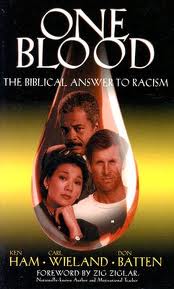
One Blood: The Biblical Answer to Racism is Ken Ham’s contribution to efforts to mend racial prejudice.

One Blood: The Biblical Answer to Racism is Ken Ham’s contribution to efforts to mend racial prejudice, and I do think Ham is genuine in his efforts. He believes that the understanding that all humans are descended from Adam and Eve, and ultimately from Noah’s three sons, is what is needed to curb racism. He also believes that the roots of racism are found in the theory of evolution, and that it was this theory of the races that inspired such atrocities as the Holocaust. Ham’s ideas – that racism stems from evolution and that creationism is the antidote – are echoed by other prominent creationists, including creationist heavyweight Henry Morris.

I grew up reading this literature and firmly rejecting both (overt) racism and the theory of evolution.

Here is an image from the Creation Museum, an image which describes a theory of human origins that I accepted as gospel truth until college:

babel

I was taught, and Answers in Genesis teaches, that Africans are the descendants of Ham, that Europeans are the descendants of Japheth, and that Asians and Middle Easterners are the descendants of Shem. I’m not surprised, then, to learn that some public school classrooms in Texas are using creationist textbooks that contain the following image:

racial

Growing up in a Christian homeschool family, the textbooks we used for subjects like history and science were suffused with religion, and this theory of racial origins is exactly what I was taught – and what Answers in Genesis teaches. What I didn’t realize, and what Answers in Genesis seems weirdly oblivious to, is this:

This theory of racial origins is actually, well, racist.

Somehow this flew over my head growing up – which is weird, given my familiarity with the Bible – but the story of Noah’s three sons is not somehow equal or without preference or value judgment.

Genesis 9: 18-27

The sons of Noah who came out of the ark were Shem, Ham and Japheth. (Ham was the father of Canaan.) These were the three sons of Noah, and from them came the people who were scattered over the earth.

Noah, a man of the soil, proceeded to plant a vineyard. When he drank some of its wine, he became drunk and lay uncovered inside his tent. Ham, the father of Canaan, saw his father’s nakedness and told his two brothers outside. But Shem and Japheth took a garment and laid it across their shoulders; then they walked in backward and covered their father’s nakedness. Their faces were turned the other way so that they would not see their father’s nakedness.

When Noah awoke from his wine and found out what his youngest son had done to him, he said,

“Cursed be Canaan!

The lowest of slaves

will he be to his brothers.”

He also said,

“Blessed be the Lord, the God of Shem!

May Canaan be the slave of Shem.

May God extend the territory of Japheth;

may Japheth live in the tents of Shem,

and may Canaan be his slave.”

“The curse of Ham” was used by antebellum Americans as a justification for slavery.

Africans, after all, were descended from Ham, and Ham was cursed by God and ordered to serve his brothers Shem and Japheth. (For more background, I highly recommend Sylvester Johnson’s The Myth of Ham in Nineteenth-Century American Christianity: Race, Heathens, and the People of God.) In other words, in spite of what Answers in Genesis maintains, racism both long predates the theory of evolution and has frequently sprung from the Bible and from the creation account itself.

Am I saying that the theory of evolution has never been used to justify racism? Of course not. Am I saying that modern creationists are of necessity racist? Not at all. What I am saying is that Answers in Genesis’ insistence that racism stems from the theory of evolution and that creationism is automatically anti-racist is both overly simplistic and factually incorrect. While I am very glad Ham wants to combat racism, I don’t think he completely understands that he is working to do so by promoting a theory of origins – that all men descend from Shem, Ham, and Japheth – that has long been seeped in racism. While this idea may hold no racist implications for him, it does for many others, especially in the American South.

(After writing the above I read this excerpt from One Blood, and I suddenly wonder if I am giving Ham too much of the benefit of the doubt. I clearly need to reread the book. Ham argues that “the curse of Ham” was actually only meant to be a curse on Canaan, but he somehow does that without making things much better at all.)

Preventing Your Daughter from Going to College

Screen Shot 2014-10-03 at 12.14.56 AM

HA note: The following is reprinted with permission from Libby Anne’s blog Love Joy Feminism. It was originally published on Patheos on October 1, 2014.

Pastor Karl Heitman recently wrote a blog post titled “2 Reasons Why My Daughter Will Not Go to College.

I pledged to myself that I will not sacrifice my daughter on *the altar of men* by sending her out of my home, care, and protection at age 18 just so that she can get a degree and achieve some worldly status. I will count those years as a precious time for my wife and me to prepare her for the wonderful task that’s ahead. The job of being a wife and mother is a high calling and I would argue is the most important job under the sun.

The first thing that occurred to me is that this isn’t Heitman’s decision, it’s his daughter Annalise’s decision (Annalise is only five at the moment). Whether Heitman likes it or not, when Annalise turns 18 she will be a legal adult and he will have no control over her decisions. Or will he?

Our current system of paying for college is messed up—including our financial aid system. If Heitman’s daughter wants to file a FAFSA to apply for financial aid, she will have to have a parent’s signature. If Heitman refuses to sign her FAFSA, Annalise is out of luck where financial aid is concerned—unless, of course, she can prove that she was abused. But I’ve seen that process, and it can be complicated, because you have to present supporting evidence. And besides, what if she isn’t abused, at least in any legal sense of the term?

But of course, even this presumes Annalise qualifies for financial aid. She might not. The general assumption is that when a young adult’s parents make too much money for her to qualify for financial aid, her parents will pitch in and help pay for her college. After all, the system is set up specifically to help young adults whose parentscan’t afford to pay for their college.

If Heitman makes enough money, Annalise may not qualify for financial aid.

So, Heitman could deprive Annalise of financial aid, and it’s possible that she might not qualify anyway. What then? It’s very unlikely that Annalise will have money to pay for college herself, especially given the rising expense. She might have a family member—an aunt or grandparent—who could help her out, but chances are her only other option would be a loan. And guess what? Someone has to cosign a loan. What if Heitman refuses to cosign a loan? Annalise might be able to find an uncle or cousin to cosign, but that’s uncertain.

Our current college financing system presumes that parents—whether poor or rich—want their children to be able to go to college. It assumes that parents of young adults—and we’re talking anyone between 18 and 24—will help pay for their children’s college if they can afford it, and that those who can’t afford it will sign their children’s FAFSAs so that they can get financial aid. But these assumptions are not always accurate, and when they’re not, it’s the young adult who is left holding the bag.

Our economic system is set up such that some of the greatest financial burdens an individual will bear occur at the very beginning of adulthood. Unfortunately, when a young adult’s parents don’t help them out—by signing a FAFSA, helping out financially, or cosigning loans—their futures and options may be severely curtailed. Yes, there may be other options—various trades, attending community college while working—but some doors are simply closed.

What of Heitman’s plan for Annalise to spend her adult years as a wife and mother? The trouble is that during the years parents—usually mothers—spend as homemakers and caregivers, they aren’t accruing social security benefits, they don’t make money, and they don’t acquire career skills or work experience. Now yes, there are things that matter more than money. But the trouble is that, in the system we currently have, a mother who stays at home (and it is usually the mother) is incredibly dependent on her husband. She’s dependent not only in a current sense (financially) but also in a future sense (social security benefits) and in a sense that increases over time (as the gap on the resume widens).

This is especially true if a woman did not attend college or gain work experience before transitioning to life as a stay-at-home mother.

As for me, I was lucky. My parents taught me that my role in life was to be a wife and mother, and absolutely not to have a career, but they still sent me to college. They told me they wanted me to have a backup plan, and options available if I didn’t marry immediately or if my husband someday were to lose his job or die. They also said that college-educated men generally want to marry college-educated women, for the intellectual compatibility. In fact, they described the money they paid for my college as my “dowry.” Of course, college graduates marrying college graduates is likely more about social homogeneity than intellectual compatibility and college is not always necessary to ensure that a young woman is prepared to support herself.

But Heitman isn’t saying that he wants to prepare is daughter to support herself using avenues outside of college. He explicitly states that he doesn’t think his daughter should be prepared to support herself. I’d like to say that Heitman is unaware of just how dependent he plans to make his daughter on her future husband, but his words make it clear that that’s not true. He argues that it is right and natural for a woman to be dependent on her husband—and obedient to him. And of course, divorce is not seen as an option. A married woman is supposed to be shackled to her husband, for good or for bad.

And besides, what if Heitman’s daughter doesn’t marry straight out of high school, or until her thirties, or at all? What would Heitman have her do—live at home with him, waiting for her prince charming to appear?

Unfortunately, he answers this question with a resounding “yes.”

I’ve read a variety of commentary on Heitman’s article, and want to highlight this bit:

Better titled “Many numbered reasons your daughter will distance herself from you when she realizes she has been given free will and stops being afraid to use it.”

This father may not realize it, but his assumption that he can dictate his daughter’s life trajectory and make her adult decisions for her will likely come back to bite him in the end, especially if he deliberately sabotages her options. Again, I have watched this happen. I know young women who have found themselves in this position, with parents unwilling to sign a FAFSA or help out in any other way.

The young women generally make it through, with blood, sweat, and tears, but their relationships with their parents generally don’t.

How Not to Address Marriage or Child Abuse

Screen Shot 2014-09-20 at 2.13.08 PM

HA note: The following is reprinted with permission from Libby Anne’s blog Love Joy Feminism. It was originally published on Patheos on September 3, 2014.

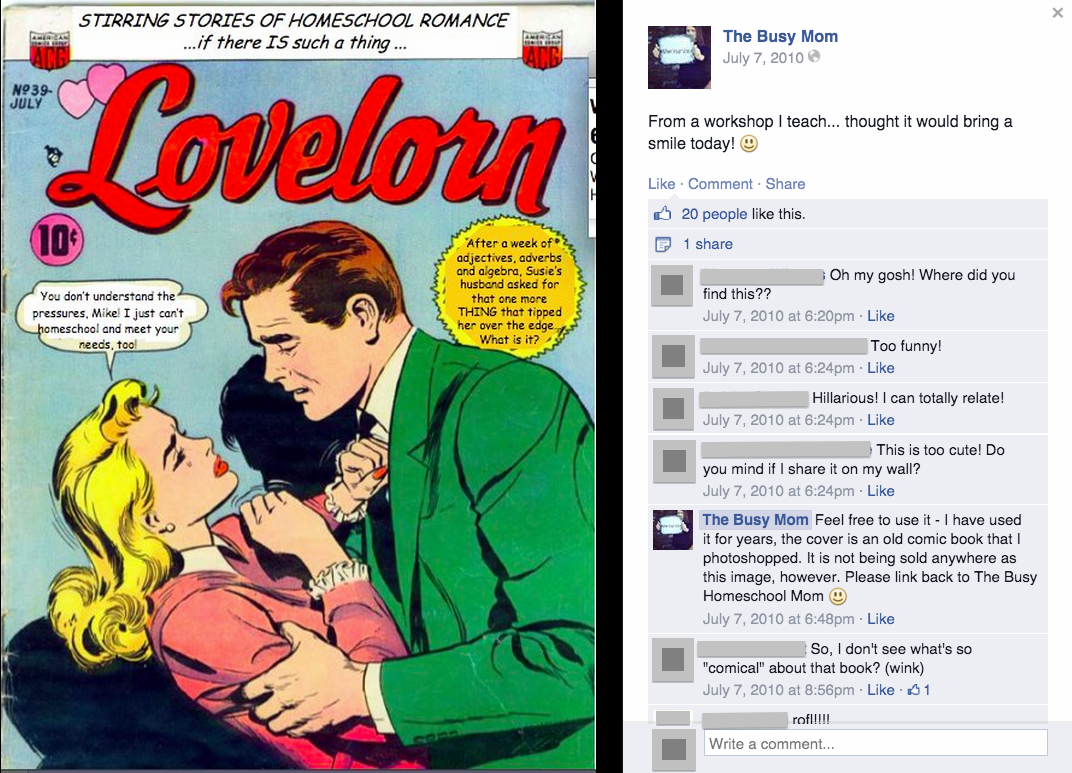
I recently came upon an image posted on Facebook by homeschool mom, speaker, and writer Heidi St. John.

I’m not sure what’s more disturbing—this image, or that none of the moms commenting on it saw this image as disturbing.

Rape-Culture-FB

The image is photoshopped from an old comic that depicts an employee sexually assaulting his “frigid” boss (see here and here or view the full comic here). Sure, one could try to argue that the image has been removed from that context, what with the new words in the bubbles and all, but that fails given the tear on the woman’s cheek and the fact that she is clearly trying to fight the man off (notice her pounding fists). Whatever the words, the image clearly depicts a woman futilely trying to fight off a stronger man’s advances. In fact, in the context St. John provides the image, it appears to be depicting attempted marital rape.

Heidi St. John runs The Busy Mom blog and holds retreats for homeschooling moms. She and her husband run several ministries, including Firmly Planted Family and Firmly Planted Co-ops, which has member co-ops across the country and offers a workbook on how to make sure your homeschool co-op is “firmly planted”. St. John is also the author of The Busy Homeschool Mom’s Guide to Romance, among other books. The author’s blurb is as follows:

busymomHomeschooling offers parents the best opportunity to shepherd their children both academically and spiritually. Yes. It’s worth it. But do you ever feel as if your life is all homeschool all the time? Do you ever wonder where the girl your husband married went? This book is for every mom who has collapsed into bed at the end of the day, looked into the eyes of her husband and promised tomorrow, she’d have time for him. Trouble is, tomorrow finds her more exhausted than the day before. If you have ever felt caught between the demands of homeschooling your children and meeting the needs of your husband, you’re not alone. Read and discover how even a busy homeschool mom can make time to nurture her marriage. It s not as hard as you think and more important than you may realize. Pre-order your copy today!

I am sure St. John has some genuinely good advice. The Amazon reviews of her book (which I have not read) speak of chapters on things like household organization and “me time.”

My concern with St. John centers on two things: first, her use of the comic book image makes me concerned about what she teaches regarding sex and consent, and second, her treatment of HA and HARO on her facebook wall makes me concerned about how her homeschool co-op ministry addresses (or does not address) things like abuse or neglect.

First, the comic book image.

The trouble is that an image like this, in the Christian homeschooling community St. John is very much a part of, arrives in a context already influenced by writers like Debi Pearl and the teachings of Bill Gothard and others. These leaders explicitly teach that a wife should never say “no” to her husband’s sexual advances. These leaders do not recognize the existence of marital rape, because they see sex within marriage as the husband’s right.

Coming in this cultural context, St. John’s image is not “funny.” It’s a problem.

It normalizes coercion and marital rape.

Second, St. John’s treatment of HARO and HA.

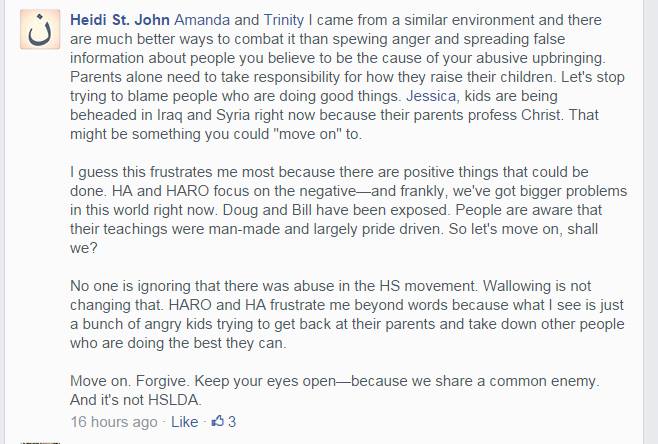
Last week St. John posted a defense of HSLDA on her facebook wall, and several homeschool alumni who had mutual friends with her left comments sharing their stories and trying to explain their concerns with an organization that defends child abusers and elevates parental rights while denying that children have rights. St. John’s responds was this:

HARO-and-HA

St. John’s response to abuse in the homeschooling environment is “we’ve got bigger problems in this world right now” and “move on.” She calls homeschool-alumni-turned-reformers “a bunch of angry kids trying to get back at their parents.”

This should not be acceptable.

I’d like to see St. John reach out to member co-ops with information on recognizing and reporting abuse and neglect, perhaps using resources developed by HARO or CRHE, but her response here suggests that she doesn’t see this as a priority. Instead, she’d rather stick with praising HSLDA and condemning homeschool alumni who point out that HSLDA’s policies protect abusers (which they do). My concerns here are much, much bigger than Phillips and Gothard. Those two leaders have gone down in scandal, but they were never the center of my concerns. The valuing of belief over people, the glossing over things like consent, the minimizing of the need to protect children—these are things that concern me.

And St. John reminds us, once again, that these things haven’t disappeared with Phillips and Gothard.

I Am a Homeschool Alumna. I Care.

Screen Shot 2014-09-16 at 12.12.16 PM

HA note: The following is reprinted with permission from Libby Anne’s blog Love Joy Feminism. It was originally published on Patheos on September 8, 2014.

You know what I’m growing really tired of? Comments like this:

There are vastly more kids in public school than are homeschooled, and abuse and educational failure are widespread in those institutions. More kids are affected by the incompetence of the public schools, yet you have devoted quite a bit of time and space here to homeschooling failures. Your interest in homeschoolers seems disproportionate to the problem.

I’m sorry, what? It reminds me of Heidi St. John’s comment:


HARO-and-HA

The relevant excerpt being:

Kids are being beheaded in Iraq and Syria right now because their parents profess Christ. That might be something you could “move on” to . . . . frankly, we’ve got bigger problems in this world right now.

What I’m hearing in these comments from homeschool parents is that the only possible reason homeschool alumni could possibly want to protect homeschooled children from abuse and neglect is to “get back at” their parents.

That sounds ridiculous, doesn’t it? Of course, these homeschool parents claim—with absolutely zero evidence—that homeschool alumni like myself are not interested in protecting homeschooled children but rather in taking down homeschooling. I’m having troubles finding words for how angry this complete unwillingness to actually listen makes me.

What I also see, though, is a lack of interest in the needs of current homeschooled children, which is odd given that most of this is coming from homeschool parents. Those who say that it is illegitimate to worry about homeschooled children until the problems in public schools are fixed are suggesting that the interests and safety of homeschooled children are secondary to those of public schooled children. As a homeschool alumna, this is really insulting. Yes, public school children matter. And so do homeschooled children. All children (and all people) matter. All children have an interest in a safe upbringing and a basic education—including homeschooled children.

I am asked why I should care so much about the wellbeing if homeschooled children, as opposed to some other cause. The answer to that is very simple. I was homeschooled. Aren’t alumni expected to care about their alma mater? For me, that’s what homeschooling is. I have sympathy for homeschooled children because I was one. I am a homeschool alumna.

Homeschool alumni have created a variety of organizations in the past year and a half. There is Homeschoolers Anonymous (HA), where homeschooled alumni who had negative experiences share their stories. There is Homeschool Alumni Reaching Out (HARO), which focuses on awareness raising and support for alumni. There is Homeschooling’s Invisible Children (HIC), a database of documented cases of child abuse or fatality in homeschooling settings. There is the Coalition for Responsible Home Education (CRHE), which focuses on research, resources, and policy.

Homeschool parents can say what they want, but they can’t make us go away.

Failing to Understand the Dynamics of Abuse: Focus on the Family on Adrian Peterson and Corporal Punishment

Screen Shot 2014-09-17 at 1.29.11 PM

HA note: The following is reprinted with permission from Libby Anne’s blog Love Joy Feminism. It was originally published on Patheos on September 17, 2014.

Yesterday, Time Magazine’s parenting section featured an article by Focus on the Family’s Jared Pingleton. The article, titled “Spanking Can Be an Appropriate Form of Child Discipline,” addresses the controversy surrounding Adrian Peterson’s suspension from the Minnesota Vikings on pending child abuse charges after leaving open lacerations on his son. In his article, Pingleton makes a case for corporal punishment while clearly calling Peterson’s actions abuse.

Pingleton begins his article with this stand-alone sentence, in bold:

We won’t go wrong if we exercise a firm and consistent hand with a soft and loving heart.

The problem with this statement is that Peterson was exercising a “firm and consistent hand,” and he was disciplining “with a soft and loving heart.” After being taken to court for injury to a child and then suspended from his team, Peterson apologized for causing his son harm, but he was very clear initially that he did not see anything wrong with his actions—and for good reason. After administering corporal punishment to his son, Peterson texted this to the child’s mother:

Never do I go overboard! But all my kids will know, hey daddy has the biggie heart but don’t play no games when it comes to acting right.

This is exactly what Focus on the family and other groups that advocate corporal punishment promote—the argue that a parent should act from a heart full of love, but exercise a firm hand when it comes to obedience and doing what is right. Is it any wonder that Peterson felt he had done nothing wrong? Many Americans were outraged by pictures of Peterson’s son—and for good reason!—but it makesabsolutely no sense to respond to this case by stating that corporal punishment should involve “a firm and consistent hand” and “a soft and loving heart.” In Peterson’s case, it did.

A parent can have “a firm and consistent hand” and “a soft and loving heart” and still abuse their children.

Before I go on, a few words of background. My parents used corporal punishment and did everything “right,” but my experience was nevertheless negative. Today I practice positive parenting and gentle discipline with my own children. Based on my experiences and a wide array of research, I would like to see corporal punishment phased out. I consider all forms of corporal punishment ethically wrong, though it’s worth noting that I do understand that not all are equally harmful. Slapping a child on their clothed bottom in an attempt to make a point is not the same thing as striking a child with an object and leaving bruises or welts. I dislike the term “spanking” because it erases these sorts of distinctions and everyone seems to define it differently. Finally, to avoid confusion I tend to adhere to the guidelines generally followed by social services and reserve the label “abuse” for corporal punishment that causes bodily injury (i.e. bruises, welts, and worse). That is the definition I will be using throughout this post.

My concerns with Pingleton’s article are twofold. First, Pingleton others child abusers to the extent that he makes it impossible to consider that seemingly normal, loving people could be child abusers. The reality is that child abusers often get away with their actions because they can fool those around them into seeing them as kind, loving people who would never harm their children and thus can’t be child abusers. Second, Pingleton reinforces the many justifications child abusers use to defend their actions. Child abusers are rarely malicious or sadistic. More often, they believe that they are just trying to do right by their children, and that pain is how children learn. Yes, Pingleton condemns child abuse, but he seems to lack any understanding of the dynamics of abuse. If he actually understood these dynamics, he would see that his words also serve to make abusers invisible and reinforce their justifications.

Here is an example of how Pingleton others child abusers:

There is a giant chasm between a mild spanking properly administered out of love and an out-of-control adult venting their emotions by physically abusing a child.

In creating this dichotomy between abusive and nonabusive parents, Pingleton is clearly putting Adrian Peterson’s actions in the “out of control adult venting their emotions by physically abusing a child” category. But there has been no indication that Peterson was out of control (i.e. that Peterson was not in careful control of his actions the entire time) or that he was venting his emotions (Peterson has been clear that the punishment was administered to teach his child to not shove other children). Pingleton is trying to shove Adrian Peterson into a child abuse box he has fashioned many sizes too small, because he doesn’t understand who child abusers are or how they operate.

The reality is that there is no “chasm” between “mild spanking properly administered out of love” and “an out-of-control adult venting their emotions by physically abusing a child.”

Instead, there is a sliding scale. There is also no clear and obvious line between a “spanking” and a “beating.” This is what corporal punishment advocates like Pingleton miss. Adrian Peterson was not on one side of this scale or the other—he was somewhere in between. Different people put the line between acceptable parental behavior and abuse at different points on that line, as is made obvious by the fact that some Americans have defended Peterson’s actions as not abusive. This idea that there is a “chasm” between reasonable discipline and child abuse is nonsense.

We often have this caricature of a child abuser in our mind—out of control, angry—and while some abusers do fit that profile others do not. But when we believe abusers look like this caricature we have created, we create a situation where Adrian Peterson can still insist that he is not a child abuser—because he does not look like that. But the reality is that child abusers often don’t look like that at all. In fact, sometimes they look like this:

This idea that child abusers are some sort of monsters and that normal, loving people do not abuse their children a serious, serious problem.

It allows us to miss and overlook very real abuse because the perpetrators are nice, and smile, and say the right things. The reality is that abusers are very good at fooling others and looking picture perfect, and if we don’t understand that we will be likely to brush warning signs under the rug when they do appear.

Pingleton goes on:

It is vital, however, that spanking be administered within proper guidelines. The reports about the punishment meted out by Peterson to his son, and the consequent injuries his son suffered, indicate his behavior on that occasion was far outside those boundaries.

If this is what he wants to argue, Pingleton needs to drop his whole “we won’t go wrong if we exercise a firm and consistent hand with a soft and loving heart” schtick, because Peterson followed that short line of advice and did go wrong. Does Pingleton seriously think that parents who abuse their children don’t believe in being firm and consistent and administering discipline out of love? Does he not know that most parents who abuse their children say things like “this is for your own good” and “I’m only doing this because I love you”? Is he unaware that child abusers say things like “children need a firm hand” and “we have to be consistent”?

I’m glad that Pingleton recognizes that Adrian Peterson abused his child, but I’m troubled by his total lack of understanding of why it happened. He seems completely unaware that what he thinks is a caution against abuse—”we won’t go wrong if we exercise a firm and consistent hand with a soft and loving heart”—is in fact the very argument Peterson used to insist that there was nothing wrong with what he did when he left his son with open lacerations. If Pingleton wants to protect children from being abused, he needs to stop making abuse-enabling statements like that.

That Pingleton has no understanding of the dynamics of abuse is bizarre given that he is the director of Focus on the Family’s counseling program.

Pingleton goes on to give some guidelines for appropriate corporal punishment. He says that it should only be used in “cases of willful disobedience or defiance of authority,” and that “a child should always receive a clear warning” first and understand why they are being punished. The punishment should take place in a private area and should be “lovingly administered” and should not involve “the potential to cause physical harm.” Afterwards, the child should be told once again why they were punished, to ensure that they understand and have learned the intended lesson.

From what I have read, it appears that the only point where Peterson did not follow Pingleton’s advice was in causing physical harm—the open lacerations. But once again, the line here is less obvious that Peterson thinks. My own mother carefully followed the guidelines Pingleton laid out, but she did on very rare occasions leave bruises or welts, and on one occasion she drew blood with a switch. She nevermeant to leave bruises or welts, and certainly never intended to draw blood that one time. But when you’re hitting your child’s soft, bare bottom with a wooden paddle or a switch cut from a tree (my mother used both), it’s harder to make sure you don’t leave bruises, welts, or cuts than one might think. And as Peterson has said many times, he never intended to leave open lacerations—he did not realize that the switch he used would do that much damage to his son’s skin.

What I’m trying to point out is that while Pingleton thinks he is drawing an obvious and simple line between abuse and appropriate discipline, the line he is drawing is not nearly as obvious or clear as he thinks. A parent following Pingleton’s guidelines for administering corporal punishment can leave marks on a child completely unintentionally. After all, striking a child naturally involves some risk of harm. Lydia Schatz’s parents used a plastic switch to administer corporal punishment. This switch broke down the girl’s muscle tissue, and when fragments of muscle tissue entered her bloodstream it caused liver failure.

Lydia’s parents never intended for this to happen and in fact had no idea it could happen, but Lydia still died.

Later on in his article, Pingleton makes it very clear that corporal punishment should hurt. After explaining that parents have a responsibility to discipline their children, Pingleton quotes from the Bible:

No discipline seems enjoyable at the time, but painful. Later on however, it yields the fruit of peace and righteousness to those who have been trained by it. (Hebrews 12:11)

Pingleton argues that teaching children right from wrong should hurt—even that it must hurt—but that it’s for the child’s own good and will yield longterm fruits. This idea that discipline has to hurt, but will pay off in the long run—this was also part of Adrian Peterson’s justification for his actions. Whether Pingleton realizes this or not (and given his understanding of the dynamics of abuse it is likely that he does not), this is yet another argument commonly used by abusers—what they’re doing should hurt, they say, because that’s the only way the child will learn their lesson.

In his texts to his son’s mother, Peterson explained that the reason he went on for so long was that the child did not cry. He took that as an indication that he wasn’t hitting hard enough to get the message across—because getting the message across had to involve pain. Because of his belief that correcting his child’s actions must involve pain, Peterson denied that he had done anything wrong.

Pingleton ends his article with this paragraph:

Parenting is a hard job. None of us do it perfectly. And to make it even more challenging, none of our kids come with an instruction manual attached. But our children need us to do it to the best of our ability, with all the wisdom, love, gentleness and strength we can muster. We won’t go wrong if we exercise a firm and consistent hand with a soft and loving heart.

Pingleton finishes with the same sentence with which he began. He clearly wants to emphasize it. Pingleton says over and over again that abuse is a tragedy and is wrong, wrong, wrong, but he does not seem to recognize that his own words are inadvertently reinforcing child abusers’ justifications for their actions. Does he not realize that child abusers say things like “I’m only trying to make them a better person“? How is he unaware that child abusers say things like “pain is how children learn“?

Ultimately, this is one of my biggest problem with the arguments made by advocates of corporal punishment. Most of their arguments in favor of corporal punishments are the same arguments used by child abusers to justify their abuse. Their only caution against abuse appears to be clarifying that corporal punishment should be administered out of love rather than anger, but this plays into incorrect stereotypes about what child abuse looks like and is less helpful than they seem to think. Suggesting that parents use their own judgement to make sure they don’t go to far is equally unhelpful.

Most child abusers tell their children they are doing this because they love them, and most would deny that they’ve gone too far, or that they ever intend to harm their children.

How can Pingleton not see how his own words can be used to justify not only corporal punishment he considers appropriate but also actual child abuse? How can he not see that child abusers are not all evil monsters venting their anger on their children, and that suggesting that there is a huge “chasm” between child abusers and other parents serves to keep parents from self reflection and prevent people from seeing child abuse right in front of their eyes? How can he be Focus on the Family’s head of counselingand not see this?

On Crushes

Screen Shot 2014-09-15 at 10.24.29 PM

HA note: The following is reprinted with permission from Libby Anne’s blog Love Joy Feminism. It was originally published on Patheos on September 14, 2014.

Growing up on the conservative Christian homeschooling culture of courtship and purity rings made a lot of things about boy-girl interactions different. Everything was ramped up, accelerated somehow. Our mothers jumped straight from simple attractions on our part to the possibility of marriage. We did too.

I still remember my first crush. I was seven. He was nine. I was homeschooled, but he wasn’t. My mother and his mother knew each other from church. Finally, I got up the courage to ask him what he wanted to be when he grew up, to see if our life visions were compatible. He said he wanted to be a basketball player. I knew that almost certainly wouldn’t happen, and that even if it did, the longterm prospects were slim. This declaration on his part made him seem unwise, and thus definitely an unsuitable partner. How would I be able to submit to his headship when his life ambition was basketball player? I still thought he was cute and all, but my crush was for all intents and purposes over, because I knew there was nothing there for us.

We were told we shouldn’t date until we were ready for marriage. Well, they told us we shouldn’t date at all, that we should court, but that those relationships should not begin before each party was ready to marry. In other words, guy-girl relationships were intrinsically tied to marriage. Guy-girl relationships that weren’t marriage-oriented were wrong and would have all sorts of consequences.

In this context, it’s not surprising that we children would immediately jump to thoughts of marriage upon even the slightest crush.

Were there prospects? Could we possibly end up married, someday? If no, attraction must be crushed. If yes? Well, one can dream, right? I mean, I might be 14 and he might be 16, and we may not be ready for marriage and I might be too afraid of the opposite sex to talk to him anyway, but the most important pressing question is whether maybe, someday, we might be compatible and in a position to marry, right?

There was one young man whom I had always found gangly and awkward and unattractive, but when I headed off to college I learned that he was headed off to university to study engineering. Hmm, I thought. That’s good prospects. Maybe I should reconsider how I felt about him? If I played my cards right, perhaps there might be something there. After all, we had the same beliefs and background. Like me, he was from a large homeschooling family, even more conservative than mine if anything.

Reading that now, I’m struck by how mercenary it was. But that was my reality.

I don’t think it’s helpful to ramp the pressure up to 100 and insert the marriage question into the slightest childhood crush. Most people will have multiple relationships before they meet the person they marry, and that’s actually a good thing, because it’s how we learn and grow. I was taught growing up that we give away “pieces of our heart” every time we have a relationship. The ideal, I was taught, was for my very first relationship to lead to marriage. But the truth is that we learn and grow through our relationships. My husband wouldn’t be the person he is today if he hadn’t dated the two women he dated before me—and I like the person he is today. Far from depriving me of pieces of his heart, those two relationships improved him.

But perhaps what I find most unhealthy about this whole pieces-of-your-heart/your-first-relationship-should-lead-to-marriage ideal is what it means for young men and women who begin a relationship and find it turning south, only to feel that leaving the relationship is not an option. I know women today who found themselves in abusive relationships—yes, good evangelical homeschooled girls who followed the rules and courted good evangelical homeschooled boys—only to feel trapped. Leaving was out of the question—leaving meant not simply relationship failure but comprehensive life failure, and things lost that could never be retrieved.

I know what I’m going to tell my children: It’s okay. It doesn’t have to mean more than you want it to mean. Enjoy the moment. Focus on building healthy and fulfilling relationships rather than trying to force things toward marriage.

Oh, and also? Sometimes a crush is just a crush. And that’s okay.

Israel Wayne on the (Patriarchal) Father’s Role

Screen Shot 2014-08-24 at 11.26.02 AM

HA note: The following is reprinted with permission from Libby Anne’s blog Love Joy Feminism. It was originally published on Patheos on August 4, 2014.

Israel Wayne is supposed to be a voice of reason in the Christian homeschooling community. A homeschool graduate himself, and now a homeschool father, he travels the convention circuit and has written blog posts criticizing various patriarchal homeschool leaders. It’s a pity he’s unaware that he is himself one of those patriarchal homeschool leaders.

Unless you’ve been living under a rock lately, you’ve heard the smash pop hit, “Rude” by the group Magic!. It speaks about a young man, seeking permission to marry a traditional man’s daughter.

He is turned down by the young lady’s father, but rather than being rebuffed, he retorts with the line, “I’m gonna marry her anyway!”

This is obviously a disturbing thought for any man who has spent a couple of decades nurturing what he considers to be one of his most valuable relationships on the planet. How might a father respond to such a scenario?

Hi Israel! Guess what? I was one of those daughters!

My now-husband Sean asked my father permission to marry me, and was denied that permission. We got married anyway, and we’ve never—ever—regretted that. Believe it or not, I was actually in the best position to decided who I should marry, because I know my strengths, weaknesses, interests, and desires better than anyone else—including my father. I also knew Sean a whole lot better than my father did, or cared to, which meant I was also a better judge of his character, and I knew what I was getting into.

Had my father spent a couple of decades nurturing his relationship with me? Sure! But I had also spent a couple of decades growing, maturing, and transitioning to life as an independent individual. I was—and am—more than my father’s relationship with me. And it’s a good thing too, because my father let my decision to marry against his wishes ruin our relationship, when he didn’t have to. He’s the one who chose to let our relationship die. If he had wanted to keep that “valuable” relationship he could have, but chose not to.

This really isn’t all that complicated. It is completely reasonable for a young couple to choose to marry without parental permission. If that decision destroys a father’s relationship with his daughter, that is generally his doing, not hers.

As I read Wayne’s post, I became curious about the music video he was referring to. So I looked it up. Allow me to share it with you!

I don’t know about you, but I really appreciated this music video. The woman was clearly an adult, as I was when my father denied his permission. Furthermore, while the young man tried three times to get the young woman’s father’s permission, the father made absolutely no attempt to get to know him. It’s very clear that the father was judging based on outward appearances and prejudices rather than any actual specific concerns for his daughter’s happiness or safety.

Indeed, his daughter appeared just as sure and happy in her choice as is her fiancé.

But of course, Wayne has more to say:

I think the popularity of Magic’s hit, “Rude” emphasizes the shift that has occurred culturally in America over the past 60 years, where fathers are no longer considered to be important entities in family life. They are regularly portrayed on television and movies as weak, bumbling idiots, who are constantly rescued from their folly by their wives and children.

I don’t actually think this is the case. I mean yes, it is true that fathers are too often portrayed as “bumbling idiots” when it comes to things like childcare. This is a problem, and is a feminist issue—men are just as capable of being nurturing and devoted to their children as are women, and it is a disservice to so many fathers to suggest otherwise. And you know what else? Diaper changing isn’t done with ladybits. But I’m not so sure that this is what we see reflected in this music video. This father isn’t portrayed as a “bumbling idiot” but rather as a judgmental control freak who doesn’t want to let his adult daughter make her own life decisions. And the reason this portrayal hits home is that it happens. I’ve been there. I wouldn’t wish it on anyone.

There has always been a tension that has existed between fathers and prospective young men hoping to whisk away their daughters. I believe it was G.K. Chesterton who said that fathers in every generation feel that they taking a priceless vase and handing it to an ape when they give their daughters in marriage. There certainly are scenarios of over-bearing fathers who act in a domineering and abuse manner, but sometimes proper protection can be seen as over-protection.

You know something? I am not happy with being compared to a “priceless vase” to be put on a trophy shelf or handed over to a new owner. Can Wayne not see that this completely robs women of their autonomy?

How exactly can Wayne call out patriarchy in the homeschooling movement and then so clearly endorse it?

He apparently thinks that fathers should exercise some sort of veto power over their adult daughters’ marriage decisions—but this is the very problem we anti-patriarchy bloggers have been talking about!

And another thing—Wayne apparently thinks it’s easy to tell between “over-bearing fathers who act in a domineering and abusive manner” and “proper protection.” What is the distinction, exactly? Where is the line? My father certainly never saw himself as “over-bearing,” “domineering,” or “abusive.” From his perspective, he was simply trying to protect his daughter. Wayne throws in this bit about over-bearing and domineering fathers to try to assert that he is against “that kind of thing”—even as he advocates for it.

I’m not saying that fathers shouldn’t express any concerns they may have about their daughters’ prospective marriage partners. They absolutely should, especially if there are abusive relationship patterns or warning signs. But that doesn’t tend to be what Wayne or others like him are talking about. My own father refused to give his permission in large part because Sean was not “100% pro-life,” for example (yes, my father had a checklist). What Wayne and men like my father are concerned about is not healthy relationship patterns or abuse but rather ideological purity.

Even in cases where there are actual concerns about abuse, all a father (or mother) can do is express their concerns and then be there for their child. Adult women do not in fact need their parents’ permission to marry. Shutting the door in your daughter’s fiancé’s face is more likely to drive your daughter away than it is to make her leave her fiancé.

Wayne also includes (and appears to endorse) this homemade video. In it, the father threatens prospective suiters with assault and proclaims that he’s not afraid to go to jail for it. I had to stop before finishing it.

Look, daughters aren’t property to be bought and sold.

If you’re worried about your daughter’s safety, whatever happened with equipping them to protect themselves rather than trying to “protect” them by controlling their life choices? Because I’ll tell you this right now: controlling their life choices is not going to end well.

Actually, let me amend that—that’s not going to end well for you. Your daughter will probably make it through, with some therapy, and have a wonderful life with her chosen partner. You’re the one who will be left alone in the cold, written out of your daughter’s life—just like the father in the music video.

P.S. A number of people have that the young man in the music video comes across as too possessive, and as having little interest in what the young woman in question wants. I understand those critiques. However, it’s worth noting that the father appears to reject the young man based not on these concerns but on prejudice, and that in reacting as he does the father himself is too possessive of his daughter and shows little interest in what she wants. The result is that, regardless of the quality of her suitor, he drives his daughter away. I also do appreciate that in the music video the young woman appears to have her own agency and be just as into the relationship as the young man, for what it’s worth.

Critics may find the following interpretations interesting. Both are sung by women; the first is a lesbian interpretation and the second is sung from the perspective of the young woman rather than the suitor.