The Underlying Agenda I Didn’t Know About

HA note: The following is reprinted with permission from Julie Anne Smith’s blog Spiritual Sounding Board. It was originally published as “The Homeschool Movement: Its Reconstructionist Roots and Rushdoony’s Influence” on December 8, 2012.

*****

“We are authorized by God to challenge all that is not godly! God is angry with the wicked every day, and the sins of the wicked deserve the infliction of God’s wrath in this life as well as the life hereafter!” ~ R.J. Rushdoony

I know the title of this post seems dry and boring. If spiritual abuse is a concern of yours, I encourage you to take the time to read this post carefully. Check out the links and do some research on your own. The information I have found has compelled me to keep blogging, to keep telling my story, and to keep sharing the stories of others. I am just a little worked up on this topic.

There is much more to homeschooling than just educating children. There is much more to patriarchy and courtship than fathers being heads of home and parents involved in the process of finding mates for their adult children. You must know that there is an agenda going on.

This agenda ties these practices together. I thought I was homeschooling my children because I could do a better job than the local public school system. I thought I was homeschooling my children so I could include Bible in their education and also protect them from negative worldly influences. That was pretty much my agenda. But that was not the agenda of the people I looked up to – the leaders in the homeschooling community. We looked to the leaders because they knew what they were doing and could help guide us on our foreign path. But there was an underlying agenda that I didn’t know about, that they did not disclose. It was there all along, but it’s not so obvious. I want to expose that now.

My blog started with the intent to share about my family’s experience at a spiritually abusive church. There has been much heartache in that experience and then 3-1/2 years later, it continued as my former pastor filed a defamation lawsuit against me and 4 others (and lost) this past summer. I have seen the impact on my family and have done a lot of soul searching: What led us to that church? Who influenced my life as a Christian? Who influenced my life as a mother? Who influenced my life as I ventured into homeschooling my children? As I researched my primary influencers, I found a common thread of destructive ideologies within the homeschooling movement.

My first article on the homeschooling movement opened up a whole can of worms on a culture that I have been a part of for the last 20 years or so.  Some of these teachings (courtship, modesty/purity, full-quiver) have infiltrated churches and families who do not teach their children at home.  It is a powerful movement and I caught on to the movement without realizing I was part of it.  I embraced certain aspects of it, brought those aspects that I agreed with to my churches.   As we moved around the country (my husband was in the Navy), I shared these aspects with my friends and friends shared the aspects they learned with me, etc.That is how this movement spreads. It can be one particular teaching or many, but they all intertwine, feeding the agenda.

It is important to have knowledge of this movement because even if you have no desire to homeschool your children or maybe you are single or empty-nesters, this movement spreads to churches in some way or other and as we have seen with courtship, patriarchy, and other teachings, some of the teachings leave a devastating path with emotional and spiritual turmoil.

The other night I read an article about Michael Farris that got me worked up. Mike Farris is known as one of the key pillars of the homeschool movement. I wanted to share my thoughts on a situation regarding Michael Farris, but realized without sharing more background information, you wouldn’t get the full picture.  So, please allow me to do that now.

Before Michael Farris was a pillar in the homeschool community, there was another very prominent figure, Rousas John Rushdoony (1916-2001). I believe Rushdoony set the trajectory for the homeschooling movement.  Although Rushdoony died in 2001, he established the basis of the movement long before. These roots are in Christian Reconstructionism.

I found this article which described Christian Reconstructionism very well.  As you read the variety of quoted materials included in the post, I encourage you to keep in mind how the ideas of patriarchy, courtship, full-quiver tie in with this belief system:

What is Reconstructionism?

Reconstructionism is a theology that arose out of conservative Presbyterianism (Reformed and Orthodox), which proposes that contemporary application of the laws of Old Testament Israel, or “Biblical Law,” is the basis for reconstructing society toward the Kingdom of God on earth. Reconstructionism argues that the Bible is to be the governing text for all areas of life–such as government, education, law, and the arts, not merely “social” or “moral” issues like pornography, homosexuality, and abortion.

Reconstructionists have formulated a “Biblical world view” and “Biblical principles” by which to examine contemporary matters. Reconstructionist theologian David Chilton succinctly describes this view: “The Christian goal for the world is the universal development of Biblical theocratic republics, in which every area of life is redeemed and placed under the Lordship of Jesus Christ and the rule of God’s law.”

More broadly, Reconstructionists believe that there are three main areas of governance: family government, church government, and civil government. Under God’s covenant, the nuclear family is the basic unit. The husband is the head of the family, and wife and children are “in submission” to him. In turn, the husband “submits” to Jesus and to God’s laws as detailed in the Old Testament. The church has its own ecclesiastical structure and governance. Civil government exists to implement God’s laws. All three institutions are under Biblical Law, the implementation of which is called “theonomy.”

Let’s learn a little about Rushdoony. This is from Wikipedia:

Rousas John Rushdoony (April 25, 1916 – February 8, 2001) was a Calvinist philosopher, historian, andtheologian and is widely credited as the father of Christian Reconstructionism and an inspiration for the modern Christian homeschool movement. His followers and critics have argued that his thought exerts considerable influence on the Christian right.

I was glad to find this video on Rushdoony and his Reconstructionist beliefs. It is an interview with Bill Moyers of PBS and is very good. It’s still difficult for me to wrap the idea around my head that part of this belief system is to bring the Old Testament laws into modern times: e.g., death penalty for those who commit adultery, death penalty for homosexuals, etc.

This quotation — from a very interesting article — describes how Rushdoony took his Reconstructionist views and made a case for educating children at home and thus became known as the “father of the homeschool movement” by many:

Key to this strategy was the homeschooling movement.  Education, Rushdoony realized early on, was the best way to distribute his message. To that end, he wrote multiple books on the history of American education, charting its transformation from one-room schoolhouses and parochial schools to urban institutions. These books became guideposts for Christians who believed that public schools were indoctrinating their kids in the false faith of secular humanism. McVicar, the Ohio State scholar, says, “Rushdoony understood that if he changed the way Christians educated their children, he could change the way they thought.”

The homeschool movement is comprised of specific teachings/beliefs. These teachings come from various groups or individuals who share the common thread of homeschooling. These groups work independently and may have different focuses, are in different locations, but again, the foundational agenda can be found in Reconstructionist roots. Interestingly, I had the above paragraph typed up a couple days ago and a few minutes ago I read an article by Frederick Clarkson originally published in June 1994 about this Reconstructionist “movement” and how it has spread over the years:

A Movement of Ideas

As a movement primarily of ideas, Reconstructionism has no single denominational or institutional home. Nor is it totally defined by a single charismatic leader, nor even a single text. Rather, it is defined by a small group of scholars who are identified with Reformed or Orthodox Presbyterianism. The movement networks primarily through magazines, conferences, publishing houses, think tanks, and bookstores. As a matter of strategy, it is a self-consciously decentralized and publicity-shy movement.

This is exactly what I have seen happening in the homeschool movement and why it is so hard to pin down because it is not localized in one church, one denomination, or organization. Both the Reconstructionist and homeschool movements are so invasive and have spread the same way. You or people you know may be part of either the Reconstructionist movement or the homeschool movement and have adopted ideologies without even realizing it. I realized through my research that I furthered the homeschool movement by sharing books, CDs, talking to my friends about my new-found ideas. I had been a part of it all along endorsing it and spreading it quite convincingly among my friends and church acquaintances.

Here’s a little more on Rushdoony.  In 1965 he founded the non-profit organization called Chalcedon Foundation to promote the Reconstructionism.  Read Chalcedon’s vision statement here. Here’s a brief summary from Wikipedia:

The Chalcedon Foundation is an American Christian Reconstructionist organization founded by Rousas John Rushdoony in 1965. Named for the Council of Chalcedon, it has also included theologians such as Gary North, who later founded his own organization, the Institute for Christian Economics.

The Chalcedon Foundation provides educational material in the form of books, newsletter reports and various electronic media, toward advancing the theological teachings of Rushdoony’s Christian Reconstructionism movement. It is notable for its role in the influence of Christianity on politics in the U.S. and has been described as “a think tank of the Religious Right.” Rushdoony’s son, Mark now heads the foundation. The Chalcedon Foundation has been listed as an anti-gay hate group by the Southern Poverty Law Centerfor, among other reasons, supporting the death penalty for homosexuals.

We can see in the above summary that this Reconstructionist organization has infiltrated the education systems and politics in America with their Reconstructionist agenda.

Here are more articles I found interesting in researching this topic:

Invitation to a Stoning

Chalcedon Foundation Leads Christian Reconstructionists in Campaign to Convert Conservative Fundamentalist Churches

His Truth is Marching On

When we think of spiritual abuse, we think of it in the confines of a church. The homeschool movement is different because it has no confines. It is scattered all over the country, people can become as involved as they want in various groups, but what I’ve noticed is that there are behavioral characteristics used by those in the homeschool movement which are similar to behavior used by spiritually abusive church leaders. There are different dynamics, but the end results can be the same.  This is why I keep sharing personal stories about these topics.
Burn In Case Of Evil: Cain’s Story, Part Two

HA note: The author’s name has been changed to ensure anonymity. “Cain” is a pseudonym.

*****

In this series: Part One | Part Two | Part Three | Part Four

*****

"I don’t take spiritual advice from cultists."
“I don’t take spiritual advice from cultists.”

There are two versions of me: my parents’ version of me and my version of me.  Before my high school years, I don’t think there were two versions of me.  Instead, there was just the version my parents wanted.  This is probably true of most children, but my parents were fundamentalist Christians involved in ATI – a homeschooling cult.

In my middle school years (I can’t really tell time by years, or by grades, my youth is blurred and marked by big events or debate resolutions), my parents plunged me into the patriarchal/men-must-be-leaders movements of the 1990s.  They saw homosexuality, single women, women in authority, and feminism as threats to traditional gender roles.  So they trained me to be a warrior for godly men.  ATI’s version of this was called ALERT (Ralph has written about it here) and they liked to play Boy Scouts – but with less fun and more Bible study.  I became a biblical scholar around this age, constantly studying passages, their Greek and Hebrew meanings, cross-referencing those passages in lexicons and study tools, and recording my observations on something called the “Meditation Worksheet.”  Ironically, these worksheets prepared me deconstruct my cultic worldview and to rebuild my own worldview– whoops!

I was that really Christian kid that probably drove you nuts.  I preached to my Christian neighbors that they shouldn’t be reading the NIV because it was Satan’s tool to undermine the divinity of Jesus.  I passed out tracts at restaurants.  I was not afraid to judge everyone, as a thirteen year old, and inform them about the Straight and Narrow Path to Holiness.  Some of my closest friends became the pastor of our small Southern Baptist church – we would regularly discuss theology.

In high school, I started to think for myself and form my version of me (I’ll call it “me-me” and my parents’ version “parent-me”).  Whenever me-me would discuss his thoughts with my parents, I would come into conflict with them.  Their Christian worldview permeated every sector of knowledge – biology, geology, and especially politics, history, and religion.  Throughout my high school years I vacillated between me-me and parent-me.  At will, I could “turn off” all the parts of myself that my parents disliked.  However, when there was something me-me really wanted that I couldn’t just “turn off” my desire for, it drove me crazy.  Usually it was girls.  It wasn’t a sexual thing, I just loved the intimacy and having someone I could share all my teenage angst with.  My parents and I fought for probably five years over girls.

My parents decided that I needed some relationship indoctrination, so I got to learn all about “courtship.”  Courtship is about as traditional and stupid as it sounds.  I was told that I was supposed to “guard my heart” against “serial dating.”  They made dating and breaking up sound like this violent emotional crime that left people with long-term scars.  This meant that, before I entered into any relationship, I was supposed to ask my parents’ permission before I asked the girl’s father for permission to date her.  Mind you, all power and authority over women was supposed to flow through men.  Like any good patriarchy.  Physical contact during a courtship is almost always a strict no-no.  You are not allowed to hold hands, kiss, hug, or even be together alone.  Some of the courtships I have seen have ended in terrible marriages and, in one case, double homicide.

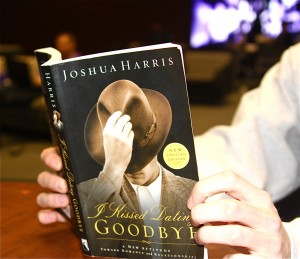
This idea of courtship was huge and fixated on sexual purity and emotional purity.  It grew huge after Joshua Harris’ book I Kiss Dating Goodbye and it was advocated at basically every homeschooling event and by most institutions.  Some groups formed solely for the purpose of educating people about courtship and Patrick Henry College (started by Michael Farris to train homeschoolers to be influential in Washington, D.C. politics).  ATI was huge about courtship, they even advocate betrothal!  That’s where the children have even less power in their romantic lives and the parents “pick” out a decent mate for them, then they are forced into a marriage because it’s “God’s will.”  Of course, only fathers, and occasionally mothers, know God’s will

So commitment in my romantic relationships was usually propelled by the guilt of needing to be in a “courtship.”  Of course, you aren’t supposed to court until the man is financially able to support a woman, which meant I was supposed to avoid romantic relationships til my mid-20s.  This was unacceptable, so I just engaged in quasi-courtship with three different girls through high school – sort of promising to marry them all, planning our lives and futures together, and then usually they broke up with me because God told them to (though I was an ass).

I remember I would form a lot of what would become my identity on the car rides home from something.  My truck became my only escape on a daily basis – with my truck came the first time in my life I had literal freedom.  I could go where I wanted, when I wanted.  That freedom usually provoked thoughts and I would work big issues like courtship in my mind listening to music.  I’m always amazed at how my parents will dismiss me-me and try to guilt and shame parent-me out of the shell.  De-construction and re-construction your identity is not easy and my parents always acted like it was fun for me to rebel.  Yes, when I was a teenager it was fun to let the immature me-me out for a joy ride, only to be clamped down on and repressed.  But that excitement ended in college.  I slowly came to a peace about myself that did not depend on my parents, or their affection.  Finding the me-me was one thing, but synthesizing that into my emotions was much more difficult.

I say all this to try and explain both of the versions of myself.  I can be parent-me, I can turn it on, and turn off my own desires and personality.  It took years for me to even find out what me-me wanted from life and I found a tremendous peace when I discovered my desires and not my parents’.  Throughout college, I would go home and I would let a little more of me-me come out – it was a very slow “coming out,” to borrow a phrase.  I admitted to smoking tobacco.  That I wasn’t a libertarian anymore, I was a liberal – lots of these involved political discussions where my parents felt almost as betrayed that I no longer shared their political beliefs than if I had renounced the faith.  I never did renounce Christianity, only the corrupt vessel of the Christian church.  Admitting I was dating took awhile – I just recently admitted I believed in evolution.  Usually, each admission of the me-me ended in a fight or conflict.  Even in college, they could not let go.

When I first started dating my wife, I asked if she could stay the night in my parent’s house because I needed a ride back to school.  My father said he wasn’t comfortable with that because it would give my younger sister a bad example of “serial dating.  To put this in perspective, this would be the second girl I brought home to my family ever.  I said that I was really serious about this girl and if they chose to act like this, I would tell my girlfriend, and I would understand if she didn’t want my children around them.  This sobered them up quickly and they agreed to let her stay.  But it demonstrates the types of conflicts that would occur when me-me contradicted parent-me.

When my parents manage to convince me to attend their church, my mom always expects me to sing.  My mother and I spent a lot of time bonding in the church choir when I was younger, so she expects me to find the same joy in it now as I did then.  It simply does not work like that.  Me-me does not enjoy church because it reminds me of all the negative feelings of guilt, shame, and intense pressure to be good.  These days when it comes to spirituality, me-me cannot compromise.

Even now that I am married, my parents still want and expect parent-me.  I don’t like the same things, I’m not the same person, and when they laugh and reminisce about the great times they had with parent-me, I can’t help but feel uneasy inside.  They reminisce for parent-me because they know they may never see him again.  They still try to draw on the guilt and shame they instill in me by saying things like “that’s not what we wanted for your life.”  Or telling me the consequences of my sins, then questioning why I don’t think certain things are sins.  When they pressure me-me to revert to parent-me, I get angry, defensive, and emotional.  So I just stop expecting anything, sharing anything, being vulnerable.  I don’t want parent-me for my life – that should mean something.  And I don’t take spiritual advice from cultists.

To be continued.

Homeschool Movement and Abuse, An Introduction

HA note: The following is reprinted with permission from Julie Anne Smith’s blog Spiritual Sounding Board. It was originally published on October 4, 2012.

The lawsuit from my former abusive church has come and gone and I have been doing some deep thinking — trying to figure out what brought us to that particular church — what made that church appealing to us? I had to acknowledge that this church, like other prior churches, was strongly pro-homeschooling. In fact, if you didn’t homeschool, you may not feel very comfortable there. So, it made me go back further, all the way back to the very beginning — before we started homeschooling and were investigating. What I have discovered is alarming:  patriarchal teachings that are often times abusive, parenting styles that are often abusive, and ideas completely outside of mainstream Christianity are going on in the homeschool movement.

My husband and I have been married 27 years and have 7 children from 25 yrs down to our 6-yr old “caboose”.  We have always homeschooled.  We have always believed that this was the best choice for our family.  We have been to many churches due to my husband’s military service and job changes.  Many people have influenced us in our homeschooling, parenting, marriage, and our Christian life journey and right now, I am angry.   I am angry about what I have discovered looking over our marriage, looking at our parenting styles over the years, looking at decisions we have made, looking at people who influenced us — people we trusted to be godly, like-minded and who wanted the best for their children and families.

If you have not been connected with the homeschool movement and click on some of these links, you might say:  ”Um, yea, you drank the Kool-Aid long ago.”  If you’ve been in the homeschool movement, you will probably be nodding along and can reminisce with me. I will take you on a wild journey going back through what I have experienced or seen in the past couple decades as a homeschooling mom.  Here is a sampling, and not in any order, of the kinds of influences, beliefs, philosophies, practices we dealt with or were familiar with among the homeschooling movement over the years:

Why did we have so many children?  How do you know when your quiver is full?  Would we have had this many children if we hadn’t listened to specific teachings?  Who invented the jumper dress?  Why did I sometimes feel guilty if I didn’t wear my denim jumper?  I no longer own a denim jumper.  Who decided Gregg Harris or Michael Farris were the spokesmen for homeschoolers?  Why did so many homeschoolers flock to the articles and books of Mary Pride?

Is it okay to refrain from sex to not get pregnant or is that saying “no” to God’s blessings of children?  Did it really mean one isn’t trusting God if taking measures to prevent pregnancy after cycles returned 6 weeks postpartum (and round-the-clock nursing)?  How many blessings of babies did I prevent by taking matters in my own hands?  Is God mad at me for my “interference” of “His plan”?

What about all of those families who stop having babies after only 4 children or 2 children — are they disobeying God?  Why don’t they want God’s blessings?  Who is targeting the homeschooling community to convince them to pop out babies to overpopulate the world with Christians babies?  Why does this same dude bombard our mailboxes right before Christmas to encourage us to buy Christmas toys (gender specific boy toys for boy and girly girl toys for girls) when their family does not celebrate this “pagan” holiday?

How did I get to the point where I believed that I may be treading dangerously if I was not a member of the Homeschool Legal Defense Association? Who would protect me if someone from school district came to my door and wanted to find out why my children weren’t attending the evil government school down the block?  How many homeschool families printed out instructions on what to say to government officials  if “they” came unannounced to our door to interrogate?  How many of us had HSLDA phone numbers in a prominent place — just in case? Where did all of this fear come from?

Why was I corrected when I said “public” school instead of their preferred “government” school?  Is there an agenda going on? Who is feeding all of this? Who decided that boys should be owning their own home businesses to support their families?  Who decided that all colleges were bad until Patrick Henry College was founded by popular homeschool leaders in the “movement” and then all of a sudden it became “okay” and even “good” to send our kids away to college?

How did the homeschool movement influence my views as far as who I voted for or how involved I was in politics? How did they convince me that I was eating improperly and I needed to grind my own wheat and make my own bread?  How did the homeschool community have the inside scoop before my traditional-schooled friends from church when it was going to become the end-of-life-as-we knew-it during the Y2K scare?  Who brought that hype to the homeschool community?  Would you like to ask me how many homeschoolers I personally know who are still going through their stockpiles of grains? Seriously!

When did I get to the point where I looked down at my friends who were Christians and either sent their children to public or private schools when “they should” be teaching their own?  How did all of this happen?  Why do so many homeschoolers balk at immunizations? Why are some homeschoolers so proud?  Homeschooled kids were the smartest because they always won the National Spelling Bees, right? Who decided that homeschoolers should be involved with speech and debate? Why are so many families going to their state capitals and involving themselves in politics — because they were going to be the movers and shakers of world in the political arenas?  And why is my husband responsible for my faith and the faith of our children? And why do we have to go through him on spiritual matters?  Does God not speak directly to homeschool kids and wives?

Who told me about modesty and how I should be dressing and how my daughters should be dressing?  What does modesty have to do with homeschooling?  Why do all homeschool boys look alike with similar short haircuts?   Who convinced me that my children could never “date”, but must only “court” and that my husband gets to choose our children’s future spouses?  How did, “I Kissed Dating Goodbye” become such a popular book?  Who named the government as “evil” for wanting to know how our children are educated?  Why do homeschoolers assume the worst when they file their “notice to intent” with their local school district?

Why do they assume that the school district secretary doesn’t want to deal with homeschoolers and will instigate more trouble by wanting more information than required by law?  Who made up this purity ring ceremony — and that our teen daughters should wear their purity rings symbolizing their virginity until they replace it with their wedding ring?  Who started this thing where daughters shave their fathers’ beards? Below you will see an invitation to a Father Daughter Tea from Vision Forum. Fast forward to 1:37 to see daughters shaving their fathers. Um, really?

Who decided that boys should have their homes paid for before they get married?   And why are organized sports so wrong?    When did Young Earth creation become a primary issue to be a Christian and that if you didn’t believe it, you might not be Christian?   Why are scientists looked at as if suspect?  Psychology is of the devil.  What’s with all of those pictures of large families with matching clothes on the covers of homeschooling magazines?  Are my children supposed to be wearing matching clothes?  Who decided that was the right way to dress kids?  Who decided that women should only wear dresses?

And what about those who show up at conventions with head coverings — are we bad women if we don’t have them?   Who decided that family-integrated churches were better than traditional churches for our family?  Why is it that homeschoolers brag about their children being able to interact and socialize well, yet you can “pick them out” a mile away because they look and act so “different”?   Who has been instigating the us-vs-them mentality regarding so many of these topics?  Who decided that the only job that we should be teaching our daughters is to be “keepers of the home” and serving their fathers and then serving their future husbands?

Who decided a 1/4-inch plumber’s line was an appropriate tool for spanking?  Who taught us that if we had to repeat a command twice to our children, our children were being disobedient:  First-Time Obedience.   How did we let this group convince us that all infants should be able to go 4 hours between feedings.  What single man decided that fathers were an umbrella of authority over the family below God?  What same man also encouraged men and women to get vasectomies and tubal ligations reversed to allow God to control the size of their families and then paraded post-reversal children in front of the auditorium at conventions?

This is quite a diversion from spiritual abuse in the church, but I need to go there.  I now believe the homeschooling movement made our spiritually abusive church seem appealing to us.  Some of the above is just plain quirky, but other issues go much deeper affecting core spiritual beliefs and agendas.

My daughter, Hannah, is 25 yrs old and she was only homeschooled.  The first traditional school she attended was community college and last spring she became a college graduate. Her peers were from an early generation of the growing homeschool movement. More and more blogs are being published by young adults like my daughter who are “coming out” and sharing their homeschool experiences.  The stories are not pretty.    My daughter has shared some of her story.  And you can read the story I wrote about Hannah’s experience here.  In that story, you can get an idea of the controlling environment in which she lived and how she had to escape – it remains one of the most popular blog posts.

What she experienced at home has probably gone on in many homes.  I bear much responsibility for it.  I went along with it.  I have apologized to my daughter many times for it.   The abusive church we found also aligned with these philosophies of heavy-handed control of children, even adult children.  Hannah was 21 when she moved out.  She was not a child, yet we thought we owned her.

I assumed (yeah, I know about that word), that when we got into homeschooling that it was a safe community — a community where children’s best interest was at heart.  We wanted to have the primary influence in the education of our children.  That’s good, right?

But I have discovered that there is an underlying agenda in the homeschooling community that has been there all along — even years before I started — and it continues to this day. I believe that some of this underlying current — taken to an extreme — could be responsible for breaking up families, causing abuse, wreaking havoc on people’s spiritual life.

I firmly believe that God used the lawsuit in a powerful way to highlight the issue of spiritual abuse in the church.  He was there during the entire time providing amazing support for me.  My life is rich having gone through it.  But now I’m wondering if God is using another experience of my life to share here.

While I have spent countless hours writing blog posts about spiritual abuse in the church, I think there is a setup for spiritual abuse that originates in the homeschool movement. In our abusive church, we felt a “kindred spirit” (and all the homeschool moms just laughed at me with that phrase) in the church because of with like-minded teachings and beliefs. Some of these ideas need to be explored further.

I think it’s important to hear from these young adults who have lived it and are now trying to put the pieces together of their childhood together as they begin their families.

Homeschooling Under the Influence

HA note: The following is reprinted with permission from Libby Anne’s blog Love Joy Feminism. It was originally published on Patheos on March 7, 2013.

After I wrote my posts on academics and socialization, I realized that there is another way homeschooling affected my life—and it’s no less significant. In fact, it’s a whole lot more significant. Quite simply, homeschooling affected my life because it changed my parents. When I was born, my parents were fairly ordinary evangelical Christians. That didn’t last. Their involvement in the homeschool movement introduced them to new ideas they had not before been exposed to—ideas put forward by people and organizations like Michael Farris and HSLDA, Michael and Debi Pearl and No Greater Joy, and Doug Phillips and Vision Forum. I simply cannot overestimate the affect this had on my life.

Libby Anne: "This is the real legacy of homeschooling on my life: the things that have left my family damaged and torn even today, temporarily patched back together but a shadow of what it could be."
Libby Anne: “This is the real legacy of homeschooling on my life: the things that have left my family damaged and torn even today, temporarily patched back together but a shadow of what it could be.”

Somewhere in all this were these toxic ideas about control, and this insidious idea fed to my parents that they could, by homeschooling, completely determine the way we children would turn out. The homeschool literature my parents read urged them to see themselves as gardeners carefully pruning and shaping us, tying us here and clipping us there, gradually turning us into their ideal Christian men and women. My parents were promised a result, promised perfect children if they followed the perfect homeschool formula. In some sense this entire ideology robbed my siblings and I of agency, turning us into mere projections of my parents, frozen snapshots pinned on the wall.

First, of course, was the dominionism. A big word for a simple concept, but apt nonetheless. Michael Farris is easily the best known figure in the homeschool movement, and the promises that fell from his lips were sweet to my parents’ ears, their path greased by the still-raging rhetoric of the culture wars. I heard Farris speak several times, in addition to reading his literature, and one motif he was fond of was that of the Joshua generation. Farris told parents that the public schools were like Egypt, and that they were the Moses generation, taking their children out of Egypt and educating them in the wilderness. Their children, he said, would be the Joshua generation, who like the Israelites’ conquest of Canaan would retake America for Christ, creating a nation built on Christianity and God’s law. My parents bought it hook line and sinker, and looked at my siblings and I as though we were their golden ticket.

Based on this newfound ideology, my parents told us children that the reason dad was working an ordinary job rather than being a pastor, or a missionary, or a politician was so that he and mom could raise up a large number of godly offspring to go out and do all of these things a hundred fold. We were the arrows in my dad’s quiver, and they were raising us to shoot out into the world to make a difference for Christ. This is called Quiverfull, an ideology born and nurtured in the homeschool movement, passed from homeschool mother to homeschool mother and homeschool co-op to homeschool co-op like a disease. My parents were honing us and training us, they told us, preparing us for this mission. Did I mention that this could feel dehumanizing, and stifling? Oh, sometimes it could feel gloriously empowering. But the only dreams we were allowed to have were the ones our parents fed us. Step outside of that, and our parents’ smiles would instantaneously turn to frowns. And believe me, we all knew it would happen. We watched it happen, sometimes to us personally and other times to our siblings.

This leads into my next point—the utter amount of control my parents exercised over all of us offspring. Somewhere around the time I was eight or so, another homeschooling mother passed my mom Michael Pearl’s To Train Up a Child. This child rearing manual urges parents to see any disobedience as outright defiance and to see the parent-child relationship as oppositional. In fact, it goes so far as to instruct parents in how to break their children’s wills—and to threaten that those children whose wills are not broken will grow up to be miserable failures in life. This was all new to my parents, but once again, they took it in as gospel truth. Their homeschool friends all swore by the book, so it must be right—right?

The biggest thing I remember in all this was the utter rage of not being listened to. Back talk was not tolerated. In fact, any questioning of a parent’s word was out of the question. Obedience was to be immediate, complete, and without question. If it wasn’t, it was disobedience. Oh, and obedience wascheerful. Sour faces got us sent to our beds. Normal human emotions were curtailed. Dragging your feet? Complaining? Moping? A spanking, or a timeout, or a hundred sentences to write. You’re trying to explain your case? More swats, more time, more sentences. Shut your mouth, don’t talk back. Don’t question your parents. Obey.

During my teenage years my parents adopted another line fed them by the homeschool movement—that the concept of “teenager” was a modern invention, and contrary to God’s plan for the family. Rebellion was unnatural, and not to be allowed. Questioning was frowned on, and quickly answered with emotional manipulation—the dense fog of disapproval was enough to make the strongest of us buckle and give in. Further, during our teenage years we were expected to bear the responsibility and workload of an adult, but without being given the freedoms of an adult. It was like being two years old, and thirty, in a fifteen year old body. Where we went, who we were friends with, what music we listened to, and what books we read—all was still carefully monitored and controlled. And being homeschooled meant we could never get away. We were smothered under all of it.

But there was more. At a homeschool convention my parents came in contact with the marketing and literature of Vision Forum, a group whose influence has become pervasive in many homeschooling circles. Their literature is passed from homeschool mom to homeschool mom and their speakers get top billing at the main homeschool conventions. Their message is a patriarchal family order that encompasses not just husband and wife but children as well—especially daughters. Words like courtship became commonplace, and the idea that fathers should help their daughters pick their future spouses suddenly became natural. Dating was quickly off the table completely, and we awkward homeschooled teenagers eyed each other warily from across the debate table or co-op room. The idea that you could control and direct your own love life? Unthinkable. Absurd.

And suddenly the male arrows were being fashioned very differently from the female arrows. My brothers were to go out and do great things for Christ, but my sisters and I? We were to be stay at home homeschool moms raising large broods. We learned to cook, and clean, and care for children, seeing our daily lives as junior mothers as practice for our future lives. It was an odd sort of tension we girls inhabited. We were to change the world—but we were to do so by being homemakers and raising a dozen or more children. The hand that rocks the cradle is the hand that rules the world. Choice? That’s a dirty word. All that mattered was your god-given role. Any earlier dreams I’d had were cut short and I was soon unable to dream beyond the future my parents so carefully laid out for me. And then there was the whole college thing. I got lucky. Through all of this my parents held onto the value they placed on education, and they sent me, a girl, to college in spite of the warnings against it they received from some quarters. I got an education. Other girls didn’t.

And then there was the huge problem when I began to question and leave my parents’ beliefs and ideology. Having been taught by the literature of the homeschool movement to see me as clay they could mold as they saw fit, they were shocked when I shook myself and chose my own direction. They had been promised the world, and were suddenly coming up empty on their investment. It was like the Greek myth in which Pygmalion sculpted a statue of his ideal perfect woman, and then it came alive. Or at least, it would be like that myth if Pygmalion had reacted with anger and rage when the statue came to life and dared move from the pose in which he carved it. When I began thinking for myself my parents reacted as though they suddenly saw me as broken, ruined. And in some sense I was. They had put everything into making me into this certain specific image, and then I dashed it all by asking questions and making up my own mind. I was like a mirror suddenly shattered into a shower of pieces. All of the plans they had built for me were ruined.

The homeschool movement took my parents, and it twisted them. The literature, the people, the groups, the rhetoric—my parents were drastically changed as a result of their decision to homeschool. The ideas that filtered into our home from the greater homeschool movement had an impact on my life the depth of which it is difficult to express. These ideas shaped how I saw myself, dictated my dreams, and created a fairy future that was dashed the moment I dared stop and really think about all of it. The triumphalist dominionism, the stifling authoritarianism, the all-encompassing patriarchalism—this was the stuff of my childhood. And the wake of destruction that followed was the rot produced by ideologies that so suffuse the homeschool movement that it’s a challenge for even the most independent-minded homeschooler to completely escape their sway.

This is the real legacy of homeschooling on my life. It’s not my academic achievement or the socialization issues I faced as a result of growing up in a bubble. It’s all of this, the things that have left my family damaged and torn even today, temporarily patched back together but a shadow of what it could be. The control, the conformity, the attempt to treat children not as individuals with their own agency but as beings to be molded into ideologically-perfect culture warriors. The emotional manipulation, the feelings of failure, the stunted and half-formed dreams. The pain, the tears, the way my blood pressure raises when the phone rings. The broken relationships, the fear, the anguish at what could have been. The ashes of a life so carefully built that burned down when I came of age, ashes blowing in the wind. I’m building something new today, yes, but the foundation I started on had to be razed and everything begun afresh, with echoes of the past still sounding in my ears, filling my dreams, and clouding my vision.

In some sense, none of this is the fault of homeschooling—but in another sense, all of it is. If my parents hadn’t homeschooled me, everything would have been different. This sounds like a huge claim, but it’s really not. My parents started homeschooling for educational reasons, not religious reasons. All of the stuff discussed above? It hit them after they entered the world of homeschooling, not before. And because my parents never stopped attending the evangelical megachurch that fit them well when I was small, and not so well as I grew, I can make a bit of a comparative study. By the time I was high school aged, there was a huge gap between me and most of the other kids who attended that church. They dressed like normal teens, listened to Christian rock music, and attended youth group. I didn’t associate with them or befriend them—for one thing, my parents felt the church youth group was too worldly, and for another thing, their social networks revolved around their schools and thus de facto shut me out. Instead, I stayed close to the homeschooled children of a few of my parents’ friends who had also attended the church from way back. We were different—they were like me. If we hadn’t been homeschooled, we would have been like those youth group kids. Evangelical, yes, but normal evangelical.

The most prominent leaders and organizations of the homeschool movement—the curriculum publishers, the speakers, the conferences—are currently awash in all of this toxic ideology. Courtship, and blanket training, and stay at home daughters, and the Joshua generation—it’s pervasive in many—if not most!—homeschool circles. Of course, there has always been dissent from this cocktail of ideas: you’ll find that while rural areas often only have Christian homeschool groups and co-ops, more liberal areas have two (or more) parallel networks—a larger Christian homeschooling community and a smaller secular one. The growing number of people homeschooling for purely practical and pragmatic reasons, combined with the advent of the internet, which has challenged the gatekeeper status of groups like HSLDA, may help turn the tide. But at the moment the messaging and the networking, all of that is still controlled by Farris et al., and that means that all of this—the dominionism, the authoritarianism, and the patriarchalism—is insidiously widespread among homeschoolers. And that means that when ordinary evangelical parents like mine enter the homeschool movement, they open themselves up to being pulled into a toxic cocktail of beliefs that may forever change their lives—and with them the lives of their children.

This is the true legacy homechooling has had on my life.