Love Jesus, All Else Be Damned: Sophia’s Story

Homeschoolers U

HA note: The author’s name has been changed to ensure anonymity. “Sophia” is a pseudonym specifically chosen by the author.

My parents are very well meaning people.

They didn’t go to college, and they didn’t grow up religious. Just before they started a family together, they came to Christianity. For them, it meant safety. It was a formula for doing things correctly and for protecting their children from the hurt that they experienced in their own lives, hurt for which Christianity offered an explanation (sin). They homeschooled us to “protect us from the world.”

Growing up, though, I didn’t feel protected.

Instead, the most vivid memories I have from my childhood are of fear and loneliness. Fear that, at any moment, I was transgressing one of my parent’s constantly changing rules. Loneliness that came from sitting at home most days, with nothing to keep me company but my family and my books. Patrick Henry College seemed like a perfect escape. It was on the other side of the country, their rules seemed lenient to the sheltered 16-year-old filling out her college application, and best of all, I would constantly be around other people my age.

In reality, attending Patrick Henry College (PHC) was an extension of all the worst parts of my childhood. Again, I stepped into an atmosphere full of suffocating rules. All of our time was spent in rigidly structured and overbearingly supervised social interactions. When there was no rule in place, the college administration (really, disciplinary watchdogs), would remind us that we should abide by the “spirit,” not just the “letter” of the law.

If no rule existed, you weren’t safe. Instead, you needed to invent one. 

We had mandatory chapel where we (or at least, I, doubting my faith even as a freshman) had to feign enthusiasm while singing worship songs.  After that, we would listen to various speakers tell us of the evils of liberalism and homosexuality, or perhaps give a lengthy digression on some portion of the Bible. We spent the rest of our time in classes all day, then studying at night, all while conforming to a rigid dress code and rigid conduct rules (and many informal social sanctions). My four years at PHC were filled with incredible loneliness.

Within a few weeks, the excitement of leaving home faded, and the nature of my new prison became increasingly clear. I came to PHC the semester after the “schism.” My friends were all people who had been deeply affected by the ousting of multiple professors, and were generally “anti-administration.” At PHC, a school filled with students who’d spent their lives trying to understand reality in an us-versus-them (conservatives-versus-liberals, Christians-versus-nonbelievers, etc.) framework, it seemed natural to view the student body of PHC (a, mind you, very conservative school) with a liberal-versus-conservative, bad Christian-versus-good-Christian rubric.

My friends were the “liberals”, and by associating with them, dressing somewhat normally, and having career aspirations as a female, I too was branded as a liberal. Once, after attending a concert in DC with some older students, two members of the administration called me in to question me (probably thinking they could scare me, a freshman, more easily than they could an older student) about the purported use of alcohol, tobacco, and drugs by students at the concert. I managed to say something about how I thought gossip was a sin, and they let me go. It was clear, though, that I had been branded, and was being watched.

College, a place where I was supposed to finally have friends, became a place where I felt lonelier than ever.

I didn’t know whom to trust. I felt that anyone around me was possibly watching for me to transgress a rule so they could report me to the administration. And if not that, anyone around me was probably judging me:

“You’re eating that much food?”

“You’re wearing that dress?”

“Your attitude toward that boy seemed flirtatious.”

“That comment was too assertive.”

Of course, coming from where I came from, I didn’t think this was wrong, or a problem with the college. I thought that there was something wrong with me. I simply wasn’t trying hard enough to be godly or pure enough.

That was just the tip of the iceberg. I now teach college students at a much more prestigious research institution, and I know that even at major Universities, freshmen confront some of the biggest blows to their egos of their lives. Students who were at the top of their class at prep school find themselves grade-grubbing at their TA’s office hours when they receive their first B- (or worse) on an essay. At PHC, we were learning how to write and think like all college students, and that involved many ego-bruisings. But there were also a few more nefarious subtexts.

We had to excel, because this was our Christian duty. Failure was somehow sinful. But in exceling, we couldn’t be too prideful. Especially as a female, this attitude could be seen as inappropriate. In one instance, after a particularly contentious student senate meeting where I’d spoken against the “conservative” wing of the senate, a fellow student senator (a “mature Christian” male) came to me and said:

“You know, everyone hates you. You’re too assertive, and it’s not a godly or womanly attitude.”

What really broke me, though, was something that happened freshman year. I was on the college debate team, which was one of PHC’s main selling points (“See, we have this activity where our students sometimes do ok against people at normal schools! We’re awesome!”). I’d won my first tournament. At my second tournament, my partner and I won enough rounds to advance as first seed, which meant we had the best performance in preliminary rounds. Our coach (another student), thinking that I needed to learn humility, held us back from advancing, and sent another team ahead of us. I couldn’t understand it. I thought I’d done everything I needed to do, but somehow there was this deeper logic of being ambiguously “Christian enough” that I was failing to follow.  After that, part of me stopped trying. I didn’t know where the lines were anymore. I just knew that I was somehow spiritually inadequate, and I didn’t know how to fix it.

I started to go deeper and deeper inside myself in the quest to be good enough. Like so many perfectionist girls, even in less restrictive environments, I decided I needed more rigid self-discipline. So I stopped eating, both because this felt like some form of success or control, and because I felt that I needed punishment for my inadequacies. As my eating disorder continued to develop, I continued to withdraw. The only way to stay safe from the onslaught of judgment was not to let anyone in, ever. One by one, my friends started to slip away from me. I still don’t really blame them. As an 18, 19, or 20 year old, dealing with your 18 year old friend’s anorexia is a pretty tall order, especially if you think it’s a sin (which she can just stop committing) instead of a disease (for which she might need professional help). I never got that help. The campus administration, who cared so deeply about whether our skirts were 2 or 3 inches above our knees (the latter was a serious infraction) or whether we imbibed alcohol (for which you could be expelled), didn’t seem to care at all about the fact that I (and many other students) developed life threatening self-harm disorders.

At the worst of the eating disorder, when I could hardly walk and just wanted to die and make it all go away, many people questioned my “walk with the Lord,” but not a single person asked me if I was ok.

This, to me, is what PHC stood for. Love Jesus, all else be damned.

Every time someone told me they “just couldn’t deal with me anymore,” or I  “needed to get right with the Lord,” I dealt with it by closing up a little bit inside, and eating a little bit less (650 calories today, only 600 tomorrow, oh, I didn’t deserve that salad, I should throw it up, etc). When an older classmate, someone I trusted, took advantage of that trust to force himself on me, I didn’t really resist. I was just a worthless shell, after all. Who was I to say no? It didn’t even seem worth reporting.

After all, it was (as I was later told by another male student) probably because my skirts were a “stumbling block”.

My parents, of course, didn’t know what to do.

They knew something was wrong when I came home for Christmas break my freshman year, 30 pounds underweight, withdrawn, and sad. I didn’t have the words to articulate what was happening to me, or how things were going at PHC, which they interpreted as standoffish. Even if I had articulated a cry for help, their backgrounds and religion didn’t provide them with the tools to help me. They tried various tactics, including denial, anger, and threats. But eventually it was them, in a fumbling but heartfelt attempt, as well as the kind attention of a wonderful professor, that finally tipped the balance.

After my freshman year, when I was exhausted, waif-like, and contemplating giving up on it all, my mom called me. She didn’t tell me I was sinning. She didn’t yell. She didn’t judge.

She just told me how she loved me.

How when she was pregnant they told her I might not make it, and how she cried and prayed and hoped every day that I would, and how it felt to hold me for the first time, and how all she’d ever tried for in life was to protect me in pain, and how she felt like she failed, and please, please not to give up.

Her words were filled with love, and in that love was a kind of freedom. It was also the freedom I found in the classes of one particularly gifted professor, who transported us away from the rigid confines of religious rules to questions about existence, knowledge, and politics.

These glimpses of freedom helped me make it through. Eventually, I recovered from anorexia (without any professional help, which is a different story). I made it through the rest of the PHC (not happily, but again, that’s another story), and I made it out to go to graduate school in a big city with no one to answer to but myself. Now, many years later, I still get nauseous anytime I get near Purcellville, Virginia. Sometimes I’m still bitter and angry, but mostly I’m grateful for my freedom.

Last year, I came back for homecoming to speak on an alumni roundtable about graduate school. The students expressed concerns about what it would be like to be surrounded by “non-believers”, who might keep them from vocalizing a “Christian worldview” in the classroom. I’m afraid that my attempts to explain the glories of academic freedom or the wonders of objective scholarship fell on deaf ears.

What I was trying to tell them was something I wish someone had told me:

Outside of that overly stylized colonial campus, there are places where you have the freedom to say what you think, and no one’s going to report you for it.

Silenced Voices, Unspeakable Questions: Lena Baird’s Story, Part One

Homeschoolers U

HA note: The author’s name has been changed to ensure anonymity. “Lena Baird” is a pseudonym specifically chosen by the author.

My junior year at PHC, I was in a small creative writing group. We met every few weeks, and passed around our recent works—short stories, poems, novel excerpts—and wrote comments and critiques in the margins. One week, I wrote a poem in response to a chapel message that had upset me. It was yet another story, from another man, about how something terrible had almost happened—but because of faith in God, disaster was averted at the last moment.

I was sick of hearing those stories. My life experience had been nothing like that, but no one had ever told a story like mine in chapel. So I wrote:

You listen to the story, confident,
knowing the happy ending will arrive,
and leave you satisfied, your mind content,
your questions answered – yes, he did survive:
the usual miracle. But I could tell
a story with another kind of end –
an end of dreams and hopes, a glimpse of hell –
and would you smile, applauding calmly, then?
No, better to keep silent. For till you
have wept for a miracle that did not come,
and found all answers hollow and untrue,
your questions mocked beneath a dying sun –
till you have faced the dark with empty hands –
you will not hear; you cannot understand.

Not a great sonnet, by any means; but it expressed how I felt. The chapel message was not my story. I was struggling to process trauma, and loss, and tragedy. (I was probably clinically depressed, but I didn’t know anything about mental health, because that was another topic no one discussed.) I didn’t feel like I could say this to any of friends. So I said it in a poem, and even that felt like pushing a boundary—saying something people might not accept.

When I got my poem back, with comments, no one seemed to realize I was talking about myself. I don’t have the sheet of paper with comments anymore, but one girl wrote something very similar to this: “This person just doesn’t get it. God is good—someone needs to tell him!”

Not only did she assume that I was writing from the perspective of a fictional character …. she also assumed that the fictional character was male.

I knew all about God. That was the problem. What I knew about God—the narrative of Christian evangelical homeschool culture, the only framework for life I’d been exposed to—did not fit my life, at all.

And even when I dared to speak—obliquely, through creative writing—no one heard my questions.


*****

My literature professor liked talking about worldviews. He considered most authors inadequate; their lack of “a Christian worldview” invalidated—or at least diminished—their artistic merits. He talked, frequently, about the need for “a Christian renaissance” in modern literature. From what he said, I got the impression that literature by Christians pretty much stopped with Lewis and Tolkien. Gradually, I realized that this was not accurate. Gilead won the Pulitzer Prize while I was at PHC, but I never heard it mentioned in class. I discovered Flannery O’Connor, Walker Percy, and Graham Greene outside of PHC. They weren’t mentioned as examples of Christian writers, either—possibly because they were Catholics, and Catholics were suspect, at best. (Tolkien, despite his Catholicism, seemed to be infallible.)

I wanted to be a writer, and I wanted to express my faith through my writing; but by my junior year, my faith was more doubt than certainty, more questions than answers. I liked O’Connor and Greene and Percy because they wrestled with doubt; their stories expressed a complicated, conflicted, messy faith.

But there wasn’t room for faith like that in class discussions.

There wasn’t room for my story.

*****

My literature professor also talked a lot about gender roles. He said, “If a wife gets up to pray and have her quiet time at seven in the morning, the husband should get up at six.” As leader of the home, apparently the husband had to outdo his wife in everything. It wasn’t a model of marriage that appealed to me—but it was what most of my fellow students seemed to want. They talked a lot about how men were leaders, and women were supposed to support men in leadership. Almost all my friends thought the husband should lead in marriage. Most of them also thought only men should hold leadership roles in the church.

I found this baffling. One day, in the dining hall, I questioned the logic of male leadership. “What if I’m a good musician,” I said, “and the choice for music leader is between me and a man? What if the man doesn’t know how to read music?”

“It doesn’t matter,” my roommate said. “You should step back, and let him lead.”

There were five or six of us at the table. I was the only one who thought knowledge mattered more than gender. I secretly thought women could be pastors, too, but I was afraid to say that. Instead, I listened while they all explained to me that God created all men as leaders.

Later, in literature class, my professor said: “God calls a man to a vision. He calls a woman to a man.”

What did that mean for my dreams? My visions? Couldn’t a man and a woman both have dreams, and support each other in pursuing them?

He didn’t open the floor for discussion. There wasn’t room for my voice.

*****

Gender roles didn’t just factor into literature class and dining hall discussions—they permeated campus culture. The female professors were all single. The male professors were all married. Only men were invited to give chapel messages. On the rare occasions when a woman spoke, we had “split chapel”: the female students met in one room, and listened to the woman speaker. The male students met elsewhere, and listened to a man.

Only male students were allowed to lead singing in chapel. Female students could accompany singing on the piano, if they wished, or they could back up a male singer with guitar. But they were never permitted to stand at the podium and lead singing—except when we had split chapel. If only women were in the room, a woman could lead singing.

In student elections, the candidates for student body president were always male. At least one female student ran for student body vice president, but she wasn’t elected.

Part Two >

Better Late Than Never — The Senior Testimony I Never Gave: Adina’s Story

Homeschoolers U

HA note: The author’s name has been changed to ensure anonymity. “Adina” is a pseudonym.

I never gave a senior testimony at Patrick Henry College — not because I was an introvert or hated public speaking (I was a government major and I love an audience), but because I was afraid of what I could and could not say.

Now that I’ve had time to look back on my experiences at PHC let this be my senior testimony.

I started at PHC way back when there was still a “strong” distance learning program so I was physically on campus for only my Junior and Senior years of college. I fought fiercely against the stay-at-home-daughters movement all through highschool to be able to attend PHC at all, and my first two years of college I studied at home through DL for several reasons. First, it was significantly less expensive than moving to Virginia, and second, I would be able to spend more time with my family (read: remain under my father’s direct authority and command) for an extra two years.

Those two years spent in DL were hardly much more than an extension of my homeschooling. I’d in my living room reading and being intensely antisocial, though the latter was not entirely my own choice. I was one of two girls at my church at that time to actually *gasp* attend college. I loved my classes, read all of the assigned reading, and couldn’t get enough of what I was learning — but there was no real change in my life. My story here will therefore only be about the last two years of my undergrad career.

I arrived on campus a starry-eyed, twenty-one year old, insecure junior, thrilled to finally be “on my own” at my dream college trying to conceal as best I could that I was one of those uncool homeschoolers who’d been raised wearing skirts, surrounded by ATI and stay at home daughters, and was currently mired in a dreadful pseudo courtship situation.

I honestly don’t know what I was expecting when I came to PHC, but I got something very different. My insecurity and self doubt made it extremely difficult for me to make meaningful friends for quite a while and I was too embarrassed and jealous of those around me to really confide in anyone or let myself get close to anyone. I spend the majority of my first semester hiding in the stairwells to study and avoid people. I even took to sleeping under a table in the dorm study room to be away from my roommates.

From hundreds of miles away my dad tried to control my relationship with my boyfriend and I foolishly let him.  He would talk with my boyfriend for hours on end about intensely personal things about which no one has a right to ask anyone but perhaps their closest friend. My boyfriend would come away emotionally drained and exhausted, telling me he didn’t think he could endure any more. Our relationship wasn’t worth these cross examinations and detailed regulations from thousands of miles away, he said. Though I hated it, I never thought to question my assumption that courtship was how every godly relationship was supposed to happen, and hearing him say he wanted to give up tore my heart apart. What little confidence I had plummeted. I’d lived twenty-one years learning to shut down emotionally when my dad started talking and this man I loved couldn’t seem to endure it for event a few months. If I could deal with it for a lifetime without gaining anything, why couldn’t he pull through a few months to get me? I felt trapped and worthless.

What I had thought was a vibrant relationship with God deteriorated to nothing as everything came crashing down around me and my dream college became a nightmare. I hardly slept and I felt so depressed I cried every morning when my alarm went off. I got sick almost immediately after moving to campus and remained sick for three months. First a normal cold, then bronchitis, then the flu, then strep throat — but I think I only missed four or five classes total. Unless I was completely knocked out sick, I would still struggle to class and chapel, and then huddle with my blankets and soup until the early morning trying to keep on top of all my classes.

I made few friends my first year because I’d trained myself to keep people at arms length, and the friends I did make seemed incessantly needy. I was drained from dealing with my struggling relationship, the nearly constant venting and advice-giving my friends seemed to want, my work and school schedule, my health, and my lack of sleep. I felt invisible, angry, confused, alone, and by the end of my first year I was completely disillusioned with PHC. I’d expected a place of release, freedom, encouragement, and happiness, but instead I’d only found depression and intense insecurity.

The summer between my junior and senior year was both heaven and hell for me. Heaven, because I stayed in Virginia to work and lived with one of the few close friends I’d made, and hell because my boyfriend and I broke up. We got back together less than a week later, but the breakup deeply affected both of us. In a way though the breakup was a turning point for me. It was the lowest point of my existence, and from there I was able to build.

When we got back together I finally realized that the way my parents had been handling my relationship with my boyfriend was abusive, inappropriate, and damaging. While the breakup had been partly my fault, it had also been theirs because I’d allowed them a level of control in my life that was horribly harmful and they’d ran with it. And so for the first time in my life I stood up for myself. I told my parents that my boyfriend was my future and that our relationship deserved respect. I told them that I would make my own decisions for myself as an autonomous human being – and then I ended the conversation.

I cried and shook like a frightened puppy after that conversation. At twenty-two, a senior in college, I was terrified that somehow God would send fire from heaven to strike me dead for my “defiance.” But nothing happened.

My senior year I moved off campus into an apartment with my best friend, worked part time, held down an internship in DC, went to class part time, and finally began to enjoy my life. My boyfriend and I rebuilt our relationship, I consciously let people into my life and took others out, reached out for help when I needed it, established boundaries in my relationship with my parents, and began attending church regularly again. I timidly told my story when my friends returned for the fall semester and I heard nothing but encouragement, congratulations, and support. Where I’d expected smirks or confused back-pats of pity, I instead found nods of agreement and understanding. I suddenly realized all that I had in common with those around me. Many of us were stumbling through the first stages of independence, struggling against being suffocated by controlling parents, and reeling from the revelation that God was not who we’d been taught he was.

I was still very unsure of myself at times, but I began to learn things I’d never known before. Respect is a two way street, relationships must have boundaries, disagreement isn’t dishonoring, and respect doesn’t mean obedience. For the first time in my life I also realized that my relationship with my boyfriend was exclusively our responsibility. My parents had no right to try to control it, and I was hurting myself by letting them have that power. It’s still hard at times — almost paralyzing — to look at myself and see that I am learning these things so late in life.Sometimes I wonder if I’ve been forever screwed over.

When my class began giving senior testimonies I didn’t know what to say. As I looked back over my previous two years all I saw was pain and disillusionment. Really that is an unfair characterization since I did have incredibly bright, happy spots as I would later see, but my life was so tumultuous at the time I couldn’t see any pattern of progress or goodness. I saw the wonderful friends I’d made there — both among the student body and the faculty — but I couldn’t get past the fact that my life had fallen apart while I was there and I felt like I was left trying to put it back together alone.

Now having put some distance between myself and my time at PHC I can see what was really going on. If you’d asked me what I thought of my time at PHC while I was there I would have most likely said it was all awful and nothing could make me ever willingly repeat it. Now I can see that the destruction PHC brought on my life was a God-send. It’s true, I did fall apart at and because of PHC, but it was the painful falling apart that I needed.

I’m reminded of the section in The Voyage of the Dawn Treader chapter 7 where Eustice loses his dragon skin. He peeled off layers himself and thought he was free each time, but until he was deeply torn by something else — someone else — he was not truly free. My dragon skin was the buildup of twenty one years of legalistic religion that completely obscured God’s true nature, and PHC was my Aslan — painfully and agonizingly tearing away what I’d been confined in to reveal who I was truly made to be.

I will be the first to say that PHC isn’t for everyone. There are people who have gone there and had terrible experiences and I don’t pretend those don’t exist. I’ve seen students be cruel, heartless, inconsiderate, and downright wrong in their treatment of people, and I don’t want anyone to misunderstand me and think that I’m saying anyone who comes away with a bad taste in their mouth after coming to PHC is lying. I’ve known people who got incredibly annoyed with the level of immaturity displayed by some of the students there, and I’ve seen it too — I won’t deny it. Sadly I was probably that cruel, heartless, inconsiderate, immature, downright wrong student at times. It took two years at PHC to change me.

What I will deny is that PHC is furthering the abuse that has taken place within certain extremely conservative homeschooling circles. You see, it was at PHC that I was first treated as an equal. I was respected at PHC. I was there that I was told that I could be whatever I sent my mind to. At PHC I learned to have a voice for myself, and together with some of my closest friends we took those first baby steps towards understanding who we were and that we deserved respect and should have the final say in our own decisions. It was first at PHC where my mind was more important than my gender. This is my experience.

I can’t finish here without bring up PHC and patriarchy (I hate even typing that word). PHC is associated with patriarchy, I won’t deny it. But the association is a good one, not a bad one (let me explain before you fry me – I hate patriarchy. It is an evil, cruel, disgusting manglement of Christianity that disgusts me). PHC is associated with patriarchy because it is one of the only colleges that the broken children of patriarchy are allowed to go.

When I came to PHC, the dust of patriarchy clung to my clothes, despite the fact that I thought I’d already shaken it off. It was PHC that helped me truly clean the scum of patriarchy and legalism from my life. It was my professors and my classmates that made that long hard journey with me. PHC’s proximity to those caught up in the patriarchy movement give it the ability to understand and meet the needs of those who come from that background. Had I gone off to a different school that wasn’t so close to the homeschooling community there would have been no one to understand my background and sympathetically help me along my journey out of that type of upbringing.

PHC played a very important role for me and for many of my friends as well. It looks conservative enough on paper that controlling homeschool parents will “allow” their children to attend there when they wouldn’t ever dream of letting them go to any other college (that was my experience — PHC was hard enough, I know my parents would never have let me go anywhere else, and I wasn’t in a place in my life to do something without my parents’ “blessing”). Once at PHC, those students who come from that type of background are able to unlearn everything wrong they’ve been taught and re-learn who God really is and what Christianity means in a setting of mostly sympathetic, understanding fellow students and professors.

PHC is a safe place for these homeschoolers to venture out of their background in a world of otherwise understandably confused people who wouldn’t know how to help. The skirt-wearing courtship-enduring freshman me wouldn’t have survived very long anywhere but at PHC.

As imperfect as PHC can be, in my mind it will always be the “halfway house” between my upbringing and where I am today. It was painful and agonizing, but ultimately the best thing that ever happened in my life and I thank God every day for the destruction I underwent at PHC. It saved me and I would be a mess if I hadn’t have gone. It is for this reason that I want PHC to continue on strong: so it can continue to save the broken children of homeschooling.

Now you’ll have to excuse me because I have a date with my fiance.

The Psychological Cost Of Not Being Provided For

Screen Shot 2014-06-15 at 5.28.22 PM

HA note: The following is reprinted with permission from Sarah Henderson’s blog Feminist in Spite of Them. It was originally published on her blog on October 3, 2013.

Children not getting what they want certainly does not constitute child maltreatment, and historically isn’t uncommon. The societal construct of childhood has changed several times in last few centuries, with ebbs and flows in the level of freedoms, rights, and responsibilities children have at various ages.Children have not always had childhoods. However, children have always depended on their parents to provide for them. Sometimes children who are not cared for are removed from their parents, and historically some children who were not cared for died. Children who are not provided for, know.

It is a painful realization that through choices made by parents of their own free will, a child was not given what was needed.

My siblings and I had more responsibilities and less rights than is considered typical in current society. Part of this including not really having our own possessions, and not being given new belongings except for a few
notable occasions. We were not entitled to our own space, in fact having a right to possessions and space was contraindicated because of my parents’ belief that having too many rights would make a child feel entitled and cause corruption.

It isn’t the loss of possessions ‘that could have been’ that is the problem. The loss factor in not being “provided for” lies in the reason it happened. In the case of my family, there are several reasons that we lived an essentially impoverished lifestyle. My father did not work regularly, although he did have several different jobs for short periods of times over the years. There were simply too many children in the home to properly care for on the child tax credit. The choices my parents made, including various business attempts, meant that even when there was money, it was not spent in a way that contributed to the well-being of the individuals in the family, or the family as a whole.

My father believed that he should not have a job in an organization where a woman was in a position over him in the company hierarchy in any way, even if he never interacted with them. This belief came into play over time, as he further and further restricted his job options by becoming more strict over the years about what his interaction with women could be in the workplace. It had originally started with not being able to be a peer with a women or have an immediate supervisor who a women, and then expanded to include most organizations by default. Not having a job most of the time naturally resulted in not having enough money to provide for the family. My mother never worked because my parents believed that her place was in the home being a homemaker.

My parents disapproved of welfare, and in hindsight I realize that they would certainly have not been eligible for welfare, given that two able bodied people cannot sit at home and receive welfare.

They did receive the Canadian child tax benefit, and when you have 9 children under the age of 18, it turns out that that benefit is not an insignificant amount of money – still not enough to properly care for that many children, but there was more money than we were led to believe as children. This money was spent mainly on groceries and “business expenses”, and on housing costs, however my family never had very high housing costs because my parents owned properties and stacked many children into very small spaces. They also kept expenses under control by gate-keeping the use of heat and lights.

My parents had a number of businesses over the years, so many that it is difficult to keep track of all of them.  There was a furnace selling business, in which my father spent a great deal of money on pamphlets and a floor model and a trailer to pull the floor model (it was the size of a garden shed), entry fees to farm shows, and advertisements, and in the end sold less than half a dozen over two years. There was a wood selling business in which my father bought chain saws and other equipment like protective pants and helmets and gloves, and then piled firewood up near the road and behind the house and sold it to passersby. The money earned through this simply could never pay for the amount of labour (child labour and his own) and start up costs. We did not burn wood in our own house.

There were yearly attempts at market gardens. These were family exercises, in which we all went out in the spring (homeschooling did not interfere with this) and dug up the garden by hand and with a rototiller that my dad spent thousands of dollars on to maintain every year – for some reason it never worked and he had to take it for servicing literally several times per year. We then put about $100 worth of seeds in the ground. Most of it never came up. My sisters and I tried to water the garden with buckets, but we couldn’t water an acre of garden by ourselves. Depending on the year and what stage of child-bearing my mother was in, some of it was picked and some of it was left to rot in the garden – my father had always lost interest by this point and was off working on some other ‘home business’. We never really sold much. We sometimes paid for a farmer’s market booth and tried to sell there, however never earned as much as was spent on seeds. We also preserved some of it through canning and freezing.

Because of all these financial decisions, my parents did not provide the basic necessities to us. Instead they depended on the charity of acquaintances, even for such dubious items as hand-me-down underwear. Underwear for children, even 9 children, is very cheap, but my parents decided to ask other families to give us their underwear that was no longer wanted. And they did. They were also given ratty dresses and shoes and pants and shirts for the boys. We sometimes wanted new items, but we were shamed for not being grateful to the church families for giving us their castoffs, and were forced to wear the cast offs to church and thank the parent and the child who gave the clothes personally.

My parents always seemed to be able to provide for their own needs.

My mother wore hand me down clothes sometimes, but usually other women made clothes for her. My father always bought his own clothes, likely from Salvation Army, but it did not go unnoticed that he was allowed to not prostrate himself to others and beg for clothes. They also seemed to be able to squeeze in date nights, even when they were barely speaking to each other and we were on a steady rotation of oatmeal, rice, and rice. They sometimes bought steaks and had them after we went to bed. They always had coffee in the mornings, even when they couldn’t afford anything else.

It was very hard for us to see other children get some of what they wanted and everything they needed, and even to see our own parents have what they wanted, while we were not allowed to have what we wanted. When we did have treats or get new things, we hoarded them and saved them and bragged to our siblings. We would take as much as we could of free things. Our parents tried hard to make sure that we viewed desiring things as a sin. Even expressing a desire for something was enough to put it completely out of reach. We were taught to put ourselves down for wanting things. We were taught that others were entitled to what they wanted, but we were not. Because we had to take what others no longer wanted, we felt like the trash of the church. We were taught that what we wanted was not important.

The psychological cost of not being provided for was a loss of self-worth. It took many years to realize that we are worth the same as others. It was quite an experience going shopping for what we wanted in the mall. Now that I work full time, and I get cheques regularly, it is still a weird feeling to see that we have enough money for what I want – not to mention what I need. I sometimes have to force myself to see that it is ok to buy a few new shirts even if I still have some. The decision to withhold basic necessities of life and let children depend on the charity of others, by choice, is intrinsically harmful and teaches children that the world is a dangerous place.

Teaching children that they are not as important as others is self-serving and abusive. 

Farris: Patriarchy Makes Kids Gays and Atheists

Photo source: http://www.theproudatheist.com/products/gaytheist

HA note: The following is reprinted with permission from Libby Anne’s blog Love Joy Feminism. It was originally published on Patheos on June 4, 2014.

If you read my blog, you’re probably aware of the Christian homeschooling subculture’s patriarchy problem. A variety of prominent Christian homeschool leaders have been promoting patriarchal family structures at homeschool conventions and in homeschool publications for well over a decade, and two of those leaders—Bill Gothard and Doug Phillips—have recently fallen, engulfed in scandal. Michael Farris, another prominent Christian homeschool leader, has since come out criticizing these leaders and the “patriarchy” they taught. Now Farris has openly criticized “patriarchy” as part of a keynote address while keynoting at a homeschool convention in Florida.

Here is a clip from Farris’s speech, followed by a transcription. In this section of his speech, Farris speaks of homeschool graduates who grew up in patriarchal homes.

The majority, I think, are walking with God. A significant minority, however, have rejected God entirely. A significant number are way way out there. And the critics that we’re seeing arising from inside the homeschooling movement—from young people in their twenties, mid-twenties mostly are the oldest group that are loudly criticizing homeschooling on the internet and so on and in other venues—were almost all raised in these kinds of homes, almost all, and there is no pretense of christianity in most of their lives. There are open homosexuals involved, there are atheists involved, there are people that utterly reject everything that we believe in and make no pretense about it. And so the idea that people are going to create generational patriarchal legacies, that didn’t work out for them very well. We’re not seeing that. You erect a false view of god for your children, don’t be surprised if they reject god entirely. That ‘s what’s going to happen. So what do we do as a movement first I would suggest that we run as far away from patriarchy and legalism as we can.

Okay, wow. I have been excited about Farris condemning patriarchy because, regardless of his motives, his words may prevent at least some families from going down that toxic rabbit hole. But this? The patriarchy turns kids into gays and atheists? That is why he’s condemning it? Not, oh I don’t know, patriarchal homeschooling hurts people? Farris has read the stories on Homeschoolers Anonymous (or at least is aware of them), but his conclusion is not “patriarchal homeschooling is toxic” but rather “patriarchal homeschooling turns kids into gays and atheists”? For serious? 

Is Farris unaware that this is still formula parenting? Farris is saying homeschool parents should run away from patriarchy because it will turn their children gay and atheist. He’s acting as though you just have to find the right form of parenting and then, viola! Your children will not be gaytheists.

What Farris apparently does not realize is that for many of us our parents’ insistence on us adopting their exact religious beliefs was just as constricting and painful patriarchal aspects of our upbringing, if not more so. My troubles with my parents started not when I rejected patriarchy but rather when I determined that God had used evolution to create the world. Ardent young-earth creationists, my parents all but disowned me. That they could treat me like that, and that they could insist on young-earth creationism in the face of clear scientific evidence, made me realize I needed to think through everything they had taught me, because any bit of it could be wrong. That path didn’t lead straight to atheism, taking me first through some other flavors of Christianity.

If anything “made me” an atheist, it was not my parents’ belief in a patriarchal family structure but rather their insistence on blatantly unscientific beliefs and their decision to value their religion over their children, punishing me emotionally for any step I took away from their party line. But I sincerely doubt we will hear Farris speak out against any of this, because frankly, he’s the one who planted these seeds in my parents in the first place.

Farris told homeschool parents, including my parents, that they were the Moses generation, removing their children from Egypt (the public schools) and educating them in the wilderness of Sinai (homeschooling). We children, Farris said, were the Joshua generation, raised up to take back the promised land of Canaan (aka to “retake America for Christ”). But then some of us, myself included, rebelled against the entire purpose we were being raised for and decided Canaan was just fine the way it was and that slaughtering its inhabitants sounded like a very bad idea. That is what provoked our parents’ backlash against us, as they sought for something to blame for our utter failure. That is why we felt suffocated, as our parents blamed us for falling short of the lofty goals Farris had fed them.

But you know what? I don’t see Farris backtracking on any of that.

For more on Farris’s suggestion that patriarchal homeschooling turns kids gay, I’d point you to Kathryn Elizabeth’s excellent piece on the topic, “We’re Here, We’re Queer (and patriarchy had nothing to do with it).”

But I would be remiss if I didn’t mention another problem with Farris’s speech, and that is how he defined “patriarchy.” If Farris were telling his audience that they should give up their belief in male headship and female submission, even if he were saying it to prevent children from turning out as gaytheists, I would be honestly and truly impressed. Why? Because Farris has for years taught that wives must submit to their husbands even if their husbands tell them not to go to church, or not to listen to tapes of sermons at home. Farris rejecting the belief in wifely submission so common to the Christian homeschooling subculture could be game-changing. And his stern rejection of “patriarchy” ought to indicate that he’s doing just that, right? Wrong.

In his speech, Farris stated explicitly that wives are to submit to their husbands. Farris may be oblivious to this fact, but that is patriarchy. Farris made this statement to eschew what he apparently thought was patriarchy—the belief that every woman must submit to every man. But this idea was never taught by anypatriarchal Christian homeschool leaders. Think you that Doug Phillips would have had his daughters submit to the man they walk by in the grocery store? No. In fact, Phillips’ argued that if everyone woman remained in submission to her god-given male authority, he would protect her from the wiles of other men. Similarly, Gothard coined the term “umbrella of authority” and promised his followers that if they submitted to their god-given authority (singular), they would be safe from the storms of this world.

In other words, Farris set up and knocked down a straw patriarchy and endorsed actual patriarchy in a speech ostensibly condemning patriarchy. Can you tell I’m frustrated? This thing writes itself like a comedy sketch.

But by all means, Farris, make the real problem gay and atheist homeschool graduates (hi!), not the actual suffering caused by toxic ideologies. I should point people back to my post on Monday, because this is yet another example of a homeschooling parent making homeschool graduates like myself the problem rather than actually engaging our concerns. In other words, it isn’t that Farris has a problem with the toxic ideas we’re calling out, it’s that he has a problem with our existence.

But you know what? At least we have their attention now.

We’re Here, We’re Queer (and patriarchy had nothing to do with it)

Screen Shot 2014-06-04 at 11.08.04 PM

HA note: The following is reprinted with permission from Kathryn Brightbill’s blog The Life and Opinions of Kathryn Elizabeth, Person. It was originally published on June 4, 2014.

I’m not sure if two examples counts as a trend, but over the last few weeks both HSLDA founder and Patrick Henry College chancellor Michael Farris and well-known homeschool mommy blogger Karen “that mom” Campbell have both suggested that the blame, as it were, for LGBT homeschoolers lies at the feet of patriarchy.

Under this narrative, patriarchy has so harmed and broken us that we have not only rejected patriarchy itself, but have fallen off into a morass of sin and depravity.

Farris’ version of the story, as given in his May 2014 keynote address at the Florida Parent-Educators Association (FPEA) Leaders Forum, is that homeschool alumni critics of homeschooling are almost all victims of patriarchy, and in rejecting that we’ve also rejected God and some of us have become “open homosexuals.” It’s all very Romans 1 of him.

Transcript:

“But the majority, I think, are walking with God. A significant minority, however, have rejected God entirely. A significant number are way, way out there. And the— and the critics that we’re seeing arise from— in the homeschooling movement from young people who are in their twenties and— twenty— mid-twenties, mostly, is kind of the oldest group— that are loudly criticizing homeschooling on the internet and so on and in other venues— were almost all raised in these kinds of homes. And there is no pretense of Christianity in most of their lives. There are openly homosexuals involved, there are atheists involved, there are people that utterly reject everything that we believe in and make no pretense about it, that are— but they came. And so the idea that people are going to create generational, patriarchal family legacies, and we’re counting for them very well, you’re not seeing that. You erect a false view of God for your children, don’t be surprised if they reject God entirely. That’s what’s going to happen.

So what do we do as a movement? First, I would suggest we run as fast and as far away from patriarchy and legalism as we possibly can.”

Full audio can be found here.

Now, aside from the fact that Farris has painted all former homeschoolers who are critical of the homeschool movement as gaytheists who reject everything they’ve been taught, completely ignoring the significant number of critiques from committed Christians (myself included—”gay” and “Christian” are not mutually exclusive), and ignoring that gaytheists deserve a say too, this is balderdash.

While I will grant him the assertion that creating a hateful, vengeful image of God isn’t exactly conducive to producing children who believe in God, blaming our queerness on patriarchy, or at least the fact that we’re open about it, isn’t going to fly.

For one, patriarchy can’t turn anybody LGBT, sexual orientation and gender identity have zilch to do with the kind of environment you grew up in. What is particularly silly though, is the idea that being raised in an environment of fear, isolation, and repression where the odds are good that you heard at least one person suggesting that people like you should be stoned, somehow makes it more likely that Christian homeschool kids will become, “openly homosexuals.”

Although my own coming out experience was uneventful, at least in part because the days of my family’s dabbling in patriarchy by way of the courtship movement were long since passed, the kids raised in the kind of hardcore patriarchy that Farris condemns go through hell to come out. If only it were so easy as to just rage quit patriarchy and become “openly homosexual” in the process.

And well, I feel for the queer kid whose parents heard that talk and assume that by ditching patriarchy they’ll produce good little heterosexual children. Patriarchy doesn’t make a kid queer, and not following patriarchy doesn’t make a kid straight. The only relation that patriarchy has to sexual orientation or gender identity is to make the life of kids growing up queer a living hell. That’s not going to change in Farris’ ideal world since, as I have already documented, he advocates the same ideas that make life miserable for LGBT kids growing up in patriarchy.

My second data point for this whole patriarchy-turns-kids-gay trend is Karen Campbell’s post last week, “Patriarchy on Trial, part 4.”

I don’t particularly feel like getting into the bit in her post where she conflates Homeschoolers Anonymous/HARO with the organization that I’m part of, the Coalition for Responsible Home Education (CRHE), suggests that we’re some sort of gay rights advocacy organization (we’re not, and we have a grand total of zero mentions of anything LGBT-related anywhere in our policy positions), and then in the comments implies that our end game is to define being anti-gay as abuse (it’s not, and the idea literally never crossed my mind until she wrote it).

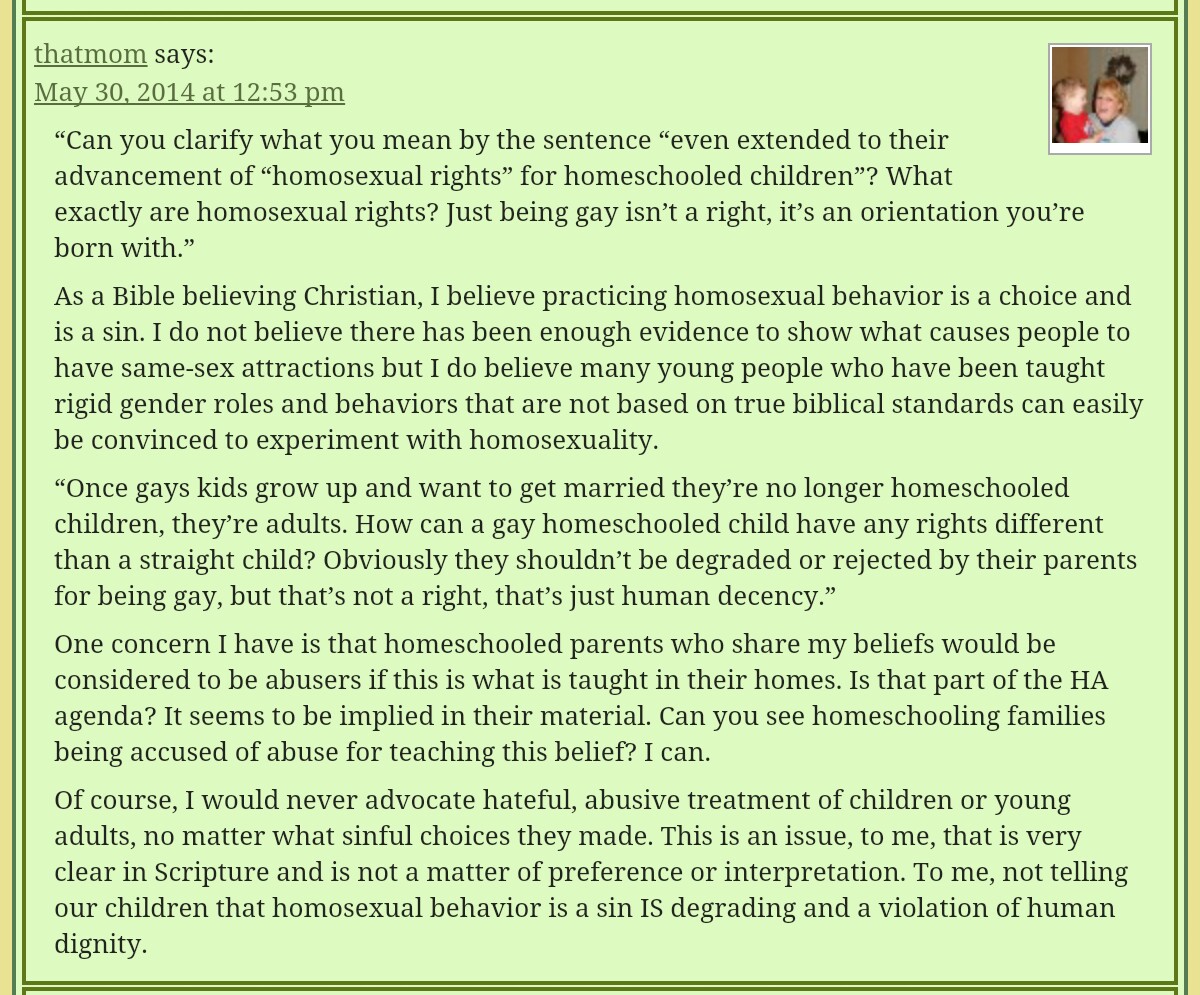
What I would rather talk about is the comment she left on her post, where Campbell suggests that young people raised in patriarchy, “can easily be convinced to experiment with homosexuality.”

karen

Ms. Campbell really doesn’t understand how this whole gay thing works if she thinks that being taught rigid gender roles is going to confuse someone into homosexuality. Also, while we’re at it, bisexuality is a thing too, though I doubt Campbell thinks it exists.

Rigid gender roles are bad, and should be rejected outright, but forcing a kid into a rigid gender role has nothing to do with who they’re attracted to. For that matter, there are kids who fit quite happily into rigidly defined gender roles but are still attracted to the same sex, and kids who don’t fit at all but who are entirely straight.

Homosexuality is about who you’re attracted to, and whether or not a kid fits into a rigid gender role is about gender identity and expression, another issue entirely. For a kid who is gender non-conforming, being forced into a rigid box isn’t going to confuse them into gayness, it’s just going to make their life unpleasant.

Besides, I didn’t grow up forced into rigid gender roles and I’m still queer. In fact, I’d wager that my parents’ version of homeschooling is one that would get the Karen Campbell seal of approval, but hey, here I am and no one convinced me into anything.

Are we so weak that she thinks we can easily be misled into gayness? I graduated from high school at 17, got a degree in computer science as the only female student in all but one class, moved overseas by myself to teach in Asia, and have my JD. That I could “easily be convinced” of anything, much less of something that makes my life harder, is insulting.

There are many things that I will lay at the feet of patriarchy, but nope, you’re not going to be able to write off LGBT homeschoolers this easily. Patriarchy did not make us, this is who we are, and there is nothing wrong with that.

We’re here, we’re queer, patriarchy had nothing to do with it, and it’s high time you get used to it.

Do Stacy McDonald and Kelly Crawford Pass the Duck Test on Patriarchy?

Screen Shot 2014-05-15 at 4.39.12 PM

HA note: The following is reprinted with permission from Julie Anne Smith’s blog Spiritual Sounding Board. It was originally published on May 8, 2014 and has been slightly modified for HA.

*****

Suppose you see a bird walking around in a farm yard. This bird has no label that says ‘duck’. But the bird certainly looks like a duck. Also, he goes to the pond and you notice that he swims like a duck. Then he opens his beak and quacks like a duck. Well, by this time you have probably reached the conclusion that the bird is a duck, whether he’s wearing a label or not.

~Richard Cunningham Patterson Jr., United States ambassador to Guatemala during the Cold War in 1950

 *****

Are you familiar with the Duck Test?  It’s an inductive reasoning test.  This familiar expression is an example of inductive reasoning:

If it looks like a duck, swims like a duck, and quacks like a duck, then it probably is a duck.

Not long after I posted the article “Queen Bees of Homeschooling Stacy McDonald and Kelly Crawford Don’t Like the “Victim” Word in the Lourdes Torres-Manteufel vs. Doug Phillips Lawsuit,” there was some fallout, most likely related to the pushback they received here. It’s always interesting to watch the responses to blog articles where we are exposing truth. We typically see back-peddling, web scrubbing, but rarely an admission of wrong teaching, etc.

I think it’s important to document what happened so that people can see for themselves and discern. Do the behaviors match the message? What is the fruit that we see? Is this the kind of teaching we want to stand behind and pay good money to hear at conferences? Do we want these foundational teachings to influence our families for decades?

Last week, R.L. Stollar, co-founder of Homeschoolers Anonymous, informed me that Kelly Crawford had written a blog article in 2008 entitled, “Tired of Patriarchy’s Bad Rap.”

Crawford’s article comes up here on a Google search:

ja1

But surprise, surprise.  If you click on the link to the original article, this is what you see:

ja2Quack, quack.

Homeschoolers Anonymous shared Crawford’s 2008 article on their Facebook page recently (on April 29) and noticed the article was removed between 4/29 and 5/2. Stollar also quoted Crawford in his comment:

For a clear definition of biblical patriarchy,” she said, you should “go here” — here being a link to the now-defunct Vision Forum’s “Tenets of Biblical Patriarchy.”

The “Tenants of Biblical Patriarchy” has been long scrubbed from the Vision Forum website, but here is the cached copy.

Homeschoolers Anonymous has a copy of Kelly Crawford’s article on file here.  When will people learn that if they post articles on the internet and remove them, it makes them look like a fool?  Take a look at the first two paragraphs of her article, the article she scrubbed:

I guess I’ll be rehashing the same topics with new names until I die, but they won’t let me go.
There is something I’m so tired of. The word “patriarchy” is practically synonymous with an explicative in this culture. I’m tired of that. Patriarchy is not a new concept, but one as old as the world itself. It is biblical and if you don’t like it, and you’re a Christian, perhaps a new religion would suit you better. 

So, did Kelly Crawford change her views on Patriarchy?

She said she would rehash the same topics until she dies. Why would she remove that article from 2008? What is she trying to hide?

Quack, quack.

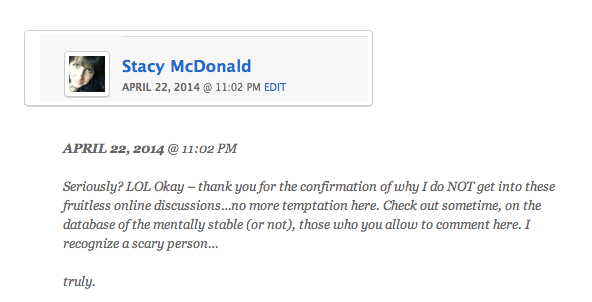
After posting the “Queen Bees” article, both Stacy McDonald and Kelly Crawford came to my blog to comment, having never participated at Spiritual Sounding Board before. We saw their true colors:

Screen Shot 2014-05-15 at 4.53.27 PM

Yes, Stacy McDonald, publicly made a low blow about the mental stability of one of my commenters.

Stacy has had a couple of weeks to think about that comment, a couple of weeks to e-mail me and say that perhaps she was out of line with that wording, but she has not. That was a rude comment. People pay to hear this woman speak, they read her blog articles. They look to her for guidance in how to raise their families. Enough said.I also want to point out another incident that occurred on the same day the article was being discussed here.  Spiritual Sounding Board reader Taunya reported that Kelly Crawford privately emailed her after 6 years of silence between the two saying,“Can’t you see what kind of people you’re running with now? The evidence, the fruit, is so clear.”  

Did you notice the 6-years-of-silence part?  

Although Crawford doesn’t mention the silence, it’s important to the whole story. Obviously this hit a nerve for Crawford and is not something to be dismissed lightly. Imagine Taunya’s surprise in receiving such an e-mail after so many years of silence. Let me put in my own words my interpretation of what Crawford is saying:  This information I am sending you is so important that I am breaking 6 years of silence to send it to you.  Listen to me!  If you don’t believe the way Stacy and I believe, you’re one of those bad-fruit people.  

What was the rotten fruit Taunya was talking about?  Things like this: 

Furthermore it is not “God’s will” for adult daughters to live in the homes of their fathers until marriage. There is nothing biblically wrong with young women attending college, working or living on their own. This is wrong and any woman falling for this as “God’s Word” is deceived. These are cult-like teachings must like the idea that women need to wear skirts and dresses for the sake of modesty or that it is wrong to limit the number of children one has.

And:

The definition of priest says it all Kelly! No women needs a priest! A man goes directly to God through Jesus and a woman does as well. She does not need her husband to be her mediator nor does she need him to be her prophet. She can read Scripture and the Holy Spirit resides in her just as He does her husband, no need for a husband to be her prophet! And KING? Wasn’t that addressed in the Old Testament. None of us need a king, we have that in Christ. 

Doesn’t that 6-year silence also say a lot? It reminds me of junior high.  “I’m not going to be your friend if you don’t like Suzy Q.”  Do you see what this is?  It’s my-way-or-the-highway mentality. You have to go along with my beliefs in order to be part of my group. It creates an us vs. them mentality. You are either in, or your are out. 

*****

If it looks like a duck, and quacks like a duck, we have at least to consider the possibility that we have a small aquatic bird of the family Anatidae on our hands.

~Douglas Adams

*****

Quack, quack.

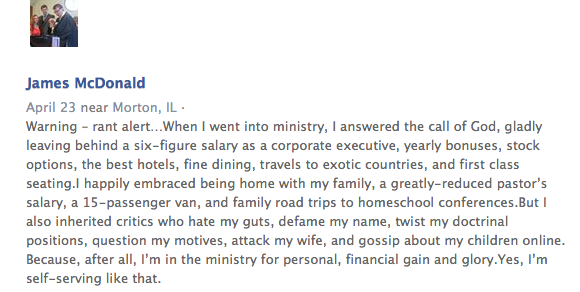
Stacy and Kelly left the conversation, but the conversation continued to over 400 comments, but look what happened within 24 hours on Stacy and James McDonald’s Facebook page.  The first is a rant from James McDonald:

Screen Shot 2014-05-15 at 4.58.55 PM

Attitude much, James?

On the same day, April 23, Stacy posted a note on her Facebook wall endorsing her husband’s article, “The ‘P’ Word,” which is about Patriarchy. Her husband, in his article on Patriarchy discusses words and their meanings and how sometimes the meanings change. He tries to paint a beautiful picture of Patriarchy.

But check this out, is she really saying she is going to have to disguise that P (patriarchy) word from her vocabulary?

Stacy McDonald: All that being said, I personally believe that, for the sake of clarity, and knowing that the word has been so ravaged in the eyes of so many, it’s best to not to use the word. Because the term is not as important as the principle. “A rose by any other name would smell as sweet.” Biblical order is important, but we don’t have to use a word that provokes people or causes them to misunderstand us.

Ok, so let’s just act like that word doesn’t exist. Is that what she’s saying? We’re going to continue doing the talk, and walking the walk, but we’re just not going to let anyone know what we’re really doing is Patriarchy. 

*****

When I see a bird that walks like a duck and swims like a duck and quacks like a duck, I call that bird a duck.

~James Whitcomb Riley

*****

What we see is a very familiar pattern of behavior:

  • anyone who disagrees is labeled in a negative way:  mentally disabled, rotten fruit, divisive, some might even question the salvation of one who disagrees
  • instead of addressing conflict or misunderstandings: remove article entirely with no explanation
  • completely mischaracterize a critic, claiming criticisms they never made like a “strawman,” then  talk only about the strawman instead of the matter at hand
  • publicly air a “woe is me” rant of martyrdom on own forum to garner support and “attaboys”
  • black/white thinking: you are for us or against us

Folks, the above patterns are the rotten fruit.

It’s rotten fruit in attempt to defend more stinking, rotten fruit:  Patriarchy.Stacy and Kelly have been promoting “Biblical Patriarchy” for years.  Now Stacy wants to quack about it, without using the P word. It’s time to call this heretical teaching out now. It is destroying families. It is keeping young ladies held captive in their own homes, not giving them choices to further their education, to be critical thinkers, to use the creative minds God created for them.

Removing blog articles and not saying the P word is not going to change the fact that Patriarchy = Duck.

The Shell Game Revealed

Stacy McDonald and her husband James. Source: http://familyreformation.files.wordpress.com/2007/09/mediaphoto_large.gif

HA note: The following is reprinted with permission from Libby Anne’s blog Love Joy Feminism. It was originally published on Patheos on May 2, 2014.

I really didn’t expect to see Christian homeschool leaders out-and-out reveal that, in the wake of the Doug Phillips scandal, they’re dumping the word patriarchy but keeping the ideas behind it. I mean it’s pretty clear that a lot of them are doing that, but they’re generally doing it in a shell game sort of way as though no one will notice. But not all are taking that approach.

Commenting on her husband’s blog, homeschool author and speaker Stacy McDonald had this to say:

stacy1

Well then. That makes it easy, doesn’t it?

Stacy McDonald is right when she says “the term is not as important as the principle.” But she gets it exactly backwards. She is willing to drop the term but wants to keep the principle. Newsflash here—the principle is what I and so many others have a problem here.

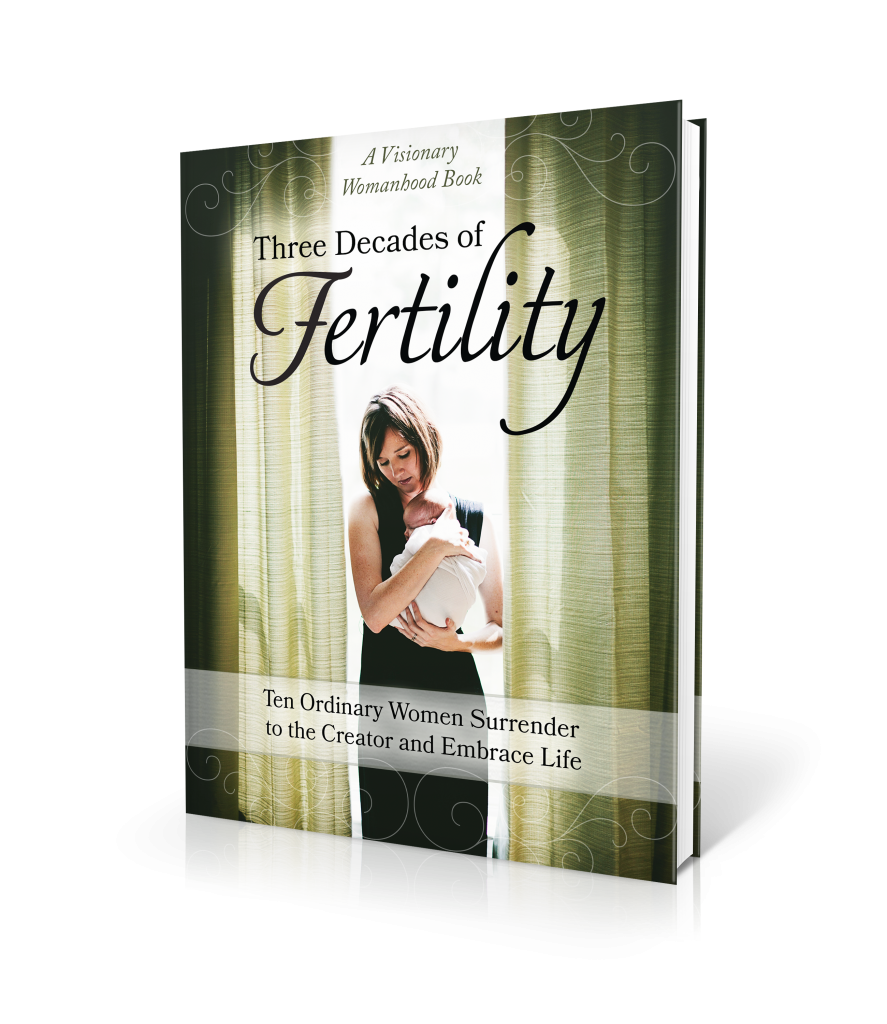
stacy2I should be clear that Stacy McDonald is no marginal voice in the world of Christian patriarchy. She’s the author of Passionate Housewives Desperate for God and Raising Maidens of Virtue and Three Decades of Fertility. She runs the website Steadfast Daughters and blogs at Your Sacred Calling. She writes for Ladies against Feminism. Stacy McDonald is no stranger in the more general homeschool world either. She and her husband used to run Homeschooling Today magazine, and Stacy is a popular speaker at homeschool conventions.

So with all of those ties to the patriarchy movement within Christian homeschooling that Stacy McDonald writes of dropping the word patriarchy while keeping the principle because “we don’t have to use a word that provokes people or causes them to misunderstand us.” But what exactly is being misunderstood, here? If Stacy McDonald preaches patriarchy, as she very openly does does, we’re not “misunderstanding” anything at all when we call it out. As for “provoking” people, I’m pretty sure it’s the ideas that are doing the provoking, not the term. That is apparently lost on Stacy.

But I suppose I’m just glad someone is being honest.

What “Christian Patriarchy” Is Not

Screen Shot 2014-04-26 at 5.45.19 PM

By R.L. Stollar, HA Community Coordinator

“Patriarchy” has suddenly become a dirty word in the homeschooling movement. Whereas a short while ago it was a badge of honor, a symbol of pure righteous manliness, now leaders are scrambling to distance themselves from this word. They are swearing left and right that they aren’t “it” and they never were “it” and gosh, why are people saying they are? They have been so gracious about “allowing” their daughters the privilege of wearing pants — or the privilege to go to college — they, the men with the divine authority, have allowed this. How could anyone think poorly of them?

The sudden energy exerted by these leaders to claim they oppose Patriarchy has reached corners that are so actually patriarchical it has become almost humorous to observe. Kevin Swanson recently wrote a post on April 18 where he matter-of-factly declares, “I am not a patriarchal-ist. I have never been a patriarchal-ist, and I’ve never called myself a patriarchal-ist.” As evidence he offers the following statement: “It is no sin for a woman to take college level classes.”

Well, gee, that settles that. I eagerly await Bill Gothard’s declaration that he’s not a legalism-ist.

As news about the predatory conduct of Doug Phillips — one of the key figures in the Christian Patriarchy movement — and Bill Gothard — one of the most ardent advocates of Legalism — spreads into the mainstream media, this will become a more common occurrence. The problems plaguing the Christian Homeschooling Movement will be chalked up to “Christian Patriarchy” and “Legalism.” Leaders will swear they aren’t those things and therefore they’re safe. We will be tempted to become fixated on labels and forget that labels aren’t the problem. The problem, as Libby Anne points out, are “the beliefs [they’re] promoting.”

Furthermore, while I agree with Libby Anne that the beliefs should take central stage, I am mystified because few people seem to understand the words themselves. And I wonder whether that’s why the beliefs are getting the short end of the stick. We’ve turned “Christian Patriarchy” into this bizarre caricature — i.e., “not letting your daughters go to college” — that’s completely untrue. Go look at Vision Forum’s “Tenets of Biblical Patriarchy.” Not letting your daughters go to college is not on the list. We’re collapsing so many different categories — Quiverfull, Christian Patriarchy, general Patriarchy, Stay-At-Home-Daughter Movement, Complementarianism, etc. — that these words are becoming powerless.

A fundamental rule of communication is this: “The One Who Defines the Terms Controls the Argument.”

This is true.

But there is another fundamental rule of communication: “The One Who Employs the Definitions Sloppily Loses Control of the Argument.”

We’re at a point now where someone has claimed that Patrick Henry College is not patriarchical and “proved” it by describing the college in blatantly patriarchical terms. And the reason for that is simple: we’ve exchanged the phrase “Christian Patriarchy” for “Patriarchy,” when the former is simply a particularly extreme version of the latter. Patriarchy is any and every system based on male authority and dominance, one manifestation of which is Christian Patriarchy. We’re also at a point where Michael Farris is confusingly equating “Quiverfull” with “Patriarchy”: not only did he think “not sending your daughters to college” had something to do with “Quiverfull,” he also thought that “not sending your daughters to college” (a caricature of Christian Patriarchy) was the definition of Patriarchy (which is has nothing to do with whether or not your daughters go to college).

So I’d like to dispel a few myths about what Christian Patriarchy is. I’d like to emphasize that, by saying Christian Patriarchy isn’t these things, I’m not saying it cannot be. I am saying it is so much bigger than these things. To limit it to these things enables misdirection.

Myth #1: Christian Patriarchy is Patriarchy.

Christian Patriarchy is Patriarchy in one sense: insofar as Christian Patriarchy is a system based on male authority and dominance, it is a subset of Patriarchy. But as I stated previously, Patriarchy — being a system based on male authority and dominance — is huge. Any system grounded in male authority and dominance is Patriarchy. Thus even Complementarianism — however mild or extreme — is still Patriarchy because it still rests upon the foundational idea that males have a unique authority or right to dominance.

When we say that, “Oh, ____ isn’t into Patriarchy” — when we what we mean is, “Oh, ____ isn’t into Christian Patriarchy” — we are giving someone an opportunity to downplay the fact that they are still into Patriarchy. And the problem with the subset of Christian Patriarchy isn’t that its an extreme version of Patriarchy. The problem is that it is Patriarchy. Period.

So for example, Michael Farris does believe in and advocate for Patriarchy. Just observe any of the politicians he endorses or, simpler yet, read his 2004 book What A Daughter Needs From her Dad. Sure, Farris doesn’t believe in and advocate for the limited caricature of Christian Patriarchy where daughters can’t go to college. But again, as stated earlier, even that’s a caricature of Christian Patriarchy (as we’ll discuss shortly). Michael Farris agrees with Christian Patriarchy far more than he disagrees with it.

Myth #2: Christian Patriarchy is Quiverfull.

Quiverfull and Christian Patriarchy are often confused as the same thing. In fact, Michael Farris himself has confused these categories, when he said that he does “believe women should go to college.” Whether or not you let your daughters go to college has nothing to do with Quiverfull. Quiverfull is, more or less, a specifically Christian form of natalism — the idea of employing procreation as a tool of sociopolitical dominion and categorizing birth control as rebellion against God. Michael Pearl gave us a perfect embodiment of Quiverfull’s dominionist streak, when he recently stated,

“If you can’t out-vote them today, out-breed them for tomorrow.”

That is Quiverfull (albeit a distilled, intense version of it). And see, that sentiment could exist in a matriarchicial society. (In fact, Mary Pride — often considered “the Queen of Quiverfull” — personally insinuated that she believes in Matriarchy more than Patriarchy. Though she has a nonsensical definition of Matriarchy, she has harsh words for Christian Patriarchy advocates.)

Yes, there are many advocates of Christian Patriarchy who are Quiverfull. And by all means, speak out against the dehumanizing and toxic idea that your children are your weapons, and a woman’s vagina is a weapons-building factory.

But remember these are distinct, especially considering there are many advocates of Christian Patriarchy who are not Quiverfull. Take Doug Wilson, for example. Doug Wilson is considered one of the pillars of Christian Patriarchy but believes birth control can be useful to ensure you’re actually taking care of your current children. That’s outright heresy to the Quiverfull crowd.

Myth #3: Christian Patriarchy is Opposed to Daughters Going to College.

The Stay-At-Home-Daughter Movement rose out of Christian Patriarchy. Indeed, many of this movement’s advocates — for example, Voddie Baucham, Doug Phillips, and Geoff Botkin, who promoted or were featured in the film, “Return of the Daughters” — are giants in the Christian Patriarchy movement. But — and this is crucial — not all advocates of Christian Patriarchy believe daughters cannot go to college. In fact, the majority of them are okay with it, provided their daughters (1) are still at home while attending college, (2) do not go to a secular college, and (3) study something relevant to “domestic affairs.” There is plenty to critique about that criteria, but using this “can daughters can go to college” litmus test is a red herring. Case in point: Baucham’s daughter Jasmine — while still living at home — not only has a Bachelors degree but is currently pursuing a Masters degree.

And this isn’t a “new” development in Christian Patriarchy. John Thompson, writing in Patriarch Magazine (a cornerstone publication of the Christian Patriarchy movement during the 90’s), articulated over a decade ago that it was tolerable to let your daughter get college-educated provided that education is gender-oriented and via home study.

So, again — this college litmus test is a red herring.

Myth #4: Christian Patriarchy is two steps away from wearing a burka.

This myth was articulated a few days ago, and I couldn’t help but laugh. Seriously, let’s look at two images of the daughters of popular proponents of Christian Patriarchy:

Geoff Botkin’s daughters, Anna-Sofia and Elizabeth:

anna-sofia-and-elizabeth-botkin

Voddie Baucham’s daughter, Jasmine:

jasmine

Burkas? Seriously?

Look, there are many, many parallels and connections between Christian fundamentalism and Islamic fundamentalism that one can make. Likewise, there are many, many parallels and connections between Christian Patriarchy and Islamic Patriarchy that one can make. The parallels exist because fundamentalism and patriarchy as systems transcend people groups and cultures. Identifying and speaking out against those parallels and connections is important; it should be done frequently, passionately, and loudly.

However, to say that, “Christian Patriarchy is two steps away from wearing a burka” is an asinine argument. Christian Patriarchy is not defined by clothing. Yes, there are many people within the Christian Patriarchy movement who have swallowed Modesty Culture. In fact, the above two images do not disprove this. (“Modesty Culture,” like Christian Patriarchy, is not defined by how many “steps” it is away from wearing a burka.) But they do demonstrate that slapping Christian Patriarchy with “burka” confuses the issue.

Myth #5: Christian Patriarchy is Limited to Homeschooling.

This is the weirdest myth. Rumor has it that Christian Patriarchy advocates are only into homeschooling, whereas Christian Patriarchy opponents tolerate other forms of education — for example, classical education in a private Christian school.

This is pure nonsense. Doug Wilson adamantly and vocally prefers private classical Christian education to homeschooling. He personally founded a private school and did not homeschool his kids. In his 1991 book Recovering the Lost Tools of Learning, Wilson makes clear that he believes “classical private schools to be superior to classical homeschooling.” He states his case so strongly, in fact, that some say “he condemns home school as a viable option,” and one homeschooling parent demanded he “stop being asked to speak at homeschool events.” In his own words, though, it’s not so much homeschooling itself that he objects as much as it is “a radical home-centeredness” that “[insists] that the home can not only replace the school, but also the church and the civil magistrate.”

An appreciation of private Christian education among Christian Patriarchy advocates is not limited to Wilson. R.C. Sproul, Jr. — who co-wrote Vision Forum’s “Tenets of Biblical Patriarchy” with Doug Phillips — agrees to some extent with Wilson. In October 2011, Sproul Jr. said that, ultimately, what’s important is Christian education that teaches “day in and day out the Lordship of Christ over all things,” and thus “the real issue is the secular perspective of the public schools, more than the methodology of homeschooling versus Christian schooling.”

Similarly, Patriarch Magazine argued over a decade ago that, while homeschooling is “ideal,” “Christian schools are a commendable alternative to the degenerate state schools.”

*****

It is pretty amazing that “Christian Patriarchy” as a specific concept — and Patriarchy as a general system — is finally being widely discussed among Christian homeschoolers. Seriously. It is amazing. This is the first step towards wider awareness and change: our vocabulary is being adopted and we can point to that vocabulary to facilitate conversation.

However, we take a step backwards if we start equivocating between terms and diminish those terms’ potency. If you are new to this conversation, please take the time to educate yourself about what these words mean. Libby Anne has a great breakdown of what “Christian Patriarchy” is that she wrote in 2012. Read it. Think about it. Also read about what Patriarchy is and how it differs from the specific subset of Christian/Biblical Patriarchy. Educate yourself about how similar Christian Patriarchy and Complementarianism are (and arguably even identical), and why both are Patriarchy. (And while you’re at it, look up Kyriarchy, too.)

Then reassess this mass hysteria among homeschool leaders who are begging us to consider them anti-Patriarchy. Because they are not.

Sugar-coated Patriarchy is still Patriarchy.

Is the Christian Homeschool World Really Changing?

Screen Shot 2014-04-22 at 5.31.34 PM

HA note: The following is reprinted with permission from Libby Anne’s blog Love Joy Feminism. It was originally published on Patheos on April 22, 2014.

Things are changing in the Christian homeschooling world. Vision Forum has fallen and ATI is shaken. People are talking, really talking, and the narratives are shifting.

Some are still resisting this conversation.

They claim that Doug Phillips’ fall had nothing to do with his patriarchal ideology. With both Phillips and Gothard, they argue, the problem was with the leader, not the belief system. These claims are dispiriting, because in some sense these leaders are interchangeable. Old ones will fall, new ones will rise, and if the ideology remains the same nothing will change.

But other leaders are being more honest. They, Michael Farris and Chris Jeub among them, are connecting the dots and calling out a problem deeper than an individual leader. In this facebook comment, Farris responds to a homeschool graduate’s reiteration of her story (I’ve marked the relevant bit):

m1

When I read these things, I am reminded of evangelical attempts to soften toxic ideas so that they become more palatable, and that concerns me. For example, I heard evangelical leaders at the megachurch I grew up attending walk the idea of male headship back to spiritual leadership and breaking the tie when husband and wife cannot come to an agreement. While I appreciate that there are evangelicals who have moved away from an emphasis on total wifely obedience and submission, the idea of male headship itself is a problem, and softening it doesn’t change that. Is the walked-back view better? Yes, but it’s still a problem.

I wonder how far Christian homeschooling will change over all of this, and whether that change will be deep or surface-level. All Doug Phillips did was take ideas already out there—the idea of the Joshua Generation, the emphasis on male headship and wifely submission, the idea that girls should be encouraged to be homemakers and discouraged from having careers—and deepen each, using direct language, until his words and dictates became an embarrassment.

If Christian homeschool leaders see Phillips’ direct language and strident emphasis as the problem and fail to realize that it is at the core the underlying ideas that they themselves have long held that is the problem, change will be shallow indeed.

The word “patriarchy” is not the problem. The ideas that underly that word are the problem.

If the Christian homeschool leaders who are speaking out today reject the word “patriarchy” but hold onto the idea that a wife must submit to her husband, what have we actually gained? What is actually different?

Israel Wayne of Family Renewal wrote that:

In September of 2013, Michael Farris, founder of the Home School Legal Defense Association (HSLDA) spoke to state convention coordinators and other national homeschooling leaders, at the annual leadership conference they sponsor. He warned against the dangers of the excesses of extreme child discipline and a low view of women that has taken hold in some corners of the homeschooling community. He warned that unless homeschooling leaders actively speak against abusive and unGodly approaches to child discipline and unBiblical views of Patriarchal authority (that demean and devalue women), we risk losing our very legal freedom to homeschool.

From Wayne’s description, it sounds like Farris told other homeschool leaders that they needed to speak against child abuse and the devaluing of women or else homeschool freedoms would be at risk. The emphasis here appears sorely misplaced. Shouldn’t the primary concern be for the children who are abused and the women who are devalued rather than for the possibility that people will react to these abuses by turning against the legal freedom to homeschool?

I should note that I very much question what Farris means by “our very legal freedom to homeschool.” I suspect what he actually means is our freedom to homeschool without oversight or accountability. And here is a very real issue—Farris is now speaking out against “patriarchy,” and it appears that he may begin speaking against child abuse (though that remains to be seen), but he is still against legal accountability for homeschooling, accountability that would support children’s right to an education and their right to an upbringing free from abuse or neglect.

HSLDA’s current president, Mike Smith, will be presenting this keynote address at an upcoming homeschool conference:

Remembering the Reason, Renewing the Vision A general overview of the challenges, burdens and benefits of homeschooling from a veteran homeschool father and leader. Addressing the potential homeschooler, the new homeschooler, the veteran homeschooler and all homeschoolers in between, Mike outlines the success of homeschooling in academics and socialization, describes legal and legislative advances,and concludes that homeschoolers have earned the right to be left alone. 

This last bit is a serious problem. Whether or not Farris indeed intends to speak out loudly and publicly against patriarchy and child abuse, his organization will continue to work against legal reforms that help fight these problems, reforms that would bring homeschooled children into contact with mandatory reporters or ensure that homeschooled girls are not passed over educationally because of their gender. A change in culture is needed, yes, but the unregulated nature of homeschooling in many states both contributes to and is a result of that culture.

We need more. Homeschooled children deserve more.

But this is only the start of the things that concern me as I watch this current moment. Israel Wayne followed up on his discussion of Farris comments with these unfortunate paragraphs:

Mr. Farris has sounded a much-needed warning. My concern, however, is that when we over-react and swing to the other ditch, we end up teaching only love, grace and mercy (with no boundaries for children). By rejecting “Patriarchy” (abusive or domineering tendencies of men towards their wives and families), we may revert to the Feminism of the 1960′s, and all the problems that came with it, that led many women to react 180 degrees in the other direction by staying home and homeschooling their children. By rejecting rigid step-by-step rules about issues like strict clothing mandates and courtship procedures, we may revert back to the kind of sexual permissiveness that led to the legalism in the first place.

Do we really want to go back to families where mom is trying to pull that whole family uphill all by herself, while dad is off playing golf, letting mom run the family all by herself? Do want three-year-olds who rule the parents with an iron fist and parents who jump at their every demand? Do we really want teens who are groping their girlfriends in the back seat of a car because we don’t want to impose a legalistic standard on them? Do we really want to encourage the kind of American narcissism that says children are a nuisance and O.8 children is the goal, because we want to avoid the imbalance of policing bedrooms and imposing doctrines not clearly spelled out in Scripture?

This is not change, this is more of the same. What we need is change, real change. I think we’re at a moment of contingency where we might see such change, but to be honest. I don’t feel all that hopeful at the moment. I worry that the change will be more in gloss than in substance.

I can promise you one thing—I’ll keep pushing.