A Game of Online Telephone: Homeschooling, Asylum, and the Attorney General

Screen Shot 2013-09-17 at 1.49.33 PM

A Game of Online Telephone: Homeschooling, Asylum, and the Attorney General, By Nicholas Bolzman

HA note: Nicholas Bolzman blogs at Looking for Overland, a joint blog project “authored by three friends who met at Patrick Henry College and then worked together at the Home School Legal Defense Association.” This essay was originally published on February 26, 2013 and is reprinted with his permission. Nicholas Bolzman received his JD from Michigan State University College of Law last spring and is a graduate of Patrick Henry College.

Dear homeschooling community:

Despite what you may have heard, the arguments presented by the Department Justice in the case involving German homeschoolers do not pose a direct threat to your homeschooling freedoms.

Over the last few weeks I’ve watch as, in a game of online telephone, this story has evolved from HSLDA’s Mike Farris’ musings, to the question of whether domestic homeschooling rises or falls with this case to, finally, “Holder vs. home schooling.”

Unfortunately, in the hysteria, the actual issue at stake seems to have been lost.

As a brief background on the case, in January of 2010, an Immigration Judge granted asylum to the family. The Department of Homeland Security appealed that decision to the Board of Immigration Appeals, which reversed the Immigration Judge in May of 2012. The family has now appealed to the Sixth Circuit Court of Appeals and is awaiting a decision. Once that decision is made, the losing side can request the Supreme Court for review.

Three primary issues need to be remembered as we think about this case.

First, the dispute is not really about constitutional rights.

Yes, parental rights are considered a fundamental constitutional right here in the United States, but that is largely beside the point. Since the German state is not bound by our Constitution, whether it has “violated” it or whether its actions would be permitted if conducted by a US political entity is immaterial. Germany, as a sovereign political entity, has the authority to make the laws governing German citizens.

Asylum, in a general sense, is inherently a check on sovereignty. And it must be couched in such terms. More than a mere preference, it is a statement that the oppressing state acted in an illegitimate manner toward its citizens. This transfers the debate about homeschooling from one of US Constitutional rights (which are largely irrelevant to asylum claims) to one of international human rights.

As I’ve written before, there is support for parental choice in education being a peremptory human right. That, and not domestic constitutional rights language, is where the debate lies. This case does have the potential to make a large impact on the status of parental rights in the international sphere, and for that reason I’m hopeful that the family wins. But even if the family loses, Eric Holder won’t be sending out SWAT teams to round up US homeschooling families.

Second, the litigation is not concentrated on whether the homeschooling family is wanted, is desirable, or would otherwise make a positive contribution to the nation.

It is not about whether the family should or can homeschool here. The government is not attempting to deport them because they homeschool. Instead, the question is whether Germany’s denial of the family’s right to homeschool makes them a “refugee.” If it does not, they do not have legal immigration status and, like all others without status, they would be required to leave or find some other way to obtain status.

To qualify as a refugee the family must show that they are someone “who is persecuted or who has a well-founded fear of persecution on account of race, religion, nationality, membership in a particular social group, or political opinion.” INA 101(a)(42)(B); 8 USC § 1101(a)(42)(B).

This definition is easily broken into two parts, the treatment part (persecution) and the prosecutor’s motivation (“on account of…”). Even if “persecution”–which Congress never bothered to define–is shown, only certain types of persecution make one eligible for asylum. The persecuting government must be doing the persecution “on account of race, religion, nationality, membership in a particular social group, or political opinion.”

The litigation before the Sixth Circuit includes parts of both elements.

First, the government is making the case that Germany’s treatment of the family does not amount to persecution. Under the legal standard, not every form of mistreatment constitutes persecution. It must reach a certain level of seriousness–often including physical beatings or threats of death. However, it can also include economic coercion. For the German family, even the initial Immigration Judge who granted asylum did not find that they had suffered past persecution. However, he did find that they had a well-founded fear of future persecution based on Germany’s treatment of homeschoolers in general.

But persecution aside, the family also has to show that they were targeted on “on account of race, religion, nationality, membership in a particular social group, or political opinion.” Race, nationality, and political opinion are not even being argued, so the only two arguments the family is using are religion and membership in a particular social group. Religion is tricky, since while the law does interfere with their religions beliefs, it is a general law that does not single them out or in any other way target them. Social group is the other argument, but that term is so loosely defined and unclear that there is little hope to avoid litigation when asserting it.

That German homeschoolers are a particular social group is certainly a strong argument, but it is not one that asylum law has previously recognized, so it should not be surprising that DOJ would resist.

And asylum claims against general laws are often unsuccessful, the most notorious example being the BIA’s 1989 holding that those fleeing China’s one-child policy were not eligible for asylum (in 1996 the asylum definition was specifically amended to fix this). Conscientious objectors to a general draft law have also been denied. The rationale here is that states have authority to pass laws that apply to everyone, and absent something extreme, enforcing that law is not persecution on account of one of the protected grounds.

So, although one can characterize the government’s motivations in continuing the litigation as opposition to homeschooling, it is just as easy to interpret it as a strict adherence to our immigration laws. And isn’t that something conservatives want?

Third, it is dangerous to impose personal motivations on the attorneys or departments based on their positions.

If this approach were viable, then the following conclusions must also be drawn:

  • That the Bush administration, and specifically Attorney General Ashcroft, supported child soldiers in Uganda (asylum granted by Third Circuit, but DOJ litigated against, 2003).
  • That the Bush Administration somehow wanted the death of Edgar Chocoy, the Guatemalan teen who escaped a gang with a price on his head, made it to the United States, and claimed asylum. His claim was denied and he was returned to Guatemala. He was shot to death one week later.

And that is only a small sample of the asylum cases either denied or objected to by the US government over the past thirty years. DHS/DOJ routinely denies or opposes asylum claims from those who believe they are going back to situations much worse than the German family. That is their job.

Please don’t get me wrong. Germany is violating peremptory human rights in its denial of homeschooling freedoms, and the family should be granted asylum. But the mere fact that the attorneys at DOJ oppose what they see as an expansion of asylum law–as they routinely oppose situations much worse than this–is no grounds to vilify them.

If anything, the litigation calls into question whether our asylum law is too strict.

Allowing the Devil to Undress You: The Slut-Shaming of a Former Homeschooler

Teresa Scanlan.
Teresa Scanlan.

By R.L. Stollar, HA Community Coordinator

*****

A disgrace.

A destructive force against families.

Homeschool dropout.

A rat turd.

These are but a number of phrases used on HSLDA’s Facebook page in reference to Teresa Scanlan, a former homeschooler attending Patrick Henry College. These are not phrases used by HSLDA; in fact, HSLDA has championed Teresa as a homeschool success story. But these phrases are also not coming from anti-homeschoolers or liberal secularists.

They are coming from fans (or at least previous fans) of HSLDA.

Yesterday, HSLDA shared about Teresa’s life and homeschooling experience in light of her being crowned Miss America in 2011. It was obviously about marketing to some extent — “the secret behind the crown was homeschooling!,” HSLDA says. But it also was about celebrating a young woman with passion and drive.

But things got ugly.

Some of HSLDA’s fans were livid. In fact, if you were looking for evidence that the modesty and purity culture that exists within Christian homeschooling can lead to some truly dehumanizing and dangerous thoughts, look no further than what unfolded.

Here is HSLDA’s original post about Teresa Scanlan, and here is the link to the post on Facebook:

Screen Shot 2013-08-21 at 9.38.33 PM

The comments that some people are leaving on HSLDA’s post about Teresa are frankly alarming. They are misogynistic and dripping with body-shaming. They even are scarily reminiscent of rape culture — that women are responsible for men’s lust and are “asking for it.”

Seriously.

There is direct, no-holds-barred slut-shaming going on right on HSLDA’s Facebook page.

Check it out:

Screen Shot 2013-08-21 at 9.39.55 PM

Yes, you read that right. Someone is pulling their support from HSLDA because of HSLDA’s link — which was merely a link to their original radio series about Teresa. Because old men and young men might “fix their eyes” upon Teresa dressed in a rather conservative red dress (you can’t even see her shoulders!).

Now you might wonder: how is that picture immodest? Well, it isn’t. But fear not. People encouraged other people to google her in a bikini. (Does that sound a bit hypocritical? Because it is hypocritical, and also slightly creepy.)

Screen Shot 2013-08-21 at 9.40.12 PM

Not everyone on HSLDA’s page, however, was attacking Teresa. Some people tried to defend her – and then got promptly slut-shamed, too.

Screen Shot 2013-08-21 at 9.40.49 PM

Yes, if you participate in a pageant, you have caused men to commit adultery and you will be “held accountable of Judgement Day.”

The comments continue:

Screen Shot 2013-08-21 at 9.41.21 PM

Another defender, who is attacked:

Screen Shot 2013-08-21 at 9.41.58 PM

By the way, Teresa is a Christian.

Not just “a” Christian, but a conservative Christian. In fact, she points out in her radio interview with HSLDA that many of the young women that participate in pageants are actually conservative Christians:

Actually, the majority of contestants, believe it or not, are Christian conservatives, I found, in the competition. And then the judges, in my interview, they have my resume in front of them, and they saw a lot of church activities and things on there, so during my interviews, several of them actually asked me questions about my faith.

But that does not stop people from judging her relationship with God:

Screen Shot 2013-08-21 at 9.42.34 PM

Also:

Screen Shot 2013-08-21 at 9.44.52 PM

It really is a train wreck. They call her a “homeschool dropout,” and attack her for wanting a career:

Screen Shot 2013-08-21 at 9.43.00 PM

They compare her to a “rat turd”:

Screen Shot 2013-08-21 at 9.43.21 PM

They do not hesitate to link to her Facebook profile (which, as we all know, will probably lead to further online bullying, harassment, and slut-shaming):

Screen Shot 2013-08-21 at 9.44.38 PM

This is not to even mention the likely hypocrisy and double standard of some people in the homeschooling community when they only think of modesty and purity in terms of women. What about men?

Were all these people up in arms when Tim Tebow went shirtless for magazines?

Or were they parading Tebow around as a homeschool superhero? Kathryn brilliantly pointed out (not on HSLDA’s page) this double standard about equally harmless actions:

Screen Shot 2013-08-21 at 9.45.14 PM

Credit must be given to those people who are defending Teresa on HSLDA’s page. This goes to show that not all homeschoolers — in fact, not all Christian homeschoolers — believe in the toxic ideas behind modesty and purity culture ideology.

I commend those people for standing up against those ideas and the people that would use those ideas to shame a young woman.

We need to push back like this. We need more homeschoolers to speak up against these ideas (and not just against the modesty and purity culture ideas). Teresa’s own experience has demonstrated that this shaming is (very sadly) nothing new to her:

When I first won, I thought, of course, that I would get criticism from the public in general about being a Christian, but it was kind of surprising to me that probably the most criticism I received was actually from conservative Christians that competing in the competition like Miss America did not line up with their morals and values.

No one deserves to be abused and harassed in this manner, regardless of their way of dress, their gender, their political or religious beliefs, or anything else. In fact, I commend HSLDA for being willing to champion a conservative Christian woman who is — through her actions — bravely overturning some of the deeply held assumptions in some conservative Christian circles. She is celebrating her beauty and her body, she is going to college, and she has high career aspirations — in fact, as HSLDA mentions in their bio of her, “her highest career goals are to run for president in 2028 or to be nominated to the Supreme Court.”

She also hopes to educate people about eating disorders.

She has expressed a desire to “educate children and adults alike as to the signs and risks of eating disorders, as well as how and where to get help for themselves or a loved one.”

More power to her.

When Michael Farris Threatened To Send The FBI After A Homeschool Kid

When Michael Farris Threatened To Send The FBI After A Homeschool Kid

By R.L. Stollar, HA Community Coordinator

*****

“Once upon a time, long before Instagram, Twitter, Tumblr and Facebook, there was a web blogging service called Xanga.”

~NBC, June 2013

******

It was the beginning of December last year when the words lit up my computer screen like lights on a Christmas tree:

“PATRICK HENRY COLLEGE CHANCELLOR MICHAEL FARRIS THREATENS TO SUE QUEERPHC!”

I had no idea what QueerPHC was. But I knew Patrick Henry College. It was that college I thought about going to back when I competed in NCFCA. Honestly, apart from a few friends from my debate days going to PHC, I hadn’t given as much as a passing thought to PHC in the years since.

In fact, I probably would still be unaware of happenings at PHC — still unaware of the existence of QueerPHC — if it were not for Michael Farris.

So in a sense, I need to thank Michael Farris for bringing QueerPHC to my attention. If Farris never threatened to sue the group, I — like a lot of people, probably — wouldn’t have known anything about it.

But threaten to sue he did. And that is why I am writing this story.

A little background information:

In July of 2012, a group of Patrick Henry College alumni got together and created a blog. Their very first blog post was on July 3, where they said:

“This is a collaborative blog produced by several Patrick Henry College (PHC) students, current and former. We, being a group of people, do have varying opinions and beliefs, but one thing we do share in common is our desire to help and encourage other Patrick Henry College students, current and former, in any way that we can.”

The purpose of the blog was to provide education and information about LGBT issues, because PHC itself did not offer such education and information:

“Patrick Henry College does not offer courses in Queer Studies, Sex Ed, or Gender Equality. However, these are issues that are of pressing importance in our culture today and are of importance to us personally. We hope to use this blog to provide information on those topics that are taboo at PHC.”

For the next few months, Queer PHC posted about a variety of issues, all without any public disturbance from PHC itself. The pseudonymous writing team of Kate Kane, Captain Jack, and Alan Scott wrote about growing up queer, people denying the existence of LGBT people, ex-gay therapy, and how the student newspaper, Patrick Henry College Herald, addressed homosexuality issues.

But then the proverbial shit hit the metaphorical fan.

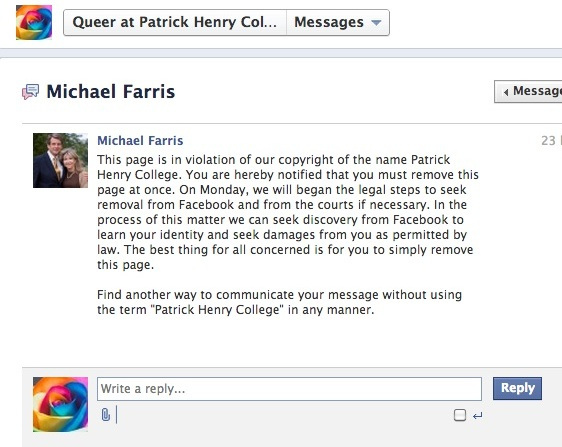
Over the first weekend in December, Michael Farris, the college’s chancellor, used his own Facebook page to contact Queer PHC and threaten them with a lawsuit:

Photo from Queer PHC.

Text is,

This page is in violation of our copyright of the name Patrick Henry College. You are hereby notified that you must remove this page at once. On Monday we will began [sic] the legal steps to seek removal from Facebook and from the courts if necessary. In this process of this matter we can seek discovery from Facebook to learn your identity and seek damages from you as permitted by law. The best thing for all concerned is for you to simply remove this page.

Find another way to communicate your message without using the term ‘Patrick Henry College’ in any manner.”

The problems with what Farris said and did are astounding. Not only is this a completely nonsensical interpretation of copyright law, not only is it slightly outrageous that Farris would pretty much threaten to “out” the individuals behind the group, but Farris used a personal Facebook page to communicate a legal threat on behalf of an entire college. Did he consult with the college’s board before making a legal threat on behalf of the college? Did they approve of the Facebook message? (Were they even aware of it beforehand?) These are important questions, especially considering what happened next.

What happened next was the Streisand effect. So incomprehensible was Farris’ strategy of internet bullying and censorship based on false legal issues that his threat suddenly exploded — Gangnam style — across the Internet.

On December 3, New York Magazine immediately scooped the story. Then the local newspaper. Then a flurry of bloggers, including Libby Anne at Patheos. Then Inside Higher Ed. Then the Chronicle of Higher Education. Even the New York Times picked it up.

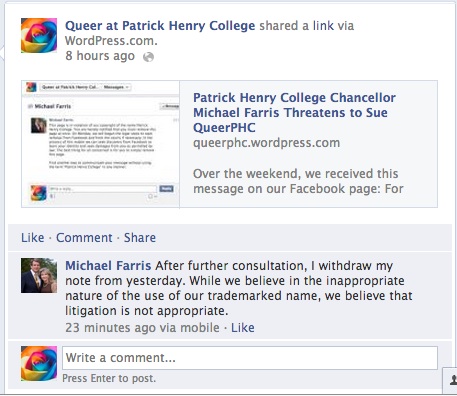
Of course, as soon as the controversy started (and probably once the PHC board realized what a bizarre and inappropriate action Farris had undertaken), Farris recanted — this time through a public comment on Queer PHC’s status:

Photo from Queer PHC.

But it was too late. The PR damage had begun.

When I heard about Farris threatening a perfectly legal Facebook group with an unfounded, frivolous lawsuit, I was floored. What better way to damage the credibility and reputation of not only PHC, but the homeschooling movement, by using abusive techniques like threatening fellow professed Christians with erroneous legal action? Not only fellow professed Christians, but your own former students?

But something about what Farris did to Queer PHC didn’t feel surprising. In fact, it felt familiar.

I couldn’t quite put my finger on it. But I was having a sense of deja vu.

Eventually, it struck me. And I went searching through my vast archive of saved emails from my old Hotmail account. And I found it.

In the early 2000s, when all of us homeschool speech and debate alumni were either still in high school or just beginning college, we socialized on Xanga. Xanga is to social media what Grandmaster Flash is to rap: really, really old school. Created in 1999, Xanga was around before Facebook, even pre-dating when most of us were on Myspace. Xanga was kind of like an public online diary: you could make posts, like other peoples’ posts, and subscribe to other people to stay connected. And that was about it.

(And yes, if you’re morbidly curious, my Xanga is still up. So feel free to search my teenage angst and amateur attempts at poetry, philosophy, theology, and public diary-writing for evidence you can use against me in the future.)

I created my Xanga profile on March 18, 2004. Most of my close friends from NCFCA and CFC had Xanga accounts as well. As this was really the beginning of social media, there weren’t really any parents using Xanga. It was primarily a teenage activity.

After a few months, two separate individuals created parody Michael Farris accounts. One was created on May 28, 2004. The other was created on July 26, 2004. (As you can see from these links, the accounts have since been scrubbed clean.) I don’t really remember much from the later account that was created, but I remember the first one because a friend of mine made it. It was clearly marked as a parody account, did not attempt to impersonate Farris to deceive anyone, and wasn’t even “offensive.” While a lot of us debaters were “punks” in one sense or another, we were still conservative Christian homeschoolers. So my friend’s parody account of Michael Farris did not involve things like dick jokes. I remember Fake Farris’s posts being along the lines of “I AM MICHAEL FARRIS AND OMG HOMESCHOOLING WILL SAVE THE WORLD!!!”

You know, immature attempts at ironic comedy that failed miserably. But again, nothing that even came close to slander. Nor identity theft. As it clearly stated it was a parody account, it didn’t even violate Xanga’s technical terms of use.

In 2004, on Xanga, you could “subscribe” to other peoples’ accounts. This would be the equivalent of “liking” or “following” a Facebook page today. Since I was one of the only people that used my real name on Xanga, and I was subscribed to the michael_farris parody account, I was the only person that Farris could recognize to contact about the account.

Oh yes, he contacted me about the parody account! Perhaps I just got ahead of myself. In 2004, Michael Farris — President of Patrick Henry College — was apparently monitoring what high school homeschool debaters were doing on a social media site. And as soon as he saw a parody account of himself, he went into militant mode.

On Wednesday, July 28, 2004, nearly a decade before he employed erroneous legal threats against Queer PHC, Michael Farris emailed me. In another way that this parallels the QueerPHC debacle, Farris contacted me with his official “PHC Office of the President” email address. The following is a screenshot of what he said, along with the text:

Screen Shot 2013-06-21 at 1.50.00 AM

Text is,

From: “PHC Office of the President” <president@phc.edu>

To: <suavedrummerboy@hotmail.com>

Subject: Ryan is this you?

Date: Wed, 28 Jul 2004 17:17:34 -0400

Ryan,

This is Mike Farris–the real one from Patrick Henry College.

I see you as a subscriber to a xanga website named Michael_Farris. Your posts there seem to indicate that you know who this is who is running this.

I just went through a difficult time shutting down another xanga site called “michaelfarris”.

I am prepared to take civil and criminal legal action against this person. Identity theft is a crime. It is also subject to civil action (if for no other reason) than it violates Xanga’s terms of use. I want your acquaintance to save himself a lot of legal grief.

Here’s what he needs to do. Delete absolutely everything from the site. Then, send me the password to the site so that I can take control of it so that neither he nor anyone else can ever steal my identity in this manner again. If he does this I absolutely promise I will take no action of any kind against him. If he does not do so (and do so promptly) I will go after him with vigor.

It may seem funny to some, but it is not funny in the least to me. I will turn this over to the FBI if I have to. But seems it seems pretty obvious that this person is or was an NCFCA debater I wanted to try to quietly end the problem without the need for drastic measures.

Can you help?

Mike Farris

Yes, almost a decade before Michael Farris tried to bully and threaten Queer PHC with a frivolous lawsuit because he didn’t like what they were doing, Farris also threatened a Christian homeschool kid with civil and criminal action — even going so far as to invoke the FBI. As if the FBI would’ve given a @#$% about some kid’s Xanga account in 2004. But we were young. We had no idea. I was terrified. I immediately told my friend. He was terrified as well. What Michael Farris hoped to accomplish — using inaccurate legal concepts to coerce a highschooler into turning over the account information to a perfectly legal parody account — was successful.

A decade later, Farris apparently still uses the same tactics.

The funny thing is, this email I received would’ve likely slipped away into oblivion, covered by the dust of my long-forgotten memories. But in the same way that Queer PHC’s existence occurred to me because of Farris’ threat against the group, my remembrance of the email was likewise resurrected. To some, the very fact that I am bringing it into the open might seem petty and vindictive. But I do not reveal it for those purposes.

I am publicizing this email because of the trend I have repeatedly seen from the leaders of the Christian homeschooling movement. I am remembering the censorship employed by NCFCA leaders when forensics alumni, coaches, and students attempted to protest BJU’s history of institutionalized racism. I am remembering a personal censorship, which I will talk about next week during our Resolved: series. I am remembering how Farris went after Queer PHC. I am remembering how HSLDA chose to block former homeschool students from its Facebook page for speaking up about abuse during our #HSLDAMustAct campaign.

What I experienced a decade ago, what Queer PHC experienced last year — these are not isolated incidents. They are symptoms of a problem: the problem of how this movement chooses to interact with its whistleblowers. It has groomed us to “take back the culture.” Yet when we try to do so, the movement suddenly realizes “the culture” we want to take back is not the Evil Candyland of Liberalism, but our very own home — homeschooling itself.

If you are not toeing the line, if you question the movement’s assumptions, if you even dare to make parody accounts — the movement wants to shut you down and silence you. And Michael Farris led the way, is leading the way, by the choices he made and continues to make.

Considering Farris’ railings against Obama’s “tyranny” as of late, I cannot help but wonder: how exactly does bullying and censorship of young people demonstrate the ideals of freedom?

Grassroots in Education: A History of the Modern Homeschooling Movement in America, Part 3, By Katy-Anne Wilson

Grassroots in Education: A History of the Modern Homeschooling Movement in America, Part 3, By Katy-Anne Wilson

Katy-Anne Wilson describes herself as “mommy to four public children who are or will be sent to public school (so thankful for special education programs).” She is about to graduate college with a degree in writing and sociology. This post was originally published on her blog on August 11, 2012, and is reprinted with her permission.

*****

In this series: Part One | Part Two | Part Three

*****

Right Wing Conservative Politics

"These fundamentalists are now unhappy with the public school system that was a Christan fundamentalist initiative in the first place."
“These fundamentalists are now unhappy with the public school system that was a Christan fundamentalist initiative in the first place.”

Christian fundamentalists consider America to be a Christian nation founded by Christians and on Christian principles. The Christian fundamentalists are highly involved in political activism, and their workforce is made up mostly of stay at home wives and mothers. (Gaither 2009, p. 337). Cooper and Sereau state that parents who homeschool are more highly involved in politics than parents of children in public or private schools, and they are involved by voting, contributing money, contacting officials and attending rallies. (Cooper & Sereau 2007, p. 122). They also say that homeschool families are politically savvy and have used an intense political commitment to advocate some real change in society on the issue of homeschooling. These families are very well organized and have lobbied for their rights. (Cooper & Sereau 2007, p. 125)

Coleman (2010, unpub.) claims that the religious fundamentalist homeschoolers are also politically motivated and intend on solving the culture wars through political platforms. She further says that the Christian fundamentalist homeschooling crowd are now a very strong and powerful political force. (Coleman 2010, unpub.) The Home School Legal Defense Association (HSLDA) which is run by Mike Farris fights for the rights of fundamentalist Christian homeschoolers.

These homeschoolers also have their own college to accept homeschooled children called Patrick Henry College.  And many a high school or college aged Christian fundamentalist homeschooled child finds themselves being involved in political activism for the conservative religious right. The religious right also successfully infiltrated the Republican party in the 1980’s and have been strong in their political involvement ever since. (Dowdy & McNamara 1997, p. 168).

Cimino and Lattin (1998, p. 137) claim that the religious right is heavily involved in wanting to make America into a Christian nation and therefore push their fundamentalist ideals onto everybody. Many of these fundamentalists are Christian Reconstructionists, a movement which advocates bringing back many of the Old Testament laws and living a life based strictly on the Bible. There are, however, some Christian fundamentalists who do not advocate reconstructionism but rather they fight for “traditional values” or “family values” which is where the culture wars come into the picture. (Cimino & Lattin 1998, p. 137)

Conclusion

The Ideologues see homeschooling as a major way to wage the culture wars and gain political clout, trying to get America to live by traditional white, Protestant, fundamentalist values. These fundamentalists are now unhappy with the public school system that was a Christan fundamentalist initiative in the first place. Many homeschool their children in order to teach them their own ideologies. If they can have lots of children and indoctrinate those children well enough into their belief system, they’ll have a new generation to carry out their plan as they will believe the same thing their parents did. If they sent their children to public school their children would be taught a different worldview and would have much less chance of growing up to be a right wing, conservative, Christian fundamentalist.

Although there are plenty of secular families who homeschool, this paper focused on the religious right, the Christian fundamentalists and evangelicals, because they make up the bulk of the homeschooling modern homeschooling movement and have certainly had the most influence. These people homeschool in order to wage a “war” on the culture, wanting to change American society into a Christian society based on Biblical values and rules, as interpreted by the religious right and not necessarily by what the Bible actually says.

It is very important for American society that they realize the magnitude of what is going on here. The Christian fundamentalists basically took over an entire movement and rallied their own crusades for homeschooling, so that they can pass these same ideologies on to their children whom they hope will repeat the pattern. Their goal is to infiltrate further into the political arena, in order to fight the culture wars. If Americans want to be sure that they won’t be executed for being homosexual or for having an affair, or live under other such laws, they had best keep a close eye on the actions of the conservative right wing Christian homeschoolers and not underestimate their influence.

End of series.

*****

References

Carper, J, & Hunt, T 2007, “Chapter 9: Homeschooling redivivus,” Dissenting tradition in American education pp. 239-264 Peter Lang Publishing, Inc. Education Research Complete, EBSCOhost, viewed 13 August 2011.

Coleman, R.E. 2010, Ideologues, pedagogues, pragmatics: a case study of the homeschool community in Delaware County, Indiana, Masters thesis, Ball State University, Muncie, Indiana.

Cimino, R & Lattin, D 1998, Shopping for Faith: American religion in the new millennium, John Wiley & Sons, New York.

Cooper, B & Sureau, J 2007, “The politics of homeschooling: new developments, new challenges”, Educational Policy, 21, 1, p. 110-131, Education Research Complete, EBSCOhost, viewed 13 August 2011.

Dowdy, T.E. & McNamara, P.H, 1997 Religion north American style, Rutgers University Press, New Brunswick, New Jersey.

Gaither, M 2009, ‘Homeschooling in the USA: past, present and future’, Theory and Research in Education, 7, 3, pp. 331-346, Education Research Complete, EBSCOhost, viewed 13 August 2011.

Goldfield, Abbott, Anderson, Argersinger, Argersinger, Barney, & Weir 2001, The American journey: a history of the United States, 2nd edition, Prentice Hall, Upper Saddle River, New Jersey.

Klicka, C.J, 1995 The right choice: the incredible failure of public education and the rising hope of home schooling: an academic historical, practical and legal perspective, Noble publishing associates, Gresham, Oregon.

A Tool In Someone Else’s Culture War: Philosophical Perspectives’s Story, Part Two

HA note: The author’s name has been changed to ensure anonymity. “PhilosophicalPerspectives” is the author’s chosen pseudonym.

*****

In this series: Part One — We Need Advocates | Part Two — A Tool In Someone Else’s Culture War

***** 

The stories shared so far on HA are rough.  Whenever another story pops up on my blogroll, I take a deep breath before reading – and sometimes I have to cut myself off.  There’s only so much trauma I can read in a day, especially when so much of it triggers my own.

Part of growing up in the homeschool community in the 80’s and 90’s was living defensively.  Our parents felt like they were culture warriors, and everyone and everything in the world was against them and their choice to homeschool. We, their children, were the proof they offered to the world (and each other) that they weren’t screwing up. Not only was it vital that we act like little adults on all occasions, but we had to be well-spoken, articulate, and ourselves advocates for homeschooling. I remember many conversations with my mother at the age of 8, where I agreed with her disapproval of *that* family whose children just couldn’t sit still and be quiet, or walk through a museum and respectful read all the placards. We, on the other hand, were excellent at it – and this meant that we were “good children”.

We visited well-respected leaders in government and business, we politely and persuasively argued the case for our political agenda, all while going through puberty. We were nowhere near normal, but that’s why we appealed to powerful people. Who has ever heard of a 15 year old who argues persuasively in front of the state legislature, instead of hanging out at the mall with her friends? No one.

Except homeschoolers. We sure churn out a lot of teenage spokespeople.

I always cringe when I hear stories like Sarah Merkle’s, because I was one of the kids who spoke before legislatures and guest-lectured in local high schools. I was a tool in someone else’s culture war. I was remarkable for my non-normalcy, and I was praised for it.

My reality check came later. I don’t know Sarah, but when I was in her shoes, I didn’t actually have my own, well researched, well-formed and nuanced thoughts on gun control or any other topic – I had my parents’ thoughts, or my pastor’s thoughts, or the thoughts of another influential adult who told me what the “good arguments” were on the topic in question. I was smart, so I didn’t just take talking points from my handlers – I accumulated a lot of other people’s ideas, and even a couple of dissenting opinions, and synthesized them all so that I could speak from “my own” perspective. The thing is, it didn’t require me to seriously wrestle with dissent, or the complications of policy ideas, it just required me to adopt, reformulate, and regurgitate what I’d heard. What’s worse – I was never really allowed to ask questions about the assumptions that were passed on to me. It wasn’t until I got to college that I was actually free to think and ponder and explore, intellectually as well as personally.

I didn’t have my own thoughts at 15 – they weren’t allowed. As others have noted here, debate is seen as a vital skill for homeschooled offspring – after all, “God’s Harvard” prides itself on the quality of their moot court team (as well as, apparently, soccer…). Debate is important, not because it teaches kids to think, but because it gives us the skill to package propaganda in a convenient, Bill O’Reilly-friendly segment, and makes us appealing politicians and lawyers, ready to be the next generation of culture warriors.

For all our debating, dissent wasn’t allowed. I remember losing debate rounds because an argument that I made sounded something remotely like it could be related to a philosophical principle advocated by Marx. I’m not kidding.

Wait, let me rephrase. Dissent was fine, within a prescribed sphere.

The following topics were open for discussion:

• Infant vs. Adult Baptism

• Predestination vs. Free Will

• The moral weight of a vote for a republican (compared, of course, to a vote for the constitution party)

• The US Farm Bill.

• The failings of other religions and how to prove Christianity was right

• Whether or not it’s morally acceptable to wear a sleeveless dress on your wedding day (the answer: no)

• And, my favorite — the real reasons for the Civil War (slavery or states’ rights?!)

Anyway, the real point — we’ve been parroting a Republican platform and the great things about homeschooling since we were toddlers. Any negative or critical commentary was marked as “rebellious”, and unacceptable, especially when it was directed at homeschooling itself. The options were, repent, or get out. I carried my parents’ defensiveness about the homeschooling movement with me into college, where I had many conversations that started off, “yes, there are some downsides to homeschooling, but…”

It’s taken me a long time away from the homeschooling movement to detox, and come to terms with the pain it inflicted. After eight years away from the movement, I started realizing that I wasn’t just a disobedient, sinful, and rebellious teen. I began naming the things I suffered, and the perpetrators who inflicted them.

I felt totally alone.

None of my non-homeschooled friends had any categories to begin to understand what I was talking about. I was lucky if they’d ever even heard of Josh Harris, and they’d certainly never had personal interaction with his family. They had no concept of a world where it was acceptable for a father to deny a daughter her driver’s license, because her husband might not want her to have that freedom (a position I heard advocated at a young age, at a homeschool conference in my home state). Any time I began a conversation about my own experiences, I ended up answering the same questions. “Did you, like, have a desk in your living room?” “Did you go to school in your pajamas?” “Did you get to sleep in until 10?” Sometimes, we’d get to the real crap, but they were so shocked by the extremes of the movement that they didn’t believe they were real, or that something so blatantly ridiculous had actually impacted my life. I never got to process the things that really changed me.  I never had space to talk about how the patriarchal narrative that reigns uncontested within the homeschooling movement affected my identity as a woman, or how purity and courtship teachings twisted my view of cross-gender relationships, whether platonic or romantic. Two examples spring to mind.

1. I remember telling a prominent female homeschooling leader during my senior year of high school how excited I was to go to the prestigious college to which I’d been accepted. She responded with concern, asking me “whether or not I was planning to pursue a career.”  I think I told her that I didn’t really know, but I was looking forward to all the new opportunities to learn.  The next time I saw her, she gave me a graduation present with a note reading, “with prayers that God will reveal his word and will clearly to you that you might joyfully embrace His ways.” For those not adept at reading between homeschooler lines – my pursuit of a secular education, and potentially a career, she was telling me, was at best based on ignorance of the Word of God, and at worst, on disobedience and rebellion.

With a few swift words and a terrible present, she not only undermined my accomplishments, skills, and personality (I was too ‘leaderly’ for a woman), she questioned my obedience to the God I claimed to follow. I’ve noticed that the thoughts that this woman reinforced (they’d been planted much earlier) have haunted me as I’ve applied for fellowships, talked to recruiters, and pursued career paths.  Despite my (objectively) impressive resume, I find myself wrestling with a toxic combination of shame, insecurity, and guilt whenever I pursue or am offered a prestigious position or set an ambitious goal. Mental accusations of pride, selfishness, or narcissism rush to the forefront. I’m just now learning how to fend them off.

2. I recently came across an Instant Message conversation with the guy I sort of dated in high school (culture notes, for the uninitiated – AIM was a primary source of social interaction for many of us.  I say “sort of dated” because the attraction we felt was taboo, and therefore secret).  It was the conversation where we decided that we “had romantic feelings for each other”.  I was 18 at the time. The exchange went something like this:

Me – “I need to pray about what to tell my parents.”

Him – “What kind of commitment do we have to each other?”

Me – “well, we’re not dating… we can’t”

Him – “just because we haven’t verbalized it doesn’t mean we don’t have one.  I think our commitment should be to prayerfully and cautiously court nine months from now, when you go to college.”

Me – “That sounds great.”

Him – “Shall we state our commitment?”

Me – “I commit to begin a relationship with you for the purpose of exploring a deeper commitment, while bathed in prayer”

Him – “I commit to prayerfully begin a relationship for the purpose of exploring the possibility of a more permanent and concrete commitment, to begin approximately nine months from now.  I intend to ask your father’s blessing when we begin the next phase”.

When I found this conversation, I couldn’t help but laugh. Such contractual language was the model we had for beginning a mature, and godly relationship – and it gave us both the warm fuzzies (I’ll spare you the rest of the conversation). All of this, mind you, was undertaken under much secrecy, because our parents would have objected in a million unimaginable ways.  This doesn’t even begin to cover the number of problematic things about that relationship – but it strikes me how deep courtship culture influenced me.  I saw myself as an object to be negotiated for, between me, my “beau” (as my mom always calls them), my father, and God.  I was “progressive” in that I was willing to strike a deal on my own, at least in the short term.  Thus, this dry, non-salacious exchange between people who were legally adults, via computer, across thousands of miles, was considered both the height of “romance” (because of the bargain we struck) and the height of rebellion (because my dad wasn’t at the negotiating table).

To get back to the point. As I look back at experiences like these, which are far less intense than many others shared on this blog, I realize that I have never had a chance to actually dig into the underlying values I imbibed, and process the pain, anger, and embarrassment that I experienced. I need space to write, and to read, and to be reassured I’m not crazy or alone when I tell stories like mine.

That’s why Homeschoolers Anonymous is so important. We’ve been isolated from each other from a long time. We’ve never had anywhere to share our stories with each other and the world. This is a space for recounting the past and healing from the damage it has done. Trust me, we know the good bits of homeschooling, and we know the ways it’s benefitted us – we’ve been talking about it since we could talk.  What we need now is space to voice the bad.

To be continued.

Burn In Case Of Evil: Cain’s Story, Part Two

HA note: The author’s name has been changed to ensure anonymity. “Cain” is a pseudonym.

*****

In this series: Part One | Part Two | Part Three | Part Four

*****

"I don’t take spiritual advice from cultists."
“I don’t take spiritual advice from cultists.”

There are two versions of me: my parents’ version of me and my version of me.  Before my high school years, I don’t think there were two versions of me.  Instead, there was just the version my parents wanted.  This is probably true of most children, but my parents were fundamentalist Christians involved in ATI – a homeschooling cult.

In my middle school years (I can’t really tell time by years, or by grades, my youth is blurred and marked by big events or debate resolutions), my parents plunged me into the patriarchal/men-must-be-leaders movements of the 1990s.  They saw homosexuality, single women, women in authority, and feminism as threats to traditional gender roles.  So they trained me to be a warrior for godly men.  ATI’s version of this was called ALERT (Ralph has written about it here) and they liked to play Boy Scouts – but with less fun and more Bible study.  I became a biblical scholar around this age, constantly studying passages, their Greek and Hebrew meanings, cross-referencing those passages in lexicons and study tools, and recording my observations on something called the “Meditation Worksheet.”  Ironically, these worksheets prepared me deconstruct my cultic worldview and to rebuild my own worldview– whoops!

I was that really Christian kid that probably drove you nuts.  I preached to my Christian neighbors that they shouldn’t be reading the NIV because it was Satan’s tool to undermine the divinity of Jesus.  I passed out tracts at restaurants.  I was not afraid to judge everyone, as a thirteen year old, and inform them about the Straight and Narrow Path to Holiness.  Some of my closest friends became the pastor of our small Southern Baptist church – we would regularly discuss theology.

In high school, I started to think for myself and form my version of me (I’ll call it “me-me” and my parents’ version “parent-me”).  Whenever me-me would discuss his thoughts with my parents, I would come into conflict with them.  Their Christian worldview permeated every sector of knowledge – biology, geology, and especially politics, history, and religion.  Throughout my high school years I vacillated between me-me and parent-me.  At will, I could “turn off” all the parts of myself that my parents disliked.  However, when there was something me-me really wanted that I couldn’t just “turn off” my desire for, it drove me crazy.  Usually it was girls.  It wasn’t a sexual thing, I just loved the intimacy and having someone I could share all my teenage angst with.  My parents and I fought for probably five years over girls.

My parents decided that I needed some relationship indoctrination, so I got to learn all about “courtship.”  Courtship is about as traditional and stupid as it sounds.  I was told that I was supposed to “guard my heart” against “serial dating.”  They made dating and breaking up sound like this violent emotional crime that left people with long-term scars.  This meant that, before I entered into any relationship, I was supposed to ask my parents’ permission before I asked the girl’s father for permission to date her.  Mind you, all power and authority over women was supposed to flow through men.  Like any good patriarchy.  Physical contact during a courtship is almost always a strict no-no.  You are not allowed to hold hands, kiss, hug, or even be together alone.  Some of the courtships I have seen have ended in terrible marriages and, in one case, double homicide.

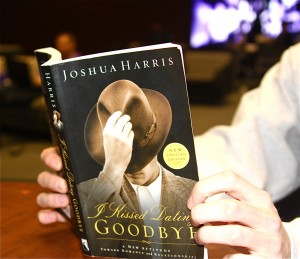
This idea of courtship was huge and fixated on sexual purity and emotional purity.  It grew huge after Joshua Harris’ book I Kiss Dating Goodbye and it was advocated at basically every homeschooling event and by most institutions.  Some groups formed solely for the purpose of educating people about courtship and Patrick Henry College (started by Michael Farris to train homeschoolers to be influential in Washington, D.C. politics).  ATI was huge about courtship, they even advocate betrothal!  That’s where the children have even less power in their romantic lives and the parents “pick” out a decent mate for them, then they are forced into a marriage because it’s “God’s will.”  Of course, only fathers, and occasionally mothers, know God’s will

So commitment in my romantic relationships was usually propelled by the guilt of needing to be in a “courtship.”  Of course, you aren’t supposed to court until the man is financially able to support a woman, which meant I was supposed to avoid romantic relationships til my mid-20s.  This was unacceptable, so I just engaged in quasi-courtship with three different girls through high school – sort of promising to marry them all, planning our lives and futures together, and then usually they broke up with me because God told them to (though I was an ass).

I remember I would form a lot of what would become my identity on the car rides home from something.  My truck became my only escape on a daily basis – with my truck came the first time in my life I had literal freedom.  I could go where I wanted, when I wanted.  That freedom usually provoked thoughts and I would work big issues like courtship in my mind listening to music.  I’m always amazed at how my parents will dismiss me-me and try to guilt and shame parent-me out of the shell.  De-construction and re-construction your identity is not easy and my parents always acted like it was fun for me to rebel.  Yes, when I was a teenager it was fun to let the immature me-me out for a joy ride, only to be clamped down on and repressed.  But that excitement ended in college.  I slowly came to a peace about myself that did not depend on my parents, or their affection.  Finding the me-me was one thing, but synthesizing that into my emotions was much more difficult.

I say all this to try and explain both of the versions of myself.  I can be parent-me, I can turn it on, and turn off my own desires and personality.  It took years for me to even find out what me-me wanted from life and I found a tremendous peace when I discovered my desires and not my parents’.  Throughout college, I would go home and I would let a little more of me-me come out – it was a very slow “coming out,” to borrow a phrase.  I admitted to smoking tobacco.  That I wasn’t a libertarian anymore, I was a liberal – lots of these involved political discussions where my parents felt almost as betrayed that I no longer shared their political beliefs than if I had renounced the faith.  I never did renounce Christianity, only the corrupt vessel of the Christian church.  Admitting I was dating took awhile – I just recently admitted I believed in evolution.  Usually, each admission of the me-me ended in a fight or conflict.  Even in college, they could not let go.

When I first started dating my wife, I asked if she could stay the night in my parent’s house because I needed a ride back to school.  My father said he wasn’t comfortable with that because it would give my younger sister a bad example of “serial dating.  To put this in perspective, this would be the second girl I brought home to my family ever.  I said that I was really serious about this girl and if they chose to act like this, I would tell my girlfriend, and I would understand if she didn’t want my children around them.  This sobered them up quickly and they agreed to let her stay.  But it demonstrates the types of conflicts that would occur when me-me contradicted parent-me.

When my parents manage to convince me to attend their church, my mom always expects me to sing.  My mother and I spent a lot of time bonding in the church choir when I was younger, so she expects me to find the same joy in it now as I did then.  It simply does not work like that.  Me-me does not enjoy church because it reminds me of all the negative feelings of guilt, shame, and intense pressure to be good.  These days when it comes to spirituality, me-me cannot compromise.

Even now that I am married, my parents still want and expect parent-me.  I don’t like the same things, I’m not the same person, and when they laugh and reminisce about the great times they had with parent-me, I can’t help but feel uneasy inside.  They reminisce for parent-me because they know they may never see him again.  They still try to draw on the guilt and shame they instill in me by saying things like “that’s not what we wanted for your life.”  Or telling me the consequences of my sins, then questioning why I don’t think certain things are sins.  When they pressure me-me to revert to parent-me, I get angry, defensive, and emotional.  So I just stop expecting anything, sharing anything, being vulnerable.  I don’t want parent-me for my life – that should mean something.  And I don’t take spiritual advice from cultists.

To be continued.

Homeschool Movement and Abuse, An Introduction

HA note: The following is reprinted with permission from Julie Anne Smith’s blog Spiritual Sounding Board. It was originally published on October 4, 2012.

The lawsuit from my former abusive church has come and gone and I have been doing some deep thinking — trying to figure out what brought us to that particular church — what made that church appealing to us? I had to acknowledge that this church, like other prior churches, was strongly pro-homeschooling. In fact, if you didn’t homeschool, you may not feel very comfortable there. So, it made me go back further, all the way back to the very beginning — before we started homeschooling and were investigating. What I have discovered is alarming:  patriarchal teachings that are often times abusive, parenting styles that are often abusive, and ideas completely outside of mainstream Christianity are going on in the homeschool movement.

My husband and I have been married 27 years and have 7 children from 25 yrs down to our 6-yr old “caboose”.  We have always homeschooled.  We have always believed that this was the best choice for our family.  We have been to many churches due to my husband’s military service and job changes.  Many people have influenced us in our homeschooling, parenting, marriage, and our Christian life journey and right now, I am angry.   I am angry about what I have discovered looking over our marriage, looking at our parenting styles over the years, looking at decisions we have made, looking at people who influenced us — people we trusted to be godly, like-minded and who wanted the best for their children and families.

If you have not been connected with the homeschool movement and click on some of these links, you might say:  ”Um, yea, you drank the Kool-Aid long ago.”  If you’ve been in the homeschool movement, you will probably be nodding along and can reminisce with me. I will take you on a wild journey going back through what I have experienced or seen in the past couple decades as a homeschooling mom.  Here is a sampling, and not in any order, of the kinds of influences, beliefs, philosophies, practices we dealt with or were familiar with among the homeschooling movement over the years:

Why did we have so many children?  How do you know when your quiver is full?  Would we have had this many children if we hadn’t listened to specific teachings?  Who invented the jumper dress?  Why did I sometimes feel guilty if I didn’t wear my denim jumper?  I no longer own a denim jumper.  Who decided Gregg Harris or Michael Farris were the spokesmen for homeschoolers?  Why did so many homeschoolers flock to the articles and books of Mary Pride?

Is it okay to refrain from sex to not get pregnant or is that saying “no” to God’s blessings of children?  Did it really mean one isn’t trusting God if taking measures to prevent pregnancy after cycles returned 6 weeks postpartum (and round-the-clock nursing)?  How many blessings of babies did I prevent by taking matters in my own hands?  Is God mad at me for my “interference” of “His plan”?

What about all of those families who stop having babies after only 4 children or 2 children — are they disobeying God?  Why don’t they want God’s blessings?  Who is targeting the homeschooling community to convince them to pop out babies to overpopulate the world with Christians babies?  Why does this same dude bombard our mailboxes right before Christmas to encourage us to buy Christmas toys (gender specific boy toys for boy and girly girl toys for girls) when their family does not celebrate this “pagan” holiday?

How did I get to the point where I believed that I may be treading dangerously if I was not a member of the Homeschool Legal Defense Association? Who would protect me if someone from school district came to my door and wanted to find out why my children weren’t attending the evil government school down the block?  How many homeschool families printed out instructions on what to say to government officials  if “they” came unannounced to our door to interrogate?  How many of us had HSLDA phone numbers in a prominent place — just in case? Where did all of this fear come from?

Why was I corrected when I said “public” school instead of their preferred “government” school?  Is there an agenda going on? Who is feeding all of this? Who decided that boys should be owning their own home businesses to support their families?  Who decided that all colleges were bad until Patrick Henry College was founded by popular homeschool leaders in the “movement” and then all of a sudden it became “okay” and even “good” to send our kids away to college?

How did the homeschool movement influence my views as far as who I voted for or how involved I was in politics? How did they convince me that I was eating improperly and I needed to grind my own wheat and make my own bread?  How did the homeschool community have the inside scoop before my traditional-schooled friends from church when it was going to become the end-of-life-as-we knew-it during the Y2K scare?  Who brought that hype to the homeschool community?  Would you like to ask me how many homeschoolers I personally know who are still going through their stockpiles of grains? Seriously!

When did I get to the point where I looked down at my friends who were Christians and either sent their children to public or private schools when “they should” be teaching their own?  How did all of this happen?  Why do so many homeschoolers balk at immunizations? Why are some homeschoolers so proud?  Homeschooled kids were the smartest because they always won the National Spelling Bees, right? Who decided that homeschoolers should be involved with speech and debate? Why are so many families going to their state capitals and involving themselves in politics — because they were going to be the movers and shakers of world in the political arenas?  And why is my husband responsible for my faith and the faith of our children? And why do we have to go through him on spiritual matters?  Does God not speak directly to homeschool kids and wives?

Who told me about modesty and how I should be dressing and how my daughters should be dressing?  What does modesty have to do with homeschooling?  Why do all homeschool boys look alike with similar short haircuts?   Who convinced me that my children could never “date”, but must only “court” and that my husband gets to choose our children’s future spouses?  How did, “I Kissed Dating Goodbye” become such a popular book?  Who named the government as “evil” for wanting to know how our children are educated?  Why do homeschoolers assume the worst when they file their “notice to intent” with their local school district?

Why do they assume that the school district secretary doesn’t want to deal with homeschoolers and will instigate more trouble by wanting more information than required by law?  Who made up this purity ring ceremony — and that our teen daughters should wear their purity rings symbolizing their virginity until they replace it with their wedding ring?  Who started this thing where daughters shave their fathers’ beards? Below you will see an invitation to a Father Daughter Tea from Vision Forum. Fast forward to 1:37 to see daughters shaving their fathers. Um, really?

Who decided that boys should have their homes paid for before they get married?   And why are organized sports so wrong?    When did Young Earth creation become a primary issue to be a Christian and that if you didn’t believe it, you might not be Christian?   Why are scientists looked at as if suspect?  Psychology is of the devil.  What’s with all of those pictures of large families with matching clothes on the covers of homeschooling magazines?  Are my children supposed to be wearing matching clothes?  Who decided that was the right way to dress kids?  Who decided that women should only wear dresses?

And what about those who show up at conventions with head coverings — are we bad women if we don’t have them?   Who decided that family-integrated churches were better than traditional churches for our family?  Why is it that homeschoolers brag about their children being able to interact and socialize well, yet you can “pick them out” a mile away because they look and act so “different”?   Who has been instigating the us-vs-them mentality regarding so many of these topics?  Who decided that the only job that we should be teaching our daughters is to be “keepers of the home” and serving their fathers and then serving their future husbands?

Who decided a 1/4-inch plumber’s line was an appropriate tool for spanking?  Who taught us that if we had to repeat a command twice to our children, our children were being disobedient:  First-Time Obedience.   How did we let this group convince us that all infants should be able to go 4 hours between feedings.  What single man decided that fathers were an umbrella of authority over the family below God?  What same man also encouraged men and women to get vasectomies and tubal ligations reversed to allow God to control the size of their families and then paraded post-reversal children in front of the auditorium at conventions?

This is quite a diversion from spiritual abuse in the church, but I need to go there.  I now believe the homeschooling movement made our spiritually abusive church seem appealing to us.  Some of the above is just plain quirky, but other issues go much deeper affecting core spiritual beliefs and agendas.

My daughter, Hannah, is 25 yrs old and she was only homeschooled.  The first traditional school she attended was community college and last spring she became a college graduate. Her peers were from an early generation of the growing homeschool movement. More and more blogs are being published by young adults like my daughter who are “coming out” and sharing their homeschool experiences.  The stories are not pretty.    My daughter has shared some of her story.  And you can read the story I wrote about Hannah’s experience here.  In that story, you can get an idea of the controlling environment in which she lived and how she had to escape – it remains one of the most popular blog posts.

What she experienced at home has probably gone on in many homes.  I bear much responsibility for it.  I went along with it.  I have apologized to my daughter many times for it.   The abusive church we found also aligned with these philosophies of heavy-handed control of children, even adult children.  Hannah was 21 when she moved out.  She was not a child, yet we thought we owned her.

I assumed (yeah, I know about that word), that when we got into homeschooling that it was a safe community — a community where children’s best interest was at heart.  We wanted to have the primary influence in the education of our children.  That’s good, right?

But I have discovered that there is an underlying agenda in the homeschooling community that has been there all along — even years before I started — and it continues to this day. I believe that some of this underlying current — taken to an extreme — could be responsible for breaking up families, causing abuse, wreaking havoc on people’s spiritual life.

I firmly believe that God used the lawsuit in a powerful way to highlight the issue of spiritual abuse in the church.  He was there during the entire time providing amazing support for me.  My life is rich having gone through it.  But now I’m wondering if God is using another experience of my life to share here.

While I have spent countless hours writing blog posts about spiritual abuse in the church, I think there is a setup for spiritual abuse that originates in the homeschool movement. In our abusive church, we felt a “kindred spirit” (and all the homeschool moms just laughed at me with that phrase) in the church because of with like-minded teachings and beliefs. Some of these ideas need to be explored further.

I think it’s important to hear from these young adults who have lived it and are now trying to put the pieces together of their childhood together as they begin their families.