I Was Born With A Severe Immune Disease: Attackfish

positives

I Was Born With A Severe Immune Disease: Attackfish

HA note: The following is reprinted with permission from Libby Anne’s blog Love Joy Feminism. It was a guest post by Attackfish and was originally published on Patheos on February 3, 2013.

I was “homeschooled” (and I’m not sure I am comfortable calling it that) for absolutely non-ideological reasons, and in fact, there was only ever a brief time during my schooling in which I was not enrolled in public school, at the very end, a few weeks before I took my GED.

I was born with a severe immune disease, and along with making me extremely prone to infection, it also causes me to have seizures, narcolepsy, fainting spells, asthma, and circulatory problems, all of which grow worse when my body is run down. This made just getting to school, a building with two thousand people and all of their pathogens, a real challenge for me, and in my freshman year of high school, my family and I convinced the school district to send a teacher home to teach me, as part of a program usually used for students with less chronic illnesses, like pneumonia. I was enrolled in six periods of classes, and the teachers from those classes would send me assignments through the home hospital teacher, so the academics of my schooling were identical to the ones at the local high school, aside from the fact that I was allowed to pace myself.

Every year, I did attempt to go back to attending school, and every year I lasted a couple of months before admitting that no, I wasn’t magically better this year.

We knew that the home hospital program existed, because my elementary school had begged us to take advantage of a similar system when I was in kindergarten, because they were unable to handle my “strange behavior” which would much later be diagnosed as seizures. My seizures aren’t what most people think of as seizures. During them, I lose all awareness of myself, and run around, glaze-eyed and utterly non responsive for up to several hours, looking for a place to hide, attacking anyone who physically tries to stop me.

They happened at least once a week before I was diagnosed and received treatment, and sometimes, they happened several times a day, almost always at school. Before I was diagnosed, the school and my teachers assumed it was some kind of emotional problem, and the other students were terrified of me. Even once I had a diagnosis, the teacher and principal I had at the time both refused to believe they were anything other than a brat’s tantrums.

As I stopped having them, they encouraged the other students to bully me mercilessly as punishment, and I eventually had to change schools because of the abuse.

Although we moved to another state when I was in middle school, the social anxiety, low self esteem, and poor grasp of social cues the earlier bullying, and falling prey to my first of two stalkers, had left me with, marked me out as easy prey for more bullies and another stalker, right up until I withdrew from high school.

My bisexuality having somehow become common knowledge to the student body didn’t help matters.

For years, my family and I had battled bullies and an administration dead set against helping me end the torment I was enduring. I had switched schools, moved, and done everything I could to blend in and keep my head down.

I was out of options and out of hope.

I remember this tremendous sense of relief at the idea of leaving school, and once I had, I felt truly safe for the first time in years.

For the first time, my illness presented the solution. I really was too sick to go to school. The bullies and my stalkers hadn’t driven me out, I could leave school guilt free. Learning at home for me was an overwhelmingly positive experience, giving me space to breathe, heal, and gather my strength. I had become so used to living in fear that I didn’t realize how afraid I had been until I wasn’t any longer. Later I would be diagnosed with PTSD, most likely from the two stalkers, and it took me years to be able to admit to myself that I wasn’t just weak, or a wimp, or an overdramatic teenage girl, that school for me was bad.

It was ugly, and it was bad

Escaping it was a Good Thing.

And it was medically necessary. Given how vital the chance to lick my wounds and put myself back together was, it’s sometimes hard to remember the real reason I left high school was that I kept ending up in the hospital.

I don’t fit in well in the pro-homeschooling camp, because I don’t think it’s the best thing ever and everybody should do it. In my case, it was a last resort, but most students aren’t as horrifically unlucky as I was. It’s more that I believe in everyone’s right to protect themselves and to leave abuse.

For me, that meant learning at home. I’m grateful for it.

From Bullying to As You Like It: Skjaere

positives

From Bullying to As You Like It: Skjaere

HA note: The following is reprinted with permission from Libby Anne’s blog Love Joy Feminism. It was a guest post by Skjaere and was originally published on Patheos on January 27, 2013.

I was home schooled full time in eighth grade, and part time in ninth and tenth. Up until that time, I had been enrolled in our local public schools, where my dad was a teacher.

I’d been having problems with bullying at my middle school (both by my peers and by teachers, WTF?!).

When my mother asked me if I wanted to try home schooling, I jumped at the chance. It sounded almost too good to be true. I could choose my own reading lists and projects? Sign me up!

We were not a terribly religious family by any definition at that point. We attended the Episcopal church a block from our house because it was closest, and I had a lot of friends who went there. Our home school curriculum was not based on conservative politics either. We did things like visiting the local National Park and helping them plant seedlings. We went whale watching. I researched my family tree as a history project, and read Lewis and Clark’s journals.

It turned out the promise to pick my own reading list was too good to be true.

I loved to read, but my interest was mostly limited to fantasy fiction. I was allowed to choose books from a pre-selected list, however, which included such classics as 1984, Fahrenheit 451, To Kill a Mocking Bird, as well as various works by Mark Twain and William Shakespeare.

We also frequently got together with other home schooling families for Latin classes (our parents let us choose what language we wanted to take), and they all fell more into the hippie home schooler mold than the religious as well. One of my best friends was part of that groups, and we hung out together a lot. Many of us also took ballet classes together and participated in the Girl Scouts, so I don’t feel like I missed out on socialisation, especially when compared with the experiences I had suffered at my middle school. At the end of my ninth grade year, we organised a dramatic reading of “As You Like It” with an all-female cast and a five-year-old Duke. It was pretty awesome.

I was lucky to have two educated parents, and a mother who was able to stay home and teach my sister and me.

My dad was a math and science teacher at the local high school, and my mother had an English degree, so we have most of our major bases covered right there. I also took some correspondence courses through the University of Nebraska, did a year a our local community college through the Running Start programme, and then went to the high school full time my senior year. By the end of all that, my transcript was a confusing mish-mash, and it was pretty much impossible to calculate my GPA, but I did well on the SAT and was accepted to some wonderful univerisities.

After almost twenty years and some major shifts in my personal politics, I still feel pretty good about my home school experience.

A Week of Joy: Call for Contributions to HA’s Upcoming Positives Series

Screen Shot 2013-08-06 at 1.21.00 PM

By R.L. Stollar, HA Community Coordinator

*****

I have a very complicated relationship with homeschooling.

In many ways I have significant problems with the Christian homeschool movement; in many other ways, however, I appreciate my homeschool education. My education was lacking in some areas, particularly science, but it was also exceptionally above average in other areas, such as language arts and communication. I have suffered emotional and verbal abuse in homeschooling contexts. But this was at the hands of other homeschooling parents, not my own parents. My parents have been extraordinarily supportive of Homeschoolers Anonymous, for which I am deeply grateful. Also, while I experienced emotional and verbal abuse in homeschooling contexts, I have also experienced sexual abuse in a public school context.

I am under no delusion about the universality of abuse.

It is for these reasons that I do not primarily see my identity as a survivor of homeschooling. In many ways I am a survivor: I am a survivor of abuse, sometimes from abuse in homeschooling and sometimes not. But my experiences are too mixed to be able to fairly isolate only one community from which I am a survivor. I have instead channeled that complex pain into wanting to make the world a better place in whatever context I can. Since homeschooling was my life for so many years, I see myself as an advocate for other homeschoolers who have had far worse experiences than I have.

Honestly, most of my experiences growing up in SELAH and CHEA, my California homeschool groups, were positive. It was while traveling around the country with Communicators for Christ that my eyes were opened to all the different subcultures and ideologies that can create real and serious damage to children. Growing up, I only had an inkling about some of these phenomena. I did not begin to connect the dots until I came into contact with thousands of other homeschoolers and began observing patterns.

Much of my life has revolved around this sort of tension, or dialectic: there is so much good, and there is much bad; there is so much pain, and there is so much joy.

As we begin our next “week series,” I am hoping that as a community we can explore this sense of tension and the reality of dialectic in our experiences.

On July 15, we asked you as a community to pick the next topic you’d like to see us address as a community. We received votes via Facebook comments, private messages, emails, and Tweets. Honestly, there was a good number of votes for all four of the options: (1) Mental health, mental illness week, (2) Abusive relationships week, (3) Grandparent(s) appreciation week, and (4) Positives (what you liked about homeschooling) week.

No one topic won by a landslide.

So obviously we need to cover all of these at some point in the near future. Mental health came in second, with a lot of vocal support for it. So it seems that would be the most appropriate topic for the series after this next one.

For the immediate next series, the winning topic was positives.

While this topic was the winner, it also received a lot of pushback — which, frankly, I understand. If you have suffered neglect or abuse in homeschooling, you’ve probably spent the majority of your life wearing a “I love homeschooling and nothing is wrong with it” mask. This might be the first time in your entire life that you’ve felt the freedom to talk about the negatives. You might be thinking, “I don’t want to talk about positives. I’ve done nothing but talk about the positives since I was a kid.”

Honestly, I personally relate to that sentiment.

At the same time that every fiber of my being wants to finally talk about the negatives, there is a place for the positives in our community. Not everyone in our community has had a bad experience. Not every ally here has experienced our pain. But they are here, supporting us, and listening to us.

I want to give people with positive experiences a place to be heard, too.

Our allies’ positive experiences are fundamentally vital to making homeschooling better for future generations. Those of us with good stories are examples of how homeschooling can be done well.

For every story that says, “This was a problem,” the question is raised: “What is the solution?” Sharing positive experiences is crucial to teaching current and future homeschooling parents the difference between those environments that led to pain and those environments that led to joy.

We need to hear those.

So those of you in our community that have had positive experiences, this is your time to speak up.

And to those of you in our community that have had negative experiences, this is actually also your time.

A week of positives does not mean we are just talking about generally positive homeschooling experiences. Yes, it means that we are taking a week to celebrate the good things. But it also means we are dedicating time to celebrate those moments of joy that contrasted with those moments of pain. This is a week of joy for everyone: to share in others’ good experiences, and also to celebrate those people or those moments that gave us a hope to carry on, that gave us maybe a unique experience of unconditional love.

I have moments like that. I remember when a horde of parents surrounded me and yelled at me (no exaggeration), and one parent silently pulled me out of that crowd and went for a walk with me. That one parent in a very real sense rescued me. He told me that, regardless of what the other parents might say, I was valuable. I was a human being and I was to be unconditionally loved.

I learned that lesson from a conservative Christian homeschooling father. So I celebrate him.

I remember that moment because moments like that, though maybe few and far between, are some of my favorite memories to this day.

Our upcoming positives week is an official celebration

Of parents that succeeded in giving their kids a good education, of those adults or peers that showed you real compassion, love, or respect, of those moments that gave you hope and healing amidst not-so-positive experiences.

Let’s celebrate all of those things together.

*****

To contribute:

If you are interested in contributing, here are some ideas for what you could write about:

  1. Your personal story of a positive homeschool education
  2. Your personal story of positive aspects of your homeschool education
  3. An experience you had where another person in your homeschool life (one of your parents, another homeschooling parent, a friend, a tutor, etc.) showed you love or respect that maybe you had not experienced before
  4. An experience you had where another person in your homeschool life taught you something that gave you hope about the future, or maybe a personal struggle you had

You do not have to pick just one topic. You could combine several of these ideas, or bring your own ideas to the table, or — if you have a lot to say — contribute several pieces on a variety of these topics.

The deadline for submission is August 23, 2013.

As always, you can contribute anonymously or publicly.

If you interested in participating in this, please email us at homeschoolersanonymous@gmail.com.

Confessions of a Homeschooler: Iris Rosenthal’s Story, Part Two

Confessions of a Homeschooler: Iris Rosenthal’s Story, Part Two

Iris Rosenthal blogs at The Spiritual Llama. This story is reprinted with her permission.

< Part One

"I remember how hard it was for me to adjust to being outside of the homeschooling bubble and in some ways, eight years later I am still adjusting."
“I remember how hard it was for me to adjust to being outside of the homeschooling bubble and in some ways, eight years later I am still adjusting.”

Since my original post I have come to the realization that I have just scratched the surface on everything that I have to tell about homeschooling. One of the problems I have with home education is that there is hardly any regulation. During the time I was homeschooled, K-12, I never once had to take the SAT or ACT or any other sort of evaluation test.

As long as it looked like I was studying I was pretty much left alone. The only subjects my mother was constantly involved in were; math, spelling and english. Occasionally she would check my work in the other subjects, but for the most part I was left to fend for myself and once I reached the age of 15 any involvement from her pretty much came to a stop.

I often hear the argument that not all parents homeschool are like this and that my mom was doing it wrong. While that may be the case, I don’t think that this should be lightly brushed off. We are talking about the education of children here! It is my belief that whichever route you choose, it’s very important that your children receive the best possible education. Be involved, be a part of their lives, listen, be aware of what they are learning about and learn with them!

With the lax requirements in place for homeschooling it only flings open the door for cases such as mine to happen. So much for homeschooling being better than public school (for those who don’t know me, that was sarcasm)!

I know my story is not the only one, my brother & sister and close friends have also experienced the same lack of education and preparedness to function in the real world because of being homeschooled. However, I’m not here to tell their story for them, I’m here to tell mine.

My first full time job experience happened when I was 21 at a call center. Yes I’d had jobs previously, but they were just odd jobs and the people I worked for I already knew from either homeschool group, church or 4-H. So I was always within that bubble my mother had me living in.

While working at the call center I got to know people who *gasp* went to public school, it was then that I started to realize that there were holes in my education. I didn’t know any math beyond the basic add and subtract. I could barely multiply or divide. Forget fractions and algebra.

I also realized that I was spelling a lot more words wrong than what I originally thought I was. It’s pretty bad (not to mention embarrassing) when your manager brings back your vacation time off request (written in clear handwriting) and asks you to tell what words you meant to put down. I found myself sticking out a lot in all the wrong ways, and my judgmental attitude towards people who were different than me didn’t help with that at all!

I had never been around so many people from so many different backgrounds before, it was quite an eye opener and culture shock for me! I still remember the first time I heard someone swear. If I didn’t agree with something someone said or did I made sure to let them know that it offended me. If I knew someone was a Christian and I heard them say something that I didn’t believe a Christian should say I made sure to let them know how wrong they were.

Looking back, I was quite obnoxious and judgmental towards my coworkers at that job. It is no small wonder that barely any of them talk to me anymore and I can’t say that I blame them!

I am so thankful that I have learned since then and now at my current job I am known among my coworkers for being helpful and a team player. I no longer allow my homeschooling experience to define me, in fact I hardly ever bring it up. I don’t feel as though I should have to defend my education (or lack thereof) to anyone.

It is my desire that people know and define me by who I really am, and not as some “failed product of home education.”

I hope that by sharing my experiences I can somehow prevent them from happening to someone else. I remember how hard it was for me to adjust to being outside of the homeschooling bubble and in some ways, eight years later I am still adjusting.

If anyone is reading this and is going through that rough transition period from the bubble to the real world, just know that you aren’t the only one who has traveled that path. It may be rough now, but in the end you will be stronger and wiser for it!

Visualizing “The Myth of the Unsocialized Homeschooler”

HA note: The following is reprinted with permission from Heather Doney’s blog Becoming Worldly. It was originally published on July 7, 2013.

I googled “homeschool” to see what pictures came up. Many of them had to do with socialization and the messages that homeschool parents get and give about it. So I figured I’d talk about homeschooling and the issue of socialization today and use some of the cartoons I found in the process. Some of them are a little disconcerting in the way they point out issues I see, just maybe not quite in the ways the cartoonists intended.

What is This “Socialization Problem” You Speak Of?

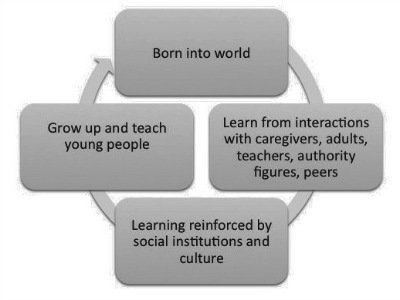
So first a bit about what socialization is and how it relates to homeschooling. This diagram explains socialization pretty simply and it comes from a site that talks abut stopping cycles of discrimination that are often passed on intergenerationally.
soc1

I think the site the diagram comes from – Parenting for Social Change – makes an excellent point – that this is generally how socialization is done but socialization can sometimes be bad. You can absolutely be taught harmful things as well as positive things in the course of your socialization and most people are taught a mix. What homeschooling parents often become inclined to do though is try to eliminate or greatly reduce these “bad” things by winnowing their child’s socialization opportunities down to only parentally vetted and approved sources and quite often those approved sources are fellow homeschoolers, religious leaders, highly edited texts and media, other “likeminded families,” and sometimes, when the parent is particularly controlling or inept at socialization themselves, nobody at all except for the immediate family.

Yes, this last one is a real big problem because terrible things can happen when families get isolated like that and it is a big risk factor for all kinds of abuse, neglect, and poor mental and physical health. Thing is, this social isolation problem happens in homeschooling much more frequently than it should. In fact, even in Brian Ray’s wacky (and so methodologically unsound that I am stopping myself from going on a rant about how many problems it has) “Strengths of Their Own” study included something I found interesting about it. See if you can catch it.

soc2

That’s right. The third bar from the bottom. The yellow one. If 87% of the children in Brian Ray’s highly self-selective study play with “people outside the family” (and I will leave you to ponder right along with me as to why this wording is not “other children outside the family”) then that means that 13% of children in Brian Ray’s study do not play with others outside of their own family, which I would most definitely define as a socialization problem. If Brian Ray, excellent fudger, misconstruer, self-quoter, and ideological spit-shiner of homeschool data extraordinaire, has almost 15% of the kids in his rather cherry-picked study having this issue, how common must it actually be in real life and how do people in homeschooling react to this issue? Well, let’s see…

Socialization Sarcasm

This cartoon makes fun of the concept that socialization problems exist in homeschooling. To me it implies that socialization happens so naturally that it simply isn’t something a homeschool Mom could forget. Why? Well, I’m honestly not exactly sure. Socialization is a component that definitely can be ignored or accidentally left out and it has openly (and wrongly) been discounted as being unimportant by many prominent homeschool leaders. Because it has been ignored and dismissed as a necessary part of many homeschool curriculums is the main reason why homeschoolers have gotten the reputation for being unsocialized in the first place.

soc3

Most homeschool kids don’t like being stereotyped as unsocialized or feeling like they are unsocialized (I mean really, who would?). So there’s also some memes and jokes that have been spread by teenage homeschoolers implying how inherently dumb or inappropriate they think it is when people make socialization an issue. Most of these involve poking fun at the “myth” that socialization is a problem in homeschooling. There is this YouTube video by a homeschooled girl who is trying to do this by distinguishing “the homeschooled” from “the homeschoolers” and while I find it funny, I’m quite sure that her pie chart is wrong and she perpetuates elitist stereotypes she has likely heard throughout her homeschooling experience.

This blog had a post by a homeschool graduate complaining about people asking what’s become known as the “socialization question” and in her post she uses a picture I’ve seen fairly often. There’s even t-shirts with this printed on them that you can buy.

soc4

Socialization is Fishy

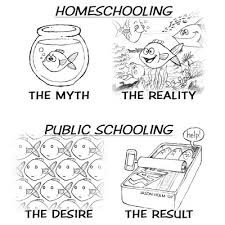
So what do homeschooling parents think about the socialization issue when theydo actually address it? Let’s start out with this cartoon, as it’s used a lot. It claims that a lack of socialization in homeschooling isn’t just a rare problem, but an outright myth. It implies that homeschool kids are not only actually in diverse environments as part of a natural ecosystem but are thrilled about it. It also implies that children who are socialized in public school are like half-dead sardines in a can rather than the school of likeminded fish they are expected to be.
soc5

This cartoon is a direct dismissal of there being any merit to the “socialization problem” and it is compounded with a public school counter-stereotype. This is unsurprising to me as the argument that homeschool socialization problems are an outright myth is quite often included with something disparaging about public school or insulting to teachers (and this cartoon is no exception). Notwithstanding how insulting it is to imply that most people who go through public school are like dead fish, is this depiction of homeschool versus public school in any way accurate? Well, I imagine for the occasional situation it is, but in general, certainly not.

Oddly this cartoon was actually almost the exact opposite of my experience. In the CHEF homeschoolers group I was in it was all white Christian families and our parents had to sign a statement of faith to join. It was absolutely a school of fish all swimming the same way and because we got together infrequently, I generally felt like that fish in the fishbowl. Also, when I went to public school in 9th grade I was certainly no canned sardine, even if I wasn’t exactly the manic fish thrilled at the ecosystem in the upper righthand corner. The teachers often tried to corral us into all doing things the same way but we didn’t make it altogether easy for them and generally I expect it was a bit like herding cats. We were all individuals, as were the teachers. I had favorite teachers and subjects and ones I didn’t like and I made friends of different races and beliefs and political persuasions, many of whom who are still my friends and acquaintances to this day.

The Dark Knowledge of Teen Degenerates

Here’s another cartoon about homeschool kid socialization from a slightly different angle, and this one does address the idea that kids don’t always do what you want them to do and by invoking the dreaded “peer pressure,” implies that its all bad. Which one is it – are they lobotomized sardines in a can or are they violent and rebellious ingrates? Make up your mind! Also, how realistic is this, do homeschool moms actually think public school kids are like this? Where are the public school kids who are not “at-risk” of being part of the school to prison pipeline? Why aren’t there any of those at the bus stop?

soc6

Also, in this little dystopian cartoon, gang members with knives read books on values (morally relativistic ones, no doubt), evolution, meditation, and “new age” religion (if that isn’t a culture wars, fearmongering buzzword, I don’t know what is) and pregnant girls read about sex ed and still don’t know what made them pregnant. This cartoon is crazy stuff. People don’t drink beer and shoot up heroin (yeah, there’s a needle on the ground in the cartoon) while waiting for the school bus (although some do smoke cigarettes). People who read a lot don’t typically join gangs. People who know about comprehensive sex ed aren’t any more likely to have sex than kids who don’t and they are much less likely to accidentally get knocked up. Honestly, if this is what anyone actually thinks the world is like then they are not fit to educate other human beings and they probably need some mental help themselves.

Sweet Homeschool Girl in the Ghetto

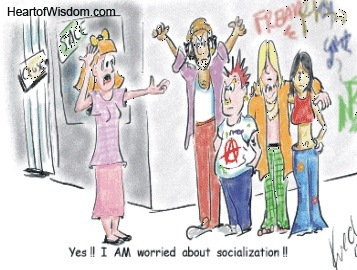
This cartoon is similar to the previous one in that it also indicates that public school socialization is all bad, but it depicts the expected reaction of the homeschool girl in the public school and implies that if your daughter goes to public high school (obviously radiating her feminine purity with a big hair bow and below-the-knee church skirt) that she will soon be shocked and horrified to encounter people dressed immodestly, young people openly dating, tattoos and piercings everywhere, vandalism and crime, blatant teenage rebellion, and big scary black boys that look more like grown men. So obviously the answer is to just have her at home not knowing that people who are different from her exist, and make most of the people her age out to be disgusting, immoral, and scary, right?

soc7

I followed this cartoon to its site, a blog called Heart of Wisdom, trying to get a higher resolution picture. The blog talked about how homeschool kids should only selectively socialize with other Christians and claims this is biblical. Yep, this is just the type of homeschooling “socialization” I am familiar with. It’s a form of social isolation and indoctrination called “sheltering.” This stuff is all about parental fear and desire for control and helicopter parenting to this extreme is very unhealthy for your child. It will mean that in adulthood that they won’t know how to function at an optimal level. You cannot shield your kid from all “bad influences” and indeed there is nothing in the bible that says your kids cannot play with the kids of people who have different beliefs. That is quite a stretch and it is insular, cultish thinking.

My Homeschool Kid is Smarter than Your Honors Student

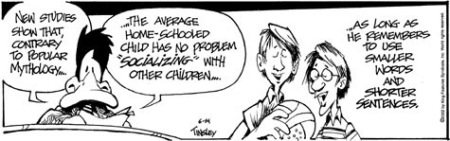
That same Heart of Wisdom blog had this other cartoon about homeschooling, so I followed that link and it was to a page dedicated specifically to homeschool cartoons. When I see stuff like this cartoon I have to once again ask – is this supposed to be funny? Do these people actually think this is accurate? My main question, though, is why the elitism and negativity? Even if your kid is getting a much better education in homeschooling, why talk trash about children who through no fault of their own don’t have as good of an education? Why make it into a competition, act like homeschool kids in general are “better” than other kids? It shows me some immature and defensive parenting, really. If you revel in it when someone else isn’t doing as good as you it shows you are 1) being a jerk and 2) secretly worried that you’re no good at what you’re doing. Nobody should ever be excited about other kids having a sub-par education, thinking it makes them and their kids look better. That’s just gross.

soc8

As it is, I find that there is a grain of truth in this cartoon but perhaps not quite in the way the cartoonist intended. I’ve known a lot of homeschool kids who do use big words in conversations and they soon realize that it comes across as awkward when they socialize with other non-homeschool kids. Admission: I was that kid myself. I read a lot of classic literature and became familiar with words that simply aren’t used in everyday speech anymore. Trying to use them in peer-to-peer conversations didn’t reflect on me being smarter. It reflected on me not having a modern day frame of reference as to what is appropriate. It reflected on me being socially backwards. Lots of public school kids who are bookworms like I was know many big words. They also know the right words to use for their audience. Context is everything. An unsocialized homeschool kid doesn’t have that context and very well might find that using 18th century literary terms in a conversation about basketball will indeed get people looking at them sideways. If homeschool parents want to be proud of that, think it makes their kid (and by extension them) “better,” it shows they truly don’t understand the issue at hand.

Parental Fear & Social Anxiety

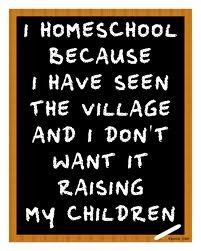
That’s where I think we hit the crux of this whole thing. I think the main issue is parental angst and fearfulness. Too many homeschooling parents socially struggled in school themselves and/or got into drugs or unhealthy sexual relationships. Instead of taking a broader view today, they expect that they need to hide their kid away from these settings or the exact same thing will happen to their kid even though their kid is in a different school district in a different generation and *gasp* a different person. These parents become scared of or hurt by the society we live in, withdraw, and then use homeschooling as an excuse to be separatist, snooty, and helicopter over their kids. These are not positive reasons for homeschooling and these are the exact kind of fearful and overbearing attitudes that lead to socialization problems for homeschool kids.
soc9

Because people with strong views often find themselves in positions of leadership, those with exclusionary, separatist, and elitist attitudes often end up running things and then set this negative and divisive tone for the homeschooling group and the community it serves. It’s so pervasive that even some “second choicers” who start homeschooling simply because the other educational options in the area aren’t up to meeting their child’s particular needs (which is an excellent reason to homeschool, in my opinion), can get sucked into this culture, an “us versus them” mindset where homeschooling represents everything that is pure and good and healthy for children and public school and the people and structures that support it represents everything bad. This creates a parallel society of sorts and then you see people start calling public schools “government schools” in a pejorative sense. All this “us versus them” talk fans the fear that homeschooling parents are vulnerable (although still superior) outsiders who are or soon will be discriminated against and this in turn leads to easy exploitation of these scared people.

Why does widespread homeschool participation in things like the fundamentalist-led HSLDA, which capitalizes on these fears and requires dues money (that then goes into their cultish culture wars arsenal) for unnecessary “legal protection” exist? Because many these people are too freaked out to do anything more than cling onto a protector, ignoring all evidence that their “protector” just wants to use them – financially and for furthering a disturbingly anti-democratic agenda. This fear grows and leads to the kind of mindset that spawns ridiculous cartoons like the one below.
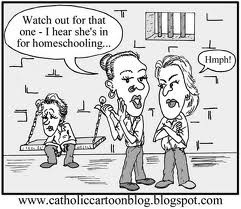
soc10

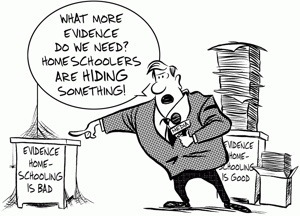
Put in prison for homeschooling – really? Of course in this cartoon there’s that same (expected) depiction of scary people with piercings, this time instead of a shocked daughter (projecting much?) it’s got a dejected homeschool Mom being shunned by hardened criminals who sarcastically note that her “crime” was homeschooling.

Homeschooling parents who follow these “leaders” (often starting because their local homeschool support group requires or recommends HSLDA membership) hear these divisive messages and become scared to death of being framed, exposed, persecuted, worrying that they will land in jail just for homeschooling. It may be a wacky and unrealistic fear given what’s actually going on, but if people hear it often enough they often come to believe it, along with the bogus stats and stories claiming that homeschooling is as close to perfect an educational option one can get in such a messed up society, and the myth that there is no evidence to the contrary because homeschooling is just so awesome.

soc11

Because homeschoolers test scores aren’t made public and often not even expected, registration isn’t even required in many states, and most people don’t pay much attention to homeschooling unless their kids are being homeschooled. Homeschool movement leaders have been able to get away with exhibiting the cream of the homeschooling crop as representative of all homeschoolers. This has painted an inaccurate picture and hurt the vulnerable kids by leaving them ignored as they fall through the cracks.

Saying “our homeschool kids are socialized but socialization doesn’t matter and in fact it generally sucks if it isn’t coming directly from parents” is a very unhealthy attitude to go into educating with. Responsible homeschooling parents really need to do a bit of soul-searching as to why they tolerate these inaccurate depictions of what socialization is and isn’t, why there is this the across-the-board maligning of all public schools within many homeschool communities, and why so many participate in this ugly (and frankly in my opinion undeserved) elitism, and contribute to such extreme (and inaccurate) stereotyping and putting down of children who have had to attend lower quality inner-city schools, all in order to inflate the merits of homeschooling.

Two big question:

(1) Does this kind of attitude help do anything beyond artificially boosting homeschool egos?

(2) Is there any need for this behavior if homeschooling is really so awesome?

Also, if there is no good data on the problems of homeschooling then instead of celebrating the cobwebs we need to be collecting more data. Every single education method in this world has problems and the places where the problems are denied is where child maltreatment can and does flourish.

The Truth Between “Stereotype” and “Myth”

I get the message that not all homeschoolers are cloistered and don’t know how to talk to people their own age, but the fact is that too many are and we need to recognize that it is a real problem affecting a sizable percentage of homeschool kids. Also, homeschoolers are simply not the most brilliant people in the world or inherently “smarter” than other kids, and as such they shouldn’t need to feel pressured to achieve perfection, perform as child prodigies, or that there’s a black mark on them if they mix up “asocial” and “anti-social” in a conversation.

soc12

This “myth of the unsocialized homeschooler” is an issue in homeschooling but the prevalent idea that the socialization problem is a myth is the real problem, not the legitimate questions and concerns about socialization that homeschool parents keep being asked. Those questions actually need to keep happening because social isolation and ostracism in any setting (including homeschooling) often follows a person into adulthood, and can leave people struggling with social anxiety, a small social network, low levels of social capital, mental health issues, and an unnecessary amount of sad and lonely memories.

The least we can do is stop making fun of people, stop being in denial, stop pointing fingers elsewhere, and acknowledge that it is real, it happens too often and it should be assessed and addressed as the serious problem that it is.

The Space To Be Human: Jayni’s Story

The Space To Be Human: Jayni’s Story

I was fourteen when I was introduced to CFC/NCFCA. The mother of another large home schooling family approached my mom with the “great opportunity” to provide all of the meals for a CFC conference she was coordinating. “If you make all of the meals the conference fees are waived for your family and I thought of you, since you have so many children.”

The conference was terrible. There were very clear expectations of what each attendee should look like and how they should act.  The conference was full of bright, happy, perfect home schoolers with impeccable manners. They all looked like they had stepped out of a Lands’ End catalog. (Lands’ End: the modest J. Crew) I was embarrassed to have to re-wear the only two skirts I owned for a full week. I was ashamed to be a “scholarship” kid.  I inwardly raged at the attitude that you were a bad Christian if you were not a good speaker. Naturally shy and introverted, I balked at the idea of ending the week by giving a short public speech.

It was very clear to me that I was an outsider. But by the end of the conference my mother was sold: her kids needed to do this NCFCA thing. And by the end of the conference I was hesitantly intrigued by debate: my mother would support me verbally fighting with people? Awesome.

Looking back at the few years I spent in NCFCA, I am struck by the contrast I experienced. On one hand, every organized experience (both in and out-of-state conferences, CFC, and Masters) were terrible. On the other hand, I met people who saved my life.

The first year I partnered will my unenthusiastic older brother. Wisconsin was very new to NCFCA and there was only one in-state tournament. We were warned ahead of time that all of the “community” judges were biased towards the hosting debate club. We were assured that if we lost every single round it was not an indication of our debating ability. We went 2-4 and I was devastated. I saved every ballot and poured over them incessantly, trying to find the key to my failure. For a league that touted Communicating for Christ there was very little grace for the losers.

The next year my brother went to public school. I was partner-less in a rural area with no club. I turned to everyone’s favorite online phorum to find a partner and debate coaching. It was extremely intimidating: apparently I was the only one who had not spent every waking moment since I was 12 obsessed about debate. I began spending upwards of six hours a day researching (I’ll admit, now, often without a clue about what I was looking for.)  I found an out-of-state partner and began pushing my parents to let me attend more tournaments. This meant expensive out of state travel; something my mother had not planned on. My birthday present that year was attending a practice tournament in Indiana.

The comments on my ballots that year were evenly split between admonishments of “have more confidence! =)” and “you are too intimidating and forceful, try to be more lady-like.” The capstone was at that year’s aforementioned state tournament. In a semi-final round my partner and I were debating against the tournament coordinator’s son. Before the round began when we all filed into the room to introduce ourselves to the [impartial] judges and shake their hands, one of them leaned over the table to give this guy a hug and mentioned something that happened at church last Sunday. I shook it off; I knew this team relied on smooth talking for the win, but nobody could ignore my heavy box of evidence. They were affirmative and the case was weak.  I jumped out of my chair to cross examine him after the 1A. There was a huge hole in the case and I dived right in. He talked around the question. I asked it again. He changed the subject. I rephrased and asked the same question. It got heated.

I doubt I even have to tell you that we lost the round because I was “rude.” The kicker? The timekeeper was the guy’s younger sister. My father was in the room watching the round and said afterward that when it was clear that I “had him,” the girl stopped the clock and called time.

Losing that round prevented me from going to nationals. Knowing my season was finished, I decided to focus on the friendships I had built through the online phorum instead. The phorum became a huge outlet for me. Thinking about this is still hard, and it’s hard to put into words. Looking back, the largest flaw I see in the home school debate world was the propensity to radiate perfection in everything. Because, obviously, if we’re Christians, we’re perfect.

I was envious of those “perfect” debators, and the more popular and perfect they were, the more I hated them, knowing I could never be them. I was fifteen the first time I typed over AIM that I was depressed. It took a long time to type those words because it took a long time to realize them. My closest friend, the one I had chosen to tell, responded by saying he didn’t think depression was a real thing. As my reputation grew on the phorum, I was increasingly known as the crazy girl, the rebel, the one who took things too far. Outwardly I embraced it. Inwardly I was embarrassed and ashamed. That reputation had a bright side, however. Asking questions like “Why do you believe in God?” sparked deep friendships with the girl from a single-parent home, the boy who was bipolar. These were the friends who supported me when I very shockingly announced I would no longer be a part of NCFCA because I was going to public school.

I was assailed with comments like, “you’re going to the dark side!” People were genuinely appalled; some genuinely thought this was a clear indication that I was no longer a Christian. The truth was that being home schooled in a heavily patriarchal home with an abusive father had led to suicidal depression.

The very fact that Homeschoolers Anonymous exists is a testament to the emotional trauma endured by many, and it’s very important that we have an open dialogue to ask why. Home schooling and debate are entwined worlds for many, and the individual answers will vary.

I rarely think back to my years in the NCFCA.  For the most part I prefer to forget it ever happened. When I do think back, I regret that façade of perfection we all felt pressured to adopt. Time has taught me that’s all it is: a façade. I wish that teaching us to change the world with our radical communication skills was not NCFCA’s sole focus: there was no space given to teach us to be human.

Angry Emails And Thoughts On Why They Happen: By Andrew Roblyer

Angry Emails And Thoughts On Why They Happen: By Andrew Roblyer

This past week, Homeschoolers Anonymous has been featuring articles written by former students about their experience in competitive forensics.  These articles have mostly focused on the National Christian Forensics and Communication Association (NCFCA) and Communicators for Christ/Institute for Cultural Communicators (CFC/ICC), but many of the concerns raised in those posts can be found throughout the site, not just in this series.

The legalism, the double standards for men and women, the focus on controlling external appearances and behavior, the desire to appear as put together and perfect as possible to the outside world and especially to other homeschoolers; these are all common threads throughout this tapestry of stories we are weaving here on HA.

And I have some thoughts about why that is.

As I was reading Ryan’s excellent duology about a controversial article he wrote (you should take a moment to read both posts if you haven’t already), I found myself asking why so many people were and are so terrified of criticism within the homeschooling community.  More specifically, why are so many parents scared to hear someone suggest that maybe, just maybe, we should think about things in a different light?

Because in reading Ryan’s article, I saw nothing that attacked or demeaned individual parents, leaders, or students.  I saw nothing that advocated for the dissolution of the competitive NCFCA environment.  I saw nothing that assigned motives beyond that which all the parents I knew in the NCFCA would have willingly reminded students: we are all sinners and fall short of the glory of God.  What I saw was a young man imploring a group of people he knew and loved to be compassionate.  To be understanding.  To live out the love of Christ towards those students that they lauded as representing the epitome of what they hoped their children would be.  It was a criticism of perfectionism and of the very real danger that perfectionism brings.  One would think that conservative Christian homeschooling parents would have eaten that stuff up.  So…why didn’t they?

To find an answer, I turned to the public school system (blasphemy, I know).  Critiquing the public school system in this country does not yield the same percentage of outraged responses from educators as criticism to institutions like the NCFCA yields from parents, in my experience.  I know plenty of teachers who will join with you in listing the flaws of the public school system and their frustrations with the things that prevent them from doing what they love: teaching students how to think.  So why is homeschooling any different?

The difference is that the public school system is separate from the teachers who make it up. The teachers are not the system, they are but one piece of a greater whole, and so, for the most part, criticism of the system is something that they can at least tolerate and even share without any cognitive dissonance.

Homeschool parents, on the other hand, are their own educational system.  They are their schools.  They are entirely responsible for their children’s education, and so it is much harder to separate the teacher from the parent from the education.

I think I first started to realize this a few months ago when I was discussing my public accounts of coming out with my mom.  She told me that she felt like I had painted my “education” and “childhood” with such broad strokes that, for a reader who didn’t know me, it would be easy to assume my parents had contributed to many of the problems that I perceive with both.  And, as she felt that she and my father had tried very hard not to be the cause of problems like my negative self-worth and depression/anxiety, she felt hurt by what I had written.  I quickly tried to reassure her that I didn’t blame her or dad for any of that, and have since tried to do a better job delineating between the loving, supportive home life that I had growing up.

This, I would imagine, is not a unique situation.  I would imagine that, for many of our parents who have poured so much energy and time into us as children, fretting over curriculum and wanting us to be good, Godly people, their methodology is all-too-easily conflated with their intentions and personal character.

I spoke about this exact phenomenon in my article for the Homeschoolers Are Out series, when I struggled to separate the structure of homeschooling from the conservative Christian religious community I was raised in.  To me, homeschooling and NCFCA and CFC/ICC are all structures first and foremost, but I realize now that they are structures informed by a very personal passion of our parents.

As I told my mom, it was true that they never spoke negatively about gay people at home, but we never really discussed it at all.  This meant that I was hearing one message denigrating my self-worth from external sources and silence on the subject at home, so the external message was the one I internalized.  I don’t blame her for this, nor am I in any way upset about it, but it’s something I have to recognize and process as I become more self-aware.  And while it was easy for me to see that this was not a personal failing or character flaw of my parents, I think it was much harder for them not to see that criticism as such.

I say this not to suggest that we should cease criticism of these institutions and structures; quite the opposite in fact.  We should continue to offer thoughtful criticism and tell our stories in full, with the hope of provoking thought and change to those institutions.  However, I think that we must be cognizant of the ease with which a structure like homeschooling or the NCFCA can be conflated with the hearts and souls of those parents who created them.

After all, most parents are not bad people with evil intentions (though as the stories of abuse on this website show, some of them can be), and by working to differentiate between the people and the system(s) we are criticizing, we strengthen our message and, in the process, help ourselves on our journey to self-awareness.  It may be difficult to parse out what criticisms we have about the system and what criticisms we have about individuals, but I think it is worth the effort.

Let me close by saying that this is not a criticism of HA or any of its authors.  Their/our stories need to be heard and I am honored to be a part of a group that wants to tell them.  In addition, I would love to know if you (readers/authors/critics) agree with my thoughts on the conflation of the system with personal character.  Let me know in the comments!

Confessions of a Homeschooler: Iris Rosenthal’s Story

Confessions of a Homeschooler: Iris Rosenthal’s Story, Part One

Iris Rosenthal blogs at The Spiritual Llama. This story is reprinted with her permission.

"I learned at a young age to keep my different opinions to myself and to let her have her say no matter what."
“I learned at a young age to keep my different opinions to myself and to let her have her say no matter what.”

I recently came across a blog called Homeschoolers Anonymous, it caught my eye since I was homeschooled for several years and never set foot in a public school.

As I started reading the blog, I found myself relating to things that were being said there more and more. And when I read the “About” section on their website, that is when I knew I had finally found a place that understood me and the struggles I have gone through to get where I am today, and wouldn’t just dismiss my misgivings about homeschooling telling me “Oh, not all homeschoolers are like that! You just weren’t homeschooled the right way!”

My mother homeschooled my brother, sister and I from K-12 grades. I’m not sure on her exact reasoning for homeschooling us since she was never homeschooled herself and also was a private school teacher for several years. I suspect she would have preferred to have us in a private school, however, living in a very, very very rural area of the state that wasn’t possible nor cost effective. So that left her with homeschooling or having her kids attend *dramatic gasp* public school.

The subject of our education was something that my mom and dad never could seem to agree on. My mom wanted to continue homeschooling us, while my dad wanted us to attend public school once we were older. This topic continued to be something that they both strongly disagreed on even after they divorced. My mom got custody of the three of us kids and we would see our dad every other weekend.

She continued to homeschool us and our curricula consisted of books she would find for us at yard sales and at the library, she also enrolled all of us in 4-H and told us that it was part of our schooling. Once I was in my 3rd or 4th year of high school she bought a computer program called Switched On Schoolhouse.

Once a week we would go to a homeschool co-op, once I was in high school it lost it’s appeal for me because everything was geared towards the younger kids and I was the only one in high school. It was very lonely and also frustrating at times because there were classes in the co-op that I wanted to take (such as the one where you were taught how to change the oil and other basic things on your car) but was told that those were only available for the boys. They had something called Contenders of the Faith (for the boys) and Keepers of the Home (for the girls), I don’t have much experience with either of those programs since they were (as I’ve said before) geared towards the younger kids.

There are times that I have huge doubts as to how intelligent I really am. At home my mother primarily focused on my brother and his education, while my sister and I got the leftovers. It was very tiresome to always hear all the time about how “smart” and “brilliant” my brother was, how well he always did on his schoolwork and how creative he was.

I suppose you must be wondering if my mother ever tried to pass a specific social, political and religious ideology on to us kids. Short answer, yes. She only ever had either conservative talk show, or the Christian music station playing on the radio. I grew up listening to Rush Limbaugh. She also made sure that we were very involved with the church we went to (even though it was a 45 minute drive one way) and was always volunteering us for things, while at the same time not letting us choose what we really wanted to do if it didn’t match her high ideals for us.

Being the oldest I was the first one to graduate of the three of us (even though my brother had skipped a grade or two). Two weeks after graduation I was taking college classes online, even though I had informed my mother that I didn’t want to start college right after high school. I wanted to take a year off and get a job (still hadn’t had a real job at that point, nor was I even driving on my own), work in an inner city church as a volunteer. I wanted to experience the world like I never had before being confined either to the secluded farm, homeschool group, 4-H or church. I didn’t even know what I wanted to go to college for, so it made sense in my 18 year old mind to not go to college until I knew what it was that I wanted to do. And I knew that when I did go to college I would want to stay in a dorm and not take classes online.

Of course that wasn’t good enough for my mom, who took it upon herself to enroll me in an online university to take classes to get an associates degree in business administration. It was her plan for me to eventually turn the farm into a “ranch for disadvantaged youth” and that’s why I had to take these courses.

After trying my very best in the first semester I came to her in tears wanting to drop out. I had toughed it out for a semester and that was enough to reinforce my belief that business administration wasn’t for me. I tried to tell her all of this, but instead got to hear a lecture about how she didn’t raise any quitters. I told her that I would rather have a job, and she told me that in order to have a job that didn’t involve “flipping burgers” that I would have to go to college. Disagreeing with my mother is near impossible if you want to be vocal about your differing opinion, she is very dead set on being right all the time so I learned at a young age to keep my different opinions to myself and to let her have her say no matter what.

I took online classes for eight more months before the university kicked me out because my grades had plummeted so low. It was a great relief for me even though my mother was constantly chewing me out about being a failure because now I could finally get a job.

Overall I would describe my homeschooling experience as negative. Now that I am close to 30 years old and about to have a child of my own, I know that I would not want my daughter to go through what I went through. I don’t want her to be as ill-prepared when it comes to functioning in the real world as I was. I understand parents wanting to protect their kids from all the bad stuff that goes on in the world…however, you have to have balance and know that eventually you will need to teach and equip them how to handle different situations that they will face once they get out on their own.

After all, doesn’t every parent (no matter what their religious or political standings) want their child to be an independent and self-reliant adult in the real world?

Part Two >

Homeschooling and Sibling Relationships

HA note: The following is reprinted with permission from Libby Anne’s blog Love Joy Feminism. It was originally published on Patheos on June 5, 2013.

The homeschool literature that my parents read promised them that homeschooling would create perfect sibling relationships among us children, and make us all especially close and really good friends with each other—unlike those public school kids’ distant relationships with their siblings, and rivalries rather than friendships, of course. I want to take a moment, then, to talk about sibling to sibling relationships in my family. This is kind of embarrassing, to be honest—I’m not going to come off so well here.

It’s true that we kids played together all the time growing up. We sort of had to—there wasn’t usually any other option. I mean sure, we had people over, but most of the time it was just us, and so we were each other’s playmates. I have so many memories of exploring creeks, building lego cities, and chasing each other across the pond. I could go on and on—we really did have great times. But here is my first caveat—I’ve found that most of my friends today who were public schooled also had great adventures with their siblings. Sure, they weren’t around each other for quite as many hours of the day, but it’s wrong to think that they didn’t also explore creeks together, build lego cities together, and chase each other across a pond or pool. In fact, come to think of it, I had cousins growing up who went to public school (and lived far away so we very rarely saw them), and I know for a fact that they did all of those things regularly.

Now, anyone who thinks that homeschooling magically eliminates sibling rivalry is sorely, sorely confused. I’m having troubles thinking of how to easily describe it, but we had sibling rivalries, and lots of them. There were literally three years when one of my brothers and I fought every time we had to spend more than half an hour together (which meant it happened multiple times a day, of course). We just set each other off, somehow. One of my sisters and I just had such completely different outlooks that we ended up permanently at odds—she resented me for being a goody-goody, and I resented her for not being the picture perfect Christian homeschool kid. There were several sisters in a row at one point, and this didn’t always work out that well—there were plenty of times when some of them tore down the others, continually, and with no real explanation. But beyond all this, as I’m going to explain, I actually think that in our case homeschooling served to exacerbate sibling rivalry.

For one thing, we kids fought over friends. See, rather than having individual friends our family generally got together with other like-minded homeschool families as families. So, say, the Smiths and their five kids would come over, or the Joneses and their nine kids, and we’d just play with whoever was somewhere around our age. In this process, I stole friends from my close-in-age-sister. Twice. And once I took a friend who by age probably should have been hers, but I got to her first and monopolized her. And no, this didn’t make for much happy-making between my sister and I. But, well, there were a limited number of friends available to us, so we fought with each other over them, and I usually won. If we’d been in school, we would have been in separate classes and had our own individual pools of friends.

In addition, because we were homeschooled we siblings had to spend 24 hours a day together. Sometimes this worked out great, but sometimes we got on each other’s nerves. A lot. A very, very lot. I suspect that if we had had more time apart from each other we might have grated on each other less. It would have given us a break. It would have meant that we could each have our own space and our own things—something we didn’t really have, and something we often sorely needed.

Next, bullying. Talking about bullying is rather difficult because, well, I was the bully. My parents followed the Pearls’ child training methods, which they came to after another homeschool family recommended them. Based on these methods, they gave us older kids the authority to spank the younger ones. I was never sadistic or anything, but I sure wasn’t very nice about it, and I learned after coming of age and leaving home that many of the younger ones saw me as a bully and had come to hate me. Only, in this case I had been a bully they couldn’t get away from. Normally, kids who are bullied at school have a respite at home. Not so my siblings. Sadly, I’ve seen this same pattern copied by others of my siblings, and even today, among those of my siblings still living at home, the older ones are authorized to spank the younger ones. In some ways, it’s rather like parent-approved bullying. As I’ve written before, I deeply regret my involvement in this. Sure, this pattern can exist without homeschooling, but in our case it was a pattern my parents implemented based on the literature and teachings of the homeschool movement, and not something I think they would have adopted had they not homeschooled.

There’s another issue I should probably discuss as well—as junior mom, I had my favorite among the younger kids. I favored her, and the other kids knew it. In fact, more than once when I was presiding as judge over an altercation the other children accused me of taking my favorite’s side just because she was my favorite. And it was probably true. What’s saddest to me about this is actually what happened after I left home—that special relationship didn’t last. My favorite felt I’d abandoned her when all I’d done was left for college—but she was too young at the time to understand. And then things blew up between myself and my parents and there was a long gap when I didn’t visit home at all, and was afraid to have too much contact with my siblings for fear of risking my parents’ disapproval. I wish I still had a special closeness to the girl I mothered as a teen, but it’s gone now and rebuilding it is hindered by a lack of trust. Perhaps this is something specific to me, but I think it suggests that the junior mother-favored little sibling dynamic common in so many homeschool families I knew growing up wasn’t really so healthy as we thought it was.

And now we come to today.

Today, I’m extremely close to several of my adult siblings—but I’m close to them not because of being with them 24/7 growing up but rather because we were bound together by adversity as young adults. These specific siblings also went through problems with my parents when they became adults and started making their own choices, and during this time we cried on each other’s shoulders, blew off steam in long phone conversations, talked about out our backgrounds have affected us, and just generally were there for each other—and we still do this today. The interesting thing is that these aren’t even necessarily the siblings I was closest to as a kid. As for the kids still at home, my relationships with each of them are weird because if I actively try to undermine what my parents are teaching them, my parents will likely limit my contact with them, and avoiding things that will undermine what my parents are teaching them means avoiding talking about basically everything I’m interested in.

I don’t think homeschooling enhanced sibling to sibling relationships in our family. I’m not saying there weren’t some good things—I did spend more time playing with my siblings than public schooled children do, and I have lots of positive memories from these times—but rather that I think the downsides outweighed what we gained. So when I read the following quote by homeschool pioneer Mary Pride, I just had to laugh. With this background, let me offer the quote and some thoughts I had on reading it.

However, in one respect these books do get it right. In school, kids learn to segregate themselves by age. Older kids learn to be embarrassed about spending time with younger kids. Schoolkids also quickly learn the art of the putdown, and all about “ganging up” on the victim of the day. When all these social fighting skills – which clueless folks refer to as “socialization” – are brought home, it can take sibling rivalry to a new level of meanness.

Does she seriously think sibling rivalry only turns mean when kids attend public school and thus learn bullying techniques and bringing those techniques home? Or, conversely, that public school kids naturally have troubled sibling-sibling relationships? Or, to ask a third question, that homeschooling can’t in certain ways serve to increase sibling rivalry? Because my experience and the experiences of friends I now have who were public schooled very much suggests otherwise.

Does she seriously think that homeschooled kids don’t learn how to put each other down or gang up on each other? Goodness, don’t get me started on the ganging up on each other bit—for a long time, my siblings and I were split into two groups and automatically took opposite sides when there was a fight. Sometimes one faction would gang up on one kid in the other faction, and the rest of that child’s action would rush to her rescue. Each faction viewed the other with some degree of suspicion.

Does she seriously think that homeschooled kids never get annoyed by kid siblings and, yes, even at times come to resent them? Let me tell you right now—they do! I wouldn’t say I ever felt actual resentment—though the same cannot be said of all of my siblings—but I did find some of the younger ones quite annoying at times. And sometimes we older ones—some more than others—wished we could get the little kids out of our hair so we could have some space, but when the little kids share a room with you, it’s rather hard to do that.

When it comes to sibling to sibling relationships, my parents would have done better here if they had sought to read about and learn techniques for fostering positive sibling relationships rather than simply assuming that the act of homeschooling would turn us all into singing cherubs. But then, they bought what Mary Pride was selling hook line and sinker.

I want to be clear that I’m not trying to generalize from my experience—while there may be some similar patterns, I think the dynamics of sibling relationships will vary greatly from homeschool family to homeschool family (just as they vary greatly from public school family to public school family). I’m simply saying that the promise my parents were given that homeschooling would create close and blissful sibling relationships—and also would mean that none of us would face bullying—turned out to be false and grossly misleading. And yet, homeschool speakers and organizations are still out there making this same promise to unsuspecting homeschool parents today. Perhaps, in some small way, my story can help.

If you were homeschooled, I’d like to invite you to use this space to talk about how sibling relationships went in your family. And if you weren’t homeschooled, feel free to talk about your own experiences with sibling relationships and how they compare and contrast with the things I talk about here. 

A Childhood Inside: Richard’s Story

A Childhood Inside: Richard’s Story

This is the story I’ve been trying to write for twelve years.

For the nine years before that — when most expected me to attend elementary school and learn to read and write, find my adolescence in middle school and stumble towards adulthood in high school — I stayed at home. The most logical name for this would be homeschool. However, I’m a little disturbed by the ease of that word – as if a situation so complex and incomprehensible could be so effortlessly labeled, a simple hybrid of the home and the school; a natural consequence, like homeoffice or schoolroom. It wasn’t just that the school was brought into the home; it was much more.

The specifics are easy to relate, I’ve had to explain them many times when the subject is brought up. However, the actual feelings are more difficult to write about. It was as if the nervousness the night before my first day at Kindergarten was extended infinitely and awkwardly. My entrance to school was delayed, forever. I had secret expectations of eventually going to a brick and mortar institution, the schools I read about in Judy Blume novels and saw momentarily on television. Looking back, I thought all schools were indoor hallways of lockers shut down on snow days, neither of which actually happen in West Coast schools. When I made a distinction between what I saw and what I was — my life at home and how I thought everyone else lived — I posed philosophical questions about my situation. My dad was always working, so they were directed at my mother/teacher. I questioned reality and my disconnection from it: “Why don’t I go to real school?” I tried to explore the paradox of our history: “Why did you two go to public school and I can’t?” My mother could only defend our unique separation from everything outside, rather than explain it.

Homeschooling is illegal, or exists in perilous legal terrain, in most developed countries. In Germany, families are not allowed to legally withdraw their children from school and train them within the family unit – this law is intended to “to prevent the emergence of parallel societies based on separate philosophical convictions.” Here they were able to carefully capture the essence of the homeschool: not only does it prescribe a separate education, but encourages a removed existence – separate lives running along parallel to the lives of others, distinct and never touching.

My parents both had advanced degrees. My father was a librarian, my mother a teacher. Their own education, rather than making them cosmopolitan, led them to construct a strict hierarchy along the lines of religion, culture, and race. Rather than seeing themselves on the top, they adopted the Protestant ethic: they were low beings scratching their way up to the top under the vengeful eyes of God. Both attended public schools and grew up in fairly secular households. The roots of how I was raised came not from their upbringings, but rather how they made themselves as adults. My mother attended a private Christian college and, after obtaining her teaching credential, only taught at small Christian schools. My father came from a family Catholic by default, but converted to Protestantism as an adolescent. He tells a story where he was bedridden from sickness and studied the Bible until he found his answer: a religion separate from others, distinct in its purity and historicity. His move from one aspect of Christianity to another, if one could call it a conversion, probably created a need to constantly entrench his position, to lay ideals and notions to ground. My parents, of course, met each other in church.

From what I understand, they came to homeschooling on their own; or perhaps there was some inspiration from others. This was before the echo box of the Internet. We were involved in a loose homeschooling network, but then stopped. We opened our doors to other families in our church for a year or two. Pictures show us: three original children in desks in a wing of the house we called our schoolroom. In a way, we were pioneers, doing something radically different, that had only been done many times before in equal isolation. Just like the picture book “The Little House”, we were an old-fashioned red schoolhouse, the world growing and developing around us as we remained undisturbed and alone, frozen in time.

In fact, the past is a big feature of religious fundamentalism, as I see it. It’s a refuge, a inspiration, a sourcebook. We used old textbooks in our school – they were cheaper, after all, and we didn’t have to rip out contradictory scientific notions. My friends, attending other schools also in their homes, watched Shirley Temple movies and listened to Nat King Cole alone in their rooms, as if stuck in a previous time. We prayed before food, consecrating it with our thoughts and guilt. We spoke in our parents’ dialect, adopting every manner of speech and idiom along with their beliefs, hopes, and dreams. We didn’t know any better than what was given us, and no one told us any different until much later.

I received a robust schooling. There was no “un” attached to what I had, no exploration of my inner motivations or allusions to natural learning. My mother knew how to teach. Our learning was structured, undemocratic, and curricular. But, as our numbers grew and waned, the three of us learned how to be independent. Many who had this type of “structured homeschooling” transition fairly well to future schools and colleges — academics isn’t a problem. When it comes to talking to other people and not pissing your pants in public, it’s a separate question.

I lived between a high school and middle school. The exteriors were familiar, while what was inside was a mystery. On some weekends, I would climb over the locked gates and wander onto the empty playgrounds and fields — empty fragments of something I didn’t quite understand.

I would run around the track or sit on the swings.

Alone.