Pulling the Victoria’s Secret Dance

HA note: The following is reprinted with permission from Libby Anne’s blog Love Joy Feminism. It was originally published on Patheos on October 27, 2013.

Fundamentalist and conservative evangelical Christianity is weird.

Women are taught to dress modestly in public, to stay away from pornography or premarital sex, etc. Prostitutes and strippers are derided, along with everyone who dresses “like a whore” (i.e. less modestly than they’re supposed to). But in private, within marriage? Women are expected to perform.

They have to somehow go from reserved modesty to being, well, a man’s personal supermodel.

Take this blog comment, for instance:

I understand that the woman who are not in favor of woman as homemakers mainly had a history of sexual abuse or neglect or have a lack of suffering and salvation with Christ of some sort. This is a fallen world and even if [a] woman is married to a man who is fallen . . . we woman [sic] may have to pull the Victora’s [sic] Secret dance for our husband to keep him in line.

I’m not even sure how a woman who has remained abstinent and has shunned any hint of or look at immorality is supposed to know how to “pull the Victoria’s Secret dance” for her potentially cheating husband.

There’s an enormous amount of pressure on a wife to perform sexually.

Many fundamentalist and conservative evangelicals would place at least some blame on a woman if her husband cheats. Was she putting out? Had she let herself go? Was she giving him the fulfilling sex life he needed as a man? Sure, they would say the fault ultimately lays with the husband, but they would also scrutinize whether his wife was doing her proper job keeping him fulfilled.

In fundamentalist and conservative evangelical circles, a woman is to keep her husband sexually satisfied. It’s part of her job description as wife. In fact, not a few leaders would go so far as to tell women that one way to cure a cheating husband is to put out more, and better, to become a porn star in the bedroom so that their husbands are no longer tempted to cheat.

Except, it doesn’t work like that, and the pressure—and guilt—created is enormous.

Now I do want to be fair. An increasing number of evangelical leaders do place an emphasis on female sexual pleasure, and some have been doing so for decades. However, there is still generally this idea that sex is more necessary for men, and less necessary for women. Because “Women spell romance R-E-L-A-T-I-O-N-S-H-I-P. Men spell romance S-E-X.” Amirite? This shouldn’t be surprising, as this idea is also widespread in culture at large, but the increased emphasis on female sexual pleasure in evangelical circles does occur within this context.

My second concern has to do with the amount of baggage surrounding sex that so many young women who grew up in fundamentalist or conservative evangelical homes find themselves with. Switching from zero to one hundred overnight can be a problem for many of these women. Without any experience or knowledge, they’re expected to become a man’s personal Victoria’s Secret model and perform well in bed.

Of course, to be fair, it’s generally accepted that there will be a learning curve. Still, going from seeing sexual urges as sinful to seeing them as good, and then going beyond that to sexually perform in an effort to keep a husband uninterested in other women, all without outside experience even knowledge or information? Ugh.

In the last decades many fundamentalists and conservative evangelicals have been doing more to preach the goodness of marital sex, and in some cases are writing guides.

I still can’t help but feel like at least some of these read like “how to perform for your husband” manuals, rather than “how to have mutually-fulling sex with another individual” manuals (to be clear, I haven’t read them all, and will check back with you on some of this if at some point I do).

I guess I can’t get over the feeling that many fundamentalists and evangelicals don’t see a woman performing sexually for a man as in and of itself bad. It’s only bad if that man is a paying client rather than a husband you’re trying to keep from cheating.

It’s Not Always Rainbows and Roses Now, But: Eloah’s Story

rose

HA notes: The author’s name has been changed to ensure anonymity. “Eloah” is a pseudonym.

I promised a long time ago that I would write something for Homeschoolers Anonymous, but it has been hard to put these feelings to words to pixels.

I wanted so badly to contribute something positive, constructive, maybe even hopeful, to what I feared could well turn into a chaotic frenzy of confessions and self-justifications.

But I also wanted to tell the truth. Honesty, if I learned nothing else from my mistakes, is I believe the paramount virtue. I value it above—well, practically all else.

Honesty is what has brought miraculous healing to some very broken relationships, including those with my parents.

Relationships that were broken as a result of the culture fostered in the homeschooling circle I grew up in.

You see: My parents raised me to know good from bad, right from wrong, and to see things in black and white. And if there was ever confusion about which was which, the adults surrounding me had strong opinions about it that they forcefully fed to their young.

At a very early age, I learned to parrot what I heard, even if I didn’t understand or agree with it. I could passionately espouse a strong opinion in public that was either ill-formed with virtually little thought, or precisely the opposite of what I really felt.

Because I sensed that there was no room for error, I quickly became an expert liar. Even now looking back, I don’t think I realized I was doing it. My outward expressions I believe were genuine attempts to force myself to “be good” and to meet the judgmental approval of my friends’ parents and my parents’ friends.

I thought maybe if I said something long enough, and adopted a self-righteous attitude about it, I could come to believe it, accept it and maybe even agree with it.

Never, ever underestimate a child’s need for approval from adults, especially her parents.

Why would I strive so hard for approval from people who gossiped hours on end about others, their mistakes and their “sins”? (If you can call listening to rock music, going on dates with boys, wearing pants and going to college as a female “sins.”)

Because I knew they would eat me alive if I didn’t meet their expectations—in a figurative sense, of course. But the last thing I wanted was to be a topic of hypocritical and self-righteous conversation. I dreaded the punishments—the intense, oppressive groundings that were meant to treat the aforementioned sins.

This is why it’s remarkable that I did what I did, at that Master’s Conference in 2003. It was in Birmingham, my hometown, and a boy I flirted with sometimes was on guest staff with Communicators for Christ, which puts on the communications conference/tournament.

I was almost 18. I kissed him in a stairwell between rounds one day. Or he kissed me. Who ever knows? It was my first kiss, and I was giddy and excited and happy and all of those emotions that come with your first.

Except somebody saw or found out, as they inevitably do in those circles, and it got back to my parents. And before I knew it, the family staying with us that week had learned of it. And the mother called me a slut, in front of my family and hers, and said she would not trust me alone with her son (who happened to be quite a few years younger than I).

If I had committed murder, I might have met more sympathy.

I resigned from the Master’s worship team, not because I was forced to but because I knew I was expected to.

The emotional roller coaster after all of that doesn’t even need describing. You can imagine for yourselves.

On the one hand I felt liberated at last – “the adults” knew me for what I was: an imperfect human being. No need to go on pretending anymore. But on the other hand, I felt more trapped than ever. I remember one other girl—one considered among homeschoolers as “notorious,” if you know what I mean—reaching out to offer me sympathy and support. “We bad girls need to stick together,” she said.

I was horrified, because I realized I was now a “bad girl.”

I had been branded with the Scarlet A, and there was no living it down. Decent parents would never allow their sons and daughters around me again.

It wasn’t until years later that I realized she probably wasn’t all that bad. She probably wore a short skirt once, or talked back at a condescending parent. Or kissed a boy.

I can’t tell this story without sharing the redemption. Yes, it was ugly for many years, yes my relationships (romantic and otherwise) got progressively dysfunctional. I became a liar about everything—things that didn’t even matter. I hurt people just to hurt them. I rebelled just to rebel. I felt. Trapped.

Until I started speaking up about it.

Until I started talking to my parents, and sharing with them my feelings. Yes, we had many a loud argument with slamming of doors. Yes, they kicked me out, numerous times, but always let me come back. Yes, we disagreed, and there was much weeping and gnashing of teeth, but you know what?

We were hashing things out. We were challenging each other, and learning from one another. And eventually I realized they weren’t wrong about everything, they didn’t hate me and they genuinely did not realize the pressure their behaviors had put on me.

Because I never told them.

And I think maybe they realized that not everyone was formed from the same mold, and that regardless, people are entitled to learn from their own mistakes. And that maybe self-righteousness, judgment, hypocrisy and gossip are also sins.

It’s not always rainbows and roses now, but what I so love and appreciate about my parents (and I think many others from that circle have come to this place now, too) is that they love, respect and see me as a person now – not a parrot. I appreciate that they have been humble, teachable and eager to change their ways so as not to repeat the mistakes with my little brothers. There is a closeness we have now that we never experienced when I was simply walked through life agreeing with them on the outside but confused and trapped on the inside.

And who knows if we ever would have come to this place if I had not spoken up?

I only hope this story gives others the courage to speak up now, if they haven’t already.

Let’s Talk About Christian Culture and Consent

we-need-to-talk

Note from R.L. Stollar, HA Community Coordinator: The following post does not mention “homeschooling” in any way. It is more about the Christian culture in which many of our homeschooling experiences occurred. But since many of our particular homeschooling experiences occurred within this culture, this post is very relevant. After reading Kathryn’s thoughts, I, too, tried to remember when any of the modesty or purity teachings I received about relationships — in both my church and homeschooling environments — included any discussion about consent. Like Kathryn, I was at a loss. In retrospect, I find this omission rather disturbing.

HA note: The following is reprinted with permission from Kathryn Brightbill’s blog The Life and Opinions of Kathryn Elizabeth, Person. It was originally published on August 1, 2013.

*****

Let’s Talk About Christian Culture and Consent

A friend made a comment on one of my Facebook posts today that got me thinking.

The comment was about how a lot of people in the Church don’t have any kind of sexual ethic, just a bunch rules that they follow. I think that’s a good description of how it is that people buy into slippery slope arguments—the old, “if we allow people to gay marry, then what’s to stop them from toaster marrying?” logic.

If you’ve got a sexual ethic based on consent, then the answer is obvious: because toasters are incapable of consent.

If you are just operating by rules, then it makes sense that you’d think that if one of your rules gets tossed then what’s to stop all your rules from going out the window.

The comment on my Facebook post made me realize that in all of the years of growing up in the Church, of getting lectures about abstinence in Sunday school and youth group and True Love Waits, I cannot remember a single mention of consent. I remember Dawson McAllister coming to town to a True Love Waits event and telling us that anal sex was still sex and not a way to remain a virgin (which is not a bad piece of information, incidentally, though really rather stupid if the only reason you’re telling them is to make sure they remain more than just technical virgins), but for all of the talk about what you couldn’t do, the only talk about saying “no” was about not sinning.

I’ve racked my brain trying to remember even a single time that I’ve ever heard consent mentioned in a church-related setting growing up and I can’t remember a single one. 

By not teaching about consent, you produce girls who don’t know that they can refuse consent for any other reason than “it’s a sin,” and you produce boys who have never been taught that no means no. That’s a recipe for disaster. Is conservative abstinence education turning boys into accidental rapists and girls into easy victims because neither one has been educated about consent being an inviolable element in a sexual encounter?

I put this question out there on Facebook and Twitter and I’ll ask it here as well. For those of you who grew up in the church and were lectured about abstinence in youth group/Sunday school/True Love Waits/etc.:

Do any of you remember being taught about consent?

Crosspost: Sally’s First Kiss and The Princess and the Kiss

The-Princess-and-the-Kiss1-e1373847077493

HA note: The following is reprinted with permission from Libby Anne’s blog Love Joy Feminism. It was originally published on Patheos on July 24, 2013.

When I was a teen, I did a lot of babysitting for other homeschool families. One day I babysat two families worth of children while their moms went out for lunch—I think there were about ten kids total that I was watching. I was in the kitchen cleaning up from lunch and the kids were in the living room putting on a play wedding as kids sometimes do. The nine year old was presiding over the wedding of the two five year olds, a girl from the one family and a boy from the other.

All of a sudden I heard the older child say “now you’re supposed to kiss each other” and I freaked out and ran into the living room to break it up.

I wasn’t about to let those two five year olds kiss, thus forever depriving each of the chance to save that first kiss for the altar.

In the conservative Christian homeschooling community in which I grew up, a person’s first kiss was incredibly important. Even today, the products of this culture debate this question with great energy, arguing about whether forbidding the first kiss until the altar is a form of legalism or the preservation of a precious gift.

Now, I was taught that part of the reason that the first kiss should be saved for the alter was that it was a gateway into other things. First comes kissing, and then, who knows? Making out, humping, sex—once you open the door, it’s hard to close it. It would seem, then, that five year olds kissing at a play wedding wouldn’t fit this category, given that we’re not talking about a kiss that comes as a result of sexual tension and mutual attraction.

And yet.

The literature I read didn’t make a distinction between preschoolers kissing and teens kissing.

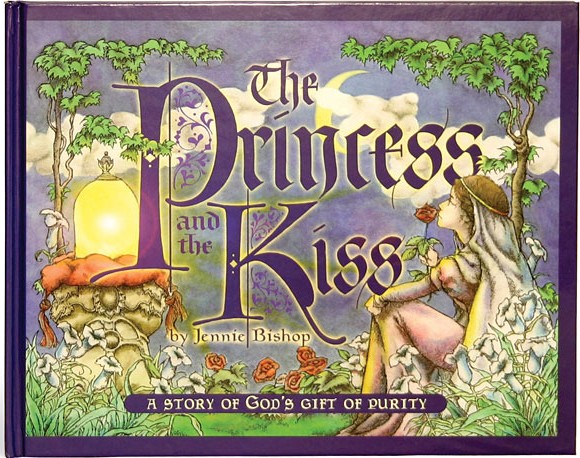
Instead, it simply talked about the importance of saving “your first kiss” for your wedding day. And of course, we were regaled with stories of virtuous couples who had done just that—didn’t we want to be like them? And then there is The Princess and the Kiss, a book marketed to children as young as four.

The book is about a king and queen who help their daughter save her most precious gift, her first kiss, for the prince she will marry. The princess’s first kiss lives in a glass orb, something like the rose in the Disney version of Beauty and the Beast (you can see it on the cover). This book has become very popular in Christian homeschooling circles and beyond, and there are hundreds of thousands in print. This is the sort of thing I was raised on (though this particular book wasn’t around when I was little, lots of kids are growing up on it now).

All of this came rushing back to mind recently when [my daughter] Sally kissed a little boy at her preschool—or, as I would have seen it in the past, when Sally “gave away her first kiss.”

We had gotten together with the family for a play date, and Sally and her little friend did the whole pretend wedding ceremony thing that little kids spontaneously do (I presided over a few in my day myself). At the end Sally grabbed the little boy and planted a kiss on his face. Surprised and bemused, I couldn’t help but recall my reaction to the pretend wedding staged by the five year olds I was babysitting so many years ago. This time, of course, my perception and reaction was different.

Sally didn’t lose anything when she kissed her little friend. Instead, she simply gained a common life experience—something she will look back at and laugh about when she’s grown.

It’s the people who impute a cute childish action with so much meaning who are creating the problem, not my preschooler.

Excerpt: 10 Things I Plan to Tell My Daughter About Sex That Aren’t That Purity Movement Crap

Screen Shot 2013-08-07 at 3.20.14 PM

Note from Nicholas Ducote, HA Community Coordinator:

I have often wrestled with what I will tell my children (when my wife and I decide to have children) when they start becoming “sexually aware.” It’s easy for me, as a newly married twenty-five year old to critique the way I was raised.

I feel that this article by “Jef With One F,” recently published by the Houston Press, is one that I would pass on to my daughters when the time came.

It offers succinct, practical advice for sex and sexual relationships in the twenty-first century. The Houston Press gave me permission to provide an excerpt here on Homeschoolers Anonymous.

*****

10 Things I Plan to Tell My Daughter About Sex That Aren’t That Purity Movement Crap

By Jef With One F

Against my better judgment I’ve been doing a lot of reading on the purity movement. If you’ve never been exposed to it, then I’ll explain. The idea is basically that you, as a father, are supposed to serve as the sole male influence in your daughter’s life until she gets married. You “guard her heart (and vagina)” because only you can be trusted with it…

…Better writers than I, like Libby Anne, have tackled the subject in depth, and you should spend an afternoon reading her work. She went through it as a daughter of movement, though. I’m a dad, and I am perfectly aware that the sexual health of this child is going to be part of my job…

Here are the ten things I know I need to tell a modern girl about sex once she matures enough to roll her eyes throughout the conversation.

10. That sex is beautiful and fun as hell, but so is driving a car and a bunch of other things that come with responsibilities. You need to ask yourself if you can handle those. I knew I couldn’t be trusted with a car at 16, so I didn’t ask for one. Same with sex. I waited until I knew I was with someone that wouldn’t use me wrong and knew what they were doing. You shouldn’t be afraid of it, but you should respect its possible consequences, such a pregnancy, disease, and just the general mess that sometimes come from sleeping with someone you shouldn’t have.

9. That someone that feels the need to lie, trick, or force you into sex is never going to be the slightest bit interested in your enjoyment of it. You might as well be a gym sock as far as they’re concerned. Don’t be a trophy.

8. That you should never do anything that will make you hate yourself to gain another person’s approval. You are not defined by the approval of others, and anyone who says you are wants to control you. You are your own person with your own unique value to yourself.

7. Your body belongs to you. Anyone that doesn’t respect that is an enemy. Run if you can, fight if you can’t, and never let someone convince you asked for or deserved it if all else fails. If a person makes you feel that they can fire you or fail you in a class or something if you don’t return their affections then they are just a rapist that doesn’t like to go out. Leave and tell someone immediately, because if it wasn’t you it will be someone else…

Check out the full article here.

His Quiver Full of Them: Jeri Lofland’s Thoughts

His Quiver Full of Them: Jeri Lofland’s Thoughts

Jeri’s post was originally published on her blog Heresy in the Heartland. It is reprinted with her permission. Also by Jeri on HA: “Generational Observations” and “Of Isolation and Community.”

Decades ago, I cross-stitched a scripture motto for my parents from Psalm 127, the favorite psalm of large families.

“Lo, children are a heritage of the Lord: and the fruit of the womb is his reward.”

The psalmist goes on to say: “As arrows are in the hand of a mighty man; so are children of the youth. Happy is the man that hath his quiver full of them…”

The term “quiverfull” is now used as both a noun and an adjective to describe a theology and lifestyle that glorifies human fertility while maintaining that God will provide the resources to raise as many children as he allows a couple to conceive. Contraception is held to be “playing God” and a violation of the command to be “Be fruitful and multiply”. The ideal Quiverfull couple are always open to “more blessings”, regardless of financial situation, health concerns, housing limitations, or needs of existing children.

I’m not certain when my parents decided that contraception was immoral. As a high schooler, Mom was an advocate of zero population growth and intended to adopt rather than bear children. A few years later, she graduated from a strict Catholic nursing school and married my dad. I was born a year later, my brother two years after that, and so on for the next 20 years.

Mail would arrive periodically from the Couple to Couple League and my parents had a couple of books by Catholic authors John & Sheila Copley explaining the practice of abstinence and/or breastfeeding as a means of birth control. Of course, even “natural family planning” (NFP) sounded too much like the evil “Planned Parenthood” so it was usually referred to as “child spacing”. Somewhere along the line my parents abandoned NFP (turns out it’s not all that effective at preventing pregnancy!) and the babies began to come even closer together.

Certainly Mom was influenced by Mary Pride’s 1985 book The Way Home, a story of the author’s journey from feminism to what she calls “reality”. Mary had just three young children when she wrote the book, in which she blasted away at contraception, lingerie, Marabel Morgan’s The Total Woman, and even Christian schools.

All forms of sex that shy away from marital fruitfulness are perverted. Masturbation, homosexuality, lesbianism, bestiality, prostitution, adultery, and even deliberate marital barrenness–all are perverted.”

“Since the word used for female is connected so strongly with the idea of nursing babies, whereas it has no connection at all with the idea of sexual activity, I believe that God is saying here that when women exchange their natural function of childbearing and motherliness for that which is ‘against nature’ [that is, trying to behave sexually like a man], the men tend to abandon the natural sexual use of the women and turn to homosexuality. When men stop seeing women as mothers, sex loses its sacredness. Sex becomes ‘recreational’, and therefore the drive begins to find new kicks.”    (Mary Pride, The Way Home, 1985)

(Pride’s position against family planning was more extreme than even the Catholic Couple-to-Couple League’s, prompting a correspondence between her and John Kippley, president of CCLI, and leading Pride to grudgingly endorse NFP in some situations in her sequel to The Way Home.)

Pride went on to birth six more babies and became a powerful force in the new homeschooling movement. My mom used to share The Way Home with all her friends and donated it to church libraries when she could. (When she encouraged me to read it, I was confused. Especially by the story about the lady wearing saran-wrap. Sexually naive young women raised in patriarchal, homeschooling isolation were definitely not Pride’s target audience.)

Mary Pride’s views fit rather well with the teachings of Bill Gothard–a middle-aged bachelor who handed out plenty of sexual and parenting advice at his seminars and encouraged couples to have surgeries to reverse previous vasectomies and tubal ligations. One of Gothard’s books informs us, “Labor in childbirth… was given to the woman for her spiritual benefit…” and points out that the God of the Old Testament “cursed several women by closing their wombs.” Attendees of Gothard’s conferences learned to associate infertility with God’s judgement. A full quiver, on the other hand, was a sign of God’s favor, a spiritual status symbol.

In 1990, a Nebraska couple published A Full Quiver: Family Planning and the Lordship of Christ. In this book, Rick and Jan Hess (homeschooling parents of ten) invite the reader to imagine a world where no one has ever had more than two or three siblings, effectively eliminating many historical figures. This exercise concludes with visualization of a future where enormous families are normal and God provides spacesuits for a missionary family moving their brood to evangelize a colony on the moon. My parents had this book, probably purchased at an IBLP seminar and still available on Gothard’s website.

Then there was Nancy Campbell’s occasional magazine for moms, Above Rubies. Nancy is a fierce promoter of anti-feminism from her compound in Tennessee. Her website includes multiple articles by women who felt guilt and regret over “the biggest mistake” of their life. After they repented, they went on to expand their families by four, five, six more babies. What mistake is reversed by more pregnancies? An abortion, perhaps? No, as it turns out, the biggest mistake of these women’s lives was a tubal ligation. Nancy also sells a book, A Change of Heart, encouraging couples to have surgeries to reverse both vasectomies and tubal ligations.

Vickie Farris, whose husband Mike is president of the Home School Legal Defense Association, homeschooled their ten children and lived to write a book about it. She encourages other women to reject birth control methods and embrace motherhood. Quiverfull women like Farris, and Michelle Duggar of “Nineteen Kids and Counting”, have built their lives on the mantra “God won’t give anyone more than they can handle”, sometimes phrased as “What God orders, he pays for”.

My parents were opponents of both birth control and sterilization. They even encouraged some of their friends to have reversal surgeries, resulting in many more babies. My mom had eleven children over 24 years, including ten [unassisted home]births. Pregnancy was not easy for her–she often referred to herself with the phrase from St. Paul, “a living sacrifice”. She spent most of my childhood breastfeeding, diapering, potty-training, and homeschooling on top of that. I understood that this was not culturally normal, but sought to convince myself that God was pleased with this self-sacrifice. I spent my teen years watching my mom’s body swell and deflate, and changing thousands of diapers.

In my twenties, as I waited for my turn to become a wife and mother, I quietly ticked off how many children I could have in years. I may have been ideologically persuaded that contraception was wrong, but I didn’t want to spend twenty years lactating either. When I got impatient for God to bring me a husband (no boyfriends on the horizon), I consoled myself by guessing how many fewer children I would bear in a shorter window of fertile sexual activity.

Fortunately, when I did get married, my husband and I quickly began to realize that many aspects of Quiverfull thought and practice were contradictory to our values. Not before taking NFP classes from a Catholic certified trainer, though. When we got pregnant anyway, we were told the method worked fine–we’d just had sex when [it turned out!] we were actually fertile. Well, what do you know?

I think my relationship with the Quiverfull movement finally ended a few years ago as I was perched on the end of an exam table in my doctor’s office. Looking up from my chart, she compassionately observed, “You’ve been raising kids for a long time,” and I burst into unexpected tears.

These days, stories of ex-Quiverfull moms and their “quivering daughters” are multiplying on the Internet like rabbits in the spring. The fruit of the movement has not turned out to be sweet; we deal with health problems, poverty, anxiety, depression, PTSD, eating disorders, cutting, sexual abuse, emotional incest, and divorce. (You can read far more than you want to know at the Homeschoolers Anonymous blog.)

In spite of these firsthand horror stories, Quiverfull continues to enjoy wide support in America and is gaining traction in other nations. Earlier this year, the BBC reported on the movement’s growth in the United Kingdom. You can listen to more, including scary-sounding clips from Nancy Campbell, here.

Meanwhile here in the States, Hobby Lobby and Catholic hospitals gnash their teeth over their employees’ rights to use birth control. Texan teenagers are taught that contraceptives don’t work. (The result? Texas has more than 10% of America’s teen births.) And TLC continues to profit from shows like “Nineteen Kids and Counting”, promoting Quiverfull ideology to some unsuspecting viewers.

The show should include a disclaimer: For your own safety, don’t try this at home.

I Will Listen: Emily Maynard’s Thoughts

I Will Listen: Emily Maynard’s Thoughts

HA note: The following post was originally published by the author on February 8, 2013. It is reprinted with her permission.

About the author: Emily Maynard is an outgoing introvert from Portland, Oregon. She likes Twitter, vegetables, fashion, Harry Potter, mentoring college students, and new information on anything. Emily is passionate about questioning, exploring, and growing alongside great friends. Her work has been featured on Prodigal Magazine, A Deeper Story, and Crosswalk, and she enjoys speaking to diverse audiences. She is not the Emily Maynard from The Bachelorette. Follow Emily at EmilyIsSpeakingUp.com.

*****

Last week I had three precious girls in my home.

They lounged on my couch and chairs, eating snacks and drinking warm cider, talking about their days at school and work and home.

And then we started talking about modesty rules and sexuality and shame. They asked if they could come to my house and talk about those things. I said yes. They showed up.

We told our stories.

And every single one of us, in our own ways, had negatively experienced our bodies, relationships, and sexuality. We all had painful experiences because of the ideas well-intended parents or or pastors or youth leaders taught us. We are all broken because of the subtle, harmful ways we learned to relate to God, ourselves, and others. We all grew up in fairly normal American Evangelical churches, with good families, at average Christian summer camps.

We are all struggling against shame. We are all seeking healing.

There was a lot of talk about The Modesty Rules on the internet recently. And then The Purity Rules. And I love all of it, this opening up and fighting shame and telling stories. But this isn’t something that happens on the internet, in comment sections that we forget in a few days.

These harmful ideas are hurting real people. Real women. Sitting on my real couch. Unraveling real lives.

This isn’t a problem just found in “legalism” or particularly heavy-handed churches. It’s not an “out there” or “just find another church” situation. This is everywhere. Based on the way it’s defended and excused by “church leaders,” it appears to be a central tenant of our faith culture.

And I can’t change that. I can’t control anyone. I’m not in charge.

So go ahead.

You can keep trying enforce The Modesty Rules or The Purity Rules. You can continue the body shaming for girls and giving us impossible standards and responsibilities. You can talk about how lust is only a problem for boys and shame every bit of sexual attraction they naturally experience. You can talk about “godly” living in a way that destroys the Image of God in real humans. You can leave out people who experience gender or sexual attraction in a way that doesn’t exactly line up with yours. You can refuse to see a correlation between your shaming ideas and so many of your children leaving the church. You can accuse me of not following scripture or of overreacting or being bitter. You can keep saying that bodies are a temptation, like alcohol. You can keep shouting that there isn’t a problem, with your hands covering your ears.

I can’t stop you.

But I will listen to your sons and daughters.

I will open up my home and my couch and my fridge and and my email inbox and my story to them.

I will try to make a safe space in my life for their voices.

I will protect their individual, precious stories because they are precious individuals.

I will let my heart hurt with theirs. I will celebrate redemption with them.

I will write out my experiences of trying to live at peace with my sexuality and my neighbors. 

I will commit to listening, to the best of my ability, not because I can save anyone, but because I want to lean in and watch Jesus save us all. 

I will be a safe person for your children hurt by your church, by your rules, by your shame. I will watch them learn to sing of grace and freedom in their own way. I will promote communities that allow healing to be messy. I will announce that we are not alone and that Hope has come. I will watch for sacred births in dirty straw and signs in the heavens.

I will see the imago dei in each of your children.

I will keep speaking up against The Modesty Rules and sexism and silencing and shame. I will keep speaking up for listening and letting the love of God overwhelm us and asking questions and taking healthy responsibility for our actions and walking out healing.

So you can keep shouting shame, go ahead.

And I will love your daughters and sons.

Life With A Gay Husband: Rachel’s Story

Life With A Gay Husband: Rachel’s Story

"I realized there was no way to fix this. He couldn't be who he was with me, and it wasn't fair to either of us to stay together."
“I realized there was no way to fix this. He couldn’t be who he was with me, and it wasn’t fair to either of us to stay together.”

I grew up as the oldest of ten children. My parents were a part of ATI and the Quiverfull movement. My father was very controlling and my mother was neglectful and withdrew herself. We had to ask my father to go anywhere. He would say to clean something or weed the garden first and then he would say no many times.

I was the “second mom” the one who listened to what my dad said and took care of the house, the other kids, stayed home as a highschooler to cook dinner while the younger kids got to play sports. I had a really good guy friend who was the oldest of ten children himself and also played the violin. We used to write to each other all the time until the letters just stopped. This guy, Jacob, would give me butterflies and make my hands sweaty and I would dream of being with him. My mom came to me and said that we were the oldest kids, so a relationship would just not work. I was confused what she meant. But, I continued to “wait” for him.

Then, at the age of 19, I went to EXCEL, which I paid for by babysitting. There, I sought God each day and somehow ended up with the exact opposite beliefs as I was taught. There, I cut my long hair, stopped wearing skirts all the time, stopped arguing with everyone, decided I needed to go to college to become a nurse and I decided I was done with waiting for Jacob. I came home and signed up to start classes. I also looked for a job, which I got in a deli.

My parents were supportive until I actually started classes and then it was, “Rachel, come home and watch the kids,” and, “Rachel, come and take the kids to their games.”  I, being a girl who did give everything to god and believing I had to obey my dad, would, but this jeopardized my grades. Here I am, a girl who has no understanding of any of my classes (all I knew how to do was read really well and basic math; I didn’t even know how to write a paper), looks very strange in mostly skirts, and thinking about sex all the time.

Then Ben entered my life.

A friend of mine told me of a homeschool debate site. I decided to join and decided to have a “gender neutral” name of “His child.” There was a guy there who wanted someone to do a bible study with him. I knew instantly that he was suicidal and I had to do it. So, I led a bible study and he eventually started asking me questions about myself.

We talked for an entire year before he decided to come to WA state to work at a camp and meet me. His parents tried to prevent him, since they ran a camp themselves, but then they found out the reason was there was a girl there and they excitedly let him go. He got me a job there as a store manager. I worked it out with my deli manager so that I could do it for the summer, but my father put his foot down and refused to let me do it. I had told him about Ben several months before which made him pretty upset. He unplugged the internet many times so I couldn’t talk to him.

I obeyed my father and did not go to camp. I picked him up at the airport with my parents and a very talkative me. But he was lost for words. The poor guy was so nervous and just grunted all the time. My father and I dropped him off at camp and my dad said, “Oh, you should exchange numbers.”  We hadn’t even talked to each other on the phone at this point. We started to have phone calls during which I talked a lot and he said nothing.

I saw him again during that summer when he had a weekend break. He played with my siblings and this is when I knew that I would marry him. He had already told me I was the girl for him before I met him. I thought he was smoking hot and very excited that a guy this attractive would be interested in me. I was sad to see him go home on the final meeting when we dropped him off at the airport.

My father, realizing that I liked this guy, put a lot of pressure on me to get him to ask permission to court me. So, I did and Ben called up my dad and asked his permission to court. I got in front of our church and announced with my father that I was courting, which in my group of people meant we were getting married. We continued talking on the phone (which was awkward for us cause he barely talked) and mostly talking online.

Six months later, he flew to see me again. We were ready to hold hands and cuddle which freaked out my parents. My father gave him 50 questions to answer by hand and said we could not talk until it was finished. I was supposed to go and work at his family’s camp as a cook for that summer. This was his reaction to that. Instead, I threw myself into working 80 hours a week. Eventually, he finished the questions over that summer. I decided I should do nursing down in Mississippi because I could take a test and get into the program. (I struggled a lot with school because my father was constantly trying to get me to come home and babysit my siblings or take them to practice and I was balancing working full time and taking classes for which I had zero knowledge, so my grades weren’t that good). Extra bonus was that I was two hours away from him.

Our plan was that I would stay there six months and we would get married and I would go to nursing school on the same campus as his seminary. We spent a few hours together in person every other weekend or so.

Finally, it came to the wedding.

Our first kiss was at the wedding alter. Bad idea… I had no idea how awkward that would be and how it just felt…wrong, like it was meant to be shared in private. Then of course, to go further, my husband was incredibly scared and nervous. I thought the bride was supposed to be the nervous one!

It puzzled me why he seemed never to want to have sex. I thought this would be a phase, but it wasn’t. This went on for years — in fact, our entire marriage.

I had always heard that men liked a woman’s body, that it turned them on. I tried that.

It didn’t work.

We talked about this and both came to the conclusion that it was cause he was a lifeguard for years and was just used to seeing almost naked bodies. He always seemed depressed about everything. He would withdraw and not talk to me or even seem to want to be around me. This would frustrate me but I was busy with work and school. I just gave him space and hoped he would show interest in me. I worked hard to try to please him and to try to motivate him. But, he always seemed unhappy, no matter what we tried.

I put my energy in trying to become pregnant. (Believe me, that took a lot of work!). We had our child and I — doing what every other mother I knew did — stayed home with him. Our problems became stronger since now I had nothing to distract me, no school or work. We were trying to become missionaries. He got ordained and we were in the application process. I was highly involved at our church.

He seemed to withdraw yet again, like he didn’t want to do it.

I had been talking to my best friend who had just come out to me. She described how she felt — in a marriage with a man — being gay herself. I asked a lot of questions and realized she sounded exactly like my husband! I approached him and asked him if he was attracted to men. He said he was but tried not to think about it.

Everything made sense!

He was repressing who he was, which was causing the depression and the withdrawing. This is why nothing seemed to work or motivate him. We continued on, wondering what we should do next. He had already been having issues with god for years but also tried to ignore that as well. I began to question the bible as well. If it is wrong about homosexuality, what else is wrong with it?

I realized it was incredibly cruel to expect a homosexual person to either be single or to be in a relationship with someone of the opposite sex. I know what that is like. This led to a spiraling amount of questions which I could not find answers to. I guess this was important to me being able to leave the marriage — and then divorce.

A couple months later, I realized there was no way to fix this. He couldn’t be who he was with me, and it wasn’t fair to either of us to stay together. So, the next six months, we made plans to separate and help each other be financially stable.

We are still friends, share custody of our son and live about a mile and a half apart.

Finding A Reason To Wake Up: Warbler

Finding A Reason To Wake Up: Warbler

Trigger warning: self-injury and self-sexual abuse.

Family Background

I know my older brother cut himself.  Sometimes he was just overly rough in whatever he was doing and got hurt that way.  I remember him sitting on the other corner of the table as my dad made us study Koine Greek together.  He glared at my father with hate-filled eyes and used his one set of fingernails to scrape up and down the inside of the other arm.  He got spanked about 3 times as much as we girls did.  He was “strong-willed” and didn’t seem to care how much they hurt him.  He boasted that he was never hurt and that they could/would have to try harder.  He was always “the rebel” and was the first one to defy our parent’s authority.

The eldest sister was “perfect” and I didn’t think she did anything like that until her ‘courtship’ went up in flames and daddy grounded her and threatened severe repercussions for ever touching the computer or getting online ever again.  I was in the other room listening to all of this, hiding.  She found me late and we sat there mutely staring at each other.  She said she was going to run away and she had a plan.  I was scared and I didn’t want her to get caught and punished worse, because that is what daddy always threatened.  But I looked deeply into her eyes; and I knew that if she did not get away, one of us would find her dead in her bedroom the next day.

I was a “chicken” in the fullest sense of the word.  I never had the courage to actually cut my own skin.  But I would exacerbate any wound or scab by picking at it fiercely and not letting them completely heal.  I would pick at the corners of my fingernails until I pulled off skin down the the cuticles that would bleed and ache for a week.  I would allow myself to get burned when I was cooking and wish the pain would keep going.  I developed a very high pain tolerance as I refused to care for bruises or cuts and attempted to “be tough” about them.

I had an active imagination and I would imagine myself doing things.  I hated being in the kitchen with the knives because I was never sure when imagination would lead to reality and I would “snap.”  Sometimes I wanted to snap.  Other times my primal instincts kicked in and I fought myself for life.  Because I saw myself as worthless and ugly and bad.

An Active Imagination

I hurt myself specifically from the time I was 10 until I was 17 or 18.  I know for a fact that homeschooling made this a problem because had I been taught more, I would not have used this to hurt myself.  A sex-ed class would have taught me much sooner that what I was doing was damaging.

I hurt myself sexually.  I would imagine some scenario where I was being forcibly raped or forced into being a sex-slave.  I would ball up a towel or a sheet and I would lay on top of it until I rubbed my skin raw (and sometimes rub it off).  I did not know much of anything about human sexuality, or why it hurt so much, but I would walk around in pain every step I took for a couple days and then do it again the next week.  I did not even know that it was “masturbating” or what that word meant until I was 14, and at that time, I was told only that it was a sin. I stopped for a couple of months because of fear, but having no other outlet, I began hurting myself again semi-regularly.  I was able to hide it even though I shared a room for most of my life.  I didn’t get any other information about sex until I was at least 16.  When I first understood the workings of sex, I was grossed out and immediately shut off the conversation.

It took me over a year to realize that what I was doing was actually sexual and bad for me physically. By that time I had an outlet for myself in a homeschooled social circle, a pet to care for, and an outdoor hobby (gardening) that gave me exercise, sunshine, and something to love and invest myself into.  I was incredibly depressed most of my teenage years and I know that was a big reason for my self-abuse.

Another reason, I believe, was because when I had a crush on a young man (he was 12, I was 9) my parents squelched it quickly and shamed me for it.  Instead of helping me develop my relationship skills and experience, I was made emotionally stilted.  My next male-interest wasn’t for another 11 years, but it fell apart due to my relationship-immaturity and inability to ‘learn’ years of relationship-growth-experiences/consequences in two years.   It caused a lot of pain and I think it was because I would have been a very different person if I had a larger social group.  I am the girl that has crushes on everybody.  Had I been able to express those and have them dealt with in a reasonable manner (not told to save everything for courtship, or when I was “ready” to be a wife and mother) I could learn what men were interested in me for me, what crushes were stupid and should have bad consequences, and what it took to make relationships work.

Homeschooling meant that my parents controlled my outward actions around men with fierce looks, codes of conduct, chaperones, and stringent rules.  So my emotions turned inward in a bad way.  I would imagine violent scenarios and hurt myself personally.  I could hide it from them because sexuality was never again discussed.  Homeschooling kept me away from my peers, leaving me with the romantic-relationship-IQ of a toddler.

When it comes to relationships with authorities; I am co-dependent and I feel the need to hide any part of me I think they will censure.  It was not healthy and it is something I still struggle with, personally.

Advice For Others Who Struggle

Find a healthy outlet.  Depression kills.

Go jogging, or plant a morning glory, grow an herb garden and start making tea, or adopt a pet, or volunteer at a shelter, or buy a junk car and find parts at a junk yard to get it running, or restore a painting.

Or climb Mount Everest.

Find something that you love and that you can pour your energy and emotions into: a place to give.

When you find a reason to get up every morning, you will not want pain any more.  I remember taking a shower and screaming into the gushing water, because that was the only place they couldn’t hear me.

It eats you up inside and I know you want to be free.      

Advice To Parents

Dear Parents:  Your kid is struggling.  Don’t say this isnt your kid.  I know they are.

This is not 1% who have a few problems, it is the 99% who hide it.

Your kid is struggling because you have set up a shame-based system of right and wrong.  If you ask them, they will deny it because they don’t trust you and they don’t want to be shamed even more. They know their failings more personally than you have ever had occasion to point out and they have internalized it.

You know that one issue that never seems to go away?  It’s a sign that something rotten is eating away at their heart.

The bad news (no, the first part wasn’t the bad news): you cannot really do anything about it at this point. Your child does not trust you; your words and actions and rules and teaching and religious views are largely the reason that this behavior began and has been happening.

You cannot stop it until after you prove beyond a shadow of a doubt that you are changing. And that will take a lot of time, more time than it will take for them to grow up and move away.  So I suggest that you do major damage control by being as brutally honest about your failings first.  Don’t expect anything from them except to try to live with you as you learn to listen.  Get books and read them and ask your child for help.  And if they actually tell you something: do everything they say.  Don’t argue, don’t talk back, don’t tell them that you never taught that.  Take what they say and live it.

Maybe after a couple years they will start trusting you enough to share their lives with you. When you demand your child give you her heart, she will give you the one you want to see.  Her real heart will be hidden as far away as it takes to stay alive.  

** 

I have this one quotation saved in my email drafts with the title “Raising Children”:

“The only hope you should have is that they will gladly share their own adult journey with you.”

Ashamed Of My Own Skin: Lily

HA note: The author’s name has been changed to ensure anonymity. “Lily” is a pseudonym.

Trigger warning: this post contains references to eating disorders and self-harm.

“You may not wear that.”

This phrase, and others like it, made up a large part of the soundtrack of my journey into womanhood.  Modesty, and all of the accompanying clothing restrictions, were part of the homeschool community of “keeping our daughters pure until marriage.”

As young girls, my sister and I were told that dressing modestly was important, in order to not be a stumbling block to men.  I remember hearing modesty talks and going to modesty “Fashion Shows” as young as 10 or 11.  Before my body even began to develop into that of a woman, I was told it needed to be covered up.   Why? To protect the eyes, minds, and hearts, of men.

Of course, I was only in middle school, and my sheltered self didn’t understand the idea of sexual attraction.  I was skinny and developed relatively late, and so the legs, chest, and shoulders that I kept covered were those of a child.   Before I even developed womanly curves, then – I learned to be ashamed of my own skin.

I have long, thick, dark brown hair, and my aunts and other extended family women will joke about the blessing and the curse this thick dark hair is for all of us – because it grows everywhere.  Face, chest, sideburns, arms, legs, stomach, eyebrows.  As I turned 11, 12, 13, 14, even – I grew more and more self conscious of my hairy legs and dark upper lip.  I would timidly ask my mom how to take care of it, embarassed by my own body.

“You’re still a little girl. That would look awful if you plucked your eyebrows.  You would look so bad.”

Athletics became unbearable – not just because of the long, knee-length shorts that stuck out from the crowd – but because of the dark, thick hair on my legs.  “It’s time to pluck the stache!” joked one of my girl friends at a homeschool co-op gathering – not knowing my shame and embarassment that came from not being allowed to.

Makeup, shaving, and tweezing would have made me look too adult-like, said my mom.  Looking too adult-like was an aspect of immodesty.  Immodesty was a stumbling block to men, and I should be ashamed of myself for the way that I was leading boys on.   My mother once told me that the fact that my hair smelled good was a valid reason for other homeschool mothers (of boys) to be angry at me: after all, I was a stumbling block to their children.

I stopped eating, quit athletics, and ran alone in my neighborhood.  My 96 lbs at 5’4″ at age 14 dropped down to close to 80.  The dark hair on my body grew finer and more plentiful, and my breasts stayed almost completely undeveloped.  I hid food every chance I could, and threw myself into school and more homeschool co-ops and extracurriculars so that I would be able to skip meals and say I had already eaten.  My nose started bleeding about twice daily, and I bruised easily – even from small bumps, I developed large bruises that stayed for weeks.

Feeling embarassed and ashamed of my body was now a regular part of my life, and self-abuse became a way to deal with those feelings.  I started cutting my upper legs – a place that I knew would always be hidden away from the world, thanks to modesty restrictions.   My parents explicitly didn’t believe in privacy for teenagers, and I began to cut myself more and more because it was the one thing that I could keep secret.   Although I was allowed no control of my own body, the secret scars I left underneath my modest clothing was something that I could control.

When I confided in a male friend about my self-injury, my parents immediately found out thanks to heavily monitored spyware on my computer.  At this point, I weighed in the mid-80s and look and acted incredibly depressed and unhealthy, but my parents saw my issues as rebellion against their authority that should be broken instead of mental and emotional issues that needed to be treated seriously.  They loved me dearly, but refused to admit that self-injury and anorexia were “real” disorders.  The few times that I went to the doctor during this period, they strongly reccomended my parents allow me to attend sessions with a medical therapist – but they refused, as they saw no potential benefits from a medical professional hearing about my “rebellion”.

I was 14.  My mother started coming into my room immediately when she saw me leave the shower and make me take my towel off so that she could check my naked body for scars.  If I was in public with her and wearing shorts, she would pull the fabric of the shorts back on my thighs to see if I had cuts on my legs, or pull the waistband of my shorts down to check my hips.

I started showering less, wearing clothing that was harder to remove, and cutting myself in even more “private” places.  As it got less convenient for her to check my fully naked body, and more time passed since she had found cuts, she stopped remembering to check – but it was much, much longer until I stopped cutting.

As for my weight, she mostly dealt with it by telling me how awful I looked.  “You’re sickly,” she told me.

As I went through high school, I got better, mostly from interacting with parts of the homeschool community that simply didn’t know about my self-harm.  I played music with a successful band and worked hard for leadership in academics, and eventually graduated and was able to cut financial ties, and subsequently a lot of the manipulation in my life.

I have three points from this story.

First of all: If you are struggling with self-injury, an eating disorder, or anything else: get help.  Get medical, professional, help.   One of the resources that children in the public education system have is private, personal access to guidance counselors who are trained to recognize problems like this and point children in a direction where they can get help.  In a homeschool situation, well-meaning parents are not always able to understand or recognize the mental/emotional issues behind things like self-injury.   When there are no other adults present who are able to help a child/young teenager and parents have ultimate authority, it can be hard to find help sometimes.

Get help though – any way you possibly can.  One thing that I learned after graduating high school was that my mental issues almost always should be discussed with a medical professional, as well-meaning church elders who I talked to would almost inevitably point me back to my parents.  Self-injury is not something that can always just be “fixed” by praying to quiet your “rebellion”.  It is real, and as a human being, you deserve real help.  Don’t be afraid to seek it out. 

Secondly: To anyone who is struggling – it gets better. Someday, you will be on your own, with access to clothing and makeup/skin care stores that you can purchase from, free from guilt.  Someday, you will have friends who never would have known that you had a dark unibrow.  Someday, the way you look will be your choice, and you won’t have to be ashamed anymore.  It gets better.  I know what it feels like to be shamed into not being beautiful.   I know what it feels like to be told that your simple desire for hygiene and feminine attractiveness is slutty, sexual, and wrong.

It’s not wrong.  Wearing a v-neck is not wrong.  Wearing makeup is not wrong.  Plucking your eyebrows or waxing your upper lip is not wrong.  It is not wrong for you to want those things, and it is wrong for them to make you feel ashamed of wanting those things.  You shouldn’t have to lash out at your own body because you are ashamed of wanting those things.

Finally:  I am an undergraduate education major, and I teach young students and teenagers in the public schools on a regular basis – and, let me tell you, conservative, non-distracting clothing is not what the homeschool community or the Modesty Survey or Josh Harris or anyone says it is.  If you want to dress conservatively and not be distracting, dress professionally.  Wear those heels and dark jeans and a sweater.  Wear dress slacks and a button-down shirt, and guess what?  It’s okay if it’s form-fitting! It’s okay if it makes you look attractive!  It’s okay if you’re wearing lipstick!  After multiple years in the real world interacting with real people, I am finally beginning to realize that conservative and “modest” clothing is not what we were told it is, and it can bring about real, serious, body-image emotional and physical harm to girls who have never learned to love their own bodies. 

I hope that one day I teach my future daughter(s), who will most likely also have dark hair all over, small breasts, and a great smile,  how to dress in a way that makes them feel attractive.  I hope they feel confident enough around me to ask me for makeup or shaving or clothes advice, and I hope that I am able to help them learn how to dress attractively and appropriately for all situations.

Maybe, just maybe, they will grow up a little bit more comfortable in their own skin.