Adult Homeschoolers Speak Out: Part Seven, What About Socialization?

Adult Homeschoolers Speak Out: Part Seven, What About Socialization?

HA note: The following series is reprinted with permission from Brittany’s blog BAM. Part Seven was originally published on June 14, 2012.

*****

Also in this series: Part One: Why I Wanted To Write This | Part Two: Survey Stats and Large Families | Part Three: Top 3 Reasons Parents Homeschool | Part Four: Academic and Emotional Experiences, K-8 | Part Five: The Highschool Experience | Part Six: College? Prepared or Not? | Part Seven: What About Socialization? | Part Eight: The Best Thing vs. What Was Missing | Part Nine, Do Former Homeschoolers Want to Homeschool? | Part Ten: Are the Stereotypes Better or Worse?

*****

Part Seven: What About Socialization?

Ask any homeschooler (past or present) the # 1 question he or she receives about homeschooling and it will be this:

What about socialization?

Most homeschoolers will laugh at this question and give some rapid-fire answers about the number of activities they are involved in or how they are so busy that they have to squeeze school work in their socializing schedule.

I have been anticipating this post for almost a month now and I have thought long and hard about why this is such a hot-button issue for people. Any Google search on “Homeschooler + socialization” will reveal a barrage of blog posts and e-articles that all profess that homeschooled children are, indeed, socialized and even better socialized their their traditionally schooled peers.

The comments to such articles are even more revealing. Every reader seems to have an opinion on this issue and the comment battles that ensue would probably fit neatly into the movie “Mean Girls.”

So why does the issue socialization bother so many people, both homeschoolers and non, seeming even more important than academic success?

I believe this is because social apptitude is spotted, judged and/or pitied long before intelligence is ever assessed in most social situations. In plain English, this statement could read like this: “He is so smart, but….bless his heart, he seems a little awkward, doesn’t he?” (That was the polite version. You can make up your own, non-sugar coated statement here.)

The issue of socialization and homeschooling is so dynamic because, whether homeschoolers like to admit it or not, what they are doing is counter-cultural. It isn’t “the way” most Americans are educated or how most adults learned to interact with the world.

This is neither good nor bad.

It simply is.

But because it is “different,” it may and often does present some challenges.

My survey results revealed some of the challenges that adult homeschoolers have faced as they entered adulthood. The numbers are primarily positive (though perhaps not as overwhelmingly confident as most homeschoolers, both past and present, may think they ought to be).

I had two questions relating to socialization:

Survey Question: Are people every surprised to find out you were homeschooled?

67% (29) of responders said “Yes!” 

Most said people were surprised because they were “so normal!”

One woman said: “Yes! Just the other day a nurse was bashing homeschoolers and I turned to her and said that I was homeschooled. She was shocked.” 

16% (7) said people were “Sometimes” surprised. 

One adult homeschooler  noted that [u]sually [the statement] is followed by a question about being social and I have to try not to laugh, but most of the time people are positive about it!”

4% (2) said people were not surprised at all to find out they were homeschooled

11% (5) said the question either “doesn’t come up” or that they “don’t tell them.”

One man revealed, People think I’m crazy or some kind of weirdo. I don’t share this unless I have to.”

My survey question specifically about socialization was linked to the question about higher education:

Survey Question: Did you pursue higher education after high school? If so, what is the highest level of education you have earned? If so, do you feel that homeschooling prepared you socially?

(Looking back I wish I hadn’t attached this question to higher education because not everyone pursued higher education and, therefore, did not answer this question — though only 2-3 did not.)

The statistics for this question are as follows:

60% (26 responders) said Yes, they felt socially prepared for higher education/the real world.  

40% (17 responders) said either “No, they were not prepared” or mentioned difficulties they had 

Of the 60% who said “yes!,” a majority argued that homeschooling gave them a chance to interact and socialize with people of all age groups instead of simply interacting in peer-age groups.

Megan W. 27 from GAYes. I had always been exposed to different people and encouraged to interact with them.

Ruth M. 23 from OK: Yes, I don’t think I had any more difficulty socially than a person who had gone to a public school. Actually, I believe homeschooling helped because it trained me to be willing to branch out and meet different people, even if they didn’t belong to what I saw as my “group.”

Elizabeth H. 21 from DESocially, I am comfortable talking to a wide variety of people, both age-wise and culturally.

Jonathan M. 30 from TXYES!! I feel that I was better prepared socially due to the fact that while homeschooling I learned to sociallize with people of all ages. I have noticed that many people who went to public schools are locked into their peer group and have a hard time with people outside of their peer group.

Elizabeth J. 27 from KS: Yes, I had many friends, and lots of experiences that were similar enough to my public school peers that I had things to talk with them about. I was comfortable in the large groups of mixed ages and abilities, something that bothered a lot of my public school peers as they were used to same age grouping.

On the negative end of the spectrum, adult homeschoolers related these experiences:

M. G. 26 from VAAlthough I have no social skills, I can’t blame that entirely on homeschooling. Yes, homeschooling gave me very few outlets to force myself to be social, but since people make me nervous and I don’t like to be social anyways, that may have happened regardless. . . Social function is probably the biggest disadvantage.

E. J. 24 from VAThat is a bit of a difficult question because I was an extremely shy child. I was socialized. There was a group of about 50-60 homeschoolers that would meet at least once a week to play, and I was often around adults that my parents knew from church, work, or their hobbies. As a child, I was very comfortable speaking with adults and I disliked events geared toward children as I found them condescending. However, as an adult, I have had some small issues with relating to everyone. Whether this is because I was homeschooled, or because of my personality, I am not really sure.

R. P. 30 from MS: I had good social skills for dealing with people of all ages in a personal and professional way. When I went to college I greatly gained social skills with my peers. Part of that may be delayed because I was homeschooled. 

K. C. 24 from VA: There were some gaps in my social abilities, and felt socially immature for a while.

M. W. 30 from OH: Homeschooling set me back at least 2 years socially. I made up for a lot of it by getting a job at McDonalds my junior year in high school.

J. C. 28 from KY: I wish my parents had been more involved . . . in making sure I was involved socially, not just by putting me into social situations but by training me in how to act in those situations.  

Whether the response was positive or negative regarding socialization, nearly all responders seemed to define “being socialized” as:

  • Being able to talk to people of all ages
  • Having friends
  • Being involved in activities

While I think these three things are important, somehow these answers left me wondering: Are people really “socialized” if they have friends, are involved in activities, and can talk to people of all ages? Are these three things really what non-homeschooler are asking when they ask, “What about socialization?”

One woman wrote, what I believe is, an excellent response to this question. Though she had friends, close family relationships, outside activities, and a part time job while being homeschooled, she still said she was “Absolutely not!” prepared socially for life after homeschooling.

M.V. 27 from IA writes: Imagine human social lives like a game . . . In a real game, the rules are carefully explained. In society, the rules are unstated and must be figured out carefully (incidentally, they change from country to country and region to region). What kids need, then, is an opportunity to practice the game and learn what the rules are. 

High school, mean as it can be, gives them that opportunity. It teaches them to respond appropriately to peer pressure, to interact with the other sex, to behave appropriately at social events, to make small talk. 

Obviously, not everyone who goes to a public school graduates with a perfect knowledge of these rules, and not everyone who is homeschooled fails completely here. My sister, for instance, picked up social rules quite well. The fact that some people do fine, however, doesn’t change the fact that society does have rules and homeschooling reduces the opportunities by which to pick up on those rules.

Missing public school means that I missed four years of an opportunity to learn some of those rules. I had a very small circle of friends at [college] and had no idea how to interact with roommates; I started getting better in [grad school] and then [when I went to work overseas].

I found this response to be very insightful and true, in many cases. Learning social rules is difficult, and if one does not learn those rules as a child or teenage, then he or she must learn them (sometimes more painfully and embarrassingly) as an adult.

I can relate to this. Even as an adult, I sometimes lack insight into when it is the right time to ask questions, especially in a group setting. Growing up, “right now” was always the right time to ask any question! In college, I always forgot to raise my hand in a classroom setting, often blurting out whatever was on my mind, often to interrupt others or be reminded by the professor “to give someone else a chance to talk/answer.”

Although I have gotten better as I have gotten older (and wiser), I have even had difficulties at my job when, at a meeting, I asked a question that–I thought!–was very applicable. I was reprimanded later by my superior privately (much to my intense embarrassment). Knowing these “unspoken rules” of group settings continues to be difficult for me, though I am slowing figuring them out.

Another issue that I believe many homeschoolers struggle with socially can be related in this example:

C. M. 31 from KS: I was a bit green when it came to dealing with people who didn’t have my best in mind, and I found myself in situations in college that I would NEVER walk into now. 

I have found that many former homeschoolers (including myself) feel blindsided when they discover that in “the real world,” not everyone has their best interest at heart. Growing up, everyone had my best interest at heart: my parents, friend’s parents (all of whom were homeschool families), Sunday School teachers, pastors (let’s see, who else did I interact with….?)

As a child, this trust in others is healthy. As an adult,  naive trust in others can be disastrous.

After reading my “Homeschoolers Speak Out: the High School Experience,” one reader commented on the issue of homeschoolers making bad decisions, even after a moral upbringing:

“I am saddened by the (seemingly) higher rate of moral failure among our home schooled families (children). Is this because of over-sheltering? I don’t know.”

While I think over-sheltering may be (and often is) an issue, I also think it is also because some (perhaps many?) homeschoolers leave home believing that everyone has their best interest in mind. Many have made bad decisions as a result of naïvety, either in choosing friends, in dating or marriage, on the job, making large purchases, or making other life changing decisions.

Ultimately, socialization is a complicated issue. I do think that it is important for all children to have friends, opportunities for activities, and the ability to interact with both peers and people of all ages (yes, being able to interact with your peers is important!).

However, I believe that true socialization is more than that, including:

  • Developing working peer relationships (with roommates, co-workers, in general social gatherings, dating and marriage)
  • Developing conflict resolution skills with non-family members
  • Being socially aware of self and others
  • Knowing and acting within social “rules” (ex. Knowing when to speak, listen, respond, or just be quiet!)
  • Being able to navigate social situations with confidence
  • And more

I do realize that the above skills are not possessed by everyone, children or adults, homeschooled or not. But it is, of course, the hope and goal of parenting (and homeschooling!) to be able to socially prepare our children for life outside the home.

What do you think? 

If you were homeschooled, do you believe you were prepared socially for “the real world”?

If you homeschool now, what are some concerns you have about the issue of “socialization”?

How do you answer the question, “What about Socialization??”

Please feel free to comment or ask questions below!

*****

To be continued.

Adult Homeschoolers Speak Out: Part Six, College? Prepared or Not?

Adult Homeschoolers Speak Out: Part Six, College? Prepared or Not?

HA note: The following series is reprinted with permission from Brittany’s blog BAM. Part Six was originally published on June 4, 2012.

*****

Also in this series: Part One: Why I Wanted To Write This | Part Two: Survey Stats and Large Families | Part Three: Top 3 Reasons Parents Homeschool | Part Four: Academic and Emotional Experiences, K-8 | Part Five: The Highschool Experience | Part Six: College? Prepared or Not? | Part Seven: What About Socialization? | Part Eight: The Best Thing vs. What Was Missing | Part Nine, Do Former Homeschoolers Want to Homeschool? | Part Ten: Are the Stereotypes Better or Worse?

*****

Part Six, College? Prepared or Not?

When my 33 year old sister, Amberley, graduated from (home) high school, most people were very skeptical about whether homeshoolers could succeed academically in college.

Yet as first generation homeschoolers (families who started homeschooling right after it became legal in their states) started going to college, research was conducted that proved that homeschoolers, indeed, do very well in college!

My research for this segment of the survey supports this idea. I am very proud of the statistics for this portion of the survey as it shows that many homeschoolers pursue higher education and succeed!

As you will see from the testimonies though, not everyone felt prepared academically, even if they eventually did very well in the college classroom. I will share my [personal] story about feeling academically prepared after I present the data from the survey.

A brief note: I have both a Bachelors and Masters degree in English and currently teach at a University. That being said, many of my friends/ former classmates/ friends of friends who participated in this survey also have advanced degrees. Though I do know that many homeschooled students pursue higher education, the numbers may be slightly greater here due to my personal connections.

Survey Question: Did you pursue higher education after high school? If so, what is the highest level of education you have earned?

Results:

  • Associates: 4
  • Bachelors: 18
  • Masters: 9 (one has 2 masters!; one in Med school)
  • PhD: 1
  • Attended college but didn’t finish: 3
  • Currently in college: 6
  • Other (Cosmetology; ministry certificate): 3
  • Didn’t go to college: 2

The next question on the survey asked whether the adult felt prepared for college academically by his or her homeschool experience. Here are the results:

76% (32 participants) said “Yes”:

Samantha C. 24 from MO: Yes, yes, yes. The night before I left for college, I was terrified that the classroom experience would be too much for me. However, when I got to college, I realized that I had spent the last 10 years educating myself, stretching myself, and had developed a natural curiosity and a desire and eagerness to learn. Freshman year was actually frustrating because I felt that I was being “spoonfed” my education. I was on the Dean’s or the President’s list every semester.

Marybeth M. 29 from CA: I think the only way it helped prepare me was in writing papers and the variety of those papers. I was really afraid of being “secular-shocked” after being Christian sheltered for my entire life. And that I would be behind academically. I don’t remember being behind, and only one class was very anti-Christian.

Renee P. 30 from MS: I was very scared about starting community college. I had myself convinced that I wouldn’t know what to do in a classroom and I would fail school. However after I walked in sat down I never had another problem. I was very prepared academically and did very well in all my classes in college. I felt I had adequate background and I also knew how to learn.

Nara N. 30 from NC: Homeschooling was superior preparation for college because I already knew how to work on my own; lectures by professors were gravy to my college education because I could basically teach myself most material from a book already. I was also used to mastering material on my own so it was natural for me to do this in college. Working independently was an even bigger part of grad school.

Many, many adults noted that they were prepared for college because they already knew how to be  independent learners and take initiative for their education.

14% (or 6 participants) said that homeschooling “Sort of” prepared them for college: 

Grady S. 26 from FL: Yes, but not prepared for the classroom atmosphere. I did take a couple classes at the community college before; that helped but [it was] still different.

Megan V. 27 from IA: Mostly. I am relatively smart anyway, and I am also naturally good with words. So although there probably were gaps in my education, I didn’t sense the gaps incredibly well; I picked stuff up. I think the biggest lack was actually in writing. In high school, my mom and I had re-read papers to see if they were “awkward.” I went into college revising papers by checking to see if they sounded “awkward” and then discovered that was a really horrible way to write. I spent a semester getting Bs and Cs before I figured out how to actually revise papers. 

That said, I think I got lucky because I have smart parents who made me do school and read the books and take tests . . . The testing and results culture in the public school may be difficult and ill-advised for many respects, but by and large, teachers there know how to train students to meet expectations and follow directions. This is not something I believe is taught in homeschooling, or even in Christian schools. A homeschooling family is, by their very nature, the maverick of the educational world. And although kids need to be taught to think for themselves, it is equally important to guarantee that they do in fact think – something that not every homeschooling family is prepared to teach their kids.

M. L. 26 from NE: No and yes. I struggled a lot, but I still managed to graduate with a 3.8. I felt like I wasn’t prepared to juggle all the classes and assignments, I struggled with writing papers, which was something we rarely did. 

Once I was in college, I felt like I missed out on so much!! There were classes I just loved like my literature class. I took it with a friend who was also homeschooled and we both felt like we were cheated and there were so many classic books and writers we had never heard of. I did awesome in most of the class, but when it came to our test it was all essay questions and I froze, because I had never done anything like that. My teacher was so great and so encouraging; she thought what I wrote was great but I gave up on the test. I really wish I had more guidance in writing, to pursue that interest and I would have loved to developed those skills….

Another participant said: Most definitely; the only aspect that was negative was that I didn’t have to study in college which led to a bit of undisciplined learning in post-graduate work.


My note: So many people said they struggled with writing because they received no instruction in it while homeschooled! Sadly, this was also my own experience. However, as I am now an English teacher, I strongly encourage parents to help their homeschool students learn how to write (or find someone to teach them!). If you are in Lynchburg VA, please email me (bmeng@liberty.edu).

9% (4 participants) said that they felt that homeschooling did not prepare them for college: 

M. W. 27 from GA: I didn’t feel very prepared. I had never been in a formal education setting in my life. I had never written a paper until I was in college. My family and I would discuss things, so I was very good at communicating but unprepared for all the writing.

M. W. 30 from OH: I had a hard time adjusting to college. By the end of my freshman year I had it figured out . . . I had some serious disadvantages in high school and college starting out. I have been able to get past most of them now.

S. M. 29 from WV: Not necessarily. I think I would have excelled in any academic environment. I was more prepared for the independent study of college, but that just have been the way my parents chose to homeschool me.

E. M. 26 from FL: I felt I was behind in some areas, not to put my Mom under the bus but areas where she was weaker tend to still be my weak points. It’s difficult to teach someone when you get just as frustrated as them due to not fully understanding the topic.

I think it is wonderful that 95% of the adults who took this survey pursed some sort of higher education. 60% have earned a Bachelors degree or higher! I think current homeschool students and parents can take comfort and heart in these numbers.

My Story: I do not think I was prepared academically for college but….

I was the 3rd of 5 children. My oldest sister (Amberley, mentioned at the beginning of this post) completed high school through a correspondence program, so her diploma is from an accredited private school. My second oldest sister, Chelsea, had no desire to pursue a degree from a college or University (her love was Cosmetology, which she trained for; she is now working in a salon as a stylist).

Neither Chelsea nor I used the correspondence school that Amberley used (I am not sure why). I remember picking my own curriculum and being in charge of my own schooling from 8th grade-12th grade. I took traditional high school math and science courses (Algebra, Geometry, Biology, Chemistry).There was no high school co-op offered when I was in high school, though we did get together with a few homeschool families for science labs.  I don’t remember taking history (although my elementary/Jr. High history studies were excellent). We did Rosetta Stone for French (It didn’t stick) and continued in our Bible curriculum (always excellent).

I never took a literature course in high school, though I did read books (there was no discussion or papers). The only writing instruction I received was when I took Composition I at a local college my Senior year. Ironically, I wanted to be an English major because I loved to read and write “stories.”

Once I got to college, I did well, although I had a lot of academic anxiety about what it meant to “do well.” (Ultimately, I graduated with a 3.7 GPA in undergraduate and a 3.9 in my MA).

College was my first experience with taking tests (we didn’t take any beyond Math tests), taking notes, writing papers, working in groups (hated and still hate this!), and getting grades (we didn’t get grades in our homeschool either. My mom would just assess where we were and had us repeat the work if we didn’t know it yet).

The only time I felt like college was “hard” was in a Spanish class. It was my second semester (first semester I got a B and didn’t learn a thing–very “absent minded” professor!) with a very strict and rather compassionless professor. This class required a lot of speaking out loud in front of others. I was morbidly embarrassed of doing this, of making mistakes in front of others–which I did frequently because I was so self-conscious. I cried multiple times in class.

After seeking tutoring, going to the professor for help, and spending 4-5 hours on homework assignments, I ultimately dropped the class. In reality, I just couldn’t handle the fact that I wasn’t good at something (homeschooling often encourages students to pursue the subjects they are good at and to just “get by” in the others) and I was socially embarrassed in front of my peers.

Perhaps being involved in more group learning during my homeschooing years, such as a co-op (or being in a traditional school setting) would have helped me in this situation. I’d like to blame the teacher (he was pretty harsh) but I know my own insecurities and lack of preparation also contributed to this failure.

In my English classes I actually blossomed. I finally had an outlet for all my thoughts (but was reminded by several professors in several classes to “let others have a turn to talk”….ugh. Socially awkward homeschooler, right there!). I did well on my papers (I only recall one C on an English paper in my whole undergraduate career)–though not due to my writing skills. (I had good ideas. I feel like I really learned to write when I got to grad school).

Honestly, I don’t believe I was prepared academically for college, especially in my chosen field (woefully unprepared in writing and critical thinking!) but I got by because homeschooling taught me to be an independent learner and I was extremely self-motivated. These were the gifts that homeschooling gave me (though I feel that my “real” education began when I went to college and when I pursued my masters degree).

What about you?

After being homeschooled did you pursue higher education? Did you feel like you were prepared academically? 

If you homeschool your child, how are you preparing him or her academically for college?

Please feel free to comment below or ask any questions! Also, please share this post on Facebook or other social networking sites if you think that this series would be beneficial to others!

The next post will be about whether homeschoolers felt socially prepared for “the real world” — yes, I am going to tackle that huge question, “What about socialization?!” The survey results are extremely enlightening and thought provoking! Please keep reading!

*****

To be continued.

Adult Homeschoolers Speak Out: Part Five, The Highschool Experience

Adult Homeschoolers Speak Out: Part Five, The Highschool Experience

HA note: The following series is reprinted with permission from Brittany’s blog BAM. Part Five was originally published on May 30, 2012.

*****

Also in this series: Part One: Why I Wanted To Write This | Part Two: Survey Stats and Large Families | Part Three: Top 3 Reasons Parents Homeschool | Part Four: Academic and Emotional Experiences, K-8 | Part Five: The Highschool Experience | Part Six: College? Prepared or Not? | Part Seven: What About Socialization? | Part Eight: The Best Thing vs. What Was Missing | Part Nine, Do Former Homeschoolers Want to Homeschool? | Part Ten: Are the Stereotypes Better or Worse?

*****

Part Five, The Highschool Experience

Isn’t it funny that when you are going through an experience you can think, “Wow! This is awesome!” and then looking back you can think, “umm….wow. That could have been a lot different/better.” (Maybe that is how most of us feel about our adolescence….?)

This is kind of how I feel about my homeschool experience in high school. During those 9th-12th grade years, I loved being homeschooled. But now that I am 10 years post high school graduation (with a BA and MA under my belt), I have different feelings about what was good and what could have been better.

Many of the adults who participated in my survey felt the same way as I did but, as a majority, had a “good” experience academically and emotionally. However, the numbers were not as positive as when people looked back at their elementary/Jr. High years.

Here’s a little comparison:

Academically:

Here is what some of them had to say about their positive academic experience in high school:

Beka R. 25 from KS: Good – I finished my high school curriculum somewhere around age 14 and then was able to do extra studies and college classes on political science and English to help prepare me for college. 

Jonathan M. 30 from TX: Here I know that I (in many ways) received a better education to prepare me for the real world. 

Elizabeth J. 24 from VA: We had the Abeka video classes, and we watched all of our classes on DVDs. Mom had researched the core classes of most high schools and what was required for colleges and we took, Math, English, Health, Science, History, Bible, Spanish, and my mom was in charge of PE. We has all of these classes every day. However, for the most part it seems very easy. I had a lot of control over my education because I was the one who was mostly in charge of studying and finishing assignments. Mom just graded everything. Other than that we were pretty much left to ourselves.

Nara N. 30 from NC: Academically: I was still above grade level. I graduated 2 years early at 16 and probably could have graduated at 15 except what would I have done then, too young to have my driver’s license even?

Bradley H. 23 from VA: Academically it was superb, from what I can remember . . . I was able to pursue science in a more rigorous fashion being homeschooled, and so I was able to prepare for college well.

Stuart G. 29 from VA: One of the best parts about my high school years was that it brought out an initiative to teach myself. My mom just gave me the books and the rest was up to me. For me, that was an important tool for me to learn, because I was learning self-discipline that would prepare me for higher level education and my career later down the road. I also began to help out with the education of my younger siblings, particularly in math. Perhaps this exercise was helping me better grasp fundamental concepts of certain subjects as well as challenging me to succinctly explain ideas, events, rules, etc. to my siblings. 

Many responders mentioned being taught high school subjects from other homeschool parents in a co-op setting; everyone thought this was a good experience. Also, many also said that they dual enrolled in college in their later high school years, giving them a head start on college classes.

As you can see from the statistics and these testimonies, many homeschool students felt that they had an excellent high school education.

However, here are the statistics for the “other side” of the story

  • 31% (13) of responders said their high school education was “not good” or “could have been better.”

Here are a variety of reasons they gave for these answers:

  • Felt under educated*
  • No guidance from outside adults (like a guidance counselor) concerning education*
  • Did bare minimum to get by
  • Could have been challenged more*
  • Parents not involved in education /  no accountability from parents / parents were too busy
  • Realized they could have achieved more
  • Difficulties and frustrations in math / science / English
  • Not as many opportunities as in a traditional school*
  • Didn’t try hard
  • Laziness (parental or personal)

In looking at all these reasons, I realize that the majority are not unique to the homeschool experience (the ones I marked with * are, perhaps, more related to homeschooling inadequacies than others). I wanted to put a star by “parents not involved” etc. but I realize that this is a gray area for many reasons:

1. If a parent is not involved in a child’s public or private school education, this could and may be a detriment to the student’s overall education

2. Many (if not most) homeschool parents encourage their high school children to be independent learners, and many students flourish in these opportunities (as seen in some of the quotes above).

3. I, myself, took charge of my own education from 8th grade-12th grade (picked my own curriculum, planned my lessons, was very independent of my parents in my education) and I turned out “fine.”

But.

Lack of parental involvement is, I feel, one of the main reasons that my high school education could have been better, though at the time, I thought I was “amazing” for being “so responsible”! I’ll talk about the pros and cons of independent learning for homeschoolers when I write about homeschooling and the college experience.

If I was going to give any “take-away” advice on this point, I would say, “Kids still need their parents to be very involved in their education (pushing, encouraging, guiding, advising) in high school, maybe even more than in the elementary years.”

Emotionally, the stats between being happy homeschooling in younger years vs. high school are only 8 points apart.

19% (8 adults) said that they had a very negative emotional experience for these reasons:

  • Felt like they missed out on a lot
  • Lack of friends / no friends
  • Lack of social experiences
  • Family problems / Bad relationship with parents
  • Felt trapped by parents decisions
  • Wanted to fit in w/ others
  • Felt intense academic anxiety (not good enough)
  • Difficulty socializing w/ others (I’ll be covering this topic in a future post!)

23% (10 adults) had mixed emotions, meaning “I liked some things, but…”

Here are some reasons they gave for having difficulty emotionally (Some of the answers are the same as above. The difference between the two groups is that the above group had a decidedly negative emotional experience for the reasons given; the group below said that their experience had some good parts but also difficulties):

  • Difficulties w/ parents,
  • Lots of teasing from non-homeschooled peers
  • Felt awkward
  • Difficulty finding friends
  • Felt something was missing from high school experience
  • Difficulty w/ curriculum (more of an academic issue but for several students, this cause emotional problems as well)
  • Struggle with shyness
  • Really wanted to go to public school

It is great to see that, overall, homeschooled high schoolers have had good experiences both academically and emotionally. Somehow though, I wish the satisfaction rate was higher for both academics and emotions (even personally). As I stated in my very first post, everyone [in my survey] “turned out fine” and, at best, have worked through their limitations that came from homeschooling or, at worse, learned to accept this part of themselves.

The truth is, everyone goes through “crap” during the high school years, either in public, private or homeschool. The struggles for public/private school students are often very different — and not just the “unholy trinity” of sex, drugs and alcohol. Like it or not, homeschooled high schoolers still experiment sexually and are tempted by drugs and alcohol. But homeschool students often go through personal struggles that their non-homeschooled peers do not have to deal with.

What do you think? 

Were you homeschooled in high school? How was your experience academically and emotionally?

Do you homeschool (or plan to homeschool) your high school student? Do any of these results surprise you?

Please share your comments below! And feel free to share this post with others that may be interested or may benefit from this series.

*****

To be continued.

Adult Homeschoolers Speak Out: Part Four, Academic and Emotional Experiences, K-8

Adult Homeschoolers Speak Out: Part Four, Academic and Emotional Experiences, K-8

HA note: The following series is reprinted with permission from Brittany’s blog BAM. Part Four was originally published on May 28, 2012.

*****

Also in this series: Part One: Why I Wanted To Write This | Part Two: Survey Stats and Large Families | Part Three: Top 3 Reasons Parents Homeschool | Part Four: Academic and Emotional Experiences, K-8 | Part Five: The Highschool Experience | Part Six: College? Prepared or Not? | Part Seven: What About Socialization? | Part Eight: The Best Thing vs. What Was Missing | Part Nine, Do Former Homeschoolers Want to Homeschool? | Part Ten: Are the Stereotypes Better or Worse?

*****

Part Four, Academic and Emotional Experiences, K-8

Welcome (or welcome back!) to this series about the experiences of Adults who were homeschooled! Today we will look at what former homeschoolers thought about their schooling experience from Kindergarten through 8th grade and how they remember feeling emotionally (liked it, didn’t like it, etc).

I thought this post was going to be pretty simple to write. I had read through all the surveys once and was thinking, “Oh, everyone had such a good experience in these grades and they all loved it!”

However, after reading through the surveys for a second time and crunching some numbers, I realized that my first impression was a little (too) rosy.

Here’s the short version:

  • 91% or 39 adults said their Academic experience was good (“Great!” “Awesome!” etc).
  • Only 9% (or 4 participants) said that it “could have been better.”

Emotionally, the numbers were a little different.

  • 65% of adults (or 28 people) said that their emotional memories were good (“I loved it!” “I really enjoyed it.” etc) or that they had no memory of how they felt (2 participants or 4%).
  • 30% (13 participants) of adult homeschoolers said that they struggled with negative emotions concerning this time in their lives. (To see survey demographics, click here).

Here are some of the Academic testimonies from the survey:

Kelly C.; 29 from VAI have really pleasant memories of my homeschooling experience as a child. My mom only has a high school education and I feel like with the curriculum she had and the homeschool community we were a part of that I was not slighted in the least from receiving a good education.

Elizabeth J., 24 from VAI loved it! . . . We only had three formal classes: Math, Spelling, and Grammar. And the rule was, once you finished the set assignments for the day, you were finished from school. So most days we would start around eight in the morning and be finished by 9:30 or 10. There were other things that we did sometimes: Handwriting, phonetics, field trips (we visited probably every important or historical site in Virginia). Also my siblings and I read like crazy. We would go to the library every Friday and get as many books as we could carry and my sister and I would read each other’s books. But we all had to get one science and one history book and write a report on it.

Nara N., 30 from NCAcademically: my Mom always chose curriculum from all kinds of places and at whatever grade level was appropriate for us in each subject. My brother and sister (twins) did not even always do the same curriculum for each subject. I was basically always above grade level and never knew what “grade” I was in.

Matthew W., 30 from OHFor the most part everything was good. I enjoyed the benefits of homeschooling and we had a lot of friends that were also homeschooled. We were in some pretty good homeschool groups and took some cool field trips. 

Christine M., 31 from  KSIt was a good, very positive experience. There were times I wanted to try out public school, but I loved knowing I could be done with my schoolwork before lunch and spend the rest of the day creating, exploring, playing, and just enjoying being a kid instead of dreading the homework that would follow me home. I had lots of time with friends at church, co-op, and in my neighborhood. I also had lots of time to foster my interest in piano.

Stuart G., 29 from VAAcademically: Admittedly, in these first years of home-schooling there was some frustration because my mother was trying to navigate the new waters of schooling at home, and being teacher for all eight of her children. On the positive side, I was given the freedom to more seriously pursue subjects I was personally interested in. My curriculum therefore, was tailored to my needs and natural inclinations, which in turn, made learning more enjoyable for myself, and (I believe) all of my siblings.

Corinna R., 35 from VAAcademically I did much better than I would have otherwise as my parents were able to cater to areas where I had a harder time (like math) and also push me and provide extra opportunities where I was gifted (like music).

Kellan A., 23 from KS:  I really enjoyed it. I feel like I learned a lot and got an extremely good groundwork for the future.

O. G., 29 from KSI thoroughly enjoyed being homeschooled. I think we had a great support group and I had a great relationship with my mom and sister. Academically I probably could have been challenged a bit more…

Emotionally, no one [in my survey] had a completely “bad” emotional experience. However, the ones whom I placed in this category indicated that they had struggled with negative emotions for about 2 years, usually starting around 5th grade. Others noted that Jr. High was a hard time emotionally (which is often a hard time for kids whether they are homeschooled or not).

Reasons cited for negative emotions:

  • Wanted to go to public school
  • Felt like he or she was missing something
  • Felt different
  • Didn’t feel “normal”
  • May have lengthened struggle with shyness
  • Was angry about being taken out of school
  • Felt like parents had too much going on to help
  • Lack of social activities

Interestingly, many participants tied their emotional experience to the availability of social experiences. (A note concerning interpretation: I had to use my personal judgement in determining the emotions behind the words/experiences in some of the surveys. For example, see academic results above where many just said, “I really enjoyed it.”).

I have included both positive and negative testimonials below:

Kelly C., 29 from VA:  [T]he community that we were a part of was wonderful for me as far as socializing. I think there is a big misconception (among the non-homeschooled) that homeschoolers do not socliaze and for me that was not true. We were involved in many activities with other homeschoolers; I participated in 4-H, we had weekly get-togethers at the park or skating rink as well as field trips to various historical/educational facilities.

However, while Kelly noted feeling “wonderful” about these experiences, M.V. relates more negative feelings toward very similar experiences. This just shows that different students had different emotional needs.

M.V., 27 from KSEmotionally, I had friends and social opportunities . . . I don’t feel like I was deprived of social events. At the same time, I don’t think I had much in the way of developmental activities. Sometimes kids this age get involved in a sport or a musical instrument: I had choir, 4-H and long walks through the pastures around our house, none of which were really conducive to developing my future skills and personality as an adult. I think the lack of developmental activities here contributed to more problems in high school.

Here is another contrast between experiences, this one concerning personality:

Nara N., 30 from NCEmotionally: I think I did just fine. I’m naturally quiet/introvert. Sometimes I wonder if public/group private school might have brought me “out” more, but I think it probably would actually not have been good for me as a young child, and would have created a lot of extra stress in my early life.

E. H., 21 from DEEmotionally, it may have lengthened my struggle with shyness, but it meant I was able to unfold in my own time and with invaluable personal/family/spiritual growth in the mean time.

S. M., 29 from WV shows a good contrast between someone who had a good academic experience but who struggled emotionally:

I was full of anxiety because I felt I was getting less of an education that my peers. I always felt educationally and intellectually inferior the entire time. Academically, I did well.

M.L., 26 from NE and M.D., 19 from KS both had positive experiences in earlier grades but struggled emotionally as they got older:

M.L., 26 from NEThe younger years I really enjoyed it, I loved being with my brothers while doing school, I felt challenged to always keep up with them . . . However with life changes, baby, sicknesses/health conditions in the family I felt that my education wasn’t as important as other things going on. Whenever I had questions about school, I felt like my mom had too much going on to help me. In 5th grade I really struggled with school, I felt like all of a sudden it was really hard, I didn’t understand it, it took me forever, I didn’t feel challenged to do well because my brother who had always been a year ahead of me was now behind me and the others were too far ahead so I had no motivation to do well it school. It was the first time I begged to go to public school, I thought, “even if I hate school, at least I would be with my friends. 

M.D., 19 from KS: My view of homeschooling up to [5th grade] was fairly accepting. I remember a few moments of jealousy toward other kids my age who got to spend their days with their friends in public school, but for the most part homeschooling was normal for me, and I didn’t question it. 

I remember middle school being the time when I really started questioning whether I wanted to be home schooled. I was becoming more involved in my church youth group and less involved in the home school group and because of this I was surrounded by kids who attended public school. 

On the other hand, other adults recorded strong, positive emotions in looking back on these years:

Stuart G., 29 from VAEmotionally: I was happy and enjoyed strong relationships with my siblings due to the fact that we were schooling together. Furthermore, my bond with my parents became stronger because of the increased time we were spending together. Especially effective was my father’s involvement in my education, which had not existed prior to home-schooling. 

There was also a noted lack of turmoil that many of my peers in public/private atmospheres experienced. Because we missed out on much of the “drama” middle-school and high-school atmospheres cultivate, we were more at peace with ourselves (choosing things we were truly interested in without regards to what was “popular” at school, etc), and amongst ourselves.

Overall, homeschoolers [in my survey] looking back at their elementary and Jr. High years remember being satisfied academically and happy emotionally (though I think some of the responses concerning emotional satisfaction are very thought provoking).

What about you? 

If you were homeschooled, what do you think about your academic and emotional experiences looking back at K-8th grade?

If you homeschool your children, what thoughts or concerns do you have about their academic and emotional lives?

Please feel free to comment and ask questions!

Also, feel free to share these posts on Facebook or other social networking sites if you feel that others would benefit from or be interested in this series!

*****

To be continued.

Adult Homeschoolers Speak Out: Part Three, Why Parents Homeschool

Adult Homeschoolers Speak Out: Part Three, Top 3 Reasons Parents Homeschool

HA note: The following series is reprinted with permission from Brittany’s blog BAM. Part Three was originally published on May 25, 2012.

*****

Also in this series: Part One: Why I Wanted To Write This | Part Two: Survey Stats and Large Families | Part Three: Top 3 Reasons Parents Homeschool | Part Four: Academic and Emotional Experiences, K-8 | Part Five: The Highschool Experience | Part Six: College? Prepared or Not? | Part Seven: What About Socialization? | Part Eight: The Best Thing vs. What Was Missing | Part Nine, Do Former Homeschoolers Want to Homeschool? | Part Ten: Are the Stereotypes Better or Worse?

*****

Part Three, Top 3 Reasons Parents Homeschool

While growing up, I heard my mother describe homeschooling as “a lifestyle” countless times to curious inquirers who wondered why anyone would embark on such an endeavor. In the late 1980s, when my family started homeschooling, the question of “why” was very apropos, considering that homeschooling was illegal or newly legal in many states.

Keeping in mind these historic details, I was very intrigued to discover the answers to the question “Why did your parents choose to homeschool, from your understanding?” from first generation homeschoolers. (To learn more about why I decided to explore these questions, click here!)

(While reading, please keep in mind the last part of the question: from your understanding. All of these responses come from the adults looking back on their experiences and to understand why their parents decided to homeschool).

An example from my own family might give insight into the wide variety of answers I got:

My oldest sister, (Amberley, 33 years old), gave this answer:

Well, homeschooling was not legal in Nebraska when I started school, so I don’t know if Mom would have homeschooled me from K or not… But she said I was a brat and wanted me to get along better with my siblings. But I think there was also the religious aspect of things, where they wanted me to be able to study the Bible and learn about things from a Biblical perspective (ie. Bible as a subject, creation).

My second oldest sister, (Chelsea, 30 years old) also mentioned the “getting along with siblings” part, as well as religious reasons.

I, personally, don’t remember my sister being “a brat” (that just makes me laugh a bit). However, the following story is what I remember my parents telling us about why they started to homeschool:

My oldest sister was in the AWANA program (a church based Bible memory club) that met on Wednesday nights. Amberley was so tired in the morning that she had a very difficult time getting up for school. My parents decided that Biblical education (like the AWANA program provided) was of greater value that academic education that required my sister to get up early in the morning. These circumstances greatly influenced my parents’ decision to start homeschooling. 

My younger brother (Kellan, 23 years old) gave this reason:

Well, all of you guys were homeschooled so by the time I rolled around I guess they just had to.

My brother’s answer, of course, is very tongue-in-cheek, but I think it gives a good example of how siblings can have different perceptions of the same event.

Most of the homeschoolers who took the survey cited multiple reasons that influenced their parents’ decision. But the # 1 reason for homeschooling on the surveys mirrored my own family’s reasons for homeschooling: Religious Reasons or Convictions. 

Here are some direct quotes from the survey:

(To see Survey Statistics, Click here)

Melissa Ann G., 26 from VA:   Parents decided to homeschool us for religious reasons.

Christine M., 31 from KS: [My parents] wanted us to have a religious foundation to our education

Jeremy D., 18 from VA: My parents didn’t like “ungodliness” of public school . . . they felt God calling them to homeschool us.

Emily M., 26 from FL: I believe it was primarily because they are very conservative and strong christians and they felt that public schools taught things they didn’t believe and they also thought that it opened up a lot of room for temptations and misguidance.

Elina C., 25 from KS: They didn’t like the evolution stance that was being taken in the school system and wanted to have the freedom to teach us creation.

Jenna C., 28 from KY: [My parents homeschooled] to keep us sheltered from many of the negative influences of the world, and to instill a love of God in our hearts.

And many others:

  • 12 people (myself included) specifically mentioned “religious conviction”as a primary reason for homeschooling
  • 6 people said that their parents wanted to protect them from “worldly,” “ungodly,” or “bad influences
  • 3 people stated that their parents “wanted to teach the Bible”

While religious convictions was the # 1 answer, the next highest response was related to Academics or dissatisfaction with Public or Private Schools.

Stuart G., 29 from VA mentions academic reasons along with others:

My parents were unhappy with the public school environment and the quality of education we were receiving. The straw that broke the camel’s back was an incident in which my sister was being bullied and the administration was ineffective in dealing with the perpetrator. After this incident, my parents decided to try homeschooling on a trial basis. After the first year, it was clear that homeschooling was the right way to go for our family.

Elizabeth J., 24 from VA stated:

My mother wanted to protect us from the negative influences found in public schools, and later (after my sister spent 3rd grade at a private Christian school) to give us a more personalized, at-our-level, education. My mother taught us at the level that we were capable of, not holding us back or going on ahead of us. She also wanted to avoid the bullying and cliche-ishness that were in the schools. 

Kaitlin G., 22 from KS explained that “My brother and I needed more 1 on 1 attention in certain subjects and we were not getting that in public school.”

  • 7 people stated that their parents believed “they could do a better job” than public/private school
  • 5 mentioned that parents “didn’t like the public schools”
  • 2 cited that the parents wanted to have more control over their child’s education
  • One mentioned being “bored” in school
  • One family had a child who was academically advanced

Finally the third highest response after Religious Convictions and Academics was because parents did not want their children being taught Sex Education (5 people mentioned this, though this reason was primarily coupled with religious convictions).

One participant saidThey believed it was God’s will for parents to take active responsibility for their children’s education. This was precipitated by early sex-education in my older brother’s second grade class.


Kelly C. 29 from VA also gave this reason: [My mom] did not want the public school system’s influence (in particular evolution and sex education) on my education. She preferred being able to teach me with a godly influence.

I found these top 3 reasons for deciding to Homeschool fascinating. Other reasons included:

  • Military/ lived overseas (4)
  • Bullying (3)
  • Private/ Christian School too expensive (3)
  • Family closeness (3)
  • Flexibility (3)
  • Disagreement w/ school
  • Thought it would be fun (I particularly liked this answer!)

In closing this very long and informative post, I wanted to share what, I believe, is is a uniquely insightful response for why parents decided to homeschool.

Christy L., 28 from CA said:

My mom started out homeschooling (I am the oldest) and did it for my first two years of school. Before I started second grade she decided to put my brothers and I into public school for two reasons 1. She does not enjoy teaching kids how to read 2. My brother was chronically ill and it was getting to be too much to homeschool and care for him. My parents then decided to homeschool all 5 kids during 6-8th grade. They wanted to ensure that we had a good bible education and felt that middle school is the time that kids really pull away from their parents and they didn’t want that. 

I so enjoyed this response because I believe it shows wise parent(s) who knew her likes and dislikes (nothing wrong with not enjoying teaching kids to read!) personal limitations (having a child who was chronically ill), and their own personal convictions about teaching the Bible and their faith, as well as developing family closeness. Christy eventually went back to public school from 9-12 grade and felt prepared and grateful for this new experience as well.

What about you?

If you were homeschooled, why did your parents choose to do so (from your understanding)?

If you homeschool your children today, what are your primary reasons for doing so?

Please feel free to comment on the above responses, or ask questions! I will do my best to answer them and provide what insight I may.

*****

To be continued.

Confessions of a Homeschooler: Iris Rosenthal’s Story, Part Two

Confessions of a Homeschooler: Iris Rosenthal’s Story, Part Two

Iris Rosenthal blogs at The Spiritual Llama. This story is reprinted with her permission.

< Part One

"I remember how hard it was for me to adjust to being outside of the homeschooling bubble and in some ways, eight years later I am still adjusting."
“I remember how hard it was for me to adjust to being outside of the homeschooling bubble and in some ways, eight years later I am still adjusting.”

Since my original post I have come to the realization that I have just scratched the surface on everything that I have to tell about homeschooling. One of the problems I have with home education is that there is hardly any regulation. During the time I was homeschooled, K-12, I never once had to take the SAT or ACT or any other sort of evaluation test.

As long as it looked like I was studying I was pretty much left alone. The only subjects my mother was constantly involved in were; math, spelling and english. Occasionally she would check my work in the other subjects, but for the most part I was left to fend for myself and once I reached the age of 15 any involvement from her pretty much came to a stop.

I often hear the argument that not all parents homeschool are like this and that my mom was doing it wrong. While that may be the case, I don’t think that this should be lightly brushed off. We are talking about the education of children here! It is my belief that whichever route you choose, it’s very important that your children receive the best possible education. Be involved, be a part of their lives, listen, be aware of what they are learning about and learn with them!

With the lax requirements in place for homeschooling it only flings open the door for cases such as mine to happen. So much for homeschooling being better than public school (for those who don’t know me, that was sarcasm)!

I know my story is not the only one, my brother & sister and close friends have also experienced the same lack of education and preparedness to function in the real world because of being homeschooled. However, I’m not here to tell their story for them, I’m here to tell mine.

My first full time job experience happened when I was 21 at a call center. Yes I’d had jobs previously, but they were just odd jobs and the people I worked for I already knew from either homeschool group, church or 4-H. So I was always within that bubble my mother had me living in.

While working at the call center I got to know people who *gasp* went to public school, it was then that I started to realize that there were holes in my education. I didn’t know any math beyond the basic add and subtract. I could barely multiply or divide. Forget fractions and algebra.

I also realized that I was spelling a lot more words wrong than what I originally thought I was. It’s pretty bad (not to mention embarrassing) when your manager brings back your vacation time off request (written in clear handwriting) and asks you to tell what words you meant to put down. I found myself sticking out a lot in all the wrong ways, and my judgmental attitude towards people who were different than me didn’t help with that at all!

I had never been around so many people from so many different backgrounds before, it was quite an eye opener and culture shock for me! I still remember the first time I heard someone swear. If I didn’t agree with something someone said or did I made sure to let them know that it offended me. If I knew someone was a Christian and I heard them say something that I didn’t believe a Christian should say I made sure to let them know how wrong they were.

Looking back, I was quite obnoxious and judgmental towards my coworkers at that job. It is no small wonder that barely any of them talk to me anymore and I can’t say that I blame them!

I am so thankful that I have learned since then and now at my current job I am known among my coworkers for being helpful and a team player. I no longer allow my homeschooling experience to define me, in fact I hardly ever bring it up. I don’t feel as though I should have to defend my education (or lack thereof) to anyone.

It is my desire that people know and define me by who I really am, and not as some “failed product of home education.”

I hope that by sharing my experiences I can somehow prevent them from happening to someone else. I remember how hard it was for me to adjust to being outside of the homeschooling bubble and in some ways, eight years later I am still adjusting.

If anyone is reading this and is going through that rough transition period from the bubble to the real world, just know that you aren’t the only one who has traveled that path. It may be rough now, but in the end you will be stronger and wiser for it!

Adult Homeschoolers Speak Out: Part Two, Survey Stats and Large Families

Adult Homeschoolers Speak Out: Part Two, Survey Stats and Large Families

HA note: The following series is reprinted with permission from Brittany’s blog BAM. Part Two was originally published on May 24, 2012.

*****

Also in this series: Part One: Why I Wanted To Write This | Part Two: Survey Stats and Large Families | Part Three: Top 3 Reasons Parents Homeschool | Part Four: Academic and Emotional Experiences, K-8 | Part Five: The Highschool Experience | Part Six: College? Prepared or Not? | Part Seven: What About Socialization? | Part Eight: The Best Thing vs. What Was Missing | Part Nine, Do Former Homeschoolers Want to Homeschool? | Part Ten: Are the Stereotypes Better or Worse?

*****

Part Two: Survey Stats and Large Families

Here are the demographic statistics from the survey I conducted about the experiences of adults who were homeschooled.

To better understand the following data, here is my own demographic information:

  • Name: Brittany Arpke Meng
  • Born in: Nebraska
  • Grew up in: Kansas
  • Currently live in: Virginia
  • Age: 28
  • Number of siblings: 4
  • Number of years homeschooled: 12 (1st-12th)
  • Marital status: Married; spouse was not homeschooled
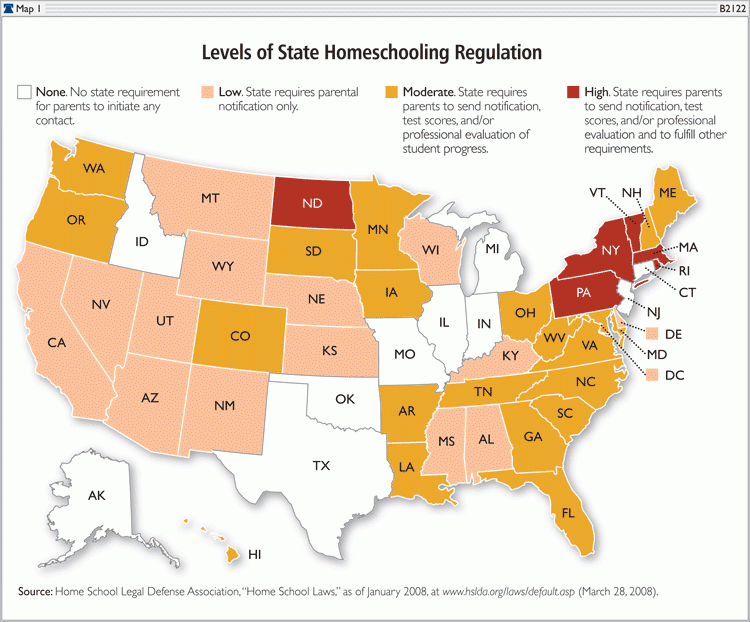
Current info about levels of government regulation for homeschoolers per state.

Total number of surveys: 44

Women: 34

Men: 10

(Sadly, the results are a little estrogen heavy, but the male perspective I received was excellent!)

These homeschoolers grew up in:

  • Kansas (16)
  • Virginia (7)
  • South Dakota (3)
  • New York (2)
  • Nebraska (2)
  • Florida (2)
  • Wisconsin
  • Illinois
  • New Mexico
  • North Dakota
  • Washington
  • Texas
  • California
  • Georgia
  • South Carolina
  • North Carolina
  • Ohio
  • Colorado
  • Illinois
  • Military family (3)
  • Overseas

These adults now live in:

  • Virginia (13)
  • Kansas (6)
  • Mississippi (2)
  • Georgia (2)
  • Florida (2)
  • California (2)
  • Oklahoma (2)
  • Iowa
  • Texas
  • North Carolina
  • West Virginia
  • Delaware
  • Missouri
  • Kentucky
  • Ohio
  • Nebraska
  • Washington
  • France
  • Japan (2)
  • Germany
  • Cayman Islands
  • Turkey

Age range: 18-37 (my minimum requirement was for the participant to be out of the house for at least one year)

Average age: 26

Fun fact: this means that earliest these families started homeschooling was around 1980!

Number of siblings range: 0-13

Average: 3 siblings

Number of years homeschooled range: 5-13

Average: 11 years

Marital status:

  • 22 married (4 spouses had homeschooling experience)
  • 16 single
  • 2 Divorced
  • 2 Engaged
  • 2 in a relationship

I included the sibling information because, in my own experience, homeschooling families tend to have large families. As you can see, the range of siblings in each family is pretty dramatic (from an only child to a family of 14 children!) The average of 4 children in a family seems pretty “normal” to me. Many homeschoolers talked about relationships with siblings in the surveys so that is why I included this information.

I also wondered though, “Does the “largeness” of a family affect the homeschooling experience positively or negatively?” I didn’t receive overwhelming data on this point but I think that two examples may provide a good contrast to answer this question.

M. M. a 29 year old from CA was the oldest of 8 children. She describes a negative experience related to family size:

My mom didn’t seem to be involved very much in my individual learning or invested in only my education since there was so many kids. I felt this was a disadvantage to me . . .My mom would start at the youngest child and work her way up to the oldest in going over their homework, teaching, etc. I don’t think she got to me very often.”

In 12th grade, M. M. did her homeschooling with another family where the other mother kept all of the young people accountable for their work.

This is just one example, of course. But in this case, family size seemed like a detriment to M.M’s homeschooling experience.

Contrasted with this is Beka R’s story, a 25 year old from Kansas and the 2nd oldest in a family of 14 children. Though Beka came from the largest family in survey group, she implied that academics were a very strong focus and stated that family relationships were the most positive part of her experience:

“One of the best things homeschooling did was allow for strong family relationships – we had school on Saturdays and had Thursdays off because that reflected my dad’s work schedule, and those Thursdays with my dad are something I’ve always cherished. I think that the primary influencers of my foundational years were my parents and grandparents, and that is something that has always shaped my values.

Most responders had a very strong family and the number of children did not seem to negatively affect the homeschooling experience (or they didn’t mention it). I think it is interesting that homeschoolers have large families though and, in my own experience, homeschooling helped make relationships with my family stronger.

What do you think? 

Did you come from a large family who homeschooled? Did it enhance or take away from your education?

Please comment or ask any questions!

*****

To be continued.

Visualizing “The Myth of the Unsocialized Homeschooler”

HA note: The following is reprinted with permission from Heather Doney’s blog Becoming Worldly. It was originally published on July 7, 2013.

I googled “homeschool” to see what pictures came up. Many of them had to do with socialization and the messages that homeschool parents get and give about it. So I figured I’d talk about homeschooling and the issue of socialization today and use some of the cartoons I found in the process. Some of them are a little disconcerting in the way they point out issues I see, just maybe not quite in the ways the cartoonists intended.

What is This “Socialization Problem” You Speak Of?

So first a bit about what socialization is and how it relates to homeschooling. This diagram explains socialization pretty simply and it comes from a site that talks abut stopping cycles of discrimination that are often passed on intergenerationally.

soc1

I think the site the diagram comes from – Parenting for Social Change – makes an excellent point – that this is generally how socialization is done but socialization can sometimes be bad. You can absolutely be taught harmful things as well as positive things in the course of your socialization and most people are taught a mix. What homeschooling parents often become inclined to do though is try to eliminate or greatly reduce these “bad” things by winnowing their child’s socialization opportunities down to only parentally vetted and approved sources and quite often those approved sources are fellow homeschoolers, religious leaders, highly edited texts and media, other “likeminded families,” and sometimes, when the parent is particularly controlling or inept at socialization themselves, nobody at all except for the immediate family.

Yes, this last one is a real big problem because terrible things can happen when families get isolated like that and it is a big risk factor for all kinds of abuse, neglect, and poor mental and physical health. Thing is, this social isolation problem happens in homeschooling much more frequently than it should. In fact, even in Brian Ray’s wacky (and so methodologically unsound that I am stopping myself from going on a rant about how many problems it has) “Strengths of Their Own” study included something I found interesting about it. See if you can catch it.

soc2

That’s right. The third bar from the bottom. The yellow one. If 87% of the children in Brian Ray’s highly self-selective study play with “people outside the family” (and I will leave you to ponder right along with me as to why this wording is not “other children outside the family”) then that means that 13% of children in Brian Ray’s study do not play with others outside of their own family, which I would most definitely define as a socialization problem. If Brian Ray, excellent fudger, misconstruer, self-quoter, and ideological spit-shiner of homeschool data extraordinaire, has almost 15% of the kids in his rather cherry-picked study having this issue, how common must it actually be in real life and how do people in homeschooling react to this issue? Well, let’s see…

Socialization Sarcasm

This cartoon makes fun of the concept that socialization problems exist in homeschooling. To me it implies that socialization happens so naturally that it simply isn’t something a homeschool Mom could forget. Why? Well, I’m honestly not exactly sure. Socialization is a component that definitely can be ignored or accidentally left out and it has openly (and wrongly) been discounted as being unimportant by many prominent homeschool leaders. Because it has been ignored and dismissed as a necessary part of many homeschool curriculums is the main reason why homeschoolers have gotten the reputation for being unsocialized in the first place.

soc3

Most homeschool kids don’t like being stereotyped as unsocialized or feeling like they are unsocialized (I mean really, who would?). So there’s also some memes and jokes that have been spread by teenage homeschoolers implying how inherently dumb or inappropriate they think it is when people make socialization an issue. Most of these involve poking fun at the “myth” that socialization is a problem in homeschooling. There is this YouTube video by a homeschooled girl who is trying to do this by distinguishing “the homeschooled” from “the homeschoolers” and while I find it funny, I’m quite sure that her pie chart is wrong and she perpetuates elitist stereotypes she has likely heard throughout her homeschooling experience.

This blog had a post by a homeschool graduate complaining about people asking what’s become known as the “socialization question” and in her post she uses a picture I’ve seen fairly often. There’s even t-shirts with this printed on them that you can buy.

soc4

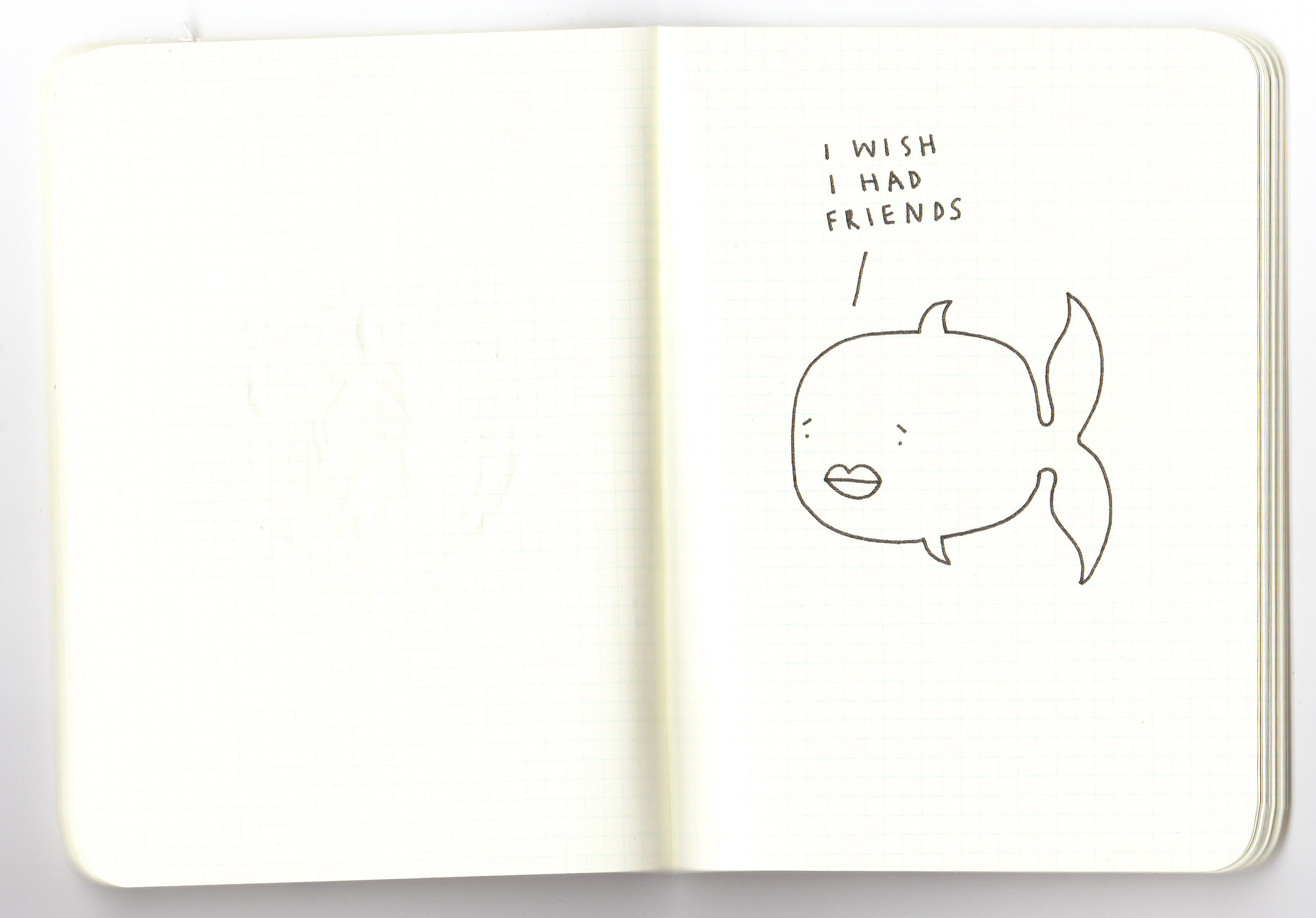
Socialization is Fishy

So what do homeschooling parents think about the socialization issue when theydo actually address it? Let’s start out with this cartoon, as it’s used a lot. It claims that a lack of socialization in homeschooling isn’t just a rare problem, but an outright myth. It implies that homeschool kids are not only actually in diverse environments as part of a natural ecosystem but are thrilled about it. It also implies that children who are socialized in public school are like half-dead sardines in a can rather than the school of likeminded fish they are expected to be.

soc5

This cartoon is a direct dismissal of there being any merit to the “socialization problem” and it is compounded with a public school counter-stereotype. This is unsurprising to me as the argument that homeschool socialization problems are an outright myth is quite often included with something disparaging about public school or insulting to teachers (and this cartoon is no exception). Notwithstanding how insulting it is to imply that most people who go through public school are like dead fish, is this depiction of homeschool versus public school in any way accurate? Well, I imagine for the occasional situation it is, but in general, certainly not.

Oddly this cartoon was actually almost the exact opposite of my experience. In the CHEF homeschoolers group I was in it was all white Christian families and our parents had to sign a statement of faith to join. It was absolutely a school of fish all swimming the same way and because we got together infrequently, I generally felt like that fish in the fishbowl. Also, when I went to public school in 9th grade I was certainly no canned sardine, even if I wasn’t exactly the manic fish thrilled at the ecosystem in the upper righthand corner. The teachers often tried to corral us into all doing things the same way but we didn’t make it altogether easy for them and generally I expect it was a bit like herding cats. We were all individuals, as were the teachers. I had favorite teachers and subjects and ones I didn’t like and I made friends of different races and beliefs and political persuasions, many of whom who are still my friends and acquaintances to this day.

The Dark Knowledge of Teen Degenerates

Here’s another cartoon about homeschool kid socialization from a slightly different angle, and this one does address the idea that kids don’t always do what you want them to do and by invoking the dreaded “peer pressure,” implies that its all bad. Which one is it – are they lobotomized sardines in a can or are they violent and rebellious ingrates? Make up your mind! Also, how realistic is this, do homeschool moms actually think public school kids are like this? Where are the public school kids who are not “at-risk” of being part of the school to prison pipeline? Why aren’t there any of those at the bus stop?

soc6

Also, in this little dystopian cartoon, gang members with knives read books on values (morally relativistic ones, no doubt), evolution, meditation, and “new age” religion (if that isn’t a culture wars, fearmongering buzzword, I don’t know what is) and pregnant girls read about sex ed and still don’t know what made them pregnant. This cartoon is crazy stuff. People don’t drink beer and shoot up heroin (yeah, there’s a needle on the ground in the cartoon) while waiting for the school bus (although some do smoke cigarettes). People who read a lot don’t typically join gangs. People who know about comprehensive sex ed aren’t any more likely to have sex than kids who don’t and they are much less likely to accidentally get knocked up. Honestly, if this is what anyone actually thinks the world is like then they are not fit to educate other human beings and they probably need some mental help themselves.

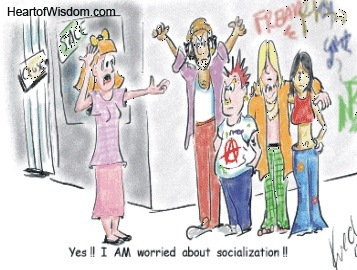
Sweet Homeschool Girl in the Ghetto

This cartoon is similar to the previous one in that it also indicates that public school socialization is all bad, but it depicts the expected reaction of the homeschool girl in the public school and implies that if your daughter goes to public high school (obviously radiating her feminine purity with a big hair bow and below-the-knee church skirt) that she will soon be shocked and horrified to encounter people dressed immodestly, young people openly dating, tattoos and piercings everywhere, vandalism and crime, blatant teenage rebellion, and big scary black boys that look more like grown men. So obviously the answer is to just have her at home not knowing that people who are different from her exist, and make most of the people her age out to be disgusting, immoral, and scary, right?

soc7

I followed this cartoon to its site, a blog called Heart of Wisdom, trying to get a higher resolution picture. The blog talked about how homeschool kids should only selectively socialize with other Christians and claims this is biblical. Yep, this is just the type of homeschooling “socialization” I am familiar with. It’s a form of social isolation and indoctrination called “sheltering.” This stuff is all about parental fear and desire for control and helicopter parenting to this extreme is very unhealthy for your child. It will mean that in adulthood that they won’t know how to function at an optimal level. You cannot shield your kid from all “bad influences” and indeed there is nothing in the bible that says your kids cannot play with the kids of people who have different beliefs. That is quite a stretch and it is insular, cultish thinking.

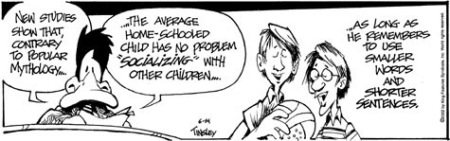
My Homeschool Kid is Smarter than Your Honors Student

That same Heart of Wisdom blog had this other cartoon about homeschooling, so I followed that link and it was to a page dedicated specifically to homeschool cartoons. When I see stuff like this cartoon I have to once again ask – is this supposed to be funny? Do these people actually think this is accurate? My main question, though, is why the elitism and negativity? Even if your kid is getting a much better education in homeschooling, why talk trash about children who through no fault of their own don’t have as good of an education? Why make it into a competition, act like homeschool kids in general are “better” than other kids? It shows me some immature and defensive parenting, really. If you revel in it when someone else isn’t doing as good as you it shows you are 1) being a jerk and 2) secretly worried that you’re no good at what you’re doing. Nobody should ever be excited about other kids having a sub-par education, thinking it makes them and their kids look better. That’s just gross.

soc8

As it is, I find that there is a grain of truth in this cartoon but perhaps not quite in the way the cartoonist intended. I’ve known a lot of homeschool kids who do use big words in conversations and they soon realize that it comes across as awkward when they socialize with other non-homeschool kids. Admission: I was that kid myself. I read a lot of classic literature and became familiar with words that simply aren’t used in everyday speech anymore. Trying to use them in peer-to-peer conversations didn’t reflect on me being smarter. It reflected on me not having a modern day frame of reference as to what is appropriate. It reflected on me being socially backwards. Lots of public school kids who are bookworms like I was know many big words. They also know the right words to use for their audience. Context is everything. An unsocialized homeschool kid doesn’t have that context and very well might find that using 18th century literary terms in a conversation about basketball will indeed get people looking at them sideways. If homeschool parents want to be proud of that, think it makes their kid (and by extension them) “better,” it shows they truly don’t understand the issue at hand.

Parental Fear & Social Anxiety

That’s where I think we hit the crux of this whole thing. I think the main issue is parental angst and fearfulness. Too many homeschooling parents socially struggled in school themselves and/or got into drugs or unhealthy sexual relationships. Instead of taking a broader view today, they expect that they need to hide their kid away from these settings or the exact same thing will happen to their kid even though their kid is in a different school district in a different generation and *gasp* a different person. These parents become scared of or hurt by the society we live in, withdraw, and then use homeschooling as an excuse to be separatist, snooty, and helicopter over their kids. These are not positive reasons for homeschooling and these are the exact kind of fearful and overbearing attitudes that lead to socialization problems for homeschool kids.

soc9

Because people with strong views often find themselves in positions of leadership, those with exclusionary, separatist, and elitist attitudes often end up running things and then set this negative and divisive tone for the homeschooling group and the community it serves. It’s so pervasive that even some “second choicers” who start homeschooling simply because the other educational options in the area aren’t up to meeting their child’s particular needs (which is an excellent reason to homeschool, in my opinion), can get sucked into this culture, an “us versus them” mindset where homeschooling represents everything that is pure and good and healthy for children and public school and the people and structures that support it represents everything bad. This creates a parallel society of sorts and then you see people start calling public schools “government schools” in a pejorative sense. All this “us versus them” talk fans the fear that homeschooling parents are vulnerable (although still superior) outsiders who are or soon will be discriminated against and this in turn leads to easy exploitation of these scared people.

Why does widespread homeschool participation in things like the fundamentalist-led HSLDA, which capitalizes on these fears and requires dues money (that then goes into their cultish culture wars arsenal) for unnecessary “legal protection” exist? Because many these people are too freaked out to do anything more than cling onto a protector, ignoring all evidence that their “protector” just wants to use them – financially and for furthering a disturbingly anti-democratic agenda. This fear grows and leads to the kind of mindset that spawns ridiculous cartoons like the one below.

soc10

Put in prison for homeschooling – really? Of course in this cartoon there’s that same (expected) depiction of scary people with piercings, this time instead of a shocked daughter (projecting much?) it’s got a dejected homeschool Mom being shunned by hardened criminals who sarcastically note that her “crime” was homeschooling.

Homeschooling parents who follow these “leaders” (often starting because their local homeschool support group requires or recommends HSLDA membership) hear these divisive messages and become scared to death of being framed, exposed, persecuted, worrying that they will land in jail just for homeschooling. It may be a wacky and unrealistic fear given what’s actually going on, but if people hear it often enough they often come to believe it, along with the bogus stats and stories claiming that homeschooling is as close to perfect an educational option one can get in such a messed up society, and the myth that there is no evidence to the contrary because homeschooling is just so awesome.

soc11

Because homeschoolers test scores aren’t made public and often not even expected, registration isn’t even required in many states, and most people don’t pay much attention to homeschooling unless their kids are being homeschooled. Homeschool movement leaders have been able to get away with exhibiting the cream of the homeschooling crop as representative of all homeschoolers. This has painted an inaccurate picture and hurt the vulnerable kids by leaving them ignored as they fall through the cracks.

Saying “our homeschool kids are socialized but socialization doesn’t matter and in fact it generally sucks if it isn’t coming directly from parents” is a very unhealthy attitude to go into educating with. Responsible homeschooling parents really need to do a bit of soul-searching as to why they tolerate these inaccurate depictions of what socialization is and isn’t, why there is this the across-the-board maligning of all public schools within many homeschool communities, and why so many participate in this ugly (and frankly in my opinion undeserved) elitism, and contribute to such extreme (and inaccurate) stereotyping and putting down of children who have had to attend lower quality inner-city schools, all in order to inflate the merits of homeschooling.

Two big question:

(1) Does this kind of attitude help do anything beyond artificially boosting homeschool egos?

(2) Is there any need for this behavior if homeschooling is really so awesome?

Also, if there is no good data on the problems of homeschooling then instead of celebrating the cobwebs we need to be collecting more data. Every single education method in this world has problems and the places where the problems are denied is where child maltreatment can and does flourish.

The Truth Between “Stereotype” and “Myth”

I get the message that not all homeschoolers are cloistered and don’t know how to talk to people their own age, but the fact is that too many are and we need to recognize that it is a real problem affecting a sizable percentage of homeschool kids. Also, homeschoolers are simply not the most brilliant people in the world or inherently “smarter” than other kids, and as such they shouldn’t need to feel pressured to achieve perfection, perform as child prodigies, or that there’s a black mark on them if they mix up “asocial” and “anti-social” in a conversation.

soc12

This “myth of the unsocialized homeschooler” is an issue in homeschooling but the prevalent idea that the socialization problem is a myth is the real problem, not the legitimate questions and concerns about socialization that homeschool parents keep being asked. Those questions actually need to keep happening because social isolation and ostracism in any setting (including homeschooling) often follows a person into adulthood, and can leave people struggling with social anxiety, a small social network, low levels of social capital, mental health issues, and an unnecessary amount of sad and lonely memories.

The least we can do is stop making fun of people, stop being in denial, stop pointing fingers elsewhere, and acknowledge that it is real, it happens too often and it should be assessed and addressed as the serious problem that it is.

Adult Homeschoolers Speak Out: Part One, Why I Wanted to Write This

Adult Homeschoolers Speak Out: Part One, Why I Wanted to Write This

HA note: The following series is reprinted with permission from Brittany’s blog BAM. Part One was originally published on May 24, 2012.

*****

Also in this series: Part One: Why I Wanted To Write This | Part Two: Survey Stats and Large Families | Part Three: Top 3 Reasons Parents Homeschool | Part Four: Academic and Emotional Experiences, K-8 | Part Five: The Highschool Experience | Part Six: College? Prepared or Not? | Part Seven: What About Socialization? | Part Eight: The Best Thing vs. What Was Missing | Part Nine, Do Former Homeschoolers Want to Homeschool? | Part Ten: Are the Stereotypes Better or Worse?

*****

Series Preface for HA

** In the introduction to my blog series in 2012 about Adult Homeschoolers I wrote that “everyone turned out fine.” This phrase may seem odd and may even seem hurtful to some HA readers and writers due to the fact that many of the stories on HA deal with the painful past of many adult homeschoolers. The purpose of sharing that “everyone turned out fine” was to state that everyone who participated in my series is now a strong, functioning adult who has worked through or is working through any struggles from their homeschooling background.

The purpose of my series was to look at the “good, bad, and ugly” issues of homeschooling in an honest and fair way, with the underlying thread of hope by sharing the experiences of many adults from all around the USA. I hope that, as you read, you will be able to identify with the stories of these men and women as they share the reasons their parents home schooled, their elementary and high school years, the “best” and “worst” thing about homeschooling, adjusting to college, socialization issues, and if they plan to homeschool their own children.

I hope that as you read, you will also feel hope; know that you are not alone.

*****

Part One: Why I Wanted to Write This

I was a first generation homeschooler.

…meaning my parents starting homeschooling in in the late 1980s right after it became legal in Nebraska (where I was born). In my elementary years, when someone asked where I went to school, 99% of the time my answer would produce a furrowed brow and the question, “What is homeschool?”

Nowadays, everyone knows someone who is homeschooling or who was homeschooled. First generation homeschoolers have grown up, gone to college, and have started families of their own.

My own children are now almost school age (I have twins who will be 5 in October) and in recent months I have been contemplating my own schooling experience.

I wondered:

  • Do former homeschoolers want to homeschool?
  • What do they think of their homeschool experience?
  • Were they happy and satisfied? Did they wish for more?
  • Were they prepared for college academically and socially or were they scared, unprepared and awkward?
  • Are they stereotypes of homeschoolers true? (homeschoolers are brainy/stupid/socially stunted/well rounded/fill in the blank?)

I spent hours on the internet, trying to find articles, blogs, anything written by former homeschoolers about their homeschool experience. I was disappointed by what I found (or the lack there of). Either I found stats about how homeschoolers are successful (with no personal testimony involved) or personal testimonies that I distrusted because I thought they were too “Pollyanna” in nature. I wanted to read about the honest experiences of adults homeschoolers, the good and the bad, the advantages and disadvantages, their thoughts on their academic experiences and the issue that homeschoolers everywhere never seem to escape:

“What about socialization???”

So I put together a short survey and and used the wonderful world of social networking to launch this blog series. I received 42 responses from adult homeschoolers from all over the USA (childhood friends, people I went to college with, friends, and friends of friends).

I am excited to share the data I have collected with you: adults who were homechooled, parents who are homeschooling their own children (and may be wondering, “Am I doing the right thing? Am I messing up my kid? WHAT ABOUT SOCIALIZATION????”), or anyone else who is curious about the lives and experiences of homeschoolers.

Here is a little sneak peek at the end of the story: Everyone [that took my survey] turned out fine. **

Not always “happily ever after” and not without some bumps, awkwardness, struggles, and obstacles on the journey to adulthood.

But, really, everyone [that took my survey] turned out fine.

[Some] parents, breathe a sigh of relief.

And keep reading.

You can look forward to personal testimony about topics such as:

  • Why first generation homeschool parents decided to homeschool
  • The academic and emotional experience of homeschoolers in grades K-8
  • The academic and emotional experiences of homeschoolers in grades 9-12
  • Do homeschoolers pursue higher education?
  • Were they truly prepared academically?
  • Were they truly prepared socially?
  • What is the best thing about homeschooling (so many people said the same thing! amazing!)
  • What former homeschoolers wish was different about their experiences
  • The inside perspective about the advantages and disadvantages of homeschooling
  • Do former homeschoolers plan to homeschool their own children?
  • The homeschoolers perspective on society’s thoughts and opinions about homeschooling

This series will be honest in every way, exploring the good, the bad, and everything in between. While my posts will primarily be focused on the results of the survey, I will also share my thoughts and experiences as they relate to the survey results.

I hope that this series inspires conversation, stirs up memories (for former homeschoolers), incites conversation, provides insight and information, and ultimately encourages those who read. Please feel free to comment, ask questions, and share your own thoughts and experiences.

*****

To be continued.

The Lessons I Wasn’t Supposed to Learn: Andrew Roblyer’s Thoughts

The Lessons I Wasn’t Supposed to Learn: Andrew Roblyer’s Thoughts

The 6 years I spent involved in the NCFCA changed my life.  I would wager, however, that my life was not changed in the way that many of the adults in NCFCA leadership wish that it had been.  The dream, espoused to us students many times over the course of our competitive careers, was that we would leave that league trained to do battle against the evil influence of the world, to defend our beliefs, and to convert people to Christianity.  It was, in essence, a conservative (and at times fundamentalist) evangelical pipe dream: a veritable army of thinkers and speakers to fight the good fight and defend their view of the Bible, Truth, and God.

Well, I came out of the league a pretty good thinker and speaker, but I’m also out of the closet, a mainline progressive Christian, and a moderate liberal.  And I am all of those things in large part because of those parents and leaders, some of whom are probably quite disappointed that I didn’t use my influence for their specific idea of what was “Good.”

But before I expound upon my NCFCA experience, I must preface with this: When I set out to write this piece, I did not set out to talk about anything negative.  My experience is one that I normally recall quite fondly (mostly because of the friendships that came out of it), but in reading the other posts this week, some very vivid and painful memories have returned to the surface, and I feel the need to discuss them.  These negative memories center around the league leadership, not the coaches I worked with or really even the parents I knew.  The few criticisms I have included are not intended to be directed at any person’s integrity or reputation.  Many of the adults in leadership while I was competing and coaching are people I have a great deal of respect for.

So, here are six things the NCFCA gave me, including some lessons that I don’t think they intended me to learn.

  • The NCFCA gave me peers, for the first time in my life.  Growing up, I was always “the smart kid.”  I hated that term, but as it was the only way I knew to get respect from both my peers and the adults in my life, I worked hard to perpetuate it.  As a kid, I always had my nose in a book, had very few close friends (but the ones I did have were wonderful), and spent a lot of time alone.  I wasn’t unhappy by any means, but I think that was only because I didn’t know what it was like to have peers.  The students in the NCFCA challenged me.  Collectively, they are some of the most intelligent, dedicated people I have ever met, and I consider myself exceedingly lucky to have met and grown to know and love so many of them.
  • The NCFCA taught me that communication is key.  More than anything intellectual, my time in the league developed the innate passion within me to be in relationship with people.  Communication was prized above anything else, including research and academic prowess.  It didn’t matter what you knew unless you knew how to talk with people and not at them, in a way that they could understand.  This tenet influences decisions I make and endeavors I undertake to this day.
  • The NCFCA taught me how to ask questions.  Whether through cross-examination in debate, extemporaneous speaking, or impromptu, I learned how to ask powerful questions both to gather information and to test the information I had already gathered.
  • The NCFCA taught me that adults are not superior to adolescents just by virtue of their age.  I guarantee you that this was not the lesson that I was intended to learn, because the league leadership rarely empowered us as young adults outside of the debate rounds.  We were looked at and spoken to like children while we were expected to think, speak, and behave like adults.  Even as legal adults, alumni were placed in a special category of judges, being the only ones to have our ballots read for legitimacy, regardless of our reputations.  On the flip side, I can’t tell you how many adult arguments and feuds I saw during my time in the NCFCA, but I can tell you that there were just as many as between students.  My time in the league removed any illusions that communication and maturity became easier as adults, which prepared me for the “real world” in a huge way.
  • The NCFCA taught me (but didn’t mean to) the value of both transparency and trust.  More specifically, it taught me that answering the question “Why?” may be one of the most important things I can do as a leader.  This was due in large part to the lack of transparency and trust between the league leadership (especially the board of directors) and many of the students.  In this area, our questioning skills were often cast in a negative light and we were dismissed.  I remember speaking with a friend about this and saying that it felt we were on a Christian Soldier assembly line, and the adults in the league were trying to control how we behaved and thought at the end of the process.  What they didn’t realize is that much like in the film I, Robot, that method of control provoked exactly what they sought to minimize.
  • The NCFCA taught me that getting know a person’s heart and individual situation is of paramount importance to the development of relationship.  I saw relationships ruined time and again because legalism got in the way of true listening and understanding.  The integrity of the “assembly line” I mentioned earlier often seemed more important than the individual students and parents involved.  This was not as much a top-down issue as it was ubiquitous: most rule violators were problems to be dealt with.  This continued through our time as alumni, dovetailing with the way that we were categorized and talked down to mentioned above.

The people I met during my time in the NCFCA are dear to my heart, including many of the people in league leadership that I knew.  Many of these issues are issues that would likely develop in any institution like NCFCA, but as it is NCFCA we are discussing this week, it is NCFCA I have written about.  Nobody involved in the league leadership was ever a “bad person,” and they all gave so much of their time and energy that it’s a wonder they don’t all have grey hair.  But the league was not perfect, no matter how much I want to remember that time in an entirely positive light. And it’s important to talk about how we perceived both the great and the not-so-great because those things have clearly contributed to who we (as authors) are as people.

So, when people who were or are involved with the league read this, I hope you know that I bear you no ill will. I still to this day recommend the league to students I work with, because it helped make me who I am today.  And I think that’s pretty awesome…even if that person isn’t exactly who the league hoped I would become.