Adult Homeschoolers Speak Out: Part One, Why I Wanted to Write This

Adult Homeschoolers Speak Out: Part One, Why I Wanted to Write This

HA note: The following series is reprinted with permission from Brittany’s blog BAM. Part One was originally published on May 24, 2012.

*****

Also in this series: Part One: Why I Wanted To Write This | Part Two: Survey Stats and Large Families | Part Three: Top 3 Reasons Parents Homeschool | Part Four: Academic and Emotional Experiences, K-8 | Part Five: The Highschool Experience | Part Six: College? Prepared or Not? | Part Seven: What About Socialization? | Part Eight: The Best Thing vs. What Was Missing | Part Nine, Do Former Homeschoolers Want to Homeschool? | Part Ten: Are the Stereotypes Better or Worse?

*****

Series Preface for HA

** In the introduction to my blog series in 2012 about Adult Homeschoolers I wrote that “everyone turned out fine.” This phrase may seem odd and may even seem hurtful to some HA readers and writers due to the fact that many of the stories on HA deal with the painful past of many adult homeschoolers. The purpose of sharing that “everyone turned out fine” was to state that everyone who participated in my series is now a strong, functioning adult who has worked through or is working through any struggles from their homeschooling background.

The purpose of my series was to look at the “good, bad, and ugly” issues of homeschooling in an honest and fair way, with the underlying thread of hope by sharing the experiences of many adults from all around the USA. I hope that, as you read, you will be able to identify with the stories of these men and women as they share the reasons their parents home schooled, their elementary and high school years, the “best” and “worst” thing about homeschooling, adjusting to college, socialization issues, and if they plan to homeschool their own children.

I hope that as you read, you will also feel hope; know that you are not alone.

*****

Part One: Why I Wanted to Write This

I was a first generation homeschooler.

…meaning my parents starting homeschooling in in the late 1980s right after it became legal in Nebraska (where I was born). In my elementary years, when someone asked where I went to school, 99% of the time my answer would produce a furrowed brow and the question, “What is homeschool?”

Nowadays, everyone knows someone who is homeschooling or who was homeschooled. First generation homeschoolers have grown up, gone to college, and have started families of their own.

My own children are now almost school age (I have twins who will be 5 in October) and in recent months I have been contemplating my own schooling experience.

I wondered:

  • Do former homeschoolers want to homeschool?
  • What do they think of their homeschool experience?
  • Were they happy and satisfied? Did they wish for more?
  • Were they prepared for college academically and socially or were they scared, unprepared and awkward?
  • Are they stereotypes of homeschoolers true? (homeschoolers are brainy/stupid/socially stunted/well rounded/fill in the blank?)

I spent hours on the internet, trying to find articles, blogs, anything written by former homeschoolers about their homeschool experience. I was disappointed by what I found (or the lack there of). Either I found stats about how homeschoolers are successful (with no personal testimony involved) or personal testimonies that I distrusted because I thought they were too “Pollyanna” in nature. I wanted to read about the honest experiences of adults homeschoolers, the good and the bad, the advantages and disadvantages, their thoughts on their academic experiences and the issue that homeschoolers everywhere never seem to escape:

“What about socialization???”

So I put together a short survey and and used the wonderful world of social networking to launch this blog series. I received 42 responses from adult homeschoolers from all over the USA (childhood friends, people I went to college with, friends, and friends of friends).

I am excited to share the data I have collected with you: adults who were homechooled, parents who are homeschooling their own children (and may be wondering, “Am I doing the right thing? Am I messing up my kid? WHAT ABOUT SOCIALIZATION????”), or anyone else who is curious about the lives and experiences of homeschoolers.

Here is a little sneak peek at the end of the story: Everyone [that took my survey] turned out fine. **

Not always “happily ever after” and not without some bumps, awkwardness, struggles, and obstacles on the journey to adulthood.

But, really, everyone [that took my survey] turned out fine.

[Some] parents, breathe a sigh of relief.

And keep reading.

You can look forward to personal testimony about topics such as:

  • Why first generation homeschool parents decided to homeschool
  • The academic and emotional experience of homeschoolers in grades K-8
  • The academic and emotional experiences of homeschoolers in grades 9-12
  • Do homeschoolers pursue higher education?
  • Were they truly prepared academically?
  • Were they truly prepared socially?
  • What is the best thing about homeschooling (so many people said the same thing! amazing!)
  • What former homeschoolers wish was different about their experiences
  • The inside perspective about the advantages and disadvantages of homeschooling
  • Do former homeschoolers plan to homeschool their own children?
  • The homeschoolers perspective on society’s thoughts and opinions about homeschooling

This series will be honest in every way, exploring the good, the bad, and everything in between. While my posts will primarily be focused on the results of the survey, I will also share my thoughts and experiences as they relate to the survey results.

I hope that this series inspires conversation, stirs up memories (for former homeschoolers), incites conversation, provides insight and information, and ultimately encourages those who read. Please feel free to comment, ask questions, and share your own thoughts and experiences.

*****

To be continued.

Rewriting History — The History of America Mega-Conference: Part Three, “Religious Liberalism” And Those Magnificent Mathers

Rewriting History — The History of America Mega-Conference: Part Three, “Religious Liberalism” And Those Magnificent Mathers

HA note: This series is reprinted with permission from Ahab’s blog, Republic of Gilead. For more information about Ahab, see his blog’s About page. Part Three of this series was originally published on July 7, 2013.

*****

Also in this series: Part One: First Impressions | Part Two: Doug Phillips on God in History | Part Three: “Religious Liberalism” And Those Magnificent Mathers | Part Four: Kevin Swanson Is Tired Of Losing | Part Five: Messiah States and Mega-Houses | Part Six: Doug Phillips Rages Against the 20th Century | Part Seven: Christian Vikings, Godly Explorers, and Strange Bacon | Part Eight: Closing Thoughts

*****

On Wednesday, July 3rd, I took in two workshops at Vision Forum’s History of America Mega-Conference: “The Rise of Religious Liberalism” and “Puritanism and the Multigenerational Vision of the Mather Family”. The first was a swipe at progressive Christianity and 19th century spiritual movements, while the latter praised Cotton Mather and his forefathers for their piety and devotion to family life.

On Wednesday morning, Col. John Eidsmoe of the Oak Brook College of Law and Government Policy presented “The Rise of Religious Liberalism”. The workshop was a polemic look at the rise of Unitarianism, Transcendentalism, and other forms of “religious liberalism” in 19th century America.

Eidsmoe spoke warmly of early Americans who celebrated Christianity. The Constitutional Convention, he claimed, had mostly Christians in attendance and involved God in their work. He dismissed the deist Founding Fathers in attendance as “outliers”. He discussed the message of 18th century preacher George Whitfield, who did much to unite Americans under a common faith, he claimed.

Eidsmoe also smiled upon Benjamin Franklin for praising Christian preaching and social endeavors, suggesting that the Founding Father appreciated Christianity. However, I found his portrait of Franklin to lack nuance. While Franklin did celebrate the Puritan virtues of his upbringing and respect preachers such as George Whitefield, he also referred to himself as a Deist in his 1771 autobiography, embraced Enlightenment ideas, endorsed religious pluralism, and spent time at a London Unitarian congregation.

In the 1800s, despite the Second Great Awakening, America sees the emergence of Unitarianism. Eidsmoe pointed out that 19th century Unitarians were different from today’s Unitarian Universalists, describing them as “strongly moral” people who revered the Bible but did not believe in the Trinity.

The 1800s also saw the emergence of Transcendentalism, which Eidsmoe described as a belief in God’s presence within nature and humans. Transcendentalists, Eidsmoe stated, believed that all humans have a divine spark within them, and that by getting in touch with that divine spark, they can become godlike. According to Eidsmoe, Transcendentalists rejected the idea of original sin and did not see the need for a savior, thus contrasting them to Christians.

Eidsmoe didn’t seem to think highly of Transcendentalists, sneering at failed Transcendentalist projects such as Fruitlands commune. He briefly discussed major Transcendentalist thinkers such as Ralph Waldo Emmerson, who drew inspiration from German thinkers such as Friedrich Schleiermacher, Buddhism, and the Bhagavad Gita. Eidsmoe also discussed Henry David Thoreau in unfriendly terms, scoffing at Thoreau for trumpeting his return to nature inWalden while eating meals at his parents’ house and drinking coffee in town. Thoreau defended civil disobedience in his classic essay, but Eidsmoe claimed that this was actually a Biblical concept rooted in obedience to God over obedience to civil authority. (For a more in-depth, non-polemical look at Transcendentalism, click here.)

Practice eisegesis much? I thought.

Transcendentalism led to the rise of “religious liberalism” by leading Americans away from Biblical Christian principles, Eidsmoe argued. While he praised Albert Schweitzer for his scholarly and humanitarian work, he disagreed with his “liberal” view of Jesus in Quest for the Historical Jesus. Eidsmoe also disagreed with the work of Julius Wellhausen, who theorized that the Pentateuch was written by four authors in different time periods rather than Moses (later known as the documentary hypothesis or Wellhausen hypothesis). Wellhausen’s theory was rooted “squarely upon evolutionary thought”, Eidsmoe insisted, even though Wellhausen was not the first scholar to speculate that someone other than Moses penned the Pentateuch. Eidsmoe frowned upon the Wellhausen hypothesis, seeing it as an attack on the divinity of Jesus himself who acknowledged Moses as the author of the Torah. Finally, Eidsmoe was also disdainful of the alleged Darwinist worldview, which he caricatured as positing that humans started in the “slime” and evolved, rather than being created by God with moral responsibility.

These 19th century forces contributed to religious liberalism, which exerts influence even today, Eidsmoe argued. He criticized modern “open-minded” liberalism as being closed-minded to anything evangelical, and caricatured religious liberalism as having five characteristics:

  • Denial of absolute truth in favor of a view of truth as relative, subjective, and evolving.
  • Emphasis on man rather than God, with God as a servant of man instead of vice versa.
  • “Presumption against the supernatural” and miraculous.
  • Optimism about progress, public education, medicine, and democracy heralding a new dawn, before events such as World War I and World War II casts shadows on progress.
  • A belief that the Bible is accurate in its conclusions but not its details, or the belief that parts of the Bible are divinely inspired but not inerrant.

The fact that this does not accurately describe progressive Christianity, past or present, seemed to have escaped him. Progressive and moderate people of faith would not describe their beliefs as such, which also seemed to have escaped Eidsmoe.

Eidsmoe listed several alleged dangers of religious liberalism, including the supposed lack of a basis for morality, the supposed lack of basis for evangelism, and the reduction of Jesus to a mere man or to one path to truth among many. Religious liberalism supposedly leaves no room for freedom, he claimed, since it reduces humans to evolutionary animals rather than moral agents accountable to God. He accused religious liberalism of having no means of maintaining Christianity or perpetuating the faith, claiming that liberal Christian denominations are losing members. (Perhaps he forgot that many mainline denominations and religious schools are losing members too?) Germany serves as a model for what can go wrong with religious liberalism, he insisted, claiming that one-hundred years of liberal German thought gave rise to Hitler and the Holocaust. In short, Eidsmoe demonized religious liberalism, using straw man arguments to grossly misrepresent what liberal Christians actually believe.

Eidsmoe concluded the workshop by warning listeners that religious liberalism could seep into their churches. He urged the audience to stay alert for liberal trends in their churches and seminaries, and to stay faithful to belief in Biblical inerrancy. In short, his workshop was not so much a tour of 19th century religious thought as a polemic against non-fundamentalist Christianity, complete with caricatures, oversimplification, and fear.

*****

On Wednesday afternoon, Scott Brown presented “Puritanism and the Multigenerational Vision of the Mather Family”. Brown, a pastor at Hope Baptist Church in Wake Forest, NC and the director of the National Center for Family-Integrated Churches, praised the Mather family as a model of piety.

Brown’s workshop focused on three men in the Mather family — Richard, Increase, and Cotton Mather — whom he praised for the “fruitfulness”, citing John 15:5-8 and John 15:16-17. Three generations of the family “cried out for a rising generation”, Brown observed, celebrating the Mathers as a “beacon of light” for families.

According to Brown, the Mathers resolved to bring everything into obedience with the Bible. Every member of the family was dedicated to God and lived for something beyond themselves, he claimed. By looking to scripture alone, the Mathers knew who they were and what role they were to play in life, rather than asking “who am I?”

Brown delved into the individual histories of Richard, Increase, and Cotton Mather, with emphasis on their religious lives and concern for the next generation. I noticed anti-Catholic bias in Brown’s description of Richard Mather when he noted that Richard’s father almost allowed Catholic merchants to fund his education. The Catholic merchants “coveted” Richard’s gifts, and Brown considered it pivotal in Richard’s development that he was not educated by Catholic. Brown then drew parallels to modern times, when “great pagan institutions” allegedly “pickle” children’s brains by pouring “paganism” into them.

Okay, you guys keep throwing around the word ‘pagan’. I don’t think it means what you think it means, I thought.

Brown observed common themes of moral decline in the preaching of Increase and Cotton Mather. For instance, Increase scoured the Old Testament for patterns among the prophets regarding God’s blessing and judgment, Brown said. Increase was reportedly concerned about the “onslaught of wickedness” in his society, and preached sermons on the importance of teaching piety to the next generation. Likewise, Cotton Mather was said to be watching his society decline, and encouraged cultivation of piety in children, Brown stated. Cotton Mather taught parents that children belong in church and are part of the congregation, a belief that Brown seemed to admire.

Brown devoted much of his discussion to Cotton Mather’s admonishments for parents on the spiritual upbringing of children. According to Brown, Cotton urged parents to set good religious examples for their children, concern themselves with their offspring’s spiritual state, and “plead God’s promises” to their children. Moreover, Cotton penned a list of twenty-one resolutions for fathers, including praying for their children, preaching to the family, encouraging children’s self-reflection on their souls, and “marrying” their children to Christ.

At the conclusion of the workshop, Brown listed six lessons that families can derive from the Mathers’ example. Modern Christian families, like the Mathers, must strive to be families (1) dedicated to future generations, (2) possessing clear visions of home life, church life, and civil life, (3) aware of the times and responsive to them in both public and private ways, (4) dedicated to the prosperity of the church, (5) determined to honor each other even as they disagree, and (6) crying out for their sons.

In his haste to praise the piety of the Mather family, Brown ignored the dark side of that piety. He neglected Cotton Mather’s Memorable Providences, Relating to Witchcrafts and Possessions, a 1689 treatise on the dangers of witchcraft and demons that was widely read in late 17th century New England. Some historians speculate that Cotton Mather’s writings on witchcraft contributed to the anti-witchcraft hysteria that spawned the Salem Witch Trials. He ignored Cotton Mather’s zeal to convert black slaves to Christianity in The Negro Christianized: An Essay to Excite and Assist that Good Work, the Instruction of Negro-Servants in ChristianityThe 1706 treatise encouraged slave owners to convert their black slaves to Christianity, assuring them that Christianity permits slavery and will not bring about slave’s liberty. The transmission of piety to young generations must be done in a spirit of self-reflection, lest that piety lead to destructive ends as it did with Cotton Mather.

I can accept the idea that the Mathers longed to do well by their children and grandchildren, striving to raise them well and encouraging other parents to do the same. Given Increase and Cotton Mather’s ties to witchcraft myths and the Salem Witch Trials, however, I draw a different conclusion from their lives. When parents teach their children spirituality, that spirituality must also include empathy, humanity, and critical thinking. Piety without these elements can devolve into fanaticism, with unsettling results.

Stay tuned for more on the History of America Mega-Conference!

*****

To be continued.

The Space To Be Human: Jayni’s Story

The Space To Be Human: Jayni’s Story

I was fourteen when I was introduced to CFC/NCFCA. The mother of another large home schooling family approached my mom with the “great opportunity” to provide all of the meals for a CFC conference she was coordinating. “If you make all of the meals the conference fees are waived for your family and I thought of you, since you have so many children.”

The conference was terrible. There were very clear expectations of what each attendee should look like and how they should act.  The conference was full of bright, happy, perfect home schoolers with impeccable manners. They all looked like they had stepped out of a Lands’ End catalog. (Lands’ End: the modest J. Crew) I was embarrassed to have to re-wear the only two skirts I owned for a full week. I was ashamed to be a “scholarship” kid.  I inwardly raged at the attitude that you were a bad Christian if you were not a good speaker. Naturally shy and introverted, I balked at the idea of ending the week by giving a short public speech.

It was very clear to me that I was an outsider. But by the end of the conference my mother was sold: her kids needed to do this NCFCA thing. And by the end of the conference I was hesitantly intrigued by debate: my mother would support me verbally fighting with people? Awesome.

Looking back at the few years I spent in NCFCA, I am struck by the contrast I experienced. On one hand, every organized experience (both in and out-of-state conferences, CFC, and Masters) were terrible. On the other hand, I met people who saved my life.

The first year I partnered will my unenthusiastic older brother. Wisconsin was very new to NCFCA and there was only one in-state tournament. We were warned ahead of time that all of the “community” judges were biased towards the hosting debate club. We were assured that if we lost every single round it was not an indication of our debating ability. We went 2-4 and I was devastated. I saved every ballot and poured over them incessantly, trying to find the key to my failure. For a league that touted Communicating for Christ there was very little grace for the losers.

The next year my brother went to public school. I was partner-less in a rural area with no club. I turned to everyone’s favorite online phorum to find a partner and debate coaching. It was extremely intimidating: apparently I was the only one who had not spent every waking moment since I was 12 obsessed about debate. I began spending upwards of six hours a day researching (I’ll admit, now, often without a clue about what I was looking for.)  I found an out-of-state partner and began pushing my parents to let me attend more tournaments. This meant expensive out of state travel; something my mother had not planned on. My birthday present that year was attending a practice tournament in Indiana.

The comments on my ballots that year were evenly split between admonishments of “have more confidence! =)” and “you are too intimidating and forceful, try to be more lady-like.” The capstone was at that year’s aforementioned state tournament. In a semi-final round my partner and I were debating against the tournament coordinator’s son. Before the round began when we all filed into the room to introduce ourselves to the [impartial] judges and shake their hands, one of them leaned over the table to give this guy a hug and mentioned something that happened at church last Sunday. I shook it off; I knew this team relied on smooth talking for the win, but nobody could ignore my heavy box of evidence. They were affirmative and the case was weak.  I jumped out of my chair to cross examine him after the 1A. There was a huge hole in the case and I dived right in. He talked around the question. I asked it again. He changed the subject. I rephrased and asked the same question. It got heated.

I doubt I even have to tell you that we lost the round because I was “rude.” The kicker? The timekeeper was the guy’s younger sister. My father was in the room watching the round and said afterward that when it was clear that I “had him,” the girl stopped the clock and called time.

Losing that round prevented me from going to nationals. Knowing my season was finished, I decided to focus on the friendships I had built through the online phorum instead. The phorum became a huge outlet for me. Thinking about this is still hard, and it’s hard to put into words. Looking back, the largest flaw I see in the home school debate world was the propensity to radiate perfection in everything. Because, obviously, if we’re Christians, we’re perfect.

I was envious of those “perfect” debators, and the more popular and perfect they were, the more I hated them, knowing I could never be them. I was fifteen the first time I typed over AIM that I was depressed. It took a long time to type those words because it took a long time to realize them. My closest friend, the one I had chosen to tell, responded by saying he didn’t think depression was a real thing. As my reputation grew on the phorum, I was increasingly known as the crazy girl, the rebel, the one who took things too far. Outwardly I embraced it. Inwardly I was embarrassed and ashamed. That reputation had a bright side, however. Asking questions like “Why do you believe in God?” sparked deep friendships with the girl from a single-parent home, the boy who was bipolar. These were the friends who supported me when I very shockingly announced I would no longer be a part of NCFCA because I was going to public school.

I was assailed with comments like, “you’re going to the dark side!” People were genuinely appalled; some genuinely thought this was a clear indication that I was no longer a Christian. The truth was that being home schooled in a heavily patriarchal home with an abusive father had led to suicidal depression.

The very fact that Homeschoolers Anonymous exists is a testament to the emotional trauma endured by many, and it’s very important that we have an open dialogue to ask why. Home schooling and debate are entwined worlds for many, and the individual answers will vary.

I rarely think back to my years in the NCFCA.  For the most part I prefer to forget it ever happened. When I do think back, I regret that façade of perfection we all felt pressured to adopt. Time has taught me that’s all it is: a façade. I wish that teaching us to change the world with our radical communication skills was not NCFCA’s sole focus: there was no space given to teach us to be human.

Young Earth, Young People, and Abandoned Faith

HA note: The following is reprinted with permission from Julie Anne Smith’s blog Spiritual Sounding Board. It was originally published on July 10, 2013 with the title, “Ken Ham, Young Earth Creationism, Young People Abandoning Their Faith: My Daughter’s Story.”

This story pains me.  It’s a personal one.

Parenting is very challenging. Homeschooling children has also been a challenge. When we began homeschooling our children, we chose to do so for a number of reasons.  We wanted to have better oversight over the curricula our children were taught because we wanted to give them a solid Christian foundation.

As typical Christian parents, we did not want them to have “worldly” influences. We got support at homeschool conventions, conferences. I spent time on the internet in e-mail groups, message boards, etc, and got support and information there. In the Christian homeschooling arena, Creationism was taught in the science curricula. Evolution was labeled as evil and we needed to protect our children from those false ideas.

Ken Ham spoke on the homeschooling circuit and we went to his seminars.  Others echoed his ideas and if you were a Christian homeschooler, you very likely taught your children Young Earth Creationism (YEC), as this was the primary science taught in the available Christian homeschooling texts – at least that I saw in my circles.

Science has never been my “thang.”  I don’t need to know the process of how we got here. The Bible told me how we got here.  I believed what it said and that settled the issue for me.   I didn’t need to discuss it further.

My husband, however, is an engineer.  He is very interested in knowing the process of things. I can’t imagine him not wanting to know how things work.  Engineers live and breathe processes.

Teaching creationism was a perfect fit for my husband.  He took the kids to creationism seminars over the years, bought quite a few creationist books about dinosaurs and the origins of the earth, and the kids soaked it up.  I found our eldest daughter devouring the books just for fun. She was sold. It was a foundational issue for faith, just like Ken Ham always said.

Here is a quotation by Ken Ham to students at Bob Jones University:

 “The majority of Christian colleges in this nation won’t take a stand on a literal Genesis, as you do here at Bob Jones University,” he said. And that compromise, according to Mr. Ham, is the very reason that some Christian young people are abandoning their faith. He said, “We have increasing numbers of people who have been led to doubt the history in the Bible, and so they don’t believe the Gospel based on that history.”

A couple of months ago, my older kids and I were at a restaurant and Hannah, 26 yrs old, shared with me a pivotal experience.  I hadn’t heard this story before.  Remember, science bores me.  When she talked this time about science, I was not bored.  I listened with great sadness and also understanding.  It made sense to me.  I asked Hannah if she would share her story here and she agreed.

I do not agree with Ken Ham anymore.  I hope my daughter’s story will open your eyes to another side of the story which Mr. Ham would not dare to admit.  His intentions may be good in holding so strongly to the YEC teachings, but we cannot dismiss that his ministry and possibly livelihood depend upon it.

I don’t care if people believe in Young Earth Creation or not.  To me, it is not a salvation issue or gospel issue.  But the YEC-only way of believing did not work for my daughter, it backfired. I think it’s important to take a closer look at this issue.  Hannah’s story follows.

*****

My Experience with Young Earth Creationism

by Hannah Smith

While on a break between classes at the local community college, a previous homeschooled friend I knew from church and I were sitting at a table chatting in the main lobby. I honestly have no idea how the subject came up, but we were talking about YEC and evidences for it. I was trying to explain Carbon-14 dating (it’s not the easiest thing to break down off-the-cuff, but I was pretty sure I knew the very basic fundamentals of it in order to have it make sense to her.

As I was trying to explain it, one of my classmates overheard our conversation and came over and joined the conversation. He very efficiently sliced-and-diced my YEC “points” and “evidence”, but since I felt I hadn’t brushed up on the subject in a year or two, I’d investigate it more in the light of the contradictions he’d brought to surface. I wanted to see if I could do more in-depth research on the topic and figure out if and how much of what he was saying could be verified and where the disconnect between our two viewpoints occurred.

So after I went home, I dug up our trusty creationism-is-true-sort-of books commonly found in good Bible-Believing Homeschooling YEC family’s libraries. After reading the articles and chapters, I did what my father always said to do and “checked the source” – probably more to see if there were books completely dedicated to the topic of Carbon-14 dating that I could look up in the local library.

Flipping to the end of the book with the citations I was shocked that pretty much all of the sources for their proof was from other Christian YEC-believing books. So I quickly determined that they were just quoting what other people who believed similarly where saying, rather than going to scientific journals and scholarly articles written by secular authors and scientists. For example, take a look at the following excerpt taken from an article at Ken Ham’s Answers in Genesis site (Doesn’t Carbon Dating Disprove the Bible?):

In 1997 an eight-year research project was started to investigate the age of the earth. The group was called the RATE group (Radioisotopes and the Age of The Earth). The team of scientists included:

    • Larry Vardiman, PhD Atmospheric Science
    • Russell Humphreys, PhD Physics
    • Eugene Chaffin, PhD Physics
    • John Baumgardner, PhD Geophysics
    • Donald DeYoung, PhD Physics
    • Steven Austin, PhD Geology
    • Andrew Snelling, PhD Geology
    • Steven Boyd, PhD Hebraic and Cognate Studies

That looks very impressive – every single person, a PhD. But they probably all have a vested interest in this – 3 of those 8 people have written books advocating YEC and you can find that information one simple mouse-click away from the article.

Look at the sources quoted at the end of the article – they go back to other Christian Scientists with published books on the subject (the scientists above) – unless they are quoting the opposing viewpoints for comparison.

I found this info out in about 1 minute while I was writing the first paragraph above, about the same amount of time it took me five and half years ago, when this originally occurred. This kind of circular reasoning raised (and honestly still raises) major red-flags for me from a logical and scientific standpoint. If they can’t find outside sources, how does them quoting from their friends make it true?

This was the starting point of me doubting my faith. I never recovered from it.

Rewriting History — The History of America Mega-Conference: Part Two, Doug Phillips on God in History

Rewriting History — The History of America Mega-Conference: Part Two, Doug Phillips on God in History

HA note: This series is reprinted with permission from Ahab’s blog, Republic of Gilead. For more information about Ahab, see his blog’s About page. Part Two of this series was originally published on July 7, 2013.

*****

Also in this series: Part One: First Impressions | Part Two: Doug Phillips on God in History | Part Three: “Religious Liberalism” And Those Magnificent Mathers | Part Four: Kevin Swanson Is Tired Of Losing | Part Five: Messiah States and Mega-Houses | Part Six: Doug Phillips Rages Against the 20th Century | Part Seven: Christian Vikings, Godly Explorers, and Strange Bacon | Part Eight: Closing Thoughts

*****

On July 2nd, I observed the History of America Mega-Conference at the Radisson Hotel Harrisburg in Camp Hill, PA. The event is sponsored by Vision Forum, a ministry with a strong Christian Patriarchy slant that focuses strongly on “Biblical education” for children. On Tuesday evening, I sat among hundreds of Vision Forum supporters in the Raddison grand ballroom, where Vision Forum director Doug Phillips opened the conference with a talk about history, language, and forgetting. For nearly an hour, Phillips’ voice alternated between calm speech and shouting as he shared a narrow, fundamentalist view of  history.

On stage, reenactors in costume performed on bagpipes and drums, concluding their performance by circling the room. The introductory speaker praised America’s forefathers, reminding the audience that they are still part of the great American experiment. Ominously, he claimed that the world is watching to see if the U.S. will be chastened by God for forgetting its past. Next, another man delivered the evening’s benediction, praising God as “the only redeemer of sinners and cultures”. He praised Doug Phillips as one of the most important Christians in the country for recognizing the Christian responsibility to be a “civilization-builder” and restore “Christendom”.

Doug Phillips delivered the evening’s main talk, entitled “The Panorama of God’s Providence in the History of America”. Phillips thanked God for the nearly one-thousand people in attendance. He lamented that this generation has supposedly forgotten our fathers and the goodness of God. A theme he impressed upon the audience was “now is the time”, since the day may come when there are no longer opportunities to have conferences and monuments. I wasn’t sure how to interpret this — was Phillips envisioning a time when Vision Forum would not be hosting conferences, or was he trying to frighten the audience by claiming that a time of oppression and censorship would come? Given fundamentalist Christians’ predilection for claiming that they’re being persecuted, I lean toward the second interpretation.

Phillips provided an overview of the conference, discussing the historical reenactors in attendance, the Battle of Gettysburg, and the “War Between the States”. “War Between the States” is a curious term I’d hear throughout the conference, and it surprised me since I’ve never heard of the Civil War referred to that way. When Phillips announced a Saturday reenactment of the Lincoln-Douglas debate, he cheerfully boomed, “We brought Lincoln back!” Boos rose from a section of the audience. Please tell me those were just Confederate reenactors acting in character, I thought.

After a rendition of the “Star Spangled Banner” by Danny Craig, Phillips dove into theology. “God speaks to everything,” Phillips insisted, arguing that God speaks through every part of our history and culture as part of his plan. Phillips emphasized “the primacy of God’s providential history”, urging parents to teach God’s history to their children.

Phillips asked the audience what they would do if they lost their identity and didn’t know their name, parents, or nationality. Without any context for who they were, what would their lives be like? He shared the story of an elderly former admiral he met while visiting his ailing father. Even though the man had been a powerful military leader, his family wasn’t there and no one at the facility knew of his accomplishments, thereby reducing him to a man without context. That is us in modern America, Phillips said. The “might hand of God” can be seen in monuments around the country, but many people do not know they’re there. He likened Americans to the ancient Israelites when they forgot God, arguing that Americans have forgotten God, the names of their great-grandfathers, and their history. “The average schoolboy in the beginning of the 19th century knew more about history than the average college professor does today,” he claimed.

Americans have also lost their vocabulary, Phillips lamented, offering a dubious interpretation of one of the most famous lines in America’s founding documents.

“We’ve lost our vocabulary. It used to be that we used words that meant something. When we said, ‘All men are created equal’, for example, we didn’t mean that all men were created at the same income level. That’s a socialist concept. We didn’t mean when ‘all men are created equal’, that there were to be no hierarchy or differences within society. That’s a Marxist concept. When we said ‘all men are created equal’, we understood that to mean that we’re all judged by the same standard by the living God, the king and the pauper. Everyone has the same standard under God, and we’ve lost our vocabulary.”

Frankly, I don’t know how Phillips arrived at that interpretation, given that the line appears in the Declaration of Independence in a passage discussing inalienable rights and the consent of the governed.

Words such as “freedom”, “Christian”, “family”, and “marriage” are being redefined too, Phillips insisted, taking a moment to blast a recent Supreme Court decision striking down the Defense of Marriage Act (DOMA). He stated that ancient societies did not recognize same-sex marriage, ignoring overwhelming evidence to the contrary from pre-modern ChinaEuropeAfricaindigenous North Americaand other cultures.

“We’ve lost our meaning of freedom. We’ve lost the understanding of what it means to be free men. We have redefined the word ‘Christian’, and you understand, brothers and sisters, that whoever defines, wins the culture. You change the words, you change the culture. How about this one? ‘Family.’ ‘Marriage.’ How about that one? Do you understand that yours is the first generation in the recorded history of the world in which the state has sanctioned two men as legitimately being, quote, married. Oh, listen. There has always been perversion. There’s always been wickedness. There’s always been evil. But even the Romans didn’t call it marriage. Even the Greeks didn’t call it marriage. The most vile pagans didn’t call it marriage. Your president calls it marriage. That’s wrong. We’ve lost our vocabulary. We’ve lost our definitions.”

Wrong, Phillips could use an LGBTQ history course, I thought.

Phillips told the audience that they were at the conference to “pick a fight” over America’s language and history, lest “radical” forces such as evolutionists and feminists co-opt them.

“We are here to pick a fight this week. We are here to take it back. We are here to say that were are going to take it to the wall, and we are going to fight for those words, we’re going to fight for those definitions, we’re going to fight for the things that the Lord gave us, and we’re going to say Jehovah is our God. That’s why we are here this week. We do not want out vocabulary to be co-opted by Marxists, feminists, radicals, evolutionists, and others that would destroy it before our very eyes.

Using a common argument among Christian nationalists, Phillips claimed that modern American law draws heavily from the Bible, an argument I found dubious. The idea that the United States was not founded as a theocracy, that the American legal system draws from many ancient and contemporary sources, or that legal systems do not evolve in a straight line, did not factor into his argument.

“Every single time you walk into a courtroom and someone wants to enforce contract law, they’re getting it from the book of Exodus. Every single time someone says you just can’t go assault somebody, they’re getting it from the Pentateuch. Every single time you want to see order or civilization, they are hearkening back to a set of laws that a man by the name of King Alfred required becomes the laws of England that would ultimately transported over to America as part of what we would call, ultimately, our common law heritage, which was built on the word of God and the Bible. It was the Old Testament law applied to local custom … While we have lost the vocabulary, and we have lost the reference points, we still have all around us these reminders, oh, that came from God, that came from Jesus Christ. That came from the law of Moses, breathed by the Holy Spirit, and then applied by our Founding Fathers.

Phillips spoke at length about his late father, who read prolifically, gave history books to his son, and arranged for his son to meet historians and engaging figures. He warmly quoted his father’s advice on studying history, such as the need to recognize imperfect people in history and the dangers of hagiography (a pejorative term for uncritical, sanitized views of history). Hagiography is to be avoided as an “error of the revisionists” who change facts or fail to see God in control of history, he explained. The irony of Phillips’ words made me smirk.

History is about antithesis, Phillips claimed, arguing that history shows contrast and tension between those who obey Jesus Christ and those who do not. Every departure from Jesus in history is a move closer to a false understanding of reality, he insisted. God’s providence in history is the outworking of his character through which he shows his mercy, justice, and immutability, Phillips said. The work of Christ and his love for the church is the “centerpiece” of history. Whereas the ancient Greeks saw God as part of nature, God is actually above and beyond it, he argued.

WHICH Greeks? Greek thought wasn’t homogeneous on this topic, I thought. And if the Christian God is supposedly the centerpiece of history, where does that leave thousands of years of pre-Christian history? Or the rich histories of countless non-Christian cultures? Such historical tunnel vision could prevent someone from studying or appreciating world history, I thought to myself.

Phillips offered examples of God’s alleged work through history. The rise of the Roman Empire facilitated the spread of Christianity, while the 1588 defeat of the Spanish Armada meant that America would be a “reformation Christianity beachhead” instead of a Catholic land under Spain. Yeah, because those dirty Papists aren’t real Christians, right Doug? I thought.

Dedicated minorities, not majorities, shape history, he claimed. If the conference had 900 people in attendance who were “absolutely unswerving” in their mission, the world could be changed, he assured listeners.

Phillips painted America’s founding as one “drenched with Biblical Christianity”, arguing (dubiously) that America is indeed a Christian nation.

“Was America founded as a Christian nation? … It really depends on what you mean. If what you mean is was America founded such that everyone in it was a born-again, regenerate Christian, then I would suggest to you not only is that impossible … but your understanding of the terminology is completely wrong. It has never been that way, and that is not what determines whether something is a Christian nation or not. When we speak of America as founded as a Christian nation, we mean was America, in its inception, one perhaps though imperfectly which was dedicated to the God of the Bible, whose law systems were rooted in the holy scriptures, whose people perceived themselves as serving Jesus Christ of the Bible, where its basic ethical standards reflective of Christendom and the body of beliefs which we describe as Christian? Was this a nation in our laws, in our ethics, in our foundings, in our charters, in the hearts of our people one which was predisposed and dedicated at least in part to the God of the Bible? And the answer is emphatically yes.”

Phillips depicted the Christianization of the Native Americans and other non-Christian groups as overwhelmingly positive. He reserved special praise for the Christianization of Iceland, which purportedly ended the exposure of unwanted infants.

“This was a country that was historically visited by Vikings  … who may have very well have been Christians. You know, the very first Christian parliament did not take place in England. It took place about 999 in Iceland. You know, one of the very first laws enacted by a Christian parliament? You can’t kill babies. One of the very first laws, because that’s what pagans do. They kill babies. That’s what PAGANS do! PAGANS KILL BABIES! Christians protect women and children. That was part of the legacy of Christendom. And we look back and we say, oh God, how beautiful it was when our people came and saw the great commission as leading the lost to Christ. The Indian nations and the Englishmen who knew not God. How beautiful it was when they sought to declare your law as the foundational law.”

Actually, Christian men have mistreated women and children as well. Early Christians kept slaves that included women and children, and men perpetrated domestic violence in predominantly Christian cultures, both medieval and modern. Once again, Phillips’ pristine view of Christian history does not necessarily conform to historical facts.

As for Iceland, I suggest that readers take a closer look at the Icelandic kristnitaka before they attributes too many civilizing qualities to it. Phillips conveniently forgets the missionary efforts of Stefnir Thorgilsson, who reportedly destroyed non-Christian religious sites, and Thangbrandr, who reportedly had his critics murdered. He also forgets the actions of King Olafr, who reportedly threatened to kill non-Christians when faced with setbacks in converting Iceland to Christianity. (See the Íslendingabók, a 12th century account of Iceland’s conversion.)

As for the Christianization of Native Americans, Phillips conveniently forgets the dark side of those proselytization efforts, such as demonization of Native American religions, the 1883 Code of Indian Offenses, Indian boarding schools, and other chilling attempts at ethnocide. For Phillips to sugar-coat Christian history just a few minutes after discouraging hagiography struck me as darkly amusing.

Phillips concluded his talk by urging homeschooling parents to teach both scripture and providential history to their children. With this view of history, Christians can fight for their culture. The nation is on a trajectory that cannot fail, he stressed. As with other Religious Right ministries, Phillips understood children to be torchbearers for the agendas of their parents’ generation, urging parents to teach them in a manner that would continue that agenda. However, in an age of the internet, widely available books, and a rapidly shrinking world, those very children will likely be exposed to non-fundamentalist historical accounts at some point in their lives. Whether Vision Forum’s efforts to instill providential history in children will prove successful remains to be seen.

Stay tuned for more posts on the Vision Forum History of America Mega-Conference!

*****

To be continued.

A Life With No Future: Rebecca’s Story

A Life With No Future: Rebecca’s Story

HA note: The author’s name has been changed to ensure anonymity. “Rebecca” is a pseudonym.

Trigger warnings: abuse and mentions of suicidal thoughts and self-harm.

My homeschooling story has similar themes to many of the others on Homeschoolers Anonymous: religious indoctrination, abusive dynamics, and educational neglect. Overall I feel like homeschooling inadequately prepared me for adulthood.

I was fourth in a family of six kids and I was homeschooled for every grade except kindergarten. We used the Christian Liberty Academy Satellite Schools curriculum for most of my education but had changed to Switched-On Schoolhouse (Alpha and Omega) for the later grades. I had a couple of friends and acquaintances in the local homeschool group, I attended church, and sometimes took community classes such as gymnastics and swimming. Still, my primary friends were my siblings.

Educational Neglect

Our family was not impoverished but we were lower class. Having enough money was a continual concern and a source of household stress. My parents spent a lot of time working to make ends meet and maybe it was because of this that they didn’t really interact with me much or supervise my education closely. The usual routine was that I would wake up, do the assignments in my workbooks by myself, and spend the rest of the day left to my own devices. Most days I only needed help for spelling tests. Despite the religious slant to the books, I did learn a lot from them and I’m glad that at least I had the basics of spelling, math, history, and so on drilled into me.

The teen years were when I started running into educational problems. I had done all right in math so far–I needed help sometimes, but I could do the workbooks more or less on my own– until I hit Algebra 1 and I could no longer make sense of it without help. I had Saxon Math, which had been working for me until that point, but it was just not clicking anymore. Unfortunately my mom was burnt out by all the working and homeschooling and she didn’t prioritize my education very highly.

By that point I was perhaps several grades behind in assorted other subjects. I wasn’t doing that badly at most of them but I had been lazy about finishing the work on a schedule, my parents never put the heat on me to learn, and gradually I stopped bothering with the schoolwork.

My formal learning ended with a whimper. There was no graduation or diploma, we just gave up. As far as I can remember, I never got past the equivalent of Junior year. I am not sure though, since I was often clueless as to what grade I was supposed to be in.

Household Dynamics

My parents were converted to Christianity at the time of the hippie-led Jesus Movement, and they brought their relatively relaxed approach to life to our upbringing. Unlike many Christian homeschool families, we were not an authoritarian household. Since we were fundamentalist/evangelical Christians, there were definitely lots of little red flags you had to look out for (Harry Potter? Bad. Secular music? Bad. Spaghetti strap tank tops? Bad), but for the most part our parents let us have freedom. I was allowed to dress in punk clothing. We could listen to any style of music as long as it was Christian. We could be friends with whoever we wanted. Our parents tended to trust our judgment in these things even during the dreaded teen years. I’m glad that we were allowed to be individuals, and that the homeschooling gave us lots of free time to play and read.

The problem was that this undisciplined parenting approach was at times neglectful, not only for my education but also my physical and mental health. I think I was undernourished as a little girl. I had chronic stomach pains that went unaddressed, and my parents were aware of my continual depression but didn’t do anything about it. My older siblings were the ones who most often paid attention to me, comforted me when my stomach hurt, and tried to help me cheer up. When they got jobs, they were the ones buying half my meals and I finally caught up to a normal weight level.

There was a pressing problem with my mother.

She had major personal/mental health problems that did not get treated adequately. Sometimes she would go into fits of rage and terrorize me and my siblings, or threaten to kill herself or my dad. When she was at her best, she was a laughing, curious person who loved to explore the world with her kids. When she was at her worst, I thought of ways to run away from home or kill myself to escape from her. Sometimes I did run away from home and self-harm. Rarely, the abuse was physical, but she only needed to sigh rudely for my heart to start pounding. I wish she had gotten help for her problems, and I wish she had not taken them out on us.

It has taken me a long time to realize how fucked up it was.

No Future

My major issue with my homeschooling experience is the fact that it didn’t seem to be progressing towards anything. My parents didn’t seem to realize that they were supposed to raise us to become adults, not just Christians. Instead my life seemed to exist in a warped kind of Never-Never Land in which I was rocketing towards adulthood equipped with only a child’s skill set.

I knew little or nothing about household maintenance, how to hold onto a job, how to work hard or make myself useful, fix a car or drive one, how to handle a romantic relationship, take public transport, talk to adults, or how to get a scholarship or apply to a college or even exactly what college was. It’s tough to raise kids on a shoestring budget, but there was no reason my parents shouldn’t have taught me this kind of stuff or helped me see a life beyond the four walls of our house. I was told on one occasion by my parents that they didn’t care what my future ended up looking like as long as I was Christian. That was the only time they gave me any guidance about my future. (I am now an atheist, incidentally.)

When I was a little girl I would talk about all the things I would grow up to be, but that stopped before long. There was a misogynist stigma in our family that women who had careers were evil (a job to make ends meet was one thing, but being a Career Woman was another). I did not have a good experience with the food-service job I briefly held when I was 14 and I have not been able to handle even entry-level jobs since. I get severe anxiety. In my teenaged years, I was aware of no way out of my parents’ house except to get married to someone with a job.

College was not on the table, since there was just no way for 6 kids from a low-class family to make it unless we paid for it ourselves (which only one of my siblings has managed to accomplish so far). There was also a sort of contempt for higher learning that I picked up on. Part of me wonders if this I-don’t-need-no-fancy-education attitude was based on a sense of inadequacy, like if it was out of our reach, we would pretend we were too good for it. When my friends graduated they all went on to college to broaden their horizons, leaving me in a small town with nobody to hang out with. I deeply resented and envied them because I was acutely aware that my life was going nowhere. I feel like if I had been public schooled, there is a chance that a teacher or counselor might have been able to help me see a bigger picture of my life. Instead the only option I thought I had was getting married. At 20, that’s what I did, and I moved out.

Catching Up

To this day, I still feel as if I’m 10 years behind my peers.

I’m 27 and only now exploring college options and figuring out how to get a diploma equivalent, which is something most other people are starting to look at when they’re still teenagers. I think this experience is familiar to some homeschoolers as well as some people who grew up disadvantaged, and I was both. My future is in my own hands now, and my success or failure depends on me, but I don’t believe I was given the best possible shot at life. I feel inadequate when people ask where I went to college, or what my career is.

The truth is, I don’t know how to explain that I was set up to have no future.

If you set out to educate 6 kids at home, you have to follow through all the way to adulthood with each and every one of them. You have to admit when you’re in over your head and put the kids first and not your ideology. I wish my parents had done that.

Now it’s up to me to pick up the pieces and make my life into something worthwhile.

His Quiver Full of Them: Jeri Lofland’s Thoughts

His Quiver Full of Them: Jeri Lofland’s Thoughts

Jeri’s post was originally published on her blog Heresy in the Heartland. It is reprinted with her permission. Also by Jeri on HA: “Generational Observations” and “Of Isolation and Community.”

Decades ago, I cross-stitched a scripture motto for my parents from Psalm 127, the favorite psalm of large families.

“Lo, children are a heritage of the Lord: and the fruit of the womb is his reward.”

The psalmist goes on to say: “As arrows are in the hand of a mighty man; so are children of the youth. Happy is the man that hath his quiver full of them…”

The term “quiverfull” is now used as both a noun and an adjective to describe a theology and lifestyle that glorifies human fertility while maintaining that God will provide the resources to raise as many children as he allows a couple to conceive. Contraception is held to be “playing God” and a violation of the command to be “Be fruitful and multiply”. The ideal Quiverfull couple are always open to “more blessings”, regardless of financial situation, health concerns, housing limitations, or needs of existing children.

I’m not certain when my parents decided that contraception was immoral. As a high schooler, Mom was an advocate of zero population growth and intended to adopt rather than bear children. A few years later, she graduated from a strict Catholic nursing school and married my dad. I was born a year later, my brother two years after that, and so on for the next 20 years.

Mail would arrive periodically from the Couple to Couple League and my parents had a couple of books by Catholic authors John & Sheila Copley explaining the practice of abstinence and/or breastfeeding as a means of birth control. Of course, even “natural family planning” (NFP) sounded too much like the evil “Planned Parenthood” so it was usually referred to as “child spacing”. Somewhere along the line my parents abandoned NFP (turns out it’s not all that effective at preventing pregnancy!) and the babies began to come even closer together.

Certainly Mom was influenced by Mary Pride’s 1985 book The Way Home, a story of the author’s journey from feminism to what she calls “reality”. Mary had just three young children when she wrote the book, in which she blasted away at contraception, lingerie, Marabel Morgan’s The Total Woman, and even Christian schools.

All forms of sex that shy away from marital fruitfulness are perverted. Masturbation, homosexuality, lesbianism, bestiality, prostitution, adultery, and even deliberate marital barrenness–all are perverted.”

“Since the word used for female is connected so strongly with the idea of nursing babies, whereas it has no connection at all with the idea of sexual activity, I believe that God is saying here that when women exchange their natural function of childbearing and motherliness for that which is ‘against nature’ [that is, trying to behave sexually like a man], the men tend to abandon the natural sexual use of the women and turn to homosexuality. When men stop seeing women as mothers, sex loses its sacredness. Sex becomes ‘recreational’, and therefore the drive begins to find new kicks.”    (Mary Pride, The Way Home, 1985)

(Pride’s position against family planning was more extreme than even the Catholic Couple-to-Couple League’s, prompting a correspondence between her and John Kippley, president of CCLI, and leading Pride to grudgingly endorse NFP in some situations in her sequel to The Way Home.)

Pride went on to birth six more babies and became a powerful force in the new homeschooling movement. My mom used to share The Way Home with all her friends and donated it to church libraries when she could. (When she encouraged me to read it, I was confused. Especially by the story about the lady wearing saran-wrap. Sexually naive young women raised in patriarchal, homeschooling isolation were definitely not Pride’s target audience.)

Mary Pride’s views fit rather well with the teachings of Bill Gothard–a middle-aged bachelor who handed out plenty of sexual and parenting advice at his seminars and encouraged couples to have surgeries to reverse previous vasectomies and tubal ligations. One of Gothard’s books informs us, “Labor in childbirth… was given to the woman for her spiritual benefit…” and points out that the God of the Old Testament “cursed several women by closing their wombs.” Attendees of Gothard’s conferences learned to associate infertility with God’s judgement. A full quiver, on the other hand, was a sign of God’s favor, a spiritual status symbol.

In 1990, a Nebraska couple published A Full Quiver: Family Planning and the Lordship of Christ. In this book, Rick and Jan Hess (homeschooling parents of ten) invite the reader to imagine a world where no one has ever had more than two or three siblings, effectively eliminating many historical figures. This exercise concludes with visualization of a future where enormous families are normal and God provides spacesuits for a missionary family moving their brood to evangelize a colony on the moon. My parents had this book, probably purchased at an IBLP seminar and still available on Gothard’s website.

Then there was Nancy Campbell’s occasional magazine for moms, Above Rubies. Nancy is a fierce promoter of anti-feminism from her compound in Tennessee. Her website includes multiple articles by women who felt guilt and regret over “the biggest mistake” of their life. After they repented, they went on to expand their families by four, five, six more babies. What mistake is reversed by more pregnancies? An abortion, perhaps? No, as it turns out, the biggest mistake of these women’s lives was a tubal ligation. Nancy also sells a book, A Change of Heart, encouraging couples to have surgeries to reverse both vasectomies and tubal ligations.

Vickie Farris, whose husband Mike is president of the Home School Legal Defense Association, homeschooled their ten children and lived to write a book about it. She encourages other women to reject birth control methods and embrace motherhood. Quiverfull women like Farris, and Michelle Duggar of “Nineteen Kids and Counting”, have built their lives on the mantra “God won’t give anyone more than they can handle”, sometimes phrased as “What God orders, he pays for”.

My parents were opponents of both birth control and sterilization. They even encouraged some of their friends to have reversal surgeries, resulting in many more babies. My mom had eleven children over 24 years, including ten [unassisted home]births. Pregnancy was not easy for her–she often referred to herself with the phrase from St. Paul, “a living sacrifice”. She spent most of my childhood breastfeeding, diapering, potty-training, and homeschooling on top of that. I understood that this was not culturally normal, but sought to convince myself that God was pleased with this self-sacrifice. I spent my teen years watching my mom’s body swell and deflate, and changing thousands of diapers.

In my twenties, as I waited for my turn to become a wife and mother, I quietly ticked off how many children I could have in years. I may have been ideologically persuaded that contraception was wrong, but I didn’t want to spend twenty years lactating either. When I got impatient for God to bring me a husband (no boyfriends on the horizon), I consoled myself by guessing how many fewer children I would bear in a shorter window of fertile sexual activity.

Fortunately, when I did get married, my husband and I quickly began to realize that many aspects of Quiverfull thought and practice were contradictory to our values. Not before taking NFP classes from a Catholic certified trainer, though. When we got pregnant anyway, we were told the method worked fine–we’d just had sex when [it turned out!] we were actually fertile. Well, what do you know?

I think my relationship with the Quiverfull movement finally ended a few years ago as I was perched on the end of an exam table in my doctor’s office. Looking up from my chart, she compassionately observed, “You’ve been raising kids for a long time,” and I burst into unexpected tears.

These days, stories of ex-Quiverfull moms and their “quivering daughters” are multiplying on the Internet like rabbits in the spring. The fruit of the movement has not turned out to be sweet; we deal with health problems, poverty, anxiety, depression, PTSD, eating disorders, cutting, sexual abuse, emotional incest, and divorce. (You can read far more than you want to know at the Homeschoolers Anonymous blog.)

In spite of these firsthand horror stories, Quiverfull continues to enjoy wide support in America and is gaining traction in other nations. Earlier this year, the BBC reported on the movement’s growth in the United Kingdom. You can listen to more, including scary-sounding clips from Nancy Campbell, here.

Meanwhile here in the States, Hobby Lobby and Catholic hospitals gnash their teeth over their employees’ rights to use birth control. Texan teenagers are taught that contraceptives don’t work. (The result? Texas has more than 10% of America’s teen births.) And TLC continues to profit from shows like “Nineteen Kids and Counting”, promoting Quiverfull ideology to some unsuspecting viewers.

The show should include a disclaimer: For your own safety, don’t try this at home.

I Will Listen: Emily Maynard’s Thoughts

I Will Listen: Emily Maynard’s Thoughts

HA note: The following post was originally published by the author on February 8, 2013. It is reprinted with her permission.

About the author: Emily Maynard is an outgoing introvert from Portland, Oregon. She likes Twitter, vegetables, fashion, Harry Potter, mentoring college students, and new information on anything. Emily is passionate about questioning, exploring, and growing alongside great friends. Her work has been featured on Prodigal Magazine, A Deeper Story, and Crosswalk, and she enjoys speaking to diverse audiences. She is not the Emily Maynard from The Bachelorette. Follow Emily at EmilyIsSpeakingUp.com.

*****

Last week I had three precious girls in my home.

They lounged on my couch and chairs, eating snacks and drinking warm cider, talking about their days at school and work and home.

And then we started talking about modesty rules and sexuality and shame. They asked if they could come to my house and talk about those things. I said yes. They showed up.

We told our stories.

And every single one of us, in our own ways, had negatively experienced our bodies, relationships, and sexuality. We all had painful experiences because of the ideas well-intended parents or or pastors or youth leaders taught us. We are all broken because of the subtle, harmful ways we learned to relate to God, ourselves, and others. We all grew up in fairly normal American Evangelical churches, with good families, at average Christian summer camps.

We are all struggling against shame. We are all seeking healing.

There was a lot of talk about The Modesty Rules on the internet recently. And then The Purity Rules. And I love all of it, this opening up and fighting shame and telling stories. But this isn’t something that happens on the internet, in comment sections that we forget in a few days.

These harmful ideas are hurting real people. Real women. Sitting on my real couch. Unraveling real lives.

This isn’t a problem just found in “legalism” or particularly heavy-handed churches. It’s not an “out there” or “just find another church” situation. This is everywhere. Based on the way it’s defended and excused by “church leaders,” it appears to be a central tenant of our faith culture.

And I can’t change that. I can’t control anyone. I’m not in charge.

So go ahead.

You can keep trying enforce The Modesty Rules or The Purity Rules. You can continue the body shaming for girls and giving us impossible standards and responsibilities. You can talk about how lust is only a problem for boys and shame every bit of sexual attraction they naturally experience. You can talk about “godly” living in a way that destroys the Image of God in real humans. You can leave out people who experience gender or sexual attraction in a way that doesn’t exactly line up with yours. You can refuse to see a correlation between your shaming ideas and so many of your children leaving the church. You can accuse me of not following scripture or of overreacting or being bitter. You can keep saying that bodies are a temptation, like alcohol. You can keep shouting that there isn’t a problem, with your hands covering your ears.

I can’t stop you.

But I will listen to your sons and daughters.

I will open up my home and my couch and my fridge and and my email inbox and my story to them.

I will try to make a safe space in my life for their voices.

I will protect their individual, precious stories because they are precious individuals.

I will let my heart hurt with theirs. I will celebrate redemption with them.

I will write out my experiences of trying to live at peace with my sexuality and my neighbors. 

I will commit to listening, to the best of my ability, not because I can save anyone, but because I want to lean in and watch Jesus save us all. 

I will be a safe person for your children hurt by your church, by your rules, by your shame. I will watch them learn to sing of grace and freedom in their own way. I will promote communities that allow healing to be messy. I will announce that we are not alone and that Hope has come. I will watch for sacred births in dirty straw and signs in the heavens.

I will see the imago dei in each of your children.

I will keep speaking up against The Modesty Rules and sexism and silencing and shame. I will keep speaking up for listening and letting the love of God overwhelm us and asking questions and taking healthy responsibility for our actions and walking out healing.

So you can keep shouting shame, go ahead.

And I will love your daughters and sons.

Let’s Talk About Tim Tebow For A Minute

Crosspost: Let’s Talk About Tim Tebow For A Minute

HA note: The following is reprinted with permission from Kathryn Brightbill’s blog The Life and Opinions of Kathryn Elizabeth, Person. It was originally published on June 9, 2013.

I don’t know Tim Tebow, never met the guy, though from what I’ve heard from people who knew him at UF, he’s a genuinely good guy. He’s definitely someone I’d rather have representing the University of Florida than some of the other famous alumni. What I can say for certain though, is that Tim Tebow is no saint.

Wait, wait, before you get the angry mob with pitchforks and torches to come after me, hear me out. Tim Tebow is no saint because nobody is. We’re all flawed human beings trying to figure out how to live our lives, and nobody is perfect. Nobody can be perfect. Even if Tebow is the nicest guy to ever walk the planet other than Jesus himself, he’s still not perfect. Perfection is impossible. Not only that, but we don’t all agree on what “perfect” even is. No one can possibly keep everyone happy.

I’ve alluded from time to time about the pressure that comes from being put on a pedestal in the homeschool world. Being a homeschool poster child who everyone in your homeschool community looks up to as an example isn’t exactly what I would call fun. It’s something I hated as a kid, and something that I couldn’t figure out how to escape. I eventually managed to gracefully get down off the pedestal by going away to college and drifting away from the homeschooling world.

Even after having been away from that community for as long as I was though, one of the nagging things in the back of my head as I was mentally preparing myself to come out was the knowledge that there was a non-zero chance that as the story made its way through the homeschool grapevine, people would talk about me in hushed tones and wonder what went wrong. It’s why I’ve referred to myself as a cautionary tale to the homeschool subculture (and also one of the reasons why I said I could never figure out a way to even rebel). All I know is that despite being small potatoes in the homeschool world, the pressure of the pedestal that others placed me on isn’t something I’d wish on others.

So what does this have to do with Tim Tebow? Easy. Tim Tebow is, by orders of magnitude, by far the most famous homeschooler on the planet. He’s been put on a bigger pedestal than any of us ever have been, all because he’s pretty decent at the game of football.

Maybe he likes being on the pedestal, perhaps he sees it as an opportunity to be a witness for God. That’s certainly what any good little evangelical missionary kid homeschooler has heard all of their life. Whatever the case may be though, staying perched on a pedestal as high as the one he’s on for as long as he’s been on it is not something that’s easy to keep up. One misstep and you come crashing down. And as much as the cynical sports and entertainment media love to tear a person down, the church world is even more brutal.

I cringe when I see how the homeschooling and conservative Christian world talk about Tebow. With the way they’ve built him up, he really can’t win. I don’t know how he can possibly be himself when the hopes of every homeschooler, or at least every religious homeschooler, are riding on his shoulders.

Can we please have a moratorium on homeschoolers and Christian culture treating Tim Tebow as a living saint? Let the guy just be another football player for once. Stop treating him as the homeschool poster boy and let him be an actual, real person, flaws and all.

Rewriting History — The History of America Mega-Conference

Rewriting History — The History of America Mega-Conference: Part One, First Impressions

HA note: This series is reprinted with permission from Ahab’s blog, Republic of Gilead. For more information about Ahab, see his blog’s About page. Part One of this series was originally published on July 3, 2013.

*****

Also in this series: Part One: First Impressions | Part Two: Doug Phillips on God in History | Part Three: “Religious Liberalism” And Those Magnificent Mathers | Part Four: Kevin Swanson Is Tired Of Losing | Part Five: Messiah States and Mega-Houses | Part Six: Doug Phillips Rages Against the 20th Century | Part Seven: Christian Vikings, Godly Explorers, and Strange Bacon | Part Eight: Closing Thoughts

*****

On the evening of Tuesday, July 2nd, I observed the History of America Mega-Conference at the Radisson Hotel Harrisburg in Camp Hill, PA. The event is sponsored by Vision Forum, a ministry with a strong Christian Patriarchy slant that focuses strongly on “Biblical education” for children. The History of America Mega-Conference features workshops on the past four-hundred years of American history, filtered through a conservative Christian lens. (More here.) The description of the event at the Vision Forum website left no ambiguity about the conference’s agenda.

“Are you and your children equipped to answer the politically-correct, historical revisionism that dominates higher academia and the mass media today — to defend our nation’s godly heritage with nuance and precision against the fierce onslaught of secular skepticism?

Antagonists to the Christian faith are stealing our history, and it’s time we take it back. The engaging messages given at this conference will arm your family with the truth to combat the lies of the Left — to have a sure foundation for the 21st century.”

This week marks the 150th anniversary of the Battle of Gettysburg, and given the proximity of Camp Hill to Gettysburg, many attendees dressed in Civil War era costumes. The costumes, while lovely, made navigation tricky. I almost fell over a woman’s enormous hoop skirt, then got accidentally whacked in the knee by a scabbard swinging from a passing man’s belt. When did Religious Right events become this hazardous!? I thought.

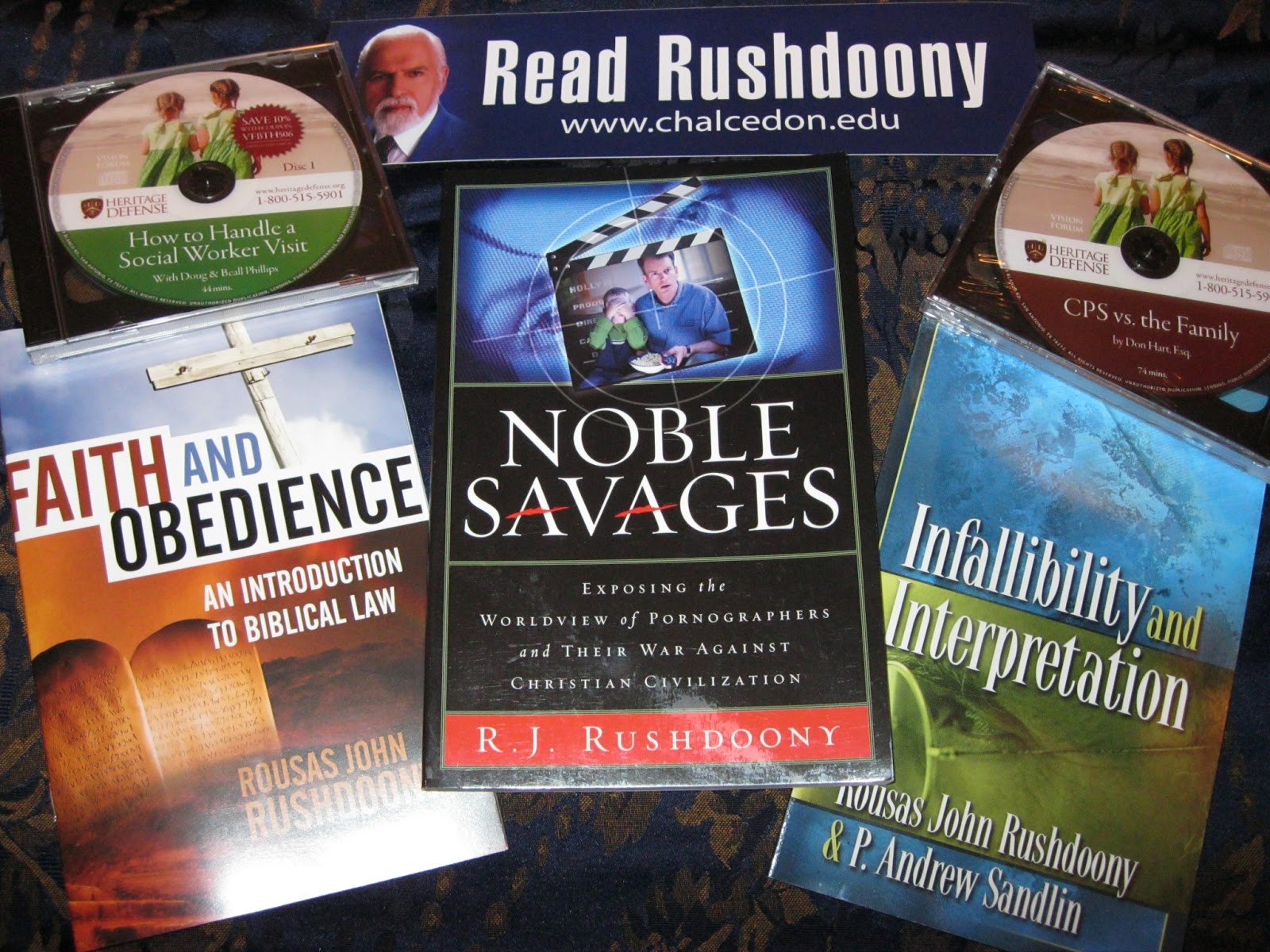
"The New Geneva Christian Leadership Academy table was stocked with books by Christian Reconstructionist author R. J. Rushdoony."
“The New Geneva Christian Leadership Academy table was stocked with books by Christian Reconstructionist author R. J. Rushdoony.”

About a dozen vendors were manning tables at the conference — mostly books, DVDs, and homeschooling curricula — and their titled amused me. The National Center for Family-Integrated Churches seemed keen on gender roles, judging by book titles such as Preparing Boys for Battle and Feminine By Design. At the Vision Forum merchandise table, alongside toy guns, toy swords, and books such as Large Family Logistics were DVDs with titles such as Tea with Michelle Duggar and Birth Control: How Did We Get Here?, a video on the evils of “child prevention”. I chuckled at the title of a video on food culture, Food Heresies: How to Reform Our Theology of Food Without Becoming a Selfish Marxist, a Radical Environmentalist, or an Imbalanced Vegan.

The New Geneva Christian Leadership Academy table was stocked with books by Christian Reconstructionist author R. J. Rushdoony, such as the colorfully named Noble Savages: Exposing the Worldview of Pornographers and Their War Against Christian Civilization. 

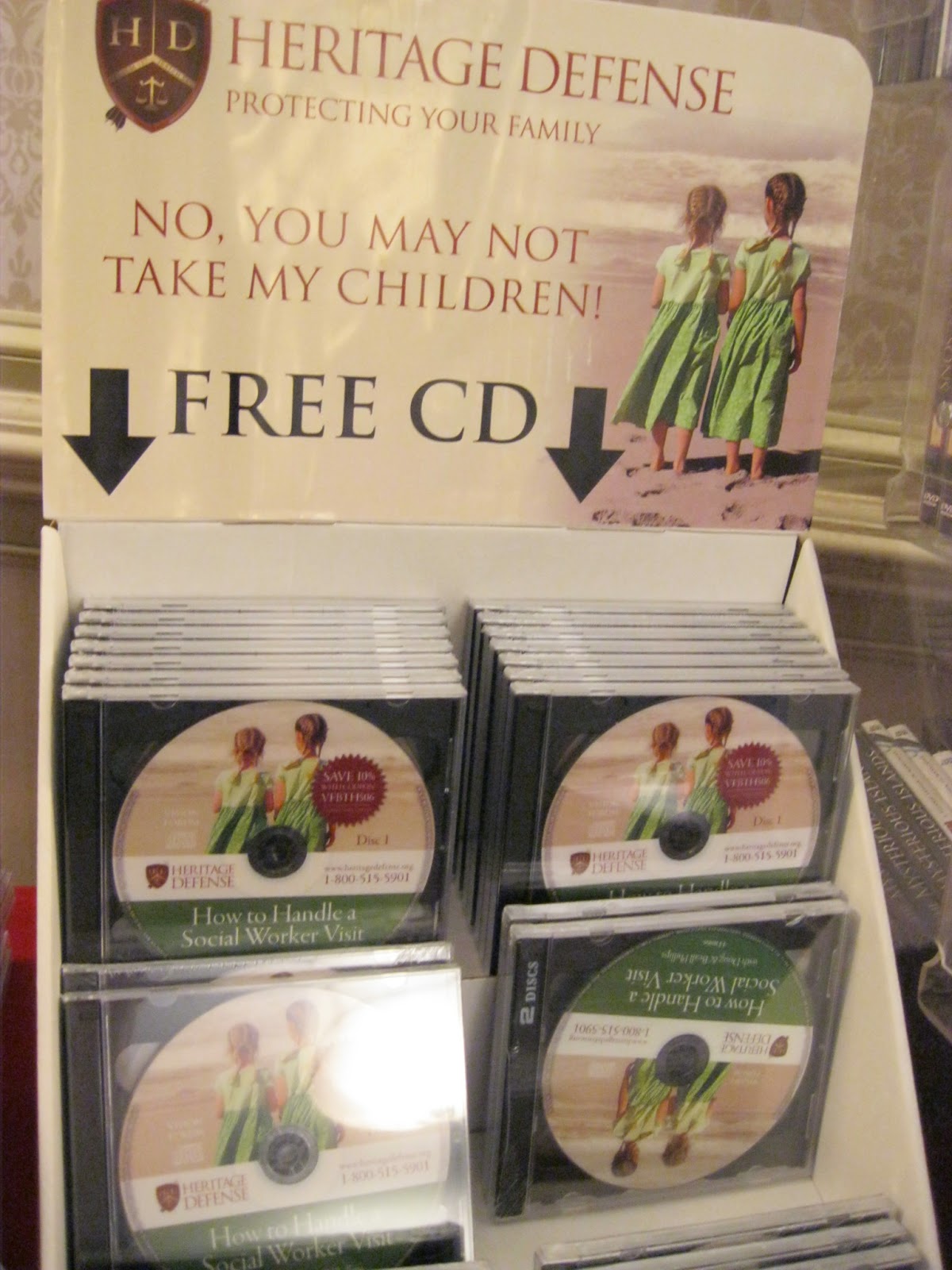
However, one display made my blood run cold. In the hotel’s grand ballroom was a display from Heritage Defense that read, “NO, YOU MAY NOT TAKE MY CHILDREN!” Sitting in the display were free DVDs such as CPS vs. the Family and How to Handle a Social Worker Visit. Upon reading the flyers at the foot of the display, I realized that Heritage Defense was casting child protective services as an opponent to Christian families. On its flyer, Heritage Defense claimed that it empowers Christian families by “uncovering social services abuses” and “holding abusive social workers accountable”. The flyer also celebrated the organization’s efforts to protect families from the following “threats” from social services:

  • Corporal Punishment
  • Sanctity of Life Decisions
  • Medical Choices like vaccinations and midwifery
  • Mandatory Reporters such as doctors, nurses, dental care providers, law enforcement, child-care services, nursery workers, coaches, counselors, and others…
  • Accidents in which children are injured
  • Premature Births or special-needs children
  • Anonymous Tips by those who wish to harm families
  • Harassment by extended family, neighbors, or mere acquaintances regarding disagreements concerning philosophical/religious direction and training of children
  • False reports generated by rebellious, disobedient, or indiscreet children within the home
  • Targeting of Profiling of Christian families because of faith, number of children, or other family dynamics
"Heritage Defense was casting child protective services as an opponent to Christian families."
“Heritage Defense was casting child protective services as an opponent to Christian families.”

Suggesting that mandatory reporters and anonymous tipsters are “threats” casts child abuse reporters as troublemakers rather than responsible citizens. To boot, the branding of children who seek help from CPS as liars or “rebellious, disobedient, or indiscreet” made me shudder. When child abuse occurs in fundamentalist families, where can victims find refuge if they’ve been taught that CPS is monstrous and that those who report are wrongheaded? When fundamentalists witness or suspect child abuse, could rhetoric like this make them reluctant to do the right thing? CPS is by no means perfect, but it does protect children from abuse and neglect, and thus this kind of demonization benefits no one.

Opening ceremonies for the conference began at 6 p.m., and hundreds of participants streamed into the grand ballroom. As the crowd filed in, I noticed several things about the attendees. First, the gathering was overwhelmingly made up of white families. Second, practically all of the women were wearing casual dresses or skirts, which I assumed had something to do with Christian patriarchy subculture. Finally, many of the families I saw had at least three children, often more, and babies were a common sight.

To be fair, everyone I met was gentle and helpful, and the families I observed treated their children with warmth. I struggled to reconcile these kindly people with the jarring messages I would hear from workshop speakers. It wasn’t just the workshop content that gave me pause — although polemic workshop titles such as “Why 19th Century American Literature Was at War with God” and “The Rise of Religious Liberalism” left me scratching my head — but the presenters of those workshops as well. I wondered how the women felt about a conference with only male presenters, or how anyone felt about a conference with all white presenters.

Stay tuned for posts on Doug Phillip’s opening speech and Wednesday’s workshops!

For more information on Vision Forum’s History of America Mega-Conference, visit the conference’s website.

*****

To be continued.