Hurts Me More Than You: Jaime and Susanna’s Stories

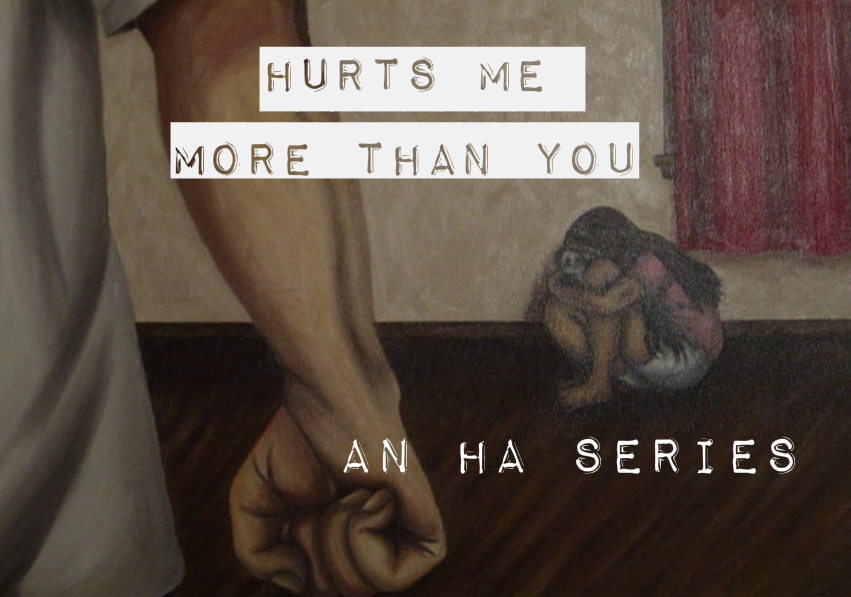
Screen Shot 2014-09-23 at 10.15.16 AM

*****

Trigger warning for Hurts Me More Than You series: posts in this series may include detailed descriptions of corporal punishment and physical abuse and violence towards children.

*****

Jaime’s Story

Two things I hate hearing the most are:  “Why are you getting spanked?” and of course “I got spanked as a kid and I turned out fine!”

We four siblings rode our bikes to a park, and we were supposed to be home by 5pm.  I was 11 and didn’t look at my watch.  When it was 5:30pm and we were still on the swings, terror gripped me.  I didn’t want to go home, then. We had to, and every delaying moment would make it worse.

We returned home eventually.  Mom lined us up.  My little sister, the youngest, got the paddle first, sprawled on a bed.  The correct technique is bare-bottom paddling until the child is gasping with sobs.  She was too little for it, and I tensed with rage.  She kicked and screamed and fell off the bed.

Mom moved on to my brothers.  You spank boys harder.  They need to be responsible.  Soon she grabbed my arm and yanked me across the bed.  She pulled my shorts and underwear off and put her elbow into my back to keep me from escaping.

The paddle was thick but slightly smaller than average—she could swing it quickly.  No set number of licks.  Just bruised and deeply red bottom and thighs.  The thighs hurt the worst.  I thought:  I’m going to run away.  Call the police.  No, wait, the HSLDA radio show said they will take my siblings away from each other.

“Why are you getting spanked?”  You must answer correctly.  You have to have “real repentance.”  It sometimes takes multiple paddlings to get it.  You sit funny that day.

“Are you sorry?”  I am whatever it takes, Mom.

I am required to hug her and can’t withdraw too fast.  Real repentance.

I want to kill her.  Or myself.  A few years later, I try to kill myself, but I can’t get anything right.

How this kind of thing happens, I understand.  She was a frustrated woman, angry with how her life was turning out at age 34.  Her husband was distant.  She did not feel she could control much.  It was past 5pm, where were her children?  They need to learn better to obey—obey the first time always, no questions ever.

She and her friends subconsciously (at times openly) judged each other based on their kids’ behavior.  And believe me, I know kids can be deeply frustrating—my coworkers today complain about their kids all the time.  It all makes sense.

Today’s culture tells me that we never hit women, we can hit children as punishment (“I turned out fine!”), and we can hit men whenever.

How about just not hitting anyone?

*****

Susanna’s Story

I have 10 siblings, so anytime an infraction had been committed that warranted spanking, but the exact perpetrator was unclear (“who tracked mud on the carpet?”), my mother would grab a belt or wooden spoon and have us all line up at her bedroom door for sometimes hours at a time as we all received the punishment one by one.

This means I have been spanked for literally nothing countless times. But trying to beg off and sobbing out “I didn’t do it!” only resulted in more spanks and a cold “I’m sure you’ve done Something that I missed.”

Occasionally, my siblings and I would be able to convince one of our own to take the blame for the ambiguous crime so that only one of us had to be punished. We had a system where we took turns volunteering if the option was given. But even when it wasn’t my turn, hearing the belt thwacks on my brothers’ legs would make me violently ill, and just thinking about it today is upsetting my stomach.

From as early as I can remember, a spanking has never made me feel “sorry”. Only angry, sick, and determined to never again let this happen to me (even though I was just as helpless to stop it the next time). I have never ever felt as angry as I did after getting spanked.

As an adult, I avoid speaking to my mother, as just seeing her upsets my stomach, and I struggle with any situation that could lead to confrontation. I used to work under an aggressive boss that I disagreed with frequently, but any time I even thought of confronting him on the smallest issue, my knees would get weak, my stomach would flip, and my hands would begin to sweat and shake uncontrollably. That same reaction can happen to me anytime I consider any confrontation; once it happened when my room mate ate my yogurt and the thought crossed my mind that I might speak to her about it.

It’s exactly the reaction my body would have through my childhood when I knew with certainty that I had a spanking coming my way.

Why I Cannot Support Frontline Family Ministries’ Abuse Prevention Week: Part Three, Kalyn’s Secret (Continued)

Screen Shot 2014-10-12 at 9.27.44 PM

By R.L. Stollar, HA Community Coordinator

*****

In this series: Part One, Introduction | Part Two, Kalyn’s Secret | Part Three, Kalyn’s Secret (Continued) | Part Four, Not Open | Part Five, Unmask the Predators | Part Six, Recommended Resources | Part Seven, Conclusion

*****

Part Three, Kalyn’s Secret (Continued)

In the first half of today’s analysis of Kalyn’s Secret, I gave some context for understanding the Cherry family and then looked at where the book took steps in the right direction.

3. The Bad

Unfortunately, the book also takes many, many steps in wrong directions. In fact, I could dedicate an entire five-day-long series to just this book and its ideas. However, that would be a tedious read and could sidetrack us into debates over theology and ideology. So I am going to focus this section less on the actual ideas and more on the consequences of those ideas when it comes to abuse prevention and mental health advocacy. I grew up hearing the mantra, “Ideas have consequences,” and I still find that mantra to hold true. So as I examine the ideas contained within Kalyn’s Secret, I will be filtering them through the lens of the following question: Does this help or harm abuse survivors and individuals with mental illness?

The ideas I will be examining are:

a. Poor biblical exegesis

b. Damaging theology

c. Perspective on mental health

d. Demonology

e. Authoritarianism and Patriarchy

f. Suggesting physical abuse and first-time obedience

g. Bad advice regarding counseling and abuse reporting

h. Recommended resources

a. Poor biblical exegesis

One of the root problems in Kalyn’s Secret is Lisa Cherry’s poor grasp of biblical exegesis. This might seem strange considering that she is a pastor at Victory Christian Center (a church she and her husband founded), but Lisa’s higher education consists only of a BS in Nursing.

I know some of you reading might not be Christians, so discussing biblical exegesis might seem meaningless. However, basic reading comprehension is a skill everyone can benefit from. And a poor grasp of biblical exegesis — whether or not you believe the Bible is true in the first place — can lead people to believe some awfully damaging ideas. So whether or not you believe the Bible is true, it behooves all of us to encourage those who do to read the Bible accurately and in a way that promotes healing (and not harmful) ideas.

There are numerous ways that Lisa engages in flawed biblical exegesis in Kalyn’s Secret: pulling verses out of context, playing fast and loose with definitions, inserting her own words into passages, switching one Bible translation for another mid-passage to justify an idea she’s trying to proof-text, etc. But I want to focus on one specific exegetical problem in particular: personalizing passages that aren’t meant to be personal. Time and time again, Lisa strips verses out of their historical and literary contexts and argues that they magically transcend those contexts and are direct messages from God to us in 2014. I know a lot of people do that. But that’s just not how reading and writing works. That’s a failure in Exegesis 101.

The most important example of Lisa doing this is her treatment of Luke 10:19: “Behold, I have given you authority to tread on serpents and scorpions, and over all the power of the enemy, and nothing will injure you.” Lisa uses this verse on two separate occasions: (1) to claim that “when we saw strange demonic activity happening in our home, we had to remind ourselves of the truth that we have been given ‘authority to tread on [snakes] and scorpions, and over all the power of the enemy, and nothing will injure [us]” (133); and (2) to claim that “speaking God’s promises” “out loud” “allows God’s Word to defeat the powers of darkness,” proof-texted with Luke 10:19 (189).

The problem is, Luke 10:19 proves nothing of the sort. Here’s the context: Jesus appointed 70 people and “sent them in pairs ahead of Him to every city and place where He Himself was going to come.” The 70 people then “returned with joy, saying, ‘Lord, even the demons are subject to us in Your name.’” Jesus responds to those 70 people and says, “Behold, I have given you authority to tread on serpents and scorpions, and over all the power of the enemy, and nothing will injure you.” This passage is directed to 70 people specifically appointed by Jesus to do a particular task during a precise moment in history, not any and every Christian living in 2014. In fact, you’ll notice that when Lisa quotes it in the first example, she actually changes the verse, replacing the word “you” with “[us].” She’s literally rewriting the Bible to make it say something it doesn’t.

This point about exegesis is significant because Lisa’s exegetical failures directly lead to the next problem: damaging theology.

b. Damaging theology

As I said earlier, Lisa and her husband are self-described “Holy Rollers” (57). The Cherry family falls squarely into the Charismatic, Word of Faith, Holiness, and Prosperity Gospel movements. Lisa talks about the necessity of true believers having “an encounter with the third person of the Trinity named the Holy Spirit” (56) — and that not having that special encounter jeopardizes one’s relationship with God.

One can see this in the strong charismatic language used by Lisa in statements like, “We must learn to avoid spirit failure and employ Spirit power” (93), “Spirit failure was causing me to be pulled into the pit with Kalyn, and I desperately needed an emergency supply of God’s supernatural power!” (96), and “Through Jesus our ‘power hook up’ was restored” (113). In fact, Chapter 7 of the book is tellingly called, “Hooked Up to the Power.”

Lisa describes two of these so-called “power hook-ups” as (1) exousia and (2) dunamis. Exousia, she says, “refers to force, superhuman mastery, and delegated influence, which reflects authority. This Greek word…holds the answer for every problem anyone is facing now or in the future…Jesus gave His authority back to His children… Jesus had the exousia, and He transferred the exousia to His true followers” (115-6). This power promises success and victory: “Because of our exousia we can stand up and proclaim, “In Jesus’ name, I command every force of darkness to leave my home” (117).

Dunamis means “a mighty working miracle power,” Lisa says. It refers to the power to heal the sick and cast out demons, and Christians have this power, too: “Jesus Himself operated in this Holy Spirit power anointing when He healed the sick, walked on water, and cast out unclean spirits…That same dunamis is available to all believers by being filled with the Spirit” (119).

Lisa takes these “power hook-ups” seriously. In fact, she states with all seriousness that the 1904 Azusa Street Revival in Los Angeles was a true working of the Holy Spirit (118). For those unfamiliar with this revival, suffice it to say that it was the beginning point of the Pentecostal and Holiness movements in the U.S. and has been directly linked to child abuse and deaths due to its emphasis on faith healing.

While I desire to respect people’s diverse theological belief systems, I do think that each and every system of human belief has weaknesses — and those weakness are particularly amplified in certain circumstances. For example, while we could argue about the validity of Calvinism’s tenet of predestination, I hope we all can agree that raising the tenet of predestination at a loved one’s funeral is counter-productive and damaging. That’s not the time and place. Similarly, raising the charismatic tenets of the Cherry family’s theological system — whether you think they are valid or not — within the context of abuse prevention is counter-productive and damaging. Here’s why:

First, it offers false hope.

The “victorious Christian living” message from these movements offers false hope to families facing the devastations of child abuse. It promises supernatural power when it should be offering accurate, concrete, and professional assistance for abuse recovery and mental illness. Examples of the promises Lisa makes include:

  • “To those who understand His ways, who respond to His incredible offer of a covenant relationship, who obey His principles, and who can believe His incredible mercies, He will make His supernatural power available” (123).
  • “God is ready to give us the fullness of His power—He’s promised to in His Word. We just need to plug in!” (125).
  • “As parents we can say no! Our prayers and our authority have power in the spirit realm” (164).
  • “When you are prepared for the day of battle, your victory is sure!” (175).

Second, it emphasizes prayer over real recovery assistance.

This is the problem with any worldview that advocates faith healing. These worldviews declare that simply saying words out loud can transform circumstances. This is mysticism, not accurate science or even biblical Christianity. Examples of Lisa’s Word-of-Faith ideology includes:

  • “Pray the prayer below for whichever spiritual condition you may be in right now, and expect God to rescue you and help you to find your own path out!” (106).
  • “By some counts it is estimated that there are over 6,000 statements of promise contained in the Word that are available to the child of God… Speaking God’s promises is how we declare our place of authority over our own lives… It allows…the release of the power of faith [and] God’s Word to defeat the power of darkness… This scriptural declaration not only transforms my mind and heals my emotions, it also transforms circumstances” (188-90).
  • “Just keep speaking those promises aloud until faith supernaturally begins to rise up in your spirit” (192).

Third, it heaps guilt upon survivors of abuse and their families.

There’s no way around the fact that recovering from child abuse and/or mental illness is a complicated and grueling process. In fact, an entire lifetime might very well be required. There will be relapses, dark moments, and times when people will just want to give up. It doesn’t matter if you are a Christian or an atheist or a Buddhist — this is just how recovery works.

To suggest to survivors of abuse and their families that there are easy answers or that they just need to tap into a supernatural source of power is devastating. Because ultimately, the realities of recovery will surface no matter what. The feelings of failure are difficult enough, but the worldview of the Cherry family only adds guilt on top of guilt. Because now survivors not only feel like failures in terms of recovery, but also failures in terms of their relationships with God. Wasn’t faith supposed to supernaturally rise up? It didn’t. So does that mean I am not a Christian? Does God hate me? Must I pray harder? What is wrong with me?

This is an insidious form of religious abuse and has no place in legitimate education about abuse prevention or recovery.

c. Perspective on mental health

Both Lisa and Kalyn Cherry (though primarily Lisa) minimize, spiritualize, and stigmatize mental health health issues through Kalyn’s Secret. They minimize by discussing mental illnesses as if they are stereotypical teenage “issues” (like smoking cigarettes) that can be easily avoided or vanquished. They spiritualize by repeatedly classifying mental illness as a tool of Satan and demons, rather than an actual illness. And they stigmatize mental illness by speaking of it as something wrong on a moral and/or spiritual level.

These problems begin at the very beginning of the book when Lisa tells a morality tale about a Parent and Child traveling on a Boat (representing life). The Parent is obsessed (and in Lisa’s mind, rightly so) with avoiding various “Islands” (the aforementioned, stereotypical teenage “issues”) and has to help the Child stay safe. In Lisa’s mind, the Parent can successfully navigate the Child’s boat and not run aground on any of the islands. And one of these Islands — amongst things like Drugs and Violence — is “Depression”: “Parent had studied the names of the other ‘islands’ their boat needed to avoid—Depression, Drugs, Sexual Abuse, Rebellion, Violence, Teen Pregnancy—and he certainly didn’t intend to get their boat caught up on any of them!” (24)

Mental illness is not something that can be “avoided” necessarily any more than any physical illness. So not only does classifying it alongside things like drugs obfuscate its roots, it also makes it appear like it’s something easily avoided or fixed. This minimizing continues throughout the book. Lisa makes it sound like God won’t let “real” Christian remain mentally ill, saying, “When God would remind us that He sent forth His Word and healed all our diseases (Ps. 107:20), we had to remind ourselves that depression would not be able to stay in Kalyn’s body. When we saw strange demonic activity happening in our home, we had to remind ourselves of the truth that we have been given ‘authority to tread on [snakes] and scorpions” (132-3). She also insinuates that parents can solve mental illness simply by praying: “When attacks come against your home, take a stand by faith and pray like this: ‘No devil…I disallow tormentors such as depression, oppression, anxiety, and stress…’ As parents, we can say no! Our prayers and our authority have power in the spirit realm” (132-3).

This, of course, is not surprising in light of the fact that the Cherry family adheres to and promotes various religious movements noted for faith hearings.

As you can see from the last quotation, Lisa also spiritualizes mental illness. She describes depression as a “tormentor” from the “devil.” Other spiritualizing language that the book uses to describe mental illness includes “weapons at the devil’s disposal” (92) and “dark forces” and “ugly monsters” (226-7). This is not a coincidence. As we will discuss in the next section, demonology is a significant factor in the Cherry family’s worldview.

The last point necessary to make about Kalyn’s Secret and mental health is that the book stigmatizes mental illness by describing it — and those who suffer from it — in intensely negative terms. Kalyn describes mental illness as a “weakness” (227) and a sign of “our perverted, godless society” (239). Lisa describes it as part of a “pit” belonging to Satan. She compares mental illness to alcohol, saying that depressed individuals use their mental illness as a “coping mechanism” that “allows the mind to shut down and temporarily give up the task of reasoning.” She also says that it’s “politically correct” to describe mental illness as an “involuntary response,” when in fact it’s “the enemy’s ultimate strategy against all God built and created” (81).

All of this is not ok. It is completely irresponsible for people claiming to be sexual abuse prevention educators to minimize, spiritualize, and stigmatize the mentally ill. Mental illness is real, it is not the result of personal failure or satanic influence, and it deserves to be treated carefully, scientifically, and compassionately. Especially considering that child abuse primes the brain for mental illness, the mental health language used in Kalyn’s Secret — a book directed towards people with child abuse experiences — is 100% inappropriate.

d. Demonology

The fact that the Cherry family repeatedly discuss mental illness in spiritual terms is not a coincidence. Demonology is a significant factor in their worldview — and it’s probably one of the most disturbing and damaging aspects of it. In their worldview, there is an intense, Frank Peretti-like world of spiritual warfare occurring underneath the surface of the physical realm: “The spiritual realm is a very real world charged with the activity of both God and His angelic ministering forces and the devil and his demonic tormenting forces” (85). Lisa makes multiple, exclamatory references to warfare, such as “This life is not like a war, it is a war!” and “This is not a symbolic war, this is a real war!” (90).

While one could make arguments for or against the concept of spiritual warfare, I want to stay focused on — as I said previously — the issues of abuse and mental health. In reference to her own family’s struggle with child abuse, Lisa employs language that is a mixture of Bill Gothard and Frank Peretti: “I underestimated the strategic cunning of the spiritual forces of darkness to develop fortresses in our homes” (13-4). Lisa also insinuates, when Kalyn was lashing out at her and her husband due to feelings of abandonment and betrayal, that her daughter was possessed: “I looked at this shell of my daughter sitting before me and was convinced it was not really her speaking to us anymore. The daughter I knew would never say such horrible things” (104).

This emphasis on “the spiritual forces of darkness” carries over into how Kalyn discusses her own abuse. Kalyn ends up seeing her relationship with her abuser as a spiritual one: “My desire to please him, impress him, and be loyal to him dominated my life. I know that this devastating connection must been constructed on a spiritual level because the tie was so strange and strong it could not have simply occurred in the natural realm” (39-40). Kalyn comes to believe this “devastating connection,” or the “so strange and strong tie,” is the result of demonic forces: “Was it only a man controlling me? No, the force that held me no man could establish or break in his own strength. I had opened the door for principalities and powers of darkness [see Eph. 6:12], and I would pay dearly” (44).

While Kalyn’s Secret references this “connection” or “tie” between Kalyn and her abuser, it does not specifically reference the concept of “soul ties,” whereby abuse victims supposedly become demonically “mind-melded” with their abusers. However, in Unmask the Predators, Lisa does specifically reference soul ties (and we’ll look at that in Part Five of this series).

There are many problems with this use of demonology in the context of abuse. The foremost one I want to mention is that that it only amplifies a victim or survivor’s feelings of terror and guilt over abuse. To suggest to a victim or survivor that their intense emotions – their feelings of anger, pain, betrayal, abandonment, and so forth — is not physically real (but rather the result of a demonic possession) is psychologically damaging. It makes them distant and distrustful of their emotions. This is damaging because (1) emotions are important indicators about reality and (2) acknowledging one’s emotions is a crucial part of healing and recovery.

Another reason why demonology is problematic in this context is that it shifts the responsibility for criminal actions away from the actual abusers and towards supernatural forces.

When discussing “our family’s crisis,” Lisa Cherry does this: “The enemies in this battle are really not the people involved in the dark acts, but the forces of evil which have taken them captive to do their will for this season” (67-8). While this could remain an abstract spiritual point, she later applies it naively and dangerously to the man who abused her own daughter. Lisa says, “I do not believe this man intentionally set out to hurt our daughter’ (137). She then blames the spiritual forces of darkness instead. While there is a time and place for empathy and forgiveness for abusers, language that in any way excuses or minimizes the actions of abusers is inappropriate here. This is especially important considering that the evangelical church today is facing an abuse crisis. We desperately need to focus on accountability, justice, and transparency, not excuses and minimizing. The latter has gone on long enough.

e. Authoritarianism and Patriarchy

Instituting a firm system of authority is a key aspect of the Cherry family’s abuse prevention strategy. In fact, I honestly can’t help but admire the perceptiveness of Kalyn even in the midst of her abuse, for she seems to have recognized the “oppressive parenting” (143) her parents were using. (It is shame this perception was silenced and cast aside as somehow demonic in origin.)

While the authority system Lisa advocates for is spoken of vaguely, one can deduce from resources she recommends (most notably, Bill Gothard and his Institute for Basic Life Principles) and the language she uses (Gothard-like language) that she envisions a top-down authoritarianism. While Lisa does not specifically reference Gothard’s notion of the “umbrella of protection” (where obedience to authority structures is necessary to be protected by God), she does use similar-sounding language, describing her family’s failure to protect Kalyn as “drop[ping] our shield of moral protection over our own children” (150). Lisa also describes the cascading effect of being out from under that protective umbrella/shield: “The point is that ultimately the enemy’s attack over Kalyn’s life became an attack over her parents, which became an attack over her whole family, which became an attack against anyone and everyone who God had preordained for her family to reach with the good news of Jesus Christ” (83). To counter this, she insists that learn to submit to all authority figures is essential to Christian families: “Obedience is God’s way, so this lifelong obedience-to-authority training course begins by learning to obey our parents and eventually obeying other authority figures” (155).

There are 3 problems with the umbrella/shield of protection concept I want to highlight:

First, this concept can be confusing or harmful to an abuse victim or survivor. As Recovering Grace has explained, “Central to the concept is the fact that under the umbrella, ‘nothing can happen to us that God did not design for his glory and our ultimate good,’ while out from under the umbrella, ‘we expose ourselves to the realm and power of Satan’s control.’ So, is a child or young person to interpret sexual abuse from an authority figure as designed by God for glory, or the result of having strayed into the realm of Satan’s control?”

Second, it exacerbates anxiety and/or panic for children, young adults, abuse survivors, and the mentally ill.

And third, authoritarian systems protect abusers, not the abused: “The umbrella of protection…ends up protecting abusers better than it protects those vulnerable to abuse…The chain-of-command dictates a worldview in which leadership is not earned, but given by divine right. This means if the leadership errs, you are not to correct him or her, or get yourself to safety, but to continue to submit.”

Patriarchy

It must also be mentioned that Lisa Cherry advocates for a specific type of authoritarianism within Christian families: patriarchy.

She explains that she used to believe in equality between husband and wife, but that was part of a “liberal mindset” (53) that blocked God’s blessings in her family’s lives. (She even insinuates that a factor leading to Kalyn’s abuse could be her family’s original lack of patriarchy, because Kalyn was not properly controlled and disciplined.) Lisa says, “My modern philosophies about many things including my marriage and my parenting were directly impacting my children” (152), and she’ll clarify in Unmask the Predators that “modern philosophies” means “feministic and humanistic philosophies.” After a true commitment to Jesus, Lisa explains she gave all that up: “I no longer fought for my equal rights. I just wanted to give my rights away” (58). So she gave up her “feminist driven point of view” and embraced male “headship” and “submission” (153). She then challenges other wives to similarly submit to patriarchy, asking “If you are a wife, are you submitted to your husband’s leadership?” (157) She implies that if the answer is, “No,” your children could be at risk.

This advocacy of patriarchy is troubling considering that patriarchy creates environments conducive to abuse, especially sexual abuse. In The Cry of Tamar: Violence Against Women and the Church’s Response, Pamela Cooper-White explains that, “Patriarchy sets the stage in general for more abuse of girls and women of every kind at the hands of men, and conditions men to view women as objects for their gratification rather than fellow human beings worthy of empathy and care.”

This is seen clearly in conservative Christian subcultures. Homeschooling mom Julie Anne Smith has observed how patriarchy is “setting up…young ladies for abuse”. And homeschool alum Sarah Jones concurs, explaining that, “The Christian patriarchy movement grooms young women for abuse, consciously or not, by brainwashing them into compliance and encouraging them to forgo developing skills necessary for independent lives.” Even conservative Christian homeschool leader Michael Farris recently admitted that “families, children, women, and even fathers…have been harmed” by patriarchy.

f. Suggesting physical abuse and first-time obedience

In addition to promoting Gothard-like authoritarian parenting as one prevention strategy against sexual abuse threats, Lisa also recommends certain types of discipline. These recommendations are made in passing comments, so I should be upfront that the following observations are based more on extrapolation than direct statements by Lisa. But the hints Lisa drops regarding her discipline recommendations are enough to concern me.

The first observation is that Lisa criticizes “gentle mothering” (151). For those unfamiliar with this buzzword, “gentle” parenting eschews corporal punishment and first-time obedience. Lisa slams gentle parenting for being one of several “modern philosophies” that are “blocking God’s blessing” in families’ lives (152).

The second observation is that Lisa sets forth first-time obedience as a litmus test for whether you are being faithful to “God’s School of Obedience.” Lisa asks, “If you have younger children, can you give them a direction the first time without complaining or delaying?” (157) For those unfamiliar with the term, “first-time obedience” is a staple of Christian discipline books advocating the physical abuse of children, such as Gary and Anne Marie Ezzos’ Growing Kids God’s Way and Michael and Debi Pearl’s To Train Up A Child.

It has been criticized by many Christian parents because it “neglects the child’s basic well being”, cripples “the development of critical thinking”, and is based on “works-based salvation” and a “gross lack of grace.”

While advocating corporal punishment and first-time obedience may not necessarily imply to you that Lisa promotes physical abuse of children, it is important to note what resources she does recommend for child training: Reb Bradley and James Dobson. Lisa encourages people to buy Dobson’s “helpful resources” (167), even though Dobson’s book on discipline, The Strong-Willed Child, compares child training with cruelly beating a dog. And in the “recommended resources” section at the end of the book, she specifically recommends using Reb Bradley’s book Child Training Tips, a book noted for its excessive emphasis on harsh corporal punishment and authoritarian parenting.

Even more troubling — considering the context of sexual abuse prevention that we’re discussing — is the fact that Bradley’s methods actively discourage abuse prevention: “Reb Bradley also takes away the child’s only remaining defense against predators: parents who are open for communication.  ‘Unless it is an emergency,’ he says, ‘children should never be permitted to criticize those over them in authority’ (p. 124).”

All of these pieces, added together with Lisa’s statement in Not Open (the book we’ll discuss in the next part of this series) that it’s “healthy” for children to experience “fear and dread” of their fathers, seem to suggest that Lisa is encouraging parents to “discipline” their children according to books that advocate physically abusing children. While this would be bad enough, it’s even more inappropriate considering she masks it as somehow preventing another type of abuse. Which, as pointed out, it actually doesn’t. Creating a authoritarian home filled with “fear and dread” actually makes it harder for children to speak out about abuse — whether that abuse is physical or sexual.

This is counter-productive and damaging advice.

g. Bad advice regarding counseling and abuse reporting

The whole process the Cherry family went through regarding counseling for Kalyn — as well as the conclusions and recommendations they came to afterwards — are troubling. I commend their willingness to try different methods to find something that helped them, but I cannot commend their destination point.

Regarding counseling, Lisa declares it must be Christian-only. She does not specify what that means to her, but considering their use of Focus on the Family’s counselors as well as their book’s recommended resources, I assume she means nouthetic or “biblical” counseling. This is a troubling method, well-documented to cause significant problems and also not particularly biblical. Lisa also argues not just for “Christian-only” counseling, but that counseling for sexual abuse isn’t always important. She says, “Counseling has to be from a Christian perspective and should only be used as it lines up with God’s specific battle strategy for your particular battle” (218). This “should only be used” line is a dangerous suggestion considering how reticent many Christian churches already feel about addressing mental health issues. Lisa is only throwing fuel on the fire of mental health stigma by saying this. Stigma like that will not help abuse victims and survivors and will only make their lives worse.

Regarding abuse reporting, it isn’t what Lisa says that’s the problem. Rather, it’s what she doesn’t say. Here is the passage from Kalyn’s Secret that mentions reporting:

Doug had spent many hours praying about whether a police report was really necessary for us to do. Would we just needlessly increase our family’s pain if we reported the abuse? Shouldn’t we just practice “kindness” and all try to “forgive and forget” what had happened? But what about our responsibility to other families and churches who could be affected by this man’s unethical behavior? As Doug listened for the Lord’s direction in this matter, he became convinced it was necessary for us to make that report to our authorities. (141-2)

Lisa and her husband did make the right call in reporting the abuse. Matthew 18, the biblical passage often used to claim abuse should be handled “in-house” by churches, does not apply to criminal actions. GRACE’s Boz Tchividjian points out that, “Child sexual abuse is not a private matter but rather a public and civic one, rightly under the sword of the civil authority.”

The problem is that at no point does Lisa encourage families to report abuse. Rather, she leaves it open-ended about whether or not they should do so because she focuses on her husband praying about it. What if “the Lord’s direction” had been otherwise? Furthermore, as I will discuss later in this week when we look at Unmask the Predators, Lisa actually discourages families from reporting abuse in certain circumstances.

This is neither sufficient nor appropriate abuse prevention advice.

h. Recommended resources

I will discuss FFM’s list of recommended resources from Kalyn’s Secret at length during Part 6 of this series when I examine their online resources. This is because (1) the book’s recommendations are the same as the online ones and (2) the recommendations deserve a thorough analysis in themselves. Today’s analysis is long enough as it is.

However, I want to at least list for you what the most troubling recommended resources are (and in Part 7 I will explain why they are troubling):

  • Bill Gothard
  • Eric and Leslie Ludy
  • Institute in Basic Life Principles
  • James Dobson
  • John Bevere
  • Lou Priolo
  • Reb Bradley
  • Ron Luce
  • Teen Mania
  • Shannon Etheridge
  • S.M. Davis
  • Watchman Nee

4. Final Thoughts

Based on Kalyn’s Secret alone, I would highly discourage people from consulting Lisa Cherry and Frontline Family Ministries for advice on sexual abuse prevention. From their advocacy of unbiblical theology to their perspective on mental health, from their obsession with demonology to their shockingly bad recommendations of people like Bill Gothard and Reb Bradley and organizations like IBLP and Teen Mania, they are pointing abuse victims, survivors, and their families in all the wrong directions. Those directions have proven time and time again to lead to immense pain for the abused.

Unfortunately, this is just the first book. We have only begun to scratch the surface of Lisa Cherry and FFM’s troubling worldview. Tomorrow I will discuss their second book, Not Open, where we learn about the culture war underpinnings driving the Cherry family and FFM.
Why I Cannot Support Frontline Family Ministries’ Abuse Prevention Week: Part Two, Kalyn’s Secret

Screen Shot 2014-10-12 at 9.27.44 PM

By R.L. Stollar, HA Community Coordinator

*****

In this series: Part One, Introduction | Part Two, Kalyn’s Secret | Part Three, Kalyn’s Secret (Continued) | Part Four, Not Open | Part Five, Unmask the Predators | Part Six, Recommended Resources | Part Seven, Conclusion

*****

Part Two, Kalyn’s Secret

I need to begin this with a warning: today’s analysis of Kalyn’s Secret is awfully long. I apologize for this, but understanding Kalyn’s Secret is foundational to understanding the rest of FFM’s materials. So the length is necessary. I will be splitting today’s analysis in two posts: this first post will explain the background, context, and positive elements of Kalyn’s Secret and the second post will examine the negative elements. (So if you’re just interested in my critiques, skip to the second half.)

I promise the rest of the week’s posts will be much less tedious. But for today, grab a cup of coffee or tea and let’s get started…

Written in 2009 by Lisa Cherry and her daughter Kalyn, Kalyn’s Secret tells the story of how then-14-year-old Kalyn was groomed for sexual abuse via phone and online interactions with a 46-year-old male parishioner from their church. The book alternates between Lisa and Kalyn’s voices (with a concluding chapter written by Lisa’s husband Doug), though the majority of the book is written by Lisa.

I want to be clear at the outset that my heart goes out to not only Kalyn for the abuse she experienced, but also to Lisa, Doug, and the entire Cherry family for the trauma that the abuse brought upon everyone. While I am going to be expressing intense disagreement with the theological, ideological, and strategic views contained in this book (and others), that in no way lessens my compassion and empathy for this family. What they — especially Kalyn — experienced was and is heartbreaking. I wish the family continued hope and healing in their personal lives and interpersonal relationships.

I also want to be clear about something else: while I was expecting to find some disagreements as I read Kalyn’s Secret (the first of the FFM books I read), I was not expecting to be fundamentally disturbed by the ideas contained within it. I was honestly hoping to be able to find much good within its pages.

Before analyzing the book, I should give some background on what happened to the Cherry family. Beginning when she was 14, Kalyn — a homeschooled and pastor’s kid — sought the friendship and approval of a family in their church. She had a crush on the family’s 21-year-old son. That son eventually moved away to college and his parents separated. The 46-year-old father of the family was “a well-regarded, seasoned employee of a local Christian organization” (36). After the father separated from his wife, he began to groom Kalyn for abuse: through compliments and flirting at first, and later, through sexually explicit phone and online conversations. Due to her upbringing and all the responsibility placed upon Kalyn since a young age, she felt she was “maturing rapidly in all areas of my life” (34), and became an easy target for the older man.

Kalyn’s parents discovered this abusive relationship when Kalyn’s conversations with the man racked up an $800 phone bill — which fortunately happened before he was able to abuse her in any physical way. The Cherry family eventually decided to file a police report and press charges against him. A jury found him “guilty of aggravated criminal sexual assault—specifically, indecent solicitation of a minor” (237)—though later the case was re-opened and the charges unfortunately dropped.

Again, my heart goes out to Kalyn and her family. This was a tragic situation and easy answers are difficult.

1. About the Cherry Family

The first step I want to take in analyzing Kalyn’s Secret is to distill who and what the Cherry family is. This means I will be throwing out labels and adjectives as descriptors. I want to clear up front about three things when I do this: (1) I am not using these descriptors to stereotype, insult, or attack the Cherry family. Rather, I just want to help you as readers to understand the worldview from which they are approaching these issues. (2) Some of these descriptors could be positive or negative depending on the context. And (3) even if I believed all these descriptors were negative, that would not mean I would necessarily condemn the abuse prevention week simply because of its messenger. So again, I provide these descriptors simply for context.

To that contextual end, the Cherry family is/are:

Quiverfull

Lisa uses classic Quiverfull language to describe her and her husband’s procreative philosophy. She says that, “God began to talk to us about having another child. It really wasn’t a discussion with Him about that but about who would be Lord over all of our womb decisions” (59, emphasis added). Lisa and her husband have 10 children.

• A pastor’s family

Lisa and her husband founded a church and became known as a stereotypical Quiverfull, homeschooling family: “The whole Cherry tribe was known around town as that pastor’s family in the white 15-passenger van with lots of kids” (27).

• “Holy Rollers”

“Holy Rollers” is traditionally considered a derogatory term used to refer to Christians who adhere to the Pentecostal and/or Holiness movements. These movements are marked by charismatic theology, perfectionism, word-of-faith teachings, and faith healings. Lisa self-describes her husband as a “Holy Roller” (57) and proudly explains how she became one, too.

• Patriarchal

I will discuss this at length later. But for the time being you should know that Lisa vehemently disagrees with any semblance of egalitarianism or feminism. She believes such ideas actively block God’s blessing in families’ lives. She advocates for traditional male headship and authority.

• Into spiritual warfare

This goes hand and hand with the fact that the Cherry family are self-described “Holy Rollers.” They believe demons are active everywhere and one must continually pray them out of house and heart. Evil spirits are responsible for everything from depression to sexual abuse.

• Paranoid

I think this descriptor might be the most negative-sounding at face value. But obviously there are circumstances in life that necessitate paranoia. The question is under what circumstances it is healthy versus unhealthy. What I want to highlight here is that the spiritual warfare ideas of the Cherry family translate (in the book) into regular states of paranoia for Lisa. For example, when talking about Kalyn during her “rebellious” stages, Lisa says, “Every time the phone would ring for her, or I saw her talking to others, I would fight of panic that she would be sucked into a world of evil” (77). Lisa felt she had to be in a constant state of alertness and activation: “Inwardly my spiritual weapons were always in my hands, and my mind was always alert for trouble” (143). When some rebellious-looking teens pulled up into the Cherry family’s driveway one day, Lisa engaged in exorcism-sounding routines: “I commanded the forces of darkness off my property. I prayed for the protection of the blood of Jesus to descend upon my daughter and my home” (144).

• Demanding

As a large pastor family constantly engaged in ministry, Lisa and Doug’s children were constantly helping out and in the spotlight. Lisa states that, “Each of our children began to rise up at young ages and share in the work of the ministry,” and she admits that, “It was not an easy lifestyle” (61). At one point Lisa says Kalyn described the parents’ home as involving “oppressive parenting” (143), but Lisa states that this was Kalyn’s demonic rebellion speaking and not her true heart.

• Controlling

Throughout Kalyn’s Secret, Lisa describes numerous moments where she and her husband controlled Kalyn’s actions and behaviors. Some of these seem justified, others seem excessive. One particular moment stood out to me: Months after the abuse was discovered, Lisa started going to a fitness center. Kalyn wanted to join her mother — which should have been considered an amazing opportunity and development for Lisa and her family. However, Lisa only allows Kalyn to go under certain conditions such as, “You’ll have to drive” and “You’ll have to sit in complete silence” (190).

• Under pressure

Due to the Cherry family’s national ministry demands, the family was constantly under pressure to put on a good face and perform. This led to many situations where Lisa and her husband chose to not prioritize their daughter over their own careers. For example, mere days after the abuse was discovered, Lisa says “we were in Tulsa at the Leadership Conference trying to hold our family together in front of hundreds of observing eyes.” During the conference, Kalyn privately told her parents that they had “ruined her life by the way we had raised her,” that she was “never coming back,” and they were “destined to lose our other kids as well due to our parenting flaws” (104). Rather than cancel the conference and deal with the situation with their daughter, Lisa and her husband chose to double-down on their ministry commitments (105).

How Lisa and Doug responded to Kalyn

All of the above labels and adjectives are important for contextualizing the process by which Lisa and her husband Doug responded when they discovered Kalyn’s abuse. Namely, they responded horribly. (And I should note in advance that Lisa herself admits she later realized they did respond horribly, which I commend her for recognizing and being honest about.) They first responded (according to Unmask the Predators) with blaming Kalyn for ruining their family’s reputation. They then thought the the root of the problem was rebellion and not abuse: “We had became so distracted and consumed by the tyranny of her urgent problems of rebellion and depression that we were being distracted from understanding her root causes—the abuse” (198). They also expressed their love in triggering ways: “[Doug] would reach out and hug her defiantly stiff body. He wouldn’t let her go” (209).

It wasn’t until months after the discovery of the abuse that Lisa realized how horribly they were responding: “I was jolted to realize I had begun to view my precious, bleeding daughter like I might a common juvenile delinquent as I had been filled with disgust, scorn, disapproval, and anger towards her” (200). Lisa then realized that Kalyn had felt unloved by her: “She [Kalyn] had a weak immune system. Her love tank is low from Mom and Dad. She feels a root of rejection from Mom” (203).

This unfortunately did not translate over into the best responses. The Cherry family “made visits to three different professional counselors” “before the Lord led us to be Kalyn’s counselors” (214). (Neither Lisa nor her husband are professional counselors.) Prior to committing to this, they called Focus on the Family’s counseling services (205). The Focus on the Family counselor asked Lisa, “Have you considered that perhaps, for right now, you and your husband could be her best counselors?” (206). This greatly encouraged Lisa, because she was not wanting Kalyn to go to outside counseling. Kalyn, however, was upset by this: “When we told Kalyn about our decision, she responded by getting angry and running away.” (206). Lisa, however, was undeterred: “We…had to reject the pieces offered that were not a part of our solution” (215).

Kalyn’s mental health

These labels and adjectives are also important to contextualize how Kalyn reacted to her parent’s response to the abuse. Kalyn reacted intensely. She lashed out, had major mood swings, experienced depression, and found solace in rebellious and/or sexualized behaviors as well as eating disorders and self-injury. Some of these reactions reached alarming levels. Her self-injury, for example, was significant: “I got mad, threw a golf ball through my window, and used the glass to cut my arms and legs.” Kalyn says this is but one of several ““erratic, bizarre behaviors” (231). She fantasized about suicide, even creating a notebook titled “When Kalyn Dies” (215).

At the end of her recovery process, this is where Kalyn ended up: “God showed me that I was the rebel the Scripture talks about, and I was the harlot the Scripture warns about” (233). As I said before, my heart goes out to Kalyn due to the trauma she experienced. But that she would feel that she was either a rebel or a harlot for experiencing perfectly legitimate emotions, pain, and struggle in response to that trauma (and then an unsupportive home environment) breaks my heart in two.

2. The Good

When I coached high school speech and debate, I always instructed my students to first say what they liked about a fellow student’s performance before they gave suggestions for improvement. So I would be a hypocrite if I did not follow my own advice. So before I offer critiques of Kalyn’s Secret, I’d like to first point out the parts of the book that I believe are helpful. I will cover the positives below, and then will I cover the negatives in a separate post.

a. Some of the “Tools” sections (Tool 2, 3, 4, 6, 7)

At the end of the book, after the Conclusion, Epilogue, and Postscript, there is a series of sections called “Tools.” The Tools sections are outside source materials selected by Lisa that address specific issues: sexual abuse, adolescent depression, suicide, teenage rebellion, eating disorders, drug abuse, online safety, and cutting. In general (though not always), the information in these sections is grounded in accurate understandings of psychology and science as well as guided by the experience of professional counselors and practitioners.

There’s a catch, though: most of these “Tools” were apparently copied and pasted by Lisa from publicly accessible websites. So you don’t need to buy the book to get them. Here are the source links:

b. Calling Christian communities to help those in crisis

One of the action steps in Lisa’s “Victory Battle Plan” is to “Get Proper Support.” This step is important and something all communities — Christian, homeschool, and otherwise — should do when it comes to issues like abuse and mental health. Communities should create support systems to help individuals and families dealing with these issues in the same way that they would help individuals and families dealing with any other traumatic situation (take cancer, for example). “In the body of Christ,” Lisa urges, “we are to bear one another’s burdens as an expression of our love.” Lisa points out practical ways her church helped her family: “Some of our closest family and friends offered practical help—casseroles, babysitting, notes of encouragement. Others offered spiritual help by praying for us and offering us words of insight and counsel” (213). This is something we can learn from.

c. Understanding abusers are usually people you trust, p. 173-4

In Chapter 11, “An Ounce of Prevention…”, Lisa points out the difficulty of teaching children to come forward about abuse experiences when children are groomed by “a trusted friend or relative.” She highlights the fact that, “Over 95 percent of child molesters are not strangers. They are trusted adults with insider status in the child’s or teen’s world” (174). This is absolutely crucial to recognize, because the “stranger danger” myth can lead us to misdirect our attention away from those who pose the greatest threats to children.

Now, I wouldn’t normally commend anyone for acknowledging basic facts about child abuse. But the homeschool narrative about child abuse has been shaped for decades by books like Mary Pride’s The Child Abuse Industry, featuring such horrific lines as, “The major problem is that the public has been convinced that child abuse is a major problem” and “Isn’t it possible to organize a bridge party without staring at an abused woman across the table?”

So Lisa Cherry’s book — by simply being a book written by a homeschool leader who acknowledges basic child abuse facts — is a huge step in the right direction.

Read the second half of my analysis of Kalyn’s Secret here.

You’re not a victim because…

Screen Shot 2014-10-21 at 12.25.01 AM

HA note: The following is reprinted with permission from Eleanor Skelton’s blog. It was originally published on October 20, 2014.

Trigger warning: victim-blaming.

Observing the backlash against my friend Cynthia Jeub’s blog series on family abuse has been quite informative for my journalistic aspirations.

Cynthia and I worked at the campus newspaper as editors for two years, and we share a passion for investigative reporting.

Together, we advocated for disabled students on campus, plotted together to conduct social experiment videos, followed the conflict over sermons about homosexuality at Bob Jones University last year, and cheered on the BJU students leaking bootleg recordings.

But two weeks ago, it got real.

Cynthia wasn’t just supporting Homeschoolers Anonymous and the spiritual abuse survivors blog network anymore, we weren’t just swapping links back and forth on chat. She shared her own story.

People told us to be quiet, to not make God or Jesus or Christianity look bad.

And all I could think of was a verse from memorizing the book of Ephesians with my youth group nearly 10 years ago: “Take no part in the unfruitful works of darkness, but instead expose them.” (ESV)

There is no need for silence any longer. I noticed several types of attempts to stop Cynthia:

“You’re mentally ill.”

Cynthia’s parents and siblings keep using “mental illness” in attempting to discredit her, posting comments like: “Hey I’m Cynthias lil brother Micah Jeub and she is making this stuff up. she is just lying. Cynthia is dealing with mental illness and needs prayer.”

In the Jeub family’s responses, the fact Cynthia is even seeing a therapist at all is grounds to claim she is “mentally ill” and that her memories should not be considered credible.

I’ve noticed that American culture often misunderstands mental illness, as illustrated by the Matt Walsh post on Robin Williams’ suicide.

But legally, the state only interferes when the patient states or acts to threaten their lives or others.  When their issues keep them from functioning in society.

So I don’t believe the Jeub family can label Cynthia “mentally ill” because she goes to counseling. She holds a full-time job and attends classes. If Cynthia’s crazy, well then so am I.

“But you forgave me.”

Another phrase abusers use to cover up the past. Especially in the church, because forgiveness is a Christian virtue, and Jesus forgave so much more than you ever could.

This brand of “forgiveness” just enables abusers, as illustrated in power and control cycles.  Read the “minimizing, denying, and blaming” section.

Last week, a friend of mine received a message from her former boyfriend’s phone, sent by his controlling, manipulative girlfriend who assaulted him back in 2012.

“Anyway, it’s all in the past now. The only thing we can do now is move forward. You seem to be doing good things in your life. And we are doing good things in ours. Lets just all be happy and forgiving and let the negativity finally subside.”

If we cannot tolerate this behavior in romantic relationships, we shouldn’t in child rearing, either. Even forgiveness does not heal the hurt.

“You’re exaggerating.”

Chris Jeub’s podcast was loaded with this excuse, mostly from Cynthia’s siblings.

“That’s not abuse, that’s what every mom does when her kids don’t do the dishes, she throws silverware at you.”

“A lot of moms would have popped before mom did.”

The Jeub children still living at home assume explosive outbursts and physical attack is normal and happens in every household.

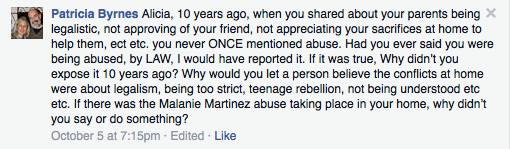
A more aggressive attempt to discredit Cynthia’s story, in the form of libel accusations, came from Patricia Byrnes, former counselor to Cynthia and the other older Jeub sisters.

She and her husband Kurt Byrnes founded Anchor of Hope Ministries in Monument, Colorado, and provide services to the homeschool community.

I received the following Facebook message from her on October 7:

p1

Also, notice her comment on Chris Jeub’s Facebook status two days before, discussing a therapy session:

p2

And her comment on Cynthia’s Melting Memory Masks post:

p3

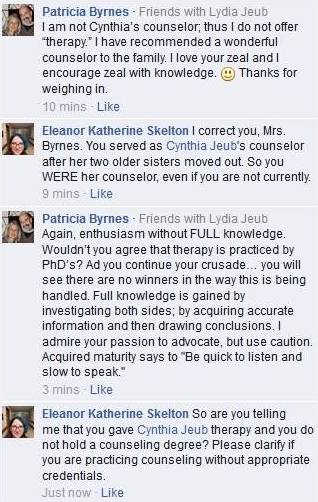
So I screen-captured Patricia’s message and posted it publicly to my Facebook account. She dialogued with us on the thread:

p4

In these online encounters, Patricia Byrnes violated her own confidentiality agreement in revealing details from prior therapy sessions. Anchor of Hope’s policy states: “Interactions between client and counselor are confidential. Unless I have permission from you, what we talk about will be private; I will not discuss it with anyone else. Our discussion will be private and confidential.”

And she actively discouraged Cynthia from sharing her story, although a counselor’s role should be to enable and empower.

Patricia Byrnes also avoided questions about her credentials, while still telling us to “use caution” and “be quick to listen and slow to speak.”

The homeschool community becomes abusive and toxic when authority figures mislabel and deny our voices and then advocate a false forgiveness above all else.

These scenarios are what perpetuated our harm for so many years.

Silence only enables abusers. Our scars have stories. And the stories matter.

Why I Cannot Support Frontline Family Ministries’ Abuse Prevention Week

Screen Shot 2014-10-13 at 11.31.50 AM

By R.L. Stollar, HA Community Coordinator

*****

In this series: Part One, Introduction | Part Two, Kalyn’s Secret | Part Three, Kalyn’s Secret (Continued) | Part Four, Not Open | Part Five, Unmask the Predators | Part Six, Recommended Resources | Part Seven, Conclusion

*****

Part One, Introduction

Since launching Homeschoolers Anonymous last year, we have called for — and organizationally been working towards — a number of actions from within homeschooling communities. One of the actions we have been most outspoken about the need for is public awareness campaigns about recognizing and addressing child abuse. This is what we asked HSLDA to do when we created our #HSLDAMustAct campaign — and it’s something we aim to do through our non-profit organization Homeschool Alumni Reaching Out.

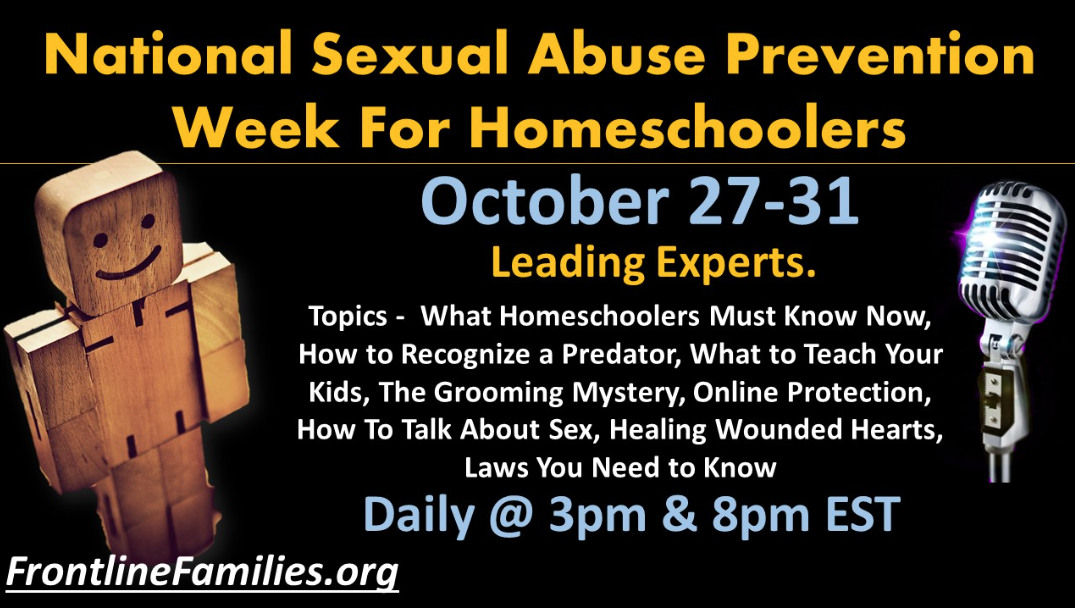
It would seem, therefore, that I would be ecstatic about the fact that Frontline Family Ministries (FFM) — a Christian organization led by homeschooling parents Lisa and Doug Cherry — recently announced their “National Sexual Abuse Prevention Week for Homeschoolers.” Not only is this a week intended to bring awareness to sexual abuse and prevention strategies, some of the speakers are people for whom I have immense respect. For example, Boz Tchividjian and Dr. Diane Langberg — both from Godly Response to Abuse in the Christian Environment (G.R.A.C.E.) — are featured speakers. Tchividjian and Langberg are doing vital and powerful work within Christian communities and organizations on behalf of abuse victims and survivors. I am grateful for their relentless efforts.

In spite of all these facts, however, I cannot personally support FFM’s prevention week. This decision has taken months to come by. I still to this day feel internally distressed by it. Feeling I need to oppose the first-ever “National Sexual Abuse Prevention Week for Homeschoolers” seems to fly in the face of everything I — and HARO — have worked towards. So that alone should tell you this decision was not made lightly.

I first became aware of FFM and the Cherry family when Lisa Cherry wrote her “Open Letter to My Fellow Homeschool Parents” several months ago. This letter — and FFM’s resources — were highly and repeatedly recommended by ThatMom’s Karen Campbell as well as promoted by HEDUA. While I had some reservations about Lisa’s open letter at the time (some of which were well-articulated by Libby Anne), and while numerous people shared the open letter with me and asked me my opinion, I chose to be silent for the time being. (My silence was unfortunately bothersome to some people.) My one comment was along the lines of, “Something doesn’t feel right, but I can’t put my finger on it.” I did appreciate Lisa speaking up and I wanted to give her and her ministry the benefit of the doubt. I also did not want to speak prematurely or ignorantly.

So for the last few months I have poured over the Cherry family’s ministry website, including all of its manifestations from the last few years via the Wayback machine. I bought and read 3 of their ministry’s books: Kalyn’s Secret by Lisa and Kalyn Cherry (2009), Not Open by Lisa and Lucas Cherry (2013), and Unmask the Predators by Lisa and (now) Kalyn Cherry Waller (2012). While this might seem excessive, I really wanted to support what FFM was doing but I could not shake the nagging feeling that something was off. So I needed to go the extra mile to be sure that, if I was to express a lack of support, that I did so accurately, fairly, and compassionately.

I have now completed the requisite research. And I have decided that my initial misgivings were indeed well-founded. In fact, I have come to the following conclusion:

To support Frontline Family Ministries is counter-productive and damaging to not only the homeschooling community in general but survivors of abuse specifically.

To explain why, I am going to take you through 4 sets of material: the 3 books I mentioned and then FFM’s website material. I’ll make each set its own post (or sometimes several) each day this week. At the end of the week I’ll also provide some concluding remarks.

HSLDA’s Michael Farris to Heidi St. John: “We Are Standing With You”

farris

By R.L. Stollar, HA Community Coordinator

Several days ago, the Home School Legal Defense Association (HSLDA) issued a statement on their involvement (or lack thereof) in allegations about a widespread cover-up of physical and sexual child abuse in the Christian homeschooling community. The child abuse is alleged to have involved the children and a relative of Paul and Gena Suarez, owners of the popular homeschool magazine The Old Schoolhouse.

HSLDA’s statement, which you can view in entirety here, was that “HSLDA does not get involved in conflicts between families or individuals” and their mission is “not to be the police force of the homeschooling movement.” In response, I pointed out that not only does The Old Schoolhouse remain an HSLDA-suggested resource promoted to HSLDA members at a special discounted rate, but HSLDA is currently sponsoring The Old Schoolhouse. In terms of finances, therefore, it’s not difficult to see why some people would believe HSLDA is taking sides.

Today, however, HSLDA founder Michael Farris made explicit at least one side he’s taking: Heidi St. John’s.

St. John has been accused of ignoring a request for help from Jenefer Igarashi — the mother of one of the alleged abuse victims — as well as playing a role in getting Igarashi blocked from a homeschool convention. St. John issued a statement regarding the allegations, which she publicly posted on her Facebook page yesterday. St. John alleges that she is “being slandered in such a way that it has become very obvious that the devil is mad” and has “been betrayed by people who claimed to be our friends.” (You can view an archived image of St. John’s Facebook post here.) Various homeschool leaders have shown or declared solidarity with St. John, including Chris Jeub (who has recently been accused of emotional and physical abuse by several of his children) and Tracy Klicka MacKillop (widow of the late Chris Klicka of HSLDA).

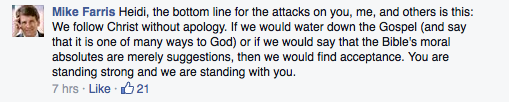
One of these leaders includes Michael Farris. Farris left the following comment on St. John’s post:

Screen Shot 2014-10-18 at 1.51.09 PM

Text is:

Heidi, the bottom line for the attacks on you, me, and others is this: We follow Christ without apology. If we would water down the Gospel (and say that it is one of many ways to God) or if we would say that the Bible’s moral absolutes are merely suggestions, then we would find acceptance. You are standing strong and we are standing with you.

Considering that all of the individuals who have brought abuse allegations against Paul and Gena Suarez of the Old Schoolhouse (and associated individuals like St. John) are outspoken Christians, it’s unclear why Farris suggests the attacks involve “watering down the Gospel.”

What is clear, however, is that HSLDA’s Michael Farris has made explicit that he’s taking St. John’s side in this situation.

Socialization and Psychological Maltreatment: Isolating Children and Teenagers

socialization

HA note: The following is reprinted with permission from Sarah Henderson’s blog Feminist in Spite of Them. It was originally published on her blog on October 3, 2014.

This post deals with parents isolating and controlling their children’s social interactions; of course my parents and many other homeschooling parents have engaged in many other forms of control, but this is one that people don’t seem to realize is a problem. Below, I give some examples of social isolation and control in my own life, and then reference work from Roberta Hibbard, Jane Barlow, and Harriet MacMillan to show how social isolation can be a serious problem for children who are subjected to it.

As I have said in previous posts, many of the people who were involved with my family over the years still don’t really get what the problem was. They will admit that my parents were a bit overprotective. Depending on the day they might even admit that my parents were controlling. But they always cycle back to trying to convince me that my parents were just doing their best, just trying to keep us safe. Then sometimes the same people concede that not everything was perfect but assure me that my father has changed.

I don’t spend much time around people who think they are in a position to re-write my history for me.

Once when I was about 15, I was something like friends with the neighbour girl. She was about 2 years older than me, and very conservative (more so than we were, in some ways – they attended a very conservative Mennonite church). Her parents and my parents ran in the same circles and spent time together talking about fundamentalism (not their word). Her dad had a home business, and one day she called and asked if I wanted to go with her to a little hamlet about 15 minutes away to pick up a part with her for her dad. My dad turned this invitation into a really big deal. He told me I had to ask her if I could call back in a few minutes so we could discuss it. I hadn’t been out of the house for days, and I really wanted to go on this 30 minute adventure with her.

I sat down with my parents, and they went over how they felt I had behaved over the past while, pointing out instances of rebellion and ways I could have tried harder in helping out around the house. In reality, I was a full time mini-mom, I cooked and cleaned and homeschooled my siblings and gardened and changed diapers. I wasn’t being taught anything anymore, although I was still being “homeschooled” I didn’t say any of that to them. I displayed appropriate contriteness and promised to mend my behaviour, and I was allowed to go. They selected several chores I would need to complete before going, and said she could pick me up in an hour. I called her back, very excited, and she reacted with confusion. It was just a short trip to grab something and she just wondered if I wanted to come. Furthermore, it was an errand she needed to run quickly for her father, and she had not planned to wait even the fifteen minutes it had taken for me to call her back, much less another hour. She went and checked with her dad, and he agreed he could wait an hour if that meant I was able to go.

This is the problem: when a teenager is “homeschooled” like that, not really doing school work anymore, and spending most of their time being the assistant mother, it actually costs the parents for the child to do something that doesn’t serve the family. And I want to be clear, although my parents were notably controlling, it wasn’t just them, there are quite a number of girls that I knew at that age that experienced a similar level of control. Every chance I had to get out of the house was treated with exaggerated importance. And then my parents have that added power to exhort even more compliant behavior.

I could give so many more detailed examples of this, like the time I “lost all privileges” (of which there were few) for being a few minutes late getting back when I went with another neighbor Mennonite girl into town to – wait for it – drop off her mother’s homemade quilts to customers. My father decided what a reasonable time was for this errand that had nothing to do with him at all, and I had the girl rush me home in a cold sweat when I realized I would be late. This errand was one that was planned in advance, and I had to earn the privilege to go with days of displaying a perfect attitude, and days of hard work. And being a few minutes late meant I lost the ability to go anywhere for months. My father allotted two hours for the trip, and we were about 20 minutes out of town. That gave us 1 hour and ten minutes to do all her errands for the quilt business.

I know a number of Mennonite teenagers from a certain church when I was 14-15 and my brother and I were invited to their youth groups. We also wanted to attend church with them on Sunday evenings. My parents treated each weekly occurrence of these activities as special privileges that they arbitrarily allowed us to earn sometimes but not others. I often wanted to go to someone’s house after church, or have someone over, but my father would not give advance permission, or even answer me if I asked him after church. He would sometimes turn to me in the van as we were leaving the parking lot and tell me that I could have someone over, or that if someone wanted me over I could go. By then, everyone would already have plans so I sometimes went back to the group and pretended to ask, and that no one was interested. I was too embarrassed to try to make plans at that point. If I refused to go over, he would be upset with me and say that I didn’t really want that privilege and shouldn’t be wasting his time asking.

My parents were able to pass this behaviour off as protective. And technically that is true, I suppose. So what is the problem?

First of all, the way they restricted my social activity, including Sunday night church, really skewed my concept of social interactions.

Social activities were something that I coveted and dreamed about, but experienced so rarely that I didn’t know how to handle myself. I tried to be funny and make people enjoy being my friend, which of course just made me seem odd. I felt envious of others my age that were allowed to have regular social interactions. Those with a more normal social life seemed more well-adjusted then me, and I felt this when I was with them, which increased my feelings of inadequacy. I felt like those with normal privileges were more important than me, because I was sometimes put in the position to try and solicit their attention and invitations. This skewed my sense of value of myself and others.

Because I had to behave so carefully in order to get a chance to take part in a social activity, there was a sense of fear attached to other people, especially other teenagers. It also increased the sense of control that my parents had over me; before I was interested in spending time with other youth, there wasn’t much that I wanted, that my parents could actually provide, that I was motivated to work for, and our family was reaching a point of chaos that meant that there wasn’t much parental approval to work towards. So I was motivated to perform my duties at home purely to get out and see other youth. My parents kept me fearful and off balance by sometimes allowing this and sometimes taking away the privilege with no explanation. My father said that if I didn’t know the privilege was being taken away, maybe I needed to lose more privileges in order to learn to respect him.

The biggest problem I have with this control over social interactions is that it stifles the learning of social lessons.

It is a form of child maltreatment to teach a child to act in an abnormal way, and therefore a form of neglect to not teach them lessons that they will need to function in adult life. I simply didn’t get enough exposure to other people as a child and teenager, and the skewed value of other people and of social interactions meant that I didn’t learn how to be a friend. I didn’t know how long a visit with a friend should last, and I didn’t know how to see that a visit was reaching an end. In fact, it was so hard for me to get out that when I was out, I often overstayed my welcome. It also impacted my ability to build planning and decision making skills.

In their report titled “Psychological Maltreatment” in “Pediatrics”, Hibbard, Barlow, and MacMillan provide a table outlining six different categories of child maltreatment (find it here). According to this table, the simple act of confining a child and restricting their community social interactions is a form of maltreatment likely to result in social maladjustment. Under the heading of exploiting/corrupting, there are two descriptions that my parents fulfilled: “Modeling, permitting, or encouraging antisocial or developmentally inappropriate behavior” by not allowing me to develop appropriate social behavior, and “restricting/undermining psychological autonomy” by not providing opportunities for me to learn to plan and make decisions in social interactions with enough information.

Isolating children and not allowing them to interact with other children and youth is a form of psychological maltreatment. Not allowing children enough opportunities to learn how to behave in social situations and not providing them with opportunities to plan and make decisions in social situations is psychological maltreatment in the exploiting/corrupting category.

“Socialization” was a joke to my parents, as it was and is for many homeschooling apologists, but the different aspects of isolation are easily categorized as psychological maltreatment.

Hibbard, et al, state that psychological maltreatment may result in a child feeling that they are unloved or only valued for what they provide to the parent, even if the parent did not intend to cause harm. They state that the effects of this maltreatment can include problems with adult attachment, including attachment to their own children, and trouble with conflict resolution in adulthood.

If a woman is to have a career and friends of her own, she will need these skills. Even if one ascribes to the school of thought that the purpose of women is to get married and stay at home with children, it should be clear that this type of isolation will not result in girls growing into well-adjusted stay at home mothers. To succeed in such a role, women will need to have social skills, planning and decision making skills, conflict resolution skills, and good attachment in order to have good relationship with their husbands and children. If a woman is to engage in some type of out of home employment before getting married, these skills will vital in that setting as well.

Socialization is not a joke; it provides several essential skills for adult life in various settings. Isolating children and youth is not a joke, it is psychological abuse, and can have serious consequences for those who experience it.

Hurts Me More Than You: A Poem by HomeschooledinGA

Screen Shot 2014-09-23 at 10.15.16 AM

*****

Trigger warning for Hurts Me More Than You series: posts in this series may include detailed descriptions of corporal punishment and physical abuse and violence towards children.

*****

A Poem by HomeschooledinGA

In slow motion I watch the belt land blow after blow.
I hear my sister’s screams as time goes slow.
I feel the terror slowly sink in,
As I realize it’s my turn again.
Try to control the urge to tremble,
The urge to cry and beg for mercy,
But this is just a preamble,
To a never ending struggle with
Love for me.
I try my hardest you see
To not let him have control of me
But
To be a person with singular thoughts
Is to be a kid with an irregular walk.
To be a kid who’s always fought
Is to be a person who’s too afraid to talk.
To be a girl with bruises down her legs,
Is to be a girl with that gait
Peg legged.
To be too scared to cry
Is the moment I realize I want to die.
In quick motion blooms the notion
That I will be nothing more than a notation
On my death certification.
As the belt lands blow after blow,
I keep my breathing going slow.
I feel the peace flood within
I realize he’ll never make me cry again.
Try to control the urge to turn around
Take his weapon seize control
Beat him until he’s the one on the ground
But now it’s time to pay the toll.
I try my hardest you see
To not let him have control of me
But
to be a person with singular thoughts
Is to have a mind full of guarded locks.
To be a kid who’s always fought
Is to be a person who’s too shell shocked.
And to be that girl with bruises down her legs
Is to be the girl who will never beg
In this never ending struggle of
Love for me.
To be too happy to feel the blows
Is the moment that I know
That I will be nothing more that a notation
On my death certification.

“He Couldn’t Breathe”: Old Schoolhouse Owners Accused of Waterboarding, Child Abuse

Screen Shot 2014-10-14 at 9.21.27 PM

This story is a modified version of a previous piece written by Hännah Ettinger (Wine & Marble) and R.L. Stollar (Homeschoolers Anonymous) on October 8, 2014.

Eric Novak grew up in Christian homeschooling circles.

He was employed from 2008-2011 by Paul and Gena Suarez, founders of The Old Schoolhouse (TOS) magazine, which boasts a readership of around 200,000. Paul and Gena speak at homeschool conventions and are seen within the homeschool community as advocates for the homeschool lifestyle. The Suarezes’ main business, TOS, is endorsed by the Great Homeschool Conventions and James Dobson as well as financially sponsored by HSLDA, the Home School Legal Defense Association.

TOS has a long history of adoration for and promotion of Michael and Debi Pearl’s No Greater Joy ministry. In 2005 TOS’s devotional editor Deborah Wuehler interviewed a member of the Pearl family for TOS, in which she wrote the Pearls were “the pioneers of homeschooling in the early 1970s” who “helped countless numbers of parents with their child training questions.” A year later the Suarezes “team[ed] up” with Michael and Debi Pearl in 2006 for a Christian homeschool conference in Germany. TOS even went so far as to give away free copies of the Pearls’ book To Train Up a Child in their “welcome packages” to new homeschoolers. After the death of homeschool kid Sean Paddock, whose mother used the Pearls’ recommended plumbing supply line for corporal punishment, Gena Suarez callously defended the Pearls, saying, “The only way you can kill a child with that is by shoving it down his throat.”

This, as well as other acts of promotion of the Pearls’ “child abuse materials,” led to a boycott of TOS in 2006 by gentle parenting bloggers

During Novak’s time as an employee of  TOS (and later, as he became a close friend to the Suarezes’ oldest son), he discovered that the Suarez and Igarashi families (the mothers of both families are sisters) are embroiled in an intense feud over physical and sexual abuse that has allegedly occurred in the family.

What Eric Novak learned about the Suarez family involved alleged physical abuse of their children as well as alleged sexual abuse within the family. According to various accounts, the Suarezes 22-year-old son, Luke, sexually abused two of his younger siblings and his young cousin, the son of Jenefer Igarashi. Luke currently has continued access to his siblings, as he lives at home with his parents. He is regularly in contact with children in the homeschool community, thanks to his family’s business. According to Novak, the Suarezes often get put up in the homes of other homeschool families when they travel. Novak relates:

“They continued going to conventions and such, and I know that for a fact that at conventions, they’ll like stay with homeschool families, and he’ll like, sleep in the younger kids’ rooms. And that’s what I’m most concerned about.”

The physical abuse allegations involve the abuse of all of the Suarez children, as well Gena’s youngest sister, “Megan.”

When Gena’s mom died, Paul and Gena took in Megan, Gena’s third sister. Megan was 13 years old and Gena was around 26. Megan claims that once she joined their family, Gena turned into a fairy-tale worthy evil surrogate mother, turning Megan into a servant and depending on her for her primary childcare support. It got to the point where even the neighbors jokingly called Megan “Cinderella,” according to a written statement by Megan (given to us by Eric Novak):

Even friends and neighbors of Gena and Paul would refer to me as “Cinderella.” It was evident to all who knew us what my role in the family was: babysitter, house cleaner and servant… and physically or mentally abused (instead of properly disciplined), when I would act childish or foolish. I was left in charge and instructed to care for and discipline the younger children in the home – even told to strike them in the face when ‘disobedient’ or ‘disrespectful’ (they’d give me ‘slapping privileges’), which still haunts me today.

Megan alleges that the Suarezes didn’t just use her for free labor. She says they physically abused her and their other children and claimed that the abuse was God’s will. It seems like they employed the Pearls’ “will-breaking” methods quite studiously. This is also from Megan’s written statement:

I witnessed and was a victim of physical and mental abuse while in the home. I watched Gena as she would strip her youngest son down (around 4 yrs old), put him in the bathtub and run cold water over his face so that he couldn’t breathe. They would have their second oldest son strip down naked and repeatedly douse him with cold water. Gena would brag that she “finally found a punishment that would get them to obey”. She would also have her children stand in the corner so long they were forced to wet their pants. I also remember seeing her boys be made to ‘make up from a fight’ by inappropriately kissing various parts of each other’s body to the point of everyone in the room feeling awkward and uncomfortable… except for Gena, who would laugh… Remembering back on these things makes me sick almost to the point of throwing up. 

…Close to the time I finally fled, it had gotten to the point that I didn’t want to live anymore. I would fantasize about dying. I couldn’t please them no matter how hard I tried. I was literally a slave in the home and punished as such when I couldn’t meet their impossible standards. What hurt the most after I fled was knowing the abuse that would continue in the lives of the children.

After Megan escaped, she found support in her other older sister, Jenefer Igarashi, and has thrived. She is now married and mentors in her community and is herself a homeschool mom. She remains a devout Christian.

For his part, Novak has decided to speak up about the allegations he learned about. He created a video explaining why he decided to speak up about the allegations against the Suarezes and his former employer The Old Schoolhouse. He also wrote an open letter to Heidi St. John, a popular homeschool speaker for the Great Homeschool Conventions, who is alleged to have participated in covering up these situations of abuse.

Other parties alleged to be involved include the National Center for Life and Liberty’s David Gibbs III, HSLDA president Michael Smith, and the Great Homeschool Conventions’ Brennan Dean.

For the full story about the allegations of the Old Schoolhouse cover-up, see HA’s original news piece here.

Hurts Me More Than You: David M. Schell’s Story

Screen Shot 2014-09-23 at 10.15.16 AM

*****

Trigger warning for Hurts Me More Than You series: posts in this series may include detailed descriptions of corporal punishment and physical abuse and violence towards children.

*****

David M. Schell’s Story

HA note: The following is reprinted with permission from David M. Schell’s blog. It was originally published on October 10, 2014.

I got spanked a lot growing up. Sometimes once a day, sometimes more often.

Spanking was a legacy handed down by grandparents on both sides. My grandfather used a belt on my dad and his eleven siblings. My paternal grandmother used whatever was handy. “We learned not to irritate her while she was ironing,” my dad would joke.

He was determined to be different until he realized “At least my dad got respect.” He took up corporal punishment. I think he went with a board instead of the rod prescribed by Proverbs because it seemed to be in the spirit of the law and more merciful.

I remember my dad asking my mom when it was appropriate to start spanking my younger siblings. He decided as soon as a child was old enough to say no, they were old enough to spank for their rebellion, which was as the sin of witchcraft. I think some of my siblings got their first spanking before they were two years old.

Disobedience of any kind was always rebranded as “rebellion” and was a spankable offense. Worse, he taught us that any time we disobeyed him, it was disobedience to God, because children obey your parents in the Lord for this is right. Disobedience to him was rebellion against God. He added that “To delay is to disobey,” so failure to obey immediately was also disobedience, and also therefore sin.

I was immensely frustrated and angry when I realized that my dad could turn anything into a sin simply by forbidding it, and he often did. He could make failure to do anything a sin, simply by telling me to do it. This realization made me feel helpless.

Like many kids, we had chores. My dad inspected each chore, every night. Those who completed their chores to his satisfaction were given a bedtime snack. Those who failed to complete them to his satisfaction were not given a snack, but instead spanked.

He often said, “I spank extra-hard for lying” to remind us that lying to get out of trouble would get us into more trouble, so we might as well tell the truth and take the spanking.

If we got into fights in which someone got hurt, the offending party was spanked.

When we got in trouble at church (maybe for talking out of turn; I don’t even remember), he would use a plastic coat hanger. Coat hangers were the worst, so we were more careful to behave at church.

At church he would be more cautious to hide the “discipline,” warning us that the government didn’t believe in the Bible and might take us away from our parents if we were caught. Not only were we the victims, but we were forced to collaborate, because nothing seemed worse at that age than being ripped away from our family.

My dad didn’t limit his sources of child-rearing advice to sacred scripture.

He also took disciplinary advice from the communists in a book he read to us called Tortured for his Faith. It was about Haralan Popov, a Bulgarian Christian who spent over a decade in prisons on charges of treason. It wasn’t completely unlike a horror story. In one episode, the communists, trying to break Popov, forced him to stand against a white wall for days on end, hitting him when he shut his eyes.

Shortly after reading this book, my dad instituted a new consequence for talking out of turn during our nightly hour-long “Bible Story:” Stand up until he was satisfied we had learned our lesson. I found myself standing during “Bible Story” every night after this.

When I got angry and blew up about something, my dad would assign me to find verses from Proverbs about anger and copy them in good handwriting. It took me years to re-learn how to be angry, and longer to learn how to have a healthy level of anger.

I don’t doubt that he had good intentions. He was then, and is now, “trying to do what is pleasing to the Lord.” The difference between then and now is that my siblings, my mom, and I have grown up and moved out, and now there’s nobody left for him to hurt in his attempts to please the Lord.

I think most adults look back fondly on their childhood and wish they could go back. I don’t. I don’t miss always dreading my dad coming home from work. I don’t miss hour-long sessions of my dad reading the Bible and making points, and having to stand up because my brain was wired directly to my mouth. I don’t miss my dad’s arbitrary rules having more power and authority then any of the rules in the Bible except “Children obey your parents.” I don’t miss having to copy verses about anger from Proverbs.

And I don’t miss being hit every night.