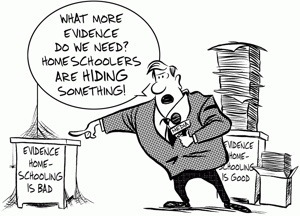
When Spiritual Abuse Comes From The Home

HA note: The following is reprinted with permission from Julie Anne Smith’s blog Spiritual Sounding Board. It was originally published on June 15, 2013 with the title, “Adult Children Shunned by Homeschool Parents: Selah’s Story.”

On my blog we recently discussed the challenges that some former homeschool students face when they leave their home.  This story is quite different from the last story, but it, too, deals with painful and strained relationships with fundamental Christian parents who were influenced by the subculture of the Homeschool Movement.

The pseudonym, Selah, was chosen for this personal account:  ”a Hebrew musical word that merges the modern concepts of pianissimo and fortissimo.”  For those not familiar with musical terms, pianissimo is a dynamic marking indicating the music should be played very softly, and fortissimo, very loudly. Selah continues,  ”In Jewish worship it is that moment of silence to mediate on what’s past, but an admonition to prepare to be dynamic.”

I love that description.   It will come more clear why she chose the name when you read her story.

I had the opportunity to talk with Selah and she shared her disturbing story with me.  Selah is 30 years old and left home 7 years ago.  Her parents had dysfunctional backgrounds, but both wanted to get things right in their lives and attempted to do a good job living their faith. Selah’s family was one of the first families to begin homeschooling in their small community. In fact, her family was ostracized for doing so.

Her family went from church to church trying to find the perfect church.  They eventually traveled to all churches within a 30-mile radius of their home, a total of 23 churches in all. They dabbled in the Shepherding Movement, had church in their home for several years, experienced some pretty destructive churches with affairs and sexual abuse occurring by church leaders. R.C. Sproul, Jr., was among her father’s influencers.

Eldest children in homeschool families often get burdened with a lot of childcare responsibilities and Selah’s family was no exception.  Selah is the oldest of six children.  While her parents worked, Selah took care of her younger siblings.  She had an outside job, but took the responsibility of making her siblings breakfast in the morning, went to work, and then came home to make sure they had their lunch, later giving them baths and putting them to bed.  Selah was the one who took most of the responsibility for caring for her two youngest siblings, yet her parents complained that she didn’t do it right.

Through her teens, Selah experienced suicidal thoughts and depression.  At the age of 19, Selah took a full-time job, but wanted to go to college.  Like many homeschool families, her parents embraced the courtship model for Selah and wanted to oversee all aspects of her romantic life.  At the age of 23, Selah’s parents interfered in the relationship with her boyfriend and eventually kicked her out of the home.

Currently, Selah is living away from her parents, but struggles because she wants to have a relationship with them and her younger siblings.  God has provided other people in her life, but the void of her family is ever-present.  This was the comment that Selah posted on the Spiritual Sounding Board Facebook page:

What do you do when the Spiritual Abuse comes from the home? I have left. I have no contact with them, which is their choice, not mine. And in a recent letter to my boyfriend, my mom (who is at the crux of this) stated that I am a threat to them and has stated to my pastor and other friends that I am mental.

I have been on my own for seven years, hold a good job and regularly attend church. They refuse to go to church stating that the corporate church is apostate. They state that until I am married, they should have the final say in my life.

I must esteem and honor them, and any perceived deviation from that has repeatedly gotten me expelled.

If they were ‘just a church’ or ‘just some people’ I could maybe just let it go. But it’s my mom and dad, and my five siblings.

There is nothing harder than telling the man you want to marry that he can never know his inlaws and that your children will never know their grandparents.

Is there a solution to this? Or will it look like this forever?

This is really heart wrenching.  What adult child deserves to be abandoned by their parents? Why is it that some fundamentalist Christians are willing to completely sever ties to their adult children when they don’t measure up to their Christian standards?

What kind of love is this?

Let me share with you what I found on Wikipedia on shunning with regard to family relationships:

A key detrimental effect of some of the practices associated with shunning relate to their effect on relationships, especially family relationships. At its extremes, the practices may destroy marriages, break up families, and separate children and their parents. The effect of shunning can be very dramatic or even devastating on the shunned, as it can damage or destroy the shunned member’s closest familial, spousal, social, emotional, and economic bonds.

Shunning contains aspects of what is known as relational aggression in psychological literature. When used by church members and member-spouse parents against excommunicant parents it contains elements of what psychologists call parental alienation. Extreme shunning may cause trauma to the shunned (and to their dependents) similar to what is studied in the psychology of torture.

What can we as a church body do to help people like Selah?

How can the church body respond to her?

I cried unto the LORD with my voice, and he heard me out of his holy hill. Selah.  

~Psalm 3:4

How Bad Homeschool Research Hurts Homeschoolers

HA note: The following is reprinted with permission from Kathryn Brightbill’s blog The Life and Opinions of Kathryn Elizabeth, Person. It was originally published on July 24, 2013.

When I was in college, I was one of the participants who answered the NHERI/HSLDA/Brian Ray survey of homeschooling graduates. I don’t remember how I got the survey, probably via email forward from my mom, but what I do remember is sending an email to my family after taking it in which I said something about how I wouldn’t believe a thing from the eventual study results. Aside from the fact that an email forwarded among homeschool groups asking people to take an internet survey is a lousy way of getting a representative sample (especially when we’re talking more than a decade ago, when we were nowhere as close to ubiquitous computing as we are now and computer access was still largely along socioeconomic lines), the survey itself was rife with methodological problems.

My memory is of a survey where I could tell exactly what answer they were looking to find, based on both the questions asked and the possible answers given for those questions. It was a survey that, even as a college student who had a positive experience and didn’t have the criticisms of the system that I do now, was so bad that I wondered why anyone would design it the way they did unless the goal was not usable data but a certain set of predetermined results.

If I got anything out of being homeschooled for twelve years by a math teacher, it’s a healthy appreciation for numbers. Numbers explain the world, or at least they can explain the world if they’re used correctly. Without good numbers, you might as well be stumbling around in the dark bumping your shins into the furniture. Bad numbers are even worse than no numbers; they’re like spreading Legos on the carpet while stumbling around in the dark with bare feet.

The HSLDA/NHERI numbers on homeschooling are like stumbling around on that Lego-strewn carpet. Aside from the aforementioned homeschool graduate survey, they also have test scores that they trot out to prove that homeschoolers do better on standardized tests than other students.

Except that the numbers don’t show that. What they actually show is the results of those homeschooled children whose parents not only use achievement tests (which isn’t all of them), who were aware of the NHERI survey (again, not all of them), and who agreed to submit their children’s scores for a study that they were already told was intended to make homeschooling look good. We have no idea how representative that group is of homeschoolers as a whole because it was self-selected and we don’t know whether that self-selected group in any way mirrors homeschoolers as a whole.

The modern homeschool movement is more than 30 years old and we still don’t have a good idea of homeschooling demographics. We know that they’re predominantly white and might be mostly religious (but even the religious makeup is hard to guess because the religious and the secular homeschoolers seldom run in the same circles). We don’t know what the socioeconomic makeup of the homeschool population is, and we don’t know the average education level of parents or a breakdown of those parents’ degrees. Without that, we can only guess at whether the socioeconomic levels of homeschoolers in NHERI’s test score data in any way represent homeschoolers as a whole.

Homeschoolers are fiercely independent even without taking into consideration that the religious ones don’t trust outside researchers because they’ve been told by HSLDA for years that outsiders want to hurt homeschooling. As for the secular unschoolers, they aren’t exactly fans of the establishment, which makes it hard to pin them down as well. Compounding the problem, the people the religious ones do trust (aka, HSLDA and NHERI) aren’t interested in giving good data, they’re interested in giving a good sales pitch for homeschooling. And so, we’re stumbling around in the dark knocking our shins into furniture and stepping on stray Legos.

There are a handful of small studies about adult former homeschoolers, but the rest is guesswork. We don’t have a good picture of the socioeconomic status of homeschooling families. We don’t really know how homeschoolers as a population do on achievement tests because we don’t have any surveys that aren’t self-selected. We don’t even have a good idea of how many people are homeschooling. It might be a million and a half, it might be twice that. We need good data and we simply don’t have it.

Are the kids I knew in high school who were all upper middle class children, mostly of parents with degrees in STEM fields, an accurate representation? What about the kids I knew when I was younger whose blue collar parents had no college and were passing their non-standard English dialect on to the kids rather than standard English grammar? Was my dad right when he always said that math was a weakness that homeschoolers needed to watch out for because the kids were being taught primarily by mothers who had been put on the consumer math track in school? Was I right when I used to tell people that the reason they thought homeschoolers were weird was because the normal ones who are in the majority didn’t advertise that they were homeschooled?

I don’t know because no one does.

And yet the Brian Ray/NHERI research keeps getting repeated in conservative and mainstream media even though it doesn’t actually tell us anything.

I understand why homeschool parents want to like the NHERI numbers; they help reassure them that they’re on the right path and not totally screwing up their kids with the homeschool choice. That’s why what NHERI’s doing with self-selected, unscientific research methods is so messed up. Parents, good parents, are relying on data that’s given a veneer of science but that may well be leading them to make educational choices that aren’t the best possible for their children. If math education, for example, really is the weakness for homeschoolers that my dad thought it was, homeschoolers need to know that so they can compensate for the weakness. If more than a fringe number of homeschool kids are having trouble fitting in with mainstream society because of the homeschool bubble, parents need to know that to correct for it.

With nothing but bad data to rely on, parents are left stumbling around in the dark hoping that they aren’t going to bash their shin on the corner of the coffee table or step on a stray Lego. That’s not serving homeschool parents well, and it’s certainly not doing anything for the kids.

Why I Am Proud of Myself: Philosophical Perspective’s Thoughts

Why I Am Proud of Myself: Philosophical Perspective’s Thoughts

HA note: The author’s name has been changed to ensure anonymity. “Philosophical Perspectives” is the author’s chosen pseudonym.

This is why I’m proud of myself.

This is not an article with arguments or nuanced thoughts, this is a declaration, for those of us who have survived.

I’m 27 years old, and I am so proud of myself.

My mom taught me to read when I was 5, and after that, I was mostly on my own.  Yes, she sought out volunteer experiences and free homeschool clubs for academic enrichment, but I had no formal education until college.

I grew up in a home where neglect was the norm.  My dad left for work in the morning, and my mom didn’t get out of bed until noon. As the oldest of three, it was my job to cook and clean, and make sure my siblings were “doing their school.”  What ability an eight year old has to make a 2 and 5 year old sit down and plow through math textbooks, I’ll never know.

My youngest sibling’s only memory of learning anything in his childhood was me, age 10, teaching him to read.

So, I’m proud of myself, because I was a voracious reader with a huge imagination and an incredible thirst for knowledge. I taught myself history, language arts, math, and science by sitting down and reading text books.

I was my own guidance counselor. As high school loomed, I knew I wanted to go to a “good college”.  So I read all of the rankings, and I figured out what I needed to learn to get where I wanted to go. I mapped out my four years of high school, asking my parents to enroll me in extension programs, community college, and co-ops. I figured out how homework worked, how to take tests, and how to build relationships with teachers so they would write me letters of recommendation.  I made sure I took math and science, because I couldn’t get those at home or through debate. I wrote tons of essays, so that I could write good applications for college. I worked 10 hours a week running a piano studio, so I could have my own spending money. I competed in the NCFCA, and won.  A lot.

I’m proud of myself, because I worked my ass off in high school, doing so much more than any of my peers. I had to figure out the system on my own, with no guidance or advice.

I’m proud of myself, because I had the drive and forethought and organization at seventeen, to call every university I wanted to apply to and ask their admissions counselors what extra information they would want, because I was homeschooled (and remember, this was 10 years ago, before homeschoolers in college was commonplace). I put together compelling and interesting application essays.  I figured out how to communicate the value of my education, by writing my own transcript and calculating my own GPA.  I had something like 10,000 volunteer hours by the time I graduated (for which I give my mom much credit). I applied for a won extremely prestigious scholarships, landing me in the top .01% of graduating high school seniors in the country, and beating out peers from prep schools who had parents, teachers, principals, and advisors prepping and nurturing them. I only had myself.

I got into a top five university, from which I earned a BA and MA in four years, and graduated with honors. I paid my way through college with no financial support from my parents. I now work for a nationally recognized organization, and am leading in their cross-cultural outreach.

I am so damn proud of myself.

Because, despite what the news articles would have you believe, I have not been successful because of my (lack of) education. I am thriving despite my homeschool experience. I have been successful because I have overcome every obstacle thrown in my path. I been smarter and worked harder than the vast majority of my non-homeschooled peers. I am tough, I am resilient, and I have already accomplished so much.

So yes, as I read and write and recall all of the bullshit I’ve lived through and coped with, I need to remember every once in awhile that I am overcoming it, and that is amazing.

I am not a homeschool success story.  I’m my own success story.

*****

Also by Philosophical Perspectives on HA:

How NCFCA Taught Me to Fight Sexism

Of Love and Office Supplies

A Tool In Someone Else’s Culture War

We Need Advocates

Why Surveys? A Critique of the Tools Used to Judge Us All

About the author: Christopher Hutton is a freelance journalist from Bloomington who writes on technology, religion, and the ideas of the day. He currently writes for Christ and Pop Culture and Paste Magazine. He is also the Social Media Manager/Intern for Rivendell Sanctuary, a new education program designed to provide a truly thorough education. Follow Christopher’s blog at http://liter8.net.

Every day I seem to see a new study or statistic being used to prove a point about something.  Beginning in the 1980’s, the religious survey organization known as the Barna Group provided data point after data point in order to reveal truths of our culture and how to interact with it.

Most recently, Generations Radio host Kevin Swanson teamed up with Brian Ray in order to record the social and spiritual conditions of the millennial generation in a survey. (You can find the survey at gen2survey.com.)

Now, to gather research is not bad.  In fact, it’s the very first thing that self-proclaimed culture-reclaimers should do.

But are they doing it effectively?

The problem with surveys is that they rely on the human language to present and record human behavior. Number concepts are different than word concepts because their definitions are clearer. If you say “five”, then people understand you are discussing a quantity. However, if you say the word “religion”, then the topic becomes fuzzier. Cultural and personal circumstances often cause words to be understood in different ways.

This causes companies to create a lot of ideologically inaccurate surveys. Consider a survey by the Barna Group which seemed to state that “only 4 percent of Christians have a biblical worldview”.  This is a big claim, and can seem scary to those fighting for a biblical worldview.

But what does Barna mean by a biblical worldview?  This isn’t obvious at first glance.  Historically, the concept of a Biblical Worldview has historically had only a few tenets which almost all people who argue for it would agree with (Inerrancy of the Bible, existence of God, Personhood of Christ, etc.), but everything else is flexible. So, was Barna adding political elements to their definition?  Were they adding debatable theological ideas into the biblical worldview?  It’s hard to know from how a group like Focus on the Family used the Barna Group’s statistics.

Kevin Swanson’s latest study is another clear example of this.  If you look at the language used in the study, it does focus on his particular form of Christianity, which emphasizes extreme forms of Conservative Christian theology, as well as an instinctual anti-government bent, an emphasis on the family relationship, and limited options for explaining one’s relationship with God, family, and the Church.

This kind of ideological shifting is dangerous, because it causes the otherwise objective data to be skewed and misbalanced.  It will misrepresent its survey-takers. It will also skew the facts.

So, be wary of surveys. Mark Twain once famously stated that “There are three kinds of lies; lies, damned lies and statistics.”  While quantitative data is helpful, it is dangerous if it is not true. So track statistics, check the facts, and never let them skew your take on a topic.

Crosspost: Methodological Problems with Kevin Swanson and Brian Ray’s Gen 2 Survey

Crosspost: Methodological Problems with Kevin Swanson and Brian Ray’s Gen 2 Survey

HA note: The following is reprinted with permission from Libby Anne’s blog Love Joy Feminism. It was written by a guest writer, Apodosis, and was originally published on Patheos on July 17, 2013. 

Libby Anne posted recently about a new survey conducted by Brian Ray of the National Home Education Research Institute, a non-profit which conducts studies of questionable scientific validity on homeschooling. As a Ph.D. social scientist myself, I looked over the new survey with a critical eye and I’m sorry to say there won’t be much useable data gleaned from it because it is rife with methodological problems.

The survey has over 100 questions and nearly every question needs revisions, so I’m just going to summarize my main critiques of the study.

1. Institutional Review Board

When you are conducting a survey that collects personal information from the participants, every IRB in the country requires that you have signed informed consent forms for each of your participants. In online surveys, these tend to include a cover page describing the purpose of the study and what is asked of the participants, as well as a signature box to show you have understood your rights.These forms often include the phrases “You may stop the survey at any time without giving a reason” and “You are not obligated to answer any question you don’t want to”. They provide contact information for the primary investigator (PI) and other associated researchers, as well as for the IRB that approved it. “If you feel your rights have been violated, call this number” etc.

In the Gen 2 survey, there is no such information. It is not clear who is being asked to participate (see #2), the goals of the study are not honestly stated (see #3), and there is no contact information for the PI or an IRB to contact if you feel your rights have been violated. I had to dig on NHERI’s website to find the email address of the PI, Dr. Brian D. Ray (it’s bray@nheri.org, btw, in case you feel your rights have been violated), and he actively discourages you from contacting him. Red flag.

A peer-reviewed publication will not publish any results from research that was not overseen by an IRB.

2. Target Population

It is not clear who is being asked to participate in the survey. In the “About” section, Ray says the participants are “those between the ages of 18-38 years old that grew up in religious homes”, but in the FAQ he says “Anyone between the ages of 18-38″ may participate. I am between the ages of 18 and 38; I was raised in a moderate mainline Protestant family, and I am now a progressive mainline Protestant. I honestly cannot tell if he wants my data or not. Though both of those statements about who should participate apply to me, the questions on the survey indicate otherwise.

3. Goals

Which brings me to my most serious methodological critique of the study, which is that the goals are not honestly stated. There are two different studies conflated here which have entirely different goals. Dr. Ray even alludes to this in the “About” section: one goal is “to come up with data points of key influences that either encouraged or deterred the participants from practicing the same faith as their parents”; the other goal is to “use the statistics from this survey to help equip parents to make more informed decisions in the education and spiritual guidance of their children.” That is, in simpler terms, the goals are (A) to find out how young people’s religious views change as they reach adulthood, and (B) to figure out how to make sure young fundamentalists/evangelicals stay in the fold.

In fact, the main goal of the study seems to be (B) with a shallow veneer of (A) superimposed on it. Now, (A) is an interesting study whose results I would look forward to reading. (B) is not a scientific study. You do not perform a scientific study with the goal of achieving a certain result. Social science is about trying to describe and explain human behavior, not about trying to change it or attach value judgments.

Here are some examples of the problems that arise when the two studies are conflated. Dr. Ray pays lip service to the idea that young people may belong to a variety of faiths, as evidenced by his questions:

Generally, what kind of religious service did you attend as a child?

What kind of church or religion do you currently associate yourself with?

Available answers include Atheist, Agnostic, Buddhist, Hindu, Jewish, Muslim, and a variety of mainline Protestant denominations in addition to the exhaustive list of evangelical/fundamentalist groups. However, on the next pages he asks questions like

My current church is serious about applying the biblical principles of eldership, shepherding, mentoring, and church discipline.

Did you ever get any “worldview” training?

How often did your Father/Mother read the Bible to you?

These questions indicate that the primary audience of this study is people raised in a fundamentalist/evangelical/Christian patriarchy home. How are Buddhists and Hindus and Atheists supposed to answer these questions? Note that there is no “Not applicable” option available. This brings me to #4.

4. Not Applicable

It is important in surveys to allow your participants the freedom to answer the questions honestly, and not be forced to pick the “closest” answer. Many of the questions follow the “Have you stopped beating your wife” pattern, where e.g. a person who has never beaten their wife has no honest way to answer the question. “Not applicable” is only an available answer for one of 100 questions in the survey. This becomes a problem with questions like the following:

How distant or close do you feel to God most of the time?

What was the status of your parents’ marriage during your raising?

My father was very involved in our family home life.

How would an atheist answer the first question without “Not applicable”? How would someone answer the second question if they were raised by two parents in a committed relationship who were not married? And in the third case, what if you didn’t have a father?

“Other” followed by a fill-in-the-blank should also occur much more frequently as an available answer in questions such as:

Have you, or your significant other, ever chosen to have an abortion? Yes/ No

Do you think that people should wait to have sex until they are married, or not necessarily? Yes/ Not necessarily

How would you describe yourself when you were a child? I was very rebellious/I struggled with rebellion, but overcame it/I was always fairly obedient and honoring as a child

In the first question, it would be more appropriate to ask “Have you ever had an unwanted pregnancy?” and then to ask how it was dealt with. As it stands, a person who has never been pregnant and a person who has carried a rapist’s child to term would give the same answer. In the second and third questions, there are clearly more than just the possible answers given. My answers would be “No, unless they want to” and “My parents were supportive of what I chose to do and who I chose to be”. Participants in the study need a way to answer these questions honestly, so even if Dr. Ray wants to limit his variables it would be more methodologically sound to provide an “Other” response with a fill-in-the-blank to such questions.

5. Leading/Biased Questions

This brings me to another point: almost every question is leading or has other problems caused, for the most part, by faulty assumptions and a lack of imagination on the part of Dr. Ray.

“What kind of church or religion do you currently associate yourself with?” Some people consider themselves to be a member of a faith without having a specific faith community. Some people consider themselves to be members of multiple faith traditions. A better question would be “How would you describe your religion or faith?” with multiple check-boxes allowed. And he should list all the religions, not just the ones he could think of off the top of his head! He forgot at least (off the top of my head) Baha’i, Sikh, Wicca, Christian Science, Animism, Deist, Shinto, Unitarian Universalist, Not applicable, Other____, and he did not provide any different denominations of Judaism or Islam. In addition, he should have grouped the religions together by type rather than alphabetically—this list makes it very hard to see if your faith is represented. And groups like “Mormons” and “Congregationalists” should be called by their actual names—LDS and UCC, respectively. This list of religions, while it pays lip service to religious diversity, is actually offensive in its exclusions and ignorance. Plus, there is no acknowledgment in this survey of mixed-faith households. What if your parents were of different faiths, or what if you and your significant other do not share a faith?

Questions such as

What is your sex/gender? Male/ Female

How was your relationship with your Mother / Father when you were 16-17 years old?

How often did your Mother / Father explain biblical principles to you?

presume an oversimplified, heteronormative view of gender and family. Sex is not the same as gender; there are quite a few other genders than just male and female; you might have parents of multiple genders or the same gender (and therefore not have a “Mother” and a “Father”); and you might have been raised by other family members, or primarily by friends, or in foster homes. If this was really a survey about changes in young people’s religious views, it would try to get an accurate picture of their lives without limiting them to these binaries. Ray should also ask about people’s sexual orientations if he’s that interested in the status of their romantic lives; however, his reference to “homosexual” “encounters” in one of the questions indicates that he probably does not believe in sexual orientation as a concept (see #6).

6. Limited Mindset

Many of these questions portray a mindset that is isolated to the evangelical/fundamentalist/Christian patriarchy/Quiverfull/Purity movements–it’s possible that Dr. Ray does not even realize there are other ideologies out there. For instance, there is this question/answer set:

What statement most aligns with how many children would you like to have? I don’t want to have children / I want no more than a few children / As many children as God will provide / I don’t know

This really should be divided into multiple questions. First, he should ask “Do you plan your pregnancies?” If no, he should ask about “how many children you hope God will give you”, but if yes, he should ask how many you plan to have. I don’t think Dr. Ray realizes that some people plan their pregnancies. Then there is the following question/answer pair:

If you have—or were to have—children, what form of education do you plan to use for them? Christian school / Christian school and homeschool / Christian school and non-Christian private school / Christian school and public school / Homeschool / Homeschool and non-Christian private school / Homeschool and public school / Private school, non-Christian / Public school / Charter school/virtual charter / Other

At least this one has “Other” as an option, though it doesn’t let you write in your response. First of all, it’s a badly designed question—he should just list the types of school and let you check as many boxes as you want. Second, the question relies on the assumption that parents would choose their children’s manner of schooling before the children even exist. What if the child is gifted or disabled? Would that change the parents’ plans? And Dr. Ray does not even realize that people who would answer like me are out there—”It depends on the child’s needs and wants, as well as other considerations such as expense, distance, quality of education, etc.”

Then there’s this question/answer pair:

Did your parents use corporal discipline (spanking) with you?No / Yes, consistently and they were generally under loving control / Yes, consistently and often they were not under loving control / Yes, inconsistently and they were generally under loving control / Yes, inconsistently, and often they were not under loving control

These answers presuppose a worldview where the value of spanking is not open to debate (spoiler: we don’t live in that world). It would be more accurate to ask “What was your parents’ position on spanking?” “How often were you spanked?” “Are your attitudes toward it positive, neutral, or negative?” “Would you spank your own children?” etc.

And then there’s the part where he puts these two questions next to each other, clearly conflating them (shades of Libby Anne’s two boxes): “Have you had a sexual encounter or physical relationship with someone to whom you are not married?” and “Were you ever sexually abused before age 18?” Note that a girl who was repeatedly raped by her Christian patriarchy father for ten years and a girl who was raped once by an acquaintance at a party as a teenager would probably have different reactions to their faith traditions, though they would give the same “Yes” response. No effort is made to make this distinction in the survey. And nowhere does the survey ask about physical abuse, since Dr. Ray probably doesn’t think it exists.

Or how about the question “If you were unsure of what was right or wrong in a particular situation, how would you decide what to do?” with the available answers: Do what would make you feel happy / Do what would help you to get ahead / Follow the advice of a parent or teacher, or other adult you respect / Do what you think God or the scripture tells you is right / Something else. These answers reveal Dr. Ray’s belief that morality does not exist outside (his brand of) Christianity.

7. Exclusionary Language

The language Dr. Ray uses is exclusionary and often confusing. For instance, he persists in using terms like church, pastor, scripture, prayer, Bible, youth group, Sunday School when these terms are uniquely Christian and do not apply to people of other faiths–he ought to say faith community, religious leader, holy book, prayer/meditation, religious education if he wanted to get accurate data. He also fails to define several terms which I don’t understand because I was not raised in a fundamentalist environment: family-integrated, homeschooling-friendly, shepherding, church discipline, worldview training. In his questions about belief in “God” and “heaven”, he ought to ask separate questions about each property he wants to assign to these words’ meanings (e.g. “Do you believe in a deity or deities?” “If yes, do you believe the deity/deities is/are omniscient? Omnipresent? Omnipotent? Does it/do they have a gender? Does it/do they affect everyday events?” etc.). If Ray wants accurate data, he should define confusing and ambiguous terms.

You should not be able to tell someone’s political and religious beliefs from survey questions designed to elicit yours. You should not be asked to give dishonest answers to survey questions because your honest answers are unavailable as options. You should not have to infer how exclusionary language in the questions would apply to your situation. You should not be asked to give out your personal information without giving your informed consent.

An IRB would not approve this study. I would not rely on any of the conclusions that come out of it.
Authoritarian Parenting Is Poison: Faith Beauchemin’s Thoughts

Authoritarian Parenting Is Poison: Faith Beauchemin’s Thoughts

The following piece was originally published by Faith Beauchemin on her blog Roses and Revolutionaries. It is reprinted with her permission. Also by Faith Beauchemin on HA: “The Importance Of Telling Your Own Story” and “Starship Captains and Dinosaurs.”

My parents wanted to be the best parents they could be.  It’s a pity that I barely even speak to them. It’s not really their fault, and I would forgive them immediately if they ever admitted their parenting had been wrong.  But they defend themselves and make excuses and believe that they were doing it all to the glory of God.  And if something is to God’s glory, of course it’s going to be good for every person involved.

But that’s not true at all. I suffer significant psychological and emotional distress to the point of being developmentally stunted in several ways because of my parents’ “god-centered” parenting techniques.

All the books and sermons available to my parents convinced them that their parenting techniques were correct.  Multiple authors and preachers basically bullied my parents and many others like them to completely dominate and break their childrens’ wills, because total obedience was God’s plan for children and if children could not obey their parents, how would they ever know how to obey God?  My parents were convinced that my eternal salvation rested on their success as parents.  If they did everything right, I would follow the Lord and be happy all my days.  Too bad I only started being truly happy after I left home and left the church.

In the interests of doing everything right, my parents chose to homeschool me and my siblings.  This, along with the very tiny church which was our only social interaction, meant my dad’s ideas and will completely dominated every aspect of my life growing up.  He passed it all off as God’s ideas and God’s will, but there was of course only one correct way to think of everything and that was my dad’s interpretation of Christianity.

As a young child, I was happy, imaginative, precocious, friendly, outgoing, intelligent, excited to explore new ideas, devouring books about dinosaurs, about history, and every story I could lay my hands on.  By the time I went to college, I was quiet, depressed, frightened of everything, unable to speak in public, socially awkward to a painful degree, and self-censoring as to what ideas I was willing to even entertain or think about. I channeled my intelligence into proving the few points that I believed were true, and disproving everything else.  My mind wasn’t just closed, it was completely locked down.  It took four long years at college to return me partially to the outgoing, intellectually curious, adventurous personality I had lost.

My parents broke my will.  They wanted to make me follow a prescribed course of life.  They had a particular bundle of beliefs that they wanted me to adopt and take with me forever.  Any flicker of self-interest, self-will, was seen as rebellion and immediately crushed.  Any personal desire contrary to their wishes was deemed sinful, and spanked out of me.  And, I cannot emphasize this enough, I never got away from my parents.  I was always in their home, always dominated by their influence, their thoughts and desires.  I had one channel of freedom, the books I checked out of the library.  But when every other part of my life was controlled so totally, I tended to closely self-censor on what books I would read or how I would interpret them.

The adversarial form of parenting, the one which sees the child’s self as automatically opposed to the parent’s authority, is unbelievably harmful to the parent/child relationship.  It took me a very long time to relate to my mom as a person rather than just an authority figure. I still can’t relate to my dad as a person, his whole being is consumed with his religion, and with trying to prioritize God in his life. He has obsessed for a long time over the fact that he’s the authority figure in the family and everyone needs to honor him, which come to think of it makes me a little worried about his mental health.  He hasn’t realized that it’s wrong to put your ideology before your children.  He doesn’t understand why we barely ever speak to him.

Even hearing about homeschooling families or reading materials written by people in the homeschooling or fundamentalist Christian movement can trigger flashbacks.  I am still working, every day, on reclaiming my self.  I wonder, sometimes, what life might have been like if I had been allowed to develop my own path instead of being forced to follow so closely my parents plan for my ideas and my life.  What might I have accomplished if I hadn’t wasted the first 19 years of my life focusing all my time and energy on matching up to this ideal Christian model held up by my parents.  Perfection was the goal and therefore it took all of my time and energy to try to reach that goal.

I have only just now, at age 23, begun with any kind of seriousness to figure out my place in the world.  Once I realized I had spent the vast majority of my life in a tiny insular principality, ruled by my father, which had very little to do with the rest of the world, I felt completely lost.  And who am I supposed to turn to to figure it out?  My parents? They’re the ones who screwed up my life this badly.

I have to rely on myself, the self that was squashed and harangued and abused almost out of existence.  I’ve survived, and I’ll go on to do something important and real and lasting in this world, but I will never know what could have happened in those years that are lost.

Confessions of a Homeschooler: Iris Rosenthal’s Story, Part Two

Confessions of a Homeschooler: Iris Rosenthal’s Story, Part Two

Iris Rosenthal blogs at The Spiritual Llama. This story is reprinted with her permission.

< Part One

"I remember how hard it was for me to adjust to being outside of the homeschooling bubble and in some ways, eight years later I am still adjusting."
“I remember how hard it was for me to adjust to being outside of the homeschooling bubble and in some ways, eight years later I am still adjusting.”

Since my original post I have come to the realization that I have just scratched the surface on everything that I have to tell about homeschooling. One of the problems I have with home education is that there is hardly any regulation. During the time I was homeschooled, K-12, I never once had to take the SAT or ACT or any other sort of evaluation test.

As long as it looked like I was studying I was pretty much left alone. The only subjects my mother was constantly involved in were; math, spelling and english. Occasionally she would check my work in the other subjects, but for the most part I was left to fend for myself and once I reached the age of 15 any involvement from her pretty much came to a stop.

I often hear the argument that not all parents homeschool are like this and that my mom was doing it wrong. While that may be the case, I don’t think that this should be lightly brushed off. We are talking about the education of children here! It is my belief that whichever route you choose, it’s very important that your children receive the best possible education. Be involved, be a part of their lives, listen, be aware of what they are learning about and learn with them!

With the lax requirements in place for homeschooling it only flings open the door for cases such as mine to happen. So much for homeschooling being better than public school (for those who don’t know me, that was sarcasm)!

I know my story is not the only one, my brother & sister and close friends have also experienced the same lack of education and preparedness to function in the real world because of being homeschooled. However, I’m not here to tell their story for them, I’m here to tell mine.

My first full time job experience happened when I was 21 at a call center. Yes I’d had jobs previously, but they were just odd jobs and the people I worked for I already knew from either homeschool group, church or 4-H. So I was always within that bubble my mother had me living in.

While working at the call center I got to know people who *gasp* went to public school, it was then that I started to realize that there were holes in my education. I didn’t know any math beyond the basic add and subtract. I could barely multiply or divide. Forget fractions and algebra.

I also realized that I was spelling a lot more words wrong than what I originally thought I was. It’s pretty bad (not to mention embarrassing) when your manager brings back your vacation time off request (written in clear handwriting) and asks you to tell what words you meant to put down. I found myself sticking out a lot in all the wrong ways, and my judgmental attitude towards people who were different than me didn’t help with that at all!

I had never been around so many people from so many different backgrounds before, it was quite an eye opener and culture shock for me! I still remember the first time I heard someone swear. If I didn’t agree with something someone said or did I made sure to let them know that it offended me. If I knew someone was a Christian and I heard them say something that I didn’t believe a Christian should say I made sure to let them know how wrong they were.

Looking back, I was quite obnoxious and judgmental towards my coworkers at that job. It is no small wonder that barely any of them talk to me anymore and I can’t say that I blame them!

I am so thankful that I have learned since then and now at my current job I am known among my coworkers for being helpful and a team player. I no longer allow my homeschooling experience to define me, in fact I hardly ever bring it up. I don’t feel as though I should have to defend my education (or lack thereof) to anyone.

It is my desire that people know and define me by who I really am, and not as some “failed product of home education.”

I hope that by sharing my experiences I can somehow prevent them from happening to someone else. I remember how hard it was for me to adjust to being outside of the homeschooling bubble and in some ways, eight years later I am still adjusting.

If anyone is reading this and is going through that rough transition period from the bubble to the real world, just know that you aren’t the only one who has traveled that path. It may be rough now, but in the end you will be stronger and wiser for it!

Visualizing “The Myth of the Unsocialized Homeschooler”

HA note: The following is reprinted with permission from Heather Doney’s blog Becoming Worldly. It was originally published on July 7, 2013.

I googled “homeschool” to see what pictures came up. Many of them had to do with socialization and the messages that homeschool parents get and give about it. So I figured I’d talk about homeschooling and the issue of socialization today and use some of the cartoons I found in the process. Some of them are a little disconcerting in the way they point out issues I see, just maybe not quite in the ways the cartoonists intended.

What is This “Socialization Problem” You Speak Of?

So first a bit about what socialization is and how it relates to homeschooling. This diagram explains socialization pretty simply and it comes from a site that talks abut stopping cycles of discrimination that are often passed on intergenerationally.

soc1

I think the site the diagram comes from – Parenting for Social Change – makes an excellent point – that this is generally how socialization is done but socialization can sometimes be bad. You can absolutely be taught harmful things as well as positive things in the course of your socialization and most people are taught a mix. What homeschooling parents often become inclined to do though is try to eliminate or greatly reduce these “bad” things by winnowing their child’s socialization opportunities down to only parentally vetted and approved sources and quite often those approved sources are fellow homeschoolers, religious leaders, highly edited texts and media, other “likeminded families,” and sometimes, when the parent is particularly controlling or inept at socialization themselves, nobody at all except for the immediate family.

Yes, this last one is a real big problem because terrible things can happen when families get isolated like that and it is a big risk factor for all kinds of abuse, neglect, and poor mental and physical health. Thing is, this social isolation problem happens in homeschooling much more frequently than it should. In fact, even in Brian Ray’s wacky (and so methodologically unsound that I am stopping myself from going on a rant about how many problems it has) “Strengths of Their Own” study included something I found interesting about it. See if you can catch it.

soc2

That’s right. The third bar from the bottom. The yellow one. If 87% of the children in Brian Ray’s highly self-selective study play with “people outside the family” (and I will leave you to ponder right along with me as to why this wording is not “other children outside the family”) then that means that 13% of children in Brian Ray’s study do not play with others outside of their own family, which I would most definitely define as a socialization problem. If Brian Ray, excellent fudger, misconstruer, self-quoter, and ideological spit-shiner of homeschool data extraordinaire, has almost 15% of the kids in his rather cherry-picked study having this issue, how common must it actually be in real life and how do people in homeschooling react to this issue? Well, let’s see…

Socialization Sarcasm

This cartoon makes fun of the concept that socialization problems exist in homeschooling. To me it implies that socialization happens so naturally that it simply isn’t something a homeschool Mom could forget. Why? Well, I’m honestly not exactly sure. Socialization is a component that definitely can be ignored or accidentally left out and it has openly (and wrongly) been discounted as being unimportant by many prominent homeschool leaders. Because it has been ignored and dismissed as a necessary part of many homeschool curriculums is the main reason why homeschoolers have gotten the reputation for being unsocialized in the first place.

soc3

Most homeschool kids don’t like being stereotyped as unsocialized or feeling like they are unsocialized (I mean really, who would?). So there’s also some memes and jokes that have been spread by teenage homeschoolers implying how inherently dumb or inappropriate they think it is when people make socialization an issue. Most of these involve poking fun at the “myth” that socialization is a problem in homeschooling. There is this YouTube video by a homeschooled girl who is trying to do this by distinguishing “the homeschooled” from “the homeschoolers” and while I find it funny, I’m quite sure that her pie chart is wrong and she perpetuates elitist stereotypes she has likely heard throughout her homeschooling experience.

This blog had a post by a homeschool graduate complaining about people asking what’s become known as the “socialization question” and in her post she uses a picture I’ve seen fairly often. There’s even t-shirts with this printed on them that you can buy.

soc4

Socialization is Fishy

So what do homeschooling parents think about the socialization issue when theydo actually address it? Let’s start out with this cartoon, as it’s used a lot. It claims that a lack of socialization in homeschooling isn’t just a rare problem, but an outright myth. It implies that homeschool kids are not only actually in diverse environments as part of a natural ecosystem but are thrilled about it. It also implies that children who are socialized in public school are like half-dead sardines in a can rather than the school of likeminded fish they are expected to be.

soc5

This cartoon is a direct dismissal of there being any merit to the “socialization problem” and it is compounded with a public school counter-stereotype. This is unsurprising to me as the argument that homeschool socialization problems are an outright myth is quite often included with something disparaging about public school or insulting to teachers (and this cartoon is no exception). Notwithstanding how insulting it is to imply that most people who go through public school are like dead fish, is this depiction of homeschool versus public school in any way accurate? Well, I imagine for the occasional situation it is, but in general, certainly not.

Oddly this cartoon was actually almost the exact opposite of my experience. In the CHEF homeschoolers group I was in it was all white Christian families and our parents had to sign a statement of faith to join. It was absolutely a school of fish all swimming the same way and because we got together infrequently, I generally felt like that fish in the fishbowl. Also, when I went to public school in 9th grade I was certainly no canned sardine, even if I wasn’t exactly the manic fish thrilled at the ecosystem in the upper righthand corner. The teachers often tried to corral us into all doing things the same way but we didn’t make it altogether easy for them and generally I expect it was a bit like herding cats. We were all individuals, as were the teachers. I had favorite teachers and subjects and ones I didn’t like and I made friends of different races and beliefs and political persuasions, many of whom who are still my friends and acquaintances to this day.

The Dark Knowledge of Teen Degenerates

Here’s another cartoon about homeschool kid socialization from a slightly different angle, and this one does address the idea that kids don’t always do what you want them to do and by invoking the dreaded “peer pressure,” implies that its all bad. Which one is it – are they lobotomized sardines in a can or are they violent and rebellious ingrates? Make up your mind! Also, how realistic is this, do homeschool moms actually think public school kids are like this? Where are the public school kids who are not “at-risk” of being part of the school to prison pipeline? Why aren’t there any of those at the bus stop?

soc6

Also, in this little dystopian cartoon, gang members with knives read books on values (morally relativistic ones, no doubt), evolution, meditation, and “new age” religion (if that isn’t a culture wars, fearmongering buzzword, I don’t know what is) and pregnant girls read about sex ed and still don’t know what made them pregnant. This cartoon is crazy stuff. People don’t drink beer and shoot up heroin (yeah, there’s a needle on the ground in the cartoon) while waiting for the school bus (although some do smoke cigarettes). People who read a lot don’t typically join gangs. People who know about comprehensive sex ed aren’t any more likely to have sex than kids who don’t and they are much less likely to accidentally get knocked up. Honestly, if this is what anyone actually thinks the world is like then they are not fit to educate other human beings and they probably need some mental help themselves.

Sweet Homeschool Girl in the Ghetto

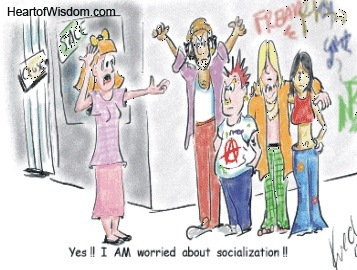
This cartoon is similar to the previous one in that it also indicates that public school socialization is all bad, but it depicts the expected reaction of the homeschool girl in the public school and implies that if your daughter goes to public high school (obviously radiating her feminine purity with a big hair bow and below-the-knee church skirt) that she will soon be shocked and horrified to encounter people dressed immodestly, young people openly dating, tattoos and piercings everywhere, vandalism and crime, blatant teenage rebellion, and big scary black boys that look more like grown men. So obviously the answer is to just have her at home not knowing that people who are different from her exist, and make most of the people her age out to be disgusting, immoral, and scary, right?

soc7

I followed this cartoon to its site, a blog called Heart of Wisdom, trying to get a higher resolution picture. The blog talked about how homeschool kids should only selectively socialize with other Christians and claims this is biblical. Yep, this is just the type of homeschooling “socialization” I am familiar with. It’s a form of social isolation and indoctrination called “sheltering.” This stuff is all about parental fear and desire for control and helicopter parenting to this extreme is very unhealthy for your child. It will mean that in adulthood that they won’t know how to function at an optimal level. You cannot shield your kid from all “bad influences” and indeed there is nothing in the bible that says your kids cannot play with the kids of people who have different beliefs. That is quite a stretch and it is insular, cultish thinking.

My Homeschool Kid is Smarter than Your Honors Student

That same Heart of Wisdom blog had this other cartoon about homeschooling, so I followed that link and it was to a page dedicated specifically to homeschool cartoons. When I see stuff like this cartoon I have to once again ask – is this supposed to be funny? Do these people actually think this is accurate? My main question, though, is why the elitism and negativity? Even if your kid is getting a much better education in homeschooling, why talk trash about children who through no fault of their own don’t have as good of an education? Why make it into a competition, act like homeschool kids in general are “better” than other kids? It shows me some immature and defensive parenting, really. If you revel in it when someone else isn’t doing as good as you it shows you are 1) being a jerk and 2) secretly worried that you’re no good at what you’re doing. Nobody should ever be excited about other kids having a sub-par education, thinking it makes them and their kids look better. That’s just gross.

soc8

As it is, I find that there is a grain of truth in this cartoon but perhaps not quite in the way the cartoonist intended. I’ve known a lot of homeschool kids who do use big words in conversations and they soon realize that it comes across as awkward when they socialize with other non-homeschool kids. Admission: I was that kid myself. I read a lot of classic literature and became familiar with words that simply aren’t used in everyday speech anymore. Trying to use them in peer-to-peer conversations didn’t reflect on me being smarter. It reflected on me not having a modern day frame of reference as to what is appropriate. It reflected on me being socially backwards. Lots of public school kids who are bookworms like I was know many big words. They also know the right words to use for their audience. Context is everything. An unsocialized homeschool kid doesn’t have that context and very well might find that using 18th century literary terms in a conversation about basketball will indeed get people looking at them sideways. If homeschool parents want to be proud of that, think it makes their kid (and by extension them) “better,” it shows they truly don’t understand the issue at hand.

Parental Fear & Social Anxiety

That’s where I think we hit the crux of this whole thing. I think the main issue is parental angst and fearfulness. Too many homeschooling parents socially struggled in school themselves and/or got into drugs or unhealthy sexual relationships. Instead of taking a broader view today, they expect that they need to hide their kid away from these settings or the exact same thing will happen to their kid even though their kid is in a different school district in a different generation and *gasp* a different person. These parents become scared of or hurt by the society we live in, withdraw, and then use homeschooling as an excuse to be separatist, snooty, and helicopter over their kids. These are not positive reasons for homeschooling and these are the exact kind of fearful and overbearing attitudes that lead to socialization problems for homeschool kids.

soc9

Because people with strong views often find themselves in positions of leadership, those with exclusionary, separatist, and elitist attitudes often end up running things and then set this negative and divisive tone for the homeschooling group and the community it serves. It’s so pervasive that even some “second choicers” who start homeschooling simply because the other educational options in the area aren’t up to meeting their child’s particular needs (which is an excellent reason to homeschool, in my opinion), can get sucked into this culture, an “us versus them” mindset where homeschooling represents everything that is pure and good and healthy for children and public school and the people and structures that support it represents everything bad. This creates a parallel society of sorts and then you see people start calling public schools “government schools” in a pejorative sense. All this “us versus them” talk fans the fear that homeschooling parents are vulnerable (although still superior) outsiders who are or soon will be discriminated against and this in turn leads to easy exploitation of these scared people.

Why does widespread homeschool participation in things like the fundamentalist-led HSLDA, which capitalizes on these fears and requires dues money (that then goes into their cultish culture wars arsenal) for unnecessary “legal protection” exist? Because many these people are too freaked out to do anything more than cling onto a protector, ignoring all evidence that their “protector” just wants to use them – financially and for furthering a disturbingly anti-democratic agenda. This fear grows and leads to the kind of mindset that spawns ridiculous cartoons like the one below.

soc10

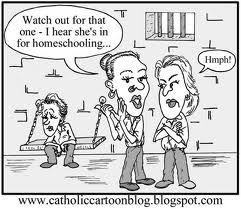
Put in prison for homeschooling – really? Of course in this cartoon there’s that same (expected) depiction of scary people with piercings, this time instead of a shocked daughter (projecting much?) it’s got a dejected homeschool Mom being shunned by hardened criminals who sarcastically note that her “crime” was homeschooling.

Homeschooling parents who follow these “leaders” (often starting because their local homeschool support group requires or recommends HSLDA membership) hear these divisive messages and become scared to death of being framed, exposed, persecuted, worrying that they will land in jail just for homeschooling. It may be a wacky and unrealistic fear given what’s actually going on, but if people hear it often enough they often come to believe it, along with the bogus stats and stories claiming that homeschooling is as close to perfect an educational option one can get in such a messed up society, and the myth that there is no evidence to the contrary because homeschooling is just so awesome.

soc11

Because homeschoolers test scores aren’t made public and often not even expected, registration isn’t even required in many states, and most people don’t pay much attention to homeschooling unless their kids are being homeschooled. Homeschool movement leaders have been able to get away with exhibiting the cream of the homeschooling crop as representative of all homeschoolers. This has painted an inaccurate picture and hurt the vulnerable kids by leaving them ignored as they fall through the cracks.

Saying “our homeschool kids are socialized but socialization doesn’t matter and in fact it generally sucks if it isn’t coming directly from parents” is a very unhealthy attitude to go into educating with. Responsible homeschooling parents really need to do a bit of soul-searching as to why they tolerate these inaccurate depictions of what socialization is and isn’t, why there is this the across-the-board maligning of all public schools within many homeschool communities, and why so many participate in this ugly (and frankly in my opinion undeserved) elitism, and contribute to such extreme (and inaccurate) stereotyping and putting down of children who have had to attend lower quality inner-city schools, all in order to inflate the merits of homeschooling.

Two big question:

(1) Does this kind of attitude help do anything beyond artificially boosting homeschool egos?

(2) Is there any need for this behavior if homeschooling is really so awesome?

Also, if there is no good data on the problems of homeschooling then instead of celebrating the cobwebs we need to be collecting more data. Every single education method in this world has problems and the places where the problems are denied is where child maltreatment can and does flourish.

The Truth Between “Stereotype” and “Myth”

I get the message that not all homeschoolers are cloistered and don’t know how to talk to people their own age, but the fact is that too many are and we need to recognize that it is a real problem affecting a sizable percentage of homeschool kids. Also, homeschoolers are simply not the most brilliant people in the world or inherently “smarter” than other kids, and as such they shouldn’t need to feel pressured to achieve perfection, perform as child prodigies, or that there’s a black mark on them if they mix up “asocial” and “anti-social” in a conversation.

soc12

This “myth of the unsocialized homeschooler” is an issue in homeschooling but the prevalent idea that the socialization problem is a myth is the real problem, not the legitimate questions and concerns about socialization that homeschool parents keep being asked. Those questions actually need to keep happening because social isolation and ostracism in any setting (including homeschooling) often follows a person into adulthood, and can leave people struggling with social anxiety, a small social network, low levels of social capital, mental health issues, and an unnecessary amount of sad and lonely memories.

The least we can do is stop making fun of people, stop being in denial, stop pointing fingers elsewhere, and acknowledge that it is real, it happens too often and it should be assessed and addressed as the serious problem that it is.

Young Earth, Young People, and Abandoned Faith

HA note: The following is reprinted with permission from Julie Anne Smith’s blog Spiritual Sounding Board. It was originally published on July 10, 2013 with the title, “Ken Ham, Young Earth Creationism, Young People Abandoning Their Faith: My Daughter’s Story.”

This story pains me.  It’s a personal one.

Parenting is very challenging. Homeschooling children has also been a challenge. When we began homeschooling our children, we chose to do so for a number of reasons.  We wanted to have better oversight over the curricula our children were taught because we wanted to give them a solid Christian foundation.

As typical Christian parents, we did not want them to have “worldly” influences. We got support at homeschool conventions, conferences. I spent time on the internet in e-mail groups, message boards, etc, and got support and information there. In the Christian homeschooling arena, Creationism was taught in the science curricula. Evolution was labeled as evil and we needed to protect our children from those false ideas.

Ken Ham spoke on the homeschooling circuit and we went to his seminars.  Others echoed his ideas and if you were a Christian homeschooler, you very likely taught your children Young Earth Creationism (YEC), as this was the primary science taught in the available Christian homeschooling texts – at least that I saw in my circles.

Science has never been my “thang.”  I don’t need to know the process of how we got here. The Bible told me how we got here.  I believed what it said and that settled the issue for me.   I didn’t need to discuss it further.

My husband, however, is an engineer.  He is very interested in knowing the process of things. I can’t imagine him not wanting to know how things work.  Engineers live and breathe processes.

Teaching creationism was a perfect fit for my husband.  He took the kids to creationism seminars over the years, bought quite a few creationist books about dinosaurs and the origins of the earth, and the kids soaked it up.  I found our eldest daughter devouring the books just for fun. She was sold. It was a foundational issue for faith, just like Ken Ham always said.

Here is a quotation by Ken Ham to students at Bob Jones University:

 “The majority of Christian colleges in this nation won’t take a stand on a literal Genesis, as you do here at Bob Jones University,” he said. And that compromise, according to Mr. Ham, is the very reason that some Christian young people are abandoning their faith. He said, “We have increasing numbers of people who have been led to doubt the history in the Bible, and so they don’t believe the Gospel based on that history.”

A couple of months ago, my older kids and I were at a restaurant and Hannah, 26 yrs old, shared with me a pivotal experience.  I hadn’t heard this story before.  Remember, science bores me.  When she talked this time about science, I was not bored.  I listened with great sadness and also understanding.  It made sense to me.  I asked Hannah if she would share her story here and she agreed.

I do not agree with Ken Ham anymore.  I hope my daughter’s story will open your eyes to another side of the story which Mr. Ham would not dare to admit.  His intentions may be good in holding so strongly to the YEC teachings, but we cannot dismiss that his ministry and possibly livelihood depend upon it.

I don’t care if people believe in Young Earth Creation or not.  To me, it is not a salvation issue or gospel issue.  But the YEC-only way of believing did not work for my daughter, it backfired. I think it’s important to take a closer look at this issue.  Hannah’s story follows.

*****

My Experience with Young Earth Creationism

by Hannah Smith

While on a break between classes at the local community college, a previous homeschooled friend I knew from church and I were sitting at a table chatting in the main lobby. I honestly have no idea how the subject came up, but we were talking about YEC and evidences for it. I was trying to explain Carbon-14 dating (it’s not the easiest thing to break down off-the-cuff, but I was pretty sure I knew the very basic fundamentals of it in order to have it make sense to her.

As I was trying to explain it, one of my classmates overheard our conversation and came over and joined the conversation. He very efficiently sliced-and-diced my YEC “points” and “evidence”, but since I felt I hadn’t brushed up on the subject in a year or two, I’d investigate it more in the light of the contradictions he’d brought to surface. I wanted to see if I could do more in-depth research on the topic and figure out if and how much of what he was saying could be verified and where the disconnect between our two viewpoints occurred.

So after I went home, I dug up our trusty creationism-is-true-sort-of books commonly found in good Bible-Believing Homeschooling YEC family’s libraries. After reading the articles and chapters, I did what my father always said to do and “checked the source” – probably more to see if there were books completely dedicated to the topic of Carbon-14 dating that I could look up in the local library.

Flipping to the end of the book with the citations I was shocked that pretty much all of the sources for their proof was from other Christian YEC-believing books. So I quickly determined that they were just quoting what other people who believed similarly where saying, rather than going to scientific journals and scholarly articles written by secular authors and scientists. For example, take a look at the following excerpt taken from an article at Ken Ham’s Answers in Genesis site (Doesn’t Carbon Dating Disprove the Bible?):

In 1997 an eight-year research project was started to investigate the age of the earth. The group was called the RATE group (Radioisotopes and the Age of The Earth). The team of scientists included:

    • Larry Vardiman, PhD Atmospheric Science
    • Russell Humphreys, PhD Physics
    • Eugene Chaffin, PhD Physics
    • John Baumgardner, PhD Geophysics
    • Donald DeYoung, PhD Physics
    • Steven Austin, PhD Geology
    • Andrew Snelling, PhD Geology
    • Steven Boyd, PhD Hebraic and Cognate Studies

That looks very impressive – every single person, a PhD. But they probably all have a vested interest in this – 3 of those 8 people have written books advocating YEC and you can find that information one simple mouse-click away from the article.

Look at the sources quoted at the end of the article – they go back to other Christian Scientists with published books on the subject (the scientists above) – unless they are quoting the opposing viewpoints for comparison.

I found this info out in about 1 minute while I was writing the first paragraph above, about the same amount of time it took me five and half years ago, when this originally occurred. This kind of circular reasoning raised (and honestly still raises) major red-flags for me from a logical and scientific standpoint. If they can’t find outside sources, how does them quoting from their friends make it true?

This was the starting point of me doubting my faith. I never recovered from it.